Market Overview:
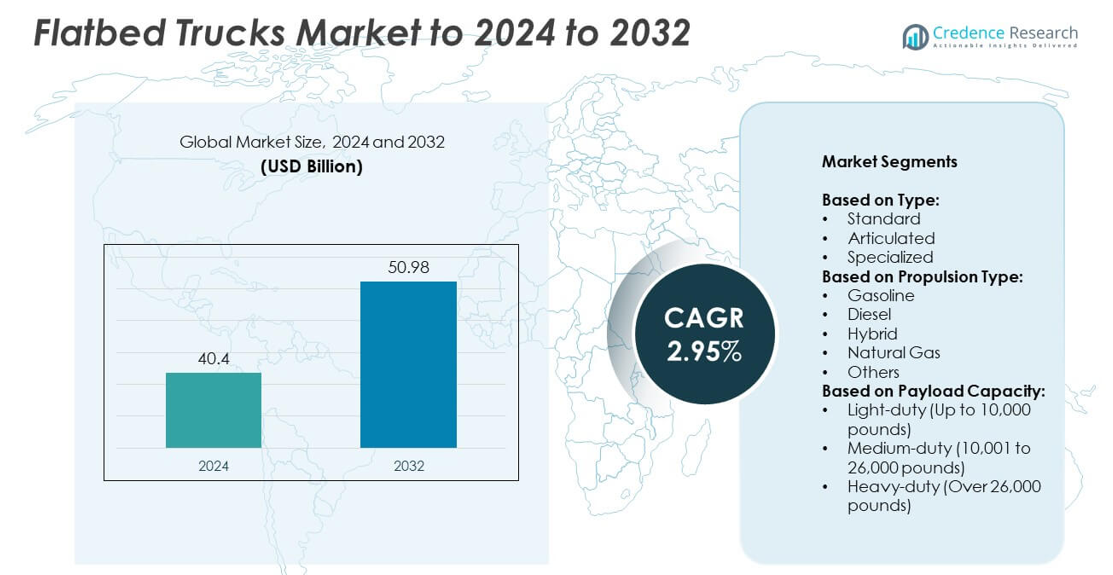
The Flatbed Trucks Market size was valued at USD 40.4 Billion in 2024 and is anticipated to reach USD 50.98 Billion by 2032, at a CAGR of 2.95% during the forecast period.
| REPORT ATTRIBUTE | DETAILS |
|---|---|
| Historical Period | 2020-2023 |
| Base Year | 2024 |
| Forecast Period | 2025-2032 |
| Flatbed Trucks Market Size 2024 | USD 40.4 Billion |
| Flatbed Trucks Market, CAGR | 2.95% |
| Flatbed Trucks Market Size 2032 | UUSD 50.98 Billion |
The flatbed trucks market is led by key players including Volvo Group, Tata Motors, Ford Motor Company, Navistar International Corporation, Dongfeng Motor Corporation, Isuzu Motors, Toyota Motor Corporation, International Trucks, Paccar Inc., Daimler AG (Mercedes-Benz), and Hino Motors, Ltd. These companies drive competition through innovation, regional expansion, and advanced product offerings tailored to diverse industrial needs. North America emerged as the leading region in 2024, holding 35% of the global share, supported by large-scale infrastructure projects and a mature logistics sector. Europe followed with 28%, while Asia Pacific accounted for 25%, reflecting strong growth driven by industrialization and urbanization.
Market Insights
- The flatbed trucks market was valued at USD 40.4 billion in 2024 and is projected to reach USD 50.98 billion by 2032, growing at a CAGR of 2.95%.
- Growth is driven by rising infrastructure projects, logistics expansion, and demand for heavy-duty trucks in construction and mining sectors.
- Trends include adoption of alternative fuel vehicles, integration of telematics and fleet management systems, and focus on lightweight materials for efficiency.
- The market is highly competitive, with global players investing in technology upgrades, regional customization, and sustainable product portfolios to strengthen positions.
- North America leads with 35% share due to advanced logistics and infrastructure, Europe follows with 28%, and Asia Pacific accounts for 25% driven by industrialization; by type, standard flatbed trucks dominate with 45% share, while diesel propulsion holds over 55% share.
Market Segmentation Analysis:
By Type
The standard flatbed trucks segment held the dominant share of the flatbed trucks market in 2024, accounting for nearly 45% of total sales. Their widespread adoption comes from versatile applications across logistics, construction, and agriculture sectors. Standard models are cost-effective, easy to maintain, and compatible with diverse cargo types, which boosts preference among fleet operators. In contrast, articulated and specialized flatbeds serve niche demands in oversized load transport and specialized industries, but their adoption remains limited compared to the broad utility and affordability of standard flatbed trucks.
- For instance, PACCAR delivered a record production of 204,200 trucks globally in 2023.
By Propulsion Type
Diesel-powered flatbed trucks accounted for more than 55% of the market share in 2024, making them the leading propulsion type. Diesel engines offer higher torque, durability, and better fuel efficiency in long-haul and heavy-duty operations, which makes them the preferred choice among logistics and construction industries. While hybrid and natural gas options are growing, their adoption is slower due to infrastructure and cost barriers. Gasoline-powered flatbeds remain relevant in light-duty applications but lack the performance required for larger payloads, further cementing diesel’s dominance.
- For instance, Daimler Truck AG confirmed that in 2023 it delivered 526,053 vehicles worldwide. The company's heavy-duty truck portfolio includes brands like Mercedes-Benz, which sold 158,511 units that year, and Freightliner, which helped drive a 4% increase in the Trucks North America segment to 195,014 units.
By Payload Capacity
Heavy-duty flatbed trucks led the market with over 50% share in 2024, driven by demand in construction, mining, and industrial goods transport. These trucks support payloads over 26,000 pounds, making them critical for industries moving heavy equipment and raw materials. Their strong presence is also linked to large infrastructure projects and rising global trade volumes. Medium-duty trucks serve regional logistics and urban freight needs, while light-duty flatbeds remain popular in agriculture and small-scale delivery, but their overall contribution is lower compared to the heavy-duty segment’s wide industrial adoption.
Key Growth Drivers
Infrastructure Expansion and Construction Projects
The surge in global infrastructure development is a primary growth driver for the flatbed trucks market. Large-scale construction projects, including highways, bridges, and urban development, demand reliable transportation of heavy equipment and raw materials. Heavy-duty flatbed trucks are widely used for carrying oversized loads that conventional trucks cannot handle. Governments worldwide are increasing investments in public infrastructure and renewable energy projects, which directly fuel demand. This consistent reliance on flatbed trucks in construction ensures stable growth momentum for the segment throughout the forecast period.
- For instance, Ashok Leyland sold 198,113 commercial vehicles in calendar year 2023. This included sales within India and internationally and represented a record annual volume for the company, surpassing its previous record from 2018.
Growth in Logistics and Freight Movement
The rising need for efficient freight and logistics solutions drives flatbed truck adoption. E-commerce growth and global trade have increased the demand for flexible transportation of goods, including machinery, building materials, and agricultural equipment. Flatbed trucks provide unmatched versatility for oversized and irregular cargo, strengthening their role in logistics chains. Fleet operators are focusing on expanding their heavy-duty truck fleets to meet rising freight demand. This expanding logistics ecosystem, particularly across cross-border and regional transport, continues to accelerate flatbed truck market growth significantly.
- For instance, in 2023, Scania delivered 96,727 vehicles globally, including trucks and buses. The company achieved growth in both sales and profits during that year. In the European market, Scania's market share for heavy trucks was 15.3% at the end of the third quarter of 2023.
Advancements in Truck Design and Technology
Innovations in flatbed truck design and technology serve as a major growth driver. Manufacturers are focusing on improving fuel efficiency, load-handling capacity, and driver comfort through advanced engineering. Integration of telematics, GPS tracking, and automated safety systems enhances operational efficiency for fleet operators. Additionally, lightweight materials are being adopted to improve payload efficiency and reduce fuel consumption. These technological upgrades not only attract fleet owners seeking cost savings but also meet stringent emission regulations, making innovation a key factor supporting the flatbed truck market’s future expansion.
Key Trends & Opportunities
Rising Demand for Alternative Fuel Trucks
A major trend in the market is the shift toward alternative fuel-powered flatbed trucks. Growing environmental concerns and stricter emission norms are encouraging adoption of hybrid, electric, and natural gas-powered trucks. Fleet operators see alternative propulsion as an opportunity to reduce fuel costs and comply with sustainability targets. Governments are offering subsidies and incentives for cleaner vehicles, which accelerates adoption. Though diesel continues to dominate, the rising demand for eco-friendly options presents a significant opportunity for manufacturers to diversify their offerings and strengthen competitiveness.
- For instance, in 2023, Hyundai Motor Group, which includes the Hyundai and Kia brands, reported 516,000 battery-electric vehicle (BEV) sales globally. Within this total, Hyundai brand BEV sales were estimated to be over 280,000.
Digital Integration and Fleet Management Solutions
Digitalization is shaping the flatbed truck market, creating opportunities for improved efficiency. Advanced telematics, AI-based fleet management systems, and IoT integration allow real-time tracking, predictive maintenance, and route optimization. These technologies reduce downtime, improve safety, and enhance cost-effectiveness for operators managing large fleets. Companies adopting digital solutions are gaining a competitive advantage by offering faster and more reliable services. The growing adoption of connected technologies presents strong opportunities for OEMs and logistics providers to improve performance, customer satisfaction, and overall market value.
- For instance, in November 2023, Iveco announced that around 100,000 of its vehicles were connected to its telematics platform.
Key Challenges
High Operating and Maintenance Costs
One of the major challenges in the flatbed trucks market is high operating and maintenance costs. Fuel expenses, repair costs, and regular maintenance add significant financial pressure for fleet operators. Heavy-duty trucks in particular consume large amounts of fuel and require frequent servicing. Rising prices of spare parts and tires further increase expenses. For smaller fleet owners and logistics startups, these costs can limit adoption. The challenge of balancing affordability with operational efficiency remains a critical hurdle for the long-term growth of the market.
Regulatory Pressure on Emissions Compliance
Stringent emission regulations across key markets pose another challenge for flatbed truck manufacturers and operators. Governments are enforcing stricter standards to curb greenhouse gas emissions, which increases compliance costs. Manufacturers must invest in new technologies, including hybrid engines and cleaner fuel systems, to meet regulations. These compliance requirements raise vehicle prices and restrict adoption, especially in cost-sensitive regions. Fleet operators face additional burdens with mandatory retrofitting and inspections. Navigating these regulatory pressures while maintaining profitability continues to be a major challenge in the flatbed trucks market.
Regional Analysis
North America
North America held the largest share of the flatbed trucks market in 2024, accounting for 35%. Strong demand is driven by infrastructure projects, construction activity, and robust logistics networks. The United States leads the region with heavy investment in highways and energy-related transport, requiring reliable heavy-duty trucks. Canada also contributes with demand in mining and forestry operations. Fleet operators in this region continue to adopt advanced fleet management technologies and fuel-efficient models. The presence of leading manufacturers and a mature logistics ecosystem ensures North America’s dominance in the global flatbed trucks market.
Europe
Europe captured 28% of the global flatbed trucks market in 2024, supported by strong logistics and industrial activity. Germany, France, and the United Kingdom lead with significant adoption in construction, automotive supply chains, and energy projects. Strict emission regulations encourage the use of advanced diesel and hybrid models, driving innovation among manufacturers. Investments in cross-border freight corridors further fuel demand for heavy-duty trucks. While Western Europe dominates the market, Eastern Europe is experiencing steady growth as infrastructure development accelerates. Europe’s focus on sustainability and regulatory compliance continues to shape product development and market expansion.
Asia Pacific
Asia Pacific accounted for 25% of the flatbed trucks market in 2024, making it a high-growth region. China and India are leading contributors, driven by rapid industrialization, urbanization, and infrastructure expansion. Heavy-duty trucks dominate as demand rises for transporting construction materials, machinery, and agricultural produce. Japan and South Korea support growth with advanced truck technologies and innovations in fuel efficiency. Increasing e-commerce activity also fuels light and medium-duty demand. The region benefits from strong domestic manufacturing, making flatbed trucks more accessible. Rising government investments in roads and logistics infrastructure strengthen Asia Pacific’s market position.
Latin America
Latin America represented 7% of the flatbed trucks market in 2024, supported by construction, mining, and agricultural sectors. Brazil and Mexico drive regional demand with large-scale infrastructure projects and exports of raw materials. Flatbed trucks are widely used for transporting steel, cement, and machinery across long distances. The adoption of heavy-duty trucks remains high due to industrial requirements, though light-duty trucks are also growing in agriculture-focused markets. Limited regulatory pressure compared to developed regions allows flexibility in fleet operations. However, economic fluctuations and higher operational costs pose challenges for steady growth in Latin America.
Middle East and Africa
The Middle East and Africa held 5% of the global flatbed trucks market in 2024, led by infrastructure and energy-related projects. Gulf countries, particularly Saudi Arabia and the UAE, drive demand through large-scale construction, oil, and gas projects. In Africa, South Africa and Nigeria contribute with mining and agricultural transportation needs. Heavy-duty flatbed trucks dominate, as industries require reliable vehicles for oversized loads. Investments in logistics and trade corridors are creating new opportunities. However, adoption of advanced propulsion systems remains limited due to high costs and insufficient infrastructure, keeping growth moderate compared to other regions.
Market Segmentations:
By Type:
- Standard
- Articulated
- Specialized
By Propulsion Type:
- Gasoline
- Diesel
- Hybrid
- Natural Gas
- Others
By Payload Capacity:
- Light-duty (Up to 10,000 pounds)
- Medium-duty (10,001 to 26,000 pounds)
- Heavy-duty (Over 26,000 pounds)
By Geography:
- North America
- U.S.
- Canada
- Mexico
- Europe
- UK
- France
- Germany
- Italy
- Spain
- Russia
- Belgium
- Netherlands
- Austria
- Sweden
- Poland
- Denmark
- Switzerland
- Rest of Europe
- Asia Pacific
- China
- Japan
- South Korea
- India
- Australia
- Thailand
- Indonesia
- Vietnam
- Malaysia
- Philippines
- Taiwan
- Rest of Asia Pacific
- Latin America
- Brazil
- Argentina
- Peru
- Chile
- Colombia
- Rest of Latin America
- Middle East
- UAE
- KSA
- Israel
- Turkey
- Iran
- Rest of Middle East
- Africa
- Egypt
- Nigeria
- Algeria
- Morocco
- Rest of Africa
Competitive Landscape
The flatbed trucks market is shaped by leading companies such as Volvo Group, Tata Motors, Ford Motor Company, Navistar International Corporation, Dongfeng Motor Corporation, Isuzu Motors, Toyota Motor Corporation, International Trucks, Paccar Inc., Daimler AG (Mercedes-Benz), and Hino Motors, Ltd. These players compete on the basis of product reliability, payload efficiency, fuel performance, and technological innovation. Market leaders focus heavily on research and development to enhance safety features, integrate telematics, and improve fuel efficiency, while also adapting to emission regulations. Strategic partnerships with logistics providers and construction firms strengthen their global presence. The competitive landscape is marked by strong regional penetration, with companies tailoring product portfolios to suit local infrastructure and regulatory needs. Increasing demand for heavy-duty trucks in construction and mining, combined with the shift toward hybrid and natural gas-powered models, is driving innovation. Overall, competition remains intense, with emphasis on sustainability, cost efficiency, and customer-focused solutions.
Key Player Analysis
- Volvo Group
- Tata Motors
- Ford Motor Company
- Navistar International Corporation
- Dongfeng Motor Corporation
- Isuzu Motors
- Toyota Motor Corporation
- International Trucks
- Paccar Inc.
- Daimler AG (Mercedes-Benz)
- Hino Motors, Ltd.
Recent Developments
- In 2025, International Trucks focused on strengthening its core medium-duty lineup, including its MV and CV series, by offering robust and versatile chassis platforms.
- In 2024, Volvo launched the Volvo FH Aero, its most fuel-efficient truck ever, which also became the winner of the 2025 Green Truck award.
- In 2023, Ford announced plans for a second-generation all-electric pickup truck, codenamed "Project T3," to be built at a new EV plant starting in 2025. The new truck will offer advanced autonomous driving capabilities.
Report Coverage
The research report offers an in-depth analysis based on Type, Propulsion Type, Payload Capacity and Geography. It details leading market players, providing an overview of their business, product offerings, investments, revenue streams, and key applications. Additionally, the report includes insights into the competitive environment, SWOT analysis, current market trends, as well as the primary drivers and constraints. Furthermore, it discusses various factors that have driven market expansion in recent years. The report also explores market dynamics, regulatory scenarios, and technological advancements that are shaping the industry. It assesses the impact of external factors and global economic changes on market growth. Lastly, it provides strategic recommendations for new entrants and established companies to navigate the complexities of the market.
Future Outlook
- The flatbed trucks market will expand steadily with infrastructure and construction investments.
- Heavy-duty flatbed trucks will remain the dominant category due to industrial demand.
- Diesel-powered trucks will continue to lead but alternative fuel adoption will rise.
- Hybrid and natural gas flatbed trucks will gain traction in regulated markets.
- Asia Pacific will emerge as the fastest-growing regional market.
- North America will maintain leadership with advanced logistics and fleet networks.
- Digital fleet management and telematics will drive operational efficiency.
- Rising e-commerce logistics will boost demand for light and medium-duty trucks.
- Manufacturers will invest in lightweight materials to enhance payload efficiency.
- Sustainability initiatives will influence product design and propulsion technologies.

Request a Free Sample
Fill in your details and we'll send you a free sample report.
- Sample data tables & charts
- Research methodology
Market Dynamics
Infrastructure Expansion and Construction Projects
Global investments in highways, bridges, and urban development are fueling demand for flatbed trucks, which are essential for transporting heavy equipment and raw materials to construction sites. This sustained infrastructure activity ensures a stable and growing need for heavy-duty flatbed vehicles.
Growth in Logistics and Freight Movement
The expansion of e-commerce and global trade is increasing the need for flexible and efficient freight solutions. Flatbed trucks are preferred for their versatility in carrying oversized and irregular cargo, making them integral to modern logistics and supply chains.
Advancements in Truck Design and Technology
Manufacturers are introducing innovations such as lightweight materials, telematics, and advanced safety systems, which improve fuel efficiency, payload capacity, and operational reliability. These enhancements attract fleet operators seeking cost savings and regulatory compliance.
Shift Toward Alternative Fuel and Sustainable Solutions
Stricter emission regulations and environmental concerns are driving the adoption of hybrid, electric, and natural gas-powered flatbed trucks. Government incentives and corporate sustainability goals are accelerating the transition to cleaner propulsion technologies.
Digital Integration and Fleet Management Solutions
The adoption of telematics, AI-based fleet management, and IoT technologies is enabling real-time tracking, predictive maintenance, and route optimization. These digital tools enhance operational efficiency and reduce downtime, making flatbed fleets more competitive and responsive to market needs.
Need a Custom Version of This Report?
Tailor the scope, geography, or segments to your exact requirements.
- Custom geography or segment scope
- Direct access to our analyst team
Frequently Asked Questions
What is the current market size for Flatbed Trucks Market, and what is its projected size in 2032?
At what Compound Annual Growth Rate is the Flatbed Trucks Market projected to grow between 2025 and 2032?
Which Flatbed Trucks Market segment held the largest share in 2024?
What are the primary factors fueling the growth of the Flatbed Trucks Market?
Who are the leading companies in the Flatbed Trucks Market?
Table of Content
Chapter 1 Market Segmentation
- 1.1 Segmentation Framework
- 1.1.1 Product and Service Classification
- 1.1.2 Application and End-Use Classification
- 1.1.3 Technology and Solution Classification
- 1.1.4 Customer and Distribution Channel Classification
- 1.1.5 Geographic Segmentation
- 1.1.6 Market Segment Definitions and Boundaries
- 1.2 By Type
- 1.2.1 Standard
- 1.2.2 Articulated
- 1.2.3 Specialized
- 1.3 By Propulsion Type
- 1.3.1 Gasoline
- 1.3.2 Diesel
- 1.3.3 Hybrid
- 1.3.4 Natural Gas
- 1.3.5 Others
- 1.4 By Payload Capacity
- 1.4.1 Light-duty (Up to 10,000 pounds)
- 1.4.2 Medium-duty (10,001 to 26,000 pounds)
- 1.4.3 Heavy-duty (Over 26,000 pounds)
Chapter 2 Introduction
- 2.1 Report Objectives and Scope
- 2.2 Product Definition and Industry Terminology
- 2.3 Market Inclusions and Exclusions
- 2.4 Research Process
- 2.4.1 Primary Research and Expert Interviews
- 2.4.2 Secondary Research and Source Review
- 2.4.3 Top-Down and Bottom-Up Estimation
- 2.4.4 Data Triangulation and Verification
- 2.5 Market Size Measurement Basis
- 2.5.1 2024: USD 40.4 billion → 2032: USD 50.98 Billion
- 2.6 Historical and Forecast Reference Periods
- 2.6.1 Base Year: 2024
- 2.6.2 Forecast Period: 2024-2032
- 2.7 Research Assumptions and Limitations
Chapter 3 Executive Summary
- 3.1 Market Snapshot and Key Findings
- 3.2 Base-Year Market Size, 2024
- 3.3 Forecast Market Size, 2032
- 3.4 Revenue and Volume Growth Outlook
- 3.5 Key Demand and Supply Indicators
- 3.6 Leading Market Segments
- 3.7 Fastest-Growing Market Opportunities
- 3.8 Regional Performance Highlights
- 3.9 Technology and Industry Transformation
- 3.10 Competitive Landscape Summary
- 3.11 Analyst View and Strategic Implications
Chapter 4 Global Flatbed Trucks Market Trends and Developments
- 4.1 Historical Industry Development
- 4.2 Recent Market Trends and Developments
- 4.3 Demand and Customer Behavior Trends
- 4.4 Technology and Product Innovation
- 4.5 Artificial Intelligence, Automation and Digitalization
- 4.6 Local Manufacturing and Supply Chain Realignment
- 4.7 Industry Partnerships, Mergers and Acquisitions
- 4.8 Sustainability and Circular Economy Developments
- 4.9 Government and Private Sector Investment Trends
- 4.10 Emerging Business Models and Commercialization
- 4.11 Industry Developments and Announcements
Chapter 5 Global Flatbed Trucks Market Production, Supply and Demand Analysis
- 5.1 Demand Trend and Consumption Analysis
- 5.2 Demand Forecast, 2024-2032
- 5.3 Production and Output Trend
- 5.4 Production and Output Forecast, 2024-2032
- 5.5 Installed Capacity and Capacity Utilization
- 5.6 Company-Wise Production Plants and Statistics
- 5.6.1 Installed Production Capacity
- 5.6.2 Actual Production
- 5.6.3 Planned Capacity and Expansion Targets
- 5.7 Supply Chain Structure and Procurement Trends
- 5.8 Supply-Demand Gap and Bottlenecks
- 5.9 Import Dependence and Sourcing Structure
- 5.10 Contract Manufacturing and Outsourcing
- 5.11 Regional Supply and Demand Concentration
Chapter 6 Global Flatbed Trucks Market Pricing Analysis
- 6.1 Pricing Structure and Measurement
- 6.2 Historical Pricing Trends
- 6.3 Pricing Outlook, 2024-2032
- 6.4 Average Selling Price and Unit Economics
- 6.5 Pricing by Product and Market Segment
- 6.6 Geographic Pricing Differences
- 6.7 Key Input, Energy, Labor and Logistics Costs
- 6.8 Contract Pricing and Purchasing Models
- 6.9 Pricing Sensitivity and Competitive Positioning
- 6.10 Price, Margin and Profitability Implications
Chapter 7 Global Flatbed Trucks Market Dynamics
- 7.1 Market Growth Drivers
- 7.1.1 Demand-Side Drivers
- 7.1.2 Technology and Innovation Drivers
- 7.1.3 Infrastructure and Investment Drivers
- 7.1.4 Regulatory and Policy Drivers
- 7.2 Market Restraints
- 7.2.1 Cost and Affordability Constraints
- 7.2.2 Technology and Adoption Barriers
- 7.2.3 Supply Chain and Operational Constraints
- 7.3 Market Challenges
- 7.3.1 Competitive Pressure and Margin Erosion
- 7.3.2 Skills, Infrastructure and Implementation Gaps
- 7.4 Emerging Market Opportunities
- 7.5 Market Dynamics Impact and Time-Horizon Assessment
Chapter 8 Global Flatbed Trucks Value Chain Analysis
- 8.1 Industry Value Chain Overview
- 8.2 Upstream Suppliers and Critical Inputs
- 8.3 Technology and Component Providers
- 8.4 Manufacturing or Service Delivery
- 8.5 Distribution, Channel Partners and Integrators
- 8.6 Downstream Applications and End Users
- 8.7 Value Addition and Profit Pools
- 8.8 Vertical Integration and Outsourcing
- 8.9 Supplier Concentration and Risk
- 8.10 Supply Chain Localization and Resilience
Chapter 9 Global Flatbed Trucks Market Regulations and Policies
- 9.1 Relevant Laws, Standards and Compliance Frameworks
- 9.2 Product, Service, Safety and Quality Requirements
- 9.3 Government Policies, Incentives and Subsidies
- 9.4 Imports, Exports and Trade Barriers
- 9.5 Public Procurement and Local Content Requirements
- 9.6 Environmental and Sustainability Compliance
- 9.7 Upcoming Policy Changes and Market Implications
Chapter 10 Global Flatbed Trucks Market Hotspots and Opportunities
- 10.1 Market Opportunity Mapping and Growth Hotspots
- 10.2 High-Growth Applications and Customer Groups
- 10.3 Underserved Markets and White-Space Opportunities
- 10.4 Emerging Technology and Product Opportunities
- 10.5 New Capacity and Investment Hotspots
- 10.6 Market Entry and Expansion Opportunities
- 10.7 Distribution and Partnership Opportunities
- 10.8 Near-Term and Long-Term Commercial Potential
- 10.9 Opportunity Attractiveness and Execution Risks
Chapter 11 Global Flatbed Trucks Market Outlook, 2024-2032
- 11.1 Market Size and Analysis
- 11.1.1 Revenue (Market Measurement: 2024: USD 40.4 billion → 2032: USD 50.98 Billion)
- 11.1.2 Market Volume and Quantity Sold
- 11.1.3 Historical Market Size
- 11.1.4 Base-Year Market Size, 2024
- 11.2 Market Forecast, 2024-2032
- 11.2.1 Revenue Forecast to 2032
- 11.2.2 Volume Forecast to 2032
- 11.2.3 CAGR and Year-on-Year Growth
- 11.2.4 Incremental Revenue Opportunity
- 11.3 Forecast Assumptions and Scenario Analysis
- 11.3.1 Base-Case Forecast
- 11.3.2 Optimistic and Conservative Scenarios
- 11.3.3 Technology, Pricing and Policy Sensitivities
- 11.4 Market Attractiveness and Growth Outlook
Chapter 12 Global Flatbed Trucks Market Segmentation and Outlook
- 12.1 Segmentation Summary and Market Shares, 2024
- 12.2 Largest and Fastest-Growing Segments
- 12.3 By Type - Market Size and Forecast, 2024-2032
- 12.3.1 Segment Definition and Scope
- 12.3.2 Historical Market Size
- 12.3.3 Revenue Forecast, 2024-2032
- 12.3.4 Volume Forecast, 2024-2032
- 12.3.5 Base-Year Market Share, 2024
- 12.3.6 Segment CAGR and Growth Drivers
- 12.3.7 Subsegment Market Size and Forecast
- 12.3.7.1 Standard
- 12.3.7.2 Articulated
- 12.3.7.3 Specialized
- 12.3.8 Subsegment Pricing and Adoption Trends
- 12.3.9 Leading Suppliers and Competition
- 12.3.10 Regional Demand and Opportunities
- 12.4 By Propulsion Type - Market Size and Forecast, 2024-2032
- 12.4.1 Segment Definition and Scope
- 12.4.2 Historical Market Size
- 12.4.3 Revenue Forecast, 2024-2032
- 12.4.4 Volume Forecast, 2024-2032
- 12.4.5 Base-Year Market Share, 2024
- 12.4.6 Segment CAGR and Growth Drivers
- 12.4.7 Subsegment Market Size and Forecast
- 12.4.7.1 Gasoline
- 12.4.7.2 Diesel
- 12.4.7.3 Hybrid
- 12.4.7.4 Natural Gas
- 12.4.7.5 Others
- 12.4.8 Subsegment Pricing and Adoption Trends
- 12.4.9 Leading Suppliers and Competition
- 12.4.10 Regional Demand and Opportunities
- 12.5 By Payload Capacity - Market Size and Forecast, 2024-2032
- 12.5.1 Segment Definition and Scope
- 12.5.2 Historical Market Size
- 12.5.3 Revenue Forecast, 2024-2032
- 12.5.4 Volume Forecast, 2024-2032
- 12.5.5 Base-Year Market Share, 2024
- 12.5.6 Segment CAGR and Growth Drivers
- 12.5.7 Subsegment Market Size and Forecast
- 12.5.7.1 Light-duty (Up to 10,000 pounds)
- 12.5.7.2 Medium-duty (10,001 to 26,000 pounds)
- 12.5.7.3 Heavy-duty (Over 26,000 pounds)
- 12.5.8 Subsegment Pricing and Adoption Trends
- 12.5.9 Leading Suppliers and Competition
- 12.5.10 Regional Demand and Opportunities
- 12.6 Segment Growth Comparison
- 12.7 Segment Attractiveness and Priority Matrix
Chapter 13 Global Flatbed Trucks Geographic Market Outlook, 2024-2032
- 13.1 Regional Market Size and Share, 2024
- 13.2 Regional Market Forecast, 2024-2032
- 13.3 Regional Pricing, Production and Demand Differences
- 13.4 North America
- 13.4.1 United States
- 13.4.2 Canada
- 13.4.3 Mexico
- 13.5 Europe
- 13.5.1 Germany
- 13.5.2 France
- 13.5.3 Italy
- 13.5.4 United Kingdom
- 13.5.5 Spain
- 13.5.6 Poland
- 13.5.7 Russia
- 13.5.8 Netherlands
- 13.5.9 Belgium
- 13.5.10 Sweden
- 13.5.11 Denmark
- 13.5.12 Norway
- 13.5.13 Rest of Europe
- 13.6 Asia Pacific
- 13.6.1 China
- 13.6.2 India
- 13.6.3 Japan
- 13.6.4 South Korea
- 13.6.5 Thailand
- 13.6.6 Indonesia
- 13.6.7 Vietnam
- 13.6.8 Malaysia
- 13.6.9 Australia
- 13.6.10 Rest of Asia Pacific
- 13.7 Latin America
- 13.7.1 Brazil
- 13.7.2 Argentina
- 13.7.3 Colombia
- 13.7.4 Chile
- 13.7.5 Rest of Latin America
- 13.8 Middle East
- 13.8.1 Saudi Arabia
- 13.8.2 United Arab Emirates
- 13.8.3 Turkey
- 13.8.4 Israel
- 13.8.5 Iran
- 13.8.6 Rest of the Middle East
- 13.9 Africa
- 13.9.1 South Africa
- 13.9.2 Egypt
- 13.9.3 Nigeria
- 13.9.4 Morocco
- 13.9.5 Rest of Africa
- 13.10 Regional Investment, Policy and Supply Chain Differences
- 13.11 Regional Competitive Landscape
- 13.12 Geographic Growth Hotspots
Chapter 14 Global Flatbed Trucks Technology, Innovation and Sustainability Outlook
- 14.1 Technology Landscape and Maturity
- 14.2 Product, Process and Service Innovation
- 14.3 AI, Automation and Digital Tools in the Industry
- 14.4 Technology Adoption and Performance Benchmarking
- 14.5 Innovation Pipeline and R&D Investment
- 14.6 Patent and Intellectual Property Trends
- 14.7 Energy Efficiency and Resource Management
- 14.8 Sustainability, Recycling and Circularity
- 14.9 Technology Roadmap, 2024-2032
- 14.10 Risks of Obsolescence and Technology Substitution
Chapter 15 Global Flatbed Trucks Market Key Strategic Imperatives
- 15.1 Growth and Market Entry Priorities
- 15.2 High-Return Products and Segments
- 15.3 Pricing, Profitability and Cost Optimization
- 15.4 Technology Investment and Product Differentiation
- 15.5 Supply Chain Localization and Resilience
- 15.6 Distribution and Customer Acquisition
- 15.7 Partnership, Acquisition and Capacity Strategy
- 15.8 Regional Expansion Priorities
- 15.9 Short-, Medium- and Long-Term Actions
Chapter 16 Competition Outlook
- 16.1 Industry Competition Characteristics
- 16.2 Market Structure and Concentration
- 16.3 Market Share and Competitive Positioning, 2024
- 16.4 Company-Wise Revenue and Product Benchmarking
- 16.5 Production and Service Capacity Benchmarking
- 16.6 Technology, Pricing and Differentiation
- 16.7 Regional Footprint and Distribution Strength
- 16.8 Mergers, Acquisitions and Strategic Alliances
- 16.9 New Entrants and Competitive Threats
- 16.10 Porter's Five Forces and Industry Attractiveness
- 16.11 Competitive Outlook, 2024-2032
Chapter 17 Company Profiles
- 17.1 Company Coverage and Selection Criteria
- 17.2 Volvo Group
- 17.2.1 Business Description
- 17.2.2 Company Ownership and Geographic Presence
- 17.2.3 Product and Service Portfolio
- 17.2.4 Manufacturing and Operating Footprint
- 17.2.5 Production Capacity and Expansion Plans
- 17.2.6 Financial Performance and Investment
- 17.2.7 Market Share and Competitive Position
- 17.2.8 Technology and Innovation Capabilities
- 17.2.9 Strategic Alliances or Partnerships
- 17.2.10 Recent Developments
- 17.2.11 Growth Strategy and Outlook
- 17.3 Tata Motors
- 17.4 Ford Motor Company
- 17.5 Navistar International Corporation
- 17.6 Dongfeng Motor Corporation
- 17.7 Isuzu Motors
- 17.8 Toyota Motor Corporation
- 17.9 Paccar Inc.
- 17.10 Daimler AG (Mercedes-Benz)
- 17.11 Hino Motors, Ltd.
- 17.12 Other Relevant Market Participants
Note: Every listed company is profiled on the structure shown under the first company. The company list is preliminary and may change based on research findings, market developments, data availability and client requirements.
Chapter 18 Disclaimer
- 18.1 Research and Forecast Disclaimer
- 18.2 Data Source and Estimation Limitations
Note: The depth of individual sections depends on data availability for this market. Volume, capacity, trade and other unit-based metrics are included where applicable.