Market Overview:
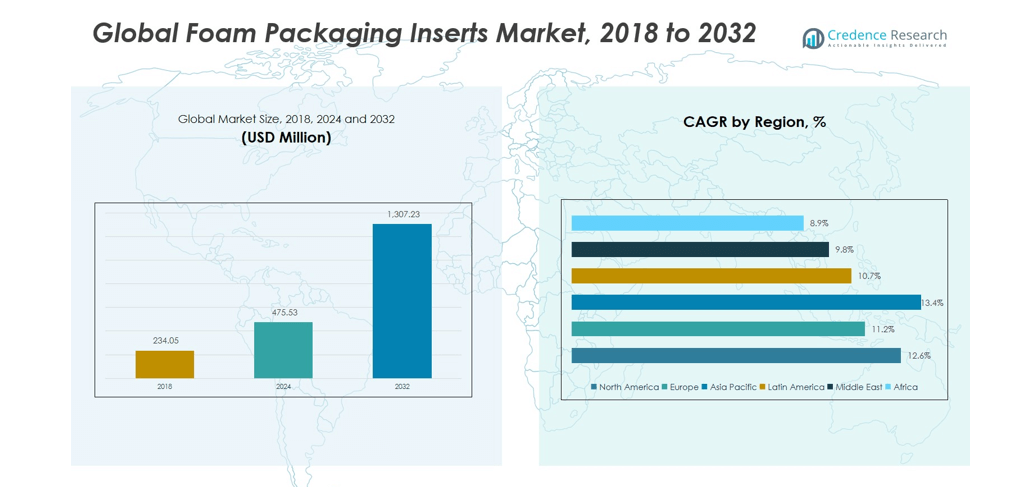
The Global Foam Packaging Inserts Market size was valued at USD 234.05 million in 2018 to USD 475.53 million in 2024 and is anticipated to reach USD 1,307.23 million by 2032, at a CAGR of 12.56% during the forecast period.
| REPORT ATTRIBUTE | DETAILS |
|---|---|
| Historical Period | 2020-2023 |
| Base Year | 2024 |
| Forecast Period | 2025-2032 |
| Foam Packaging Inserts Market Size 2024 | USD 475.53 million |
| Foam Packaging Inserts Market, CAGR | 12.56% |
| Foam Packaging Inserts Market Size 2032 | USD 1,307.23 million |
Market growth is primarily driven by the rapid rise in e-commerce shipments, which require reliable and cost-effective packaging for fragile products. The increasing focus on sustainability and innovation in recyclable foam materials also supports adoption. Manufacturers are investing in precision-cut inserts and eco-friendly foams to enhance protection, reduce waste, and meet environmental standards.
Regionally, the Asia-Pacific region leads the market due to expanding manufacturing activities, strong online retail growth, and demand for specialty packaging in China, India, and Japan. North America remains a key market owing to its advanced logistics infrastructure and high-value goods transportation. Europe follows closely, driven by strict environmental regulations, increasing sustainability initiatives, and growing preference for bio-based packaging materials.
Market Insights:
- The Global Foam Packaging Inserts Market was valued at USD 234.05 million in 2018, grew to USD 475.53 million in 2024, and is projected to reach USD 1,307.23 million by 2032, registering a CAGR of 12.56% during the forecast period.
- Asia Pacific leads the market with a 35% share due to rapid industrialization, expanding e-commerce, and strong electronics manufacturing in China, Japan, and South Korea.
- North America holds a 27% share, supported by advanced logistics infrastructure, high-value goods transportation, and strong adoption across healthcare and retail sectors.
- Europe accounts for 22% of total revenue, driven by strict environmental regulations and strong demand for recyclable and bio-based foam materials.
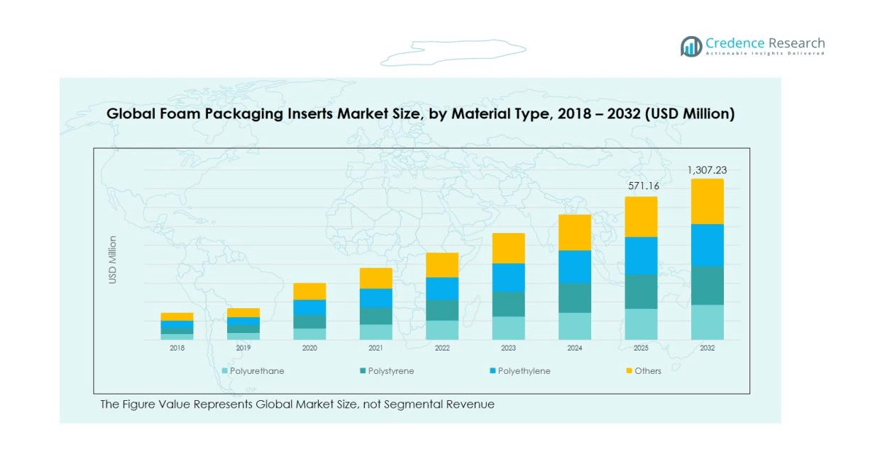
- By material type, polyurethane holds 38% share owing to its flexibility and high shock absorption, while polyethylene captures 28% share for its durability and recyclability across automotive and industrial packaging applications.
Market Drivers:
Rising Demand from E-Commerce and Electronics Sectors
The Global Foam Packaging Inserts Market benefits from the rapid expansion of online retail and consumer electronics. E-commerce platforms require reliable protective solutions to safeguard fragile and high-value goods during transit. Foam inserts provide superior cushioning and shock absorption, reducing product damage and return rates. Electronics manufacturers also rely on precision-cut inserts to protect devices and components from vibration and impact. It ensures consistent product quality and enhances brand reputation through safe delivery.
- For Instance, Samsung Electronics continued its 'Galaxy for the Planet' initiative in 2024, focusing on eliminating single-use plastics from its smartphone packaging and increasing the use of recycled materials.
Growing Focus on Sustainable and Recyclable Packaging Materials
Sustainability is a major driver shaping the foam packaging industry. Companies are developing bio-based and recyclable foams to reduce environmental impact and comply with global regulations. Manufacturers invest in materials such as polyethylene (PE) and polyurethane (PU) foams that offer both protection and recyclability. The adoption of green packaging practices supports corporate environmental goals and appeals to eco-conscious consumers. It encourages continued innovation in material science and waste reduction.
- For instance, BASF launched its certified compostable biopolymer (plastic), Ecovio, which achieved an industrial compostability standard of DIN EN 13432 and is now used by numerous European packaging manufacturers, significantly reducing landfill contributions through certified composting practices.
Expansion of Industrial and Automotive Applications
The market gains traction from industrial and automotive sectors that require protective solutions for machinery parts, tools, and precision components. Foam inserts prevent mechanical damage, moisture exposure, and surface scratches during storage and shipment. Growing production of electric vehicles and advanced components has increased demand for customized packaging designs. It supports safe transportation of batteries, sensors, and electronic modules. The adaptability of foam materials to varied shapes and densities strengthens their use in these industries.
Advancements in Design and Manufacturing Technologies
Innovation in digital design, die-cutting, and automated production enhances the precision and cost-efficiency of foam packaging inserts. Computer-aided manufacturing enables consistent shaping and faster turnaround for custom orders. Manufacturers adopt advanced equipment to reduce material waste and improve cutting accuracy. 3D modeling and simulation tools help optimize protective performance and structural integrity. It allows companies to meet rising expectations for durability, sustainability, and brand presentation.
Market Trends:
Adoption of Eco-Friendly and High-Performance Foam Materials
The Global Foam Packaging Inserts Market is experiencing a shift toward sustainable and advanced material innovations. Manufacturers are developing recyclable, biodegradable, and bio-based foams such as starch-based and polylactic acid (PLA) variants to meet environmental regulations. Demand for lightweight, high-resilience materials like cross-linked polyethylene (XLPE) and expanded polypropylene (EPP) is also rising due to their superior impact resistance and durability. Companies integrate renewable raw materials and closed-loop recycling systems to reduce carbon footprints. It promotes compliance with global sustainability goals and appeals to brands emphasizing eco-conscious packaging. The increasing preference for green packaging solutions is influencing large-scale transitions across e-commerce, electronics, and healthcare sectors. These trends reflect a growing commitment to environmental stewardship and long-term material innovation.
- For instance, Ecovative, through its licensees, produces Mushroom® Packaging (previously known as MycoFoam or EcoCradle), a biodegradable foam grown from agricultural waste (like hemp hurd or corn husks) and mycelium, that fully composts at home in as few as 45 days, supporting eco-friendly packaging needs with a growth cycle of only 7 days to create solid foam structures.
Integration of Automation, Customization, and Smart Design Solutions
Technological advancement is redefining how foam inserts are designed and manufactured. Automation in cutting, shaping, and assembly processes enhances production accuracy and speed, reducing human error and material waste. The market is witnessing the adoption of 3D modeling and computer-aided design (CAD) tools for customized inserts that fit complex product geometries. It enables quick prototyping and flexible production for industries with diverse packaging needs. Smart packaging concepts, such as QR-coded inserts for traceability and brand engagement, are gaining traction. Companies are leveraging digital tools to create precision-engineered inserts that improve aesthetics and functionality. This trend underlines the shift toward intelligent, data-driven, and design-optimized foam packaging systems.
- For instance, Armor Cases uses handheld 3D laser scanners paired with SolidWorks and AutoCAD software to achieve foam insert design accuracy up to 0.05mm, enabling rapid turnaround time as low as 30 minutes for initial 3D modeling.
Market Challenges Analysis:
Environmental Concerns and Stringent Regulatory Pressures
The Global Foam Packaging Inserts Market faces challenges due to increasing environmental scrutiny and waste management concerns. Traditional foams, such as expanded polystyrene (EPS), are non-biodegradable and contribute to landfill accumulation. Governments across major economies are imposing restrictions on single-use and non-recyclable plastics, pressuring manufacturers to adopt eco-friendly alternatives. Transitioning to sustainable materials requires significant research, testing, and capital investment, which limits adoption among smaller producers. It raises production costs and affects pricing competitiveness in mass-market applications. Companies must balance sustainability goals with maintaining durability and cost efficiency to stay compliant and profitable.
High Production Costs and Volatility in Raw Material Prices
Fluctuating prices of raw materials, such as polyethylene and polyurethane, pose a major obstacle for manufacturers. The market depends on petrochemical derivatives, which are influenced by crude oil price fluctuations and global supply disruptions. Maintaining consistent profit margins becomes difficult under volatile cost structures. It also challenges manufacturers to optimize processes without compromising quality or customization. Energy-intensive production processes further increase operational expenses. Small and medium enterprises often struggle to compete with large players that have better economies of scale and procurement networks.
Market Opportunities:
Expansion of Sustainable and Circular Packaging Solutions
The Global Foam Packaging Inserts Market presents strong opportunities through the adoption of recyclable and biodegradable materials. Growing demand for circular packaging models encourages the use of foams made from renewable or post-consumer sources. Manufacturers investing in eco-friendly polyethylene and biopolymer blends can access premium market segments. It also creates potential partnerships with brands committed to reducing plastic waste and carbon emissions. Government incentives for sustainable manufacturing strengthen this transition across developed and emerging economies. Rising consumer preference for green packaging provides long-term business growth opportunities for innovation-driven producers.
Rising Demand from Healthcare, Aerospace, and Luxury Goods Sectors
High-value industries are expanding their reliance on precision-engineered protective packaging. The need to safeguard sensitive instruments, medical devices, and aerospace components drives demand for customized foam inserts with anti-static and shock-resistant properties. Luxury goods manufacturers also seek visually appealing and durable inserts that enhance brand image and product safety. It allows suppliers to diversify portfolios and enter niche, high-margin segments. The trend toward miniaturized electronics and delicate equipment amplifies the need for advanced protective solutions. Companies that focus on high-performance materials and tailored designs can gain a competitive advantage in these specialized sectors.
Market Segmentation Analysis:
By Material Type
The Global Foam Packaging Inserts Market is segmented into polyurethane, polystyrene, polyethylene, and others. Polyurethane foam holds a major share due to its high shock absorption and flexibility, making it suitable for electronics and medical device packaging. Polystyrene remains preferred for lightweight protective packaging in consumer goods and industrial shipments due to its rigidity and cost efficiency. Polyethylene foam is gaining demand for its durability, moisture resistance, and recyclability, aligning with sustainable packaging trends. It continues to be favored in automotive and aerospace applications where vibration and impact control are critical. The “others” category includes advanced materials such as bio-based and composite foams, which are expanding with the shift toward eco-friendly packaging solutions.
- For instance, BASF and Autoliv China collaborated in 2024 to develop an innovative 'Design-for-Recycling' polyurethane foam technology for automotive steering wheels, incorporating up to 20% recycled content while maintaining mechanical performance comparable to conventional polyurethane foam.
By Application
By application, the market is categorized into electronics, automotive, consumer goods, healthcare, and others. The electronics segment dominates due to growing e-commerce sales and increased production of fragile, high-value devices. Automotive packaging applications are expanding with rising demand for electric vehicle components that require high protection standards. Consumer goods rely heavily on foam inserts for secure and aesthetic product presentation, especially in luxury and retail packaging. The healthcare segment shows steady growth, driven by the need for sterile, shock-resistant packaging for instruments and devices. It highlights the versatility of foam inserts across industries where product safety and presentation are key performance factors.
- For instance, Rivian developed structural foam from recycled ocean-bound plastic by 2024, successfully converting 500,000 kg annually into bulk bins and totes for electric vehicle component packaging, with every 10,000 bulk bins diverting approximately 145,000 kg of ocean plastic into their returnable packaging systems.
Segmentations:
By Material Type
- Polyurethane
- Polystyrene
- Polyethylene
- Others
By Application
- Electronics
- Automotive
- Consumer Goods
- Healthcare
- Others
By Region
- North America
- U.S.
- Canada
- Mexico
- Europe
- Germany
- France
- U.K.
- Italy
- Spain
- Rest of Europe
- Asia Pacific
- China
- Japan
- India
- South Korea
- South-east Asia
- Rest of Asia Pacific
- Latin America
- Brazil
- Argentina
- Rest of Latin America
- Middle East & Africa
- GCC Countries
- South Africa
- Rest of the Middle East and Africa
Regional Analysis:
North America
The North America Global Foam Packaging Inserts Market size was valued at USD 67.02 million in 2018, rising to USD 134.01 million in 2024 and projected to reach USD 369.96 million by 2032, at a CAGR of 12.6% during the forecast period. The region holds a market share of 27% driven by a mature e-commerce infrastructure and strong presence of electronics, healthcare, and retail sectors. The United States remains the dominant contributor, supported by advanced logistics and sustainability initiatives. Canada and Mexico are witnessing increased adoption due to growing manufacturing and export activities. The focus on sustainable foam materials and lightweight packaging strengthens market penetration. It continues to expand with investments in automation and recyclable packaging formats across industrial applications.
Europe
The Europe Global Foam Packaging Inserts Market size was valued at USD 44.08 million in 2018, reaching USD 84.70 million in 2024 and estimated to hit USD 211.93 million by 2032, at a CAGR of 11.2%. The region accounts for 22% of total revenue, driven by strict environmental regulations and rising demand for recyclable foams. Germany, the UK, and France lead in production and innovation within the automotive and consumer goods industries. The growing shift toward circular packaging systems enhances demand for biodegradable materials. The European Union’s sustainability targets encourage rapid adoption of eco-friendly foam solutions. It benefits from a well-established industrial base and advanced technological infrastructure.
Asia Pacific
]The Asia Pacific Global Foam Packaging Inserts Market size was valued at USD 103.56 million in 2018, increasing to USD 218.08 million in 2024 and projected to reach USD 635.62 million by 2032, at a CAGR of 13.4%. The region commands a 35% share due to rapid industrialization, strong electronics manufacturing, and expanding e-commerce networks. China, Japan, and South Korea drive large-scale demand across electronics, automotive, and medical packaging. India is emerging as a fast-growing hub with increasing domestic consumption and industrial output. The availability of cost-effective raw materials and government-backed industrial policies supports production expansion. It remains the most dynamic region, offering high growth potential for international and local manufacturers.
Latin America
The Latin America Global Foam Packaging Inserts Market size was valued at USD 10.33 million in 2018, growing to USD 20.70 million in 2024 and expected to reach USD 49.90 million by 2032, at a CAGR of 10.7%. The region contributes 8% of global share, supported by the expansion of consumer goods and automotive packaging industries. Brazil and Mexico lead demand, with rising domestic manufacturing and growing export shipments. E-commerce growth across urban areas fuels consistent packaging needs. The region is transitioning toward recyclable and lightweight foams to meet sustainability objectives. It shows growing investment in logistics networks and localized packaging production facilities.
Middle East
The Middle East Global Foam Packaging Inserts Market size was valued at USD 5.91 million in 2018, increasing to USD 10.86 million in 2024 and forecasted to reach USD 24.61 million by 2032, at a CAGR of 9.8%. The region holds a 5% share, led by GCC countries with expanding healthcare, retail, and electronics sectors. Modern retail and luxury product packaging drive premium foam insert usage. Local foam manufacturing capabilities are strengthening through industrial diversification programs. Governments are promoting sustainability-focused initiatives across packaging and materials. It continues to grow with increasing regional trade and industrial investments.
Africa
The Africa Global Foam Packaging Inserts Market size was valued at USD 3.16 million in 2018, expanding to USD 7.19 million in 2024 and projected to reach USD 15.21 million by 2032, at a CAGR of 8.9%. The region represents 3% of the global share, driven by rising retail development and consumer goods demand. South Africa leads adoption due to its established industrial base and logistics infrastructure. Nigeria, Egypt, and Kenya are witnessing increased investment in e-commerce and packaging manufacturing. Limited recycling infrastructure poses challenges, but reforms are underway to improve waste management systems. It is expected to register gradual growth supported by government initiatives and emerging sustainability awareness.
Key Player Analysis:
- Sealed Air Corporation
- Sonoco Products Company
- Pregis LLC
- Storopack Hans Reichenecker GmbH
- ACH Foam Technologies
- Polyformes Foam Solutions
- Williams Foam
- UFP Technologies
- Barco Sales & Manufacturing
- Evoco Ltd
Competitive Analysis:
The Global Foam Packaging Inserts Market is highly competitive with several established manufacturers offering innovative protective packaging solutions. Sealed Air Corporation and Sonoco Products Company lead through strong product portfolios and extensive global distribution networks. Pregis LLC and Storopack Hans Reichenecker GmbH focus on advanced cushioning technologies and eco-friendly materials to strengthen their positions in sustainable packaging. ACH Foam Technologies and Polyformes Foam Solutions specialize in customized inserts for electronics, healthcare, and industrial applications. Williams Foam and UFP Technologies enhance competitiveness through automation and design optimization for high-value industries. The market is witnessing strategic partnerships, mergers, and continuous R&D investments to develop recyclable and lightweight foam products. It maintains intense competition driven by sustainability requirements, material innovation, and demand for precision-engineered packaging across end-use sectors.
Recent Developments:
- In September 2025, Sonoco Products Company revealed plans to sell its ThermoSafe temperature-assured packaging business to Arsenal Capital Partners for up to $725 million, including conditions based on 2025 performance metrics.
Report Coverage:
The research report offers an in-depth analysis based on Material Type, Application and Region. It details leading market players, providing an overview of their business, product offerings, investments, revenue streams, and key applications. Additionally, the report includes insights into the competitive environment, SWOT analysis, current market trends, as well as the primary drivers and constraints. Furthermore, it discusses various factors that have driven market expansion in recent years. The report also explores market dynamics, regulatory scenarios, and technological advancements that are shaping the industry. It assesses the impact of external factors and global economic changes on market growth. Lastly, it provides strategic recommendations for new entrants and established companies to navigate the complexities of the market.
Future Outlook:
- The Global Foam Packaging Inserts Market will expand with increasing demand from e-commerce, electronics, and healthcare industries seeking durable and customizable packaging.
- Sustainability initiatives will push manufacturers toward recyclable, biodegradable, and bio-based foam solutions.
- Automation and digital fabrication technologies will enhance production efficiency and reduce material waste.
- Customized and precision-cut foam inserts will gain preference among luxury and high-value product manufacturers.
- The adoption of lightweight foam materials will continue to rise due to cost efficiency and transport benefits.
- Growing industrialization in Asia Pacific will strengthen regional manufacturing capabilities and export potential.
- Partnerships between packaging producers and material science firms will accelerate innovation in advanced foams.
- The automotive sector will drive demand for shock-absorbing and anti-static inserts for sensitive components.
- Rising government regulations on plastic waste will encourage circular economy models across the packaging industry.
- It will maintain steady growth supported by sustainability goals, design flexibility, and consistent adoption across global supply chains.

Request a Free Sample
Fill in your details and we'll send you a free sample report.
- Sample data tables & charts
- Research methodology
Need a Custom Version of This Report?
Tailor the scope, geography, or segments to your exact requirements.
- Custom geography or segment scope
- Direct access to our analyst team
Frequently Asked Questions
What is the current market size for the Global Foam Packaging Inserts Market, and what is its projected size in 2032?
At what Compound Annual Growth Rate is the Global Foam Packaging Inserts Market projected to grow between 2024 and 2032?
Which Global Foam Packaging Inserts Market segment held the largest share in 2024?
What are the primary factors fueling the growth of the Global Foam Packaging Inserts Market?
Who are the leading companies in the Global Foam Packaging Inserts Market?
Table of Content
Chapter 1 Market Segmentation
- 1.1 Segmentation Framework
- 1.1.1 Product and Service Classification
- 1.1.2 Application and End-Use Classification
- 1.1.3 Technology and Solution Classification
- 1.1.4 Customer and Distribution Channel Classification
- 1.1.5 Geographic Segmentation
- 1.1.6 Market Segment Definitions and Boundaries
Chapter 2 Introduction
- 2.1 Report Objectives and Scope
- 2.2 Product Definition and Industry Terminology
- 2.3 Market Inclusions and Exclusions
- 2.4 Research Process
- 2.4.1 Primary Research and Expert Interviews
- 2.4.2 Secondary Research and Source Review
- 2.4.3 Top-Down and Bottom-Up Estimation
- 2.4.4 Data Triangulation and Verification
- 2.5 Market Size Measurement Basis
- 2.5.1 2018: USD 234.05 million → 2032: USD 1,307.23 million
- 2.6 Historical and Forecast Reference Periods
- 2.6.1 Base Year: 2018
- 2.6.2 Forecast Period: 2018-2032
- 2.7 Research Assumptions and Limitations
Chapter 3 Executive Summary
- 3.1 Market Snapshot and Key Findings
- 3.2 Base-Year Market Size, 2018
- 3.3 Forecast Market Size, 2032
- 3.4 Revenue and Volume Growth Outlook
- 3.5 Key Demand and Supply Indicators
- 3.6 Leading Market Segments
- 3.7 Fastest-Growing Market Opportunities
- 3.8 Regional Performance Highlights
- 3.9 Technology and Industry Transformation
- 3.10 Competitive Landscape Summary
- 3.11 Analyst View and Strategic Implications
Chapter 4 Global Foam Packaging Inserts Market Trends and Developments
- 4.1 Historical Industry Development
- 4.2 Recent Market Trends and Developments
- 4.3 Demand and Customer Behavior Trends
- 4.4 Technology and Product Innovation
- 4.5 Artificial Intelligence, Automation and Digitalization
- 4.6 Local Manufacturing and Supply Chain Realignment
- 4.7 Industry Partnerships, Mergers and Acquisitions
- 4.8 Sustainability and Circular Economy Developments
- 4.9 Government and Private Sector Investment Trends
- 4.10 Emerging Business Models and Commercialization
- 4.11 Industry Developments and Announcements
Chapter 5 Global Foam Packaging Inserts Market Production, Supply and Demand Analysis
- 5.1 Demand Trend and Consumption Analysis
- 5.2 Demand Forecast, 2018-2032
- 5.3 Production and Output Trend
- 5.4 Production and Output Forecast, 2018-2032
- 5.5 Installed Capacity and Capacity Utilization
- 5.6 Company-Wise Production Plants and Statistics
- 5.6.1 Installed Production Capacity
- 5.6.2 Actual Production
- 5.6.3 Planned Capacity and Expansion Targets
- 5.7 Supply Chain Structure and Procurement Trends
- 5.8 Supply-Demand Gap and Bottlenecks
- 5.9 Import Dependence and Sourcing Structure
- 5.10 Contract Manufacturing and Outsourcing
- 5.11 Regional Supply and Demand Concentration
Chapter 6 Global Foam Packaging Inserts Market Pricing Analysis
- 6.1 Pricing Structure and Measurement
- 6.2 Historical Pricing Trends
- 6.3 Pricing Outlook, 2018-2032
- 6.4 Average Selling Price and Unit Economics
- 6.5 Pricing by Product and Market Segment
- 6.6 Geographic Pricing Differences
- 6.7 Key Input, Energy, Labor and Logistics Costs
- 6.8 Contract Pricing and Purchasing Models
- 6.9 Pricing Sensitivity and Competitive Positioning
- 6.10 Price, Margin and Profitability Implications
Chapter 7 Global Foam Packaging Inserts Market Dynamics
- 7.1 Market Growth Drivers
- 7.1.1 Demand-Side Drivers
- 7.1.2 Technology and Innovation Drivers
- 7.1.3 Infrastructure and Investment Drivers
- 7.1.4 Regulatory and Policy Drivers
- 7.2 Market Restraints
- 7.2.1 Cost and Affordability Constraints
- 7.2.2 Technology and Adoption Barriers
- 7.2.3 Supply Chain and Operational Constraints
- 7.3 Market Challenges
- 7.3.1 Competitive Pressure and Margin Erosion
- 7.3.2 Skills, Infrastructure and Implementation Gaps
- 7.4 Emerging Market Opportunities
- 7.5 Market Dynamics Impact and Time-Horizon Assessment
Chapter 8 Global Foam Packaging Inserts Value Chain Analysis
- 8.1 Industry Value Chain Overview
- 8.2 Upstream Suppliers and Critical Inputs
- 8.3 Technology and Component Providers
- 8.4 Manufacturing or Service Delivery
- 8.5 Distribution, Channel Partners and Integrators
- 8.6 Downstream Applications and End Users
- 8.7 Value Addition and Profit Pools
- 8.8 Vertical Integration and Outsourcing
- 8.9 Supplier Concentration and Risk
- 8.10 Supply Chain Localization and Resilience
Chapter 9 Global Foam Packaging Inserts Market Regulations and Policies
- 9.1 Relevant Laws, Standards and Compliance Frameworks
- 9.2 Product, Service, Safety and Quality Requirements
- 9.3 Government Policies, Incentives and Subsidies
- 9.4 Imports, Exports and Trade Barriers
- 9.5 Public Procurement and Local Content Requirements
- 9.6 Environmental and Sustainability Compliance
- 9.7 Upcoming Policy Changes and Market Implications
Chapter 10 Global Foam Packaging Inserts Market Hotspots and Opportunities
- 10.1 Market Opportunity Mapping and Growth Hotspots
- 10.2 High-Growth Applications and Customer Groups
- 10.3 Underserved Markets and White-Space Opportunities
- 10.4 Emerging Technology and Product Opportunities
- 10.5 New Capacity and Investment Hotspots
- 10.6 Market Entry and Expansion Opportunities
- 10.7 Distribution and Partnership Opportunities
- 10.8 Near-Term and Long-Term Commercial Potential
- 10.9 Opportunity Attractiveness and Execution Risks
Chapter 11 Global Foam Packaging Inserts Market Outlook, 2018-2032
- 11.1 Market Size and Analysis
- 11.1.1 Revenue (Market Measurement: 2018: USD 234.05 million → 2032: USD 1,307.23 million)
- 11.1.2 Market Volume and Quantity Sold
- 11.1.3 Historical Market Size
- 11.1.4 Base-Year Market Size, 2018
- 11.2 Market Forecast, 2018-2032
- 11.2.1 Revenue Forecast to 2032
- 11.2.2 Volume Forecast to 2032
- 11.2.3 CAGR and Year-on-Year Growth
- 11.2.4 Incremental Revenue Opportunity
- 11.3 Forecast Assumptions and Scenario Analysis
- 11.3.1 Base-Case Forecast
- 11.3.2 Optimistic and Conservative Scenarios
- 11.3.3 Technology, Pricing and Policy Sensitivities
- 11.4 Market Attractiveness and Growth Outlook
Chapter 12 Global Foam Packaging Inserts Market Segmentation and Outlook
- 12.1 Segmentation Summary and Market Shares, 2018
- 12.2 Largest and Fastest-Growing Segments
- 12.3 Segment Growth Comparison
- 12.4 Segment Attractiveness and Priority Matrix
Chapter 13 Global Foam Packaging Inserts Geographic Market Outlook, 2018-2032
- 13.1 Regional Market Size and Share, 2018
- 13.2 Regional Market Forecast, 2018-2032
- 13.3 Regional Pricing, Production and Demand Differences
- 13.4 North America
- 13.4.1 United States
- 13.4.2 Canada
- 13.4.3 Mexico
- 13.5 Europe
- 13.5.1 Germany
- 13.5.2 France
- 13.5.3 Italy
- 13.5.4 United Kingdom
- 13.5.5 Spain
- 13.5.6 Poland
- 13.5.7 Russia
- 13.5.8 Netherlands
- 13.5.9 Belgium
- 13.5.10 Sweden
- 13.5.11 Denmark
- 13.5.12 Norway
- 13.5.13 Rest of Europe
- 13.6 Asia Pacific
- 13.6.1 China
- 13.6.2 India
- 13.6.3 Japan
- 13.6.4 South Korea
- 13.6.5 Thailand
- 13.6.6 Indonesia
- 13.6.7 Vietnam
- 13.6.8 Malaysia
- 13.6.9 Australia
- 13.6.10 Rest of Asia Pacific
- 13.7 Latin America
- 13.7.1 Brazil
- 13.7.2 Argentina
- 13.7.3 Colombia
- 13.7.4 Chile
- 13.7.5 Rest of Latin America
- 13.8 Middle East
- 13.8.1 Saudi Arabia
- 13.8.2 United Arab Emirates
- 13.8.3 Turkey
- 13.8.4 Israel
- 13.8.5 Iran
- 13.8.6 Rest of the Middle East
- 13.9 Africa
- 13.9.1 South Africa
- 13.9.2 Egypt
- 13.9.3 Nigeria
- 13.9.4 Morocco
- 13.9.5 Rest of Africa
- 13.10 Regional Investment, Policy and Supply Chain Differences
- 13.11 Regional Competitive Landscape
- 13.12 Geographic Growth Hotspots
Chapter 14 Global Foam Packaging Inserts Technology, Innovation and Sustainability Outlook
- 14.1 Technology Landscape and Maturity
- 14.2 Product, Process and Service Innovation
- 14.3 AI, Automation and Digital Tools in the Industry
- 14.4 Technology Adoption and Performance Benchmarking
- 14.5 Innovation Pipeline and R&D Investment
- 14.6 Patent and Intellectual Property Trends
- 14.7 Energy Efficiency and Resource Management
- 14.8 Sustainability, Recycling and Circularity
- 14.9 Technology Roadmap, 2018-2032
- 14.10 Risks of Obsolescence and Technology Substitution
Chapter 15 Global Foam Packaging Inserts Market Key Strategic Imperatives
- 15.1 Growth and Market Entry Priorities
- 15.2 High-Return Products and Segments
- 15.3 Pricing, Profitability and Cost Optimization
- 15.4 Technology Investment and Product Differentiation
- 15.5 Supply Chain Localization and Resilience
- 15.6 Distribution and Customer Acquisition
- 15.7 Partnership, Acquisition and Capacity Strategy
- 15.8 Regional Expansion Priorities
- 15.9 Short-, Medium- and Long-Term Actions
Chapter 16 Competition Outlook
- 16.1 Industry Competition Characteristics
- 16.2 Market Structure and Concentration
- 16.3 Market Share and Competitive Positioning, 2018
- 16.4 Company-Wise Revenue and Product Benchmarking
- 16.5 Production and Service Capacity Benchmarking
- 16.6 Technology, Pricing and Differentiation
- 16.7 Regional Footprint and Distribution Strength
- 16.8 Mergers, Acquisitions and Strategic Alliances
- 16.9 New Entrants and Competitive Threats
- 16.10 Porter's Five Forces and Industry Attractiveness
- 16.11 Competitive Outlook, 2018-2032
Chapter 17 Company Profiles
- 17.1 Company Coverage and Selection Criteria
- 17.2 Leading Market Participants – Standard Profile Structure
- 17.2.1 Business Description
- 17.2.2 Company Ownership and Geographic Presence
- 17.2.3 Product and Service Portfolio
- 17.2.4 Manufacturing and Operating Footprint
- 17.2.5 Production Capacity and Expansion Plans
- 17.2.6 Financial Performance and Investment
- 17.2.7 Market Share and Competitive Position
- 17.2.8 Technology and Innovation Capabilities
- 17.2.9 Strategic Alliances or Partnerships
- 17.2.10 Recent Developments
- 17.2.11 Growth Strategy and Outlook
- 17.3 Other Relevant Market Participants
Note: Every listed company is profiled on the structure shown under the first company. The company list is preliminary and may change based on research findings, market developments, data availability and client requirements.
Chapter 18 Disclaimer
- 18.1 Research and Forecast Disclaimer
- 18.2 Data Source and Estimation Limitations
Note: The depth of individual sections depends on data availability for this market. Volume, capacity, trade and other unit-based metrics are included where applicable.