Market Overview:
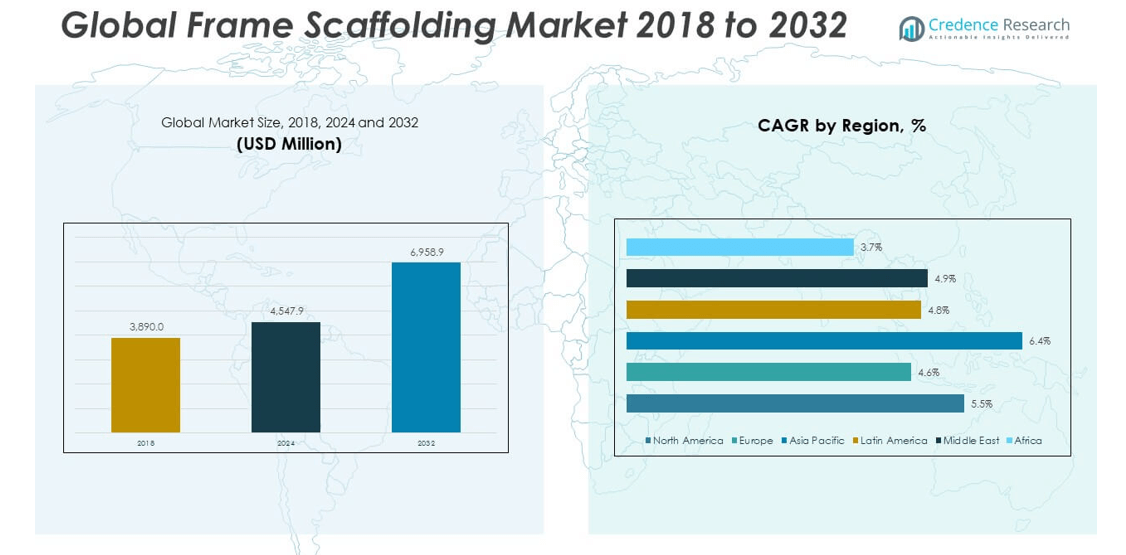
The Frame Scaffolding Market size was valued at USD 3,890.0 million in 2018 to USD 4,547.9 million in 2024 and is anticipated to reach USD 6,958.9 million by 2032, at a CAGR of 5.54% during the forecast period.
| REPORT ATTRIBUTE | DETAILS |
|---|---|
| Historical Period | 2020-2023 |
| Base Year | 2024 |
| Forecast Period | 2025-2032 |
| Frame Scaffolding Market Size 2024 | USD 4,547.9 million |
| Frame Scaffolding Market, CAGR | 5.54% |
| Frame Scaffolding Market Size 2032 | USD 6,958.9 million |
The Frame Scaffolding Market is growing due to increasing construction activities, infrastructure development, and renovation projects worldwide. Governments are investing heavily in residential, commercial, and industrial infrastructure, creating steady demand for secure and flexible scaffolding systems. Frame scaffolding's ease of installation, stability, and cost-effectiveness make it a preferred choice among contractors. The adoption of advanced materials and the focus on worker safety have further contributed to the market's expansion, as companies continue to seek durable and regulation-compliant solutions to meet evolving project requirements.
North America leads the Frame Scaffolding Market, driven by strong investments in commercial construction and refurbishment projects. Europe closely follows, supported by modernization of aging infrastructure and stringent safety regulations. Asia Pacific is emerging rapidly, with countries like China, India, and Southeast Asian nations witnessing robust urban development and industrialization. The growing need for housing, transportation infrastructure, and industrial facilities fuels demand in these regions. The Middle East and Africa are also gaining traction due to mega infrastructure and oil-related projects, while Latin America shows gradual growth influenced by urban expansion and public works initiatives.
Market Insights:
- The Frame Scaffolding Market was valued at USD 4,547.9 million in 2024 and is projected to reach USD 6,958.9 million by 2032, growing at a CAGR of 5.54%.
- Rapid growth in construction activities across residential, commercial, and infrastructure sectors is fueling market expansion.
- Rising demand for modular and adjustable scaffolding systems enhances worker safety and project efficiency.
- High initial investment costs and fluctuating raw material prices present challenges for manufacturers and contractors.
- North America and Europe maintain steady demand due to renovation and compliance-driven construction standards.
- Asia Pacific leads the market share in 2024, driven by urbanization, industrialization, and public infrastructure development.
- Stringent safety regulations and growing rental adoption continue to shape procurement patterns and market structure.
Market Drivers:
Rising Global Construction Activities Boost Demand for Frame Scaffolding
The growth in infrastructure development and large-scale construction projects worldwide directly supports the expansion of the Frame Scaffolding Market. Urbanization and population growth push governments and private developers to build more housing, commercial buildings, and public infrastructure. It benefits from demand in both emerging and developed economies due to increased focus on residential and industrial development. The need for cost-effective, easy-to-assemble scaffolding systems aligns with the preferences of contractors and builders. Its modular design and strong load-bearing capacity make it ideal for varying construction heights. The growing number of public works and transportation projects further strengthens the market. High-rise buildings and smart city initiatives increase the use of durable scaffolding. Continuous investment in energy, roads, and bridges adds steady growth momentum to the market.
Emphasis on Worker Safety and Regulatory Compliance Enhances Product Adoption
Strict safety standards in the construction industry drive the adoption of secure and compliant scaffolding systems. The Frame Scaffolding Market benefits from increasing awareness of worker protection and site safety regulations. Governments enforce standards that require contractors to adopt tested and certified scaffolding products. It provides stability and structural integrity, reducing the risk of accidents during height-based work. The demand for products that align with OSHA and EN standards contributes to consistent adoption. Contractors prioritize systems that minimize legal liabilities and protect human resources. Training programs on safe scaffolding use further accelerate professional adoption. The market gains traction from industries that focus on employee welfare and long-term sustainability.
- For instance, PERI's UP Flex Modular Scaffolding System has passed seismic qualification tests, ensuring it can withstand specific seismic loads. It complies with European standards EN 12810 and EN 12811, ensuring high safety and performance in various industrial applications.
Industrial Expansion and Infrastructure Modernization Fuel Market Demand
Expanding industrial zones and modernization of aging infrastructure create long-term growth avenues. The Frame Scaffolding Market benefits from industries such as oil and gas, manufacturing, and power that require robust support structures. Maintenance and repair of old bridges, refineries, and plants require reliable access solutions. It enables efficient and safer operations across complex industrial projects. The rising investments in plant upgrades and power transmission lines lead to steady consumption. Large facilities require high-load scaffolding systems for routine inspections and installations. Scaffolding service providers align offerings with sector-specific standards. The versatility and strength of frame scaffolding support its continued use in these applications.
Urban Redevelopment and Renovation Projects Drive Product Utilization
Urban redevelopment initiatives in aging cities fuel demand for flexible scaffolding systems. The Frame Scaffolding Market supports restoration of historical structures, commercial spaces, and residential buildings. Its simple setup and adaptability to narrow or confined spaces make it ideal for renovation works. Builders seek tools that reduce setup time while maintaining stability and safety. Governments invest in smart infrastructure and urban renewal that rely on temporary access platforms. It helps achieve efficient execution of façade repairs, retrofitting, and painting activities. Growing interior fit-out services in urban areas also benefit the market. It offers adaptability for contractors operating under tight timelines and space constraints.
- For example, Layher's SpeedyScaf frame scaffolding systems deliver a permissible load-bearing capacity of up to 2.0kN/m² across the entire deck surface, supporting the increasing requirements posed by high-rise and smart city developments.
Market Trends:
Technological Advancements in Scaffolding Design and Manufacturing
The industry is witnessing a shift toward precision engineering and automated fabrication processes. The Frame Scaffolding Market incorporates CAD and robotic welding to enhance structural consistency and durability. Manufacturers adopt galvanized and high-grade steel materials to improve longevity and corrosion resistance. Smart inventory management and digital configuration tools streamline on-site planning and logistics. It supports innovations such as integrated locking mechanisms and modular frame systems. These changes reduce labor intensity and speed up assembly and dismantling. The evolution of lightweight, high-strength alloys further supports ergonomic design. Product enhancements enable compliance with international safety codes and standards.
Rental Services Gaining Popularity Among Construction Contractors
Contractors increasingly prefer scaffolding rental models to reduce upfront costs and improve operational flexibility. The Frame Scaffolding Market adapts to this trend with scalable rental offerings and bundled installation services. It supports large and small projects that benefit from short-term use without ownership commitments. Rental firms invest in maintaining certified inventories for immediate deployment. Contractors favor renting to avoid storage, transport, and maintenance expenses. The model allows access to upgraded scaffolding designs without capital expenditure. This trend opens up recurring revenue streams for scaffolding service providers. Rental demand rises especially in metropolitan projects and temporary structures.
- For instance, United Rentals operates over 1,400 locations across North America and maintains a comprehensive inventory of scaffolding equipment to support projects of all scales. Their fleet includes a wide range of scaffolding solutions, such as modular frame units, system scaffolding, and shoring equipment, ensuring immediate nationwide deployment for construction and industrial needs
Integration of Scaffolding with Digital Site Management Platforms
Digital transformation impacts construction logistics and safety compliance. The Frame Scaffolding Market aligns with site management software for asset tracking and schedule coordination. RFID tags and QR codes are being used to monitor scaffolding inventory and ensure timely setup. Project managers track erection timelines, maintenance, and dismantling through cloud platforms. It enables better visibility of on-site activities and resource planning. Integration helps contractors meet compliance deadlines and reduce delays. Scaffolding inspections and certifications are now logged digitally for transparency. The trend supports data-driven decision-making in modern construction workflows.
- For example, NHD's AES/32 Scaffolding Module is utilized by large asset-intensive companies to streamline the tracking and management of scaffolding structures across multiple sites. This system centralizes real-time asset status, geolocation data, and digital certification logs, allowing for more efficient management and compliance.
Increased Demand for Sustainable and Recyclable Scaffolding Materials
Sustainability remains a central theme in modern infrastructure development. The Frame Scaffolding Market responds by adopting eco-friendly manufacturing and reusable systems. Builders seek scaffolding made from recyclable materials with minimal environmental impact. Manufacturers reduce the use of toxic coatings and adopt water-based finishes. It aligns with global goals for carbon emission reduction and green building standards. Modular designs minimize waste during installation and dismantling. Reuse potential across multiple sites enhances lifecycle value. Governments and project owners prioritize contractors that demonstrate environmental responsibility in equipment choices.
Market Challenges Analysis:
Fluctuating Raw Material Prices and Supply Chain Instabilities
The market faces cost volatility due to frequent changes in steel and metal prices. The Frame Scaffolding Market depends on consistent raw material supply for price stability and margin control. Steel price hikes impact production planning and procurement cycles. It challenges manufacturers to balance quality, cost, and delivery timelines. Global trade fluctuations and export restrictions disrupt component availability. Delays in material imports slow down manufacturing schedules. It increases pressure on suppliers to find alternatives without compromising standards. Manufacturers struggle to maintain competitive pricing during such disruptions.
Lack of Skilled Labor and Inconsistent Installation Practices
Proper scaffolding assembly requires trained personnel for safety and efficiency. The Frame Scaffolding Market encounters constraints due to shortages of experienced workers in many regions. Inadequate training leads to non-compliance and accident risks during setup. It affects project timelines and causes additional costs due to rework. In developing markets, informal labor practices undermine safety protocols. Lack of certification or supervision increases liability for contractors. Industry bodies are promoting certified training programs to bridge the skills gap. Demand for professionally managed scaffolding services is increasing as a result.
Market Opportunities:
Expansion into Emerging Economies with Infrastructure Boom
Emerging markets in Asia, Africa, and the Middle East present strong growth potential. The Frame Scaffolding Market sees rising demand from urbanization and mega infrastructure projects. Government investments in transport, housing, and industrial zones generate consistent orders. It can leverage local partnerships to scale operations and supply frameworks. International brands are setting up local manufacturing or distribution hubs. The rise of private construction players also creates new customer segments. Favorable policy reforms and ease of doing business attract foreign investments in construction. Public-private partnerships further expand the addressable market for scaffolding manufacturers.
Product Diversification and Modular Innovation Unlock New Applications
Innovations in modular design and compact scaffolding systems attract smaller contractors and niche industries. The Frame Scaffolding Market supports demand from events, interior works, and temporary structures. Manufacturers invest in product lines tailored for specific applications. It enables companies to target maintenance services, industrial retrofits, and high-rise facades. Faster assembly and easy mobility make these products highly desirable. The shift toward tool-free locking mechanisms simplifies usage across multiple skill levels. Modular solutions reduce storage space and logistics costs, enhancing contractor efficiency. Growth in modular construction and prefab sectors increases the relevance of these innovative scaffolding types.
Market Segmentation Analysis:
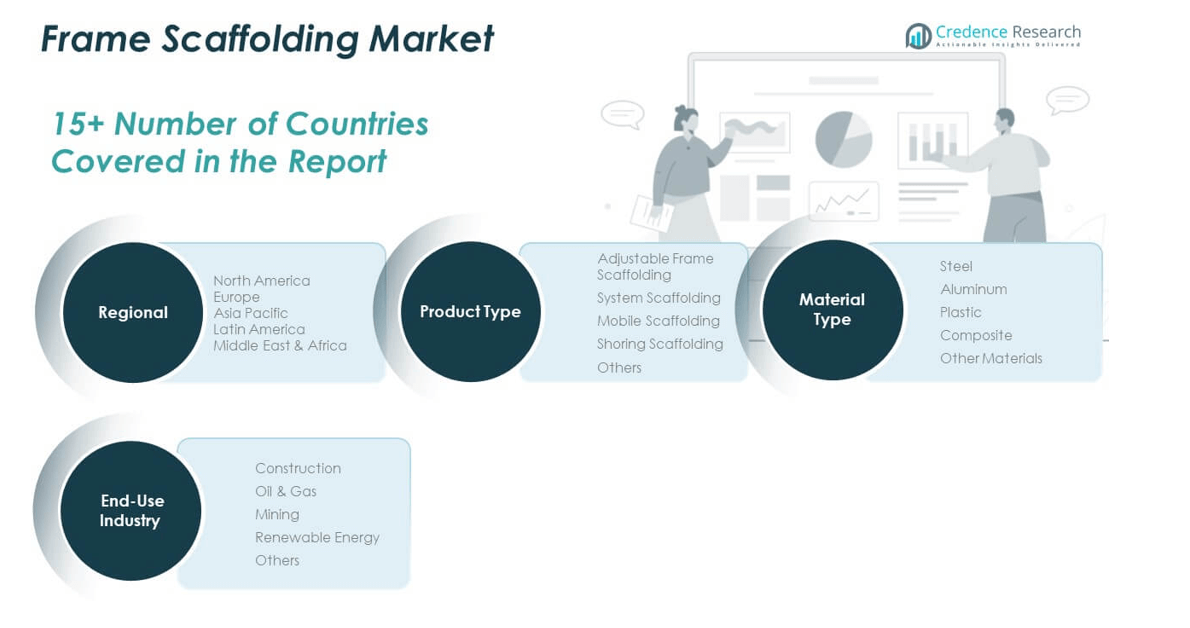
By product type, system scaffolding leads the Frame Scaffolding Market due to its modular design, high load capacity, and adaptability across complex structures. Adjustable frame scaffolding follows closely, preferred for versatility in height applications. Mobile scaffolding gains traction in maintenance and indoor projects for its portability and quick assembly. Shoring scaffolding supports structural reinforcement in bridge and heavy-load construction. The “others” segment includes specialized frames used in confined or customized workspaces.
- For example, MJ-Gerüst’s COMBI metric system achieves load classes up to 6kN/m² and has been utilized to support emergency stairway towers and complex bridge renovations, adhering to DIN EN 9001 and 14001 quality standards.
By material, steel dominates due to its superior strength, durability, and suitability for heavy-duty applications. Aluminum ranks second, favored in lightweight and mobile applications due to corrosion resistance. Composite materials attract interest in high-precision environments where electrical insulation or non-metal attributes are needed. Plastic scaffolding finds niche uses in lightweight and temporary setups. Other materials include hybrid configurations tailored to specific industrial needs.
- Altrex’s RS TOWER 52, for instance, features lightweight aluminum construction and can be assembled with working platform heights up to 14.2m indoors by two people in under 30 minutes.
By end-use industry, construction remains the largest consumer, driven by infrastructure and building projects. Oil and gas use scaffolding in refinery maintenance and plant operations. Mining applies it in excavation and tunnel access. Renewable energy projects demand scaffolding for turbine, solar, and installation works. The others segment covers shipbuilding, aviation, and industrial maintenance.
Segmentation:
By Product Type
- Adjustable Frame Scaffolding
- System Scaffolding
- Mobile Scaffolding
- Shoring Scaffolding
- Others
By Material
- Steel
- Aluminum
- Plastic
- Composite
- Other Materials
By End-Use Industry
- Construction
- Oil & Gas
- Mining
- Renewable Energy
- Others
By Region
- North America
- U.S.
- Canada
- Mexico
- Europe
- Germany
- France
- U.K.
- Italy
- Spain
- Rest of Europe
- Asia Pacific
- China
- Japan
- India
- South Korea
- South-east Asia
- Rest of Asia Pacific
- Latin America
- Brazil
- Argentina
- Rest of Latin America
- Middle East & Africa
- GCC Countries
- South Africa
- Rest of the Middle East and Africa
Regional Analysis:
North America
The North America Frame Scaffolding Market size was valued at USD 1,042.5 million in 2018 to USD 1,198.8 million in 2024 and is anticipated to reach USD 1,822.7 million by 2032, at a CAGR of 5.5% during the forecast period. North America holds a 26.36% share of the global Frame Scaffolding Market in 2024. It benefits from strong infrastructure investments across commercial and residential sectors. Demand grows due to renovation of aging structures, expansion of urban centers, and regulatory focus on worker safety. The U.S. dominates with large-scale public and private construction projects. Builders prioritize OSHA-compliant scaffolding systems to ensure safety and efficiency. Modular and reusable systems align with cost-control strategies across both metro and rural development. Adoption of rental scaffolding services is increasing, particularly in metropolitan construction hubs. Contractors value robust support systems that offer quick setup and easy transport across diverse job sites.
Europe
The Europe Frame Scaffolding Market size was valued at USD 832.5 million in 2018 to USD 926.7 million in 2024 and is anticipated to reach USD 1,320.7 million by 2032, at a CAGR of 4.6% during the forecast period. Europe accounts for 20.38% of the global Frame Scaffolding Market in 2024. It sees steady demand driven by infrastructure refurbishment, energy-efficient building upgrades, and strict EU safety norms. Major markets like Germany, France, and the UK promote high-standard scaffolding systems through regulations and incentives. Growth continues in Eastern Europe due to EU-backed development funds. Scaffolding solutions support heritage building restoration, which is common across older European cities. Contractors prefer durable and corrosion-resistant systems to withstand changing climates. The market also benefits from advancements in design automation and digital project integration. Sustainable and recyclable scaffolding materials find favor with eco-conscious developers.
Asia Pacific
The Asia Pacific Frame Scaffolding Market is projected to grow at a CAGR of 6.4% during the forecast period. Asia Pacific holds the largest share of the global Frame Scaffolding Market at 31.73% in 2024. It gains momentum from rapid urbanization, industrialization, and population growth in countries like China, India, Indonesia, and Vietnam. High-rise construction, transport infrastructure, and industrial corridors drive large-scale adoption of scaffolding systems. Developers seek cost-effective, easy-to-install solutions that meet tight timelines. It benefits from growing public-private partnerships and foreign direct investments in the construction sector. Government housing schemes and smart city initiatives create continuous demand. The presence of local manufacturers ensures competitive pricing and localized product support. The shift toward mechanized construction and digital project management further supports regional growth.
Latin America
The Latin America Frame Scaffolding Market is expected to grow at a CAGR of 4.8% during the forecast period. Latin America contributes 7.48% of the global Frame Scaffolding Market in 2024. The market expands with ongoing infrastructure programs in Brazil, Mexico, and Chile. Demand rises in sectors such as housing, commercial real estate, and energy. Governments invest in public works including metro systems, airports, and road networks. Contractors prioritize systems that reduce assembly time and support workforce safety. It serves both urban growth and rehabilitation of outdated infrastructure. Builders adopt scaffolding rental models due to capital constraints. Local players increase their presence through partnerships and cost-effective solutions. Regional demand benefits from policy shifts favoring industrial diversification and affordable housing.
Middle East
The Middle East Frame Scaffolding Market is forecast to grow at a CAGR of 4.9% during the forecast period. The region accounts for 7.59% of the global Frame Scaffolding Market in 2024. Large-scale infrastructure developments across the UAE, Saudi Arabia, and Qatar drive regional demand. Vision-based projects such as NEOM and Expo-related construction contribute to steady adoption. It serves the needs of high-rise buildings, stadiums, and transport facilities. Builders adopt modular scaffolding systems for efficiency and compliance with safety norms. Harsh weather conditions require robust, corrosion-resistant materials. Contractors emphasize reusability to reduce lifecycle costs across multiple projects. It gains from regional focus on economic diversification and tourism-related infrastructure. Stronger enforcement of safety and training protocols further fuels the demand.
Africa
The Africa Frame Scaffolding Market is anticipated to grow at a CAGR of 3.7% during the forecast period. Africa holds a 6.45% share in the global Frame Scaffolding Market in 2024. It experiences gradual growth supported by infrastructure development in countries such as South Africa, Nigeria, Kenya, and Egypt. Government investments in housing and transportation projects sustain long-term demand. Builders require cost-effective scaffolding solutions suited to emerging economies. The market favors durable systems that support both new construction and repair work. Limited skilled labor encourages adoption of easy-to-use modular frames. It faces challenges related to logistics, quality control, and regulatory enforcement. Local suppliers play a key role in meeting regional needs at affordable pricing. International companies expand through training programs and partnership models.
Key Player Analysis:
- Layher
- PERI Group
- Altrad Group
- ULMA Construction
- BrandSafway
- Waco International
- KHK Scaffolding & Formwork LLC
- AT-PAC
- ADTO Group
- Sunshine Enterprise
- Rapid Scaffolding (Engineering) Co., Ltd.
- Tianjin Wellmade Scaffold Co., Ltd.
- Rizhao Fenghua Scaffoldings Co., Ltd.
- Entrepose Echafaudages
- Devco Corporation
- Pacific Scaffold
- Turbo Scaffolding
- Scaffold Service Inc.
- Universal Manufacturing Corp.
Competitive Analysis:
The Frame Scaffolding Market features a mix of global and regional players competing on product quality, safety compliance, and pricing. Key companies such as PERI Group, Layher Holding GmbH, BrandSafway, and Waco Kwikform focus on expanding their rental fleets and innovating modular designs. It witnesses strategic alliances, mergers, and regional expansions to strengthen market presence. Players invest in advanced materials and automation to meet evolving construction standards. Companies differentiate by offering value-added services like on-site support and safety training. Market leaders maintain strong distribution networks and long-term contracts with contractors and government agencies. Regional players compete through cost-efficient solutions and quick delivery capabilities. Innovation, customization, and adherence to safety norms remain critical success factors.
Recent Developments:
- In April 2025, PERI, a leading provider in the European frame scaffolding market, unveiled its innovative product, the Vario Box, at the Bauma 2025 construction trade fair. This new offering is designed specifically for scaffolding construction companies and contractors, serving as a comprehensive storage and logistics solution to enhance on-site efficiency and safety.
- In April 2025, Layher North America made headlines by opening a new scaffolding distribution and support facility in Dundalk, Baltimore County. This strategic move positions Layher to expand its engineering, assembly, and logistics services while staying rooted in the Baltimore area.
Market Concentration & Characteristics:
The Frame Scaffolding Market is moderately concentrated with a few large players holding significant market shares. It exhibits characteristics of high product standardization, strong regulatory influence, and recurring demand from the construction and industrial sectors. Competitive pricing, product durability, and service offerings shape buying decisions. Entry barriers include capital investment, compliance standards, and distribution reach. The market favors firms with scalable operations and the ability to serve large, multi-location projects. Rental service models and product customization contribute to sustained differentiation. Technological integration and digital fleet management are becoming standard among top-tier suppliers.
Report Coverage:
The research report offers an in-depth analysis based on Product Type, Material and End-Use Industry. It details leading market players, providing an overview of their business, product offerings, investments, revenue streams, and key applications. Additionally, the report includes insights into the competitive environment, SWOT analysis, current market trends, as well as the primary drivers and constraints. Furthermore, it discusses various factors that have driven market expansion in recent years. The report also explores market dynamics, regulatory scenarios, and technological advancements that are shaping the industry. It assesses the impact of external factors and global economic changes on market growth. Lastly, it provides strategic recommendations for new entrants and established companies to navigate the complexities of the market.
Future Outlook:
- The Frame Scaffolding Market will experience sustained growth driven by rapid urbanization and infrastructure expansion, particularly in developing countries.
- Contractors will increasingly adopt modular scaffolding systems due to their quick installation, enhanced safety, and reduced labor requirements.
- Rental-based business models will gain popularity as construction firms prioritize operational flexibility and cost management.
- Governments and industry regulators will continue enforcing stringent safety and compliance standards, pushing demand for certified scaffolding products.
- Manufacturers will invest in advanced materials and automated production to improve product strength, longevity, and assembly efficiency.
- Eco-friendly scaffolding systems made from recyclable and low-impact materials will attract developers aligned with sustainability goals.
- Integration of digital tracking and asset management tools will improve scaffolding logistics, monitoring, and utilization across job sites.
- The rise in maintenance and renovation of aging infrastructure will fuel consistent demand for reliable access systems.
- Leading companies will expand into high-potential regions and invest in localized production to reduce lead times and logistics costs.
- Skill development and formal training in scaffolding installation and safety procedures will become essential to meet evolving site standards.

Request a Free Sample
Fill in your details and we'll send you a free sample report.
- Sample data tables & charts
- Research methodology
Market Dynamics
Rising Global Construction and Infrastructure Activities
Accelerated urbanization, population growth, and government investments in residential, commercial, and industrial infrastructure are driving demand for frame scaffolding systems, as they are essential for safe and efficient construction and renovation projects worldwide.
Emphasis on Worker Safety and Regulatory Compliance
Stringent safety regulations and increased awareness of worker protection are pushing contractors to adopt certified, regulation-compliant frame scaffolding systems, which offer stability and reduce accident risks, thus supporting market growth.
Technological Advancements and Modular Innovation
The adoption of advanced materials, precision engineering, and modular designs is making frame scaffolding systems more durable, easier to assemble, and adaptable to diverse project requirements, encouraging broader adoption across industries.
Growth of Rental-Based Business Models
Contractors are increasingly opting for scaffolding rental services to minimize upfront capital expenditure and gain operational flexibility, which is expanding the market by making advanced scaffolding solutions accessible to a wider range of projects.
Expansion in Emerging Markets
Rapid industrialization and infrastructure development in Asia Pacific, the Middle East, and Africa are creating significant opportunities for frame scaffolding manufacturers, as these regions invest heavily in new construction, public works, and urban redevelopment.
Need a Custom Version of This Report?
Tailor the scope, geography, or segments to your exact requirements.
- Custom geography or segment scope
- Direct access to our analyst team
Frequently Asked Questions
What is the current market size for Frame Scaffolding Market, and what is its projected size in 2032?
Which Frame Scaffolding Market segment held the largest share in 2024?
What are the primary factors fueling the growth of the Frame Scaffolding Market?
Who are the leading companies in the Frame Scaffolding Market?
Table of Content
Chapter 1 Market Segmentation
- 1.1 Segmentation Framework
- 1.1.1 Product and Service Classification
- 1.1.2 Application and End-Use Classification
- 1.1.3 Technology and Solution Classification
- 1.1.4 Customer and Distribution Channel Classification
- 1.1.5 Geographic Segmentation
- 1.1.6 Market Segment Definitions and Boundaries
- 1.2 By Material
- 1.2.1 Steel
- 1.2.2 Aluminum
- 1.2.3 Plastic
- 1.2.4 Composite
- 1.2.5 Other Materials
- 1.3 By Product Type
- 1.3.1 Adjustable Frame Scaffolding
- 1.3.2 System Scaffolding
- 1.3.3 Mobile Scaffolding
- 1.3.4 Shoring Scaffolding
- 1.3.5 Others
- 1.4 By End-Use Industry
- 1.4.1 Construction
- 1.4.2 Oil & Gas
- 1.4.3 Mining
- 1.4.4 Renewable Energy
- 1.4.5 Others
Chapter 2 Introduction
- 2.1 Report Objectives and Scope
- 2.2 Product Definition and Industry Terminology
- 2.3 Market Inclusions and Exclusions
- 2.4 Research Process
- 2.4.1 Primary Research and Expert Interviews
- 2.4.2 Secondary Research and Source Review
- 2.4.3 Top-Down and Bottom-Up Estimation
- 2.4.4 Data Triangulation and Verification
- 2.5 Market Size Measurement Basis
- 2.5.1 2024: USD 4,547.9 million → 2032: USD 6,958.9 million
- 2.6 Historical and Forecast Reference Periods
- 2.6.1 Base Year: 2024
- 2.6.2 Forecast Period: 2024-2032
- 2.7 Research Assumptions and Limitations
Chapter 3 Executive Summary
- 3.1 Market Snapshot and Key Findings
- 3.2 Base-Year Market Size, 2024
- 3.3 Forecast Market Size, 2032
- 3.4 Revenue and Volume Growth Outlook
- 3.5 Key Demand and Supply Indicators
- 3.6 Leading Market Segments
- 3.7 Fastest-Growing Market Opportunities
- 3.8 Regional Performance Highlights
- 3.9 Technology and Industry Transformation
- 3.10 Competitive Landscape Summary
- 3.11 Analyst View and Strategic Implications
Chapter 4 Global Frame Scaffolding Market Trends and Developments
- 4.1 Historical Industry Development
- 4.2 Recent Market Trends and Developments
- 4.3 Demand and Customer Behavior Trends
- 4.4 Technology and Product Innovation
- 4.5 Artificial Intelligence, Automation and Digitalization
- 4.6 Local Manufacturing and Supply Chain Realignment
- 4.7 Industry Partnerships, Mergers and Acquisitions
- 4.8 Sustainability and Circular Economy Developments
- 4.9 Government and Private Sector Investment Trends
- 4.10 Emerging Business Models and Commercialization
- 4.11 Industry Developments and Announcements
Chapter 5 Global Frame Scaffolding Market Production, Supply and Demand Analysis
- 5.1 Demand Trend and Consumption Analysis
- 5.2 Demand Forecast, 2024-2032
- 5.3 Production and Output Trend
- 5.4 Production and Output Forecast, 2024-2032
- 5.5 Installed Capacity and Capacity Utilization
- 5.6 Company-Wise Production Plants and Statistics
- 5.6.1 Installed Production Capacity
- 5.6.2 Actual Production
- 5.6.3 Planned Capacity and Expansion Targets
- 5.7 Supply Chain Structure and Procurement Trends
- 5.8 Supply-Demand Gap and Bottlenecks
- 5.9 Import Dependence and Sourcing Structure
- 5.10 Contract Manufacturing and Outsourcing
- 5.11 Regional Supply and Demand Concentration
Chapter 6 Global Frame Scaffolding Market Pricing Analysis
- 6.1 Pricing Structure and Measurement
- 6.2 Historical Pricing Trends
- 6.3 Pricing Outlook, 2024-2032
- 6.4 Average Selling Price and Unit Economics
- 6.5 Pricing by Product and Market Segment
- 6.6 Geographic Pricing Differences
- 6.7 Key Input, Energy, Labor and Logistics Costs
- 6.8 Contract Pricing and Purchasing Models
- 6.9 Pricing Sensitivity and Competitive Positioning
- 6.10 Price, Margin and Profitability Implications
Chapter 7 Global Frame Scaffolding Market Dynamics
- 7.1 Market Growth Drivers
- 7.1.1 Demand-Side Drivers
- 7.1.2 Technology and Innovation Drivers
- 7.1.3 Infrastructure and Investment Drivers
- 7.1.4 Regulatory and Policy Drivers
- 7.2 Market Restraints
- 7.2.1 Cost and Affordability Constraints
- 7.2.2 Technology and Adoption Barriers
- 7.2.3 Supply Chain and Operational Constraints
- 7.3 Market Challenges
- 7.3.1 Competitive Pressure and Margin Erosion
- 7.3.2 Skills, Infrastructure and Implementation Gaps
- 7.4 Emerging Market Opportunities
- 7.5 Market Dynamics Impact and Time-Horizon Assessment
Chapter 8 Global Frame Scaffolding Value Chain Analysis
- 8.1 Industry Value Chain Overview
- 8.2 Upstream Suppliers and Critical Inputs
- 8.3 Technology and Component Providers
- 8.4 Manufacturing or Service Delivery
- 8.5 Distribution, Channel Partners and Integrators
- 8.6 Downstream Applications and End Users
- 8.7 Value Addition and Profit Pools
- 8.8 Vertical Integration and Outsourcing
- 8.9 Supplier Concentration and Risk
- 8.10 Supply Chain Localization and Resilience
Chapter 9 Global Frame Scaffolding Market Regulations and Policies
- 9.1 Relevant Laws, Standards and Compliance Frameworks
- 9.2 Product, Service, Safety and Quality Requirements
- 9.3 Government Policies, Incentives and Subsidies
- 9.4 Imports, Exports and Trade Barriers
- 9.5 Public Procurement and Local Content Requirements
- 9.6 Environmental and Sustainability Compliance
- 9.7 Upcoming Policy Changes and Market Implications
Chapter 10 Global Frame Scaffolding Market Hotspots and Opportunities
- 10.1 Market Opportunity Mapping and Growth Hotspots
- 10.2 High-Growth Applications and Customer Groups
- 10.3 Underserved Markets and White-Space Opportunities
- 10.4 Emerging Technology and Product Opportunities
- 10.5 New Capacity and Investment Hotspots
- 10.6 Market Entry and Expansion Opportunities
- 10.7 Distribution and Partnership Opportunities
- 10.8 Near-Term and Long-Term Commercial Potential
- 10.9 Opportunity Attractiveness and Execution Risks
Chapter 11 Global Frame Scaffolding Market Outlook, 2024-2032
- 11.1 Market Size and Analysis
- 11.1.1 Revenue (Market Measurement: 2024: USD 4,547.9 million → 2032: USD 6,958.9 million)
- 11.1.2 Market Volume and Quantity Sold
- 11.1.3 Historical Market Size
- 11.1.4 Base-Year Market Size, 2024
- 11.2 Market Forecast, 2024-2032
- 11.2.1 Revenue Forecast to 2032
- 11.2.2 Volume Forecast to 2032
- 11.2.3 CAGR and Year-on-Year Growth
- 11.2.4 Incremental Revenue Opportunity
- 11.3 Forecast Assumptions and Scenario Analysis
- 11.3.1 Base-Case Forecast
- 11.3.2 Optimistic and Conservative Scenarios
- 11.3.3 Technology, Pricing and Policy Sensitivities
- 11.4 Market Attractiveness and Growth Outlook
Chapter 12 Global Frame Scaffolding Market Segmentation and Outlook
- 12.1 Segmentation Summary and Market Shares, 2024
- 12.2 Largest and Fastest-Growing Segments
- 12.3 By Material - Market Size and Forecast, 2024-2032
- 12.3.1 Segment Definition and Scope
- 12.3.2 Historical Market Size
- 12.3.3 Revenue Forecast, 2024-2032
- 12.3.4 Volume Forecast, 2024-2032
- 12.3.5 Base-Year Market Share, 2024
- 12.3.6 Segment CAGR and Growth Drivers
- 12.3.7 Subsegment Market Size and Forecast
- 12.3.7.1 Steel
- 12.3.7.2 Aluminum
- 12.3.7.3 Plastic
- 12.3.7.4 Composite
- 12.3.7.5 Other Materials
- 12.3.8 Subsegment Pricing and Adoption Trends
- 12.3.9 Leading Suppliers and Competition
- 12.3.10 Regional Demand and Opportunities
- 12.4 By Product Type - Market Size and Forecast, 2024-2032
- 12.4.1 Segment Definition and Scope
- 12.4.2 Historical Market Size
- 12.4.3 Revenue Forecast, 2024-2032
- 12.4.4 Volume Forecast, 2024-2032
- 12.4.5 Base-Year Market Share, 2024
- 12.4.6 Segment CAGR and Growth Drivers
- 12.4.7 Subsegment Market Size and Forecast
- 12.4.7.1 Adjustable Frame Scaffolding
- 12.4.7.2 System Scaffolding
- 12.4.7.3 Mobile Scaffolding
- 12.4.7.4 Shoring Scaffolding
- 12.4.7.5 Others
- 12.4.8 Subsegment Pricing and Adoption Trends
- 12.4.9 Leading Suppliers and Competition
- 12.4.10 Regional Demand and Opportunities
- 12.5 By End-Use Industry - Market Size and Forecast, 2024-2032
- 12.5.1 Segment Definition and Scope
- 12.5.2 Historical Market Size
- 12.5.3 Revenue Forecast, 2024-2032
- 12.5.4 Volume Forecast, 2024-2032
- 12.5.5 Base-Year Market Share, 2024
- 12.5.6 Segment CAGR and Growth Drivers
- 12.5.7 Subsegment Market Size and Forecast
- 12.5.7.1 Construction
- 12.5.7.2 Oil & Gas
- 12.5.7.3 Mining
- 12.5.7.4 Renewable Energy
- 12.5.7.5 Others
- 12.5.8 Subsegment Pricing and Adoption Trends
- 12.5.9 Leading Suppliers and Competition
- 12.5.10 Regional Demand and Opportunities
- 12.6 Segment Growth Comparison
- 12.7 Segment Attractiveness and Priority Matrix
Chapter 13 Global Frame Scaffolding End-Use and Application Market Outlook
- 13.1 End-Use Industry and Customer Demand Structure
- 13.2 Leading Applications and Customer Groups
- 13.3 End-Use Market Size, Share and Forecast
- 13.4 Major End-Use Industry Deep Dives
- 13.4.1 Customer Requirements and Use Cases
- 13.4.2 Demand and Replacement Cycles
- 13.4.3 Technical and Regulatory Considerations
- 13.4.4 Purchasing and Procurement Models
- 13.4.5 Leading Vendors and Distribution Channels
- 13.4.6 Forecast and Commercial Opportunities
- 13.5 Emerging Applications and Cross-Segment Demand
- 13.6 End-Use Industry Investment Priorities
Chapter 14 Global Frame Scaffolding Geographic Market Outlook, 2024-2032
- 14.1 Regional Market Size and Share, 2024
- 14.2 Regional Market Forecast, 2024-2032
- 14.3 Regional Pricing, Production and Demand Differences
- 14.4 North America
- 14.4.1 United States
- 14.4.2 Canada
- 14.4.3 Mexico
- 14.5 Europe
- 14.5.1 Germany
- 14.5.2 France
- 14.5.3 Italy
- 14.5.4 United Kingdom
- 14.5.5 Spain
- 14.5.6 Poland
- 14.5.7 Russia
- 14.5.8 Netherlands
- 14.5.9 Belgium
- 14.5.10 Sweden
- 14.5.11 Denmark
- 14.5.12 Norway
- 14.5.13 Rest of Europe
- 14.6 Asia Pacific
- 14.6.1 China
- 14.6.2 India
- 14.6.3 Japan
- 14.6.4 South Korea
- 14.6.5 Thailand
- 14.6.6 Indonesia
- 14.6.7 Vietnam
- 14.6.8 Malaysia
- 14.6.9 Australia
- 14.6.10 Rest of Asia Pacific
- 14.7 Latin America
- 14.7.1 Brazil
- 14.7.2 Argentina
- 14.7.3 Colombia
- 14.7.4 Chile
- 14.7.5 Rest of Latin America
- 14.8 Middle East
- 14.8.1 Saudi Arabia
- 14.8.2 United Arab Emirates
- 14.8.3 Turkey
- 14.8.4 Israel
- 14.8.5 Iran
- 14.8.6 Rest of the Middle East
- 14.9 Africa
- 14.9.1 South Africa
- 14.9.2 Egypt
- 14.9.3 Nigeria
- 14.9.4 Morocco
- 14.9.5 Rest of Africa
- 14.10 Regional Investment, Policy and Supply Chain Differences
- 14.11 Regional Competitive Landscape
- 14.12 Geographic Growth Hotspots
Chapter 15 Global Frame Scaffolding Technology, Innovation and Sustainability Outlook
- 15.1 Technology Landscape and Maturity
- 15.2 Product, Process and Service Innovation
- 15.3 AI, Automation and Digital Tools in the Industry
- 15.4 Technology Adoption and Performance Benchmarking
- 15.5 Innovation Pipeline and R&D Investment
- 15.6 Patent and Intellectual Property Trends
- 15.7 Energy Efficiency and Resource Management
- 15.8 Sustainability, Recycling and Circularity
- 15.9 Technology Roadmap, 2024-2032
- 15.10 Risks of Obsolescence and Technology Substitution
Chapter 16 Global Frame Scaffolding Market Key Strategic Imperatives
- 16.1 Growth and Market Entry Priorities
- 16.2 High-Return Products and Segments
- 16.3 Pricing, Profitability and Cost Optimization
- 16.4 Technology Investment and Product Differentiation
- 16.5 Supply Chain Localization and Resilience
- 16.6 Distribution and Customer Acquisition
- 16.7 Partnership, Acquisition and Capacity Strategy
- 16.8 Regional Expansion Priorities
- 16.9 Short-, Medium- and Long-Term Actions
Chapter 17 Competition Outlook
- 17.1 Industry Competition Characteristics
- 17.2 Market Structure and Concentration
- 17.3 Market Share and Competitive Positioning, 2024
- 17.4 Company-Wise Revenue and Product Benchmarking
- 17.5 Production and Service Capacity Benchmarking
- 17.6 Technology, Pricing and Differentiation
- 17.7 Regional Footprint and Distribution Strength
- 17.8 Mergers, Acquisitions and Strategic Alliances
- 17.9 New Entrants and Competitive Threats
- 17.10 Porter's Five Forces and Industry Attractiveness
- 17.11 Competitive Outlook, 2024-2032
Chapter 18 Company Profiles
- 18.1 Company Coverage and Selection Criteria
- 18.2 Layher
- 18.2.1 Business Description
- 18.2.2 Company Ownership and Geographic Presence
- 18.2.3 Product and Service Portfolio
- 18.2.4 Manufacturing and Operating Footprint
- 18.2.5 Production Capacity and Expansion Plans
- 18.2.6 Financial Performance and Investment
- 18.2.7 Market Share and Competitive Position
- 18.2.8 Technology and Innovation Capabilities
- 18.2.9 Strategic Alliances or Partnerships
- 18.2.10 Recent Developments
- 18.2.11 Growth Strategy and Outlook
- 18.3 PERI Group
- 18.4 Altrad Group
- 18.5 ULMA Construction
- 18.6 BrandSafway
- 18.7 Waco International
- 18.8 KHK Scaffolding & Formwork LLC
- 18.9 AT-PAC
- 18.10 ADTO Group
- 18.11 Sunshine Enterprise
- 18.12 Other Relevant Market Participants
Note: Every listed company is profiled on the structure shown under the first company. The company list is preliminary and may change based on research findings, market developments, data availability and client requirements.
Chapter 19 Disclaimer
- 19.1 Research and Forecast Disclaimer
- 19.2 Data Source and Estimation Limitations
Note: The depth of individual sections depends on data availability for this market. Volume, capacity, trade and other unit-based metrics are included where applicable.