Market Overview
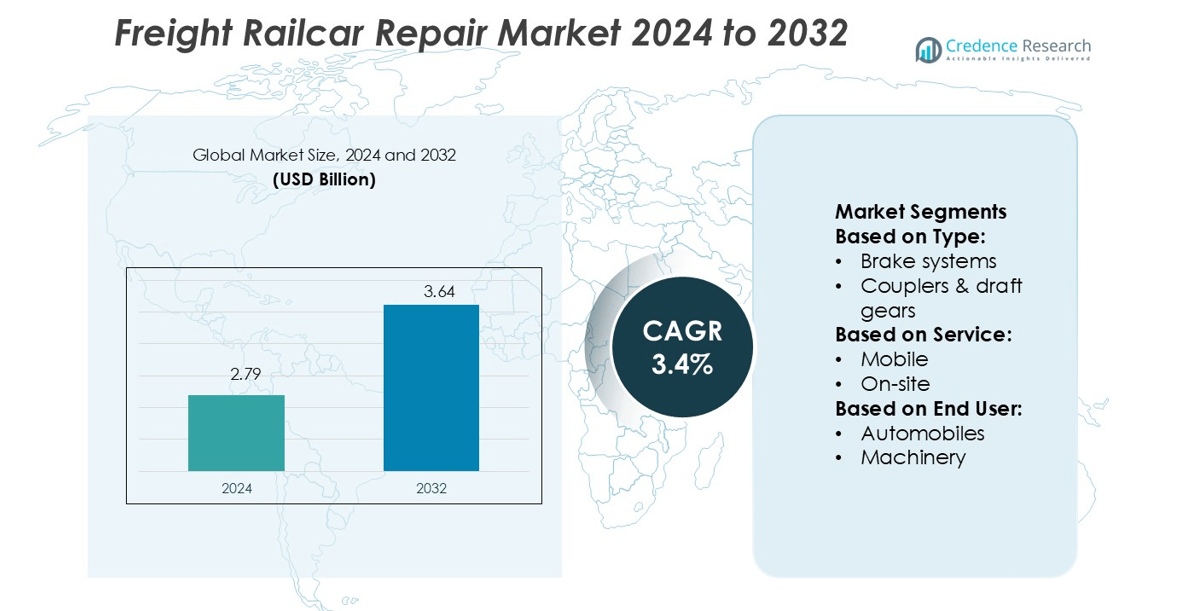
Freight Railcar Repair Market size was valued USD 2.79 billion in 2024 and is anticipated to reach USD 3.64 billion by 2032, at a CAGR of 3.4% during the forecast period.
| REPORT ATTRIBUTE | DETAILS |
|---|---|
| Historical Period | 2020-2023 |
| Base Year | 2024 |
| Forecast Period | 2025-2032 |
| Freight Railcar Repair Market Size 2024 | USD 2.79 billion |
| Freight Railcar Repair Market, CAGR | 3.4% |
| Freight Railcar Repair Market Size 2032 | USD 3.64 billion |
The Freight Railcar Repair Market is driven by prominent players such as Union Tank Car Company (UTLX), Trinity Industries, Siemens, The Greenbrier Companies, Cathcart Rail, Wabtec Corporation, Watco Companies, TTX, Alstom, and Progress Rail. These companies lead through advanced maintenance technologies, digital diagnostics, and strategic partnerships with major freight operators. Their focus on predictive maintenance, component modernization, and eco-friendly repair practices strengthens market competitiveness. North America dominates the market with a 36% share, supported by a large aging fleet, strict safety regulations, and extensive freight infrastructure. The region’s strong investment in mobile repair services and IoT-based monitoring further reinforces its leadership position.
Market Insights
- The Freight Railcar Repair Market was valued at USD 2.79 billion in 2024 and is projected to reach USD 3.64 billion by 2032, growing at a CAGR of 3.4%.
- Rising demand for predictive maintenance and fleet modernization is driving the market, supported by increasing regulatory requirements for safety and operational reliability.
- Digital diagnostics, IoT-based monitoring, and mobile repair solutions are shaping key market trends, improving repair turnaround times and reducing costs.
- Strong competition among leading players is driving technological innovation, while high capital intensity and skilled labor shortages act as restraints.
- North America leads the market with a 36% share, followed by Europe at 27% and Asia Pacific at 24%, with the mechanical repair segment dominating due to its critical role in fleet performance.
Market Segmentation Analysis:
By Type
The mechanical segment dominates the Freight Railcar Repair Market with the highest market share. Mechanical components require frequent maintenance to ensure railcar reliability and operational safety. Regular inspections of structural integrity and frame alignment drive consistent demand in this segment. Rising freight volumes and extended service life of railcars further increase repair frequency. Investments in precision repair tools and advanced welding technologies improve repair turnaround time and reduce downtime. This segment benefits from regulatory mandates on railcar safety standards, encouraging scheduled maintenance programs and modernization of existing fleets.
- For instance, Siemens introduced its Industrial Copilot for Operations running on its Xcelerator platform and NVIDIA GPUs maintenance time reduction figure of 30% is likely outdated, as more recent pilot data indicates a 25% average reduction.
By Service
The on-site service segment holds the largest share in the market. Rail operators prefer on-site repairs to minimize railcar movement, reduce costs, and limit operational disruptions. On-site servicing improves fleet availability and speeds up turnaround for time-sensitive freight operations. Mobile workshops and specialized service teams allow railcars to be serviced at depots or yards. This flexibility helps operators maintain schedules and meet safety compliance. Growing adoption of predictive maintenance tools supports on-site efficiency, as technicians can address issues before failures occur, boosting service reliability.
- For instance, The Greenbrier Companies, a member of the RailPulse coalition since 2021, manages approximately 450,000 railcars through its services network.
By End User
The automobile sector leads the market among end users. High shipment volumes and strict delivery timelines create strong demand for timely railcar repairs in this segment. Automakers rely on freight rail for cost-efficient bulk transport of vehicles and components. Any downtime affects supply chain continuity and delivery performance. Preventive repair and scheduled overhauls ensure minimal disruption to logistics operations. Additionally, growth in electric vehicle manufacturing and intermodal freight movement increases reliance on well-maintained railcar fleets, reinforcing demand for frequent and efficient repair services.
Key Growth Drivers
Rising Freight Demand
The rapid expansion of logistics and supply chain networks is increasing freight traffic, boosting demand for freight railcar repair. Industrial goods, agricultural commodities, and energy products rely heavily on rail transport. Frequent use leads to accelerated wear of brake systems, bearings, and wheelsets, driving regular maintenance cycles. Fleet operators prioritize repair services to maintain regulatory compliance and reduce downtime. This trend is supported by growing rail freight volumes across North America and Europe, where rail infrastructure remains critical to bulk transportation efficiency.
- For instance, Wabtec deployed a pantograph auto-drop device produced via additive manufacturing that cut component weight by 70 % and halved production time-leveraging Nikon SLM AM technology.
Stringent Safety and Regulatory Standards
Global transportation authorities are enforcing stricter safety and maintenance regulations for freight railcars. These rules require periodic inspections, certified component replacements, and system upgrades to meet operational standards. Non-compliance can lead to severe penalties or service interruptions, pushing operators to invest in repair services. Safety-driven regulations particularly impact critical components such as pneumatic systems, couplers, and wheels. This regulatory push not only ensures operational safety but also creates stable demand for certified repair providers, strengthening market growth.
- For instance, TugVolt system-as stated by Intramotev-has already moved over 250,000 tons and delivered more than 3,500 car-loads in production service.
Aging Railcar Fleet Replacement and Modernization
A large portion of the global freight railcar fleet is aging, requiring frequent repairs and modernization. Older cars need structural upgrades and component replacements to extend service life and comply with updated safety norms. Rail operators are prioritizing retrofit programs to enhance performance and reduce lifecycle costs. This driver is most visible in North America and Europe, where many fleets exceed 25 years of operation. Investments in modernization reduce replacement costs and increase repair service demand.
Key Trends & Opportunities
Digitalization of Maintenance Operations
Rail operators are adopting predictive maintenance systems using IoT and AI technologies. Real-time data from sensors monitors components like axles, brake systems, and bearings to identify faults early. This approach improves repair scheduling and reduces unplanned downtime. Digital platforms also help optimize inventory for spare parts, increasing operational efficiency. The trend creates new opportunities for repair service providers that integrate digital tools and offer advanced diagnostics, boosting competitiveness in the market.
- For instance, TTX began deploying GPS and sensor devices in 2023 on approximately 1,700 boxcars equipped, 1,000 were outfitted with multi-sensor suites designed to monitor impact, door/hatch status, empty/load status, and handbrake position.
Expansion of Mobile and On-Site Repair Services
Mobile and on-site repair services are gaining traction due to their ability to reduce turnaround time. Instead of transporting damaged cars to workshops, operators receive maintenance directly at terminals or sidings. This approach cuts costs and increases operational uptime for freight carriers. Mobile repair units equipped with advanced diagnostic tools and skilled personnel are becoming common across major freight corridors. Companies offering flexible service models gain a competitive edge in contract bids.
- For instance, Progress Rail markets and sells the company states that the system's performance is based on monitoring more than 300,000 batteries across over 75,000 sites.
Growing Investments in Green Rail Infrastructure
Sustainability goals are shaping rail infrastructure investments, creating new repair service opportunities. Many operators are adopting energy-efficient technologies and lightweight materials to lower emissions. Green retrofits require specialized repair capabilities to handle new materials and eco-friendly braking systems. Government incentives supporting low-emission freight transport amplify this trend. Service providers that align with these sustainability goals can secure long-term contracts with major freight operators.
Key Challenges
High Capital Intensity and Skilled Labor Shortage
Freight railcar repair requires advanced equipment, specialized tools, and skilled technicians. Setting up certified facilities involves high capital investment, which restricts market entry for smaller players. In addition, a shortage of skilled labor, particularly in welding, braking systems, and pneumatic components, increases operational costs and delays repair timelines. This gap impacts service capacity and limits scalability for repair providers.
Volatile Freight Volumes and Economic Cycles
The demand for railcar repair services fluctuates with economic cycles and freight volumes. During downturns, freight activity declines, leading to deferred maintenance and lower service demand. Market uncertainty affects investment in repair infrastructure and capacity expansion. This volatility poses challenges for service providers in maintaining stable revenue streams and long-term planning. Operators often reduce repair frequency in slow periods, further impacting profitability.
Regional Analysis
North America
North America holds a 36% share of the freight railcar repair market, supported by its extensive rail infrastructure and high freight volumes. The U.S. and Canada lead in demand due to large fleets of aging railcars and strict regulatory maintenance standards. Increased commodity transport drives frequent repairs of wheels, brake systems, and couplers. Key repair hubs in Illinois, Texas, and Ontario offer advanced maintenance facilities with digital diagnostic capabilities. Investments in predictive maintenance and mobile repair units enhance operational efficiency. Strong government oversight and continuous infrastructure modernization further strengthen North America’s dominant market position.
Europe
Europe accounts for 27% of the market share, driven by well-established freight rail networks and safety regulations. Countries like Germany, France, and the U.K. emphasize periodic inspection programs and certified repair facilities. The region is adopting digital maintenance solutions and eco-friendly retrofits to meet emission targets. Aging rolling stock and increased intermodal freight traffic create steady demand for component overhauls and structural repairs. Government funding for sustainable rail transport supports service providers offering modernized maintenance. The region’s strong regulatory framework and push for green freight operations make it a key contributor to global repair service growth.
Asia Pacific
Asia Pacific holds 24% of the market share, with China, India, and Australia driving growth. Rapid industrialization and rising bulk freight movement create strong demand for railcar repair services. Expanding rail infrastructure and large-scale fleet modernization programs increase the need for scheduled maintenance. The region is adopting predictive maintenance technologies to reduce downtime and improve operational reliability. Governments are investing heavily in rail logistics to support economic growth, boosting service opportunities. Emerging third-party maintenance providers and growing private investments are expanding repair capacity across major freight corridors, strengthening Asia Pacific’s competitive position.
Latin America
Latin America represents 7% of the market share, supported by growing mineral and agricultural freight activity. Brazil, Mexico, and Argentina are key contributors, with expanding rail infrastructure driving maintenance demand. The region focuses on upgrading older railcar fleets to meet international safety standards. However, repair capacity remains concentrated in a few hubs, limiting service coverage. Investments in mobile and on-site maintenance are improving operational flexibility. Economic reforms supporting private participation in freight rail are creating opportunities for service providers. Steady growth in bulk commodity exports is expected to strengthen the repair market in the region.
Middle East & Africa
The Middle East & Africa account for 6% of the market share, with demand growing due to expanding freight corridors and infrastructure projects. Countries like Saudi Arabia, South Africa, and the UAE are investing in rail modernization and maintenance facilities. The market focuses on repairing and upgrading tank cars, hoppers, and flatcars used in industrial transport. Limited local repair expertise creates opportunities for international service providers. Increased cross-border trade and government investment in logistics infrastructure drive future growth. Gradual adoption of predictive maintenance technologies is expected to enhance service efficiency and regional competitiveness.Top of FormBottom of Form
Market Segmentations:
By Type:
- Brake systems
- Couplers & draft gears
By Service:
- Mobile
- On-site
By End User:
- Automobiles
- Machinery
By Geography
- North America
- U.S.
- Canada
- Mexico
- Europe
- Germany
- France
- U.K.
- Italy
- Spain
- Rest of Europe
- Asia Pacific
- China
- Japan
- India
- South Korea
- South-east Asia
- Rest of Asia Pacific
- Latin America
- Brazil
- Argentina
- Rest of Latin America
- Middle East & Africa
- GCC Countries
- South Africa
- Rest of the Middle East and Africa
Competitive Landscape
The Freight Railcar Repair Market is shaped by key players such as Union Tank Car Company (UTLX), Trinity Industries, Siemens, The Greenbrier Companies, Cathcart Rail, Wabtec Corporation, Watco Companies, TTX, Alstom, and Progress Rail. The Freight Railcar Repair Market is defined by strong technological integration, service expansion, and regulatory compliance. Companies are prioritizing digital maintenance solutions, including IoT-based monitoring and predictive diagnostics, to minimize downtime and extend fleet life cycles. Many service providers are expanding mobile and on-site repair capabilities to deliver faster turnaround times and reduce operational costs. Focus on sustainable practices and advanced component repair strengthens long-term competitiveness. Continuous investments in skilled labor, automation, and certified facilities enable efficient, high-quality services. Strategic collaborations with freight operators and logistics networks further reinforce market presence and customer loyalty.
Key Player Analysis
- Union Tank Car Company (UTLX)
- Trinity Industries
- Siemens
- The Greenbrier Companies
- Cathcart Rail
- Wabtec Corporation
- Watco Companies
- TTX
- Alstom
- Progress Rail
Recent Developments
- In February 2025, CRRC signed a contract to supply freight railcars for Hafeet Rail. This project will strengthen logistics links between the UAE and Oman, improving rail transport efficiency reported by the railway transport news portal railway supply.
- In January 2025, Union Tank Car Company announced a strategic partnership to serve railcar owners and shippers. Conveniently located on the South-side of the Houston Ship Channel, the collaboration between the two companies will consist of UTLX providing railcar cleaning and repair services at 225 Rail’s 1,000 railcar storage terminal in Pasadena, TX.
- In October 2024, Genesee & Wyoming Inc. announced that its previously proposed transaction to partner with Grupo México Transports (GMXT) as owners of CG Railway, LLC closed. As part of this transaction, G&W now independently owns Central Gulf Railcar Services (CGRS), a railcar repair shop located in Mobile, Alabama.
- In December 2023, Wabtec announced its entrance into the railcar telematics market via an agreement with Intermodal Telematics B.V., a Dutch company, under which Wabtec will create a railcar telematics platform using IMT technology. Wabtec’s new railcar telematics platform will deliver real-time information to railcar and tank container owners and operators, allowing them to turn rail cargo into smart, connected assets.
Report Coverage
The research report offers an in-depth analysis based on Type, Service, End-User and Geography. It details leading market players, providing an overview of their business, product offerings, investments, revenue streams, and key applications. Additionally, the report includes insights into the competitive environment, SWOT analysis, current market trends, as well as the primary drivers and constraints. Furthermore, it discusses various factors that have driven market expansion in recent years. The report also explores market dynamics, regulatory scenarios, and technological advancements that are shaping the industry. It assesses the impact of external factors and global economic changes on market growth. Lastly, it provides strategic recommendations for new entrants and established companies to navigate the complexities of the market.
Future Outlook
- Demand for predictive maintenance solutions will increase to reduce repair downtime.
- Adoption of digital monitoring tools will enhance fleet performance and service planning.
- Mobile and on-site repair services will expand across major freight corridors.
- Aging railcar fleets will drive consistent demand for structural and component repairs.
- Investment in skilled labor and advanced repair facilities will grow steadily.
- Regulatory compliance will continue to shape maintenance strategies and service standards.
- Sustainability initiatives will push operators to adopt eco-friendly repair practices.
- Partnerships between rail operators and service providers will strengthen market reach.
- Integration of automation and AI will improve repair precision and efficiency.
- Emerging economies will become key growth markets due to expanding freight networks.

Request a Free Sample
Fill in your details and we'll send you a free sample report.
- Sample data tables & charts
- Research methodology
Need a Custom Version of This Report?
Tailor the scope, geography, or segments to your exact requirements.
- Custom geography or segment scope
- Direct access to our analyst team
Frequently Asked Questions
What is the current market size for the Freight Railcar Repair Market, and what is its projected size in 2032?
At what Compound Annual Growth Rate is the Freight Railcar Repair Market projected to grow between 2025 and 2032?
Which Freight Railcar Repair Market segment held the largest share in 2024?
What are the primary factors fueling the growth of the Freight Railcar Repair Market?
Who are the leading companies in the Freight Railcar Repair Market?
Table of Content
Chapter 1 Market Segmentation
- 1.1 Segmentation Framework
- 1.1.1 Product and Service Classification
- 1.1.2 Application and End-Use Classification
- 1.1.3 Technology and Solution Classification
- 1.1.4 Customer and Distribution Channel Classification
- 1.1.5 Geographic Segmentation
- 1.1.6 Market Segment Definitions and Boundaries
Chapter 2 Introduction
- 2.1 Report Objectives and Scope
- 2.2 Product Definition and Industry Terminology
- 2.3 Market Inclusions and Exclusions
- 2.4 Research Process
- 2.4.1 Primary Research and Expert Interviews
- 2.4.2 Secondary Research and Source Review
- 2.4.3 Top-Down and Bottom-Up Estimation
- 2.4.4 Data Triangulation and Verification
- 2.5 Market Size Measurement Basis
- 2.5.1 2024: USD 2.79 billion → 2032: USD 3.64 billion
- 2.6 Historical and Forecast Reference Periods
- 2.6.1 Base Year: 2024
- 2.6.2 Forecast Period: 2024-2032
- 2.7 Research Assumptions and Limitations
Chapter 3 Executive Summary
- 3.1 Market Snapshot and Key Findings
- 3.2 Base-Year Market Size, 2024
- 3.3 Forecast Market Size, 2032
- 3.4 Revenue and Volume Growth Outlook
- 3.5 Key Demand and Supply Indicators
- 3.6 Leading Market Segments
- 3.7 Fastest-Growing Market Opportunities
- 3.8 Regional Performance Highlights
- 3.9 Technology and Industry Transformation
- 3.10 Competitive Landscape Summary
- 3.11 Analyst View and Strategic Implications
Chapter 4 Global Freight Railcar Repair Market Trends and Developments
- 4.1 Historical Industry Development
- 4.2 Recent Market Trends and Developments
- 4.3 Demand and Customer Behavior Trends
- 4.4 Technology and Product Innovation
- 4.5 Artificial Intelligence, Automation and Digitalization
- 4.6 Local Manufacturing and Supply Chain Realignment
- 4.7 Industry Partnerships, Mergers and Acquisitions
- 4.8 Sustainability and Circular Economy Developments
- 4.9 Government and Private Sector Investment Trends
- 4.10 Emerging Business Models and Commercialization
- 4.11 Industry Developments and Announcements
Chapter 5 Global Freight Railcar Repair Market Production, Supply and Demand Analysis
- 5.1 Demand Trend and Consumption Analysis
- 5.2 Demand Forecast, 2024-2032
- 5.3 Production and Output Trend
- 5.4 Production and Output Forecast, 2024-2032
- 5.5 Installed Capacity and Capacity Utilization
- 5.6 Company-Wise Production Plants and Statistics
- 5.6.1 Installed Production Capacity
- 5.6.2 Actual Production
- 5.6.3 Planned Capacity and Expansion Targets
- 5.7 Supply Chain Structure and Procurement Trends
- 5.8 Supply-Demand Gap and Bottlenecks
- 5.9 Import Dependence and Sourcing Structure
- 5.10 Contract Manufacturing and Outsourcing
- 5.11 Regional Supply and Demand Concentration
Chapter 6 Global Freight Railcar Repair Market Pricing Analysis
- 6.1 Pricing Structure and Measurement
- 6.2 Historical Pricing Trends
- 6.3 Pricing Outlook, 2024-2032
- 6.4 Average Selling Price and Unit Economics
- 6.5 Pricing by Product and Market Segment
- 6.6 Geographic Pricing Differences
- 6.7 Key Input, Energy, Labor and Logistics Costs
- 6.8 Contract Pricing and Purchasing Models
- 6.9 Pricing Sensitivity and Competitive Positioning
- 6.10 Price, Margin and Profitability Implications
Chapter 7 Global Freight Railcar Repair Market Dynamics
- 7.1 Market Growth Drivers
- 7.1.1 Demand-Side Drivers
- 7.1.2 Technology and Innovation Drivers
- 7.1.3 Infrastructure and Investment Drivers
- 7.1.4 Regulatory and Policy Drivers
- 7.2 Market Restraints
- 7.2.1 Cost and Affordability Constraints
- 7.2.2 Technology and Adoption Barriers
- 7.2.3 Supply Chain and Operational Constraints
- 7.3 Market Challenges
- 7.3.1 Competitive Pressure and Margin Erosion
- 7.3.2 Skills, Infrastructure and Implementation Gaps
- 7.4 Emerging Market Opportunities
- 7.5 Market Dynamics Impact and Time-Horizon Assessment
Chapter 8 Global Freight Railcar Repair Value Chain Analysis
- 8.1 Industry Value Chain Overview
- 8.2 Upstream Suppliers and Critical Inputs
- 8.3 Technology and Component Providers
- 8.4 Manufacturing or Service Delivery
- 8.5 Distribution, Channel Partners and Integrators
- 8.6 Downstream Applications and End Users
- 8.7 Value Addition and Profit Pools
- 8.8 Vertical Integration and Outsourcing
- 8.9 Supplier Concentration and Risk
- 8.10 Supply Chain Localization and Resilience
Chapter 9 Global Freight Railcar Repair Market Regulations and Policies
- 9.1 Relevant Laws, Standards and Compliance Frameworks
- 9.2 Product, Service, Safety and Quality Requirements
- 9.3 Government Policies, Incentives and Subsidies
- 9.4 Imports, Exports and Trade Barriers
- 9.5 Public Procurement and Local Content Requirements
- 9.6 Environmental and Sustainability Compliance
- 9.7 Upcoming Policy Changes and Market Implications
Chapter 10 Global Freight Railcar Repair Market Hotspots and Opportunities
- 10.1 Market Opportunity Mapping and Growth Hotspots
- 10.2 High-Growth Applications and Customer Groups
- 10.3 Underserved Markets and White-Space Opportunities
- 10.4 Emerging Technology and Product Opportunities
- 10.5 New Capacity and Investment Hotspots
- 10.6 Market Entry and Expansion Opportunities
- 10.7 Distribution and Partnership Opportunities
- 10.8 Near-Term and Long-Term Commercial Potential
- 10.9 Opportunity Attractiveness and Execution Risks
Chapter 11 Global Freight Railcar Repair Market Outlook, 2024-2032
- 11.1 Market Size and Analysis
- 11.1.1 Revenue (Market Measurement: 2024: USD 2.79 billion → 2032: USD 3.64 billion)
- 11.1.2 Market Volume and Quantity Sold
- 11.1.3 Historical Market Size
- 11.1.4 Base-Year Market Size, 2024
- 11.2 Market Forecast, 2024-2032
- 11.2.1 Revenue Forecast to 2032
- 11.2.2 Volume Forecast to 2032
- 11.2.3 CAGR and Year-on-Year Growth
- 11.2.4 Incremental Revenue Opportunity
- 11.3 Forecast Assumptions and Scenario Analysis
- 11.3.1 Base-Case Forecast
- 11.3.2 Optimistic and Conservative Scenarios
- 11.3.3 Technology, Pricing and Policy Sensitivities
- 11.4 Market Attractiveness and Growth Outlook
Chapter 12 Global Freight Railcar Repair Market Segmentation and Outlook
- 12.1 Segmentation Summary and Market Shares, 2024
- 12.2 Largest and Fastest-Growing Segments
- 12.3 Segment Growth Comparison
- 12.4 Segment Attractiveness and Priority Matrix
Chapter 13 Global Freight Railcar Repair Geographic Market Outlook, 2024-2032
- 13.1 Regional Market Size and Share, 2024
- 13.2 Regional Market Forecast, 2024-2032
- 13.3 Regional Pricing, Production and Demand Differences
- 13.4 North America
- 13.4.1 United States
- 13.4.2 Canada
- 13.4.3 Mexico
- 13.5 Europe
- 13.5.1 Germany
- 13.5.2 France
- 13.5.3 Italy
- 13.5.4 United Kingdom
- 13.5.5 Spain
- 13.5.6 Poland
- 13.5.7 Russia
- 13.5.8 Netherlands
- 13.5.9 Belgium
- 13.5.10 Sweden
- 13.5.11 Denmark
- 13.5.12 Norway
- 13.5.13 Rest of Europe
- 13.6 Asia Pacific
- 13.6.1 China
- 13.6.2 India
- 13.6.3 Japan
- 13.6.4 South Korea
- 13.6.5 Thailand
- 13.6.6 Indonesia
- 13.6.7 Vietnam
- 13.6.8 Malaysia
- 13.6.9 Australia
- 13.6.10 Rest of Asia Pacific
- 13.7 Latin America
- 13.7.1 Brazil
- 13.7.2 Argentina
- 13.7.3 Colombia
- 13.7.4 Chile
- 13.7.5 Rest of Latin America
- 13.8 Middle East
- 13.8.1 Saudi Arabia
- 13.8.2 United Arab Emirates
- 13.8.3 Turkey
- 13.8.4 Israel
- 13.8.5 Iran
- 13.8.6 Rest of the Middle East
- 13.9 Africa
- 13.9.1 South Africa
- 13.9.2 Egypt
- 13.9.3 Nigeria
- 13.9.4 Morocco
- 13.9.5 Rest of Africa
- 13.10 Regional Investment, Policy and Supply Chain Differences
- 13.11 Regional Competitive Landscape
- 13.12 Geographic Growth Hotspots
Chapter 14 Global Freight Railcar Repair Technology, Innovation and Sustainability Outlook
- 14.1 Technology Landscape and Maturity
- 14.2 Product, Process and Service Innovation
- 14.3 AI, Automation and Digital Tools in the Industry
- 14.4 Technology Adoption and Performance Benchmarking
- 14.5 Innovation Pipeline and R&D Investment
- 14.6 Patent and Intellectual Property Trends
- 14.7 Energy Efficiency and Resource Management
- 14.8 Sustainability, Recycling and Circularity
- 14.9 Technology Roadmap, 2024-2032
- 14.10 Risks of Obsolescence and Technology Substitution
Chapter 15 Global Freight Railcar Repair Market Key Strategic Imperatives
- 15.1 Growth and Market Entry Priorities
- 15.2 High-Return Products and Segments
- 15.3 Pricing, Profitability and Cost Optimization
- 15.4 Technology Investment and Product Differentiation
- 15.5 Supply Chain Localization and Resilience
- 15.6 Distribution and Customer Acquisition
- 15.7 Partnership, Acquisition and Capacity Strategy
- 15.8 Regional Expansion Priorities
- 15.9 Short-, Medium- and Long-Term Actions
Chapter 16 Competition Outlook
- 16.1 Industry Competition Characteristics
- 16.2 Market Structure and Concentration
- 16.3 Market Share and Competitive Positioning, 2024
- 16.4 Company-Wise Revenue and Product Benchmarking
- 16.5 Production and Service Capacity Benchmarking
- 16.6 Technology, Pricing and Differentiation
- 16.7 Regional Footprint and Distribution Strength
- 16.8 Mergers, Acquisitions and Strategic Alliances
- 16.9 New Entrants and Competitive Threats
- 16.10 Porter's Five Forces and Industry Attractiveness
- 16.11 Competitive Outlook, 2024-2032
Chapter 17 Company Profiles
- 17.1 Company Coverage and Selection Criteria
- 17.2 Leading Market Participants – Standard Profile Structure
- 17.2.1 Business Description
- 17.2.2 Company Ownership and Geographic Presence
- 17.2.3 Product and Service Portfolio
- 17.2.4 Manufacturing and Operating Footprint
- 17.2.5 Production Capacity and Expansion Plans
- 17.2.6 Financial Performance and Investment
- 17.2.7 Market Share and Competitive Position
- 17.2.8 Technology and Innovation Capabilities
- 17.2.9 Strategic Alliances or Partnerships
- 17.2.10 Recent Developments
- 17.2.11 Growth Strategy and Outlook
- 17.3 Other Relevant Market Participants
Note: Every listed company is profiled on the structure shown under the first company. The company list is preliminary and may change based on research findings, market developments, data availability and client requirements.
Chapter 18 Disclaimer
- 18.1 Research and Forecast Disclaimer
- 18.2 Data Source and Estimation Limitations
Note: The depth of individual sections depends on data availability for this market. Volume, capacity, trade and other unit-based metrics are included where applicable.