
Layered flatbreads move from home kitchens into freezers
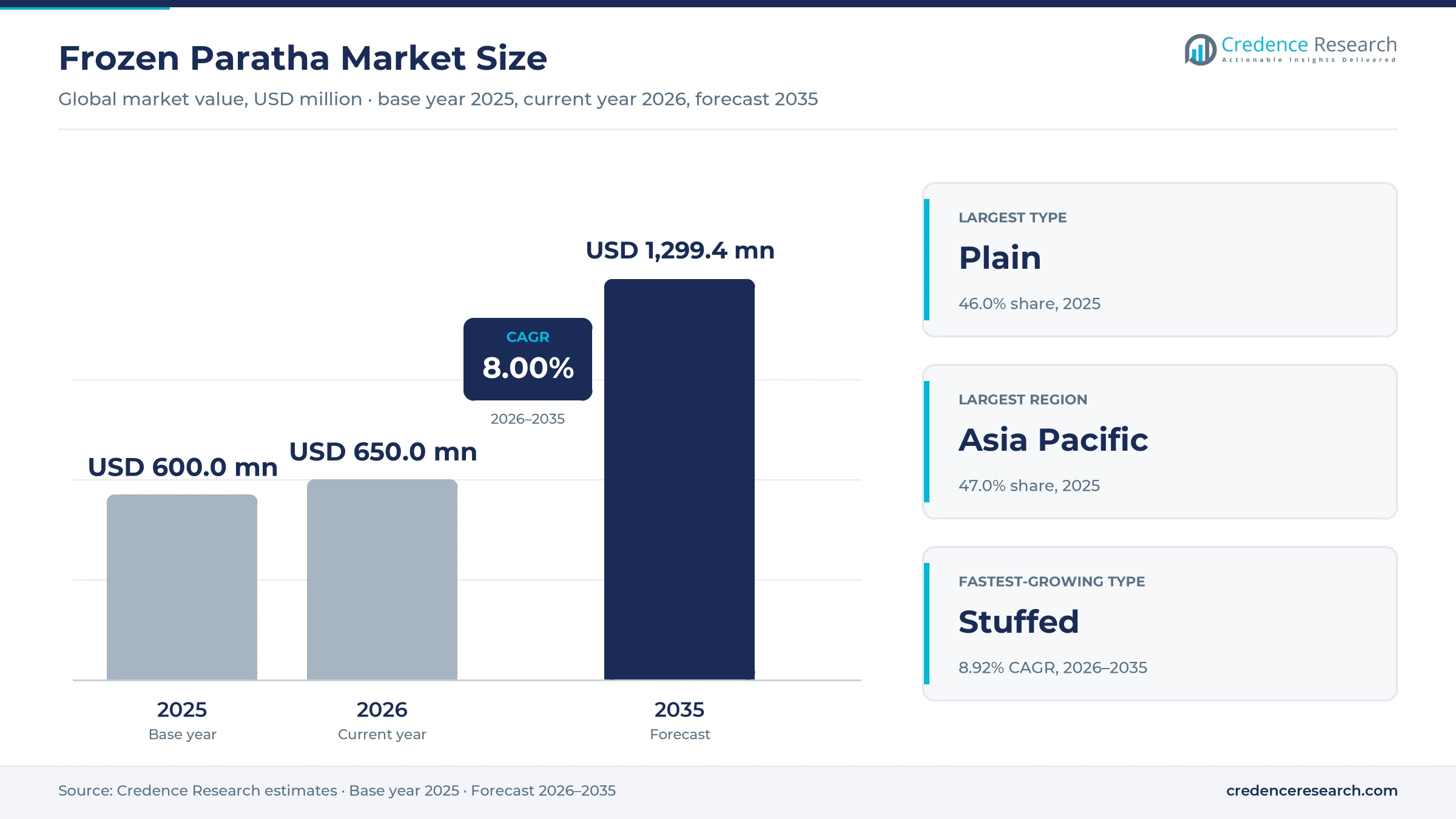
The global frozen paratha market was valued at USD 600.0 million in 2025 and is projected to increase from USD 650.0 million in 2026 to USD 1.30 billion by 2035, registering a CAGR of 8.00% during 2026–2035. Demand comes from South Asian and Southeast Asian families abroad, from dual-income households in Indian metros and from restaurants that want consistent layered bread without skilled dough staff. Asia Pacific held the largest regional share, 47.0% in 2025, because Malaysian, Indian and Bangladeshi plants supply both home shelves and export orders. Middle East & Africa is the fastest-growing region at 8.74% a year, as Gulf retailers add Malabar and chapati lines for large resident South Asian communities. The main commercial change is format innovation, since brands now sell parathas that cook in three minutes in a toaster, air fryer or combi oven. Trade policy also matters more than before, because United States tariff moves in 2025 and 2026 changed export volumes for leading Asian suppliers.
What does the frozen paratha market include?
The report counts the value of par-cooked or raw laminated wheat flatbreads that are frozen and sold for cooking at home or in kitchens, including plain, flaky lachha or Malabar, and stuffed varieties such as aloo, paneer and keema. It covers branded and store-brand packs sold through supermarkets, ethnic grocers and online platforms, plus bulk packs for hotels, caterers and restaurants.
The estimate excludes chilled or ambient flatbreads, fresh parathas made in restaurants, frozen naan sold on its own and frozen ready meals in which bread is only a side item. The value chain runs from flour millers and fat suppliers through dough lamination plants, cold stores and importers to retailers, foodservice distributors and the households and kitchens that cook the product.
Frozen Paratha Market Insights
- The frozen paratha market reached USD 600.0 million in 2025 and is projected to rise to USD 1.30 billion by 2035, growing at an 8.00% CAGR during 2026–2035.
- Asia Pacific held 47.0% of global frozen paratha value in 2025, because Malaysian, Indian and Bangladeshi plants serve both home and export demand.
- Plain parathas led the type segment with 46.0% of 2025 value, while retail led channels with 58.0% of frozen paratha sales.
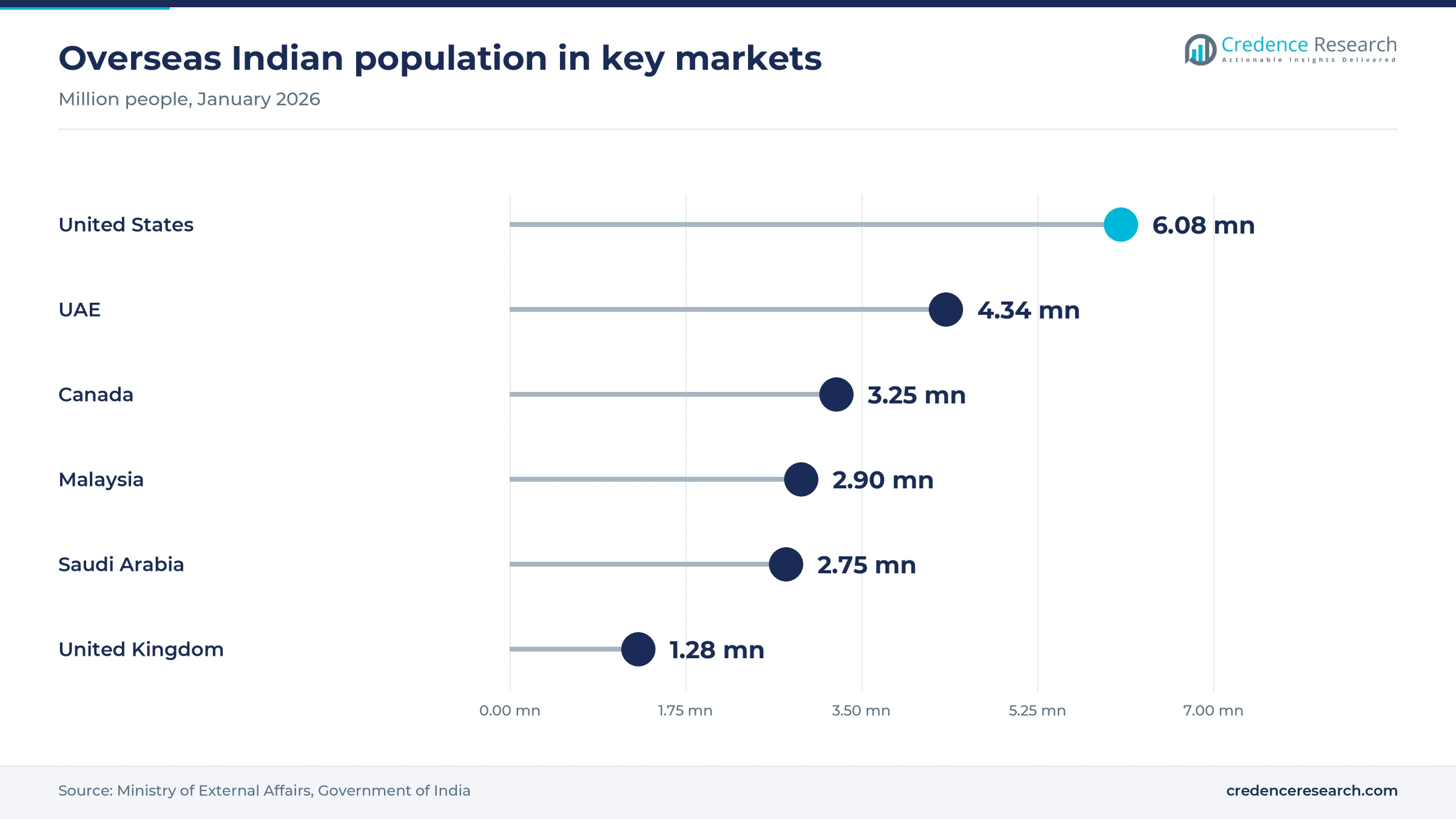
- India’s Ministry of External Affairs counted 6.08 million overseas Indians in the United States and 4.34 million in the UAE as of January 2026.
- Kawan Food says its plants can make nearly 2,800 flatbreads a minute and that its parathas reach about 40 countries with custom certificates.
Plain packs lead while stuffed variants grow fastest
Why do plain parathas hold the largest share?
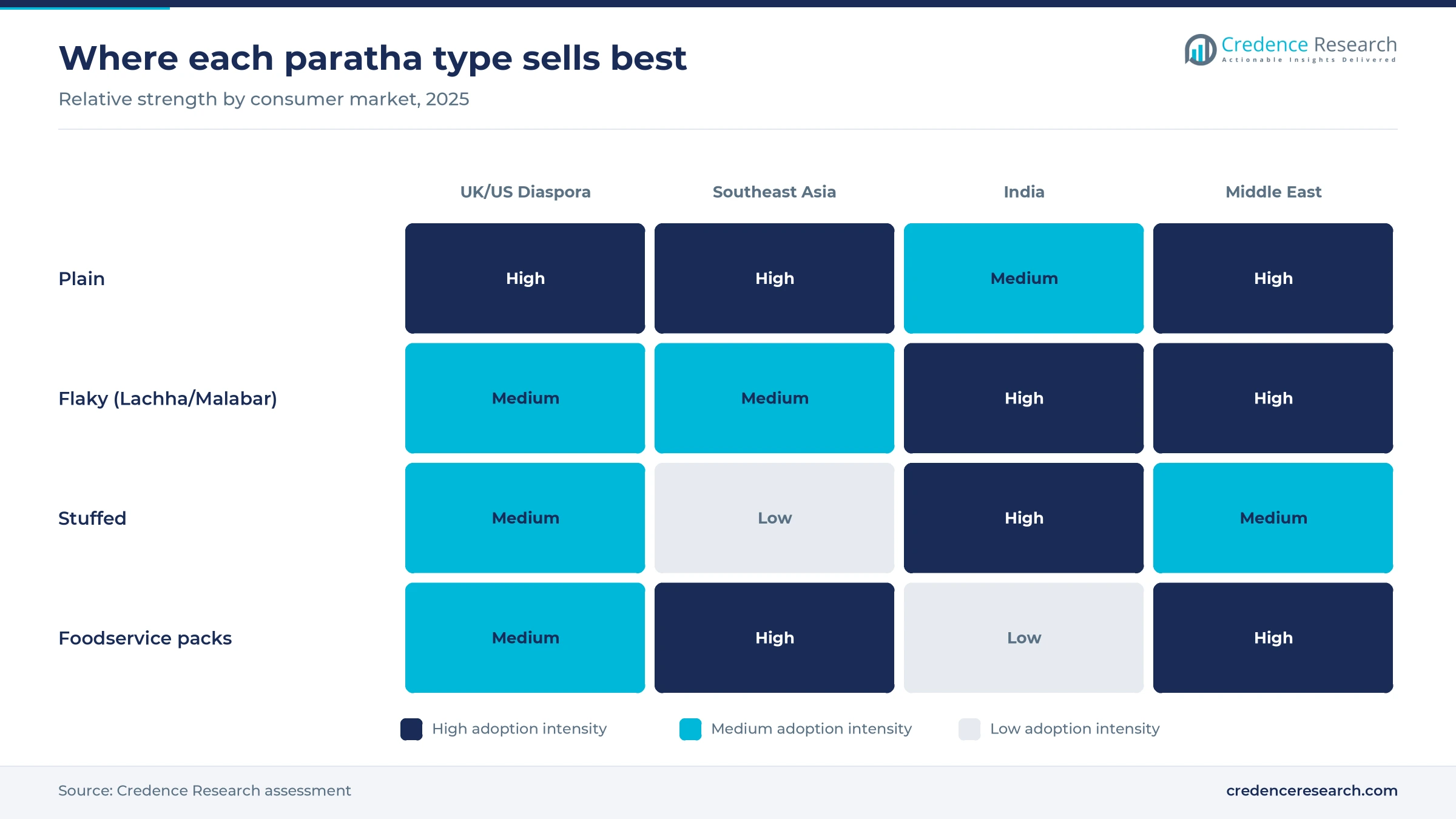
Based on type, the market is categorized into plain, flaky (lachha/Malabar) and stuffed parathas. Plain led with 46.0% of 2025 value because the plain round is the everyday bread that diaspora families buy in large family packs. Tesco sells a Humza 1.6 kg pack of about 20 plain parathas for £4.00, or £2.50 per kg, produced in Bangladesh. Stuffed parathas grow fastest at 8.92% a year, as brands add filled lines. ITC launched aloo and paneer parathas in seven Indian cities on May 18, 2023, and Taj Foods listed aloo, mix veg and muli parathas in December 2025.
Why does retail lead while foodservice grows fastest?
Based on channel, the market is categorized into retail, foodservice and export. Retail led with 58.0% of 2025 value because supermarkets, ethnic grocers and quick-delivery apps carry the consumer packs that most households buy. Carrefour UAE lists a 400 g Al Kabeer Malabar paratha made in India at AED 7.89, which shows how imported packs reach Gulf shelves. Foodservice grows fastest at 8.79% a year, as kitchens replace hand rolling with frozen stock. Kawan Food offers reduced-sodium, organic-flour and market-specific sizes for commercial kitchens, and the Malaysian Investment Development Authority notes that its roti paratha is served on the menu at Disneyland Japan.
Why do U.K. and U.S. diaspora buyers lead consumption?
Based on consumer market, the market is categorized into U.K./U.S. diaspora, Southeast Asia, India, the Middle East and others. U.K./U.S. Diaspora buyers led with 30.0% of 2025 value because large South Asian communities pay Western shelf prices. Census 2021 counted 1.86 million Indian, 1.59 million Pakistani and 0.64 million Bangladeshi residents in England and Wales, according to the Office for National Statistics. India grows fastest at 8.96% a year, as metro households adopt freezer bread. ITC sells its frozen parathas through Blinkit, Zepto, BigBasket and Swiggy Instamart at Rs 150 to Rs 250 a pack.
| Segment Group | Leading Sub-segment | Share, 2025 | Fastest-growing Sub-segment | CAGR, 2026–2035 |
|---|---|---|---|---|
| By Type | Plain | 46.0% | Stuffed | 8.92% |
| By Channel | Retail | 58.0% | Foodservice | 8.79% |
| By Consumer Market | U.K./U.S. Diaspora | 30.0% | India | 8.96% |
Request a Free Sample
Fill in your details and we'll send you a free sample report.
- Sample data tables & charts
- Research methodology
Diaspora demand and freezer aisles widen the buyer base
Diaspora and busy urban households buy frozen flatbreads
South Asian families abroad are the core buyers, because they want home-style bread without daily kneading and rolling. India’s Ministry of External Affairs counted 6.08 million overseas Indians in the United States, 4.34 million in the UAE and 2.75 million in Saudi Arabia as of January 2026. This base keeps growing, since the Pew Research Center reports that the Indian population in the United States rose 174% between 2000 and 2023 to about 4.9 million. Pakistani and Bangladeshi households add to that demand in Britain and the Gulf, and many buy frozen paratha alongside other ethnic foods. In the Credence Research model this driver adds about 2.96 percentage points to annual growth to 2035.
Retail freezer space widens ready-to-cook distribution
Wider freezer listings turn an ethnic-grocer item into a supermarket staple, and that change raises trial among new buyers. In India, ITC launched Aashirvaad frozen parathas on May 18, 2023, in Delhi, Mumbai, Bengaluru, Hyderabad, Kolkata, Chennai and Pune through its own store and five quick-commerce and e-commerce platforms. In Britain, Tesco stocks multiple frozen paratha brands, including a Humza family pack priced at £2.50 per kg. In the Gulf, Carrefour UAE sells Al Kabeer Malabar paratha at AED 19.73 per kg, so the product sits in mainstream hypermarket freezers. In the Credence Research model this driver adds about 2.16 percentage points to annual growth to 2035.
Foodservice and private-label ranges expand volumes
Restaurants, hotels and caterers buy frozen parathas to cut skilled labor, and store brands buy them to fill value tiers. Kawan Food states that its lines make nearly 2,800 flatbreads a minute, each 80 g piece is portioned to 22 cm, and the product keeps 24 months at minus 18 degrees Celsius. The same page lists reduced-sodium, organic-flour and market-specific sizing options, which suit private-label buyers. Contract packing is common too, since Tesco’s Humza pack is produced in Bangladesh for Surya Foods of Harwich. Foodservice is the fastest-growing channel at 8.79% a year in the Credence Research model. In the Credence Research model this driver adds about 1.60 percentage points to annual growth to 2035.
Halal certification and trade deals open export lanes
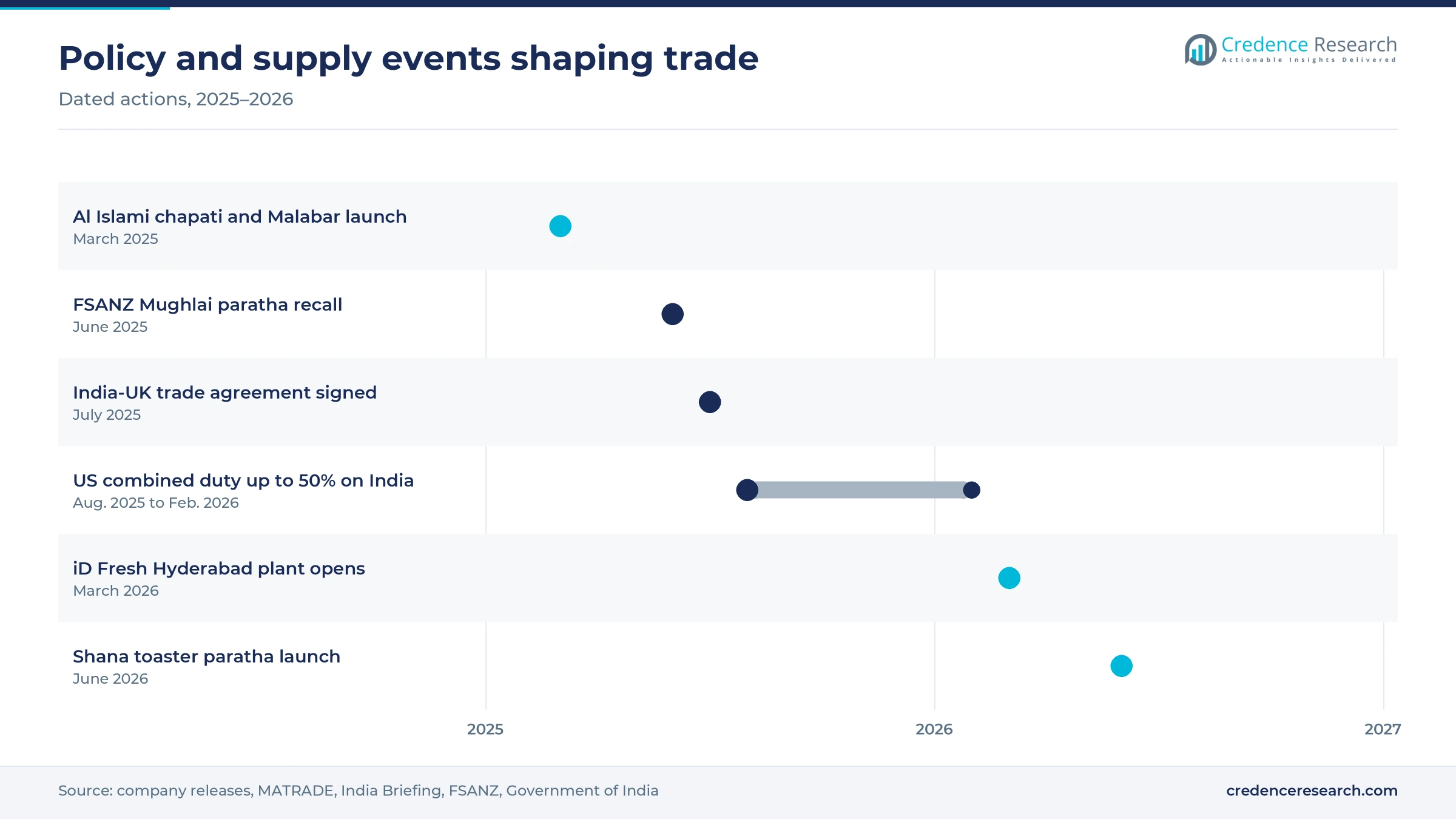
Export supply depends on halal and food-safety certificates, and recent trade agreements lower duty barriers for Asian producers. Kawan Food holds JAKIM halal, HACCP, ISO 22000 and BRCGS credentials, which buyers in the Gulf and Europe require. MATRADE reported on Oct. 3, 2025, that Malaysian processed food exports to Europe reached RM3.48 billion in 2024, up 70% from 2023. India and Britain signed a trade agreement on July 24, 2025, under which more than 95% of agricultural and processed food tariff lines, including ready-to-eat foods, face zero duty, according to ThePrint. India’s cabinet also approved a Rs 6,520 crore outlay for the Pradhan Mantri Kisan Sampada Yojana on July 31, 2025, including 100 accredited food testing labs.
Stuffed variants, toaster formats and Gulf shelf space
Shift toward stuffed and flaky premium variants
Brands are moving beyond the plain round toward filled and flaky lines that carry higher pack prices. ITC’s 2023 range included Malabar, aloo and paneer parathas priced between Rs 150 and Rs 250 a pack. Taj Foods listed original, aloo, mix veg and muli parathas at a British trade show in December 2025, while Al Islami Foods added frozen chapati and Malabar paratha in the UAE during Ramadan in March 2025. Godrej Yummiez also sells whole-wheat lachha and tawa parathas with a nine-month shelf life. Stuffed parathas grow fastest among types at 8.92% a year, and flaky lines hold a larger share than before as Malabar demand spreads beyond Kerala.
Rise of quick-cook formats for toasters and air fryers
Faster cooking formats are emerging because many buyers no longer want to heat a tawa for each piece. Shana Foods launched Paratha Toasties in Britain on June 26, 2026, a 480 g frozen pack shaped for standard toasters with an RRP of £2.75 and a cooking time of about three minutes. Asian Trader cited a survey in which 33% of shoppers named convenience as the main reason to buy frozen food, against 13% who named price. Kawan Food says its paratha cooks from frozen in three minutes on a flat top, combi oven or air fryer, and its 2025 annual report highlights a new 15-piece value pack of roti canai for family buyers. Haldiram’s sells parathas within its wider frozen range of ready meals and snacks.
Opening in Gulf hypermarkets for Malabar and chapati lines
The Gulf offers a clear opening, because resident South Asian communities are large and supermarket freezer space is growing. MEA data show 4.34 million overseas Indians in the UAE, 2.75 million in Saudi Arabia, 1.04 million in Kuwait and 830,491 Indian residents in Qatar as of January 2026. Al Islami Foods said in March 2025 that chapati and paratha form the largest category in the regional frozen dough market. Its first plain paratha, launched in 2021, already reached UAE shoppers through 26 e-commerce platforms, according to BakeryAndSnacks. Gulf retailers now give these lines more freezer space, which helps importers from India and Malaysia win new listings.
Opening for Indian plants serving British and U.S. shelves
Indian producers have an opening to win export orders as tariff barriers ease and domestic plants scale up. The India-U.K. trade agreement signed on July 24, 2025, sets zero duty on more than 95% of agricultural and processed food tariff lines. In the United States, the two governments announced an interim framework on Feb. 6, 2026, that sets an 18% reciprocal tariff on Indian goods, down from the earlier combined rate of up to 50%, according to India Briefing. iD Fresh Food opened a Rs 25 crore, 40,000 sq ft plant in Hyderabad in March 2026 that makes parotas, its fourth plant. India’s food processing scheme also funds cold chain projects and 50 food irradiation units.
Tariff swings, fat costs and allergen recalls
United States tariff swings disrupt export volumes
Tariff changes in the largest diaspora market can cut export orders within a quarter. From Aug. 27, 2025, most Indian goods faced a combined United States duty of up to 50%, according to India Briefing. Kawan Food’s 2025 annual report says new United States tariffs reduced its export volumes, with North America down 43.9% and Europe down 36.0%. Importers respond by shifting orders across supplier countries, and producers hedge by building Gulf and domestic sales.
Palm oil and wheat costs squeeze margins
Laminated parathas use a high share of fat, so vegetable oil prices move production costs quickly. The global palm oil price rose from USD 939.49 per metric ton in the second quarter of 2025 to USD 1,125.37 in the second quarter of 2026, a gain of about 20%. Producers selling at fixed retail price points cannot pass this on at once, and some reformulate fat blends or shrink pack counts to protect margins.
Allergen labeling errors lead to recalls
Multi-ingredient stuffed parathas raise labeling risk, because fillings can contain egg, dairy or nuts that buyers do not expect. Food Standards Australia New Zealand published a recall on June 11, 2025, for a 400 g Mughlai paratha with undeclared egg sold in Bangladeshi and Asian grocers in four states and territories. Small importers face the highest exposure, and retailers now ask suppliers for stronger allergen audits before listing filled lines.
Deep price promotions limit value growth
Frozen paratha competes on price in mainstream retail, so heavy promotions can hold back value even when volumes rise. Tesco offered its Humza 1.6 kg pack at a Clubcard price of £2.75 against a regular £4.00 from Sept. 1 to Nov. 10, 2026, a cut of about 31%. In Pakistan, the head of Quick Foods told Business Recorder that wheat products such as paratha are highly competitive and carry smaller margins, which limits room for brand investment.
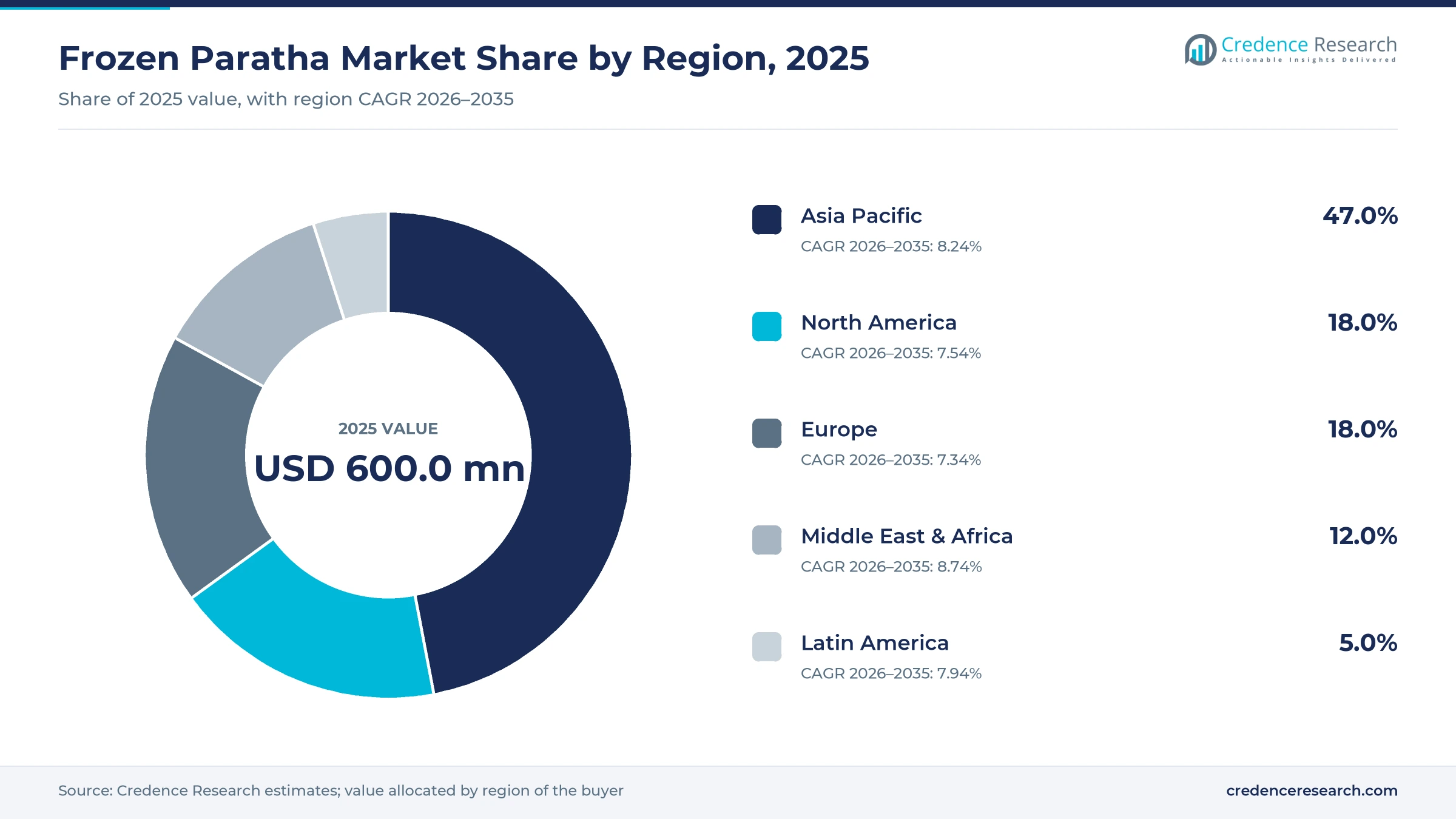
Asia Pacific leads while the Middle East grows fastest
| Region | Value, 2025 (USD million) | Share, 2025 | CAGR, 2026–2035 |
|---|---|---|---|
| Asia Pacific | 282.0 | 47.0% | 8.24% |
| North America | 108.0 | 18.0% | 7.54% |
| Europe | 108.0 | 18.0% | 7.34% |
| Middle East & Africa | 72.0 | 12.0% | 8.74% |
| Latin America | 30.0 | 5.0% | 7.94% |
Asia Pacific leads on supply and home demand
Asia Pacific held 47.0% of 2025 value and grows at 8.24% a year, because Malaysia, India and Bangladesh host the main production plants and large home markets. Kawan Food produced 17,926.6 metric tons of flatbreads and pastries in 2025, according to its annual report, and Malaysia remained its largest market. MEA counts 2.90 million overseas Indians in Malaysia and 483,199 in Singapore, which supports roti canai and paratha sales across the region.
North America is driven by South Asian households
North America held 18.0% of 2025 value and grows at 7.54% a year, as South Asian households buy frozen parathas in ethnic grocers and mainstream chains. MEA data show 6.08 million overseas Indians in the United States and 3.25 million in Canada as of January 2026. Tariff swings in 2025 slowed imports, yet the February 2026 interim framework lowered the rate on Indian goods to 18%.
Europe centers on British supermarkets
Europe held 18.0% of 2025 value and grows at 7.34% a year, with Britain as the largest buyer because of its large South Asian population. The Office for National Statistics publishes Census 2021 counts of Indian and Pakistani residents, which together exceed 3.4 million in England and Wales. Malaysian processed food exports to the European Union reached RM1.73 billion from January to August 2025, according to MATRADE, which widens supply into continental stores.
Middle East & Africa grows fastest on Gulf shelves
Middle East & Africa held 12.0% of 2025 value and grows at 8.74% a year, the fastest regional rate. Gulf hypermarkets stock Indian-made Al Kabeer Malabar parathas and UAE-made Al Islami lines, and Al Islami launched chapati and Malabar paratha in March 2025. South Africa adds demand too, since MEA counts about 1.8 million people of Indian origin and Indian nationals there as of January 2026.
Latin America rests on Caribbean roti traditions
Latin America held 5.0% of 2025 value and grows at 7.94% a year, with demand concentrated in Caribbean communities that eat roti and paratha as everyday bread. MEA lists about 700,000 persons of Indian origin in Trinidad and Tobago, 322,000 in Guyana and 165,000 in Suriname. Import costs and limited freezer capacity in smaller stores keep this region the smallest in value.
Launches and new plants from 2025 to 2026
| Development | Status and market relevance |
|---|---|
| In March 2025, Al Islami Foods launched frozen chapati and Malabar paratha in UAE supermarkets during Ramadan. | Launched; extends the company’s carbohydrate range and targets South Asian households in the Gulf. |
| In March 2026, iD Fresh Food opened a Rs 25 crore, 40,000 sq ft plant in Hyderabad that makes parotas and batter. | Operating; fourth company plant, serving Telangana, Andhra Pradesh, Vidarbha and Chhattisgarh. |
| In May 2026, Kawan Food published its 2025 annual report, which cites a new 15-piece roti canai value pack and lower export volumes. | Reported; North America volumes fell 43.9% after new United States tariffs. |
| In June 2026, Shana Foods launched Paratha Toasties, a 480 g frozen paratha shaped for standard toasters. | Launched through British wholesalers at an RRP of £2.75. |
Lamination, quick freezing and portion control
- Automated lamination builds the 24 thin layers that give a paratha its flaky texture, as Kawan Food describes for its plain line.
- Individual quick freezing at about minus 35 degrees Celsius locks each piece separately, so buyers can cook one at a time.
- Laser-guided portioning keeps each piece within one millimeter of its 22 cm target, which helps foodservice kitchens control costs.
- Shaped formats such as toaster-ready parathas cut cooking time to about three minutes and remove the need for a pan.
Need a Custom Version of This Report?
Tailor the scope, geography, or segments to your exact requirements.
- Custom geography or segment scope
- Direct access to our analyst team
Malaysian, Indian and Gulf producers compete for shelves
Competition splits between Malaysian export specialists, Indian packaged food groups and Gulf frozen food companies. Kawan Food leads in export supply, with automated plants, halal and BRCGS certificates and customized sizes for retail and foodservice buyers. ITC and Haldiram’s use national brands and wide distribution in India, and Haldiram’s sells its frozen range in more than 40 countries. Al Kabeer and Al Islami Foods compete for Gulf freezer space with halal positioning, while Sumeru and iD Fresh Food build on South Indian Malabar and parota recipes. British brands such as Shana Foods and Humza rely on contract plants in South Asia and on supermarket promotions. Price per kg, layer quality, cooking speed and certificates decide most listings. Smaller importers compete on regional recipes, but they face rising audit and allergen demands from retailers.
Companies profiled and their roles in this market
| Company | Type | Role in the market |
|---|---|---|
| Kawan Food | Manufacturer and exporter | Malaysian producer of plain and flavored parathas, chapati and roti canai for about 40 countries |
| ITC (Aashirvaad/Master Chef) | Branded food group | Sells Aashirvaad frozen Malabar, aloo and paneer parathas in Indian metros |
| Haldiram's | Branded food group | Sells frozen parathas within its Minute Khana range in India and more than 40 countries |
| Al Kabeer | Gulf frozen food brand | Sells plain, Malabar, methi and whole-wheat parathas in Gulf hypermarkets |
| Sumeru (Innovative Foods) | Manufacturer | Kerala-based maker of frozen parathas, rolls and kebabs for Indian retail |
| Al Islami Foods | Gulf frozen food brand | UAE halal producer that added plain paratha in 2021 and chapati and Malabar paratha in 2025 |
| iD Fresh Food | Ready-to-cook brand | Bengaluru-based maker of parotas with a new Hyderabad plant opened in 2026 |
| Shana Foods | Retail brand | British frozen brand selling plain, garlic and aloo parathas and toaster-ready formats |
Credence Research view on the flatbread freezer aisle
Credence Research’s view is that frozen paratha has moved from an ethnic-grocer niche into mainstream freezers in Britain, the Gulf and Indian metros. Growth to 2035 depends less on new buyers in India than on export supply to diaspora markets, where shelf prices are several times higher. Producers that hold halal and BRCGS certificates, run automated lamination and can switch supply between the United States, Britain and the Gulf are best placed. The largest risk is trade policy, as the 2025 United States tariff moves showed when North American export volumes fell sharply for a leading Malaysian supplier.
How Credence Research sized frozen flatbread demand
The report uses 2025 as the base year and forecasts values to 2035 in current United States dollars. Market values come from the Credence Research model, which combines diaspora population data, retail shelf prices, producer output and retailer listings. Regional, type, channel and consumer market splits are Credence Research estimates. Sources include government statistics from India’s Ministry of External Affairs and Britain’s Office for National Statistics, company annual reports and product pages, retailer listings, trade agency releases and regulatory recall notices.
Outlook to 2035 rests on diaspora and export growth
The frozen paratha market is projected to reach USD 1.30 billion by 2035, with growth at 8.00% a year as diaspora households and Indian metro buyers keep shifting to freezer bread. Stuffed and flaky lines should gain share, because brands keep adding aloo, paneer and Malabar variants at higher prices. Gulf demand grows fastest, while Britain and North America remain the most valuable consumer markets. Producers in India gain from new trade terms, and Malaysian suppliers keep leading on export scale. Fat and flour costs, tariffs and allergen rules will decide margins through the forecast period.
Frequently Asked Questions
How big is the frozen paratha market?
Which region leads the frozen paratha market?
Which region grows fastest?
Which paratha type holds the largest share?
Which channel grows fastest?
What drives demand for frozen paratha?
What are the main challenges?
Who are the key companies?
Table of Content
Chapter 1 Market Segmentation
- 1.1 Segmentation Framework
- 1.1.1 Product and Service Classification
- 1.1.2 Application and End-Use Classification
- 1.1.3 Technology and Solution Classification
- 1.1.4 Customer and Distribution Channel Classification
- 1.1.5 Geographic Segmentation
- 1.1.6 Market Segment Definitions and Boundaries
- 1.2 By Type
- 1.2.1 Plain
- 1.2.2 Flaky (Lachha/Malabar)
- 1.2.3 Stuffed
- 1.3 By Channel
- 1.3.1 Retail
- 1.3.2 Foodservice
- 1.3.3 Export
- 1.4 By Consumer Market
- 1.4.1 UK/US Diaspora
- 1.4.2 Southeast Asia
- 1.4.3 India
- 1.4.4 Middle East
- 1.4.5 Others
Chapter 2 Introduction
- 2.1 Report Objectives and Scope
- 2.2 Product Definition and Industry Terminology
- 2.3 Market Inclusions and Exclusions
- 2.4 Research Process
- 2.4.1 Primary Research and Expert Interviews
- 2.4.2 Secondary Research and Source Review
- 2.4.3 Top-Down and Bottom-Up Estimation
- 2.4.4 Data Triangulation and Verification
- 2.5 Market Size Measurement Basis
- 2.5.1 2025: USD 600.0 million → 2035: USD 1.30 billion
- 2.6 Historical and Forecast Reference Periods
- 2.6.1 Historical Period: 2018-2025
- 2.6.2 Base Year: 2025
- 2.6.3 Forecast Period: 2025-2035
- 2.7 Research Assumptions and Limitations
Chapter 3 Executive Summary
- 3.1 Market Snapshot and Key Findings
- 3.2 Base-Year Market Size, 2025
- 3.3 Forecast Market Size, 2035
- 3.4 Revenue and Volume Growth Outlook
- 3.5 Key Demand and Supply Indicators
- 3.6 Leading Market Segments
- 3.7 Fastest-Growing Market Opportunities
- 3.8 Regional Performance Highlights
- 3.9 Technology and Industry Transformation
- 3.10 Competitive Landscape Summary
- 3.11 Analyst View and Strategic Implications
Chapter 4 Global Frozen Paratha Market Trends and Developments
- 4.1 Historical Industry Development, 2018-2025
- 4.2 Recent Market Trends and Developments
- 4.3 Demand and Customer Behavior Trends
- 4.4 Technology and Product Innovation
- 4.5 Artificial Intelligence, Automation and Digitalization
- 4.6 Local Manufacturing and Supply Chain Realignment
- 4.7 Industry Partnerships, Mergers and Acquisitions
- 4.8 Sustainability and Circular Economy Developments
- 4.9 Government and Private Sector Investment Trends
- 4.10 Emerging Business Models and Commercialization
- 4.11 Industry Developments and Announcements
Chapter 5 Global Frozen Paratha Market Production, Supply and Demand Analysis
- 5.1 Demand Trend and Consumption Analysis, 2018-2025
- 5.2 Demand Forecast, 2025-2035
- 5.3 Production and Output Trend, 2018-2025
- 5.4 Production and Output Forecast, 2025-2035
- 5.5 Installed Capacity and Capacity Utilization
- 5.6 Company-Wise Production Plants and Statistics
- 5.6.1 Installed Production Capacity
- 5.6.2 Actual Production
- 5.6.3 Planned Capacity and Expansion Targets
- 5.7 Supply Chain Structure and Procurement Trends
- 5.8 Supply-Demand Gap and Bottlenecks
- 5.9 Import Dependence and Sourcing Structure
- 5.10 Contract Manufacturing and Outsourcing
- 5.11 Regional Supply and Demand Concentration
Chapter 6 Global Frozen Paratha Market Pricing Analysis
- 6.1 Pricing Structure and Measurement
- 6.2 Historical Pricing Trends, 2018-2025
- 6.3 Pricing Outlook, 2025-2035
- 6.4 Average Selling Price and Unit Economics
- 6.5 Pricing by Product and Market Segment
- 6.6 Geographic Pricing Differences
- 6.7 Key Input, Energy, Labor and Logistics Costs
- 6.8 Contract Pricing and Purchasing Models
- 6.9 Pricing Sensitivity and Competitive Positioning
- 6.10 Price, Margin and Profitability Implications
Chapter 7 Global Frozen Paratha Market Dynamics
- 7.1 Market Growth Drivers
- 7.1.1 Demand-Side Drivers
- 7.1.2 Technology and Innovation Drivers
- 7.1.3 Infrastructure and Investment Drivers
- 7.1.4 Regulatory and Policy Drivers
- 7.2 Market Restraints
- 7.2.1 Cost and Affordability Constraints
- 7.2.2 Technology and Adoption Barriers
- 7.2.3 Supply Chain and Operational Constraints
- 7.3 Market Challenges
- 7.3.1 Competitive Pressure and Margin Erosion
- 7.3.2 Skills, Infrastructure and Implementation Gaps
- 7.4 Emerging Market Opportunities
- 7.5 Market Dynamics Impact and Time-Horizon Assessment
Chapter 8 Global Frozen Paratha Value Chain Analysis
- 8.1 Industry Value Chain Overview
- 8.2 Upstream Suppliers and Critical Inputs
- 8.3 Technology and Component Providers
- 8.4 Manufacturing or Service Delivery
- 8.5 Distribution, Channel Partners and Integrators
- 8.6 Downstream Applications and End Users
- 8.7 Value Addition and Profit Pools
- 8.8 Vertical Integration and Outsourcing
- 8.9 Supplier Concentration and Risk
- 8.10 Supply Chain Localization and Resilience
Chapter 9 Global Frozen Paratha Market Regulations and Policies
- 9.1 Relevant Laws, Standards and Compliance Frameworks
- 9.2 Product, Service, Safety and Quality Requirements
- 9.3 Government Policies, Incentives and Subsidies
- 9.4 Imports, Exports and Trade Barriers
- 9.5 Public Procurement and Local Content Requirements
- 9.6 Environmental and Sustainability Compliance
- 9.7 Upcoming Policy Changes and Market Implications
Chapter 10 Global Frozen Paratha Market Hotspots and Opportunities
- 10.1 Market Opportunity Mapping and Growth Hotspots
- 10.2 High-Growth Applications and Customer Groups
- 10.3 Underserved Markets and White-Space Opportunities
- 10.4 Emerging Technology and Product Opportunities
- 10.5 New Capacity and Investment Hotspots
- 10.6 Market Entry and Expansion Opportunities
- 10.7 Distribution and Partnership Opportunities
- 10.8 Near-Term and Long-Term Commercial Potential
- 10.9 Opportunity Attractiveness and Execution Risks
Chapter 11 Global Frozen Paratha Market Outlook, 2025-2035
- 11.1 Market Size and Analysis
- 11.1.1 Revenue (Market Measurement: 2025: USD 600.0 million → 2035: USD 1.30 billion)
- 11.1.2 Market Volume and Quantity Sold
- 11.1.3 Historical Market Size, 2018-2025
- 11.1.4 Base-Year Market Size, 2025
- 11.2 Market Forecast, 2025-2035
- 11.2.1 Revenue Forecast to 2035
- 11.2.2 Volume Forecast to 2035
- 11.2.3 CAGR and Year-on-Year Growth
- 11.2.4 Incremental Revenue Opportunity
- 11.3 Forecast Assumptions and Scenario Analysis
- 11.3.1 Base-Case Forecast
- 11.3.2 Optimistic and Conservative Scenarios
- 11.3.3 Technology, Pricing and Policy Sensitivities
- 11.4 Market Attractiveness and Growth Outlook
Chapter 12 Global Frozen Paratha Market Segmentation and Outlook
- 12.1 Segmentation Summary and Market Shares, 2025
- 12.2 Largest and Fastest-Growing Segments
- 12.3 By Type - Market Size and Forecast, 2025-2035
- 12.3.1 Segment Definition and Scope
- 12.3.2 Historical Market Size, 2018-2025
- 12.3.3 Revenue Forecast, 2025-2035
- 12.3.4 Volume Forecast, 2025-2035
- 12.3.5 Base-Year Market Share, 2025
- 12.3.6 Segment CAGR and Growth Drivers
- 12.3.7 Subsegment Market Size and Forecast
- 12.3.7.1 Plain
- 12.3.7.2 Flaky (Lachha/Malabar)
- 12.3.7.3 Stuffed
- 12.3.8 Subsegment Pricing and Adoption Trends
- 12.3.9 Leading Suppliers and Competition
- 12.3.10 Regional Demand and Opportunities
- 12.4 By Channel - Market Size and Forecast, 2025-2035
- 12.4.1 Segment Definition and Scope
- 12.4.2 Historical Market Size, 2018-2025
- 12.4.3 Revenue Forecast, 2025-2035
- 12.4.4 Volume Forecast, 2025-2035
- 12.4.5 Base-Year Market Share, 2025
- 12.4.6 Segment CAGR and Growth Drivers
- 12.4.7 Subsegment Market Size and Forecast
- 12.4.7.1 Retail
- 12.4.7.2 Foodservice
- 12.4.7.3 Export
- 12.4.8 Subsegment Pricing and Adoption Trends
- 12.4.9 Leading Suppliers and Competition
- 12.4.10 Regional Demand and Opportunities
- 12.5 By Consumer Market - Market Size and Forecast, 2025-2035
- 12.5.1 Segment Definition and Scope
- 12.5.2 Historical Market Size, 2018-2025
- 12.5.3 Revenue Forecast, 2025-2035
- 12.5.4 Volume Forecast, 2025-2035
- 12.5.5 Base-Year Market Share, 2025
- 12.5.6 Segment CAGR and Growth Drivers
- 12.5.7 Subsegment Market Size and Forecast
- 12.5.7.1 UK/US Diaspora
- 12.5.7.2 Southeast Asia
- 12.5.7.3 India
- 12.5.7.4 Middle East
- 12.5.7.5 Others
- 12.5.8 Subsegment Pricing and Adoption Trends
- 12.5.9 Leading Suppliers and Competition
- 12.5.10 Regional Demand and Opportunities
- 12.6 Segment Growth Comparison
- 12.7 Segment Attractiveness and Priority Matrix
Chapter 13 Global Frozen Paratha Geographic Market Outlook, 2025-2035
- 13.1 Regional Market Size and Share, 2025
- 13.2 Regional Market Forecast, 2025-2035
- 13.3 Regional Pricing, Production and Demand Differences
- 13.4 North America
- 13.4.1 United States
- 13.4.2 Canada
- 13.4.3 Mexico
- 13.5 Europe
- 13.5.1 Germany
- 13.5.2 France
- 13.5.3 Italy
- 13.5.4 United Kingdom
- 13.5.5 Spain
- 13.5.6 Poland
- 13.5.7 Russia
- 13.5.8 Netherlands
- 13.5.9 Belgium
- 13.5.10 Sweden
- 13.5.11 Denmark
- 13.5.12 Norway
- 13.5.13 Rest of Europe
- 13.6 Asia Pacific
- 13.6.1 China
- 13.6.2 India
- 13.6.3 Japan
- 13.6.4 South Korea
- 13.6.5 Thailand
- 13.6.6 Indonesia
- 13.6.7 Vietnam
- 13.6.8 Malaysia
- 13.6.9 Australia
- 13.6.10 Rest of Asia Pacific
- 13.7 Latin America
- 13.7.1 Brazil
- 13.7.2 Argentina
- 13.7.3 Colombia
- 13.7.4 Chile
- 13.7.5 Rest of Latin America
- 13.8 Middle East
- 13.8.1 Saudi Arabia
- 13.8.2 United Arab Emirates
- 13.8.3 Turkey
- 13.8.4 Israel
- 13.8.5 Iran
- 13.8.6 Rest of the Middle East
- 13.9 Africa
- 13.9.1 South Africa
- 13.9.2 Egypt
- 13.9.3 Nigeria
- 13.9.4 Morocco
- 13.9.5 Rest of Africa
- 13.10 Regional Investment, Policy and Supply Chain Differences
- 13.11 Regional Competitive Landscape
- 13.12 Geographic Growth Hotspots
Chapter 14 Global Frozen Paratha Technology, Innovation and Sustainability Outlook
- 14.1 Technology Landscape and Maturity
- 14.2 Product, Process and Service Innovation
- 14.3 AI, Automation and Digital Tools in the Industry
- 14.4 Technology Adoption and Performance Benchmarking
- 14.5 Innovation Pipeline and R&D Investment
- 14.6 Patent and Intellectual Property Trends
- 14.7 Energy Efficiency and Resource Management
- 14.8 Sustainability, Recycling and Circularity
- 14.9 Technology Roadmap, 2025-2035
- 14.10 Risks of Obsolescence and Technology Substitution
Chapter 15 Global Frozen Paratha Market Key Strategic Imperatives
- 15.1 Growth and Market Entry Priorities
- 15.2 High-Return Products and Segments
- 15.3 Pricing, Profitability and Cost Optimization
- 15.4 Technology Investment and Product Differentiation
- 15.5 Supply Chain Localization and Resilience
- 15.6 Distribution and Customer Acquisition
- 15.7 Partnership, Acquisition and Capacity Strategy
- 15.8 Regional Expansion Priorities
- 15.9 Short-, Medium- and Long-Term Actions
Chapter 16 Competition Outlook
- 16.1 Industry Competition Characteristics
- 16.2 Market Structure and Concentration
- 16.3 Market Share and Competitive Positioning, 2025
- 16.4 Company-Wise Revenue and Product Benchmarking
- 16.5 Production and Service Capacity Benchmarking
- 16.6 Technology, Pricing and Differentiation
- 16.7 Regional Footprint and Distribution Strength
- 16.8 Mergers, Acquisitions and Strategic Alliances
- 16.9 New Entrants and Competitive Threats
- 16.10 Porter's Five Forces and Industry Attractiveness
- 16.11 Competitive Outlook, 2025-2035
Chapter 17 Company Profiles
- 17.1 Company Coverage and Selection Criteria
- 17.2 Kawan Food
- 17.2.1 Business Description
- 17.2.2 Company Ownership and Geographic Presence
- 17.2.3 Product and Service Portfolio
- 17.2.4 Manufacturing and Operating Footprint
- 17.2.5 Production Capacity and Expansion Plans
- 17.2.6 Financial Performance and Investment
- 17.2.7 Market Share and Competitive Position
- 17.2.8 Technology and Innovation Capabilities
- 17.2.9 Strategic Alliances or Partnerships
- 17.2.10 Recent Developments
- 17.2.11 Growth Strategy and Outlook
- 17.3 ITC (Aashirvaad/Master Chef)
- 17.4 Haldiram's
- 17.5 Al Kabeer
- 17.6 Sumeru (Innovative Foods)
- 17.7 Al Islami Foods
- 17.8 iD Fresh Food
- 17.9 Shana Foods
- 17.10 Other Relevant Market Participants
Note: Every listed company is profiled on the structure shown under the first company. The company list is preliminary and may change based on research findings, market developments, data availability and client requirements.
Chapter 18 Disclaimer
- 18.1 Research and Forecast Disclaimer
- 18.2 Data Source and Estimation Limitations
Note: The depth of individual sections depends on data availability for this market. Volume, capacity, trade and other unit-based metrics are included where applicable.

