
Sealed nut boxes now anchor festive and family gift budgets
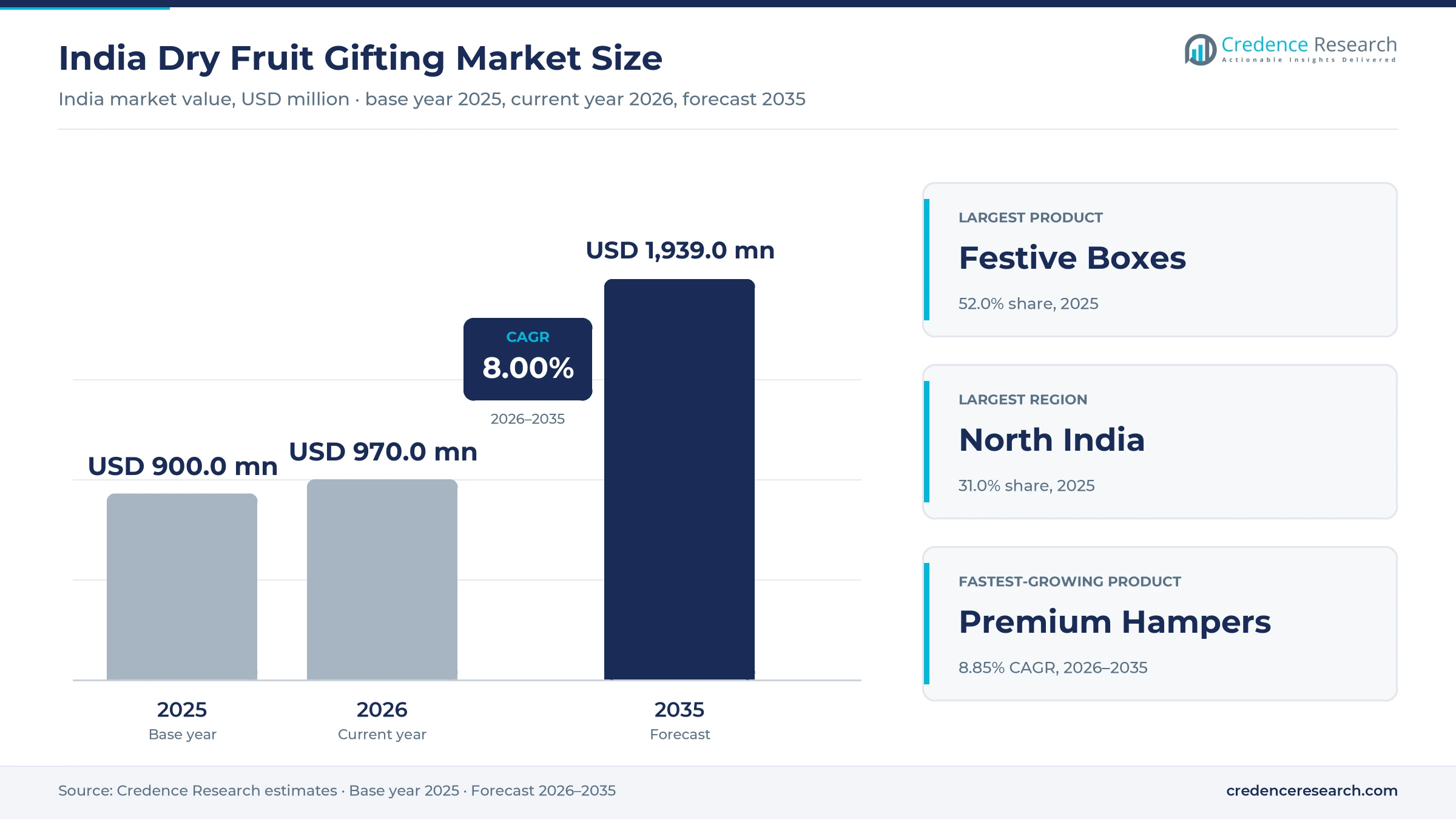
The India dry fruit gifting market was valued at USD 900.0 million in 2025 and is projected to increase from USD 970.0 million in 2026 to USD 1.94 billion by 2035, registering a CAGR of 8.00% during 2026–2035. Demand rests on a gifting habit tied to a few dates, with households, employers and wedding families buying sealed assortments of almonds, cashews, pistachios, raisins and dates during a window that peaks from August to December. North India held the largest regional share, 31.0% in 2025, on strong festive and wedding spending around Delhi and Punjab, while South India is the fastest-growing zone at 8.45% a year as online orders spread beyond its metros. Commercially, the important change is the redesign of the basket itself, because importers and box makers now shrink weights and swap costlier nuts to hold price points. Tax policy also moved in the category's favor when the goods and services tax on nuts and dried fruits was cut in September 2025.
What does dry fruit gifting in India include?
The market counts what households, employers and wedding families pay for packed assortments of nuts and dried fruits bought to give away. It covers festive cartons, premium hampers in reusable boxes or jars and bulk corporate packs, whether sold by a neighborhood merchant, a sweet shop, a brand website or a delivery app.
Loose dry fruit bought for home cooking, everyday snack packs and sweets without a dry fruit assortment are excluded. The value chain runs from importers and domestic cashew processors through wholesale markets and packers to retailers, online platforms and gifting vendors that serve corporate buyers.
India Dry Fruit Gifting Market Insights
- The market grows from USD 900.0 million in 2025 to USD 1.94 billion by 2035, an 8.00% CAGR that rests on higher box values and wider online reach as well as on festival volumes.
- North India led with 31.0% of 2025 value, and CAIT counted about 4.8 lakh weddings in Delhi alone during the 2025 wedding season.
- Festive Boxes held 52.0% of 2025 value, because small assorted cartons sit at prices that most households will pay for several recipients.
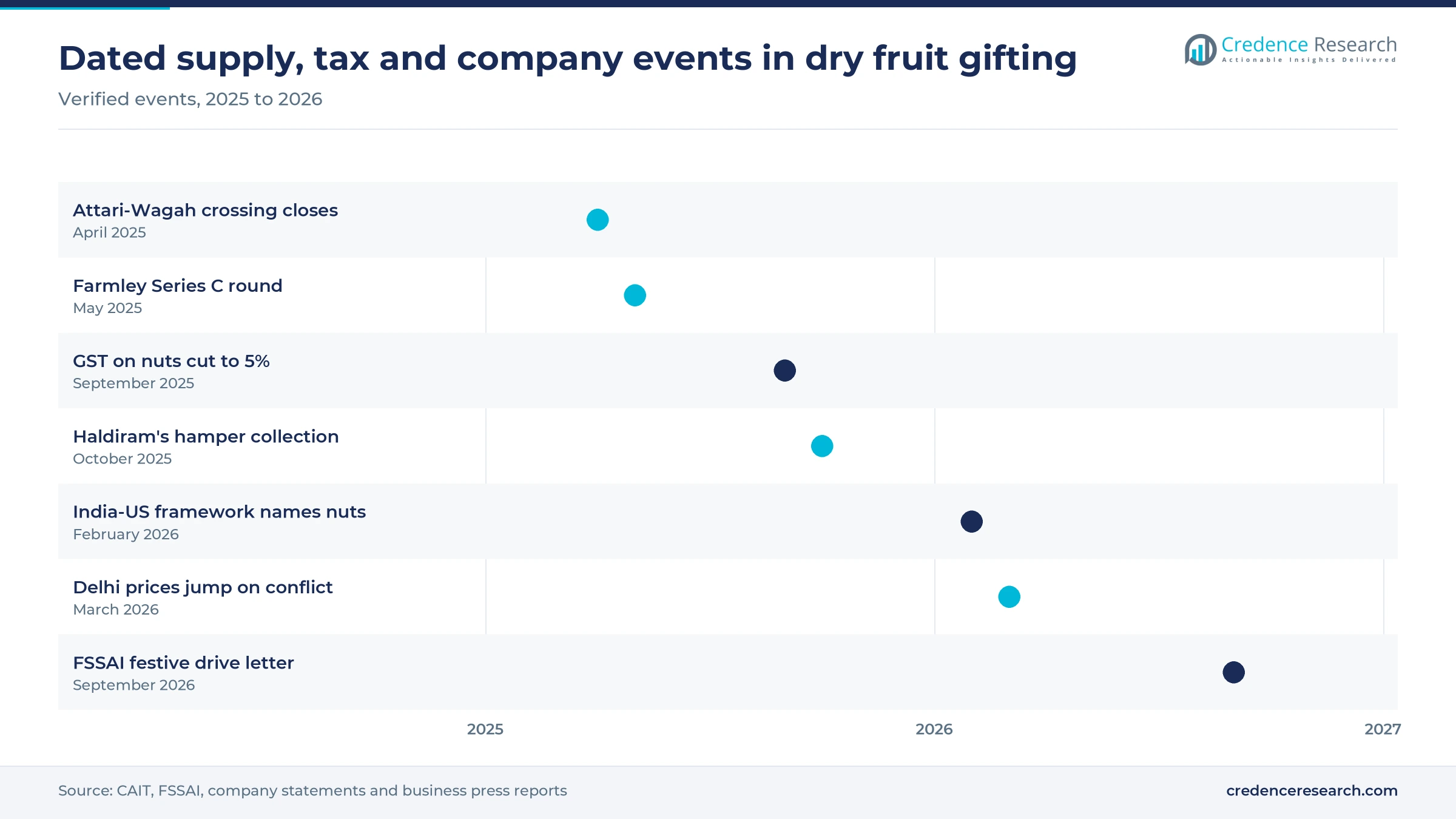
- The goods and services tax on nuts and dried fruits fell from 12% to 5% on Sept. 22, 2025, just ahead of the Diwali gifting peak.
- Farmley raised USD 40 million in May 2025 to scale dried fruits and nuts, which shows that investors now back packaged brands in a merchant-led trade.
Festive boxes, Diwali and offline shops hold most value
Why festive boxes outsell hampers and corporate packs
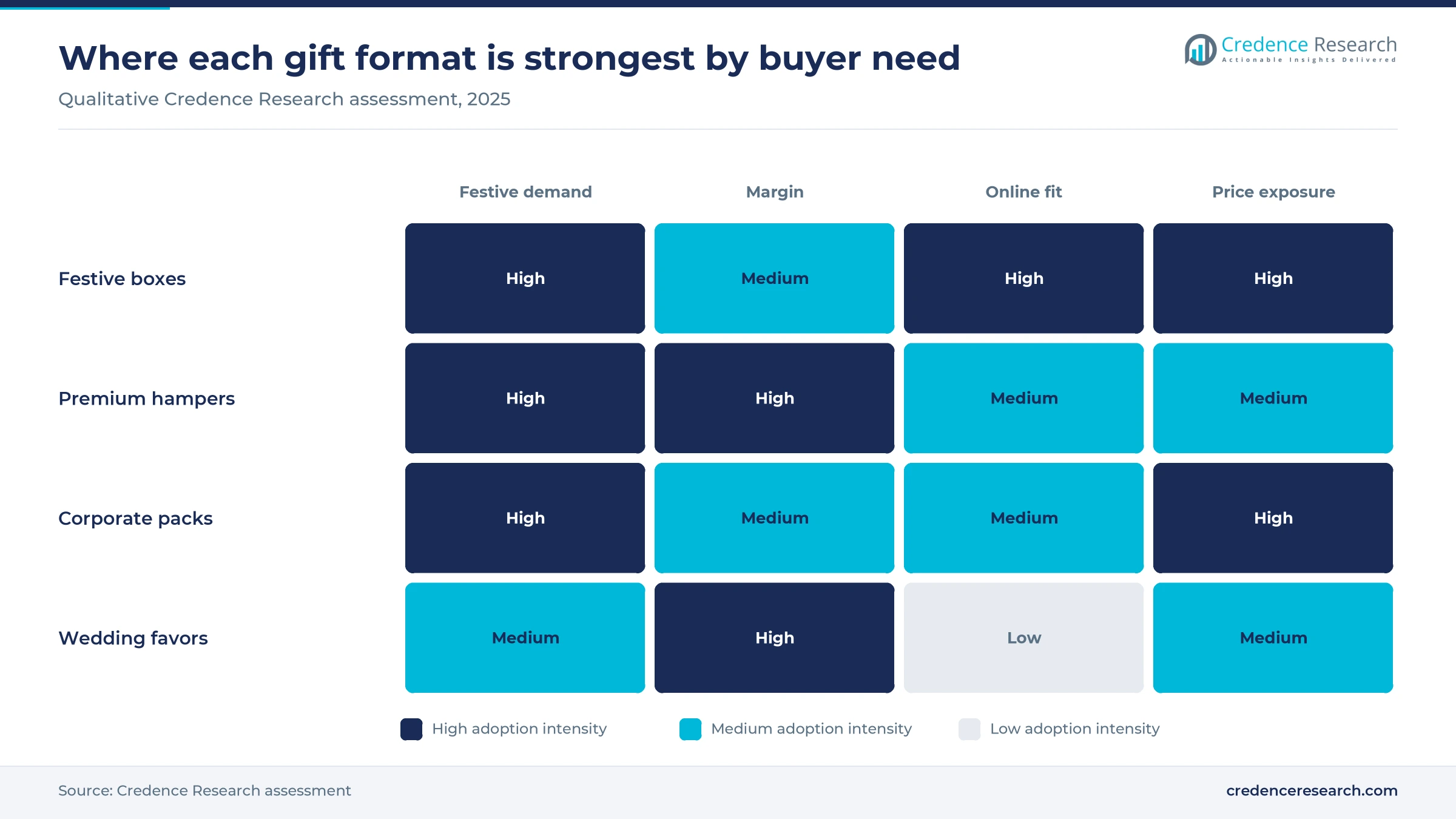
Based on product, the market is categorized into festive boxes, premium hampers and corporate packs. Festive Boxes led with 52.0% of 2025 value because small cartons meet the ticket most households will pay, and Nutraj sells a 225-gram Diwali box at Rs 430 on its own store. Shops in Bhilwara also sold gift packs at Rs 600 to Rs 3,000, Patrika reported in October 2024. Premium Hampers grow fastest at 8.85% a year as Haldiram's placed six hampers, some in reusable wooden boxes, in its gifting collection of October 2025, and as Nutraj now prices its 800-gram Healthy Bloom box at Rs 12,495.
How Diwali concentrates buying into a few weeks
Based on occasion, the market is categorized into Diwali, weddings and Raksha Bandhan. Diwali led with 62.0% of 2025 value because a USDA attaché report of Sept. 18, 2025, placed over half of household walnut use in the October and November festive season. Weddings follow, with CAIT counting 46 lakh ceremonies in the 2025 season. Raksha Bandhan grows fastest at 8.78% a year as CAIT listed sweets, dry fruits, gift packs and hampers among Rs 4,000 crore of related Rakhi products in August 2025, and as Flipkart Minutes reported that its dry fruit sales tripled, according to YourStory.
Why shops still carry most gift box sales
Based on channel, the market is categorized into offline, e-commerce and B2B. Offline led with 68.0% of 2025 value because CAIT found that mainline retail and traditional markets carried 85% of Diwali 2025 trade, and buyers still inspect grade at the counter. Bhilwara traders grade cashews and almonds and pack boxes in bulk, Patrika reported. E-Commerce grows fastest at 10.19% a year as Unicommerce counted 120% growth in quick-commerce festive orders in 2025, with tier II and III cities at about 55% of orders. B2B buying also continues, since USDA credits bulk corporate sales with lifting almond use.
| Segment Group | Leading Sub-segment | Share, 2025 | Fastest-growing Sub-segment | CAGR, 2026–2035 |
|---|---|---|---|---|
| By Product | Festive Boxes | 52.0% | Premium Hampers | 8.85% |
| By Occasion | Diwali | 62.0% | Raksha Bandhan | 8.78% |
| By Channel | Offline | 68.0% | E-Commerce | 10.19% |
Request a Free Sample
Fill in your details and we'll send you a free sample report.
- Sample data tables & charts
- Research methodology
Festivals, wellness buying and online boxes lift demand
Festive and corporate gifting sustains premium demand
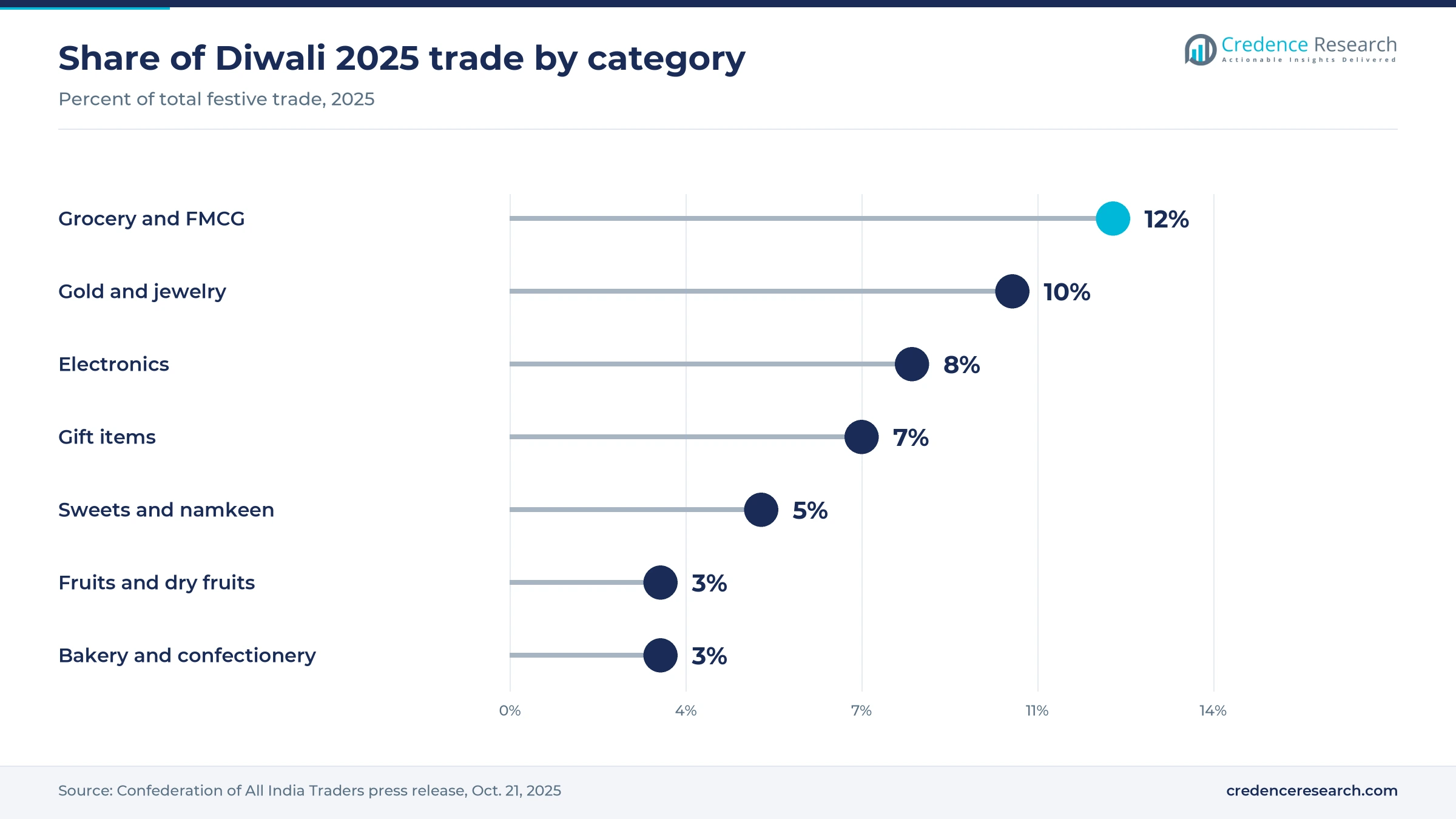
The Confederation of All India Traders put Diwali 2025 trade at Rs 6.05 lakh crore, with fruits and dry fruits at 3% of that trade and gift items at 7%. Buying that concentrated gives traders a reliable season, and an Agron Food Processing report of October 2025 showed cashew imports averaging USD 173.9 million a month from August to December 2024, against a yearly average of USD 134.8 million. Employers add a second stream through employee Diwali hampers, where YourStory puts typical staff gifts at Rs 1,500 to Rs 3,000 and client gifts at Rs 3,000 to Rs 10,000. Gujarat Samachar reported in October 2025 that about 60% of Gujarat's annual dry fruit sales happen during Diwali. In the Credence Research model this adds about 2.96 percentage points to annual growth to 2035.
Health-oriented snacking supports year-round purchases
Everyday nut eating makes a dry fruit box feel useful as well as ceremonial, and that lifts its appeal against sugar-heavy gifts. The Indian Council of Medical Research guidelines of May 2024 attributed 56.4% of India's disease burden to unhealthy diets, DT Next reported, which gave buyers a clear reason to reconsider the festive tray. The USDA Foreign Agricultural Service forecast India's 2024-25 almond imports at 190,000 metric tons, up 6% on the previous year, and this broader nuts and raisins trade keeps brands visible outside festivals. Farmley raised USD 40 million in May 2025 to scale dried fruits and nuts, Outlook Business reported. In the Credence Research model this adds about 2.16 percentage points to annual growth to 2035.
Branded boxes and e-commerce improve gifting conversion
Branded boxes and app-based delivery make a dry fruit gift easier to choose, send and trust from a distance. Nutraj lists 23 Diwali boxes on its gifting page and takes bulk orders online, while a Zee5 feature showed Happilo selling personalized festive hampers from Rs 225 to about Rs 2,999. Swiggy Instamart reported an eightfold rise in Rakhi hampers in 2025, according to YourStory. Unicommerce also recorded 33% growth in festive orders on brand websites in 2025, a route that branded mithai sellers use as well. As a result, a buyer can compare grades and prices without visiting a wholesale lane. In the Credence Research model this adds about 1.60 percentage points to annual growth to 2035.
GST cut and trade talks improve box economics
Tax and trade changes matter because imported nuts form most of the cost inside a box. The goods and services tax on almonds, pistachios and other dried fruits fell from 12% to 5% on Sept. 22, 2025, according to a Krishival Foods statement carried by The Tribune, and an Agron Food Processing report estimated that this could trim consumer prices by as much as 7%. ThePrint reported that the India-U.S. framework announced on Feb. 7, 2026, names walnuts, almonds and pistachios for duty concessions. Australian supply is growing too, with almond shipments up 93% in April to July of fiscal 2026, Agron Food Processing reported. Wider sourcing gives packers more room to hold price points during the peak, though timing remains uncertain.
Smaller baskets and fast delivery reshape the gift box
Shift toward smaller baskets and seed-filled boxes
Free Press Journal reported in October 2026 that Mumbai wholesale pistachios doubled to Rs 1,800 a kilogram, with almonds at Rs 1,100 and dates at Rs 500. Box makers responded by cutting weights and replacing costly nuts, because most corporate buyers work within fixed budgets. CAIT national secretary Shankar Thakkar told the paper that demand for pumpkin, watermelon, sunflower and chia seeds is up about 30%. Ahmedabad trade told a similar story a year earlier, when prices rose 15% to 20% at Madhupura market. This shift protects the headline price of a box, but it also moves value toward packaging and mix. Buyers therefore compare contents more closely than they did when a fixed weight of almonds set the standard.
Rise of quick-commerce gift boxes in smaller cities
Fast delivery is turning a dry fruit box into a last-minute purchase, and smaller cities are joining the pattern. IGP delivered 30 metric tons of dry fruits for Raksha Bandhan 2025, Business Today reported, and the company said Dehradun, Surat and Vijayawada grew the most, with spikes in Jalandhar, Jabalpur and Udaipur. About 6.5% of IGP's orders arrived in the final two days before the festival, which favors express shipping. Unicommerce data showed tier II orders up 28% during the 2025 Diwali season, ahead of larger cities at 24%. USDA also observes that e-commerce platforms are reaching consumers in tier II and III cities. Packers now build lighter sealed boxes that suit dark stores and courier networks.
Opening in wedding favors and family return gifts
Weddings offer an opening that sits outside the crowded Diwali calendar and buys in larger lots. CAIT counted 46 lakh weddings between Nov. 1 and Dec. 14, 2025, worth Rs 6.50 lakh crore, with dry fruit and sweets at 5% and gift items at 4% of that spending. Those families already pay for wedding catering, so a branded favor box is an easy addition to a function budget. CAIT also put Delhi at 4.8 lakh weddings, which gives suppliers a dense first target. Personalized hampers and return gifts saw the largest spike at IGP during Raksha Bandhan 2025, so similar custom sets should suit weddings, where hosts usually order in bulk.
Opening for traceable and origin-graded premium boxes
Proof of origin and testing offers premium brands a way to escape price comparisons on identical nuts. Restaurant India reported on Oct. 31, 2026, that buyers increasingly weigh aflatoxin testing, grading and batch traceability, and that named origins such as Iranian Akbari pistachios and Medjool dates now help a box stand out. Gujarat Samachar reported in October 2025 that hampers in Ahmedabad cost Rs 500 to Rs 7,000, and traders there said the hamper-packaging trade had grown strongly over five years. Better rigid carton packaging adds value too, since rigid boxes and glass jars also protect nuts from moisture. Suppliers that print test results on the box could therefore defend higher prices with corporate buyers.
Import shocks and duties squeeze box makers and traders
West Asia conflict lifts landed nut prices
Supply shocks reach gift boxes quickly because most nuts other than cashew are imported. PTI reported on March 18, 2026, that the West Asia conflict had lifted Delhi prices by 20% to 50%, according to Khari Baoli Market Association president Rajiv Bhatia. Packers with fixed festive price points absorb that cost first, so margins narrow before retail prices move. Forward buying and domestic cashew content are the main defenses available to smaller merchants.
Attari closure disrupts Afghan fig and raisin supply
Land routes add a second risk for northern traders who rely on Afghan fruit. The Attari-Wagah crossing closed on April 22, 2025, and ETV Bharat reported on May 2, 2025, that prices rose Rs 100 to Rs 400 a kilogram within five days, citing the Federation of Grocers and Dry Fruit Traders. Arrivals normally reach 40 to 60 trucks a day from mid-July to Diwali, so the closure hits box filling directly.
High duties keep walnuts costly in premium hampers
Import duties keep some of the most prized box contents expensive. USDA's September 2025 report lists a 100% basic duty on walnuts and about USD 1.14 a kilogram on shelled almonds, and domestic almond output is only about 4,150 metric tons. Trade relief is uncertain as well, since a California Walnut Commission spokesperson told FreshFruitPortal in March 2026 that the new tariff timeline was unclear. Hamper makers therefore cannot yet budget on lower landed costs.
Budget cuts and safety checks pressure festive sellers
Sellers also face tighter buyers and closer scrutiny during their most important weeks. Restaurant India noted that 2025 reports showed some companies cutting hamper budgets, which limits how much cost a vendor can pass on. FSSAI told state regulators on Sept. 29, 2026, to step up festive inspections of sweets and snacks at market hot spots. Although its letter does not name nuts, mixed boxes sold beside sweets face similar questions, so unlabeled merchant packs carry the greatest exposure.
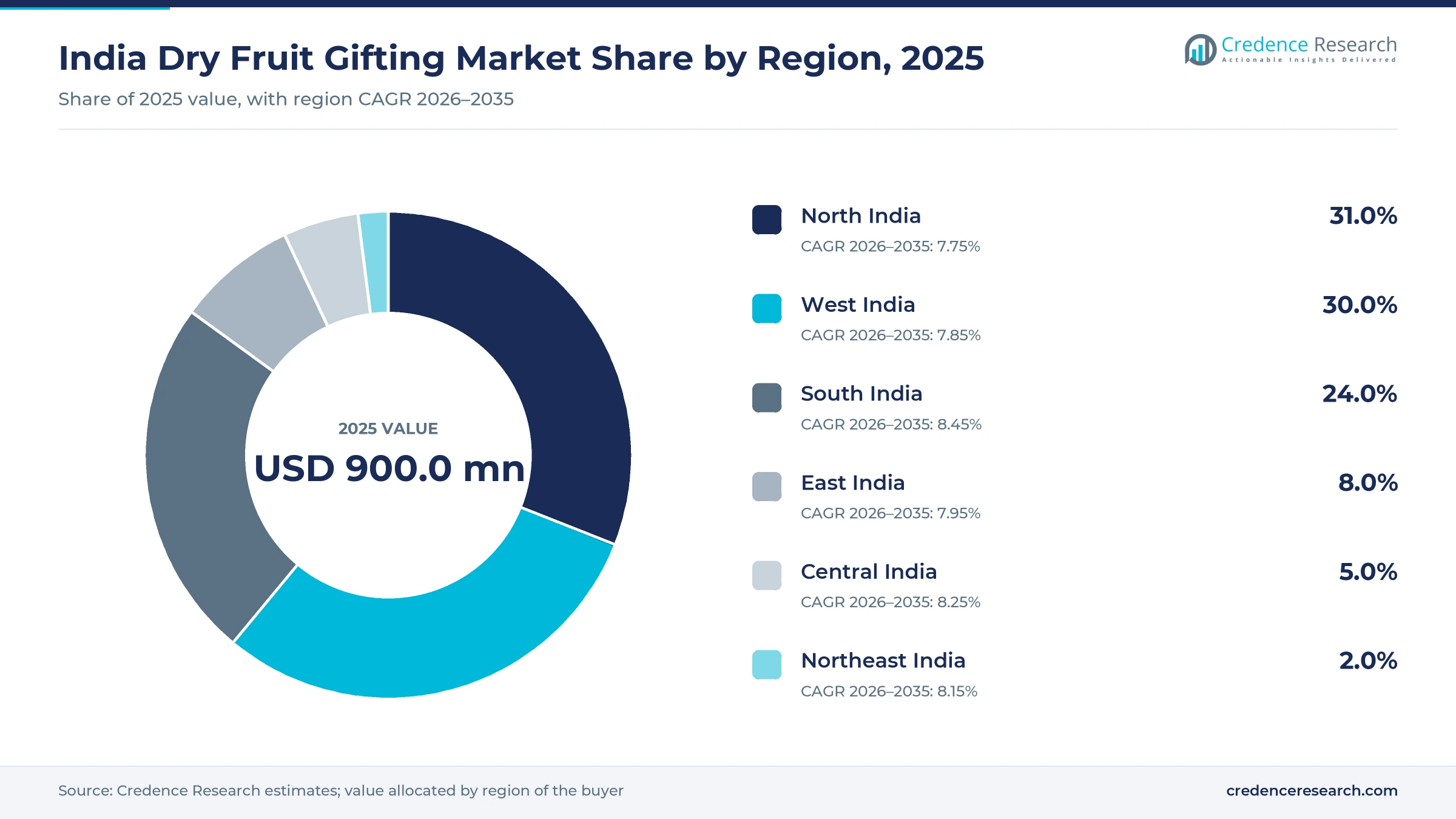
North India leads while South India grows fastest
| Region | Value, 2025 (USD million) | Share, 2025 | CAGR, 2026–2035 |
|---|---|---|---|
| North India | 279.0 | 31.0% | 7.75% |
| West India | 270.0 | 30.0% | 7.85% |
| South India | 216.0 | 24.0% | 8.45% |
| East India | 72.0 | 8.0% | 7.95% |
| Central India | 45.0 | 5.0% | 8.25% |
| Northeast India | 18.0 | 2.0% | 8.15% |
North India leads on Delhi weddings and wholesale lanes
North India held 31.0% of 2025 value and grows at 7.75% a year, supported by a strong tradition of giving nuts at Diwali and weddings. CAIT put Delhi at Rs 1.8 lakh crore of wedding trade in the 2025 season, and Khari Baoli remains a national wholesale hub for spices and dry fruits. Its dependence on imported supply also makes it the zone most exposed to border closures and West Asian shipping delays.
West India pairs trading hubs with hamper makers
West India held 30.0% of 2025 value and grows at 7.85% a year, with Mumbai and Ahmedabad acting as both markets and packing centers. Free Press Journal reported Mumbai wholesale pistachios doubling before Diwali 2026, while Madhupura traders in Ahmedabad reported strong corporate and family gifting. IGP also said Ahmedabad led tier I cities for Rakhi orders in 2025, and that Surat ranked among the fastest-growing smaller cities.
South India grows fastest on online reach and cashew sweets
South India held 24.0% of 2025 value and grows at 8.45% a year, the fastest pace in the country. Bangalore ranked among the top three metro order sources for IGP in 2025, and Vijayawada was among its fastest-growing smaller cities. Cost pressure is visible here too, since Telangana Today reported in October 2026 that Hyderabad cashews had reached Rs 960 to Rs 1,300 a kilogram and cashew sweets Rs 1,800 to Rs 2,900.
East India blends sweet shop gifting with dry fruit boxes
East India held 8.0% of 2025 value and grows at 7.95% a year, a smaller base because sandesh and rosogolla still dominate festive giving in Bengal. The Telegraph counted just over 16,000 sweet shops in Kolkata in November 2024 and said KC Das saw online sales rise about 250% over the previous two months around Diwali and Bhai Phonta. IGP also reported demand spikes in Jamshedpur during Rakhi 2025, which shows box buying spreading across the zone.
Central India rises on tier II orders and local packers
Central India held 5.0% of 2025 value and grows at 8.25% a year, from a small organized base that delivery networks are now reaching. IGP named Jabalpur among its demand spikes during Rakhi 2025, which suggests that online gifting no longer stops at the metros. Unicommerce figures point the same way, with tier II and III cities at about 55% of festive orders in 2025.
Northeast India starts from a small retail base
Northeast India held 2.0% of 2025 value and grows at 8.15% a year, the smallest share among the six zones because long supply routes limit the range on shelves. Organized sellers are present in the main city, and Vaibhavam Sweets and Snacks in Guwahati offered dry fruit combo boxes at Rs 500 to Rs 1,000 for Diwali 2024, Business Northeast reported. Growth should come from such city retailers and from wider courier coverage.
Tax, trade and capital moves mark 2025 and 2026
| Development | Status and market relevance |
|---|---|
| In May 2025, Farmley announced a USD 40 million Series C round led by L Catterton to scale dried fruits and nuts. | The funds also target untapped regional markets and new product formulations. |
| In September 2025, the goods and services tax on nuts and dried fruits fell from 12% to 5%, effective Sept. 22. | The cut arrived just before the Diwali gifting peak. |
| In October 2025, Haldiram's unveiled a six-hamper Diwali gifting collection with reusable wooden boxes and fabric bags. | The range mixes dry fruits with sweets, namkeen and cookies. |
| In February 2026, the India-U.S. framework named walnuts, almonds and pistachios for duty concessions. | Rates and timing for these nuts have not been confirmed in the sources reviewed. |
| In October 2026, Mumbai traders reported wholesale pistachios at Rs 1,800 a kilogram, about double the level of the previous Diwali. | Box makers are cutting basket weights and adding seeds to hold price points. |
Packaging, testing and delivery decide box quality
- Rigid and barrier packaging protects nuts from moisture and oxidation, and Restaurant India notes that rigid boxes and reusable glass jars also raise perceived value.
- Aflatoxin testing gives premium sellers a safety claim that buyers can check, since Restaurant India reported that buyers now weigh such checks along with grading.
- Batch traceability links a box to its origin and lot, which supports named varieties such as Iranian Akbari pistachios and California almonds.
- Express fulfillment serves late buyers, and IGP said about 6.5% of its 2025 Rakhi orders came in the final two days through express and same-day delivery.
Need a Custom Version of This Report?
Tailor the scope, geography, or segments to your exact requirements.
- Custom geography or segment scope
- Direct access to our analyst team
Local merchants hold volume as national brands chase boxes
Competition runs between local merchants, packaged nut brands and sweet and snack groups that add dry fruit to wider ranges. Local merchants in markets such as Madhupura, Bhilwara and Khari Baoli hold volume, because they can grade and pack to order at short notice. Nutraj competes through a wide box catalog and bulk ordering for corporate clients, while Happilo sells personalized hampers from about Rs 225 to about Rs 2,999. Farmley has fresh capital from L Catterton and a snack-led range that includes date bites, trail mixes and makhanas. Haldiram's brings festive brand recognition, a dedicated gifting vertical and six hampers introduced in 2025. Vendors increasingly differ on basket design more than on raw nut price, since all of them buy from similar import channels. Corporate buyers negotiate within fixed budgets, so the winners tend to be those that keep box appearance and contents credible when almond or pistachio costs jump.
Companies profiled and their roles in this market
| Company | Type | Role in the market |
|---|---|---|
| Happilo | Packaged nut brand | Sells nuts, berries and personalized festive hampers from about Rs 225 to about Rs 2,999 |
| Nutraj | Packaged nut brand | Lists 23 Diwali boxes and takes corporate bulk orders through its website |
| Farmley | Snack and dry fruit brand | Raised USD 40 million in May 2025 to scale dried fruits and nuts in new regions |
| Haldiram's | Sweet and snack group | Runs a gifting vertical and launched six Diwali hampers with dry fruits in October 2025 |
| Local Dry-Fruit Merchants | Wholesale and retail traders | Grade and pack boxes in markets such as Bhilwara, Madhupura and Khari Baoli |
Basket design matters more than the headline nut price
Credence Research's view is that basket design will decide profit in this market more than the headline price of almonds or pistachios. Import shocks recur, and buyers hold firm on price points, so suppliers need recipes that can absorb a doubling in one nut without a visible loss of quality. Cashew, which relies less on West Asian routes, gives packers a useful anchor for that purpose. Brands should publish contents and test results clearly, because a thinner box will otherwise look like a hidden price rise. Investors should watch duty changes and corporate budgets closely through each festive season.
How the gift box estimates were built
The report uses 2025 as the base year and 2026 to 2035 as the forecast period. Market values come from the Credence Research model, and segment and regional splits are Credence Research estimates informed by festive trade surveys, import data and retail price evidence. Sources include government agencies, regulator letters, trade body releases, company pages and business press reports opened during research. No interviews or surveys were conducted for this edition of the report. Occasion shares cover the three leading occasions only, with smaller festivals allocated to the nearest occasion.
Premium boxes and online orders gain ground to 2035
By 2035, the dry fruit box should be a more designed and better documented product than the merchant carton that still leads today. Premium hampers, growing at 8.85% a year, and online orders should gain the most share, although shops will remain the largest channel throughout the period. Festive boxes held 52.0% of 2025 demand, and that share should narrow as hampers gain. Lower duties under the India-U.S. framework would help hamper makers if the terms are confirmed. The largest uncertainties are West Asian supply, the rupee, corporate budgets and whether smaller baskets keep buyer trust over repeated seasons.
Frequently Asked Questions
How big is the India dry fruit gifting market?
What is driving growth in dry fruit gifting?
Which product format leads the market?
Which occasion matters most for sellers?
Which region holds the largest share?
Who are the main companies in this market?
How are high nut prices changing gift boxes?
What are the main risks for sellers?
Table of Content
Chapter 1 Market Segmentation
- 1.1 Segmentation Framework
- 1.1.1 Product and Service Classification
- 1.1.2 Application and End-Use Classification
- 1.1.3 Technology and Solution Classification
- 1.1.4 Customer and Distribution Channel Classification
- 1.1.5 Geographic Segmentation
- 1.1.6 Market Segment Definitions and Boundaries
- 1.2 By Product
- 1.2.1 Festive Boxes
- 1.2.2 Premium Hampers
- 1.2.3 Corporate Packs
- 1.3 By Occasion
- 1.3.1 Diwali
- 1.3.2 Weddings
- 1.3.3 Raksha Bandhan
- 1.4 By Channel
- 1.4.1 Offline
- 1.4.2 E-Commerce
- 1.4.3 B2B
Chapter 2 Introduction
- 2.1 Report Objectives and Scope
- 2.2 Product Definition and Industry Terminology
- 2.3 Market Inclusions and Exclusions
- 2.4 Research Process
- 2.4.1 Primary Research and Expert Interviews
- 2.4.2 Secondary Research and Source Review
- 2.4.3 Top-Down and Bottom-Up Estimation
- 2.4.4 Data Triangulation and Verification
- 2.5 Market Size Measurement Basis
- 2.5.1 2025: USD 900.0 million → 2035: USD 1.94 billion
- 2.6 Historical and Forecast Reference Periods
- 2.6.1 Historical Period: 2018-2025
- 2.6.2 Base Year: 2025
- 2.6.3 Forecast Period: 2025-2035
- 2.7 Research Assumptions and Limitations
Chapter 3 Executive Summary
- 3.1 Market Snapshot and Key Findings
- 3.2 Base-Year Market Size, 2025
- 3.3 Forecast Market Size, 2035
- 3.4 Revenue and Volume Growth Outlook
- 3.5 Key Demand and Supply Indicators
- 3.6 Leading Market Segments
- 3.7 Fastest-Growing Market Opportunities
- 3.8 Regional Performance Highlights
- 3.9 Technology and Industry Transformation
- 3.10 Competitive Landscape Summary
- 3.11 Analyst View and Strategic Implications
Chapter 4 India Dry Fruit Gifting Market Trends and Developments
- 4.1 Historical Industry Development, 2018-2025
- 4.2 Recent Market Trends and Developments
- 4.3 Demand and Customer Behavior Trends
- 4.4 Technology and Product Innovation
- 4.5 Artificial Intelligence, Automation and Digitalization
- 4.6 Local Manufacturing and Supply Chain Realignment
- 4.7 Industry Partnerships, Mergers and Acquisitions
- 4.8 Sustainability and Circular Economy Developments
- 4.9 Government and Private Sector Investment Trends
- 4.10 Emerging Business Models and Commercialization
- 4.11 Industry Developments and Announcements
Chapter 5 India Dry Fruit Gifting Market Production, Supply and Demand Analysis
- 5.1 Demand Trend and Consumption Analysis, 2018-2025
- 5.2 Demand Forecast, 2025-2035
- 5.3 Production and Output Trend, 2018-2025
- 5.4 Production and Output Forecast, 2025-2035
- 5.5 Installed Capacity and Capacity Utilization
- 5.6 Company-Wise Production Plants and Statistics
- 5.6.1 Installed Production Capacity
- 5.6.2 Actual Production
- 5.6.3 Planned Capacity and Expansion Targets
- 5.7 Supply Chain Structure and Procurement Trends
- 5.8 Supply-Demand Gap and Bottlenecks
- 5.9 Import Dependence and Sourcing Structure
- 5.10 Contract Manufacturing and Outsourcing
- 5.11 Regional Supply and Demand Concentration
Chapter 6 India Dry Fruit Gifting Market Pricing Analysis
- 6.1 Pricing Structure and Measurement
- 6.2 Historical Pricing Trends, 2018-2025
- 6.3 Pricing Outlook, 2025-2035
- 6.4 Average Selling Price and Unit Economics
- 6.5 Pricing by Product and Market Segment
- 6.6 Geographic Pricing Differences
- 6.7 Key Input, Energy, Labor and Logistics Costs
- 6.8 Contract Pricing and Purchasing Models
- 6.9 Pricing Sensitivity and Competitive Positioning
- 6.10 Price, Margin and Profitability Implications
Chapter 7 India Dry Fruit Gifting Market Dynamics
- 7.1 Market Growth Drivers
- 7.1.1 Demand-Side Drivers
- 7.1.2 Technology and Innovation Drivers
- 7.1.3 Infrastructure and Investment Drivers
- 7.1.4 Regulatory and Policy Drivers
- 7.2 Market Restraints
- 7.2.1 Cost and Affordability Constraints
- 7.2.2 Technology and Adoption Barriers
- 7.2.3 Supply Chain and Operational Constraints
- 7.3 Market Challenges
- 7.3.1 Competitive Pressure and Margin Erosion
- 7.3.2 Skills, Infrastructure and Implementation Gaps
- 7.4 Emerging Market Opportunities
- 7.5 Market Dynamics Impact and Time-Horizon Assessment
Chapter 8 India Dry Fruit Gifting Value Chain Analysis
- 8.1 Industry Value Chain Overview
- 8.2 Upstream Suppliers and Critical Inputs
- 8.3 Technology and Component Providers
- 8.4 Manufacturing or Service Delivery
- 8.5 Distribution, Channel Partners and Integrators
- 8.6 Downstream Applications and End Users
- 8.7 Value Addition and Profit Pools
- 8.8 Vertical Integration and Outsourcing
- 8.9 Supplier Concentration and Risk
- 8.10 Supply Chain Localization and Resilience
Chapter 9 India Dry Fruit Gifting Market Regulations and Policies
- 9.1 Relevant Laws, Standards and Compliance Frameworks
- 9.2 Product, Service, Safety and Quality Requirements
- 9.3 Government Policies, Incentives and Subsidies
- 9.4 Imports, Exports and Trade Barriers
- 9.5 Public Procurement and Local Content Requirements
- 9.6 Environmental and Sustainability Compliance
- 9.7 Upcoming Policy Changes and Market Implications
Chapter 10 India Dry Fruit Gifting Market Hotspots and Opportunities
- 10.1 Market Opportunity Mapping and Growth Hotspots
- 10.2 High-Growth Applications and Customer Groups
- 10.3 Underserved Markets and White-Space Opportunities
- 10.4 Emerging Technology and Product Opportunities
- 10.5 New Capacity and Investment Hotspots
- 10.6 Market Entry and Expansion Opportunities
- 10.7 Distribution and Partnership Opportunities
- 10.8 Near-Term and Long-Term Commercial Potential
- 10.9 Opportunity Attractiveness and Execution Risks
Chapter 11 India Dry Fruit Gifting Market Outlook, 2025-2035
- 11.1 Market Size and Analysis
- 11.1.1 Revenue (Market Measurement: 2025: USD 900.0 million → 2035: USD 1.94 billion)
- 11.1.2 Market Volume and Quantity Sold
- 11.1.3 Historical Market Size, 2018-2025
- 11.1.4 Base-Year Market Size, 2025
- 11.2 Market Forecast, 2025-2035
- 11.2.1 Revenue Forecast to 2035
- 11.2.2 Volume Forecast to 2035
- 11.2.3 CAGR and Year-on-Year Growth
- 11.2.4 Incremental Revenue Opportunity
- 11.3 Forecast Assumptions and Scenario Analysis
- 11.3.1 Base-Case Forecast
- 11.3.2 Optimistic and Conservative Scenarios
- 11.3.3 Technology, Pricing and Policy Sensitivities
- 11.4 Market Attractiveness and Growth Outlook
Chapter 12 India Dry Fruit Gifting Market Segmentation and Outlook
- 12.1 Segmentation Summary and Market Shares, 2025
- 12.2 Largest and Fastest-Growing Segments
- 12.3 By Product - Market Size and Forecast, 2025-2035
- 12.3.1 Segment Definition and Scope
- 12.3.2 Historical Market Size, 2018-2025
- 12.3.3 Revenue Forecast, 2025-2035
- 12.3.4 Volume Forecast, 2025-2035
- 12.3.5 Base-Year Market Share, 2025
- 12.3.6 Segment CAGR and Growth Drivers
- 12.3.7 Subsegment Market Size and Forecast
- 12.3.7.1 Festive Boxes
- 12.3.7.2 Premium Hampers
- 12.3.7.3 Corporate Packs
- 12.3.8 Subsegment Pricing and Adoption Trends
- 12.3.9 Leading Suppliers and Competition
- 12.3.10 Regional Demand and Opportunities
- 12.4 By Occasion - Market Size and Forecast, 2025-2035
- 12.4.1 Segment Definition and Scope
- 12.4.2 Historical Market Size, 2018-2025
- 12.4.3 Revenue Forecast, 2025-2035
- 12.4.4 Volume Forecast, 2025-2035
- 12.4.5 Base-Year Market Share, 2025
- 12.4.6 Segment CAGR and Growth Drivers
- 12.4.7 Subsegment Market Size and Forecast
- 12.4.7.1 Diwali
- 12.4.7.2 Weddings
- 12.4.7.3 Raksha Bandhan
- 12.4.8 Subsegment Pricing and Adoption Trends
- 12.4.9 Leading Suppliers and Competition
- 12.4.10 Regional Demand and Opportunities
- 12.5 By Channel - Market Size and Forecast, 2025-2035
- 12.5.1 Segment Definition and Scope
- 12.5.2 Historical Market Size, 2018-2025
- 12.5.3 Revenue Forecast, 2025-2035
- 12.5.4 Volume Forecast, 2025-2035
- 12.5.5 Base-Year Market Share, 2025
- 12.5.6 Segment CAGR and Growth Drivers
- 12.5.7 Subsegment Market Size and Forecast
- 12.5.7.1 Offline
- 12.5.7.2 E-Commerce
- 12.5.7.3 B2B
- 12.5.8 Subsegment Pricing and Adoption Trends
- 12.5.9 Leading Suppliers and Competition
- 12.5.10 Regional Demand and Opportunities
- 12.6 Segment Growth Comparison
- 12.7 Segment Attractiveness and Priority Matrix
Chapter 13 India Dry Fruit Gifting Geographic Market Outlook, 2025-2035
- 13.1 Domestic Market Distribution and Demand Clusters
- 13.2 State- or Province-Wise Market Size and Forecast, 2025-2035
- 13.3 City and Metropolitan Market Outlook
- 13.4 Industrial, Manufacturing and Commercial Clusters
- 13.5 Geographic Concentration of Key End Users
- 13.6 Local Pricing and Purchasing Differences
- 13.7 Domestic Production Facilities and Capacity Map
- 13.8 Local Infrastructure and Project Pipeline
- 13.9 State-Level Policy and Incentive Differences
- 13.10 Subnational Investment Hotspots and Opportunities
- 13.11 Distribution and Logistics Networks
- 13.12 Domestic Competitive Footprint
Chapter 14 India Dry Fruit Gifting Technology, Innovation and Sustainability Outlook
- 14.1 Technology Landscape and Maturity
- 14.2 Product, Process and Service Innovation
- 14.3 AI, Automation and Digital Tools in the Industry
- 14.4 Technology Adoption and Performance Benchmarking
- 14.5 Innovation Pipeline and R&D Investment
- 14.6 Patent and Intellectual Property Trends
- 14.7 Energy Efficiency and Resource Management
- 14.8 Sustainability, Recycling and Circularity
- 14.9 Technology Roadmap, 2025-2035
- 14.10 Risks of Obsolescence and Technology Substitution
Chapter 15 India Dry Fruit Gifting Market Key Strategic Imperatives
- 15.1 Growth and Market Entry Priorities
- 15.2 High-Return Products and Segments
- 15.3 Pricing, Profitability and Cost Optimization
- 15.4 Technology Investment and Product Differentiation
- 15.5 Supply Chain Localization and Resilience
- 15.6 Distribution and Customer Acquisition
- 15.7 Partnership, Acquisition and Capacity Strategy
- 15.8 Regional Expansion Priorities
- 15.9 Short-, Medium- and Long-Term Actions
Chapter 16 Competition Outlook
- 16.1 Industry Competition Characteristics
- 16.2 Market Structure and Concentration
- 16.3 Market Share and Competitive Positioning, 2025
- 16.4 Company-Wise Revenue and Product Benchmarking
- 16.5 Production and Service Capacity Benchmarking
- 16.6 Technology, Pricing and Differentiation
- 16.7 Regional Footprint and Distribution Strength
- 16.8 Mergers, Acquisitions and Strategic Alliances
- 16.9 New Entrants and Competitive Threats
- 16.10 Porter's Five Forces and Industry Attractiveness
- 16.11 Competitive Outlook, 2025-2035
Chapter 17 Company Profiles
- 17.1 Company Coverage and Selection Criteria
- 17.2 Happilo
- 17.2.1 Business Description
- 17.2.2 Company Ownership and Geographic Presence
- 17.2.3 Product and Service Portfolio
- 17.2.4 Manufacturing and Operating Footprint
- 17.2.5 Production Capacity and Expansion Plans
- 17.2.6 Financial Performance and Investment
- 17.2.7 Market Share and Competitive Position
- 17.2.8 Technology and Innovation Capabilities
- 17.2.9 Strategic Alliances or Partnerships
- 17.2.10 Recent Developments
- 17.2.11 Growth Strategy and Outlook
- 17.3 Nutraj
- 17.4 Farmley
- 17.5 Haldiram's
- 17.6 Local Dry-Fruit Merchants
- 17.7 Other Relevant Market Participants
Note: Every listed company is profiled on the structure shown under the first company. The company list is preliminary and may change based on research findings, market developments, data availability and client requirements.
Chapter 18 Disclaimer
- 18.1 Research and Forecast Disclaimer
- 18.2 Data Source and Estimation Limitations
Note: The depth of individual sections depends on data availability for this market. Volume, capacity, trade and other unit-based metrics are included where applicable.

