
Branded tea moves from roadside stalls to organized outlets
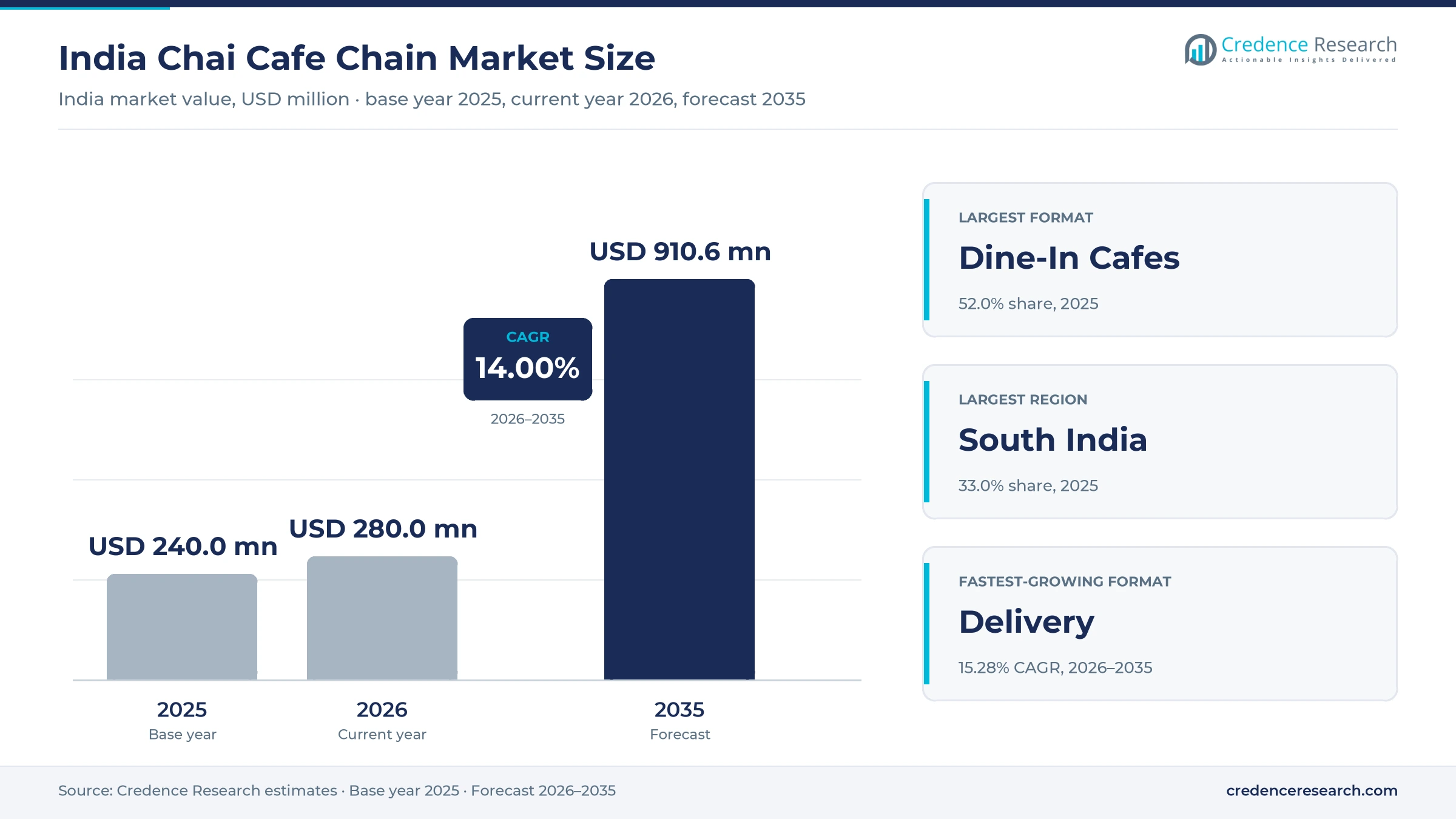
The India chai cafe chain market was valued at USD 240.0 million in 2025 and is projected to increase from USD 280.0 million in 2026 to USD 910.6 million by 2035, registering a CAGR of 14.00% during 2026–2035. Demand comes from young urban buyers who want an affordable place to meet, from office workers who order by app and from franchise partners opening outlets beyond the largest cities. South India held the largest regional share, 33.0% in 2025, supported by dense tea cultures in Bengaluru and Chennai. Central India is the fastest-growing region at 15.19% a year as franchise brands add outlets in cities such as Bhopal. Capital is also moving, as Tea Post filed fresh listing papers in June 2025, while Chaayos was reported in April 2026 to be seeking new capital for more outlets and kitchen automation.
What does the organized chai cafe business include?
The market counts consumer sales at branded multi-outlet tea chains in India, including seated cafes, small kiosks and orders fulfilled through apps. Sales of tea, snacks and light meals at those outlets are included, whether a company or a franchise partner runs the site.
Independent roadside stalls, packaged tea sold through grocers, and coffee-led cafes are excluded from the count. The value chain runs from tea and milk suppliers through central kitchens and brewing equipment to outlets, delivery platforms and franchise partners.
India Chai Cafe Chain Market Insights
- The market grows from USD 240.0 million in 2025 to USD 910.6 million by 2035, a 14.00% CAGR over 2026–2035, as branded outlets take occasions from unorganized tea stalls.
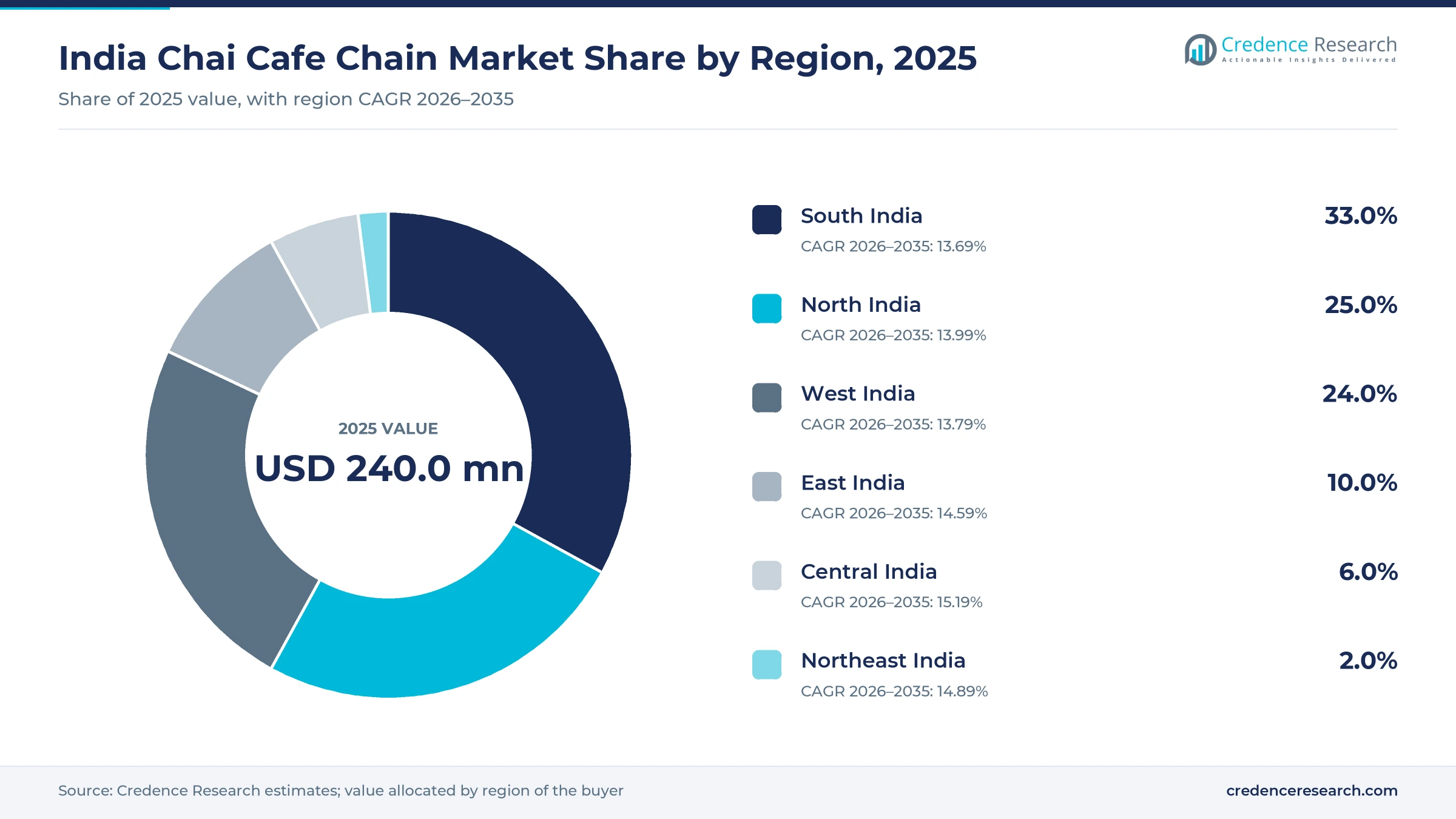
- South India led with 33.0% of 2025 value, helped by the Bengaluru and Chennai home markets of Chai Point and Chai Kings.
- Dine-In Cafes led with 52.0% of 2025 value because seated outlets combine longer visits with wider food menus than kiosks can hold.
- Indian Railways opened its stations to premium brand catering outlets in November 2025, creating a new five-year licensed route for tea chains.
- Chai Point, Tea Post and Chaayos have each pursued listing or growth capital since 2025, so store rollouts increasingly depend on outlet-level returns.
Seated cafes lead value as delivery and tier-2 outlets scale
Why do seated outlets lead while delivery grows fastest?
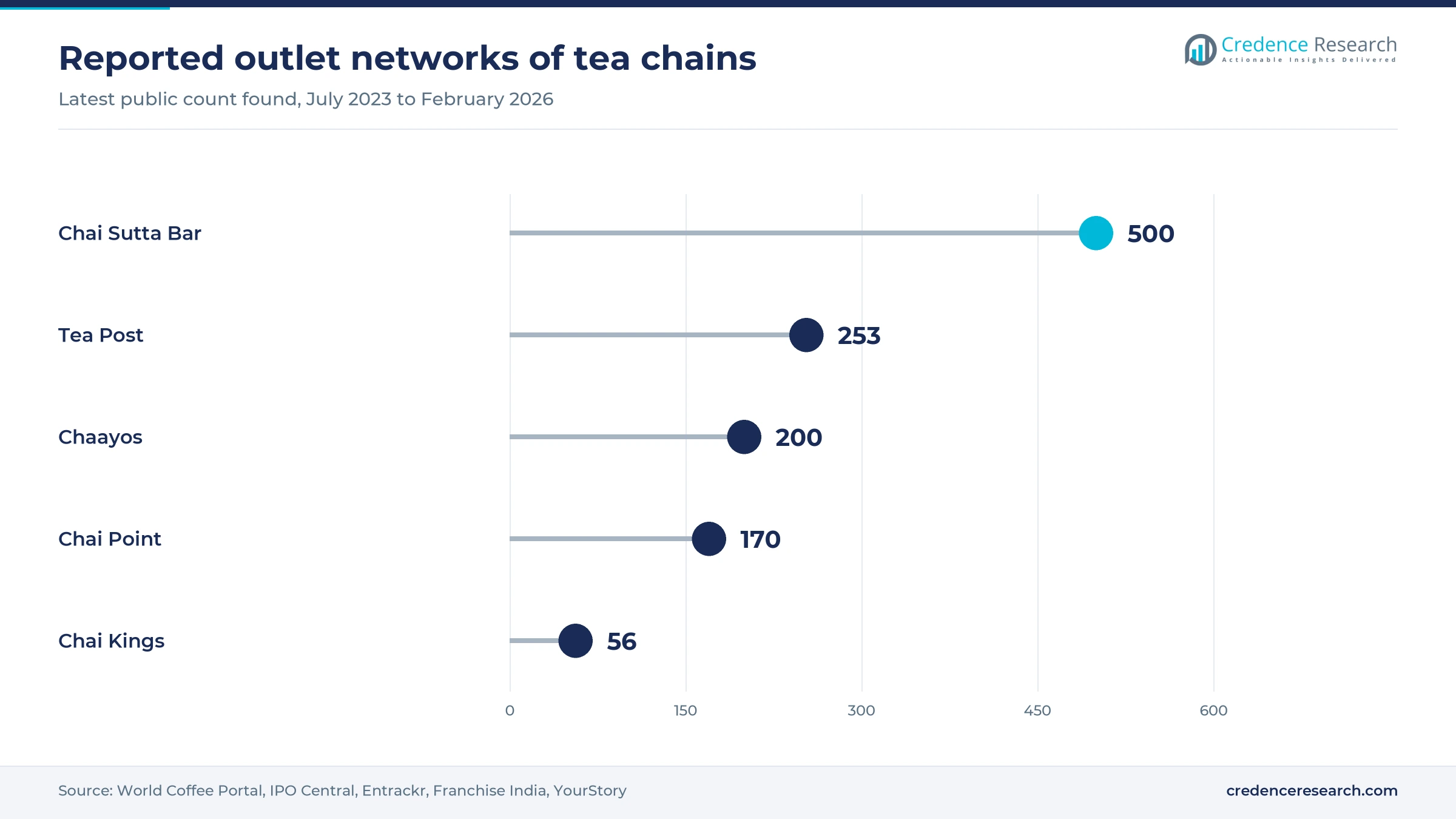
Based on format, the market is categorized into dine-in cafes, kiosks and delivery. Dine-In Cafes led with 52.0% of 2025 value because seats support longer visits and larger orders, and BloombergQuint reported in March 2020 that tea cafes averaged bills of Rs 150 to Rs 250 against cups priced from Rs 65. Delivery grows fastest at 15.28% a year as The Hindu BusinessLine reported in March 2026 that Chai Kings splits its orders about evenly between online and offline channels. Kiosks remain important for footfall because Tea Post runs 185 small kiosks, according to IPO Central, and they suit stations, offices and malls.
How does franchising change the pace of openings?
Based on operating model, the market is categorized into franchise and company-owned outlets. Franchise led with 58.0% of 2025 value because partners fund the sites, and Business Insider reported in July 2022 that MBA Chai Wala partners cover all outlet investment. Franchise also grows fastest at 14.45% a year as Tea Post added 24 franchise cafes and seven company-operated cafes in nine months of fiscal 2025, according to IPO Central. Company-owned chains still matter because Chaayos and Chai Point control their brewing systems, service and customer data across more than 370 outlets between them.
Why are smaller cities gaining share from metros?
Based on city tier, the market is categorized into metro and tier-2 locations. Metro led with 72.0% of 2025 value because office and student density supports several visits a month, and Entrackr reported in February 2026 that Chaayos built more than 200 outlets across only Delhi-NCR, Mumbai and Bengaluru. Tier-2 grows fastest at 15.20% a year as Chai Sutta Bar widened from 195 cities in March 2023 to 300 by July 2023, according to Restaurant India and World Coffee Portal. Lower rents help partners recover the Rs 14 lakh to Rs 18 lakh outlet cost reported by YourStory.
| Segment Group | Leading Sub-segment | Share, 2025 | Fastest-growing Sub-segment | CAGR, 2026–2035 |
|---|---|---|---|---|
| By Format | Dine-In Cafes | 52.0% | Delivery | 15.28% |
| By Model | Franchise | 58.0% | Franchise | 14.45% |
| By City Tier | Metro | 72.0% | Tier-2 | 15.20% |
Request a Free Sample
Fill in your details and we'll send you a free sample report.
- Sample data tables & charts
- Research methodology
Young buyers, franchising and food pairings lift store sales
Young buyers want an affordable social beverage
Young urban buyers want a place to meet that costs less than a coffee chain, and tea chains are built around that visit. Youth aged 15 to 29 were projected at 27.2% of the population in 2021, according to official youth statistics. Tea also holds a large habit advantage, because National Sample Survey Office data cited by BloombergQuint in March 2020 showed Indians drinking about 17 cups of tea for each cup of coffee. Tea competes with other caffeinated beverage options at a lower bill, as the same report put Chaayos tickets near Rs 250 against about Rs 550 at Starbucks. In the Credence Research model this adds about 5.18 percentage points to annual growth to 2035.
Franchise rollouts add stores in smaller urban centers
Franchising lets a tea brand enter new cities without funding each site, and that has changed the geography of the category. Chai Sutta Bar reached 500 outlets across 300 cities by July 2023, according to World Coffee Portal, and it relies on franchise partners for much of that network. Tea Post shows the same pattern, because its offer documents listed 253 stores, of which 188 were franchise-operated. MBA Chai Wala expanded to 100 cities by July 2022 and aimed for 200 by that year end, according to Business Insider. As a result, Tier-2 locations grow at 15.20% a year. In the Credence Research model this adds about 3.78 percentage points to annual growth to 2035.
Food pairings and loyalty raise average bills
Snacks and repeat ordering lift spending per visit, which matters because a cup of tea alone rarely pays for a prime site. BloombergQuint reported in March 2020 that food made up 18% of Chai Point revenue, while its average bill was rising 15% to 18% a year. The same report said repeat Chaayos customers visited about 3.8 times a month, a pattern that rewards saved preferences and app ordering. Menus have since widened, because YourStory reported in July 2024 that Chai Kings sold more than 200 items priced from Rs 30 to Rs 400 across eight categories. These changes support the bill sizes that seated outlets depend on. In the Credence Research model this adds about 2.80 percentage points to annual growth to 2035.
Workplace machines widen the reach of tea brands
Offices give tea chains steady daily volume outside their shops, and that volume helps absorb central kitchen and brand costs. Chai Point had about 5,000 myChai brewing machines leased across India by December 2022, with clients such as Amazon, Intel and Microsoft, according to World Coffee Portal. Corporate partnerships made up about 40% of its sales at that time, and the company planned to reach 30,000 machines within five years. Franchise India later reported that the company sold close to 900,000 cups a day across its channels. This workplace base also helps the brand win retail visits, because employees meet the same tea at work and near their homes.
Kiosks, rapid delivery and rail outlets reshape the format
Shift toward ten-minute delivery for hot beverages
Rapid delivery is moving tea from a planned outlet visit to an impulse order, and platforms are investing heavily in that habit. Swiggy Bolt had reached more than 400 cities by January 2025, while Zepto Cafe rose from about 30,000 to about 50,000 daily orders in a month, according to Inc42. Chai Kings already takes about half of its orders online, as The Hindu BusinessLine reported in March 2026. Tea Post has also added a dark kitchen to its network, according to IPO Central, and Chaiera said in an October 2025 release carried by The Tribune that it plans dark stores in every city. These moves help Delivery grow at 15.28% a year, although thermal quality remains a limit on delivery radius.
Rise of small kiosks over large seated cafes
Small formats are gaining ground because they open quickly and need little rent, which suits a low-priced product. Tea Post had 185 small kiosks against 62 standard cafes in its filing data, according to IPO Central. Chai Point operated about 110 walk-in stores and 60 seated stores in 2025, according to Franchise India. Regional brands are following the same logic, because Business Northeast reported that ESAH Repose franchises can fit in 150 square feet with 10 to 15 seats. Kolkata-based Tea Junction used kiosk and shop-in-shop formats by August 2019, and it also explored bubble tea for younger buyers. As a result, operators are treating outlet size as a portfolio decision instead of a single standard store.
Opening at railway stations through premium catering licenses
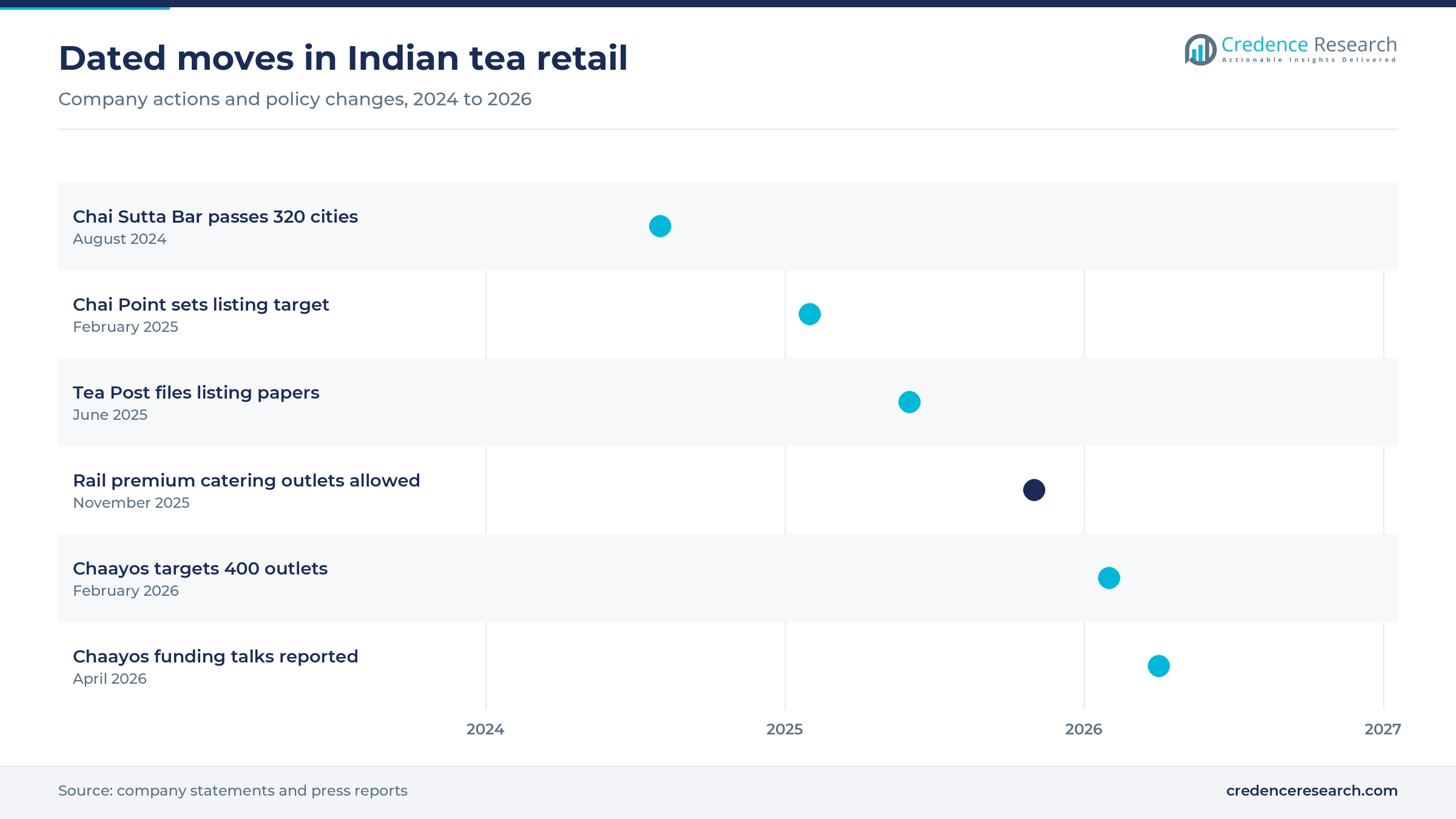
Railway stations offer tea chains a large new opening, because passengers already buy tea there and branded options have been limited. BW Retail World reported on Dec. 26, 2025, that the central government amended the Catering Policy 2017 of Indian Railways to add premium brand catering outlets. Licenses are allocated through e-auctions for five years, and chains may run company-owned or franchise stores across a network of more than 7,000 stations. First outlets were expected in 2026, so early winners can secure sites with heavy daily footfall. Event demand points to the same appeal, since Chai Point sold more than 100,000 cups a day at the peak of the Maha Kumbh, according to Franchise India.
Opening for growth capital as chains near listing
Public listings and new funding give well-run chains an opening to expand faster than smaller rivals can. Tea Post filed fresh listing papers on June 13, 2025, according to Groww, and IPO Central reported that Rs 39.47 crore of the fresh issue would fund new company-operated cafes. Chai Point co-founder Tarun Khanna told Storyboard18 in February 2025 that the company aimed to list by May 2026. Mint reported in April 2026 that Chaayos was seeking USD 50 million to USD 70 million for outlets in tier-1 and tier-2 cities, kitchen automation and digital platforms. Entrackr reported that the chain aims to reach 400 outlets, which would double its network and raise the benchmark for scale in the category.
Milk costs, tax rules and stall pricing squeeze margins
Milk price increases raise the cost of each cup
Milk is a core input, so retail price moves pass directly into outlet margins. Storyboard18 reported that Amul raised milk prices by Rs 2 a liter on May 1, 2025, a day after Mother Dairy made a similar move. Kiosk operators feel this most because their bills are small and menus offer little room to absorb costs. Some relief came from softer leaf prices, with Tradejini putting 2025 auction averages near Rs 187 a kilogram. Chains respond through central purchasing and periodic menu price changes.
No input tax credit limits relief on outlet costs
Standalone outlets pay 5% GST on sales but cannot claim input tax credit, according to Razorpay, so tax paid on rent, equipment and fit-outs stays in the cost base. This burden is heavier for chains opening many sites each year, because new outlets carry the largest capital bills. Chai Kings, for example, spends Rs 14 lakh to Rs 18 lakh on each outlet, according to YourStory. Operators reduce the exposure through smaller formats, franchise funding and standardized store designs that lower fit-out spending.
Roadside tea stalls set a very low price anchor
Informal stalls remain the main competitor, and their prices limit what a branded cup can charge outside the metros. YourStory reported in July 2024 that Chennai alone has about 25,000 tea stalls, and Business Northeast reported kulhad tea at Rs 10 in a Mangaldoi outlet. Branded cups started near Rs 65 at tea cafes when BloombergQuint checked in March 2020. As a result, tier-2 partners face slower payback unless they trim menus, rents and staffing.
Delivery platforms compete as well as distribute
Delivery brings reach, but platforms also launch their own quick cafes, which puts chains in a difficult position. Inc42 reported in January 2025 that the National Restaurant Association of India was preparing to approach the Competition Commission of India over private labels from Zomato and Swiggy. The association has also alleged high commissions and delayed payments. Chains with a large online share, such as Chai Kings, face the most exposure, so many are pushing their own apps and loyalty programs.
South India leads while central cities add stores fastest
| Region | Value, 2025 (USD million) | Share, 2025 | CAGR, 2026–2035 |
|---|---|---|---|
| South India | 79.2 | 33.0% | 13.69% |
| North India | 60.0 | 25.0% | 13.99% |
| West India | 57.6 | 24.0% | 13.79% |
| East India | 24.0 | 10.0% | 14.59% |
| Central India | 14.4 | 6.0% | 15.19% |
| Northeast India | 4.8 | 2.0% | 14.89% |
South India leads through Bengaluru and Chennai
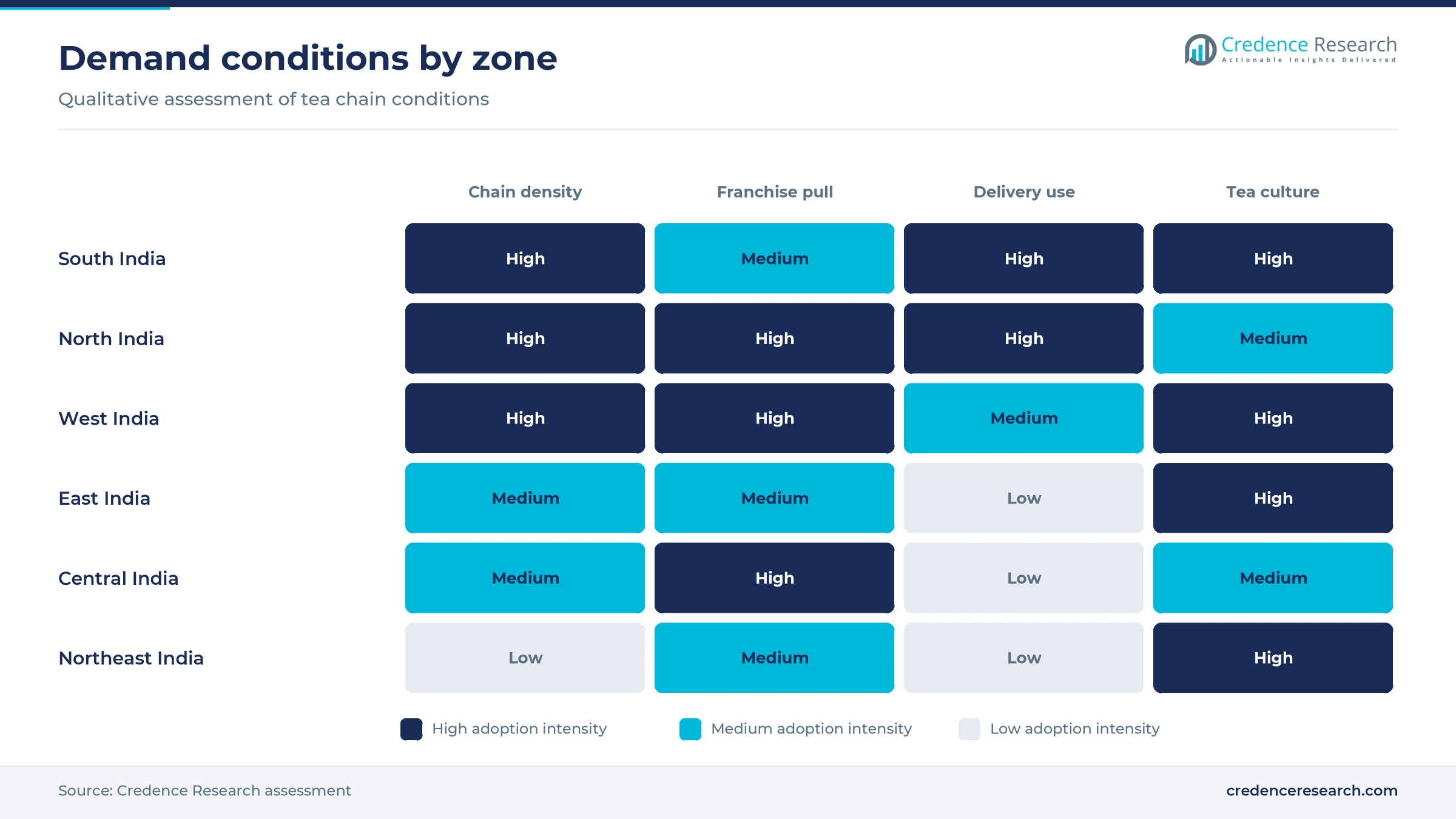
South India held 33.0% of 2025 value and grows at 13.69% a year, the largest position in the country. Bengaluru is the base and largest market of Chai Point, according to World Coffee Portal, and it gives the zone a dense office customer base. Chennai adds a second strong cluster, because Chai Kings had 50 of its 56 outlets there in July 2024, according to YourStory. The chain planned about 30 more Chennai stores in 2026, which keeps competition high.
North India grows from the Delhi-NCR base
North India accounted for 25.0% of 2025 value and grows at 13.99% a year, anchored by Delhi-NCR offices and students. Chaayos opened its first store in Gurugram in 2012, according to Petpooja, and the region remains one of its three core markets. Chai Sutta Bar and MBA Chai Wala widen this reach into smaller cities, including Srinagar and other northern centers named by Business Insider in July 2022. Franchise openings therefore matter as much as metro density here.
West India is shaped by Gujarat and Maharashtra
West India held 24.0% of 2025 value and grows at 13.79% a year, helped by a strong regional brand. Tea Post operated in 61 cities across Gujarat, Maharashtra, Rajasthan and Madhya Pradesh when Groww reviewed its filing in June 2025. Its franchise clusters around Gujarat towns show how a regional chain can build density before going national. Mumbai adds national competition, because Chai Point and Chaayos both operate there and compete for office and commuter buyers.
East India builds on Kolkata adda habits
East India represented 10.0% of 2025 value and grows at 14.59% a year, supported by a long culture of conversation over tea. Tea Junction had 50 outlets in Kolkata and Siliguri by August 2019, according to Restaurant India, and it sources its tea from Assam. West Bengal also produced 45.90 million kilograms of tea in August 2025, according to Tea Board data published by Outlook Business. National chains remain less visible here, which leaves room for new franchise openings.
Central India adds franchise outlets fastest
Central India held 6.0% of 2025 value and is the fastest-growing zone at 15.19% a year, starting from a small base. Madhya Pradesh is one of the four states in the Tea Post footprint, according to Groww and Business Insider named Bhopal among MBA Chai Wala cities in July 2022. Lower rents suit kiosks and small franchise cafes, so partners can open with less capital than in metro locations.
Northeast India starts small near the tea gardens
Northeast India accounted for 2.0% of 2025 value and grows at 14.89% a year, the smallest but one of the quicker zones. Assam produced 103.52 million kilograms of tea in August 2025, according to Tea Board data published by Outlook Business, so local supply is close at hand. ESAH Repose opened in Mangaldoi with a target of 100 franchises in four to five years, according to Business Northeast. Low price points remain the main limit on bills in this zone.
Listing plans and new funding mark 2025 and 2026 moves
| Development | Status and market relevance |
|---|---|
| In June 2025, Tea Post filed fresh listing papers covering a fresh issue and an offer for sale. | Filed; proceeds are planned for new company-operated cafes |
| In November 2025, the central government amended the Indian Railways Catering Policy 2017 to allow premium brand catering outlets at stations. | In force; five-year licenses are allocated through e-auctions |
| In February 2026, Entrackr reported that Chaayos had more than 200 outlets and aimed to reach 400. | Rollout under way across Delhi-NCR, Mumbai and Bengaluru |
| In March 2026, The Hindu BusinessLine reported that Chai Kings planned about 30 more Chennai stores in 2026. | Planned; tier-2 entry is expected later |
| In April 2026, Mint reported that Chaayos was in talks to raise USD 50 million to USD 70 million. | In talks; funds target outlets, automation and digital platforms |
Brewing machines and app data lower the cost of each cup
- Chai Monk is the in-house IoT brewer at Chaayos, and it handles about 80% of the brewing while staff finish each order, according to Petpooja.
- myChai machines extend Chai Point into offices through leased brewers, which gives the brand daily volume without opening a full retail store.
- Face-based login cut repeat ordering at Chaayos from about two minutes to about 20 seconds, although the company made it opt-in after privacy criticism in 2019.
Need a Custom Version of This Report?
Tailor the scope, geography, or segments to your exact requirements.
- Custom geography or segment scope
- Direct access to our analyst team
Franchise networks and company-run brands compete on reach
Competition splits between company-run brands that control quality and franchise networks that prioritize reach. Chaayos and Chai Point invest in brewing systems, apps and metro density, while Chai Sutta Bar and MBA Chai Wala use partner capital to enter many cities quickly. Tea Post sits between these models, combining a Gujarat-led franchise cluster with some company-operated cafes. Rivals also come from the wider quick service restaurant field, which IPO Central put at Rs 67,440 crore for the organized segment, citing the India Food Services Report 2024. Regional brands such as Chai Kings in Chennai and Tea Junction in Kolkata defend local clusters with focused menus and lower overheads. Unit returns now matter more than store count, because listing candidates must show that outlets earn back their cost. Chains that combine consistent tea, food attachment and low rents hold the strongest position.
Companies profiled and their roles in this market
| Company | Type | Role in the market |
|---|---|---|
| Chaayos | Company-run tea cafe chain | Runs more than 200 outlets in Delhi-NCR, Mumbai and Bengaluru using Chai Monk brewers |
| Chai Point | Retail and workplace tea brand | Combines about 170 stores with leased myChai brewing machines at workplaces |
| Chai Sutta Bar | Franchise kulhad tea chain | Reports a presence in more than 320 cities and serves tea in clay kulhads |
| MBA Chai Wala | Franchise tea chain | Sells outlets to partners who fund the sites across many Indian cities |
| Tea Post | Regional franchise and company-run chain | Operates kiosks and cafes in Gujarat, Maharashtra, Rajasthan and Madhya Pradesh |
Store economics will decide which tea brands reach scale
Credence Research's view is that the category has proved its demand, and the next test is store economics. Chains have shown that buyers will pay for a consistent cup, yet a low bill leaves limited room for rent and platform fees. Brands that raise food attachment and repeat visits should outperform those that chase store count alone. Franchise rollouts will carry much of the growth for each cafe chain, but they need strict quality control to protect the brand. Railway licenses and delivery could add useful volume, though both bring costs that must be tested at outlet level before a chain commits widely.
How the tea outlet estimates were built
The report uses 2025 as the base year and 2026 to 2035 as the forecast period. Market values come from the Credence Research model, and segment and regional splits are Credence Research estimates informed by public evidence. Sources include official statistics, Tea Board data published in the press, company statements, public offer document summaries and business press reports. No interviews or surveys were conducted in preparing this report. Older chain data points are shown with their dates, because private companies publish store counts irregularly.
Smaller cities and delivery shape demand to 2035
The market should more than triple between 2026 and 2035 as branded tea reaches more cities and more occasions. Metro stores will still produce the larger share of value, but tier-2 franchise openings should account for much of the new store count. Delivery and small kiosks should gain from seated formats, while railway outlets add a new licensed channel if early sites perform well. A small number of listed or well-funded cafe chain operators are likely to set standards on quality and data. Regional brands should keep strong local positions where tea habits and supply are distinctive.
Frequently Asked Questions
How big is the India chai cafe chain market?
How fast is the market growing?
Which region leads the market?
Which format holds the largest share?
Why does franchising matter in this market?
What are the main challenges for tea chains?
Which companies are active in this market?
What new opportunity could open up for chains?
Table of Content
Chapter 1 Market Segmentation
- 1.1 Segmentation Framework
- 1.1.1 Product and Service Classification
- 1.1.2 Application and End-Use Classification
- 1.1.3 Technology and Solution Classification
- 1.1.4 Customer and Distribution Channel Classification
- 1.1.5 Geographic Segmentation
- 1.1.6 Market Segment Definitions and Boundaries
- 1.2 By Format
- 1.2.1 Dine-In Cafes
- 1.2.2 Kiosks
- 1.2.3 Delivery
- 1.3 By Model
- 1.3.1 Franchise
- 1.3.2 Company-Owned
- 1.4 By City Tier
- 1.4.1 Metro
- 1.4.2 Tier-2
Chapter 2 Introduction
- 2.1 Report Objectives and Scope
- 2.2 Product Definition and Industry Terminology
- 2.3 Market Inclusions and Exclusions
- 2.4 Research Process
- 2.4.1 Primary Research and Expert Interviews
- 2.4.2 Secondary Research and Source Review
- 2.4.3 Top-Down and Bottom-Up Estimation
- 2.4.4 Data Triangulation and Verification
- 2.5 Market Size Measurement Basis
- 2.5.1 2025: USD 240.0 million → 2035: USD 910.6 million
- 2.6 Historical and Forecast Reference Periods
- 2.6.1 Historical Period: 2018-2025
- 2.6.2 Base Year: 2025
- 2.6.3 Forecast Period: 2025-2035
- 2.7 Research Assumptions and Limitations
Chapter 3 Executive Summary
- 3.1 Market Snapshot and Key Findings
- 3.2 Base-Year Market Size, 2025
- 3.3 Forecast Market Size, 2035
- 3.4 Revenue and Volume Growth Outlook
- 3.5 Key Demand and Supply Indicators
- 3.6 Leading Market Segments
- 3.7 Fastest-Growing Market Opportunities
- 3.8 Regional Performance Highlights
- 3.9 Technology and Industry Transformation
- 3.10 Competitive Landscape Summary
- 3.11 Analyst View and Strategic Implications
Chapter 4 India Chai Cafe Chain Market Trends and Developments
- 4.1 Historical Industry Development, 2018-2025
- 4.2 Recent Market Trends and Developments
- 4.3 Demand and Customer Behavior Trends
- 4.4 Technology and Product Innovation
- 4.5 Artificial Intelligence, Automation and Digitalization
- 4.6 Local Manufacturing and Supply Chain Realignment
- 4.7 Industry Partnerships, Mergers and Acquisitions
- 4.8 Sustainability and Circular Economy Developments
- 4.9 Government and Private Sector Investment Trends
- 4.10 Emerging Business Models and Commercialization
- 4.11 Industry Developments and Announcements
Chapter 5 India Chai Cafe Chain Market Production, Supply and Demand Analysis
- 5.1 Demand Trend and Consumption Analysis, 2018-2025
- 5.2 Demand Forecast, 2025-2035
- 5.3 Production and Output Trend, 2018-2025
- 5.4 Production and Output Forecast, 2025-2035
- 5.5 Installed Capacity and Capacity Utilization
- 5.6 Company-Wise Production Plants and Statistics
- 5.6.1 Installed Production Capacity
- 5.6.2 Actual Production
- 5.6.3 Planned Capacity and Expansion Targets
- 5.7 Supply Chain Structure and Procurement Trends
- 5.8 Supply-Demand Gap and Bottlenecks
- 5.9 Import Dependence and Sourcing Structure
- 5.10 Contract Manufacturing and Outsourcing
- 5.11 Regional Supply and Demand Concentration
Chapter 6 India Chai Cafe Chain Market Pricing Analysis
- 6.1 Pricing Structure and Measurement
- 6.2 Historical Pricing Trends, 2018-2025
- 6.3 Pricing Outlook, 2025-2035
- 6.4 Average Selling Price and Unit Economics
- 6.5 Pricing by Product and Market Segment
- 6.6 Geographic Pricing Differences
- 6.7 Key Input, Energy, Labor and Logistics Costs
- 6.8 Contract Pricing and Purchasing Models
- 6.9 Pricing Sensitivity and Competitive Positioning
- 6.10 Price, Margin and Profitability Implications
Chapter 7 India Chai Cafe Chain Market Dynamics
- 7.1 Market Growth Drivers
- 7.1.1 Demand-Side Drivers
- 7.1.2 Technology and Innovation Drivers
- 7.1.3 Infrastructure and Investment Drivers
- 7.1.4 Regulatory and Policy Drivers
- 7.2 Market Restraints
- 7.2.1 Cost and Affordability Constraints
- 7.2.2 Technology and Adoption Barriers
- 7.2.3 Supply Chain and Operational Constraints
- 7.3 Market Challenges
- 7.3.1 Competitive Pressure and Margin Erosion
- 7.3.2 Skills, Infrastructure and Implementation Gaps
- 7.4 Emerging Market Opportunities
- 7.5 Market Dynamics Impact and Time-Horizon Assessment
Chapter 8 India Chai Cafe Chain Value Chain Analysis
- 8.1 Industry Value Chain Overview
- 8.2 Upstream Suppliers and Critical Inputs
- 8.3 Technology and Component Providers
- 8.4 Manufacturing or Service Delivery
- 8.5 Distribution, Channel Partners and Integrators
- 8.6 Downstream Applications and End Users
- 8.7 Value Addition and Profit Pools
- 8.8 Vertical Integration and Outsourcing
- 8.9 Supplier Concentration and Risk
- 8.10 Supply Chain Localization and Resilience
Chapter 9 India Chai Cafe Chain Market Regulations and Policies
- 9.1 Relevant Laws, Standards and Compliance Frameworks
- 9.2 Product, Service, Safety and Quality Requirements
- 9.3 Government Policies, Incentives and Subsidies
- 9.4 Imports, Exports and Trade Barriers
- 9.5 Public Procurement and Local Content Requirements
- 9.6 Environmental and Sustainability Compliance
- 9.7 Upcoming Policy Changes and Market Implications
Chapter 10 India Chai Cafe Chain Market Hotspots and Opportunities
- 10.1 Market Opportunity Mapping and Growth Hotspots
- 10.2 High-Growth Applications and Customer Groups
- 10.3 Underserved Markets and White-Space Opportunities
- 10.4 Emerging Technology and Product Opportunities
- 10.5 New Capacity and Investment Hotspots
- 10.6 Market Entry and Expansion Opportunities
- 10.7 Distribution and Partnership Opportunities
- 10.8 Near-Term and Long-Term Commercial Potential
- 10.9 Opportunity Attractiveness and Execution Risks
Chapter 11 India Chai Cafe Chain Market Outlook, 2025-2035
- 11.1 Market Size and Analysis
- 11.1.1 Revenue (Market Measurement: 2025: USD 240.0 million → 2035: USD 910.6 million)
- 11.1.2 Market Volume and Quantity Sold
- 11.1.3 Historical Market Size, 2018-2025
- 11.1.4 Base-Year Market Size, 2025
- 11.2 Market Forecast, 2025-2035
- 11.2.1 Revenue Forecast to 2035
- 11.2.2 Volume Forecast to 2035
- 11.2.3 CAGR and Year-on-Year Growth
- 11.2.4 Incremental Revenue Opportunity
- 11.3 Forecast Assumptions and Scenario Analysis
- 11.3.1 Base-Case Forecast
- 11.3.2 Optimistic and Conservative Scenarios
- 11.3.3 Technology, Pricing and Policy Sensitivities
- 11.4 Market Attractiveness and Growth Outlook
Chapter 12 India Chai Cafe Chain Market Segmentation and Outlook
- 12.1 Segmentation Summary and Market Shares, 2025
- 12.2 Largest and Fastest-Growing Segments
- 12.3 By Format - Market Size and Forecast, 2025-2035
- 12.3.1 Segment Definition and Scope
- 12.3.2 Historical Market Size, 2018-2025
- 12.3.3 Revenue Forecast, 2025-2035
- 12.3.4 Volume Forecast, 2025-2035
- 12.3.5 Base-Year Market Share, 2025
- 12.3.6 Segment CAGR and Growth Drivers
- 12.3.7 Subsegment Market Size and Forecast
- 12.3.7.1 Dine-In Cafes
- 12.3.7.2 Kiosks
- 12.3.7.3 Delivery
- 12.3.8 Subsegment Pricing and Adoption Trends
- 12.3.9 Leading Suppliers and Competition
- 12.3.10 Regional Demand and Opportunities
- 12.4 By Model - Market Size and Forecast, 2025-2035
- 12.4.1 Segment Definition and Scope
- 12.4.2 Historical Market Size, 2018-2025
- 12.4.3 Revenue Forecast, 2025-2035
- 12.4.4 Volume Forecast, 2025-2035
- 12.4.5 Base-Year Market Share, 2025
- 12.4.6 Segment CAGR and Growth Drivers
- 12.4.7 Subsegment Market Size and Forecast
- 12.4.7.1 Franchise
- 12.4.7.2 Company-Owned
- 12.4.8 Subsegment Pricing and Adoption Trends
- 12.4.9 Leading Suppliers and Competition
- 12.4.10 Regional Demand and Opportunities
- 12.5 By City Tier - Market Size and Forecast, 2025-2035
- 12.5.1 Segment Definition and Scope
- 12.5.2 Historical Market Size, 2018-2025
- 12.5.3 Revenue Forecast, 2025-2035
- 12.5.4 Volume Forecast, 2025-2035
- 12.5.5 Base-Year Market Share, 2025
- 12.5.6 Segment CAGR and Growth Drivers
- 12.5.7 Subsegment Market Size and Forecast
- 12.5.7.1 Metro
- 12.5.7.2 Tier-2
- 12.5.8 Subsegment Pricing and Adoption Trends
- 12.5.9 Leading Suppliers and Competition
- 12.5.10 Regional Demand and Opportunities
- 12.6 Segment Growth Comparison
- 12.7 Segment Attractiveness and Priority Matrix
Chapter 13 India Chai Cafe Chain Geographic Market Outlook, 2025-2035
- 13.1 Domestic Market Distribution and Demand Clusters
- 13.2 State- or Province-Wise Market Size and Forecast, 2025-2035
- 13.3 City and Metropolitan Market Outlook
- 13.4 Industrial, Manufacturing and Commercial Clusters
- 13.5 Geographic Concentration of Key End Users
- 13.6 Local Pricing and Purchasing Differences
- 13.7 Domestic Production Facilities and Capacity Map
- 13.8 Local Infrastructure and Project Pipeline
- 13.9 State-Level Policy and Incentive Differences
- 13.10 Subnational Investment Hotspots and Opportunities
- 13.11 Distribution and Logistics Networks
- 13.12 Domestic Competitive Footprint
Chapter 14 India Chai Cafe Chain Technology, Innovation and Sustainability Outlook
- 14.1 Technology Landscape and Maturity
- 14.2 Product, Process and Service Innovation
- 14.3 AI, Automation and Digital Tools in the Industry
- 14.4 Technology Adoption and Performance Benchmarking
- 14.5 Innovation Pipeline and R&D Investment
- 14.6 Patent and Intellectual Property Trends
- 14.7 Energy Efficiency and Resource Management
- 14.8 Sustainability, Recycling and Circularity
- 14.9 Technology Roadmap, 2025-2035
- 14.10 Risks of Obsolescence and Technology Substitution
Chapter 15 India Chai Cafe Chain Market Key Strategic Imperatives
- 15.1 Growth and Market Entry Priorities
- 15.2 High-Return Products and Segments
- 15.3 Pricing, Profitability and Cost Optimization
- 15.4 Technology Investment and Product Differentiation
- 15.5 Supply Chain Localization and Resilience
- 15.6 Distribution and Customer Acquisition
- 15.7 Partnership, Acquisition and Capacity Strategy
- 15.8 Regional Expansion Priorities
- 15.9 Short-, Medium- and Long-Term Actions
Chapter 16 Competition Outlook
- 16.1 Industry Competition Characteristics
- 16.2 Market Structure and Concentration
- 16.3 Market Share and Competitive Positioning, 2025
- 16.4 Company-Wise Revenue and Product Benchmarking
- 16.5 Production and Service Capacity Benchmarking
- 16.6 Technology, Pricing and Differentiation
- 16.7 Regional Footprint and Distribution Strength
- 16.8 Mergers, Acquisitions and Strategic Alliances
- 16.9 New Entrants and Competitive Threats
- 16.10 Porter's Five Forces and Industry Attractiveness
- 16.11 Competitive Outlook, 2025-2035
Chapter 17 Company Profiles
- 17.1 Company Coverage and Selection Criteria
- 17.2 Chaayos
- 17.2.1 Business Description
- 17.2.2 Company Ownership and Geographic Presence
- 17.2.3 Product and Service Portfolio
- 17.2.4 Manufacturing and Operating Footprint
- 17.2.5 Production Capacity and Expansion Plans
- 17.2.6 Financial Performance and Investment
- 17.2.7 Market Share and Competitive Position
- 17.2.8 Technology and Innovation Capabilities
- 17.2.9 Strategic Alliances or Partnerships
- 17.2.10 Recent Developments
- 17.2.11 Growth Strategy and Outlook
- 17.3 Chai Point
- 17.4 Chai Sutta Bar
- 17.5 MBA Chai Wala
- 17.6 Tea Post
- 17.7 Other Relevant Market Participants
Note: Every listed company is profiled on the structure shown under the first company. The company list is preliminary and may change based on research findings, market developments, data availability and client requirements.
Chapter 18 Disclaimer
- 18.1 Research and Forecast Disclaimer
- 18.2 Data Source and Estimation Limitations
Note: The depth of individual sections depends on data availability for this market. Volume, capacity, trade and other unit-based metrics are included where applicable.

