
A southern breakfast habit becomes a national category
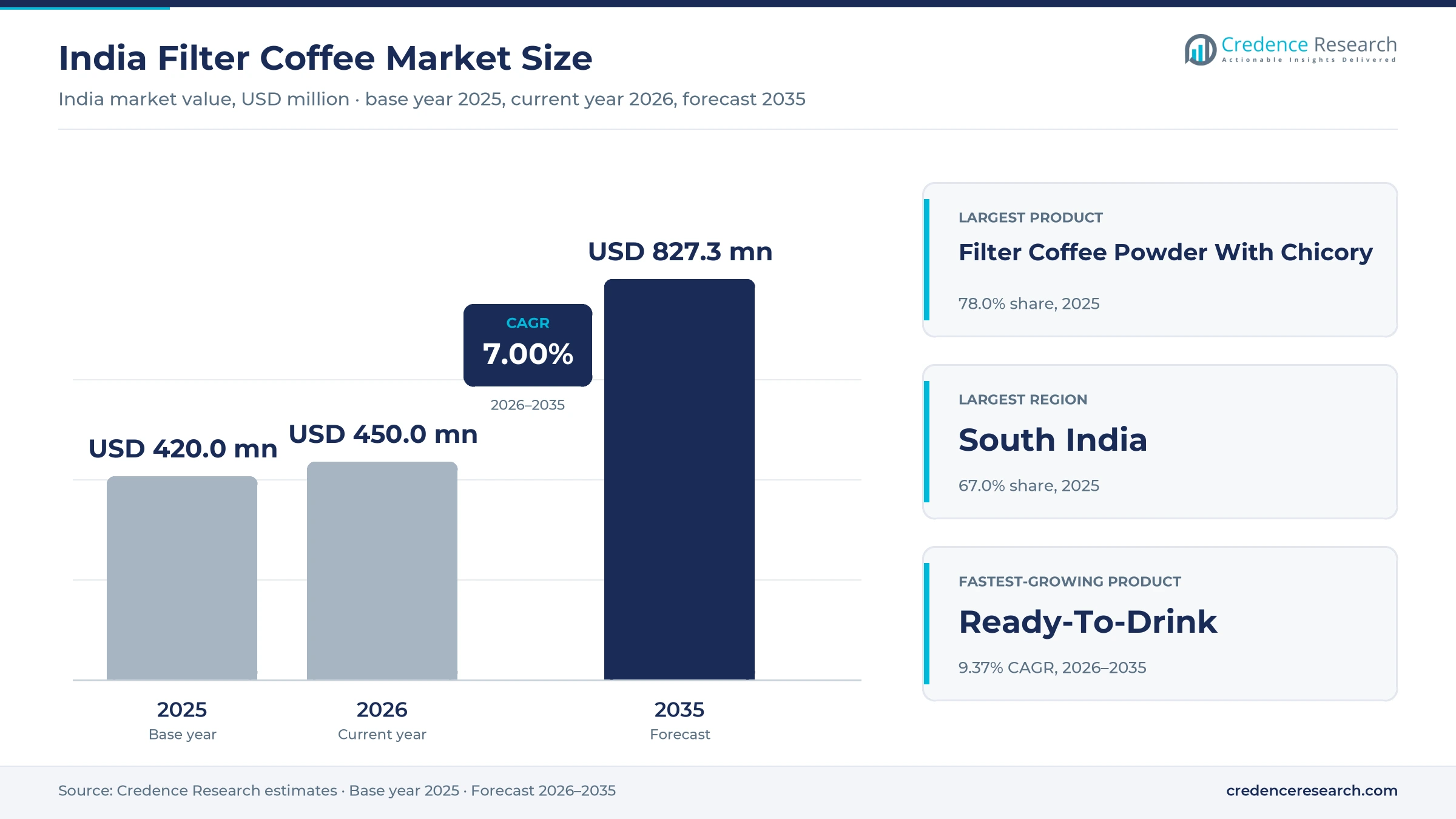
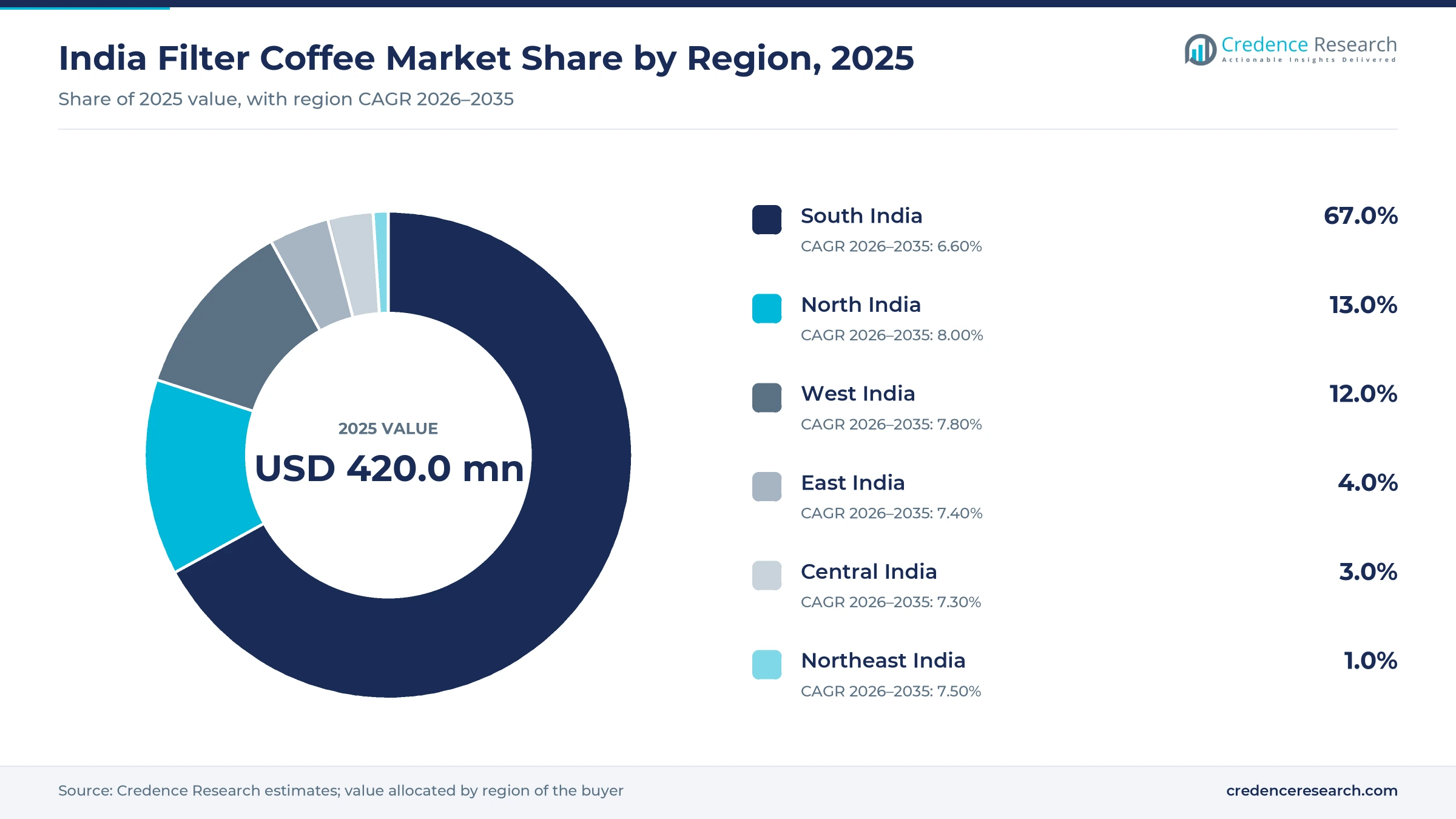
The India filter coffee market was valued at USD 420.0 million in 2025 and is projected to increase from USD 450.0 million in 2026 to USD 827.3 million by 2035, registering a CAGR of 7.00% during 2026–2035. Demand comes from households that brew a chicory blend each morning, from darshinis and cafes that sell the drink by the cup, and from younger buyers who want the same taste without a brass filter. South India held the largest regional share, 67.0% in 2025, because heritage roasters in Tamil Nadu and Karnataka still sell through neighborhood shops and their own stores. North India is the fastest-growing region at 8.00% a year as southern brands and chains plan outlets in Delhi and nearby cities. Labeling is also changing, since the food regulator will require coffee and chicory percentages on the front of the pack from July 1, 2027.
What does the filter coffee market include in India?
The market counts consumer spending on roast and ground filter coffee powder blended with chicory, on liquid decoction and on ready-to-drink filter coffee, along with cups sold at darshinis and cafes. Buyers purchase from neighborhood grocers, company roaster shops, supermarkets, online stores and outlets that brew on site.
Soluble instant coffee, espresso-led specialty drinks and green bean exports are excluded from the count. The value chain runs from growers in Karnataka, Kerala and Tamil Nadu through curing and roasting works, chicory suppliers and distributors to retail shelves and brewing counters.
India Filter Coffee Market Insights
- The market grows from USD 420.0 million in 2025 to USD 827.3 million by 2035, a 7.00% CAGR over 2026–2035, as packaged decoction and cafes extend a long-standing home habit.
- South India led with 67.0% of 2025 value, in line with a Coffee Board survey placing most national coffee consumption in the southern states.
- Filter Coffee Powder With Chicory led with 78.0% of 2025 value because chicory-mixed coffee makes up about three-quarters of coffee consumed in India, according to StoneX.
- FSSAI issued its coffee-chicory labeling notification on Aug. 8, 2025, and later moved compliance to July 1, 2027, so roasters must redesign their front-of-pack declarations.
- A family office linked to the Bikaji promoter agreed in May 2026 to buy 35% of The Filter Coffee operator for up to Rs 100 crore.
Chicory powder leads while cans and modern trade grow fast
Why does chicory powder lead while ready-to-drink grows fastest?
Based on product, the market is categorized into filter coffee powder with chicory, decoction and ready-to-drink. Filter Coffee Powder With Chicory led with 78.0% of 2025 value because households keep buying blends, and Cothas Coffee lists options from 53% coffee with 47% chicory to pure coffee at Rs 410 to Rs 565 for 500 grams in November 2026. Ready-To-Drink grows fastest at 9.37% a year as Tata Consumer Products set a Rs 70 national price for a 180-ml cold coffee can in October 2024. Decoction sits between them, since iD Fresh Food priced a 20-ml pack at Rs 10, according to Comunicaffe in October 2018.
How do shops, retail chains and cafes divide the sales?
Based on channel, the market is categorized into general trade, modern trade and cafes, with online sales counted in modern trade. General Trade led with 46.0% of 2025 value because roasters depend on distributors, and Sri Narasu's Coffee plans to grow from 42 distributors to nearly 150 this fiscal year, according to AgroSpectrum in May 2026. Modern Trade grows fastest at 8.04% a year as the same brand now sells through D-Mart, Lulu, Reliance, Amazon, Flipkart and Blinkit, according to DT Next. Cafes also matter, since Coimbatore Filter Coffee counted 120 small outlets in Andhra Pradesh and Telangana in June 2024, according to Deccan Chronicle.
Why does the rest of India outweigh any single state?
Based on state, the market is categorized into Tamil Nadu, Karnataka, Andhra Pradesh & Telangana, Kerala and the rest of India. Rest Of India led with 33.0% of 2025 value only because it pools every state outside the south, while Tamil Nadu is the largest single state, and Outlook Business reported in July 2026 that about 80% of Sri Narasu's business comes from Tamil Nadu. Karnataka supplies the beans, with 256,695 metric tons in the 2025-26 final estimate from the Coffee Board. Rest Of India grows fastest at 7.55% a year as BW Retail World reported in September 2026 that filter coffee consumption is rising in North India.
| Segment Group | Leading Sub-segment | Share, 2025 | Fastest-growing Sub-segment | CAGR, 2026–2035 |
|---|---|---|---|---|
| By Product | Filter Coffee Powder With Chicory | 78.0% | Ready-To-Drink | 9.37% |
| By Channel | General Trade | 46.0% | Modern Trade | 8.04% |
| By State | Rest Of India | 33.0% | Rest Of India | 7.55% |
Request a Free Sample
Fill in your details and we'll send you a free sample report.
- Sample data tables & charts
- Research methodology
Breakfast routine, new cafes and easy formats widen demand
Breakfast and beverage habits sustain regional sales
Daily routine is the largest source of demand, because the drink is tied to breakfast at home and at darshinis across the southern states. The 2023 Coffee Board survey, cited by StoneX in August 2025, placed 75% to 80% of national coffee consumption in the south. Breakfast also carries the outlet economics, since YourStory reported in January 2026 that the morning meal accounts for 40% to 45% of sales at The Filter Coffee in Bengaluru. Consumption volumes support the pattern, as a study commissioned by the Coffee Board estimated domestic demand at 96,000 metric tons in 2024, up from 91,000 metric tons in 2023. In the Credence Research model this adds about 2.59 percentage points to annual growth to 2035, which keeps the south at the center of the category.
Ready-to-drink and specialty cafes reach new consumers
New formats bring in buyers who never owned a filter, which widens the category beyond its traditional households. Tata Consumer Products launched its 180-ml Tata Coffee Grand Cold Coffee can at Rs 70 in October 2024, according to its release carried by ThePrint, giving convenience stores a low entry price alongside cold brew products. Cafe concepts are moving the same way, as Retail4Growth reported in September 2025 that Adhira & Appa Coffee plans more than 50 outlets by the fiscal year-end after opening in Kochi. USDA Foreign Agricultural Service analysts, as summarized by Daily Coffee News in May 2026, also credit younger consumers and specialty cafes in Bengaluru, Mumbai and Jaipur for rising use. In the Credence Research model this adds about 1.89 percentage points a year.
Packaged decoction and online brands expand access
Liquid decoction removes the half-hour brew, and online listing puts it in front of migrants living far from a local roaster. BW Disrupt reported in January 2017 that True South offered a decoction with a shelf life of about five months and drew close to half of its online volume from loyal retail buyers. Heritage brands are following, since Outlook Business reported in July 2026 that Sri Narasu's recently launched a ready-to-use decoction. Online reach has widened as well, because DT Next reported in May 2026 that the brand now sells through Amazon, Flipkart and Blinkit. In the Credence Research model this adds about 1.40 percentage points to annual growth, and Modern Trade grows fastest at 8.04% a year.
Roaster and retail expansion lifts shelf availability
Roasters are putting more of their own stores and distributors into states they once served lightly, which raises availability for existing buyers. Sri Narasu's operates 78 company-owned stores, opened its first Bengaluru store and expected an Amaravati store within months, according to AgroSpectrum in May 2026. Cooperative and state-backed outlets add further reach, since ETV Bharat reported in December 2025 that 96 Araku coffee outlets operate across Andhra Pradesh. A Press Information Bureau note of November 2025 also counts eight Koraput Coffee cafes, including four in Bhubaneswar, and 12 India Coffee Houses run by the Coffee Board. This retail growth matters beyond the south, because shelves in new states also carry the caffeinated beverage alternatives that compete for the same morning purchase.
Decoction, darshini chains and northern stores reshape sales
Shift from neighborhood darshinis to branded dine-in chains
Organized chains are rising around the darshini model, adding seating, delivery and standard preparation to a drink once sold at the counter. Indian Retailer reported in February 2026 that The Filter Coffee reached 10 Bengaluru stores after opening at Sadashivanagar on Feb. 9 and at Church Street on Feb. 23. Investors have noticed the format, since Mint reported on May 8, 2026, that a family office linked to the Bikaji promoter would buy 35% of the operator for up to Rs 100 crore in tranches. Coimbatore Filter Coffee took the same step in June 2024 by opening a premium cafe at Ameerpet in Hyderabad, according to Telangana Today. This path resembles the one taken by chai cafe chains, where franchise partners carry much of the rollout.
Rise of labeled blends and higher-coffee recipes
Buyers are getting clearer choices on strength, and brands are rising to that by naming the blend ratio on every pack. Cothas Coffee listed six blend ratios in November 2026, from a 53% coffee Deccan Brew to a pure coffee Nova Blend, with a Darshini Special at Rs 430 for 500 grams. Regulation pushes in the same direction, because FSSAI will require coffee and chicory percentages on the principal display panel from July 1, 2027. Regional taste also shapes the recipe, since Tata Consumer Products told Outlook Business in January 2023 that buyers outside the south preferred 100% coffee, while its southern Tata Grand used a 70% coffee blend. Roasters can therefore sell one heritage name at several price points without changing their distribution.
Northern metros offer an opening for southern brands
The clearest opening lies with northern and western cities, where the drink is known but few roasters have a shelf presence. BW Retail World reported in September 2026 that filter coffee consumption is growing in North India, and Outlook Business reported in July 2026 that Sri Narasu's is targeting Delhi and Mumbai with roughly 10% of its business now from other Indian states. YourStory reported in January 2026 that The Filter Coffee plans a northern rollout across six or seven cities, including Delhi, Kanpur, Lucknow and Noida, by 2027. Retail4Growth also named Nashik among Adhira & Appa Coffee's upcoming outlets in September 2025, within a plan for more than 50 stores. West India adds a further 12.0% share of 2025 value, which gives roasters a second large market for early distribution.
Institutional and hospitality supply is an open route
Hotels, offices and quick-service chains are an opening for decoction makers, because a consistent liquid removes the skill and time needed to brew at volume. BW Disrupt reported in January 2017 that True South supplied ITC luxury hotels, Fortune hotels, IHG and the Leela Palace group as well as quick-service chains. Cothas Coffee shows the same demand with named products, listing a Premium Special Hotel Blend at Rs 460 for 500 grams on its online store in November 2026. The route has scale, since the Indian Coffee Workers Co-operative Society counts more than 186 branches across 20 states, according to The Hitavada in July 2025. Suppliers that win these accounts gain steady volume with less dependence on retail promotion or on seasonal household stocking.
Bean costs, label rules and instant rivals pressure margins
Volatile bean prices squeeze roasters and darshinis
Bean costs are the main margin risk, because powder and cup prices move more slowly than green coffee. USDA Foreign Agricultural Service analysts reported arabica farmgate prices up 64% since October in their 2025 annual report. The Coffee Board listed mild arabica at Rs 800.42 per kg on Feb. 14, 2025, according to Deccan Herald, and Bengaluru hoteliers expected cup prices to rise 10% to 15%. Small roasters absorb most of this pressure, so they rely on blend changes and forward buying to protect margins.
Front-of-pack chicory rules force a packaging redesign
Labeling rules add cost for every roaster that sells a blend, especially firms with many small packs. FSSAI moved compliance to July 1, 2027, after its Aug. 8, 2025, notification drew objections about panels under 100 square cm. Packs must show coffee and chicory percentages on the principal display panel, in text at least 1 mm high on panels up to 100 square cm and 2 mm high on larger ones. Regional brands with broad ranges bear the largest change, so many will likely use up existing stock and then reduce their number of pack sizes.
Instant coffee holds the bulk of domestic use
Instant coffee limits the category's reach, because it is cheaper per cup and needs no equipment or brewing skill. BW Retail World reported in May 2026 that soluble coffee should make up about 73% of household consumption, citing USDA Foreign Agricultural Service analysts. The gap also widened on price, since a Press Information Bureau note of November 2025 expected the instant coffee tax cut from 18% to 5% to lower retail prices by 11% to 12%. Roasters respond by selling decoction and easier filter kits to households that value freshness.
Thin shelf presence outside the southern states
Limited reach outside the south slows growth, because most roasters built their distribution around a few home districts. Outlook Business reported in July 2026 that four-fifths of Sri Narasu's business still comes from Tamil Nadu, even after a century of trading. Fresh supply is part of the problem, since the company promises shelf delivery within 24 hours only inside that state, according to AgroSpectrum in May 2026. Entrants elsewhere must therefore fund distributors and regional roasting before their volumes justify the cost, which delays returns.
South India dominates as northern cities add new buyers
| Region | Value, 2025 (USD million) | Share, 2025 | CAGR, 2026–2035 |
|---|---|---|---|
| South India | 281.4 | 67.0% | 6.60% |
| North India | 54.6 | 13.0% | 8.00% |
| West India | 50.4 | 12.0% | 7.80% |
| East India | 16.8 | 4.0% | 7.40% |
| Central India | 12.6 | 3.0% | 7.30% |
| Northeast India | 4.2 | 1.0% | 7.50% |
South India anchors the habit and the roasters
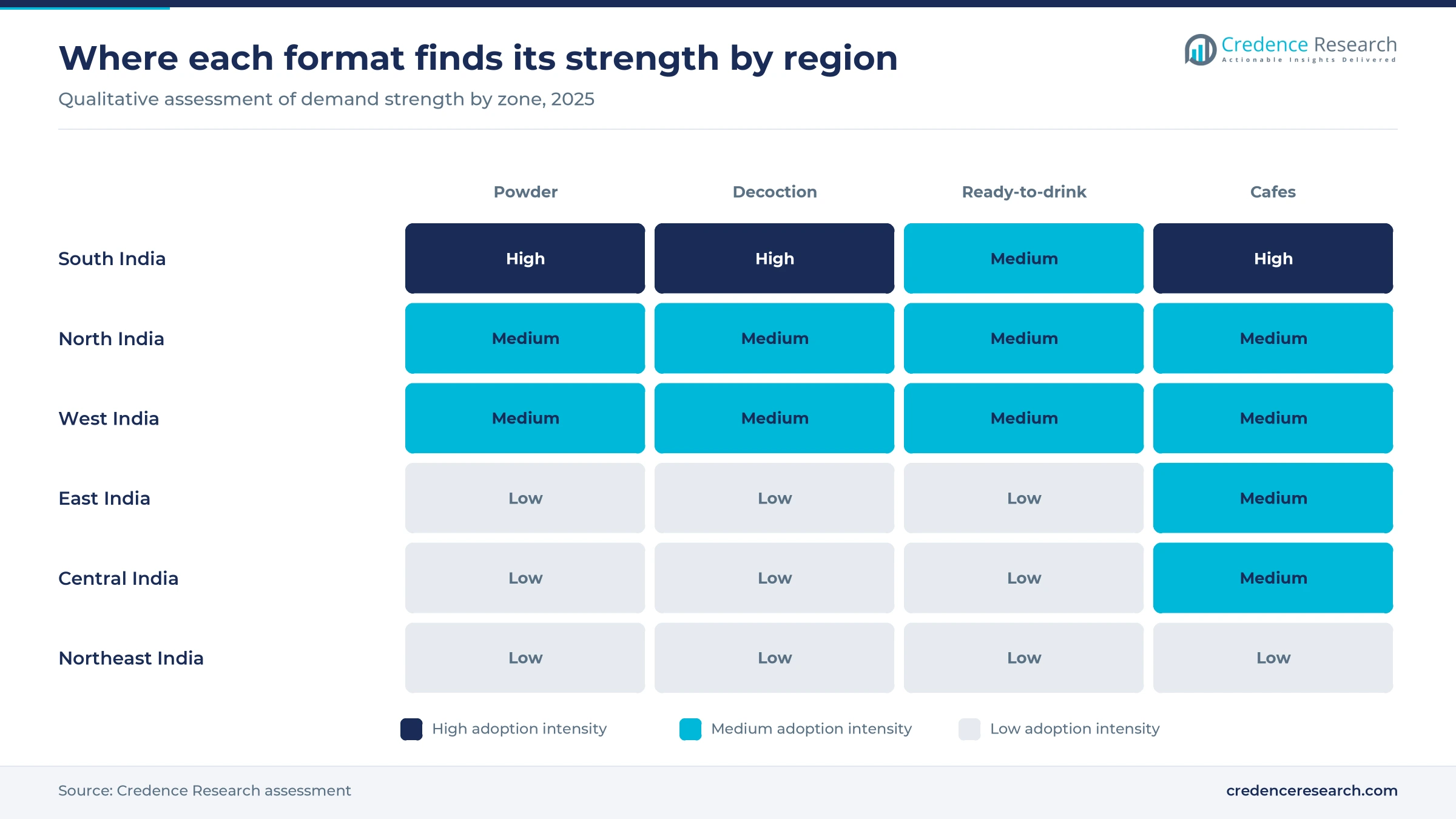
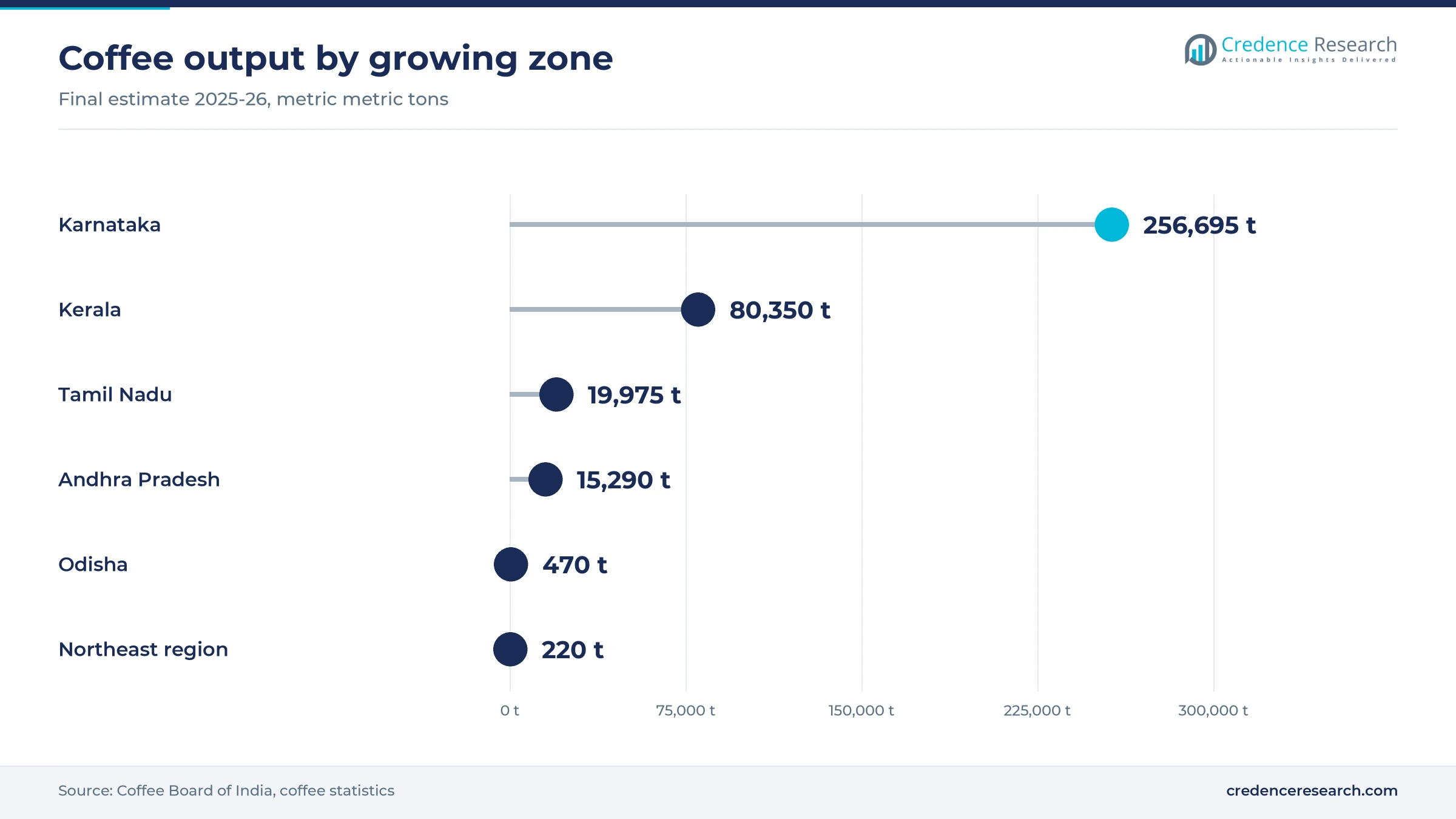
South India held 67.0% of 2025 value and grows at 6.60% a year, which is the slowest rate because household penetration is already high. The Coffee Board final estimate for 2025-26 places Karnataka at 256,695 metric tons, Kerala at 80,350 metric tons and Tamil Nadu at 19,975 metric tons, so roasters buy close to their customers. Heritage names such as Sri Narasu's in Salem and Cothas, with a signature store at Bangalore International Airport, sell through local networks, and Kerala gained a new chain when Adhira & Appa opened in Kochi.
North India adds buyers through migrants and new cafes
North India held 13.0% of 2025 value and is the fastest-growing region at 8.00% a year, starting from a small base of households and cafe customers in Delhi and nearby cities. BW Retail World reported in September 2026 that filter coffee consumption is rising in the north. The Filter Coffee plans to enter Delhi, Kanpur, Lucknow, Noida and Gurugram by 2027, according to YourStory. A wider rollout would make the drink a more regular purchase for buyers in these cities.
West India grows on Mumbai and new outlet plans
West India held 12.0% of 2025 value and grows at 7.80% a year, helped by new roaster and outlet plans in Maharashtra. Outlook Business reported in July 2026 that Sri Narasu's is targeting Mumbai and other parts of Maharashtra. Retail4Growth named Nashik among Adhira & Appa Coffee's upcoming outlets in September 2025. USDA analysts also cited specialty cafes in Mumbai and Jaipur as a source of younger coffee drinkers, which widens the likely customer base.
East India builds on Koraput and cooperative cafes
East India held 4.0% of 2025 value and grows at 7.40% a year from a small base of cafes and local growers. A Press Information Bureau note of November 2025 counts eight Koraput Coffee cafes, including four in Bhubaneswar and one in Puri, while the Coffee Board estimates Odisha output at 470 metric tons in 2025-26. These outlets familiarize local buyers with brewed coffee, although packaged filter blends remain a small purchase in the region at this stage.
Central India relies on the coffee house network
Central India held 3.0% of 2025 value and grows at 7.30% a year, with brewed coffee reaching buyers mainly through cooperative outlets. The Indian Coffee Workers Co-operative Society, based in Jabalpur since 1958, counts more than 186 branches across 20 states, according to The Hitavada in July 2025. Few packaged roasters have a strong shelf presence here, so growth depends on chains and modern trade reaching cities where the coffee house is the main reference point.
Northeast India remains a small, early market
Northeast India held 1.0% of 2025 value and grows at 7.50% a year, the smallest base among the six zones. The Coffee Board estimates output in the region at only 220 metric tons in 2025-26, and Outlook Business reported in June 2025 that the Board is targeting non-traditional zones in the Northeast for expansion. Local supply may support small roasters and cafes over time, but packaged filter blends still reach most buyers through online orders and metro retailers.
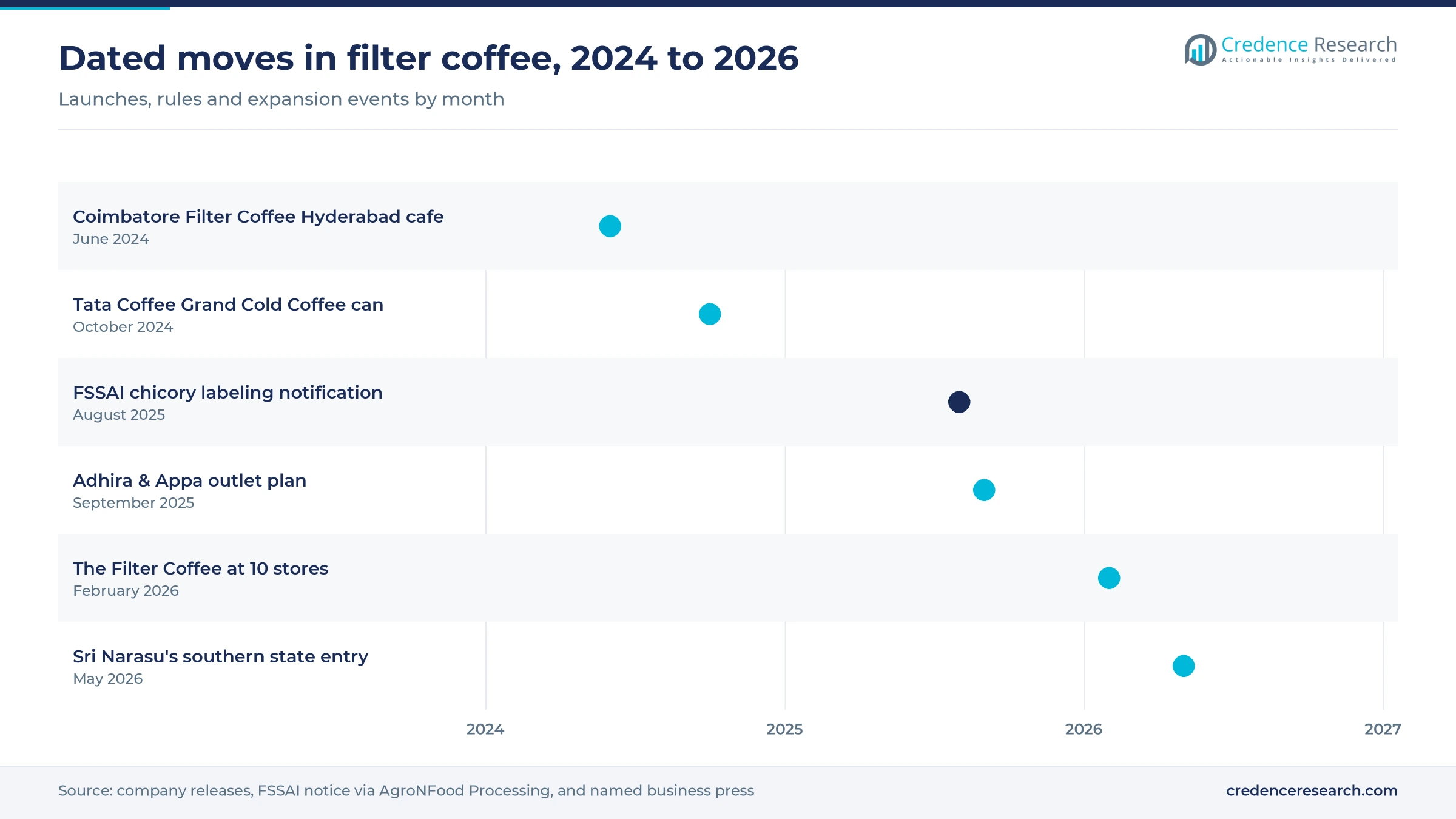
New capital and state entries marked 2024 to 2026
| Development | Status and market relevance |
|---|---|
| In June 2024, Coimbatore Filter Coffee opened its first premium cafe in Hyderabad at Ameerpet, adding to 120 small outlets in Andhra Pradesh and Telangana. | Opened; shows the move from kiosks to seated formats |
| In October 2024, Tata Consumer Products launched Tata Coffee Grand Cold Coffee in a 180-ml can priced at Rs 70. | Launched nationally; sets a low entry price for ready-to-drink |
| In August 2025, FSSAI issued its coffee-chicory labeling notification, and it later extended compliance to July 1, 2027. | In force from 2027; roasters are redesigning packs |
| In February 2026, The Filter Coffee reached 10 Bengaluru stores with new outlets at Sadashivanagar and Church Street. | Open; tests dine-in and food court formats |
| In May 2026, Sri Narasu's Coffee announced entry into Karnataka, Kerala and Andhra Pradesh, while a family office linked to the Bikaji promoter agreed to buy 35% of The Filter Coffee operator. | Both underway; capital and distribution move outside home markets |
Roasting, liquid extraction and packs extend freshness
- Roast and blend control lets brands publish fixed ratios, as Cothas Coffee does with blends from 53% to 100% coffee in November 2026.
- Liquid extraction turns the brew into a shelf product, as True South reached a shelf life of about five months with no added preservatives, according to BW Disrupt in January 2017.
- Short-cycle roasting and distribution protects aroma, since Sri Narasu's says fresh coffee reaches shelves within 24 hours in Tamil Nadu, according to AgroSpectrum in May 2026.
- Canned and portion packs lower the entry price, as shown by a 180-ml Tata can at Rs 70 and a 20-ml iD Fresh Food decoction pack at Rs 10.
Need a Custom Version of This Report?
Tailor the scope, geography, or segments to your exact requirements.
- Custom geography or segment scope
- Direct access to our analyst team
Heritage roasters face national brands and new cafe chains
Competition runs on three fronts, which are heritage roasters, national brands and funded cafe chains. Sri Narasu's Coffee, Cothas Coffee and Leo Coffee rely on recognized blends, own stores and neighborhood shops, and Retail4Growth reported in September 2019 that Leo Coffee sold through more than 40 company-owned stores and about 300 other retailers. Tata Consumer Products competes on national distribution and on formats such as Tata Coffee Quick Filter and canned cold coffee, which suit buyers who do not own a brewer. Coimbatore Filter Coffee and The Filter Coffee build volume at the counter and through franchising or investor capital, so their brands become known before any pack reaches a shelf. iD Fresh Food launched a ready-to-use decoction in 17 Indian cities in October 2018, which extended decoction demand beyond home brewers. Competition therefore centers on freshness, blend strength and shelf presence, which shape repeat purchases.
Companies profiled and their roles in this market
| Company | Type | Role in the market |
|---|---|---|
| Sri Narasu's Coffee | Heritage roaster | 78 company-owned stores in May 2026 and expansion into Karnataka, Kerala and Andhra Pradesh |
| Cothas Coffee | Heritage roaster | Published blend ratios, hotel and darshini products and a Bangalore airport store |
| Leo Coffee | Heritage roaster | Brand founded in 1971 with its own stores and modern and traditional retail |
| Tata Consumer Products | National brand | Tata Coffee Grand, Quick Filter powder and canned cold coffee |
| Coimbatore Filter Coffee | Cafe chain | 120 small outlets in Andhra Pradesh and Telangana in June 2024 |
| The Filter Coffee | Cafe chain | 10 Bengaluru stores in February 2026 and new investor backing |
| iD Fresh Food | Packaged decoction | Ready-to-use decoction launched in 17 cities in October 2018 |
Blend transparency and fresh supply will decide the winners
Credence Research's view is that this category will be won on trust in the blend and on the freshness of supply rather than on advertising alone. The 2027 FSSAI label will make recipes directly comparable, which favors brands willing to publish higher coffee content and explain the price. The most useful next step for roasters is regional roasting or tight distribution in new northern and western cities, because a stale pack can undo the heritage advantage quickly.
How the filter coffee estimates were built
The report uses 2025 as the base year and 2026–2035 as the forecast period. Market values come from the Credence Research model, and regional, state, product and channel splits are Credence Research estimates informed by public data on production, consumption, prices and outlet counts. Sources include the Coffee Board of India, the USDA Foreign Agricultural Service, FSSAI notices as reported by trade publishers, Press Information Bureau notes, company releases, company websites and named business press. No interviews or surveys were conducted in preparing this report.
Northern households and ready formats shape demand to 2035
The market is expected to reach USD 827.3 million by 2035 as the drink moves from a southern home ritual to a wider packaged and cafe purchase. South India will keep the largest share, although its lead should narrow as northern and western cities gain distribution. Powder blends will remain the main format, while decoction and cans take a larger share of new buyers. Soluble formats at about 73% of household demand leave filter products a large share of use still to win. Margins will depend on green coffee prices, and roasters that manage blends carefully after the 2027 label rule should be better placed than those relying only on a familiar name.
Frequently Asked Questions
How big is the India filter coffee market?
Which product leads the India filter coffee market?
Which region leads filter coffee sales in India?
Which region grows fastest in this market?
What drives demand for filter coffee in India?
What does the new chicory labeling rule require?
Which companies are active in this market?
What is the main risk for filter coffee roasters?
Table of Content
Chapter 1 Market Segmentation
- 1.1 Segmentation Framework
- 1.1.1 Product and Service Classification
- 1.1.2 Application and End-Use Classification
- 1.1.3 Technology and Solution Classification
- 1.1.4 Customer and Distribution Channel Classification
- 1.1.5 Geographic Segmentation
- 1.1.6 Market Segment Definitions and Boundaries
- 1.2 By Product
- 1.2.1 Filter Coffee Powder With Chicory
- 1.2.2 Decoction
- 1.2.3 Ready-To-Drink
- 1.3 By Channel
- 1.3.1 General Trade
- 1.3.2 Modern Trade
- 1.3.3 Cafes
- 1.4 By State
- 1.4.1 Tamil Nadu
- 1.4.2 Karnataka
- 1.4.3 Andhra Pradesh & Telangana
- 1.4.4 Kerala
- 1.4.5 Rest Of India
Chapter 2 Introduction
- 2.1 Report Objectives and Scope
- 2.2 Product Definition and Industry Terminology
- 2.3 Market Inclusions and Exclusions
- 2.4 Research Process
- 2.4.1 Primary Research and Expert Interviews
- 2.4.2 Secondary Research and Source Review
- 2.4.3 Top-Down and Bottom-Up Estimation
- 2.4.4 Data Triangulation and Verification
- 2.5 Market Size Measurement Basis
- 2.5.1 2025: USD 420.0 million → 2035: USD 827.3 million
- 2.6 Historical and Forecast Reference Periods
- 2.6.1 Historical Period: 2018-2025
- 2.6.2 Base Year: 2025
- 2.6.3 Forecast Period: 2025-2035
- 2.7 Research Assumptions and Limitations
Chapter 3 Executive Summary
- 3.1 Market Snapshot and Key Findings
- 3.2 Base-Year Market Size, 2025
- 3.3 Forecast Market Size, 2035
- 3.4 Revenue and Volume Growth Outlook
- 3.5 Key Demand and Supply Indicators
- 3.6 Leading Market Segments
- 3.7 Fastest-Growing Market Opportunities
- 3.8 Regional Performance Highlights
- 3.9 Technology and Industry Transformation
- 3.10 Competitive Landscape Summary
- 3.11 Analyst View and Strategic Implications
Chapter 4 India Filter Coffee Market Trends and Developments
- 4.1 Historical Industry Development, 2018-2025
- 4.2 Recent Market Trends and Developments
- 4.3 Demand and Customer Behavior Trends
- 4.4 Technology and Product Innovation
- 4.5 Artificial Intelligence, Automation and Digitalization
- 4.6 Local Manufacturing and Supply Chain Realignment
- 4.7 Industry Partnerships, Mergers and Acquisitions
- 4.8 Sustainability and Circular Economy Developments
- 4.9 Government and Private Sector Investment Trends
- 4.10 Emerging Business Models and Commercialization
- 4.11 Industry Developments and Announcements
Chapter 5 India Filter Coffee Market Production, Supply and Demand Analysis
- 5.1 Demand Trend and Consumption Analysis, 2018-2025
- 5.2 Demand Forecast, 2025-2035
- 5.3 Production and Output Trend, 2018-2025
- 5.4 Production and Output Forecast, 2025-2035
- 5.5 Installed Capacity and Capacity Utilization
- 5.6 Company-Wise Production Plants and Statistics
- 5.6.1 Installed Production Capacity
- 5.6.2 Actual Production
- 5.6.3 Planned Capacity and Expansion Targets
- 5.7 Supply Chain Structure and Procurement Trends
- 5.8 Supply-Demand Gap and Bottlenecks
- 5.9 Import Dependence and Sourcing Structure
- 5.10 Contract Manufacturing and Outsourcing
- 5.11 Regional Supply and Demand Concentration
Chapter 6 India Filter Coffee Market Pricing Analysis
- 6.1 Pricing Structure and Measurement
- 6.2 Historical Pricing Trends, 2018-2025
- 6.3 Pricing Outlook, 2025-2035
- 6.4 Average Selling Price and Unit Economics
- 6.5 Pricing by Product and Market Segment
- 6.6 Geographic Pricing Differences
- 6.7 Key Input, Energy, Labor and Logistics Costs
- 6.8 Contract Pricing and Purchasing Models
- 6.9 Pricing Sensitivity and Competitive Positioning
- 6.10 Price, Margin and Profitability Implications
Chapter 7 India Filter Coffee Market Dynamics
- 7.1 Market Growth Drivers
- 7.1.1 Demand-Side Drivers
- 7.1.2 Technology and Innovation Drivers
- 7.1.3 Infrastructure and Investment Drivers
- 7.1.4 Regulatory and Policy Drivers
- 7.2 Market Restraints
- 7.2.1 Cost and Affordability Constraints
- 7.2.2 Technology and Adoption Barriers
- 7.2.3 Supply Chain and Operational Constraints
- 7.3 Market Challenges
- 7.3.1 Competitive Pressure and Margin Erosion
- 7.3.2 Skills, Infrastructure and Implementation Gaps
- 7.4 Emerging Market Opportunities
- 7.5 Market Dynamics Impact and Time-Horizon Assessment
Chapter 8 India Filter Coffee Value Chain Analysis
- 8.1 Industry Value Chain Overview
- 8.2 Upstream Suppliers and Critical Inputs
- 8.3 Technology and Component Providers
- 8.4 Manufacturing or Service Delivery
- 8.5 Distribution, Channel Partners and Integrators
- 8.6 Downstream Applications and End Users
- 8.7 Value Addition and Profit Pools
- 8.8 Vertical Integration and Outsourcing
- 8.9 Supplier Concentration and Risk
- 8.10 Supply Chain Localization and Resilience
Chapter 9 India Filter Coffee Market Regulations and Policies
- 9.1 Relevant Laws, Standards and Compliance Frameworks
- 9.2 Product, Service, Safety and Quality Requirements
- 9.3 Government Policies, Incentives and Subsidies
- 9.4 Imports, Exports and Trade Barriers
- 9.5 Public Procurement and Local Content Requirements
- 9.6 Environmental and Sustainability Compliance
- 9.7 Upcoming Policy Changes and Market Implications
Chapter 10 India Filter Coffee Market Hotspots and Opportunities
- 10.1 Market Opportunity Mapping and Growth Hotspots
- 10.2 High-Growth Applications and Customer Groups
- 10.3 Underserved Markets and White-Space Opportunities
- 10.4 Emerging Technology and Product Opportunities
- 10.5 New Capacity and Investment Hotspots
- 10.6 Market Entry and Expansion Opportunities
- 10.7 Distribution and Partnership Opportunities
- 10.8 Near-Term and Long-Term Commercial Potential
- 10.9 Opportunity Attractiveness and Execution Risks
Chapter 11 India Filter Coffee Market Outlook, 2025-2035
- 11.1 Market Size and Analysis
- 11.1.1 Revenue (Market Measurement: 2025: USD 420.0 million → 2035: USD 827.3 million)
- 11.1.2 Market Volume and Quantity Sold
- 11.1.3 Historical Market Size, 2018-2025
- 11.1.4 Base-Year Market Size, 2025
- 11.2 Market Forecast, 2025-2035
- 11.2.1 Revenue Forecast to 2035
- 11.2.2 Volume Forecast to 2035
- 11.2.3 CAGR and Year-on-Year Growth
- 11.2.4 Incremental Revenue Opportunity
- 11.3 Forecast Assumptions and Scenario Analysis
- 11.3.1 Base-Case Forecast
- 11.3.2 Optimistic and Conservative Scenarios
- 11.3.3 Technology, Pricing and Policy Sensitivities
- 11.4 Market Attractiveness and Growth Outlook
Chapter 12 India Filter Coffee Market Segmentation and Outlook
- 12.1 Segmentation Summary and Market Shares, 2025
- 12.2 Largest and Fastest-Growing Segments
- 12.3 By Product - Market Size and Forecast, 2025-2035
- 12.3.1 Segment Definition and Scope
- 12.3.2 Historical Market Size, 2018-2025
- 12.3.3 Revenue Forecast, 2025-2035
- 12.3.4 Volume Forecast, 2025-2035
- 12.3.5 Base-Year Market Share, 2025
- 12.3.6 Segment CAGR and Growth Drivers
- 12.3.7 Subsegment Market Size and Forecast
- 12.3.7.1 Filter Coffee Powder With Chicory
- 12.3.7.2 Decoction
- 12.3.7.3 Ready-To-Drink
- 12.3.8 Subsegment Pricing and Adoption Trends
- 12.3.9 Leading Suppliers and Competition
- 12.3.10 Regional Demand and Opportunities
- 12.4 By Channel - Market Size and Forecast, 2025-2035
- 12.4.1 Segment Definition and Scope
- 12.4.2 Historical Market Size, 2018-2025
- 12.4.3 Revenue Forecast, 2025-2035
- 12.4.4 Volume Forecast, 2025-2035
- 12.4.5 Base-Year Market Share, 2025
- 12.4.6 Segment CAGR and Growth Drivers
- 12.4.7 Subsegment Market Size and Forecast
- 12.4.7.1 General Trade
- 12.4.7.2 Modern Trade
- 12.4.7.3 Cafes
- 12.4.8 Subsegment Pricing and Adoption Trends
- 12.4.9 Leading Suppliers and Competition
- 12.4.10 Regional Demand and Opportunities
- 12.5 By State - Market Size and Forecast, 2025-2035
- 12.5.1 Segment Definition and Scope
- 12.5.2 Historical Market Size, 2018-2025
- 12.5.3 Revenue Forecast, 2025-2035
- 12.5.4 Volume Forecast, 2025-2035
- 12.5.5 Base-Year Market Share, 2025
- 12.5.6 Segment CAGR and Growth Drivers
- 12.5.7 Subsegment Market Size and Forecast
- 12.5.7.1 Tamil Nadu
- 12.5.7.2 Karnataka
- 12.5.7.3 Andhra Pradesh & Telangana
- 12.5.7.4 Kerala
- 12.5.7.5 Rest Of India
- 12.5.8 Subsegment Pricing and Adoption Trends
- 12.5.9 Leading Suppliers and Competition
- 12.5.10 Regional Demand and Opportunities
- 12.6 Segment Growth Comparison
- 12.7 Segment Attractiveness and Priority Matrix
Chapter 13 India Filter Coffee Geographic Market Outlook, 2025-2035
- 13.1 Domestic Market Distribution and Demand Clusters
- 13.2 State- or Province-Wise Market Size and Forecast, 2025-2035
- 13.3 City and Metropolitan Market Outlook
- 13.4 Industrial, Manufacturing and Commercial Clusters
- 13.5 Geographic Concentration of Key End Users
- 13.6 Local Pricing and Purchasing Differences
- 13.7 Domestic Production Facilities and Capacity Map
- 13.8 Local Infrastructure and Project Pipeline
- 13.9 State-Level Policy and Incentive Differences
- 13.10 Subnational Investment Hotspots and Opportunities
- 13.11 Distribution and Logistics Networks
- 13.12 Domestic Competitive Footprint
Chapter 14 India Filter Coffee Technology, Innovation and Sustainability Outlook
- 14.1 Technology Landscape and Maturity
- 14.2 Product, Process and Service Innovation
- 14.3 AI, Automation and Digital Tools in the Industry
- 14.4 Technology Adoption and Performance Benchmarking
- 14.5 Innovation Pipeline and R&D Investment
- 14.6 Patent and Intellectual Property Trends
- 14.7 Energy Efficiency and Resource Management
- 14.8 Sustainability, Recycling and Circularity
- 14.9 Technology Roadmap, 2025-2035
- 14.10 Risks of Obsolescence and Technology Substitution
Chapter 15 India Filter Coffee Market Key Strategic Imperatives
- 15.1 Growth and Market Entry Priorities
- 15.2 High-Return Products and Segments
- 15.3 Pricing, Profitability and Cost Optimization
- 15.4 Technology Investment and Product Differentiation
- 15.5 Supply Chain Localization and Resilience
- 15.6 Distribution and Customer Acquisition
- 15.7 Partnership, Acquisition and Capacity Strategy
- 15.8 Regional Expansion Priorities
- 15.9 Short-, Medium- and Long-Term Actions
Chapter 16 Competition Outlook
- 16.1 Industry Competition Characteristics
- 16.2 Market Structure and Concentration
- 16.3 Market Share and Competitive Positioning, 2025
- 16.4 Company-Wise Revenue and Product Benchmarking
- 16.5 Production and Service Capacity Benchmarking
- 16.6 Technology, Pricing and Differentiation
- 16.7 Regional Footprint and Distribution Strength
- 16.8 Mergers, Acquisitions and Strategic Alliances
- 16.9 New Entrants and Competitive Threats
- 16.10 Porter's Five Forces and Industry Attractiveness
- 16.11 Competitive Outlook, 2025-2035
Chapter 17 Company Profiles
- 17.1 Company Coverage and Selection Criteria
- 17.2 Sri Narasu's Coffee
- 17.2.1 Business Description
- 17.2.2 Company Ownership and Geographic Presence
- 17.2.3 Product and Service Portfolio
- 17.2.4 Manufacturing and Operating Footprint
- 17.2.5 Production Capacity and Expansion Plans
- 17.2.6 Financial Performance and Investment
- 17.2.7 Market Share and Competitive Position
- 17.2.8 Technology and Innovation Capabilities
- 17.2.9 Strategic Alliances or Partnerships
- 17.2.10 Recent Developments
- 17.2.11 Growth Strategy and Outlook
- 17.3 Cothas Coffee
- 17.4 Leo Coffee
- 17.5 Tata Consumer Products
- 17.6 Coimbatore Filter Coffee
- 17.7 The Filter Coffee
- 17.8 iD Fresh Food
- 17.9 Other Relevant Market Participants
Note: Every listed company is profiled on the structure shown under the first company. The company list is preliminary and may change based on research findings, market developments, data availability and client requirements.
Chapter 18 Disclaimer
- 18.1 Research and Forecast Disclaimer
- 18.2 Data Source and Estimation Limitations
Note: The depth of individual sections depends on data availability for this market. Volume, capacity, trade and other unit-based metrics are included where applicable.

