
Market Overview
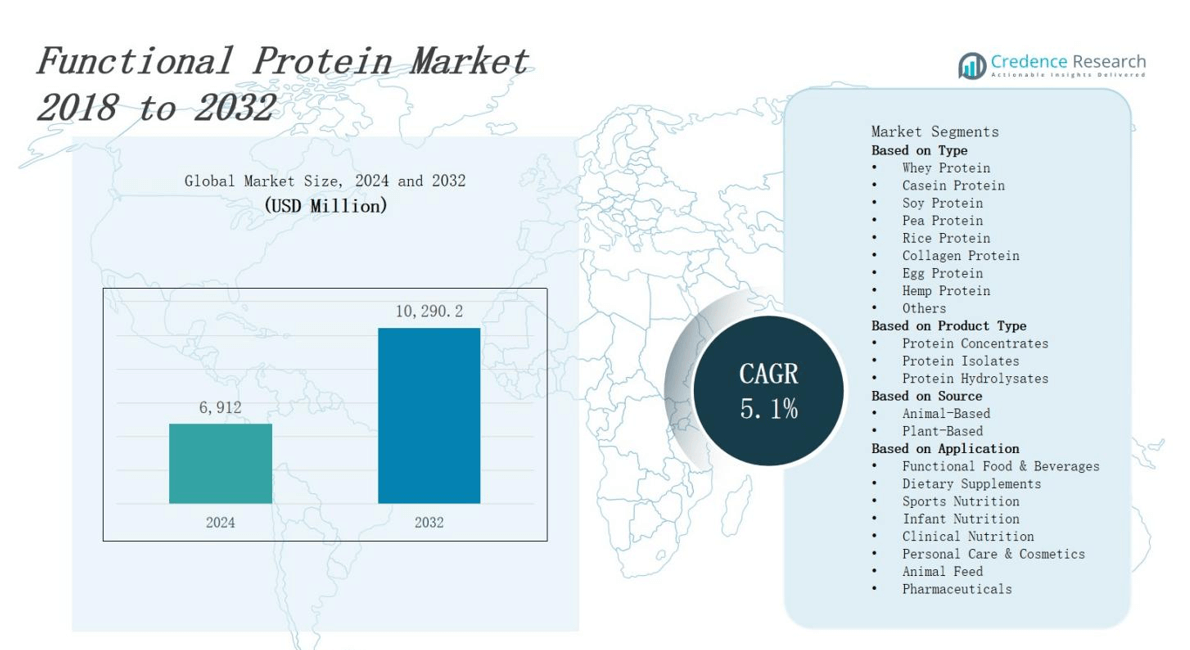
The functional protein market is projected to expand from USD 6,912 million in 2024 to USD 10,290.2 million by 2032, reflecting a CAGR of 5.1%.
| REPORT ATTRIBUTE | DETAILS |
|---|---|
| Historical Period | 2020-2023 |
| Base Year | 2024 |
| Forecast Period | 2025-2032 |
| Functional Protein Market Size 2024 | USD 6,912 million |
| Functional Protein Market, CAGR | 5.1% |
| Functional Protein Market Size 2032 | USD 10,290.2 million |
The functional protein market benefits from rising consumer focus on health and wellness, which drives demand for high‑protein, clean‑label ingredients in food and beverage applications. Manufacturers leverage advances in extraction technologies and fermentation processes to develop novel protein isolates and concentrates with improved solubility and sensory profiles. Growing interest in plant‑based and alternative proteins fuels diversification of product portfolios, while sports nutrition and weight‑management applications sustain steady uptake. Companies adopt sustainable sourcing practices and collaborate with nutrition research firms to validate functional benefits. Continued investment in personalized nutrition and on‑trend formats, such as protein‑fortified snacks and beverages, supports long‑term market growth.
In the functional protein market, North America leads with 35% share supported by global dairy and sports nutrition industries and key players such as Cargill and Archer Daniels Midland Company. Europe holds 25% share driven by stringent regulations and ingredient leaders including Roquette Frères and DuPont Nutrition & Biosciences. Asia Pacific commands 30% share with rapid uptake of plant‑based proteins led by Ingredion and Royal DSM. Latin America accounts for 6% and Middle East & Africa holds 4%, where Arla Foods Ingredients and Fonterra Co‑operative Group secure presence.
Market Insights
- The functional protein market will grow from USD 6,912 million in 2024 to USD 10,290.2 million by 2032 at a 5.1% CAGR.
- North America holds 35% market share, Asia Pacific 30%, Europe 25%, Latin America 6% and Middle East & Africa 4%.
- Rising health and wellness focus drives demand for high‑protein, clean‑label ingredients in foods and beverages.
- Advances in extraction, fermentation and membrane technologies improve yield, purity and sensory profiles of protein isolates.
- Plant‑based proteins (pea, soy, rice, algae) expand product portfolios and meet vegan consumer preferences.
- Clean‑label transparency and third‑party certifications reassure consumers on sourcing, allergen control and non‑GMO status.
- Personalized nutrition and sports applications fuel novel formats, digital customization platforms and direct‑to‑consumer subscription models.
Market Drivers
Rising Health and Wellness Focus Drives Demand
Consumer emphasis on health and well-being fuels growth of the functional protein market. It supports strong demand for high‑quality protein ingredients in beverages, nutrition bars, and dairy alternatives. Manufacturers develop isolates and concentrates that deliver targeted benefits such as muscle recovery and immune support. Partnerships with research institutions validate efficacy and boost consumer confidence. Regulatory approvals for novel protein sources encourage product innovation.
- For instance, Kerry Group, which invests heavily in R&D to develop novel plant-based protein isolates with enhanced digestibility and bioavailability, validated by research partnerships to boost consumer trust.
Advancements in Processing Technologies Propel Growth
Innovations in extraction and purification techniques transform the functional protein market. It enables producers obtain higher yields and purity from plant and animal sources. Ultrafiltration, enzymatic hydrolysis and membrane separation refine product profiles while reducing production costs. Equipment manufacturers supply scalable systems that meet industry demand. Collaboration with technology firms accelerates optimization. Increased automation improves consistency. Investment in pilot plants supports scale‑up and viability.
- For instance, GEA’s ultrafiltration systems are used widely in dairy processing to efficiently separate proteins while reducing energy consumption.
Sustainable Sourcing and Environmental Compliance
Growing regulatory pressure from governments and consumer demand for sustainability influence the functional protein market. It compels suppliers to adopt responsibly sourced raw materials from certified farms and fisheries to ensure traceability. Adoption of renewable energy and water conservation measures increases eco‑efficiency across operations. Suppliers implement waste minimization and recycling strategies. Brands report environmental metrics publicly and engage stakeholders. Continuous improvement programs foster circular economy principles and long‑term resource security globally.
Expansion of Personalized and Sports Nutrition Applications
Tailored nutrition trends drive innovation within the functional protein market. It integrates advanced formulations in sports supplements and meal replacements. Athletes seek high‑protein blends that support performance and recovery. Nutrigenomics research enhances formulation precision based on metabolism. Collaboration between supplement brands and biotech firms generates customized solutions. Trials demonstrate efficacy and encourage adoption by medical providers. Growth of direct‑to‑consumer channels accelerates market penetration.
Market Trends
Shift Toward Plant‑Based Protein Sources
The functional protein market reflects growing consumer preference for plant‑based proteins derived from peas, soy and algae. It prompts ingredient suppliers to source diverse crops and pursue novel pulse varieties to optimize amino acid profiles. Manufacturers collaborate with farmers to secure supply chains and implement sustainable agriculture practices. Research teams validate nutritional benefits to support product positioning. Retailers expand shelf space for plant‑based protein bars and beverages. Investors allocate capital toward alternative protein startups.
- For instance, tofu, a soy-based product, offers about 9 grams of protein per 3-ounce serving and contains all nine essential amino acids, making it a complete protein source widely utilized in meat substitute products.
Demand for Clean‑Label Credibility
The functional protein market sees rising demand for clean‑label formulations and transparent sourcing. It drives companies to publish origin details and regulatory compliance data. Brands adopt third‑party certifications to reassure consumers on allergen control and non‑GMO status. Suppliers streamline supply chain audits to meet retailer standards. Marketing teams emphasize minimal additives and ingredient traceability on packaging. Retailers test products for contaminants and promote certified labels. Analysts expect further emphasis on ingredient transparency.
- For instance, NutraBio exemplifies this trend by fully disclosing all ingredients on their protein supplement labels, avoiding proprietary blends, and rigorously testing every batch for contaminants through third-party labs to ensure compliance and consumer trust.
Expansion of Novel Delivery Formats
The functional protein market embraces novel delivery formats that cater to consumer convenience. It spurs development of ready‑to‑drink protein shots, shelf‑stable protein powders and snack bars embedded with microencapsulated proteins. Manufacturers test edible films and protein‑infused pastas to broaden applications. Equipment suppliers offer high‑shear mixing and spray‑drying technologies to refine texture. Retail rollout of instant protein mixes and single‑serve sachets meets on‑the‑go lifestyles. Investors fund startups exploring protein‑enriched baking ingredients.
Adoption of Digital Platforms for Personalization
The functional protein market leverages digital platforms to deliver personalized nutrition solutions. It integrates mobile apps and wearable data to tailor protein intake based on user activity and metabolism. Brands launch subscription models with algorithm‑driven product recommendations. Data analytics firms provide insights on consumption patterns to refine formulations. Virtual consultations with nutritionists support customized protein programs. E‑commerce channels integrate loyalty programs to track customer preferences and repeat purchases.
Market Challenges Analysis
High Production and Supply Chain Barriers Limit Growth
High production costs challenge the functional protein market. It reflects complex extraction and purification steps that require specialized equipment and skilled operators. Fluctuations in raw material prices lead to unpredictable margins and deter investment. Manufacturers face logistical hurdles in maintaining cold chains and preserving protein integrity across distributed facilities. Limited scalability of pilot processes delays large‑scale commercial rollout. Stakeholders commit significant capital expenditures to upgrade infrastructure and adopt advanced processing technologies. Persistent supply chain disruptions undermine supplier reliability and extend lead times.
Diverse Regulatory Demands and Quality Assurance Risks
Regulatory requirements create complexity for the functional protein market. It must satisfy varying safety, labeling and purity standards across multiple jurisdictions. Lengthy approval timelines for novel protein sources extend time to market and increase compliance costs. Quality control teams implement rigorous testing protocols to maintain functional performance and detect contaminants. Inconsistent definitions of acceptable ingredient specifications hinder supplier alignment. Consumer concerns about allergenicity and genetic modification demand transparent communication and third‑party certification. Intellectual property disputes over proprietary extraction methods add legal uncertainty.
Market Opportunities
Strategic Partnerships Drive Innovation and Access
Partnerships between ingredient suppliers and research institutes fuel growth in the functional protein market. It enables rapid development of next‑generation protein isolates with enhanced bioavailability. Collaborative ventures secure exclusive access to proprietary extraction technologies and scale‑up facilities. Joint investments reduce capital risk for manufacturers expanding production capacity. Licensing agreements grant brands rights to novel protein formulations under trademarked processes. Venture capital backing accelerates pilot projects and market entry for startups. Regulatory consulting partnerships streamline approval pathways and ensure compliance with global safety standards.
Expansion into Emerging Regional and Clinical Segments
Growing demand in Asia Pacific and Latin America presents new growth avenues for the functional protein market. It encourages local formulators to adapt blends for regional dietary habits and palates. Retailers integrate protein‑enriched staples into mainstream grocery assortments and online platforms. Clinical nutrition providers incorporate targeted protein blends into therapeutic diets for aging populations and chronic‑disease management. Public‑private partnerships support protein fortification programs in school feeding and maternal health initiatives. Medical trials validate clinical benefits and generate bulk procurement contracts. Distribution networks expand through specialty pharmacies and hospital supply chains.
Market Segmentation Analysis:
By Type
Whey protein leads the functional protein market with widespread use in sports supplements and nutrition bars. It offers complete amino acid profiles and rapid absorption. Casein protein holds steady demand in meal‑replacement products due to slow release properties. Plant‑derived segments such as soy, pea and rice protein gain traction among vegan consumers. Collagen protein supports beauty and joint health applications. Egg and hemp protein serve niche segments. Other specialty proteins satisfy emerging functional needs.
- For instance, Hilmar Ingredients produces a variety of whey protein products specializing in high-quality isolates and concentrates for application in food and beverage industries worldwide.
By Product Type
Protein concentrates represent the largest share of the functional protein market given cost‑effective production. It delivers balanced nutrition in food and beverage formulations. Protein isolates drive highest growth because of superior purity and minimal fats. Protein hydrolysates find strong uptake in clinical and sports nutrition where rapid digestion confers recovery benefits. Manufacturers tailor processing parameters to optimize solubility and taste. Investment in pilot‑scale facilities expands isolate and hydrolysate capacities to meet brand specifications.
- For instance, Archer Daniels Midland (ADM) produces soy protein concentrates widely used to enhance nutritional profiles in bakery products. Protein isolates drive the highest growth because of superior purity and minimal fats.
By Source
Animal‑based proteins dominate overall value due to established whey and casein supply chains. It ensures consistent quality and regulatory familiarity among formulators. Plant‑based proteins exhibit fastest growth as consumers seek sustainable, allergen‑friendly options. Suppliers explore novel pulses and algae to diversify offerings. Blended formulations combine animal and plant sources to balance functionality and consumer preferences. Traceability requirements drive certified sourcing for both categories. Regional producers tailor source portfolios to local dietary habits.
Segments:
Based on Type
- Whey Protein
- Casein Protein
- Soy Protein
- Pea Protein
- Rice Protein
- Collagen Protein
- Egg Protein
- Hemp Protein
- Others
Based on Product Type
- Protein Concentrates
- Protein Isolates
- Protein Hydrolysates
Based on Source
- Animal-Based
- Plant-Based
Based on Application
- Functional Food & Beverages
- Dietary Supplements
- Sports Nutrition
- Infant Nutrition
- Clinical Nutrition
- Personal Care & Cosmetics
- Animal Feed
- Pharmaceuticals
Based on Distribution Channel
- Supermarkets
- Online Retail
- Specialty Stores
- Convenience Stores
- Pharmacies
- Direct Sales
Based on End-User
- Athletes & Fitness Enthusiasts
- Lifestyle Users
- Geriatric Population
- Infants & Children
- Medical Patients
Based on the Geography:
- North America
- U.S.
- Canada
- Mexico
- Europe
- Germany
- France
- U.K.
- Italy
- Spain
- Rest of Europe
- Asia Pacific
- China
- Japan
- India
- South Korea
- South-east Asia
- Rest of Asia Pacific
- Latin America
- Brazil
- Argentina
- Rest of Latin America
- Middle East & Africa
- GCC Countries
- South Africa
- Rest of the Middle East and Africa
Regional Analysis
North America
North America leads the functional protein market with a 35% share driven by established dairy and sports nutrition industries. It benefits from robust R&D infrastructure and strong collaboration between universities and ingredient suppliers. Manufacturers in the United States and Canada introduce novel whey and collagen variants to meet diverse consumer needs. Regulatory clarity and high disposable incomes support premium protein formats and personalized nutrition services. Retailers allocate prime shelf space to protein‑enriched products across mainstream and specialty channels. Market share in Europe stands at 25%, Asia Pacific at 30%, Latin America at 6%, and Middle East & Africa at 4%.
Europe
Europe commands a 25% share of the functional protein market thanks to well‑developed nutraceutical regulations and health‑conscious consumers. It leverages advanced fermentation and membrane technologies to refine plant‑based and animal‑derived proteins. Collaboration between ingredient firms and certification bodies ensures strict compliance with non‑GMO and allergen‑free standards. Retail chains across Germany, France and the UK feature protein‑fortified foods and beverages prominently. Investment in cold‑chain logistics preserves product integrity from production hubs to retail outlets. Market share in North America stands at 35%, Asia Pacific at 30%, Latin America at 6%, and Middle East & Africa at 4%.
Asia Pacific
Asia Pacific holds a 30% share of the functional protein market fueled by growing health awareness and expanding middle‑class populations. It sees rapid adoption of pea, soy and rice proteins tailored to local diets. Manufacturers partner with regional farmers to secure sustainable supply chains and optimize cost structures. Government initiatives in China, India and Southeast Asia promote protein fortification in school meals and eldercare programs. E‑commerce platforms accelerate product distribution and consumer engagement. Market share in North America stands at 35%, Europe at 25%, Latin America at 6%, and Middle East & Africa at 4%.
Key Player Analysis
- Roquette Frères
- Tate & Lyle PLC
- Royal DSM N.V.
- Fonterra Co‑operative Group Limited
- Cargill, Incorporated
- Kerry Group plc
- BASF SE
- DuPont Nutrition & Biosciences
- Archer Daniels Midland Company
- Glanbia plc
- Ingredion Incorporated
- Arla Foods Ingredients Group P/S
Competitive Analysis
Leading ingredient suppliers compete on technology, sustainability and product portfolios. Companies such as Roquette Frères and Tate & Lyle PLC invest heavily in enzyme‑based extraction platforms to differentiate protein isolates. Cargill, Incorporated and Archer Daniels Midland Company secure raw material access through strategic farming partnerships. Fonterra Co‑operative Group Limited and Arla Foods Ingredients Group P/S leverage established dairy supply chains to scale animal‑based proteins globally. DuPont Nutrition & Biosciences and Royal DSM N.V. develop tailored hydrolysate formulations for clinical nutrition segments. Glanbia plc collaborates with sports nutrition brands to position whey proteins in premium supplements. Ingredion Incorporated and BASF SE focus on plant‑based innovations to meet growing vegan demand. It highlights supply chain integration and regulatory compliance as key competitive drivers. Emerging alternative protein startups create niche competition, driving incumbent firms to enhance research pipelines and accelerate product launches to maintain market leadership in the functional protein market.
Recent Developments
- In March 12, 2025, Shiru and GreenLab formed a strategic partnership to commercialize sustainable food proteins using GreenLab’s proprietary corn expression system, enhancing Shiru’s AI‑driven ingredient discovery with scalable production capabilities
- In January 31, 2025, Burcon NutraScience Corporation announced that its alliance partner RE ProMan, LLC signed a purchase and sale agreement to acquire a North American protein production facility, paving the way for commercial‑scale plant‑based protein manufacturing
- In May 20, 2024, REBBL introduced Smoothie Starter™, an organic oat‑ and coconut‑milk base delivering 20 g of plant‑based protein plus zinc and postbiotics to support gut health
- In June 3, 2025, Meala FoodTech partnered with dsm‑firmenich to launch Vertis™ PB Pea, a patented texturizing pea protein now available in Europe for clean‑label meat alternatives
Market Concentration & Characteristics
The functional protein market features a moderate concentration among leading ingredient suppliers, with the top five companies commanding more than half of global revenues. It relies on large‑scale extraction facilities and proprietary purification platforms that raise entry barriers for new competitors. It demands robust quality control systems to meet stringent safety and labeling regulations across regions. It depends on diversified supply chains that secure both animal and plant protein sources under certified sustainability standards. It emphasizes continuous innovation in formulation, supported by R&D partnerships with academic institutions and technology providers. It benefits from strategic alliances and licensing agreements that grant access to novel protein isolates and hydrolysates. It attracts significant venture capital investment, particularly in alternative proteins and personalized nutrition. It maintains resilience through flexible production capacities and integrated distribution networks that serve food, beverage, clinical and sports nutrition segments worldwide.
Report Coverage
The research report offers an in-depth analysis based on Type, Product Type, Source, Application, Distribuion Channel, End-User and Geography. It details leading market players, providing an overview of their business, product offerings, investments, revenue streams, and key applications. Additionally, the report includes insights into the competitive environment, SWOT analysis, current market trends, as well as the primary drivers and constraints. Furthermore, it discusses various factors that have driven market expansion in recent years. The report also explores market dynamics, regulatory scenarios, and technological advancements that are shaping the industry. It assesses the impact of external factors and global economic changes on market growth. Lastly, it provides strategic recommendations for new entrants and established companies to navigate the complexities of the market.
Future Outlook
- Manufacturers will expand protein variants using diverse sources to satisfy consumer nutrition and wellness expectations.
- Companies will integrate precision fermentation to create novel protein sources with functionality and sustainability benefits.
- Brands will adopt blockchain to ensure transparent supply chains, traceability for functional protein ingredients globally.
- Suppliers will partner with biotech firms to accelerate development and launch protein formulations across markets.
- Retailers will personalize protein blends through subscription models, leverage consumer data for tailored nutrition solutions.
- Clinical nutrition will integrate functional proteins into therapeutic diets, improving patient outcomes and recovery support.
- Regulators will update guidelines to accommodate novel protein sources, balancing safety requirements with innovation incentives.
- Producers will scale sustainable farming practices, implement renewable energy strategies to secure raw materials responsibly.
- Technology developers will refine extraction techniques to reduce environmental impact, improve yields, optimize production costs.
- Startups will disrupt traditional markets, introducing alternative protein innovations that challenge incumbents and attract investment.

Request a Free Sample
Fill in your details and we'll send you a free sample report.
- Sample data tables & charts
- Research methodology
Market Dynamics
Health and Wellness Focus
Increasing consumer awareness of health and wellness is driving demand for high-protein, clean-label ingredients in foods and beverages. This trend supports the uptake of functional proteins for muscle recovery, immune support, and overall well-being.
Advancements in Extraction and Processing Technologies
Innovations such as ultrafiltration, enzymatic hydrolysis, and membrane separation are improving the yield, purity, and sensory profiles of protein isolates and concentrates, making functional proteins more appealing and cost-effective for manufacturers and consumers.
Shift Toward Plant-Based and Alternative Proteins
Growing interest in plant-based diets and sustainable food sources is fueling the development and adoption of pea, soy, rice, and algae proteins. This diversification meets vegan and allergen-friendly consumer preferences and expands product portfolios.
Expansion of Personalized and Sports Nutrition
The rise of personalized nutrition and sports applications is driving demand for tailored protein blends and novel delivery formats. Digital platforms and direct-to-consumer models enable customization based on individual metabolic needs and activity levels.
Sustainable Sourcing and Environmental Compliance
Regulatory pressure and consumer demand for sustainability are pushing suppliers to adopt responsible sourcing, renewable energy, and waste minimization practices. This enhances brand reputation and ensures long-term resource security in the functional protein market.
Need a Custom Version of This Report?
Tailor the scope, geography, or segments to your exact requirements.
- Custom geography or segment scope
- Direct access to our analyst team
Frequently Asked Questions
What is the current size of the functional protein market?
What are the key segments within the functional protein market?
What are some challenges faced by the functional protein market?
Who are the major players in the functional protein market?
Table of Content
Chapter 1 Market Segmentation
- 1.1 Segmentation Framework
- 1.1.1 Product and Service Classification
- 1.1.2 Application and End-Use Classification
- 1.1.3 Technology and Solution Classification
- 1.1.4 Customer and Distribution Channel Classification
- 1.1.5 Geographic Segmentation
- 1.1.6 Market Segment Definitions and Boundaries
- 1.2 By Type
- 1.2.1 Whey Protein
- 1.2.2 Casein Protein
- 1.2.3 Soy Protein
- 1.2.4 Pea Protein
- 1.2.5 Rice Protein
- 1.2.6 Collagen Protein
- 1.2.7 Egg Protein
- 1.2.8 Hemp Protein
- 1.2.9 Others
- 1.3 By Source
- 1.3.1 Animal-Based
- 1.3.2 Plant-Based
- 1.4 By Application
- 1.4.1 Functional Food & Beverages
- 1.4.2 Dietary Supplements
- 1.4.3 Sports Nutrition
- 1.4.4 Infant Nutrition
- 1.4.5 Clinical Nutrition
- 1.4.6 Personal Care & Cosmetics
- 1.4.7 Animal Feed
- 1.4.8 Pharmaceuticals
- 1.5 By Product Type
- 1.5.1 Protein Concentrates
- 1.5.2 Protein Isolates
- 1.5.3 Protein Hydrolysates
Chapter 2 Introduction
- 2.1 Report Objectives and Scope
- 2.2 Product Definition and Industry Terminology
- 2.3 Market Inclusions and Exclusions
- 2.4 Research Process
- 2.4.1 Primary Research and Expert Interviews
- 2.4.2 Secondary Research and Source Review
- 2.4.3 Top-Down and Bottom-Up Estimation
- 2.4.4 Data Triangulation and Verification
- 2.5 Market Size Measurement Basis
- 2.5.1 2024: USD 10,840.63 million → 2032: USD 42,482.51 million
- 2.6 Historical and Forecast Reference Periods
- 2.6.1 Base Year: 2024
- 2.6.2 Forecast Period: 2024-2032
- 2.7 Research Assumptions and Limitations
Chapter 3 Executive Summary
- 3.1 Market Snapshot and Key Findings
- 3.2 Base-Year Market Size, 2024
- 3.3 Forecast Market Size, 2032
- 3.4 Revenue and Volume Growth Outlook
- 3.5 Key Demand and Supply Indicators
- 3.6 Leading Market Segments
- 3.7 Fastest-Growing Market Opportunities
- 3.8 Regional Performance Highlights
- 3.9 Technology and Industry Transformation
- 3.10 Competitive Landscape Summary
- 3.11 Analyst View and Strategic Implications
Chapter 4 Global Functional Protein Market Trends and Developments
- 4.1 Historical Industry Development
- 4.2 Recent Market Trends and Developments
- 4.3 Demand and Customer Behavior Trends
- 4.4 Technology and Product Innovation
- 4.5 Artificial Intelligence, Automation and Digitalization
- 4.6 Local Manufacturing and Supply Chain Realignment
- 4.7 Industry Partnerships, Mergers and Acquisitions
- 4.8 Sustainability and Circular Economy Developments
- 4.9 Government and Private Sector Investment Trends
- 4.10 Emerging Business Models and Commercialization
- 4.11 Industry Developments and Announcements
Chapter 5 Global Functional Protein Market Production, Supply and Demand Analysis
- 5.1 Demand Trend and Consumption Analysis
- 5.2 Demand Forecast, 2024-2032
- 5.3 Production and Output Trend
- 5.4 Production and Output Forecast, 2024-2032
- 5.5 Installed Capacity and Capacity Utilization
- 5.6 Company-Wise Production Plants and Statistics
- 5.6.1 Installed Production Capacity
- 5.6.2 Actual Production
- 5.6.3 Planned Capacity and Expansion Targets
- 5.7 Supply Chain Structure and Procurement Trends
- 5.8 Supply-Demand Gap and Bottlenecks
- 5.9 Import Dependence and Sourcing Structure
- 5.10 Contract Manufacturing and Outsourcing
- 5.11 Regional Supply and Demand Concentration
Chapter 6 Global Functional Protein Market Pricing Analysis
- 6.1 Pricing Structure and Measurement
- 6.2 Historical Pricing Trends
- 6.3 Pricing Outlook, 2024-2032
- 6.4 Average Selling Price and Unit Economics
- 6.5 Pricing by Product and Market Segment
- 6.6 Geographic Pricing Differences
- 6.7 Key Input, Energy, Labor and Logistics Costs
- 6.8 Contract Pricing and Purchasing Models
- 6.9 Pricing Sensitivity and Competitive Positioning
- 6.10 Price, Margin and Profitability Implications
Chapter 7 Global Functional Protein Market Dynamics
- 7.1 Market Growth Drivers
- 7.1.1 Demand-Side Drivers
- 7.1.2 Technology and Innovation Drivers
- 7.1.3 Infrastructure and Investment Drivers
- 7.1.4 Regulatory and Policy Drivers
- 7.2 Market Restraints
- 7.2.1 Cost and Affordability Constraints
- 7.2.2 Technology and Adoption Barriers
- 7.2.3 Supply Chain and Operational Constraints
- 7.3 Market Challenges
- 7.3.1 Competitive Pressure and Margin Erosion
- 7.3.2 Skills, Infrastructure and Implementation Gaps
- 7.4 Emerging Market Opportunities
- 7.5 Market Dynamics Impact and Time-Horizon Assessment
Chapter 8 Global Functional Protein Value Chain Analysis
- 8.1 Industry Value Chain Overview
- 8.2 Upstream Suppliers and Critical Inputs
- 8.3 Technology and Component Providers
- 8.4 Manufacturing or Service Delivery
- 8.5 Distribution, Channel Partners and Integrators
- 8.6 Downstream Applications and End Users
- 8.7 Value Addition and Profit Pools
- 8.8 Vertical Integration and Outsourcing
- 8.9 Supplier Concentration and Risk
- 8.10 Supply Chain Localization and Resilience
Chapter 9 Global Functional Protein Market Regulations and Policies
- 9.1 Relevant Laws, Standards and Compliance Frameworks
- 9.2 Product, Service, Safety and Quality Requirements
- 9.3 Government Policies, Incentives and Subsidies
- 9.4 Imports, Exports and Trade Barriers
- 9.5 Public Procurement and Local Content Requirements
- 9.6 Environmental and Sustainability Compliance
- 9.7 Upcoming Policy Changes and Market Implications
Chapter 10 Global Functional Protein Market Hotspots and Opportunities
- 10.1 Market Opportunity Mapping and Growth Hotspots
- 10.2 High-Growth Applications and Customer Groups
- 10.3 Underserved Markets and White-Space Opportunities
- 10.4 Emerging Technology and Product Opportunities
- 10.5 New Capacity and Investment Hotspots
- 10.6 Market Entry and Expansion Opportunities
- 10.7 Distribution and Partnership Opportunities
- 10.8 Near-Term and Long-Term Commercial Potential
- 10.9 Opportunity Attractiveness and Execution Risks
Chapter 11 Global Functional Protein Market Outlook, 2024-2032
- 11.1 Market Size and Analysis
- 11.1.1 Revenue (Market Measurement: 2024: USD 10,840.63 million → 2032: USD 42,482.51 million)
- 11.1.2 Market Volume and Quantity Sold
- 11.1.3 Historical Market Size
- 11.1.4 Base-Year Market Size, 2024
- 11.2 Market Forecast, 2024-2032
- 11.2.1 Revenue Forecast to 2032
- 11.2.2 Volume Forecast to 2032
- 11.2.3 CAGR and Year-on-Year Growth
- 11.2.4 Incremental Revenue Opportunity
- 11.3 Forecast Assumptions and Scenario Analysis
- 11.3.1 Base-Case Forecast
- 11.3.2 Optimistic and Conservative Scenarios
- 11.3.3 Technology, Pricing and Policy Sensitivities
- 11.4 Market Attractiveness and Growth Outlook
Chapter 12 Global Functional Protein Market Segmentation and Outlook
- 12.1 Segmentation Summary and Market Shares, 2024
- 12.2 Largest and Fastest-Growing Segments
- 12.3 By Type - Market Size and Forecast, 2024-2032
- 12.3.1 Segment Definition and Scope
- 12.3.2 Historical Market Size
- 12.3.3 Revenue Forecast, 2024-2032
- 12.3.4 Volume Forecast, 2024-2032
- 12.3.5 Base-Year Market Share, 2024
- 12.3.6 Segment CAGR and Growth Drivers
- 12.3.7 Subsegment Market Size and Forecast
- 12.3.7.1 Whey Protein
- 12.3.7.2 Casein Protein
- 12.3.7.3 Soy Protein
- 12.3.7.4 Pea Protein
- 12.3.7.5 Rice Protein
- 12.3.7.6 Collagen Protein
- 12.3.7.7 Egg Protein
- 12.3.7.8 Hemp Protein
- 12.3.7.9 Others
- 12.3.8 Subsegment Pricing and Adoption Trends
- 12.3.9 Leading Suppliers and Competition
- 12.3.10 Regional Demand and Opportunities
- 12.4 By Source - Market Size and Forecast, 2024-2032
- 12.4.1 Segment Definition and Scope
- 12.4.2 Historical Market Size
- 12.4.3 Revenue Forecast, 2024-2032
- 12.4.4 Volume Forecast, 2024-2032
- 12.4.5 Base-Year Market Share, 2024
- 12.4.6 Segment CAGR and Growth Drivers
- 12.4.7 Subsegment Market Size and Forecast
- 12.4.7.1 Animal-Based
- 12.4.7.2 Plant-Based
- 12.4.8 Subsegment Pricing and Adoption Trends
- 12.4.9 Leading Suppliers and Competition
- 12.4.10 Regional Demand and Opportunities
- 12.5 By Application - Market Size and Forecast, 2024-2032
- 12.5.1 Segment Definition and Scope
- 12.5.2 Historical Market Size
- 12.5.3 Revenue Forecast, 2024-2032
- 12.5.4 Volume Forecast, 2024-2032
- 12.5.5 Base-Year Market Share, 2024
- 12.5.6 Segment CAGR and Growth Drivers
- 12.5.7 Subsegment Market Size and Forecast
- 12.5.7.1 Functional Food & Beverages
- 12.5.7.2 Dietary Supplements
- 12.5.7.3 Sports Nutrition
- 12.5.7.4 Infant Nutrition
- 12.5.7.5 Clinical Nutrition
- 12.5.7.6 Personal Care & Cosmetics
- 12.5.7.7 Animal Feed
- 12.5.7.8 Pharmaceuticals
- 12.5.8 Subsegment Pricing and Adoption Trends
- 12.5.9 Leading Suppliers and Competition
- 12.5.10 Regional Demand and Opportunities
- 12.6 By Product Type - Market Size and Forecast, 2024-2032
- 12.6.1 Segment Definition and Scope
- 12.6.2 Historical Market Size
- 12.6.3 Revenue Forecast, 2024-2032
- 12.6.4 Volume Forecast, 2024-2032
- 12.6.5 Base-Year Market Share, 2024
- 12.6.6 Segment CAGR and Growth Drivers
- 12.6.7 Subsegment Market Size and Forecast
- 12.6.7.1 Protein Concentrates
- 12.6.7.2 Protein Isolates
- 12.6.7.3 Protein Hydrolysates
- 12.6.8 Subsegment Pricing and Adoption Trends
- 12.6.9 Leading Suppliers and Competition
- 12.6.10 Regional Demand and Opportunities
- 12.7 Segment Growth Comparison
- 12.8 Segment Attractiveness and Priority Matrix
Chapter 13 Global Functional Protein End-Use and Application Market Outlook
- 13.1 End-Use Industry and Customer Demand Structure
- 13.2 Leading Applications and Customer Groups
- 13.3 End-Use Market Size, Share and Forecast
- 13.4 Major End-Use Industry Deep Dives
- 13.4.1 Customer Requirements and Use Cases
- 13.4.2 Demand and Replacement Cycles
- 13.4.3 Technical and Regulatory Considerations
- 13.4.4 Purchasing and Procurement Models
- 13.4.5 Leading Vendors and Distribution Channels
- 13.4.6 Forecast and Commercial Opportunities
- 13.5 Emerging Applications and Cross-Segment Demand
- 13.6 End-Use Industry Investment Priorities
Chapter 14 Global Functional Protein Geographic Market Outlook, 2024-2032
- 14.1 Regional Market Size and Share, 2024
- 14.2 Regional Market Forecast, 2024-2032
- 14.3 Regional Pricing, Production and Demand Differences
- 14.4 North America
- 14.4.1 United States
- 14.4.2 Canada
- 14.4.3 Mexico
- 14.5 Europe
- 14.5.1 Germany
- 14.5.2 France
- 14.5.3 Italy
- 14.5.4 United Kingdom
- 14.5.5 Spain
- 14.5.6 Poland
- 14.5.7 Russia
- 14.5.8 Netherlands
- 14.5.9 Belgium
- 14.5.10 Sweden
- 14.5.11 Denmark
- 14.5.12 Norway
- 14.5.13 Rest of Europe
- 14.6 Asia Pacific
- 14.6.1 China
- 14.6.2 India
- 14.6.3 Japan
- 14.6.4 South Korea
- 14.6.5 Thailand
- 14.6.6 Indonesia
- 14.6.7 Vietnam
- 14.6.8 Malaysia
- 14.6.9 Australia
- 14.6.10 Rest of Asia Pacific
- 14.7 Latin America
- 14.7.1 Brazil
- 14.7.2 Argentina
- 14.7.3 Colombia
- 14.7.4 Chile
- 14.7.5 Rest of Latin America
- 14.8 Middle East
- 14.8.1 Saudi Arabia
- 14.8.2 United Arab Emirates
- 14.8.3 Turkey
- 14.8.4 Israel
- 14.8.5 Iran
- 14.8.6 Rest of the Middle East
- 14.9 Africa
- 14.9.1 South Africa
- 14.9.2 Egypt
- 14.9.3 Nigeria
- 14.9.4 Morocco
- 14.9.5 Rest of Africa
- 14.10 Regional Investment, Policy and Supply Chain Differences
- 14.11 Regional Competitive Landscape
- 14.12 Geographic Growth Hotspots
Chapter 15 Global Functional Protein Technology, Innovation and Sustainability Outlook
- 15.1 Technology Landscape and Maturity
- 15.2 Product, Process and Service Innovation
- 15.3 AI, Automation and Digital Tools in the Industry
- 15.4 Technology Adoption and Performance Benchmarking
- 15.5 Innovation Pipeline and R&D Investment
- 15.6 Patent and Intellectual Property Trends
- 15.7 Energy Efficiency and Resource Management
- 15.8 Sustainability, Recycling and Circularity
- 15.9 Technology Roadmap, 2024-2032
- 15.10 Risks of Obsolescence and Technology Substitution
Chapter 16 Global Functional Protein Market Key Strategic Imperatives
- 16.1 Growth and Market Entry Priorities
- 16.2 High-Return Products and Segments
- 16.3 Pricing, Profitability and Cost Optimization
- 16.4 Technology Investment and Product Differentiation
- 16.5 Supply Chain Localization and Resilience
- 16.6 Distribution and Customer Acquisition
- 16.7 Partnership, Acquisition and Capacity Strategy
- 16.8 Regional Expansion Priorities
- 16.9 Short-, Medium- and Long-Term Actions
Chapter 17 Competition Outlook
- 17.1 Industry Competition Characteristics
- 17.2 Market Structure and Concentration
- 17.3 Market Share and Competitive Positioning, 2024
- 17.4 Company-Wise Revenue and Product Benchmarking
- 17.5 Production and Service Capacity Benchmarking
- 17.6 Technology, Pricing and Differentiation
- 17.7 Regional Footprint and Distribution Strength
- 17.8 Mergers, Acquisitions and Strategic Alliances
- 17.9 New Entrants and Competitive Threats
- 17.10 Porter's Five Forces and Industry Attractiveness
- 17.11 Competitive Outlook, 2024-2032
Chapter 18 Company Profiles
- 18.1 Company Coverage and Selection Criteria
- 18.2 Roquette Frères
- 18.2.1 Business Description
- 18.2.2 Company Ownership and Geographic Presence
- 18.2.3 Product and Service Portfolio
- 18.2.4 Manufacturing and Operating Footprint
- 18.2.5 Production Capacity and Expansion Plans
- 18.2.6 Financial Performance and Investment
- 18.2.7 Market Share and Competitive Position
- 18.2.8 Technology and Innovation Capabilities
- 18.2.9 Strategic Alliances or Partnerships
- 18.2.10 Recent Developments
- 18.2.11 Growth Strategy and Outlook
- 18.3 Tate & Lyle PLC
- 18.4 Royal DSM N.V.
- 18.5 Fonterra Co-operative Group Limited
- 18.6 Cargill, Incorporated
- 18.7 Kerry Group plc
- 18.8 BASF SE
- 18.9 DuPont Nutrition & Biosciences
- 18.10 Archer Daniels Midland Company
- 18.11 Glanbia plc
- 18.12 Other Relevant Market Participants
Note: Every listed company is profiled on the structure shown under the first company. The company list is preliminary and may change based on research findings, market developments, data availability and client requirements.
Chapter 19 Disclaimer
- 19.1 Research and Forecast Disclaimer
- 19.2 Data Source and Estimation Limitations
Note: The depth of individual sections depends on data availability for this market. Volume, capacity, trade and other unit-based metrics are included where applicable.

