
Licensed robo-advice and halal screening shape demand
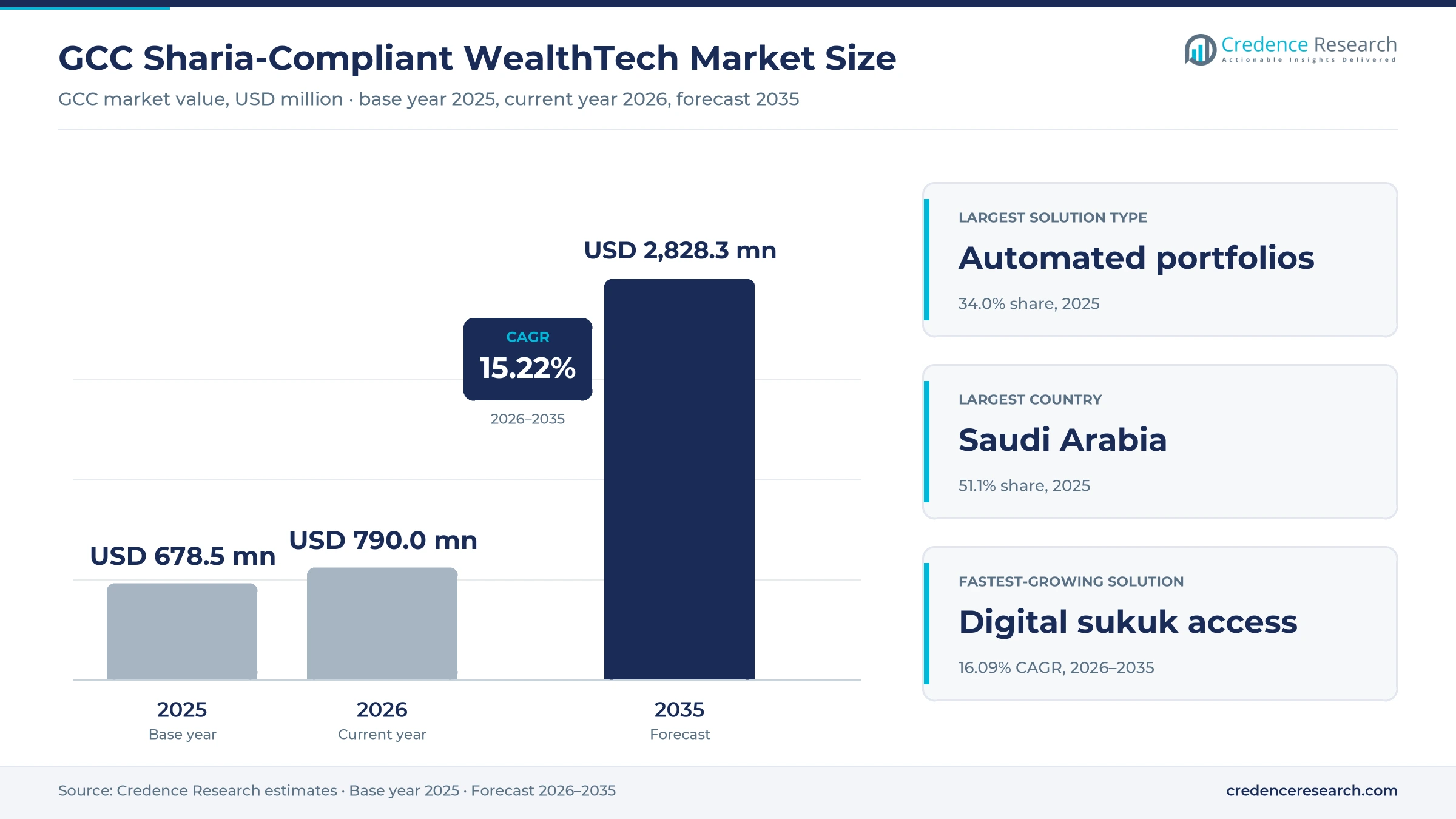
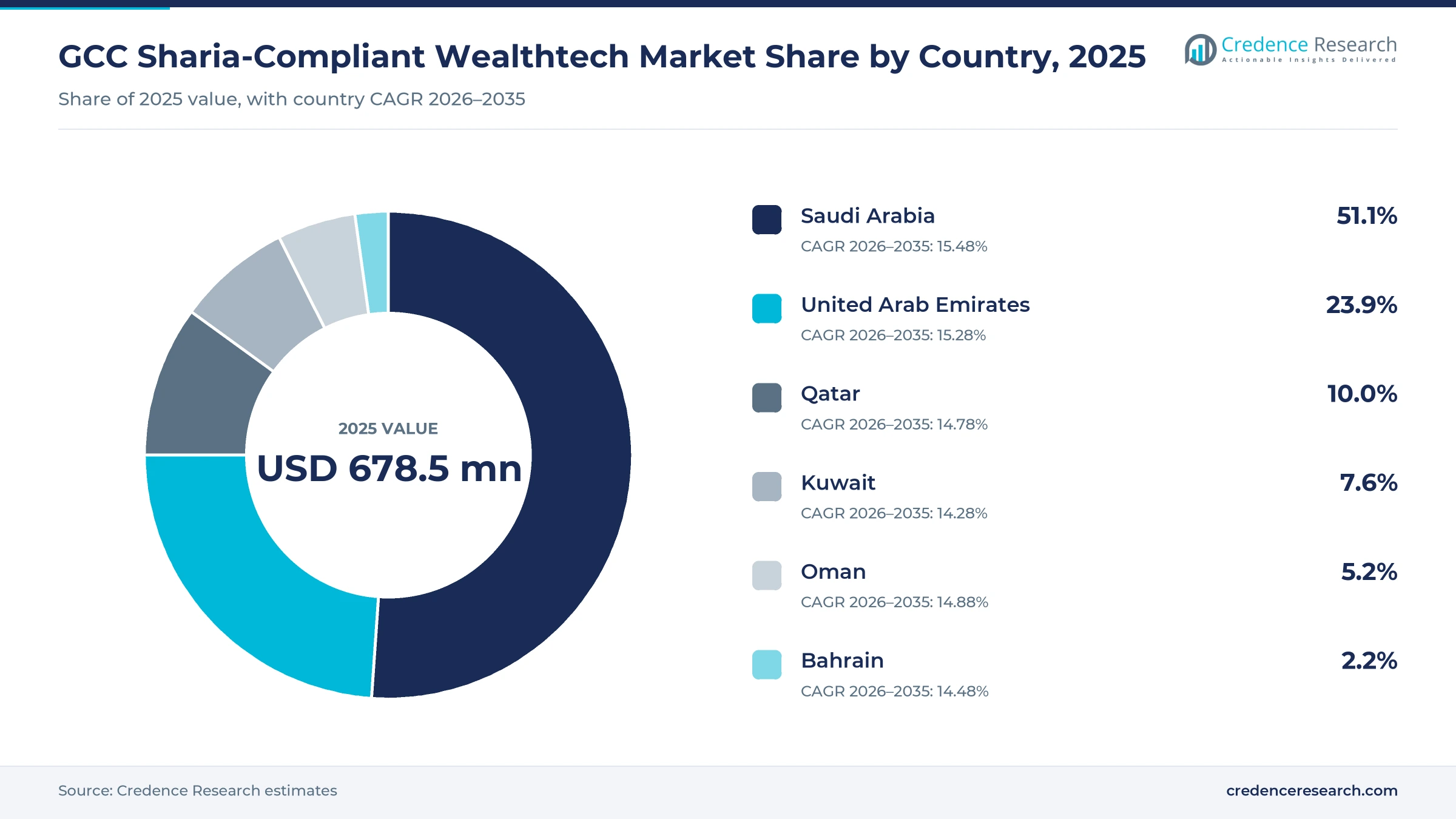
The GCC Sharia-compliant Wealthtech market was valued at USD 678.5 million in 2025 and is projected to increase from USD 790.0 million in 2026 to USD 2.83 billion by 2035, registering a CAGR of 15.22% during 2026–2035. Demand comes from young salaried savers, emerging affluent families and high-net-worth investors who want low-cost portfolios, halal stock screening and access to sukuk through mobile apps and bank channels. Saudi Arabia held the largest country share, 51.1% in 2025, because its Capital Market Authority licenses robo-advisers and the kingdom has the largest Islamic finance base in the Gulf. Saudi Arabia is also the fastest-growing country at 15.48% a year, as robo-advisory assets and investor numbers rise quickly. In turn, the Saudi regulator approved a dedicated robo-advisory framework in March 2026, which gives platforms clearer rules for automated advice.
Which digital investing services does the estimate cover?
The estimate measures the revenue of Sharia-compliant digital wealth services in the six Gulf Cooperation Council countries, including automated portfolio management, halal securities screening and research, digital sukuk and fixed-income access, fractional real-asset investing and wealth planning and zakat tools. It counts fees earned from retail, affluent, private and institutional clients through apps, banks, brokers and advisers.
The estimate excludes the value of client assets, conventional brokerage and wealth products that are not certified as Sharia compliant, and core banking software sold to banks. The value chain runs from Sharia boards, data and screening providers and custodians through licensed platforms and banks to investors in each Gulf country.
GCC Sharia-Compliant Wealthtech Market Insights
- The GCC Sharia-compliant Wealthtech market was valued at USD 678.5 million in 2025 and is projected to reach USD 2.83 billion by 2035, registering a CAGR of 15.22% during 2026–2035.
- Saudi Arabia held a 51.1% share of 2025 value, because robo-advisory portfolio assets in the kingdom reached SAR 6.4 billion by the end of 2025.
- Automated Sharia portfolio management led with a 34.0% share of 2025 value, because licensed robo-advisers build halal portfolios from small monthly deposits.
- The Saudi Capital Market Authority approved its robo-advisory framework in March 2026, after a public consultation that ran in August 2025.
- Digital sukuk and fixed-income access grows fastest at 16.09% a year during 2026–2035, as debt platforms and tokenized sukuk widen access for retail savers.
Automated portfolios lead while digital sukuk grows fastest
Why do automated portfolios hold the largest value?
Based on solution type, the market is categorized into automated Sharia portfolio management, halal securities screening and research, digital sukuk and fixed-income access, fractional real-asset investing and wealth planning and zakat tools. Automated Sharia Portfolio Management led with a 34.0% share of 2025 value, because licensed robo-advisers charge asset fees on growing balances. Digital Sukuk and Fixed-Income Access grows fastest at 16.09% a year, as debt platforms reach retail savers.
Which investors generate most platform revenue?
Based on customer segment, the market is categorized into mass retail investors, emerging affluent investors, high-net-worth individuals, family offices and institutional investors. Mass Retail Investors led with a 38.0% share of 2025 value, because young salaried savers open small accounts in large numbers. Mass Retail Investors also grow fastest at 15.83% a year, as low minimum deposits bring first-time investors into halal portfolios.
How do investors reach Sharia-compliant platforms?
Based on distribution channel, the market is categorized into direct-to-consumer mobile apps, bank-embedded wealth journeys, broker and exchange integrations, employer and community partnerships, and advisor-assisted digital channels. Direct-to-Consumer Mobile Apps led with a 41.0% share of 2025 value, because licensed apps sign up investors directly. Bank-Embedded Wealth Journeys grow fastest at 16.00% a year, as Islamic banks add investing to their apps.
| Segment Group | Leading Sub-segment | Share, 2025 | Fastest-growing Sub-segment | CAGR, 2026–2035 |
|---|---|---|---|---|
| By Solution Type | Automated Sharia Portfolio Management | 34.0% | Digital Sukuk and Fixed-Income Access | 16.09% |
| By Customer Segment | Mass Retail Investors | 38.0% | Mass Retail Investors | 15.83% |
| By Distribution Channel | Direct-to-Consumer Mobile Apps | 41.0% | Bank-Embedded Wealth Journeys | 16.00% |
Request a Free Sample
Fill in your details and we'll send you a free sample report.
- Sample data tables & charts
- Research methodology
Islamic finance depth and digital readiness lift adoption
How does a deep Islamic finance base lift demand?
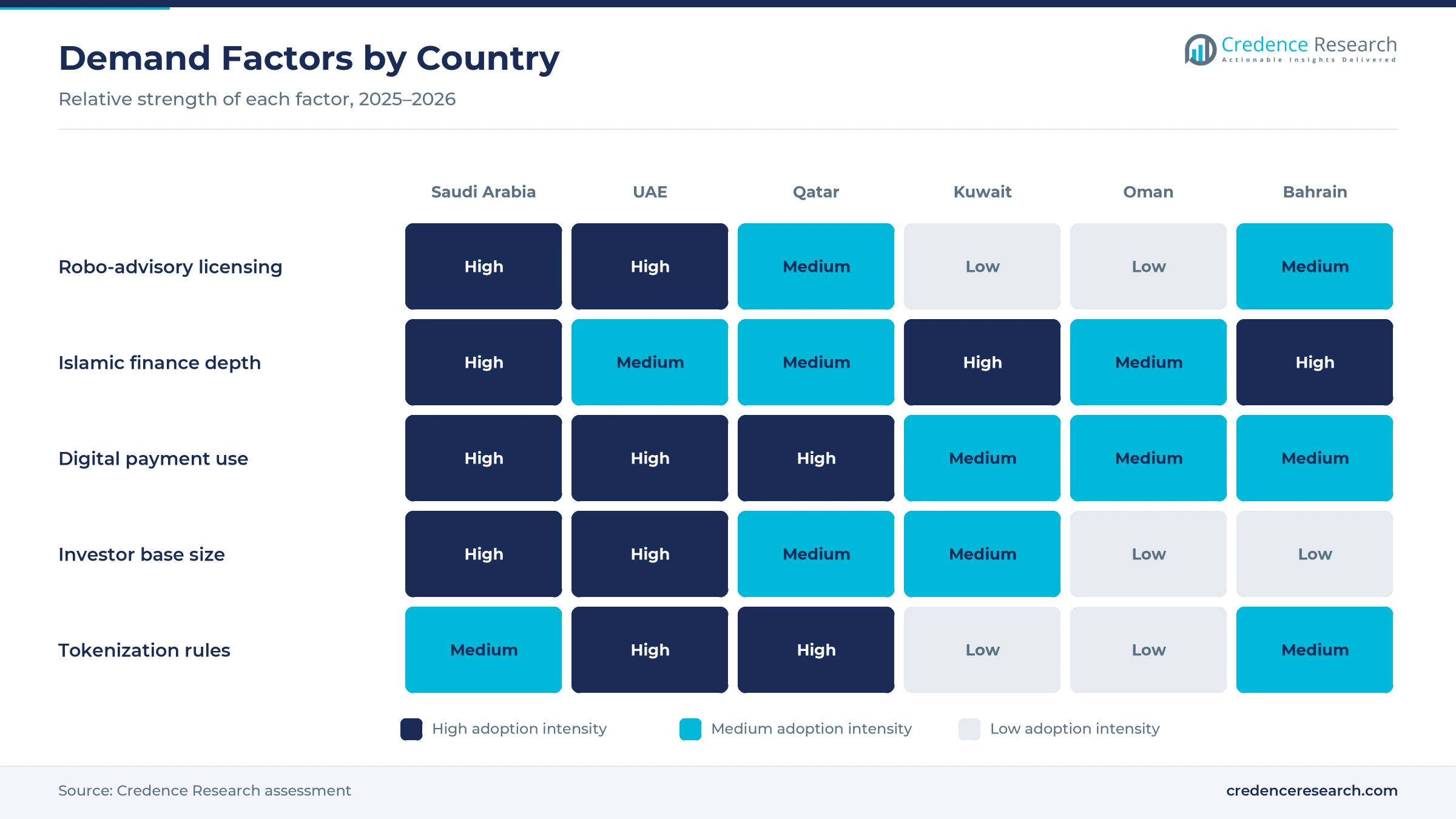
A deep Islamic finance base lifts demand, because Gulf savers already use Sharia-compliant banks and now want the same standard for their investments. Listed sukuk and debt instruments in Saudi Arabia reached SAR 713.4 billion at the end of 2025, up about 7.5% from SAR 663.5 billion, according to the Capital Market Authority annual report. Islamic banks and Islamic windows held about 20% of Omani banking assets at the end of November 2025, up from 19.2% a year earlier. Kuwait also accounted for around 6% of global Islamic banking assets, a Central Bank of Kuwait official said in 2018. As a result, automated Sharia portfolio management holds 34.0% of 2025 value, because savers trust certified halal portfolios.
Why does digital transaction readiness speed adoption?
Digital transaction readiness speeds adoption, because Gulf residents already bank, pay and trade through mobile apps and expect investing to work the same way. Digital payments made up 85% of retail transactions in Saudi Arabia in 2025, up from 79% in 2024, according to the Vision 2030 annual report. Beneficiary investors of fintech and robo-advisory services rose 35% to more than 1.06 million by the end of 2025. Robo-advisory portfolios in the kingdom also passed 511,000 in the third quarter of 2025, according to regulator data reported in December 2025. In turn, direct-to-consumer mobile apps hold 41.0% of 2025 value, because investors open accounts entirely on their phones.
How do fintech and wealth hubs widen the supply of platforms?
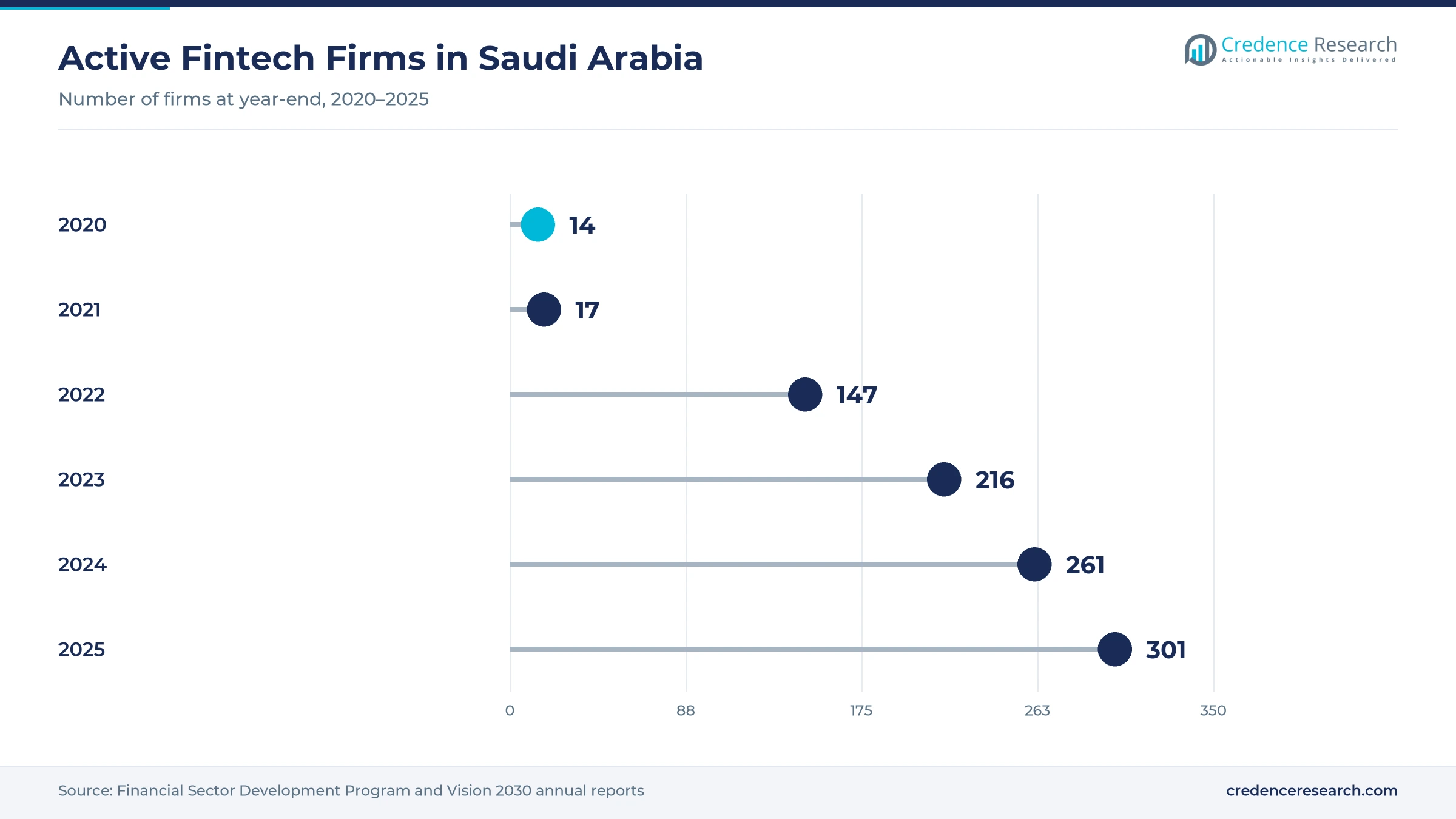
Fintech and wealth hubs widen the supply of platforms, because regulators in Riyadh, Abu Dhabi, Dubai and Doha offer licenses, test labs and clear rules for new firms. Saudi Arabia had 261 active fintech firms at the end of 2024 and 301 in 2025, against a Vision 2030 target of 525 firms. The Capital Market Authority had granted 68 fintech experimental permits by the end of the second quarter of 2025. Wahed received a Financial Services Permission from the Abu Dhabi Global Market regulator in November 2023 to run a dedicated Islamic digital investment platform. As a result, the United Arab Emirates holds 23.9% of 2025 value, because Abu Dhabi and Dubai host many licensed apps.
Why does a young, growing population add new investors?
A young, growing population adds new investors, because many Gulf nationals and residents are in their first decade of saving and prefer low-cost digital accounts. Oman had 5.28 million residents and Qatar 2.86 million in 2024, according to the World Bank, which adds to the pool of potential savers outside Saudi Arabia. Robo-advisory assets in the kingdom reached SAR 5.44 billion in the third quarter of 2025, up 79% year on year, before rising to SAR 6.4 billion by the end of 2025. Sarwa reported a US$1 billion client assets milestone in May 2026. In turn, mass retail investors grow at 15.83% a year, the fastest customer segment, as first-time savers open halal portfolios with small deposits.
Bank-embedded investing and tokenized assets reshape access
How is the shift to licensed robo-advice changing the market?
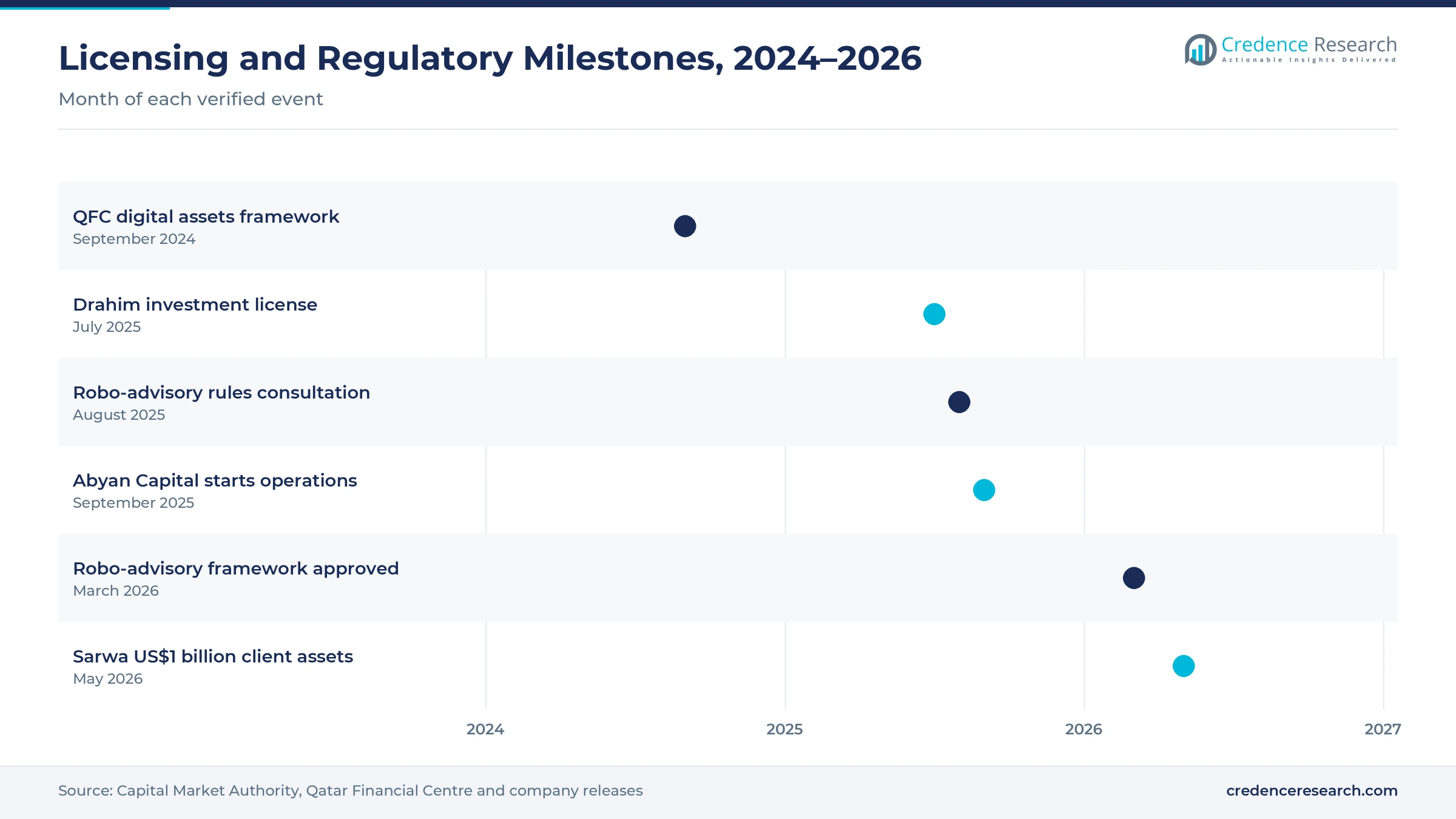
The shift to licensed robo-advice is changing the market, because regulators now set clear rules for automated portfolios and investors trust licensed firms more. The Saudi Capital Market Authority consulted on robo-advisory rules in August 2025 and approved the framework in March 2026. It also licensed Drahim App Investment to manage investments by a resolution dated July 28, 2025. Abyan Capital completed its commencement requirements on Sept. 22, 2025, for dealing, managing investments and custody. As a result, automated Sharia portfolio management keeps the largest share, while new licenses expand the number of digital advice platforms serving Gulf savers.
Why is the rise of bank-embedded investing notable?
The rise of bank-embedded investing is notable, because Islamic banks hold the deposits and trust of most Gulf savers and can add investing inside existing apps. Islamic banking assets in Oman reached US$24.1 billion, growing faster than conventional bank assets, according to Omani press reports in January 2026. Capital market institutions licensed by the Saudi regulator reached 215 by the end of 2025, after 32 new licenses. Their revenue also rose 19.4% to SAR 20.8 billion in 2025. In turn, bank-embedded wealth journeys grow at 16.00% a year, as banks pair mobile banking apps with halal portfolios.
Can digital sukuk and debt platforms open retail access?
Digital sukuk and debt platforms can open retail access, because small investors rarely reach sukuk through traditional bank and broker channels. Debt instrument offering platforms in Saudi Arabia raised more than SAR 5.1 billion by the end of 2025, a 48% increase from SAR 3.4 billion in 2024. Corporate sukuk and debt offerings raised SAR 50.7 billion in 2025, compared with SAR 33.9 billion for equity. Listed sukuk and debt instruments also reached SAR 713.4 billion. As a result, digital sukuk and fixed-income access grows at 16.09% a year, the fastest solution type during 2026–2035.
Is there room to grow in tokenized real assets?
Tokenized real assets offer room to grow, because Gulf investors favor property and other tangible assets that fit Sharia principles. The Qatar Financial Centre launched its digital assets framework on Sept. 1, 2024, giving legal recognition to smart contracts and tokenization, according to the Gulf Times. More than 20 start-ups and fintech firms had joined the QFC Digital Assets Lab since it opened in October 2023. The Saudi regulator also counted 50 fintech companies in its Fintech Lab in mid-2025. In turn, fractional real-asset investing gains new products, as financial technology firms tokenize property units for small investors.
Sharia standard gaps and thin product shelves slow scale-up
How do differing Sharia standards slow scale-up?
Differing Sharia standards slow scale-up, because each platform needs its own Sharia board, and scholars can disagree on screening ratios and product structures. As a result, platforms that expand across Gulf countries must sometimes adjust products for each market, which adds legal and advisory costs. Firms respond with widely used screening methods and published fatwas, which help investors compare platforms. This barrier eases as regulators and standard setters align their guidance.
Why does a thin halal product shelf limit choice?
A thin halal product shelf limits choice, because few local funds, ETFs and sukuk are available in small denominations for retail investors. In turn, many platforms rely on global halal ETFs and U.S. stocks, which adds currency risk and reduces exposure to local markets. Platforms respond by adding local sukuk, real estate funds and debt platforms, which widen choice over time. This gap is narrowing as Gulf issuers list more sukuk.
How do licensing costs weigh on small platforms?
Licensing costs weigh on small platforms, because each Gulf country requires separate licenses, capital and compliance staff before a firm can serve local investors. As a result, start-ups often stay in one market or operate under limited test permits for longer periods. Firms respond with partnerships, regulatory sandboxes and shared compliance services, which lower the cost of entry. This pressure favors well-funded platforms that can hold several licenses.
Why does low investor literacy slow first purchases?
Low investor literacy slows first purchases, because many savers are unsure how halal portfolios, sukuk and zakat calculations work in practice. In turn, some users open accounts but leave balances small or idle for months. Platforms respond with Arabic content, goal-based tools and zakat calculators, which help users build confidence and invest regularly. This challenge eases as employers and banks add education to their savings programs.
Saudi Arabia leads and grows fastest among Gulf countries
| Country | Value, 2025 (USD million) | Share, 2025 | CAGR, 2026–2035 |
|---|---|---|---|
| Saudi Arabia | 346.7 | 51.1% | 15.48% |
| United Arab Emirates | 162.2 | 23.9% | 15.28% |
| Qatar | 67.8 | 10.0% | 14.78% |
| Kuwait | 51.6 | 7.6% | 14.28% |
| Oman | 35.3 | 5.2% | 14.88% |
| Bahrain | 14.9 | 2.2% | 14.48% |
Why does Saudi Arabia lead the Gulf market?
Saudi Arabia held a 51.1% share of 2025 value and grows fastest at 15.48% a year, because its regulator licenses robo-advisers and debt platforms at scale. Robo-advisory portfolio assets reached SAR 6.4 billion by the end of 2025, up 86% in a year. Drahim, Abyan Capital and other local firms completed licensing steps in 2025. As a result, Saudi Arabia generates more than half of regional platform revenue.
How do Abu Dhabi and Dubai support the UAE share?
The United Arab Emirates held a 23.9% share of 2025 value and grows at 15.28% a year, because Abu Dhabi Global Market and the Dubai International Financial Centre host many licensed platforms. Wahed received its Abu Dhabi permission in November 2023, and Sarwa reported US$1 billion in client assets in May 2026. baraka is also based in the Dubai International Financial Centre. In turn, the UAE serves a large expatriate and national investor base.
What supports demand in Qatar?
Qatar held a 10.0% share of 2025 value and grows at 14.78% a year, because high incomes and a growing Islamic finance sector support digital investing. The Qatar Financial Centre launched its digital assets framework on Sept. 1, 2024, under the central bank's Third Financial Sector Strategy. More than 20 firms had joined the QFC Digital Assets Lab. As a result, Qatar is building a base for tokenized products.
How does Kuwait contribute to platform revenue?
Kuwait held a 7.6% share of 2025 value and grows at 14.28% a year, because the country has a long-established Islamic banking sector with its first Islamic bank launched in 1977. Kuwait accounted for around 6% of global Islamic banking assets, a central bank official said in 2018. In turn, Kuwaiti savers are familiar with Sharia-compliant products and can move to digital portfolios.
What role do Oman and Bahrain play?
Oman held a 5.2% share of 2025 value and grows at 14.88% a year, because Islamic banks and windows held about 20% of Omani banking assets at the end of November 2025. Bahrain held a 2.2% share of 2025 value and grows at 14.48% a year, because its investor base is smaller than those of its neighbors. The Central Bank of Bahrain created a fintech regulatory sandbox in 2017 for local and foreign firms. As a result, both markets attract platforms that test products before regional expansion.
Licenses, frameworks and asset milestones, 2024–2026
| Development | Status and market relevance |
|---|---|
| In September 2024, the Qatar Financial Centre launched its digital assets framework, giving legal recognition to smart contracts and tokenization. | Opens a base for tokenized real-asset products |
| In July 2025, the Saudi Capital Market Authority licensed Drahim App Investment to conduct investment management. | Adds a licensed local digital investing app |
| In September 2025, Abyan Capital completed its commencement requirements for dealing, managing investments and custody. | Expands licensed Sharia-focused asset management |
| In March 2026, the Saudi Capital Market Authority approved its robo-advisory framework after an August 2025 consultation. | Sets clear rules for automated advice |
| In May 2026, Sarwa reported a US$1 billion client assets milestone. | Shows scale for UAE digital investing apps |
Screening engines and open finance define new platforms
- Sharia screening engines test company revenue sources and debt ratios against published standards, which lets platforms filter stocks, ETFs and funds automatically for each investor.
- AI-based portfolio optimization matches risk scores and goals to halal model portfolios, which keeps fees low while rebalancing accounts without manual work.
- Open finance and account aggregation link bank, card and investment data with customer consent, which helps platforms suggest savings amounts and zakat totals.
- Tokenization and distributed ledgers split property and sukuk into small digital units, which lowers minimum investments and speeds settlement for retail savers.
Need a Custom Version of This Report?
Tailor the scope, geography, or segments to your exact requirements.
- Custom geography or segment scope
- Direct access to our analyst team
Licensed apps and Islamic banks compete for young savers
Competition combines licensed robo-advisers, investing apps and halal screening tools with Islamic banks that add investing to their own apps. Wahed competes with diversified Sharia-compliant portfolios under its Abu Dhabi permission. Sarwa competes in the UAE with automated portfolios, including a halal option, and reported US$1 billion in client assets in May 2026. Abyan Capital and Drahim compete in Saudi Arabia after completing Capital Market Authority licensing steps in 2025. baraka competes from the Dubai International Financial Centre with low-cost access to U.S. stocks and ETFs. Musaffa and Zoya compete in halal stock screening and research. Rivals compete on Sharia board credibility, fees, minimum deposits, local product access and licensing reach across Gulf countries.
Which platforms serve Gulf Sharia-conscious investors?
| Company | Type | Role in the market |
|---|---|---|
| Wahed | Islamic robo-adviser | Holds an Abu Dhabi Global Market permission since November 2023 |
| Sarwa | Digital investing platform | Reported US$1 billion in client assets in May 2026 |
| Abyan Capital | Licensed asset manager | Completed Saudi commencement requirements in September 2025 |
| Drahim | Digital investing app | Licensed by the Saudi regulator for investment management in July 2025 |
| baraka | Investing app | Based in the Dubai International Financial Centre |
Credence Research view on Islamic digital investing
Credence Research's view is that Sharia-compliant digital wealth services in the Gulf will grow quickly because regulators now license robo-advice and young savers prefer halal portfolios on their phones. Saudi Arabia will remain the anchor market, supported by fast growth in robo-advisory assets and a new framework approved in March 2026. Digital sukuk and tokenized real assets add the fastest new revenue. Platforms with strong Sharia boards, bank partnerships and multi-country licenses should gain the most.
How the Gulf digital investing estimate was built
The report uses 2025 as the base year on a calendar basis, and market values come from the Credence Research model. That model combines regulator annual reports and license announcements, official fintech program statistics, international agency data and company releases. Segment splits and country growth rates are Credence Research estimates, while country shares follow the client-provided split. Sources used are regulator releases, official statistics, trade media and company releases, and no interviews or surveys were used.
Robo-advice and digital sukuk carry growth to 2035
The GCC Sharia-compliant Wealthtech market is expected to reach USD 2.83 billion by 2035, a 15.22% CAGR during 2026–2035, as licensed robo-advisers, bank-embedded investing and digital sukuk bring more savers into halal portfolios. Growth should be strongest in digital sukuk access, mass retail investors and Saudi Arabia, because these areas gain most from new rules and young savers. Differing Sharia standards, thin local product shelves and licensing costs could slow growth for smaller platforms, while investor education and bank partnerships should widen the base of regular savers.
Frequently Asked Questions
How big is the GCC Sharia-compliant Wealthtech market?
Which solution type leads the market?
Which country leads the Gulf market?
How fast are Saudi robo-advisory assets growing?
What new rules support Sharia-compliant digital investing?
Which distribution channel grows fastest?
Who are the leading companies in the market?
What are the main challenges for platforms?
Table of Content
Chapter 1 Market Segmentation
- 1.1 Segmentation Framework
- 1.1.1 Product and Service Classification
- 1.1.2 Application and End-Use Classification
- 1.1.3 Technology and Solution Classification
- 1.1.4 Customer and Distribution Channel Classification
- 1.1.5 Geographic Segmentation
- 1.1.6 Market Segment Definitions and Boundaries
- 1.2 By Solution Type
- 1.2.1 Automated Sharia Portfolio Management
- 1.2.2 Halal Securities Screening and Research
- 1.2.3 Digital Sukuk and Fixed-Income Access
- 1.2.4 Fractional Real-Asset Investing
- 1.2.5 Wealth Planning and Zakat Tools
- 1.3 By Customer Segment
- 1.3.1 Mass Retail Investors
- 1.3.2 Emerging Affluent Investors
- 1.3.3 High-Net-Worth Individuals
- 1.3.4 Family Offices
- 1.3.5 Institutional Investors
- 1.4 By Country
- 1.4.1 Saudi Arabia
- 1.4.2 United Arab Emirates
- 1.4.3 Kuwait
- 1.4.4 Qatar
- 1.4.5 Bahrain
- 1.4.6 Oman
Chapter 2 Introduction
- 2.1 Report Objectives and Scope
- 2.2 Product Definition and Industry Terminology
- 2.3 Market Inclusions and Exclusions
- 2.4 Research Process
- 2.4.1 Primary Research and Expert Interviews
- 2.4.2 Secondary Research and Source Review
- 2.4.3 Top-Down and Bottom-Up Estimation
- 2.4.4 Data Triangulation and Verification
- 2.5 Market Size Measurement Basis
- 2.5.1 2025: USD 678.5 million → 2035: USD 2.83 billion
- 2.6 Historical and Forecast Reference Periods
- 2.6.1 Historical Period: 2018-2025
- 2.6.2 Base Year: 2025
- 2.6.3 Forecast Period: 2025-2035
- 2.7 Research Assumptions and Limitations
Chapter 3 Executive Summary
- 3.1 Market Snapshot and Key Findings
- 3.2 Base-Year Market Size, 2025
- 3.3 Forecast Market Size, 2035
- 3.4 Revenue and Volume Growth Outlook
- 3.5 Key Demand and Supply Indicators
- 3.6 Leading Market Segments
- 3.7 Fastest-Growing Market Opportunities
- 3.8 Regional Performance Highlights
- 3.9 Technology and Industry Transformation
- 3.10 Competitive Landscape Summary
- 3.11 Analyst View and Strategic Implications
Chapter 4 GCC Sharia-Compliant Wealthtech Market Trends and Developments
- 4.1 Historical Industry Development, 2018-2025
- 4.2 Recent Market Trends and Developments
- 4.3 Demand and Customer Behavior Trends
- 4.4 Technology and Product Innovation
- 4.5 Artificial Intelligence, Automation and Digitalization
- 4.6 Local Manufacturing and Supply Chain Realignment
- 4.7 Industry Partnerships, Mergers and Acquisitions
- 4.8 Sustainability and Circular Economy Developments
- 4.9 Government and Private Sector Investment Trends
- 4.10 Emerging Business Models and Commercialization
- 4.11 Industry Developments and Announcements
Chapter 5 GCC Sharia-Compliant Wealthtech Market Supply and Demand Analysis
- 5.1 Demand Trend and Consumption Analysis, 2018-2025
- 5.2 Demand Forecast, 2025-2035
- 5.3 Supply Chain Structure and Procurement Trends
- 5.4 Supply-Demand Gap and Bottlenecks
- 5.5 Import Dependence and Sourcing Structure
- 5.6 Regional Supply and Demand Concentration
Chapter 6 GCC Sharia-Compliant Wealthtech Market Pricing Analysis
- 6.1 Pricing Structure and Measurement
- 6.2 Historical Pricing Trends, 2018-2025
- 6.3 Pricing Outlook, 2025-2035
- 6.4 Pricing by Product and Market Segment
- 6.5 Geographic Pricing Differences
- 6.6 Key Input, Energy, Labor and Logistics Costs
- 6.7 Contract Pricing and Purchasing Models
- 6.8 Pricing Sensitivity and Competitive Positioning
- 6.9 Price, Margin and Profitability Implications
Chapter 7 GCC Sharia-Compliant Wealthtech Market Dynamics
- 7.1 Market Growth Drivers
- 7.1.1 Demand-Side Drivers
- 7.1.2 Technology and Innovation Drivers
- 7.1.3 Infrastructure and Investment Drivers
- 7.1.4 Regulatory and Policy Drivers
- 7.2 Market Restraints
- 7.2.1 Cost and Affordability Constraints
- 7.2.2 Technology and Adoption Barriers
- 7.2.3 Supply Chain and Operational Constraints
- 7.3 Market Challenges
- 7.3.1 Competitive Pressure and Margin Erosion
- 7.3.2 Skills, Infrastructure and Implementation Gaps
- 7.4 Emerging Market Opportunities
- 7.5 Market Dynamics Impact and Time-Horizon Assessment
Chapter 8 GCC Sharia-Compliant Wealthtech Value Chain Analysis
- 8.1 Industry Value Chain Overview
- 8.2 Upstream Suppliers and Critical Inputs
- 8.3 Technology and Component Providers
- 8.4 Manufacturing or Service Delivery
- 8.5 Distribution, Channel Partners and Integrators
- 8.6 Downstream Applications and End Users
- 8.7 Value Addition and Profit Pools
- 8.8 Vertical Integration and Outsourcing
- 8.9 Supplier Concentration and Risk
- 8.10 Supply Chain Localization and Resilience
Chapter 9 GCC Sharia-Compliant Wealthtech Market Regulations and Policies
- 9.1 Relevant Laws, Standards and Compliance Frameworks
- 9.2 Product, Service, Safety and Quality Requirements
- 9.3 Government Policies, Incentives and Subsidies
- 9.4 Imports, Exports and Trade Barriers
- 9.5 Public Procurement and Local Content Requirements
- 9.6 Data Protection, AI and Cybersecurity Compliance
- 9.7 Upcoming Policy Changes and Market Implications
Chapter 10 GCC Sharia-Compliant Wealthtech Market Hotspots and Opportunities
- 10.1 Market Opportunity Mapping and Growth Hotspots
- 10.2 High-Growth Applications and Customer Groups
- 10.3 Underserved Markets and White-Space Opportunities
- 10.4 Emerging Technology and Product Opportunities
- 10.5 New Capacity and Investment Hotspots
- 10.6 Market Entry and Expansion Opportunities
- 10.7 Distribution and Partnership Opportunities
- 10.8 Near-Term and Long-Term Commercial Potential
- 10.9 Opportunity Attractiveness and Execution Risks
Chapter 11 GCC Sharia-Compliant Wealthtech Market Outlook, 2025-2035
- 11.1 Market Size and Analysis
- 11.1.1 Revenue (Market Measurement: 2025: USD 678.5 million → 2035: USD 2.83 billion)
- 11.1.2 Historical Market Size, 2018-2025
- 11.1.3 Base-Year Market Size, 2025
- 11.2 Market Forecast, 2025-2035
- 11.2.1 Revenue Forecast to 2035
- 11.2.2 CAGR and Year-on-Year Growth
- 11.2.3 Incremental Revenue Opportunity
- 11.3 Forecast Assumptions and Scenario Analysis
- 11.3.1 Base-Case Forecast
- 11.3.2 Optimistic and Conservative Scenarios
- 11.3.3 Technology, Pricing and Policy Sensitivities
- 11.4 Market Attractiveness and Growth Outlook
Chapter 12 GCC Sharia-Compliant Wealthtech Market Segmentation and Outlook
- 12.1 Segmentation Summary and Market Shares, 2025
- 12.2 Largest and Fastest-Growing Segments
- 12.3 By Solution Type - Market Size and Forecast, 2025-2035
- 12.3.1 Segment Definition and Scope
- 12.3.2 Historical Market Size, 2018-2025
- 12.3.3 Revenue Forecast, 2025-2035
- 12.3.4 Base-Year Market Share, 2025
- 12.3.5 Segment CAGR and Growth Drivers
- 12.3.6 Subsegment Market Size and Forecast
- 12.3.6.1 Automated Sharia Portfolio Management
- 12.3.6.2 Halal Securities Screening and Research
- 12.3.6.3 Digital Sukuk and Fixed-Income Access
- 12.3.6.4 Fractional Real-Asset Investing
- 12.3.6.5 Wealth Planning and Zakat Tools
- 12.3.7 Subsegment Pricing and Adoption Trends
- 12.3.8 Leading Suppliers and Competition
- 12.3.9 Regional Demand and Opportunities
- 12.4 By Customer Segment - Market Size and Forecast, 2025-2035
- 12.4.1 Segment Definition and Scope
- 12.4.2 Historical Market Size, 2018-2025
- 12.4.3 Revenue Forecast, 2025-2035
- 12.4.4 Base-Year Market Share, 2025
- 12.4.5 Segment CAGR and Growth Drivers
- 12.4.6 Subsegment Market Size and Forecast
- 12.4.6.1 Mass Retail Investors
- 12.4.6.2 Emerging Affluent Investors
- 12.4.6.3 High-Net-Worth Individuals
- 12.4.6.4 Family Offices
- 12.4.6.5 Institutional Investors
- 12.4.7 Subsegment Pricing and Adoption Trends
- 12.4.8 Leading Suppliers and Competition
- 12.4.9 Regional Demand and Opportunities
- 12.5 By Country - Market Size and Forecast, 2025-2035
- 12.5.1 Segment Definition and Scope
- 12.5.2 Historical Market Size, 2018-2025
- 12.5.3 Revenue Forecast, 2025-2035
- 12.5.4 Base-Year Market Share, 2025
- 12.5.5 Segment CAGR and Growth Drivers
- 12.5.6 Subsegment Market Size and Forecast
- 12.5.6.1 Saudi Arabia
- 12.5.6.2 United Arab Emirates
- 12.5.6.3 Kuwait
- 12.5.6.4 Qatar
- 12.5.6.5 Bahrain
- 12.5.6.6 Oman
- 12.5.7 Subsegment Pricing and Adoption Trends
- 12.5.8 Leading Suppliers and Competition
- 12.5.9 Regional Demand and Opportunities
- 12.6 Segment Growth Comparison
- 12.7 Segment Attractiveness and Priority Matrix
Chapter 13 GCC Sharia-Compliant Wealthtech End-Use and Application Market Outlook
- 13.1 End-Use Industry and Customer Demand Structure
- 13.2 Leading Applications and Customer Groups
- 13.3 End-Use Market Size, Share and Forecast
- 13.4 Major End-Use Industry Deep Dives
- 13.4.1 Customer Requirements and Use Cases
- 13.4.2 Demand and Replacement Cycles
- 13.4.3 Technical and Regulatory Considerations
- 13.4.4 Purchasing and Procurement Models
- 13.4.5 Leading Vendors and Distribution Channels
- 13.4.6 Forecast and Commercial Opportunities
- 13.5 Emerging Applications and Cross-Segment Demand
- 13.6 End-Use Industry Investment Priorities
Chapter 14 GCC Sharia-Compliant Wealthtech Geographic Market Outlook, 2025-2035
- 14.1 Regional Market Size and Country-Level Shares, 2025
- 14.2 Country Market Size Comparison, 2025
- 14.3 Country Market Forecasts, 2025-2035
- 14.4 Subregional Industrial and Demand Clusters
- 14.5 Intra-Regional Pricing and Cost Differences
- 14.6 Cross-Border Trade and Supply Networks
- 14.7 Regional Supply and Demand Balances
- 14.8 Country Opportunity Comparison and Prioritization
Note: Every listed country is covered on the structure shown under the first country.
Chapter 15 GCC Sharia-Compliant Wealthtech Technology, Innovation and Sustainability Outlook
- 15.1 Technology Landscape and Maturity
- 15.2 Product, Process and Service Innovation
- 15.3 AI, Automation and Digital Tools in the Industry
- 15.4 Technology Adoption and Performance Benchmarking
- 15.5 Innovation Pipeline and R&D Investment
- 15.6 Energy Efficiency and Resource Management
- 15.7 Sustainability, Recycling and Circularity
- 15.8 Technology Roadmap, 2025-2035
- 15.9 Risks of Obsolescence and Technology Substitution
Chapter 16 GCC Sharia-Compliant Wealthtech Market Key Strategic Imperatives
- 16.1 Growth and Market Entry Priorities
- 16.2 High-Return Products and Segments
- 16.3 Pricing, Profitability and Cost Optimization
- 16.4 Technology Investment and Product Differentiation
- 16.5 Supply Chain Localization and Resilience
- 16.6 Distribution and Customer Acquisition
- 16.7 Partnership, Acquisition and Capacity Strategy
- 16.8 Regional Expansion Priorities
- 16.9 Short-, Medium- and Long-Term Actions
Chapter 17 Competition Outlook
- 17.1 Industry Competition Characteristics
- 17.2 Market Structure and Concentration
- 17.3 Market Share and Competitive Positioning, 2025
- 17.4 Company-Wise Revenue and Product Benchmarking
- 17.5 Production and Service Capacity Benchmarking
- 17.6 Technology, Pricing and Differentiation
- 17.7 Regional Footprint and Distribution Strength
- 17.8 Mergers, Acquisitions and Strategic Alliances
- 17.9 New Entrants and Competitive Threats
- 17.10 Porter's Five Forces and Industry Attractiveness
- 17.11 Competitive Outlook, 2025-2035
Chapter 18 Company Profiles
- 18.1 Company Coverage and Selection Criteria
- 18.2 Wahed
- 18.2.1 Business Description
- 18.2.2 Company Ownership and Geographic Presence
- 18.2.3 Product and Service Portfolio
- 18.2.4 Manufacturing and Operating Footprint
- 18.2.5 Financial Performance and Investment
- 18.2.6 Market Share and Competitive Position
- 18.2.7 Technology and Innovation Capabilities
- 18.2.8 Strategic Alliances or Partnerships
- 18.2.9 Recent Developments
- 18.2.10 Growth Strategy and Outlook
- 18.3 Abyan Capital
- 18.4 Drahim
- 18.5 Malaa Technologies
- 18.6 Sarwa
- 18.7 baraka
- 18.8 Musaffa
- 18.9 Zoya
- 18.10 Stake
- 18.11 SmartCrowd
- 18.12 Other Relevant Market Participants
Note: Every listed company is profiled on the structure shown under the first company. The company list is preliminary and may change based on research findings, market developments, data availability and client requirements.
Chapter 19 Disclaimer
- 19.1 Research and Forecast Disclaimer
- 19.2 Data Source and Estimation Limitations
Note: The depth of individual sections depends on data availability for this market. Volume, capacity, trade and other unit-based metrics are included where applicable.

