
Market Overview
The genetic analysis market size was valued at USD 7.87 billion in 2024 and is projected to reach USD 17.98 billion by 2032, registering a CAGR of 10.88% during the forecast period.
| REPORT ATTRIBUTE | DETAILS |
|---|---|
| Historical Period | 2020-2023 |
| Base Year | 2024 |
| Forecast Period | 2025-2032 |
| Genetic Analysis Market Size 2024 | USD 7.87 billion |
| Genetic Analysis Market, CAGR | 10.88% |
| Genetic Analysis Market Size 2032 | USD 17.98 billion |
The genetic analysis market grows with rising demand for precision medicine and early disease detection. Technological advances in next-generation sequencing and AI-driven analytics improve accuracy and speed of results. Government initiatives and funding for population-scale genomics projects support adoption. It benefits from growing awareness of preventive healthcare and availability of direct-to-consumer genetic testing kits. Expanding use in drug discovery and companion diagnostics further strengthens market potential. The trend toward personalized medicine drives continuous investment in research and development.
North America leads the genetic analysis market due to advanced healthcare infrastructure and strong adoption of genomic technologies. Europe follows with robust government initiatives supporting precision medicine and population-wide screening programs. Asia-Pacific shows rapid growth driven by improving healthcare access and large-scale genome mapping projects. Key players driving the market include Quest Diagnostics Inc., Qiagen, Hoffmann-La Roche AG, and Thermo Fisher Scientific, focusing on innovation, partnerships, and expanded product offerings to strengthen their presence across developed and emerging markets.
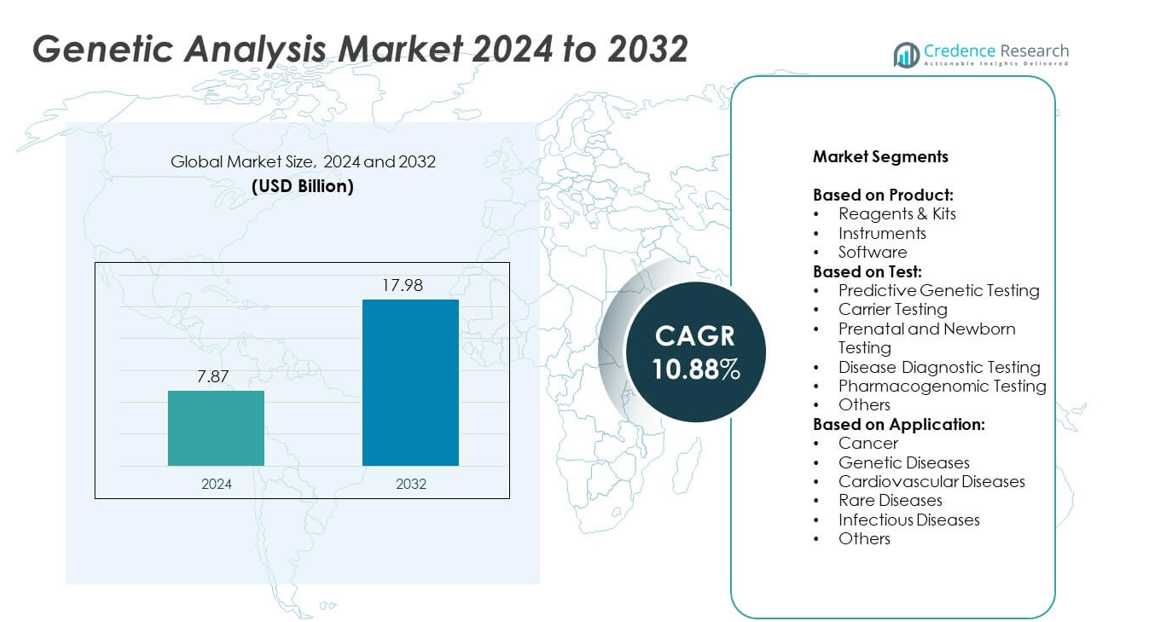
Market Insights
- The genetic analysis market was valued at USD 7.87 billion in 2024 and is projected to reach USD 17.98 billion by 2032, growing at a CAGR of 10.88%.
- Rising demand for precision medicine and early disease diagnosis drives adoption of genetic testing solutions.
- Advancements in next-generation sequencing, AI-powered analytics, and cloud platforms improve accuracy and reduce turnaround time.
- The market is competitive with major players focusing on innovation, partnerships, and expansion into emerging markets.
- High testing costs and limited reimbursement policies remain key challenges for broader adoption, especially in developing regions.
- North America leads with strong infrastructure and research funding, followed by Europe with robust genomics initiatives and Asia-Pacific showing fastest growth.
- Growing government support for population-scale genomics projects and rising use of pharmacogenomics in drug development create long-term opportunities for market players.
Market Drivers
Rising Demand for Precision Medicine and Personalized Healthcare
The genetic analysis market benefits from the rapid adoption of precision medicine approaches. Healthcare providers rely on genetic testing to tailor treatments for cancer, cardiovascular, and rare diseases. Growing awareness among patients drives early diagnostic adoption. Pharmaceutical companies use genetic data to design targeted therapies and reduce trial failures. It supports the shift toward predictive and preventive healthcare models. The trend enhances clinical outcomes and reduces overall treatment costs.
- For instance, GeneDx reported 74,547 exome and genome test results in 2024, an increase of 51% compared to the prior year.
Technological Advancements in Genetic Testing Tools and Platforms
Innovations in next-generation sequencing and microarray technologies strengthen the genetic analysis market. Automated workflows and AI-driven data interpretation improve speed and accuracy of results. Cost reductions make genetic testing more accessible for hospitals and diagnostic labs. It encourages integration into routine clinical practice. Cloud-based platforms support large-scale genomic data storage and analysis. Advancements allow deeper insights into complex genetic disorders.
- For instance, Genetic Analysis AS’ core product, the GA-map Dysbiosis Test, achieved 37% growth year-to-date December 2024 compared to 2023 and reached NOK 13.2 million in revenue for that product alone.
Supportive Regulatory Frameworks and Government Initiatives
Favorable policies promote genetic testing adoption across developed and emerging economies. Governments fund population-scale genomic programs to advance research and precision medicine. Public health agencies encourage screening for hereditary conditions. It creates strong demand for genetic testing services in national health programs. Partnerships between public and private sectors accelerate research translation into clinical use. Clear regulatory pathways build trust and standardization in test quality.
Growing Role of Genetic Testing in Drug Development and Clinical Trials
Pharmaceutical companies integrate genetic analysis to identify drug responders and improve safety. Companion diagnostics gain traction for targeted therapies in oncology and rare diseases. The genetic analysis market supports biomarker discovery and patient stratification. It helps reduce trial duration and improves approval success rates. Collaboration between biotech firms and CROs expands genetic testing capacity for global studies. Rising investment in pharmacogenomics fuels long-term market expansion.
Market Trends
Expansion of Direct-to-Consumer Genetic Testing Services
The genetic analysis market observes strong growth in direct-to-consumer testing. Companies offer at-home kits for ancestry, health risk, and trait analysis. Rising consumer awareness supports demand for convenient genetic insights. It improves access to genetic data without clinical visits. Digital platforms enable secure data sharing with healthcare providers. The trend encourages proactive health management among consumers.
- For instance, As of April 2025, the Emirati Genome Programme has sequenced the genetic data of more than 800,000 Emiratis. This places the UAE on track to sequence the entire Emirati population of approximately 1 million citizens. M42, a technology-enabled healthcare company, is a partner in the project.
Integration of Artificial Intelligence and Big Data in Genomics
AI tools transform how genomic data is processed and interpreted. The genetic analysis market leverages machine learning for faster variant classification. Big data analytics uncovers links between genes and diseases with higher precision. It supports drug discovery and personalized treatment planning. Cloud-based AI platforms enable real-time collaboration among researchers. The approach reduces errors and improves diagnostic accuracy.
- For instance, Natera, Inc. processed approximately 188,800 oncology tests in the second quarter of 2025, an increase from the approximately 125,400 tests performed in the second quarter of 2024. This represents an increase of 50.6% year-over-year.
Shift Toward Population-Scale Genomics and Screening Programs
Governments and research institutions invest in large-scale genome mapping projects. The genetic analysis market benefits from national initiatives focused on public health. These programs identify genetic risk factors across populations. It improves disease prevention strategies and guides policy decisions. Partnerships between genomic labs and healthcare systems expand access to testing. Such efforts strengthen global genetic databases for future research.
Growing Adoption of Multi-Omics and Integrated Diagnostics
Multi-omics combines genomics, proteomics, and metabolomics for comprehensive insights. The genetic analysis market sees demand for integrated platforms in research and clinics. It enhances understanding of complex diseases and treatment response. Researchers use combined data to uncover novel biomarkers. Pharmaceutical firms adopt multi-omics to optimize drug pipelines. The trend supports precision medicine and personalized care models.
Market Challenges Analysis
High Cost of Genetic Testing and Limited Reimbursement Policies
The genetic analysis market faces barriers due to high testing costs. Many advanced sequencing technologies remain expensive for routine use. Limited insurance coverage reduces patient access to genetic testing in several regions. It slows adoption in low- and middle-income countries. Hospitals and clinics often hesitate to integrate tests without financial support. Cost pressure also affects smaller laboratories and research institutions. Wider reimbursement frameworks are needed to accelerate adoption.
Data Privacy Concerns and Regulatory Complexity
Growing volumes of genomic data create privacy and security challenges. The genetic analysis market must comply with strict regulations such as GDPR and HIPAA. It requires secure storage and sharing systems to protect patient information. Data breaches can reduce public trust in genetic testing. Complex approval processes delay launch of new tests in some countries. Companies invest in compliance and cybersecurity, which raises operational costs. Strong governance is vital for sustained market growth.
Market Opportunities
Emerging Demand in Developing Regions and Expanding Healthcare Access
The genetic analysis market has strong opportunities in Asia-Pacific, Latin America, and Africa. Rising healthcare spending and improving diagnostic infrastructure support market penetration. Governments invest in population screening programs to detect genetic disorders early. It creates a wider customer base for testing service providers. Growing awareness of preventive healthcare encourages adoption in urban areas. Partnerships with local labs and clinics help global companies enter new markets. These regions offer long-term growth potential due to large patient populations.
Advancement of Personalized Medicine and Companion Diagnostics
Pharmaceutical and biotech companies expand research in pharmacogenomics and biomarker-driven therapies. The genetic analysis market plays a central role in enabling targeted drug development. It allows identification of responders and non-responders, improving clinical outcomes. Demand for companion diagnostics grows with approvals of precision therapies in oncology and rare diseases. Integration of genetic testing into routine care supports more efficient treatment planning. Collaborations between diagnostic firms and drug developers create new revenue streams. Rising investment in R&D strengthens innovation across the industry.
Market Segmentation Analysis:
By Product:
Reagents and kits hold the largest share in the genetic analysis market due to their recurring demand and essential role in testing workflows. These consumables are critical for PCR, sequencing, and genotyping procedures. Instruments, including sequencers and analyzers, contribute significantly with rising installation in clinical and research laboratories. It benefits from automation and improved throughput that reduce turnaround times. Software solutions gain momentum as genomic data interpretation becomes more complex. AI-powered platforms enable fast analysis and support clinical decision-making.
- For instance, Myriad Genetics saw hereditary cancer testing volume in oncology rise about 14% year-over-year in Q2 2025, especially through its MyRisk with RiskScore tests.
By Test:
Disease diagnostic testing dominates the market with high use in oncology, infectious disease detection, and genetic screening. Predictive genetic testing grows steadily with rising focus on risk assessment for hereditary cancers and chronic disorders. Carrier testing remains crucial for couples planning pregnancies, helping reduce the risk of passing on genetic conditions. It supports early interventions and family planning decisions. Prenatal and newborn testing is widely adopted under national health programs to identify disorders at birth. Pharmacogenomic testing expands with the approval of targeted therapies that require companion diagnostics. Other tests cover lifestyle and ancestry segments appealing to consumer health markets.
- For instance, Grail, Inc. sold more than 137,000 Galleri® multi-cancer early detection tests in 2024, growing its U.S. test volume significantly
By Application:
Cancer leads the segment due to the critical need for early diagnosis and targeted therapy selection. Genetic diseases account for significant demand driven by rare disease research initiatives. It helps clinicians develop personalized treatment plans and improve outcomes. Cardiovascular disease testing supports detection of inherited conditions such as cardiomyopathies. Rare disease testing gains importance with expanding orphan drug development efforts. Infectious disease testing integrates with molecular diagnostics for rapid pathogen identification. Other applications include neurological and metabolic disorders, broadening the overall adoption of genetic testing solutions.
Segments:
Based on Product:
- Reagents & Kits
- Instruments
- Software
Based on Test:
- Predictive Genetic Testing
- Carrier Testing
- Prenatal and Newborn Testing
- Disease Diagnostic Testing
- Pharmacogenomic Testing
- Others
Based on Application:
- Cancer
- Genetic Diseases
- Cardiovascular Diseases
- Rare Diseases
- Infectious Diseases
- Others
Based on the Geography:
- North America
- U.S.
- Canada
- Mexico
- Europe
- UK
- France
- Germany
- Italy
- Spain
- Russia
- Belgium
- Netherlands
- Austria
- Sweden
- Poland
- Denmark
- Switzerland
- Rest of Europe
- Asia Pacific
- China
- Japan
- South Korea
- India
- Australia
- Thailand
- Indonesia
- Vietnam
- Malaysia
- Philippines
- Taiwan
- Rest of Asia Pacific
- Latin America
- Brazil
- Argentina
- Peru
- Chile
- Colombia
- Rest of Latin America
- Middle East
- UAE
- KSA
- Israel
- Turkey
- Iran
- Rest of Middle East
- Africa
- Egypt
- Nigeria
- Algeria
- Morocco
- Rest of Africa
Regional Analysis
North America
North America holds the largest share of the genetic analysis market, accounting for 39% in 2024. The region benefits from advanced healthcare infrastructure, strong research funding, and early adoption of innovative testing technologies. High prevalence of chronic diseases such as cancer and cardiovascular disorders drives demand for genetic testing solutions. It also supports large-scale genomic projects like the All of Us Research Program, which fuels data collection and personalized medicine initiatives. The presence of leading companies and well-established diagnostic laboratories further strengthens the market. Favorable reimbursement policies for genetic tests encourage hospitals and clinics to integrate them into routine care. Rising awareness among patients and physicians continues to expand the adoption of predictive and preventive genetic testing services across the region.
Europe
Europe represents a significant share of the market, contributing 28% in 2024. The region shows strong focus on precision medicine through EU-backed programs and national genomics initiatives. Countries such as the UK, Germany, and France invest heavily in next-generation sequencing infrastructure to support cancer and rare disease diagnostics. It benefits from strict regulatory frameworks that ensure high-quality standards for genetic testing. Growing collaboration between academic institutes and biotechnology companies drives innovation in genomic data analysis. Population-wide screening programs expand access to early disease detection and prevention. Rising healthcare spending and public awareness encourage broader use of genetic counseling services across the region.
Asia-Pacific
Asia-Pacific is one of the fastest-growing regions, holding 22% of the global share in 2024. Rapidly developing healthcare systems in China, India, and Japan create strong opportunities for market growth. Government initiatives, such as genome mapping projects, support research and precision medicine development. It experiences increasing demand for prenatal, carrier, and disease diagnostic testing due to a large population base and rising birth rates. Expanding medical tourism also contributes to adoption of advanced diagnostics. Local companies invest in cost-effective testing solutions to meet the needs of price-sensitive markets. Growing partnerships with global players accelerate technology transfer and improve access to high-quality genetic testing services.
Latin America
Latin America captures 7% of the genetic analysis market in 2024, with steady growth potential. Brazil and Mexico lead regional adoption supported by public health programs and investments in molecular diagnostics. Rising burden of infectious diseases and genetic disorders creates demand for advanced screening solutions. It benefits from improving healthcare infrastructure and growing awareness of preventive medicine. Partnerships between regional laboratories and multinational companies enhance testing capacity and service availability. Increasing government focus on expanding access to diagnostic tools supports long-term growth. The region continues to adopt cost-effective solutions tailored to local needs.
Middle East and Africa
The Middle East and Africa account for 4% of the total market in 2024, representing a nascent but growing segment. Demand is rising due to higher prevalence of genetic disorders in certain populations and growing interest in prenatal and carrier screening. It faces challenges from limited infrastructure and high cost of advanced testing, yet investments in healthcare modernization are improving access. Countries such as the UAE and Saudi Arabia lead adoption through national genomics programs. International collaborations are helping to build local capacity for genetic counseling and sequencing. Awareness campaigns and private sector investments are gradually expanding market reach in underserved areas. The region holds long-term potential with increasing focus on precision medicine initiatives.
Key Player Analysis
- Quest Diagnostics Inc.
- Qiagen
- AutoGenomics Inc.
- Hoffmann-La Roche AG
- Danaher (Cepheid)
- BioRad Laboratories
- Celera Group
- IntegraGen
- Thermo Fisher Scientific
- ELITech Group
- Abbott Laboratories
- PerkinElmer, Inc.
Competitive Analysis
The genetic analysis market is highly competitive, with key players including Quest Diagnostics Inc., Qiagen, AutoGenomics Inc., Hoffmann-La Roche AG, Danaher (Cepheid), BioRad Laboratories, Celera Group, IntegraGen, Thermo Fisher Scientific, ELITech Group, Abbott Laboratories, and PerkinElmer, Inc. These companies focus on innovation, strategic partnerships, and expanding their product portfolios to strengthen market presence. Many invest heavily in next-generation sequencing, PCR solutions, and advanced diagnostic kits to meet growing demand for precision medicine. They emphasize automation and digital platforms to enhance testing speed, accuracy, and scalability. Competition is driven by continuous research and development efforts targeting improved diagnostic accuracy and cost efficiency. Companies actively pursue mergers, acquisitions, and collaborations with research institutes to expand global reach and access new technologies. The market also sees growing emphasis on companion diagnostics and pharmacogenomics, aligning solutions with drug development pipelines. Firms expand into emerging markets by partnering with local laboratories and healthcare providers to increase accessibility. Continuous focus on regulatory compliance and quality standards helps maintain trust and market credibility. The competitive landscape remains dynamic, with players seeking differentiation through specialized assays, software integration, and value-added services that support personalized healthcare and clinical decision-making.
Recent Developments
- In 2025, Cepheid (Danaher) and Oxford Nanopore Technologies formed a collaboration to develop a sample and library preparation workflow using GeneXpert and Nanopore sequencing for infectious disease analysis.
- In 2025, Thermo Fisher opened its first US Advanced Therapies Collaboration Center (ATxCC) in Carlsbad, California, to support cell therapy development and commercialization.
- In 2024, QIAGEN launched IPA Interpret, an AI-extension of its Ingenuity Pathway Analysis tool for automatic interpretation of complex biological data.
Report Coverage
The research report offers an in-depth analysis based on Product, Test, Application and Geography. It details leading market players, providing an overview of their business, product offerings, investments, revenue streams, and key applications. Additionally, the report includes insights into the competitive environment, SWOT analysis, current market trends, as well as the primary drivers and constraints. Furthermore, it discusses various factors that have driven market expansion in recent years. The report also explores market dynamics, regulatory scenarios, and technological advancements that are shaping the industry. It assesses the impact of external factors and global economic changes on market growth. Lastly, it provides strategic recommendations for new entrants and established companies to navigate the complexities of the market.
Future Outlook
- The market will expand with growing adoption of precision medicine worldwide.
- Rising demand for early disease detection will drive genetic testing volumes.
- Advances in next-generation sequencing will lower costs and improve accessibility.
- AI-based analytics will enhance accuracy and speed of genetic data interpretation.
- Population-scale genomics programs will generate valuable datasets for research.
- Pharmaceutical companies will increase use of pharmacogenomics in drug development.
- Direct-to-consumer genetic testing will see higher adoption for health insights.
- Emerging economies will witness faster uptake with improved healthcare infrastructure.
- Integration of multi-omics will support personalized treatment planning.
- Collaborations between diagnostics firms and research institutes will boost innovation.

Request a Free Sample
Fill in your details and we'll send you a free sample report.
- Sample data tables & charts
- Research methodology
Market Dynamics
Adoption of Precision Medicine and Personalized Healthcare
Healthcare providers and pharmaceutical companies are increasingly utilizing genetic analysis to tailor treatments for cancer, cardiovascular, and rare diseases, improving clinical outcomes and reducing overall treatment costs. This shift toward predictive and preventive healthcare models is driving demand for advanced genetic testing solutions.
Technological Advancements in Sequencing and Analytics
Innovations in next-generation sequencing, microarray technologies, and AI-driven data interpretation are enhancing the speed, accuracy, and accessibility of genetic testing. Automation and cloud-based platforms are making large-scale genomic analysis feasible for both clinical and research applications.
Government Initiatives and Population-Scale Genomics Projects
National and regional governments are funding large-scale genomics programs and supporting regulatory frameworks that encourage the adoption of genetic testing. These initiatives expand access to genetic services and generate valuable datasets for research and public health.
Expansion of Direct-to-Consumer Genetic Testing
The availability of at-home genetic testing kits for ancestry, health risk, and trait analysis is increasing consumer engagement and awareness. This trend is broadening the market beyond clinical settings and encouraging proactive health management.
Integration of Genetic Testing in Drug Development and Companion Diagnostics
Pharmaceutical companies are leveraging genetic analysis for biomarker discovery, patient stratification, and companion diagnostics, particularly in oncology and rare diseases. This integration accelerates drug development, improves trial success rates, and supports the approval of targeted therapies.
Need a Custom Version of This Report?
Tailor the scope, geography, or segments to your exact requirements.
- Custom geography or segment scope
- Direct access to our analyst team
Frequently Asked Questions
What is the current market size for Genetic Analysis market, and what is its projected size in 2032?
At what Compound Annual Growth Rate is the Genetic Analysis Market projected to grow between 2025 and 2032?
What are the primary factors fueling the growth of the Genetic Analysis market?
Who are the leading companies in the Genetic Analysis Market?
Table of Content
Chapter 1 Market Segmentation
- 1.1 Segmentation Framework
- 1.1.1 Product and Service Classification
- 1.1.2 Application and End-Use Classification
- 1.1.3 Technology and Solution Classification
- 1.1.4 Customer and Distribution Channel Classification
- 1.1.5 Geographic Segmentation
- 1.1.6 Market Segment Definitions and Boundaries
- 1.2 By Test
- 1.2.1 Predictive Genetic Testing
- 1.2.2 Carrier Testing
- 1.2.3 Prenatal and Newborn Testing
- 1.2.4 Disease Diagnostic Testing
- 1.2.5 Pharmacogenomic Testing
- 1.2.6 Others
- 1.3 By Product
- 1.3.1 Reagents & Kits
- 1.3.2 Instruments
- 1.3.3 Software
- 1.4 By Application
- 1.4.1 Cancer
- 1.4.2 Genetic Diseases
- 1.4.3 Cardiovascular Diseases
- 1.4.4 Rare Diseases
- 1.4.5 Infectious Diseases
- 1.4.6 Others
Chapter 2 Introduction
- 2.1 Report Objectives and Scope
- 2.2 Product Definition and Industry Terminology
- 2.3 Market Inclusions and Exclusions
- 2.4 Research Process
- 2.4.1 Primary Research and Expert Interviews
- 2.4.2 Secondary Research and Source Review
- 2.4.3 Top-Down and Bottom-Up Estimation
- 2.4.4 Data Triangulation and Verification
- 2.5 Market Size Measurement Basis
- 2.5.1 2024: USD 7.87 billion → 2032: USD 17.98 billion
- 2.6 Historical and Forecast Reference Periods
- 2.6.1 Base Year: 2024
- 2.6.2 Forecast Period: 2024-2032
- 2.7 Research Assumptions and Limitations
Chapter 3 Executive Summary
- 3.1 Market Snapshot and Key Findings
- 3.2 Base-Year Market Size, 2024
- 3.3 Forecast Market Size, 2032
- 3.4 Revenue and Volume Growth Outlook
- 3.5 Key Demand and Supply Indicators
- 3.6 Leading Market Segments
- 3.7 Fastest-Growing Market Opportunities
- 3.8 Regional Performance Highlights
- 3.9 Technology and Industry Transformation
- 3.10 Competitive Landscape Summary
- 3.11 Analyst View and Strategic Implications
Chapter 4 Global Genetic Analysis Market Trends and Developments
- 4.1 Historical Industry Development
- 4.2 Recent Market Trends and Developments
- 4.3 Demand and Customer Behavior Trends
- 4.4 Technology and Product Innovation
- 4.5 Artificial Intelligence, Automation and Digitalization
- 4.6 Local Manufacturing and Supply Chain Realignment
- 4.7 Industry Partnerships, Mergers and Acquisitions
- 4.8 Sustainability and Circular Economy Developments
- 4.9 Government and Private Sector Investment Trends
- 4.10 Emerging Business Models and Commercialization
- 4.11 Industry Developments and Announcements
Chapter 5 Global Genetic Analysis Market Production, Supply and Demand Analysis
- 5.1 Demand Trend and Consumption Analysis
- 5.2 Demand Forecast, 2024-2032
- 5.3 Production and Output Trend
- 5.4 Production and Output Forecast, 2024-2032
- 5.5 Installed Capacity and Capacity Utilization
- 5.6 Company-Wise Production Plants and Statistics
- 5.6.1 Installed Production Capacity
- 5.6.2 Actual Production
- 5.6.3 Planned Capacity and Expansion Targets
- 5.7 Supply Chain Structure and Procurement Trends
- 5.8 Supply-Demand Gap and Bottlenecks
- 5.9 Import Dependence and Sourcing Structure
- 5.10 Contract Manufacturing and Outsourcing
- 5.11 Regional Supply and Demand Concentration
Chapter 6 Global Genetic Analysis Market Pricing Analysis
- 6.1 Pricing Structure and Measurement
- 6.2 Historical Pricing Trends
- 6.3 Pricing Outlook, 2024-2032
- 6.4 Average Selling Price and Unit Economics
- 6.5 Pricing by Product and Market Segment
- 6.6 Geographic Pricing Differences
- 6.7 Key Input, Energy, Labor and Logistics Costs
- 6.8 Contract Pricing and Purchasing Models
- 6.9 Pricing Sensitivity and Competitive Positioning
- 6.10 Price, Margin and Profitability Implications
Chapter 7 Global Genetic Analysis Market Dynamics
- 7.1 Market Growth Drivers
- 7.1.1 Demand-Side Drivers
- 7.1.2 Technology and Innovation Drivers
- 7.1.3 Infrastructure and Investment Drivers
- 7.1.4 Regulatory and Policy Drivers
- 7.2 Market Restraints
- 7.2.1 Cost and Affordability Constraints
- 7.2.2 Technology and Adoption Barriers
- 7.2.3 Supply Chain and Operational Constraints
- 7.3 Market Challenges
- 7.3.1 Competitive Pressure and Margin Erosion
- 7.3.2 Skills, Infrastructure and Implementation Gaps
- 7.4 Emerging Market Opportunities
- 7.5 Market Dynamics Impact and Time-Horizon Assessment
Chapter 8 Global Genetic Analysis Value Chain Analysis
- 8.1 Industry Value Chain Overview
- 8.2 Upstream Suppliers and Critical Inputs
- 8.3 Technology and Component Providers
- 8.4 Manufacturing or Service Delivery
- 8.5 Distribution, Channel Partners and Integrators
- 8.6 Downstream Applications and End Users
- 8.7 Value Addition and Profit Pools
- 8.8 Vertical Integration and Outsourcing
- 8.9 Supplier Concentration and Risk
- 8.10 Supply Chain Localization and Resilience
Chapter 9 Global Genetic Analysis Market Regulations and Policies
- 9.1 Relevant Laws, Standards and Compliance Frameworks
- 9.2 Product, Service, Safety and Quality Requirements
- 9.3 Government Policies, Incentives and Subsidies
- 9.4 Imports, Exports and Trade Barriers
- 9.5 Public Procurement and Local Content Requirements
- 9.6 Environmental and Sustainability Compliance
- 9.7 Upcoming Policy Changes and Market Implications
Chapter 10 Global Genetic Analysis Market Hotspots and Opportunities
- 10.1 Market Opportunity Mapping and Growth Hotspots
- 10.2 High-Growth Applications and Customer Groups
- 10.3 Underserved Markets and White-Space Opportunities
- 10.4 Emerging Technology and Product Opportunities
- 10.5 New Capacity and Investment Hotspots
- 10.6 Market Entry and Expansion Opportunities
- 10.7 Distribution and Partnership Opportunities
- 10.8 Near-Term and Long-Term Commercial Potential
- 10.9 Opportunity Attractiveness and Execution Risks
Chapter 11 Global Genetic Analysis Market Outlook, 2024-2032
- 11.1 Market Size and Analysis
- 11.1.1 Revenue (Market Measurement: 2024: USD 7.87 billion → 2032: USD 17.98 billion)
- 11.1.2 Market Volume and Quantity Sold
- 11.1.3 Historical Market Size
- 11.1.4 Base-Year Market Size, 2024
- 11.2 Market Forecast, 2024-2032
- 11.2.1 Revenue Forecast to 2032
- 11.2.2 Volume Forecast to 2032
- 11.2.3 CAGR and Year-on-Year Growth
- 11.2.4 Incremental Revenue Opportunity
- 11.3 Forecast Assumptions and Scenario Analysis
- 11.3.1 Base-Case Forecast
- 11.3.2 Optimistic and Conservative Scenarios
- 11.3.3 Technology, Pricing and Policy Sensitivities
- 11.4 Market Attractiveness and Growth Outlook
Chapter 12 Global Genetic Analysis Market Segmentation and Outlook
- 12.1 Segmentation Summary and Market Shares, 2024
- 12.2 Largest and Fastest-Growing Segments
- 12.3 By Test - Market Size and Forecast, 2024-2032
- 12.3.1 Segment Definition and Scope
- 12.3.2 Historical Market Size
- 12.3.3 Revenue Forecast, 2024-2032
- 12.3.4 Volume Forecast, 2024-2032
- 12.3.5 Base-Year Market Share, 2024
- 12.3.6 Segment CAGR and Growth Drivers
- 12.3.7 Subsegment Market Size and Forecast
- 12.3.7.1 Predictive Genetic Testing
- 12.3.7.2 Carrier Testing
- 12.3.7.3 Prenatal and Newborn Testing
- 12.3.7.4 Disease Diagnostic Testing
- 12.3.7.5 Pharmacogenomic Testing
- 12.3.7.6 Others
- 12.3.8 Subsegment Pricing and Adoption Trends
- 12.3.9 Leading Suppliers and Competition
- 12.3.10 Regional Demand and Opportunities
- 12.4 By Product - Market Size and Forecast, 2024-2032
- 12.4.1 Segment Definition and Scope
- 12.4.2 Historical Market Size
- 12.4.3 Revenue Forecast, 2024-2032
- 12.4.4 Volume Forecast, 2024-2032
- 12.4.5 Base-Year Market Share, 2024
- 12.4.6 Segment CAGR and Growth Drivers
- 12.4.7 Subsegment Market Size and Forecast
- 12.4.7.1 Reagents & Kits
- 12.4.7.2 Instruments
- 12.4.7.3 Software
- 12.4.8 Subsegment Pricing and Adoption Trends
- 12.4.9 Leading Suppliers and Competition
- 12.4.10 Regional Demand and Opportunities
- 12.5 By Application - Market Size and Forecast, 2024-2032
- 12.5.1 Segment Definition and Scope
- 12.5.2 Historical Market Size
- 12.5.3 Revenue Forecast, 2024-2032
- 12.5.4 Volume Forecast, 2024-2032
- 12.5.5 Base-Year Market Share, 2024
- 12.5.6 Segment CAGR and Growth Drivers
- 12.5.7 Subsegment Market Size and Forecast
- 12.5.7.1 Cancer
- 12.5.7.2 Genetic Diseases
- 12.5.7.3 Cardiovascular Diseases
- 12.5.7.4 Rare Diseases
- 12.5.7.5 Infectious Diseases
- 12.5.7.6 Others
- 12.5.8 Subsegment Pricing and Adoption Trends
- 12.5.9 Leading Suppliers and Competition
- 12.5.10 Regional Demand and Opportunities
- 12.6 Segment Growth Comparison
- 12.7 Segment Attractiveness and Priority Matrix
Chapter 13 Global Genetic Analysis End-Use and Application Market Outlook
- 13.1 End-Use Industry and Customer Demand Structure
- 13.2 Leading Applications and Customer Groups
- 13.3 End-Use Market Size, Share and Forecast
- 13.4 Major End-Use Industry Deep Dives
- 13.4.1 Customer Requirements and Use Cases
- 13.4.2 Demand and Replacement Cycles
- 13.4.3 Technical and Regulatory Considerations
- 13.4.4 Purchasing and Procurement Models
- 13.4.5 Leading Vendors and Distribution Channels
- 13.4.6 Forecast and Commercial Opportunities
- 13.5 Emerging Applications and Cross-Segment Demand
- 13.6 End-Use Industry Investment Priorities
Chapter 14 Global Genetic Analysis Geographic Market Outlook, 2024-2032
- 14.1 Regional Market Size and Share, 2024
- 14.2 Regional Market Forecast, 2024-2032
- 14.3 Regional Pricing, Production and Demand Differences
- 14.4 North America
- 14.4.1 United States
- 14.4.2 Canada
- 14.4.3 Mexico
- 14.5 Europe
- 14.5.1 Germany
- 14.5.2 France
- 14.5.3 Italy
- 14.5.4 United Kingdom
- 14.5.5 Spain
- 14.5.6 Poland
- 14.5.7 Russia
- 14.5.8 Netherlands
- 14.5.9 Belgium
- 14.5.10 Sweden
- 14.5.11 Denmark
- 14.5.12 Norway
- 14.5.13 Rest of Europe
- 14.6 Asia Pacific
- 14.6.1 China
- 14.6.2 India
- 14.6.3 Japan
- 14.6.4 South Korea
- 14.6.5 Thailand
- 14.6.6 Indonesia
- 14.6.7 Vietnam
- 14.6.8 Malaysia
- 14.6.9 Australia
- 14.6.10 Rest of Asia Pacific
- 14.7 Latin America
- 14.7.1 Brazil
- 14.7.2 Argentina
- 14.7.3 Colombia
- 14.7.4 Chile
- 14.7.5 Rest of Latin America
- 14.8 Middle East
- 14.8.1 Saudi Arabia
- 14.8.2 United Arab Emirates
- 14.8.3 Turkey
- 14.8.4 Israel
- 14.8.5 Iran
- 14.8.6 Rest of the Middle East
- 14.9 Africa
- 14.9.1 South Africa
- 14.9.2 Egypt
- 14.9.3 Nigeria
- 14.9.4 Morocco
- 14.9.5 Rest of Africa
- 14.10 Regional Investment, Policy and Supply Chain Differences
- 14.11 Regional Competitive Landscape
- 14.12 Geographic Growth Hotspots
Chapter 15 Global Genetic Analysis Technology, Innovation and Sustainability Outlook
- 15.1 Technology Landscape and Maturity
- 15.2 Product, Process and Service Innovation
- 15.3 AI, Automation and Digital Tools in the Industry
- 15.4 Technology Adoption and Performance Benchmarking
- 15.5 Innovation Pipeline and R&D Investment
- 15.6 Patent and Intellectual Property Trends
- 15.7 Energy Efficiency and Resource Management
- 15.8 Sustainability, Recycling and Circularity
- 15.9 Technology Roadmap, 2024-2032
- 15.10 Risks of Obsolescence and Technology Substitution
Chapter 16 Global Genetic Analysis Market Key Strategic Imperatives
- 16.1 Growth and Market Entry Priorities
- 16.2 High-Return Products and Segments
- 16.3 Pricing, Profitability and Cost Optimization
- 16.4 Technology Investment and Product Differentiation
- 16.5 Supply Chain Localization and Resilience
- 16.6 Distribution and Customer Acquisition
- 16.7 Partnership, Acquisition and Capacity Strategy
- 16.8 Regional Expansion Priorities
- 16.9 Short-, Medium- and Long-Term Actions
Chapter 17 Competition Outlook
- 17.1 Industry Competition Characteristics
- 17.2 Market Structure and Concentration
- 17.3 Market Share and Competitive Positioning, 2024
- 17.4 Company-Wise Revenue and Product Benchmarking
- 17.5 Production and Service Capacity Benchmarking
- 17.6 Technology, Pricing and Differentiation
- 17.7 Regional Footprint and Distribution Strength
- 17.8 Mergers, Acquisitions and Strategic Alliances
- 17.9 New Entrants and Competitive Threats
- 17.10 Porter's Five Forces and Industry Attractiveness
- 17.11 Competitive Outlook, 2024-2032
Chapter 18 Company Profiles
- 18.1 Company Coverage and Selection Criteria
- 18.2 Quest Diagnostics Inc.
- 18.2.1 Business Description
- 18.2.2 Company Ownership and Geographic Presence
- 18.2.3 Product and Service Portfolio
- 18.2.4 Manufacturing and Operating Footprint
- 18.2.5 Production Capacity and Expansion Plans
- 18.2.6 Financial Performance and Investment
- 18.2.7 Market Share and Competitive Position
- 18.2.8 Technology and Innovation Capabilities
- 18.2.9 Strategic Alliances or Partnerships
- 18.2.10 Recent Developments
- 18.2.11 Growth Strategy and Outlook
- 18.3 Qiagen
- 18.4 Hoffmann-La Roche AG
- 18.5 Thermo Fisher Scientific
- 18.6 Danaher (Cepheid)
- 18.7 Abbott Laboratories
- 18.8 PerkinElmer, Inc.
- 18.9 BioRad Laboratories
- 18.10 Myriad Genetics
- 18.11 Natera, Inc.
- 18.12 Other Relevant Market Participants
Note: Every listed company is profiled on the structure shown under the first company. The company list is preliminary and may change based on research findings, market developments, data availability and client requirements.
Chapter 19 Disclaimer
- 19.1 Research and Forecast Disclaimer
- 19.2 Data Source and Estimation Limitations
Note: The depth of individual sections depends on data availability for this market. Volume, capacity, trade and other unit-based metrics are included where applicable.

