
Market Overview
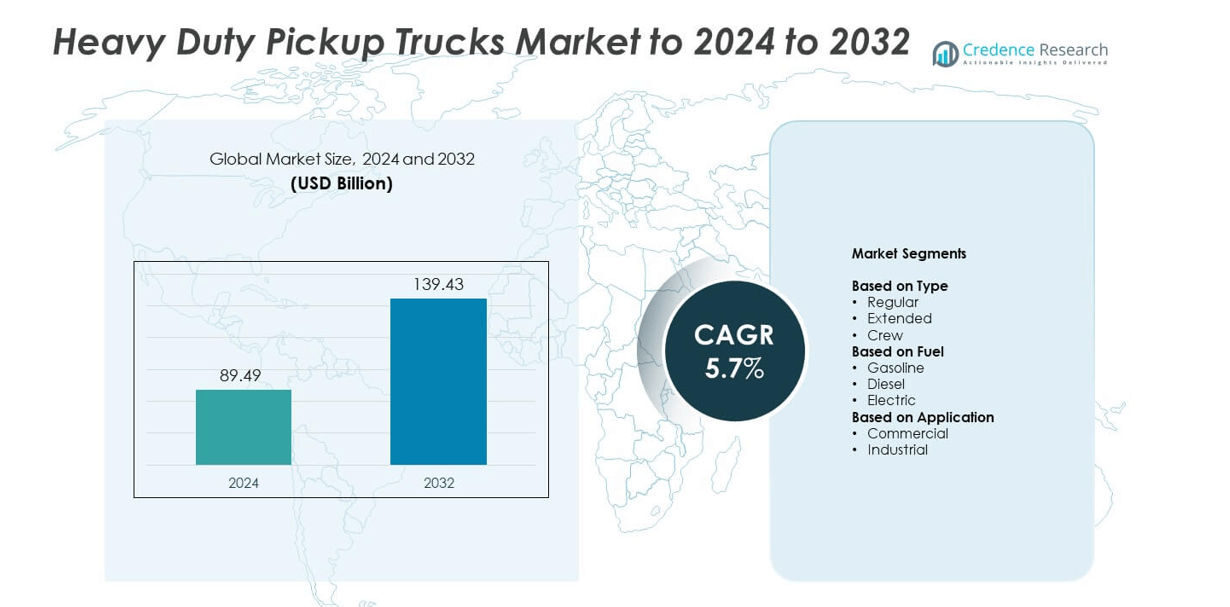
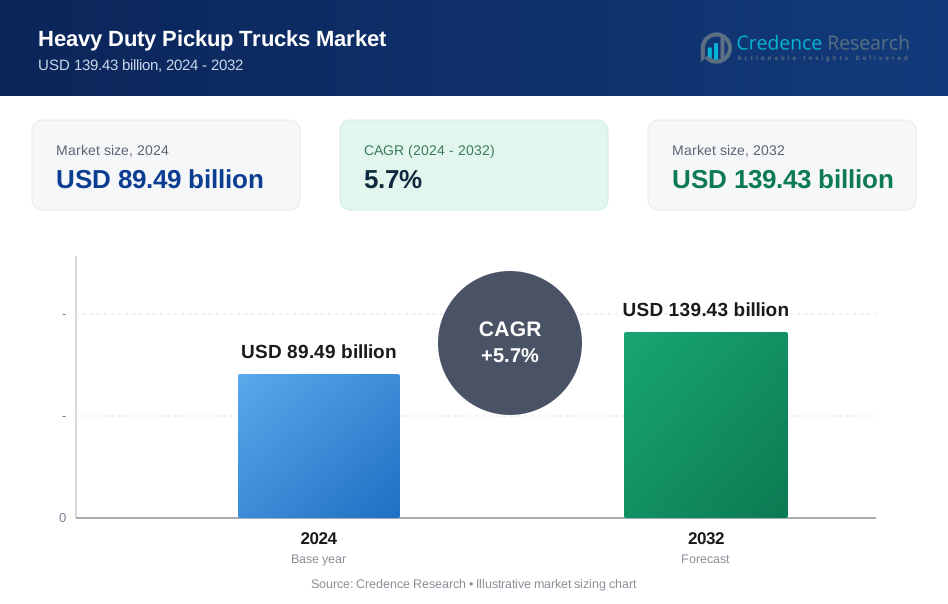
Heavy Duty Pickup Trucks Market size was valued at USD 89.49 billion in 2024 and is anticipated to reach USD 139.43 billion by 2032, at a CAGR of 5.7% during the forecast period.
| REPORT ATTRIBUTE | DETAILS |
|---|---|
| Historical Period | 2020-2023 |
| Base Year | 2024 |
| Forecast Period | 2025-2032 |
| Heavy Duty Pickup Trucks Market Size 2024 | USD 89.49 billion |
| Heavy Duty Pickup Trucks Market, CAGR | 5.7% |
| Heavy Duty Pickup Trucks Market Size 2032 | USD 139.43 billion |
The heavy-duty pickup trucks market is led by major companies including Toyota Motor Corporation, Ford Motor Company, General Motors, Nissan, Ram Trucks, Volkswagen, Honda, Mitsubishi Motors, Isuzu, Great Wall Motors, Kia Corporation, and NYE Toyota. These manufacturers compete through innovation in electrification, safety features, and connectivity to strengthen market presence. North America dominates the global market with a 48% share, driven by high adoption across construction, logistics, and personal utility segments. Europe and Asia-Pacific follow, supported by infrastructure growth and fleet modernization initiatives that continue to expand the global demand for heavy-duty pickup trucks.
Market Insights
- The heavy-duty pickup trucks market was valued at USD 89.49 billion in 2024 and is projected to reach USD 139.43 billion by 2032, growing at a CAGR of 5.7%.
- Rising demand from construction, logistics, and agricultural sectors drives market expansion, supported by fleet modernization and advanced performance technologies.
- Electric and hybrid heavy-duty pickups are emerging as key trends, with manufacturers focusing on battery efficiency, telematics integration, and sustainability.
- The market is highly competitive, with global and regional players emphasizing product innovation, lightweight materials, and improved fuel efficiency to gain market share.
- North America leads the market with 48% share, followed by Europe at 23% and Asia-Pacific at 21%, while the crew cab segment dominates globally with about 46% share due to its comfort and utility advantages.
Market Segmentation Analysis:
By Type
The crew cab segment dominated the heavy-duty pickup trucks market in 2024, holding around 46% of the total share. Crew cab trucks offer spacious interiors and four-door designs, making them ideal for both personal and commercial use. Their comfort, towing capacity, and versatility attract construction firms, logistics companies, and individual users. Manufacturers are focusing on advanced driver-assistance systems and improved cabin ergonomics to enhance usability. The demand for multipurpose vehicles with enhanced passenger comfort continues to drive crew cab adoption globally.
- For instance, Ford’s Super Duty crew cab lists 43.6 in rear legroom and 131.9 cu ft passenger volume.
By Fuel
The diesel segment held the largest share of about 58% in 2024, driven by its superior torque, towing power, and fuel efficiency. Diesel-powered heavy-duty pickups are preferred in construction, mining, and long-haul transport applications requiring high load capacity. Major manufacturers are improving diesel engines with lower emissions and higher mileage to meet stricter environmental norms. The segment benefits from continued fleet modernization and government incentives for cleaner diesel technologies. Diesel remains the primary fuel choice due to performance reliability and cost efficiency.
- For instance, Ram's 6.7L Cummins High-Output is rated at 1,075 lb-ft of torque and offers up to 37,090 lb of maximum diesel towing capacity when equipped in a Ram 3500 model from model years 2022 to 2024, though this capacity figure changed slightly for 2025.
By Application
The commercial segment accounted for approximately 62% of the heavy-duty pickup trucks market in 2024. These vehicles are widely used in logistics, construction, agriculture, and utility services for material transport and operations. Businesses prefer heavy-duty pickups for their durability, payload capacity, and adaptability to rugged terrains. Growing e-commerce activity and infrastructure expansion projects further boost demand. Fleet operators increasingly favor vehicles offering advanced telematics, reduced downtime, and fuel optimization features, strengthening the commercial segment’s dominance across global markets.
Key Growth Drivers
Rising Demand from Construction and Logistics Sectors
The expansion of construction and logistics industries significantly drives the heavy-duty pickup trucks market. These sectors require powerful vehicles capable of handling large payloads and challenging terrains. Increasing infrastructure investments across North America and Asia-Pacific amplify fleet purchases. Logistics operators favor heavy-duty pickups for their durability and towing efficiency, especially in last-mile and cross-country delivery operations. The rising need for fleet modernization and off-road adaptability continues to strengthen this segment’s growth momentum globally.
- For instance, GMC’s 2500 Crew Cab is rated to tow 22,070 lb, addressing worksite and logistics needs.
Technological Advancements and Vehicle Electrification
Manufacturers are integrating advanced technologies such as telematics, ADAS, and hybrid powertrains to enhance performance. Electrification efforts, including the development of battery-powered heavy-duty pickups, are gaining traction to meet emission standards. Improved battery density and fast-charging capabilities increase adoption across commercial fleets. Companies are also introducing AI-driven diagnostics for predictive maintenance. These innovations enhance fuel efficiency, safety, and reliability, positioning technologically advanced trucks as a preferred choice in both industrial and logistics operations.
- For instance, Chevrolet’s Silverado EV offers up to 492 miles EPA-estimated range and 12,500 lb towing on specified trims.
Growing Demand for Multi-Utility and Comfort Features
Customers increasingly seek heavy-duty pickups that combine power with passenger comfort and utility. Enhanced interiors, infotainment systems, and ergonomic designs make these trucks suitable for both work and personal use. Dual-purpose usage is rising among contractors and small business owners who value comfort and functionality. Manufacturers are responding by offering customizable cabin options and luxury-grade features without compromising load performance, strengthening overall market appeal across varied user segments.
Key Trends & Opportunities
Emergence of Electric and Hybrid Heavy-Duty Pickups
Electric and hybrid heavy-duty pickups are emerging as a major market opportunity due to sustainability goals. Automakers are investing heavily in electric models with extended range and higher towing capacities. Growing adoption of clean energy fleets in government and corporate sectors supports this shift. Charging infrastructure expansion and declining battery costs further encourage adoption. This trend presents strong long-term potential for reducing carbon emissions and enhancing operational efficiency.
- For instance, Tesla’s Cybertruck lists 11,000 lb towing and 120.7 cu ft cargo volume.
Integration of Advanced Connectivity and Fleet Management Solutions
The rise of IoT-based connectivity enables real-time vehicle tracking, predictive maintenance, and performance monitoring. Fleet managers leverage telematics systems to improve fuel usage, optimize routes, and reduce downtime. These connected systems enhance driver safety and operational control, leading to greater efficiency in commercial operations. As 5G technology expands, connected heavy-duty pickups will become integral to modern fleet ecosystems.
- For instance, Ford Pro reported having 610,000 global paid software subscriptions as of the end of Q2 2024, representing a 35% increase year-over-year.
Key Challenges
High Production and Ownership Costs
The heavy-duty pickup truck market faces challenges due to rising production costs linked to advanced materials and technology integration. High fuel consumption and maintenance expenses increase total ownership costs, especially for small enterprises. Despite strong demand, affordability remains a barrier for large-scale adoption in developing regions. Manufacturers are working to balance innovation with cost efficiency to retain competitiveness across price-sensitive markets.
Stringent Emission Regulations and Environmental Concerns
Tightening emission norms across major economies pose compliance challenges for traditional diesel-powered trucks. Manufacturers must invest heavily in cleaner technologies and exhaust treatment systems to meet regulatory standards. This increases R&D expenses and production complexity. Shifting toward electric and hybrid models demands significant infrastructure and supply chain adaptation, making it difficult for conventional manufacturers to maintain profitability during this transition phase.
Regional Analysis
North America
North America dominated the heavy-duty pickup trucks market in 2024 with a 48% share. The region benefits from high consumer preference for large vehicles and strong adoption across construction, logistics, and agriculture sectors. The U.S. leads due to advanced manufacturing facilities and the presence of key players such as Ford, General Motors, and RAM. Favorable financing options, fleet renewals, and demand for luxury-grade trucks drive steady growth. Ongoing infrastructure investment and electrification initiatives further strengthen regional market expansion, especially for hybrid and electric pickup models.
Europe
Europe held around 23% of the heavy-duty pickup trucks market in 2024, supported by demand from industrial and commercial sectors. Germany, the U.K., and France are major contributors, driven by growing adoption in utility, construction, and transport applications. Increasing focus on low-emission vehicles and sustainable manufacturing practices is reshaping fleet procurement patterns. Manufacturers are launching cleaner diesel and hybrid models to meet Euro 7 emission norms. The region’s growing interest in electric variants aligns with decarbonization goals, promoting gradual yet consistent market expansion.
Asia-Pacific
Asia-Pacific accounted for approximately 21% of the global heavy-duty pickup trucks market in 2024. Strong demand from China, India, and Australia supports growth across logistics, mining, and construction industries. Urbanization and government investments in infrastructure fuel vehicle purchases for commercial use. Local manufacturers expand production capacity and offer cost-competitive models tailored to regional needs. The increasing shift toward electrification, particularly in China, further boosts the regional outlook. Expanding export activities and the rise of e-commerce logistics enhance long-term market potential.
Latin America
Latin America captured around 5% of the heavy-duty pickup trucks market in 2024, driven by rising construction and agricultural activities. Brazil and Mexico are the largest markets, supported by local assembly operations and favorable trade policies. Economic recovery and industrial expansion increase fleet purchases across commercial sectors. Diesel-powered models dominate due to fuel efficiency and durability in rugged terrains. However, limited infrastructure and high import duties slightly restrain growth. Ongoing fleet modernization and regional partnerships with global automakers are expected to improve market penetration.
Middle East & Africa
The Middle East and Africa region accounted for nearly 3% of the global heavy-duty pickup trucks market in 2024. Demand is led by oil and gas, mining, and construction industries requiring durable vehicles for tough environments. Countries like Saudi Arabia, South Africa, and the UAE show strong adoption due to infrastructure development and logistics expansion. Diesel variants remain popular, though interest in electric trucks is gradually emerging. Ongoing government investments in transport and industrial sectors are expected to strengthen market presence over the coming years.
Market Segmentations:
By Type
- Regular
- Extended
- Crew
By Fuel
- Gasoline
- Diesel
- Electric
By Application
- Commercial
- Industrial
By Geography
- North America
- U.S.
- Canada
- Mexico
- Europe
- Germany
- France
- U.K.
- Italy
- Spain
- Rest of Europe
- Asia Pacific
- China
- Japan
- India
- South Korea
- South-east Asia
- Rest of Asia Pacific
- Latin America
- Brazil
- Argentina
- Rest of Latin America
- Middle East & Africa
- GCC Countries
- South Africa
- Rest of the Middle East and Africa
Competitive Landscape
The heavy-duty pickup trucks market is highly competitive, with key players such as Toyota Motor Corporation, Ford Motor Company, General Motors, Nissan, Ram Trucks, Volkswagen, Honda, Mitsubishi Motors, Isuzu, Great Wall Motors, Kia Corporation, and NYE Toyota leading global production and innovation. Competition centers on powertrain efficiency, electrification, and durability, driving companies to enhance performance, safety, and comfort features. Manufacturers are investing heavily in hybrid and electric pickup development to meet evolving emission standards and consumer preferences. Advanced telematics, autonomous driving systems, and digital connectivity are being integrated to improve fleet management and driver experience. Strategic collaborations with battery suppliers, software developers, and logistics operators are shaping next-generation vehicle designs. Firms are also optimizing manufacturing operations through modular platforms and lightweight materials to reduce production costs. Growing focus on sustainability, aftermarket services, and regional customization continues to define competition and strengthen brand presence across global markets.
Key Player Analysis
- Toyota Motor Corporation
- Ford Motor Company
- General Motors
- Nissan
- Ram Trucks
- Volkswagen
- Honda
- Mitsubishi Motors
- Isuzu
- Great Wall Motors
- Kia Corporation
- NYE Toyota
Recent Developments
- In 2024, Ram (Stellantis) announced the launch of the Ram 1500 Ramcharger hybrid ahead of schedule, showcasing Stellantis' move to integrate hybrid technology.
- In 2024, Toyota introduced a 48V mild-hybrid system to the Toyota Hilux in several markets, enhancing performance and efficiency with a small electric motor and battery that can provide additional torque at start-off.
- In 2022, Ford introduced its all-new 2023 F-Series Super Duty, saying it is “unrivaled” among heavy-duty pickup trucks with the best towing capacity
Report Coverage
The research report offers an in-depth analysis based on Type, Fuel, Application and Geography. It details leading market players, providing an overview of their business, product offerings, investments, revenue streams, and key applications. Additionally, the report includes insights into the competitive environment, SWOT analysis, current market trends, as well as the primary drivers and constraints. Furthermore, it discusses various factors that have driven market expansion in recent years. The report also explores market dynamics, regulatory scenarios, and technological advancements that are shaping the industry. It assesses the impact of external factors and global economic changes on market growth. Lastly, it provides strategic recommendations for new entrants and established companies to navigate the complexities of the market.
Future Outlook
- Manufacturers will focus on developing electric and hybrid heavy-duty pickups to reduce emissions.
- Advancements in battery technology will extend vehicle range and improve charging efficiency.
- Integration of autonomous and driver-assist technologies will enhance safety and fleet productivity.
- Demand for connected trucks with telematics and IoT features will continue to rise.
- Lightweight materials such as aluminum and composites will be adopted to improve fuel efficiency.
- Customization options for commercial and personal use will drive product diversification.
- Expansion of charging infrastructure will accelerate electric pickup adoption in major markets.
- Fleet operators will prioritize vehicles offering lower maintenance and operating costs.
- Government incentives for clean mobility will encourage investment in sustainable truck models.
- Strategic partnerships between automakers and tech firms will shape innovation in next-generation heavy-duty pickups.
Request a Free Sample
Fill in your details and we'll send you a free sample report.
- Sample data tables & charts
- Research methodology
Need a Custom Version of This Report?
Tailor the scope, geography, or segments to your exact requirements.
- Custom geography or segment scope
- Direct access to our analyst team
Frequently Asked Questions
What is the current market size for Heavy Duty Pickup Trucks Market, and what is its projected size in 2032?
At what Compound Annual Growth Rate is the Heavy Duty Pickup Trucks Market projected to grow between 2025 and 2032?
Which Heavy Duty Pickup Trucks Market segment held the largest share in 2024?
What are the primary factors fueling the growth of the Heavy Duty Pickup Trucks Market?
Who are the leading companies in the Heavy Duty Pickup Trucks Market?
Table of Content
Chapter 1. Report Introduction
- 1.1 Report Description & Purpose
- 1.1.1 Report Title & Market Definition
- 1.1.2 Unique Selling Propositions (USP) & Key Differentiators
- 1.1.3 Value Proposition for Stakeholders
- 1.2 Research Objectives
- 1.2.1 Market Sizing Objectives (Volume & Revenue)
- 1.2.2 Segmentation Objectives
- 1.2.3 Competitive Intelligence Objectives
- 1.2.4 Forecast & Scenario Objectives
- 1.3 Report Scope
- 1.3.1 Heavy Duty Pickup Trucks Scope – Types & Subtypes Covered
- 1.3.2 Geographic Scope – Regions & Countries Covered
- 1.3.3 Historical Period, Base Year & Forecast Period (2024; forecast to 2032)
- 1.3.4 Inclusions & Exclusions
- 1.4 HS Code & Classification Framework
- 1.5 Currency, Units & Pricing Basis
- 1.6 Target Stakeholders
- 1.7 Limitations & Assumptions
Chapter 2. Executive Summary
- 2.1 Global Heavy Duty Pickup Trucks Market Snapshot
- 2.1.1 Market Size – Historical (2024) & Forecast (2024-2032) (2024: USD 89.49 billion → 2032: USD 139.43 billion)
- 2.1.2 Volume & Revenue – Global Totals
- 2.1.3 Key Market Highlights – Top Five Facts
- 2.2 Heavy Duty Pickup Trucks Market Segmentation Snapshot
- 2.2.1 Market Split by Region – 2024 vs. 2032
- 2.3 Competitive Snapshot
- 2.3.1 Top 10 Players by Revenue Share – 2024
- 2.3.2 Top 10 Players by Volume Share – 2024
- 2.3.3 Recent Strategic Developments (18-Month Summary)
- 2.4 Key Investment Highlights & Strategic Conclusions
Chapter 3. Heavy Duty Pickup Trucks Market Dynamics & Industry Analysis
- 3.1 Market Overview & Context
- 3.1.1 Heavy Duty Pickup Trucks Market Position in the Broader Automotive Value Chain
- 3.1.2 OEM vs. Replacement Market Dynamics
- 3.1.3 Market Maturity & Development Stage by Region
- 3.2 Heavy Duty Pickup Trucks Market Drivers
- 3.3 Heavy Duty Pickup Trucks Market Restraints & Challenges
- 3.4 Heavy Duty Pickup Trucks Market Opportunities
- 3.5 Porter's Five Forces Analysis
- 3.5.1 Threat of New Entrants
- 3.5.2 Bargaining Power of Suppliers
- 3.5.3 Bargaining Power of Buyers
- 3.5.4 Threat of Substitutes
- 3.5.5 Competitive Rivalry – Intensity Assessment
- 3.6 Heavy Duty Pickup Trucks Value Chain Analysis
- 3.6.1 Upstream – Raw Material/Input Suppliers
- 3.6.1.1 Raw Material/Input 1
- 3.6.1.2 Raw Material/Input 2
- 3.6.1.3 Raw Material/Input 3
- 3.6.2 Midstream – Production/Manufacturing/Service Delivery
- 3.6.2.1 Production/Process Overview
- 3.6.2.2 Key Facility Locations & Capacity by Manufacturer
- 3.6.3 Downstream – Distribution & End Consumer
- 3.6.3.1 Primary Channel – B2B/OEM
- 3.6.3.2 Secondary Channels – Dealer, Retail, Online, Direct
- 3.6.4 Value Chain Profitability Analysis
- 3.6.1 Upstream – Raw Material/Input Suppliers
- 3.7 PESTEL Analysis
- 3.7.1 Political Factors
- 3.7.2 Economic Factors
- 3.7.3 Social Factors
- 3.7.4 Technological Factors
- 3.7.5 Environmental Factors
- 3.7.6 Legal Factors
- 3.8 Heavy Duty Pickup Trucks Supply Chain Analysis
- 3.8.1 Raw Material/Input Supply Risk Assessment
- 3.8.2 Manufacturing Concentration Risk (Geographic Exposure)
- 3.8.3 Trade Disruption Impact Analysis
- 3.9 Regulatory & Policy Landscape
Note: The regulatory and policy landscape section covers regulations based on their applicability to the market, Heavy Duty Pickup Trucks category, geography, and scope of the study. Only regulatory frameworks with a material impact on operations, compliance, trade, sustainability, or market access are analyzed in detail.
Chapter 4. Key Investment Pockets & Opportunity Analysis
- 4.1 Heavy Duty Pickup Trucks Market Attractiveness Analysis
- 4.1.1 By Region – Investment Attractiveness Matrix (Volume × CAGR)
- 4.2 Absolute Revenue Growth Opportunity
- 4.2.1 By Region – Absolute USD Growth Through 2032
- 4.3 Incremental Volume Opportunity
- 4.3.1 By Region – Incremental Volume Through 2032
- 4.3.2 Segment – Incremental Volume
- 4.4 Emerging Submarket Opportunity Deep Dive (Subject to Applicability)
- 4.5 Emerging Market Opportunity Scorecards
- 4.5.1 United States
- 4.5.2 Europe
- 4.5.3 Asia
- 4.5.4 Middle East & Africa
Note: Emerging Market Opportunity Scorecards will be included based on relevance and strategic importance. Regions listed are indicative and may vary depending on data availability and market dynamics.
Chapter 5. Heavy Duty Pickup Trucks Import-Export Analysis & Trade Flows
- 5.1 Global Trade Overview
- 5.1.1 Global Export Value by Country (2024)
- 5.1.2 Global Export Volume by Country (2024)
- 5.1.3 Global Import Value by Country (2024)
- 5.1.4 Global Import Volume by Country (2024)
- 5.1.5 Net Trade Balance by Country (2024)
- 5.2 Export Analysis – Segment
- 5.2.1 Type 1 (HS Code)
- 5.2.2 Type 2 (HS Code)
- 5.2.3 Type 3 (HS Code)
- 5.2.4 Type 4 (HS Code)
- 5.2.5 Type 5 (HS Code)
- 5.3 Import Analysis – Segment
- 5.3.1 Type 1 (HS Code)
- 5.3.2 Type 2 (HS Code)
- 5.3.3 Type 3 (HS Code)
- 5.3.4 Type 4 (HS Code)
- 5.3.5 Type 5 (HS Code)
- 5.4 Average Unit Trade Prices
- 5.4.1 Average Export Price – Segment & Country
- 5.4.2 Average Import Price – Segment & Source Country
- 5.4.3 Price Trends (2024)
- 5.5 Key Trade Route Analysis
- 5.5.1 Trade Route 1
- 5.5.2 Trade Route 2
- 5.5.3 Trade Route 3
- 5.5.4 Trade Route 4
- 5.5.5 Trade Route 5
- 5.6 Trade Policy Impact Assessment
- 5.6.1 US Anti-Dumping & Section 301 Tariffs
- 5.6.2 EU Customs Union Impact
- 5.6.3 Major Free Trade Agreements
- 5.6.4 USMCA Rules of Origin
Note: Trade policy analysis will be included only where relevant to the Heavy Duty Pickup Trucks market.
Chapter 6. Competitive Landscape & Company Benchmarking
- 6.1 Heavy Duty Pickup Trucks Market Concentration & Structure
- 6.1.1 Herfindahl-Hirschman Index (HHI) – vs. 2024
- 6.1.2 Tier 1, Tier 2 & Tier 3 Market Structure
- 6.1.3 Global, Regional & Local Player Dynamics
- 6.2 Heavy Duty Pickup Trucks Market Share Analysis – 2024
- 6.2.1 Global Revenue Share by Company
- 6.2.2 Global Volume Share by Company
- 6.2.3 Regional Revenue Share
- 6.2.4 Market Share Evolution ( vs. 2024)
- 6.2.5 OEM Segment Share by Company
- 6.2.6 Replacement Segment Share by Company
- 6.3 Production/Delivery Capacity & Facility Analysis
- 6.3.1 Global Installed Capacity
- 6.3.2 Capacity Utilization Rates
- 6.3.3 Production/Output Volume
- 6.3.4 Facility Locations & Capacity Map
- 6.3.5 Planned Capacity Additions
- 6.4 Heavy Duty Pickup Trucks Competitive Benchmarking Matrix
- 6.4.1 Revenue, Volume, CAGR & Profitability Comparison
- 6.4.2 Channel Revenue Mix
- 6.4.3 Geographic Revenue Exposure
- 6.4.4 R&D Intensity
- 6.4.5 Sustainability Maturity
- 6.5 Strategic Developments in Heavy Duty Pickup Trucks (Last 24 Months)
- 6.5.1 Mergers, Acquisitions & Divestments
- 6.5.2 New Heavy Duty Pickup Trucks Launches
- 6.5.3 Facility Expansions
- 6.5.4 Strategic Alliances, Joint Ventures & Partnerships
- 6.5.5 Distribution Expansion & Market Entry
- 6.5.6 Sustainability & ESG Initiatives
- 6.6 Competitive Strategy Mapping
- 6.6.1 Leader, Challenger, Follower & Niche Classification
- 6.6.2 Pricing Strategy Comparison
- 6.6.3 Channel Strategy Matrix
Note: Strategic developments are included based on their materiality and the availability of reliable information.
Chapter 7. Global Heavy Duty Pickup Trucks Market – By Distribution Channel
- 7.1 Segment Overview
- 7.1.1 Volume & Revenue Split by Channel (2024 & 2032)
- 7.1.2 Channel Mix Evolution (2024-2032)
Chapter 8. Regional Market Analysis – Global Overview
- 8.1 Global Regional Overview
- 8.1.1 Regional Volume Share
- 8.1.2 Regional Revenue Share
- 8.1.3 Regional Volume by Region
- 8.1.4 Regional Revenue by Region
- 8.1.5 Regional Forecast Through 2032
- 8.2 Cross-Regional Segment Analysis
- 8.2.1 By Distribution Channel
- 8.2.2 By Brand/Price Tier
Chapter 9. North America Heavy Duty Pickup Trucks Market
- 9.1 United States
- 9.2 Canada
- 9.3 Mexico
Chapter 10. Europe Heavy Duty Pickup Trucks Market
- 10.1 Germany
- 10.2 France
- 10.3 Italy
- 10.4 United Kingdom
- 10.5 Spain
- 10.6 Poland
- 10.7 Russia
- 10.8 Netherlands
- 10.9 Belgium
- 10.10 Sweden
- 10.11 Denmark
- 10.12 Norway
- 10.13 Rest of Europe
Chapter 11. Asia Pacific Heavy Duty Pickup Trucks Market
- 11.1 China
- 11.2 India
- 11.3 Japan
- 11.4 South Korea
- 11.5 Thailand
- 11.6 Indonesia
- 11.7 Vietnam
- 11.8 Malaysia
- 11.9 Australia
- 11.10 Rest of Asia Pacific
Chapter 12. Latin America Heavy Duty Pickup Trucks Market
- 12.1 Brazil
- 12.2 Argentina
- 12.3 Colombia
- 12.4 Chile
- 12.5 Rest of Latin America
Chapter 13. Middle East Heavy Duty Pickup Trucks Market
- 13.1 Saudi Arabia
- 13.2 United Arab Emirates
- 13.3 Turkey
- 13.4 Israel
- 13.5 Iran
- 13.6 Rest of the Middle East
Chapter 14. Africa Heavy Duty Pickup Trucks Market
- 14.1 South Africa
- 14.2 Egypt
- 14.3 Nigeria
- 14.4 Morocco
- 14.5 Rest of Africa
Chapter 15. Heavy Duty Pickup Trucks Company Profiles
- 15.1 [Company 01]
- 15.1.1 Company Overview
- 15.1.2 Key Management Personnel
- 15.1.3 Products & Services Portfolio
- 15.1.4 Financial Performance
- 15.1.5 Key Market Focus & Geographic Presence
- 15.1.6 Recent Developments & Strategic Initiatives
Note: The company profile list is preliminary and may change based on research findings, market developments, data availability, and client requirements.
Chapter 16. Appendices
- Appendix A – List of Abbreviations & Acronyms
- Appendix B – Industry Classification Code Reference – Full Series
- Appendix C – Production & Capacity Data Tables
- Appendix D – End-Use & Demand Base Tables
- Appendix E – Consumption & Replacement Rate Assumptions
- Appendix F – ASP Reference Tables
- Appendix G – Manufacturing & Facility Database
- Appendix H – Import-Export Data Tables
- Appendix I – Regulatory Summary Tables
- Appendix J – Primary Research Participant List (Anonymized)
- Appendix K – Primary Research Questionnaire Framework
- Appendix L – Data Sources & Bibliography
- Appendix M – Market Size Divergence & Source Comparison
Chapter 17. Research Methodology
- 17.1 Research Framework & Philosophy
- 17.2 Secondary Research – Sources, Hierarchy & Data Extraction
- 17.3 Data Modeling – Bottom-Up & Top-Down Market Sizing
- 17.4 Primary Research – Stakeholder Framework, LOI & Sample Sizes
- 17.5 Forecast Methodology – Regression, Scenario & Sensitivity Analysis
- 17.6 Quality Control – Four-Layer Validation Framework
- 17.7 Limitations & Standard Assumptions
- 17.8 Disclaimer
