Market Overview
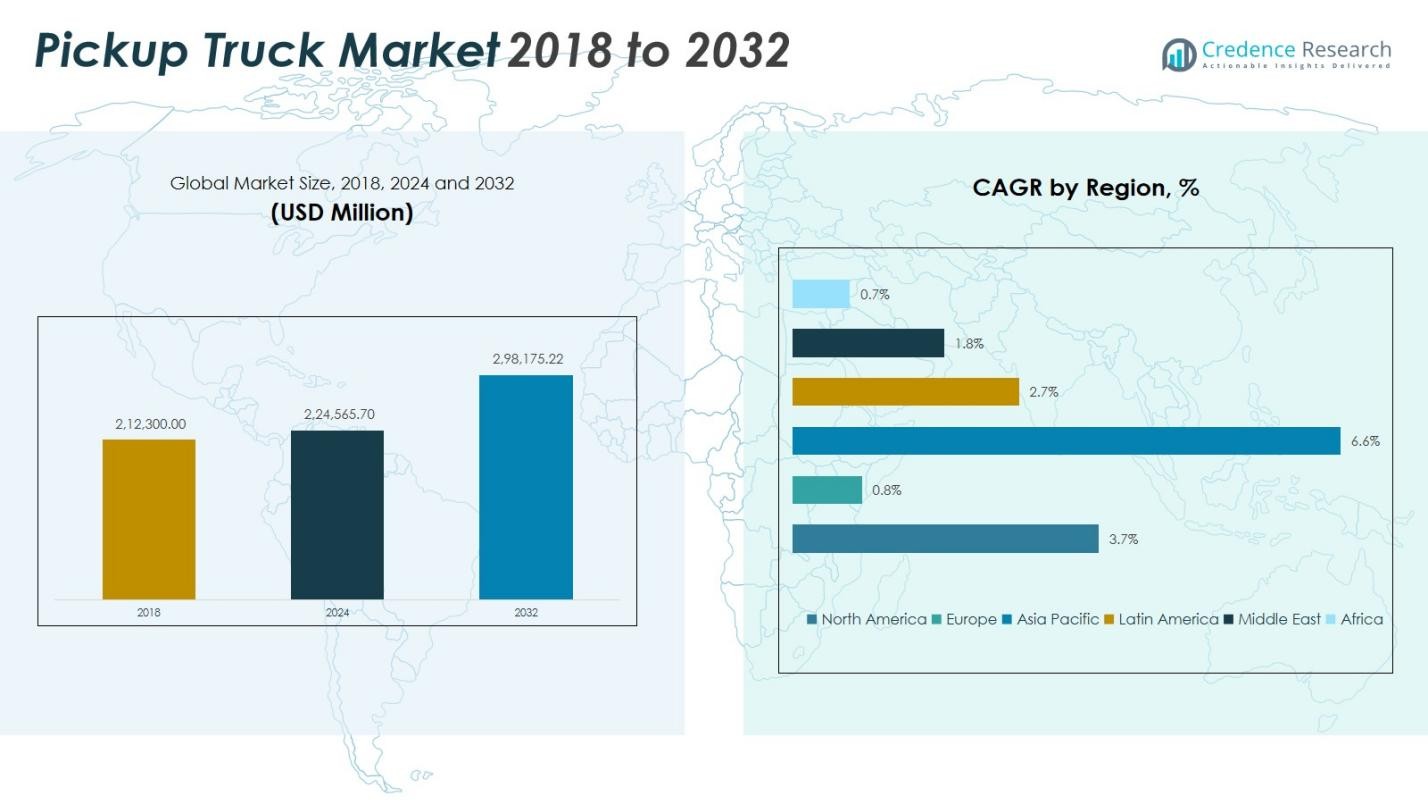
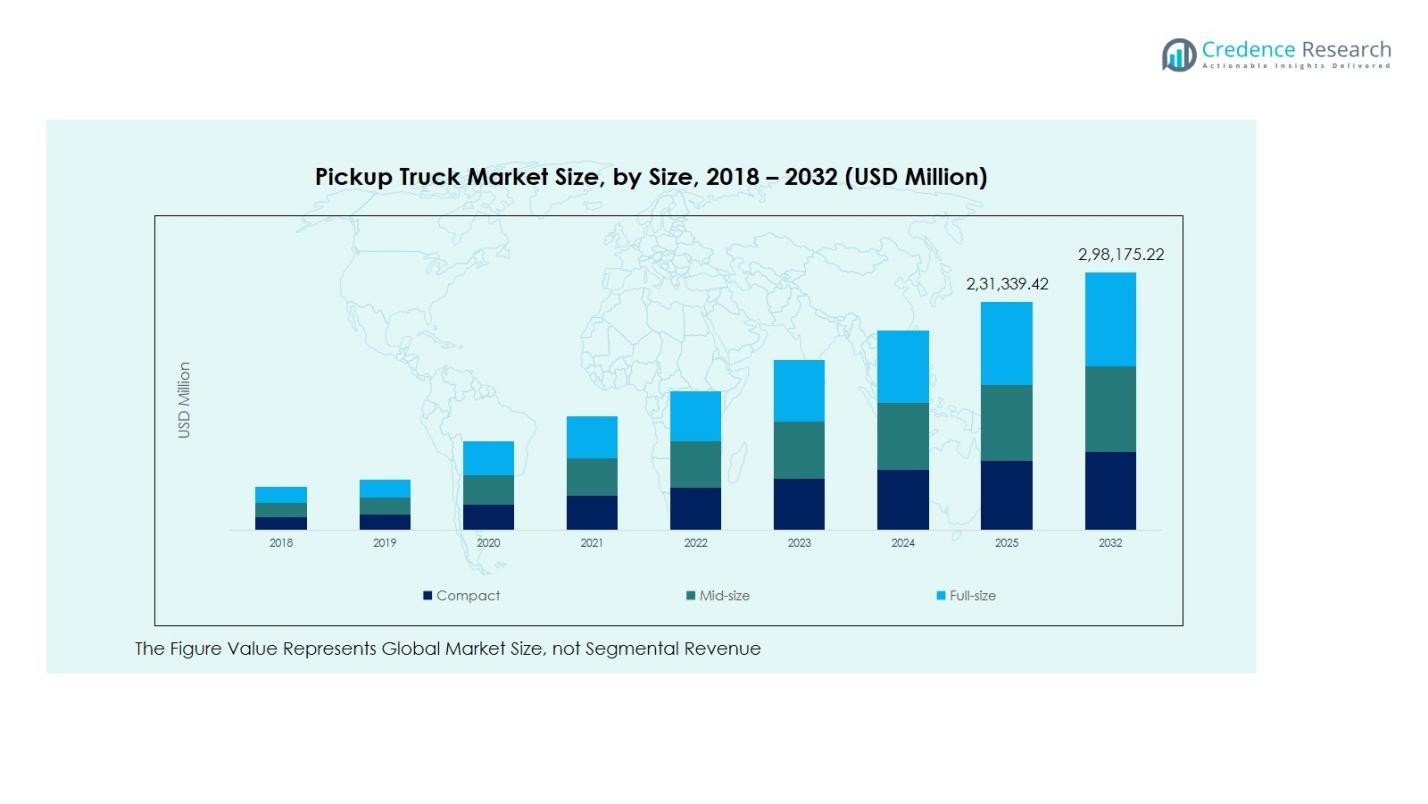
Pickup Truck Market size was valued at USD 212,300.00 Million in 2018 to USD 224,565.70 Million in 2024 and is anticipated to reach USD 298,175.22 Million by 2032, at a CAGR of 3.69% during the forecast period.
| REPORT ATTRIBUTE | DETAILS |
|---|---|
| Historical Period | 2020-2023 |
| Base Year | 2024 |
| Forecast Period | 2025-2032 |
| Pickup Truck Market Size 2024 | USD 224,565.70 Million |
| Pickup Truck Market, CAGR | 3.69% |
| Pickup Truck Market Size 2032 | USD 298,175.22 Million |
Pickup Truck Market is shaped by the presence of leading automotive manufacturers including Ford Motor Company, General Motors, Toyota Motor Corporation, Nissan Motor Co., Ltd., and Tata Motors, among others. These players focus on product innovation, expanding vehicle electrification, and improving payload capacities to strengthen their market positioning. The market is driven by increasing adoption across commercial fleets and personal use cases. North America leads the Pickup Truck Market with 45% share in 2024, owing to robust demand for full-size models and increasing electric pickup launches from domestic and global OEMs.
Market Insights
- Pickup Truck Market was valued at USD 224,565.70 Million in 2024 and is projected to reach USD 298,175.22 Million by 2032 at a CAGR of 3.69%.
- Market growth is supported by strong demand from commercial fleets, construction, agriculture, and logistics sectors, with light-duty pickup trucks capturing 60% share in 2024 due to their versatility and fuel efficiency.
- Electrification of pickup trucks, rising adoption of connected vehicle technologies, and growing consumer interest in lifestyle and off-road models are emerging trends reshaping product development and purchase patterns.
- Major manufacturers like Ford, Toyota, General Motors, and Tata Motors are focusing on electric models, advanced safety, and customization options to retain leadership and address evolving buyer preferences.
- North America leads the market with a 45% share in 2024, followed by Asia Pacific with 30% share, driven by rising infrastructure investments and increasing personal and commercial vehicle usage across urban and rural areas.
Market Segmentation Analysis:
By Vehicle Type
The Vehicle Type segment in the Pickup Truck Market is led by Light-duty trucks, accounting for 60% market share in 2024. This dominance is driven by their fuel efficiency, versatility, and suitability for both personal and commercial use. Light-duty models appeal to consumers seeking practicality for daily commutes and light hauling. In contrast, Heavy-duty trucks capture about 40% share, driven by demand across construction, mining, and agricultural industries where higher payload capacities are essential. Their enhanced towing power and rugged build support market growth in industrial regions.
- For instance, the Ford F-150 offers a range of engines including a hybrid version achieving up to 25 mpg city and 26 mpg highway, making it efficient and practical for daily use.
By Application
Among applications, the Commercial segment holds the leading position with 45% market share in 2024. This dominance is propelled by increasing use of pickup trucks in last-mile logistics, delivery services, and fleet operations. The Industrial segment follows with a 25% share, benefiting from use in mining, oil and gas, and manufacturing industries. Personal use contributes 20% of the market, supported by rising lifestyle demand and off-road applications. The Others segment, holding the remaining 10% share, includes utility and government applications with moderate growth.
- For instance, Mahindra’s Bolero Maxi Truck, designed for commercial use, offers a spacious cargo area ideal for last-mile logistics and delivery services.
By Fuel Type
The Diesel segment dominates the fuel type category with 65% market share, driven by superior torque, durability, and efficiency in heavy-duty applications. Diesel trucks are preferred in commercial and industrial sectors where long-running hours and powerful performance are vital. The Petrol segment accounts for about 30% share, driven by lower cost and lighter urban usage. The Electric segment, though emerging, represents around 5% share and is expected to grow rapidly, fueled by environmental regulations, technological advancements, and the development of electric pickup models by global OEMs.
 Key Growth Drivers
Rise in Commercial Fleet Adoption
The increasing adoption of pickup trucks for commercial fleet operations is a major growth driver for the market. Logistics, construction, and utilities companies are expanding their fleets to support rising demand for direct-to-consumer deliveries and last-mile connectivity. Light-duty pickup trucks are particularly favored for their versatility, cost-efficiency, and adaptability across regional terrains. Moreover, supportive financing options and fleet management solutions encourage small and mid-size businesses to invest in pickup trucks, further boosting market penetration, especially in North America and developing Asian markets.
- For instance, companies like GreenLine are expanding fleets with 1,500 LNG-powered trucks to cater to industrial and logistics needs, reflecting the growing trend of integrating cleaner technologies alongside conventional vehicles.
Growing Demand for Lifestyle and Personal Use
Pickup trucks are no longer confined to commercial use; they have become increasingly popular among individual consumers for lifestyle, recreational, and personal transportation. Growing interest in off-roading, adventure travel, and camping drives demand for trucks with enhanced comfort, safety, and performance features. Automakers are responding with advanced infotainment, premium interiors, and customizable configurations. This trend is particularly prominent in developed markets like the United States, Australia, and Canada, where consumers prioritize multi-purpose vehicles that balance utility with personal comfort and style.
- For insatnce, trucks like the Chevrolet Silverado 1500 now come equipped with large infotainment touchscreens, wireless charging, and enhanced safety features, blending utility with comfort and style for multi-purpose personal use.
Technological Advancements in Powertrains
Rapid advancements in powertrain technologies, including hybrid and electric options, are transforming the pickup truck segment. OEMs are actively investing in battery electric pickup trucks with improved range, towing capacity, and fast-charging capabilities. Advanced driver assistance systems (ADAS), telematics, and connectivity features are also becoming integral, improving safety and efficiency. These advancements address sustainability concerns while enhancing overall vehicle performance, making modern pickup trucks more appealing across both consumer and commercial segments. This technological shift aligns with stricter emission norms and a growing preference for environmentally responsible vehicles.
Key Trends & Opportunities
Electrification of Pickup Trucks
The electrification of pickup trucks is a major trend creating new opportunities for automakers and suppliers. With the launch of models like the Ford F-150 Lightning, Tesla Cybertruck, and GMC Hummer EV, the market is witnessing increased competition in the electric utility vehicle space. Electric pickups offer significant benefits such as reduced operating costs, lower emissions, and digital enhancements. Government incentives, charging infrastructure expansion, and rising consumer awareness further enhance adoption potential. This trend is expected to accelerate as OEMs invest in EV platforms specifically designed for utility and high-performance use.
- For instance, the GMC Hummer EV combines rugged capability with advanced digital features, boasting a 303-mile EPA range and innovative driver assistance technologies.
Customization and Premiumization
Demand for customized and premium pickup trucks is rising sharply, driven by consumer desire for enhanced comfort, performance, and personal style. Manufacturers are offering a wide range of trim levels, powertrain options, bed configurations, and off-road packages tailored to diverse buyer preferences. Premium interiors, advanced infotainment systems, larger wheelbases, and off-road-oriented design are increasingly popular. This trend not only enhances consumer satisfaction but also boosts profit margins for OEMs. The premium pickup segment, particularly in North America and Europe, is becoming a lucrative market for brands focusing on personalization and technology integration.
- For instance, off-road packages like those available on the GMC Sierra AT4 enhance performance with suspension upgrades and rugged design, catering to buyers who want both capability and luxury.
Key Challenges
High Ownership and Maintenance Costs
One of the primary challenges for the pickup truck market is the high cost of ownership, including purchase price, insurance, maintenance, and fuel expenses. While pickup trucks offer durability and performance, operating costs often outweigh those of sedans or compact SUVs, restricting adoption among price-sensitive customers. Additionally, frequent usage in demanding environments accelerates wear and tear, leading to higher service expenses. As fuel prices fluctuate and maintenance costs rise, some consumers and businesses may opt for alternative vehicle types or delay fleet expansion, limiting market growth.
Stringent Emission Norms and Environmental Regulations
The pickup truck segment faces increasing pressure from stringent emission standards and regulatory requirements worldwide. Traditional internal combustion engines, especially diesel variants, are under scrutiny due to higher CO₂ emissions. Compliance with tightening fuel efficiency mandates requires costly investments in advanced powertrains, lightweight materials, and emission control technologies. These challenges risk increasing vehicle prices and reducing profit margins for manufacturers. While electrification offers a solution, infrastructure gaps and high initial costs remain hurdles, especially in emerging markets with limited EV support systems.
 Regional Analysis
North America
North America dominates the Pickup Truck Market with a market share of 45% in 2024, driven by strong demand across both personal and commercial applications. The United States is the key contributor, supported by high consumer preference for full-size pickup trucks, advanced vehicle customization options, and robust manufacturing capabilities from leading OEMs. Popularity among individual buyers and fleet operators continues to drive model upgrades and technological innovation. Growing adoption of electric pickup trucks further boosts regional growth, with initiatives from major players like Ford, General Motors, and Tesla shaping the market’s long-term direction.
Asia Pacific
Asia Pacific holds a 30% share of the Pickup Truck Market and is the fastest-growing region, driven by rapid urbanization, expanding infrastructure projects, and rising demand for compact and mid-size trucks. Countries like China, Japan, India, and Australia are key contributors, each with diverse consumer and industrial use cases. The region benefits from increasing foreign investments, government incentives for electric vehicle adoption, and rising lifestyle purchases. Local manufacturers like Tata Motors and Isuzu contribute to robust competition, while interest in off-road recreational vehicles and fleet applications further broadens regional growth prospects.
Europe
Europe accounts for a 15% market share in the global Pickup Truck Market, driven by growing interest in lifestyle and compact utility vehicles. Demand is supported by logistics, agriculture, and light industrial applications, with pickup models gaining acceptance in the UK, Germany, and France. Increasing fuel efficiency standards and electrification trends are encouraging model development and hybrid adoption. The European consumer prefers compact and mid-size designs tailored to urban environments. OEMs like Volkswagen, Renault, and Daimler are expanding their pickup offerings, while stricter emission regulations and EV incentives shape future growth trajectories.
Latin America
Latin America represents a 5% share of the Pickup Truck Market, with Brazil and Argentina leading regional demand. The market is driven by agricultural and mining sectors, where pickup trucks serve as essential transport vehicles due to rugged terrains and operational flexibility. Small businesses and utility sectors also contribute to demand, while consumer interest grows in lifestyle vehicles. Affordability remains key, with regional manufacturers and international brands offering budget-friendly models. Economic instability and fluctuating import duties are constraints, but ongoing investments in local manufacturing and dealership networks are expected to drive modest yet steady market growth.
Middle East & Africa
The Middle East & Africa region holds a 5% share of the Pickup Truck Market, with demand driven by construction, oil & gas, and military sectors. Countries like Saudi Arabia, the UAE, and South Africa are primary markets, where rugged environments favor durable and high-capacity trucks. The region experiences demand for both light-duty personal models and heavy-duty industrial pickups. Limited electrification infrastructure and economic disparities constrain wider adoption, but projects in infrastructure development support future potential. Global OEMs are expanding regional operations, catering to custom fleet needs and government procurement, sustaining long-term market relevance.
Market Segmentations:
By Vehicle Type
- Light-duty
- Heavy-duty
By Application
- Commercial
- Industrial
- Personal
- Others
By Fuel Type
- Diesel
- Petrol
- Electric
By Size
- Compact
- Mid-size
- Full-size
By Towing Capability
- Light Towing (Up to 7,500 lbs)
- Medium Towing (7,501–12,000 lbs)
- Heavy Towing (12,001+ lbs)
By Region
- North America
- U.S.
- Canada
- Mexico
- Europe
- Germany
- France
- U.K.
- Italy
- Spain
- Rest of Europe
- Asia Pacific
- China
- Japan
- India
- South Korea
- South-east Asia
- Rest of Asia Pacific
- Latin America
- Brazil
- Argentina
- Rest of Latin America
- Middle East & Africa
- GCC Countries
- South Africa
- Rest of the Middle East and Africa
Competitive Landscape
Competitive landscape of the Pickup Truck Market is defined by prominent automotive manufacturers such as Ford Motor Company, General Motors, Toyota Motor Corporation, Nissan Motor Co., Ltd., and Tata Motors. These leading players are focused on strategic initiatives to expand their market presence, including product innovation, electrification, and diversified model offerings. The rise of electric pickup trucks has intensified brand differentiation, with key companies launching cutting-edge models that integrate advanced technologies, such as enhanced connectivity, ADAS, and smart infotainment systems. These efforts are supported by investments in R&D, collaborations with battery and tech providers, and expansion into emerging markets. Additionally, regional manufacturers are gaining ground by offering value-driven products tailored to regional needs. The market dynamics are further influenced by evolving consumer preferences toward personalization, sustainable mobility, and performance-driven features. Competition extends beyond product quality, as OEMs increasingly focus on service networks, reliability, and post-sale customization to strengthen customer loyalty and tap into long-term fleet partnerships.
Key Player Analysis
- Ford Motor Company (USA)
- General Motors (USA)
- Toyota Motor Corporation (Japan)
- Fiat Chrysler Automobiles (USA)
- Nissan Motor Co., Ltd. (Japan)
- Honda Motor Company, Ltd. (Japan)
- Isuzu Motors Ltd. (Japan)
- Tata Motors (India)
- Mahindra & Mahindra Ltd. (India)
- Volkswagen AG (Germany)
- Daimler AG (Germany)
- Great Wall Motors (China)
- Mitsubishi Motors Corporation (Japan)
- Hyundai Motor Company (South Korea)
- Mazda Motor Corporation (Japan)
- Subaru Corporation (Japan)
- Renault S.A. (France)
- Suzuki Motor Corporation (Japan)
- SAIC Motor Corporation Limited (China)
Recent Developments
- In April 2025, Slate Auto unveiled its new 2027 “Slate Truck” EV-priced at around US $27,000 and designed to be a radically simple, U.S.-made electric pickup.
- In September 2025, Hyundai formally announced plans to launch a body-on-frame mid-size pickup truck in the U.S. by the end of the decade, targeting established rivals like the Toyota Tacoma and Ford Ranger.
- In September 2025, Stellantis announced that it is halting development of its fully electric full-size pickup (the formerly planned Ram 1500 REV) due to weakening demand for BEV trucks in North America.
- In September 2025, TELO Trucks (a U.S. startup) completed a US$20 million Series A funding round to support its launch of an urban-scaled electric pickup truck for U.S. cities.
Report Coverage
The research report offers an in-depth analysis based on Vehicle Type, Application, Fuel Type, Size, Towing Capability and Region. It details leading market players, providing an overview of their business, product offerings, investments, revenue streams, and key applications. Additionally, the report includes insights into the competitive environment, SWOT analysis, current market trends, as well as the primary drivers and constraints. Furthermore, it discusses various factors that have driven market expansion in recent years. The report also explores market dynamics, regulatory scenarios, and technological advancements that are shaping the industry. It assesses the impact of external factors and global economic changes on market growth. Lastly, it provides strategic recommendations for new entrants and established companies to navigate the complexities of the market.
Future Outlook
- Pickup Truck Market will experience steady growth driven by rising commercial fleet demand and infrastructure development.
- Electric pickup trucks will witness significant adoption as major OEMs launch battery-powered models with enhanced performance.
- Connected and autonomous technologies will increasingly be integrated into new pickup models for safety and efficiency.
- Customization and premium features will evolve as consumer preferences shift toward comfort, convenience, and advanced infotainment.
- Government regulations and emission norms will accelerate investment in hybrid and fully electric pickup platforms.
- Emerging markets in Asia and Latin America will contribute strongly to volume growth due to expanding construction and agricultural sectors.
- Light-duty pickup trucks will remain the dominant segment due to versatility and improved fuel efficiency.
- Smart fleet management solutions will drive adoption in logistics and delivery operations.
- Brand differentiation will increasingly rely on product reliability, towing power, and connectivity features.
- Strategic partnerships and supply chain improvements will support expanded global presence for leading manufacturers.

Request a Free Sample
Fill in your details and we'll send you a free sample report.
- Sample data tables & charts
- Research methodology
Need a Custom Version of This Report?
Tailor the scope, geography, or segments to your exact requirements.
- Custom geography or segment scope
- Direct access to our analyst team
Frequently Asked Questions
What is the current market size for Pickup Truck Market, and what is its projected size in 2032?
At what Compound Annual Growth Rate is the Pickup Truck Market projected to grow between 2025 and 2032?
Which Pickup Truck Market segment held the largest share in 2024?
What are the primary factors fueling the growth of the Pickup Truck Market?
Who are the leading companies in the Pickup Truck Market?
Which region commanded the largest share of the Pickup Truck Market in 2024?
Table of Content
Chapter 1 Market Segmentation
- 1.1 Segmentation Framework
- 1.1.1 Product and Service Classification
- 1.1.2 Application and End-Use Classification
- 1.1.3 Technology and Solution Classification
- 1.1.4 Customer and Distribution Channel Classification
- 1.1.5 Geographic Segmentation
- 1.1.6 Market Segment Definitions and Boundaries
Chapter 2 Introduction
- 2.1 Report Objectives and Scope
- 2.2 Product Definition and Industry Terminology
- 2.3 Market Inclusions and Exclusions
- 2.4 Research Process
- 2.4.1 Primary Research and Expert Interviews
- 2.4.2 Secondary Research and Source Review
- 2.4.3 Top-Down and Bottom-Up Estimation
- 2.4.4 Data Triangulation and Verification
- 2.5 Market Size Measurement Basis
- 2.5.1 2024: USD 224,565.70 Million → 2032: USD 298,175.22 Million
- 2.6 Historical and Forecast Reference Periods
- 2.6.1 Base Year: 2024
- 2.6.2 Forecast Period: 2024-2032
- 2.7 Research Assumptions and Limitations
Chapter 3 Executive Summary
- 3.1 Market Snapshot and Key Findings
- 3.2 Base-Year Market Size, 2024
- 3.3 Forecast Market Size, 2032
- 3.4 Revenue and Volume Growth Outlook
- 3.5 Key Demand and Supply Indicators
- 3.6 Leading Market Segments
- 3.7 Fastest-Growing Market Opportunities
- 3.8 Regional Performance Highlights
- 3.9 Technology and Industry Transformation
- 3.10 Competitive Landscape Summary
- 3.11 Analyst View and Strategic Implications
Chapter 4 Global Pickup Truck Market Trends and Developments
- 4.1 Historical Industry Development
- 4.2 Recent Market Trends and Developments
- 4.3 Demand and Customer Behavior Trends
- 4.4 Technology and Product Innovation
- 4.5 Artificial Intelligence, Automation and Digitalization
- 4.6 Local Manufacturing and Supply Chain Realignment
- 4.7 Industry Partnerships, Mergers and Acquisitions
- 4.8 Sustainability and Circular Economy Developments
- 4.9 Government and Private Sector Investment Trends
- 4.10 Emerging Business Models and Commercialization
- 4.11 Industry Developments and Announcements
Chapter 5 Global Pickup Truck Market Production, Supply and Demand Analysis
- 5.1 Demand Trend and Consumption Analysis
- 5.2 Demand Forecast, 2024-2032
- 5.3 Production and Output Trend
- 5.4 Production and Output Forecast, 2024-2032
- 5.5 Installed Capacity and Capacity Utilization
- 5.6 Company-Wise Production Plants and Statistics
- 5.6.1 Installed Production Capacity
- 5.6.2 Actual Production
- 5.6.3 Planned Capacity and Expansion Targets
- 5.7 Supply Chain Structure and Procurement Trends
- 5.8 Supply-Demand Gap and Bottlenecks
- 5.9 Import Dependence and Sourcing Structure
- 5.10 Contract Manufacturing and Outsourcing
- 5.11 Regional Supply and Demand Concentration
Chapter 6 Global Pickup Truck Market Pricing Analysis
- 6.1 Pricing Structure and Measurement
- 6.2 Historical Pricing Trends
- 6.3 Pricing Outlook, 2024-2032
- 6.4 Average Selling Price and Unit Economics
- 6.5 Pricing by Product and Market Segment
- 6.6 Geographic Pricing Differences
- 6.7 Key Input, Energy, Labor and Logistics Costs
- 6.8 Contract Pricing and Purchasing Models
- 6.9 Pricing Sensitivity and Competitive Positioning
- 6.10 Price, Margin and Profitability Implications
Chapter 7 Global Pickup Truck Market Dynamics
- 7.1 Market Growth Drivers
- 7.1.1 Demand-Side Drivers
- 7.1.2 Technology and Innovation Drivers
- 7.1.3 Infrastructure and Investment Drivers
- 7.1.4 Regulatory and Policy Drivers
- 7.2 Market Restraints
- 7.2.1 Cost and Affordability Constraints
- 7.2.2 Technology and Adoption Barriers
- 7.2.3 Supply Chain and Operational Constraints
- 7.3 Market Challenges
- 7.3.1 Competitive Pressure and Margin Erosion
- 7.3.2 Skills, Infrastructure and Implementation Gaps
- 7.4 Emerging Market Opportunities
- 7.5 Market Dynamics Impact and Time-Horizon Assessment
Chapter 8 Global Pickup Truck Value Chain Analysis
- 8.1 Industry Value Chain Overview
- 8.2 Upstream Suppliers and Critical Inputs
- 8.3 Technology and Component Providers
- 8.4 Manufacturing or Service Delivery
- 8.5 Distribution, Channel Partners and Integrators
- 8.6 Downstream Applications and End Users
- 8.7 Value Addition and Profit Pools
- 8.8 Vertical Integration and Outsourcing
- 8.9 Supplier Concentration and Risk
- 8.10 Supply Chain Localization and Resilience
Chapter 9 Global Pickup Truck Market Regulations and Policies
- 9.1 Relevant Laws, Standards and Compliance Frameworks
- 9.2 Product, Service, Safety and Quality Requirements
- 9.3 Government Policies, Incentives and Subsidies
- 9.4 Imports, Exports and Trade Barriers
- 9.5 Public Procurement and Local Content Requirements
- 9.6 Environmental and Sustainability Compliance
- 9.7 Upcoming Policy Changes and Market Implications
Chapter 10 Global Pickup Truck Market Hotspots and Opportunities
- 10.1 Market Opportunity Mapping and Growth Hotspots
- 10.2 High-Growth Applications and Customer Groups
- 10.3 Underserved Markets and White-Space Opportunities
- 10.4 Emerging Technology and Product Opportunities
- 10.5 New Capacity and Investment Hotspots
- 10.6 Market Entry and Expansion Opportunities
- 10.7 Distribution and Partnership Opportunities
- 10.8 Near-Term and Long-Term Commercial Potential
- 10.9 Opportunity Attractiveness and Execution Risks
Chapter 11 Global Pickup Truck Market Outlook, 2024-2032
- 11.1 Market Size and Analysis
- 11.1.1 Revenue (Market Measurement: 2024: USD 224,565.70 Million → 2032: USD 298,175.22 Million)
- 11.1.2 Market Volume and Quantity Sold
- 11.1.3 Historical Market Size
- 11.1.4 Base-Year Market Size, 2024
- 11.2 Market Forecast, 2024-2032
- 11.2.1 Revenue Forecast to 2032
- 11.2.2 Volume Forecast to 2032
- 11.2.3 CAGR and Year-on-Year Growth
- 11.2.4 Incremental Revenue Opportunity
- 11.3 Forecast Assumptions and Scenario Analysis
- 11.3.1 Base-Case Forecast
- 11.3.2 Optimistic and Conservative Scenarios
- 11.3.3 Technology, Pricing and Policy Sensitivities
- 11.4 Market Attractiveness and Growth Outlook
Chapter 12 Global Pickup Truck Market Segmentation and Outlook
- 12.1 Segmentation Summary and Market Shares, 2024
- 12.2 Largest and Fastest-Growing Segments
- 12.3 Segment Growth Comparison
- 12.4 Segment Attractiveness and Priority Matrix
Chapter 13 Global Pickup Truck Geographic Market Outlook, 2024-2032
- 13.1 Regional Market Size and Share, 2024
- 13.2 Regional Market Forecast, 2024-2032
- 13.3 Regional Pricing, Production and Demand Differences
- 13.4 North America
- 13.4.1 United States
- 13.4.2 Canada
- 13.4.3 Mexico
- 13.5 Europe
- 13.5.1 Germany
- 13.5.2 France
- 13.5.3 Italy
- 13.5.4 United Kingdom
- 13.5.5 Spain
- 13.5.6 Poland
- 13.5.7 Russia
- 13.5.8 Netherlands
- 13.5.9 Belgium
- 13.5.10 Sweden
- 13.5.11 Denmark
- 13.5.12 Norway
- 13.5.13 Rest of Europe
- 13.6 Asia Pacific
- 13.6.1 China
- 13.6.2 India
- 13.6.3 Japan
- 13.6.4 South Korea
- 13.6.5 Thailand
- 13.6.6 Indonesia
- 13.6.7 Vietnam
- 13.6.8 Malaysia
- 13.6.9 Australia
- 13.6.10 Rest of Asia Pacific
- 13.7 Latin America
- 13.7.1 Brazil
- 13.7.2 Argentina
- 13.7.3 Colombia
- 13.7.4 Chile
- 13.7.5 Rest of Latin America
- 13.8 Middle East
- 13.8.1 Saudi Arabia
- 13.8.2 United Arab Emirates
- 13.8.3 Turkey
- 13.8.4 Israel
- 13.8.5 Iran
- 13.8.6 Rest of the Middle East
- 13.9 Africa
- 13.9.1 South Africa
- 13.9.2 Egypt
- 13.9.3 Nigeria
- 13.9.4 Morocco
- 13.9.5 Rest of Africa
- 13.10 Regional Investment, Policy and Supply Chain Differences
- 13.11 Regional Competitive Landscape
- 13.12 Geographic Growth Hotspots
Chapter 14 Global Pickup Truck Technology, Innovation and Sustainability Outlook
- 14.1 Technology Landscape and Maturity
- 14.2 Product, Process and Service Innovation
- 14.3 AI, Automation and Digital Tools in the Industry
- 14.4 Technology Adoption and Performance Benchmarking
- 14.5 Innovation Pipeline and R&D Investment
- 14.6 Patent and Intellectual Property Trends
- 14.7 Energy Efficiency and Resource Management
- 14.8 Sustainability, Recycling and Circularity
- 14.9 Technology Roadmap, 2024-2032
- 14.10 Risks of Obsolescence and Technology Substitution
Chapter 15 Global Pickup Truck Market Key Strategic Imperatives
- 15.1 Growth and Market Entry Priorities
- 15.2 High-Return Products and Segments
- 15.3 Pricing, Profitability and Cost Optimization
- 15.4 Technology Investment and Product Differentiation
- 15.5 Supply Chain Localization and Resilience
- 15.6 Distribution and Customer Acquisition
- 15.7 Partnership, Acquisition and Capacity Strategy
- 15.8 Regional Expansion Priorities
- 15.9 Short-, Medium- and Long-Term Actions
Chapter 16 Competition Outlook
- 16.1 Industry Competition Characteristics
- 16.2 Market Structure and Concentration
- 16.3 Market Share and Competitive Positioning, 2024
- 16.4 Company-Wise Revenue and Product Benchmarking
- 16.5 Production and Service Capacity Benchmarking
- 16.6 Technology, Pricing and Differentiation
- 16.7 Regional Footprint and Distribution Strength
- 16.8 Mergers, Acquisitions and Strategic Alliances
- 16.9 New Entrants and Competitive Threats
- 16.10 Porter's Five Forces and Industry Attractiveness
- 16.11 Competitive Outlook, 2024-2032
Chapter 17 Company Profiles
- 17.1 Company Coverage and Selection Criteria
- 17.2 Leading Market Participants – Standard Profile Structure
- 17.2.1 Business Description
- 17.2.2 Company Ownership and Geographic Presence
- 17.2.3 Product and Service Portfolio
- 17.2.4 Manufacturing and Operating Footprint
- 17.2.5 Production Capacity and Expansion Plans
- 17.2.6 Financial Performance and Investment
- 17.2.7 Market Share and Competitive Position
- 17.2.8 Technology and Innovation Capabilities
- 17.2.9 Strategic Alliances or Partnerships
- 17.2.10 Recent Developments
- 17.2.11 Growth Strategy and Outlook
- 17.3 Other Relevant Market Participants
Note: Every listed company is profiled on the structure shown under the first company. The company list is preliminary and may change based on research findings, market developments, data availability and client requirements.
Chapter 18 Disclaimer
- 18.1 Research and Forecast Disclaimer
- 18.2 Data Source and Estimation Limitations
Note: The depth of individual sections depends on data availability for this market. Volume, capacity, trade and other unit-based metrics are included where applicable.