Menopause care and endocrine deficits drive steady demand
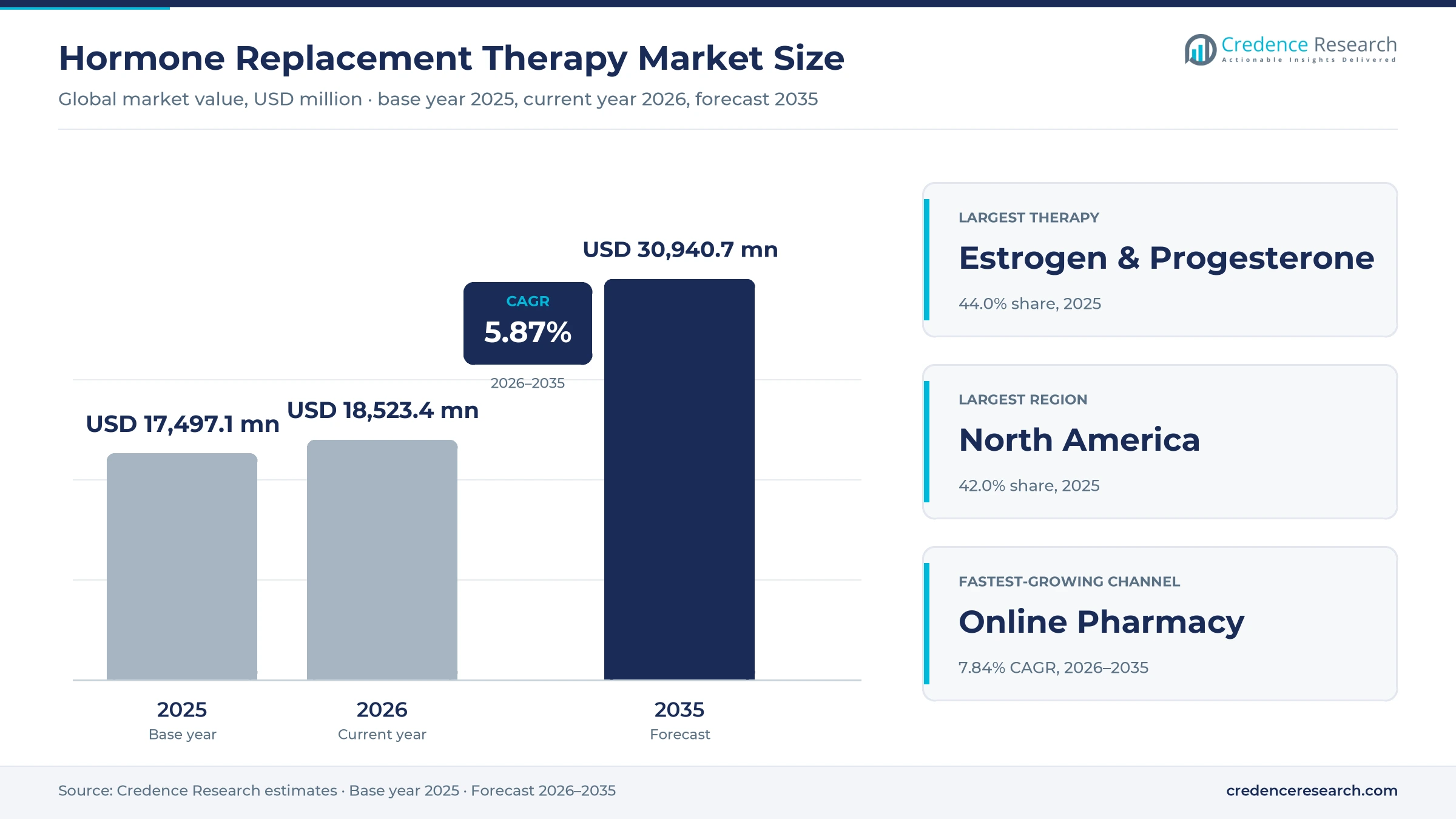
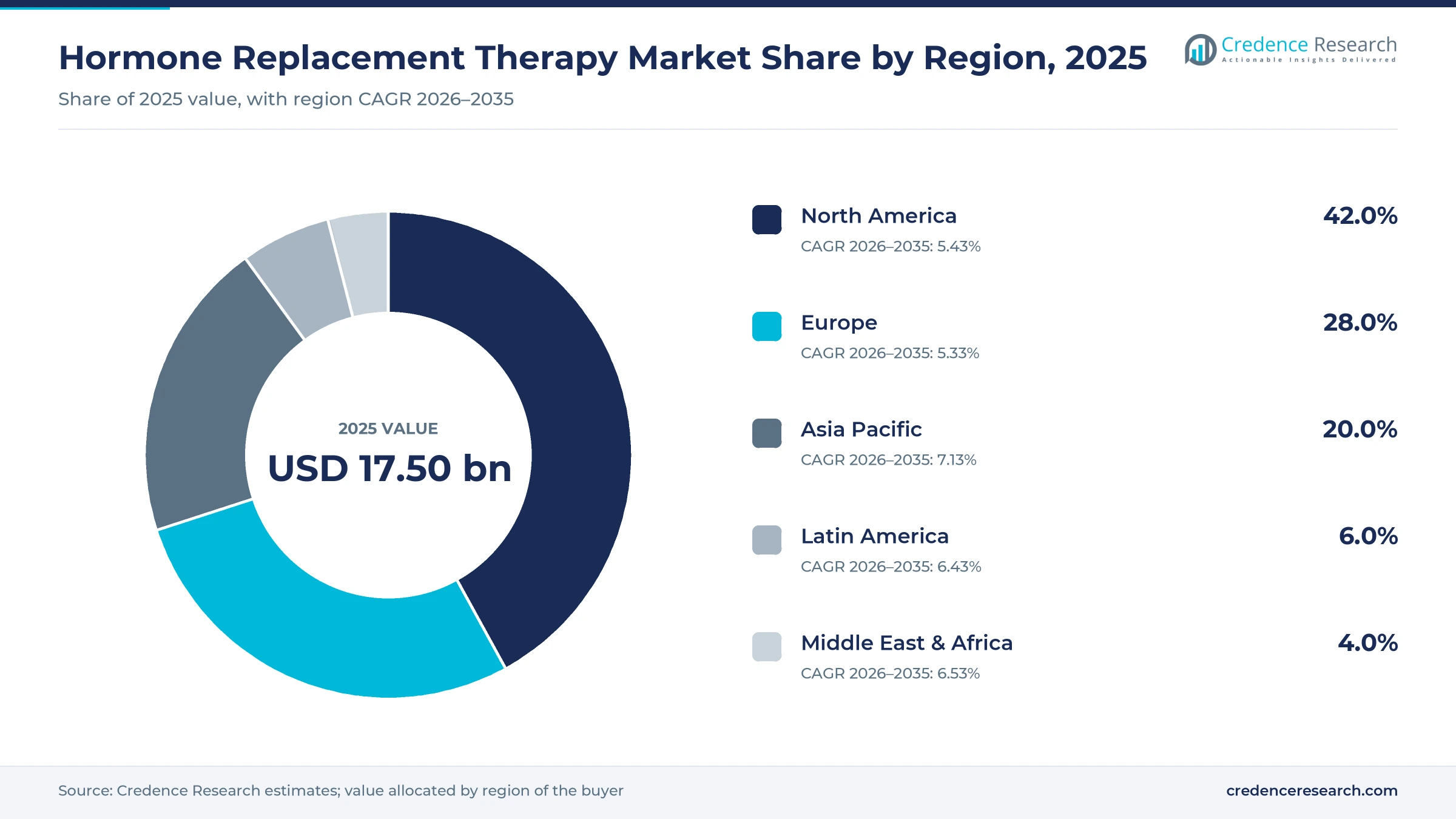
The global hormone replacement therapy market was valued at USD 17.50 billion in 2025 and is projected to increase from USD 18.52 billion in 2026 to USD 30.94 billion by 2035, registering a CAGR of 5.87% during 2026–2035. Demand comes from women treated for hot flashes and other menopause symptoms, adults with underactive thyroid glands, men with low testosterone and children with growth hormone deficiency. North America held the largest regional share, 42.0% in 2025, because prescription volumes and branded hormone prices are both high in the U.S. Asia Pacific is the fastest-growing region at 7.13% a year, as aging populations in China, Japan and South Korea raise menopause and endocrine care needs. The main regulatory change came in November 2025, when the U.S. Food and Drug Administration began removing broad boxed warnings from menopausal hormone therapy labels, a shift that is expected to bring more women back to treatment.
Which hormone treatments does the market count?
The market counts manufacturer revenue from prescription products that replace hormones the body no longer makes in sufficient amounts. It covers systemic and local estrogen and progestogen products for menopause, levothyroxine and other thyroid hormones, testosterone gels, injections and pellets, and recombinant human growth hormone. Buyers include hospital, retail and online pharmacies, specialty distributors, insurers, public health systems and patients who pay out of pocket.
The scope excludes hormonal contraceptives, hormone therapy used to treat breast and prostate cancer, fertility stimulation drugs and dietary supplements sold without a prescription. Compounded hormone preparations and non-hormonal menopause medicines are also left out, although they compete with approved hormone products for the same patients.
Hormone Replacement Therapy Market Insights
- The hormone replacement therapy market grows from USD 17.50 billion in 2025 to USD 30.94 billion by 2035, a 5.87% CAGR over 2026–2035, as more women and endocrine patients are treated.
- North America held 42.0% of global value in 2025, reflecting high prescription volumes and branded prices for hormone products in the U.S.
- Estrogen and progesterone replacement therapy led therapies with 44.0% of 2025 value, because menopause affects every woman in midlife.
- On Nov. 10, 2025, the FDA asked makers of menopausal hormone therapies to remove boxed warning language on cardiovascular disease, breast cancer and dementia.
- Gedeon Richter bought the estetrol business of bankrupt Mithra Pharmaceuticals in June 2024 for EUR 175 million, shifting a new estrogen pipeline to a larger owner.
Estrogen and progesterone products hold the largest share
Why do estrogen and progesterone products lead?
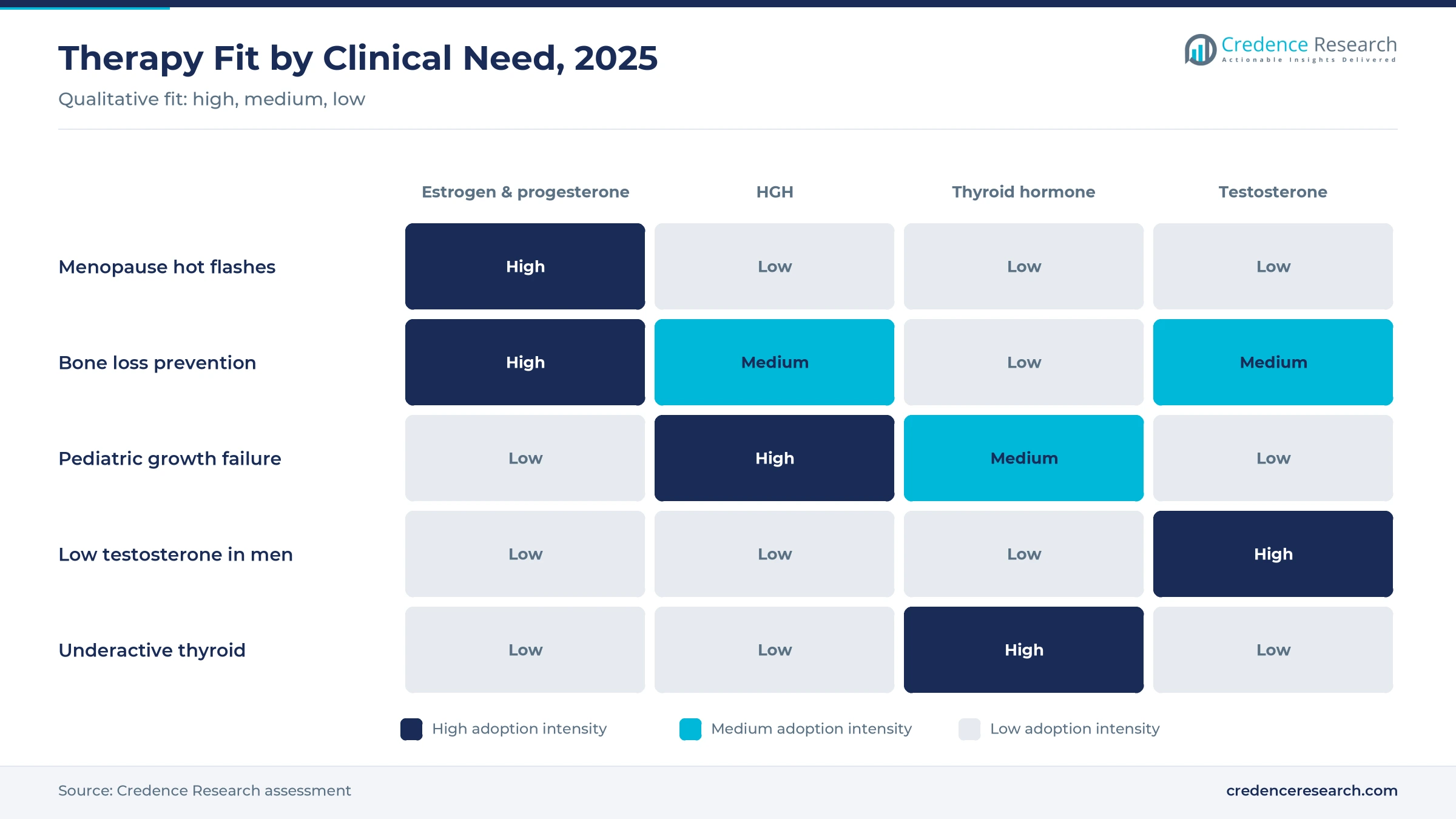
Based on therapy, the market is categorized into estrogen and progesterone replacement therapy, HGH replacement therapy, thyroid hormone replacement therapy, testosterone replacement therapy and others. Estrogen and progesterone replacement therapy led with a 44.0% share of 2025 value, because menopause symptoms affect a very large group of women aged 45 to 60. The same group also grows fastest at 6.35% a year, as revised U.S. labels ease prescriber concerns about long-term safety.
How do menopause and other indications divide value?
Based on disease indication, the market is categorized into menopause, hypothyroidism, male hypogonadism, growth hormone deficiency and others. Menopause led with a 43.0% share of 2025 value, because hot flashes, night sweats and vaginal atrophy bring millions of women to treatment. Menopause also grows fastest at 6.35% a year, while low-cost generic levothyroxine keeps hypothyroidism value growth modest despite high patient numbers.
Where do patients fill hormone prescriptions?
Based on distribution channel, the market is categorized into hospital pharmacy, retail pharmacy, online pharmacy and others. Retail Pharmacy led with a 48.0% share of 2025 value, because most hormone therapy is taken at home for years and refilled monthly. Online Pharmacy grows fastest at 7.84% a year, as telehealth menopause clinics and mail-order refills gain users.
| Segment Group | Leading Sub-segment | Share, 2025 | Fastest-growing Sub-segment | CAGR, 2026–2035 |
|---|---|---|---|---|
| By Therapy | Estrogen & Progesterone Replacement Therapy | 44.0% | Estrogen & Progesterone Replacement Therapy | 6.35% |
| By Disease Indication | Menopause | 43.0% | Menopause | 6.35% |
| By Distribution Channel | Retail Pharmacy | 48.0% | Online Pharmacy | 7.84% |
Request a Free Sample
Fill in your details and we'll send you a free sample report.
- Sample data tables & charts
- Research methodology
Label reform, aging women and pediatric growth care
How does U.S. label reform reopen menopause treatment?
Safety warnings added after the Women's Health Initiative studies discouraged many women and doctors from using hormone therapy for two decades. On Nov. 10, 2025, the FDA asked makers of menopausal hormone therapies to remove boxed warning language on cardiovascular disease, breast cancer and probable dementia. The agency also noted that only about 2 million U.S. women aged 46 to 65 received a systemic hormone prescription in 2020. This gap between need and use gives the label change room to lift volumes.
Why does an aging female population sustain demand?
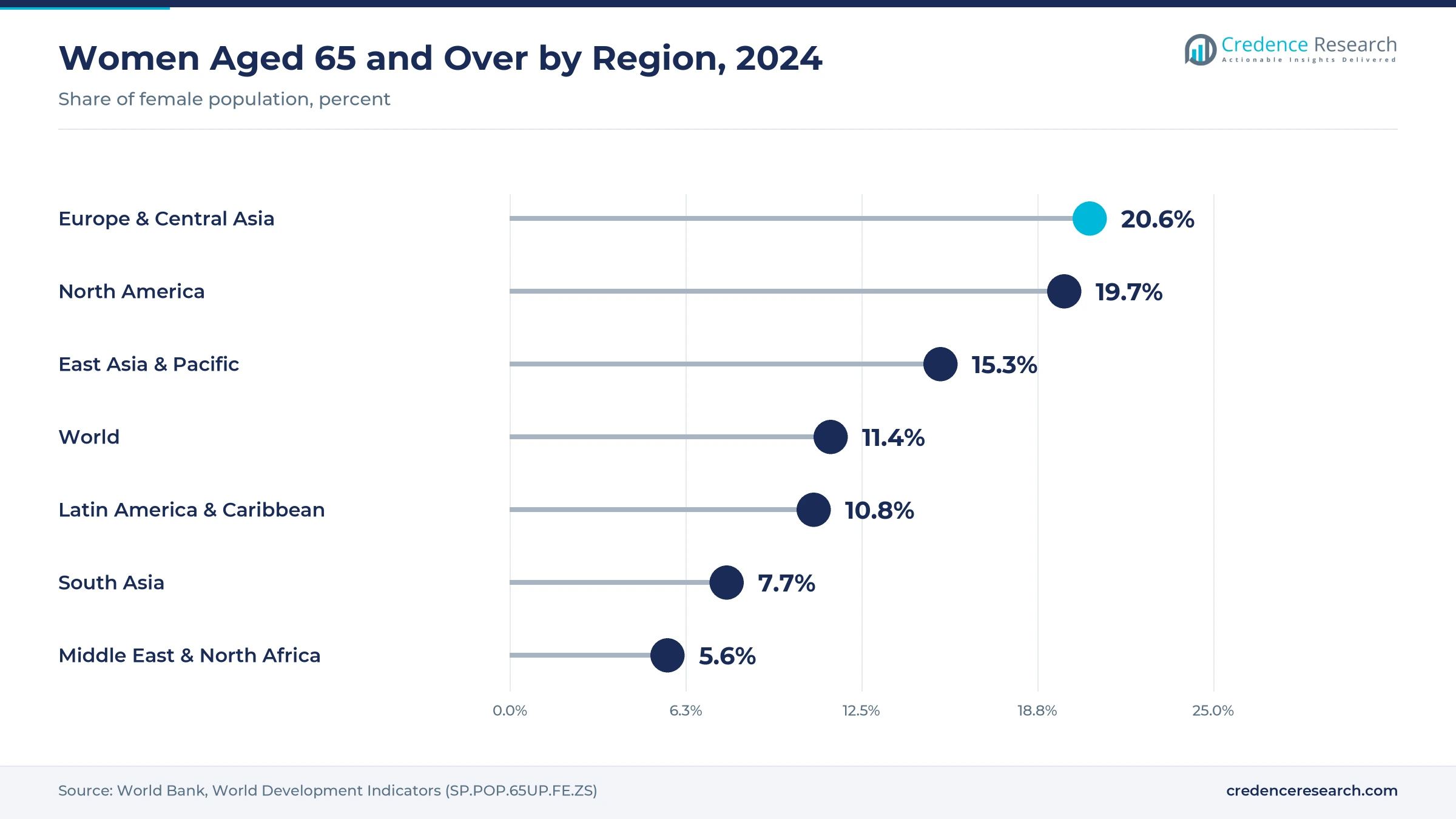
The number of women in their late forties and fifties keeps rising in most regions, which enlarges the group that experiences menopause symptoms each year. The FDA cited U.S. Census data showing about 41 million American women aged 45 to 64 in 2020, the ages when hot flashes are most common. Many of these women also seek care for postmenopausal osteoporosis, where estrogen helps slow bone loss. Because the FDA now favors starting systemic therapy before age 60, more women in this group qualify for timely treatment.
How do new pediatric growth indications add patients?
Growth hormone makers are widening the groups of children who can receive treatment, which expands the HGH patient pool. On Feb. 27, 2026, the FDA approved Novo Nordisk's once-weekly Sogroya for three additional pediatric indications, covering idiopathic short stature, small for gestational age and Noonan syndrome. Novo Nordisk announced the approval in 2026 as an expansion of weekly dosing for families who previously gave daily injections. In turn, better adherence supports longer treatment courses and steadier demand.
Why does clearer testosterone labeling support prescribing?
Uncertainty about heart risks had long limited testosterone use among men with confirmed low hormone levels. On Feb. 28, 2025, the FDA required class-wide labeling changes that added the TRAVERSE trial results and removed boxed warning language about adverse cardiovascular outcomes. The agency also required new blood pressure warnings for products that lacked them. Because prescribers now have clearer safety data, treatment of diagnosed male hypogonadism can grow steadily. AbbVie and Endo, which market testosterone brands, operate under the same 2025 class labeling as every other supplier.
Weekly growth hormone, patches and online refills
Why is long-acting growth hormone rising?
Long-acting growth hormone products are rising as families and endocrinologists shift away from daily injections. Weekly formulations such as Sogroya reduce the burden of treatment for children who may need therapy for many years. The expanded Sogroya label covers children aged 2.5 years and older with three additional growth conditions. Because missed doses reduce growth outcomes, simpler regimens improve results and keep patients on therapy longer. This shift supports value growth in HGH replacement therapy even where patient numbers rise only slowly.
How is telehealth menopause care emerging?
Telehealth clinics that focus on menopause care are emerging in the U.S. and Europe, giving women faster access to prescribers who understand hormone therapy. These services often pair online consultations with home delivery of patches, gels and tablets through e-pharmacy channels. As a result, online pharmacy gains a steadily larger share of monthly hormone refills. Women who previously went untreated because of long waits for specialists now start treatment sooner.
Where is the opening in transdermal estrogen?
Transdermal estrogen offers a clear opening, because doctors increasingly prefer delivery through the skin for women with higher clot risk. Transdermal skin patches and gels avoid first-pass liver metabolism and give steady hormone levels across the day. Noven Pharmaceuticals and Viatris supply estradiol patches to this demand. Companies that can secure reliable patch supply and smaller, more discreet designs are well placed to gain share.
Can wider menopause awareness open new demand?
Greater public discussion of menopause offers an opening, because many symptomatic women have never discussed treatment with a doctor. Employers, health systems and menopause wellness providers are adding education programs that encourage women to seek care. A 2021 study cited by the FDA put the prevalence of moderate to severe hot flashes at about 34% among women aged 45 to 65. When symptoms are recognized earlier, more women start therapy within 10 years of menopause, the window the FDA now highlights. This pattern should lift prescriptions in North America and Europe first.
Safety perceptions, generic pricing and abuse controls
How do lingering safety fears limit uptake?
Many women and some doctors still associate hormone therapy with breast cancer and heart risks reported in the early 2000s. Although the FDA announced revised U.S. labels in November 2025, other regulators have not all followed, and prescribing habits change slowly. Women who stopped therapy years ago may not return without new advice. Medical societies and companies therefore need sustained education to turn the label change into higher use. This gap matters most in Europe and Asia, where earlier warnings still shape patient leaflets.
Why does generic pricing cap value growth?
Most estrogen, progesterone, levothyroxine and testosterone molecules are off patent and sold as low-cost generics. In November 2025, the FDA also approved the first generic version of Premarin in more than 30 years, adding competition for conjugated estrogens. Generic entry lowers average prices even when patient numbers rise. Branded makers respond with new delivery formats and patient support programs. Distributors also pressure suppliers through tenders, which further narrows margins on older tablets and patches.
What competition comes from non-hormonal options?
New non-hormonal medicines give women who cannot or will not use hormones another route to symptom relief. In October 2025, Bayer received U.S. approval for Lynkuet, a hormone-free daily pill for moderate to severe hot flashes due to menopause. Bayer announced the approval on Oct. 24, 2025, describing Lynkuet as its first hormone-free treatment for menopause symptoms. Such options may draw some patients away from estrogen, particularly women with a history of breast cancer. However, they do not address bone loss or vaginal symptoms, which keeps hormone therapy central for many women.
How do controls on testosterone and growth hormone affect access?
Testosterone is a controlled substance in the U.S., and growth hormone faces strict rules against off-label use for athletic or anti-aging purposes. These controls add paperwork, limit refills and discourage some prescribers. Insurers also require proof of deficiency before paying for expensive growth hormone. As a result, access depends on diagnosis quality and prior authorization rules in each health system. Pediatric endocrinologists therefore spend considerable time documenting growth data before insurers approve treatment.
North America leads while Asia Pacific grows fastest
| Region | Value, 2025 (USD billion) | Share, 2025 | CAGR, 2026–2035 |
|---|---|---|---|
| North America | 7.35 | 42.0% | 5.43% |
| Europe | 4.90 | 28.0% | 5.33% |
| Asia Pacific | 3.50 | 20.0% | 7.13% |
| Latin America | 1.05 | 6.0% | 6.43% |
| Middle East & Africa | 0.70 | 4.0% | 6.53% |
North America leads on prescriptions and prices
North America held a 42.0% share of 2025 value and grows at 5.43% a year through 2035. The U.S. leads spending, because branded hormone products, testosterone gels and growth hormone pens carry high prices. The FDA label changes announced in November 2025 should raise menopause prescriptions over the next few years. However, generic conjugated estrogens and low-cost levothyroxine hold value growth below the global rate.
Europe relies on national menopause guidance
Europe held a 28.0% share of 2025 value and grows at 5.33% a year, the slowest pace among the five regions. The U.K., Germany, France and Italy account for most demand, with public health systems paying for most prescriptions. Transdermal estradiol patches and gels are widely used across the region by menopause specialists. However, tender pricing and reference prices keep value growth modest even as menopause awareness rises.
Asia Pacific grows on aging populations
Asia Pacific held a 20.0% share of 2025 value and is the fastest-growing region at 7.13% a year. Japan, China and South Korea have large and rising numbers of women over 50, and treatment rates for menopause remain low. Demand for growth hormone and thyroid hormone also rises as diagnosis of thyroid gland disorders and pediatric growth problems improves. As incomes grow, more patients in urban China and India pay for branded products.
Latin America expands through retail pharmacies
Latin America held a 6.0% share of 2025 value and grows at 6.43% a year through 2035. Brazil and Mexico account for most demand, with retail pharmacies selling estrogen, progestogen and thyroid products. Currency swings raise the cost of imported growth hormone and limit pediatric treatment.
Gulf health systems lead a small regional base
The Middle East & Africa held a 4.0% share of 2025 value and grows at 6.53% a year. Gulf states lead spending, with public programs that cover growth hormone and thyroid care. Across much of Africa, access to branded hormone therapy remains limited.
Label changes, approvals and asset sales since 2024
| Development | Status and market relevance |
|---|---|
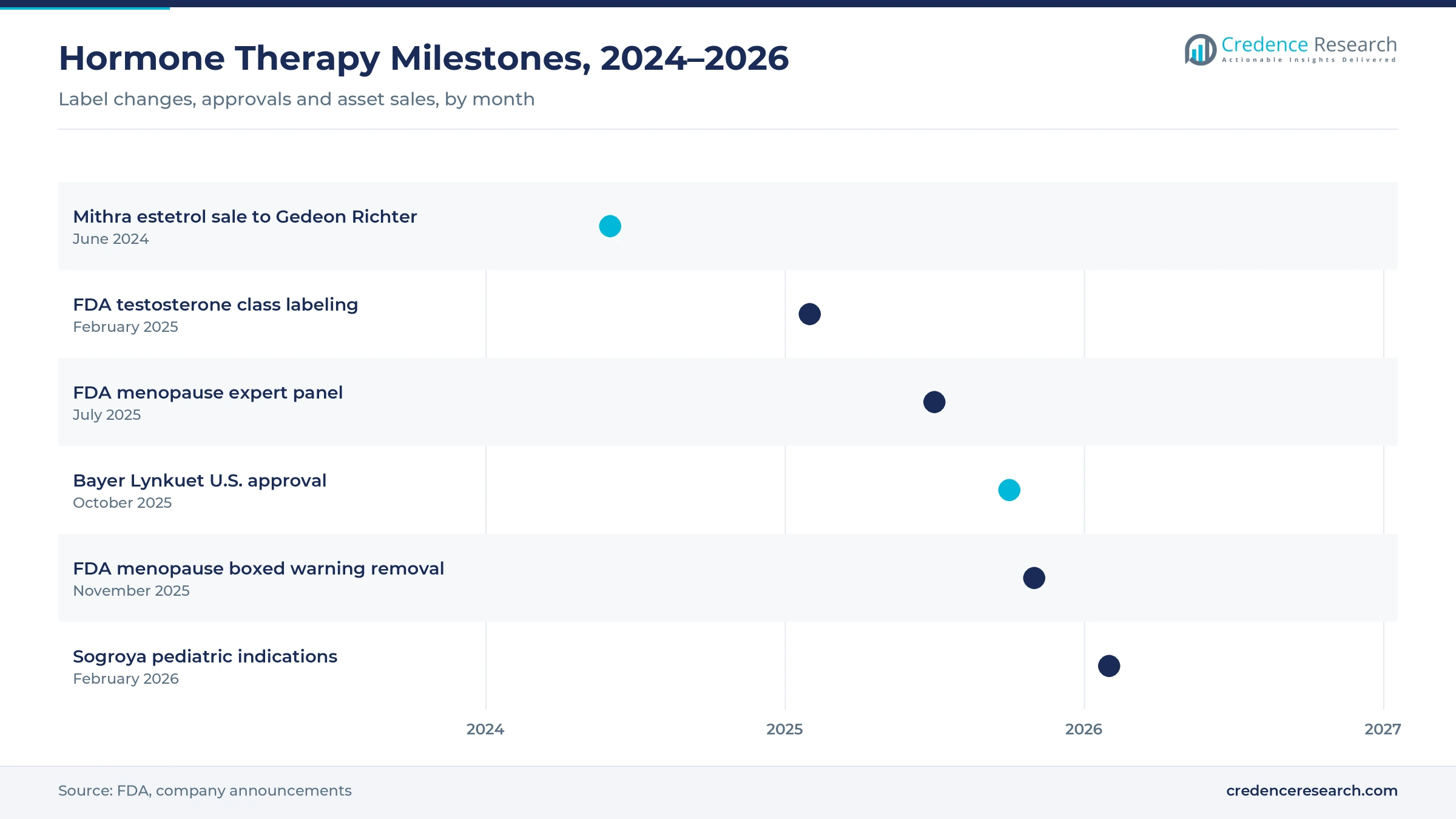
| In June 2024, Mithra Pharmaceuticals, then under bankruptcy, sold its estetrol business, including Estetra and Neuralis, to Gedeon Richter. | Completed. Valued at EUR 175 million in aggregate. |
| In February 2025, the FDA required class-wide labeling changes for testosterone products, adding TRAVERSE trial results. | In effect. Removes boxed cardiovascular language and adds blood pressure warnings. |
| In October 2025, Bayer received U.S. approval for Lynkuet, a hormone-free treatment for menopause hot flashes. | Approved. Adds a non-hormonal competitor for vasomotor symptoms. |
| In November 2025, the FDA began removing broad boxed warnings from menopausal hormone therapy labels and approved a generic Premarin. | Under way. Labels updated with new guidance on starting therapy. |
| In February 2026, the FDA approved Novo Nordisk's weekly Sogroya for three additional pediatric growth indications. | Approved. Widens weekly growth hormone use in children. |
Delivery formats shape adherence and dosing control
- Transdermal patches and gels deliver estradiol and testosterone through the skin, which avoids first-pass liver metabolism and gives steady levels.
- Weekly growth hormone replaces daily injections with one dose a week, which eases treatment for children and families.
- Vaginal estrogen products treat local symptoms with low doses, which limits exposure for women who need only local relief.
- Long-acting testosterone injections reduce clinic visits by spacing doses weeks apart for men with confirmed deficiency.
- Estetrol-based products use a natural estrogen made during pregnancy, which developers study as a newer menopause option.
Need a Custom Version of This Report?
Tailor the scope, geography, or segments to your exact requirements.
- Custom geography or segment scope
- Direct access to our analyst team
Endocrine specialists and generic makers share the field
Competition in hormone replacement therapy splits between endocrine specialists, large diversified drugmakers and generic producers. Novo Nordisk A/S, Eli Lilly and Company, Pfizer Inc. and F. Hoffmann-La Roche Ltd. hold long-standing growth hormone portfolios, while Novo Nordisk leads in once-weekly dosing. Pfizer Inc., Bayer AG and Noven Pharmaceuticals, Inc. supply estrogen and progestogen products, with Noven focused on transdermal patches. AbbVie, Inc. holds thyroid and testosterone brands, and Endo International plc supplies testosterone products. Viatris, Inc. and Merck & Co., Inc. sell hormone products at lower prices across many markets. Gedeon Richter acquired the estetrol business of Mithra Pharmaceuticals in June 2024, after Mithra went bankrupt. Because generics dominate many molecules, companies compete on delivery formats, supply reliability and support for prescribers.
Companies profiled and their roles in this market
| Company | Type | Role in the market |
|---|---|---|
| Novo Nordisk A/S | Endocrine specialist | Norditropin and once-weekly Sogroya growth hormone |
| Eli Lilly and Company | Diversified pharma | Humatrope growth hormone |
| Pfizer Inc. | Diversified pharma | Premarin estrogens and Genotropin growth hormone |
| Bayer AG | Diversified pharma | Estrogen products and the non-hormonal Lynkuet |
| Noven Pharmaceuticals, Inc. | Transdermal specialist | Estradiol patches for menopause |
| AbbVie, Inc. | Diversified pharma | Thyroid and testosterone brands |
| Viatris, Inc. | Generics | Generic estradiol and hormone products |
| Merck & Co., Inc. | Diversified pharma | Hormone portfolio in selected markets |
| F. Hoffmann-La Roche Ltd. | Diversified pharma | Growth hormone through its Genentech unit |
| Endo International plc | Specialty pharma | Testosterone products |
| Mithra Pharmaceuticals | Women's health developer | Sold estetrol assets to Gedeon Richter in 2024 |
Prescriber confidence, not new molecules, sets the pace
Credence Research's view is that prescriber confidence, rather than new molecules, will set the growth pace in hormone replacement therapy through 2035. The November 2025 U.S. label changes remove a long-standing barrier for menopause care, and similar steps by other regulators would extend the effect. Weekly growth hormone and clearer testosterone labeling add steady demand in smaller groups. However, generic pricing and new non-hormonal medicines limit price gains. Companies with transdermal formats, reliable supply and prescriber education programs are best placed.
How the 2025 baseline and forecast were built
The report uses 2025 as the base year and forecasts market value to 2035, with growth rates stated for 2026–2035. Market values come from the Credence Research market model, which combines treated patient numbers, typical dosing and treatment length, and average selling prices by region and channel. Splits by therapy, disease indication, distribution channel and region are Credence Research estimates. Sources used include FDA labeling notices, World Bank population data and company announcements. No primary interviews or surveys were used to build the estimates in this report.
Wider menopause treatment lifts value through 2035
By 2035, the hormone replacement therapy market reaches USD 30.94 billion, with more women starting menopause treatment earlier. Estrogen and progesterone products remain the largest group as revised labels change prescribing habits. Weekly growth hormone becomes the standard for many children, while testosterone use grows among men with confirmed deficiency. Online pharmacies take a larger share of monthly refills as telehealth menopause clinics mature. Asia Pacific gains share as aging populations in Japan, China and South Korea seek treatment, while generic competition keeps price growth moderate in mature markets.
Frequently Asked Questions
How big is the hormone replacement therapy market?
Which therapy leads the market?
Which disease indication grows fastest?
Which region holds the largest share?
What did the FDA change in November 2025?
How did testosterone labels change in 2025?
Who are the leading companies?
What are the main challenges?
Table of Content
Chapter 1 Market Segmentation
- 1.1 Segmentation Framework
- 1.1.1 Product and Service Classification
- 1.1.2 Application and End-Use Classification
- 1.1.3 Technology and Solution Classification
- 1.1.4 Customer and Distribution Channel Classification
- 1.1.5 Geographic Segmentation
- 1.1.6 Market Segment Definitions and Boundaries
- 1.2 By Therapy
- 1.2.1 Estrogen & Progesterone Replacement Therapy
- 1.2.2 HGH Replacement Therapy
- 1.2.3 Thyroid Hormone Replacement Therapy
- 1.2.4 Testosterone Replacement Therapy
- 1.2.5 Others
- 1.3 By Disease Indication
- 1.3.1 Menopause
- 1.3.2 Hypothyroidism
- 1.3.3 Male Hypogonadism
- 1.3.4 Growth Hormone Deficiency
- 1.3.5 Others
Chapter 2 Introduction
- 2.1 Report Objectives and Scope
- 2.2 Product Definition and Industry Terminology
- 2.3 Market Inclusions and Exclusions
- 2.4 Research Process
- 2.4.1 Primary Research and Expert Interviews
- 2.4.2 Secondary Research and Source Review
- 2.4.3 Top-Down and Bottom-Up Estimation
- 2.4.4 Data Triangulation and Verification
- 2.5 Market Size Measurement Basis
- 2.5.1 2025: USD 17.50 billion → 2035: USD 30.94 billion
- 2.6 Historical and Forecast Reference Periods
- 2.6.1 Historical Period: 2018-2025
- 2.6.2 Base Year: 2025
- 2.6.3 Forecast Period: 2025-2035
- 2.7 Research Assumptions and Limitations
Chapter 3 Executive Summary
- 3.1 Market Snapshot and Key Findings
- 3.2 Base-Year Market Size, 2025
- 3.3 Forecast Market Size, 2035
- 3.4 Revenue and Volume Growth Outlook
- 3.5 Key Demand and Supply Indicators
- 3.6 Leading Market Segments
- 3.7 Fastest-Growing Market Opportunities
- 3.8 Regional Performance Highlights
- 3.9 Technology and Industry Transformation
- 3.10 Competitive Landscape Summary
- 3.11 Analyst View and Strategic Implications
Chapter 4 Global Hormone Replacement Therapy Market Trends and Developments
- 4.1 Historical Industry Development, 2018-2025
- 4.2 Recent Market Trends and Developments
- 4.3 Demand and Customer Behavior Trends
- 4.4 Technology and Product Innovation
- 4.5 Artificial Intelligence, Automation and Digitalization
- 4.6 Local Manufacturing and Supply Chain Realignment
- 4.7 Industry Partnerships, Mergers and Acquisitions
- 4.8 Sustainability and Circular Economy Developments
- 4.9 Government and Private Sector Investment Trends
- 4.10 Emerging Business Models and Commercialization
- 4.11 Industry Developments and Announcements
Chapter 5 Global Hormone Replacement Therapy Market Production, Supply and Demand Analysis
- 5.1 Demand Trend and Consumption Analysis, 2018-2025
- 5.2 Demand Forecast, 2025-2035
- 5.3 Production and Output Trend, 2018-2025
- 5.4 Production and Output Forecast, 2025-2035
- 5.5 Installed Capacity and Capacity Utilization
- 5.6 Company-Wise Production Plants and Statistics
- 5.6.1 Installed Production Capacity
- 5.6.2 Actual Production
- 5.6.3 Planned Capacity and Expansion Targets
- 5.7 Supply Chain Structure and Procurement Trends
- 5.8 Supply-Demand Gap and Bottlenecks
- 5.9 Import Dependence and Sourcing Structure
- 5.10 Contract Manufacturing and Outsourcing
- 5.11 Regional Supply and Demand Concentration
Chapter 6 Global Hormone Replacement Therapy Market Pricing Analysis
- 6.1 Pricing Structure and Measurement
- 6.2 Historical Pricing Trends, 2018-2025
- 6.3 Pricing Outlook, 2025-2035
- 6.4 Average Selling Price and Unit Economics
- 6.5 Pricing by Product and Market Segment
- 6.6 Geographic Pricing Differences
- 6.7 Key Input, Energy, Labor and Logistics Costs
- 6.8 Contract Pricing and Purchasing Models
- 6.9 Pricing Sensitivity and Competitive Positioning
- 6.10 Price, Margin and Profitability Implications
Chapter 7 Global Hormone Replacement Therapy Market Dynamics
- 7.1 Market Growth Drivers
- 7.1.1 Demand-Side Drivers
- 7.1.2 Technology and Innovation Drivers
- 7.1.3 Infrastructure and Investment Drivers
- 7.1.4 Regulatory and Policy Drivers
- 7.2 Market Restraints
- 7.2.1 Cost and Affordability Constraints
- 7.2.2 Technology and Adoption Barriers
- 7.2.3 Supply Chain and Operational Constraints
- 7.3 Market Challenges
- 7.3.1 Competitive Pressure and Margin Erosion
- 7.3.2 Skills, Infrastructure and Implementation Gaps
- 7.4 Emerging Market Opportunities
- 7.5 Market Dynamics Impact and Time-Horizon Assessment
Chapter 8 Global Hormone Replacement Therapy Value Chain Analysis
- 8.1 Industry Value Chain Overview
- 8.2 Upstream Suppliers and Critical Inputs
- 8.3 Technology and Component Providers
- 8.4 Manufacturing or Service Delivery
- 8.5 Distribution, Channel Partners and Integrators
- 8.6 Downstream Applications and End Users
- 8.7 Value Addition and Profit Pools
- 8.8 Vertical Integration and Outsourcing
- 8.9 Supplier Concentration and Risk
- 8.10 Supply Chain Localization and Resilience
Chapter 9 Global Hormone Replacement Therapy Market Regulations and Policies
- 9.1 Relevant Laws, Standards and Compliance Frameworks
- 9.2 Product, Service, Safety and Quality Requirements
- 9.3 Government Policies, Incentives and Subsidies
- 9.4 Imports, Exports and Trade Barriers
- 9.5 Public Procurement and Local Content Requirements
- 9.6 Environmental and Sustainability Compliance
- 9.7 Upcoming Policy Changes and Market Implications
Chapter 10 Global Hormone Replacement Therapy Market Hotspots and Opportunities
- 10.1 Market Opportunity Mapping and Growth Hotspots
- 10.2 High-Growth Applications and Customer Groups
- 10.3 Underserved Markets and White-Space Opportunities
- 10.4 Emerging Technology and Product Opportunities
- 10.5 New Capacity and Investment Hotspots
- 10.6 Market Entry and Expansion Opportunities
- 10.7 Distribution and Partnership Opportunities
- 10.8 Near-Term and Long-Term Commercial Potential
- 10.9 Opportunity Attractiveness and Execution Risks
Chapter 11 Global Hormone Replacement Therapy Market Outlook, 2025-2035
- 11.1 Market Size and Analysis
- 11.1.1 Revenue (Market Measurement: 2025: USD 17.50 billion → 2035: USD 30.94 billion)
- 11.1.2 Market Volume and Quantity Sold
- 11.1.3 Historical Market Size, 2018-2025
- 11.1.4 Base-Year Market Size, 2025
- 11.2 Market Forecast, 2025-2035
- 11.2.1 Revenue Forecast to 2035
- 11.2.2 Volume Forecast to 2035
- 11.2.3 CAGR and Year-on-Year Growth
- 11.2.4 Incremental Revenue Opportunity
- 11.3 Forecast Assumptions and Scenario Analysis
- 11.3.1 Base-Case Forecast
- 11.3.2 Optimistic and Conservative Scenarios
- 11.3.3 Technology, Pricing and Policy Sensitivities
- 11.4 Market Attractiveness and Growth Outlook
Chapter 12 Global Hormone Replacement Therapy Market Segmentation and Outlook
- 12.1 Segmentation Summary and Market Shares, 2025
- 12.2 Largest and Fastest-Growing Segments
- 12.3 By Therapy - Market Size and Forecast, 2025-2035
- 12.3.1 Segment Definition and Scope
- 12.3.2 Historical Market Size, 2018-2025
- 12.3.3 Revenue Forecast, 2025-2035
- 12.3.4 Volume Forecast, 2025-2035
- 12.3.5 Base-Year Market Share, 2025
- 12.3.6 Segment CAGR and Growth Drivers
- 12.3.7 Subsegment Market Size and Forecast
- 12.3.7.1 Estrogen & Progesterone Replacement Therapy
- 12.3.7.2 HGH Replacement Therapy
- 12.3.7.3 Thyroid Hormone Replacement Therapy
- 12.3.7.4 Testosterone Replacement Therapy
- 12.3.7.5 Others
- 12.3.8 Subsegment Pricing and Adoption Trends
- 12.3.9 Leading Suppliers and Competition
- 12.3.10 Regional Demand and Opportunities
- 12.4 By Disease Indication - Market Size and Forecast, 2025-2035
- 12.4.1 Segment Definition and Scope
- 12.4.2 Historical Market Size, 2018-2025
- 12.4.3 Revenue Forecast, 2025-2035
- 12.4.4 Volume Forecast, 2025-2035
- 12.4.5 Base-Year Market Share, 2025
- 12.4.6 Segment CAGR and Growth Drivers
- 12.4.7 Subsegment Market Size and Forecast
- 12.4.7.1 Menopause
- 12.4.7.2 Hypothyroidism
- 12.4.7.3 Male Hypogonadism
- 12.4.7.4 Growth Hormone Deficiency
- 12.4.7.5 Others
- 12.4.8 Subsegment Pricing and Adoption Trends
- 12.4.9 Leading Suppliers and Competition
- 12.4.10 Regional Demand and Opportunities
- 12.5 Segment Growth Comparison
- 12.6 Segment Attractiveness and Priority Matrix
Chapter 13 Global Hormone Replacement Therapy Geographic Market Outlook, 2025-2035
- 13.1 Regional Market Size and Share, 2025
- 13.2 Regional Market Forecast, 2025-2035
- 13.3 Regional Pricing, Production and Demand Differences
- 13.4 North America
- 13.4.1 United States
- 13.4.2 Canada
- 13.4.3 Mexico
- 13.5 Europe
- 13.5.1 Germany
- 13.5.2 France
- 13.5.3 Italy
- 13.5.4 United Kingdom
- 13.5.5 Spain
- 13.5.6 Poland
- 13.5.7 Russia
- 13.5.8 Netherlands
- 13.5.9 Belgium
- 13.5.10 Sweden
- 13.5.11 Denmark
- 13.5.12 Norway
- 13.5.13 Rest of Europe
- 13.6 Asia Pacific
- 13.6.1 China
- 13.6.2 India
- 13.6.3 Japan
- 13.6.4 South Korea
- 13.6.5 Thailand
- 13.6.6 Indonesia
- 13.6.7 Vietnam
- 13.6.8 Malaysia
- 13.6.9 Australia
- 13.6.10 Rest of Asia Pacific
- 13.7 Latin America
- 13.7.1 Brazil
- 13.7.2 Argentina
- 13.7.3 Colombia
- 13.7.4 Chile
- 13.7.5 Rest of Latin America
- 13.8 Middle East
- 13.8.1 Saudi Arabia
- 13.8.2 United Arab Emirates
- 13.8.3 Turkey
- 13.8.4 Israel
- 13.8.5 Iran
- 13.8.6 Rest of the Middle East
- 13.9 Africa
- 13.9.1 South Africa
- 13.9.2 Egypt
- 13.9.3 Nigeria
- 13.9.4 Morocco
- 13.9.5 Rest of Africa
- 13.10 Regional Investment, Policy and Supply Chain Differences
- 13.11 Regional Competitive Landscape
- 13.12 Geographic Growth Hotspots
Chapter 14 Global Hormone Replacement Therapy Technology, Innovation and Sustainability Outlook
- 14.1 Technology Landscape and Maturity
- 14.2 Product, Process and Service Innovation
- 14.3 AI, Automation and Digital Tools in the Industry
- 14.4 Technology Adoption and Performance Benchmarking
- 14.5 Innovation Pipeline and R&D Investment
- 14.6 Patent and Intellectual Property Trends
- 14.7 Energy Efficiency and Resource Management
- 14.8 Sustainability, Recycling and Circularity
- 14.9 Technology Roadmap, 2025-2035
- 14.10 Risks of Obsolescence and Technology Substitution
Chapter 15 Global Hormone Replacement Therapy Market Key Strategic Imperatives
- 15.1 Growth and Market Entry Priorities
- 15.2 High-Return Products and Segments
- 15.3 Pricing, Profitability and Cost Optimization
- 15.4 Technology Investment and Product Differentiation
- 15.5 Supply Chain Localization and Resilience
- 15.6 Distribution and Customer Acquisition
- 15.7 Partnership, Acquisition and Capacity Strategy
- 15.8 Regional Expansion Priorities
- 15.9 Short-, Medium- and Long-Term Actions
Chapter 16 Competition Outlook
- 16.1 Industry Competition Characteristics
- 16.2 Market Structure and Concentration
- 16.3 Market Share and Competitive Positioning, 2025
- 16.4 Company-Wise Revenue and Product Benchmarking
- 16.5 Production and Service Capacity Benchmarking
- 16.6 Technology, Pricing and Differentiation
- 16.7 Regional Footprint and Distribution Strength
- 16.8 Mergers, Acquisitions and Strategic Alliances
- 16.9 New Entrants and Competitive Threats
- 16.10 Porter's Five Forces and Industry Attractiveness
- 16.11 Competitive Outlook, 2025-2035
Chapter 17 Company Profiles
- 17.1 Company Coverage and Selection Criteria
- 17.2 Eli Lilly and Company
- 17.2.1 Business Description
- 17.2.2 Company Ownership and Geographic Presence
- 17.2.3 Product and Service Portfolio
- 17.2.4 Manufacturing and Operating Footprint
- 17.2.5 Production Capacity and Expansion Plans
- 17.2.6 Financial Performance and Investment
- 17.2.7 Market Share and Competitive Position
- 17.2.8 Technology and Innovation Capabilities
- 17.2.9 Strategic Alliances or Partnerships
- 17.2.10 Recent Developments
- 17.2.11 Growth Strategy and Outlook
- 17.3 Bayer AG
- 17.4 Noven Pharmaceuticals, Inc.
- 17.5 Pfizer Inc.
- 17.6 Merck & Co., Inc.
- 17.7 Viatris, Inc.
- 17.8 Novo Nordisk A/S
- 17.9 F. Hoffmann-La Roche Ltd.
- 17.10 AbbVie, Inc.
- 17.11 Endo International plc
- 17.12 Mithra Pharmaceuticals
- 17.13 Other Relevant Market Participants
Note: Every listed company is profiled on the structure shown under the first company. The company list is preliminary and may change based on research findings, market developments, data availability and client requirements.
Chapter 18 Disclaimer
- 18.1 Research and Forecast Disclaimer
- 18.2 Data Source and Estimation Limitations
Note: The depth of individual sections depends on data availability for this market. Volume, capacity, trade and other unit-based metrics are included where applicable.