| REPORT ATTRIBUTE | DETAILS |
|---|---|
| Historical Period | 2020-2023 |
| Base Year | 2024 |
| Forecast Period | 2025-2032 |
| HVAC Silencers Market Size 2024 | USD 1,321.2 million |
| HVAC Silencers Market, CAGR | 5.23% |
| HVAC Silencers Market Size 2032 | USD 1,985.2 million |
Market Overview:
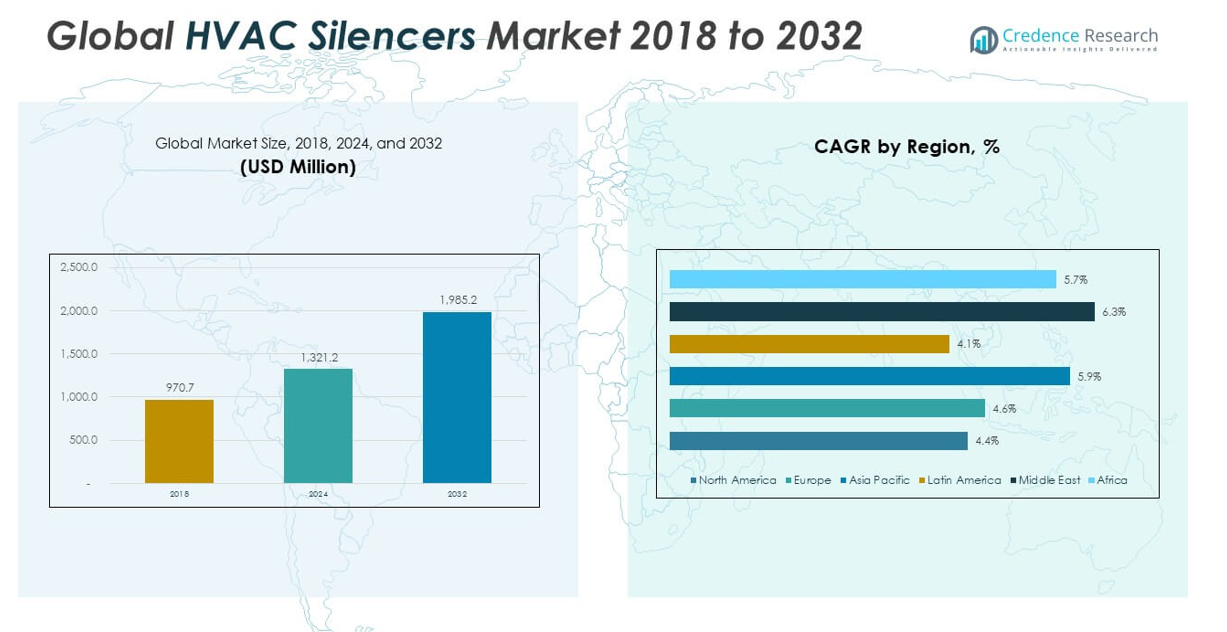
The Global HVAC Silencers Market size was valued at USD 970.7 million in 2018 to USD 1,321.2 million in 2024 and is anticipated to reach USD 1,985.2 million by 2032, at a CAGR of 5.23%% during the forecast period.
Key market drivers include rising urbanization, evolving building regulations, and growing health concerns linked to noise pollution. HVAC silencers are increasingly specified in commercial, residential, healthcare, and institutional environments where acoustic comfort and compliance with local noise ordinances are critical. Technological advancements in silencer design-such as low-pressure-drop configurations, enhanced sound-absorptive materials, and smart integration for digital HVAC systems-are further enhancing product appeal. Sustainability trends are also influencing the market, prompting manufacturers to develop eco-friendly silencers compatible with green building certifications like LEED and BREEAM. Additionally, growth in smart buildings and energy-efficient retrofitting solutions continues to accelerate the adoption of next-generation silencers globally. The rising demand for occupant wellness and productivity in workplaces is also boosting adoption. Integration of IoT and AI-based noise monitoring is expected to become a standard feature in future silencer systems.
Regionally, North America holds the largest market share, driven by stringent noise-control regulations, a mature HVAC industry, and widespread adoption of advanced silencing technologies. Europe follows closely, with strong regulatory enforcement and growing demand for low-noise systems in energy-efficient buildings. Asia-Pacific stands out as the fastest-growing region, fueled by rapid urban expansion, infrastructure development, and increasing construction activity across China, India, Japan, and Southeast Asia. Meanwhile, Latin America, the Middle East, and Africa are emerging markets with steady growth, supported by urban development, rising awareness of indoor air quality, and expanding commercial construction in select economies. Public-private investments in sustainable infrastructure projects are also contributing to market expansion in these regions. Governments are encouraging noise mitigation as part of broader environmental and occupational safety initiatives.
Market Insights:
- The Global HVAC Silencers Market grew from USD 970.7 million in 2018 to USD 1,321.2 million in 2024 and is projected to reach USD 1,985.2 million by 2032, registering a CAGR of 5.23%.
- Rapid urban development and smart city initiatives are increasing the integration of HVAC silencers across residential, commercial, and institutional buildings to meet acoustic comfort standards.
- Regulatory pressure in regions like North America and Europe is driving demand for certified low-noise HVAC silencers that comply with strict environmental and building noise regulations.
- Technological advancements, such as low-pressure-drop designs and improved sound-absorptive materials, are enhancing product performance and energy efficiency.
- Growing emphasis on sustainable construction is prompting manufacturers to produce silencers that meet LEED, BREEAM, and WELL certification requirements using recyclable and low-emission components.
- Cost sensitivity and limited space in retrofit or budget-constrained projects, particularly in emerging markets, remain key challenges restricting large-scale adoption.
- North America holds the largest market share, while Asia-Pacific is the fastest-growing region due to ongoing urbanization, infrastructure development, and construction activities in China, India, and Southeast Asia.
Market Drivers:
Urbanization and Rising Infrastructure Demand Fuel HVAC Silencer Adoption:
The rapid pace of global urbanization and expansion of residential, commercial, and institutional infrastructure is a major driver of the Global HVAC Silencers Market. Growing demand for soundproof indoor environments in high-density urban settings has led to increased integration of silencers in HVAC systems. Builders and architects are incorporating noise control features in the early design phase to ensure compliance with modern building codes. The proliferation of large-scale real estate and smart city projects is expanding the application scope of silencers across multiple building types. Acoustic comfort has become a key performance metric in commercial spaces, healthcare facilities, and hospitality venues. Rising consumer awareness of indoor environmental quality continues to reinforce the need for efficient silencing solutions.
- For instance, IAC Acoustics’ modular duct silencers have been specified by professional engineers since 1950 for controlling noise in air handling systems, with their products being laboratory developed and periodically tested for predictable noise reduction performance under controlled conditions.
Tightening Noise Pollution Regulations Accelerate Market Penetration:
Stringent noise control regulations and environmental standards are propelling the demand for advanced HVAC silencers. Regulatory bodies in North America, Europe, and parts of Asia are enforcing strict decibel limits in occupied buildings, particularly in hospitals, schools, and residential complexes. The Global HVAC Silencers Market is witnessing a shift toward solutions that meet both local ordinance requirements and international acoustic certifications. Manufacturers are responding by offering a wide range of low-noise products tested under ISO and ASHRAE standards. Compliance-driven retrofitting and facility upgrades are further increasing product demand in existing buildings. Enforcement of workplace noise standards is also boosting installations across industrial and corporate office settings.
- For instance, VAW Systems, a leading manufacturer, provides fan silencers that are custom engineered to help facilities comply with OSHA noise standards by delivering high attenuation levels with minimal pressure drop, supporting compliance in both new and retrofitted installations.
Technological Innovations Strengthen Competitive Advantage and Product Value:
The market is evolving with innovations in silencer design and material science that improve performance and energy efficiency. Low-pressure-drop silencers are becoming more common due to their ability to maintain system airflow while minimizing sound. Integration with digital HVAC systems, smart controls, and predictive maintenance platforms is creating value for both OEMs and facility operators. The Global HVAC Silencers Market benefits from advances in sound-absorptive materials such as fiberglass, mineral wool, and composite polymers. These developments allow manufacturers to offer lightweight, fire-resistant, and thermally stable silencers suitable for a range of HVAC configurations. Intelligent design tools and simulation software are also enabling faster customization and performance validation.
Sustainability and Green Building Trends Influence Product Design and Specification:
The shift toward sustainable construction and energy-efficient systems is significantly shaping market dynamics. HVAC silencers are now expected to meet criteria for green building certifications such as LEED, BREEAM, and WELL. Manufacturers are introducing eco-friendly silencers with recyclable components and low-VOC finishes to align with environmental standards. The market is being influenced by growing interest in net-zero and carbon-neutral buildings, where every component-including acoustic solutions-must support energy goals. Integration into energy modeling and HVAC performance simulations is making silencers part of the broader system optimization strategy. The Global HVAC Silencers Market continues to evolve with the construction industry’s increasing focus on lifecycle cost, resource efficiency, and environmental compliance.
Market Trends:
Customization and Modular Silencer Solutions Gain Preference Across Applications:
End users are increasingly demanding HVAC silencers that are tailored to specific project needs and acoustic profiles. This shift toward customization is driving manufacturers to offer modular silencer designs that can be easily adapted for various duct sizes, airflow requirements, and noise attenuation levels. The Global HVAC Silencers Market is witnessing a transition from standard, off-the-shelf products to configurable solutions that offer flexibility in installation and integration. Modular silencers are also reducing lead times, improving ease of maintenance, and supporting scalable retrofits. OEMs and contractors are valuing the ability to assemble systems with interchangeable components that minimize disruption and downtime. This trend is aligning with the broader construction industry focus on prefabricated and on-site adaptive solutions.
- For instance, IAC Acoustics offers both rectangular and cylindrical silencers that are developed and tested in advanced aero-acoustic laboratories, ensuring each product meets catalogued dynamic insertion loss, self-noise, and pressure drop performance data, with quality control verified through periodic laboratory testing.
Digital Twin and Simulation Tools Reshape Acoustic Design and Testing:
The integration of digital twin technology and advanced simulation software is transforming the design and validation of HVAC silencers. Engineers can now use virtual models to simulate airflow, noise propagation, and silencer performance in real-world conditions before manufacturing begins. It is helping reduce prototyping costs, accelerate product development cycles, and increase acoustic precision. The Global HVAC Silencers Market is benefiting from this trend by enabling stakeholders to optimize product selection based on actual building acoustics and system requirements. These tools are also improving collaboration between architects, mechanical engineers, and HVAC consultants, leading to better overall system integration. Predictive modeling is becoming a standard tool in both new construction and retrofit projects.
Aesthetic Integration and Architectural Compatibility Become Key Priorities:
Demand is rising for HVAC silencers that not only perform acoustically but also blend seamlessly into modern architectural spaces. Architects and designers are prioritizing visual harmony, driving manufacturers to develop silencers with concealed installations, compact profiles, or custom finishes. The Global HVAC Silencers Market is responding with products that accommodate both form and function, especially in open-ceiling or exposed duct environments. Color-matching, smooth surface treatments, and clean-line designs are increasingly in demand for commercial interiors, museums, retail spaces, and premium residential buildings. End users expect noise control solutions to complement interior aesthetics without compromising on performance. This trend is pushing innovation in silencer housing and mounting systems.
- For instance, Rosenberg Ventilatoren GmbH I-Series Backward Curved Fan, which won the 2025 AHR Innovation Award, features a compact design optimized for both acoustic performance and architectural compatibility, reducing visible mechanical footprint in commercial interiors.
Focus on Lifecycle Performance and Total Cost of Ownership Strengthens:
Facility managers and procurement teams are evaluating HVAC silencers based on lifecycle value rather than upfront costs. This shift is influencing manufacturers to highlight durability, corrosion resistance, ease of cleaning, and long-term acoustic stability in product specifications. The Global HVAC Silencers Market is seeing a stronger emphasis on maintenance-friendly designs, including access panels and washable linings. Clients are also requesting data on energy impact, material sustainability, and product warranties to assess long-term returns. Lifecycle modeling tools and third-party certifications are playing a larger role in purchasing decisions. This trend reflects a broader industry movement toward operational efficiency and performance transparency in building systems.
Market Challenges Analysis:
Cost Sensitivity and Budget Constraints in Price-Driven Markets Limit Adoption:
One of the key challenges in the Global HVAC Silencers Market is the high price sensitivity in cost-driven construction sectors. Many developers and contractors prioritize immediate cost savings over long-term acoustic performance, leading to the exclusion of silencers from HVAC specifications. In emerging economies, the focus often remains on basic ventilation functionality rather than advanced noise control. Budget constraints in public infrastructure and low-margin residential projects further reduce the demand for high-quality silencers. It creates barriers for manufacturers that offer premium or custom-engineered solutions. The need to justify the return on investment for silencers, especially in retrofit projects, slows procurement decisions and narrows the addressable market.
Installation Complexity and Space Limitations Pose Integration Challenges:
HVAC silencers often require adequate space within ductwork or mechanical rooms, which can be difficult to accommodate in compact or pre-designed building layouts. Tight ceiling spaces, architectural limitations, and dense mechanical routing make installation more complex and labor-intensive. The Global HVAC Silencers Market faces challenges where mechanical contractors must balance acoustic goals with spatial constraints and airflow requirements. Improper installation can degrade performance and lead to higher pressure drops, reducing HVAC system efficiency. Coordination between design teams and HVAC specialists is essential but often overlooked during the planning phase. Lack of standardization across silencer products also complicates integration into modular or prefabricated HVAC systems.
Market Opportunities:
Expansion of Green Building Certifications Creates New Specification Demand:
The growing global emphasis on sustainable construction presents strong opportunities for the Global HVAC Silencers Market. Green building certifications such as LEED, BREEAM, and WELL are now prioritizing acoustic comfort as a critical indoor environmental quality parameter. Project developers are actively seeking HVAC components that contribute to both energy efficiency and occupant well-being. Silencers designed with recyclable materials and low-emission finishes can align with these criteria. It opens the door for manufacturers to differentiate products through sustainability credentials and performance documentation. Partnerships with green consultants and inclusion in certified product databases can further expand market reach.
Growth in Data Centers, Healthcare, and Mixed-Use Developments Drives Demand:
The rise of noise-sensitive, high-performance building segments offers targeted growth potential for silencer manufacturers. The Global HVAC Silencers Market can benefit from the expansion of data centers, hospitals, laboratories, and luxury mixed-use developments that require strict noise control standards. These projects often involve specialized HVAC configurations where custom silencers can play a critical role. Urban infill projects and vertical developments are also creating opportunities for compact, high-efficiency silencers. Long-term service contracts in these facilities offer recurring revenue potential through maintenance and replacements. Strong demand from these technically demanding sectors supports innovation and higher-value product positioning.
Market Segmentation Analysis:
By Silencer Configurations
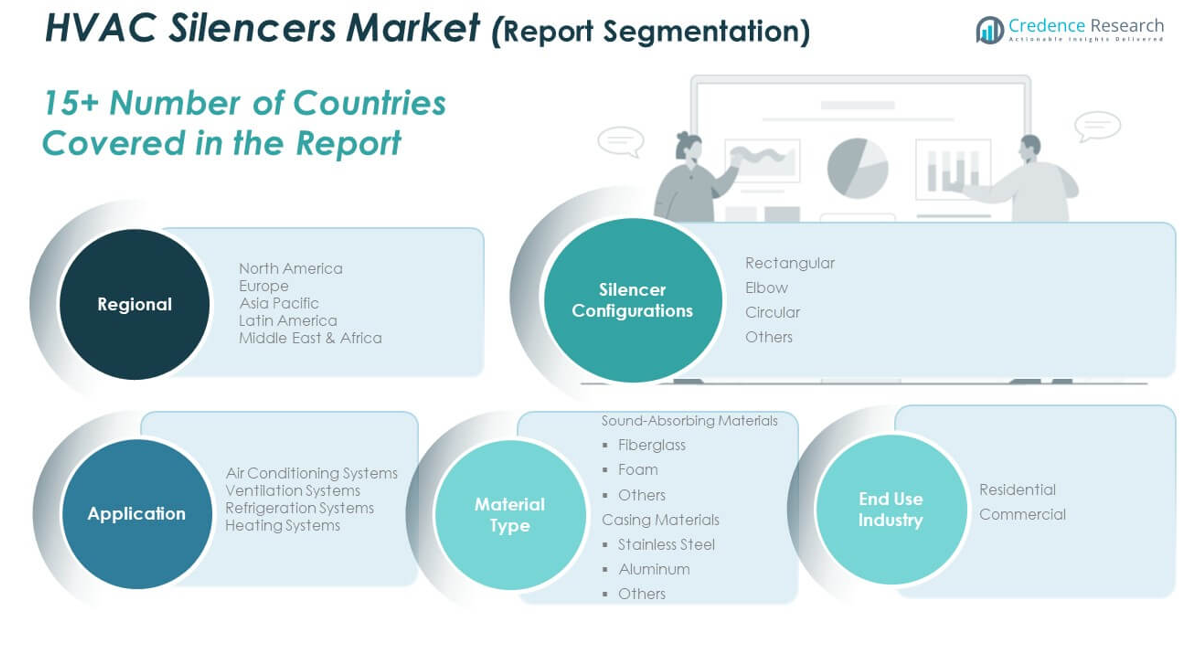
Rectangular silencers hold the leading market share due to their ease of integration into standard ductwork in commercial and institutional buildings. Elbow silencers are preferred in duct bends where space constraints and directional changes require noise attenuation. Circular silencers are gaining traction in round duct systems, especially in residential and light commercial installations. The “others” segment includes non-standard or application-specific designs used in retrofitting and specialty environments.
- For instance, IAC Acoustics’ rectangular and cylindrical duct silencers are laboratory tested to ensure accurate catalogued dynamic insertion loss, self-noise, and pressure drop data, enabling their widespread use in commercial and institutional buildings.
By Application
Air conditioning systems account for the largest share of applications, driven by demand for thermal comfort in high-occupancy buildings. Ventilation systems follow closely, with silencers ensuring airflow without compromising noise levels in public and industrial settings. Refrigeration and heating systems represent niche but critical use cases in cold storage, laboratories, and industrial facilities, where acoustic control supports operational efficiency and safety.
- For instance, VAW Systems’ fan silencers are engineered to deliver high attenuation for both standard ventilation fans and heavy-duty, high-pressure fan systems, supporting noise control in industrial, commercial, and public settings.
By Material Type
Under sound-absorbing materials, fiberglass dominates due to its acoustic performance, thermal insulation, and flame resistance. Foam is used in lightweight applications, offering flexibility and easy installation. In casing materials, stainless steel is preferred for durability and corrosion resistance in heavy-duty applications, while aluminum supports lightweight installations. The “others” category includes galvanized steel and composite materials.
By End User Industry
The commercial segment leads the Global HVAC Silencers Market due to high deployment across offices, healthcare, hospitality, and retail spaces. The residential segment is expanding, supported by growing awareness of indoor noise reduction and demand for comfort-driven HVAC installations.
Segmentation:
By Silencer Configurations
- Rectangular
- Elbow
- Circular
- Others
By Application
- Air Conditioning Systems
- Ventilation Systems
- Refrigeration Systems
- Heating Systems
By Material Type
Sound-Absorbing Materials
- Fiberglass
- Foam
- Others
Casing Materials
- Stainless Steel
- Aluminum
- Others
By End User Industry
- Residential
- Commercial
By Region
- North America
- U.S.
- Canada
- Mexico
- Europe
- Germany
- France
- U.K.
- Italy
- Spain
- Rest of Europe
- Asia Pacific
- China
- Japan
- India
- South Korea
- South-east Asia
- Rest of Asia Pacific
- Latin America
- Brazil
- Argentina
- Rest of Latin America
- Middle East & Africa
- GCC Countries
- South Africa
- Rest of the Middle East and Africa
Regional Analysis:
The North America HVAC Silencers Market size was valued at USD 195.21 million in 2018 to USD 253.74 million in 2024 and is anticipated to reach USD 357.33 million by 2032, at a CAGR of 4.4% during the forecast period. North America holds a substantial share of the Global HVAC Silencers Market, driven by strong enforcement of noise regulations and the maturity of HVAC infrastructure. It benefits from consistent demand across commercial buildings, hospitals, and institutional settings where acoustic comfort is essential. The U.S. leads the region, supported by high adoption of advanced building systems and retrofitting activities. Market players in the region focus on energy efficiency and smart HVAC integration, enhancing the value proposition of silencers. Strict adherence to ASHRAE and LEED standards strengthens product specification across construction projects. The market continues to evolve through innovations in material durability and smart monitoring systems.
The Europe HVAC Silencers Market size was valued at USD 272.77 million in 2018 to USD 359.36 million in 2024 and is anticipated to reach USD 516.14 million by 2032, at a CAGR of 4.6% during the forecast period. Europe ranks second in terms of market share, supported by environmental legislation and widespread implementation of low-noise HVAC systems. It emphasizes sustainable construction and acoustic health, particularly in office complexes, schools, and healthcare facilities. Countries like Germany, the UK, and France are leading adopters due to their high construction standards and demand for indoor environmental quality. The market favors silencers that align with EU noise directives and green building certifications. The commercial segment drives most of the demand, while retrofitting in historical buildings contributes to specialized applications. Manufacturers benefit from a well-established regulatory framework and customer preference for certified, low-emission materials.
The Asia Pacific HVAC Silencers Market size was valued at USD 356.26 million in 2018 to USD 504.18 million in 2024 and is anticipated to reach USD 796.25 million by 2032, at a CAGR of 5.9% during the forecast period. Asia Pacific is the fastest-growing region in the Global HVAC Silencers Market, driven by rapid urbanization and large-scale infrastructure development. Countries like China, India, Japan, and South Korea contribute significantly to construction activity, especially in commercial, mixed-use, and industrial projects. Rising demand for thermal comfort, indoor air quality, and acoustic standards is pushing the integration of silencers in new buildings. Government investments in smart cities and green buildings are reinforcing product demand. The market is becoming more competitive, with both global and regional manufacturers expanding their footprint. Increasing awareness of workplace wellness and regulatory alignment is also shaping adoption trends.
The Latin America HVAC Silencers Market size was valued at USD 39.90 million in 2018 to USD 51.19 million in 2024 and is anticipated to reach USD 70.67 million by 2032, at a CAGR of 4.1% during the forecast period. Latin America holds a modest share of the Global HVAC Silencers Market but is experiencing steady growth driven by urban development and commercial expansion. Brazil and Mexico lead regional demand due to rising construction in healthcare, hospitality, and office spaces. Adoption remains focused in Tier 1 cities, where building standards and noise regulations are more strictly implemented. Energy efficiency initiatives and international hotel chains are influencing demand for quieter HVAC systems. The market shows potential in retrofits and high-end residential segments. Local manufacturing and affordable silencer solutions are becoming key focus areas for regional suppliers.
The Middle East HVAC Silencers Market size was valued at USD 73.19 million in 2018 to USD 106.01 million in 2024 and is anticipated to reach USD 172.11 million by 2032, at a CAGR of 6.3% during the forecast period. The Middle East shows strong growth potential, driven by high investment in commercial real estate, luxury developments, and climate control systems. Countries such as the UAE, Saudi Arabia, and Qatar continue to invest in mega projects, including hotels, airports, and hospitals. Acoustic comfort is a priority in modern architecture, increasing the use of HVAC silencers in design specifications. Demand is also influenced by the need to manage noise in high-capacity air systems suited for extreme climates. International contractors and consultants are introducing global standards, lifting product expectations. The market supports high-spec silencers capable of handling larger volumes and higher pressures.
The Africa HVAC Silencers Market size was valued at USD 33.39 million in 2018 to USD 46.69 million in 2024 and is anticipated to reach USD 72.66 million by 2032, at a CAGR of 5.7% during the forecast period. Africa presents emerging opportunities for the HVAC silencers industry, led by urbanization and increased investments in commercial infrastructure. South Africa, Egypt, and Kenya are key contributors to regional demand, with growth centered in healthcare, hospitality, and education sectors. Awareness around indoor comfort and building noise control is rising, particularly in urban centers. Limited budgets in some countries drive preference for cost-effective and durable silencer solutions. International donors and organizations involved in infrastructure development are also supporting adoption. The market outlook remains positive as governments push for modern, sustainable building practices.
Key Player Analysis:
- Siemens AG
- Johnson Controls
- Honeywell International
- Marmite Industries Ltd
- Acoustic Sciences Corporation
- Munters
- Rosenberg Ventilatoren GmbH
- Emerson Electric
- Aeroacoustic
- Panasonic Corporation
- Kinetics Noise Control
- Carrier Global Corporation
- Trane Technologies
Competitive Analysis:
The Global HVAC Silencers Market features a competitive landscape marked by the presence of established multinational corporations and specialized acoustic solution providers. Key players such as Siemens AG, Honeywell International, Johnson Controls, Carrier Global Corporation, and Trane Technologies maintain strong market positions through diversified product portfolios and global distribution networks. It is characterized by steady innovation, with manufacturers focusing on low-pressure-drop designs, durable casing materials, and environmentally compliant solutions. Companies are investing in R&D to meet growing demand for silencers compatible with smart HVAC systems and green building certifications. Strategic partnerships with construction firms and MEP consultants help expand market reach and specification inclusion. Smaller players compete by offering customized silencers and cost-effective solutions for regional markets. Price competitiveness, technical performance, and compliance with noise regulations continue to shape the competitive dynamics of the market. The entry of regional manufacturers in Asia and the Middle East is gradually intensifying price and innovation pressure.
Recent Developments:
- In June 2025, Honeywell Internationalunveiled Honeywell Connected Solutions, an AI-powered building management platform that integrates critical building software and technologies into a single interface. Early adopters include Verizon Communications and Vanderbilt University. The platform offers advanced encryption, remote monitoring, predictive maintenance, and energy management solutions to improve operational efficiency and sustainability in building environments.
- In May 2025, Muntersinaugurated a new state-of-the-art facility in Amesbury, Massachusetts, focused on desiccant dehumidification products and climate control solutions for the North American market. The 430,000-square-foot site is designed with sustainability at its core, featuring electrified processes, renewable energy, and a rooftop solar array. This investment supports Munters’ long-term growth objectives and climate ambitions, aiming to double in size and halve its climate footprint by 2030.
- In March 2025, Honeywell announced the acquisition of Sundyne, a manufacturer of engineered pumps and gas compressors, for $2.16 billion. This acquisition will expand Honeywell’s Energy and Sustainability Solutions business and enhance its portfolio in process technologies and critical equipment.
- In January 2025, Munters also announced a $29.95 million investment to expand its HVAC manufacturing facility in Botetourt County, Virginia, creating 270 new jobs and further increasing its production capacity in the U.S.
- In September 2024, Munters formed a partnership with ZutaCore, a U.S.-based leader in waterless liquid cooling, to integrate ZutaCore’s two-phase cooling technology with Munters SyCool systems for data centers, addressing the challenges of high-density AI-generated heat.
Market Concentration & Characteristics:
The Global HVAC Silencers Market exhibits moderate market concentration, with a mix of global manufacturers and regional suppliers competing across segments. It is characterized by a strong emphasis on product performance, regulatory compliance, and application-specific customization. The market favors companies with advanced engineering capabilities and the ability to meet diverse building standards across regions. Product differentiation often revolves around material quality, airflow efficiency, and acoustic attenuation. Demand is project-driven, with specifications influenced by architects, HVAC consultants, and facility owners. Long sales cycles, technical validation, and contractor relationships shape purchasing decisions. Market growth is supported by rising awareness of acoustic comfort and increasing integration of silencers into sustainable building projects.
Report Coverage:
The research report offers an in-depth analysis based on by silencer configuration, application, material type, and end user industry. It details leading market players, providing an overview of their business, product offerings, investments, revenue streams, and key applications. Additionally, the report includes insights into the competitive environment, SWOT analysis, current market trends, as well as the primary drivers and constraints. Furthermore, it discusses various factors that have driven market expansion in recent years. The report also explores market dynamics, regulatory scenarios, and technological advancements that are shaping the industry. It assesses the impact of external factors and global economic changes on market growth. Lastly, it provides strategic recommendations for new entrants and established companies to navigate the complexities of the market.
Future Outlook:
- Rising demand for acoustically optimized indoor environments will drive silencer integration across new construction and retrofit projects.
- Growth in smart buildings will increase the adoption of silencers compatible with digital HVAC and IoT systems.
- Manufacturers will focus on low-pressure-drop designs that balance noise control with energy efficiency.
- Regulatory enforcement on noise pollution and building acoustics will expand in developing economies.
- Green building certifications will influence product design, favoring silencers with recyclable materials and low-VOC finishes.
- Customization and modular product configurations will gain traction in complex mechanical layouts.
- Asia Pacific will continue to lead global growth, supported by urban expansion and infrastructure investments.
- Maintenance-friendly silencers with washable linings and corrosion-resistant materials will see stronger demand.
- Strategic collaborations between OEMs and MEP consultants will influence specification trends.
- Emerging technologies like digital twins and acoustic simulation tools will enhance product validation and selection.

Request a Free Sample
Fill in your details and we'll send you a free sample report.
- Sample data tables & charts
- Research methodology
Market Dynamics
Urbanization and Infrastructure Growth
Rapid urban development and expansion of commercial, residential, and institutional buildings are increasing the need for acoustic comfort, driving the integration of HVAC silencers into new and existing structures.
Stringent Noise Pollution Regulations
Tightening building codes and environmental standards in regions like North America and Europe are mandating lower noise levels in occupied spaces, compelling the adoption of certified, high-performance HVAC silencers.
Technological Advancements in Silencer Design
Innovations such as low-pressure-drop configurations, improved sound-absorptive materials, and smart integration with digital HVAC systems are enhancing silencer efficiency and appeal, supporting broader market adoption.
Sustainability and Green Building Certifications
The push for sustainable construction and compliance with certifications like LEED and BREEAM is prompting manufacturers to develop eco-friendly silencers, increasing demand among environmentally conscious developers.
Growth in Smart Buildings and Digital Integration
The rise of smart buildings and IoT-enabled HVAC systems is driving demand for silencers that can be monitored and optimized digitally, supporting predictive maintenance and energy efficiency goals.
Need a Custom Version of This Report?
Tailor the scope, geography, or segments to your exact requirements.
- Custom geography or segment scope
- Direct access to our analyst team
Frequently Asked Questions
What is the current size of the Global HVAC Silencers Market?
What are the key segments within the Global HVAC Silencers Market?
What are some challenges faced by the Global HVAC Silencers Market?
Who are the major players in the Global HVAC Silencers Market?
Table of Content
Chapter 1 Market Segmentation
- 1.1 Segmentation Framework
- 1.1.1 Product and Service Classification
- 1.1.2 Application and End-Use Classification
- 1.1.3 Technology and Solution Classification
- 1.1.4 Customer and Distribution Channel Classification
- 1.1.5 Geographic Segmentation
- 1.1.6 Market Segment Definitions and Boundaries
- 1.2 By Application
- 1.2.1 Air Conditioning Systems
- 1.2.2 Ventilation Systems
- 1.2.3 Refrigeration Systems
- 1.2.4 Heating Systems
- 1.3 By Material Type
- 1.3.1 Fiberglass
- 1.3.2 Foam
- 1.3.3 Stainless Steel
- 1.3.4 Aluminum
- 1.3.5 Others
- 1.4 By End User Industry
- 1.4.1 Residential
- 1.4.2 Commercial
- 1.5 By Silencer Configuration
- 1.5.1 Rectangular
- 1.5.2 Elbow
- 1.5.3 Circular
- 1.5.4 Others
Chapter 2 Introduction
- 2.1 Report Objectives and Scope
- 2.2 Product Definition and Industry Terminology
- 2.3 Market Inclusions and Exclusions
- 2.4 Research Process
- 2.4.1 Primary Research and Expert Interviews
- 2.4.2 Secondary Research and Source Review
- 2.4.3 Top-Down and Bottom-Up Estimation
- 2.4.4 Data Triangulation and Verification
- 2.5 Market Size Measurement Basis
- 2.5.1 2024: USD 1,321.2 million → 2032: USD 1,985.2 million
- 2.6 Historical and Forecast Reference Periods
- 2.6.1 Base Year: 2024
- 2.6.2 Forecast Period: 2024-2032
- 2.7 Research Assumptions and Limitations
Chapter 3 Executive Summary
- 3.1 Market Snapshot and Key Findings
- 3.2 Base-Year Market Size, 2024
- 3.3 Forecast Market Size, 2032
- 3.4 Revenue and Volume Growth Outlook
- 3.5 Key Demand and Supply Indicators
- 3.6 Leading Market Segments
- 3.7 Fastest-Growing Market Opportunities
- 3.8 Regional Performance Highlights
- 3.9 Technology and Industry Transformation
- 3.10 Competitive Landscape Summary
- 3.11 Analyst View and Strategic Implications
Chapter 4 Global HVAC Silencers Market Trends and Developments
- 4.1 Historical Industry Development
- 4.2 Recent Market Trends and Developments
- 4.3 Demand and Customer Behavior Trends
- 4.4 Technology and Product Innovation
- 4.5 Artificial Intelligence, Automation and Digitalization
- 4.6 Local Manufacturing and Supply Chain Realignment
- 4.7 Industry Partnerships, Mergers and Acquisitions
- 4.8 Sustainability and Circular Economy Developments
- 4.9 Government and Private Sector Investment Trends
- 4.10 Emerging Business Models and Commercialization
- 4.11 Industry Developments and Announcements
Chapter 5 Global HVAC Silencers Market Production, Supply and Demand Analysis
- 5.1 Demand Trend and Consumption Analysis
- 5.2 Demand Forecast, 2024-2032
- 5.3 Production and Output Trend
- 5.4 Production and Output Forecast, 2024-2032
- 5.5 Installed Capacity and Capacity Utilization
- 5.6 Company-Wise Production Plants and Statistics
- 5.6.1 Installed Production Capacity
- 5.6.2 Actual Production
- 5.6.3 Planned Capacity and Expansion Targets
- 5.7 Supply Chain Structure and Procurement Trends
- 5.8 Supply-Demand Gap and Bottlenecks
- 5.9 Import Dependence and Sourcing Structure
- 5.10 Contract Manufacturing and Outsourcing
- 5.11 Regional Supply and Demand Concentration
Chapter 6 Global HVAC Silencers Market Pricing Analysis
- 6.1 Pricing Structure and Measurement
- 6.2 Historical Pricing Trends
- 6.3 Pricing Outlook, 2024-2032
- 6.4 Average Selling Price and Unit Economics
- 6.5 Pricing by Product and Market Segment
- 6.6 Geographic Pricing Differences
- 6.7 Key Input, Energy, Labor and Logistics Costs
- 6.8 Contract Pricing and Purchasing Models
- 6.9 Pricing Sensitivity and Competitive Positioning
- 6.10 Price, Margin and Profitability Implications
Chapter 7 Global HVAC Silencers Market Dynamics
- 7.1 Market Growth Drivers
- 7.1.1 Demand-Side Drivers
- 7.1.2 Technology and Innovation Drivers
- 7.1.3 Infrastructure and Investment Drivers
- 7.1.4 Regulatory and Policy Drivers
- 7.2 Market Restraints
- 7.2.1 Cost and Affordability Constraints
- 7.2.2 Technology and Adoption Barriers
- 7.2.3 Supply Chain and Operational Constraints
- 7.3 Market Challenges
- 7.3.1 Competitive Pressure and Margin Erosion
- 7.3.2 Skills, Infrastructure and Implementation Gaps
- 7.4 Emerging Market Opportunities
- 7.5 Market Dynamics Impact and Time-Horizon Assessment
Chapter 8 Global HVAC Silencers Value Chain Analysis
- 8.1 Industry Value Chain Overview
- 8.2 Upstream Suppliers and Critical Inputs
- 8.3 Technology and Component Providers
- 8.4 Manufacturing or Service Delivery
- 8.5 Distribution, Channel Partners and Integrators
- 8.6 Downstream Applications and End Users
- 8.7 Value Addition and Profit Pools
- 8.8 Vertical Integration and Outsourcing
- 8.9 Supplier Concentration and Risk
- 8.10 Supply Chain Localization and Resilience
Chapter 9 Global HVAC Silencers Market Regulations and Policies
- 9.1 Relevant Laws, Standards and Compliance Frameworks
- 9.2 Product, Service, Safety and Quality Requirements
- 9.3 Government Policies, Incentives and Subsidies
- 9.4 Imports, Exports and Trade Barriers
- 9.5 Public Procurement and Local Content Requirements
- 9.6 Environmental and Sustainability Compliance
- 9.7 Upcoming Policy Changes and Market Implications
Chapter 10 Global HVAC Silencers Market Hotspots and Opportunities
- 10.1 Market Opportunity Mapping and Growth Hotspots
- 10.2 High-Growth Applications and Customer Groups
- 10.3 Underserved Markets and White-Space Opportunities
- 10.4 Emerging Technology and Product Opportunities
- 10.5 New Capacity and Investment Hotspots
- 10.6 Market Entry and Expansion Opportunities
- 10.7 Distribution and Partnership Opportunities
- 10.8 Near-Term and Long-Term Commercial Potential
- 10.9 Opportunity Attractiveness and Execution Risks
Chapter 11 Global HVAC Silencers Market Outlook, 2024-2032
- 11.1 Market Size and Analysis
- 11.1.1 Revenue (Market Measurement: 2024: USD 1,321.2 million → 2032: USD 1,985.2 million)
- 11.1.2 Market Volume and Quantity Sold
- 11.1.3 Historical Market Size
- 11.1.4 Base-Year Market Size, 2024
- 11.2 Market Forecast, 2024-2032
- 11.2.1 Revenue Forecast to 2032
- 11.2.2 Volume Forecast to 2032
- 11.2.3 CAGR and Year-on-Year Growth
- 11.2.4 Incremental Revenue Opportunity
- 11.3 Forecast Assumptions and Scenario Analysis
- 11.3.1 Base-Case Forecast
- 11.3.2 Optimistic and Conservative Scenarios
- 11.3.3 Technology, Pricing and Policy Sensitivities
- 11.4 Market Attractiveness and Growth Outlook
Chapter 12 Global HVAC Silencers Market Segmentation and Outlook
- 12.1 Segmentation Summary and Market Shares, 2024
- 12.2 Largest and Fastest-Growing Segments
- 12.3 By Application - Market Size and Forecast, 2024-2032
- 12.3.1 Segment Definition and Scope
- 12.3.2 Historical Market Size
- 12.3.3 Revenue Forecast, 2024-2032
- 12.3.4 Volume Forecast, 2024-2032
- 12.3.5 Base-Year Market Share, 2024
- 12.3.6 Segment CAGR and Growth Drivers
- 12.3.7 Subsegment Market Size and Forecast
- 12.3.7.1 Air Conditioning Systems
- 12.3.7.2 Ventilation Systems
- 12.3.7.3 Refrigeration Systems
- 12.3.7.4 Heating Systems
- 12.3.8 Subsegment Pricing and Adoption Trends
- 12.3.9 Leading Suppliers and Competition
- 12.3.10 Regional Demand and Opportunities
- 12.4 By Material Type - Market Size and Forecast, 2024-2032
- 12.4.1 Segment Definition and Scope
- 12.4.2 Historical Market Size
- 12.4.3 Revenue Forecast, 2024-2032
- 12.4.4 Volume Forecast, 2024-2032
- 12.4.5 Base-Year Market Share, 2024
- 12.4.6 Segment CAGR and Growth Drivers
- 12.4.7 Subsegment Market Size and Forecast
- 12.4.7.1 Fiberglass
- 12.4.7.2 Foam
- 12.4.7.3 Stainless Steel
- 12.4.7.4 Aluminum
- 12.4.7.5 Others
- 12.4.8 Subsegment Pricing and Adoption Trends
- 12.4.9 Leading Suppliers and Competition
- 12.4.10 Regional Demand and Opportunities
- 12.5 By End User Industry - Market Size and Forecast, 2024-2032
- 12.5.1 Segment Definition and Scope
- 12.5.2 Historical Market Size
- 12.5.3 Revenue Forecast, 2024-2032
- 12.5.4 Volume Forecast, 2024-2032
- 12.5.5 Base-Year Market Share, 2024
- 12.5.6 Segment CAGR and Growth Drivers
- 12.5.7 Subsegment Market Size and Forecast
- 12.5.7.1 Residential
- 12.5.7.2 Commercial
- 12.5.8 Subsegment Pricing and Adoption Trends
- 12.5.9 Leading Suppliers and Competition
- 12.5.10 Regional Demand and Opportunities
- 12.6 By Silencer Configuration - Market Size and Forecast, 2024-2032
- 12.6.1 Segment Definition and Scope
- 12.6.2 Historical Market Size
- 12.6.3 Revenue Forecast, 2024-2032
- 12.6.4 Volume Forecast, 2024-2032
- 12.6.5 Base-Year Market Share, 2024
- 12.6.6 Segment CAGR and Growth Drivers
- 12.6.7 Subsegment Market Size and Forecast
- 12.6.7.1 Rectangular
- 12.6.7.2 Elbow
- 12.6.7.3 Circular
- 12.6.7.4 Others
- 12.6.8 Subsegment Pricing and Adoption Trends
- 12.6.9 Leading Suppliers and Competition
- 12.6.10 Regional Demand and Opportunities
- 12.7 Segment Growth Comparison
- 12.8 Segment Attractiveness and Priority Matrix
Chapter 13 Global HVAC Silencers End-Use and Application Market Outlook
- 13.1 End-Use Industry and Customer Demand Structure
- 13.2 Leading Applications and Customer Groups
- 13.3 End-Use Market Size, Share and Forecast
- 13.4 Major End-Use Industry Deep Dives
- 13.4.1 Customer Requirements and Use Cases
- 13.4.2 Demand and Replacement Cycles
- 13.4.3 Technical and Regulatory Considerations
- 13.4.4 Purchasing and Procurement Models
- 13.4.5 Leading Vendors and Distribution Channels
- 13.4.6 Forecast and Commercial Opportunities
- 13.5 Emerging Applications and Cross-Segment Demand
- 13.6 End-Use Industry Investment Priorities
Chapter 14 Global HVAC Silencers Geographic Market Outlook, 2024-2032
- 14.1 Regional Market Size and Share, 2024
- 14.2 Regional Market Forecast, 2024-2032
- 14.3 Regional Pricing, Production and Demand Differences
- 14.4 North America
- 14.4.1 United States
- 14.4.2 Canada
- 14.4.3 Mexico
- 14.5 Europe
- 14.5.1 Germany
- 14.5.2 France
- 14.5.3 Italy
- 14.5.4 United Kingdom
- 14.5.5 Spain
- 14.5.6 Poland
- 14.5.7 Russia
- 14.5.8 Netherlands
- 14.5.9 Belgium
- 14.5.10 Sweden
- 14.5.11 Denmark
- 14.5.12 Norway
- 14.5.13 Rest of Europe
- 14.6 Asia Pacific
- 14.6.1 China
- 14.6.2 India
- 14.6.3 Japan
- 14.6.4 South Korea
- 14.6.5 Thailand
- 14.6.6 Indonesia
- 14.6.7 Vietnam
- 14.6.8 Malaysia
- 14.6.9 Australia
- 14.6.10 Rest of Asia Pacific
- 14.7 Latin America
- 14.7.1 Brazil
- 14.7.2 Argentina
- 14.7.3 Colombia
- 14.7.4 Chile
- 14.7.5 Rest of Latin America
- 14.8 Middle East
- 14.8.1 Saudi Arabia
- 14.8.2 United Arab Emirates
- 14.8.3 Turkey
- 14.8.4 Israel
- 14.8.5 Iran
- 14.8.6 Rest of the Middle East
- 14.9 Africa
- 14.9.1 South Africa
- 14.9.2 Egypt
- 14.9.3 Nigeria
- 14.9.4 Morocco
- 14.9.5 Rest of Africa
- 14.10 Regional Investment, Policy and Supply Chain Differences
- 14.11 Regional Competitive Landscape
- 14.12 Geographic Growth Hotspots
Chapter 15 Global HVAC Silencers Technology, Innovation and Sustainability Outlook
- 15.1 Technology Landscape and Maturity
- 15.2 Product, Process and Service Innovation
- 15.3 AI, Automation and Digital Tools in the Industry
- 15.4 Technology Adoption and Performance Benchmarking
- 15.5 Innovation Pipeline and R&D Investment
- 15.6 Patent and Intellectual Property Trends
- 15.7 Energy Efficiency and Resource Management
- 15.8 Sustainability, Recycling and Circularity
- 15.9 Technology Roadmap, 2024-2032
- 15.10 Risks of Obsolescence and Technology Substitution
Chapter 16 Global HVAC Silencers Market Key Strategic Imperatives
- 16.1 Growth and Market Entry Priorities
- 16.2 High-Return Products and Segments
- 16.3 Pricing, Profitability and Cost Optimization
- 16.4 Technology Investment and Product Differentiation
- 16.5 Supply Chain Localization and Resilience
- 16.6 Distribution and Customer Acquisition
- 16.7 Partnership, Acquisition and Capacity Strategy
- 16.8 Regional Expansion Priorities
- 16.9 Short-, Medium- and Long-Term Actions
Chapter 17 Competition Outlook
- 17.1 Industry Competition Characteristics
- 17.2 Market Structure and Concentration
- 17.3 Market Share and Competitive Positioning, 2024
- 17.4 Company-Wise Revenue and Product Benchmarking
- 17.5 Production and Service Capacity Benchmarking
- 17.6 Technology, Pricing and Differentiation
- 17.7 Regional Footprint and Distribution Strength
- 17.8 Mergers, Acquisitions and Strategic Alliances
- 17.9 New Entrants and Competitive Threats
- 17.10 Porter's Five Forces and Industry Attractiveness
- 17.11 Competitive Outlook, 2024-2032
Chapter 18 Company Profiles
- 18.1 Company Coverage and Selection Criteria
- 18.2 Siemens AG
- 18.2.1 Business Description
- 18.2.2 Company Ownership and Geographic Presence
- 18.2.3 Product and Service Portfolio
- 18.2.4 Manufacturing and Operating Footprint
- 18.2.5 Production Capacity and Expansion Plans
- 18.2.6 Financial Performance and Investment
- 18.2.7 Market Share and Competitive Position
- 18.2.8 Technology and Innovation Capabilities
- 18.2.9 Strategic Alliances or Partnerships
- 18.2.10 Recent Developments
- 18.2.11 Growth Strategy and Outlook
- 18.3 Johnson Controls
- 18.4 Honeywell International
- 18.5 Marmite Industries Ltd
- 18.6 Acoustic Sciences Corporation
- 18.7 Munters
- 18.8 Rosenberg Ventilatoren GmbH
- 18.9 Emerson Electric
- 18.10 Carrier Global Corporation
- 18.11 Trane Technologies
- 18.12 Other Relevant Market Participants
Note: Every listed company is profiled on the structure shown under the first company. The company list is preliminary and may change based on research findings, market developments, data availability and client requirements.
Chapter 19 Disclaimer
- 19.1 Research and Forecast Disclaimer
- 19.2 Data Source and Estimation Limitations
Note: The depth of individual sections depends on data availability for this market. Volume, capacity, trade and other unit-based metrics are included where applicable.