
Market Overview:
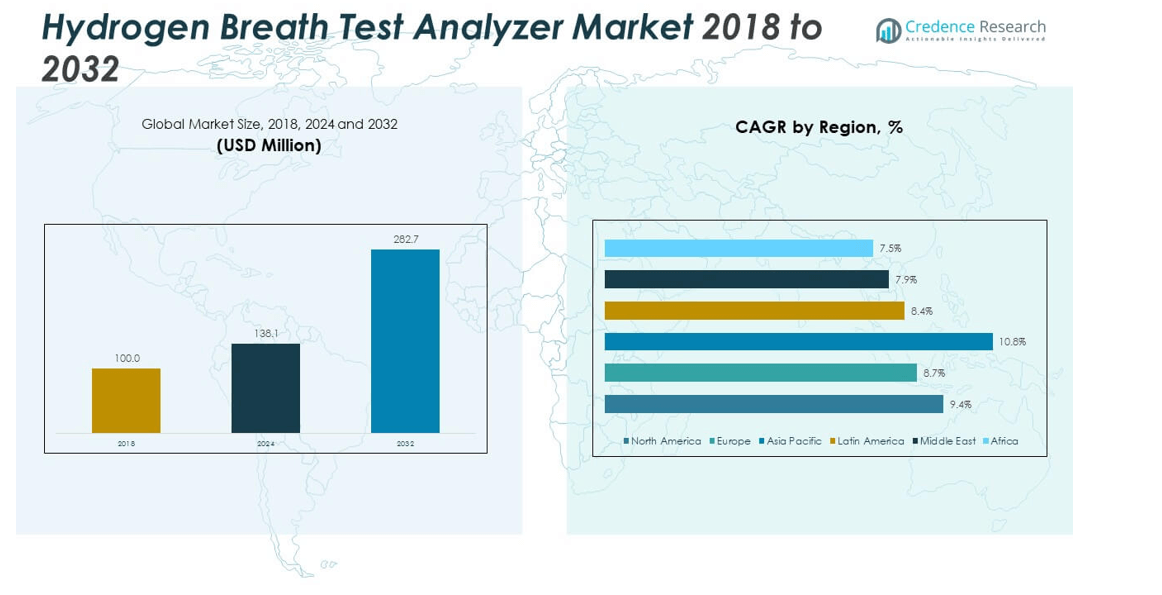
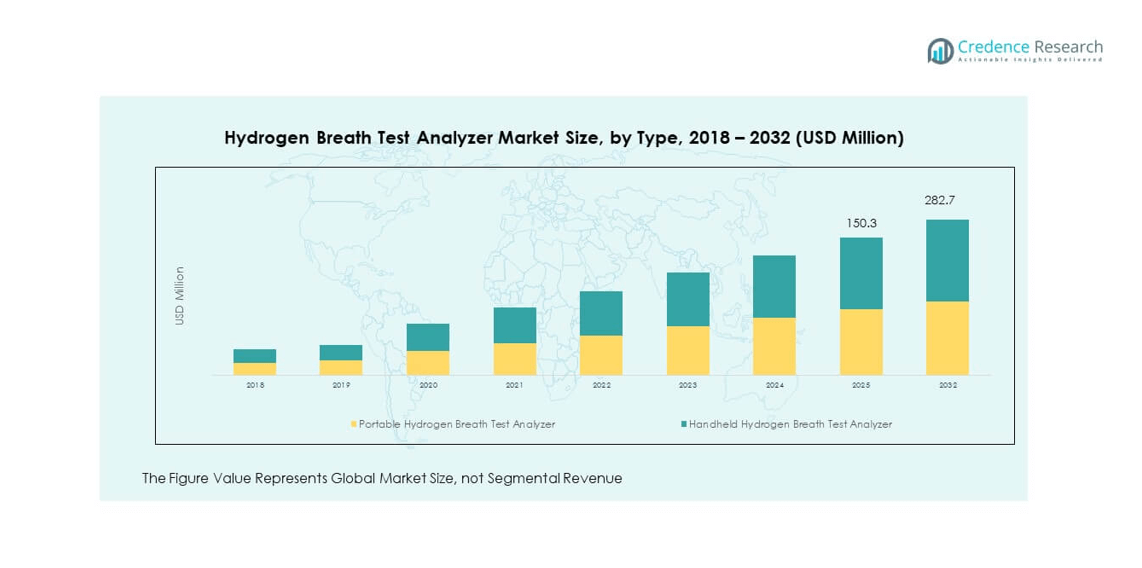
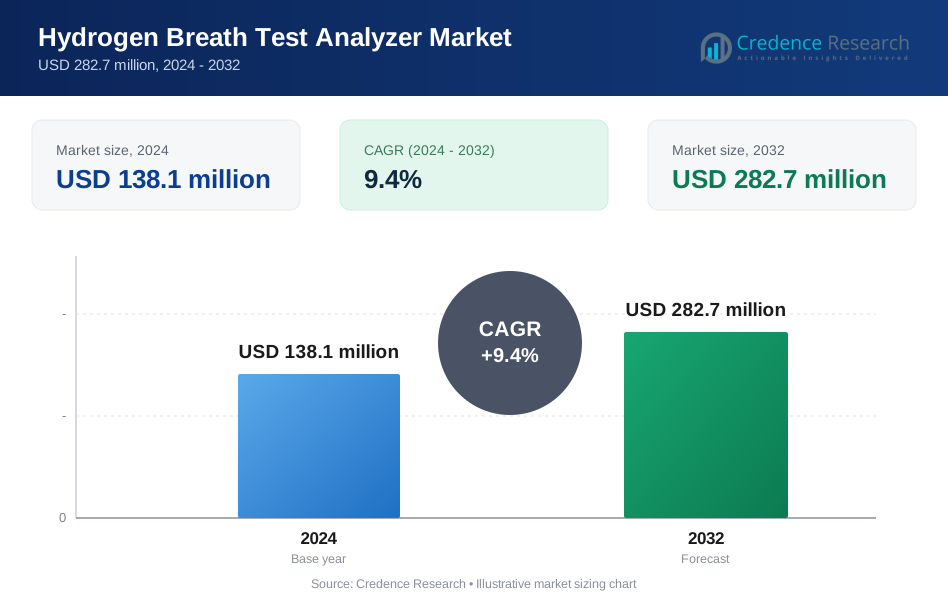
The Hydrogen Breath Test Analyzer Market size was valued at USD 100.0 million in 2018 to USD 138.1 million in 2024 and is anticipated to reach USD 282.7 million by 2032, at a CAGR of 9.4% during the forecast period.
| REPORT ATTRIBUTE | DETAILS |
|---|---|
| Historical Period | 2020-2023 |
| Base Year | 2024 |
| Forecast Period | 2025-2032 |
| Hydrogen Breath Test Analyzer Market Size 2024 | USD 138.1 million |
| Hydrogen Breath Test Analyzer Market, CAGR | 9.4% |
| Hydrogen Breath Test Analyzer Market Size 2032 | USD 282.7 million |
The market is witnessing strong growth due to rising awareness of gastrointestinal disorders, including lactose intolerance, small intestinal bacterial overgrowth (SIBO), and irritable bowel syndrome (IBS). Increasing adoption of non-invasive diagnostic tools is driving demand, as patients and clinicians prefer safer and quicker testing methods. Technological advancements have enhanced the accuracy, portability, and ease of use of hydrogen breath test analyzers, further boosting their adoption across hospitals, clinics, and diagnostic centers. In addition, growing healthcare spending and patient inclination toward early diagnosis support market expansion.
Geographically, North America leads the hydrogen breath test analyzer market due to advanced healthcare infrastructure and high prevalence of digestive disorders. Europe also holds a significant share, supported by robust diagnostic practices and adoption of modern diagnostic tools. The Asia-Pacific region is emerging as the fastest-growing market, fueled by increasing awareness, rising healthcare investments, and a growing patient pool. Countries such as China and India are expanding healthcare access and diagnostic capabilities, making the region a key growth hotspot. Meanwhile, Latin America and the Middle East are gradually adopting these analyzers, supported by improving healthcare facilities.
Market Insights:
- The Hydrogen Breath Test Analyzer Market was valued at USD 100.0 million in 2018, reached USD 138.1 million in 2024, and is projected to reach USD 282.7 million by 2032, at a CAGR of 9.4%.
- North America led with 37.9% share in 2024 due to advanced healthcare systems, Europe followed with 26.6% supported by strong diagnostic adoption, and Asia Pacific held 23.5% driven by expanding infrastructure.
- Asia Pacific is the fastest-growing region, supported by a 10.8% CAGR, fueled by urbanization, large patient pools, and rising investments in healthcare modernization.
- By type, handheld analyzers accounted for 58% of the market share in 2024, reflecting their portability and adoption in outpatient and clinical settings.
- Portable analyzers represented 42% in 2024, maintaining strong demand in hospitals for advanced diagnostic accuracy and structured workflows.
Market Drivers:
Rising Incidence of Gastrointestinal Disorders Increasing Diagnostic Demand
The Hydrogen Breath Test Analyzer Market benefits from the growing prevalence of gastrointestinal disorders worldwide. Patients diagnosed with lactose intolerance, irritable bowel syndrome, or small intestinal bacterial overgrowth require accurate diagnostic methods. Healthcare professionals are adopting these devices for their non-invasive nature and reliable results. Hospitals and diagnostic laboratories rely on analyzers to streamline testing procedures and ensure better patient outcomes. Growing awareness about early disease detection further supports adoption across both developed and emerging regions. The availability of portable and user-friendly analyzers expands accessibility for clinics and private practices. Patients prefer safer alternatives to invasive procedures, making hydrogen breath analyzers a preferred choice. Government initiatives supporting better diagnosis contribute to rising demand and long-term market growth.
- For example, QuinTron’s BreathTracker SC analyzer is widely used in hospitals and clinics for diagnosing gastrointestinal disorders such as lactose intolerance and SIBO. It measures hydrogen (2–150 ppm) and methane (2–75 ppm) with solid-state sensors, offers a rapid 1.5-minute analysis cycle, and features CO₂-based contamination detection to ensure accurate, non-invasive results.
Technological Advancements Improving Accuracy and Usability in Devices
The Hydrogen Breath Test Analyzer Market continues to expand due to rapid improvements in device technology. Manufacturers are integrating advanced sensors and software systems for better accuracy. New models ensure precise measurement of hydrogen levels in breath samples with minimal errors. Devices now offer portability, allowing clinics to perform tests without extensive laboratory setups. User-friendly interfaces help healthcare workers improve testing efficiency and reduce training requirements. Rising investment in research supports innovation and product diversification in this space. Remote monitoring and digital connectivity features improve clinical workflow for hospitals and specialized centers. Integration of smart data systems ensures healthcare professionals can analyze results effectively. These advancements strengthen adoption rates and drive long-term growth in demand.
- For example, Bedfont Scientific’s Gastrolyzer range uses electrochemical sensors and a full-colour touchscreen for portable hydrogen breath testing. It supports mouthpiece or facemask sampling, offers 0–500 ppm analysis, and includes calibration reminders, patient profile storage, and a user-friendly interface. Its ergonomic design and low maintenance make it ideal for hospitals and outpatient clinics.
Rising Patient Preference for Non-Invasive Diagnostic Approaches
The Hydrogen Breath Test Analyzer Market benefits from a strong shift toward non-invasive diagnostic tools. Patients increasingly avoid traditional invasive procedures that cause discomfort or carry risks. Breath analyzers offer painless, quick, and safe diagnostic outcomes for digestive issues. Doctors recommend such tests due to higher patient compliance and reduced complications. Non-invasive testing reduces overall healthcare costs by minimizing hospital stays and complex procedures. Growing demand from outpatient clinics reflects the rising role of patient-friendly diagnostics. Insurance providers support adoption by recognizing the cost-effective benefits of non-invasive solutions. Government healthcare reforms in several regions promote safer diagnostic tools across patient groups. This shift in patient behavior strengthens market penetration across multiple geographies.
Healthcare Spending and Expanding Infrastructure Fueling Market Adoption
The Hydrogen Breath Test Analyzer Market is witnessing support from expanding healthcare infrastructure and spending. Governments are investing in diagnostic centers and hospitals, increasing access to modern equipment. Rising income levels across emerging economies encourage higher healthcare expenditure by households. Private and public institutions prioritize accurate diagnostic systems to improve patient outcomes. Hospitals are expanding adoption of analyzers as part of broader diagnostic modernization strategies. Clinics and outpatient centers invest in portable analyzers to expand their service offerings. The rise of medical tourism in several countries also boosts adoption in private care facilities. Strong partnerships between manufacturers and healthcare providers improve supply chains and awareness. This environment ensures continued demand growth and expanded market presence across regions.
Market Trends:
Integration of Digital Technologies Enhancing Diagnostic Workflow
The Hydrogen Breath Test Analyzer Market shows increasing adoption of digital technology to streamline testing. Integration of cloud-based systems allows real-time storage and retrieval of test results. Healthcare providers utilize connected platforms to monitor and compare patient outcomes effectively. Devices equipped with Bluetooth and wireless connectivity improve data transfer to medical systems. Hospitals deploy integrated solutions that combine testing with electronic medical record platforms. The rise of telehealth services further supports digital adoption in diagnostic workflows. Data security measures are being strengthened to protect patient health records. Healthcare institutions invest in advanced IT infrastructure, making digital-enabled analyzers more attractive. This trend improves efficiency and patient experience across diagnostic facilities.
Portable Devices Supporting Decentralized and Outpatient Testing Expansion
The Hydrogen Breath Test Analyzer Market benefits from growing demand for portable testing solutions. Portable devices enable clinics, outpatient centers, and even small practices to perform reliable diagnostics. These systems eliminate dependence on large laboratories for accurate testing outcomes. Patients prefer accessible testing options that require less time and effort. The adoption of point-of-care devices ensures quicker diagnoses for digestive health issues. Manufacturers design compact analyzers that meet the needs of mobile and remote healthcare setups. Expansion of community healthcare centers in emerging economies fuels this trend. Portable analyzers also improve availability in rural areas with limited infrastructure. This trend widens market reach and enhances global accessibility for patients.
Strategic Collaborations Among Manufacturers and Healthcare Institutions
The Hydrogen Breath Test Analyzer Market is experiencing growth driven by partnerships between device makers and healthcare providers. Collaborations support clinical trials, product validation, and large-scale adoption programs. Hospitals work closely with manufacturers to test new technologies and refine product features. Joint efforts ensure devices meet safety, accuracy, and usability standards required by regulatory bodies. Industry alliances also promote awareness of hydrogen breath testing across healthcare professionals. Manufacturers leverage these partnerships to strengthen their global presence and distribution networks. Academic institutions play a role in researching new diagnostic applications and methods. Collaborative ecosystems accelerate innovation and improve trust in advanced diagnostic systems. This trend supports the broader adoption of analyzers across different healthcare environments.
- For example, Commonwealth Diagnostics International (CDI) provided hydrogen and methane breath test kits for multiple major clinical trials, including the FDA Phase III study with Salix Pharmaceuticals (2012–2014) for Rifaximin in IBS-D, where patients completed breath testing every two weeks over an eight-week regimen to monitor treatment efficacy.
Regulatory Standards and Guidelines Enhancing Product Reliability
The Hydrogen Breath Test Analyzer Market is shaped by evolving regulatory frameworks in healthcare diagnostics. Regulatory authorities enforce strict quality standards for device performance and patient safety. Companies must meet requirements for product approval before entering major markets. Compliance with ISO certifications strengthens product credibility and increases trust among healthcare providers. Hospitals prefer equipment backed by certifications to ensure reliability and reduce liability risks. Global harmonization of standards creates opportunities for broader market access. Regulatory bodies also promote patient education programs to encourage adoption of certified devices. These measures build confidence in non-invasive diagnostic technologies. Compliance-driven improvements strengthen long-term market stability and competitiveness.
- For example, Fischer Analysen Instrumente GmbH’s LactoFAN2 hydrogen breath test device is certified under EN ISO 13485, demonstrating compliance with internationally recognized standards for medical device quality management in breath testing diagnostics.
Market Challenges Analysis:
High Cost of Advanced Devices Restricting Broad Adoption
The Hydrogen Breath Test Analyzer Market faces challenges due to the high costs of advanced diagnostic devices. Smaller clinics and facilities in emerging economies struggle to afford modern analyzers. Price sensitivity in low-income regions limits adoption despite growing demand. Hospitals with restricted budgets often delay purchasing such specialized diagnostic equipment. The need for regular maintenance and calibration further adds to cost burdens. Manufacturers face difficulties in balancing affordability with advanced technology integration. Limited reimbursement policies in some countries reduce accessibility for patients. These challenges hinder market expansion and restrict opportunities for rapid adoption.
Lack of Skilled Professionals and Limited Awareness Hindering Growth
The Hydrogen Breath Test Analyzer Market also struggles with the shortage of trained professionals. Operating and interpreting results from analyzers require specialized skills. Many regions, especially rural areas, lack qualified healthcare workers for diagnostics. Low awareness among patients about the availability of non-invasive tests slows demand. Healthcare systems must invest in training and awareness campaigns to address this gap. Inconsistent knowledge among practitioners leads to underutilization of analyzers. Manufacturers need to provide comprehensive training to improve confidence in their devices. Limited knowledge dissemination across healthcare systems restricts wider market adoption. This challenge impacts both developed and emerging markets, creating uneven growth patterns.
Market Opportunities:
Rising Demand in Emerging Healthcare Economies Creating Growth Potential
The Hydrogen Breath Test Analyzer Market has significant opportunities in emerging healthcare economies. Countries with expanding healthcare infrastructure are actively adopting modern diagnostic devices. Rising disposable incomes increase patient spending on advanced diagnostic tools. Governments in these regions are investing in non-invasive diagnostic solutions to improve public health. Clinics and hospitals are rapidly expanding, creating demand for portable and affordable analyzers. Patients in urban areas show growing awareness of digestive health testing options. Medical tourism boosts demand for modern diagnostic equipment in private hospitals. These conditions create strong potential for market penetration across emerging economies.
Innovation and Product Development Expanding Application Scope
The Hydrogen Breath Test Analyzer Market offers opportunities through innovation and application expansion. Manufacturers are investing in research to develop devices with higher accuracy and connectivity. Expanding diagnostic applications beyond traditional digestive disorders opens new avenues. Smart diagnostic platforms integrated with data analytics enhance patient management. Devices compatible with telehealth systems strengthen their role in digital healthcare. Portable analyzers designed for home-based use expand market outreach. Strong emphasis on personalized healthcare supports adoption of analyzers in preventive medicine. Innovative designs and features make devices more accessible and user-friendly. These opportunities pave the way for long-term growth and competitive advantage.
Market Segmentation Analysis:
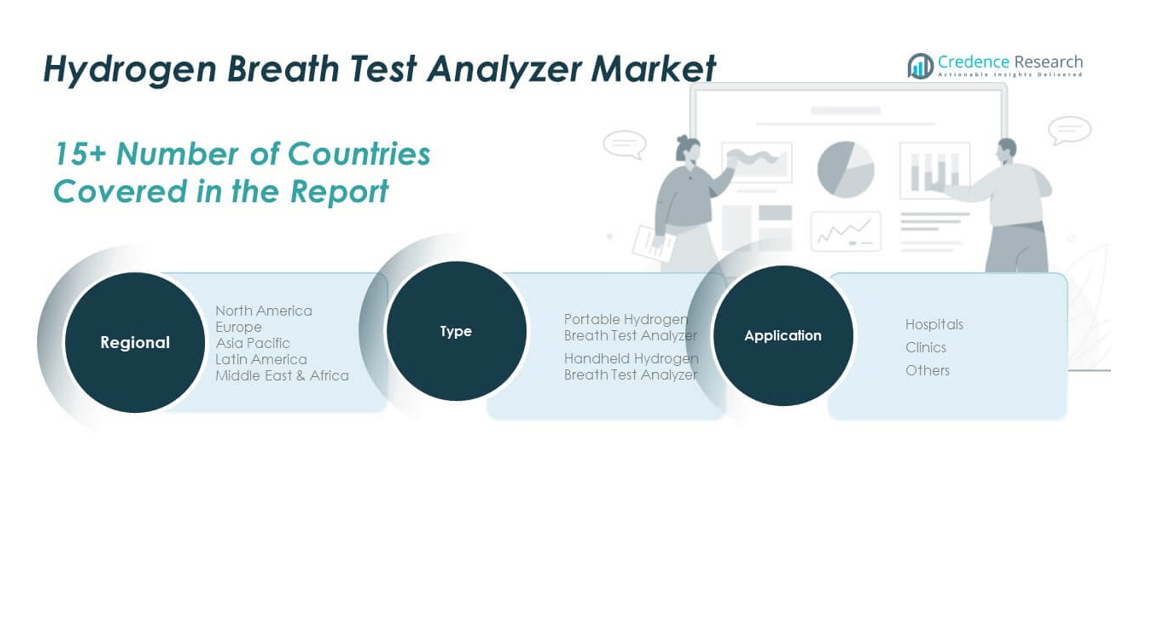
The Hydrogen Breath Test Analyzer Market is segmented
By type into portable and handheld devices. Portable analyzers dominate due to their adaptability in hospitals and large diagnostic centers. Handheld analyzers are gaining traction for point-of-care settings, offering convenience and ease of use. Both types meet the demand for non-invasive diagnostics, though portable devices remain favored for advanced clinical accuracy.
- For example, the Gastrogenius™ Breath Monitor by LABORIE is a portable desktop analyzer that measures hydrogen, methane, and oxygen in expired breath samples and is routinely used in hospital and specialized diagnostic center settings for advanced gastrointestinal testing.
By application, hospitals lead the adoption owing to high patient volumes and structured diagnostic facilities. Clinics are emerging as important users, supported by rising awareness of gastrointestinal diagnostics. The "others" segment, which includes research laboratories and specialized diagnostic centers, contributes steadily by serving niche testing requirements. Each application segment highlights the growing reliance on accurate, non-invasive testing methods.
- For example, FoodMarble’s AIRE® handheld hydrogen breathalyzer demonstrated utility in outpatient clinics for the diagnosis of SIBO and carbohydrate intolerance, supporting quick, non-invasive patient management at the clinic level in validation studies.
Segmentation:
By Type
- Portable Hydrogen Breath Test Analyzer
- Handheld Hydrogen Breath Test Analyzer
By Application
- Hospitals
- Clinics
- Others
By Region
- North America
- U.S.
- Canada
- Mexico
- Europe
- UK
- France
- Germany
- Italy
- Spain
- Russia
- Belgium
- Netherlands
- Austria
- Sweden
- Poland
- Denmark
- Switzerland
- Rest of Europe
- Asia Pacific
- China
- Japan
- South Korea
- India
- Australia
- Thailand
- Indonesia
- Vietnam
- Malaysia
- Philippines
- Taiwan
- Rest of Asia Pacific
- Latin America
- Brazil
- Argentina
- Peru
- Chile
- Colombia
- Rest of Latin America
- Middle East
- UAE
- KSA
- Israel
- Turkey
- Iran
- Rest of Middle East
- Africa
- Egypt
- Nigeria
- Algeria
- Morocco
- Rest of Africa
Regional Analysis:
North America
The North America Hydrogen Breath Test Analyzer Market size was valued at USD 38.4 million in 2018 to USD 52.4 million in 2024 and is anticipated to reach USD 107.2 million by 2032, at a CAGR of 9.4% during the forecast period. North America holds the largest market share of 37.9% in 2024, driven by advanced healthcare systems and strong adoption of diagnostic technologies. The U.S. leads regional growth due to high awareness of gastrointestinal disorders and the presence of established healthcare providers. Canada and Mexico are contributing with steady expansion through improved healthcare infrastructure. Hospitals remain primary adopters in this region, supported by favorable insurance coverage and reimbursement policies. The market benefits from strong investments in medical research and high patient awareness. Manufacturers actively collaborate with diagnostic centers to expand their reach. It demonstrates continued dominance, supported by mature regulatory frameworks and innovation-focused strategies.
Europe
The Europe Hydrogen Breath Test Analyzer Market size was valued at USD 27.7 million in 2018 to USD 36.8 million in 2024 and is anticipated to reach USD 71.3 million by 2032, at a CAGR of 8.7% during the forecast period. Europe represents 26.6% of the market share in 2024, supported by strong diagnostic adoption and established medical infrastructure. The UK, Germany, and France lead the region with rising demand for non-invasive diagnostic tools. Italy and Spain also contribute steadily, reflecting increasing awareness of gastrointestinal health. Hospitals dominate usage due to advanced clinical practices, while clinics expand adoption for outpatient care. Regulatory standards promote certified devices, ensuring reliability and safety across the market. Investment in preventive healthcare also drives uptake of hydrogen breath analyzers. The region shows consistent growth, fueled by established healthcare systems and patient preference for safe diagnostics.
Asia Pacific
The Asia Pacific Hydrogen Breath Test Analyzer Market size was valued at USD 22.5 million in 2018 to USD 32.5 million in 2024 and is anticipated to reach USD 73.8 million by 2032, at a CAGR of 10.8% during the forecast period. Asia Pacific holds 23.5% of the global share in 2024, making it the fastest-growing regional market. China, Japan, and India drive growth through expanding healthcare infrastructure and rising patient awareness. South Korea and Australia also contribute significantly with advanced diagnostic adoption. The region benefits from large patient pools requiring accurate diagnosis of digestive disorders. Rapid urbanization and increasing disposable income strengthen the demand for diagnostic tools. Governments are actively investing in modern healthcare infrastructure, expanding access to advanced technologies. Clinics and outpatient centers show rising adoption alongside hospitals. The region presents high potential, supported by dynamic economic and healthcare developments.
Latin America
The Latin America Hydrogen Breath Test Analyzer Market size was valued at USD 5.9 million in 2018 to USD 8.1 million in 2024 and is anticipated to reach USD 15.3 million by 2032, at a CAGR of 8.4% during the forecast period. Latin America accounts for 5.8% of the market share in 2024, showing steady growth supported by improving healthcare facilities. Brazil leads regional adoption with strong investment in private healthcare and medical tourism. Argentina follows with rising use of non-invasive diagnostics in urban centers. Smaller nations in the region are gradually increasing awareness and access. Hospitals adopt analyzers more actively, though clinics are becoming important growth contributors. Limited public sector funding creates reliance on private healthcare providers. Patient demand is increasing due to greater focus on digestive health. The region holds moderate growth potential with expanding adoption in larger economies.
Middle East
The Middle East Hydrogen Breath Test Analyzer Market size was valued at USD 3.5 million in 2018 to USD 4.5 million in 2024 and is anticipated to reach USD 8.2 million by 2032, at a CAGR of 7.9% during the forecast period. The Middle East represents 3.2% of the global share in 2024, supported by healthcare investments in GCC countries. Saudi Arabia and the UAE are leading with modern hospitals and growing patient awareness. Israel demonstrates strong adoption due to advanced healthcare research and infrastructure. Turkey is expanding demand with increasing diagnostic services and healthcare reforms. Hospitals remain the primary adopters, supported by government healthcare initiatives. Patient awareness campaigns on digestive health aid in expanding adoption. Clinics are gradually investing in portable analyzers to enhance diagnostic capabilities. The region shows steady growth potential through healthcare modernization and rising private sector investment.
Africa
The Africa Hydrogen Breath Test Analyzer Market size was valued at USD 2.1 million in 2018 to USD 3.8 million in 2024 and is anticipated to reach USD 6.9 million by 2032, at a CAGR of 7.5% during the forecast period. Africa accounts for 2.8% of the global share in 2024, reflecting gradual adoption of advanced diagnostics. South Africa leads the region with higher healthcare spending and better infrastructure. Egypt contributes with growing adoption in urban centers and private hospitals. Many countries face challenges in affordability and limited access to modern diagnostic equipment. The market relies on gradual expansion of clinics and private healthcare providers. Hospitals remain key users, though adoption is limited compared to other regions. Patient awareness is increasing, though uneven across rural and urban areas. Africa represents long-term potential with improvements in healthcare investment and diagnostic infrastructure.
Key Player Analysis:
- QuinTron Instrument Company
- MD Diagnostics Ltd.
- LABORIE
- FAN GmbH
- Bedfont Scientific
Competitive Analysis:
The Hydrogen Breath Test Analyzer Market is shaped by a mix of established manufacturers and specialized diagnostic solution providers. Key players include QuinTron Instrument, MD Diagnostics, LABORIE, FAN GmbH, and Bedfont Scientific, each focusing on innovation, product reliability, and global reach. Companies compete through advanced technologies that enhance accuracy, portability, and ease of use. It benefits from strong partnerships between manufacturers and healthcare institutions, supporting adoption in hospitals and clinics. Firms invest in research to expand applications and strengthen regulatory compliance. Product differentiation through user-friendly designs and digital connectivity features creates a competitive edge. Expansion into emerging economies remains a strategic focus, supported by collaborations with distributors and healthcare networks. The competitive environment reflects both steady innovation and aggressive regional expansion strategies, positioning leading companies to capture growth opportunities in the evolving diagnostic landscape.
Recent Developments:
- In July 2025, Bedfont Scientific Limited formed a partnership with Medvision for Medical Services Company in Kuwait, securing registration for its Gastrolyzer® range of hydrogen-methane breath testing devices to expand access to gastrointestinal diagnostics in the Middle East. This collaboration is expected to improve local availability and support for non-invasive breath testing technology in the region.
- In May 2025, LABORIE, a leading medical device manufacturer, expanded its gastrointestinal diagnostics portfolio through the acquisition of diagnostic product lines related to hydrogen breath testing. This strategic move signaled LABORIE’s enhanced focus on non-invasive diagnostic segments, particularly targeting the growing demand for hydrogen and methane breath testing in hospitals, clinics, and home-care settings.
Report Coverage:
The research report offers an in-depth analysis based on type and application. It details leading market players, providing an overview of their business, product offerings, investments, revenue streams, and key applications. Additionally, the report includes insights into the competitive environment, SWOT analysis, current market trends, as well as the primary drivers and constraints. Furthermore, it discusses various factors that have driven market expansion in recent years. The report also explores market dynamics, regulatory scenarios, and technological advancements that are shaping the industry. It assesses the impact of external factors and global economic changes on market growth. Lastly, it provides strategic recommendations for new entrants and established companies to navigate the complexities of the market.
Future Outlook:
- Growing adoption of non-invasive diagnostic tools is expected to increase demand in hospitals and clinics, where patient comfort and efficiency remain priorities.
- Rising awareness of gastrointestinal disorders will expand the global testing base, driving wider adoption of hydrogen breath analyzers across multiple regions.
- Advancements in portable and handheld analyzers will enhance accessibility for outpatient centers and smaller healthcare facilities, boosting market presence.
- Integration of digital connectivity and smart data systems will streamline result management, improve clinical efficiency, and strengthen diagnostic accuracy.
- Expanding healthcare infrastructure in emerging economies will create fresh opportunities for adoption, especially in urbanizing regions with increasing healthcare access.
- Strategic collaborations between manufacturers and healthcare institutions will help accelerate market penetration and ensure broader distribution of analyzers.
- Investments in research and development will expand diagnostic applications, moving beyond gastrointestinal testing into wider preventive healthcare areas.
- Strong regulatory frameworks will enhance device reliability, ensuring safety standards and building patient confidence in non-invasive diagnostics.
- Rising global healthcare spending will support adoption of advanced analyzers, allowing hospitals and clinics to modernize their diagnostic capabilities.
- Competition among key players will foster innovation, promote affordability, and support geographic expansion, sustaining long-term market growth.
Request a Free Sample
Fill in your details and we'll send you a free sample report.
- Sample data tables & charts
- Research methodology
Need a Custom Version of This Report?
Tailor the scope, geography, or segments to your exact requirements.
- Custom geography or segment scope
- Direct access to our analyst team
Frequently Asked Questions
What is the current market size for Hydrogen Breath Test Analyzer Market, and what is its projected size in 2032?
At what Compound Annual Growth Rate is the Hydrogen Breath Test Analyzer Market projected to grow between 2024 and 2032?
What are the primary factors fueling the growth of the Hydrogen Breath Test Analyzer Market?
Who are the leading companies in the Hydrogen Breath Test Analyzer Market?
Table of Content
Chapter 1. Report Introduction
- 1.1 Report Description & Purpose
- 1.1.1 Report Title & Market Definition
- 1.1.2 Unique Selling Propositions (USP) & Key Differentiators
- 1.1.3 Value Proposition for Stakeholders
- 1.2 Research Objectives
- 1.2.1 Market Sizing Objectives (Volume & Revenue)
- 1.2.2 Segmentation Objectives
- 1.2.3 Competitive Intelligence Objectives
- 1.2.4 Forecast & Scenario Objectives
- 1.3 Report Scope
- 1.3.1 Hydrogen Breath Test Analyzer Scope – Types & Subtypes Covered
- 1.3.2 Geographic Scope – Regions & Countries Covered
- 1.3.3 Historical Period, Base Year & Forecast Period (2024; forecast to 2032)
- 1.3.4 Inclusions & Exclusions
- 1.4 HS Code & Classification Framework
- 1.5 Currency, Units & Pricing Basis
- 1.6 Target Stakeholders
- 1.7 Limitations & Assumptions
Chapter 2. Executive Summary
- 2.1 Global Hydrogen Breath Test Analyzer Market Snapshot
- 2.1.1 Market Size – Historical (2024) & Forecast (2024-2032) (2024: USD 138.1 million → 2032: USD 282.7 million)
- 2.1.2 Volume & Revenue – Global Totals
- 2.1.3 Key Market Highlights – Top Five Facts
- 2.2 Hydrogen Breath Test Analyzer Market Segmentation Snapshot
- 2.2.1 Market Split by Region – 2024 vs. 2032
- 2.3 Competitive Snapshot
- 2.3.1 Top 10 Players by Revenue Share – 2024
- 2.3.2 Top 10 Players by Volume Share – 2024
- 2.3.3 Recent Strategic Developments (18-Month Summary)
- 2.4 Key Investment Highlights & Strategic Conclusions
Chapter 3. Hydrogen Breath Test Analyzer Market Dynamics & Industry Analysis
- 3.1 Market Overview & Context
- 3.1.1 Hydrogen Breath Test Analyzer Market Position in the Broader Automotive Value Chain
- 3.1.2 OEM vs. Replacement Market Dynamics
- 3.1.3 Market Maturity & Development Stage by Region
- 3.2 Hydrogen Breath Test Analyzer Market Drivers
- 3.3 Hydrogen Breath Test Analyzer Market Restraints & Challenges
- 3.4 Hydrogen Breath Test Analyzer Market Opportunities
- 3.5 Porter's Five Forces Analysis
- 3.5.1 Threat of New Entrants
- 3.5.2 Bargaining Power of Suppliers
- 3.5.3 Bargaining Power of Buyers
- 3.5.4 Threat of Substitutes
- 3.5.5 Competitive Rivalry – Intensity Assessment
- 3.6 Hydrogen Breath Test Analyzer Value Chain Analysis
- 3.6.1 Upstream – Raw Material/Input Suppliers
- 3.6.1.1 Raw Material/Input 1
- 3.6.1.2 Raw Material/Input 2
- 3.6.1.3 Raw Material/Input 3
- 3.6.2 Midstream – Production/Manufacturing/Service Delivery
- 3.6.2.1 Production/Process Overview
- 3.6.2.2 Key Facility Locations & Capacity by Manufacturer
- 3.6.3 Downstream – Distribution & End Consumer
- 3.6.3.1 Primary Channel – B2B/OEM
- 3.6.3.2 Secondary Channels – Dealer, Retail, Online, Direct
- 3.6.4 Value Chain Profitability Analysis
- 3.6.1 Upstream – Raw Material/Input Suppliers
- 3.7 PESTEL Analysis
- 3.7.1 Political Factors
- 3.7.2 Economic Factors
- 3.7.3 Social Factors
- 3.7.4 Technological Factors
- 3.7.5 Environmental Factors
- 3.7.6 Legal Factors
- 3.8 Hydrogen Breath Test Analyzer Supply Chain Analysis
- 3.8.1 Raw Material/Input Supply Risk Assessment
- 3.8.2 Manufacturing Concentration Risk (Geographic Exposure)
- 3.8.3 Trade Disruption Impact Analysis
- 3.9 Regulatory & Policy Landscape
Note: The regulatory and policy landscape section covers regulations based on their applicability to the market, Hydrogen Breath Test Analyzer category, geography, and scope of the study. Only regulatory frameworks with a material impact on operations, compliance, trade, sustainability, or market access are analyzed in detail.
Chapter 4. Key Investment Pockets & Opportunity Analysis
- 4.1 Hydrogen Breath Test Analyzer Market Attractiveness Analysis
- 4.1.1 By Region – Investment Attractiveness Matrix (Volume × CAGR)
- 4.2 Absolute Revenue Growth Opportunity
- 4.2.1 By Region – Absolute USD Growth Through 2032
- 4.3 Incremental Volume Opportunity
- 4.3.1 By Region – Incremental Volume Through 2032
- 4.3.2 Segment – Incremental Volume
- 4.4 Emerging Submarket Opportunity Deep Dive (Subject to Applicability)
- 4.5 Emerging Market Opportunity Scorecards
- 4.5.1 United States
- 4.5.2 Europe
- 4.5.3 Asia
- 4.5.4 Middle East & Africa
Note: Emerging Market Opportunity Scorecards will be included based on relevance and strategic importance. Regions listed are indicative and may vary depending on data availability and market dynamics.
Chapter 5. Hydrogen Breath Test Analyzer Import-Export Analysis & Trade Flows
- 5.1 Global Trade Overview
- 5.1.1 Global Export Value by Country (2024)
- 5.1.2 Global Export Volume by Country (2024)
- 5.1.3 Global Import Value by Country (2024)
- 5.1.4 Global Import Volume by Country (2024)
- 5.1.5 Net Trade Balance by Country (2024)
- 5.2 Export Analysis – Segment
- 5.2.1 Type 1 (HS Code)
- 5.2.2 Type 2 (HS Code)
- 5.2.3 Type 3 (HS Code)
- 5.2.4 Type 4 (HS Code)
- 5.2.5 Type 5 (HS Code)
- 5.3 Import Analysis – Segment
- 5.3.1 Type 1 (HS Code)
- 5.3.2 Type 2 (HS Code)
- 5.3.3 Type 3 (HS Code)
- 5.3.4 Type 4 (HS Code)
- 5.3.5 Type 5 (HS Code)
- 5.4 Average Unit Trade Prices
- 5.4.1 Average Export Price – Segment & Country
- 5.4.2 Average Import Price – Segment & Source Country
- 5.4.3 Price Trends (2024)
- 5.5 Key Trade Route Analysis
- 5.5.1 Trade Route 1
- 5.5.2 Trade Route 2
- 5.5.3 Trade Route 3
- 5.5.4 Trade Route 4
- 5.5.5 Trade Route 5
- 5.6 Trade Policy Impact Assessment
- 5.6.1 US Anti-Dumping & Section 301 Tariffs
- 5.6.2 EU Customs Union Impact
- 5.6.3 Major Free Trade Agreements
- 5.6.4 USMCA Rules of Origin
Note: Trade policy analysis will be included only where relevant to the Hydrogen Breath Test Analyzer market.
Chapter 6. Competitive Landscape & Company Benchmarking
- 6.1 Hydrogen Breath Test Analyzer Market Concentration & Structure
- 6.1.1 Herfindahl-Hirschman Index (HHI) – vs. 2024
- 6.1.2 Tier 1, Tier 2 & Tier 3 Market Structure
- 6.1.3 Global, Regional & Local Player Dynamics
- 6.2 Hydrogen Breath Test Analyzer Market Share Analysis – 2024
- 6.2.1 Global Revenue Share by Company
- 6.2.2 Global Volume Share by Company
- 6.2.3 Regional Revenue Share
- 6.2.4 Market Share Evolution ( vs. 2024)
- 6.2.5 OEM Segment Share by Company
- 6.2.6 Replacement Segment Share by Company
- 6.3 Production/Delivery Capacity & Facility Analysis
- 6.3.1 Global Installed Capacity
- 6.3.2 Capacity Utilization Rates
- 6.3.3 Production/Output Volume
- 6.3.4 Facility Locations & Capacity Map
- 6.3.5 Planned Capacity Additions
- 6.4 Hydrogen Breath Test Analyzer Competitive Benchmarking Matrix
- 6.4.1 Revenue, Volume, CAGR & Profitability Comparison
- 6.4.2 Channel Revenue Mix
- 6.4.3 Geographic Revenue Exposure
- 6.4.4 R&D Intensity
- 6.4.5 Sustainability Maturity
- 6.5 Strategic Developments in Hydrogen Breath Test Analyzer (Last 24 Months)
- 6.5.1 Mergers, Acquisitions & Divestments
- 6.5.2 New Hydrogen Breath Test Analyzer Launches
- 6.5.3 Facility Expansions
- 6.5.4 Strategic Alliances, Joint Ventures & Partnerships
- 6.5.5 Distribution Expansion & Market Entry
- 6.5.6 Sustainability & ESG Initiatives
- 6.6 Competitive Strategy Mapping
- 6.6.1 Leader, Challenger, Follower & Niche Classification
- 6.6.2 Pricing Strategy Comparison
- 6.6.3 Channel Strategy Matrix
Note: Strategic developments are included based on their materiality and the availability of reliable information.
Chapter 7. Global Hydrogen Breath Test Analyzer Market – By Distribution Channel
- 7.1 Segment Overview
- 7.1.1 Volume & Revenue Split by Channel (2024 & 2032)
- 7.1.2 Channel Mix Evolution (2024-2032)
Chapter 8. Regional Market Analysis – Global Overview
- 8.1 Global Regional Overview
- 8.1.1 Regional Volume Share
- 8.1.2 Regional Revenue Share
- 8.1.3 Regional Volume by Region
- 8.1.4 Regional Revenue by Region
- 8.1.5 Regional Forecast Through 2032
- 8.2 Cross-Regional Segment Analysis
- 8.2.1 By Distribution Channel
- 8.2.2 By Brand/Price Tier
Chapter 9. North America Hydrogen Breath Test Analyzer Market
- 9.1 United States
- 9.2 Canada
- 9.3 Mexico
Chapter 10. Europe Hydrogen Breath Test Analyzer Market
- 10.1 Germany
- 10.2 France
- 10.3 Italy
- 10.4 United Kingdom
- 10.5 Spain
- 10.6 Poland
- 10.7 Russia
- 10.8 Netherlands
- 10.9 Belgium
- 10.10 Sweden
- 10.11 Denmark
- 10.12 Norway
- 10.13 Rest of Europe
Chapter 11. Asia Pacific Hydrogen Breath Test Analyzer Market
- 11.1 China
- 11.2 India
- 11.3 Japan
- 11.4 South Korea
- 11.5 Thailand
- 11.6 Indonesia
- 11.7 Vietnam
- 11.8 Malaysia
- 11.9 Australia
- 11.10 Rest of Asia Pacific
Chapter 12. Latin America Hydrogen Breath Test Analyzer Market
- 12.1 Brazil
- 12.2 Argentina
- 12.3 Colombia
- 12.4 Chile
- 12.5 Rest of Latin America
Chapter 13. Middle East Hydrogen Breath Test Analyzer Market
- 13.1 Saudi Arabia
- 13.2 United Arab Emirates
- 13.3 Turkey
- 13.4 Israel
- 13.5 Iran
- 13.6 Rest of the Middle East
Chapter 14. Africa Hydrogen Breath Test Analyzer Market
- 14.1 South Africa
- 14.2 Egypt
- 14.3 Nigeria
- 14.4 Morocco
- 14.5 Rest of Africa
Chapter 15. Hydrogen Breath Test Analyzer Company Profiles
- 15.1 [Company 01]
- 15.1.1 Company Overview
- 15.1.2 Key Management Personnel
- 15.1.3 Products & Services Portfolio
- 15.1.4 Financial Performance
- 15.1.5 Key Market Focus & Geographic Presence
- 15.1.6 Recent Developments & Strategic Initiatives
Note: The company profile list is preliminary and may change based on research findings, market developments, data availability, and client requirements.
Chapter 16. Appendices
- Appendix A – List of Abbreviations & Acronyms
- Appendix B – Industry Classification Code Reference – Full Series
- Appendix C – Production & Capacity Data Tables
- Appendix D – End-Use & Demand Base Tables
- Appendix E – Consumption & Replacement Rate Assumptions
- Appendix F – ASP Reference Tables
- Appendix G – Manufacturing & Facility Database
- Appendix H – Import-Export Data Tables
- Appendix I – Regulatory Summary Tables
- Appendix J – Primary Research Participant List (Anonymized)
- Appendix K – Primary Research Questionnaire Framework
- Appendix L – Data Sources & Bibliography
- Appendix M – Market Size Divergence & Source Comparison
Chapter 17. Research Methodology
- 17.1 Research Framework & Philosophy
- 17.2 Secondary Research – Sources, Hierarchy & Data Extraction
- 17.3 Data Modeling – Bottom-Up & Top-Down Market Sizing
- 17.4 Primary Research – Stakeholder Framework, LOI & Sample Sizes
- 17.5 Forecast Methodology – Regression, Scenario & Sensitivity Analysis
- 17.6 Quality Control – Four-Layer Validation Framework
- 17.7 Limitations & Standard Assumptions
- 17.8 Disclaimer
