
Market Overview
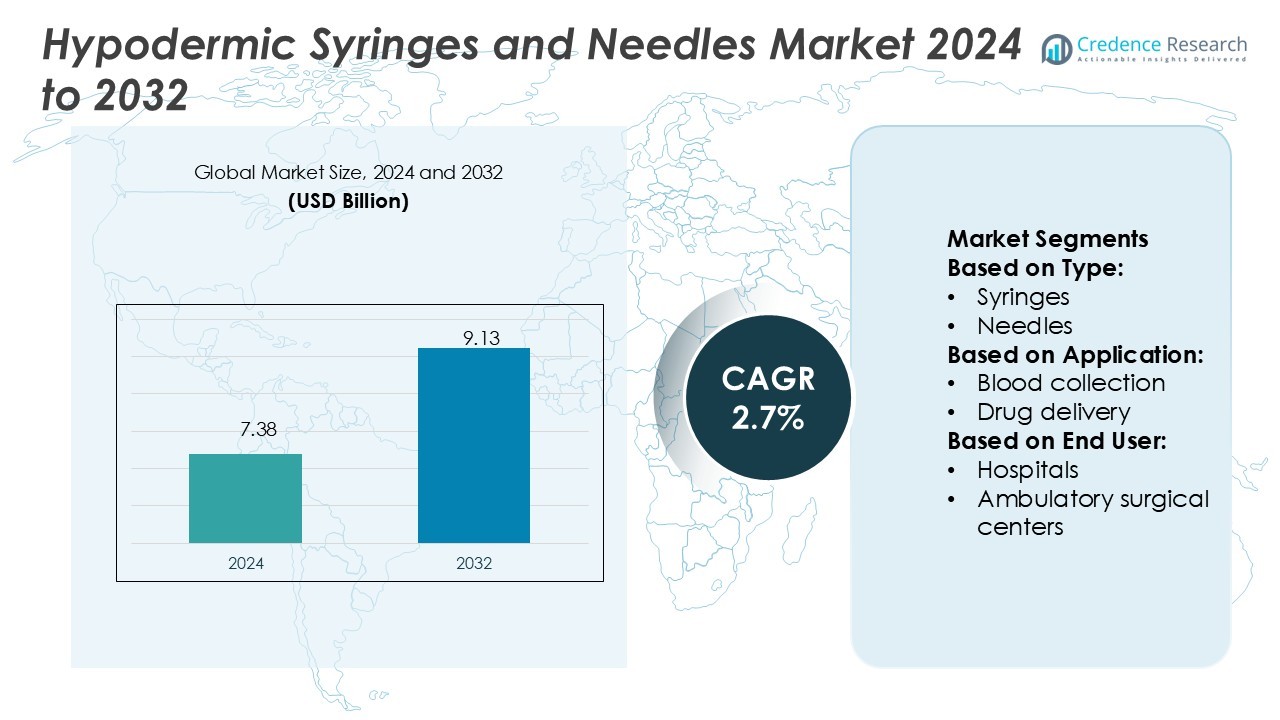
Hypodermic Syringes and Needles Market size was valued USD 7.38 billion in 2024 and is anticipated to reach USD 9.13 billion by 2032, at a CAGR of 2.7% during the forecast period.
| REPORT ATTRIBUTE | DETAILS |
|---|---|
| Historical Period | 2020-2023 |
| Base Year | 2024 |
| Forecast Period | 2025-2032 |
| Hypodermic Syringes and Needles Market Size 2024 | USD 7.38 Billion |
| Hypodermic Syringes and Needles Market, CAGR | 2.7% |
| Hypodermic Syringes and Needles Market Size 2032 | USD 9.13 Billion |
The hypodermic syringes and needles market is shaped by prominent players such as BD (Becton, Dickinson and Company), B. Braun, Abbott, Cardinal Health, Catalent, ICU Medical, EXEL, HI-TECH MEDICS, DeRoyal, and Connecticut Hypodermics. These companies strengthen their positions through innovation, safety-focused product development, and expansion of global distribution networks. BD and B. Braun lead with advanced safety-engineered devices, while Cardinal Health and Abbott focus on large-scale supply chains. Catalent drives growth in prefilled syringe manufacturing, supporting biologics and vaccine delivery. Regionally, North America dominates the market with 35% share, driven by strong healthcare infrastructure, high chronic disease prevalence, and widespread adoption of safety-compliant injection solutions.
Market Insights
- The hypodermic syringes and needles market size was valued at USD 7.38 billion in 2024 and is projected to reach USD 9.13 billion by 2032, growing at a CAGR of 2.7%.
- Rising chronic disease prevalence, increasing vaccination programs, and the shift toward safety-engineered devices remain key drivers supporting steady demand across hospitals and outpatient care.
- Prefilled syringes, disposable formats, and home healthcare adoption represent strong trends, with prefilled syringes gaining share due to biologics and vaccine delivery.
- The competitive landscape is defined by players such as BD, B. Braun, Abbott, Cardinal Health, and Catalent, with innovation, regulatory compliance, and global distribution networks shaping market positioning.
- North America leads with 35% share, supported by advanced healthcare infrastructure and high adoption of safety devices, while syringes hold over 55% of the type segment share, maintaining dominance due to their broad use in drug delivery and immunization.
Market Segmentation Analysis:
By Type
The syringes segment dominates the hypodermic syringes and needles market with over 55% share. Their leadership is driven by widespread use in drug delivery, vaccinations, and diagnostic procedures. The integration of prefilled syringes and safety-engineered designs enhances convenience and minimizes infection risks. Needles continue to hold a strong presence, but rising concerns over accidental needle-stick injuries and demand for minimally invasive devices are encouraging adoption of advanced syringe formats. Increasing global immunization programs and chronic disease prevalence sustain syringes as the leading product category.
- For instance, Catalent’s Brussels facility operates high-speed aseptic filling lines for prefilled syringes, with reported annual capacities of over 200 million units for large-scale drug delivery programs.
By Application
Drug delivery represents the dominant application, accounting for more than 40% market share. This is fueled by the rising use of injectables in chronic disease treatments such as diabetes, cancer, and cardiovascular conditions. The growing preference for biologics and biosimilars further supports higher demand for hypodermic devices. Insulin administration also drives steady growth, particularly in regions with rising diabetes prevalence. Blood collection and vaccination applications remain vital, supported by routine diagnostic practices and government-led immunization campaigns, but drug delivery continues to lead due to its wider, recurrent use across therapeutic areas.
- For instance, ICU Medical’s Plum 360 infusion system supports comprehensive drug libraries with up to 2,500 medications and delivers medication with an accuracy of ±5% for most flow rates. The system, recognized for its safety features, supports millions of safe infusions annually in hospital drug delivery applications.
By End User
Hospitals are the leading end user, holding over 50% of the market share. Their dominance is supported by high patient inflow, extensive use of syringes and needles in surgeries, diagnostics, and therapeutic care. Ambulatory surgical centers also contribute significantly, driven by rising demand for minimally invasive procedures. Diagnostic centers play a growing role due to increasing emphasis on preventive healthcare and routine blood testing. Other end-use settings, including clinics and home care, are expanding steadily as self-administration of medications grows. However, hospitals remain the primary growth driver due to large-scale procurement and standardized medical practices.
Key Growth Drivers
Rising Prevalence of Chronic Diseases
The increasing incidence of chronic conditions such as diabetes, cancer, and cardiovascular disorders fuels the demand for hypodermic syringes and needles. Frequent medication administration, blood sampling, and long-term injectable therapies drive consistent usage in healthcare facilities. The growing burden of lifestyle-related illnesses worldwide ensures sustained adoption, with insulin administration alone accounting for a significant portion of demand. Expanding access to healthcare in emerging economies further amplifies consumption, positioning chronic disease management as a primary driver for market growth.
- For instance, Cardinal Health’s Insulin Safety Syringes offer graduations at 0.01 mL increments and employ a permanently attached needle to minimize dead space, enabling precise dosing with low residual volume after injection.
Expansion of Immunization Programs
Government-led immunization campaigns and global vaccination drives significantly contribute to market growth. Programs targeting infectious diseases such as influenza, hepatitis, and measles require large-scale syringe and needle usage. The COVID-19 pandemic further highlighted the critical role of reliable injection devices in mass vaccination efforts. Continued focus on preventive healthcare, coupled with international partnerships promoting immunization in developing regions, sustains high demand. The adoption of auto-disable syringes in vaccination programs also drives market expansion by ensuring safety and preventing reuse.
- For instance, DeRoyal’s 12 mL angiographic control syringe uses a three-ring plunger geometry, includes a 0.5 mL reservoir on the plunger tip, and maintains a smooth operation across its stroke length to ensure consistent pressure delivery in interventional procedures.
Advancements in Safety-Engineered Devices
The adoption of safety-engineered syringes and needles is accelerating due to stringent regulations and healthcare worker safety concerns. These devices help reduce the risk of needle-stick injuries and cross-contamination, which remain significant challenges in medical environments. Technological innovations, such as retractable needles and prefilled syringes, improve both safety and efficiency in clinical settings. Hospitals and diagnostic centers increasingly prefer such devices to meet compliance standards and enhance patient care. This shift toward safety-focused products positions innovation as a core driver for market penetration.
Key Trends & Opportunities
Rising Demand for Prefilled Syringes
Prefilled syringes are gaining popularity due to their convenience, accuracy, and reduced contamination risks. Pharmaceutical companies are increasingly packaging biologics and vaccines in prefilled formats, which streamline administration and minimize dosing errors. This trend supports both hospital and home care use, particularly in chronic disease management. As self-administration of drugs grows, demand for prefilled syringes offers significant opportunities for manufacturers to strengthen their product portfolios and capture long-term growth in the evolving healthcare landscape.
- For instance, BD’s Sterifill Advance™ polymer prefillable syringe has been validated for manual injections in 5, 10, and 20 mL formats and for pump-based infusions at 20 and 50 mL volumes, ensuring smooth compatibility with electric syringe pumps.
Growing Shift Toward Home Healthcare
The rise in home healthcare and self-administration of injectable drugs is reshaping market demand. Patients managing conditions such as diabetes and autoimmune disorders increasingly prefer administering medications at home, supported by user-friendly and disposable syringe and needle designs. This shift reduces hospital dependency and improves patient convenience. Manufacturers developing compact, safe, and easy-to-use injection devices can leverage this opportunity to tap into the expanding home care segment, which is expected to grow rapidly in both developed and emerging markets.
- For instance, Connecticut Hypodermics offers a wide range of stainless steel tubing, including large-gauge sizes such as 6RW and 6TW. The company manufactures these and other sizes for precision hypodermic needles and related medical components, which are deployed across a variety of medical applications.
Key Challenges
Risk of Needle-Stick Injuries
Despite technological advances, needle-stick injuries remain a persistent challenge in the medical sector. Such incidents expose healthcare workers to bloodborne pathogens, increasing occupational health risks and raising liability concerns for healthcare providers. The issue also drives higher compliance costs as institutions invest in safety-engineered products. Limited awareness and inconsistent adoption in low-resource settings further compound the challenge. Addressing this requires broader regulatory enforcement, training, and availability of affordable safety devices.
Environmental and Disposal Concerns
Improper disposal of syringes and needles creates significant environmental and public health risks. Medical waste management systems in many regions remain underdeveloped, leading to unsafe recycling and accidental reuse. Regulatory frameworks mandate safe disposal, but compliance varies widely across geographies. Growing scrutiny over plastic waste and sustainability pressures are also pushing manufacturers to explore eco-friendly alternatives. Balancing safety, affordability, and environmental responsibility presents a key challenge that could slow market adoption without innovative waste management solutions.
Regional Analysis
North America
North America holds a leading position in the hypodermic syringes and needles market with over 35% share. The region’s dominance is supported by a high prevalence of chronic diseases, advanced healthcare infrastructure, and strong regulatory compliance. Widespread adoption of safety-engineered syringes, coupled with large-scale vaccination programs, strengthens growth. The United States drives the majority of demand, with increasing use in diabetes management and biologics delivery. Favorable reimbursement policies and strict occupational safety regulations further enhance market penetration. Canada contributes significantly through public health initiatives, ensuring steady demand across both hospital and outpatient care settings.
Europe
Europe accounts for nearly 30% of the global hypodermic syringes and needles market share. The region benefits from robust healthcare systems, strong regulatory frameworks, and rising demand for safety-engineered devices. Germany, France, and the United Kingdom lead consumption, driven by growing chronic disease prevalence and high immunization rates. Strict compliance with EU directives regarding medical device safety fosters rapid adoption of retractable and auto-disable syringes. Additionally, investments in biologics and biosimilar drugs fuel demand for prefilled syringes. Expansion of outpatient care services and rising focus on preventive healthcare further support market growth across European countries.
Asia-Pacific
Asia-Pacific represents the fastest-growing region, holding over 25% share of the hypodermic syringes and needles market. Rapid population growth, rising chronic disease cases, and government-led immunization programs drive expansion. Countries such as China, India, and Japan lead adoption due to increasing healthcare investments and expanding pharmaceutical industries. The prevalence of diabetes and infectious diseases further boosts syringe demand. Low manufacturing costs and large-scale production capabilities make the region a key supplier to global markets. Growing demand for disposable and safety syringes, coupled with expanding home healthcare adoption, positions Asia-Pacific as a crucial growth hub.
Latin America
Latin America contributes nearly 6% of the global market share, supported by expanding healthcare access and rising vaccination campaigns. Brazil and Mexico lead regional adoption, driven by government immunization programs and increasing awareness of infection control practices. Growing investments in public healthcare infrastructure and rising chronic disease prevalence, particularly diabetes, strengthen demand. However, challenges in regulatory compliance and uneven adoption of safety syringes limit faster penetration. The shift toward disposable syringes and rising partnerships with global medical device manufacturers present opportunities for expansion, especially as healthcare spending continues to increase in key countries.
Middle East & Africa (MEA)
The Middle East & Africa region accounts for close to 4% of the market share, with gradual growth driven by rising healthcare investments and public health initiatives. Gulf countries, including Saudi Arabia and the UAE, dominate regional demand due to advanced healthcare facilities and higher adoption of modern injection devices. In Africa, vaccination programs supported by global health organizations sustain syringe consumption, though limited infrastructure and affordability issues remain key barriers. Increasing incidence of infectious diseases and government focus on expanding healthcare access create growth opportunities for affordable, safety-engineered syringe and needle solutions.
Market Segmentations:
By Type:
- Syringes
- Needles
By Application:
- Blood collection
- Drug delivery
By End User:
- Hospitals
- Ambulatory surgical centers
By Geography
- North America
- U.S.
- Canada
- Mexico
- Europe
- Germany
- France
- U.K.
- Italy
- Spain
- Rest of Europe
- Asia Pacific
- China
- Japan
- India
- South Korea
- South-east Asia
- Rest of Asia Pacific
- Latin America
- Brazil
- Argentina
- Rest of Latin America
- Middle East & Africa
- GCC Countries
- South Africa
- Rest of the Middle East and Africa
Competitive Landscape
The competitive landscape of the hypodermic syringes and needles market is shaped by leading players including Catalent, ICU Medical, EXEL, HI-TECH MEDICS, Cardinal Health, Abbott, DeRoyal, BD (Becton, Dickinson and Company), Connecticut Hypodermics, and B. Braun. The hypodermic syringes and needles market is highly competitive, driven by innovation, regulatory standards, and expanding healthcare demand. Manufacturers focus on developing safety-engineered devices to minimize needle-stick injuries and enhance patient care. The growing preference for disposable and prefilled syringes is reshaping market strategies, with strong emphasis on automation, precision, and compliance with international safety guidelines. Companies are also investing in sustainable manufacturing practices and eco-friendly designs to address environmental concerns related to medical waste. Strategic partnerships, capacity expansions, and regional distribution agreements further define the competitive environment, ensuring wider market reach and stronger positioning.
Key Player Analysis
- Catalent
- ICU Medical
- EXEL
- HI-TECH MEDICS
- Cardinal Health
- Abbott
- DeRoyal
- BD (Becton, Dickinson and Company)
- Connecticut Hypodermics
- Braun
Recent Developments
- In January 2025, Terumo launched the Injection Filter Needle, featuring an integrated 5-micron filter to prevent particulate transfer in hypodermic and intravitreal injections.
- In May 2024, Gerresheimer, one of the healthcare and pharmaceutical packaging companies based in Germany, expanded its Queretaro capacity of ready-to-fill (RTF) syringes in Mexico.
- In March 2024, SCHOTT Pharma built its first U.S. facility to manufacture pre-fillable polymer syringes required to meet the need for deep-cold storage and transportation of mRNA medications.
- In March 2024, Hindustan Syringes and Medical Devices (HMD), one of the leading providers of auto-disable and disposable syringes, launched Dispojekt, an indigenous single-use safety syringe to minimize instances of needle stick injuries.
Report Coverage
The research report offers an in-depth analysis based on Type, Application, End-User and Geography. It details leading market players, providing an overview of their business, product offerings, investments, revenue streams, and key applications. Additionally, the report includes insights into the competitive environment, SWOT analysis, current market trends, as well as the primary drivers and constraints. Furthermore, it discusses various factors that have driven market expansion in recent years. The report also explores market dynamics, regulatory scenarios, and technological advancements that are shaping the industry. It assesses the impact of external factors and global economic changes on market growth. Lastly, it provides strategic recommendations for new entrants and established companies to navigate the complexities of the market.
Future Outlook
- The market will continue growing due to the rising prevalence of chronic diseases.
- Demand for safety-engineered syringes will increase with stricter healthcare safety regulations.
- Prefilled syringes will gain traction as biologics and biosimilars become more common.
- Home healthcare adoption will expand, driving demand for user-friendly injection devices.
- Vaccination programs will remain a major growth driver across developing and developed regions.
- Manufacturers will focus on sustainable syringe designs to address disposal challenges.
- Emerging markets will witness strong growth supported by healthcare infrastructure development.
- Technological innovation will improve efficiency and reduce risks of needle-stick injuries.
- Strategic collaborations and partnerships will expand global distribution networks.
- Competitive pressure will drive continuous product upgrades and cost-effective solutions.

Request a Free Sample
Fill in your details and we'll send you a free sample report.
- Sample data tables & charts
- Research methodology
Market Dynamics
Rising Prevalence of Chronic Diseases
The increasing incidence of chronic conditions such as diabetes, cancer, and cardiovascular disorders drives the need for frequent medication administration and blood sampling, fueling steady demand for hypodermic syringes and needles in healthcare facilities worldwide.
Expansion of Immunization Programs
Government-led vaccination campaigns and global immunization initiatives require large-scale use of syringes and needles, especially highlighted during the COVID-19 pandemic, sustaining high market demand and supporting growth in both developed and emerging regions.
Advancements in Safety-Engineered Devices
Stringent regulations and healthcare worker safety concerns are accelerating the adoption of safety-engineered syringes and needles, such as retractable and auto-disable devices, reducing needle-stick injuries and cross-contamination risks, and driving market penetration.
Growth in Prefilled Syringes and Home Healthcare
The shift toward prefilled syringes for biologics and vaccines, along with the rise in home healthcare and self-administration of injectable drugs, is increasing demand for user-friendly, disposable, and accurate injection devices, expanding the market beyond traditional hospital settings.
Healthcare Infrastructure Development in Emerging Markets
Rapid improvements in healthcare infrastructure, increased healthcare spending, and expanding access to medical services in Asia Pacific, Latin America, and parts of Africa are boosting the adoption of hypodermic syringes and needles, making these regions key growth contributors.
Need a Custom Version of This Report?
Tailor the scope, geography, or segments to your exact requirements.
- Custom geography or segment scope
- Direct access to our analyst team
Frequently Asked Questions
What is the current market size for Hypodermic Syringes and Needles Market, and what is its projected size in 2032?
At what Compound Annual Growth Rate is the Hypodermic Syringes and Needles Market projected to grow between 2025 and 2032?
Which Hypodermic Syringes and Needles Market segment held the largest share in 2024?
What are the primary factors fueling the growth of the Hypodermic Syringes and Needles Market?
Who are the leading companies in the Hypodermic Syringes and Needles Market?
Which region commanded the largest share of the Hypodermic Syringes and Needles Market in 2024?
Table of Content
Chapter 1 Market Segmentation
- 1.1 Segmentation Framework
- 1.1.1 Product and Service Classification
- 1.1.2 Application and End-Use Classification
- 1.1.3 Technology and Solution Classification
- 1.1.4 Customer and Distribution Channel Classification
- 1.1.5 Geographic Segmentation
- 1.1.6 Market Segment Definitions and Boundaries
- 1.2 By Type
- 1.2.1 Syringes
- 1.2.2 Needles
- 1.3 By End User
- 1.3.1 Hospitals
- 1.3.2 Ambulatory surgical centers
- 1.3.3 Diagnostic centers
- 1.3.4 Home care
- 1.3.5 Clinics
- 1.4 By Application
- 1.4.1 Drug delivery
- 1.4.2 Blood collection
- 1.4.3 Vaccination
- 1.4.4 Diagnostic procedures
Chapter 2 Introduction
- 2.1 Report Objectives and Scope
- 2.2 Product Definition and Industry Terminology
- 2.3 Market Inclusions and Exclusions
- 2.4 Research Process
- 2.4.1 Primary Research and Expert Interviews
- 2.4.2 Secondary Research and Source Review
- 2.4.3 Top-Down and Bottom-Up Estimation
- 2.4.4 Data Triangulation and Verification
- 2.5 Market Size Measurement Basis
- 2.5.1 2024: USD 7.38 billion → 2032: USD 9.13 billion
- 2.6 Historical and Forecast Reference Periods
- 2.6.1 Base Year: 2024
- 2.6.2 Forecast Period: 2024-2032
- 2.7 Research Assumptions and Limitations
Chapter 3 Executive Summary
- 3.1 Market Snapshot and Key Findings
- 3.2 Base-Year Market Size, 2024
- 3.3 Forecast Market Size, 2032
- 3.4 Revenue and Volume Growth Outlook
- 3.5 Key Demand and Supply Indicators
- 3.6 Leading Market Segments
- 3.7 Fastest-Growing Market Opportunities
- 3.8 Regional Performance Highlights
- 3.9 Technology and Industry Transformation
- 3.10 Competitive Landscape Summary
- 3.11 Analyst View and Strategic Implications
Chapter 4 Global Hypodermic Syringes and Needles Market Trends and Developments
- 4.1 Historical Industry Development
- 4.2 Recent Market Trends and Developments
- 4.3 Demand and Customer Behavior Trends
- 4.4 Technology and Product Innovation
- 4.5 Artificial Intelligence, Automation and Digitalization
- 4.6 Local Manufacturing and Supply Chain Realignment
- 4.7 Industry Partnerships, Mergers and Acquisitions
- 4.8 Sustainability and Circular Economy Developments
- 4.9 Government and Private Sector Investment Trends
- 4.10 Emerging Business Models and Commercialization
- 4.11 Industry Developments and Announcements
Chapter 5 Global Hypodermic Syringes and Needles Market Production, Supply and Demand Analysis
- 5.1 Demand Trend and Consumption Analysis
- 5.2 Demand Forecast, 2024-2032
- 5.3 Production and Output Trend
- 5.4 Production and Output Forecast, 2024-2032
- 5.5 Installed Capacity and Capacity Utilization
- 5.6 Company-Wise Production Plants and Statistics
- 5.6.1 Installed Production Capacity
- 5.6.2 Actual Production
- 5.6.3 Planned Capacity and Expansion Targets
- 5.7 Supply Chain Structure and Procurement Trends
- 5.8 Supply-Demand Gap and Bottlenecks
- 5.9 Import Dependence and Sourcing Structure
- 5.10 Contract Manufacturing and Outsourcing
- 5.11 Regional Supply and Demand Concentration
Chapter 6 Global Hypodermic Syringes and Needles Market Pricing Analysis
- 6.1 Pricing Structure and Measurement
- 6.2 Historical Pricing Trends
- 6.3 Pricing Outlook, 2024-2032
- 6.4 Average Selling Price and Unit Economics
- 6.5 Pricing by Product and Market Segment
- 6.6 Geographic Pricing Differences
- 6.7 Key Input, Energy, Labor and Logistics Costs
- 6.8 Contract Pricing and Purchasing Models
- 6.9 Pricing Sensitivity and Competitive Positioning
- 6.10 Price, Margin and Profitability Implications
Chapter 7 Global Hypodermic Syringes and Needles Market Dynamics
- 7.1 Market Growth Drivers
- 7.1.1 Demand-Side Drivers
- 7.1.2 Technology and Innovation Drivers
- 7.1.3 Infrastructure and Investment Drivers
- 7.1.4 Regulatory and Policy Drivers
- 7.2 Market Restraints
- 7.2.1 Cost and Affordability Constraints
- 7.2.2 Technology and Adoption Barriers
- 7.2.3 Supply Chain and Operational Constraints
- 7.3 Market Challenges
- 7.3.1 Competitive Pressure and Margin Erosion
- 7.3.2 Skills, Infrastructure and Implementation Gaps
- 7.4 Emerging Market Opportunities
- 7.5 Market Dynamics Impact and Time-Horizon Assessment
Chapter 8 Global Hypodermic Syringes and Needles Value Chain Analysis
- 8.1 Industry Value Chain Overview
- 8.2 Upstream Suppliers and Critical Inputs
- 8.3 Technology and Component Providers
- 8.4 Manufacturing or Service Delivery
- 8.5 Distribution, Channel Partners and Integrators
- 8.6 Downstream Applications and End Users
- 8.7 Value Addition and Profit Pools
- 8.8 Vertical Integration and Outsourcing
- 8.9 Supplier Concentration and Risk
- 8.10 Supply Chain Localization and Resilience
Chapter 9 Global Hypodermic Syringes and Needles Market Regulations and Policies
- 9.1 Relevant Laws, Standards and Compliance Frameworks
- 9.2 Product, Service, Safety and Quality Requirements
- 9.3 Government Policies, Incentives and Subsidies
- 9.4 Imports, Exports and Trade Barriers
- 9.5 Public Procurement and Local Content Requirements
- 9.6 Environmental and Sustainability Compliance
- 9.7 Upcoming Policy Changes and Market Implications
Chapter 10 Global Hypodermic Syringes and Needles Market Hotspots and Opportunities
- 10.1 Market Opportunity Mapping and Growth Hotspots
- 10.2 High-Growth Applications and Customer Groups
- 10.3 Underserved Markets and White-Space Opportunities
- 10.4 Emerging Technology and Product Opportunities
- 10.5 New Capacity and Investment Hotspots
- 10.6 Market Entry and Expansion Opportunities
- 10.7 Distribution and Partnership Opportunities
- 10.8 Near-Term and Long-Term Commercial Potential
- 10.9 Opportunity Attractiveness and Execution Risks
Chapter 11 Global Hypodermic Syringes and Needles Market Outlook, 2024-2032
- 11.1 Market Size and Analysis
- 11.1.1 Revenue (Market Measurement: 2024: USD 7.38 billion → 2032: USD 9.13 billion)
- 11.1.2 Market Volume and Quantity Sold
- 11.1.3 Historical Market Size
- 11.1.4 Base-Year Market Size, 2024
- 11.2 Market Forecast, 2024-2032
- 11.2.1 Revenue Forecast to 2032
- 11.2.2 Volume Forecast to 2032
- 11.2.3 CAGR and Year-on-Year Growth
- 11.2.4 Incremental Revenue Opportunity
- 11.3 Forecast Assumptions and Scenario Analysis
- 11.3.1 Base-Case Forecast
- 11.3.2 Optimistic and Conservative Scenarios
- 11.3.3 Technology, Pricing and Policy Sensitivities
- 11.4 Market Attractiveness and Growth Outlook
Chapter 12 Global Hypodermic Syringes and Needles Market Segmentation and Outlook
- 12.1 Segmentation Summary and Market Shares, 2024
- 12.2 Largest and Fastest-Growing Segments
- 12.3 By Type - Market Size and Forecast, 2024-2032
- 12.3.1 Segment Definition and Scope
- 12.3.2 Historical Market Size
- 12.3.3 Revenue Forecast, 2024-2032
- 12.3.4 Volume Forecast, 2024-2032
- 12.3.5 Base-Year Market Share, 2024
- 12.3.6 Segment CAGR and Growth Drivers
- 12.3.7 Subsegment Market Size and Forecast
- 12.3.7.1 Syringes
- 12.3.7.2 Needles
- 12.3.8 Subsegment Pricing and Adoption Trends
- 12.3.9 Leading Suppliers and Competition
- 12.3.10 Regional Demand and Opportunities
- 12.4 By End User - Market Size and Forecast, 2024-2032
- 12.4.1 Segment Definition and Scope
- 12.4.2 Historical Market Size
- 12.4.3 Revenue Forecast, 2024-2032
- 12.4.4 Volume Forecast, 2024-2032
- 12.4.5 Base-Year Market Share, 2024
- 12.4.6 Segment CAGR and Growth Drivers
- 12.4.7 Subsegment Market Size and Forecast
- 12.4.7.1 Hospitals
- 12.4.7.2 Ambulatory surgical centers
- 12.4.7.3 Diagnostic centers
- 12.4.7.4 Home care
- 12.4.7.5 Clinics
- 12.4.8 Subsegment Pricing and Adoption Trends
- 12.4.9 Leading Suppliers and Competition
- 12.4.10 Regional Demand and Opportunities
- 12.5 By Application - Market Size and Forecast, 2024-2032
- 12.5.1 Segment Definition and Scope
- 12.5.2 Historical Market Size
- 12.5.3 Revenue Forecast, 2024-2032
- 12.5.4 Volume Forecast, 2024-2032
- 12.5.5 Base-Year Market Share, 2024
- 12.5.6 Segment CAGR and Growth Drivers
- 12.5.7 Subsegment Market Size and Forecast
- 12.5.7.1 Drug delivery
- 12.5.7.2 Blood collection
- 12.5.7.3 Vaccination
- 12.5.7.4 Diagnostic procedures
- 12.5.8 Subsegment Pricing and Adoption Trends
- 12.5.9 Leading Suppliers and Competition
- 12.5.10 Regional Demand and Opportunities
- 12.6 Segment Growth Comparison
- 12.7 Segment Attractiveness and Priority Matrix
Chapter 13 Global Hypodermic Syringes and Needles End-Use and Application Market Outlook
- 13.1 End-Use Industry and Customer Demand Structure
- 13.2 Leading Applications and Customer Groups
- 13.3 End-Use Market Size, Share and Forecast
- 13.4 Major End-Use Industry Deep Dives
- 13.4.1 Customer Requirements and Use Cases
- 13.4.2 Demand and Replacement Cycles
- 13.4.3 Technical and Regulatory Considerations
- 13.4.4 Purchasing and Procurement Models
- 13.4.5 Leading Vendors and Distribution Channels
- 13.4.6 Forecast and Commercial Opportunities
- 13.5 Emerging Applications and Cross-Segment Demand
- 13.6 End-Use Industry Investment Priorities
Chapter 14 Global Hypodermic Syringes and Needles Geographic Market Outlook, 2024-2032
- 14.1 Regional Market Size and Share, 2024
- 14.2 Regional Market Forecast, 2024-2032
- 14.3 Regional Pricing, Production and Demand Differences
- 14.4 North America
- 14.4.1 United States
- 14.4.2 Canada
- 14.4.3 Mexico
- 14.5 Europe
- 14.5.1 Germany
- 14.5.2 France
- 14.5.3 Italy
- 14.5.4 United Kingdom
- 14.5.5 Spain
- 14.5.6 Poland
- 14.5.7 Russia
- 14.5.8 Netherlands
- 14.5.9 Belgium
- 14.5.10 Sweden
- 14.5.11 Denmark
- 14.5.12 Norway
- 14.5.13 Rest of Europe
- 14.6 Asia Pacific
- 14.6.1 China
- 14.6.2 India
- 14.6.3 Japan
- 14.6.4 South Korea
- 14.6.5 Thailand
- 14.6.6 Indonesia
- 14.6.7 Vietnam
- 14.6.8 Malaysia
- 14.6.9 Australia
- 14.6.10 Rest of Asia Pacific
- 14.7 Latin America
- 14.7.1 Brazil
- 14.7.2 Argentina
- 14.7.3 Colombia
- 14.7.4 Chile
- 14.7.5 Rest of Latin America
- 14.8 Middle East
- 14.8.1 Saudi Arabia
- 14.8.2 United Arab Emirates
- 14.8.3 Turkey
- 14.8.4 Israel
- 14.8.5 Iran
- 14.8.6 Rest of the Middle East
- 14.9 Africa
- 14.9.1 South Africa
- 14.9.2 Egypt
- 14.9.3 Nigeria
- 14.9.4 Morocco
- 14.9.5 Rest of Africa
- 14.10 Regional Investment, Policy and Supply Chain Differences
- 14.11 Regional Competitive Landscape
- 14.12 Geographic Growth Hotspots
Chapter 15 Global Hypodermic Syringes and Needles Technology, Innovation and Sustainability Outlook
- 15.1 Technology Landscape and Maturity
- 15.2 Product, Process and Service Innovation
- 15.3 AI, Automation and Digital Tools in the Industry
- 15.4 Technology Adoption and Performance Benchmarking
- 15.5 Innovation Pipeline and R&D Investment
- 15.6 Patent and Intellectual Property Trends
- 15.7 Energy Efficiency and Resource Management
- 15.8 Sustainability, Recycling and Circularity
- 15.9 Technology Roadmap, 2024-2032
- 15.10 Risks of Obsolescence and Technology Substitution
Chapter 16 Global Hypodermic Syringes and Needles Market Key Strategic Imperatives
- 16.1 Growth and Market Entry Priorities
- 16.2 High-Return Products and Segments
- 16.3 Pricing, Profitability and Cost Optimization
- 16.4 Technology Investment and Product Differentiation
- 16.5 Supply Chain Localization and Resilience
- 16.6 Distribution and Customer Acquisition
- 16.7 Partnership, Acquisition and Capacity Strategy
- 16.8 Regional Expansion Priorities
- 16.9 Short-, Medium- and Long-Term Actions
Chapter 17 Competition Outlook
- 17.1 Industry Competition Characteristics
- 17.2 Market Structure and Concentration
- 17.3 Market Share and Competitive Positioning, 2024
- 17.4 Company-Wise Revenue and Product Benchmarking
- 17.5 Production and Service Capacity Benchmarking
- 17.6 Technology, Pricing and Differentiation
- 17.7 Regional Footprint and Distribution Strength
- 17.8 Mergers, Acquisitions and Strategic Alliances
- 17.9 New Entrants and Competitive Threats
- 17.10 Porter's Five Forces and Industry Attractiveness
- 17.11 Competitive Outlook, 2024-2032
Chapter 18 Company Profiles
- 18.1 Company Coverage and Selection Criteria
- 18.2 BD (Becton, Dickinson and Company)
- 18.2.1 Business Description
- 18.2.2 Company Ownership and Geographic Presence
- 18.2.3 Product and Service Portfolio
- 18.2.4 Manufacturing and Operating Footprint
- 18.2.5 Production Capacity and Expansion Plans
- 18.2.6 Financial Performance and Investment
- 18.2.7 Market Share and Competitive Position
- 18.2.8 Technology and Innovation Capabilities
- 18.2.9 Strategic Alliances or Partnerships
- 18.2.10 Recent Developments
- 18.2.11 Growth Strategy and Outlook
- 18.3 B. Braun
- 18.4 Abbott
- 18.5 Cardinal Health
- 18.6 Catalent
- 18.7 ICU Medical
- 18.8 EXEL
- 18.9 HI-TECH MEDICS
- 18.10 DeRoyal
- 18.11 Connecticut Hypodermics
- 18.12 Other Relevant Market Participants
Note: Every listed company is profiled on the structure shown under the first company. The company list is preliminary and may change based on research findings, market developments, data availability and client requirements.
Chapter 19 Disclaimer
- 19.1 Research and Forecast Disclaimer
- 19.2 Data Source and Estimation Limitations
Note: The depth of individual sections depends on data availability for this market. Volume, capacity, trade and other unit-based metrics are included where applicable.

