
Sterling silver turns into an everyday branded purchase
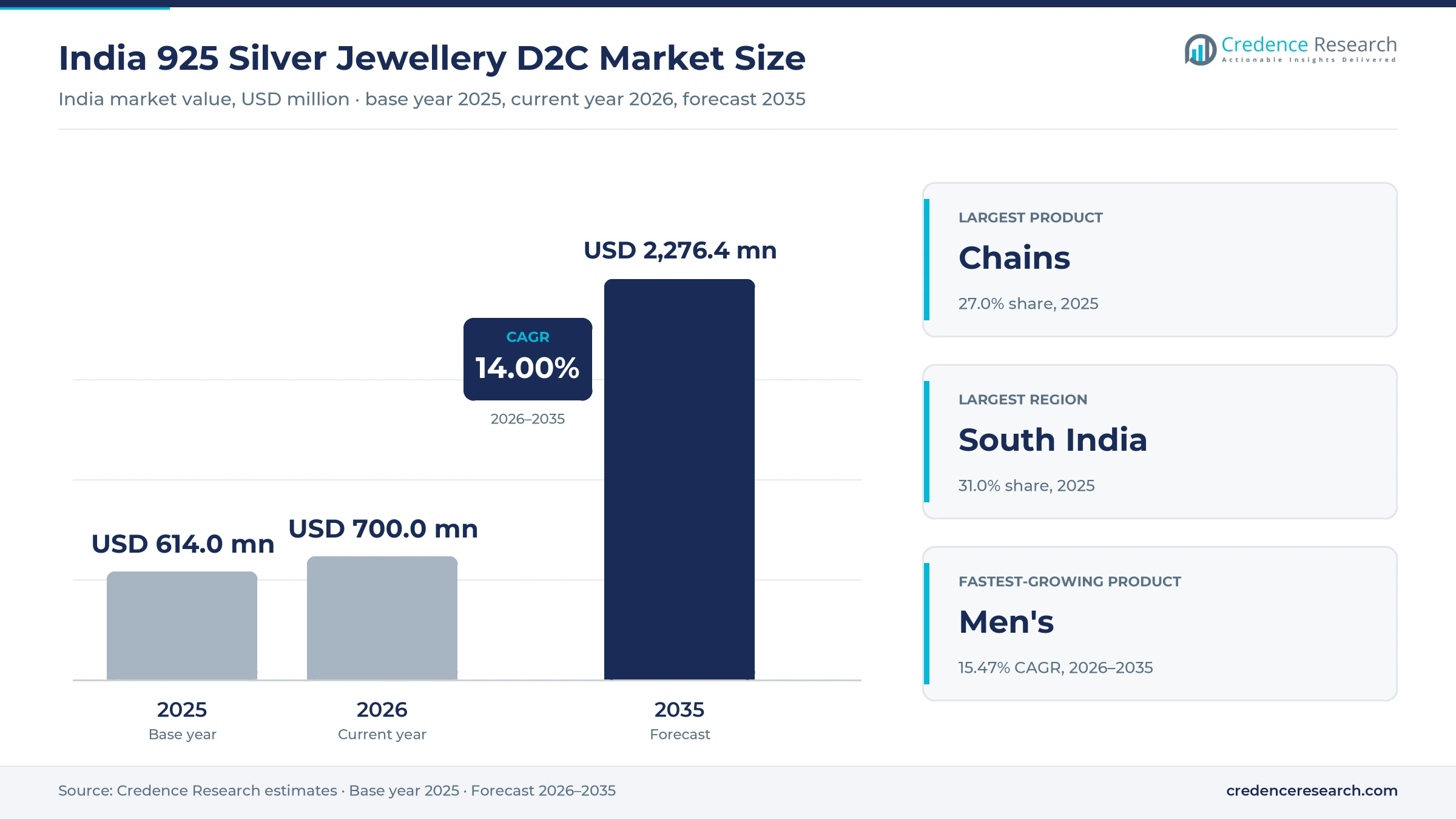
The India 925 silver jewellery D2C market was valued at USD 614.0 million in 2025 and is projected to increase from USD 700.0 million in 2026 to USD 2.28 billion by 2035, registering a CAGR of 14.00% during 2026–2035. Demand comes from young urban buyers who treat sterling silver as daily-wear and gifting jewelry, and from brands that sell it through their own websites, apps and stores rather than through traditional silversmiths. South India held the largest regional share, 31.0% in 2025, helped by Bengaluru, where the category's largest brand began, while North India is the fastest-growing zone at 14.51% a year as store networks spread across Delhi-NCR and Uttar Pradesh. The main commercial change is the move from online-only selling toward dense company store networks backed by large funding rounds. Purity assurance also improved after silver hallmarks started carrying a six-digit HUID code in September 2025, which lets buyers verify grade 925 pieces.
What does 925 silver D2C jewelry in India include?
The market counts what consumers pay for grade 925 sterling silver rings, earrings, chains, anklets and men's pieces bought directly from brands. It covers brand websites and apps, brand storefronts on marketplaces, company and franchise stores and quick-commerce listings managed by the brand itself.
Traditional heavy silver ornaments sold by weight at local jewelers, silver coins, bars and utensils and plated base-metal fashion pieces are excluded. The value chain runs from bullion importers and casting clusters through designers, platers and finishers to brand warehouses, stores and delivery partners.
India 925 Silver Jewellery D2C Market Insights
- The market grows from USD 614.0 million in 2025 to USD 2.28 billion by 2035, a 14.00% CAGR that rests on new store openings and higher average prices as well as on online reach.
- South India led with 31.0% of 2025 value, and BIS data show the southern region recording the highest silver hallmarking activity after HUID codes began.
- Chains held 27.0% of 2025 value, because pendant necklaces and personalized name chains anchor most brand catalogs and gift orders.
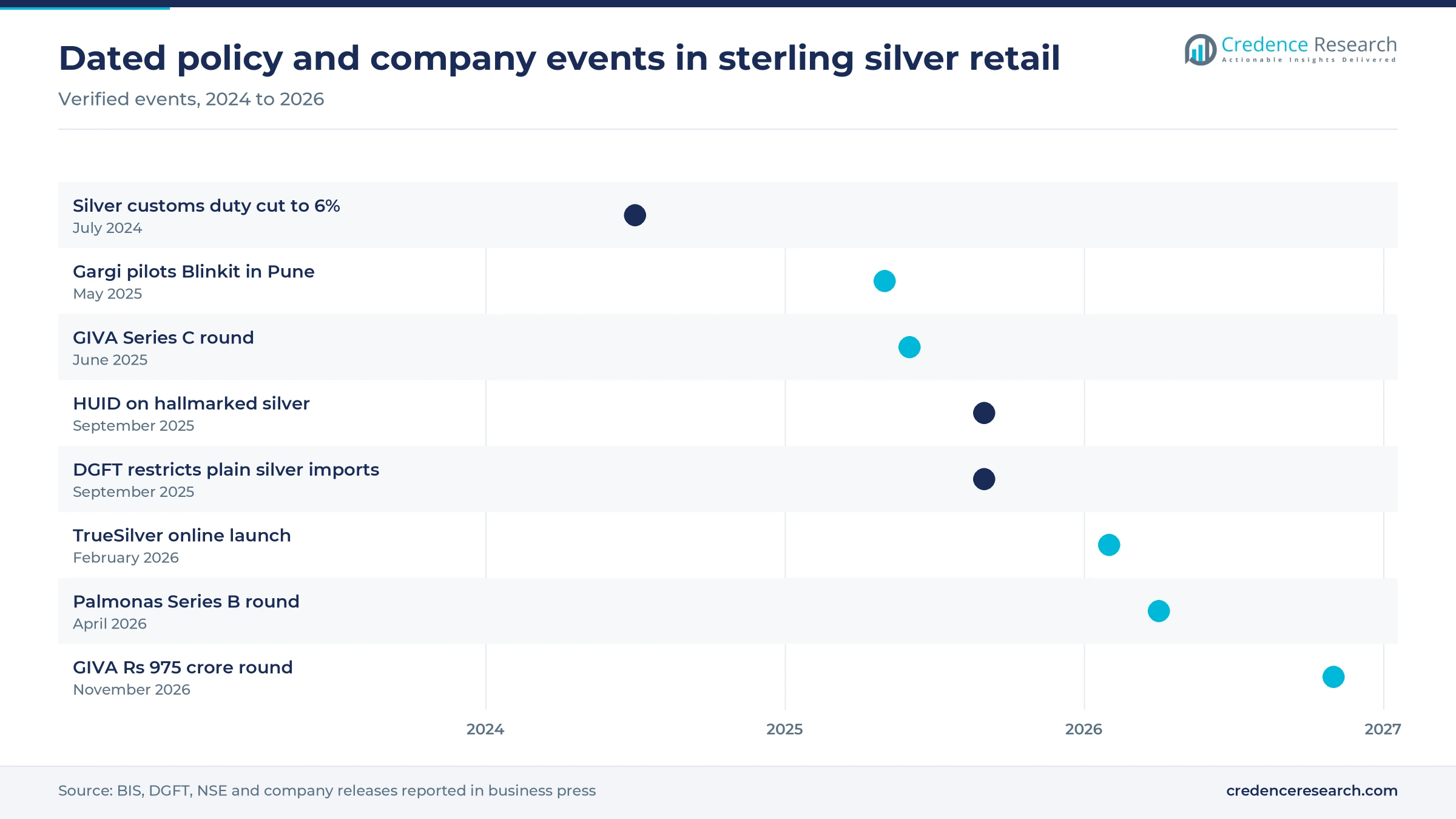
- Silver hallmarks began carrying a six-digit HUID code on Sept. 1, 2025, and nearly 90% of registered articles were grade 925 or 800.
- GIVA raised Rs 975 crore in November 2026 and plans 160 new stores in fiscal 2027, which shows how much capital now backs sterling brands.
Chains, mid-priced pieces and online orders lead value
Why chains lead and men's pieces grow fastest
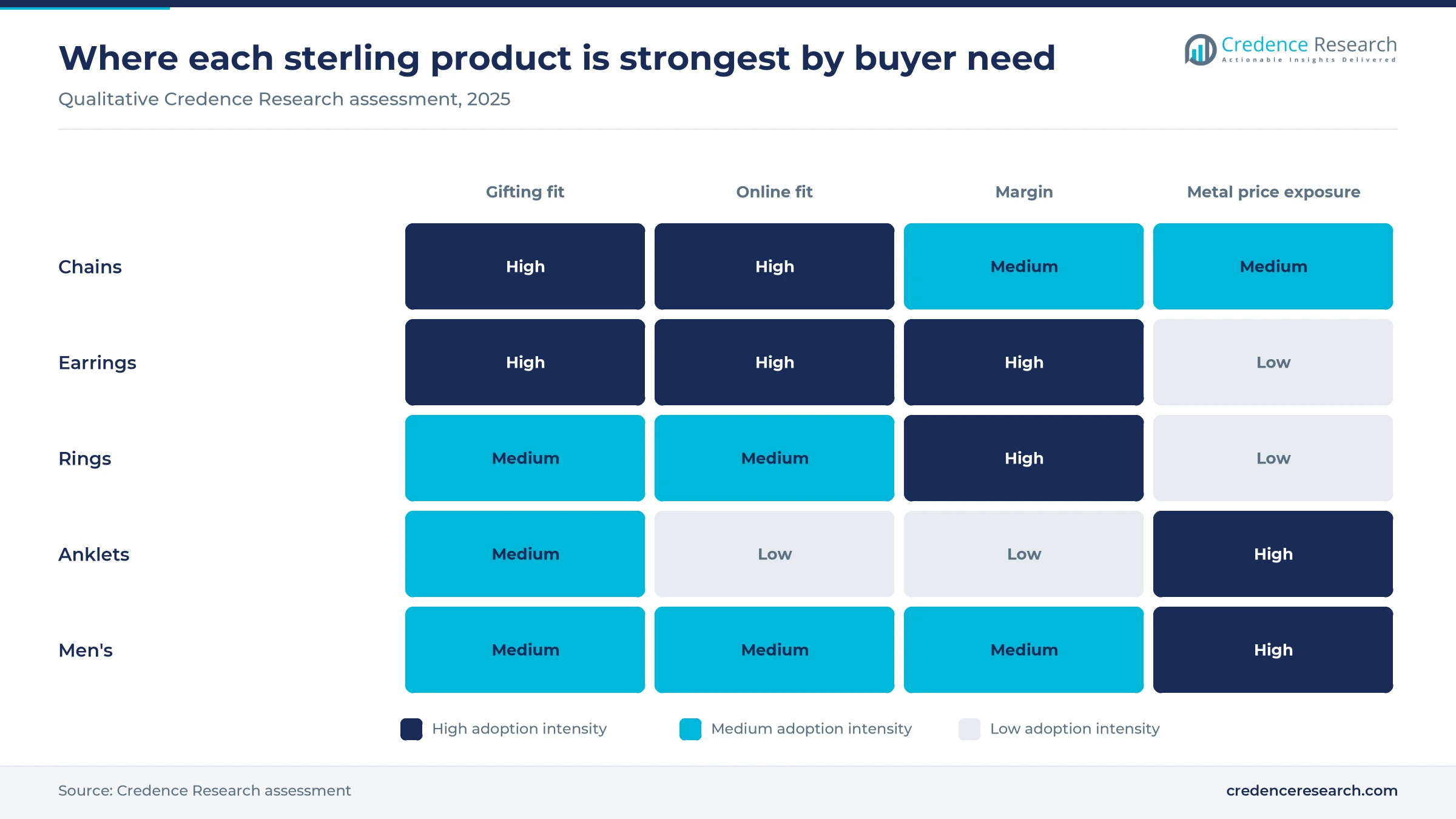
Based on product, the market is categorized into rings, earrings, chains, anklets and men's pieces. Chains led with 27.0% of 2025 value because pendant necklaces sell as both gifts and daily wear, and GIVA named a constellation necklace and a zircon pendant among its best sellers to Entrepreneur India in May 2022. Earrings follow closely, and Zepto reported a 4.5x jump in earring sales around Raksha Bandhan 2025, YourStory reported. Men's pieces grow fastest at 15.47% a year as men now account for about 20% of GIVA's silver business, according to Inc42 in November 2026.
How mid-priced pieces carry most sterling value
Based on price, the market is categorized into below Rs 2,000, Rs 2,000 to 5,000 and above Rs 5,000. Rs 2,000 to 5,000 led with 45.0% of 2025 value because GIVA's average silver selling price is about Rs 3,500, Inc42 reported, and TrueSilver said its online orders average Rs 2,000 to Rs 5,000. Titan's Mia by Tanishq also priced its first silver range at Rs 1,999 to Rs 5,999 when it launched in September 2018, Fashion Network reported. The Above Rs 5,000 band grows fastest at 15.23% a year as CaratLane's Shaya Diamonds sets natural diamonds in 925 silver from Rs 5,000, GJEPC's Solitaire reported.
Why brand websites still carry most orders
Based on channel, the market is categorized into online, own stores and q-commerce. Online led with 60.0% of 2025 value because direct online sales still make up about 55% of GIVA revenue, Inc42 reported in November 2026, and D2C Insider put Palmonas' own digital channels at about 50% in July 2026. Own stores are catching up, since GIVA aims for a 75% to 80% offline share within three years. Q-Commerce grows fastest at 16.93% a year as Gargi by PN Gadgil & Sons put its under-Rs 1,000 silver and fashion range on Blinkit in Mumbai in June 2025, Indian Jeweller reported.
| Segment Group | Leading Sub-segment | Share, 2025 | Fastest-growing Sub-segment | CAGR, 2026–2035 |
|---|---|---|---|---|
| By Product | Chains | 27.0% | Men's | 15.47% |
| By Price | Rs 2,000 to 5,000 | 45.0% | Above Rs 5,000 | 15.23% |
| By Channel | Online | 60.0% | Q-Commerce | 16.93% |
Request a Free Sample
Fill in your details and we'll send you a free sample report.
- Sample data tables & charts
- Research methodology
Digital brands, gifting and hallmarks widen the buyer base
Digital-first brands bring new buyers to sterling silver
Brands that began online have turned sterling silver from a counter purchase into a branded, returnable product that younger buyers can browse at any hour. GIVA raised Rs 975 crore on Nov. 3, 2026, in a round led by Multiples, and the company now runs about 425 stores, with silver at about 60% of its revenue. Palmonas, founded in 2022, crossed 75 stores in July 2026 while selling 925 sterling silver and steel pieces, D2C Insider reported. New entrants keep arriving, and ACPL Exports launched TrueSilver online in February 2026 with about 900 items on its own site, Amazon and Myntra. In the Credence Research model this adds about 5.18 percentage points to annual growth to 2035.
Gifting and everyday designs lift purchase frequency
Low ticket sizes and daily-wear designs let buyers return for birthdays, festivals and small treats instead of saving for one heavy ornament. GIVA said repeat orders reached 35% to 40% of sales after its loyalty program, according to an Inc42 feature in 2025, and its silver pieces average about Rs 3,500. Festival habits support the category too, since the All India Gem and Jewellery Domestic Council reported a sharp rise in silver coin sales over Dhanteras 2025, led by tier II and tier III cities. World Bank data put Indian household final consumption at about USD 2.24 trillion in 2025, which gives discretionary gifting a large and growing base. In the Credence Research model this adds about 3.78 percentage points to annual growth to 2035.
Social reach and custom pieces raise conversion
Celebrity-led social marketing and personalized designs give shoppers a reason to buy now rather than keep browsing. GIVA told Entrepreneur India in May 2022 that an Anushka Sharma-branded constellation necklace was among its best sellers, and the company's CEO told Inc42 in 2025 that GIVA ranks second among online jewelry retailers by total traffic. Customization works the same way, because GIVA lists silver personalized name necklaces on its store and Salty sells personalized initial and charm necklaces from about Rs 995. Engraved pieces are made to order, which ties each sale to a named gift occasion. These pieces also travel well in gift boxes and pouches that brands design for unboxing videos. In the Credence Research model this adds about 2.80 percentage points to annual growth to 2035.
HUID hallmarks build trust in 925 purity
Verified purity matters because sterling silver looks identical to cheaper alloys and plated pieces at the point of sale. Silver hallmarks began carrying a six-digit HUID code on Sept. 1, 2025, and GJEPC's Solitaire reported that more than 17 lakh silver articles were registered with a HUID in about three months, with nearly 90% of them in grades 925 or 800. BIS Director General Sanjay Garg said in June 2026 that hallmarked silver jewelry articles rose to 59 lakh in fiscal 2025-26, up from more than 32 lakh a year earlier. Buyers can check each code in the BIS CARE app, which unbranded sellers cannot match. As a result, hallmarking strengthens the premium of organized sellers over open-market pieces of uncertain grade.
Dense stores and 10-minute delivery reshape sterling sales
Shift from online-only selling to dense store networks
Brands that began online now open stores close together, because offline orders carry larger baskets. GIVA had 280 stores across 48 cities in November 2025, including 72 in Delhi-NCR, and planned one store every 2 to 3 kilometers instead of every 5, Projects Today reported. Inc42 reported in November 2026 that GIVA's offline orders run nearly twice the value of online ones. TrueSilver plans 100 company stores of 700 to 800 square feet costing about Rs 50 lakh each, D2C Insider reported in February 2026. This shift raises fixed costs, but it also lets buyers touch, try and return sterling pieces, which matters for first-time buyers and for demi-fine pieces sold beside them.
Rise of quick-commerce jewelry for last-minute gifts
Fast delivery is turning a small silver piece into a last-minute gift that arrives with groceries. Gargi by PN Gadgil & Sons piloted its under-Rs 1,000 silver and fashion range on Blinkit in Pune in May 2025 before Mumbai in June, Indian Jeweller reported. Zepto recorded a 4.5x rise in earring sales and Swiggy Instamart a 3.5x rise in orders around Raksha Bandhan 2025, YourStory reported. Palmonas also counts marketplaces and quick commerce together at roughly a quarter of revenue, D2C Insider reported in July 2026. Brands therefore design lighter, pre-packed pieces under Rs 2,000 that suit dark stores and need no sizing.
Opening in men's chains, bracelets and kadas
Men's jewelry is a clear opening because few sterling brands have built full ranges for it. IBEF reported in March 2026 that men's jewelry grew 25% to 30% in 2025 and now forms about 15% of India's jewelry market, a share that has roughly tripled since 2020. GIVA already earns about 20% of its silver business from men, according to Inc42 in November 2026. Men's pieces grow at 15.47% a year in this report, the fastest product rate. Chains, bracelets and kadas suit sterling silver because they carry weight without gold prices, and brands that add sizing advice and stores near offices could capture buyers who still shop at local silversmiths.
Opening for diamond-set and vermeil premium pieces
Premium sterling pieces offer brands a route to higher tickets without moving into gold jewelry. CaratLane's Shaya Diamonds sets natural diamonds in 925 silver from Rs 5,000, GJEPC's Solitaire reported, aimed at first-time diamond buyers. Palmonas finishes sterling silver with an 18K gold vermeil, Inc42 reported in April 2026, and GIVA sells lab-grown diamond pieces at about Rs 15,000 to Rs 18,000. The Above Rs 5,000 band grows at 15.23% a year, the fastest price rate in this report. Stones and plating raise value per gram, so brands can protect margins when silver costs climb, and buyers who trade up rarely return to the lowest price band.
Metal price swings and import rules test brand margins
Record silver prices push pieces above price points
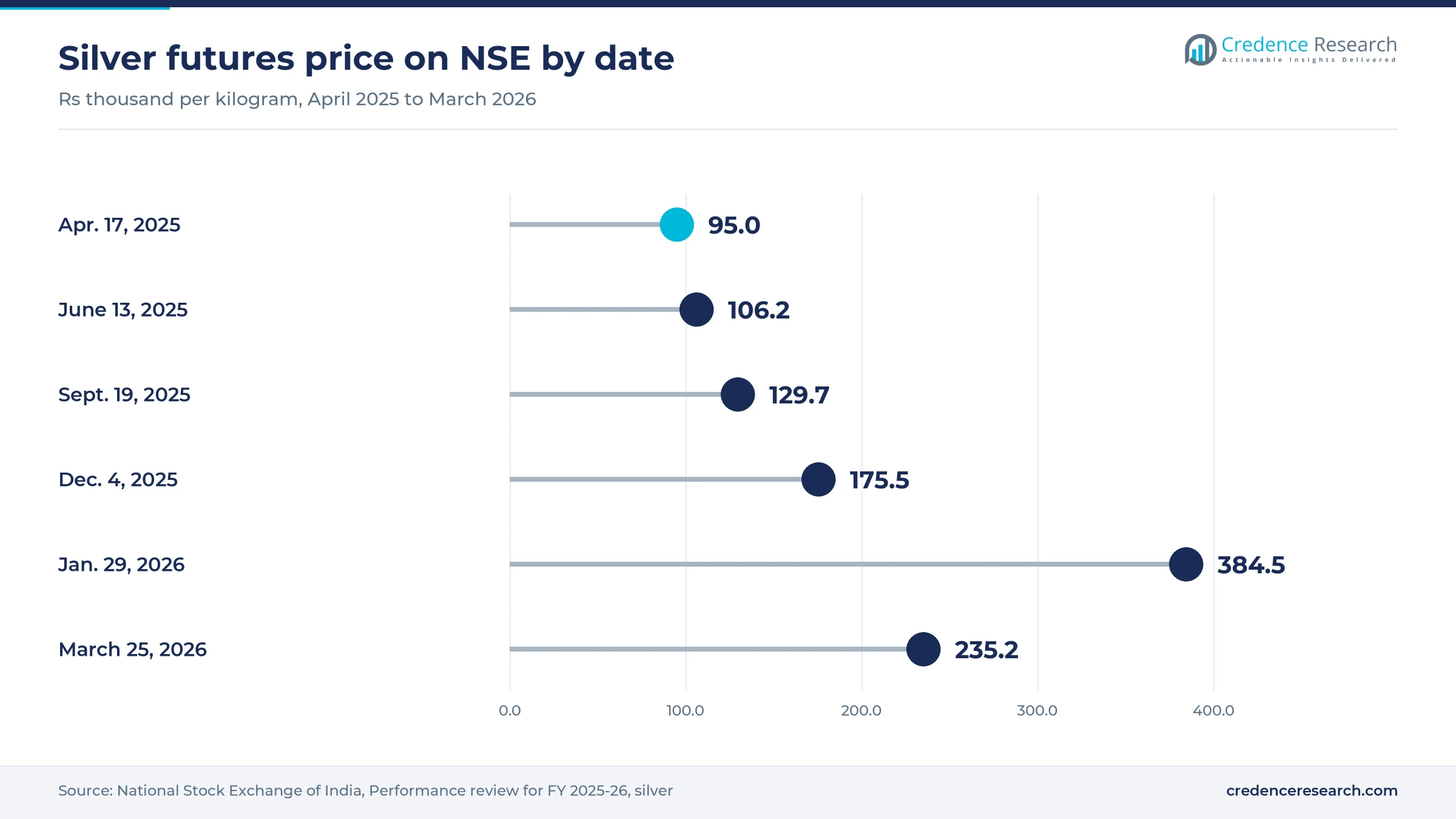
An NSE review of June 2026 showed silver futures rising from Rs 95,024 a kilogram on April 17, 2025, to Rs 3,84,541 on Jan. 29, 2026. ThePrint reported in January 2026 that a 100-gram anklet costing about Rs 10,000 earlier now cost nearly Rs 25,000. Brands that promise fixed price bands must either cut weight, raise prices or absorb the cost, and each choice risks lost buyers. Hedging, lighter hollow designs and more plated or stone-set pieces are the main defenses for sterling brands.
Fabrication slump strains casting clusters
Supply clusters that cast sterling pieces have been hit hard by the price surge. The NSE review shows Indian silver jewelry fabrication falling from 87.9 million ounces in 2024 to 70.3 million ounces in 2025. In Salem, festival anklet orders fell by about three-fifths and wholesalers stopped supplying metal for at least 15 days, DT Next reported in October 2025. Brands that rely on these workshops face delays, so some now hold buffer stock.
Voluntary hallmarking leaves purity gaps
Silver hallmarking has been voluntary since 2005, and BIS Director General Sanjay Garg said in June 2026 that a mandatory rule would come only gradually. About 230 assaying and hallmarking centers are recognized for silver, and Garg said only five BIS staff run the whole hallmarking operation. Unhallmarked pieces sold online as 925 can therefore differ in grade, which undermines trust for every seller. Brands that hallmark full catalogs and publish HUID codes reduce this exposure for their own buyers.
Import restrictions limit finished-piece sourcing
Trade rules now limit how cheaply brands can import finished silver pieces from abroad. In September 2025 the DGFT moved unstudded plain silver jewelry imports from free to restricted, requiring a license, after imports from Thailand rose from about 4 to 40 metric tons, the NSE review noted. The restriction was extended to gold, silver and platinum jewelry under Chapter 71 in March and April 2026. Brands that sourced finished stock abroad must shift to domestic workshops, which adds cost and time to every collection launch.
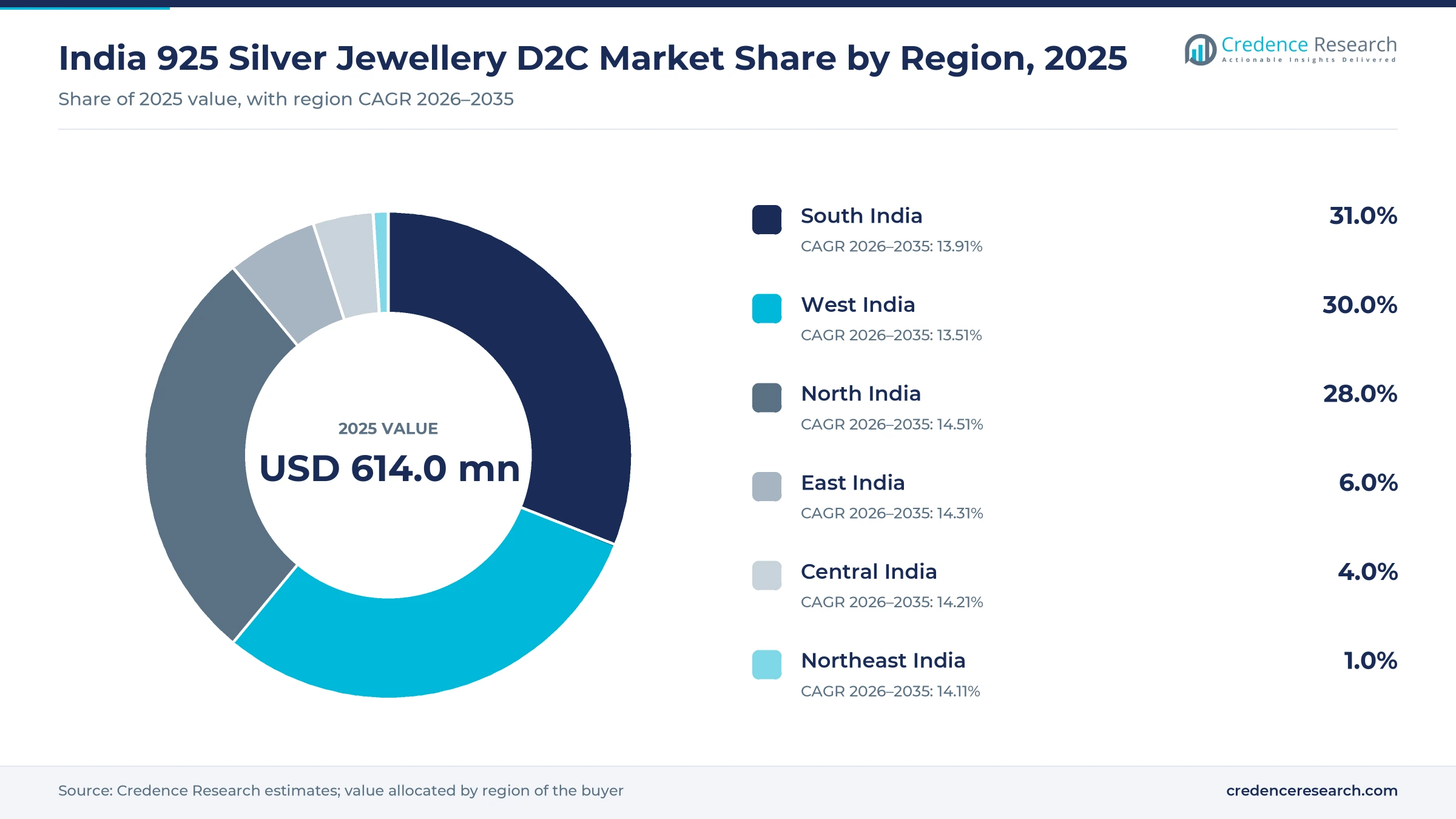
Bengaluru brands keep the South ahead as Delhi-NCR gains
| Region | Value, 2025 (USD million) | Share, 2025 | CAGR, 2026–2035 |
|---|---|---|---|
| South India | 190.4 | 31.0% | 13.91% |
| West India | 184.2 | 30.0% | 13.51% |
| North India | 171.9 | 28.0% | 14.51% |
| East India | 36.8 | 6.0% | 14.31% |
| Central India | 24.6 | 4.0% | 14.21% |
| Northeast India | 6.1 | 1.0% | 14.11% |
South India leads on Bengaluru brands and hallmarking
South India held 31.0% of 2025 value and grows at 13.91% a year, supported by early adoption of branded sterling silver. GIVA launched in Bengaluru in 2019, opened its first store there in 2022 and planned 10 to 15 more stores in the city. BIS figures show the southern region with the highest silver hallmarking activity after HUID codes began. Salem, with about 1,500 silver units employing nearly one lakh people, also ships anklets to buyers in Maharashtra, Rajasthan, Gujarat and other states.
West India pairs casting hubs with quick-commerce pilots
West India held 30.0% of 2025 value and grows at 13.51% a year, with Mumbai, Pune and Ahmedabad acting as both demand centers and supply bases. Rajkot is a major silver casting hub, although ThePrint reported in January 2026 that a wholesaler there now sells only about 5% of earlier monthly volume. Gargi by PN Gadgil & Sons tested Blinkit delivery in Pune and Mumbai in 2025, and GIVA plans to deepen its presence in Surat.
North India grows fastest on Delhi-NCR store density
North India held 28.0% of 2025 value and grows at 14.51% a year, the fastest pace in the country. GIVA had 72 stores in Delhi-NCR in November 2025, and Inc42 reported a year later that it would deepen Lucknow, Dehradun and Kanpur and enter Agra. Palmonas opened at DLF Galleria in Gurugram in July 2026 and also trades in Jaipur, Noida and Gorakhpur. Agra remains one of the main silver ornament clusters supplying the zone.
East India builds from Kolkata and Patna stores
East India held 6.0% of 2025 value and grows at 14.31% a year, from a smaller organized base. Palmonas lists Patna and Kolkata among its store cities, and TrueSilver named Kolkata among its four launch focus cities in February 2026. BIS reported eastern hallmarking activity trailing the southern region, which shows that verified 925 supply is still thin. Kolkata's traditional silver workshops give brands a local supply base for handmade pieces.
Central India rises on tier 2 festive buying
Central India held 4.0% of 2025 value and grows at 14.21% a year, from a base that store networks are only beginning to reach. Indore is a recognized silver trading hub, ThePrint noted in January 2026. The All India Gem and Jewellery Domestic Council said silver coin sales rose 35% to 40% in tier II and tier III cities during Dhanteras 2025, a sign that festive silver buying is broadening beyond the metros into towns where brands are only starting to arrive.
Northeast India starts from a small online base
Northeast India held 1.0% of 2025 value and grows at 14.11% a year, the smallest share among the six zones. None of the expansion cities that GIVA named in November 2026 lies in the zone, so most buyers there still order through brand websites and wider online retail platforms. Long delivery routes also make returns and exchanges slower, which weighs on conversion. Growth should therefore come mainly from courier coverage and a few brand stores in Guwahati over the forecast period.
Funding rounds and hallmark rules mark 2025 and 2026
| Development | Status and market relevance |
|---|---|
| In June 2025, GIVA raised Rs 530 crore in a Series C round led by Creaegis to fund retail expansion and manufacturing. | The company had 280 stores across 48 cities by November 2025. |
| In September 2025, BIS began HUID codes on hallmarked silver, and the DGFT restricted imports of plain silver jewelry. | More than 17 lakh silver articles were registered with a HUID in about three months. |
| In February 2026, ACPL Exports launched TrueSilver online with about 900 items and a target of 100 stores. | Initial focus cities are Delhi, Mumbai, Bengaluru and Kolkata. |
| In April 2026, Palmonas raised USD 40 million in a Series B round led by Xponentia Capital and Vertex Growth Fund. | The brand crossed 75 stores by July 2026. |
| In November 2026, GIVA raised Rs 975 crore in a round led by Multiples and planned 160 new stores in fiscal 2027. | Silver makes up about 60% of its revenue. |
Hallmark codes, plating and engraving shape the product
- HUID hallmarking laser-engraves a six-digit code beside the BIS mark and the purity grade, and buyers can check it in the BIS CARE app.
- Gold vermeil plating layers 18K gold over sterling silver, which Palmonas uses to give silver pieces a gold look at a lower price.
- Laser engraving puts names and initials on pendants and bracelets, which supports the personalized collections that GIVA and Salty list.
- Digital casting uses computer-aided design and 3D-printed wax patterns so brands can release small batches of new designs quickly.
Need a Custom Version of This Report?
Tailor the scope, geography, or segments to your exact requirements.
- Custom geography or segment scope
- Direct access to our analyst team
Venture-backed brands race to build store networks
Competition runs between venture-backed digital brands, jewelry groups with silver lines and a long tail of marketplace sellers. GIVA leads the organized segment with about 425 stores and a silver-heavy range, and it now competes on store density as much as on design. Palmonas sells sterling silver and steel pieces with gold vermeil and is adding stores quickly after its 2026 Series B round. Titan competes through Mia by Tanishq and CaratLane's Shaya, which brings natural diamonds into 925 silver. Salty competes on personalized pieces and gift sets at lower prices, and TrueSilver entered in 2026 from an export base. Gargi by PN Gadgil & Sons uses franchise stores and Blinkit for under-Rs 1,000 pieces. Brands increasingly differ on hallmarking, return policies and delivery speed, since most source from similar casting clusters, and those that hold price points through silver swings tend to keep buyers.
Sterling brands, group labels and new entrants profiled
| Company | Type | Role in the market |
|---|---|---|
| GIVA | Digital-first sterling brand | Runs about 425 stores, with silver at about 60% of revenue and men at about 20% of silver sales |
| Palmonas | Demi-fine brand | Sells 925 sterling silver and steel pieces with gold vermeil through 75+ stores and its own site |
| Salty | Fashion accessories brand | Sells personalized initial and charm necklaces from about Rs 995 online |
| Tanishq (Mia silver line) | Jewelry group brand | Mia by Tanishq added certified 92.5% silver pieces at Rs 1,999 to Rs 5,999 in 2018 |
| Shaya by CaratLane | Jewelry group brand | Sets natural diamonds in 925 silver from Rs 5,000 under Shaya Diamonds |
| TrueSilver | New D2C entrant | Launched online in February 2026 with about 900 items and plans 100 stores |
| Gargi by PN Gadgil & Sons | Silver and fashion brand | Sells under-Rs 1,000 pieces on Blinkit and through 96 store touchpoints |
Price discipline matters more than metal cost
Credence Research's view is that price discipline will decide profit in the India 925 silver jewellery D2C market more than the cost of the metal itself. Silver more than doubled between April 2025 and January 2026, yet buyers still shop within fixed price bands, so brands need designs that can absorb a sharp rise without visible loss of quality. Lighter hollow pieces, plating and stone settings give brands that flexibility today. Brands should hallmark full catalogs and publish HUID codes, because purity proof is the clearest edge over open-market sellers. Investors should watch store payback periods, since the move offline raises fixed costs just as metal prices swing.
How the sterling silver brand estimates were built
The report uses 2025 as the base year and 2026 to 2035 as the forecast period. Market values come from the Credence Research model, and segment and regional splits are Credence Research estimates informed by company disclosures, BIS hallmarking data, silver fabrication data and platform sales reports. Sources include government agencies, exchange reviews, trade bodies, company pages and business press reports opened during research. No interviews or surveys were conducted for this edition of the report. Traditional silver ornaments sold by weight, coins, bars and plated base-metal pieces are excluded from the market value.
Stores, men's lines and premium pieces gain to 2035
By 2035, the India 925 silver jewellery D2C market should be a mainstream branded category with dense store networks across the larger cities. Chains held 27.0% of 2025 value and should stay the largest product, while men's pieces gain the most share. Own stores should narrow the gap with online sales as GIVA, Palmonas and TrueSilver add outlets, and quick commerce should grow from a small base for gifts under Rs 2,000. A mandatory hallmark rule would favor organized brands if BIS adopts it. The largest uncertainties are the silver price, the rupee, import rules and whether venture-funded store networks earn back their costs.
Frequently Asked Questions
How big is the India 925 silver jewellery D2C market?
What is driving growth in sterling silver brands?
Which product leads the market?
Which price band matters most?
Which region holds the largest share?
Who are the main companies in this market?
How does HUID hallmarking affect buyers?
What are the main risks for brands?
Table of Content
Chapter 1 Market Segmentation
- 1.1 Segmentation Framework
- 1.1.1 Product and Service Classification
- 1.1.2 Application and End-Use Classification
- 1.1.3 Technology and Solution Classification
- 1.1.4 Customer and Distribution Channel Classification
- 1.1.5 Geographic Segmentation
- 1.1.6 Market Segment Definitions and Boundaries
- 1.2 By Product
- 1.2.1 Chains
- 1.2.2 Earrings
- 1.2.3 Rings
- 1.2.4 Anklets
- 1.2.5 Men's
- 1.3 By Price
- 1.3.1 Rs 2,000 to 5,000
- 1.3.2 Below Rs 2,000
- 1.3.3 Above Rs 5,000
- 1.4 By Channel
- 1.4.1 Online
- 1.4.2 Own Stores
- 1.4.3 Q-Commerce
Chapter 2 Introduction
- 2.1 Report Objectives and Scope
- 2.2 Product Definition and Industry Terminology
- 2.3 Market Inclusions and Exclusions
- 2.4 Research Process
- 2.4.1 Primary Research and Expert Interviews
- 2.4.2 Secondary Research and Source Review
- 2.4.3 Top-Down and Bottom-Up Estimation
- 2.4.4 Data Triangulation and Verification
- 2.5 Market Size Measurement Basis
- 2.5.1 2025: USD 614.0 million → 2035: USD 2.28 billion
- 2.6 Historical and Forecast Reference Periods
- 2.6.1 Historical Period: 2018-2025
- 2.6.2 Base Year: 2025
- 2.6.3 Forecast Period: 2025-2035
- 2.7 Research Assumptions and Limitations
Chapter 3 Executive Summary
- 3.1 Market Snapshot and Key Findings
- 3.2 Base-Year Market Size, 2025
- 3.3 Forecast Market Size, 2035
- 3.4 Revenue and Volume Growth Outlook
- 3.5 Key Demand and Supply Indicators
- 3.6 Leading Market Segments
- 3.7 Fastest-Growing Market Opportunities
- 3.8 Regional Performance Highlights
- 3.9 Technology and Industry Transformation
- 3.10 Competitive Landscape Summary
- 3.11 Analyst View and Strategic Implications
Chapter 4 India 925 Silver Jewellery D2C Market Trends and Developments
- 4.1 Historical Industry Development, 2018-2025
- 4.2 Recent Market Trends and Developments
- 4.3 Demand and Customer Behavior Trends
- 4.4 Technology and Product Innovation
- 4.5 Artificial Intelligence, Automation and Digitalization
- 4.6 Local Manufacturing and Supply Chain Realignment
- 4.7 Industry Partnerships, Mergers and Acquisitions
- 4.8 Sustainability and Circular Economy Developments
- 4.9 Government and Private Sector Investment Trends
- 4.10 Emerging Business Models and Commercialization
- 4.11 Industry Developments and Announcements
Chapter 5 India 925 Silver Jewellery D2C Market Production, Supply and Demand Analysis
- 5.1 Demand Trend and Consumption Analysis, 2018-2025
- 5.2 Demand Forecast, 2025-2035
- 5.3 Production and Output Trend, 2018-2025
- 5.4 Production and Output Forecast, 2025-2035
- 5.5 Installed Capacity and Capacity Utilization
- 5.6 Company-Wise Production Plants and Statistics
- 5.6.1 Installed Production Capacity
- 5.6.2 Actual Production
- 5.6.3 Planned Capacity and Expansion Targets
- 5.7 Supply Chain Structure and Procurement Trends
- 5.8 Supply-Demand Gap and Bottlenecks
- 5.9 Import Dependence and Sourcing Structure
- 5.10 Contract Manufacturing and Outsourcing
- 5.11 Regional Supply and Demand Concentration
Chapter 6 India 925 Silver Jewellery D2C Market Pricing Analysis
- 6.1 Pricing Structure and Measurement
- 6.2 Historical Pricing Trends, 2018-2025
- 6.3 Pricing Outlook, 2025-2035
- 6.4 Average Selling Price and Unit Economics
- 6.5 Pricing by Product and Market Segment
- 6.6 Geographic Pricing Differences
- 6.7 Key Input, Energy, Labor and Logistics Costs
- 6.8 Contract Pricing and Purchasing Models
- 6.9 Pricing Sensitivity and Competitive Positioning
- 6.10 Price, Margin and Profitability Implications
Chapter 7 India 925 Silver Jewellery D2C Market Dynamics
- 7.1 Market Growth Drivers
- 7.1.1 Demand-Side Drivers
- 7.1.2 Technology and Innovation Drivers
- 7.1.3 Infrastructure and Investment Drivers
- 7.1.4 Regulatory and Policy Drivers
- 7.2 Market Restraints
- 7.2.1 Cost and Affordability Constraints
- 7.2.2 Technology and Adoption Barriers
- 7.2.3 Supply Chain and Operational Constraints
- 7.3 Market Challenges
- 7.3.1 Competitive Pressure and Margin Erosion
- 7.3.2 Skills, Infrastructure and Implementation Gaps
- 7.4 Emerging Market Opportunities
- 7.5 Market Dynamics Impact and Time-Horizon Assessment
Chapter 8 India 925 Silver Jewellery D2C Value Chain Analysis
- 8.1 Industry Value Chain Overview
- 8.2 Upstream Suppliers and Critical Inputs
- 8.3 Technology and Component Providers
- 8.4 Manufacturing or Service Delivery
- 8.5 Distribution, Channel Partners and Integrators
- 8.6 Downstream Applications and End Users
- 8.7 Value Addition and Profit Pools
- 8.8 Vertical Integration and Outsourcing
- 8.9 Supplier Concentration and Risk
- 8.10 Supply Chain Localization and Resilience
Chapter 9 India 925 Silver Jewellery D2C Market Regulations and Policies
- 9.1 Relevant Laws, Standards and Compliance Frameworks
- 9.2 Product, Service, Safety and Quality Requirements
- 9.3 Government Policies, Incentives and Subsidies
- 9.4 Imports, Exports and Trade Barriers
- 9.5 Public Procurement and Local Content Requirements
- 9.6 Environmental and Sustainability Compliance
- 9.7 Upcoming Policy Changes and Market Implications
Chapter 10 India 925 Silver Jewellery D2C Market Hotspots and Opportunities
- 10.1 Market Opportunity Mapping and Growth Hotspots
- 10.2 High-Growth Applications and Customer Groups
- 10.3 Underserved Markets and White-Space Opportunities
- 10.4 Emerging Technology and Product Opportunities
- 10.5 New Capacity and Investment Hotspots
- 10.6 Market Entry and Expansion Opportunities
- 10.7 Distribution and Partnership Opportunities
- 10.8 Near-Term and Long-Term Commercial Potential
- 10.9 Opportunity Attractiveness and Execution Risks
Chapter 11 India 925 Silver Jewellery D2C Market Outlook, 2025-2035
- 11.1 Market Size and Analysis
- 11.1.1 Revenue (Market Measurement: 2025: USD 614.0 million → 2035: USD 2.28 billion)
- 11.1.2 Market Volume and Quantity Sold
- 11.1.3 Historical Market Size, 2018-2025
- 11.1.4 Base-Year Market Size, 2025
- 11.2 Market Forecast, 2025-2035
- 11.2.1 Revenue Forecast to 2035
- 11.2.2 Volume Forecast to 2035
- 11.2.3 CAGR and Year-on-Year Growth
- 11.2.4 Incremental Revenue Opportunity
- 11.3 Forecast Assumptions and Scenario Analysis
- 11.3.1 Base-Case Forecast
- 11.3.2 Optimistic and Conservative Scenarios
- 11.3.3 Technology, Pricing and Policy Sensitivities
- 11.4 Market Attractiveness and Growth Outlook
Chapter 12 India 925 Silver Jewellery D2C Market Segmentation and Outlook
- 12.1 Segmentation Summary and Market Shares, 2025
- 12.2 Largest and Fastest-Growing Segments
- 12.3 By Product - Market Size and Forecast, 2025-2035
- 12.3.1 Segment Definition and Scope
- 12.3.2 Historical Market Size, 2018-2025
- 12.3.3 Revenue Forecast, 2025-2035
- 12.3.4 Volume Forecast, 2025-2035
- 12.3.5 Base-Year Market Share, 2025
- 12.3.6 Segment CAGR and Growth Drivers
- 12.3.7 Subsegment Market Size and Forecast
- 12.3.7.1 Chains
- 12.3.7.2 Earrings
- 12.3.7.3 Rings
- 12.3.7.4 Anklets
- 12.3.7.5 Men's
- 12.3.8 Subsegment Pricing and Adoption Trends
- 12.3.9 Leading Suppliers and Competition
- 12.3.10 Regional Demand and Opportunities
- 12.4 By Price - Market Size and Forecast, 2025-2035
- 12.4.1 Segment Definition and Scope
- 12.4.2 Historical Market Size, 2018-2025
- 12.4.3 Revenue Forecast, 2025-2035
- 12.4.4 Volume Forecast, 2025-2035
- 12.4.5 Base-Year Market Share, 2025
- 12.4.6 Segment CAGR and Growth Drivers
- 12.4.7 Subsegment Market Size and Forecast
- 12.4.7.1 Rs 2,000 to 5,000
- 12.4.7.2 Below Rs 2,000
- 12.4.7.3 Above Rs 5,000
- 12.4.8 Subsegment Pricing and Adoption Trends
- 12.4.9 Leading Suppliers and Competition
- 12.4.10 Regional Demand and Opportunities
- 12.5 By Channel - Market Size and Forecast, 2025-2035
- 12.5.1 Segment Definition and Scope
- 12.5.2 Historical Market Size, 2018-2025
- 12.5.3 Revenue Forecast, 2025-2035
- 12.5.4 Volume Forecast, 2025-2035
- 12.5.5 Base-Year Market Share, 2025
- 12.5.6 Segment CAGR and Growth Drivers
- 12.5.7 Subsegment Market Size and Forecast
- 12.5.7.1 Online
- 12.5.7.2 Own Stores
- 12.5.7.3 Q-Commerce
- 12.5.8 Subsegment Pricing and Adoption Trends
- 12.5.9 Leading Suppliers and Competition
- 12.5.10 Regional Demand and Opportunities
- 12.6 Segment Growth Comparison
- 12.7 Segment Attractiveness and Priority Matrix
Chapter 13 India 925 Silver Jewellery D2C Geographic Market Outlook, 2025-2035
- 13.1 Domestic Market Distribution and Demand Clusters
- 13.2 State- or Province-Wise Market Size and Forecast, 2025-2035
- 13.3 City and Metropolitan Market Outlook
- 13.4 Industrial, Manufacturing and Commercial Clusters
- 13.5 Geographic Concentration of Key End Users
- 13.6 Local Pricing and Purchasing Differences
- 13.7 Domestic Production Facilities and Capacity Map
- 13.8 Local Infrastructure and Project Pipeline
- 13.9 State-Level Policy and Incentive Differences
- 13.10 Subnational Investment Hotspots and Opportunities
- 13.11 Distribution and Logistics Networks
- 13.12 Domestic Competitive Footprint
Chapter 14 India 925 Silver Jewellery D2C Technology, Innovation and Sustainability Outlook
- 14.1 Technology Landscape and Maturity
- 14.2 Product, Process and Service Innovation
- 14.3 AI, Automation and Digital Tools in the Industry
- 14.4 Technology Adoption and Performance Benchmarking
- 14.5 Innovation Pipeline and R&D Investment
- 14.6 Patent and Intellectual Property Trends
- 14.7 Energy Efficiency and Resource Management
- 14.8 Sustainability, Recycling and Circularity
- 14.9 Technology Roadmap, 2025-2035
- 14.10 Risks of Obsolescence and Technology Substitution
Chapter 15 India 925 Silver Jewellery D2C Market Key Strategic Imperatives
- 15.1 Growth and Market Entry Priorities
- 15.2 High-Return Products and Segments
- 15.3 Pricing, Profitability and Cost Optimization
- 15.4 Technology Investment and Product Differentiation
- 15.5 Supply Chain Localization and Resilience
- 15.6 Distribution and Customer Acquisition
- 15.7 Partnership, Acquisition and Capacity Strategy
- 15.8 Regional Expansion Priorities
- 15.9 Short-, Medium- and Long-Term Actions
Chapter 16 Competition Outlook
- 16.1 Industry Competition Characteristics
- 16.2 Market Structure and Concentration
- 16.3 Market Share and Competitive Positioning, 2025
- 16.4 Company-Wise Revenue and Product Benchmarking
- 16.5 Production and Service Capacity Benchmarking
- 16.6 Technology, Pricing and Differentiation
- 16.7 Regional Footprint and Distribution Strength
- 16.8 Mergers, Acquisitions and Strategic Alliances
- 16.9 New Entrants and Competitive Threats
- 16.10 Porter's Five Forces and Industry Attractiveness
- 16.11 Competitive Outlook, 2025-2035
Chapter 17 Company Profiles
- 17.1 Company Coverage and Selection Criteria
- 17.2 GIVA
- 17.2.1 Business Description
- 17.2.2 Company Ownership and Geographic Presence
- 17.2.3 Product and Service Portfolio
- 17.2.4 Manufacturing and Operating Footprint
- 17.2.5 Production Capacity and Expansion Plans
- 17.2.6 Financial Performance and Investment
- 17.2.7 Market Share and Competitive Position
- 17.2.8 Technology and Innovation Capabilities
- 17.2.9 Strategic Alliances or Partnerships
- 17.2.10 Recent Developments
- 17.2.11 Growth Strategy and Outlook
- 17.3 Palmonas
- 17.4 Salty
- 17.5 Tanishq (Mia silver line)
- 17.6 Shaya by CaratLane
- 17.7 TrueSilver
- 17.8 Gargi by PN Gadgil & Sons
- 17.9 Other Relevant Market Participants
Note: Every listed company is profiled on the structure shown under the first company. The company list is preliminary and may change based on research findings, market developments, data availability and client requirements.
Chapter 18 Disclaimer
- 18.1 Research and Forecast Disclaimer
- 18.2 Data Source and Estimation Limitations
Note: The depth of individual sections depends on data availability for this market. Volume, capacity, trade and other unit-based metrics are included where applicable.

