
Baths, trims and spa care for dogs and cats set the scope
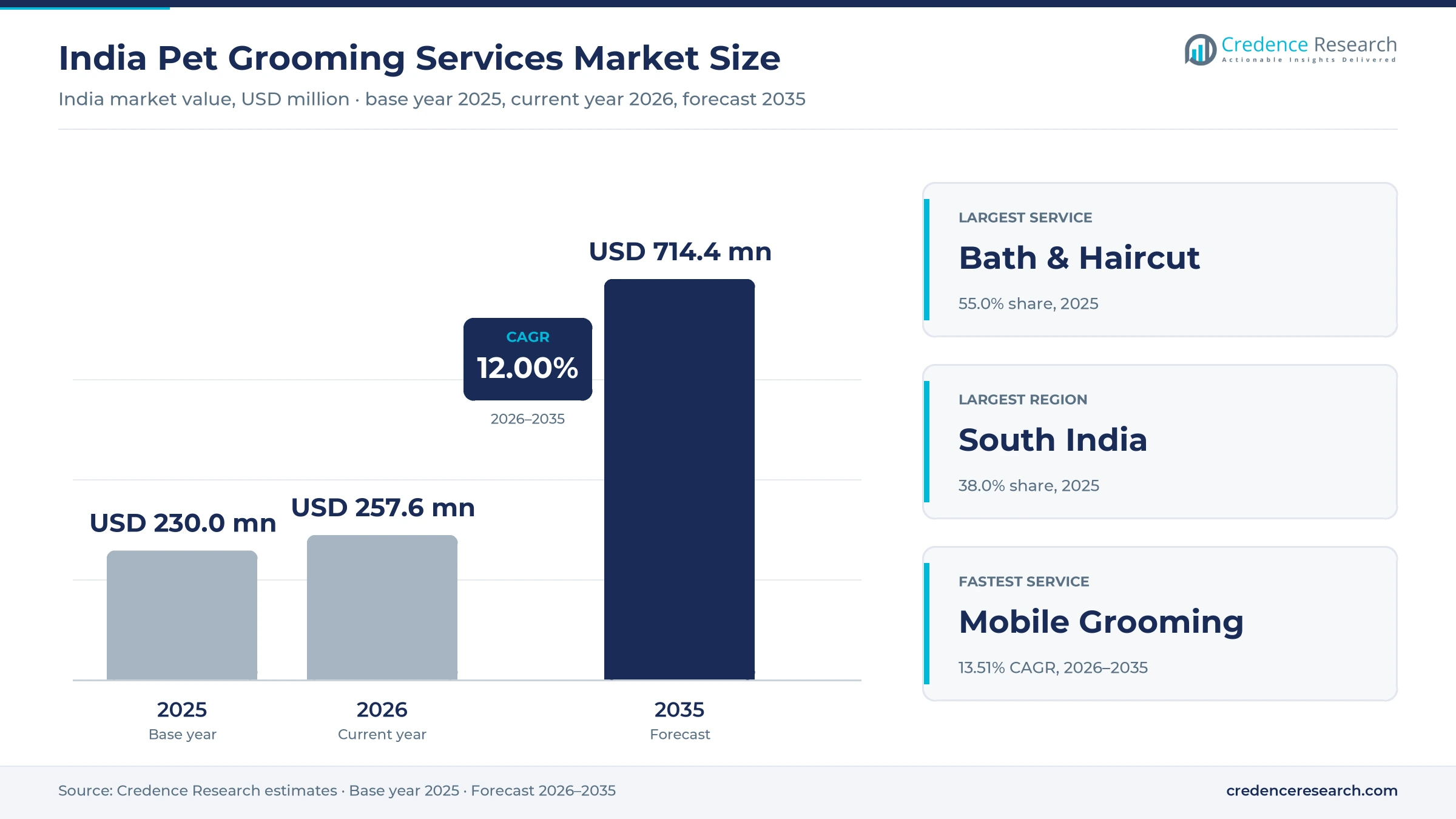
The India pet grooming services market was valued at USD 230.0 million in 2025 and is projected to increase from USD 257.6 million in 2026 to USD 714.4 million by 2035, registering a CAGR of 12.00% during 2026–2035. Demand comes from dog and cat owners who pay for baths, haircuts, de-shedding, tick treatments and spa sessions at salons, clinics and their own doorsteps. South India held the largest regional share, 38.0% in 2025, because Bengaluru and Hyderabad host dense networks of chain spas, clinics and home groomers. Northeast India is the fastest-growing region at 13.86% a year, starting from a very small base. Pet homes keep multiplying, since about 32 million households kept pets in 2024, up from about 26 million in 2019, according to Entrepreneur India. Delivery is also changing, because Supertails added at-home grooming to its quick commerce service in January 2026, while Heads Up For Tails ran more than 70 spas in 18 cities.
What counts as a paid grooming service in India?
The market counts fees that owners pay for bathing, haircuts, nail and ear care, de-shedding, tick and flea baths and spa treatments for dogs and cats. It covers walk-in salons, grooming bays inside pet stores and vet clinics, prepaid session packages and groomers who visit homes on bikes or in fitted vans, booked by phone or through apps.
The market excludes shampoos, brushes and other grooming products sold for home use, as well as veterinary treatment, boarding, training and daycare fees. Value flows from owners to salons, chains and platforms, which then pay groomers, product suppliers, van operators and property owners.
India Pet Grooming Services Market Insights
- Grooming service revenue rises from USD 230.0 million in 2025 to USD 714.4 million by 2035 at a 12.00% CAGR, as pet homes multiply and owners move from home baths to paid visits.
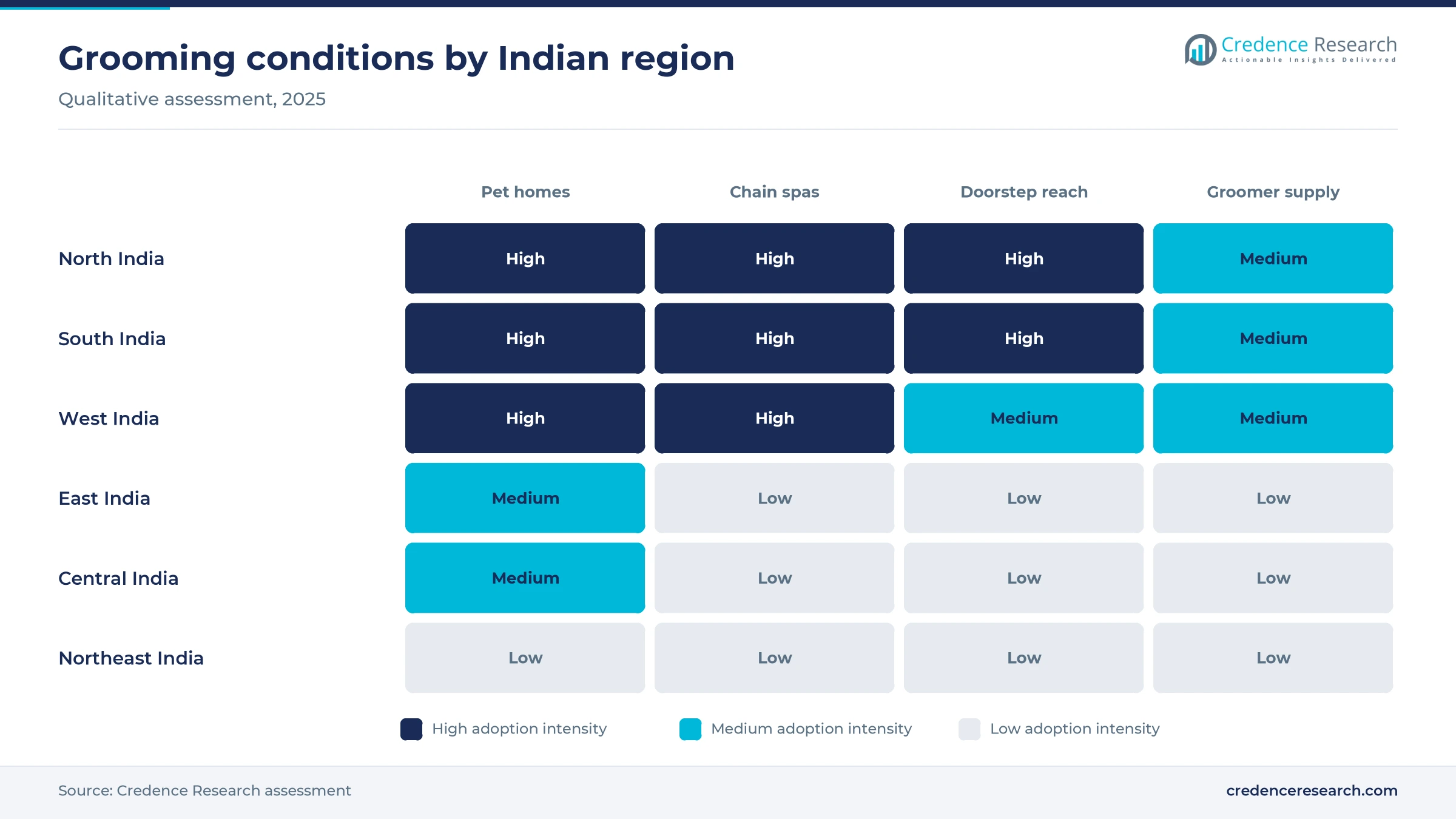
- South India held 38.0% of 2025 value, because Bengaluru and Hyderabad host Supertails clinics, PawSpace providers and Petfolk home groomers.
- Bath & Haircut accounted for 55.0% of 2025 value, as Vetic lists grooming sessions from Rs 712 at more than 20 clinics.
- Supertails added at-home grooming to its quick commerce service in January 2026, after raising US$30 million in its Series C round.
- Heads Up For Tails closed a US$25 million Series B in January 2026, when it ran more than 70 grooming spas in 18 cities.
Bath and haircut visits and metro salons lead spending
Why bath and haircut visits hold the largest share
Based on service, the market is categorized into bath & haircut, spa and mobile grooming. Bath & Haircut led with 55.0% of 2025 value because most owners book a wash, trim and nail clip every few weeks, and Vetic lists grooming sessions from Rs 712 across more than 20 clinics in Delhi NCR, Bengaluru and Mumbai. Heads Up For Tails sells bath, blow-dry and haircut services through more than 70 spas. Mobile Grooming grows fastest at 13.51% a year as doorstep formats spread, and Inc42 reported that Supertails added at-home grooming to its quick commerce service in January 2026. Spa combos for ticks and sensitive skin sit between the two.
Dogs dominate while cat grooming grows faster
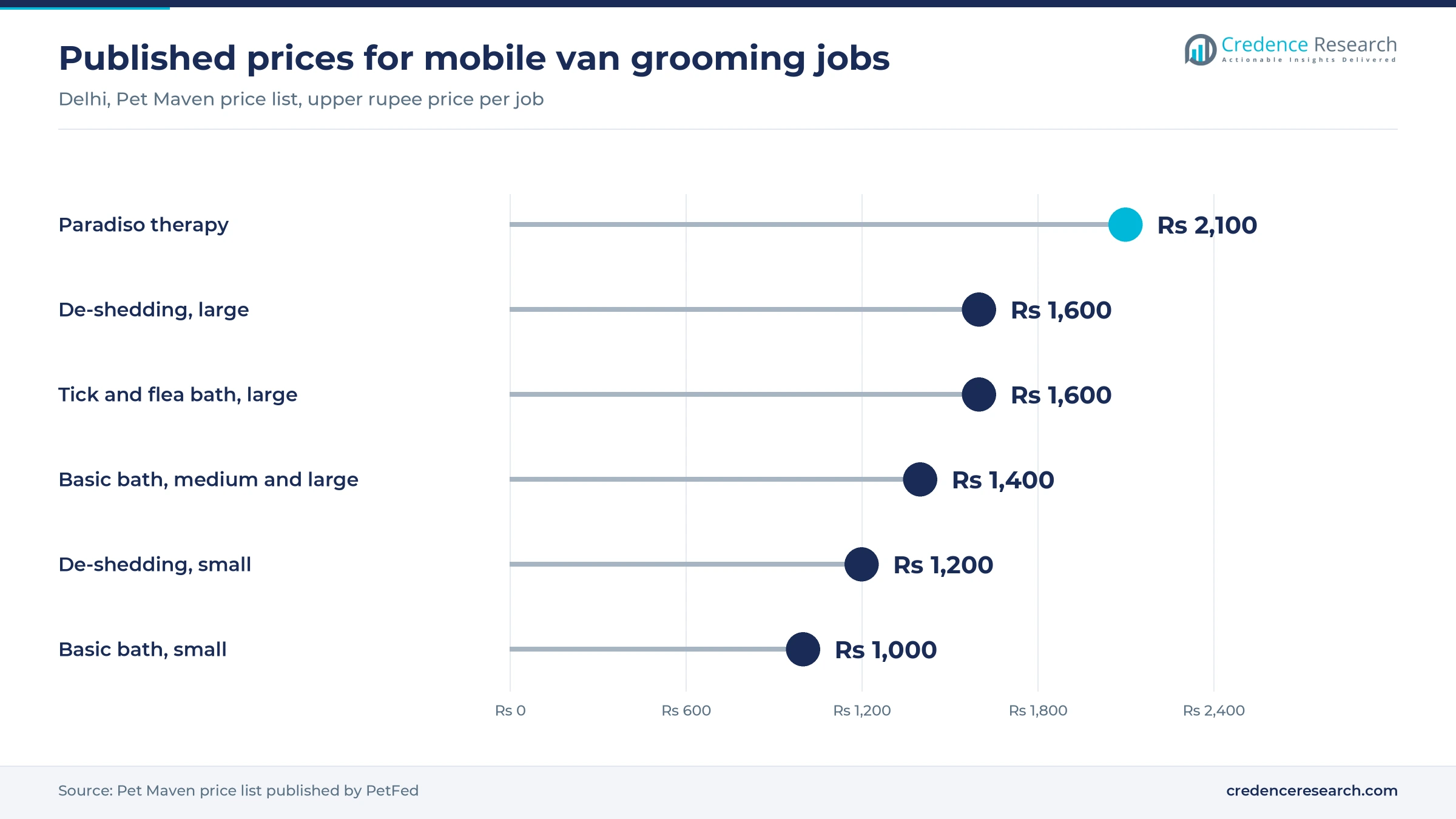
Based on pet, the market is categorized into dogs and cats. Dogs led with 86.0% of 2025 value because dog coats need regular bathing, de-shedding and tick care, and the Pet Maven grooming van in Delhi prices its packages by dog size, from Rs 800 for a small-breed bath to Rs 1,600 for a large-breed tick bath, according to PetFed. Cats grow fastest at 13.36% a year as cat ownership rises in apartments. Heads Up For Tails says its team is trained to groom only cats and dogs, and Freossi brought cat grooming expert Fadly Fuad to train more than 60 professionals in Mumbai in July 2026.
Metros lead as tier-2 cities gain organized spas
Based on city, the market is categorized into metros and tier-2 cities. Metros led with 72.0% of 2025 value because organized capacity is concentrated there, and Vetic lists its grooming clinics in Gurugram, Delhi, Noida, Ghaziabad, Bengaluru and Mumbai. Supertails also targets 70 to 100 clinics across the top six cities within 24 to 36 months, according to Outlook Business. Tier-2 cities grow fastest at 13.27% a year as chains move outward, and Whalesbook reported in June 2026 that pet care orders in tier-II and smaller cities grew 96% year on year. Zigly opened its 40th center in Jaipur in December 2025.
| Segment Group | Leading Sub-segment | Share, 2025 | Fastest-growing Sub-segment | CAGR, 2026–2035 |
|---|---|---|---|---|
| By Service | Bath & Haircut | 55.0% | Mobile Grooming | 13.51% |
| By Pet | Dogs | 86.0% | Cats | 13.36% |
| By City | Metros | 72.0% | Tier-2 | 13.27% |
Request a Free Sample
Fill in your details and we'll send you a free sample report.
- Sample data tables & charts
- Research methodology
Pet homes, doorstep visits and packages lift bookings
More pet homes and higher spending lift grooming visits
Grooming spend follows the number of pet homes and how much each one spends on care beyond food. Entrepreneur India reported in January 2026 that about 32 million Indian households kept pets in 2024, up from about 26 million in 2019. IBEF put the wider pet care market at Rs 30,434 crore, or US$3.6 billion, in CY24, with services such as grooming, training and boarding at about Rs 600 crore and accessories at about Rs 500 crore. Household budgets have room for such services, because MoSPI data show urban monthly per capita spending rose to Rs 6,996 in 2023-24 from Rs 6,459 a year earlier, with non-food items taking about 60%. In the Credence Research model this adds about 4.44 percentage points to annual growth to 2035.
Doorstep and mobile grooming remove travel barriers
Doorstep formats remove the hardest part of a salon visit for many owners, which is carrying a large or anxious dog through city traffic. Inc42 reported in February 2026 that Supertails had added at-home grooming to its quick commerce service in January, alongside deliveries in under 30 minutes. In Hyderabad, Petfolk launched home grooming in December 2023 with groomers on eco-friendly bikes, adding to its mobile grooming vans, Telangana Today reported. The Pet Maven van in Delhi charges Rs 800 to Rs 1,000 for a small-breed bath and blow dry, according to PetFed. PawSpace has served more than 35,000 customers in Bengaluru and Hyderabad through over 500 verified providers. In the Credence Research model this adds about 3.24 percentage points to annual growth to 2035.
Session packages and premium treatments raise visit frequency
Prepaid packages and add-on treatments turn occasional baths into a schedule, which raises the number of paid visits per pet each year. Heads Up For Tails sells spa packages of 3, 6, 12 and 18 sessions with savings of up to 10%, 20% and 30%, valid for 5 to 16 months. Its spa menu also adds tick and flea, sensitive skin and medicated shampoo combos to the basic bath. Pet Maven charges Rs 1,600 to Rs 2,100 for its essential-oil Paradiso therapy, against Rs 800 for a basic small-breed bath, according to PetFed. Repeat use is already visible, because 27% of PawSpace bookings are repeat bookings, YourStory reported. In the Credence Research model this adds about 2.40 percentage points to annual growth to 2035.
Funded chains add spas and clinic grooming bays
Fresh capital is letting organized chains open grooming capacity faster than independent salons can. Heads Up For Tails closed a US$25 million Series B in January 2026, when it ran more than 70 grooming spas in 18 cities and aimed for at least 250 stores in 2026 and 2027. Supertails raised US$30 million in February 2026 to expand clinics, according to Inc42 and Vetic raised US$40 million in a round led by Bessemer Venture Partners in June 2026, YourStory reported. Zigly ran 46 centers in 19 cities in July 2026 and plans 60 to 65 by the end of FY27, according to D2C Insider. These chains favor bath and haircut visits and spa combos, which supports Bath & Haircut at 55.0% of 2025 value.
Clinic grooming and cat care reshape the service mix
Shift of grooming into vet clinics and care centers
Grooming is shifting into clinics and multi-service centers, where a vet can check skin, ears and ticks during the same visit. Vetic offers 45-minute to 90-minute grooming packages at more than 20 clinics in Delhi NCR, Bengaluru and Mumbai, with sessions starting at Rs 712. Outlook Business reported in February 2026 that the front of a Supertails clinic handles retail, grooming and vaccinations, and Inc42 counted 12 Supertails clinics in Bengaluru by August 2026. Zigly opened its Jaipur center in December 2025 as its 40th, combining vet care with grooming and spa treatments, according to the company. The model also lifts demand for tick and flea treatments, which clinics can apply right after a medicated bath.
Rise of cat grooming and specialist feline handling
Cat grooming is rising as a distinct service, because cats need different handling, quieter rooms and shorter sessions than dogs. Heads Up For Tails says its spa team is trained to groom only cats and dogs, and it lists kitten grooming as a separate item on its spa menu. In July 2026, Freossi launched its Grooming Tribe at Zane's Pet Spa in Mumbai, where cat grooming expert Fadly Fuad worked with more than 60 professionals, Devdiscourse reported. Heads Up For Tails separately lists more than 400 expert groomers across more than 100 locations, and Freossi said it will expand its training programs nationwide, which should add groomers able to handle cats. As a result, Cats grow at 13.36% a year in the Credence Research model, the faster of the two pet groups.
Opening for organized grooming in tier-2 cities
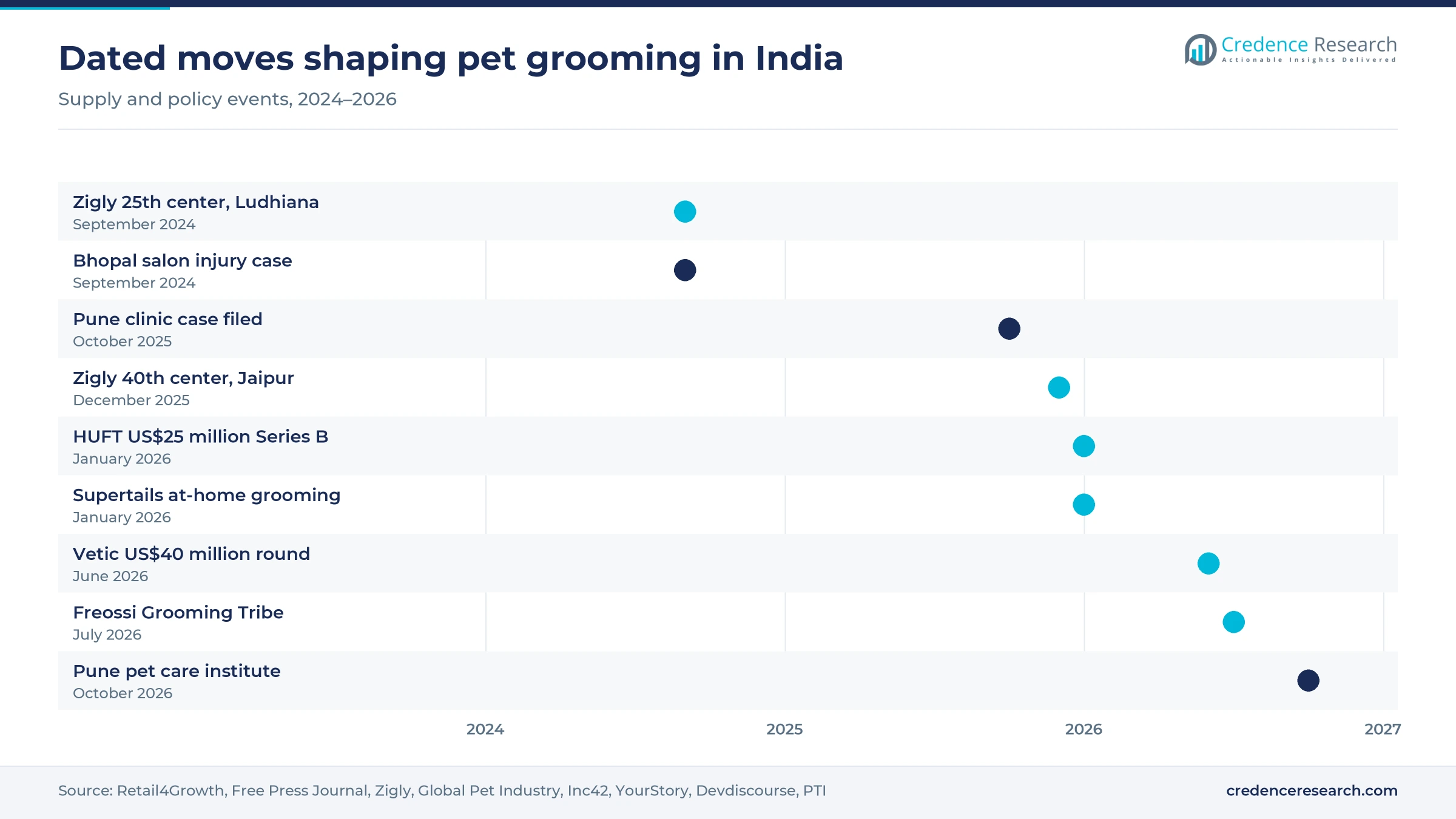
Tier-2 cities are an opening for chains and doorstep groomers, because demand there is rising faster than local salon capacity. Whalesbook reported in June 2026 that pet care orders in tier-II and smaller cities grew 96% year on year, naming Guwahati, Dibrugarh and Meerut as hotspots. Zigly already runs centers with grooming in Ludhiana, Jalandhar, Dehradun, Indore and Amritsar, according to its December 2025 release, and it opened its 48th center in Surat in August 2026. Retail4Growth reported in September 2024 that the Ludhiana outlet was its 25th, which shows how quickly the chain moved beyond metros. Tier-2 cities grow at 13.27% a year in the Credence Research model.
Opening in professional groomer training
Training is an opening because chains and mobile operators need far more skilled groomers than the market now produces. A PTI report carried by ThePrint said the Pet Care Education and Training Ecosystem in Pune, inaugurated on Oct. 6, 2026, by Maharashtra Skill Development Minister Mangal Prabhat Lodha, is the first such institute in the country, with grooming among its courses. Heads Up For Tails lists more than 400 expert groomers across more than 100 locations, a staff base that needs steady hiring as it targets 250 stores. PawSpace had run six batches of seven students through its training academy, YourStory reported. Freossi also plans to take its grooming training nationwide after its Mumbai launch in July 2026.
Safety lapses and thin groomer supply strain providers
Grooming accidents and injuries erode owner trust
Accidents at salons damage trust in professional grooming, because owners hand over pets without watching the session. In September 2024, police in Bhopal registered a case against a salon owner after a 1.5-year-old dog's tongue was cut during a trim, Free Press Journal reported. In October 2025, Pune police booked the owner and staff of a pet clinic after a dog left there for a bath on Sept. 28 died, the same paper reported. Such cases push owners toward home visits, where they can watch, or toward chains with clear protocols.
Few trained groomers slow capacity growth
Trained groomers are scarce, which limits how fast salons and vans can add bookable slots. The first dedicated pet care education institute in the country opened in Pune only in October 2026, according to a PTI report in ThePrint. Before that, most groomers learned on the job or at brand events such as the Freossi session for more than 60 professionals in Mumbai in July 2026. Chains with large teams, such as Heads Up For Tails with more than 400 groomers, must therefore train staff internally, which raises costs and slows openings.
Low penetration and price sensitivity limit paid visits
Paid grooming remains a small habit outside affluent city homes, which caps the customer base for every provider. Entrepreneur India put pet penetration at roughly 10% of households in January 2026, against more than 60% in mature markets. A basic van bath for a medium or large dog costs up to Rs 1,400 at Pet Maven, while MoSPI put urban monthly per capita spending at Rs 6,996 in 2023-24. Many owners therefore bathe dogs at home and book professionals only for haircuts or tick treatments.
Vet shortages limit medicated and clinic grooming
Medicated baths, skin care and tick removal work best with a vet nearby, but vets remain scarce across the country. IBEF estimated in September 2025 that India had only about 4,000 to 5,000 practicing veterinarians, mostly in urban and semi-urban areas. That shortage limits the clinic-linked grooming model in smaller towns, where salons cannot refer skin cases quickly. Chains respond by concentrating clinic grooming in metros, while Vetic plans Vet at Home visits and wider insurance and wellness plans after its June 2026 round.
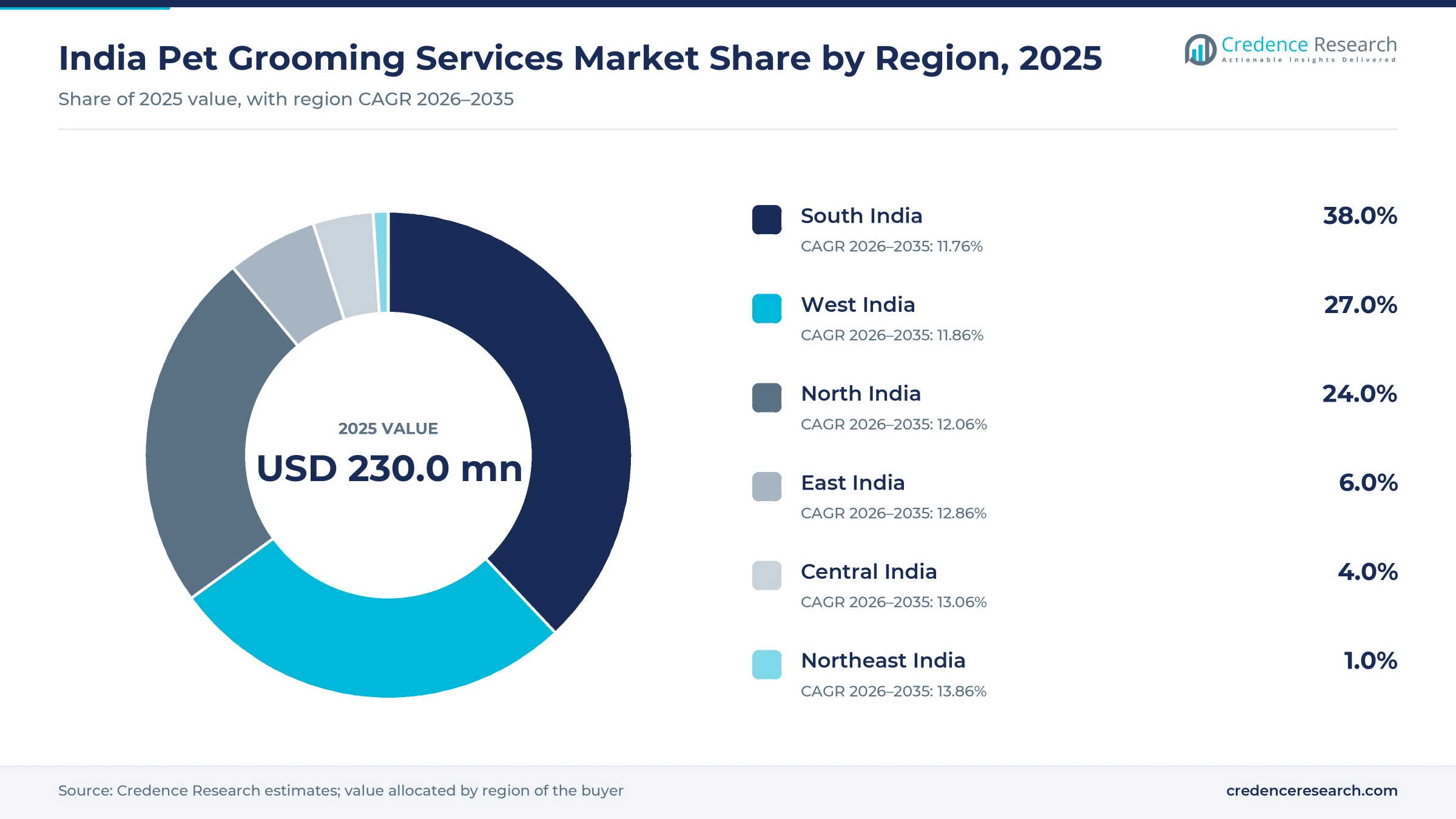
Bengaluru and Hyderabad keep South India in front
| Region | Value, 2025 (USD million) | Share, 2025 | CAGR, 2026–2035 |
|---|---|---|---|
| South India | 87.4 | 38.0% | 11.76% |
| West India | 62.1 | 27.0% | 11.86% |
| North India | 55.2 | 24.0% | 12.06% |
| East India | 13.8 | 6.0% | 12.86% |
| Central India | 9.2 | 4.0% | 13.06% |
| Northeast India | 2.3 | 1.0% | 13.86% |
South India leads on dense chain and home grooming networks
South India held 38.0% of 2025 value and grows at 11.76% a year, the largest zone in the India pet grooming services market. Bengaluru is the main test city for organized players, and Inc42 counted 12 Supertails clinics there in August 2026. PawSpace serves Bengaluru and Hyderabad through more than 500 verified providers, according to YourStory. In Hyderabad, Petfolk launched bike-based home grooming in December 2023 alongside its mobile vans, Telangana Today reported and Zigly lists Secunderabad and Bangalore among its center cities.
West India grows on Mumbai, Pune and Surat demand
West India held 27.0% of 2025 value and grows at 11.86% a year, led by Mumbai, Pune, Ahmedabad and Surat. Mumbai hosted the launch of the Freossi Grooming Tribe in July 2026, and Pune opened the Pet Care Education and Training Ecosystem in October 2026. Zigly opened its 48th center in Surat in August 2026, adding grooming capacity in Gujarat. Vetic also lists Mumbai among its grooming clinic cities, which brings clinic-linked grooming to the largest metro in the zone.
North India builds on Delhi NCR clinics and vans
North India held 24.0% of 2025 value and grows at 12.06% a year, with Delhi NCR as its core market. Vetic lists grooming clinics in Gurugram, Delhi, Noida and Ghaziabad, while Zigly runs 24x7 centers in Kailash Colony and Janakpuri, Retail4Growth reported in September 2024. Mobile operators are also established, since Flying Fur has run doorstep grooming vans from Delhi since 2015, according to BounceWatch. Zigly centers in Chandigarh, Ludhiana, Jalandhar and Jaipur carry organized grooming beyond the capital.
East India grows from a thin organized base
East India held 6.0% of 2025 value and grows at 12.86% a year, faster than the national pace from a smaller base. Organized grooming is thinner here, although Heads Up For Tails shows customer reviews from its spas in Kolkata and Jamshedpur on its spa page. Local salons carry most of the paid work in the zone, so each new chain spa adds first-time visits. MoSPI data show urban spending rising across the country, which supports more paid visits in cities such as Kolkata and Bhubaneswar.
Central India depends on Indore and Bhopal salons
Central India held 4.0% of 2025 value and grows at 13.06% a year from a small base. Zigly lists Indore among its center cities, which brings clinic-linked grooming and spa services to Madhya Pradesh. The zone has also seen the trust problem in informal work, since Bhopal police booked a salon owner in September 2024 after a dog's tongue was cut during a trim. Chains that offer supervised sessions can therefore win share from local salons in Indore, Bhopal and Raipur.
Guwahati orders give Northeast India a grooming foothold
Northeast India held 1.0% of 2025 value and grows at 13.86% a year, the fastest pace in the model. The base is very small because few organized salons or vans operate in the hill states. Whalesbook named Guwahati and Dibrugarh in June 2026 as hotspots for pet care orders from tier-II and smaller cities. That online buying base gives mobile groomers and future chain spas a starting point in Guwahati and nearby towns.
Funding rounds and training moves from 2024 to 2026
| Development | Status and market relevance |
|---|---|
| In December 2025, Zigly opened its 40th pet care center in Jaipur, offering vet care, grooming and spa treatments. | Opened, widens chain grooming in Rajasthan |
| In January 2026, Heads Up For Tails closed a US$25 million Series B while running more than 70 grooming spas in 18 cities. | Funded, targets 250 stores in 2026 and 2027 |
| In February 2026, Supertails raised US$30 million in a Series C led by Venturi Partners after adding at-home grooming in January. | Funded, expands clinics and doorstep services |
| In June 2026, Vetic raised US$40 million in a round led by Bessemer Venture Partners to expand its clinic network. | Funded, plans Vet at Home visits |
| In October 2026, the Pet Care Education and Training Ecosystem opened in Pune with grooming among its training courses. | Opened, adds a formal groomer training route |
Vans, home kits and apps change how grooming is delivered
- Mobile grooming vans bring a full-service salon to the owner's doorstep, the model Flying Fur has run in Delhi since 2015, according to BounceWatch.
- Bike-based home kits let groomers reach apartments quickly, and Petfolk sent groomers on eco-friendly bikes when it launched home grooming in Hyderabad in December 2023.
- App and quick commerce booking lets owners schedule a groomer in the same app they use for supplies, as Supertails did after adding at-home grooming in January 2026.
- Medicated and tick baths use specialist shampoos for skin and parasite problems, and Heads Up For Tails sells them as tick and flea, sensitive skin and medicated shampoo combos.
Need a Custom Version of This Report?
Tailor the scope, geography, or segments to your exact requirements.
- Custom geography or segment scope
- Direct access to our analyst team
Funded chains compete with thousands of local salons
The India pet grooming services market is fragmented, with thousands of local salons and home groomers competing against a few funded chains. Heads Up For Tails leads organized spa capacity, with more than 70 spas in 18 cities in January 2026 and multi-session packages that lock in repeat visits. Supertails competes through clinics and at-home grooming tied to its quick commerce app, and it serves nearly one million pet parents, Inc42 reported in August 2026. Zigly pairs grooming with vet care in 46 centers across 19 cities, while Vetic sells grooming packages at more than 20 clinics in Delhi NCR, Bengaluru and Mumbai. Doorstep specialists such as PawSpace, Petfolk, Pet Maven and Flying Fur compete on convenience in one or two cities each. Competition turns on trained staff, safety and price, and chains increasingly bundle grooming with food and supplies to keep owners inside one ecosystem.
Companies profiled and their roles in this market
| Company | Type | Role in the market |
|---|---|---|
| Heads Up For Tails | Pet retail and spa chain | Runs more than 70 grooming spas in 18 cities with 3 to 18 session packages |
| Supertails | Pet care platform | Offers at-home grooming through quick commerce and grooming at its Bengaluru clinics |
| Zigly | Pet care center chain | Combines vet care, grooming and spa in 46 centers across 19 cities |
| Vetic | Vet clinic chain | Sells 45-minute to 90-minute grooming packages at more than 20 clinics |
| PawSpace | Doorstep service platform | Books grooming and other services in Bengaluru and Hyderabad through 500+ providers |
| Petfolk | Pet care facility | Runs mobile grooming vans and bike-based home grooming in Hyderabad |
| Pet Maven | Mobile grooming van | Serves Delhi with bath, de-shedding, tick and spa packages from Rs 800 |
Trained groomers and safe sessions will decide winners
Credence Research's view is that the India pet grooming services market will reward providers that can field trained, supervised groomers at scale. Demand is secure because pet homes keep growing and urban budgets have room for non-food spending. Chains with packages, clinics and apps are best placed to turn occasional baths into regular visits, while doorstep formats win busy owners and large dogs. Demand in the India pet grooming services market is broadening, since Whalesbook reported a 41% year-on-year rise in pet care orders in June 2026. The constraint is skill and trust, since accident cases in Bhopal and Pune show the cost of untrained handling.
How the pet household grooming model was built
The report uses 2025 as the base year and forecasts to 2035. Market values come from the Credence Research model, checked against pet households multiplied by the share using paid grooming, visit frequency and published service prices. Segment and regional splits are Credence Research estimates informed by chain and clinic locations, published price lists, platform order data and official household spending statistics. Sources used include government statistics, government trust publications, trade and business press, and company websites and announcements. No interviews or surveys were conducted in preparing this report.
More pet homes keep grooming visits rising to 2035
India pet grooming services revenue is forecast to reach USD 714.4 million by 2035 at a 12.00% CAGR, with more pet homes and more frequent paid visits doing most of the work. South India should remain the largest region, while Northeast India, Central India and East India grow faster as chains reach smaller cities. Mobile grooming is expected to grow at 13.51% a year, while bath and haircut visits remain the largest service. Cat grooming and tier-2 cities should keep gaining share, and providers that train groomers well and offer fair package prices are likely to capture most repeat business.
Frequently Asked Questions
How big is the India pet grooming services market?
Which region leads the market?
Which service type is largest?
Which service grows fastest?
How much does a grooming session cost?
How many households keep pets in India?
Who are the main grooming providers?
What is the biggest risk for the market?
Table of Content
Chapter 1 Market Segmentation
- 1.1 Segmentation Framework
- 1.1.1 Product and Service Classification
- 1.1.2 Application and End-Use Classification
- 1.1.3 Technology and Solution Classification
- 1.1.4 Customer and Distribution Channel Classification
- 1.1.5 Geographic Segmentation
- 1.1.6 Market Segment Definitions and Boundaries
- 1.2 By Service
- 1.2.1 Bath & Haircut
- 1.2.2 Spa
- 1.2.3 Mobile Grooming
- 1.3 By Pet
- 1.3.1 Dogs
- 1.3.2 Cats
- 1.4 By City
- 1.4.1 Metros
- 1.4.2 Tier-2
Chapter 2 Introduction
- 2.1 Report Objectives and Scope
- 2.2 Product Definition and Industry Terminology
- 2.3 Market Inclusions and Exclusions
- 2.4 Research Process
- 2.4.1 Primary Research and Expert Interviews
- 2.4.2 Secondary Research and Source Review
- 2.4.3 Top-Down and Bottom-Up Estimation
- 2.4.4 Data Triangulation and Verification
- 2.5 Market Size Measurement Basis
- 2.5.1 2025: USD 230.0 million → 2035: USD 714.4 million
- 2.6 Historical and Forecast Reference Periods
- 2.6.1 Historical Period: 2018-2025
- 2.6.2 Base Year: 2025
- 2.6.3 Forecast Period: 2025-2035
- 2.7 Research Assumptions and Limitations
Chapter 3 Executive Summary
- 3.1 Market Snapshot and Key Findings
- 3.2 Base-Year Market Size, 2025
- 3.3 Forecast Market Size, 2035
- 3.4 Revenue and Volume Growth Outlook
- 3.5 Key Demand and Supply Indicators
- 3.6 Leading Market Segments
- 3.7 Fastest-Growing Market Opportunities
- 3.8 Regional Performance Highlights
- 3.9 Technology and Industry Transformation
- 3.10 Competitive Landscape Summary
- 3.11 Analyst View and Strategic Implications
Chapter 4 India Pet Grooming Services Market Trends and Developments
- 4.1 Historical Industry Development, 2018-2025
- 4.2 Recent Market Trends and Developments
- 4.3 Demand and Customer Behavior Trends
- 4.4 Technology and Product Innovation
- 4.5 Artificial Intelligence, Automation and Digitalization
- 4.6 Local Manufacturing and Supply Chain Realignment
- 4.7 Industry Partnerships, Mergers and Acquisitions
- 4.8 Sustainability and Circular Economy Developments
- 4.9 Government and Private Sector Investment Trends
- 4.10 Emerging Business Models and Commercialization
- 4.11 Industry Developments and Announcements
Chapter 5 India Pet Grooming Services Market Supply and Demand Analysis
- 5.1 Demand Trend and Consumption Analysis, 2018-2025
- 5.2 Demand Forecast, 2025-2035
- 5.3 Supply Chain Structure and Procurement Trends
- 5.4 Supply-Demand Gap and Bottlenecks
- 5.5 Import Dependence and Sourcing Structure
- 5.6 Regional Supply and Demand Concentration
Chapter 6 India Pet Grooming Services Market Pricing Analysis
- 6.1 Pricing Structure and Measurement
- 6.2 Historical Pricing Trends, 2018-2025
- 6.3 Pricing Outlook, 2025-2035
- 6.4 Pricing by Product and Market Segment
- 6.5 Geographic Pricing Differences
- 6.6 Key Input, Energy, Labor and Logistics Costs
- 6.7 Contract Pricing and Purchasing Models
- 6.8 Pricing Sensitivity and Competitive Positioning
- 6.9 Price, Margin and Profitability Implications
Chapter 7 India Pet Grooming Services Market Dynamics
- 7.1 Market Growth Drivers
- 7.1.1 Demand-Side Drivers
- 7.1.2 Technology and Innovation Drivers
- 7.1.3 Infrastructure and Investment Drivers
- 7.1.4 Regulatory and Policy Drivers
- 7.2 Market Restraints
- 7.2.1 Cost and Affordability Constraints
- 7.2.2 Technology and Adoption Barriers
- 7.2.3 Supply Chain and Operational Constraints
- 7.3 Market Challenges
- 7.3.1 Competitive Pressure and Margin Erosion
- 7.3.2 Skills, Infrastructure and Implementation Gaps
- 7.4 Emerging Market Opportunities
- 7.5 Market Dynamics Impact and Time-Horizon Assessment
Chapter 8 India Pet Grooming Services Value Chain Analysis
- 8.1 Industry Value Chain Overview
- 8.2 Upstream Suppliers and Critical Inputs
- 8.3 Technology and Component Providers
- 8.4 Manufacturing or Service Delivery
- 8.5 Distribution, Channel Partners and Integrators
- 8.6 Downstream Applications and End Users
- 8.7 Value Addition and Profit Pools
- 8.8 Vertical Integration and Outsourcing
- 8.9 Supplier Concentration and Risk
- 8.10 Supply Chain Localization and Resilience
Chapter 9 India Pet Grooming Services Market Regulations and Policies
- 9.1 Relevant Laws, Standards and Compliance Frameworks
- 9.2 Product, Service, Safety and Quality Requirements
- 9.3 Government Policies, Incentives and Subsidies
- 9.4 Imports, Exports and Trade Barriers
- 9.5 Public Procurement and Local Content Requirements
- 9.6 Data Protection, AI and Cybersecurity Compliance
- 9.7 Upcoming Policy Changes and Market Implications
Chapter 10 India Pet Grooming Services Market Hotspots and Opportunities
- 10.1 Market Opportunity Mapping and Growth Hotspots
- 10.2 High-Growth Applications and Customer Groups
- 10.3 Underserved Markets and White-Space Opportunities
- 10.4 Emerging Technology and Product Opportunities
- 10.5 New Capacity and Investment Hotspots
- 10.6 Market Entry and Expansion Opportunities
- 10.7 Distribution and Partnership Opportunities
- 10.8 Near-Term and Long-Term Commercial Potential
- 10.9 Opportunity Attractiveness and Execution Risks
Chapter 11 India Pet Grooming Services Market Outlook, 2025-2035
- 11.1 Market Size and Analysis
- 11.1.1 Revenue (Market Measurement: 2025: USD 230.0 million → 2035: USD 714.4 million)
- 11.1.2 Historical Market Size, 2018-2025
- 11.1.3 Base-Year Market Size, 2025
- 11.2 Market Forecast, 2025-2035
- 11.2.1 Revenue Forecast to 2035
- 11.2.2 CAGR and Year-on-Year Growth
- 11.2.3 Incremental Revenue Opportunity
- 11.3 Forecast Assumptions and Scenario Analysis
- 11.3.1 Base-Case Forecast
- 11.3.2 Optimistic and Conservative Scenarios
- 11.3.3 Technology, Pricing and Policy Sensitivities
- 11.4 Market Attractiveness and Growth Outlook
Chapter 12 India Pet Grooming Services Market Segmentation and Outlook
- 12.1 Segmentation Summary and Market Shares, 2025
- 12.2 Largest and Fastest-Growing Segments
- 12.3 By Service - Market Size and Forecast, 2025-2035
- 12.3.1 Segment Definition and Scope
- 12.3.2 Historical Market Size, 2018-2025
- 12.3.3 Revenue Forecast, 2025-2035
- 12.3.4 Base-Year Market Share, 2025
- 12.3.5 Segment CAGR and Growth Drivers
- 12.3.6 Subsegment Market Size and Forecast
- 12.3.6.1 Bath & Haircut
- 12.3.6.2 Spa
- 12.3.6.3 Mobile Grooming
- 12.3.7 Subsegment Pricing and Adoption Trends
- 12.3.8 Leading Suppliers and Competition
- 12.3.9 Regional Demand and Opportunities
- 12.4 By Pet - Market Size and Forecast, 2025-2035
- 12.4.1 Segment Definition and Scope
- 12.4.2 Historical Market Size, 2018-2025
- 12.4.3 Revenue Forecast, 2025-2035
- 12.4.4 Base-Year Market Share, 2025
- 12.4.5 Segment CAGR and Growth Drivers
- 12.4.6 Subsegment Market Size and Forecast
- 12.4.6.1 Dogs
- 12.4.6.2 Cats
- 12.4.7 Subsegment Pricing and Adoption Trends
- 12.4.8 Leading Suppliers and Competition
- 12.4.9 Regional Demand and Opportunities
- 12.5 By City - Market Size and Forecast, 2025-2035
- 12.5.1 Segment Definition and Scope
- 12.5.2 Historical Market Size, 2018-2025
- 12.5.3 Revenue Forecast, 2025-2035
- 12.5.4 Base-Year Market Share, 2025
- 12.5.5 Segment CAGR and Growth Drivers
- 12.5.6 Subsegment Market Size and Forecast
- 12.5.6.1 Metros
- 12.5.6.2 Tier-2
- 12.5.7 Subsegment Pricing and Adoption Trends
- 12.5.8 Leading Suppliers and Competition
- 12.5.9 Regional Demand and Opportunities
- 12.6 Segment Growth Comparison
- 12.7 Segment Attractiveness and Priority Matrix
Chapter 13 India Pet Grooming Services Geographic Market Outlook, 2025-2035
- 13.1 Domestic Market Distribution and Demand Clusters
- 13.2 State- or Province-Wise Market Size and Forecast, 2025-2035
- 13.3 City and Metropolitan Market Outlook
- 13.4 Industrial, Manufacturing and Commercial Clusters
- 13.5 Geographic Concentration of Key End Users
- 13.6 Local Pricing and Purchasing Differences
- 13.7 Domestic Production Facilities and Capacity Map
- 13.8 Local Infrastructure and Project Pipeline
- 13.9 State-Level Policy and Incentive Differences
- 13.10 Subnational Investment Hotspots and Opportunities
- 13.11 Distribution and Logistics Networks
- 13.12 Domestic Competitive Footprint
Chapter 14 India Pet Grooming Services Technology, Innovation and Sustainability Outlook
- 14.1 Technology Landscape and Maturity
- 14.2 Product, Process and Service Innovation
- 14.3 AI, Automation and Digital Tools in the Industry
- 14.4 Technology Adoption and Performance Benchmarking
- 14.5 Innovation Pipeline and R&D Investment
- 14.6 Energy Efficiency and Resource Management
- 14.7 Sustainability, Recycling and Circularity
- 14.8 Technology Roadmap, 2025-2035
- 14.9 Risks of Obsolescence and Technology Substitution
Chapter 15 India Pet Grooming Services Market Key Strategic Imperatives
- 15.1 Growth and Market Entry Priorities
- 15.2 High-Return Products and Segments
- 15.3 Pricing, Profitability and Cost Optimization
- 15.4 Technology Investment and Product Differentiation
- 15.5 Supply Chain Localization and Resilience
- 15.6 Distribution and Customer Acquisition
- 15.7 Partnership, Acquisition and Capacity Strategy
- 15.8 Regional Expansion Priorities
- 15.9 Short-, Medium- and Long-Term Actions
Chapter 16 Competition Outlook
- 16.1 Industry Competition Characteristics
- 16.2 Market Structure and Concentration
- 16.3 Market Share and Competitive Positioning, 2025
- 16.4 Company-Wise Revenue and Product Benchmarking
- 16.5 Production and Service Capacity Benchmarking
- 16.6 Technology, Pricing and Differentiation
- 16.7 Regional Footprint and Distribution Strength
- 16.8 Mergers, Acquisitions and Strategic Alliances
- 16.9 New Entrants and Competitive Threats
- 16.10 Porter's Five Forces and Industry Attractiveness
- 16.11 Competitive Outlook, 2025-2035
Chapter 17 Company Profiles
- 17.1 Company Coverage and Selection Criteria
- 17.2 Heads Up For Tails
- 17.2.1 Business Description
- 17.2.2 Company Ownership and Geographic Presence
- 17.2.3 Product and Service Portfolio
- 17.2.4 Manufacturing and Operating Footprint
- 17.2.5 Financial Performance and Investment
- 17.2.6 Market Share and Competitive Position
- 17.2.7 Technology and Innovation Capabilities
- 17.2.8 Strategic Alliances or Partnerships
- 17.2.9 Recent Developments
- 17.2.10 Growth Strategy and Outlook
- 17.3 Supertails
- 17.4 Zigly
- 17.5 Vetic
- 17.6 PawSpace
- 17.7 Petfolk
- 17.8 Pet Maven
- 17.9 Flying Fur
- 17.10 Other Relevant Market Participants
Note: Every listed company is profiled on the structure shown under the first company. The company list is preliminary and may change based on research findings, market developments, data availability and client requirements.
Chapter 18 Disclaimer
- 18.1 Research and Forecast Disclaimer
- 18.2 Data Source and Estimation Limitations
Note: The depth of individual sections depends on data availability for this market. Volume, capacity, trade and other unit-based metrics are included where applicable.

