
Cashew Market Overview:
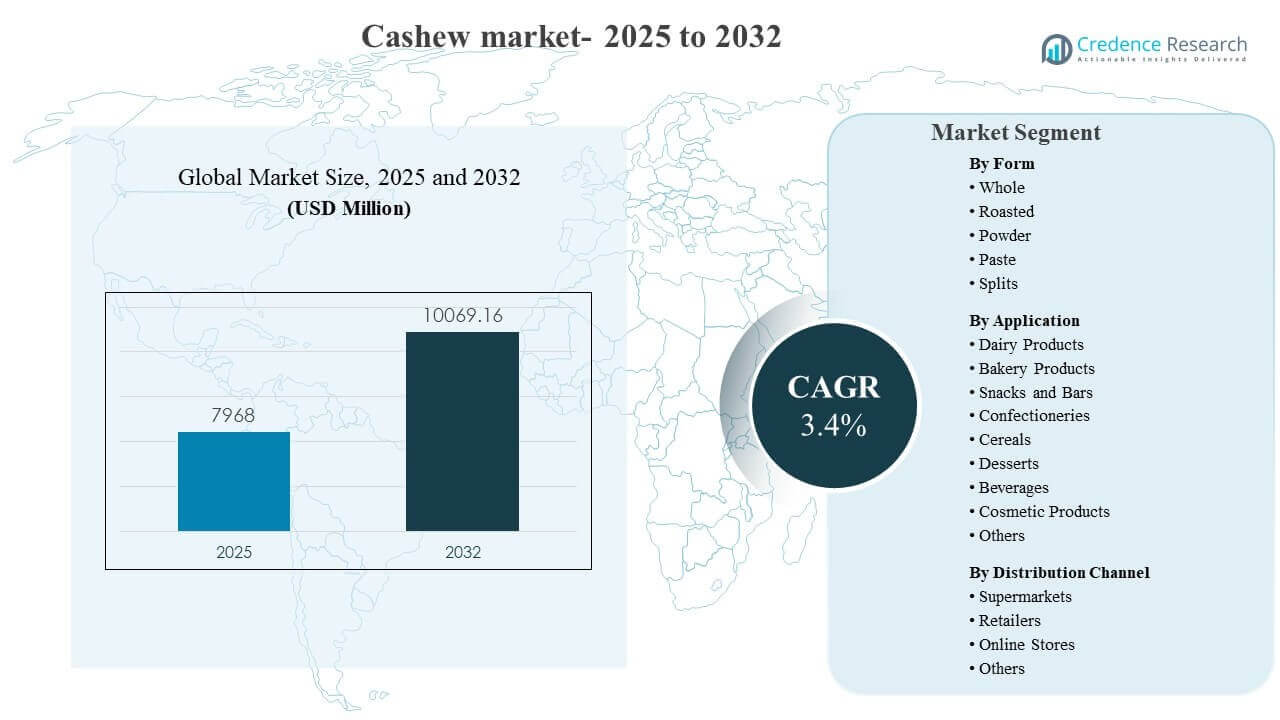
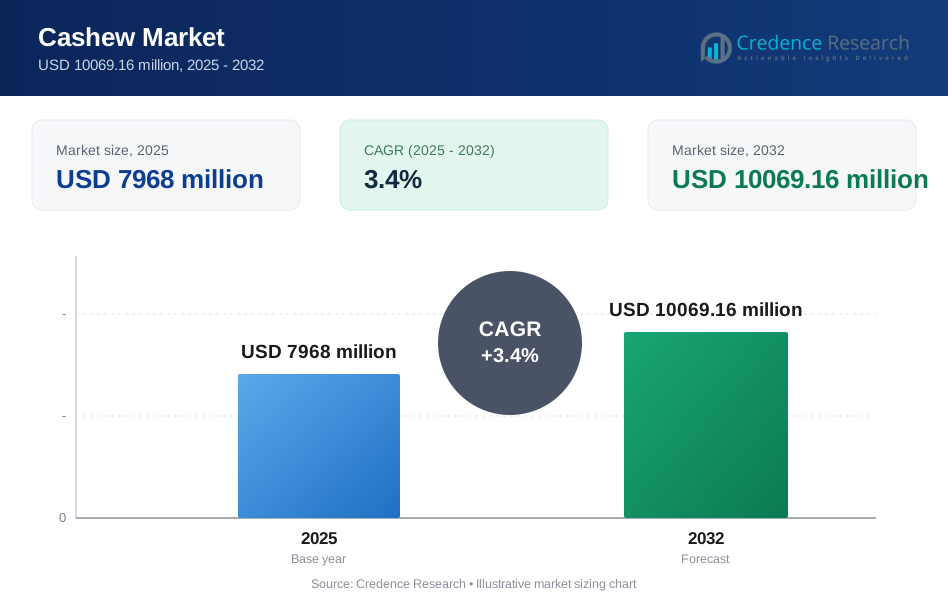
The global Cashew market size was estimated at USD 7968 million in 2025 and is expected to reach USD 10069.16 million by 2032, growing at a CAGR of 3.4% from 2025 to 2032. Demand expansion is driven primarily by rising everyday snacking and ingredient use, with cashews benefiting from a premium health-positioned profile across roasted snacks, bars, bakery inclusions, and plant-forward formulations that use paste and powder for texture and mouthfeel. Asia Pacific remains the largest consumption and processing center, supported by strong domestic demand in major producing economies and a large export-oriented processing base that helps stabilize supply availability for global retail and food manufacturing channels.
| REPORT ATTRIBUTE | DETAILS |
|---|---|
| Historical Period | 2020-2024 |
| Base Year | 2025 |
| Forecast Period | 2026-2032 |
| Cashew Market Size 2025 | USD 7968 million |
| Cashew Market, CAGR | 3.4% |
| Cashew Market Size 2032 | USD 10069.16 million |
Key Market Trends & Insights
- Asia Pacific accounted for 39.80% share in 2025, supported by large-scale processing capacity and expanding packaged snack penetration across urban retail.
- North America held 24.60% share in 2025, reflecting steady demand for roasted, flavored, and portion-controlled packs across modern retail and DTC formats.
- Whole form led with 42.00% share in 2025, indicating continued preference for premium kernels used in snack packs and gifting assortments.
- Snacks and Bars represented 26.70% share in 2025, highlighting the role of convenience eating and functional snacking in sustaining repeat purchases.
- Online Stores reached 24.50% share in 2025, indicating faster channel mix shifts driven by assortment breadth, subscription packs, and price transparency.
Segment Analysis
The cashew market shows a clear shift toward value-added consumption rather than purely raw kernel trade, with stronger pull from branded snacking and ingredient applications. Whole form remains the core purchase format, though roasted variants capture incremental demand through flavor innovation and convenient pack sizes. Industrial buyers increasingly adopt paste and powder formats in bakery, confectionery, and plant-forward recipes, improving utilization of pieces and splits while supporting margin stability across grades.
Application demand is led by direct snacking and bar formats, with secondary strength from bakery and confectionery where cashews provide texture, inclusions, and premium positioning. Dairy and dessert applications increasingly use cashew paste in sauces, spreads, and cream-style formulations, especially within plant-forward product lines. Cosmetic applications remain a smaller but specialized demand pocket where cashew-derived oils and extracts support niche formulations.
Channel dynamics reflect continued dominance of supermarkets and traditional retailers, complemented by fast-growing e-commerce penetration. Online platforms support discovery-led purchases such as flavored assortments and premium grades, and also enable repeat buying through multi-pack bundles. Modern trade enhances visibility through shelf placement and cross-category promotions alongside dry fruits, snacks, and baking ingredients.
By Form Insights
Whole accounted for the largest share of 42.00% in 2025. Whole kernels remain preferred for premium snack packs, gifting assortments, and visible inclusions in bakery and confectionery products. Roasted formats expand consumption frequency through flavor variety and convenience positioning across modern retail shelves. Splits, paste, and powder support industrial usage by improving yield utilization and lowering formulation costs in sauces, spreads, and fillings.
By Application Insights
Snacks and Bars accounted for the largest share of 26.70% in 2025. Snacking demand benefits from portability, perceived nutrition value, and premium taste positioning that supports repeat purchases across multiple dayparts. Bakery and confectionery demand remains resilient because cashews act as a premium inclusion ingredient with stable consumer appeal. Dairy, desserts, and beverages increasingly use cashew paste for creaminess, enabling broader usage beyond traditional dry-fruit consumption.
By Distribution Channel Insights
Supermarkets accounted for the largest share of 33.00% in 2025. Supermarkets offer wide assortment, bulk pack options, and strong in-store visibility that supports conversion for both everyday and occasion purchases. Retailers remain important for regional preferences, impulse packs, and dry-fruit assortment sales in local markets. Online Stores expand access to premium grades, subscription boxes, and flavored innovations that support faster channel growth versus offline alternatives.
Cashew Market Drivers
Expansion Of Healthy Snacking And Premium Dry-Fruit Consumption
The cashew market benefits from rising demand for nutrient-positioned snacking that fits convenience-led lifestyles. Consumers increasingly prefer premium nuts for taste, satiety, and perceived clean-label value in everyday diets. Branded roasted and flavored packs improve purchase frequency through variety and portion control. Retail merchandising alongside snacks and dried fruits improves visibility and trial. Premium gifting and festive assortments further support higher-value cashew consumption across multiple regions.
Growth In Food Manufacturing Use Across Bakery, Confectionery, And Dairy-Style Formulations
Food manufacturers use cashews to improve texture, crunch, and premium positioning in baked goods and confectionery products. Cashew paste and powder also gain adoption in sauces, fillings, spreads, and cream-style formulations, including plant-forward product lines. Industrial demand supports consistent offtake across kernel grades, including splits and pieces. Broader application diversity reduces reliance on a single end-use segment. This multi-application pull supports steady volume demand and value-added processing.
Channel Modernization Through Supermarkets And E-Commerce Expansion
Modern trade strengthens category performance by offering wide assortment, quality visibility, and predictable pricing in organized retail. Supermarkets support bulk purchases and cross-promotions that link cashews with cereals, desserts, and baking ingredients. E-commerce expands access to premium grades, specialty flavors, and subscription packs that increase repeat buying. Direct-to-consumer models enable brands to test new formats and packaging quickly. Growing online penetration also improves reach in secondary cities with limited premium retail.
- For instance, Indian club and modern retail chains now contract directly with exporters for premium W180 and W210 grades under private labels, enforcing strict defect tolerances on kernels displayed in transparent bulk or pouch formats. Supermarkets support bulk purchases and cross-promotions that link cashews with cereals, desserts, and baking ingredients.
Supply Chain Professionalization And Processing Investments In Producing Regions
The cashew market is supported by improving procurement systems, quality grading practices, and processing upgrades in producing economies. Investments in sorting, roasting, and packaging enhance consistency, shelf life, and export readiness for value-added kernels. Better traceability and food safety practices help suppliers meet stricter retailer requirements. Processing improvements also reduce losses and stabilize yields across grades. Enhanced capability across the chain supports both local branded growth and export competitiveness.
- For instance, India’s ability to supply 93.7 percent of domestic cashew demand in shelled-kernel form and generate hundreds of millions of dollars in kernel export revenues reflects the value captured through processing sophistication rather than raw nut trading alone.
Cashew Market Challenges
Supply variability remains a key challenge due to dependence on agricultural cycles, weather sensitivity, and inconsistent farm-level productivity. Price fluctuations for raw nuts and kernels can pressure margins for processors and brand owners, especially when retail pricing cannot adjust quickly. Quality consistency is difficult across origins because grading practices and post-harvest handling can differ widely. Logistics constraints and cross-border trade frictions can also disrupt lead times for import-dependent consuming regions.
- For instance, in California’s 2023 almond season, unseasonably cold, wet weather cut expected output by about 50 million pounds versus the 2.6-billion-pound pre-season estimate, as low bee flight hours and average minimum temperatures dropping to 1.32°C in early April hindered pollination and nut development.
Competitive intensity creates additional pressure through private-label expansion, frequent promotions, and rising expectations on packaging, certifications, and traceability. Smaller processors may struggle to meet stringent retailer standards for food safety documentation and consistent sizing. Value-added formats require investments in roasting, seasoning, and packaging lines that raise fixed costs. Brand differentiation is difficult in commoditized kernel categories, requiring ongoing innovation and channel management to protect price realization.
Cashew Market Trends and Opportunities
Premiumization is increasing through flavored roasted cashews, coated variants, and curated assortments that target gifting and impulse purchases. Product innovation focuses on reduced-sodium, clean seasoning profiles, and functional blends with seeds and dried fruits. Cashew paste is gaining traction as an ingredient base for sauces, spreads, and cream-style applications that support plant-forward recipes. Brands that align packaging and flavor innovation with modern trade and online discovery can improve repeat rates.
- For instance, Ella Foods in India launched salted roasted cashews with plant-based low-sodium salt delivering approximately 40% less sodium than regular salted cashews, positioning them as a premium yet heart-health-focused snack for modern retail channels.
Opportunities are expanding in online-first offerings such as subscription packs, bundle assortments, and premium grade selections with transparent sourcing narratives. Foodservice and ingredient channels offer growth potential for paste, powder, and splits in bakery fillings, dessert toppings, and beverage mixes. Emerging markets provide runway for organized retail penetration and branded dry-fruit adoption as disposable income rises. Processors that invest in consistent grading and retail-ready packaging can capture higher-value contracts with supermarkets and specialty retailers.
Regional Insights
North America
North America held 24.60% share in 2025, supported by consistent demand for roasted and flavored cashews in packaged snack formats. Organized retail remains a key demand driver through wide assortments and strong category merchandising. Portion-controlled packs and premium mixes increase consumption frequency across working populations. E-commerce and direct-to-consumer channels broaden access to specialty flavors and premium grades. Ingredient usage in bakery and confectionery manufacturing also supports steady baseline demand.
Europe
Europe accounted for 20.10% share in 2025, driven by stable retail demand for premium nuts and strong ingredient usage in bakery and confectionery. Quality standards and traceability expectations favor suppliers with robust grading and certification capabilities. Private label remains influential, shaping pricing and packaging requirements across modern trade. Premium assortments and gifting packs support value growth in seasonal demand cycles. Online retail continues to gain traction for specialty assortments and bulk purchasing.
Asia Pacific
Asia Pacific led with 39.80% share in 2025, supported by large processing capacity and high household consumption in major producing economies. Regional supply chains enable broad availability of whole kernels and value-added roasted formats across modern and traditional retail. Domestic brands expand through flavor localization and pack-size innovation that targets everyday snacking. Strong processing ecosystems also support exports of graded kernels to global retail and food manufacturing buyers. Growing urbanization and organized retail penetration continue to reinforce demand.
Latin America
Latin America represented 9.10% share in 2025, supported by a mix of domestic consumption and regional supply capabilities. The market benefits from rising modern retail penetration that increases visibility for packaged nuts and dry-fruit assortments. Demand growth is supported by premium snacking trends and gifting-oriented product placements in supermarkets. Local processors can improve competitiveness through consistent grading and retail-ready packaging. Online channels provide incremental reach for premium assortments in urban centers.
Middle East & Africa
Middle East & Africa accounted for 6.40% share in 2025, with demand shaped by dry-fruit gifting traditions and expanding modern retail in major cities. Producing countries in Africa are increasingly important to global supply, supporting processing investments and export-linked value chains. Retail demand grows through branded assortments, mixed nuts, and premium pack formats. Import-dependent markets emphasize reliable supply and stable kernel quality. Growth potential remains strong as organized retail and e-commerce penetration expand.
Competitive Landscape
Competition in the cashew market centers on sourcing reliability, kernel quality consistency, and the ability to supply retail-ready packs and ingredient-grade formats across multiple applications. Leading participants differentiate through grading capabilities, food safety compliance, packaging innovation, and flavor development in roasted variants. Partnerships with modern trade and online platforms strengthen route-to-market efficiency and improve shelf visibility. Value-added processing capabilities also help suppliers capture higher margins beyond commodity kernel trading.
Agrocel Industries Pvt. Ltd. operates within a broader agro-commodity ecosystem that supports procurement scale and supply continuity across agricultural inputs. The company’s positioning can benefit from integrated sourcing relationships and quality management practices that reduce variability in kernel specifications. Focus areas often include consistent grading, stable supply commitments for bulk buyers, and development of packaged offerings aligned to modern retail requirements. Strengthening export-facing compliance and expanding value-added processing can improve competitiveness across premium channels.
The industry research and growth report includes detailed analyses of the competitive landscape of the market and information about key companies, including:
- Agrocel Industries Pvt. Ltd.
- Aryan International
- Aurora Products Inc.
- Bata Food (BARDAKCIGROUP)
- CBL Natural Foods (Pvt) Ltd.
- Delicious Cashew Co.
- Delphi Organic GmbH
- Divine Foods LLC
- Haldiram's
- Kalbavi Cashews
- Lafooco (PAN Group)
- Nutty Yogi
- Royal Dry Fruits
- Wonderland Foods
Qualitative and quantitative analysis of companies has been conducted to help clients understand the wider business environment as well as the strengths and weaknesses of key industry players. Data is qualitatively analyzed to categorize companies as pure play, category-focused, industry-focused, and diversified; it is quantitatively analyzed to categorize companies as dominant, leading, strong, tentative, and weak.
Recent Developments
- In July 2025, the African Cashew Alliance (ACA) and the All‑India Cashew Association (AICA) entered into a Memorandum of Understanding to enhance Africa–India collaboration in the cashew sector, aiming to jointly address key challenges in the global cashew value chain and promote deeper cooperation across production, processing, and trade activities.
- In August 2025, UMYUM, a Vancouver‑based plant‑based dairy company, expanded its cashew‑based dairy alternative range including soft cheeses and gourmet butters made from whole cashews into retail markets across the United States, reflecting rising demand for innovative cashew‑derived plant‑based foods.
- In November 2025, Nigeria and Vietnam signed a strategic cooperation agreement between their national cashew associations, formalized at the VINACAS Golden Cashew Rendezvous 2025 in Hanoi, to deepen collaboration in cashew production, processing, technology transfer, product diversification, and bilateral trade, thereby strengthening value‑chain development across both countries and supporting Nigeria’s non‑oil export diversification strategy.
- In January 2026, Vietnam’s cashew industry reported record export revenues of about USD 5.23 billion for 2025, driven largely by strong global demand for processed cashew kernels despite the country importing nearly USD 4.5 billion worth of raw cashew nuts from Cambodia and African suppliers to sustain its processing capacity.
Report Scope
| Report Attribute | Details |
| Market size value in 2025 | USD 7968 million |
| Revenue forecast in 2032 | USD 10069.16 million |
| Growth rate (CAGR) | 3.4% (2025–2032) |
| Base year | 2025 |
| Forecast period | 2026-2032 |
| Quantitative units | USD million |
| Segments covered | By Form Outlook: Whole, Roasted, Powder, Paste, Splits; By Application Outlook: Dairy Products, Bakery Products, Snacks and Bars, Confectioneries, Cereals, Desserts, Beverages, Cosmetic Products, Others; By Distribution Channel Outlook: Supermarkets, Retailers, Online Stores, Others |
| Regional scope | North America, Europe, Asia Pacific, Latin America, Middle East & Africa |
| Key companies profiled | Agrocel Industries Pvt. Ltd., Aryan International, Aurora Products Inc., Bata Food (BARDAKCIGROUP), CBL Natural Foods (Pvt) Ltd., Delicious Cashew Co., Delphi Organic GmbH, Divine Foods LLC, Haldiram's, Kalbavi Cashews, Lafooco (PAN Group), Nutty Yogi, Royal Dry Fruits, Wonderland Foods |
| No.of Pages | 330 |
Segmentation
By Form
- Whole
- Roasted
- Powder
- Paste
- Splits
By Application
- Dairy Products
- Bakery Products
- Snacks and Bars
- Confectioneries
- Cereals
- Desserts
- Beverages
- Cosmetic Products
- Others
By Distribution Channel
- Supermarkets
- Retailers
- Online Stores
- Others
By Region
- North America
- U.S.
- Canada
- Mexico
- Europe
- Germany
- France
- U.K.
- Italy
- Spain
- Rest of Europe
- Asia Pacific
- China
- Japan
- India
- South Korea
- South-east Asia
- Rest of Asia Pacific
- Latin America
- Brazil
- Argentina
- Rest of Latin America
- Middle East & Africa
- GCC Countries
- South Africa
- Rest of the Middle East and Africa
Request a Free Sample
Fill in your details and we'll send you a free sample report.
- Sample data tables & charts
- Research methodology
Need a Custom Version of This Report?
Tailor the scope, geography, or segments to your exact requirements.
- Custom geography or segment scope
- Direct access to our analyst team
Frequently Asked Questions
What is the market size of the Cashew market in 2025 and what is the forecast by 2032?
What is the growth rate of the Cashew market during 2025–2032?
Which segment leads the Cashew market by form in 2025?
What factors are driving growth in the Cashew market?
Who are the key players in the Cashew market?
Which region leads the Cashew market in 2025?
Table of Content
Chapter 1. Report Introduction
- 1.1 Report Description & Purpose
- 1.1.1 Report Title & Market Definition
- 1.1.2 Unique Selling Propositions (USP) & Key Differentiators
- 1.1.3 Value Proposition for Stakeholders
- 1.2 Research Objectives
- 1.2.1 Market Sizing Objectives (Volume & Revenue)
- 1.2.2 Segmentation Objectives
- 1.2.3 Competitive Intelligence Objectives
- 1.2.4 Forecast & Scenario Objectives
- 1.3 Report Scope
- 1.3.1 Cashew Scope – Types & Subtypes Covered
- 1.3.2 Geographic Scope – Regions & Countries Covered
- 1.3.3 Historical Period, Base Year & Forecast Period (2025; forecast to 2032)
- 1.3.4 Inclusions & Exclusions
- 1.4 HS Code & Classification Framework
- 1.5 Currency, Units & Pricing Basis
- 1.6 Target Stakeholders
- 1.7 Limitations & Assumptions
Chapter 2. Executive Summary
- 2.1 Global Cashew Market Snapshot
- 2.1.1 Market Size – Historical (2025) & Forecast (2025-2032) (2025: USD 7968 million → 2032: USD 10069.16 million)
- 2.1.2 Volume & Revenue – Global Totals
- 2.1.3 Key Market Highlights – Top Five Facts
- 2.2 Cashew Market Segmentation Snapshot
- 2.2.1 Market Split by Region – 2025 vs. 2032
- 2.3 Competitive Snapshot
- 2.3.1 Top 10 Players by Revenue Share – 2025
- 2.3.2 Top 10 Players by Volume Share – 2025
- 2.3.3 Recent Strategic Developments (18-Month Summary)
- 2.4 Key Investment Highlights & Strategic Conclusions
Chapter 3. Cashew Market Dynamics & Industry Analysis
- 3.1 Market Overview & Context
- 3.1.1 Cashew Market Position in the Broader Automotive Value Chain
- 3.1.2 OEM vs. Replacement Market Dynamics
- 3.1.3 Market Maturity & Development Stage by Region
- 3.2 Cashew Market Drivers
- 3.3 Cashew Market Restraints & Challenges
- 3.4 Cashew Market Opportunities
- 3.5 Porter's Five Forces Analysis
- 3.5.1 Threat of New Entrants
- 3.5.2 Bargaining Power of Suppliers
- 3.5.3 Bargaining Power of Buyers
- 3.5.4 Threat of Substitutes
- 3.5.5 Competitive Rivalry – Intensity Assessment
- 3.6 Cashew Value Chain Analysis
- 3.6.1 Upstream – Raw Material/Input Suppliers
- 3.6.1.1 Raw Material/Input 1
- 3.6.1.2 Raw Material/Input 2
- 3.6.1.3 Raw Material/Input 3
- 3.6.2 Midstream – Production/Manufacturing/Service Delivery
- 3.6.2.1 Production/Process Overview
- 3.6.2.2 Key Facility Locations & Capacity by Manufacturer
- 3.6.3 Downstream – Distribution & End Consumer
- 3.6.3.1 Primary Channel – B2B/OEM
- 3.6.3.2 Secondary Channels – Dealer, Retail, Online, Direct
- 3.6.4 Value Chain Profitability Analysis
- 3.6.1 Upstream – Raw Material/Input Suppliers
- 3.7 PESTEL Analysis
- 3.7.1 Political Factors
- 3.7.2 Economic Factors
- 3.7.3 Social Factors
- 3.7.4 Technological Factors
- 3.7.5 Environmental Factors
- 3.7.6 Legal Factors
- 3.8 Cashew Supply Chain Analysis
- 3.8.1 Raw Material/Input Supply Risk Assessment
- 3.8.2 Manufacturing Concentration Risk (Geographic Exposure)
- 3.8.3 Trade Disruption Impact Analysis
- 3.9 Regulatory & Policy Landscape
Note: The regulatory and policy landscape section covers regulations based on their applicability to the market, Cashew category, geography, and scope of the study. Only regulatory frameworks with a material impact on operations, compliance, trade, sustainability, or market access are analyzed in detail.
Chapter 4. Key Investment Pockets & Opportunity Analysis
- 4.1 Cashew Market Attractiveness Analysis
- 4.1.1 By Region – Investment Attractiveness Matrix (Volume × CAGR)
- 4.2 Absolute Revenue Growth Opportunity
- 4.2.1 By Region – Absolute USD Growth Through 2032
- 4.3 Incremental Volume Opportunity
- 4.3.1 By Region – Incremental Volume Through 2032
- 4.3.2 Segment – Incremental Volume
- 4.4 Emerging Submarket Opportunity Deep Dive (Subject to Applicability)
- 4.5 Emerging Market Opportunity Scorecards
- 4.5.1 United States
- 4.5.2 Europe
- 4.5.3 Asia
- 4.5.4 Middle East & Africa
Note: Emerging Market Opportunity Scorecards will be included based on relevance and strategic importance. Regions listed are indicative and may vary depending on data availability and market dynamics.
Chapter 5. Cashew Import-Export Analysis & Trade Flows
- 5.1 Global Trade Overview
- 5.1.1 Global Export Value by Country (2025)
- 5.1.2 Global Export Volume by Country (2025)
- 5.1.3 Global Import Value by Country (2025)
- 5.1.4 Global Import Volume by Country (2025)
- 5.1.5 Net Trade Balance by Country (2025)
- 5.2 Export Analysis – Segment
- 5.2.1 Type 1 (HS Code)
- 5.2.2 Type 2 (HS Code)
- 5.2.3 Type 3 (HS Code)
- 5.2.4 Type 4 (HS Code)
- 5.2.5 Type 5 (HS Code)
- 5.3 Import Analysis – Segment
- 5.3.1 Type 1 (HS Code)
- 5.3.2 Type 2 (HS Code)
- 5.3.3 Type 3 (HS Code)
- 5.3.4 Type 4 (HS Code)
- 5.3.5 Type 5 (HS Code)
- 5.4 Average Unit Trade Prices
- 5.4.1 Average Export Price – Segment & Country
- 5.4.2 Average Import Price – Segment & Source Country
- 5.4.3 Price Trends (2025)
- 5.5 Key Trade Route Analysis
- 5.5.1 Trade Route 1
- 5.5.2 Trade Route 2
- 5.5.3 Trade Route 3
- 5.5.4 Trade Route 4
- 5.5.5 Trade Route 5
- 5.6 Trade Policy Impact Assessment
- 5.6.1 US Anti-Dumping & Section 301 Tariffs
- 5.6.2 EU Customs Union Impact
- 5.6.3 Major Free Trade Agreements
- 5.6.4 USMCA Rules of Origin
Note: Trade policy analysis will be included only where relevant to the Cashew market.
Chapter 6. Competitive Landscape & Company Benchmarking
- 6.1 Cashew Market Concentration & Structure
- 6.1.1 Herfindahl-Hirschman Index (HHI) – vs. 2025
- 6.1.2 Tier 1, Tier 2 & Tier 3 Market Structure
- 6.1.3 Global, Regional & Local Player Dynamics
- 6.2 Cashew Market Share Analysis – 2025
- 6.2.1 Global Revenue Share by Company
- 6.2.2 Global Volume Share by Company
- 6.2.3 Regional Revenue Share
- 6.2.4 Market Share Evolution ( vs. 2025)
- 6.2.5 OEM Segment Share by Company
- 6.2.6 Replacement Segment Share by Company
- 6.3 Production/Delivery Capacity & Facility Analysis
- 6.3.1 Global Installed Capacity
- 6.3.2 Capacity Utilization Rates
- 6.3.3 Production/Output Volume
- 6.3.4 Facility Locations & Capacity Map
- 6.3.5 Planned Capacity Additions
- 6.4 Cashew Competitive Benchmarking Matrix
- 6.4.1 Revenue, Volume, CAGR & Profitability Comparison
- 6.4.2 Channel Revenue Mix
- 6.4.3 Geographic Revenue Exposure
- 6.4.4 R&D Intensity
- 6.4.5 Sustainability Maturity
- 6.5 Strategic Developments in Cashew (Last 24 Months)
- 6.5.1 Mergers, Acquisitions & Divestments
- 6.5.2 New Cashew Launches
- 6.5.3 Facility Expansions
- 6.5.4 Strategic Alliances, Joint Ventures & Partnerships
- 6.5.5 Distribution Expansion & Market Entry
- 6.5.6 Sustainability & ESG Initiatives
- 6.6 Competitive Strategy Mapping
- 6.6.1 Leader, Challenger, Follower & Niche Classification
- 6.6.2 Pricing Strategy Comparison
- 6.6.3 Channel Strategy Matrix
Note: Strategic developments are included based on their materiality and the availability of reliable information.
Chapter 7. Global Cashew Market – By Distribution Channel
- 7.1 Segment Overview
- 7.1.1 Volume & Revenue Split by Channel (2025 & 2032)
- 7.1.2 Channel Mix Evolution (2025-2032)
Chapter 8. Regional Market Analysis – Global Overview
- 8.1 Global Regional Overview
- 8.1.1 Regional Volume Share
- 8.1.2 Regional Revenue Share
- 8.1.3 Regional Volume by Region
- 8.1.4 Regional Revenue by Region
- 8.1.5 Regional Forecast Through 2032
- 8.2 Cross-Regional Segment Analysis
- 8.2.1 By Distribution Channel
- 8.2.2 By Brand/Price Tier
Chapter 9. North America Cashew Market
- 9.1 United States
- 9.2 Canada
- 9.3 Mexico
Chapter 10. Europe Cashew Market
- 10.1 Germany
- 10.2 France
- 10.3 Italy
- 10.4 United Kingdom
- 10.5 Spain
- 10.6 Poland
- 10.7 Russia
- 10.8 Netherlands
- 10.9 Belgium
- 10.10 Sweden
- 10.11 Denmark
- 10.12 Norway
- 10.13 Rest of Europe
Chapter 11. Asia Pacific Cashew Market
- 11.1 China
- 11.2 India
- 11.3 Japan
- 11.4 South Korea
- 11.5 Thailand
- 11.6 Indonesia
- 11.7 Vietnam
- 11.8 Malaysia
- 11.9 Australia
- 11.10 Rest of Asia Pacific
Chapter 12. Latin America Cashew Market
- 12.1 Brazil
- 12.2 Argentina
- 12.3 Colombia
- 12.4 Chile
- 12.5 Rest of Latin America
Chapter 13. Middle East Cashew Market
- 13.1 Saudi Arabia
- 13.2 United Arab Emirates
- 13.3 Turkey
- 13.4 Israel
- 13.5 Iran
- 13.6 Rest of the Middle East
Chapter 14. Africa Cashew Market
- 14.1 South Africa
- 14.2 Egypt
- 14.3 Nigeria
- 14.4 Morocco
- 14.5 Rest of Africa
Chapter 15. Cashew Company Profiles
- 15.1 [Company 01]
- 15.1.1 Company Overview
- 15.1.2 Key Management Personnel
- 15.1.3 Products & Services Portfolio
- 15.1.4 Financial Performance
- 15.1.5 Key Market Focus & Geographic Presence
- 15.1.6 Recent Developments & Strategic Initiatives
Note: The company profile list is preliminary and may change based on research findings, market developments, data availability, and client requirements.
Chapter 16. Appendices
- Appendix A – List of Abbreviations & Acronyms
- Appendix B – Industry Classification Code Reference – Full Series
- Appendix C – Production & Capacity Data Tables
- Appendix D – End-Use & Demand Base Tables
- Appendix E – Consumption & Replacement Rate Assumptions
- Appendix F – ASP Reference Tables
- Appendix G – Manufacturing & Facility Database
- Appendix H – Import-Export Data Tables
- Appendix I – Regulatory Summary Tables
- Appendix J – Primary Research Participant List (Anonymized)
- Appendix K – Primary Research Questionnaire Framework
- Appendix L – Data Sources & Bibliography
- Appendix M – Market Size Divergence & Source Comparison
Chapter 17. Research Methodology
- 17.1 Research Framework & Philosophy
- 17.2 Secondary Research – Sources, Hierarchy & Data Extraction
- 17.3 Data Modeling – Bottom-Up & Top-Down Market Sizing
- 17.4 Primary Research – Stakeholder Framework, LOI & Sample Sizes
- 17.5 Forecast Methodology – Regression, Scenario & Sensitivity Analysis
- 17.6 Quality Control – Four-Layer Validation Framework
- 17.7 Limitations & Standard Assumptions
- 17.8 Disclaimer
