
Multi-function menus lift the value of each Indian wedding
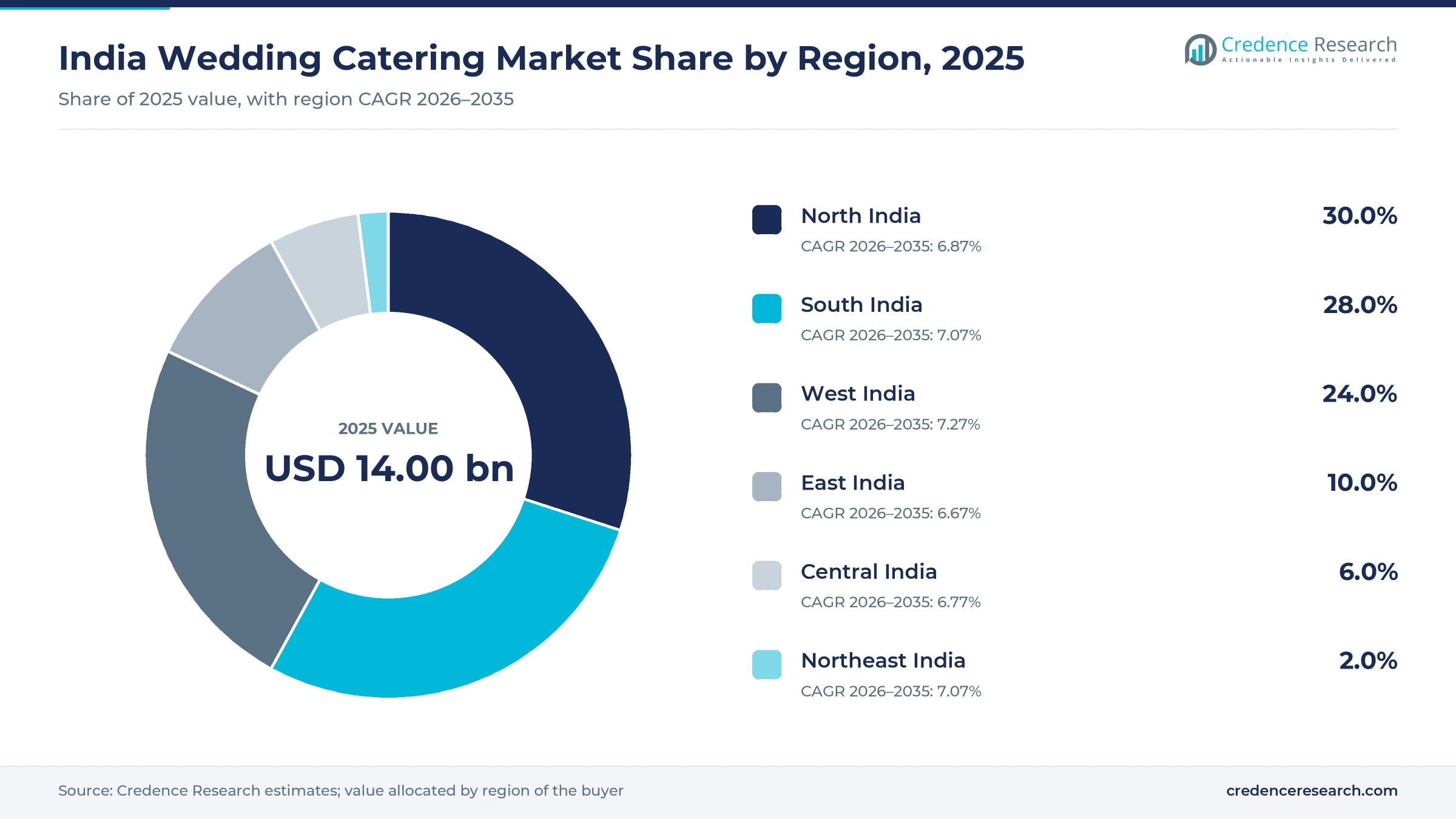
The India wedding catering market was valued at USD 14.00 billion in 2025 and is projected to increase from USD 14.90 billion in 2026 to USD 27.39 billion by 2035, registering a CAGR of 7.00% during 2026–2035. Demand comes from a very large base of family functions, where food is usually the most visible service a host buys and each wedding can require several separate meals. North India held the largest regional share, 30.0% in 2025, on high spending across Delhi, Punjab and Uttar Pradesh, while West India is the fastest-growing zone at 7.27% a year as banquet and destination business expands in Maharashtra, Gujarat and Goa. Commercially, the important change is the move from single-meal orders toward contracts that cover several functions, which favors vendors with larger kitchens and trained staff. Regulation is tightening at the same time, because Rajasthan now requires advance notice of large events and licensed caterers at venues.
What does wedding catering in India include?
The market counts what families and event organizers pay for food and beverage service across pre-wedding functions, the ceremony and the reception. It covers menu planning, cooking, service staff, live counters and on-site logistics, whether the caterer works from a family home, a lawn, a marriage garden or a hotel ballroom.
Corporate events, institutional contract meals, restaurant dining and packaged sweets bought outside a catering contract are excluded. The value chain runs from wholesale produce, meat, oil and fuel suppliers through independent caterers and hotel banquet kitchens to households, which often book through planners or venue owners.
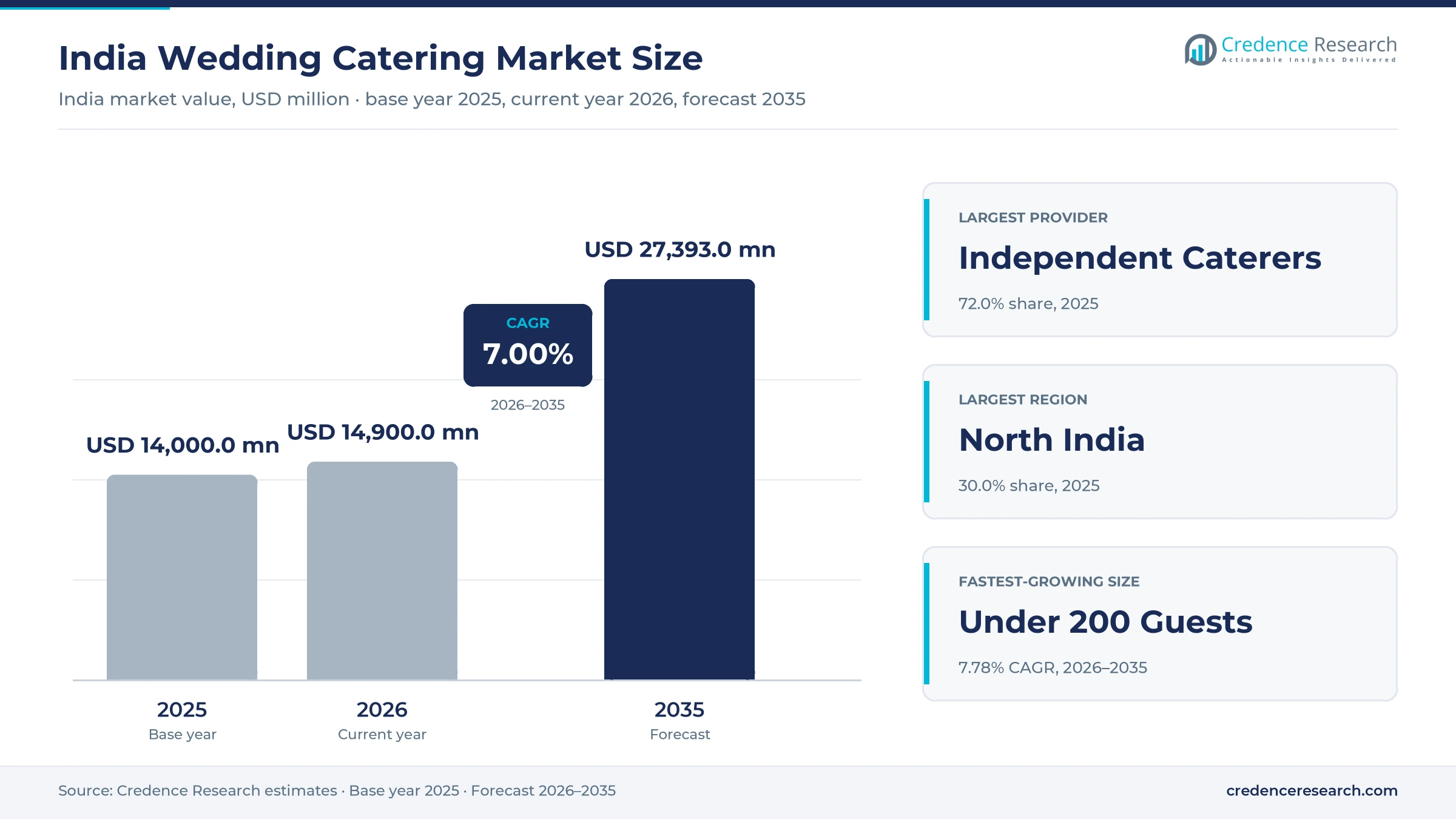
India Wedding Catering Market Insights
- The market grows from USD 14.00 billion in 2025 to USD 27.39 billion by 2035, a 7.00% CAGR that rests more on spending per guest than on wedding counts.
- North India led with 30.0% of 2025 value, supported by Delhi, Punjab and Uttar Pradesh, where wedding catering budgets are among the largest in the country.
- Independent Caterers held 72.0% of 2025 value, because local kitchens serve the bulk of weddings that never reach a hotel ballroom or a premium planner.
- Rajasthan issued event food rules reported in August 2026 that require advance notice and licensed caterers, which marks a shift toward formal supply in a fragmented trade.
- Foodlink F&B Holdings filed for a Rs 160 crore fresh issue in June 2025, partly for catering capital spending, showing that investors now see scale potential in premium catering.
Mid-size weddings and independent caterers hold most value
Why weddings of 200 to 500 guests carry the most value
Based on wedding size, the market is categorized into under 200 guests, 200-500 guests and over 500 guests. 200-500 Guests led with 48.0% of 2025 value because WedMeGood's survey of more than 2,400 couples, reported in February 2024, found an average list of 310 guests. Menus for that size also spread across functions, and Vedding estimated in April 2026 that 300 guests over three functions cost Rs 10 lakh to Rs 22 lakh in food. Under 200 Guests grows fastest at 7.78% a year, as WedMeGood found 12% of couples choosing intimate gatherings and smaller destination events raise spending per guest.
How regional diets keep vegetarian menus in front
Based on cuisine, the market is categorized into vegetarian, non-vegetarian and multi-cuisine menus. Vegetarian led with 40.0% of 2025 value because high-spending northern states eat little meat, and NFHS-4 data analyzed by IndiaSpend showed only 4% of women in Punjab and 6% in Rajasthan eating fish, chicken or meat weekly. Non-vegetarian menus rely on edible meat and dominate in Kerala, where the same data showed 92.8%. Multi-Cuisine grows fastest at 7.58% a year, as PTI reported in December 2025 that spending on handcrafted menus, regional cuisine and custom decor rose 15% to 20%.
Why independent caterers still serve most Indian weddings
Based on provider, the market is categorized into independent caterers and hotel banquets. Independent Caterers led with 72.0% of 2025 value because the scale of the season far exceeds hotel capacity, with the Confederation of All India Traders counting 4.6 million weddings in 45 days against just over 14,000 keys at ITC Hotels in January 2026. Local kitchens also serve homes, lawns and community halls that hotels do not reach. Hotel Banquets grows fastest at 7.71% a year, as industry estimates cited by Sheraton Grand Pune put 2025 growth in hotel-led weddings at 10% to 12%.
| Segment Group | Leading Sub-segment | Share, 2025 | Fastest-growing Sub-segment | CAGR, 2026–2035 |
|---|---|---|---|---|
| By Wedding Size | 200-500 Guests | 48.0% | Under 200 Guests | 7.78% |
| By Cuisine | Vegetarian | 40.0% | Multi-Cuisine | 7.58% |
| By Provider | Independent Caterers | 72.0% | Hotel Banquets | 7.71% |
Request a Free Sample
Fill in your details and we'll send you a free sample report.
- Sample data tables & charts
- Research methodology
Event spending and premium menus outrun wedding counts
Wedding volume and event spending support catering demand
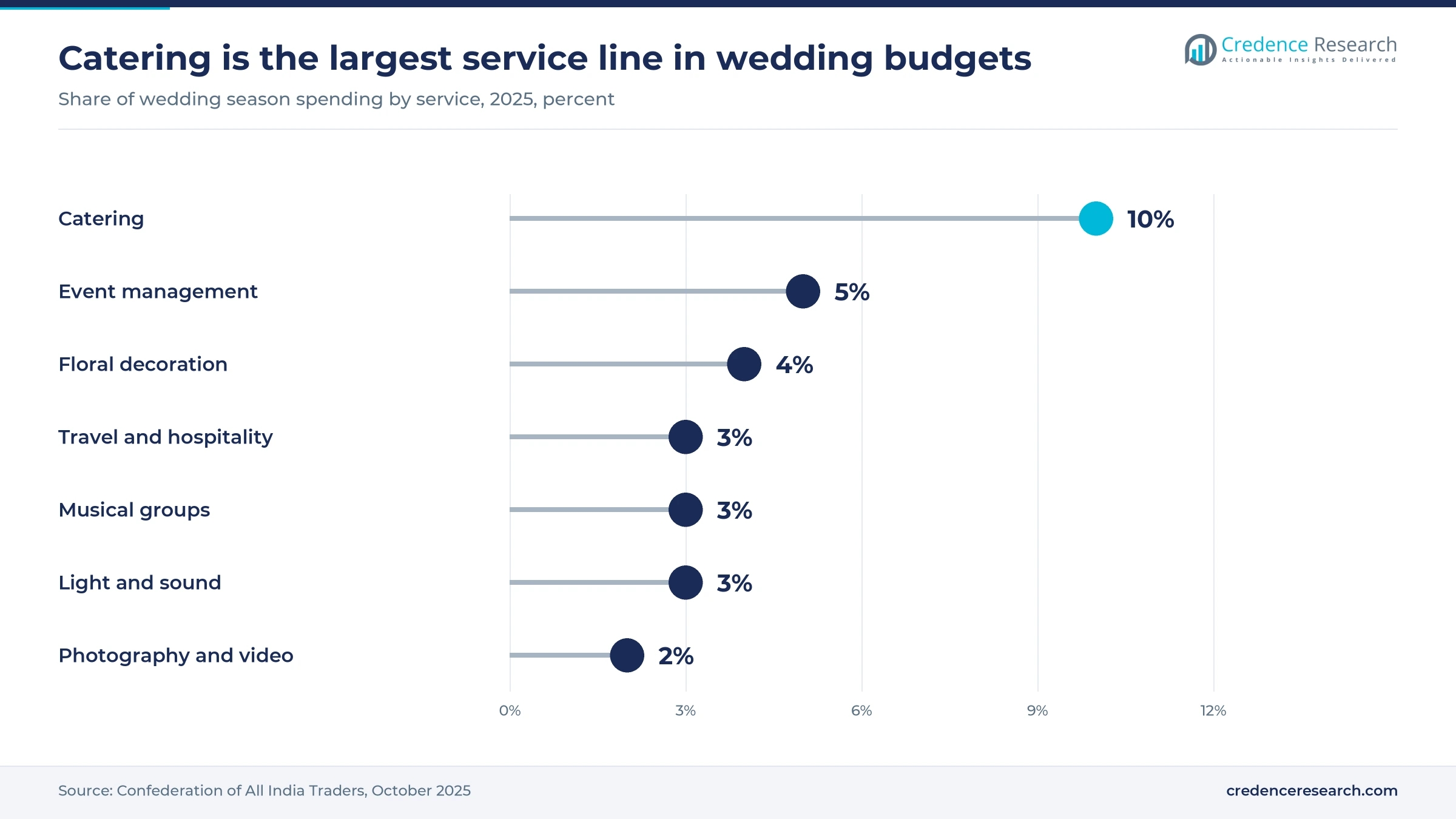
Wedding volume sets the floor for catering orders, while spending per event has risen faster than the count. The Confederation of All India Traders (CAIT) estimated about 4.6 million weddings and Rs 6.5 lakh crore of trade between Nov. 1 and Dec. 14, 2025, with catering taking 10% of that spending. Its 2024 estimate was 4.8 million weddings and Rs 5.9 lakh crore, so value rose even as the count slipped. Jefferies, in a June 2024 note reported by The Week, counted 8 million to 10 million weddings a year, which spreads kitchen work beyond winter. The trade body also gave 5% of spending to dry fruits and sweets as a separate line. In the Credence Research model this adds about 2.59 percentage points to annual growth to 2035.
Premium menus and destination weddings raise per-guest receipts
Destination events raise catering receipts because every meal for traveling guests falls to one contracted kitchen for several days. WedMeGood's 2025-26 survey of 2,000 couples, reported in December 2025, put the average budget at Rs 39.5 lakh, up 8% in a year, and found that about one wedding in four was a destination event. The same survey showed average destination budgets moving from Rs 51.1 lakh to Rs 58 lakh. CoTrav's review of about 60 luxury weddings, carried by PTI, assigned 50% to 60% of budgets to decor, food, planning and celebrations. As a result, caterers can sell menu design and live stations rather than plates alone. In the Credence Research model this adds about 1.89 percentage points to annual growth to 2035.
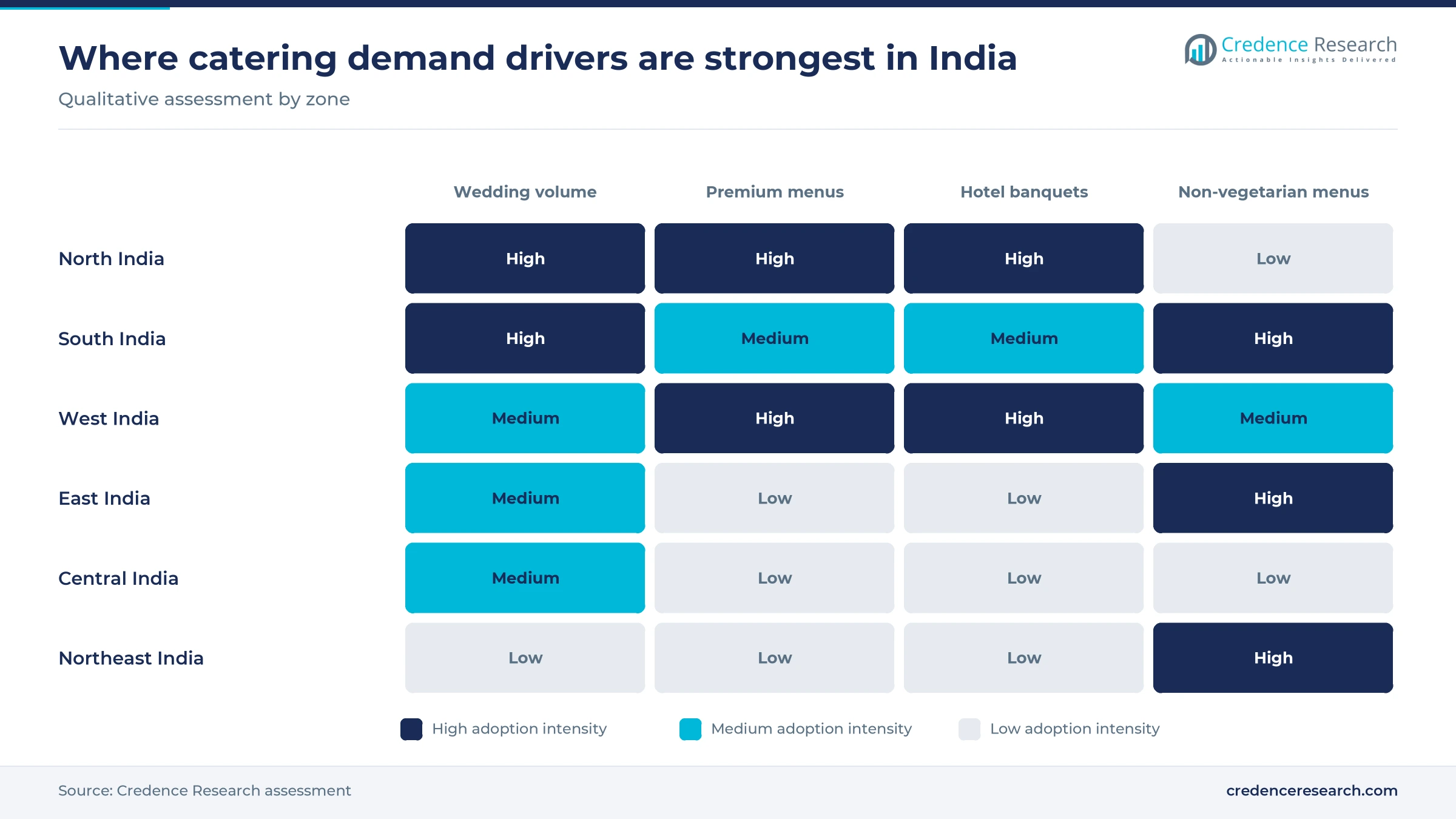
Organized catering vendors win multi-event bundled contracts
Families increasingly buy food for several functions as one contract, which rewards vendors able to staff and supply kitchens over multiple days. Whalesbook reported in June 2026 that chains including ITC Hotels, Radisson and Marriott sell weddings as packages of rooms, banquet halls and premium catering. Capital is following this model, because Foodlink F&B Holdings filed draft papers in June 2025 for a Rs 160 crore fresh issue, partly to expand restaurants and catering services. Restaurant India reported in December 2025 that SEBI had issued its final observations on that offer. Vedding's April 2026 estimate of Rs 1,200 to Rs 2,500 a plate across functions shows the ticket involved. In the Credence Research model this adds about 1.40 percentage points to annual growth to 2035.
Hotel growth brings banquet kitchens to smaller cities
New hotel supply widens the premium catering base because each property adds a ballroom, a trained brigade and a licensed kitchen in cities that had few such options. ITC Hotels crossed 150 operating hotels in the December 2025 quarter and said banqueting mainly led its food and beverage growth, according to RP Realty Plus in January 2026. Marriott opened its 150th Indian property at Katra in 2024 and aimed for 250 including its pipeline, Hotel Management Network reported in May 2024. Indian Hotels Company chief Puneet Chhatwal also cited an extended wedding season in January 2025, according to Skift.
Licensed kitchens and hotel outdoor teams reshape supply
Shift toward licensed caterers and notified events
Food safety oversight is moving from kitchens alone to the event itself, which changes who can legally win a booking. Rajasthan issued a standard operating procedure for large events, reported in August 2026, under which organizers must give the event date, venue, guest count, food preparation site and caterer license number before service. Marriage gardens, banquet halls, hotels and farmhouses must hire only licensed caterers and display those licenses. Many small halwais have opposed the system as impractical and very difficult. Radisson Blu Greater Noida marketed its FSSAI-certified kitchen as a selling point, according to Restaurant India in July 2026. The stakes are large given 4.6 million weddings counted by CAIT in 2025. If other states copy Rajasthan, registered caterers should gain share from unlicensed cooks over the forecast period.
Rise of hotel teams catering outside the hotel
Hotel kitchens are moving beyond their own ballrooms, which brings branded operators into the home and lawn events once left to local caterers. Radisson Blu Greater Noida offers outdoor service for 50 to more than 1,000 guests, including weddings at private residences, with temperature-controlled transport, according to a July 2026 report. Whalesbook reported in June 2026 that mid-tier and regional chains are upgrading banquet facilities to compete for wedding business. Sheraton Grand Pune also forecast further growth in hotel-led weddings for 2026, PTI reported in December 2025. As a result, Hotel Banquets expands at 7.71% a year in the Credence Research estimate. Independent caterers respond by adding plated service, tasting sessions and better cold-chain handling for premium clients.
Opportunity in domestic destination wedding circuits
New destination circuits offer an opening for caterers that can run remote kitchens and supply regional menus away from city wholesale markets. Prime Minister Narendra Modi urged families to hold weddings in India and named Auli, Munsyari, Chopta and Dayara in Uttarakhand, Eventfaqs reported in December 2025. The Pioneer Edge counted over 500 weddings at Triyuginarayan temple by May 2025, with more than 100 a month in peak season. Kerala Travel Mart scheduled a wedding conclave for August 2025 that listed catering among its exhibitor groups and regional cuisine among its showcases, linking weddings with culinary tourism. WedMeGood found that close to 90% of couples in its 2025-26 survey stayed within India for destination events.
Opportunity in digital quotes and lower-waste menus
Smaller functions and waste-conscious families give new entrants a way to compete without a large banquet base. CaterNinja, founded in Bengaluru, said it served gatherings of 10 to 1,000 guests from cloud kitchens in six cities and generated quotes by algorithm, YourStory reported in October 2024. WedMeGood found that 38% of couples in its 2025-26 survey paid most vendors digitally, which supports online booking. Waste is the second opening, because Greenmyna estimated that an average Indian wedding produces 700 to 800 kilograms of food waste over two days, according to Outlook Traveller in July 2024. The Assam Tribune also reported Guwahati planners selling green packages with locally grown produce in July 2025, so precise portion planning can become a paid service.
Fuel, food prices and rules squeeze caterer margins
Commercial LPG shocks can erase quoted margins
Fuel is a direct threat to fixed-price quotes, because commercial LPG reached Rs 3,074 in Bhopal by May 2026 after a rise of Rs 1,248 in two months, according to the Free Press Journal. Rambabu Sharma of the Madhya Pradesh Tent Caterers Association estimated an added cost of up to Rs 50,000 on a Rs 5 lakh food budget for a 500-guest event. Restaurants also moved to diesel and induction-based commercial kitchen equipment, which adds capital spending. Caterers can respond by adding fuel clauses to their event contracts.
Volatile food prices make early quotes risky
Ingredient swings hit caterers hardest during peak months, when volumes are largest and bookings were priced long before. India's food inflation reached 7.74% in September 2026, with onion prices up 108.09% against a year earlier, according to the Ministry of Statistics. Business Standard also reported that mustard oil rose 24% and refined oil 23.4% in August 2025. Small caterers carry the most risk because they rarely hedge or buy forward. Shorter quote validity and menu substitution clauses reduce some of this exposure.
Licensing and tax rules burden smaller caterers
Formal rules add cost for small cooks who have long worked on cash and word of mouth. Rajasthan now asks for an FSSAI number and event details before service, and small halwais have called the process very difficult for their businesses, according to Curly Tales. The Tamil Nadu Authority for Advance Ruling held in a case reported by Taxscan that outdoor catering outside specified premises carries a mandatory 5% GST without input credit, so a Coimbatore caterer could not opt for 18% with credit. Registration drives by trade bodies and simple mobile filing could limit the disruption for smaller operators.
Peak-date crowding and failed deliveries hurt trust
Auspicious dates concentrate demand so tightly that kitchen capacity and reliability both suffer. The Tribune reported in November 2024 that about 150,000 weddings were due in Punjab through December, with caterers working three shifts on some days. Kerala Kaumudi reported in September 2026 that a Kanjirappally firm failed to deliver food to two Kottayam weddings under contracts of Rs 1 lakh and Rs 1.4 lakh. Families therefore pay more for proven vendors, while written contracts and staged payments offer practical protection.
North India leads while West India grows fastest
| Region | Value, 2025 (USD billion) | Share, 2025 | CAGR, 2026–2035 |
|---|---|---|---|
| North India | 4.20 | 30.0% | 6.87% |
| South India | 3.92 | 28.0% | 7.07% |
| West India | 3.36 | 24.0% | 7.27% |
| East India | 1.40 | 10.0% | 6.67% |
| Central India | 0.84 | 6.0% | 6.77% |
| Northeast India | 0.28 | 2.0% | 7.07% |
North India leads on Delhi and Punjab budgets
North India held 30.0% of 2025 value and grows at 6.87% a year, supported by the country's largest concentration of high-budget events. The Confederation of All India Traders attributed about 480,000 weddings and Rs 1.8 lakh crore of trade to Delhi alone in the 2025 season. It also singled out Uttar Pradesh and Punjab for high spending on catering and traditional decor. Jaipur recorded the highest average budget in WedMeGood's 2025-26 survey at Rs 73 lakh, which supports demand for premium vegetarian menus.
South India pairs temple weddings with rich feasts
South India held 28.0% of 2025 value and grows at 7.07% a year, helped by large temple wedding traffic and strong demand for non-vegetarian and traditional feast menus. Guruvayur Devaswom in Kerala hosted a record 437 weddings on Aug. 23, 2026, according to ETV Bharat, which shows the intensity of peak dates. WedMeGood put average budgets in Bengaluru and Hyderabad at Rs 37 lakh in its 2025-26 survey. The trade body also noted strong banquet growth in Karnataka and rising heritage wedding demand.
West India grows fastest on banquets and destinations
West India held 24.0% of 2025 value and is the fastest zone at 7.27% a year, because hotel banquets and destination events are expanding from a large urban base. CAIT cited strong growth in event and banquet services in Maharashtra and luxury weddings in Gujarat. PTI reported that destination weddings made up 55% to 60% of premium enquiries at Sheraton Grand Pune in 2025. Mumbai averaged Rs 35 lakh a wedding in WedMeGood's survey, and Blue Sea Bespoke Catering serves Mumbai and Delhi NCR.
East India is price-sensitive but protein-rich
East India held 10.0% of 2025 value and grows at 6.67% a year, as lower average budgets limit premium hotel business while fish and meat keep menu value firm. The Telegraph reported from Kolkata's Salt Lake that minimum non-vegetarian catering rates rose to Rs 950 to Rs 1,100 a plate from Rs 500 to Rs 650 during the 2022-23 winter. The same report cited Bengali wedding budgets starting at Rs 8 lakh to Rs 15 lakh, and only 37 prescribed dates that year.
Central India depends on local tent caterers
Central India held 6.0% of 2025 value and grows at 6.77% a year, with tent caterers and marriage gardens serving most events rather than branded hotels. The Free Press Journal reported in May 2026 that more than 20,000 weddings were scheduled in Madhya Pradesh by July, which gives a sense of seasonal catering demand in one state. The same report showed the region's exposure to fuel prices, since hotels and eateries received only about half of their required LPG supply during that period.
Northeast India starts small with local produce menus
Northeast India held 2.0% of 2025 value and grows at 7.07% a year from the smallest base among the six zones. Menus lean toward meat and fish, since NFHS-4 data analyzed by IndiaSpend showed 80.4% of women in Assam eating fish, chicken or meat weekly. The Assam Tribune reported in July 2025 that Guwahati planners were selling green wedding packages with locally grown produce and refill stations. Limited branded banquet supply keeps most of this business with local caterers and community venues.
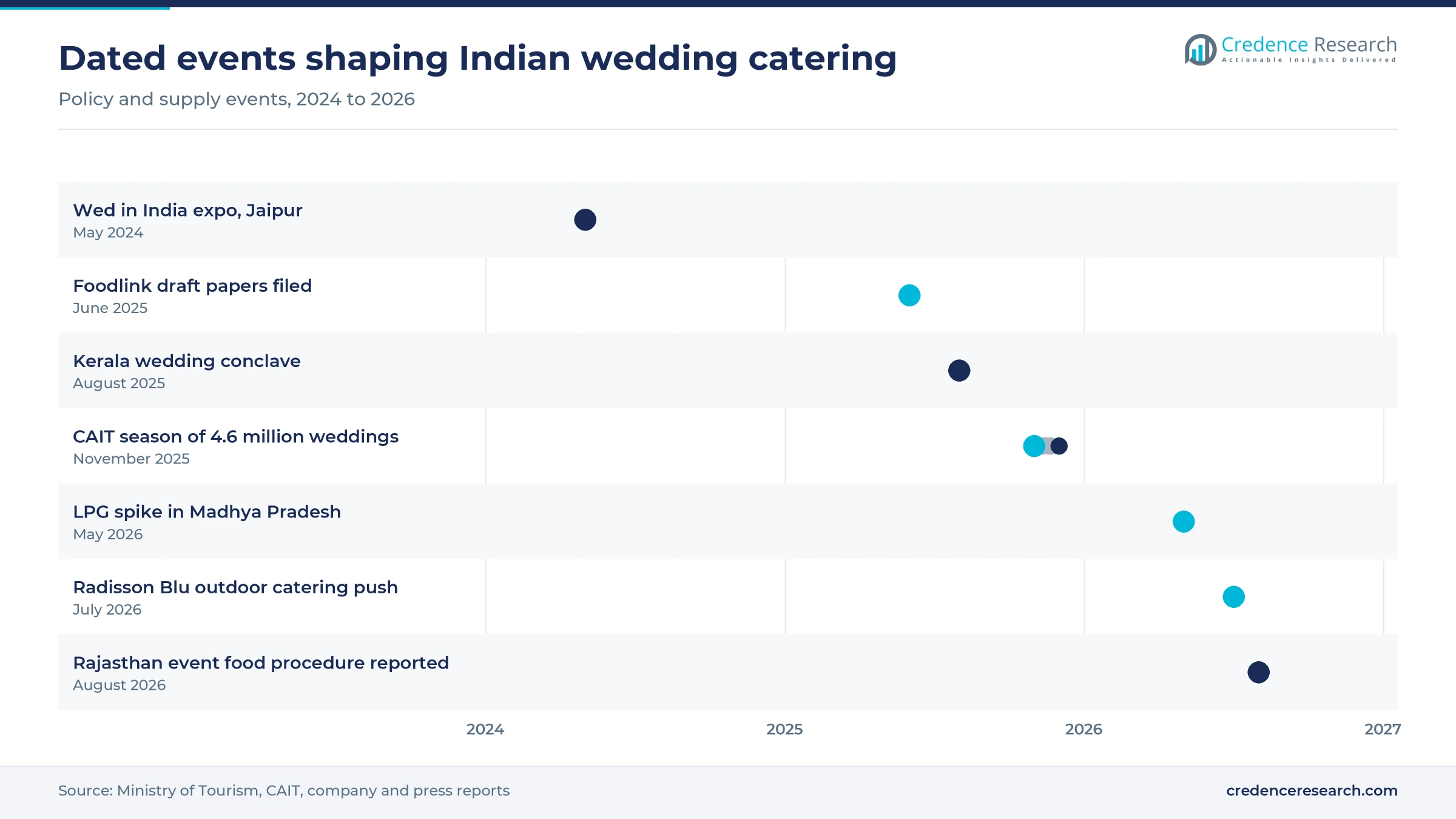
Listings, safety rules and hotel moves mark 2025 and 2026
| Development | Status and market relevance |
|---|---|
| In June 2025, Foodlink F&B Holdings filed draft papers with SEBI for a Rs 160 crore fresh issue, partly to fund restaurants and catering services | Filed, with SEBI final observations reported in December 2025; signals investor interest in premium catering |
| In January 2026, ITC Hotels reported crossing 150 operating hotels and said banqueting mainly led food and beverage growth in the December quarter | Reported; confirms that weddings matter to luxury hotel kitchens |
| In July 2026, Radisson Blu Greater Noida expanded outdoor catering across Delhi NCR for 50 to more than 1,000 guests | Live; extends hotel kitchens to weddings at private residences |
| In August 2026, reports described a Rajasthan procedure requiring notice of large events and licensed caterers at venues | In force as reported; small halwais oppose it and other states may study the model |
Kitchen logistics decide quality at large wedding events
- Temperature-controlled transport keeps food safe between a central kitchen and a home or lawn venue, and Radisson Blu Greater Noida uses it for outdoor events.
- Induction and alternative cooking systems reduce dependence on commercial LPG, which became a priority for eateries in Madhya Pradesh during the May 2026 supply shortage.
- Algorithmic quoting tools turn guest count and cuisine choice into a price, as CaterNinja described in October 2024, which shortens the sales cycle for small functions.
- Portion planning methods address the 700 to 800 kilograms of two-day wedding waste estimated by Greenmyna, and they can lower food cost for hosts as well.
Need a Custom Version of This Report?
Tailor the scope, geography, or segments to your exact requirements.
- Custom geography or segment scope
- Direct access to our analyst team
Local caterers hold volume as hotels chase premium events
Competition splits into two tiers that rarely meet on price. Local caterers, halwais and tent operators serve most weddings through referrals, venue tie-ups and flexible menus, and no single brand holds a national share. At the top, Indian Hotels Company, ITC Hotels and Marriott International sell ballrooms, rooms and food as one package, while Radisson Blu Greater Noida has taken hotel cooking to private homes. Foodlink F&B Holdings and Blue Sea Bespoke Catering compete for high-profile events on menu design and service. Licenses, reliable delivery on crowded dates and the ability to run several functions in sequence are becoming the main tests for premium buyers. Fuel and ingredient swings favor operators with purchasing scale and written contracts. Consolidation should remain slow, because cuisine is regional and families often trust a known cook over a national name.
Companies profiled and their roles in this market
| Company | Type | Role in the market |
|---|---|---|
| Indian Hotels Company (Taj) | Luxury hotel group | Its chief cited an extended wedding season in January 2025, and Whalesbook listed it among chains reporting stronger wedding bookings. |
| ITC Hotels | Luxury hotel group | Reported banqueting-led food and beverage growth in the December 2025 quarter; ITC Grand Bharat won a 2025 wedding hotel award. |
| Marriott International | Global hotel group | Reached 150 Indian properties in 2024 and sells weddings through its hotel network, including Tier II expansion. |
| Foodlink F&B Holdings | Premium catering and restaurants | Runs luxury catering for high-profile events and filed for an IPO in June 2025. |
| Radisson Blu Greater Noida | Hotel outdoor catering | Offers outdoor wedding service for 50 to more than 1,000 guests across Delhi NCR. |
| Blue Sea Bespoke Catering | Regional premium caterer | Provides wedding catering in Mumbai and Delhi NCR, with roots in the Worli banquet venue. |
Bundled menus matter more than wedding counts
Credence Research's view is that this market should be read through receipts per guest rather than wedding counts. CAIT's own figures show the 2025 season earning more trade from fewer weddings than 2024, and that pattern supports a steady but moderate growth path. The most valuable position will belong to vendors that can run several functions, hold a clean license file and absorb cost swings through contract terms. The largest uncertainty lies in the split itself, because few caterers publish data, so provider and cuisine shares rest on survey and trade evidence.
How the wedding catering estimates were built
The report uses 2025 as the base year and 2026 to 2035 as the forecast period. Market values come from the Credence Research model, and segment and regional splits are Credence Research estimates informed by public evidence. Sources include trade body releases, official price statistics, company announcements, published surveys and press reports. No interviews or primary surveys were conducted for this particular report.
Value growth rests on menus and destination events to 2035
Catering value should keep growing to USD 27.39 billion by 2035, with West India and hotel banquets gaining share slowly rather than displacing local kitchens. The most useful signals will be whether other states adopt Rajasthan-style event notices, whether Foodlink completes its listing and whether commercial fuel prices settle after the 2026 spike. Destination circuits in Uttarakhand and Kerala could add new premium demand if road access and local supply improve. Caterers that price risk properly, build regional menus and document food safety should hold the strongest position over the next decade.
Frequently Asked Questions
How big is the India wedding catering market?
Which region leads India wedding catering?
Which zone grows fastest?
Which wedding size holds the largest share?
Who provides most wedding catering in India?
Why does menu type matter in this market?
What are the main risks for caterers?
Who are the main companies in this market?
Table of Content
Chapter 1 Market Segmentation
- 1.1 Segmentation Framework
- 1.1.1 Product and Service Classification
- 1.1.2 Application and End-Use Classification
- 1.1.3 Technology and Solution Classification
- 1.1.4 Customer and Distribution Channel Classification
- 1.1.5 Geographic Segmentation
- 1.1.6 Market Segment Definitions and Boundaries
- 1.2 By Wedding Size
- 1.2.1 Under 200 Guests
- 1.2.2 200-500 Guests
- 1.2.3 Over 500 Guests
- 1.3 By Cuisine
- 1.3.1 Vegetarian
- 1.3.2 Non-Vegetarian
- 1.3.3 Multi-Cuisine
- 1.4 By Provider
- 1.4.1 Independent Caterers
- 1.4.2 Hotel Banquets
Chapter 2 Introduction
- 2.1 Report Objectives and Scope
- 2.2 Product Definition and Industry Terminology
- 2.3 Market Inclusions and Exclusions
- 2.4 Research Process
- 2.4.1 Primary Research and Expert Interviews
- 2.4.2 Secondary Research and Source Review
- 2.4.3 Top-Down and Bottom-Up Estimation
- 2.4.4 Data Triangulation and Verification
- 2.5 Market Size Measurement Basis
- 2.5.1 2025: USD 14.00 billion → 2035: USD 27.39 billion
- 2.6 Historical and Forecast Reference Periods
- 2.6.1 Historical Period: 2018-2025
- 2.6.2 Base Year: 2025
- 2.6.3 Forecast Period: 2025-2035
- 2.7 Research Assumptions and Limitations
Chapter 3 Executive Summary
- 3.1 Market Snapshot and Key Findings
- 3.2 Base-Year Market Size, 2025
- 3.3 Forecast Market Size, 2035
- 3.4 Revenue and Volume Growth Outlook
- 3.5 Key Demand and Supply Indicators
- 3.6 Leading Market Segments
- 3.7 Fastest-Growing Market Opportunities
- 3.8 Regional Performance Highlights
- 3.9 Technology and Industry Transformation
- 3.10 Competitive Landscape Summary
- 3.11 Analyst View and Strategic Implications
Chapter 4 India Wedding Catering Market Trends and Developments
- 4.1 Historical Industry Development, 2018-2025
- 4.2 Recent Market Trends and Developments
- 4.3 Demand and Customer Behavior Trends
- 4.4 Technology and Product Innovation
- 4.5 Artificial Intelligence, Automation and Digitalization
- 4.6 Local Manufacturing and Supply Chain Realignment
- 4.7 Industry Partnerships, Mergers and Acquisitions
- 4.8 Sustainability and Circular Economy Developments
- 4.9 Government and Private Sector Investment Trends
- 4.10 Emerging Business Models and Commercialization
- 4.11 Industry Developments and Announcements
Chapter 5 India Wedding Catering Market Production, Supply and Demand Analysis
- 5.1 Demand Trend and Consumption Analysis, 2018-2025
- 5.2 Demand Forecast, 2025-2035
- 5.3 Production and Output Trend, 2018-2025
- 5.4 Production and Output Forecast, 2025-2035
- 5.5 Installed Capacity and Capacity Utilization
- 5.6 Company-Wise Production Plants and Statistics
- 5.6.1 Installed Production Capacity
- 5.6.2 Actual Production
- 5.6.3 Planned Capacity and Expansion Targets
- 5.7 Supply Chain Structure and Procurement Trends
- 5.8 Supply-Demand Gap and Bottlenecks
- 5.9 Import Dependence and Sourcing Structure
- 5.10 Contract Manufacturing and Outsourcing
- 5.11 Regional Supply and Demand Concentration
Chapter 6 India Wedding Catering Market Pricing Analysis
- 6.1 Pricing Structure and Measurement
- 6.2 Historical Pricing Trends, 2018-2025
- 6.3 Pricing Outlook, 2025-2035
- 6.4 Average Selling Price and Unit Economics
- 6.5 Pricing by Product and Market Segment
- 6.6 Geographic Pricing Differences
- 6.7 Key Input, Energy, Labor and Logistics Costs
- 6.8 Contract Pricing and Purchasing Models
- 6.9 Pricing Sensitivity and Competitive Positioning
- 6.10 Price, Margin and Profitability Implications
Chapter 7 India Wedding Catering Market Dynamics
- 7.1 Market Growth Drivers
- 7.1.1 Demand-Side Drivers
- 7.1.2 Technology and Innovation Drivers
- 7.1.3 Infrastructure and Investment Drivers
- 7.1.4 Regulatory and Policy Drivers
- 7.2 Market Restraints
- 7.2.1 Cost and Affordability Constraints
- 7.2.2 Technology and Adoption Barriers
- 7.2.3 Supply Chain and Operational Constraints
- 7.3 Market Challenges
- 7.3.1 Competitive Pressure and Margin Erosion
- 7.3.2 Skills, Infrastructure and Implementation Gaps
- 7.4 Emerging Market Opportunities
- 7.5 Market Dynamics Impact and Time-Horizon Assessment
Chapter 8 India Wedding Catering Value Chain Analysis
- 8.1 Industry Value Chain Overview
- 8.2 Upstream Suppliers and Critical Inputs
- 8.3 Technology and Component Providers
- 8.4 Manufacturing or Service Delivery
- 8.5 Distribution, Channel Partners and Integrators
- 8.6 Downstream Applications and End Users
- 8.7 Value Addition and Profit Pools
- 8.8 Vertical Integration and Outsourcing
- 8.9 Supplier Concentration and Risk
- 8.10 Supply Chain Localization and Resilience
Chapter 9 India Wedding Catering Market Regulations and Policies
- 9.1 Relevant Laws, Standards and Compliance Frameworks
- 9.2 Product, Service, Safety and Quality Requirements
- 9.3 Government Policies, Incentives and Subsidies
- 9.4 Imports, Exports and Trade Barriers
- 9.5 Public Procurement and Local Content Requirements
- 9.6 Environmental and Sustainability Compliance
- 9.7 Upcoming Policy Changes and Market Implications
Chapter 10 India Wedding Catering Market Hotspots and Opportunities
- 10.1 Market Opportunity Mapping and Growth Hotspots
- 10.2 High-Growth Applications and Customer Groups
- 10.3 Underserved Markets and White-Space Opportunities
- 10.4 Emerging Technology and Product Opportunities
- 10.5 New Capacity and Investment Hotspots
- 10.6 Market Entry and Expansion Opportunities
- 10.7 Distribution and Partnership Opportunities
- 10.8 Near-Term and Long-Term Commercial Potential
- 10.9 Opportunity Attractiveness and Execution Risks
Chapter 11 India Wedding Catering Market Outlook, 2025-2035
- 11.1 Market Size and Analysis
- 11.1.1 Revenue (Market Measurement: 2025: USD 14.00 billion → 2035: USD 27.39 billion)
- 11.1.2 Market Volume and Quantity Sold
- 11.1.3 Historical Market Size, 2018-2025
- 11.1.4 Base-Year Market Size, 2025
- 11.2 Market Forecast, 2025-2035
- 11.2.1 Revenue Forecast to 2035
- 11.2.2 Volume Forecast to 2035
- 11.2.3 CAGR and Year-on-Year Growth
- 11.2.4 Incremental Revenue Opportunity
- 11.3 Forecast Assumptions and Scenario Analysis
- 11.3.1 Base-Case Forecast
- 11.3.2 Optimistic and Conservative Scenarios
- 11.3.3 Technology, Pricing and Policy Sensitivities
- 11.4 Market Attractiveness and Growth Outlook
Chapter 12 India Wedding Catering Market Segmentation and Outlook
- 12.1 Segmentation Summary and Market Shares, 2025
- 12.2 Largest and Fastest-Growing Segments
- 12.3 By Wedding Size - Market Size and Forecast, 2025-2035
- 12.3.1 Segment Definition and Scope
- 12.3.2 Historical Market Size, 2018-2025
- 12.3.3 Revenue Forecast, 2025-2035
- 12.3.4 Volume Forecast, 2025-2035
- 12.3.5 Base-Year Market Share, 2025
- 12.3.6 Segment CAGR and Growth Drivers
- 12.3.7 Subsegment Market Size and Forecast
- 12.3.7.1 Under 200 Guests
- 12.3.7.2 200-500 Guests
- 12.3.7.3 Over 500 Guests
- 12.3.8 Subsegment Pricing and Adoption Trends
- 12.3.9 Leading Suppliers and Competition
- 12.3.10 Regional Demand and Opportunities
- 12.4 By Cuisine - Market Size and Forecast, 2025-2035
- 12.4.1 Segment Definition and Scope
- 12.4.2 Historical Market Size, 2018-2025
- 12.4.3 Revenue Forecast, 2025-2035
- 12.4.4 Volume Forecast, 2025-2035
- 12.4.5 Base-Year Market Share, 2025
- 12.4.6 Segment CAGR and Growth Drivers
- 12.4.7 Subsegment Market Size and Forecast
- 12.4.7.1 Vegetarian
- 12.4.7.2 Non-Vegetarian
- 12.4.7.3 Multi-Cuisine
- 12.4.8 Subsegment Pricing and Adoption Trends
- 12.4.9 Leading Suppliers and Competition
- 12.4.10 Regional Demand and Opportunities
- 12.5 By Provider - Market Size and Forecast, 2025-2035
- 12.5.1 Segment Definition and Scope
- 12.5.2 Historical Market Size, 2018-2025
- 12.5.3 Revenue Forecast, 2025-2035
- 12.5.4 Volume Forecast, 2025-2035
- 12.5.5 Base-Year Market Share, 2025
- 12.5.6 Segment CAGR and Growth Drivers
- 12.5.7 Subsegment Market Size and Forecast
- 12.5.7.1 Independent Caterers
- 12.5.7.2 Hotel Banquets
- 12.5.8 Subsegment Pricing and Adoption Trends
- 12.5.9 Leading Suppliers and Competition
- 12.5.10 Regional Demand and Opportunities
- 12.6 Segment Growth Comparison
- 12.7 Segment Attractiveness and Priority Matrix
Chapter 13 India Wedding Catering Geographic Market Outlook, 2025-2035
- 13.1 Domestic Market Distribution and Demand Clusters
- 13.2 State- or Province-Wise Market Size and Forecast, 2025-2035
- 13.3 City and Metropolitan Market Outlook
- 13.4 Industrial, Manufacturing and Commercial Clusters
- 13.5 Geographic Concentration of Key End Users
- 13.6 Local Pricing and Purchasing Differences
- 13.7 Domestic Production Facilities and Capacity Map
- 13.8 Local Infrastructure and Project Pipeline
- 13.9 State-Level Policy and Incentive Differences
- 13.10 Subnational Investment Hotspots and Opportunities
- 13.11 Distribution and Logistics Networks
- 13.12 Domestic Competitive Footprint
Chapter 14 India Wedding Catering Technology, Innovation and Sustainability Outlook
- 14.1 Technology Landscape and Maturity
- 14.2 Product, Process and Service Innovation
- 14.3 AI, Automation and Digital Tools in the Industry
- 14.4 Technology Adoption and Performance Benchmarking
- 14.5 Innovation Pipeline and R&D Investment
- 14.6 Patent and Intellectual Property Trends
- 14.7 Energy Efficiency and Resource Management
- 14.8 Sustainability, Recycling and Circularity
- 14.9 Technology Roadmap, 2025-2035
- 14.10 Risks of Obsolescence and Technology Substitution
Chapter 15 India Wedding Catering Market Key Strategic Imperatives
- 15.1 Growth and Market Entry Priorities
- 15.2 High-Return Products and Segments
- 15.3 Pricing, Profitability and Cost Optimization
- 15.4 Technology Investment and Product Differentiation
- 15.5 Supply Chain Localization and Resilience
- 15.6 Distribution and Customer Acquisition
- 15.7 Partnership, Acquisition and Capacity Strategy
- 15.8 Regional Expansion Priorities
- 15.9 Short-, Medium- and Long-Term Actions
Chapter 16 Competition Outlook
- 16.1 Industry Competition Characteristics
- 16.2 Market Structure and Concentration
- 16.3 Market Share and Competitive Positioning, 2025
- 16.4 Company-Wise Revenue and Product Benchmarking
- 16.5 Production and Service Capacity Benchmarking
- 16.6 Technology, Pricing and Differentiation
- 16.7 Regional Footprint and Distribution Strength
- 16.8 Mergers, Acquisitions and Strategic Alliances
- 16.9 New Entrants and Competitive Threats
- 16.10 Porter's Five Forces and Industry Attractiveness
- 16.11 Competitive Outlook, 2025-2035
Chapter 17 Company Profiles
- 17.1 Company Coverage and Selection Criteria
- 17.2 Indian Hotels Company (Taj)
- 17.2.1 Business Description
- 17.2.2 Company Ownership and Geographic Presence
- 17.2.3 Product and Service Portfolio
- 17.2.4 Manufacturing and Operating Footprint
- 17.2.5 Production Capacity and Expansion Plans
- 17.2.6 Financial Performance and Investment
- 17.2.7 Market Share and Competitive Position
- 17.2.8 Technology and Innovation Capabilities
- 17.2.9 Strategic Alliances or Partnerships
- 17.2.10 Recent Developments
- 17.2.11 Growth Strategy and Outlook
- 17.3 ITC Hotels
- 17.4 Marriott International
- 17.5 Foodlink F&B Holdings
- 17.6 Radisson Blu Greater Noida
- 17.7 Blue Sea Bespoke Catering
- 17.8 Other Relevant Market Participants
Note: Every listed company is profiled on the structure shown under the first company. The company list is preliminary and may change based on research findings, market developments, data availability and client requirements.
Chapter 18 Disclaimer
- 18.1 Research and Forecast Disclaimer
- 18.2 Data Source and Estimation Limitations
Note: The depth of individual sections depends on data availability for this market. Volume, capacity, trade and other unit-based metrics are included where applicable.

