
Kota rebuilds its classroom base after a three-year slump
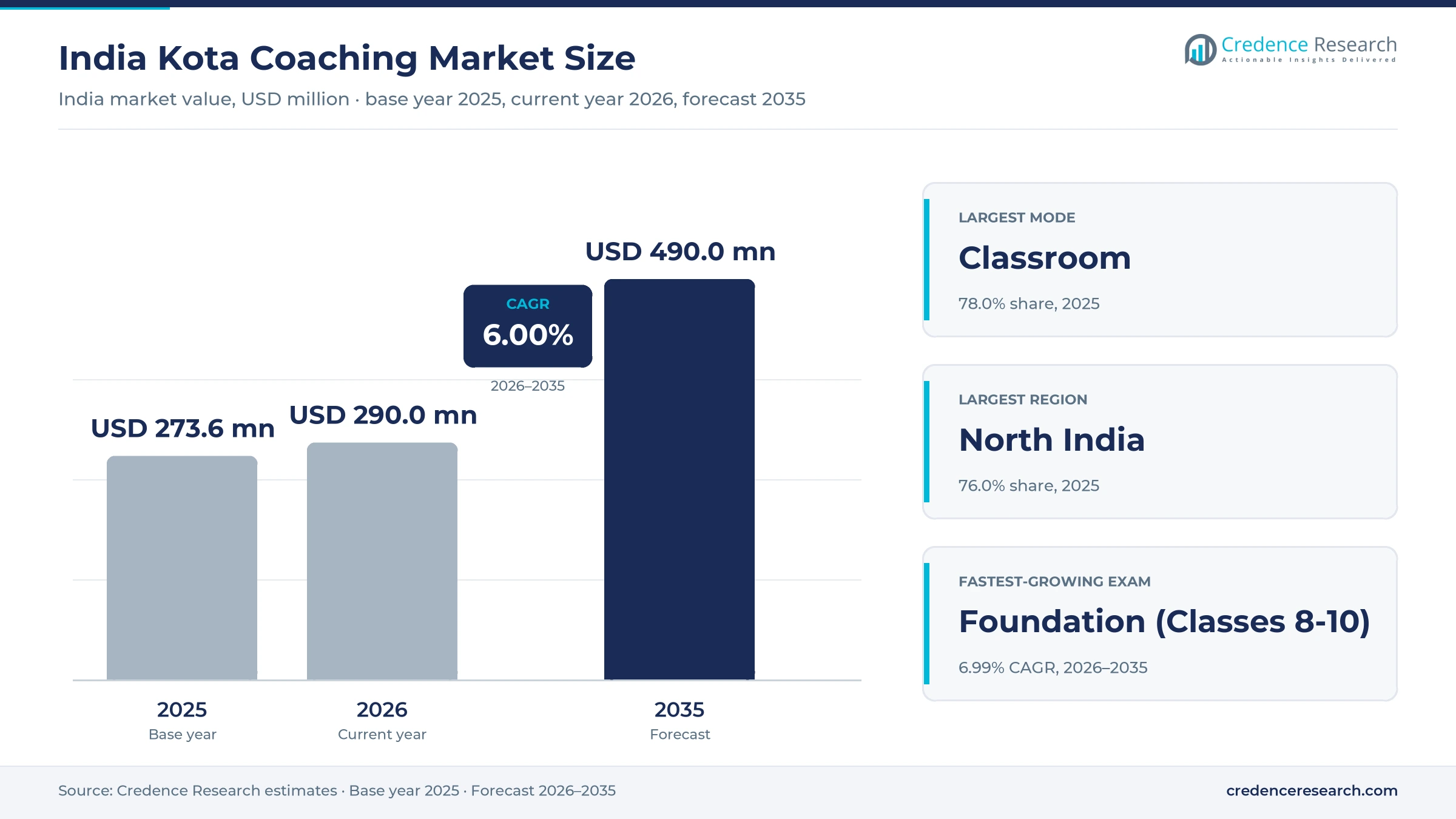
The India Kota coaching market was valued at USD 273.6 million in 2025 and is projected to increase from USD 290.0 million in 2026 to USD 490.0 million by 2035, registering a CAGR of 6.00% during 2026–2035. Demand comes from Class 11, Class 12 and repeat-year JEE and NEET aspirants who move to the Rajasthan city for residential classroom programs, along with younger foundation students and learners who buy test series from home. North India held the largest regional share, 76.0% in 2025, because classroom teaching in Kota is delivered there, while Northeast India is the fastest-growing region at 7.16% a year on online and hybrid programs. The city is recovering from a three-year enrollment decline, and Free Press Journal reported in April 2026 that admissions for the 2026-27 session were running 20% to 25% higher. Rajasthan's coaching law, which received assent in September 2025, now adds registration, refund and counseling duties for every large institute.
What does Kota coaching revenue include, and how do families buy it?
The market counts fees paid to Kota-based coaching programs for JEE, NEET and foundation preparation, across classroom, hybrid and online add-on delivery. It also counts test series and the program income that institutes earn through hostel tie-ups. Families usually buy a full-year or two-year course in one or two installments, often after a scholarship test, and then arrange lodging and meals in the city.
Rent and mess bills paid directly to independent hostels are excluded, and so are coaching centers in other cities that do not sell a Kota-delivered program. Regions are measured by where the service is delivered, so a student from Bihar who lives in Kota counts in North India, while the same student buying an online test series at home counts in East India.
India Kota Coaching Market Insights
- The India Kota coaching market rises from USD 273.6 million in 2025 to USD 490.0 million by 2035, a CAGR of 6.00%, as enrollment recovers from its 2025 low.
- North India held 76.0% of 2025 value because Kota classroom teaching is delivered there, and Northeast India grows fastest at 7.16% a year on remote programs.
- Classroom programs held 78.0% of 2025 value, because Collegedunia lists Kota offline course fees at about twice the level of online courses at several institutes.
- Rajasthan's coaching law received assent on Sept. 23, 2025, and it now requires registration, counseling and pro-rata refunds from centers teaching more than 100 students.
- Allen, Motion, Resonance, Vibrant Academy and PhysicsWallah compete on results and faculty, while national center networks pull some students away from relocating to Kota.
JEE classrooms and tuition anchor Kota program revenue
JEE leads on fee level and applicant numbers
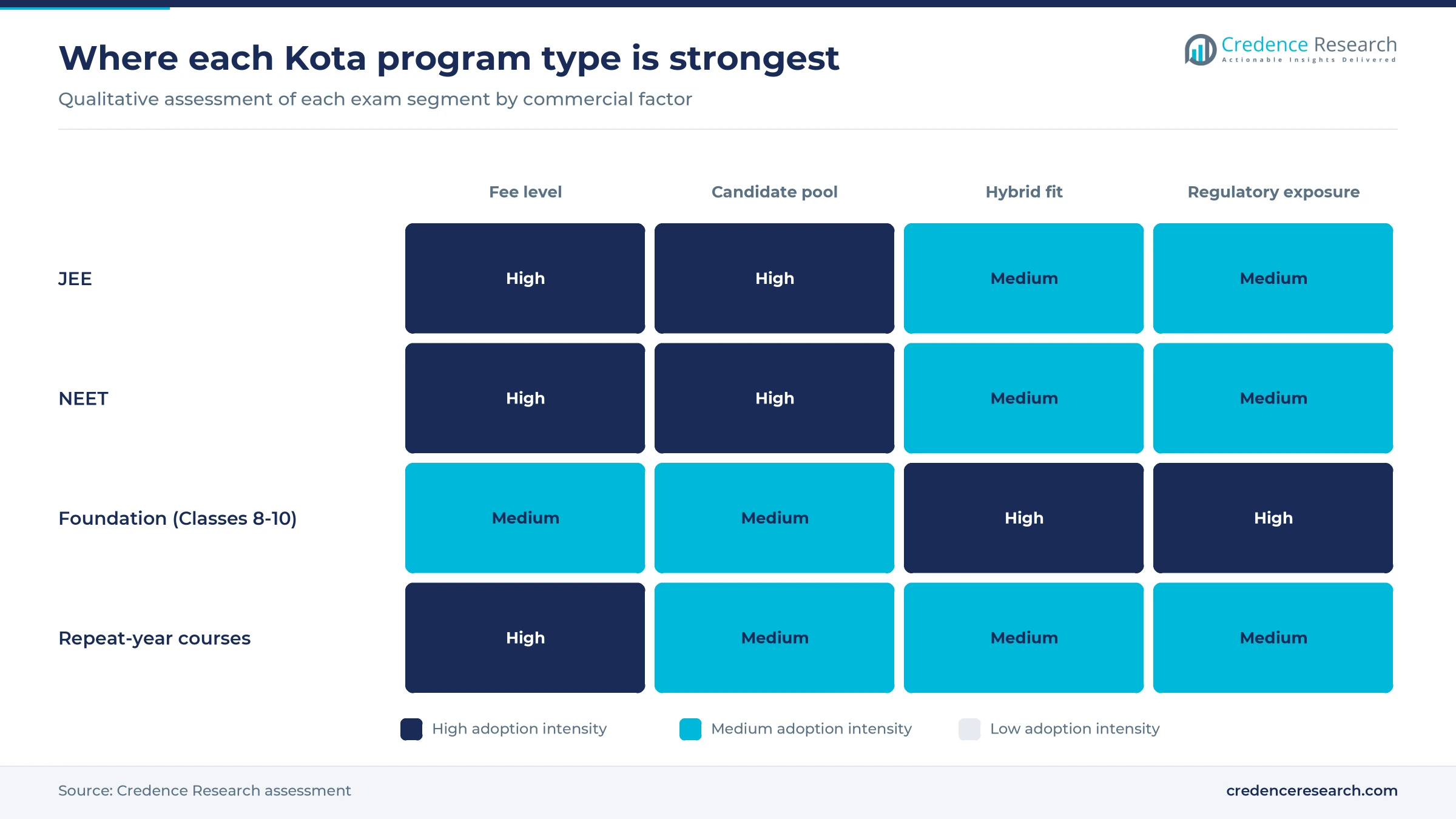
Based on exam, the market is categorized into JEE, NEET and Foundation (Classes 8-10). JEE led with a 2025 share of 48.0% because it carries the wider fee ceiling and a record applicant pool. Collegedunia lists Allen's Class 12 JEE classroom course at up to Rs 176,000 against Rs 122,881 for its NEET equivalent, and Allen News counted more than 1.6 million JEE Main 2026 applicants in February 2026. Foundation (Classes 8-10) grows fastest at 6.99% a year as Rajasthan's 2025 Act sets no minimum student age, and PhysicsWallah's Kota Vidyapeeth now lists Class 8, Class 9 and Class 10 batches.
Classroom batches still earn most Kota fees
Based on mode, the market is categorized into Classroom, Hybrid and Online Add-On. Classroom led with a 2025 share of 78.0% because Kota's income still rests on students sitting in physical batches. Collegedunia's Kota listing shows average offline fees of Rs 145,000 at Resonance and Rs 155,000 at Vibrant Academy, against online averages of Rs 55,000 and Rs 76,000. Hybrid grows fastest at 7.74% a year as institutes fund mixed delivery, and YourStory reported in September 2025 that PhysicsWallah had earmarked Rs 49.89 crore of its IPO proceeds for Hybrid Pathshala centers.
Tuition dwarfs test series and hostel income
Based on revenue stream, the market is categorized into Tuition, Test Series and Hostel Tie-Ups. Tuition led with a 2025 share of 80.0% because a course fee is many times any add-on. Resonance publishes a 2026-27 fee of up to Rs 90,000 for its yearlong JEE Main classroom program at Kota, while Collegedunia lists Motion's test series at Rs 4,999. Test Series grows fastest at 7.46% a year as institutes sell to learners who never relocate, and PhysicsWallah's test series is listed at Rs 8,475 offline and Rs 2,500 online.
| Segment Group | Leading Sub-segment | Share, 2025 | Fastest-growing Sub-segment | CAGR, 2026–2035 |
|---|---|---|---|---|
| By Exam | JEE | 48.0% | Foundation (Classes 8-10) | 6.99% |
| By Mode | Classroom | 78.0% | Hybrid | 7.74% |
| By Revenue Stream | Tuition | 80.0% | Test Series | 7.46% |
Request a Free Sample
Fill in your details and we'll send you a free sample report.
- Sample data tables & charts
- Research methodology
Aspirant inflows and residential spending lift Kota revenue
JEE and NEET inflows sustain Kota classroom enrollment
A record national candidate pool keeps the top of Kota's funnel full even after the city's weak years. National Testing Agency data reported by ETV Bharat show 1,300,368 candidates appeared in the January 2026 JEE Main session, the highest attendance in five years. NEET UG 2026 drew about 2.28 million candidates according to Careers360, and Medical Dialogues reported in May 2026 that four states supplied about 41% of them, Rajasthan among them. Free Press Journal reported in April 2026 that Kota admissions for 2026-27 were running 20% to 25% ahead after three years of decline. In the Credence Research model this adds about 2.3 percentage points to annual growth to 2035, and classroom programs held 78.0% of 2025 value.
Residential programs raise spending per student
Residential coaching adds a second bill to every enrollment in Kota, which lifts the value of each student who relocates. ThePrint counted more than 4,000 hostels with about 180,000 rooms in October 2024, with hostel fees of Rs 8,000 to Rs 12,000 a month and nearly 500 messes. Careers360 puts the combined cost of coaching and living in Kota at Rs 150,000 to Rs 300,000 a year, well above course fees alone. Rajasthan's coaching law of 2025 covers hostel and mess fees in its pro-rata refund rule, which shows how closely the charges travel with the course. In the Credence Research model this adds about 1.7 percentage points to annual growth to 2035.
Hybrid test series and repeat courses extend student value
Test series and repeat-year courses keep a family paying after the first attempt, which extends the value of each student. Allen sells its JEE Nurture Online Target 2027 course at Rs 93,500 plus taxes, with 10 review tests and national benchmarking through All India Online Open Tests. Collegedunia lists Allen's classroom course for droppers and repeaters at Rs 92,000 to Rs 178,000 for one more year. Allen News reported on May 21, 2026, that students returning for the NEET re-exam came from eight states, and hostel associations waived deposits and charged rent by the day. In the Credence Research model this adds about 1.1 percentage points to annual growth to 2035.
Low living costs and better air access support Kota
Kota's price advantage and its results record give families a reason to travel despite closer options. Free Press Journal reported in April 2026 that lodging and food cost Rs 5,000 to Rs 10,000 in Kota against Rs 15,000 to Rs 20,000 in metro cities. The same report said eight of the 12 students scoring 100 percentile in the January 2026 JEE Main session came from Allen Kota. Access should improve as well, because Indian Infrastructure reported that the foundation stone for the Kota airport was laid on March 7, 2026, at about Rs 15 billion with capacity for 2 million passengers a year. As a result, relocation should remain the core of the Kota model through the forecast period.
Hybrid delivery and foundation batches reshape Kota programs
Shift toward hybrid delivery from Kota brands
Kota brands are moving toward mixed delivery because many families will no longer pay for relocation alone. Entrepreneur India reported in May 2026 that Allen Digital combines live classes, recorded lectures, test series and AI-based analysis, and that Allen acquired Doubtnut to strengthen the platform. This shift places Kota programs inside the wider education technology contest for household budgets. Household data show the price gap, since MoSPI's education survey released in August 2025 found 27.0% of students took private coaching at an average of Rs 6,384 a year in higher secondary. Online courses at Rs 55,000 to Rs 76,000 on Collegedunia's Kota listing sit between that level and classroom fees, and Hybrid grows at 7.74% a year.
Rise of satellite centers closer to students' homes
National center networks are bringing Kota-style teaching to home cities, which changes where brands invest and where families spend. Entrepreneur India reported in May 2026 that Allen runs over 285 classroom centers in more than 64 cities, including Darbhanga, Gaya and Vijayawada. YourStory reported that PhysicsWallah had 198 offline centers in 109 cities on March 31, 2025, with Rs 234.37 crore of IPO proceeds earmarked for Vidyapeeth centers. The Goan reported that Motion Education has more than 90 centers after opening at Porvorim in Goa. ETV Bharat reported in December 2025 that top institutes have opened branches in Bihar and Uttar Pradesh, which helps explain why North India grows at only 5.76% a year.
Foundation batches open a younger student base
Foundation programs offer an opening because they start the relationship with a family years before the JEE or NEET course. The World Bank puts India's gross secondary enrollment at 79.6% in 2025, with about 133 million pupils, so the addressable base is large. Careers360 reported in March 2025 that Rajasthan's bill dropped the central minimum age of 16, and the final Act sets no age limit. Allen's Class 9 to 10 classroom program is listed at Rs 60,000 to Rs 81,000, while The Goan reported that Motion Education serves students from Class 8. These courses compete with after-school programs for time, yet Foundation (Classes 8-10) still grows at 6.99% a year.
Spare hostel rooms create room for bundled offers
Spare residential capacity gives institutes and hostel owners an opening to sell bundled, compliant packages at sharper prices. Free Press Journal reported in April 2026 that Kota's infrastructure was built for over 200,000 students, against about 125,000 students in 2025. ThePrint reported in February 2025 that hostels had ended security deposits and capped annual maintenance at Rs 2,000, and that the district administration had trained 7,000 staff in gatekeeping. The Kota Cares help desks planned for railway stations and bus stands list compliant hostels, which gives approved owners a direct route to arriving families. Bundled offers fit the law, since the Act already refunds hostel, mess and course fees on the same pro-rata basis.
Empty hostels, new rules and student safety test Kota
Falling enrollment leaves hostels and teachers exposed
Enrollment fell from 160,000 students in 2023 to about 125,000 in 2025, according to Free Press Journal, and hostel owners carry the excess space. ETV Bharat reported in December 2025 that one 109-room Coral Park hostel housed 12 students. Business Standard reported in December 2024 that some rents fell from Rs 15,000 to Rs 9,000, which cuts income for owners who built for a larger city. Institutes also feel the strain, since ThePrint reported a 31% drop at Allen's Kota centers in June 2024.
Rajasthan rules raise compliance costs for small centers
Rajasthan's Act, which received assent on Sept. 23, 2025, requires registration for centers teaching more than 100 students, one square meter per student and refunds within 10 days. Penalties reach Rs 200,000 for a second violation, and further breaches cancel registration. Careers360 reported in March 2025 that the Hadauti Sambhag Coaching Samiti called the bill a death warrant for small institutes. Larger brands can absorb these costs more easily, so small tutors may need to merge, partner or exit the market.
Student safety concerns weigh on family decisions
Student safety remains the most sensitive risk for a city that sells relocation to teenagers and their parents. ThePrint cited official data showing 28 student suicides in Kota in 2023, and Careers360 reported that the Supreme Court questioned Rajasthan on May 23, 2025, over 14 cases that year. Parents who read such reports may choose a center nearer home, which directly reduces enrollment. Institutes and hostels are responding with counseling systems, staff gatekeeping training and anti-hanging devices, although results will take time to show.
National policy may limit coaching hours and advertising
A central panel could reshape the coaching model, because its proposals touch teaching hours, advertising and exam design together. Careers360 reported that the Ministry of Education formed the nine-member committee on June 19, 2025, to examine coaching dependency and dummy schools. Business Today reported on Jan. 13, 2026, that its recommendations include capping classes at two to three hours a day and tightening advertising rules. Long-day residential batches would be most exposed, so institutes may need to redesign schedules and fee structures if these proposals become binding.
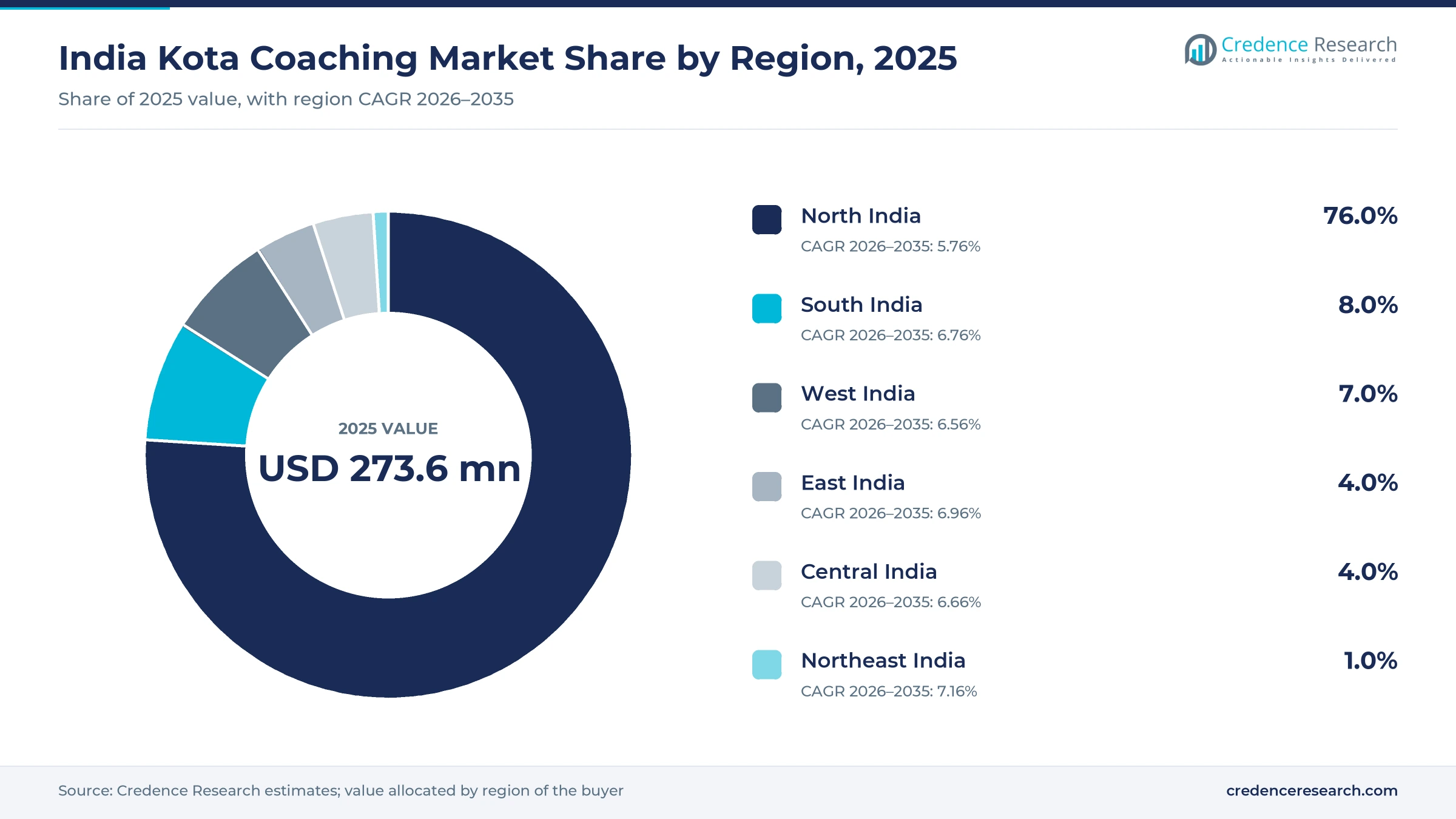
North India dominates because Kota classrooms sit there
| Region | Value, 2025 (USD million) | Share, 2025 | CAGR, 2026–2035 |
|---|---|---|---|
| North India | 207.9 | 76.0% | 5.76% |
| South India | 21.9 | 8.0% | 6.76% |
| West India | 19.2 | 7.0% | 6.56% |
| East India | 10.9 | 4.0% | 6.96% |
| Central India | 10.9 | 4.0% | 6.66% |
| Northeast India | 2.7 | 1.0% | 7.16% |
North India holds the classrooms and most of the value
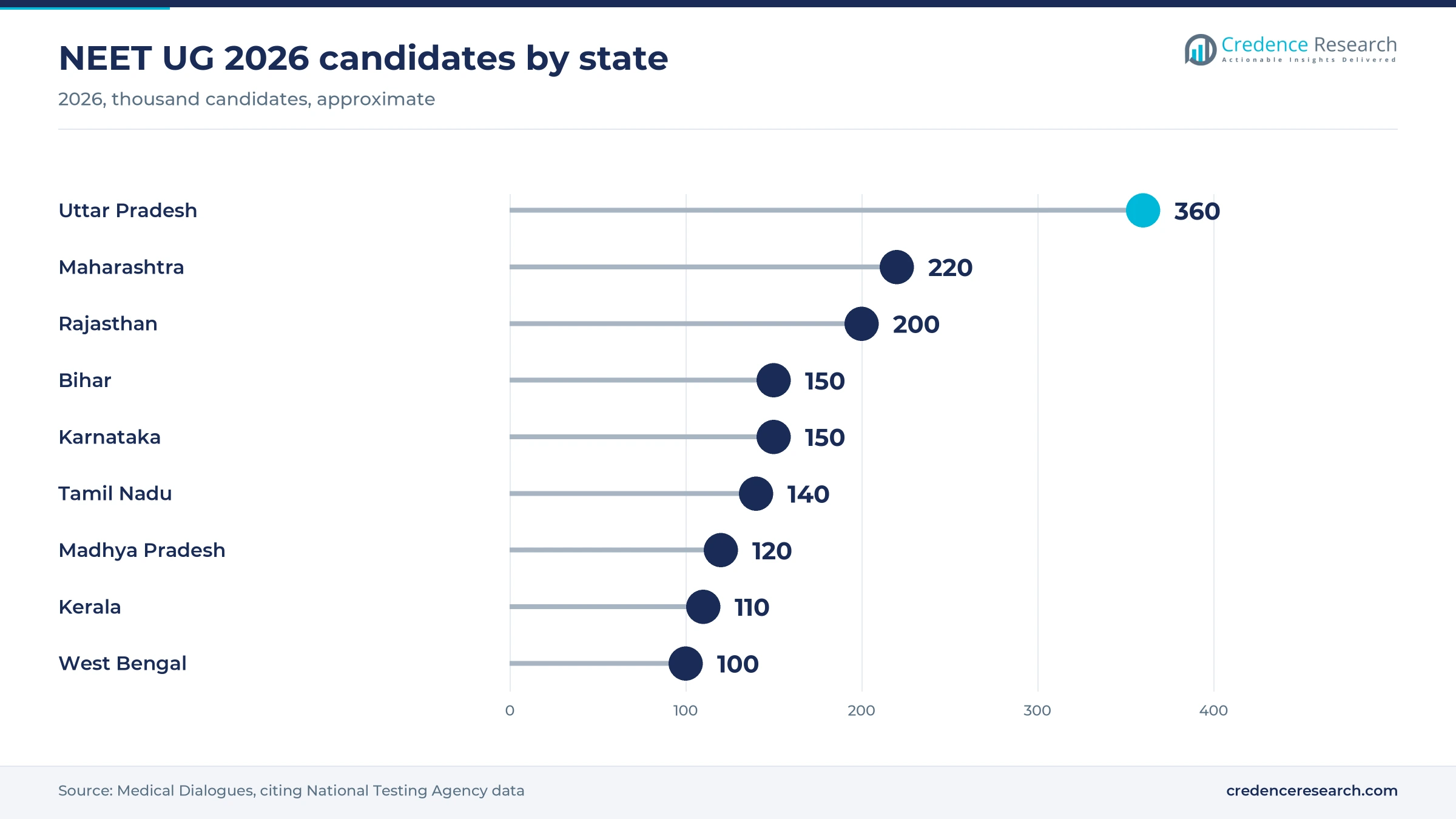
North India had a 2025 share of 76.0% and grows at 5.76% a year, because Kota's classrooms, hostels and test centers all sit in Rajasthan. Free Press Journal counted about 35 coaching institutes, 4,000 hostels and 45,000 paying guest facilities in the city in March 2026. Medical Dialogues reported about 360,000 NEET UG 2026 candidates in Uttar Pradesh and about 200,000 in Rajasthan, which keeps the nearest feeder states large. Slower growth reflects the share of new branches opening closer to these students.
South India buys remote programs alongside strong local rivals
South India had a 2025 share of 8.0% and grows at 6.76% a year, mainly through online add-ons and hybrid programs rather than relocation. Medical Dialogues reported about 150,000 NEET UG 2026 candidates in Karnataka, 140,000 in Tamil Nadu and 110,000 in Kerala, a large pool for test series. Entrepreneur India reported in May 2026 that Allen had reached Visakhapatnam and Vijayawada, and YourStory named Chennai among PhysicsWallah's planned expansion cities. Credence Research therefore estimates a small share of Kota-delivered revenue in this zone.
Maharashtra demand and new partner centers lift West India
West India had a 2025 share of 7.0% and grows at 6.56% a year, helped by Maharashtra's large candidate pool. Medical Dialogues reported about 220,000 NEET UG 2026 candidates in that state, the second-highest count in India. The Goan reported that Motion Education runs its Porvorim center in Goa with Excellence Education Academy, and Entrepreneur India listed Kolhapur among Allen's newer cities. Credence Research estimates that test series and hybrid add-ons from Kota brands make up most of the value in this zone.
East India sends students to Kota and buys at home
East India had a 2025 share of 4.0% and grows at 6.96% a year, although many of its students are counted in North India while they live in Kota. Medical Dialogues reported about 150,000 NEET UG 2026 candidates in Bihar and about 100,000 in West Bengal. Entrepreneur India reported that Allen has opened in Darbhanga and Gaya, and YourStory named Muzaffarpur and Dhanbad as PhysicsWallah expansion cities. Credence Research expects these closer options to lift hybrid sales here, which supports growth from a small base.
Central India sits close enough for short-stay programs
Central India had a 2025 share of 4.0% and grows at 6.66% a year, supported by its proximity to Kota and its sizable candidate pool. Medical Dialogues reported about 120,000 NEET UG 2026 candidates in Madhya Pradesh. Allen News listed Madhya Pradesh and Chhattisgarh among the eight states sending students back to Kota for the NEET re-exam in May 2026. Entrepreneur India named Bhilai among Allen's newer cities and YourStory named Ujjain for PhysicsWallah, so remote and hybrid sales in this zone should grow steadily.
Northeast India grows fastest from the smallest base
Northeast India had a 2025 share of 1.0% and grows at 7.16% a year, the fastest pace among the zones because distance favors online purchase. Distance from Kota makes relocation costly for many families here, and YourStory named Jorhat as a PhysicsWallah expansion city in September 2025. Free Press Journal quoted a parent from Imphal in Manipur among those choosing Kota in 2026, which shows the city's reach into this zone. Test series and hybrid add-ons therefore carry most of the regional opportunity through 2035.
Rules, reforms and new batches mark 2024 to 2026 in Kota
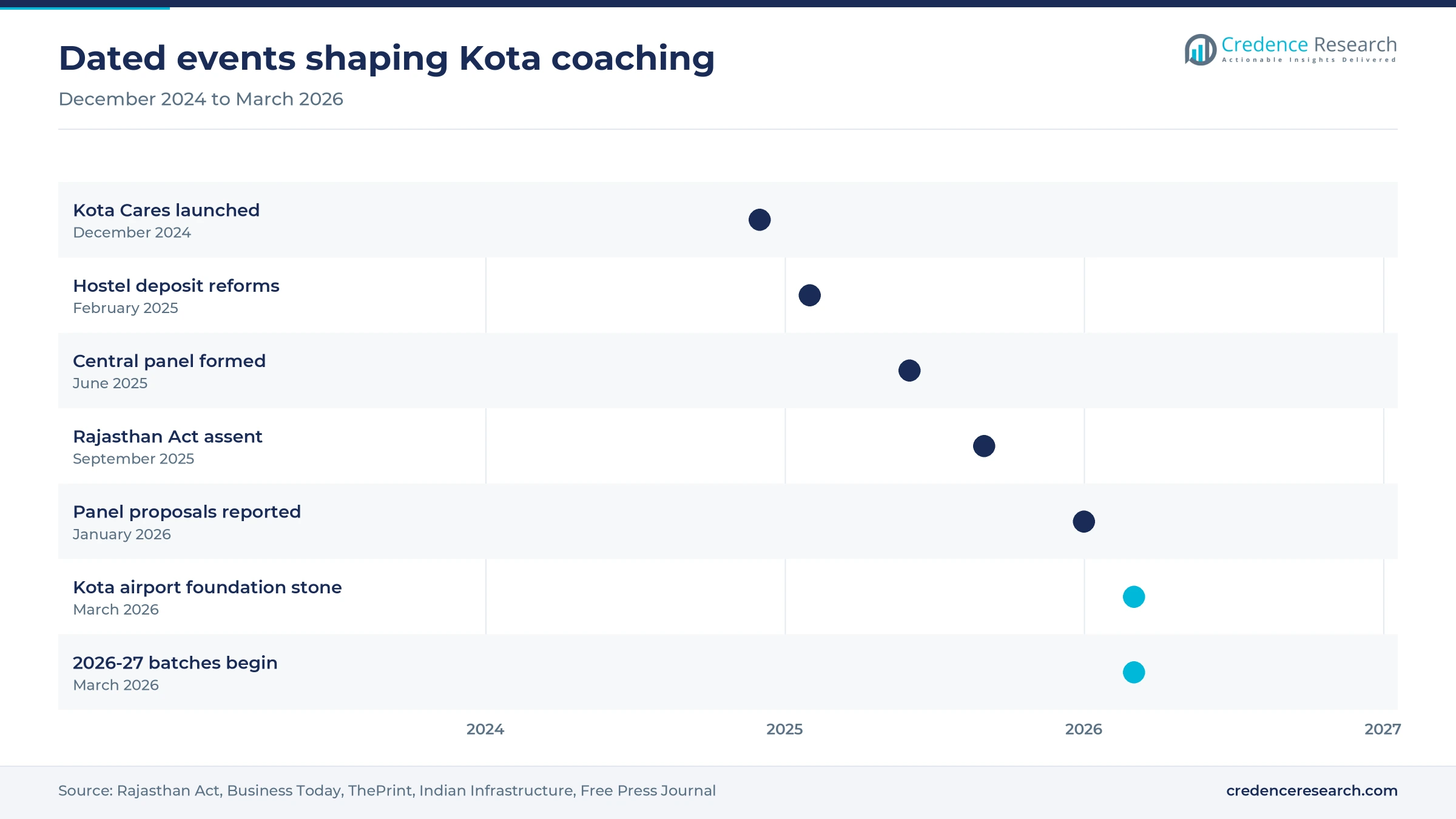
| Development | Status and market relevance |
|---|---|
| In December 2024, the Kota Cares initiative began in the city, with a focus on student welfare and hostel listings. | Active, with help desks planned at railway stations and bus stands |
| In February 2025, Kota hostels ended security deposits and capped annual maintenance charges at Rs 2,000. | In force through the Kota Hostel Association and district administration |
| In September 2025, Rajasthan's coaching control and regulation law received the governor's assent. | Registration required for centers teaching more than 100 students |
| In January 2026, a Ministry of Education panel recommended capping coaching classes at two to three hours a day. | Recommendation reported by Business Today, not yet binding |
| In March 2026, new Kota batches for the 2026-27 session began as admissions were running about 20% to 25% ahead. | Early recovery reported by Free Press Journal |
Digital testing tools extend the reach of Kota institutes
- Allen Digital combines live classes, recorded lectures, test series and AI-based performance analysis on one platform, according to Entrepreneur India in May 2026.
- Weak-area analytics use test results to direct each student toward specific topics, a practice drawn from adaptive learning tools that Allen now applies through its digital platform.
- All India Test Series gives PhysicsWallah's Kota Vidyapeeth students national rankings and milestone tests, which lets learners benchmark themselves outside one classroom.
- Biometric and CCTV systems are now required in Kota hostels under the February 2025 reforms, and they sit alongside regular night attendance checks through personal room visits.
Need a Custom Version of This Report?
Tailor the scope, geography, or segments to your exact requirements.
- Custom geography or segment scope
- Direct access to our analyst team
Results and faculty decide competition among Kota brands
Competition in Kota turns on published results, faculty reputation and the fee a family actually pays after scholarships. Allen is the largest local institute, and The Hitavada reported in December 2025 that Allen students filled 4,226 of 18,160 seats across 23 Indian Institutes of Technology in the 2025 cycle, a figure the institute itself reports. Motion Education, Resonance and Vibrant Academy compete with JEE-focused or mixed course ranges and offline fees that Collegedunia lists at about Rs 125,000 to Rs 155,000. PhysicsWallah opened its first offline Vidyapeeth center in Kota in June 2022, and its listed offline average of Rs 83,646 pressures rivals on price. National test preparation habits also matter, because every brand now sells standalone test series to students outside its batches. Scale helps with faculty retention, although ThePrint reported that faculty poaching lifted some salaries by 50% to 60%.
Companies profiled and their roles in this market
| Company | Type | Role in the market |
|---|---|---|
| Allen Career Institute | Classroom and hybrid leader | Largest Kota institute, with JEE, NEET and foundation courses and the Allen Digital platform |
| Motion Education | Kota-based institute | Runs JEE, NEET and foundation courses in Kota, plus more than 90 centers nationally |
| Resonance | Kota-based institute | Publishes 2026-27 fees for yearlong JEE Main classroom programs at Kota |
| Vibrant Academy | JEE specialist | Offers JEE Main and JEE Advanced courses in Kota, with online options and test series |
| PhysicsWallah (Vidyapeeth) | Lower-priced entrant | Kota Vidyapeeth lists JEE, NEET and Class 8 to 10 batches with an All India Test Series |
Kota recovery depends on safety and price, not capacity
Credence Research's view is that Kota does not have a capacity problem, since rooms for over 200,000 students are already built. It has a confidence problem, because parents now weigh student safety and lower-cost home-city options against the city's results record. The 2026-27 admissions rebound is encouraging, although it follows three years of decline and may not repeat each year. Institutes that publish verified results, meet the Rajasthan Act early and offer hybrid continuity after a student leaves Kota should take the largest share of the recovery.
How Credence Research sized Kota program revenue
The report uses 2025 as the base year and 2026 to 2035 as the forecast period. Market values come from the Credence Research model, and segment and regional splits are Credence Research estimates based on fee listings, enrollment reports and exam candidate data. Sources include the Rajasthan Act, Press Information Bureau releases, World Bank data, institute fee pages and named press reports. Enrollment figures from local stakeholders vary widely, so they were used as ranges. No interviews or primary surveys were conducted for this report.
Kota grows through 2035 on a smaller, hybrid footprint
The India Kota coaching market should rise from USD 290.0 million in 2026 to USD 490.0 million by 2035 at a 6.00% CAGR, though it is unlikely to regain its 2022 student count quickly. Growth will come from higher spending per student, foundation batches and remote sales, rather than from filling every empty hostel room. Northeast India should keep the fastest regional pace from its small base, while North India still dominates by value. The main variables are whether the central panel's proposed hour cap becomes binding and whether student safety keeps improving in the city.
Frequently Asked Questions
How big is the India Kota coaching market?
Which exam segment leads the market?
Which segment grows fastest by exam?
Why does North India hold most of the market?
How many students study in Kota?
What does the Rajasthan coaching law require?
Who are the main companies in Kota coaching?
What is the biggest risk to the market?
Table of Content
Chapter 1 Market Segmentation
- 1.1 Segmentation Framework
- 1.1.1 Product and Service Classification
- 1.1.2 Application and End-Use Classification
- 1.1.3 Technology and Solution Classification
- 1.1.4 Customer and Distribution Channel Classification
- 1.1.5 Geographic Segmentation
- 1.1.6 Market Segment Definitions and Boundaries
- 1.2 By Exam
- 1.2.1 JEE
- 1.2.2 NEET
- 1.2.3 Foundation (Classes 8-10)
- 1.3 By Mode
- 1.3.1 Classroom
- 1.3.2 Hybrid
- 1.3.3 Online Add-On
- 1.4 By Revenue Stream
- 1.4.1 Tuition
- 1.4.2 Test Series
- 1.4.3 Hostel Tie-Ups
Chapter 2 Introduction
- 2.1 Report Objectives and Scope
- 2.2 Product Definition and Industry Terminology
- 2.3 Market Inclusions and Exclusions
- 2.4 Research Process
- 2.4.1 Primary Research and Expert Interviews
- 2.4.2 Secondary Research and Source Review
- 2.4.3 Top-Down and Bottom-Up Estimation
- 2.4.4 Data Triangulation and Verification
- 2.5 Market Size Measurement Basis
- 2.5.1 2025: USD 273.6 million → 2035: USD 490.0 million
- 2.6 Historical and Forecast Reference Periods
- 2.6.1 Historical Period: 2018-2025
- 2.6.2 Base Year: 2025
- 2.6.3 Forecast Period: 2025-2035
- 2.7 Research Assumptions and Limitations
Chapter 3 Executive Summary
- 3.1 Market Snapshot and Key Findings
- 3.2 Base-Year Market Size, 2025
- 3.3 Forecast Market Size, 2035
- 3.4 Revenue and Volume Growth Outlook
- 3.5 Key Demand and Supply Indicators
- 3.6 Leading Market Segments
- 3.7 Fastest-Growing Market Opportunities
- 3.8 Regional Performance Highlights
- 3.9 Technology and Industry Transformation
- 3.10 Competitive Landscape Summary
- 3.11 Analyst View and Strategic Implications
Chapter 4 India Kota Coaching Market Trends and Developments
- 4.1 Historical Industry Development, 2018-2025
- 4.2 Recent Market Trends and Developments
- 4.3 Demand and Customer Behavior Trends
- 4.4 Technology and Product Innovation
- 4.5 Artificial Intelligence, Automation and Digitalization
- 4.6 Local Manufacturing and Supply Chain Realignment
- 4.7 Industry Partnerships, Mergers and Acquisitions
- 4.8 Sustainability and Circular Economy Developments
- 4.9 Government and Private Sector Investment Trends
- 4.10 Emerging Business Models and Commercialization
- 4.11 Industry Developments and Announcements
Chapter 5 India Kota Coaching Market Production, Supply and Demand Analysis
- 5.1 Demand Trend and Consumption Analysis, 2018-2025
- 5.2 Demand Forecast, 2025-2035
- 5.3 Production and Output Trend, 2018-2025
- 5.4 Production and Output Forecast, 2025-2035
- 5.5 Installed Capacity and Capacity Utilization
- 5.6 Company-Wise Production Plants and Statistics
- 5.6.1 Installed Production Capacity
- 5.6.2 Actual Production
- 5.6.3 Planned Capacity and Expansion Targets
- 5.7 Supply Chain Structure and Procurement Trends
- 5.8 Supply-Demand Gap and Bottlenecks
- 5.9 Import Dependence and Sourcing Structure
- 5.10 Contract Manufacturing and Outsourcing
- 5.11 Regional Supply and Demand Concentration
Chapter 6 India Kota Coaching Market Pricing Analysis
- 6.1 Pricing Structure and Measurement
- 6.2 Historical Pricing Trends, 2018-2025
- 6.3 Pricing Outlook, 2025-2035
- 6.4 Average Selling Price and Unit Economics
- 6.5 Pricing by Product and Market Segment
- 6.6 Geographic Pricing Differences
- 6.7 Key Input, Energy, Labor and Logistics Costs
- 6.8 Contract Pricing and Purchasing Models
- 6.9 Pricing Sensitivity and Competitive Positioning
- 6.10 Price, Margin and Profitability Implications
Chapter 7 India Kota Coaching Market Dynamics
- 7.1 Market Growth Drivers
- 7.1.1 Demand-Side Drivers
- 7.1.2 Technology and Innovation Drivers
- 7.1.3 Infrastructure and Investment Drivers
- 7.1.4 Regulatory and Policy Drivers
- 7.2 Market Restraints
- 7.2.1 Cost and Affordability Constraints
- 7.2.2 Technology and Adoption Barriers
- 7.2.3 Supply Chain and Operational Constraints
- 7.3 Market Challenges
- 7.3.1 Competitive Pressure and Margin Erosion
- 7.3.2 Skills, Infrastructure and Implementation Gaps
- 7.4 Emerging Market Opportunities
- 7.5 Market Dynamics Impact and Time-Horizon Assessment
Chapter 8 India Kota Coaching Value Chain Analysis
- 8.1 Industry Value Chain Overview
- 8.2 Upstream Suppliers and Critical Inputs
- 8.3 Technology and Component Providers
- 8.4 Manufacturing or Service Delivery
- 8.5 Distribution, Channel Partners and Integrators
- 8.6 Downstream Applications and End Users
- 8.7 Value Addition and Profit Pools
- 8.8 Vertical Integration and Outsourcing
- 8.9 Supplier Concentration and Risk
- 8.10 Supply Chain Localization and Resilience
Chapter 9 India Kota Coaching Market Regulations and Policies
- 9.1 Relevant Laws, Standards and Compliance Frameworks
- 9.2 Product, Service, Safety and Quality Requirements
- 9.3 Government Policies, Incentives and Subsidies
- 9.4 Imports, Exports and Trade Barriers
- 9.5 Public Procurement and Local Content Requirements
- 9.6 Environmental and Sustainability Compliance
- 9.7 Upcoming Policy Changes and Market Implications
Chapter 10 India Kota Coaching Market Hotspots and Opportunities
- 10.1 Market Opportunity Mapping and Growth Hotspots
- 10.2 High-Growth Applications and Customer Groups
- 10.3 Underserved Markets and White-Space Opportunities
- 10.4 Emerging Technology and Product Opportunities
- 10.5 New Capacity and Investment Hotspots
- 10.6 Market Entry and Expansion Opportunities
- 10.7 Distribution and Partnership Opportunities
- 10.8 Near-Term and Long-Term Commercial Potential
- 10.9 Opportunity Attractiveness and Execution Risks
Chapter 11 India Kota Coaching Market Outlook, 2025-2035
- 11.1 Market Size and Analysis
- 11.1.1 Revenue (Market Measurement: 2025: USD 273.6 million → 2035: USD 490.0 million)
- 11.1.2 Market Volume and Quantity Sold
- 11.1.3 Historical Market Size, 2018-2025
- 11.1.4 Base-Year Market Size, 2025
- 11.2 Market Forecast, 2025-2035
- 11.2.1 Revenue Forecast to 2035
- 11.2.2 Volume Forecast to 2035
- 11.2.3 CAGR and Year-on-Year Growth
- 11.2.4 Incremental Revenue Opportunity
- 11.3 Forecast Assumptions and Scenario Analysis
- 11.3.1 Base-Case Forecast
- 11.3.2 Optimistic and Conservative Scenarios
- 11.3.3 Technology, Pricing and Policy Sensitivities
- 11.4 Market Attractiveness and Growth Outlook
Chapter 12 India Kota Coaching Market Segmentation and Outlook
- 12.1 Segmentation Summary and Market Shares, 2025
- 12.2 Largest and Fastest-Growing Segments
- 12.3 By Exam - Market Size and Forecast, 2025-2035
- 12.3.1 Segment Definition and Scope
- 12.3.2 Historical Market Size, 2018-2025
- 12.3.3 Revenue Forecast, 2025-2035
- 12.3.4 Volume Forecast, 2025-2035
- 12.3.5 Base-Year Market Share, 2025
- 12.3.6 Segment CAGR and Growth Drivers
- 12.3.7 Subsegment Market Size and Forecast
- 12.3.7.1 JEE
- 12.3.7.2 NEET
- 12.3.7.3 Foundation (Classes 8-10)
- 12.3.8 Subsegment Pricing and Adoption Trends
- 12.3.9 Leading Suppliers and Competition
- 12.3.10 Regional Demand and Opportunities
- 12.4 By Mode - Market Size and Forecast, 2025-2035
- 12.4.1 Segment Definition and Scope
- 12.4.2 Historical Market Size, 2018-2025
- 12.4.3 Revenue Forecast, 2025-2035
- 12.4.4 Volume Forecast, 2025-2035
- 12.4.5 Base-Year Market Share, 2025
- 12.4.6 Segment CAGR and Growth Drivers
- 12.4.7 Subsegment Market Size and Forecast
- 12.4.7.1 Classroom
- 12.4.7.2 Hybrid
- 12.4.7.3 Online Add-On
- 12.4.8 Subsegment Pricing and Adoption Trends
- 12.4.9 Leading Suppliers and Competition
- 12.4.10 Regional Demand and Opportunities
- 12.5 By Revenue Stream - Market Size and Forecast, 2025-2035
- 12.5.1 Segment Definition and Scope
- 12.5.2 Historical Market Size, 2018-2025
- 12.5.3 Revenue Forecast, 2025-2035
- 12.5.4 Volume Forecast, 2025-2035
- 12.5.5 Base-Year Market Share, 2025
- 12.5.6 Segment CAGR and Growth Drivers
- 12.5.7 Subsegment Market Size and Forecast
- 12.5.7.1 Tuition
- 12.5.7.2 Test Series
- 12.5.7.3 Hostel Tie-Ups
- 12.5.8 Subsegment Pricing and Adoption Trends
- 12.5.9 Leading Suppliers and Competition
- 12.5.10 Regional Demand and Opportunities
- 12.6 Segment Growth Comparison
- 12.7 Segment Attractiveness and Priority Matrix
Chapter 13 India Kota Coaching Geographic Market Outlook, 2025-2035
- 13.1 Domestic Market Distribution and Demand Clusters
- 13.2 State- or Province-Wise Market Size and Forecast, 2025-2035
- 13.3 City and Metropolitan Market Outlook
- 13.4 Industrial, Manufacturing and Commercial Clusters
- 13.5 Geographic Concentration of Key End Users
- 13.6 Local Pricing and Purchasing Differences
- 13.7 Domestic Production Facilities and Capacity Map
- 13.8 Local Infrastructure and Project Pipeline
- 13.9 State-Level Policy and Incentive Differences
- 13.10 Subnational Investment Hotspots and Opportunities
- 13.11 Distribution and Logistics Networks
- 13.12 Domestic Competitive Footprint
Chapter 14 India Kota Coaching Technology, Innovation and Sustainability Outlook
- 14.1 Technology Landscape and Maturity
- 14.2 Product, Process and Service Innovation
- 14.3 AI, Automation and Digital Tools in the Industry
- 14.4 Technology Adoption and Performance Benchmarking
- 14.5 Innovation Pipeline and R&D Investment
- 14.6 Patent and Intellectual Property Trends
- 14.7 Energy Efficiency and Resource Management
- 14.8 Sustainability, Recycling and Circularity
- 14.9 Technology Roadmap, 2025-2035
- 14.10 Risks of Obsolescence and Technology Substitution
Chapter 15 India Kota Coaching Market Key Strategic Imperatives
- 15.1 Growth and Market Entry Priorities
- 15.2 High-Return Products and Segments
- 15.3 Pricing, Profitability and Cost Optimization
- 15.4 Technology Investment and Product Differentiation
- 15.5 Supply Chain Localization and Resilience
- 15.6 Distribution and Customer Acquisition
- 15.7 Partnership, Acquisition and Capacity Strategy
- 15.8 Regional Expansion Priorities
- 15.9 Short-, Medium- and Long-Term Actions
Chapter 16 Competition Outlook
- 16.1 Industry Competition Characteristics
- 16.2 Market Structure and Concentration
- 16.3 Market Share and Competitive Positioning, 2025
- 16.4 Company-Wise Revenue and Product Benchmarking
- 16.5 Production and Service Capacity Benchmarking
- 16.6 Technology, Pricing and Differentiation
- 16.7 Regional Footprint and Distribution Strength
- 16.8 Mergers, Acquisitions and Strategic Alliances
- 16.9 New Entrants and Competitive Threats
- 16.10 Porter's Five Forces and Industry Attractiveness
- 16.11 Competitive Outlook, 2025-2035
Chapter 17 Company Profiles
- 17.1 Company Coverage and Selection Criteria
- 17.2 Allen Career Institute
- 17.2.1 Business Description
- 17.2.2 Company Ownership and Geographic Presence
- 17.2.3 Product and Service Portfolio
- 17.2.4 Manufacturing and Operating Footprint
- 17.2.5 Production Capacity and Expansion Plans
- 17.2.6 Financial Performance and Investment
- 17.2.7 Market Share and Competitive Position
- 17.2.8 Technology and Innovation Capabilities
- 17.2.9 Strategic Alliances or Partnerships
- 17.2.10 Recent Developments
- 17.2.11 Growth Strategy and Outlook
- 17.3 Motion Education
- 17.4 Resonance
- 17.5 Vibrant Academy
- 17.6 PhysicsWallah (Vidyapeeth)
- 17.7 Other Relevant Market Participants
Note: Every listed company is profiled on the structure shown under the first company. The company list is preliminary and may change based on research findings, market developments, data availability and client requirements.
Chapter 18 Disclaimer
- 18.1 Research and Forecast Disclaimer
- 18.2 Data Source and Estimation Limitations
Note: The depth of individual sections depends on data availability for this market. Volume, capacity, trade and other unit-based metrics are included where applicable.

