
A long exam funnel keeps paid UPSC preparation in demand
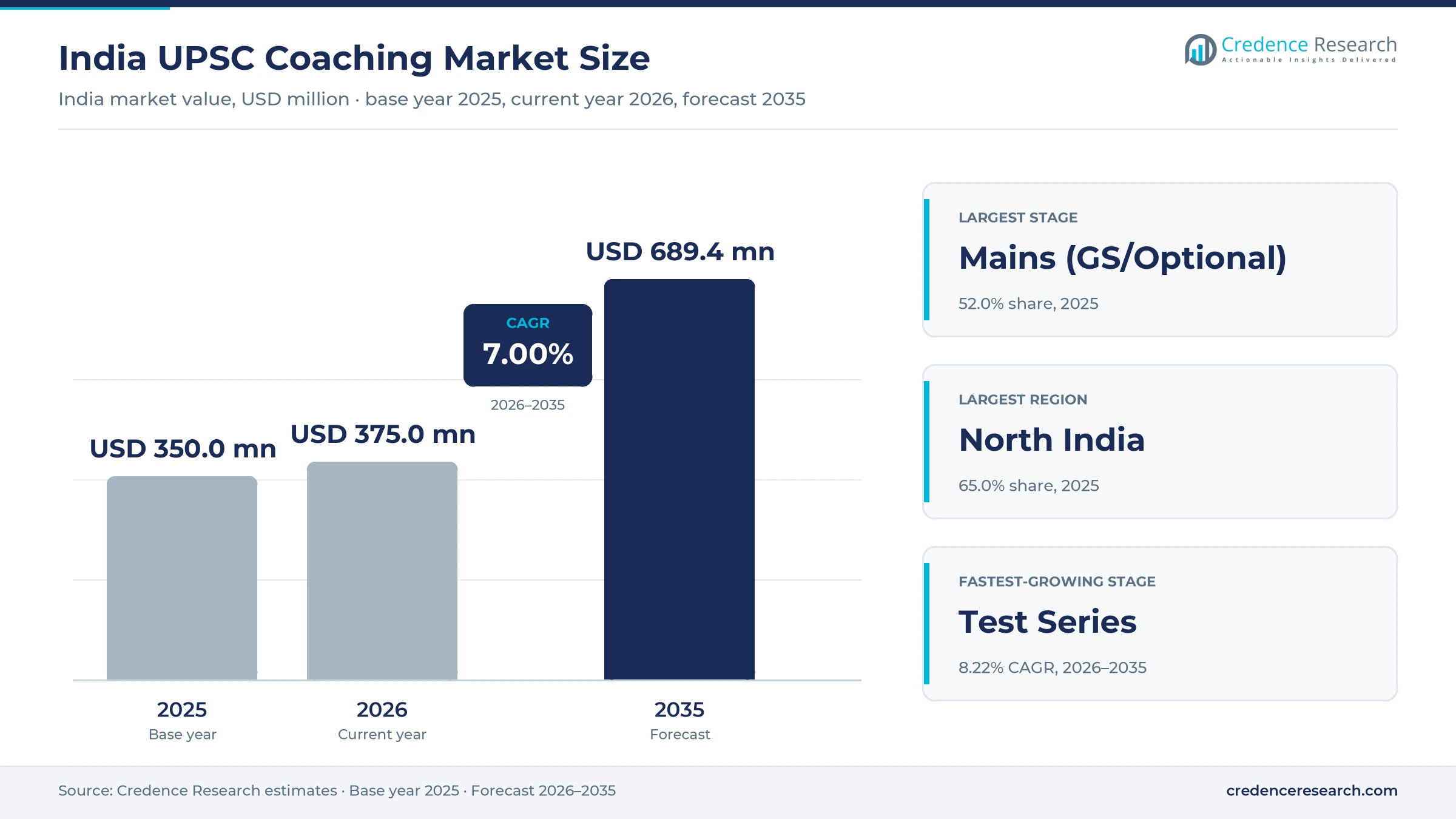
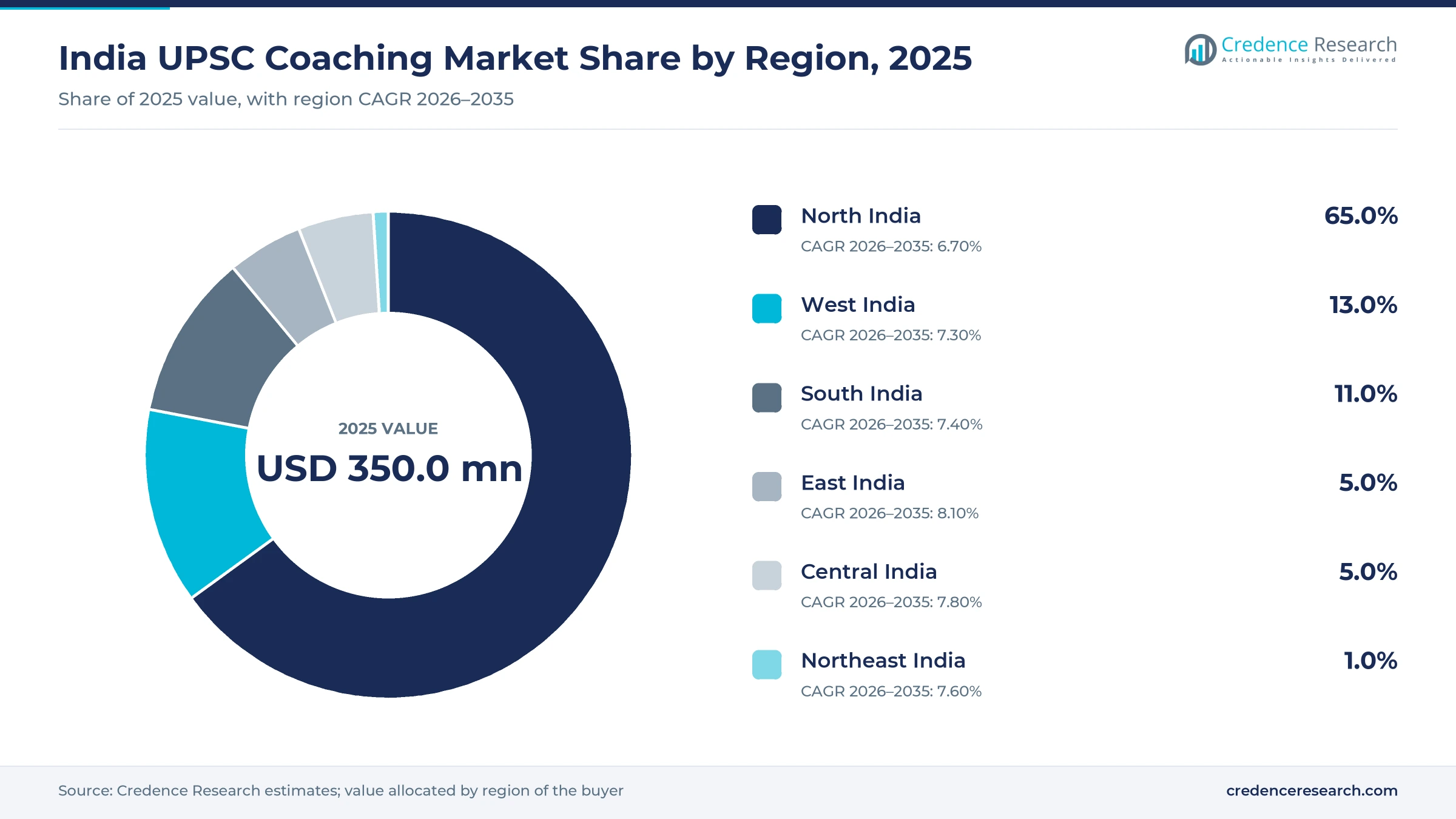
The India UPSC coaching market was valued at USD 350.0 million in 2025 and is projected to increase from USD 375.0 million in 2026 to USD 689.4 million by 2035, registering a CAGR of 7.00% during 2026–2035. Demand comes from graduates who pay for classroom, live online and test-based preparation for an exam that drew about 1 million prelims takers in 2025 and ended with 958 recommended candidates. North India held the largest regional share, 65.0% in 2025, because Old Rajinder Nagar, Karol Bagh and Mukherjee Nagar remain the national classroom base. East India is the fastest-growing region at 8.10% a year, as Delhi institutes open in cities such as Patna and Ranchi. The commercial picture also changed in May 2026, when the consumer regulator penalized Vajiram & Ravi over results claims, following earlier orders against Drishti IAS and Vision IAS. Institutes must now show which course each successful candidate actually took.
Which civil services preparation fees count toward this total?
The market counts fees paid to institutes and platforms for Civil Services Examination preparation, including prelims and mains teaching, optional-subject courses, test series and interview programs, delivered in classrooms or online. Aspirants usually buy a full general studies course and add optional and test modules later.
The estimate excludes rent, food and travel costs for aspirants who move to Delhi, standalone books, state civil service batches and free government programs. The value chain runs from faculty and study material through centers and apps to aspirants, who are usually graduates paying with family support.
India UPSC Coaching Market Insights
- Spending rises from USD 350.0 million in 2025 to USD 689.4 million by 2035, a 7.00% CAGR, as aspirants buy more modular courses and online batches.
- North India held 65.0% of 2025 value, anchored by Old Rajinder Nagar, Karol Bagh and Mukherjee Nagar in Delhi.
- Mains (GS/Optional) teaching held 52.0% of 2025 value, supported by two 250-mark optional papers that lead aspirants to add courses priced near Rs 50,000.
- Regulators found in May 2026 that 97.56% of the candidates one leading institute showed for 2023 had taken only its free interview program.
- Consolidation is under way, with upGrad closing its all-stock purchase of Unacademy on Sept. 1, 2026 and Drishti IAS adding Patna and Ranchi centers.
Mains teaching carries value as test series grow fastest
Mains courses lead while test series grow fastest
Based on stage, the market is categorized into prelims, mains (GS/optional), interview and test series. Mains (GS/Optional) programs led with 52.0% of 2025 value because they combine general studies teaching with an optional paper set worth 500 marks, and Vajiram & Ravi lists optional courses at Rs 50,000 to Rs 54,000 for most subjects. Test Series grows fastest at 8.22% a year as candidates buy tests separately, and Outlook Business reported in December 2025 that most candidates claimed by Vision IAS took test or interview programs instead of foundation courses. Interview value stays small because leading institutes offer guidance free.
Classrooms hold value as online batches gain share
Based on mode, the market is categorized into offline (Delhi hubs) and online. Offline (Delhi Hubs) teaching led with 70.0% of 2025 value because aspirants still pay a premium for face-to-face faculty and peer groups, and ThePrint reported in January 2025 that foundation batches cost about Rs 2 lakh a year, excluding rent and food. Online delivery grows fastest at 8.23% a year as it removes the Delhi living cost, and Open magazine reported in February 2026 that online programs made up about one-third of sales at Drishti IAS, with management expecting that portion to rise.
English batches lead as Hindi results stay under pressure
Based on language, the market is categorized into English and Hindi. English batches led with 66.0% of 2025 value and also grow fastest at 7.20% a year, because the UPSC Annual Report 2023–24, as summarized by PhysicsWallah, shows about 13,000 English-medium mains candidates against about 500 in Hindi, with the English count rising each year. Hindi batches still hold a large paying base at the prelims stage, and Drishti IAS built its brand there after 1999. However, a Rajya Sabha reply reported by Indian Masterminds in August 2026 showed Hindi or Maithili IAS and IPS recommendations falling to five in 2024 from 27 in 2022.
| Segment Group | Leading Sub-segment | Share, 2025 | Fastest-growing Sub-segment | CAGR, 2026–2035 |
|---|---|---|---|---|
| By Stage | Mains (GS/Optional) | 52.0% | Test Series | 8.22% |
| By Mode | Offline (Delhi Hubs) | 70.0% | Online | 8.23% |
| By Language | English | 66.0% | English | 7.20% |
Request a Free Sample
Fill in your details and we'll send you a free sample report.
- Sample data tables & charts
- Research methodology
Exam odds, optional papers and online reach lift spending
Civil services exam demand sustains structured preparation
The Civil Services Examination has a very long funnel, and that length converts directly into paid, staged preparation. The Free Press Journal reported in June 2025 that 14,161 candidates cleared prelims from about 1 million test takers. UPSC then recommended 958 candidates on March 6, 2026 against 1,087 notified vacancies, according to Onmanorama. The 2026 notice listed about 933 vacancies, according to Deccan Chronicle. ThePrint reported in February 2024 that aspirant numbers rose from about 500,000 in 2012 to over 1.1 million in 2022, while posts slipped from 1,091 to 1,022. In the Credence Research model this adds about 2.66 percentage points to annual growth to 2035.
Optional courses and mains test series lift spending
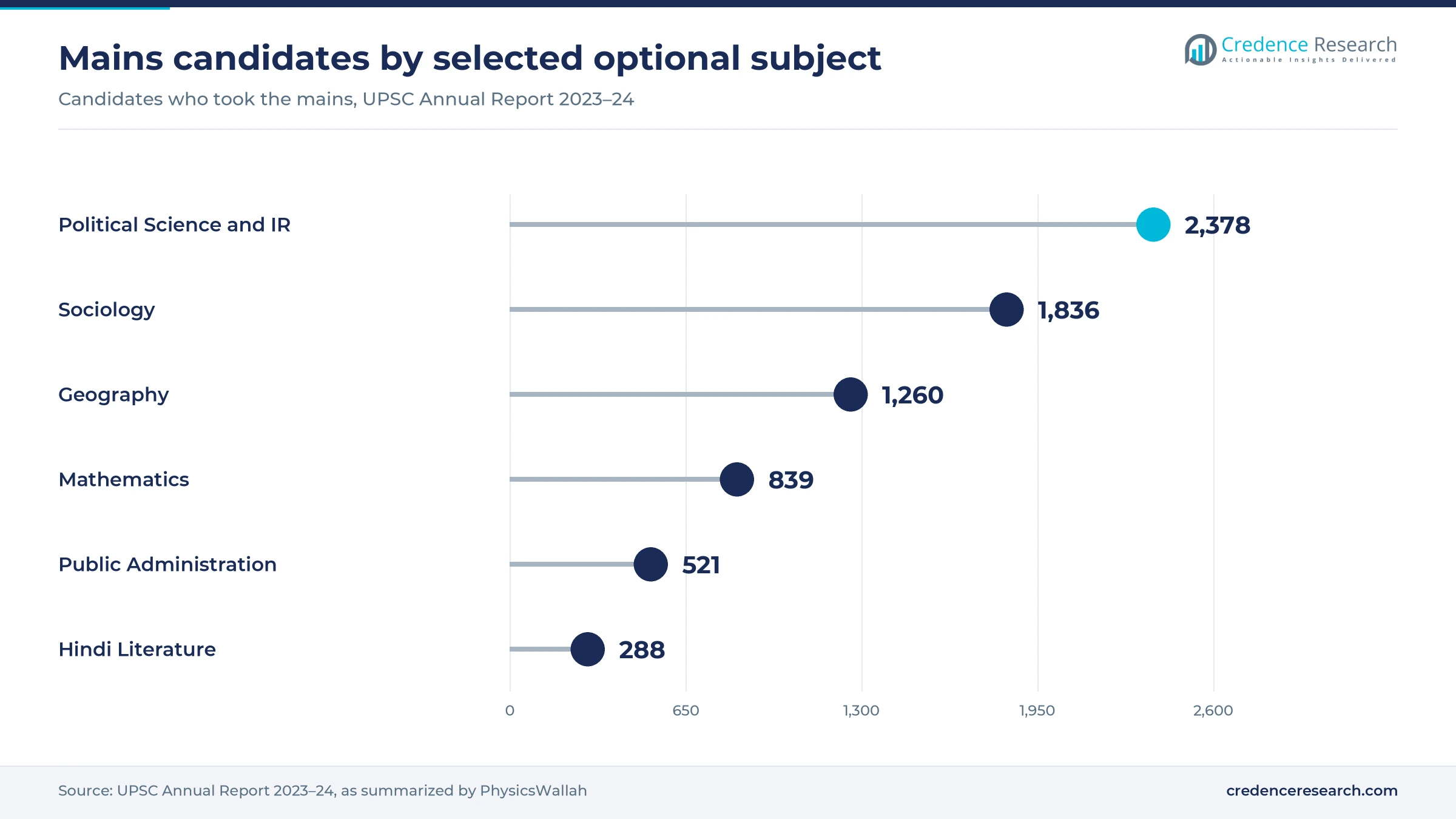
Mains is where a single aspirant adds several paid modules, so it raises spending per student more than any other stage. Candidates choose one of 48 optional subjects, assessed in two 250-mark papers, according to Vajiram & Ravi. The institute's fee page for 2026–27 lists mains test series at up to Rs 27,000, on top of general studies at Rs 1.8 lakh. UPSC Annual Report data show 2,378 mains candidates took Political Science and International Relations and 1,836 took Sociology, which gives institutes large single-subject batches. In the Credence Research model this adds about 1.96 percentage points to annual growth to 2035, and Test Series capture a growing part of that gain.
Digital delivery extends institutes beyond Delhi classrooms
Online delivery lets Delhi faculty reach graduates who cannot move to a hub, which adds paying students rather than only moving them. Open magazine reported in February 2026 that online programs now bring in about one-third of sales at Drishti IAS, with management expecting that share to rise. Vajiram & Ravi prices its online general studies course the same as the classroom version, which shows how far the format has matured. The Vision IAS test center list covers 38 cities, including Guwahati and Vijayawada. Unacademy, an education technology company, said its UPSC vertical reached positive contribution margins in 2025, according to YourStory. In the Credence Research model this adds about 1.26 percentage points to annual growth to 2035.
Educated youth joblessness keeps the aspirant pool large
Weak entry-level job options keep graduates in preparation for longer, which sustains repeat purchases of courses and tests. The Periodic Labour Force Survey press note of March 27, 2026 put urban youth unemployment at 13.6% in 2025, while the rate for people aged 15 and above with secondary education or higher was 6.5%. Paid coaching is also a familiar household expense, since the Comprehensive Modular Survey on Education found in August 2025 that 27.0% of students took private coaching. Spending on higher education often flows straight into exam preparation, because many aspirants start in college, and Vajiram & Ravi runs a live online college foundation program lasting 10 months.
Disclosure rules and new hubs reshape coaching models
Shift of classroom capacity from Delhi to state capitals
Classroom capacity is moving out of crowded Delhi lanes and toward Noida and state capitals, as both safety rules and local demand push institutes outward. Drishti IAS moved a substantial part of its operations from Mukherjee Nagar to a larger Noida campus and now also teaches in Ranchi and Patna, according to Open magazine in February 2026. ThePrint reported in February 2024 that institutes wanted new hubs in Patna, Indore and Jaipur. Raj Malhotra's IAS, meanwhile, opened a Karol Bagh branch in March 2024 and shut it within eight months, according to ThePrint in January 2025. As a result, East India gains share from a small base, although North India remains the main source of value.
Rise of course-level disclosure in results advertising
Results advertising is moving from headline ranks toward disclosure of the course each candidate actually attended, which changes how institutes sell. Careers360 reported on May 30, 2026 that the consumer regulator fined Vajiram & Ravi Rs 7 lakh and found that 97.56% of the 2023 candidates shown had joined only its free interview program. Outlook Business reported in October 2025 that 162 of 216 candidates in a Drishti IAS claim had done the same. The authority had issued more than 60 notices and over Rs 1.46 crore in penalties across competitive exams by then. In turn, institutes with real foundation-course outcomes should gain, because they can publish them with confidence.
Opportunity in Hindi and regional-language online batches
Language-focused online batches are an opening, because many candidates outside English medium still lack strong, low-cost mains support. A government reply reported by Indian Masterminds in August 2026 showed 1,133 candidates wrote the 2024 mains in Hindi and other scheduled languages, and only 50 qualified. ThePrint reported in July 2026 that recent final lists have included roughly 20 to 50 Hindi-medium candidates. StudyIQ already runs a live Hindi foundation batch for 2027, and Next IAS launched a Hindi-medium batch after the 2022 results, according to ThePrint. Providers that improve answer writing in these languages could win aspirants who now see few options, while also supporting broader e-learning habits in smaller towns.
Opening in state-sponsored aspirant programs
State governments have become a meaningful funder of preparation, which opens an institutional channel for capable providers. Tamil Nadu planned Rs 7,500 monthly stipends for about 1,000 aspirants for 10 months, with Rs 10 crore in funding, according to DT Next in March 2025. Uttar Pradesh reported 156 Abhyudaya centers and over 82,209 supported students by October 2024, according to Elets eGov. Delhi's Jai Bhim scheme partnered with 46 private centers at its rollout, according to ThePrint. The scheme pays the fees of selected students at those private institutes. Institutes with verified outcomes and regional teaching capacity could supply faculty, test preparation tools and mock interviews under these programs, although public budgets limit the fee per student.
Safety, enforcement and fee limits test institutes
Building safety crackdowns disrupted Delhi classrooms
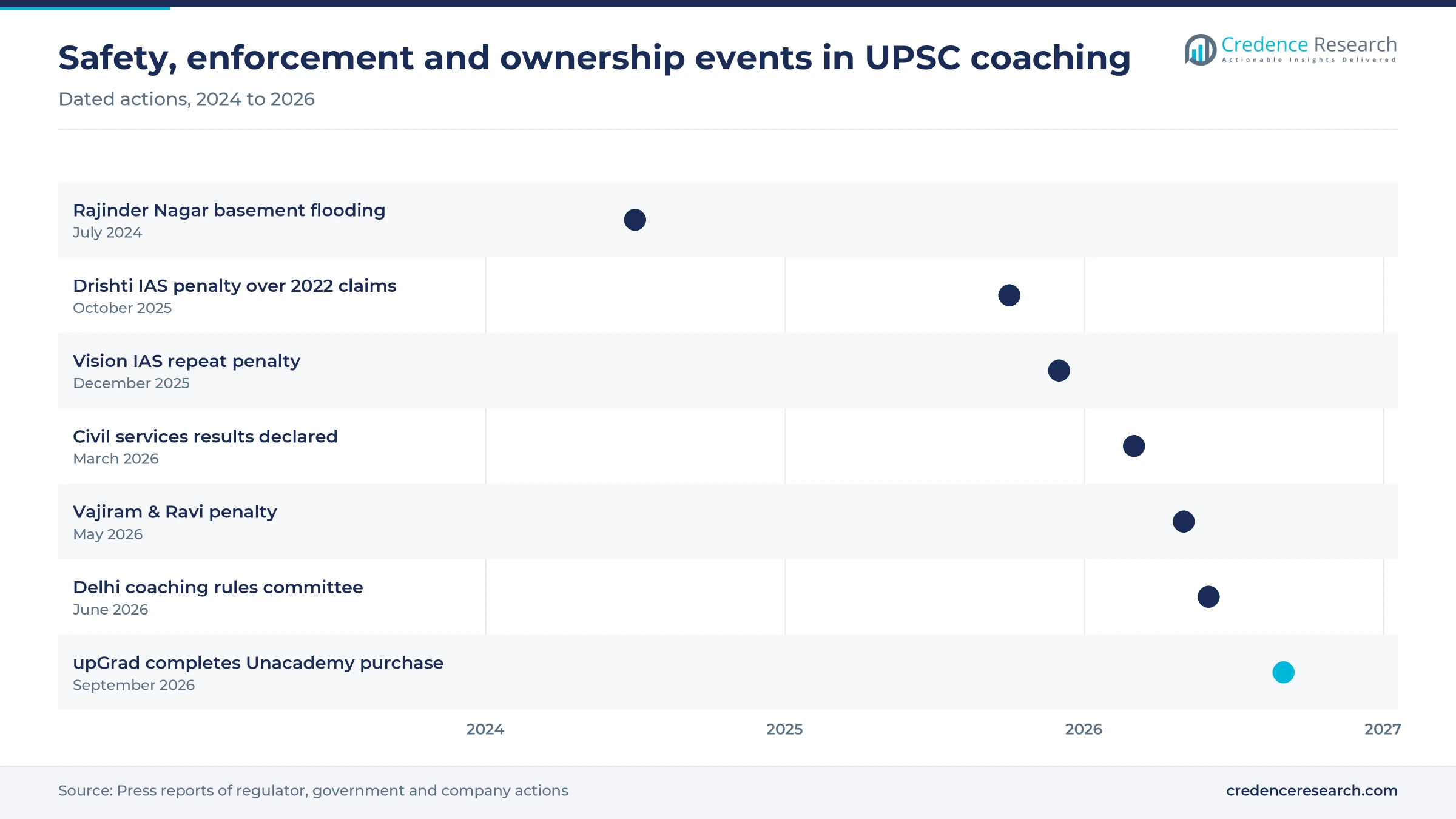
Building safety remains the most immediate risk for Delhi operators. Three aspirants drowned in a flooded Rau's IAS Study Circle basement on July 27, 2024, and authorities sealed 20 coaching basements within two days, according to Outlook Business. Delhi Police had already told the High Court in 2023 that only 67 of 583 institutes held fire safety certificates. Drishti IAS's chief executive then cited a 40% to 50% admissions drop across institutes in January 2025. Centers with compliant premises are better placed to recover enrollment.
Consumer complaints and penalties hit brand trust
Consumer enforcement is raising the cost of aggressive selling and strict refund terms. The National Consumer Helpline logged 16,276 coaching complaints in 2023–24, up from 5,351 the year before, according to ETV Bharat in June 2026. Vision IAS received an Rs 11 lakh penalty in December 2025 as a repeat offender, according to Careers360, which reported 28 penalized institutes by then. Smaller institutes with weak records are the most exposed, so published refund rules and audited results are the practical response.
New Delhi rules could cap fees and raise costs
Delhi is moving toward direct rules on fees, building standards and staff conditions, which could squeeze margins in the main hub. Education Minister Ashish Sood announced a drafting committee on June 11, 2026, following the Saket building collapse, according to Careers360. A federal panel led by Vineet Joshi also recommended capping classes at two to three hours a day, according to Business Today in January 2026. Large chains can absorb compliance more easily, while smaller Karol Bagh operators may consolidate or relocate.
Low selection odds and living costs limit spending
Affordability limits how much aspirants can spend, especially when selection odds remain so low. ThePrint reported in January 2025 that one aspirant who returned to Pune from Delhi after the 2024 basement deaths now saves up to Rs 18,000 a month. The Coaching Federation of India also asked the finance minister in January 2026 to cut goods and services tax on coaching to 5% or nil, according to Careers360. Many aspirants therefore choose lower-priced online modules or free state programs, so institutes need flexible pricing and clear course outcomes.
North India dominates while East India grows fastest
| Region | Value, 2025 (USD million) | Share, 2025 | CAGR, 2026–2035 |
|---|---|---|---|
| North India | 227.5 | 65.0% | 6.70% |
| West India | 45.5 | 13.0% | 7.30% |
| South India | 38.5 | 11.0% | 7.40% |
| East India | 17.5 | 5.0% | 8.10% |
| Central India | 17.5 | 5.0% | 7.80% |
| Northeast India | 3.5 | 1.0% | 7.60% |
North India leads through Delhi hubs and UP aspirants
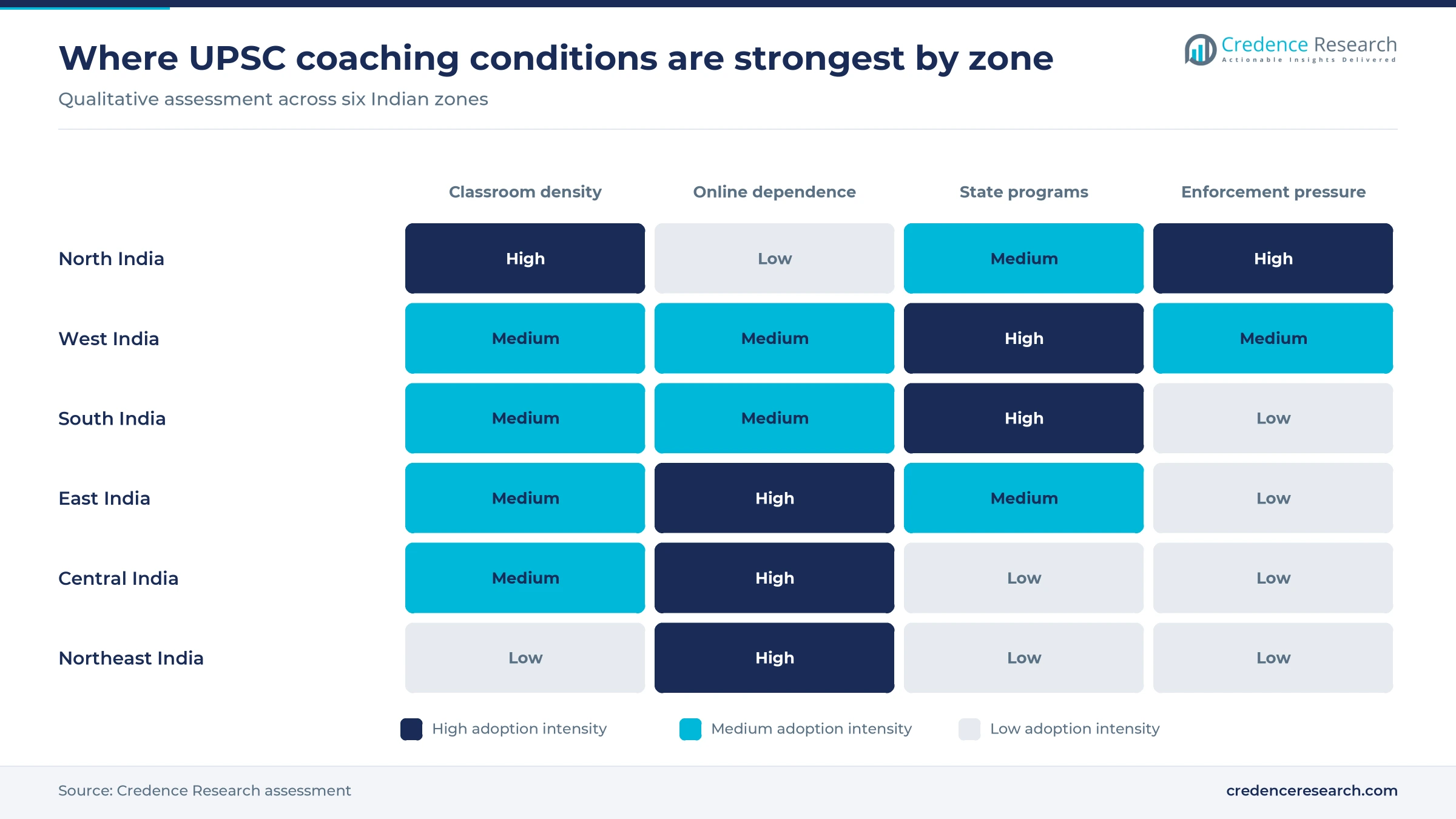
North India held 65.0% of 2025 value and grows at 6.70% a year, supported by the national classroom base in Old Rajinder Nagar, Karol Bagh and Mukherjee Nagar. Uttar Pradesh produced 29 of 179 IAS selections in the 2024 exam and Rajasthan 21, according to Indian Masterminds. Drishti IAS also teaches in Noida, Prayagraj, Lucknow and Jaipur, which keeps fees within the zone even as some students leave Delhi. Growth trails other zones because crackdowns and rents favor relocation.
West India draws value from Mumbai and Pune batches
West India held 13.0% of 2025 value and grows at 7.30% a year, with Maharashtra as its anchor. The state has run public civil services training since 1976 through its State Institute for Administrative Careers, according to ThePrint, with centers in Kolhapur, Amravati and Aurangabad. Demand here shows in the 2025 Vision IAS list of test centers in Mumbai, Pune, Nagpur and Ahmedabad, while PhysicsWallah named Pune among planned offline locations in May 2023. Paid test series therefore sit alongside the public option in these cities.
South India pairs Chennai classrooms with state support
South India held 11.0% of 2025 value and grows at 7.40% a year, helped by local classroom options and strong state programs. Vajiram & Ravi runs a 10-month general studies classroom course at its Anna Nagar center in Chennai. Free Press Journal reported in March 2026 that 56 of 60 Tamil Nadu candidates selected in the 2025 exam had benefited from the Naan Mudhalvan scheme. That public support limits private pricing, although Vision IAS test centers in Bengaluru and Hyderabad show paid demand.
East India grows fastest as Bihar gets local centers
East India held 5.0% of 2025 value and grows at 8.10% a year, the fastest pace among the zones. Bihar produced 15 IAS selections in the 2024 exam, according to Indian Masterminds, yet many of its aspirants have traditionally paid fees in Delhi. Drishti IAS opening in Patna and Ranchi during FY26 brings part of that spending home. West Bengal also runs a Kolkata study center with 26 satellite centers across 22 districts, according to ThePrint, which keeps fees low.
Central India gains from Indore and Bhopal classrooms
Central India held 5.0% of 2025 value and grows at 7.80% a year, with Madhya Pradesh as the main source of paid demand. Drishti IAS teaches in Indore, and PhysicsWallah listed the city among its planned offline locations in May 2023. Vision IAS test centers in Bhopal, Jabalpur and Raipur add a local route for mains practice, which saves a move to Delhi. As a result, more fees should stay in the zone through 2035.
Northeast India stays small and depends on online batches
Northeast India held 1.0% of 2025 value and grows at 7.60% a year from a small base. Guwahati is the only northeastern city on the 38-city Vision IAS test center list, which shows how thin local supply remains. Outlook Business listed Manipur among the states with a legal framework for private coaching in 2024. Limited classroom options and long travel to Delhi make live online batches the practical choice for most aspirants in the eight states.
Enforcement and consolidation marked 2024 to 2026
| Development | Status and market relevance |
|---|---|
| In July 2024, flooding at a Rau's IAS Study Circle basement killed three aspirants and led to sealing of 20 Delhi coaching basements. | Completed; it triggered court oversight and safety surveys in other states. |
| In October 2025, the consumer regulator fined Drishti IAS Rs 5 lakh over its 2022 selection claims. | Issued; the second penalty on the institute after a September 2024 order. |
| In December 2025, Vision IAS received an Rs 11 lakh penalty as a repeat offender. | Issued; only three of 119 claimed candidates took foundation courses. |
| In May 2026, Vajiram & Ravi was fined Rs 7 lakh over results claims for the 2023 exam. | Issued; the order directs it to discontinue the claims. |
| In September 2026, upGrad completed its all-stock acquisition of Unacademy. | Completed; UPSC stays part of the core test preparation portfolio. |
Live platforms and test engines change preparation
- Live and recorded platforms let one Delhi faculty team serve many towns, as the 910-day validity on a StudyIQ Hindi foundation course shows.
- Test series engines support prelims and mains practice at scale, including the self-evaluation and premium mains options listed by Vajiram & Ravi.
- Offline test networks combine online enrollment with exam-hall practice, as the 38-city Vision IAS test center list demonstrates for mains candidates.
- Video channels work as a low-cost enrollment funnel, as StudyIQ reported over 14 million YouTube subscribers in August 2023, according to ThePrint.
Need a Custom Version of This Report?
Tailor the scope, geography, or segments to your exact requirements.
- Custom geography or segment scope
- Direct access to our analyst team
Delhi brands and online platforms compete on reach
Demand in 2026 turns on faculty reputation, published results, center reach and price across both classroom and online formats. Vajiram & Ravi rests on its Old Rajinder Nagar classrooms and a Chennai center, while Vision IAS pairs Delhi classes with one of the widest test networks. Drishti IAS built its name with Hindi-medium aspirants and now teaches in several state capitals, although acquisition talks with PhysicsWallah did not conclude, according to Open magazine. Next IAS says enrollment comes largely through counseling at engineering colleges and Delhi University, according to ThePrint. StudyIQ, which Adda247 bought for about USD 20 million, uses its video audience to sell online courses. Unacademy passed to upGrad on Sept. 1, 2026 and has moved company-run sites to franchise operators. As a result, classroom brands compete on outcomes and attention, whereas online platforms compete on reach and affordability.
Companies profiled and their roles in this market
| Company | Type | Role in the market |
|---|---|---|
| Vajiram & Ravi | Classroom and online institute | General studies, optional and test programs from Old Rajinder Nagar and Chennai |
| Vision IAS | Classroom and test network | Foundation courses, Abhyaas tests and mock interviews, with test centers in 38 cities |
| Drishti IAS | Hindi and English institute | Classroom centers in Delhi, Noida and state capitals, plus online programs |
| Next IAS | Classroom institute | Delhi institute with study material focus and a Hindi-medium batch |
| StudyIQ (Adda247) | Online platform | Live Hindi and English foundation batches and test series, backed by a large video audience |
| Unacademy | Online platform | UPSC courses under upGrad ownership, with offline sites moving to franchise operators |
Value moves toward modular courses and proven results
Credence Research's view is that the market will reward modular buying and verifiable results more than headline rank counts. Regulators have shown that many claimed candidates bought only tests or free interview guidance, so aspirants can now see how little a full course may have contributed. That should move some spending toward test series and optional modules, while foundation courses must prove their value. Test Series grow at 8.22% a year in the Credence Research model, the fastest rate among the four stages. Institutes should publish outcomes by course and keep buildings compliant, because both now decide reputation. Buyers should compare refund terms before paying a full-year fee.
Exam counts and fee pages anchor these estimates
The report uses 2025 as the base year and 2026–2035 as the forecast period. Market values come from the Credence Research model, and regional and segment splits are Credence Research estimates informed by exam counts, published fees and center data. Sources include the UPSC Annual Report 2023–24 as summarized by PhysicsWallah, the statistics ministry labor and education surveys, consumer regulator orders as reported in the press, institute fee pages and named press reports. No interviews or surveys were conducted for this edition of the report.
Spending nearly doubles as classrooms spread by 2035
The market reaches USD 689.4 million by 2035 at a 7.00% CAGR, and the path should stay steady because exam seats will remain scarce against a very large aspirant pool. Test Series and Online courses will likely take a larger part of spending, while Delhi keeps its reputation but a slightly smaller share. Regulation in Delhi should favor larger chains with compliant buildings, and consumer orders should keep pressure on results advertising. Regional centers will bring preparation closer to home, and demand in East India should strengthen through 2035 as Patna and Ranchi batches mature.
Frequently Asked Questions
How big is the India UPSC coaching market?
Which stage of UPSC coaching holds the largest share?
Which region leads India UPSC coaching spending?
Which region is growing fastest?
What drives demand for UPSC coaching?
How has regulation affected UPSC coaching institutes?
How does online UPSC coaching compare with classroom courses?
Which companies operate in the India UPSC coaching market?
Table of Content
Chapter 1 Market Segmentation
- 1.1 Segmentation Framework
- 1.1.1 Product and Service Classification
- 1.1.2 Application and End-Use Classification
- 1.1.3 Technology and Solution Classification
- 1.1.4 Customer and Distribution Channel Classification
- 1.1.5 Geographic Segmentation
- 1.1.6 Market Segment Definitions and Boundaries
- 1.2 By Stage
- 1.2.1 Prelims
- 1.2.2 Mains (GS/Optional)
- 1.2.3 Interview
- 1.2.4 Test Series
- 1.3 By Mode
- 1.3.1 Offline (Delhi Hubs)
- 1.3.2 Online
- 1.4 By Language
- 1.4.1 English
- 1.4.2 Hindi
Chapter 2 Introduction
- 2.1 Report Objectives and Scope
- 2.2 Product Definition and Industry Terminology
- 2.3 Market Inclusions and Exclusions
- 2.4 Research Process
- 2.4.1 Primary Research and Expert Interviews
- 2.4.2 Secondary Research and Source Review
- 2.4.3 Top-Down and Bottom-Up Estimation
- 2.4.4 Data Triangulation and Verification
- 2.5 Market Size Measurement Basis
- 2.5.1 2025: USD 350.0 million → 2035: USD 689.4 million
- 2.6 Historical and Forecast Reference Periods
- 2.6.1 Historical Period: 2018-2025
- 2.6.2 Base Year: 2025
- 2.6.3 Forecast Period: 2025-2035
- 2.7 Research Assumptions and Limitations
Chapter 3 Executive Summary
- 3.1 Market Snapshot and Key Findings
- 3.2 Base-Year Market Size, 2025
- 3.3 Forecast Market Size, 2035
- 3.4 Revenue and Volume Growth Outlook
- 3.5 Key Demand and Supply Indicators
- 3.6 Leading Market Segments
- 3.7 Fastest-Growing Market Opportunities
- 3.8 Regional Performance Highlights
- 3.9 Technology and Industry Transformation
- 3.10 Competitive Landscape Summary
- 3.11 Analyst View and Strategic Implications
Chapter 4 India UPSC Coaching Market Trends and Developments
- 4.1 Historical Industry Development, 2018-2025
- 4.2 Recent Market Trends and Developments
- 4.3 Demand and Customer Behavior Trends
- 4.4 Technology and Product Innovation
- 4.5 Artificial Intelligence, Automation and Digitalization
- 4.6 Local Manufacturing and Supply Chain Realignment
- 4.7 Industry Partnerships, Mergers and Acquisitions
- 4.8 Sustainability and Circular Economy Developments
- 4.9 Government and Private Sector Investment Trends
- 4.10 Emerging Business Models and Commercialization
- 4.11 Industry Developments and Announcements
Chapter 5 India UPSC Coaching Market Production, Supply and Demand Analysis
- 5.1 Demand Trend and Consumption Analysis, 2018-2025
- 5.2 Demand Forecast, 2025-2035
- 5.3 Production and Output Trend, 2018-2025
- 5.4 Production and Output Forecast, 2025-2035
- 5.5 Installed Capacity and Capacity Utilization
- 5.6 Company-Wise Production Plants and Statistics
- 5.6.1 Installed Production Capacity
- 5.6.2 Actual Production
- 5.6.3 Planned Capacity and Expansion Targets
- 5.7 Supply Chain Structure and Procurement Trends
- 5.8 Supply-Demand Gap and Bottlenecks
- 5.9 Import Dependence and Sourcing Structure
- 5.10 Contract Manufacturing and Outsourcing
- 5.11 Regional Supply and Demand Concentration
Chapter 6 India UPSC Coaching Market Pricing Analysis
- 6.1 Pricing Structure and Measurement
- 6.2 Historical Pricing Trends, 2018-2025
- 6.3 Pricing Outlook, 2025-2035
- 6.4 Average Selling Price and Unit Economics
- 6.5 Pricing by Product and Market Segment
- 6.6 Geographic Pricing Differences
- 6.7 Key Input, Energy, Labor and Logistics Costs
- 6.8 Contract Pricing and Purchasing Models
- 6.9 Pricing Sensitivity and Competitive Positioning
- 6.10 Price, Margin and Profitability Implications
Chapter 7 India UPSC Coaching Market Dynamics
- 7.1 Market Growth Drivers
- 7.1.1 Demand-Side Drivers
- 7.1.2 Technology and Innovation Drivers
- 7.1.3 Infrastructure and Investment Drivers
- 7.1.4 Regulatory and Policy Drivers
- 7.2 Market Restraints
- 7.2.1 Cost and Affordability Constraints
- 7.2.2 Technology and Adoption Barriers
- 7.2.3 Supply Chain and Operational Constraints
- 7.3 Market Challenges
- 7.3.1 Competitive Pressure and Margin Erosion
- 7.3.2 Skills, Infrastructure and Implementation Gaps
- 7.4 Emerging Market Opportunities
- 7.5 Market Dynamics Impact and Time-Horizon Assessment
Chapter 8 India UPSC Coaching Value Chain Analysis
- 8.1 Industry Value Chain Overview
- 8.2 Upstream Suppliers and Critical Inputs
- 8.3 Technology and Component Providers
- 8.4 Manufacturing or Service Delivery
- 8.5 Distribution, Channel Partners and Integrators
- 8.6 Downstream Applications and End Users
- 8.7 Value Addition and Profit Pools
- 8.8 Vertical Integration and Outsourcing
- 8.9 Supplier Concentration and Risk
- 8.10 Supply Chain Localization and Resilience
Chapter 9 India UPSC Coaching Market Regulations and Policies
- 9.1 Relevant Laws, Standards and Compliance Frameworks
- 9.2 Product, Service, Safety and Quality Requirements
- 9.3 Government Policies, Incentives and Subsidies
- 9.4 Imports, Exports and Trade Barriers
- 9.5 Public Procurement and Local Content Requirements
- 9.6 Environmental and Sustainability Compliance
- 9.7 Upcoming Policy Changes and Market Implications
Chapter 10 India UPSC Coaching Market Hotspots and Opportunities
- 10.1 Market Opportunity Mapping and Growth Hotspots
- 10.2 High-Growth Applications and Customer Groups
- 10.3 Underserved Markets and White-Space Opportunities
- 10.4 Emerging Technology and Product Opportunities
- 10.5 New Capacity and Investment Hotspots
- 10.6 Market Entry and Expansion Opportunities
- 10.7 Distribution and Partnership Opportunities
- 10.8 Near-Term and Long-Term Commercial Potential
- 10.9 Opportunity Attractiveness and Execution Risks
Chapter 11 India UPSC Coaching Market Outlook, 2025-2035
- 11.1 Market Size and Analysis
- 11.1.1 Revenue (Market Measurement: 2025: USD 350.0 million → 2035: USD 689.4 million)
- 11.1.2 Market Volume and Quantity Sold
- 11.1.3 Historical Market Size, 2018-2025
- 11.1.4 Base-Year Market Size, 2025
- 11.2 Market Forecast, 2025-2035
- 11.2.1 Revenue Forecast to 2035
- 11.2.2 Volume Forecast to 2035
- 11.2.3 CAGR and Year-on-Year Growth
- 11.2.4 Incremental Revenue Opportunity
- 11.3 Forecast Assumptions and Scenario Analysis
- 11.3.1 Base-Case Forecast
- 11.3.2 Optimistic and Conservative Scenarios
- 11.3.3 Technology, Pricing and Policy Sensitivities
- 11.4 Market Attractiveness and Growth Outlook
Chapter 12 India UPSC Coaching Market Segmentation and Outlook
- 12.1 Segmentation Summary and Market Shares, 2025
- 12.2 Largest and Fastest-Growing Segments
- 12.3 By Stage - Market Size and Forecast, 2025-2035
- 12.3.1 Segment Definition and Scope
- 12.3.2 Historical Market Size, 2018-2025
- 12.3.3 Revenue Forecast, 2025-2035
- 12.3.4 Volume Forecast, 2025-2035
- 12.3.5 Base-Year Market Share, 2025
- 12.3.6 Segment CAGR and Growth Drivers
- 12.3.7 Subsegment Market Size and Forecast
- 12.3.7.1 Prelims
- 12.3.7.2 Mains (GS/Optional)
- 12.3.7.3 Interview
- 12.3.7.4 Test Series
- 12.3.8 Subsegment Pricing and Adoption Trends
- 12.3.9 Leading Suppliers and Competition
- 12.3.10 Regional Demand and Opportunities
- 12.4 By Mode - Market Size and Forecast, 2025-2035
- 12.4.1 Segment Definition and Scope
- 12.4.2 Historical Market Size, 2018-2025
- 12.4.3 Revenue Forecast, 2025-2035
- 12.4.4 Volume Forecast, 2025-2035
- 12.4.5 Base-Year Market Share, 2025
- 12.4.6 Segment CAGR and Growth Drivers
- 12.4.7 Subsegment Market Size and Forecast
- 12.4.7.1 Offline (Delhi Hubs)
- 12.4.7.2 Online
- 12.4.8 Subsegment Pricing and Adoption Trends
- 12.4.9 Leading Suppliers and Competition
- 12.4.10 Regional Demand and Opportunities
- 12.5 By Language - Market Size and Forecast, 2025-2035
- 12.5.1 Segment Definition and Scope
- 12.5.2 Historical Market Size, 2018-2025
- 12.5.3 Revenue Forecast, 2025-2035
- 12.5.4 Volume Forecast, 2025-2035
- 12.5.5 Base-Year Market Share, 2025
- 12.5.6 Segment CAGR and Growth Drivers
- 12.5.7 Subsegment Market Size and Forecast
- 12.5.7.1 English
- 12.5.7.2 Hindi
- 12.5.8 Subsegment Pricing and Adoption Trends
- 12.5.9 Leading Suppliers and Competition
- 12.5.10 Regional Demand and Opportunities
- 12.6 Segment Growth Comparison
- 12.7 Segment Attractiveness and Priority Matrix
Chapter 13 India UPSC Coaching Geographic Market Outlook, 2025-2035
- 13.1 Domestic Market Distribution and Demand Clusters
- 13.2 State- or Province-Wise Market Size and Forecast, 2025-2035
- 13.3 City and Metropolitan Market Outlook
- 13.4 Industrial, Manufacturing and Commercial Clusters
- 13.5 Geographic Concentration of Key End Users
- 13.6 Local Pricing and Purchasing Differences
- 13.7 Domestic Production Facilities and Capacity Map
- 13.8 Local Infrastructure and Project Pipeline
- 13.9 State-Level Policy and Incentive Differences
- 13.10 Subnational Investment Hotspots and Opportunities
- 13.11 Distribution and Logistics Networks
- 13.12 Domestic Competitive Footprint
Chapter 14 India UPSC Coaching Technology, Innovation and Sustainability Outlook
- 14.1 Technology Landscape and Maturity
- 14.2 Product, Process and Service Innovation
- 14.3 AI, Automation and Digital Tools in the Industry
- 14.4 Technology Adoption and Performance Benchmarking
- 14.5 Innovation Pipeline and R&D Investment
- 14.6 Patent and Intellectual Property Trends
- 14.7 Energy Efficiency and Resource Management
- 14.8 Sustainability, Recycling and Circularity
- 14.9 Technology Roadmap, 2025-2035
- 14.10 Risks of Obsolescence and Technology Substitution
Chapter 15 India UPSC Coaching Market Key Strategic Imperatives
- 15.1 Growth and Market Entry Priorities
- 15.2 High-Return Products and Segments
- 15.3 Pricing, Profitability and Cost Optimization
- 15.4 Technology Investment and Product Differentiation
- 15.5 Supply Chain Localization and Resilience
- 15.6 Distribution and Customer Acquisition
- 15.7 Partnership, Acquisition and Capacity Strategy
- 15.8 Regional Expansion Priorities
- 15.9 Short-, Medium- and Long-Term Actions
Chapter 16 Competition Outlook
- 16.1 Industry Competition Characteristics
- 16.2 Market Structure and Concentration
- 16.3 Market Share and Competitive Positioning, 2025
- 16.4 Company-Wise Revenue and Product Benchmarking
- 16.5 Production and Service Capacity Benchmarking
- 16.6 Technology, Pricing and Differentiation
- 16.7 Regional Footprint and Distribution Strength
- 16.8 Mergers, Acquisitions and Strategic Alliances
- 16.9 New Entrants and Competitive Threats
- 16.10 Porter's Five Forces and Industry Attractiveness
- 16.11 Competitive Outlook, 2025-2035
Chapter 17 Company Profiles
- 17.1 Company Coverage and Selection Criteria
- 17.2 Vajiram & Ravi
- 17.2.1 Business Description
- 17.2.2 Company Ownership and Geographic Presence
- 17.2.3 Product and Service Portfolio
- 17.2.4 Manufacturing and Operating Footprint
- 17.2.5 Production Capacity and Expansion Plans
- 17.2.6 Financial Performance and Investment
- 17.2.7 Market Share and Competitive Position
- 17.2.8 Technology and Innovation Capabilities
- 17.2.9 Strategic Alliances or Partnerships
- 17.2.10 Recent Developments
- 17.2.11 Growth Strategy and Outlook
- 17.3 Vision IAS
- 17.4 Drishti IAS
- 17.5 Next IAS
- 17.6 StudyIQ (Adda247)
- 17.7 Unacademy
- 17.8 Other Relevant Market Participants
Note: Every listed company is profiled on the structure shown under the first company. The company list is preliminary and may change based on research findings, market developments, data availability and client requirements.
Chapter 18 Disclaimer
- 18.1 Research and Forecast Disclaimer
- 18.2 Data Source and Estimation Limitations
Note: The depth of individual sections depends on data availability for this market. Volume, capacity, trade and other unit-based metrics are included where applicable.

