
Market Overview:
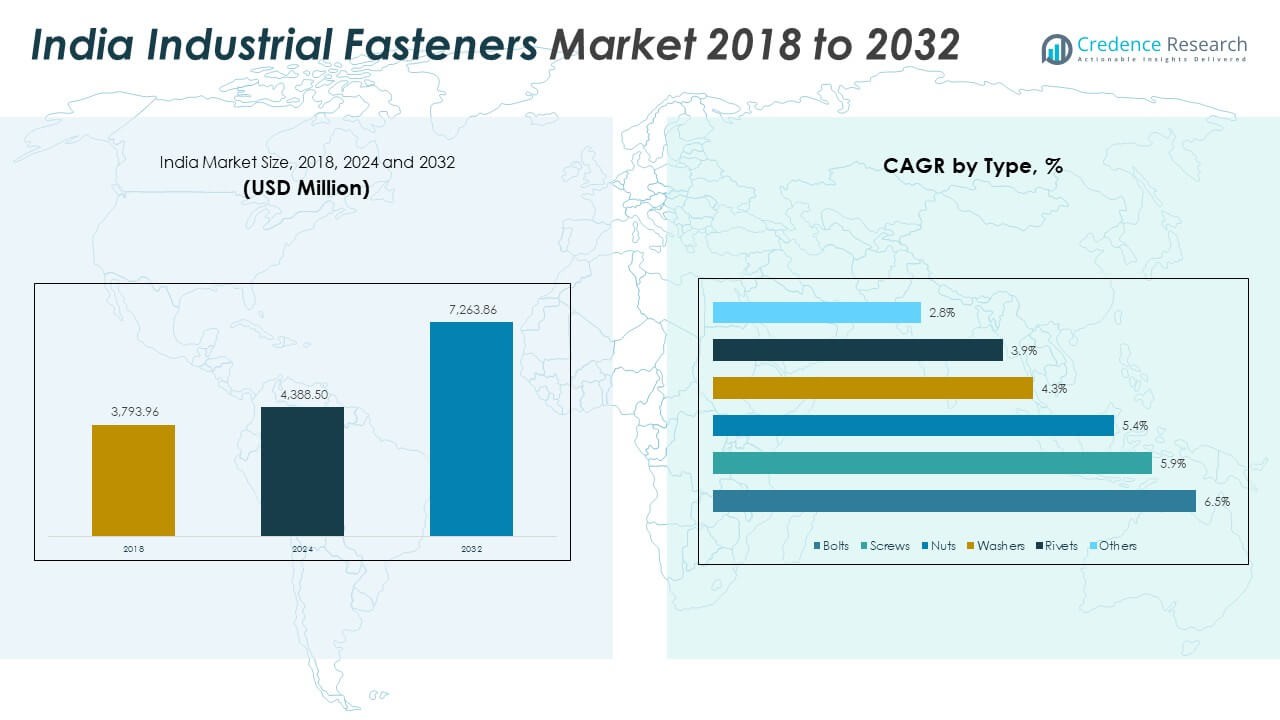
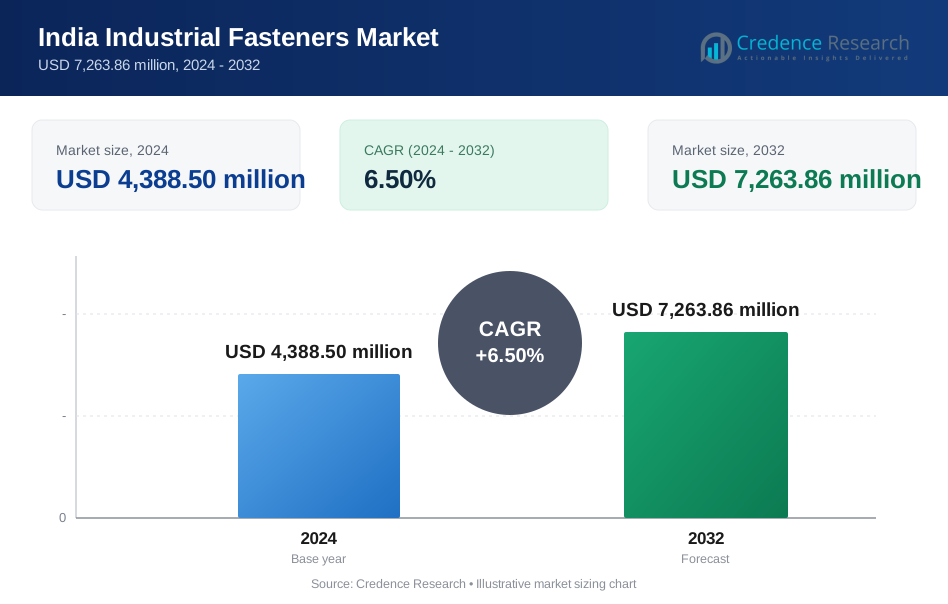
The India Industrial Fasteners Market size was valued at USD 3,793.96 million in 2018 to USD 4,388.50 million in 2024 and is anticipated to reach USD 7,263.86 million by 2032, at a CAGR of 6.50% during the forecast period.
| REPORT ATTRIBUTE | DETAILS |
|---|---|
| Historical Period | 2020-2023 |
| Base Year | 2024 |
| Forecast Period | 2025-2032 |
| India Industrial Fasteners Market Size 2024 | USD 4,388.50 Million |
| India Industrial Fasteners Market, CAGR | 6.50% |
| India Industrial Fasteners Market Size 2032 | USD 7,263.86 Million |
The market growth is supported by strong demand from automotive, construction, and manufacturing industries. Expanding infrastructure projects and housing developments in urban and semi-urban regions increase the need for fasteners. Growing adoption of advanced materials and lightweight fasteners further strengthens the industry. Rising industrial automation and modern machinery production also boost fastener consumption, enhancing efficiency and durability across sectors. A strong supply chain network and availability of low-cost manufacturing provide an added advantage for India.
Geographically, India’s fasteners market benefits from strong industrial bases in states like Maharashtra, Gujarat, and Tamil Nadu. Northern states such as Haryana and Uttar Pradesh also show strong demand, driven by automotive hubs and construction projects. Emerging regions in eastern and southern India are experiencing growth due to government initiatives supporting infrastructure and manufacturing expansion. Urbanization, coupled with the “Make in India” initiative, creates balanced growth across developed and emerging regions, making India a competitive player in global fasteners manufacturing.
Market Insights:
- The India Industrial Fasteners Market was valued at USD 3,793.96 million in 2018, reached USD 4,388.50 million in 2024, and is projected to hit USD 7,263.86 million by 2032, growing at a CAGR of 6.50%.
- The northern region leads with 36% share, supported by automotive and engineering hubs, while the western region holds 28% due to industrial bases in Maharashtra and Gujarat. The southern region follows with 22%, led by aerospace and electronics demand.
- The eastern region holds 14% share and is the fastest-growing, driven by steel plants, construction, and infrastructure expansion.
- Externally threaded fasteners dominate with 40% share, reflecting their wide use in automotive and machinery. Internally threaded fasteners account for 25%, serving precision-driven applications.
- Non-threaded fasteners hold 20% share, while aerospace-grade fasteners capture 15%, supported by growth in defense and aviation.
Market Drivers:
Strong Growth in Automotive Production and Component Demand:
The India Industrial Fasteners Market is strongly supported by the automotive industry. Rapid expansion of passenger and commercial vehicle production drives high-volume demand for fasteners. Rising consumer preference for personal vehicles further boosts production across auto hubs. Global automotive firms setting up plants in India create a multiplier effect on demand. Suppliers are innovating with lightweight and high-strength fasteners to meet industry requirements. Electric vehicle manufacturing also increases the need for precision fasteners. The industry strengthens its role as a vital supplier to the automotive supply chain.
- For instance, ARaymond India is a preferred supplier of automotive fasteners to Bajaj Auto, manufacturing over 70% of parts locally and supporting the assembly of millions of motorcycles and three-wheelers annually across India. Suppliers are innovating with lightweight and high-strength fasteners to meet industry requirements. Electric vehicle manufacturing also increases the need for precision fasteners.
Infrastructure Expansion and Rapid Urbanization Stimulating Demand:
Large-scale infrastructure projects create a strong push for fasteners in construction and engineering. Government-led investments in highways, metro systems, and airports increase industrial consumption. Urban housing projects and smart city initiatives contribute to steady growth. Contractors prefer high-quality fasteners that offer durability in large structures. Demand extends to bridges, industrial parks, and power plants. Urbanization also supports furniture, electrical, and appliances industries that require fasteners. The construction sector reinforces the growth of the India Industrial Fasteners Market with long-term demand.
- For instance, Super Screws Pvt. Ltd from Haryana signed an MoU with Mitsuchi Corporation in 2024 to jointly manufacture specialized cold-forged fasteners for infrastructure projects, enhancing production capacity with precision tolerances supporting rapid urban development. Urbanization also supports furniture, electrical, and appliances industries that require fasteners.
Rising Manufacturing Output and Industrialization in Emerging Sectors:
Growing industrialization is driving higher consumption of industrial fasteners in manufacturing units. Sectors such as machinery, textiles, and energy require specialized fasteners for assembly and maintenance. Expansion of defense production facilities adds new dimensions to demand. Manufacturers are investing in capacity to support engineering exports. Industrial clusters in Gujarat, Maharashtra, and Tamil Nadu ensure a consistent supply base. Small and medium enterprises are also strengthening demand at regional levels. The market benefits from wider application scope across industries with diverse requirements.
Technological Innovations and Adoption of Advanced Materials:
Innovation in design and materials boosts the quality and strength of fasteners. Use of alloys, stainless steel, and composites enhances resistance and longevity. Technology-driven manufacturing improves precision and performance. Export markets prefer advanced fasteners meeting international standards. Automation in production increases consistency and lowers defects. Demand for custom-engineered fasteners supports the growth of specialized suppliers. It expands the market by catering to niche applications in aerospace and defense.
Market Trends:
Rising Demand for Customized and Application-Specific Fasteners:
Customers increasingly seek fasteners tailored to specialized applications. Aerospace, defense, and electronics industries demand products with exact tolerances. Customized fasteners ensure efficiency and reliability in critical systems. Manufacturers are adopting flexible production processes to meet unique orders. Export opportunities grow with international buyers preferring tailored products. Small and mid-sized suppliers are entering the customized solutions space. The India Industrial Fasteners Market reflects this trend by diversifying its product range.
Shift Toward High-Performance Coatings and Corrosion Resistance:
Fasteners with advanced coatings are gaining preference in harsh environments. Oil and gas, marine, and construction projects require products with extended durability. Zinc, nickel, and specialized chemical coatings improve corrosion resistance. Firms invest in eco-friendly plating processes that meet environmental regulations. Demand grows for fasteners with anti-rust properties in humid regions. Manufacturers integrate testing and certifications to assure long-term performance. It creates opportunities for innovation in surface treatment technologies.
- For instance, AN Fasteners in India offers surface-treated fasteners with eco-friendly coatings that significantly improve rust resistance, passing ASTM B117 salt spray tests beyond 1,000 hours, ensuring long-term durability in humid and marine environments. Firms invest in eco-friendly plating processes that meet environmental regulations.
Expansion of Online Distribution and E-Commerce Platforms:
Digital platforms are transforming procurement practices in industrial supply chains. Buyers prefer online portals for efficiency and transparency. E-commerce provides access to a wider variety of fasteners with real-time availability. SMEs benefit from easier procurement channels at competitive pricing. Online marketplaces support bulk orders and customization requests. Logistics advancements improve delivery to remote industrial regions. The India Industrial Fasteners Market adapts by integrating digital distribution strategies.
Increasing Global Trade and Export Opportunities for Indian Suppliers:
India is emerging as a key exporter of industrial fasteners. Competitive pricing and manufacturing scale support global expansion. Buyers from North America, Europe, and Asia-Pacific source from Indian firms. Compliance with ISO and ASTM standards increases trust in exports. Trade agreements boost access to international markets. Manufacturers are investing in global certifications to enhance credibility. It positions India as a reliable player in the global supply chain.
Market Challenges Analysis:
Fluctuations in Raw Material Prices and Supply Constraints:
The India Industrial Fasteners Market faces cost volatility linked to raw materials like steel, aluminum, and alloys. Global price swings impact production margins for manufacturers. Small players struggle with bulk procurement compared to larger firms. Unstable supply chains, driven by global disruptions, worsen the challenge. Dependency on imports for specialized materials adds pressure. Rising transportation costs influence the overall pricing structure. It restricts the ability of local suppliers to remain competitive in both domestic and export markets.
Intense Market Competition and Pressure on Quality Standards:
Strong competition from domestic and international firms challenges profitability. Unorganized players create pricing pressures with low-cost alternatives. Maintaining quality standards becomes difficult for smaller manufacturers. Customers prefer certified products, limiting the market for uncertified suppliers. Rapid technological shifts demand investment in new machinery and testing. Firms unable to adapt risk losing contracts to global rivals. The India Industrial Fasteners Market must balance affordability with strict quality expectations across industries.
Market Opportunities:
Rising Demand from Renewable Energy and Electric Vehicle Sectors:
The transition to clean energy sources supports new opportunities for fasteners. Wind turbines, solar projects, and electric vehicles require specialized fastening solutions. Lightweight, durable fasteners are crucial for meeting performance goals. Indian suppliers can expand by catering to these sectors. Partnerships with renewable energy firms create long-term growth potential. It allows firms to diversify beyond traditional markets. The India Industrial Fasteners Market benefits from innovation in sustainable applications.
Government Initiatives and Export Promotion Creating Growth Prospects:
Government policies such as “Make in India” support local manufacturing capacity. Export promotion councils provide assistance for global certifications and trade fairs. Incentives encourage firms to scale production and expand exports. Trade opportunities open new markets for specialized fasteners worldwide. Infrastructure and industrial investments create strong domestic demand. Policy support strengthens India’s global competitiveness in fasteners. It offers a dual advantage of growth in domestic and international markets.
Market Segmentation Analysis:
By Type and Product
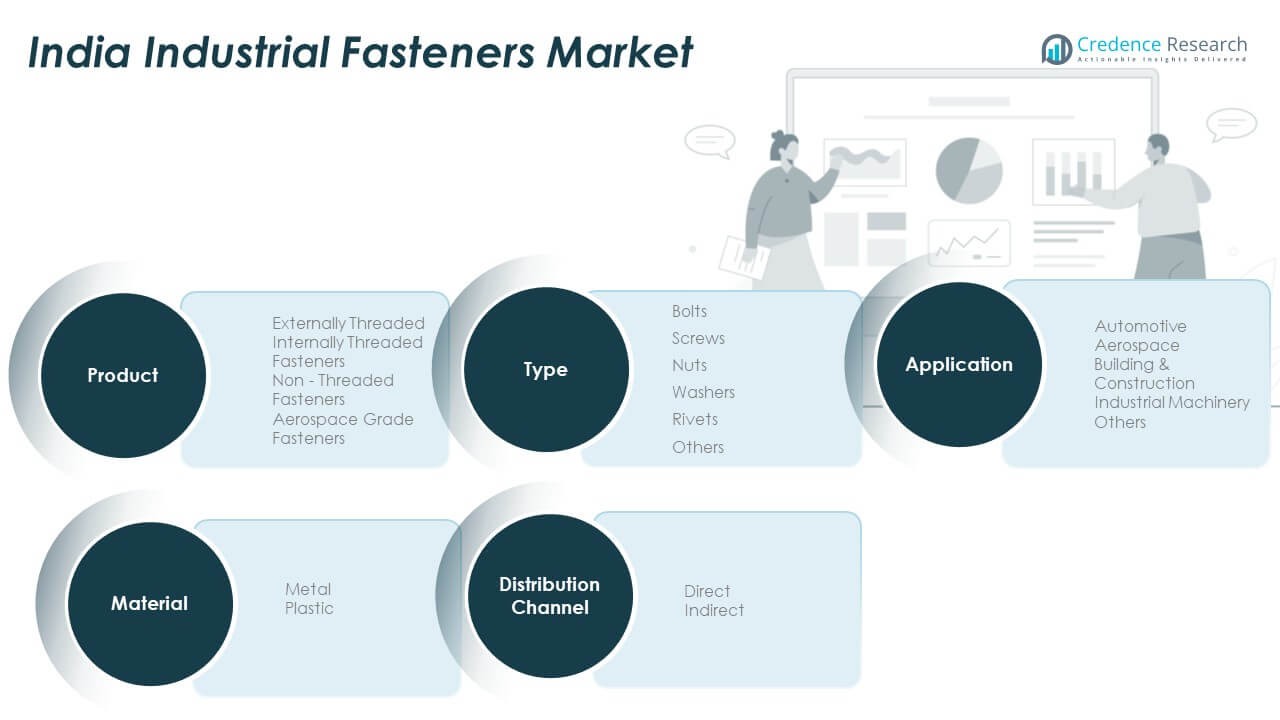
The India Industrial Fasteners Market demonstrates strong demand across bolts, screws, nuts, washers, rivets, and other categories. Bolts and screws dominate usage due to their wide application in automotive and construction. Nuts and washers support structural integrity in machinery and infrastructure. Rivets and specialized fasteners gain traction in aerospace and heavy engineering. By product, externally threaded fasteners lead the market with extensive adoption in automotive and industrial machinery. Internally threaded fasteners support precision applications, while non-threaded fasteners address structural needs. Aerospace-grade fasteners cater to defense and aviation, emphasizing durability and strength.
- For instance, Bhansali Component & Fasteners, a company with over four decades of experience, employs precision machining to produce a variety of high-strength, stainless steel fasteners. These are used across various sectors like automotive, aerospace, and heavy machinery, ensuring consistent quality. General trends in the industry show nuts and washers are used for structural integrity, while specialized fasteners like rivets are gaining traction in demanding fields such as aerospace.
By Material
The market is primarily driven by metal fasteners, supported by steel and alloy-based products. Metal dominates due to high tensile strength, durability, and cost-effectiveness in industrial and construction applications. Stainless steel fasteners remain preferred for corrosion resistance and reliability in critical environments. Plastic fasteners, while smaller in share, are gaining demand in electronics and lightweight automotive applications. They provide flexibility, insulation, and cost advantages in niche areas. It benefits from a balanced mix of materials, allowing suppliers to serve diverse end-use industries.
- FOR INSTANCE, Hilton Steel is a leading Indian manufacturer and supplier of corrosion-resistant fasteners and forged components for various industrial applications. Stainless steel remains a preferred material for fasteners due to its corrosion resistance and reliability in critical environments.
By Application and Distribution Channel
Automotive leads the market, supported by strong domestic vehicle production and export demand. Aerospace emerges as a key segment, requiring precision-engineered fasteners for safety and performance. Building and construction also contribute significantly, driven by infrastructure expansion across India. Industrial machinery provides steady demand, ensuring long-term consumption of specialized fasteners. Other segments, such as electronics and furniture, add to market diversification. Direct distribution channels dominate with established supplier-buyer relationships, while indirect channels gain share through online platforms and distributors. It reflects a well-structured segmentation that balances traditional demand with emerging opportunities.
Segmentation:
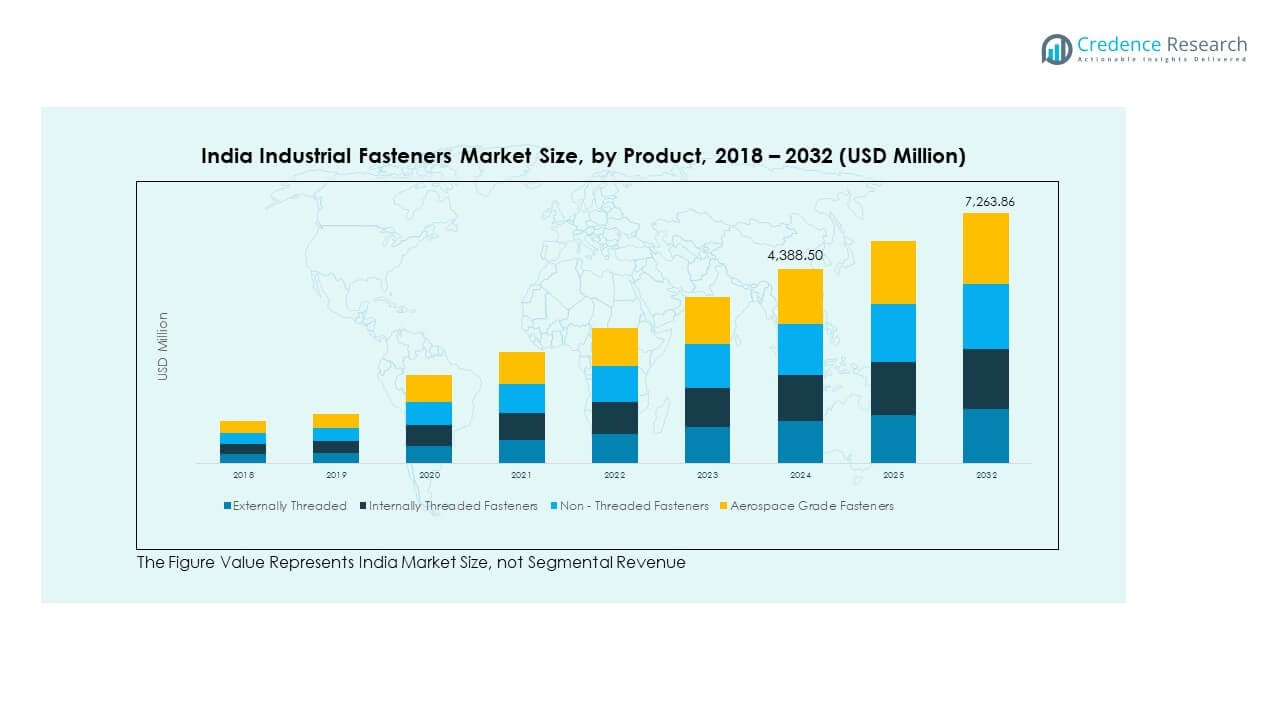
By Type
- Bolts
- Screws
- Nuts
- Washers
- Rivets
- Others
By Product
- Externally Threaded
- Internally Threaded Fasteners
- Non-Threaded Fasteners
- Aerospace Grade Fasteners
By Material
- Metal
- Plastic
By Application
- Automotive
- Aerospace
- Building & Construction
- Industrial Machinery
- Others
By Distribution Channel
- Direct
- Indirect
Regional Analysis:
Northern Region Leading with Strong Automotive and Industrial Base
The northern region holds the largest share of the India Industrial Fasteners Market with around 36%. Haryana, Punjab, and Uttar Pradesh are key hubs for automotive and engineering industries, driving high-volume demand for fasteners. Gurgaon and Faridabad host major automotive OEMs and tier-1 suppliers, creating consistent consumption. The presence of industrial clusters further strengthens regional growth. Government-backed infrastructure projects in Delhi NCR support construction-related demand. It continues to maintain leadership due to its strong manufacturing ecosystem and strategic location.
Western Region Expanding with Manufacturing and Infrastructure Growth
The western region accounts for nearly 28% of the India Industrial Fasteners Market. Maharashtra and Gujarat are major contributors, supported by strong industrial bases and port infrastructure. Automotive production in Pune and Aurangabad drives steady demand. Gujarat supports industrial machinery and energy projects, increasing the need for durable fasteners. Construction of highways, smart cities, and industrial corridors reinforces the market footprint. It benefits from export opportunities due to efficient logistics and global trade access.
Southern and Eastern Regions Emerging as High-Growth Markets
The southern region captures about 22% share of the India Industrial Fasteners Market, driven by Tamil Nadu and Karnataka. Strong presence of automotive, aerospace, and electronics industries increases demand for advanced fasteners. Chennai and Bangalore remain critical centers for both domestic and export-oriented production. The eastern region holds nearly 14% share, led by West Bengal and Odisha, where construction and heavy industries fuel growth. Rising investments in steel plants and industrial corridors support consumption. It shows high growth potential as infrastructure development accelerates in tier-2 and tier-3 cities.
Key Player Analysis:
- Sundram Fasteners Limited
- Sterling Tools Limited
- Universal Precision Screws
- Deepak Fasteners Limited
- KOVA Fasteners Pvt. Ltd.
- Precision Fasteners Ltd.
Competitive Analysis:
The India Industrial Fasteners Market is highly competitive with strong participation from domestic and global players. Large companies such as Sundram Fasteners Limited, Sterling Tools Limited, and Deepak Fasteners Limited dominate organized production, while smaller firms cater to niche applications and price-sensitive segments. International manufacturers strengthen competition by offering certified products for aerospace and defense. It faces constant innovation with players investing in advanced materials, coatings, and lightweight fasteners. The presence of unorganized suppliers exerts pricing pressure, forcing larger firms to focus on quality, technology, and distribution networks. Strategic partnerships and export expansion remain central to market positioning.
Recent Developments:
- In February 2025, Universal Precision Screws exhibited at Fastener Fair Global 2025 in Stuttgart, Germany, showcasing their latest innovations and reinforcing their commitment to the international fastener industry.
- In March 2025, Deepak Fasteners Limited reported improved financial performance and growth in operations, with sustained production increases from their Madhya Pradesh plant, though no specific product launch or acquisition was detailed.
- KOVA Fasteners Pvt. Ltd. continues to emphasize quality and production capabilities as a certified manufacturer, focusing on state-of-the-art technology and customer service in their ongoing operations, without specific announcements of new launches or acquisitions recently.
Report Coverage:
The research report offers an in-depth analysis based on type, product, material, application, and distribution channel. It details leading market players, providing an overview of their business, product offerings, investments, revenue streams, and key applications. Additionally, the report includes insights into the competitive environment, SWOT analysis, current market trends, as well as the primary drivers and constraints. Furthermore, it discusses various factors that have driven market expansion in recent years. The report also explores market dynamics, regulatory scenarios, and technological advancements that are shaping the industry. It assesses the impact of external factors and global economic changes on market growth. Lastly, it provides strategic recommendations for new entrants and established companies to navigate the complexities of the market.
Future Outlook:
- Rising automotive production will continue to drive strong demand for fasteners.
- Aerospace-grade fasteners will expand with defense and aviation industry growth.
- Infrastructure development will sustain steady consumption across construction applications.
- Export opportunities will grow as Indian suppliers achieve international certifications.
- Customized and application-specific fasteners will gain wider adoption.
- Plastic and lightweight fasteners will see increased usage in electronics and EVs.
- Online distribution channels will enhance accessibility for SMEs and buyers.
- Advanced coatings and corrosion-resistant products will strengthen performance standards.
- Government initiatives will boost domestic manufacturing capacity and reduce import dependency.
- Regional industrial clusters will remain pivotal in shaping supply and demand dynamics.
Request a Free Sample
Fill in your details and we'll send you a free sample report.
- Sample data tables & charts
- Research methodology
Market Dynamics
Automotive Industry Expansion
Rapid growth in India's automotive sector, including both passenger and commercial vehicles, is driving high-volume demand for industrial fasteners. The presence of global automotive manufacturers and the rise of electric vehicle production further amplify the need for advanced, lightweight, and precision fasteners.
Infrastructure and Urbanization Boom
Large-scale government investments in infrastructure - such as highways, metro systems, airports, and urban housing - are significantly increasing the consumption of fasteners in construction and engineering projects. Urbanization and smart city initiatives are sustaining long-term demand across multiple sectors.
Manufacturing and Industrialization Growth
The expansion of manufacturing output in sectors like machinery, textiles, and energy is fueling the need for specialized fasteners for assembly and maintenance. The development of industrial clusters and the rise of small and medium enterprises are broadening the market base.
Technological Advancements and Material Innovation
Adoption of advanced materials such as alloys, stainless steel, and composites is enhancing the strength, durability, and corrosion resistance of fasteners. Technological innovations in manufacturing processes are enabling the production of custom-engineered and high-performance fasteners for niche applications.
Export Opportunities and Government Initiatives
India's competitive manufacturing costs and compliance with international standards are boosting fastener exports to global markets. Government policies like 'Make in India' and export promotion initiatives are supporting local manufacturers in scaling up production and accessing new international markets.
Need a Custom Version of This Report?
Tailor the scope, geography, or segments to your exact requirements.
- Custom geography or segment scope
- Direct access to our analyst team
Frequently Asked Questions
What is the current market size for India Industrial Fasteners Market, and what is its projected size in 2032?
At what Compound Annual Growth Rate is the India Industrial Fasteners Market projected to grow between 2024 and 2032?
Which India Industrial Fasteners Market segment held the largest share in 2024?
What are the primary factors fueling the growth of the India Industrial Fasteners Market?
Who are the leading companies in the India Industrial Fasteners Market?
Which region commanded the largest share of the India Industrial Fasteners Market in 2024?
Table of Content
Chapter 1 Market Segmentation
- 1.1 Segmentation Framework
- 1.1.1 Product and Service Classification
- 1.1.2 Application and End-Use Classification
- 1.1.3 Technology and Solution Classification
- 1.1.4 Customer and Distribution Channel Classification
- 1.1.5 Geographic Segmentation
- 1.1.6 Market Segment Definitions and Boundaries
- 1.2 By Type
- 1.2.1 Bolts
- 1.2.2 Screws
- 1.2.3 Nuts
- 1.2.4 Washers
- 1.2.5 Rivets
- 1.2.6 Others
- 1.3 By Product
- 1.3.1 Externally Threaded Fasteners
- 1.3.2 Internally Threaded Fasteners
- 1.3.3 Non-Threaded Fasteners
- 1.3.4 Aerospace Grade Fasteners
- 1.4 By Material
- 1.4.1 Metal
- 1.4.2 Plastic
- 1.5 By Application
- 1.5.1 Automotive
- 1.5.2 Aerospace
- 1.5.3 Building & Construction
- 1.5.4 Industrial Machinery
- 1.5.5 Others
Chapter 2 Introduction
- 2.1 Report Objectives and Scope
- 2.2 Product Definition and Industry Terminology
- 2.3 Market Inclusions and Exclusions
- 2.4 Research Process
- 2.4.1 Primary Research and Expert Interviews
- 2.4.2 Secondary Research and Source Review
- 2.4.3 Top-Down and Bottom-Up Estimation
- 2.4.4 Data Triangulation and Verification
- 2.5 Market Size Measurement Basis
- 2.5.1 2024: USD 4,388.50 million → 2032: USD 7,263.86 million
- 2.6 Historical and Forecast Reference Periods
- 2.6.1 Base Year: 2024
- 2.6.2 Forecast Period: 2024-2032
- 2.7 Research Assumptions and Limitations
Chapter 3 Executive Summary
- 3.1 Market Snapshot and Key Findings
- 3.2 Base-Year Market Size, 2024
- 3.3 Forecast Market Size, 2032
- 3.4 Revenue and Volume Growth Outlook
- 3.5 Key Demand and Supply Indicators
- 3.6 Leading Market Segments
- 3.7 Fastest-Growing Market Opportunities
- 3.8 Regional Performance Highlights
- 3.9 Technology and Industry Transformation
- 3.10 Competitive Landscape Summary
- 3.11 Analyst View and Strategic Implications
Chapter 4 India Industrial Fasteners Market Trends and Developments
- 4.1 Historical Industry Development
- 4.2 Recent Market Trends and Developments
- 4.3 Demand and Customer Behavior Trends
- 4.4 Technology and Product Innovation
- 4.5 Artificial Intelligence, Automation and Digitalization
- 4.6 Local Manufacturing and Supply Chain Realignment
- 4.7 Industry Partnerships, Mergers and Acquisitions
- 4.8 Sustainability and Circular Economy Developments
- 4.9 Government and Private Sector Investment Trends
- 4.10 Emerging Business Models and Commercialization
- 4.11 Industry Developments and Announcements
Chapter 5 India Industrial Fasteners Market Production, Supply and Demand Analysis
- 5.1 Demand Trend and Consumption Analysis
- 5.2 Demand Forecast, 2024-2032
- 5.3 Production and Output Trend
- 5.4 Production and Output Forecast, 2024-2032
- 5.5 Installed Capacity and Capacity Utilization
- 5.6 Company-Wise Production Plants and Statistics
- 5.6.1 Installed Production Capacity
- 5.6.2 Actual Production
- 5.6.3 Planned Capacity and Expansion Targets
- 5.7 Supply Chain Structure and Procurement Trends
- 5.8 Supply-Demand Gap and Bottlenecks
- 5.9 Import Dependence and Sourcing Structure
- 5.10 Contract Manufacturing and Outsourcing
- 5.11 Regional Supply and Demand Concentration
Chapter 6 India Industrial Fasteners Market Pricing Analysis
- 6.1 Pricing Structure and Measurement
- 6.2 Historical Pricing Trends
- 6.3 Pricing Outlook, 2024-2032
- 6.4 Average Selling Price and Unit Economics
- 6.5 Pricing by Product and Market Segment
- 6.6 Geographic Pricing Differences
- 6.7 Key Input, Energy, Labor and Logistics Costs
- 6.8 Contract Pricing and Purchasing Models
- 6.9 Pricing Sensitivity and Competitive Positioning
- 6.10 Price, Margin and Profitability Implications
Chapter 7 India Industrial Fasteners Market Dynamics
- 7.1 Market Growth Drivers
- 7.1.1 Demand-Side Drivers
- 7.1.2 Technology and Innovation Drivers
- 7.1.3 Infrastructure and Investment Drivers
- 7.1.4 Regulatory and Policy Drivers
- 7.2 Market Restraints
- 7.2.1 Cost and Affordability Constraints
- 7.2.2 Technology and Adoption Barriers
- 7.2.3 Supply Chain and Operational Constraints
- 7.3 Market Challenges
- 7.3.1 Competitive Pressure and Margin Erosion
- 7.3.2 Skills, Infrastructure and Implementation Gaps
- 7.4 Emerging Market Opportunities
- 7.5 Market Dynamics Impact and Time-Horizon Assessment
Chapter 8 India Industrial Fasteners Value Chain Analysis
- 8.1 Industry Value Chain Overview
- 8.2 Upstream Suppliers and Critical Inputs
- 8.3 Technology and Component Providers
- 8.4 Manufacturing or Service Delivery
- 8.5 Distribution, Channel Partners and Integrators
- 8.6 Downstream Applications and End Users
- 8.7 Value Addition and Profit Pools
- 8.8 Vertical Integration and Outsourcing
- 8.9 Supplier Concentration and Risk
- 8.10 Supply Chain Localization and Resilience
Chapter 9 India Industrial Fasteners Market Regulations and Policies
- 9.1 Relevant Laws, Standards and Compliance Frameworks
- 9.2 Product, Service, Safety and Quality Requirements
- 9.3 Government Policies, Incentives and Subsidies
- 9.4 Imports, Exports and Trade Barriers
- 9.5 Public Procurement and Local Content Requirements
- 9.6 Environmental and Sustainability Compliance
- 9.7 Upcoming Policy Changes and Market Implications
Chapter 10 India Industrial Fasteners Market Hotspots and Opportunities
- 10.1 Market Opportunity Mapping and Growth Hotspots
- 10.2 High-Growth Applications and Customer Groups
- 10.3 Underserved Markets and White-Space Opportunities
- 10.4 Emerging Technology and Product Opportunities
- 10.5 New Capacity and Investment Hotspots
- 10.6 Market Entry and Expansion Opportunities
- 10.7 Distribution and Partnership Opportunities
- 10.8 Near-Term and Long-Term Commercial Potential
- 10.9 Opportunity Attractiveness and Execution Risks
Chapter 11 India Industrial Fasteners Market Outlook, 2024-2032
- 11.1 Market Size and Analysis
- 11.1.1 Revenue (Market Measurement: 2024: USD 4,388.50 million → 2032: USD 7,263.86 million)
- 11.1.2 Market Volume and Quantity Sold
- 11.1.3 Historical Market Size
- 11.1.4 Base-Year Market Size, 2024
- 11.2 Market Forecast, 2024-2032
- 11.2.1 Revenue Forecast to 2032
- 11.2.2 Volume Forecast to 2032
- 11.2.3 CAGR and Year-on-Year Growth
- 11.2.4 Incremental Revenue Opportunity
- 11.3 Forecast Assumptions and Scenario Analysis
- 11.3.1 Base-Case Forecast
- 11.3.2 Optimistic and Conservative Scenarios
- 11.3.3 Technology, Pricing and Policy Sensitivities
- 11.4 Market Attractiveness and Growth Outlook
Chapter 12 India Industrial Fasteners Market Segmentation and Outlook
- 12.1 Segmentation Summary and Market Shares, 2024
- 12.2 Largest and Fastest-Growing Segments
- 12.3 By Type - Market Size and Forecast, 2024-2032
- 12.3.1 Segment Definition and Scope
- 12.3.2 Historical Market Size
- 12.3.3 Revenue Forecast, 2024-2032
- 12.3.4 Volume Forecast, 2024-2032
- 12.3.5 Base-Year Market Share, 2024
- 12.3.6 Segment CAGR and Growth Drivers
- 12.3.7 Subsegment Market Size and Forecast
- 12.3.7.1 Bolts
- 12.3.7.2 Screws
- 12.3.7.3 Nuts
- 12.3.7.4 Washers
- 12.3.7.5 Rivets
- 12.3.7.6 Others
- 12.3.8 Subsegment Pricing and Adoption Trends
- 12.3.9 Leading Suppliers and Competition
- 12.3.10 Regional Demand and Opportunities
- 12.4 By Product - Market Size and Forecast, 2024-2032
- 12.4.1 Segment Definition and Scope
- 12.4.2 Historical Market Size
- 12.4.3 Revenue Forecast, 2024-2032
- 12.4.4 Volume Forecast, 2024-2032
- 12.4.5 Base-Year Market Share, 2024
- 12.4.6 Segment CAGR and Growth Drivers
- 12.4.7 Subsegment Market Size and Forecast
- 12.4.7.1 Externally Threaded Fasteners
- 12.4.7.2 Internally Threaded Fasteners
- 12.4.7.3 Non-Threaded Fasteners
- 12.4.7.4 Aerospace Grade Fasteners
- 12.4.8 Subsegment Pricing and Adoption Trends
- 12.4.9 Leading Suppliers and Competition
- 12.4.10 Regional Demand and Opportunities
- 12.5 By Material - Market Size and Forecast, 2024-2032
- 12.5.1 Segment Definition and Scope
- 12.5.2 Historical Market Size
- 12.5.3 Revenue Forecast, 2024-2032
- 12.5.4 Volume Forecast, 2024-2032
- 12.5.5 Base-Year Market Share, 2024
- 12.5.6 Segment CAGR and Growth Drivers
- 12.5.7 Subsegment Market Size and Forecast
- 12.5.7.1 Metal
- 12.5.7.2 Plastic
- 12.5.8 Subsegment Pricing and Adoption Trends
- 12.5.9 Leading Suppliers and Competition
- 12.5.10 Regional Demand and Opportunities
- 12.6 By Application - Market Size and Forecast, 2024-2032
- 12.6.1 Segment Definition and Scope
- 12.6.2 Historical Market Size
- 12.6.3 Revenue Forecast, 2024-2032
- 12.6.4 Volume Forecast, 2024-2032
- 12.6.5 Base-Year Market Share, 2024
- 12.6.6 Segment CAGR and Growth Drivers
- 12.6.7 Subsegment Market Size and Forecast
- 12.6.7.1 Automotive
- 12.6.7.2 Aerospace
- 12.6.7.3 Building & Construction
- 12.6.7.4 Industrial Machinery
- 12.6.7.5 Others
- 12.6.8 Subsegment Pricing and Adoption Trends
- 12.6.9 Leading Suppliers and Competition
- 12.6.10 Regional Demand and Opportunities
- 12.7 Segment Growth Comparison
- 12.8 Segment Attractiveness and Priority Matrix
Chapter 13 India Industrial Fasteners End-Use and Application Market Outlook
- 13.1 End-Use Industry and Customer Demand Structure
- 13.2 Leading Applications and Customer Groups
- 13.3 End-Use Market Size, Share and Forecast
- 13.4 Major End-Use Industry Deep Dives
- 13.4.1 Customer Requirements and Use Cases
- 13.4.2 Demand and Replacement Cycles
- 13.4.3 Technical and Regulatory Considerations
- 13.4.4 Purchasing and Procurement Models
- 13.4.5 Leading Vendors and Distribution Channels
- 13.4.6 Forecast and Commercial Opportunities
- 13.5 Emerging Applications and Cross-Segment Demand
- 13.6 End-Use Industry Investment Priorities
Chapter 14 India Industrial Fasteners Geographic Market Outlook, 2024-2032
- 14.1 Domestic Market Distribution and Demand Clusters
- 14.2 State- or Province-Wise Market Size and Forecast, 2024-2032
- 14.3 City and Metropolitan Market Outlook
- 14.4 Industrial, Manufacturing and Commercial Clusters
- 14.5 Geographic Concentration of Key End Users
- 14.6 Local Pricing and Purchasing Differences
- 14.7 Domestic Production Facilities and Capacity Map
- 14.8 Local Infrastructure and Project Pipeline
- 14.9 State-Level Policy and Incentive Differences
- 14.10 Subnational Investment Hotspots and Opportunities
- 14.11 Distribution and Logistics Networks
- 14.12 Domestic Competitive Footprint
Chapter 15 India Industrial Fasteners Technology, Innovation and Sustainability Outlook
- 15.1 Technology Landscape and Maturity
- 15.2 Product, Process and Service Innovation
- 15.3 AI, Automation and Digital Tools in the Industry
- 15.4 Technology Adoption and Performance Benchmarking
- 15.5 Innovation Pipeline and R&D Investment
- 15.6 Patent and Intellectual Property Trends
- 15.7 Energy Efficiency and Resource Management
- 15.8 Sustainability, Recycling and Circularity
- 15.9 Technology Roadmap, 2024-2032
- 15.10 Risks of Obsolescence and Technology Substitution
Chapter 16 India Industrial Fasteners Market Key Strategic Imperatives
- 16.1 Growth and Market Entry Priorities
- 16.2 High-Return Products and Segments
- 16.3 Pricing, Profitability and Cost Optimization
- 16.4 Technology Investment and Product Differentiation
- 16.5 Supply Chain Localization and Resilience
- 16.6 Distribution and Customer Acquisition
- 16.7 Partnership, Acquisition and Capacity Strategy
- 16.8 Regional Expansion Priorities
- 16.9 Short-, Medium- and Long-Term Actions
Chapter 17 Competition Outlook
- 17.1 Industry Competition Characteristics
- 17.2 Market Structure and Concentration
- 17.3 Market Share and Competitive Positioning, 2024
- 17.4 Company-Wise Revenue and Product Benchmarking
- 17.5 Production and Service Capacity Benchmarking
- 17.6 Technology, Pricing and Differentiation
- 17.7 Regional Footprint and Distribution Strength
- 17.8 Mergers, Acquisitions and Strategic Alliances
- 17.9 New Entrants and Competitive Threats
- 17.10 Porter's Five Forces and Industry Attractiveness
- 17.11 Competitive Outlook, 2024-2032
Chapter 18 Company Profiles
- 18.1 Company Coverage and Selection Criteria
- 18.2 Sundram Fasteners Limited
- 18.2.1 Business Description
- 18.2.2 Company Ownership and Geographic Presence
- 18.2.3 Product and Service Portfolio
- 18.2.4 Manufacturing and Operating Footprint
- 18.2.5 Production Capacity and Expansion Plans
- 18.2.6 Financial Performance and Investment
- 18.2.7 Market Share and Competitive Position
- 18.2.8 Technology and Innovation Capabilities
- 18.2.9 Strategic Alliances or Partnerships
- 18.2.10 Recent Developments
- 18.2.11 Growth Strategy and Outlook
- 18.3 Sterling Tools Limited
- 18.4 Universal Precision Screws
- 18.5 Deepak Fasteners Limited
- 18.6 KOVA Fasteners Pvt. Ltd.
- 18.7 Precision Fasteners Ltd.
- 18.8 Super Screws Pvt. Ltd.
- 18.9 Hilton Steel
- 18.10 ARaymond India
- 18.11 Bhansali Component & Fasteners
- 18.12 Other Relevant Market Participants
Note: Every listed company is profiled on the structure shown under the first company. The company list is preliminary and may change based on research findings, market developments, data availability and client requirements.
Chapter 19 Disclaimer
- 19.1 Research and Forecast Disclaimer
- 19.2 Data Source and Estimation Limitations
Note: The depth of individual sections depends on data availability for this market. Volume, capacity, trade and other unit-based metrics are included where applicable.

