
Imported polymers and local formulators shape supply
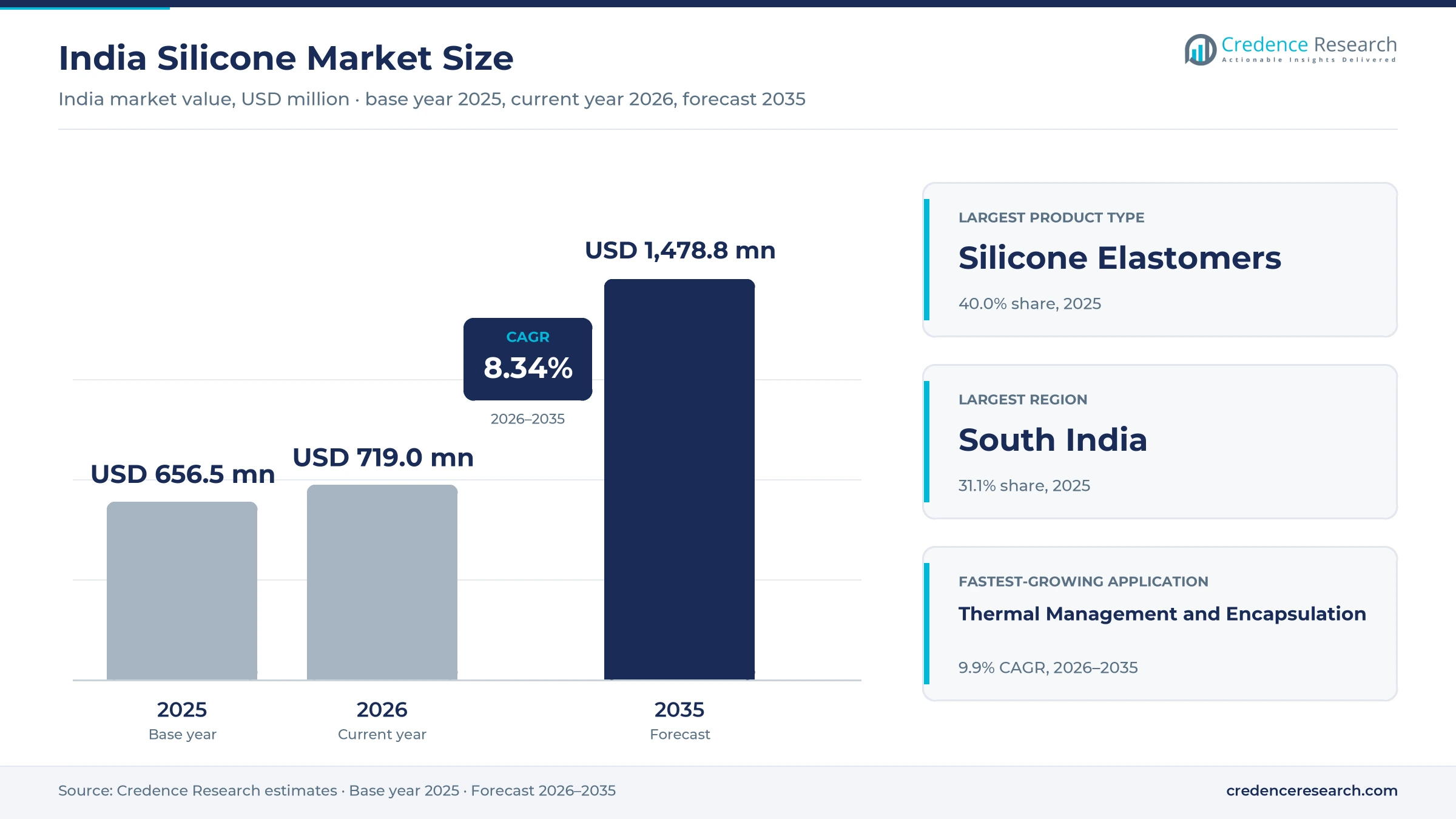
The India silicone market was valued at USD 656.5 million in 2025 and is projected to increase from USD 719.0 million in 2026 to USD 1.48 billion by 2035, registering a CAGR of 8.34% during 2026–2035. Demand comes from sealants and coatings for buildings and infrastructure, from rubber parts and thermal materials for vehicles and electronics, and from fluids and emulsions used in shampoos, textiles and industrial processing. South India held the largest regional share, 31.1% in 2025, because Tamil Nadu and Karnataka combine electronics assembly, vehicle plants and textile clusters. West India is the fastest-growing region at 9.0% a year as Gujarat adds chip packaging plants and Maharashtra keeps its automotive base. Most base polymers are still imported, so landed prices follow Chinese siloxane prices and the rupee. New local capacity for emulsions and rubber compounds is starting to shorten supply chains for formulators.
Finished silicone grades count while silicon metal stays out
The market counts silicone fluids, elastomers, resins, emulsions and gels sold for use in India, whether made at local plants or imported as polymers and finished grades. Formulators, OEMs, construction material producers and consumer product makers buy them directly from producers, through authorized distributors or from specialty chemical dealers.
Silicon metal, polysilicon for solar wafers and fumed silica sold on its own sit outside the count. The value chain runs from imported siloxane intermediates and polymers through local compounding, emulsifying and sealant filling, then to molders, paint and textile chemical makers, cosmetic brands and building contractors.
India Silicone Market Insights
- Spending rises from USD 656.5 million in 2025 to USD 1.48 billion by 2035, an 8.34% CAGR, as electric vehicles, chip packaging and solar module plants add thermal and encapsulation demand.
- South India held 31.1% of 2025 value, supported by Tamil Nadu and Karnataka, which together shipped more than 63% of India’s electronics exports in 2024-25.
- Silicone Elastomers accounted for 40.0% of 2025 value, while Sealing and Bonding made up 34.0% of spending across construction and industry.
- Wacker completed a GMP-certified silicone emulsion complex at Panagarh in March 2026, adding local supply for cosmetic and personal care formulators.
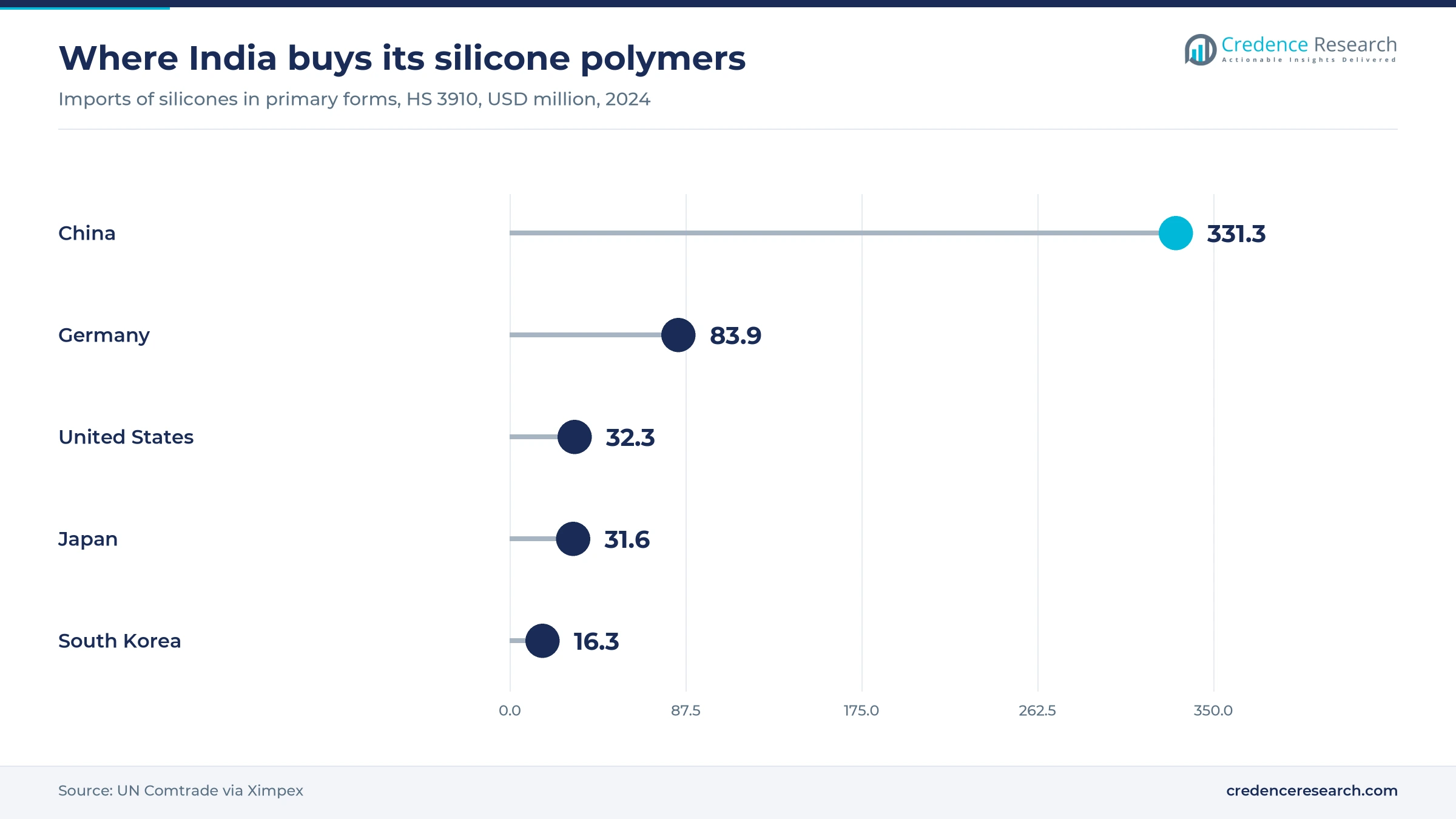
- Imports of silicones in primary forms reached USD 548.5 million in 2024, and 60.4% came from China, which ties local prices to Chinese siloxane cycles.
Elastomers and sealants lead as encapsulation grows fastest
Why do elastomers lead silicone spending in India?
Based on product type, the market is categorized into silicone fluids, silicone elastomers, silicone resins and silicone emulsions and gels. Silicone Elastomers led with 40.0% of 2025 value because rubber compounds serve cables, insulators, vehicle parts and medical goods, and Wacker opened Panagarh in July 2022 for silicone rubber and ready-to-use compounds, saying the site would double its Indian output. Silicone emulsions and gels grow fastest at 9.2% a year as Wacker completed a GMP-certified emulsion complex of 15,000 square meters at Panagarh in March 2026 for cosmetic customers.
How do buildings and electronics split end-use demand?
Based on end-use industry, the market is categorized into construction and infrastructure, personal care and consumer goods, automotive and transportation, electrical and electronics, and industrial processing. Construction and Infrastructure led with 30.0% of 2025 value because public works keep sealant and coating volumes high, and the Union Budget of Feb. 1, 2026, raised central capital spending to ₹12.2 lakh crore for 2026-27. Electrical and electronics grow fastest at 9.6% a year as electronics production rose to over ₹11.3 lakh crore in 2024-25, Minister Ashwini Vaishnaw said.
Where do sealing and thermal uses take silicone volume?
Based on application, the market is categorized into sealing and bonding, lubrication and release, thermal management and encapsulation, surface modification and water repellency, and personal care conditioning. Sealing and Bonding led with 34.0% of 2025 value because façade, glazing and sanitary joints use silicone sealants, and India imposed a five-year anti-dumping duty on Chinese silicone sealant in 2022 after a petition by Alstone Industries. Thermal management and encapsulation grows fastest at 9.9% a year as Micron and Kaynes Semicon opened chip packaging plants in February and March 2026, The Next Web reported.
How do silicone suppliers reach Indian buyers?
Based on sales channel, the market is categorized into direct manufacturer sales, authorized distributors, specialty chemical dealers, importer-distributors and digital B2B procurement. Direct Manufacturer Sales led with 42.0% of 2025 value because large molders and formulators buy grades by contract from local plants such as Elkem’s Chakan site, which makes 2,100 metric tons of rubber compounds a year near Pune’s automotive cluster. Authorized distributors grow fastest at 9.2% a year as Caldic agreed on July 3, 2026, to distribute Elkay Chemicals’ silicone resins and emulsions across India.
| Segment Group | Leading Sub-segment | Share, 2025 | Fastest-growing Sub-segment | CAGR, 2026–2035 |
|---|---|---|---|---|
| By Product Type | Silicone Elastomers | 40.0% | Silicone Emulsions and Gels | 9.2% |
| By End-Use Industry | Construction and Infrastructure | 30.0% | Electrical and Electronics | 9.6% |
| By Application | Sealing and Bonding | 34.0% | Thermal Management and Encapsulation | 9.9% |
| By Sales Channel | Direct Manufacturer Sales | 42.0% | Authorized Distributors | 9.2% |
Siloxane costs and the rupee set silicone prices
Silicone pricing in India starts with imported siloxane polymers, so landed costs follow Chinese monomer prices, freight and the rupee with a lag of one to three months. Commodity fluids and general-purpose sealants trade on price, and distributors revise lists often when Chinese supply is long. Specialty grades for electronics, medical goods and cosmetics carry wider margins, because buyers pay for qualification, purity and technical service. As a result, suppliers with local compounding and emulsion plants can hold prices steadier than pure importers and win contract business from larger formulators.
| Product or cost item | Typical price or fee | Basis |
|---|---|---|
| DMC monomer, China spot, April 2025 | 11,000 to 12,000 yuan per ton | Shanghai Metals Market, April 2025 |
| Commodity silicone fluids and polymers, landed | About USD 2.5 to 4 per kg | Credence Research estimate from Chinese DMC prices and 2024 import values |
| Specialty grades from Germany, Japan and Korea | About USD 4 to 11 per kg | Credence Research estimate from 2024 import values by origin |
| General-purpose silicone sealant, 280 ml cartridge | ₹317 per cartridge | Asian Paints SmartCare listing on IndustryBuying, 2026 |
Request a Free Sample
Fill in your details and we'll send you a free sample report.
- Sample data tables & charts
- Research methodology
Electric vehicles, beauty and chip plants lift silicone use
EV, battery and advanced automotive localization
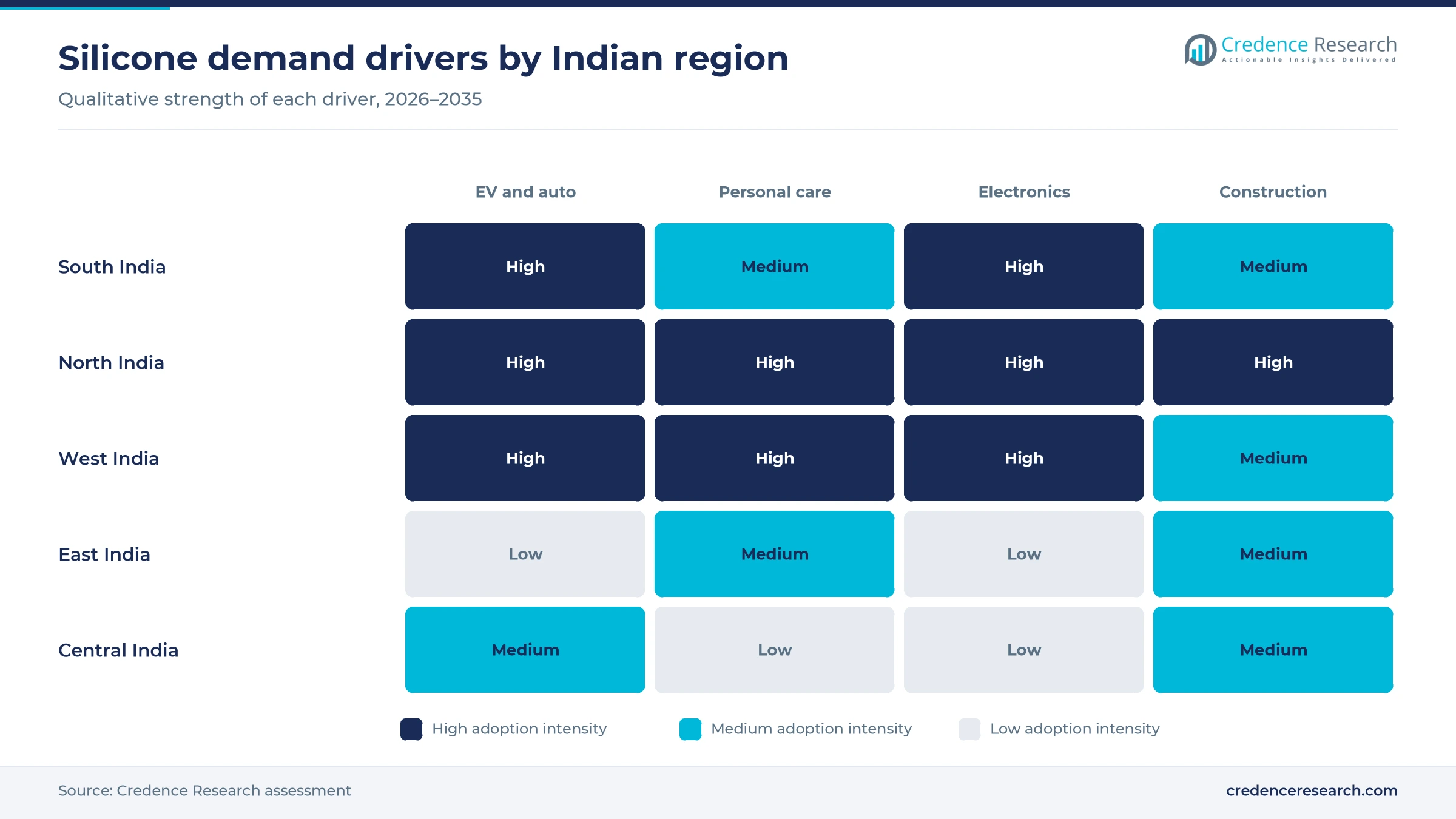
Vehicle electrification raises silicone content per vehicle, because battery packs, chargers and power electronics need gap fillers, potting compounds and cable insulation. India sold about 2.3 million electric vehicles in 2025, around 8% of new registrations, according to Vahan data compiled by the India Energy Storage Alliance. Electric two-wheelers made up about 1.28 million of those 2.3 million electric vehicles, and each localized battery pack adds thermal and sealing demand that petrol models did not need. The International Energy Agency reports that electric models took a record 57% of three-wheeler sales in 2024, making India the largest electric three-wheeler market. Conventional output is also at a high, with record domestic passenger vehicle sales of about 4.6 million units in 2025-26, SIAM reported, which keeps elastomer demand steady.
Personal care premiumization and local formulation
Beauty brands are moving toward conditioning shampoos, serums and sun care, which use silicone fluids, gums and emulsions for feel and spreadability. Nykaa counted 15.8 million annual unique beauty customers at the end of 2024-25, up 27%, and ran 237 stores in 79 cities, its results call showed. Local supply already exists, since Wacker’s Amtala hydrosilylation plant near Kolkata has made over 6,000 metric tons a year of functional fluids for shampoos and textiles since 2018. Wacker said in March 2026 that it expects further significant growth in India for its silicone products. Brand owners in Mumbai and Delhi can now source many conditioning grades domestically instead of waiting on imports.
Electronics and semiconductor manufacturing scale-up
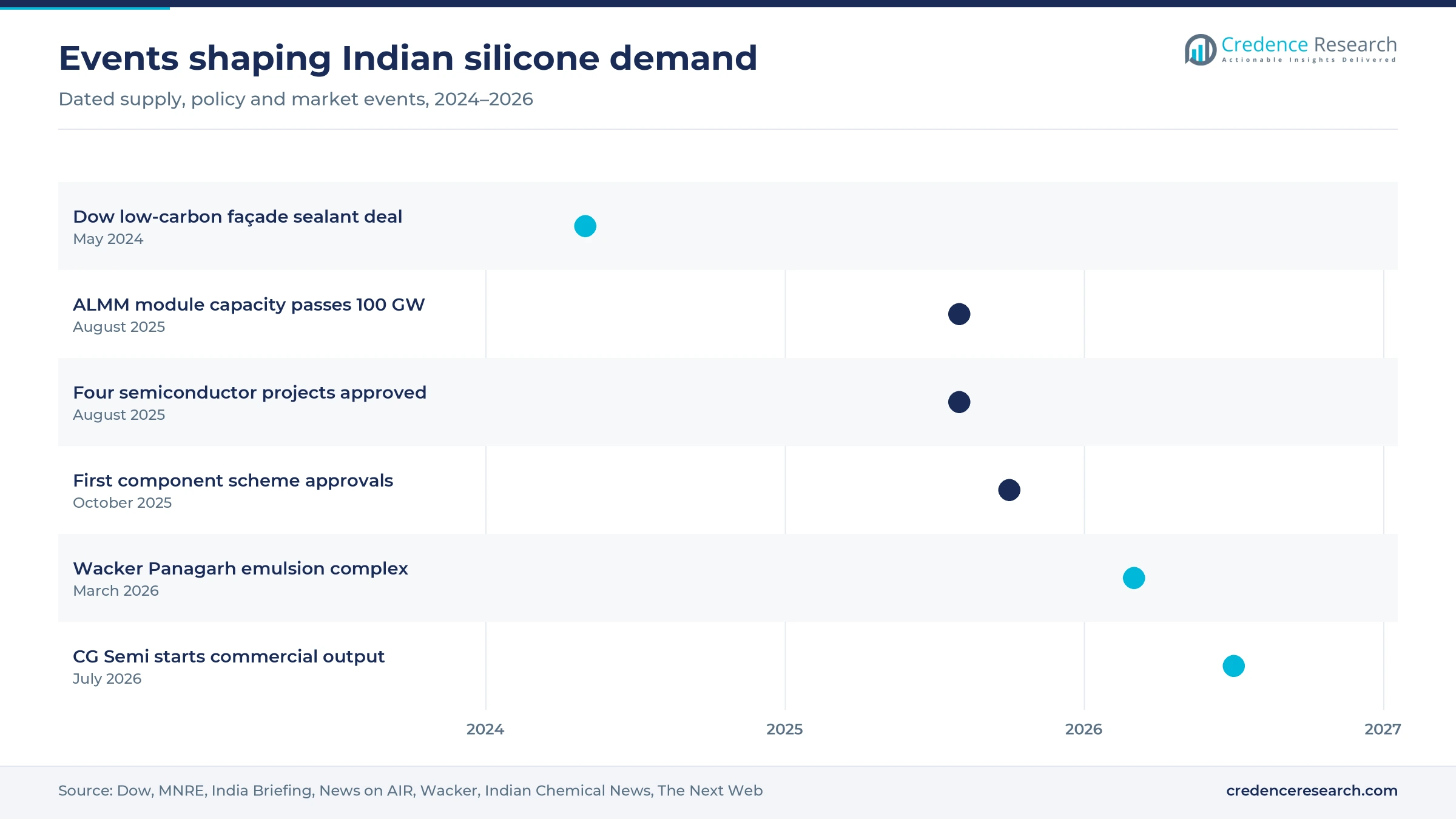
Chip packaging and component plants consume encapsulants, die-attach adhesives, thermal pads and conformal coatings, so each new line opens recurring silicone demand. CG Semi began commercial production at Sanand on July 4, 2026, with initial output of 200 million chips a year, the third packaging plant under the national mission. The semiconductor program had sanctioned 10 projects worth about ₹1.60 trillion by August 2025, according to India Briefing. MeitY also approved a first tranche of seven component projects worth ₹5,532 crore on Oct. 27, 2025, covering PCBs, laminates and camera modules, News on AIR reported. Electronics buyers qualify materials for years, so early suppliers keep the business.
Infrastructure spending sustains sealant and coating demand
Public works and private building keep the largest volume of silicone in sealants, water repellents and façade materials, even as newer uses grow faster. The construction sector grew 9.4% in real terms in 2024-25, the fastest of the major sectors, according to the Ministry of Statistics and Programme Implementation. The 2025-26 Union Budget set central capital spending at ₹11.21 lakh crore, with ₹2.72 lakh crore for roads and ₹2.52 lakh crore for railways, The Tribune reported. Station upgrades, airports and glass-fronted offices all specify weatherproofing joints, so Construction and Infrastructure keeps 30.0% of value. Contractors choose on approvals and warranty more than on price.
Local capacity and low-carbon sealants reshape supply
Rise of local silicone capacity and process know-how
Producers are building more silicone capability inside India, which shortens lead times for formulators that once waited on imported grades. Aether Industries and Dow India announced on July 31, 2026, a multi-year research program on silicone manufacturing technologies at Aether’s Surat facilities, European Rubber Journal reported. Wacker Metroark’s managing director said its older Amtala site is stretched to its limits and will focus more on product and process development. Elkem also kept selected silicone assets in India when it agreed in February 2026 to transfer the bulk of its global silicones business to Bluestar in exchange for the 52.9% stake Bluestar held, Indian Chemical News reported. Its retained Chakan plant, rated at 2,100 metric tons of compounds a year, keeps a second local rubber source alongside Wacker.
Shift toward lower-carbon façade sealants
Developers chasing green building ratings are beginning to ask for documented carbon footprints on façade sealants, a new basis for supplier choice. Dow India agreed with Glass Wall Systems India in May 2024 to supply DOWSIL 983 structural glazing and DOWSIL 791 weatherproofing sealants from its reduced-carbon Decarbia range, Dow said. The supply is verified as carbon neutral under PAS 2060, which covers feedstock, plant emissions, renewable power and offsets. Sealing and bonding, at 34.0% of 2025 value, is the application most exposed to this change. Producers that can certify footprints should win specifications on large commercial towers.
Opportunity in solar module sealing and potting
Solar module plants are an expanding outlet for frame sealants, junction box adhesives and potting compounds, which must last decades outdoors. India’s solar module manufacturing capacity listed under ALMM crossed 100 GW in August 2025, according to the Ministry of New and Renewable Energy. Dow introduced six DOWSIL PV sealants and adhesives for frame sealing, rail and junction box bonding and potting in March 2023, Mercom India reported. Thermal management and encapsulation, the fastest application at 9.9% a year, gains from every new module line. Suppliers with local technical service can win qualification at module makers in Gujarat and Tamil Nadu.
Opportunity in power semiconductors and silicon carbide
Power devices for vehicles, chargers and grids need high-temperature silicone gels and encapsulants, and India is now approving such fabs. The Union Cabinet approved four projects on Aug. 12, 2025, including SiCSem’s silicon carbide fab in Bhubaneswar with reported capacity of 60,000 wafers a year, India Briefing reported. The same tranche covered a Continental Device India expansion in Mohali for MOSFETs, IGBTs and Schottky diodes. Tata Electronics’ Dholera fab, approved in February 2024 at about ₹91,000 crore, plans 50,000 wafers a month. Encapsulation suppliers that qualify early with these plants can lock in long product lives.
China reliance, price swings and a weak rupee test margins
Heavy reliance on Chinese base polymers
Supply security is the main structural weakness, because imports of silicones in primary forms reached USD 548.5 million in 2024 and 60.4% came from China, UN Comtrade data compiled by Ximpex show. Formulators that buy spot from importers carry the most exposure to freight delays and trade measures. This concentration is a supply risk, and larger buyers are spreading orders across German, Japanese and Korean grades, although those cost more per kilogram and need fresh approvals.
Siloxane price swings disrupt inventory planning
Price volatility makes stock planning hard for Indian buyers, because Chinese DMC monomer fell 1,950 yuan per ton in one week in April 2025, the fastest drop in recent years, Shanghai Metals Market reported. Local producers and distributors holding high-cost inventory then lose margin as importers undercut them. Short contracts and indexed pricing limit the damage, although many small formulators still buy on spot terms and carry the full pressure of each swing.
A weaker rupee raises landed costs
Currency weakness raises the rupee cost of every imported drum, because the rupee hit a record low of 90.42 per U.S. dollar on Dec. 4, 2025, after falling about 5.5% over the year, Business Today reported. Formulators selling sealants under fixed dealer price lists absorb the gap for several months. This cost pressure falls hardest on importers, while producers with Indian plants gain an edge that strengthens the case for local finishing capacity.
Slow battery cell build-out delays EV volumes
Battery cell localization is behind plan, which delays some of the thermal material demand expected from electric vehicles. Only 1.4 GWh of cell capacity under the 50 GWh battery PLI scheme had been commissioned by October 2025, Down To Earth reported. Silicone suppliers targeting pack makers therefore face slower qualification, smaller early orders and a real risk that planned thermal material volumes slip by several years.
South India leads while Gujarat makes West India fastest
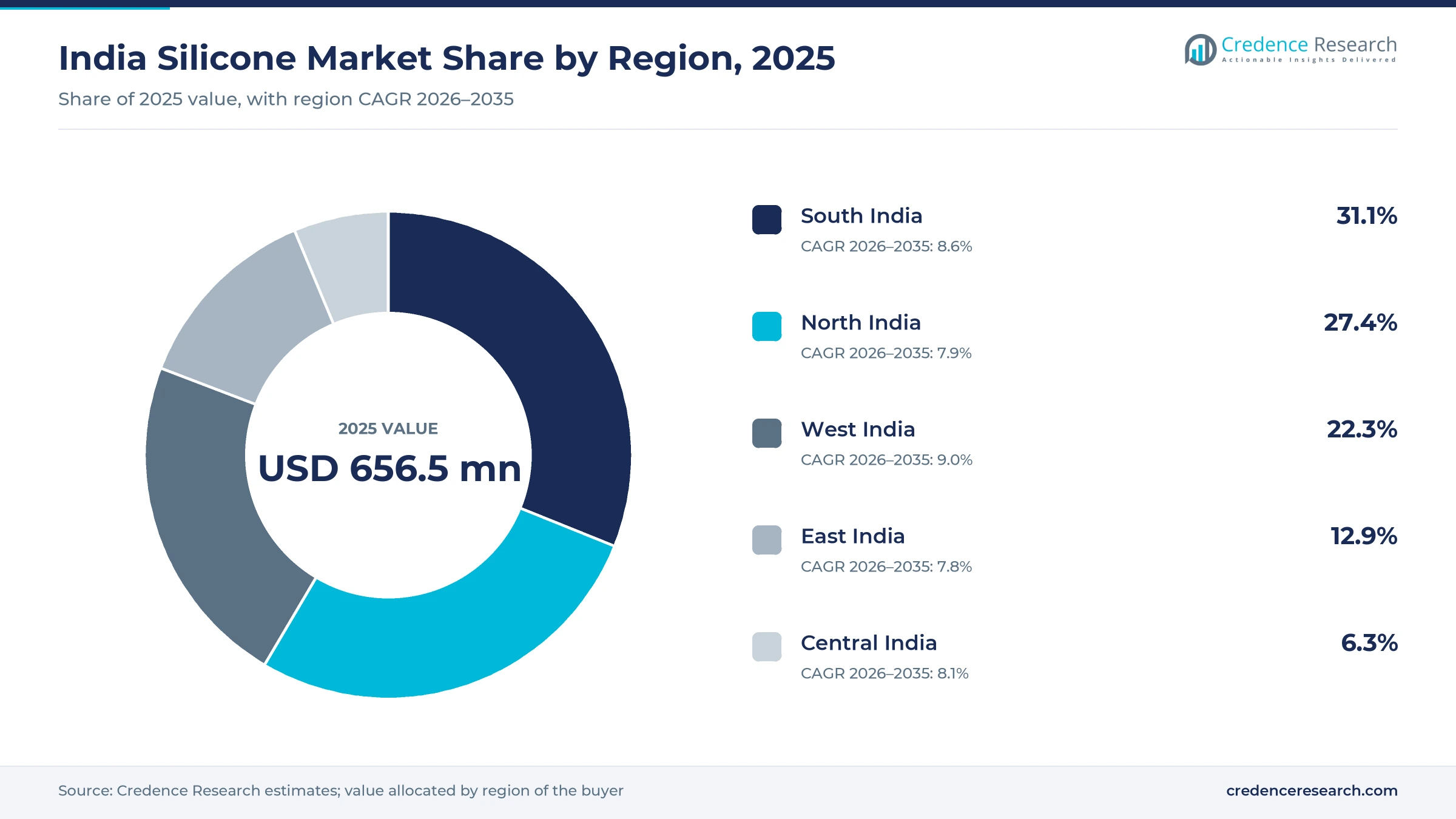
Regional shares of silicone spending follow the Credence Research regional model, built from electronics and vehicle output, textile and personal care clusters, construction activity and the location of silicone plants and distributors. South India and North India together held 58.5% of 2025 demand.
| Region | Value, 2025 (USD million) | Share, 2025 | CAGR, 2026–2035 |
|---|---|---|---|
| South India | 204.2 | 31.1% | 8.6% |
| North India | 179.9 | 27.4% | 7.9% |
| West India | 146.4 | 22.3% | 9.0% |
| East India | 84.7 | 12.9% | 7.8% |
| Central India | 41.4 | 6.3% | 8.1% |
South India leads on electronics and textile clusters
South India held 31.1% of 2025 value and grows at 8.6% a year. Tamil Nadu shipped USD 14.65 billion of electronics in 2024-25, 41.3% of the national total, and Karnataka added USD 7.85 billion, according to the Tamil Nadu industries minister as reported by KNN India. Tirupur’s knitwear cluster also buys silicone softeners, and Momentive runs its regional research center in Bengaluru. Electronics, textiles and vehicles give the region the broadest buyer mix.
North India rests on phones, vehicles and textiles
North India held 27.4% of 2025 value and grows at 7.9% a year. Prime Minister Narendra Modi said in September 2025 that 55% of mobile phones made in India are produced in Uttar Pradesh, mostly around Noida. The National Capital Region also hosts large car and two-wheeler plants, and CHT India serves textile mills from a branch in Ludhiana. Phone assembly in the region lifts demand for silicone adhesives, pads and coatings.
West India grows fastest on Gujarat chip plants
West India is the fastest-growing region at 9.0% a year and held 22.3% of 2025 value. Gujarat had six approved semiconductor projects worth about ₹1.24 lakh crore by July 2026, DeshGujarat reported, including the Sanand packaging plants noted above. Maharashtra adds the Pune and Chakan automotive belt and many of the country’s construction chemical and paint formulators. Chip and solar plants should lift the region’s share by 2035.
East India hosts the largest local silicone plants
East India held 12.9% of 2025 value and grows at 7.8% a year. Wacker has made silicone fluids, emulsions and rubber compounds at Amtala near Kolkata since 1999, and its Panagarh site covers 165,000 square meters. Odisha also gained two semiconductor approvals in Bhubaneswar in 2025. Regional consumption is smaller than local production, so much of the eastern output ships to buyers in other regions.
Central India builds from a small industrial base
Central India held 6.3% of 2025 value and grows at 8.1% a year. Madhya Pradesh was one of three states in the first electronic component projects approved in October 2025, alongside Tamil Nadu and Andhra Pradesh. Automotive and pharmaceutical plants around Pithampur and Indore buy molded parts, release agents and antifoams. Demand is spread across many small buyers served mainly through dealers, which keeps the region below a tenth of national value.
New plants, distribution pacts and exits mark 2024-2026
| Development | Status and market relevance |
|---|---|
| In May 2024, Dow India agreed to supply reduced-carbon DOWSIL façade sealants to Glass Wall Systems India. | In supply, verified carbon neutral under PAS 2060 |
| In February 2026, Elkem agreed to transfer most of its silicones business to Bluestar while keeping selected Indian assets. | Deal set to close in 2026; Chakan site retained |
| In March 2026, Wacker completed a GMP-certified silicone emulsion complex at Panagarh, West Bengal. | Operating, serving cosmetic and personal care customers |
| In July 2026, Caldic signed a partnership to distribute Elkay Chemicals’ silicone resins and emulsions in India. | Active, aimed at paints, coatings and construction materials |
| In July 2026, Aether Industries and Dow India launched joint research on silicone manufacturing technologies in Surat. | Multi-year program, investment not disclosed |
Cure chemistry and functional fluids separate suppliers
- Condensation-cure systems dominate general-purpose and façade sealants, because they cure at room temperature with moisture from the air.
- Addition-cure systems serve liquid silicone rubber molding, potting and gap fillers, where low shrinkage and fast cycles matter for electronics.
- High-temperature vulcanizing produces rubber compounds for cables, insulators and vehicle parts, as made at Panagarh and Chakan.
- Emulsion polymerization and formulation creates water-based silicones for shampoos, textile softeners and paints, a growing share of local output.
- Functionalized silicone chemistry attaches glycol, amino or other groups to silicone chains, which Amtala uses for textile and personal care fluids.
Need a Custom Version of This Report?
Tailor the scope, geography, or segments to your exact requirements.
- Custom geography or segment scope
- Direct access to our analyst team
Global producers and local formulators split the market
Competition in the India silicone market is split between global producers that supply base polymers and specialty grades and local companies that formulate finished products. Wacker Metroark has the largest local production footprint, with plants at Amtala and Panagarh, while Dow, Momentive and Shin-Etsu compete through imports, technical centers and distributor networks. Elkem supplies rubber compounds from Chakan and kept its Indian assets in the Bluestar deal noted above. Alstone and Pidilite sell branded sealants through hardware and building material dealers, and Resil and CHT India serve textile mills with silicone softeners. Elkay competes in heat-resistant resins and water-based emulsions for paint and coating makers. Suppliers compete on qualification with OEMs, local technical service and delivery time, because many grades must pass months of testing before buyers switch.
A few global producers supply many local formulators
Supply in the India silicone market is organized in two distinct layers. A handful of global producers, Wacker, Dow, Momentive, Shin-Etsu and Elkem, control most base polymers and specialty grades, and only Wacker and Elkem run sizable Indian plants. Below them, hundreds of formulators such as Alstone, Pidilite, Resil and Elkay turn polymers into sealants, softeners, resins and emulsions. Entry is easy in sealant filling and textile softeners but hard in electronic and medical grades, where approvals take years. Margins sit with producers of qualified specialty grades and with brand owners that control dealer networks.
Companies profiled and their roles in this market
| Company | Type | Role in the market |
|---|---|---|
| Wacker Metroark Chemicals Pvt. Ltd. | Local producer of global group | Fluids, emulsions and rubber compounds made at Amtala and Panagarh, West Bengal |
| Dow Chemical International Pvt. Ltd. | Global producer | DOWSIL sealants, fluids and Molykote lubricants for construction and industry |
| Momentive Performance Materials (India) Pvt. Ltd. | Global producer | Specialty silicones with a research and business center in Bengaluru |
| Shin-Etsu Silicones India Pvt. Ltd. | Global producer | Silicone fluids, rubbers and resins sold through distributors in four metros |
| Elkem South Asia Pvt. Ltd. | Local producer of global group | Silicone rubber compounds from its Chakan plant near Pune |
| CHT India Pvt. Ltd. | Specialty supplier | Silicone elastomers, consumer care and textile auxiliaries from Mumbai |
| Elkay Chemicals Pvt. Ltd. | Local manufacturer | Silicone resins, emulsions and antifoams for coatings and industry |
| Resil Chemicals Pvt. Ltd. | Local formulator | Silicone softeners and finishes for textile processing |
| Alstone Industries Pvt. Ltd. | Local sealant maker | General-purpose and façade silicone sealants sold through building dealers |
| Pidilite Industries Ltd. | Local brand owner | Feviseal and Dr. Fixit silicone sealants sold through hardware retail |
Local finishing capacity will decide who captures growth
Credence Research's view is that the next stage of the India silicone market will be decided by who builds local finishing capacity close to new electronics, solar and vehicle plants. Base polymers will stay mostly imported for years, so landed costs remain tied to Chinese siloxane prices and the rupee. The value, however, is moving to qualified grades for encapsulation, thermal management and cosmetics, where buyers pay for consistency and service. Producers with Indian emulsion and compounding lines, and distributors with technical teams, are best placed, while pure traders of commodity fluids face thinner margins.
Trade data and plant capacity anchor the silicone estimate
The report uses 2025 as the base year and forecasts to 2035. Market values for the India silicone market come from the Credence Research model, checked against a top-down calculation of silicone imports, local plant capacity and typical first-sale prices. Regional and segment shares and growth rates are Credence Research estimates based on public data, including national statistics, ministry releases, trade data, company announcements and press coverage. No interviews or surveys were carried out for this edition.
Electronics and EV thermal needs carry growth to 2035
The India silicone market is forecast to reach USD 1.48 billion by 2035, at an 8.34% CAGR across 2026–2035. Early growth will depend on how quickly chip packaging, solar module and battery plants reach volume, and on import costs. Later years should bring more locally made emulsions and compounds, wider use of thermal and encapsulation grades in vehicles and electronics, and steady sealant demand from infrastructure. South India should keep the largest share through 2035, although West India narrows the gap as Gujarat’s plants ramp up.
Electronics ramp-up and import costs decide the range of outcomes
In the base case, spending grows from USD 719.0 million in 2026 along the central forecast as chip packaging, solar module and vehicle plants ramp up on schedule. The downside case assumes slower semiconductor and battery projects, a further fall in the rupee and weak building activity. The upside case adds faster local packaging output, quicker EV adoption and more premium personal care launches, which raise the share of high-value specialty grades.
| Scenario | CAGR, 2026–2035 | Value, 2035 | What has to hold |
|---|---|---|---|
| Downside | 6.5% | USD 1.27 billion | Chip and battery projects slip, the rupee weakens further and construction slows |
| Base | 8.34% | USD 1.48 billion | Packaging, solar and vehicle plants ramp up broadly on announced timelines |
| Upside | 9.8% | USD 1.67 billion | Faster EV adoption and chip output lift high-value encapsulation and thermal grades |
Frequently Asked Questions
How big is the India silicone market?
Which product type leads silicone spending in India?
Which region holds the largest share?
Which region is growing fastest?
How do electric vehicles affect silicone demand in India?
How much silicone does India import?
Which companies are active in the market?
What are the main risks for silicone buyers?
Table of Content
Chapter 1 Market Segmentation
- 1.1 Segmentation Framework
- 1.1.1 Product and Service Classification
- 1.1.2 Application and End-Use Classification
- 1.1.3 Technology and Solution Classification
- 1.1.4 Customer and Distribution Channel Classification
- 1.1.5 Geographic Segmentation
- 1.1.6 Market Segment Definitions and Boundaries
- 1.2 By Product Type
- 1.2.1 Silicone Elastomers
- 1.2.2 Silicone Fluids
- 1.2.3 Silicone Emulsions and Gels
- 1.2.4 Silicone Resins
- 1.3 By End-Use Industry
- 1.3.1 Construction and Infrastructure
- 1.3.2 Automotive and Transportation
- 1.3.3 Electrical and Electronics
- 1.3.4 Personal Care and Consumer Goods
- 1.3.5 Industrial Processing
- 1.4 By Application
- 1.4.1 Sealing and Bonding
- 1.4.2 Thermal Management and Encapsulation
- 1.4.3 Surface Modification and Water Repellency
- 1.4.4 Lubrication and Release
- 1.4.5 Personal Care Conditioning
- 1.5 By Sales Channel
- 1.5.1 Direct Manufacturer Sales
- 1.5.2 Authorized Distributors
- 1.5.3 Specialty Chemical Dealers
- 1.5.4 Importer-Distributors
- 1.5.5 Digital B2B Procurement
Chapter 2 Introduction
- 2.1 Report Objectives and Scope
- 2.2 Product Definition and Industry Terminology
- 2.3 Market Inclusions and Exclusions
- 2.4 Research Process
- 2.4.1 Primary Research and Expert Interviews
- 2.4.2 Secondary Research and Source Review
- 2.4.3 Top-Down and Bottom-Up Estimation
- 2.4.4 Data Triangulation and Verification
- 2.5 Market Size Measurement Basis
- 2.5.1 2025: USD 656.5 million → 2035: USD 1.48 billion
- 2.6 Historical and Forecast Reference Periods
- 2.6.1 Historical Period: 2018-2025
- 2.6.2 Base Year: 2025
- 2.6.3 Forecast Period: 2025-2035
- 2.7 Research Assumptions and Limitations
Chapter 3 Executive Summary
- 3.1 Market Snapshot and Key Findings
- 3.2 Base-Year Market Size, 2025
- 3.3 Forecast Market Size, 2035
- 3.4 Revenue and Volume Growth Outlook
- 3.5 Key Demand and Supply Indicators
- 3.6 Leading Market Segments
- 3.7 Fastest-Growing Market Opportunities
- 3.8 Regional Performance Highlights
- 3.9 Technology and Industry Transformation
- 3.10 Competitive Landscape Summary
- 3.11 Analyst View and Strategic Implications
Chapter 4 India Silicone Market Trends and Developments
- 4.1 Historical Industry Development, 2018-2025
- 4.2 Recent Market Trends and Developments
- 4.3 Demand and Customer Behavior Trends
- 4.4 Technology and Product Innovation
- 4.5 Artificial Intelligence, Automation and Digitalization
- 4.6 Local Manufacturing and Supply Chain Realignment
- 4.7 Industry Partnerships, Mergers and Acquisitions
- 4.8 Sustainability and Circular Economy Developments
- 4.9 Government and Private Sector Investment Trends
- 4.10 Emerging Business Models and Commercialization
- 4.11 Industry Developments and Announcements
Chapter 5 India Silicone Market Production, Supply and Demand Analysis
- 5.1 Demand Trend and Consumption Analysis, 2018-2025
- 5.2 Demand Forecast, 2025-2035
- 5.3 Production and Output Trend, 2018-2025
- 5.4 Production and Output Forecast, 2025-2035
- 5.5 Installed Capacity and Capacity Utilization
- 5.6 Company-Wise Production Plants and Statistics
- 5.6.1 Installed Production Capacity
- 5.6.2 Actual Production
- 5.6.3 Planned Capacity and Expansion Targets
- 5.7 Supply Chain Structure and Procurement Trends
- 5.8 Supply-Demand Gap and Bottlenecks
- 5.9 Import Dependence and Sourcing Structure
- 5.10 Contract Manufacturing and Outsourcing
- 5.11 Regional Supply and Demand Concentration
Chapter 6 India Silicone Market Pricing Analysis
- 6.1 Pricing Structure and Measurement
- 6.2 Historical Pricing Trends, 2018-2025
- 6.3 Pricing Outlook, 2025-2035
- 6.4 Average Selling Price and Unit Economics
- 6.5 Pricing by Product and Market Segment
- 6.6 Geographic Pricing Differences
- 6.7 Key Input, Energy, Labor and Logistics Costs
- 6.8 Contract Pricing and Purchasing Models
- 6.9 Pricing Sensitivity and Competitive Positioning
- 6.10 Price, Margin and Profitability Implications
Chapter 7 India Silicone Market Dynamics
- 7.1 Market Growth Drivers
- 7.1.1 Demand-Side Drivers
- 7.1.2 Technology and Innovation Drivers
- 7.1.3 Infrastructure and Investment Drivers
- 7.1.4 Regulatory and Policy Drivers
- 7.2 Market Restraints
- 7.2.1 Cost and Affordability Constraints
- 7.2.2 Technology and Adoption Barriers
- 7.2.3 Supply Chain and Operational Constraints
- 7.3 Market Challenges
- 7.3.1 Competitive Pressure and Margin Erosion
- 7.3.2 Skills, Infrastructure and Implementation Gaps
- 7.4 Emerging Market Opportunities
- 7.5 Market Dynamics Impact and Time-Horizon Assessment
Chapter 8 India Silicone Value Chain Analysis
- 8.1 Industry Value Chain Overview
- 8.2 Upstream Suppliers and Critical Inputs
- 8.3 Technology and Component Providers
- 8.4 Manufacturing or Service Delivery
- 8.5 Distribution, Channel Partners and Integrators
- 8.6 Downstream Applications and End Users
- 8.7 Value Addition and Profit Pools
- 8.8 Vertical Integration and Outsourcing
- 8.9 Supplier Concentration and Risk
- 8.10 Supply Chain Localization and Resilience
Chapter 9 India Silicone Market Regulations and Policies
- 9.1 Relevant Laws, Standards and Compliance Frameworks
- 9.2 Product, Service, Safety and Quality Requirements
- 9.3 Government Policies, Incentives and Subsidies
- 9.4 Imports, Exports and Trade Barriers
- 9.5 Public Procurement and Local Content Requirements
- 9.6 Environmental and Sustainability Compliance
- 9.7 Upcoming Policy Changes and Market Implications
Chapter 10 India Silicone Market Hotspots and Opportunities
- 10.1 Market Opportunity Mapping and Growth Hotspots
- 10.2 High-Growth Applications and Customer Groups
- 10.3 Underserved Markets and White-Space Opportunities
- 10.4 Emerging Technology and Product Opportunities
- 10.5 New Capacity and Investment Hotspots
- 10.6 Market Entry and Expansion Opportunities
- 10.7 Distribution and Partnership Opportunities
- 10.8 Near-Term and Long-Term Commercial Potential
- 10.9 Opportunity Attractiveness and Execution Risks
Chapter 11 India Silicone Market Outlook, 2025-2035
- 11.1 Market Size and Analysis
- 11.1.1 Revenue (Market Measurement: 2025: USD 656.5 million → 2035: USD 1.48 billion)
- 11.1.2 Market Volume and Quantity Sold
- 11.1.3 Historical Market Size, 2018-2025
- 11.1.4 Base-Year Market Size, 2025
- 11.2 Market Forecast, 2025-2035
- 11.2.1 Revenue Forecast to 2035
- 11.2.2 Volume Forecast to 2035
- 11.2.3 CAGR and Year-on-Year Growth
- 11.2.4 Incremental Revenue Opportunity
- 11.3 Forecast Assumptions and Scenario Analysis
- 11.3.1 Base-Case Forecast
- 11.3.2 Optimistic and Conservative Scenarios
- 11.3.3 Technology, Pricing and Policy Sensitivities
- 11.4 Market Attractiveness and Growth Outlook
Chapter 12 India Silicone Market Segmentation and Outlook
- 12.1 Segmentation Summary and Market Shares, 2025
- 12.2 Largest and Fastest-Growing Segments
- 12.3 By Product Type - Market Size and Forecast, 2025-2035
- 12.3.1 Segment Definition and Scope
- 12.3.2 Historical Market Size, 2018-2025
- 12.3.3 Revenue Forecast, 2025-2035
- 12.3.4 Volume Forecast, 2025-2035
- 12.3.5 Base-Year Market Share, 2025
- 12.3.6 Segment CAGR and Growth Drivers
- 12.3.7 Subsegment Market Size and Forecast
- 12.3.7.1 Silicone Elastomers
- 12.3.7.2 Silicone Fluids
- 12.3.7.3 Silicone Emulsions and Gels
- 12.3.7.4 Silicone Resins
- 12.3.8 Subsegment Pricing and Adoption Trends
- 12.3.9 Leading Suppliers and Competition
- 12.3.10 Regional Demand and Opportunities
- 12.4 By End-Use Industry - Market Size and Forecast, 2025-2035
- 12.4.1 Segment Definition and Scope
- 12.4.2 Historical Market Size, 2018-2025
- 12.4.3 Revenue Forecast, 2025-2035
- 12.4.4 Volume Forecast, 2025-2035
- 12.4.5 Base-Year Market Share, 2025
- 12.4.6 Segment CAGR and Growth Drivers
- 12.4.7 Subsegment Market Size and Forecast
- 12.4.7.1 Construction and Infrastructure
- 12.4.7.2 Automotive and Transportation
- 12.4.7.3 Electrical and Electronics
- 12.4.7.4 Personal Care and Consumer Goods
- 12.4.7.5 Industrial Processing
- 12.4.8 Subsegment Pricing and Adoption Trends
- 12.4.9 Leading Suppliers and Competition
- 12.4.10 Regional Demand and Opportunities
- 12.5 By Application - Market Size and Forecast, 2025-2035
- 12.5.1 Segment Definition and Scope
- 12.5.2 Historical Market Size, 2018-2025
- 12.5.3 Revenue Forecast, 2025-2035
- 12.5.4 Volume Forecast, 2025-2035
- 12.5.5 Base-Year Market Share, 2025
- 12.5.6 Segment CAGR and Growth Drivers
- 12.5.7 Subsegment Market Size and Forecast
- 12.5.7.1 Sealing and Bonding
- 12.5.7.2 Thermal Management and Encapsulation
- 12.5.7.3 Surface Modification and Water Repellency
- 12.5.7.4 Lubrication and Release
- 12.5.7.5 Personal Care Conditioning
- 12.5.8 Subsegment Pricing and Adoption Trends
- 12.5.9 Leading Suppliers and Competition
- 12.5.10 Regional Demand and Opportunities
- 12.6 By Sales Channel - Market Size and Forecast, 2025-2035
- 12.6.1 Segment Definition and Scope
- 12.6.2 Historical Market Size, 2018-2025
- 12.6.3 Revenue Forecast, 2025-2035
- 12.6.4 Volume Forecast, 2025-2035
- 12.6.5 Base-Year Market Share, 2025
- 12.6.6 Segment CAGR and Growth Drivers
- 12.6.7 Subsegment Market Size and Forecast
- 12.6.7.1 Direct Manufacturer Sales
- 12.6.7.2 Authorized Distributors
- 12.6.7.3 Specialty Chemical Dealers
- 12.6.7.4 Importer-Distributors
- 12.6.7.5 Digital B2B Procurement
- 12.6.8 Subsegment Pricing and Adoption Trends
- 12.6.9 Leading Suppliers and Competition
- 12.6.10 Regional Demand and Opportunities
- 12.7 Segment Growth Comparison
- 12.8 Segment Attractiveness and Priority Matrix
Chapter 13 India Silicone End-Use and Application Market Outlook
- 13.1 End-Use Industry and Customer Demand Structure
- 13.2 Leading Applications and Customer Groups
- 13.3 End-Use Market Size, Share and Forecast
- 13.4 Major End-Use Industry Deep Dives
- 13.4.1 Customer Requirements and Use Cases
- 13.4.2 Demand and Replacement Cycles
- 13.4.3 Technical and Regulatory Considerations
- 13.4.4 Purchasing and Procurement Models
- 13.4.5 Leading Vendors and Distribution Channels
- 13.4.6 Forecast and Commercial Opportunities
- 13.5 Emerging Applications and Cross-Segment Demand
- 13.6 End-Use Industry Investment Priorities
Chapter 14 India Silicone Geographic Market Outlook, 2025-2035
- 14.1 Domestic Market Distribution and Demand Clusters
- 14.2 State- or Province-Wise Market Size and Forecast, 2025-2035
- 14.3 City and Metropolitan Market Outlook
- 14.4 Industrial, Manufacturing and Commercial Clusters
- 14.5 Geographic Concentration of Key End Users
- 14.6 Local Pricing and Purchasing Differences
- 14.7 Domestic Production Facilities and Capacity Map
- 14.8 Local Infrastructure and Project Pipeline
- 14.9 State-Level Policy and Incentive Differences
- 14.10 Subnational Investment Hotspots and Opportunities
- 14.11 Distribution and Logistics Networks
- 14.12 Domestic Competitive Footprint
Chapter 15 India Silicone Technology, Innovation and Sustainability Outlook
- 15.1 Technology Landscape and Maturity
- 15.2 Product, Process and Service Innovation
- 15.3 AI, Automation and Digital Tools in the Industry
- 15.4 Technology Adoption and Performance Benchmarking
- 15.5 Innovation Pipeline and R&D Investment
- 15.6 Patent and Intellectual Property Trends
- 15.7 Energy Efficiency and Resource Management
- 15.8 Sustainability, Recycling and Circularity
- 15.9 Technology Roadmap, 2025-2035
- 15.10 Risks of Obsolescence and Technology Substitution
Chapter 16 India Silicone Market Key Strategic Imperatives
- 16.1 Growth and Market Entry Priorities
- 16.2 High-Return Products and Segments
- 16.3 Pricing, Profitability and Cost Optimization
- 16.4 Technology Investment and Product Differentiation
- 16.5 Supply Chain Localization and Resilience
- 16.6 Distribution and Customer Acquisition
- 16.7 Partnership, Acquisition and Capacity Strategy
- 16.8 Regional Expansion Priorities
- 16.9 Short-, Medium- and Long-Term Actions
Chapter 17 Competition Outlook
- 17.1 Industry Competition Characteristics
- 17.2 Market Structure and Concentration
- 17.3 Market Share and Competitive Positioning, 2025
- 17.4 Company-Wise Revenue and Product Benchmarking
- 17.5 Production and Service Capacity Benchmarking
- 17.6 Technology, Pricing and Differentiation
- 17.7 Regional Footprint and Distribution Strength
- 17.8 Mergers, Acquisitions and Strategic Alliances
- 17.9 New Entrants and Competitive Threats
- 17.10 Porter's Five Forces and Industry Attractiveness
- 17.11 Competitive Outlook, 2025-2035
Chapter 18 Company Profiles
- 18.1 Company Coverage and Selection Criteria
- 18.2 Wacker Metroark Chemicals Pvt. Ltd.
- 18.2.1 Business Description
- 18.2.2 Company Ownership and Geographic Presence
- 18.2.3 Product and Service Portfolio
- 18.2.4 Manufacturing and Operating Footprint
- 18.2.5 Production Capacity and Expansion Plans
- 18.2.6 Financial Performance and Investment
- 18.2.7 Market Share and Competitive Position
- 18.2.8 Technology and Innovation Capabilities
- 18.2.9 Strategic Alliances or Partnerships
- 18.2.10 Recent Developments
- 18.2.11 Growth Strategy and Outlook
- 18.3 Dow Chemical International Pvt. Ltd.
- 18.4 Momentive Performance Materials (India) Pvt. Ltd.
- 18.5 Shin-Etsu Silicones India Pvt. Ltd.
- 18.6 Elkem South Asia Pvt. Ltd.
- 18.7 CHT India Pvt. Ltd.
- 18.8 Elkay Chemicals Pvt. Ltd.
- 18.9 Resil Chemicals Pvt. Ltd.
- 18.10 Alstone Industries Pvt. Ltd.
- 18.11 Pidilite Industries Ltd.
- 18.12 Other Relevant Market Participants
Note: Every listed company is profiled on the structure shown under the first company. The company list is preliminary and may change based on research findings, market developments, data availability and client requirements.
Chapter 19 Disclaimer
- 19.1 Research and Forecast Disclaimer
- 19.2 Data Source and Estimation Limitations
Note: The depth of individual sections depends on data availability for this market. Volume, capacity, trade and other unit-based metrics are included where applicable.

