
India Construction Chemicals Market Overview:
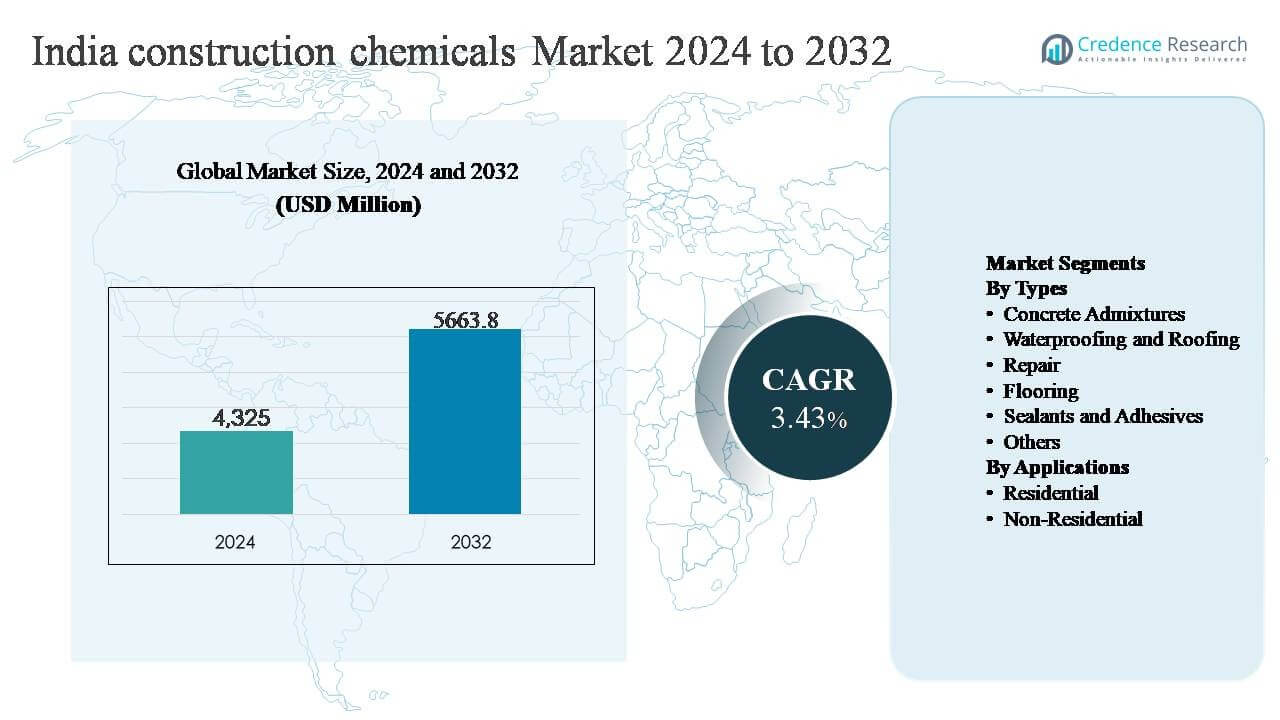
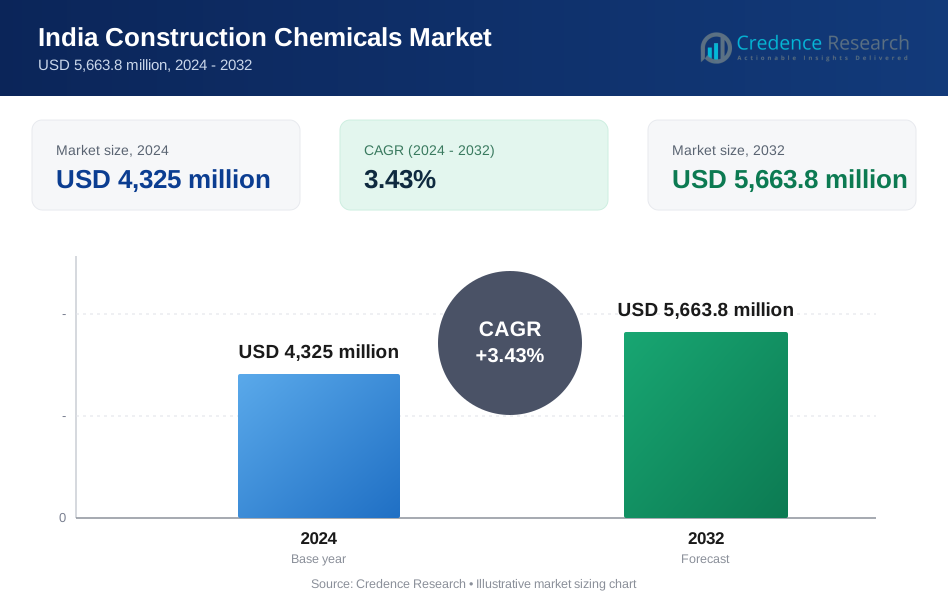
The India construction chemicals market was valued at USD 4,325 million in 2024 and is projected to reach USD 5,663.8 million by 2032, expanding at a CAGR of 3.43% during the forecast period.
| REPORT ATTRIBUTE | DETAILS |
|---|---|
| Historical Period | 2020-2023 |
| Base Year | 2024 |
| Forecast Period | 2025-2032 |
| India Construction Chemicals Market Size 2024 | USD 4,325 million |
| India Construction Chemicals Market, CAGR | 3.43% |
| India Construction Chemicals Market Size 2032 | USD 5,663.8 million |
India Construction Chemicals Market Insights
- Market trends highlight increasing adoption of waterproofing, repair, and flooring solutions due to aging infrastructure and higher focus on lifecycle performance, while organized manufacturers gain share through branded, ready-to-use, and application-specific products.
- Competitive dynamics remain moderately fragmented, with multinational and domestic players competing on performance, pricing, distribution reach, and contractor training, while local players retain presence in price-sensitive residential projects.
- Regionally, West India leads with ~30% share, followed by North India ~28%, South India ~24%, East India ~10%, and Central India ~8%, reflecting infrastructure intensity, urban development, and industrial concentration.
India Construction Chemicals Market Segmentation Analysis:
By Types
By type, concrete admixtures dominate the India construction chemicals market, accounting for the largest market share due to their widespread use in infrastructure, commercial, and residential construction. Their dominance is driven by the need to improve concrete strength, workability, setting time control, and durability in diverse climatic conditions. Waterproofing and roofing chemicals represent the fastest-growing sub-segment, supported by increasing urban housing, metro rail projects, and heightened awareness of moisture protection and structural longevity. Repair, flooring, sealants, and adhesives collectively gain traction from aging infrastructure, industrial expansion, and rising refurbishment activity, while others cater to specialized applications.
- For instance, Sika India manufactures its ViscoCrete® series polycarboxylate ether (PCE) admixtures at facilities in Jhagadia and Kharagpur, with individual product formulations designed to support concrete grades exceeding M60 while enabling slump retention beyond 120 minutes for large infrastructure pours.
By Applications
By application, the non-residential segment holds the dominant market share, driven by sustained investments in infrastructure, industrial facilities, commercial complexes, and transportation networks. Concrete admixtures and repair chemicals form the leading sub-segments within non-residential construction due to their critical role in structural performance and lifecycle cost reduction. The residential segment follows closely, supported by urbanization, affordable housing initiatives, and increased use of waterproofing, flooring, and sealant solutions in apartments and housing projects. Growing consumer preference for durable and quality construction continues to reinforce demand across both application segments.
- For instance, Fosroc Chemicals India provides Nitomortar® and Renderoc® repair systems used in industrial and transport infrastructure, with products tested to deliver bond strength exceeding 2 MPa and low permeability performance compliant with EN 1504 standards, extending the service life of concrete assets exposed to heavy loading.
Key Growth Drivers
Infrastructure and Urban Development Momentum
Large-scale infrastructure development remains a primary growth driver for the India construction chemicals market. Ongoing investments in highways, metro rail corridors, airports, ports, industrial corridors, and smart city projects are significantly increasing demand for high-performance construction materials. Concrete admixtures, waterproofing systems, repair chemicals, and protective coatings are increasingly specified to meet durability, load-bearing, and lifecycle performance requirements. Government-backed programs focused on connectivity, logistics efficiency, and urban mobility continue to expand the volume and complexity of construction projects. As project sizes grow and timelines tighten, contractors rely more on construction chemicals to enhance concrete strength, reduce curing time, and improve resistance to environmental stress, reinforcing sustained market demand.
- For instance, Pidilite Industries’ Dr. Fixit solutions are used in urban infrastructure such as flyovers and metro stations, with elastomeric waterproofing membranes tested for water pressure resistance up to 3 bar and crack-bridging capability of 1.5 mm, supporting long-term protection against seepage.
Rising Housing Construction and Real Estate Revival
Growth in residential construction, driven by urbanization, population expansion, and renewed real estate activity, is accelerating the adoption of construction chemicals across India. Affordable housing schemes, redevelopment of old urban areas, and expansion of tier-2 and tier-3 cities are increasing consumption of waterproofing chemicals, adhesives, sealants, flooring compounds, and repair products. Developers increasingly focus on quality and durability to reduce long-term maintenance costs and improve buyer confidence. Improved access to organized construction chemical brands, growing awareness among builders, and the shift from traditional on-site mixes to ready-to-use formulations are further strengthening penetration across housing projects.
- For instance, Master Builders Solutions India offers pre-engineered MasterEmaco® repair mortars for residential and commercial structural rehabilitation. These products deliver high compressive strength, often exceeding 40 MPa at 28 days (with some grades reaching over 60 MPa), ensuring consistent quality and faster on-site application compared to site-mixed alternatives.
Focus on Durability, Safety, and Lifecycle Performance
Stricter quality norms, safety requirements, and emphasis on lifecycle cost optimization are driving the use of advanced construction chemicals. Infrastructure owners and developers increasingly prioritize long-term structural integrity, corrosion resistance, and environmental protection, particularly in coastal, industrial, and high-traffic regions. Concrete admixtures and protective coatings help extend service life, while repair and rehabilitation chemicals support asset preservation. The shift from short-term cost savings to total lifecycle value encourages the use of specialized formulations that improve performance under harsh climatic conditions, making durability-driven procurement a core market driver.
Key Trends & Opportunities
Shift Toward High-Performance and Customized Solutions
The market is witnessing a clear trend toward high-performance and application-specific construction chemicals. Developers and infrastructure contractors increasingly demand customized admixtures, advanced waterproofing systems, and specialized repair solutions tailored to project requirements and local conditions. This trend creates opportunities for manufacturers to offer differentiated products that address faster construction cycles, extreme weather resistance, and higher load capacities. The growing use of ready-mix concrete and mechanized construction further supports adoption of precision-engineered chemical formulations.
- For instance, UltraTech Building Solutions, through its technical services and RMC network, deploys admixture-optimized concrete mixes capable of maintaining consistent workability for over 90 minutes during pumping and placing operations, reducing variability associated with site mixing.
Growing Demand for Repair, Rehabilitation, and Retrofitting
Aging infrastructure and urban redevelopment are creating strong opportunities for repair and rehabilitation chemicals. Bridges, flyovers, commercial buildings, and industrial facilities increasingly require structural strengthening, crack repair, and surface protection. Government focus on asset maintenance rather than replacement supports demand for epoxy-based repairs, micro concrete, and fiber-reinforced systems. This trend offers long-term growth potential as maintenance cycles become more structured and preventive in nature.
- For instance, Asian Paints PPG provides heavy-duty protective coatings for concrete and steel infrastructure, with anti-corrosive systems tested to withstand over 1,000 hours of salt spray exposure under standardized laboratory conditions.
Key Challenges
Price Sensitivity and Fragmented Customer Base
Price sensitivity remains a key challenge in the India construction chemicals market, particularly in residential and small-scale construction. Many contractors and local builders continue to prioritize upfront material costs over long-term performance benefits, limiting adoption of premium products. The highly fragmented customer base makes it difficult for manufacturers to drive standardization and consistent quality usage, especially in unorganized construction segments. This cost-driven decision-making can slow penetration of advanced and value-added chemical solutions.
Technical Awareness and Skilled Application Constraints
Limited technical awareness and lack of skilled applicators pose challenges to effective product utilization. Improper application of waterproofing, repair, or flooring systems can lead to performance failures, affecting customer confidence. Training gaps among contractors and laborers, particularly in smaller cities, hinder optimal adoption of specialized construction chemicals. Addressing this challenge requires sustained investment in training programs, on-site technical support, and education to ensure correct usage and long-term performance outcomes.
Regional Analysis
North India
North India accounts for approximately 28% of the India construction chemicals market, driven by strong construction activity across Delhi NCR, Uttar Pradesh, Haryana, Punjab, and Rajasthan. Large-scale infrastructure projects, including expressways, metro rail networks, airports, and industrial corridors, sustain high demand for concrete admixtures and repair chemicals. Rapid residential and commercial development in NCR significantly boosts consumption of waterproofing, flooring, and sealant solutions. Government-led urban redevelopment and public infrastructure investments continue to reinforce regional demand, while the presence of large contractors and organized developers supports higher adoption of branded and performance-oriented construction chemical products.
West India
West India represents the largest regional share at around 30%, supported by intense industrialization, urban expansion, and infrastructure spending in Maharashtra, Gujarat, and Rajasthan. Mega cities such as Mumbai, Pune, and Ahmedabad drive strong demand for concrete admixtures, waterproofing systems, and protective coatings in high-rise residential and commercial projects. Industrial zones, ports, refineries, and logistics hubs further increase consumption of repair and corrosion-protection chemicals. Favorable industrial policies, private sector investments, and continuous redevelopment of aging urban infrastructure make West India the most mature and consumption-intensive regional market.
South India
South India holds nearly 24% of the market share, led by steady growth in Tamil Nadu, Karnataka, Telangana, Andhra Pradesh, and Kerala. Strong IT and commercial real estate development, coupled with expanding manufacturing hubs and metro rail projects, drives demand for flooring systems, sealants, and admixtures. High rainfall and coastal exposure increase the use of advanced waterproofing and protective coatings. Residential construction in cities such as Bengaluru, Chennai, and Hyderabad further supports market growth, while higher awareness of quality construction materials encourages adoption of advanced construction chemical solutions.
East India
East India contributes approximately 10% of the total market, supported by infrastructure development and industrial investments in states such as West Bengal, Odisha, Jharkhand, and Bihar. Growth is driven by highway expansion, port development, mining-related infrastructure, and affordable housing projects. Demand remains concentrated in concrete admixtures and repair chemicals, particularly for public infrastructure and industrial facilities. Although overall penetration is lower than in western and southern regions, increasing urbanization and government focus on regional connectivity are gradually expanding the construction chemicals market across eastern India.
Central India
Central India accounts for about 8% of the market, with demand primarily driven by residential construction, road development, and irrigation projects in Madhya Pradesh and Chhattisgarh. Concrete admixtures and waterproofing chemicals dominate consumption, supported by housing schemes and public infrastructure investments. While industrial activity is relatively limited compared to western and southern regions, improving connectivity and urban growth are encouraging construction activity. The market remains price-sensitive, but gradual adoption of organized construction chemicals is improving as developers focus more on durability and long-term performance.
India Construction Chemicals Market Segmentations:
By Types
- Concrete Admixtures
- Waterproofing and Roofing
- Repair
- Flooring
- Sealants and Adhesives
- Others
By Applications
- Residential
- Non-Residential
By Geography
- North India
- West India
- South India
- East India
- Central India
Competitive Landscape
The competitive landscape of the India construction chemicals market is moderately fragmented, characterized by the presence of multinational corporations, large domestic manufacturers, and a wide base of regional and local players. Leading companies compete on product performance, technical support, brand recognition, and distribution reach, particularly in high-volume segments such as concrete admixtures and waterproofing systems. Multinational players leverage advanced formulations, strong R&D capabilities, and established relationships with large contractors and infrastructure developers.
Domestic manufacturers focus on cost competitiveness, localized production, and expanding dealer networks to strengthen penetration in tier-2 and tier-3 cities. Strategic priorities across the market include capacity expansions, product customization for local conditions, and contractor training programs. Increasing emphasis on value-added solutions, lifecycle performance, and compliance with quality standards continues to intensify competition, while consolidation and partnerships are gradually shaping a more organized and professionalized market structure.
Key Player Analysis
- Sika AG
- Pidilite Industries Ltd.
- BASF SE
- Asian Paints Ltd.
- Fosroc Chemicals India Pvt. Ltd.
- Saint-Gobain S.A.
- Ultratech Cement
- Berger Paints India Ltd.
- Dow Inc.
- ACC Ltd.
- Thermax Ltd.
Recent Developments
- In December 2025, Pidilite Industries showcased its full range of construction and interior solutions at ACETECH exhibitions in Bengaluru, Mumbai, and Delhi, underscoring its expanded Pidilite Professional Solutions (PPS) portfolio tailored for architects, developers, and contractors, emphasizing advanced application support beyond traditional products.
- In February 2025, Sika AG acquired Singapore-based Elmich Pte, a firm specializing in greening systems and urban sustainability technologies to strengthen its Asia-Pacific footprint, indirectly supporting its construction chemicals ecosystem by enhancing sustainability-oriented offerings across the region, including India.
Report Coverage
The research report offers an in-depth analysis based on Types, Applications and Geography. It details leading market players, providing an overview of their business, product offerings, investments, revenue streams, and key applications. Additionally, the report includes insights into the competitive environment, SWOT analysis, current market trends, as well as the primary drivers and constraints. Furthermore, it discusses various factors that have driven market expansion in recent years. The report also explores market dynamics, regulatory scenarios, and technological advancements that are shaping the industry. It assesses the impact of external factors and global economic changes on market growth. Lastly, it provides strategic recommendations for new entrants and established companies to navigate the complexities of the market.
Request a Free Sample
Fill in your details and we'll send you a free sample report.
- Sample data tables & charts
- Research methodology
Need a Custom Version of This Report?
Tailor the scope, geography, or segments to your exact requirements.
- Custom geography or segment scope
- Direct access to our analyst team
Frequently Asked Questions
What is the current market size for India construction chemicals, and what is its projected size in 2032?
At what Compound Annual Growth Rate is the India construction chemicals market projected to grow between 2024 and 2032?
Which India construction chemicals segment held the largest share in 2024?
What are the primary factors fueling the growth of the India construction chemicals market?
Who are the leading companies in the India construction chemicals market?
Which region commanded the largest share of the India construction chemicals market in 2024?
Table of Content
Chapter 1. Report Introduction
- 1.1 Report Description & Purpose
- 1.1.1 Report Title & Market Definition
- 1.1.2 Unique Selling Propositions (USP) & Key Differentiators
- 1.1.3 Value Proposition for Stakeholders
- 1.2 Research Objectives
- 1.2.1 Market Sizing Objectives (Volume & Revenue)
- 1.2.2 Segmentation Objectives
- 1.2.3 Competitive Intelligence Objectives
- 1.2.4 Forecast & Scenario Objectives
- 1.3 Report Scope
- 1.3.1 India Construction Chemicals Scope – Types & Subtypes Covered
- 1.3.2 Geographic Scope – Regions & Countries Covered
- 1.3.3 Historical Period, Base Year & Forecast Period (2024; forecast to 2032)
- 1.3.4 Inclusions & Exclusions
- 1.4 HS Code & Classification Framework
- 1.5 Currency, Units & Pricing Basis
- 1.6 Target Stakeholders
- 1.7 Limitations & Assumptions
Chapter 2. Executive Summary
- 2.1 Global India Construction Chemicals Market Snapshot
- 2.1.1 Market Size – Historical (2024) & Forecast (2024-2032) (2024: USD 4,325 million → 2032: USD 5,663.8 million)
- 2.1.2 Volume & Revenue – Global Totals
- 2.1.3 Key Market Highlights – Top Five Facts
- 2.2 India Construction Chemicals Market Segmentation Snapshot
- 2.2.1 Market Split by Region – 2024 vs. 2032
- 2.3 Competitive Snapshot
- 2.3.1 Top 10 Players by Revenue Share – 2024
- 2.3.2 Top 10 Players by Volume Share – 2024
- 2.3.3 Recent Strategic Developments (18-Month Summary)
- 2.4 Key Investment Highlights & Strategic Conclusions
Chapter 3. India Construction Chemicals Market Dynamics & Industry Analysis
- 3.1 Market Overview & Context
- 3.1.1 India Construction Chemicals Market Position in the Broader Automotive Value Chain
- 3.1.2 OEM vs. Replacement Market Dynamics
- 3.1.3 Market Maturity & Development Stage by Region
- 3.2 India Construction Chemicals Market Drivers
- 3.3 India Construction Chemicals Market Restraints & Challenges
- 3.4 India Construction Chemicals Market Opportunities
- 3.5 Porter's Five Forces Analysis
- 3.5.1 Threat of New Entrants
- 3.5.2 Bargaining Power of Suppliers
- 3.5.3 Bargaining Power of Buyers
- 3.5.4 Threat of Substitutes
- 3.5.5 Competitive Rivalry – Intensity Assessment
- 3.6 India Construction Chemicals Value Chain Analysis
- 3.6.1 Upstream – Raw Material/Input Suppliers
- 3.6.1.1 Raw Material/Input 1
- 3.6.1.2 Raw Material/Input 2
- 3.6.1.3 Raw Material/Input 3
- 3.6.2 Midstream – Production/Manufacturing/Service Delivery
- 3.6.2.1 Production/Process Overview
- 3.6.2.2 Key Facility Locations & Capacity by Manufacturer
- 3.6.3 Downstream – Distribution & End Consumer
- 3.6.3.1 Primary Channel – B2B/OEM
- 3.6.3.2 Secondary Channels – Dealer, Retail, Online, Direct
- 3.6.4 Value Chain Profitability Analysis
- 3.6.1 Upstream – Raw Material/Input Suppliers
- 3.7 PESTEL Analysis
- 3.7.1 Political Factors
- 3.7.2 Economic Factors
- 3.7.3 Social Factors
- 3.7.4 Technological Factors
- 3.7.5 Environmental Factors
- 3.7.6 Legal Factors
- 3.8 India Construction Chemicals Supply Chain Analysis
- 3.8.1 Raw Material/Input Supply Risk Assessment
- 3.8.2 Manufacturing Concentration Risk (Geographic Exposure)
- 3.8.3 Trade Disruption Impact Analysis
- 3.9 Regulatory & Policy Landscape
Note: The regulatory and policy landscape section covers regulations based on their applicability to the market, India Construction Chemicals category, geography, and scope of the study. Only regulatory frameworks with a material impact on operations, compliance, trade, sustainability, or market access are analyzed in detail.
Chapter 4. Key Investment Pockets & Opportunity Analysis
- 4.1 India Construction Chemicals Market Attractiveness Analysis
- 4.1.1 By Region – Investment Attractiveness Matrix (Volume × CAGR)
- 4.2 Absolute Revenue Growth Opportunity
- 4.2.1 By Region – Absolute USD Growth Through 2032
- 4.3 Incremental Volume Opportunity
- 4.3.1 By Region – Incremental Volume Through 2032
- 4.3.2 Segment – Incremental Volume
- 4.4 Emerging Submarket Opportunity Deep Dive (Subject to Applicability)
- 4.5 Emerging Market Opportunity Scorecards
- 4.5.1 United States
- 4.5.2 Europe
- 4.5.3 Asia
- 4.5.4 Middle East & Africa
Note: Emerging Market Opportunity Scorecards will be included based on relevance and strategic importance. Regions listed are indicative and may vary depending on data availability and market dynamics.
Chapter 5. India Construction Chemicals Import-Export Analysis & Trade Flows
- 5.1 Global Trade Overview
- 5.1.1 Global Export Value by Country (2024)
- 5.1.2 Global Export Volume by Country (2024)
- 5.1.3 Global Import Value by Country (2024)
- 5.1.4 Global Import Volume by Country (2024)
- 5.1.5 Net Trade Balance by Country (2024)
- 5.2 Export Analysis – Segment
- 5.2.1 Type 1 (HS Code)
- 5.2.2 Type 2 (HS Code)
- 5.2.3 Type 3 (HS Code)
- 5.2.4 Type 4 (HS Code)
- 5.2.5 Type 5 (HS Code)
- 5.3 Import Analysis – Segment
- 5.3.1 Type 1 (HS Code)
- 5.3.2 Type 2 (HS Code)
- 5.3.3 Type 3 (HS Code)
- 5.3.4 Type 4 (HS Code)
- 5.3.5 Type 5 (HS Code)
- 5.4 Average Unit Trade Prices
- 5.4.1 Average Export Price – Segment & Country
- 5.4.2 Average Import Price – Segment & Source Country
- 5.4.3 Price Trends (2024)
- 5.5 Key Trade Route Analysis
- 5.5.1 Trade Route 1
- 5.5.2 Trade Route 2
- 5.5.3 Trade Route 3
- 5.5.4 Trade Route 4
- 5.5.5 Trade Route 5
- 5.6 Trade Policy Impact Assessment
- 5.6.1 US Anti-Dumping & Section 301 Tariffs
- 5.6.2 EU Customs Union Impact
- 5.6.3 Major Free Trade Agreements
- 5.6.4 USMCA Rules of Origin
Note: Trade policy analysis will be included only where relevant to the India Construction Chemicals market.
Chapter 6. Competitive Landscape & Company Benchmarking
- 6.1 India Construction Chemicals Market Concentration & Structure
- 6.1.1 Herfindahl-Hirschman Index (HHI) – vs. 2024
- 6.1.2 Tier 1, Tier 2 & Tier 3 Market Structure
- 6.1.3 Global, Regional & Local Player Dynamics
- 6.2 India Construction Chemicals Market Share Analysis – 2024
- 6.2.1 Global Revenue Share by Company
- 6.2.2 Global Volume Share by Company
- 6.2.3 Regional Revenue Share
- 6.2.4 Market Share Evolution ( vs. 2024)
- 6.2.5 OEM Segment Share by Company
- 6.2.6 Replacement Segment Share by Company
- 6.3 Production/Delivery Capacity & Facility Analysis
- 6.3.1 Global Installed Capacity
- 6.3.2 Capacity Utilization Rates
- 6.3.3 Production/Output Volume
- 6.3.4 Facility Locations & Capacity Map
- 6.3.5 Planned Capacity Additions
- 6.4 India Construction Chemicals Competitive Benchmarking Matrix
- 6.4.1 Revenue, Volume, CAGR & Profitability Comparison
- 6.4.2 Channel Revenue Mix
- 6.4.3 Geographic Revenue Exposure
- 6.4.4 R&D Intensity
- 6.4.5 Sustainability Maturity
- 6.5 Strategic Developments in India Construction Chemicals (Last 24 Months)
- 6.5.1 Mergers, Acquisitions & Divestments
- 6.5.2 New India Construction Chemicals Launches
- 6.5.3 Facility Expansions
- 6.5.4 Strategic Alliances, Joint Ventures & Partnerships
- 6.5.5 Distribution Expansion & Market Entry
- 6.5.6 Sustainability & ESG Initiatives
- 6.6 Competitive Strategy Mapping
- 6.6.1 Leader, Challenger, Follower & Niche Classification
- 6.6.2 Pricing Strategy Comparison
- 6.6.3 Channel Strategy Matrix
Note: Strategic developments are included based on their materiality and the availability of reliable information.
Chapter 7. Global India Construction Chemicals Market – By Distribution Channel
- 7.1 Segment Overview
- 7.1.1 Volume & Revenue Split by Channel (2024 & 2032)
- 7.1.2 Channel Mix Evolution (2024-2032)
Chapter 8. Regional Market Analysis – Global Overview
- 8.1 Global Regional Overview
- 8.1.1 Regional Volume Share
- 8.1.2 Regional Revenue Share
- 8.1.3 Regional Volume by Region
- 8.1.4 Regional Revenue by Region
- 8.1.5 Regional Forecast Through 2032
- 8.2 Cross-Regional Segment Analysis
- 8.2.1 By Distribution Channel
- 8.2.2 By Brand/Price Tier
Chapter 9. North America India Construction Chemicals Market
- 9.1 United States
- 9.2 Canada
- 9.3 Mexico
Chapter 10. Europe India Construction Chemicals Market
- 10.1 Germany
- 10.2 France
- 10.3 Italy
- 10.4 United Kingdom
- 10.5 Spain
- 10.6 Poland
- 10.7 Russia
- 10.8 Netherlands
- 10.9 Belgium
- 10.10 Sweden
- 10.11 Denmark
- 10.12 Norway
- 10.13 Rest of Europe
Chapter 11. Asia Pacific India Construction Chemicals Market
- 11.1 China
- 11.2 India
- 11.3 Japan
- 11.4 South Korea
- 11.5 Thailand
- 11.6 Indonesia
- 11.7 Vietnam
- 11.8 Malaysia
- 11.9 Australia
- 11.10 Rest of Asia Pacific
Chapter 12. Latin America India Construction Chemicals Market
- 12.1 Brazil
- 12.2 Argentina
- 12.3 Colombia
- 12.4 Chile
- 12.5 Rest of Latin America
Chapter 13. Middle East India Construction Chemicals Market
- 13.1 Saudi Arabia
- 13.2 United Arab Emirates
- 13.3 Turkey
- 13.4 Israel
- 13.5 Iran
- 13.6 Rest of the Middle East
Chapter 14. Africa India Construction Chemicals Market
- 14.1 South Africa
- 14.2 Egypt
- 14.3 Nigeria
- 14.4 Morocco
- 14.5 Rest of Africa
Chapter 15. India Construction Chemicals Company Profiles
- 15.1 [Company 01]
- 15.1.1 Company Overview
- 15.1.2 Key Management Personnel
- 15.1.3 Products & Services Portfolio
- 15.1.4 Financial Performance
- 15.1.5 Key Market Focus & Geographic Presence
- 15.1.6 Recent Developments & Strategic Initiatives
Note: The company profile list is preliminary and may change based on research findings, market developments, data availability, and client requirements.
Chapter 16. Appendices
- Appendix A – List of Abbreviations & Acronyms
- Appendix B – Industry Classification Code Reference – Full Series
- Appendix C – Production & Capacity Data Tables
- Appendix D – End-Use & Demand Base Tables
- Appendix E – Consumption & Replacement Rate Assumptions
- Appendix F – ASP Reference Tables
- Appendix G – Manufacturing & Facility Database
- Appendix H – Import-Export Data Tables
- Appendix I – Regulatory Summary Tables
- Appendix J – Primary Research Participant List (Anonymized)
- Appendix K – Primary Research Questionnaire Framework
- Appendix L – Data Sources & Bibliography
- Appendix M – Market Size Divergence & Source Comparison
Chapter 17. Research Methodology
- 17.1 Research Framework & Philosophy
- 17.2 Secondary Research – Sources, Hierarchy & Data Extraction
- 17.3 Data Modeling – Bottom-Up & Top-Down Market Sizing
- 17.4 Primary Research – Stakeholder Framework, LOI & Sample Sizes
- 17.5 Forecast Methodology – Regression, Scenario & Sensitivity Analysis
- 17.6 Quality Control – Four-Layer Validation Framework
- 17.7 Limitations & Standard Assumptions
- 17.8 Disclaimer
