Installations turn decor into a major wedding budget line
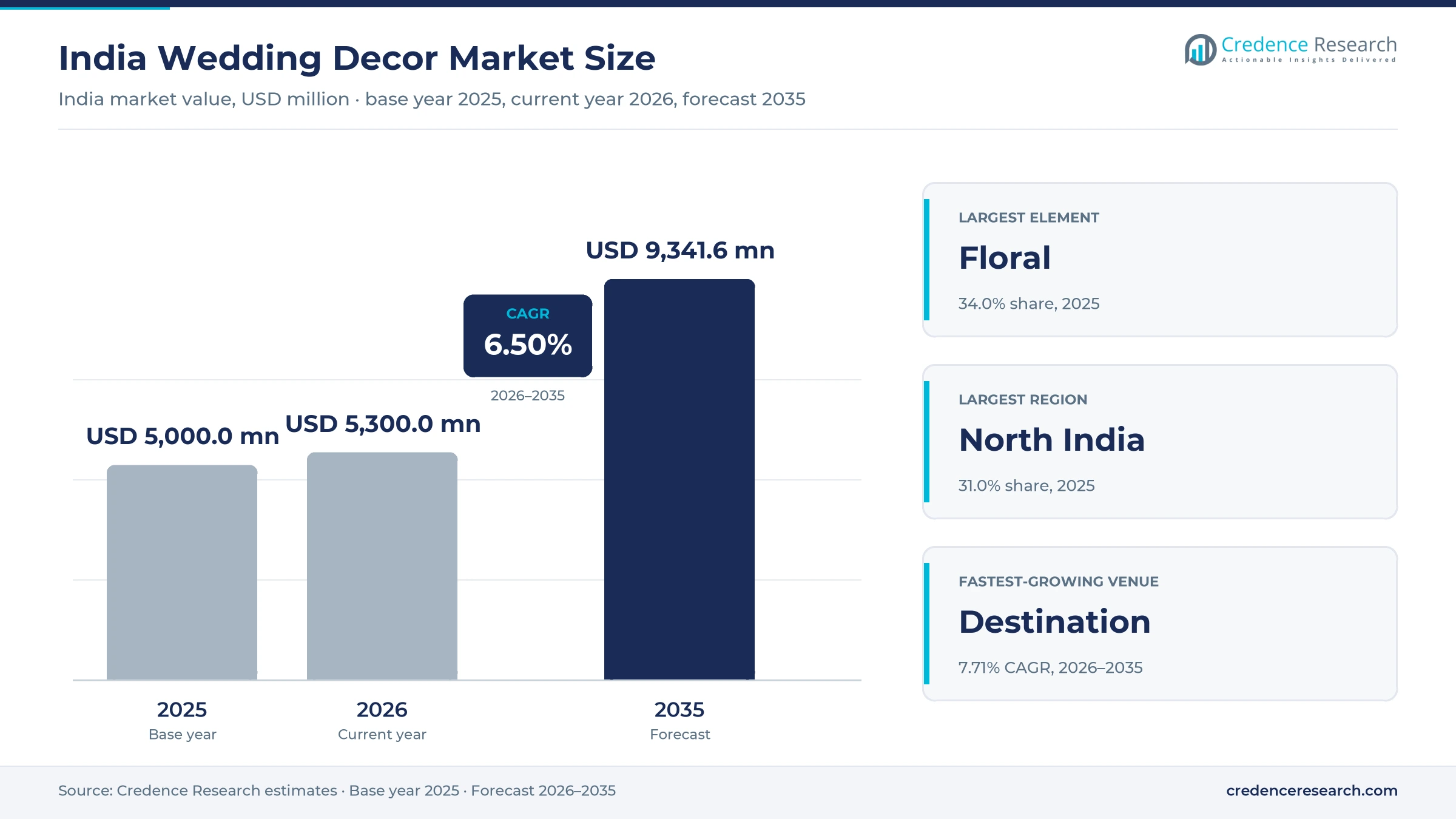
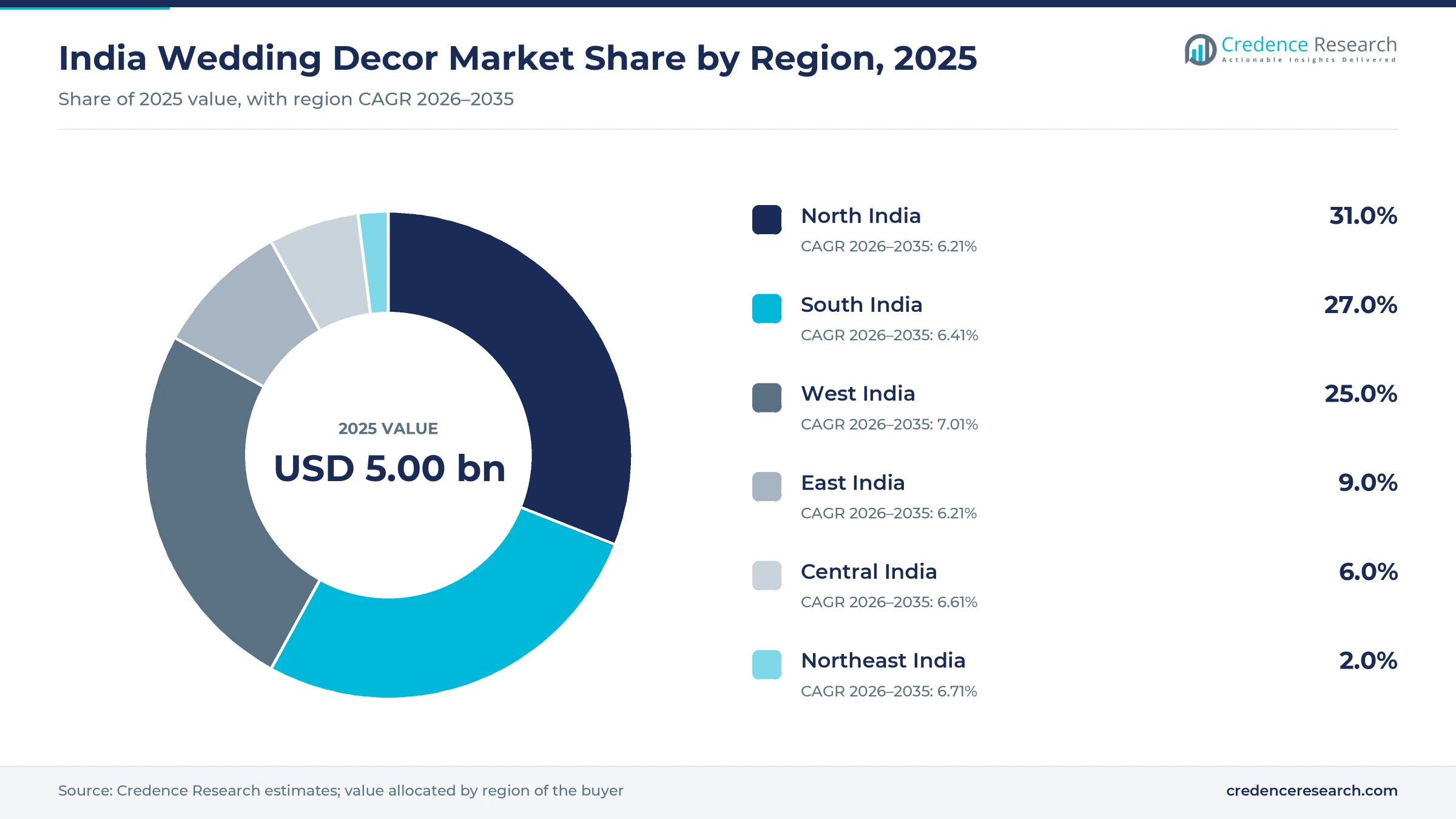
The India wedding decor market was valued at USD 5.00 billion in 2025 and is projected to increase from USD 5.30 billion in 2026 to USD 9.34 billion by 2035, registering a CAGR of 6.50% during 2026–2035. Spending comes from families commissioning floral work, lighting, stages, mandaps and themed installations across several functions, and from hotels and planners that bundle those builds into packages. North India held the largest regional share at 31.0% in 2025, helped by dense wedding activity in Delhi, Uttar Pradesh and Punjab. West India is the fastest-growing region at 7.01% a year, as Goa bookings and the Wed in Gujarat campaign pull more ceremonies toward coastal and heritage sites. Destination weddings now make up about one in four ceremonies, which raises the logistics and design content of each decor contract. The commercial change to watch is the shift of overseas ceremonies back home after the West Asia crisis, which hotel groups reported through 2026.
What does wedding decor spending include in India?
The market counts what households and planners pay for floral work, lighting design, stages and mandaps, and themed installations at wedding functions. It includes design fees, rented props and structures, labor, transport and on-site installation by decorators, tent houses, floral houses and planner-led teams. Buyers usually contract through a decorator directly, a venue panel or a planner who runs the whole event.
The market excludes venue rental, catering, photography, entertainment fees, apparel, jewelry and guest travel, even where a package invoice combines them. It also excludes home decor bought for the couple after the wedding. The value chain runs from flower growers and prop fabricators through tent houses and lighting vendors to designers, who carry the client relationship and most of the design margin.
India Wedding Decor Market Insights
- The market stands at USD 5.00 billion in 2025 and reaches USD 9.34 billion by 2035, a 6.50% CAGR over 2026–2035, with value per event rising faster than wedding counts.
- North India held 31.0% of 2025 value, supported by dense wedding activity in Delhi, Uttar Pradesh and Punjab that the Confederation of All India Traders documented in November 2025.
- Floral work led the element split with 34.0% of 2025 value because flowers appear at almost every function, from small banquets to palace ceremonies.
- Overseas ceremonies are moving home, and IHCL reported a 25% rise in Goa wedding bookings in June 2026 as Middle East destinations lost appeal.
- Competition splits among planner-led studios, floral houses, venue panels and tent houses, so the firm that owns the design brief usually keeps the largest share of margin.
Florals lead as theme builds and destinations grow fastest
Why do florals still anchor most decor contracts?
Based on element, the market is categorized into floral, lighting, stage/mandap and theme decor. Floral led with 34.0% of 2025 value because the Confederation of All India Traders put floral decoration at 4% of total wedding spending in November 2025, ahead of light and sound at 3%. Theme Decor grows fastest at 7.24% a year as couples commission specific concepts, and Pinterest data published by BW Retail World in September 2025 showed searches for desi wedding decor up 1,825% and purple themes up 1,434% between the first quarters of 2024 and 2025.
How does venue type change the size of a decor job?
Based on venue, the market is categorized into banquet, outdoor and destination settings. Banquet sites led with 44.0% of 2025 value because about three in four ceremonies remain local, according to the WedMeGood 2025-2026 survey, and Faridabad alone had about 300 halls and similar venues in a November 2023 Tribune count. Destination events grow fastest at 7.71% a year as the same survey put their average budget at INR 58 lakh against INR 39.5 lakh overall. That gap funds transported props, crews and full-site builds, which local banquet jobs rarely need.
Which budget tier carries the most decor value?
Based on budget, the market is categorized into economy, premium and luxury tiers. Premium weddings led with 46.0% of 2025 value because the average wedding budget reached INR 39.5 lakh in the WedMeGood 2025-2026 survey, leaving room for custom stages, layered lighting and separate looks for each function. Luxury events grow fastest at 7.66% a year as almost 9% of weddings exceeded INR 1 crore in the WedMeGood survey of December 2024. Economy jobs remain numerous, and VenueLook lists decoration from INR 40,000, but their ticket size limits their share of value.
| Segment Group | Leading Sub-segment | Share, 2025 | Fastest-growing Sub-segment | CAGR, 2026–2035 |
|---|---|---|---|---|
| By Element | Floral | 34.0% | Theme Decor | 7.24% |
| By Venue | Banquet | 44.0% | Destination | 7.71% |
| By Budget | Premium | 46.0% | Luxury | 7.66% |
Request a Free Sample
Fill in your details and we'll send you a free sample report.
- Sample data tables & charts
- Research methodology
Themes, destinations and packages lift project value
Premium themes increase spending on decor installations
Families are paying for designed environments rather than simple flower and fabric setups, and that shift lifts the value of each contract. The WedMeGood 2025-2026 survey put the average wedding budget at INR 39.5 lakh, up 8% on the year. Kotak Mahindra Asset Management wrote in November 2025 that decor and entertainment take 10% to 15% of a wedding budget. Tamarind Global vice president Anjali Tolani told the Free Press Journal in January 2026 that couples now want suspended florals and 360-degree immersive rooms. These larger builds need fabricators, riggers and much longer installation windows. In the Credence Research model this adds about 2.40 percentage points to annual growth to 2035.
Destination events and social aesthetics expand demand
Destination ceremonies carry larger decor scopes, and social platforms raise the visual standard families expect from them. WedMeGood found that about one in four weddings is now a destination event and that nearly 90% of those stay inside India, which keeps the decor work with domestic vendors rather than with suppliers for ceremonies held in Europe or the Gulf. Pinterest data reported by BW Retail World in September 2025 showed wedding boards created up 32% and shoppable Pin clicks and saves up 87%. Prime Minister Narendra Modi renewed his appeal for weddings at home at Vadodara in May 2026, naming the Statue of Unity as a venue. In the Credence Research model this adds about 1.76 percentage points to annual growth to 2035.
Rental inventories and integrated packages raise project value
Rented inventory and single-contract planning services let decorators sell larger scopes without forcing families to manage each vendor themselves. Kotak Mahindra Asset Management counted 14 vendors for the average couple in November 2025, a coordination load that favors integrated offers. WedMeGood reported in December 2024 that 27% of destination weddings hired a planner, against 10.5% of local weddings. FNP Venues, part of Ferns N Petals, says it has hosted more than 10,000 weddings and pairs its venues with an in-house event team and decorator panels. Bundling also has a tax logic, because TaxGarden notes that bare hire of lights, chairs and tents is taxed at the separate rate of each item. In the Credence Research model this adds about 1.30 percentage points to annual growth to 2035.
Longer celebrations multiply the sets each family orders
Multi-day formats multiply the number of separate setups a decorator can bill within one wedding. WeddingWire India reported in March 2025, from a survey of more than 2,100 couples, that 35% of weddings last three days and 32% last four days or longer. The Confederation of All India Traders counted 4.6 million weddings in the 2025 winter season against 3.8 million in 2023, so the base of events is also larger. Household capacity is improving too, as the Ministry of Statistics and Programme Implementation reported monthly per capita spending of INR 6,996 in urban areas during 2023-24, about 8% higher on the year. Each added function typically needs its own palette, stage and lighting plan.
Immersive light and rooted mandaps reshape the brief
Shift toward immersive light and projection
Lighting is moving from a supporting role to the main design medium at high-end functions. Tamarind Global told the Free Press Journal in January 2026 that projection mapping on ceilings and tablecloths, mood-based LED color changes and wrap-around visuals are defining 2026 briefs. The same newspaper reported drone light shows at Bhopal receptions in December 2024, which carries the trend beyond metro palaces. There is some pushback, because Bhopal planner Deva Jain said plain or flower backdrops were replacing LED screens at sangeets. Theme Decor work benefits most, growing at 7.24% a year, since it absorbs these technical layers into a single concept. CAIT also reported in November 2025 that 1% to 2% of wedding budgets now go to digital content and social media coverage.
Rise of culturally rooted statement mandaps
Couples are asking for mandaps that signal heritage while still photographing well for social media. Bhopal planner Anmol Budhiraja told the Free Press Journal in December 2024 that Ram Mandir-style mandaps were a new request and that Pichwai paintings were dressing haldi and mehndi venues. VenueLook listed temple-inspired carved designs, floating mandaps and regional motifs such as Madhubani and Kerala murals among its 2025-26 styles, with costs from INR 50,000 to INR 10 lakh or more. CAIT also noted rising demand for heritage and temple weddings in southern states in November 2025. These designs reward local craft workshops, and they raise the craft content of stage work well above standard fabric framing.
Opportunity in emerging wedding towns and returning overseas events
Decorators can open new territory by following hotels into smaller wedding markets now gaining destination demand. Business Today reported in June 2026 that Marriott's Noor Mahal in Karnal was tracking more than 25% ahead, Leisure Hotels Group saw wedding enquiries rise 20% and Radisson reported double-digit growth, with Nashik, Indore and Guwahati among its named markets. Sarovar named Pilibhit, Sindhudurg and Mathura as emerging destinations, and banker Sarthak Ahuja said in July 2025 that Taj, ITC and Hyatt were moving into Siliguri. A regional inventory base in these towns could win repeat hotel panel work, because props and crews would no longer travel from distant metros.
Opening for reusable and low-waste decor inventories
Reusable decor offers a commercial opening because regulation and buyer attitudes now point the same way. The Union environment ministry confirmed that polystyrene for decoration was banned from July 1, 2022, removing a cheap staple from stage and backdrop work. WedMeGood reported in December 2024 that more than 50% of respondents had chosen or were choosing eco-conscious options, and WeddingWire India put sustainable elements at 27% of couples in March 2025. Tamarind Global cited locally grown florals, recycled fabrics and bamboo or cane structures in its January 2026 outlook. Decorators that build owned, reusable frames can rent them repeatedly across a season, which improves margin as well as the sustainability claim.
Flower costs, tight dates and fire rules pressure margins
How do flower price spikes hurt fixed-price decor contracts?
Flowers are perishable and cannot be stocked, so decorators absorb sudden price moves when quotes are fixed months ahead. FloralDaily quoted Kolkata wholesaler Sheikh Rajesh of Mullick Ghat saying domestic prices had more than doubled during peak wedding season. National Horticulture Database figures cited by IBEF show FY24 loose flower output of about 2.28 million metric tons, spread across many small growers. Smaller decorators with thin margins suffer most, so larger firms add escalation clauses, contract growers and blend in artificial or foliage stems.
Why does a compressed calendar strain crews and inventory?
Auspicious dates bunch demand into short windows, leaving decorators with idle months and overloaded weeks. Patna Press reported in January 2026 that Chaturmas runs from July 25 to Nov. 20, 2026, with only four favorable November dates and seven in December. Kotak Mahindra Asset Management estimated more than 100,000 weddings a day during the 2025 peak. Crews, trucks and rented structures run short on those dates, which raises labor costs. Larger houses respond with advance booking deposits and by moving inventory between cities.
What do fire rules and incidents mean for temporary structures?
Fire safety is a growing liability because pandals combine fabric, wiring and crowds in temporary settings. Delhi Fire Service rules bar synthetic materials and ropes, and they require 4.5-meter side margins and exits at least 2.5 meters wide. The Tribune reported in November 2023 that only about 10% of roughly 300 Faridabad venues held the mandatory fire clearance. Devdiscourse reported that a Gurugram banquet hall burned down on Feb. 13, 2026, after hosting a wedding. Decorators face higher material costs and stricter venue checks, so certified fabrics and licensed electricians are becoming a selling point.
How does the tax structure complicate decorator pricing?
Tax treatment varies by contract form, which makes quotes hard to compare and penalizes small operators that lack advisers. TaxGarden noted in October 2026 that crewed setups carry 18% GST, while a shamiana and outdoor catering package carries 5% without input credit. Planner Shobhit Jaiin told EVENTFAQS in November 2025 that taxes can take 18% to 28% of an invoice. The 6% composition option also lapses at INR 50 lakh of turnover. Organized firms that charge full tax can therefore look expensive against small composition-scheme operators, so clear package pricing matters.
North leads on volume while West gains on destination demand
| Region | Value, 2025 (USD billion) | Share, 2025 | CAGR, 2026–2035 |
|---|---|---|---|
| North India | 1.55 | 31.0% | 6.21% |
| South India | 1.35 | 27.0% | 6.41% |
| West India | 1.25 | 25.0% | 7.01% |
| East India | 0.45 | 9.0% | 6.21% |
| Central India | 0.30 | 6.0% | 6.61% |
| Northeast India | 0.10 | 2.0% | 6.71% |
North India leads on dense wedding activity
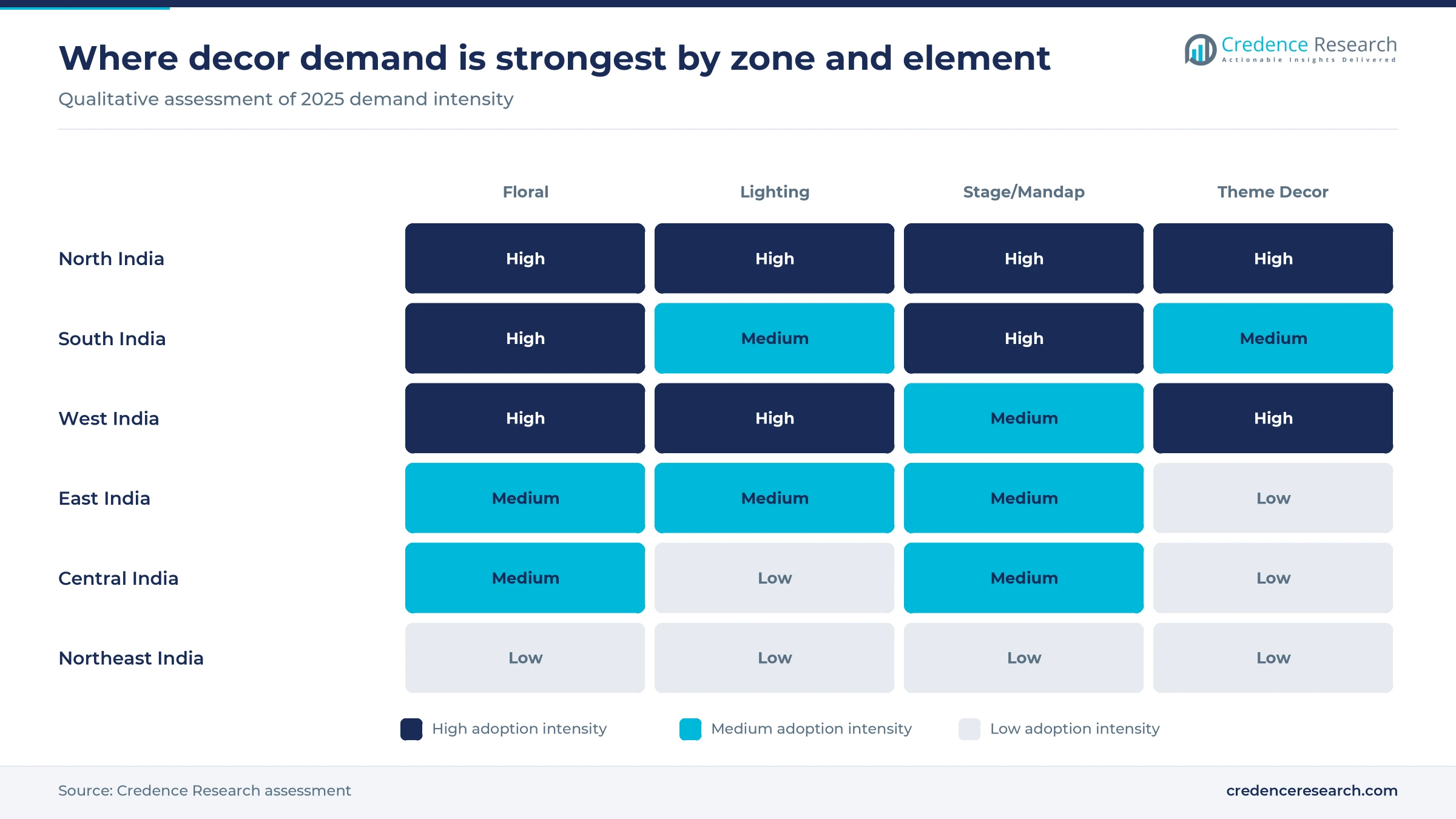
North India held 31.0% of 2025 value and grows at 6.21% a year. CAIT estimated 480,000 weddings and INR 1.8 lakh crore of trade in Delhi alone for the 2025 season, and it singled out Uttar Pradesh and Punjab for high spending on traditional decor. Jaipur recorded the highest average wedding spend in the WedMeGood 2025-2026 survey at INR 73 lakh, against INR 38 lakh in Delhi. That combination of volume and palace-led luxury keeps the zone ahead through the forecast.
South India pairs flower supply with temple ceremonies
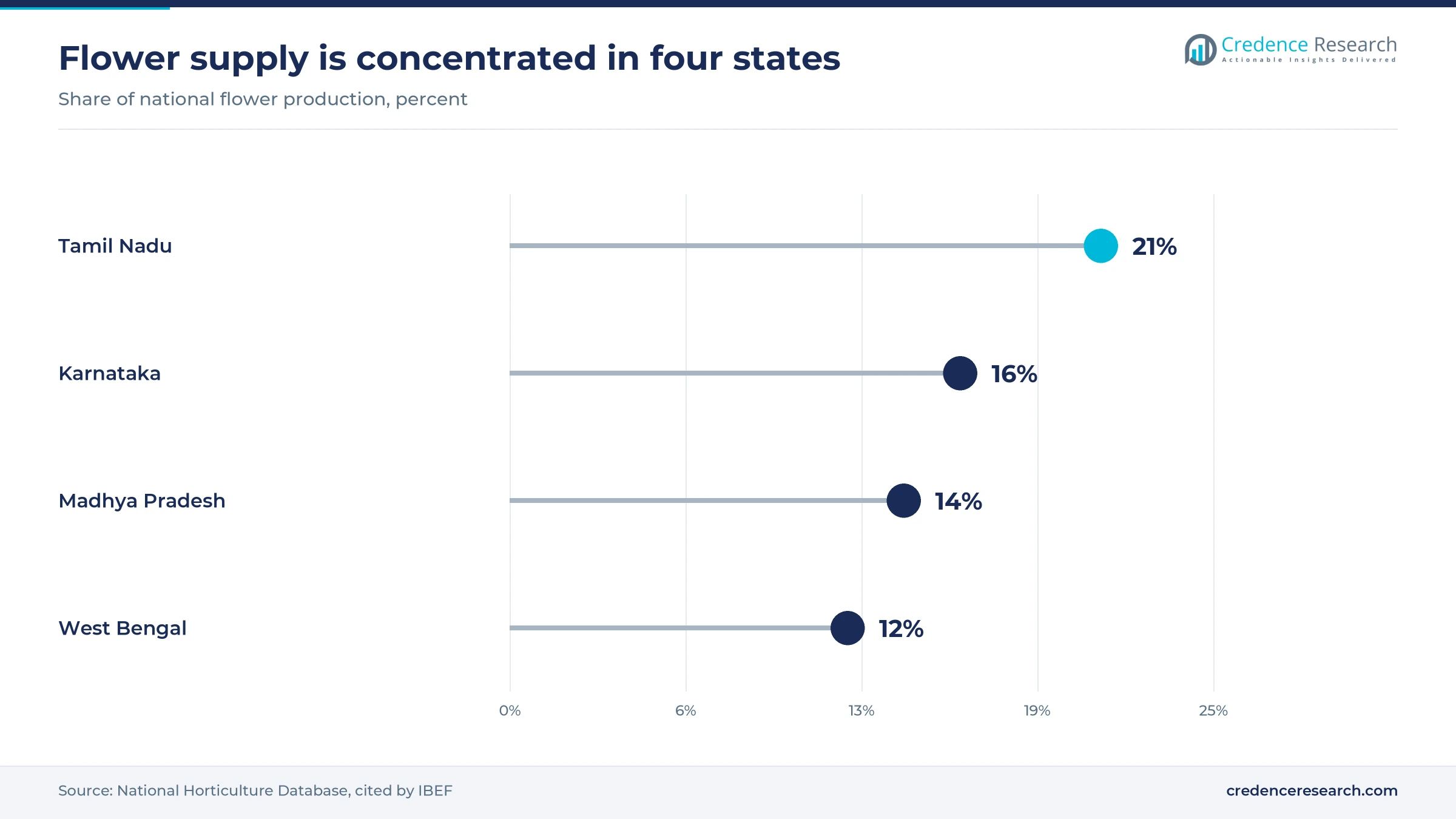
South India held 27.0% of 2025 value and grows at 6.41% a year. Tamil Nadu and Karnataka produce 21% and 16% of national flower output, according to IBEF, which shortens supply lines for floral work and keeps fresh stems cheaper than in distant markets. CAIT reported rising demand for heritage and temple weddings in southern states and strong growth in Karnataka banquet services. WedMeGood put average spending at INR 37 lakh in both Bengaluru and Hyderabad, which supports steady premium commissions.
West India grows fastest on coastal and heritage events
West India held 25.0% of 2025 value and grows at 7.01% a year, the fastest of the six zones. IHCL reported a 25% rise in Goa wedding bookings in June 2026, and Gujarat announced a Wed in Gujarat initiative in its 2026-27 budget, according to Outlook Traveller in February 2026. Trav Talk reported the campaign launch in March 2026, saying it targets demand now concentrated in Rajasthan and Goa. Mumbai adds a deep planner base that includes Marry Me, and CAIT cited strong growth in Maharashtra banquet services.
East India draws on Kolkata flower trade and Siliguri hotels
East India held 9.0% of 2025 value and grows at 6.21% a year. West Bengal produces 12% of national flower output, according to IBEF. Kolkata's Mullick Ghat market supplies decorators across the zone, though FloralDaily reported its prices more than doubling in peak season. Business Today reported in July 2025 that Siliguri draws wedding guests from Bihar and Bengal, with Taj, ITC and Hyatt moving into the city. Hotel entry there should add branded banquet capacity for decorators to serve in the coming years.
Central India builds on growers and new wedding towns
Central India held 6.0% of 2025 value and grows at 6.61% a year. Madhya Pradesh grows 14% of national flower output, according to IBEF, which gives local decorators a nearby supply of stems. WedMeGood listed Khajuraho among newer destination picks in December 2024, and Radisson named Indore among its wedding markets in June 2026. Bhopal planners told the Free Press Journal about themed mandaps and drone shows in December 2024, which shows that metro-style briefs now reach the zone's cities.
Northeast India starts small around Guwahati hotels
Northeast India held 2.0% of 2025 value and grows at 6.71% a year from a small base. Radisson named Guwahati among its wedding markets in June 2026, which suggests branded banquet capacity is beginning to anchor organized decor demand. IBEF lists Mizoram among the country's other major flower producers, offering some local supply. Long transport routes still raise the cost of props and crews brought from Kolkata or Delhi, so most jobs remain with local decorators working from smaller inventories.
Policy appeals and hotel bookings set the recent pace
| Development | Status and market relevance |
|---|---|
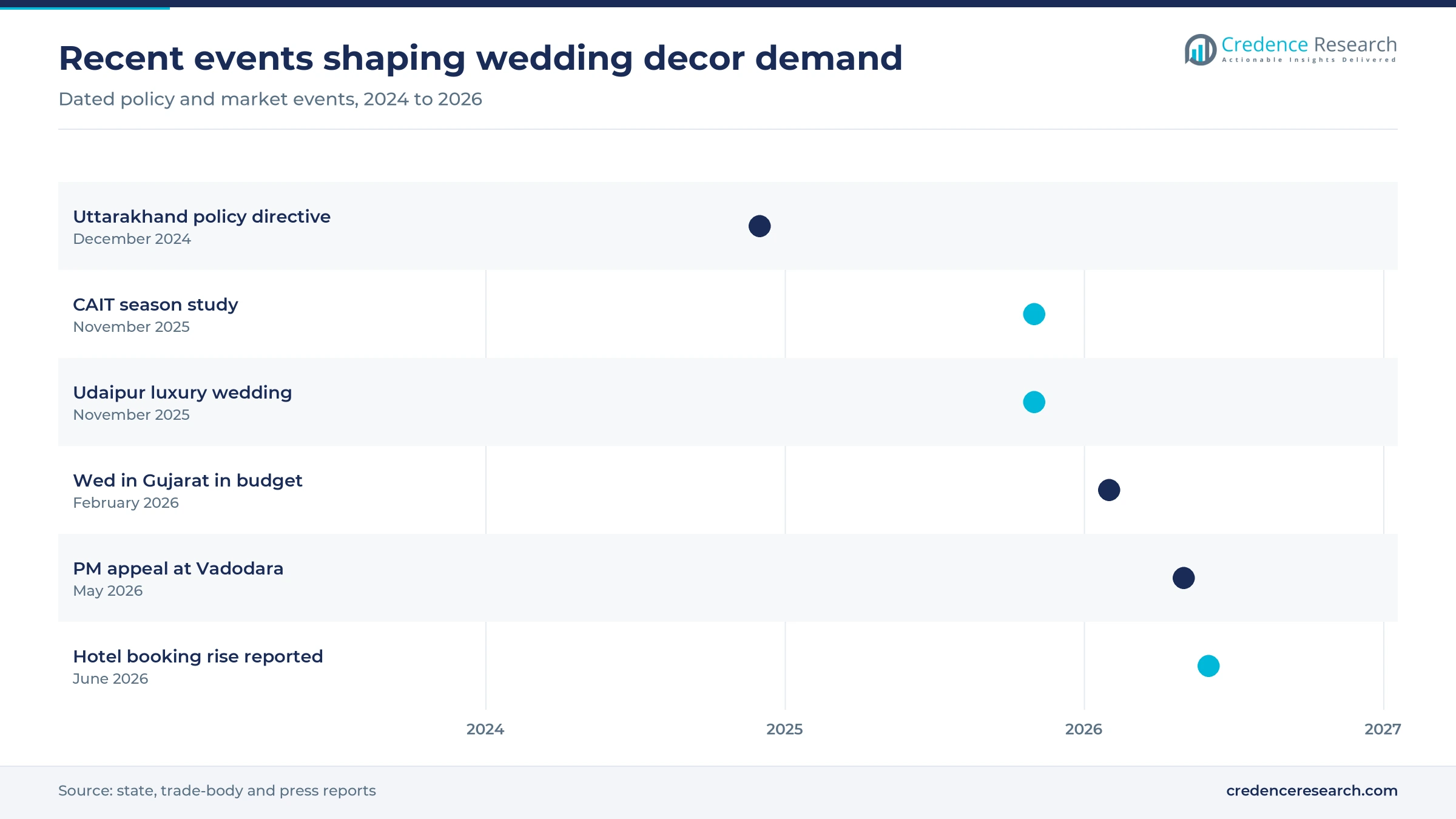
| In December 2024, Uttarakhand Chief Minister Pushkar Singh Dhami asked the tourism department to prepare a destination wedding policy within four weeks. | Directive issued in Dehradun; it signals state interest in new hill venues for decor work |
| In November 2025, the Confederation of All India Traders estimated 4.6 million weddings and INR 6.50 lakh crore of season trade, with floral decoration at 4%. | Published study of 75 cities; the main public anchor for decor spending |
| In November 2025, an Udaipur wedding used The A-Cube Project and Interflora for floral styling at Taj Lake Palace, according to Outlook Luxe. | Completed Nov. 23; a visible benchmark for luxury floral commissions |
| In February 2026, Gujarat included a Wed in Gujarat initiative in its 2026-27 budget, and Trav Talk reported the campaign launch in March 2026. | Campaign launched; no incentive amounts published so far |
| In June 2026, Business Today reported that IHCL saw a 25% rise in Goa wedding bookings as overseas ceremonies shifted home. | Reported hotel data; supports the destination decor pipeline |
Projection, drones and modular frames change the build
- Projection mapping replaces some physical backdrops on ceilings and tablecloths, as Tamarind Global described in January 2026, and it lets one venue carry several looks in one night.
- Drone light shows add a sky-level layer to receptions, and the Free Press Journal reported heart shapes and messages at Bhopal weddings in December 2024.
- Modular bamboo and metal frames offer an alternative to banned polystyrene on stages, and bamboo or cane structures appeared in the Tamarind Global outlook of January 2026.
- AI planning and online tools shorten the concept stage, and CAIT reported 20% to 25% sales growth in related services in November 2025.
Need a Custom Version of This Report?
Tailor the scope, geography, or segments to your exact requirements.
- Custom geography or segment scope
- Direct access to our analyst team
Planners, floral houses and venues vie for the full brief
Competition is highly fragmented, and no single firm dominates a market served largely by local tent houses and decorators. Planner-led studios such as Shaadi Squad, launched in 2015, and Mumbai-based Marry Me win the luxury brief and direct design across functions. Ferns N Petals approaches the market through venues, combining FNP Venues properties with an in-house event team and FNP Wedding Decor in South Delhi. Interflora India and The A-Cube Project sell floral styling and design, and both worked on the November 2025 Udaipur wedding covered by Outlook Luxe. Tamarind Global sells celebrations as part of its broader events and exhibitions work. Hotels also shape competition through decorator panels that restrict which vendors may work on site. The contest is mainly about owning the concept, because the firm holding the design brief can subcontract fabrication and rentals at a margin.
Companies profiled and their roles in this market
| Company | Type | Role in the market |
|---|---|---|
| FNP Weddings & Events | Venue and decor group | Ferns N Petals unit offering decor in South Delhi, venues across Delhi NCR and an in-house event team |
| Shaadi Squad | Luxury planner | Planning studio founded in 2015, known for celebrity weddings since 2017, directing design across functions |
| Marry Me | Wedding planner | Mumbai-based planner with destination pages for Goa and Rajasthan and a floral arm, House of Flowers |
| Interflora India | Floral house | Provided pastel-to-sunset mehendi florals at the November 2025 Udaipur wedding |
| The A-Cube Project | Design studio | Styled the haldi at Taj Lake Palace in the same November 2025 Udaipur wedding |
| Tamarind Global | Celebrations company | Advises on immersive, projection-led and locally sourced decor for 2026 events |
Domestic luxury demand matters more than wedding counts
Credence Research's view is that the market's growth depends more on value per event than on wedding counts. CAIT's own series shows the number of weddings falling from 4.8 million in 2024 to 4.6 million in 2025 while spending rose, and that pattern should persist. The strongest position belongs to firms that control design and own reusable inventory, because labor and flowers remain volatile. The most exposed firms are small tent houses selling on price alone, which face tougher fire checks, material bans and clients who now arrive with a detailed concept.
How Credence Research built these estimates
The report uses 2025 as the base year and forecasts to 2035. Market values come from the Credence Research model, and segment and regional splits are Credence Research estimates checked against public indicators. Sources used include trade-body releases from the Confederation of All India Traders, government statistics and notices from the Ministry of Statistics and Programme Implementation, the Press Information Bureau and Delhi Fire Service, the WedMeGood and WeddingWire India consumer surveys as published, company pages and dated press coverage. No primary interviews or proprietary surveys were conducted for this edition of the report.
Value per event, not volume, drives the road to 2035
The market moves from USD 5.30 billion in 2026 to USD 9.34 billion by 2035, a 6.50% CAGR over 2026–2035. Domestic destination ceremonies are likely to keep gaining share if overseas travel remains less attractive and states such as Gujarat and Uttarakhand turn campaigns into usable venues. Decor budgets should keep shifting toward fabricated sets and technical lighting, while fresh flowers stay central to most ceremonies. The main risks are flower price spikes, tighter fire enforcement and a compressed religious calendar in some years. Organized firms should gain share gradually, though local decorators will still handle most ceremonies in smaller towns.
Frequently Asked Questions
How big is the India wedding decor market?
Which element holds the largest share of wedding decor spending?
Which venue type is growing fastest?
Which region leads the market?
Which region is growing fastest?
What is driving demand for wedding decor in India?
What are the main challenges for decorators?
Who are the main companies in the market?
Table of Content
Chapter 1 Market Segmentation
- 1.1 Segmentation Framework
- 1.1.1 Product and Service Classification
- 1.1.2 Application and End-Use Classification
- 1.1.3 Technology and Solution Classification
- 1.1.4 Customer and Distribution Channel Classification
- 1.1.5 Geographic Segmentation
- 1.1.6 Market Segment Definitions and Boundaries
- 1.2 By Element
- 1.2.1 Floral
- 1.2.2 Stage/Mandap
- 1.2.3 Lighting
- 1.2.4 Theme Decor
- 1.3 By Venue
- 1.3.1 Banquet
- 1.3.2 Destination
- 1.3.3 Outdoor
- 1.4 By Budget
- 1.4.1 Premium
- 1.4.2 Economy
- 1.4.3 Luxury
Chapter 2 Introduction
- 2.1 Report Objectives and Scope
- 2.2 Product Definition and Industry Terminology
- 2.3 Market Inclusions and Exclusions
- 2.4 Research Process
- 2.4.1 Primary Research and Expert Interviews
- 2.4.2 Secondary Research and Source Review
- 2.4.3 Top-Down and Bottom-Up Estimation
- 2.4.4 Data Triangulation and Verification
- 2.5 Market Size Measurement Basis
- 2.5.1 2025: USD 5.00 billion → 2035: USD 9.34 billion
- 2.6 Historical and Forecast Reference Periods
- 2.6.1 Historical Period: 2018-2025
- 2.6.2 Base Year: 2025
- 2.6.3 Forecast Period: 2025-2035
- 2.7 Research Assumptions and Limitations
Chapter 3 Executive Summary
- 3.1 Market Snapshot and Key Findings
- 3.2 Base-Year Market Size, 2025
- 3.3 Forecast Market Size, 2035
- 3.4 Revenue and Volume Growth Outlook
- 3.5 Key Demand and Supply Indicators
- 3.6 Leading Market Segments
- 3.7 Fastest-Growing Market Opportunities
- 3.8 Regional Performance Highlights
- 3.9 Technology and Industry Transformation
- 3.10 Competitive Landscape Summary
- 3.11 Analyst View and Strategic Implications
Chapter 4 India Wedding Decor Market Trends and Developments
- 4.1 Historical Industry Development, 2018-2025
- 4.2 Recent Market Trends and Developments
- 4.3 Demand and Customer Behavior Trends
- 4.4 Technology and Product Innovation
- 4.5 Artificial Intelligence, Automation and Digitalization
- 4.6 Local Manufacturing and Supply Chain Realignment
- 4.7 Industry Partnerships, Mergers and Acquisitions
- 4.8 Sustainability and Circular Economy Developments
- 4.9 Government and Private Sector Investment Trends
- 4.10 Emerging Business Models and Commercialization
- 4.11 Industry Developments and Announcements
Chapter 5 India Wedding Decor Market Supply and Demand Analysis
- 5.1 Demand Trend and Consumption Analysis, 2018-2025
- 5.2 Demand Forecast, 2025-2035
- 5.3 Supply Chain Structure and Procurement Trends
- 5.4 Supply-Demand Gap and Bottlenecks
- 5.5 Import Dependence and Sourcing Structure
- 5.6 Regional Supply and Demand Concentration
Chapter 6 India Wedding Decor Market Pricing Analysis
- 6.1 Pricing Structure and Measurement
- 6.2 Historical Pricing Trends, 2018-2025
- 6.3 Pricing Outlook, 2025-2035
- 6.4 Pricing by Product and Market Segment
- 6.5 Geographic Pricing Differences
- 6.6 Key Input, Energy, Labor and Logistics Costs
- 6.7 Contract Pricing and Purchasing Models
- 6.8 Pricing Sensitivity and Competitive Positioning
- 6.9 Price, Margin and Profitability Implications
Chapter 7 India Wedding Decor Market Dynamics
- 7.1 Market Growth Drivers
- 7.1.1 Demand-Side Drivers
- 7.1.2 Technology and Innovation Drivers
- 7.1.3 Infrastructure and Investment Drivers
- 7.1.4 Regulatory and Policy Drivers
- 7.2 Market Restraints
- 7.2.1 Cost and Affordability Constraints
- 7.2.2 Technology and Adoption Barriers
- 7.2.3 Supply Chain and Operational Constraints
- 7.3 Market Challenges
- 7.3.1 Competitive Pressure and Margin Erosion
- 7.3.2 Skills, Infrastructure and Implementation Gaps
- 7.4 Emerging Market Opportunities
- 7.5 Market Dynamics Impact and Time-Horizon Assessment
Chapter 8 India Wedding Decor Value Chain Analysis
- 8.1 Industry Value Chain Overview
- 8.2 Upstream Suppliers and Critical Inputs
- 8.3 Technology and Component Providers
- 8.4 Manufacturing or Service Delivery
- 8.5 Distribution, Channel Partners and Integrators
- 8.6 Downstream Applications and End Users
- 8.7 Value Addition and Profit Pools
- 8.8 Vertical Integration and Outsourcing
- 8.9 Supplier Concentration and Risk
- 8.10 Supply Chain Localization and Resilience
Chapter 9 India Wedding Decor Market Regulations and Policies
- 9.1 Relevant Laws, Standards and Compliance Frameworks
- 9.2 Product, Service, Safety and Quality Requirements
- 9.3 Government Policies, Incentives and Subsidies
- 9.4 Imports, Exports and Trade Barriers
- 9.5 Public Procurement and Local Content Requirements
- 9.6 Data Protection, AI and Cybersecurity Compliance
- 9.7 Upcoming Policy Changes and Market Implications
Chapter 10 India Wedding Decor Market Hotspots and Opportunities
- 10.1 Market Opportunity Mapping and Growth Hotspots
- 10.2 High-Growth Applications and Customer Groups
- 10.3 Underserved Markets and White-Space Opportunities
- 10.4 Emerging Technology and Product Opportunities
- 10.5 New Capacity and Investment Hotspots
- 10.6 Market Entry and Expansion Opportunities
- 10.7 Distribution and Partnership Opportunities
- 10.8 Near-Term and Long-Term Commercial Potential
- 10.9 Opportunity Attractiveness and Execution Risks
Chapter 11 India Wedding Decor Market Outlook, 2025-2035
- 11.1 Market Size and Analysis
- 11.1.1 Revenue (Market Measurement: 2025: USD 5.00 billion → 2035: USD 9.34 billion)
- 11.1.2 Historical Market Size, 2018-2025
- 11.1.3 Base-Year Market Size, 2025
- 11.2 Market Forecast, 2025-2035
- 11.2.1 Revenue Forecast to 2035
- 11.2.2 CAGR and Year-on-Year Growth
- 11.2.3 Incremental Revenue Opportunity
- 11.3 Forecast Assumptions and Scenario Analysis
- 11.3.1 Base-Case Forecast
- 11.3.2 Optimistic and Conservative Scenarios
- 11.3.3 Technology, Pricing and Policy Sensitivities
- 11.4 Market Attractiveness and Growth Outlook
Chapter 12 India Wedding Decor Market Segmentation and Outlook
- 12.1 Segmentation Summary and Market Shares, 2025
- 12.2 Largest and Fastest-Growing Segments
- 12.3 By Element - Market Size and Forecast, 2025-2035
- 12.3.1 Segment Definition and Scope
- 12.3.2 Historical Market Size, 2018-2025
- 12.3.3 Revenue Forecast, 2025-2035
- 12.3.4 Base-Year Market Share, 2025
- 12.3.5 Segment CAGR and Growth Drivers
- 12.3.6 Subsegment Market Size and Forecast
- 12.3.6.1 Floral
- 12.3.6.2 Stage/Mandap
- 12.3.6.3 Lighting
- 12.3.6.4 Theme Decor
- 12.3.7 Subsegment Pricing and Adoption Trends
- 12.3.8 Leading Suppliers and Competition
- 12.3.9 Regional Demand and Opportunities
- 12.4 By Venue - Market Size and Forecast, 2025-2035
- 12.4.1 Segment Definition and Scope
- 12.4.2 Historical Market Size, 2018-2025
- 12.4.3 Revenue Forecast, 2025-2035
- 12.4.4 Base-Year Market Share, 2025
- 12.4.5 Segment CAGR and Growth Drivers
- 12.4.6 Subsegment Market Size and Forecast
- 12.4.6.1 Banquet
- 12.4.6.2 Destination
- 12.4.6.3 Outdoor
- 12.4.7 Subsegment Pricing and Adoption Trends
- 12.4.8 Leading Suppliers and Competition
- 12.4.9 Regional Demand and Opportunities
- 12.5 By Budget - Market Size and Forecast, 2025-2035
- 12.5.1 Segment Definition and Scope
- 12.5.2 Historical Market Size, 2018-2025
- 12.5.3 Revenue Forecast, 2025-2035
- 12.5.4 Base-Year Market Share, 2025
- 12.5.5 Segment CAGR and Growth Drivers
- 12.5.6 Subsegment Market Size and Forecast
- 12.5.6.1 Premium
- 12.5.6.2 Economy
- 12.5.6.3 Luxury
- 12.5.7 Subsegment Pricing and Adoption Trends
- 12.5.8 Leading Suppliers and Competition
- 12.5.9 Regional Demand and Opportunities
- 12.6 Segment Growth Comparison
- 12.7 Segment Attractiveness and Priority Matrix
Chapter 13 India Wedding Decor Geographic Market Outlook, 2025-2035
- 13.1 Domestic Market Distribution and Demand Clusters
- 13.2 State- or Province-Wise Market Size and Forecast, 2025-2035
- 13.3 City and Metropolitan Market Outlook
- 13.4 Industrial, Manufacturing and Commercial Clusters
- 13.5 Geographic Concentration of Key End Users
- 13.6 Local Pricing and Purchasing Differences
- 13.7 Domestic Production Facilities and Capacity Map
- 13.8 Local Infrastructure and Project Pipeline
- 13.9 State-Level Policy and Incentive Differences
- 13.10 Subnational Investment Hotspots and Opportunities
- 13.11 Distribution and Logistics Networks
- 13.12 Domestic Competitive Footprint
Chapter 14 India Wedding Decor Technology, Innovation and Sustainability Outlook
- 14.1 Technology Landscape and Maturity
- 14.2 Product, Process and Service Innovation
- 14.3 AI, Automation and Digital Tools in the Industry
- 14.4 Technology Adoption and Performance Benchmarking
- 14.5 Innovation Pipeline and R&D Investment
- 14.6 Energy Efficiency and Resource Management
- 14.7 Sustainability, Recycling and Circularity
- 14.8 Technology Roadmap, 2025-2035
- 14.9 Risks of Obsolescence and Technology Substitution
Chapter 15 India Wedding Decor Market Key Strategic Imperatives
- 15.1 Growth and Market Entry Priorities
- 15.2 High-Return Products and Segments
- 15.3 Pricing, Profitability and Cost Optimization
- 15.4 Technology Investment and Product Differentiation
- 15.5 Supply Chain Localization and Resilience
- 15.6 Distribution and Customer Acquisition
- 15.7 Partnership, Acquisition and Capacity Strategy
- 15.8 Regional Expansion Priorities
- 15.9 Short-, Medium- and Long-Term Actions
Chapter 16 Competition Outlook
- 16.1 Industry Competition Characteristics
- 16.2 Market Structure and Concentration
- 16.3 Market Share and Competitive Positioning, 2025
- 16.4 Company-Wise Revenue and Product Benchmarking
- 16.5 Production and Service Capacity Benchmarking
- 16.6 Technology, Pricing and Differentiation
- 16.7 Regional Footprint and Distribution Strength
- 16.8 Mergers, Acquisitions and Strategic Alliances
- 16.9 New Entrants and Competitive Threats
- 16.10 Porter's Five Forces and Industry Attractiveness
- 16.11 Competitive Outlook, 2025-2035
Chapter 17 Company Profiles
- 17.1 Company Coverage and Selection Criteria
- 17.2 FNP Weddings & Events
- 17.2.1 Business Description
- 17.2.2 Company Ownership and Geographic Presence
- 17.2.3 Product and Service Portfolio
- 17.2.4 Manufacturing and Operating Footprint
- 17.2.5 Financial Performance and Investment
- 17.2.6 Market Share and Competitive Position
- 17.2.7 Technology and Innovation Capabilities
- 17.2.8 Strategic Alliances or Partnerships
- 17.2.9 Recent Developments
- 17.2.10 Growth Strategy and Outlook
- 17.3 Shaadi Squad
- 17.4 Marry Me
- 17.5 Interflora India
- 17.6 The A-Cube Project
- 17.7 Tamarind Global
- 17.8 Other Relevant Market Participants
Note: Every listed company is profiled on the structure shown under the first company. The company list is preliminary and may change based on research findings, market developments, data availability and client requirements.
Chapter 18 Disclaimer
- 18.1 Research and Forecast Disclaimer
- 18.2 Data Source and Estimation Limitations
Note: The depth of individual sections depends on data availability for this market. Volume, capacity, trade and other unit-based metrics are included where applicable.