
Market Overview:
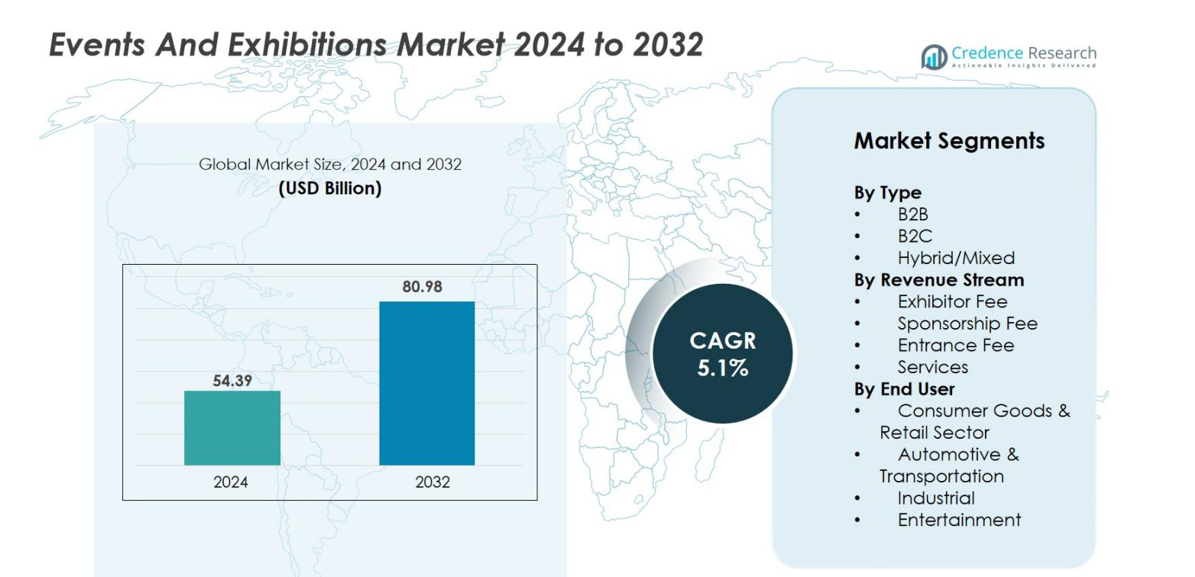
Events and Exhibitions Market size was valued at USD 54.39 Billion in 2024 and is anticipated to reach USD 80.98 Billion by 2032, at a CAGR of 5.1% during the forecast period.| REPORT ATTRIBUTE | DETAILS |
|---|---|
| Historical Period | 2020-2023 |
| Base Year | 2024 |
| Forecast Period | 2025-2032 |
| Events and Exhibitions Market Size 2024 | USD 54.39 Billion |
| Events and Exhibitions Market, CAGR | 5.1% |
| Events and Exhibitions Market Size 2032 | USD 80.98 Billion |
Market Insights
- The Events and Exhibitions Market was valued at USD 54.39 Billion in 2024 and is projected to reach USD 80.98 Billion by 2032, expanding at a CAGR of 5.1% during the forecast period.
- Steady growth is driven by rising corporate marketing investments, increasing global trade activities, and strong demand for experiential engagement across B2B and consumer-focused exhibitions.
- Key trends include rapid adoption of hybrid event formats, digital registration systems, immersive technologies, and sustainability-focused exhibition practices that enhance efficiency and attendee experience.
- Leading players such as RELX Plc, Fiera Milano SpA, Deutsche Messe AG, GL Events, MCH Group AG, and Reed Exhibitions strengthen industry presence through venue modernization, technology integration, and diversified event portfolios.
- North America leads with 34.8% market share, while Europe holds 28.6% and Asia Pacific accounts for 24.3%; the B2B segment dominates with 62.4% share, supported by strong participation from corporate and industrial exhibitors.
Market Segmentation Analysis
By Type The Events and Exhibitions Market demonstrate strong performance across B2B, B2C, and Hybrid formats, with B2B events emerging as the dominant sub-segment, accounting for 62.4% of the market share in 2024. This leadership is supported by rising demand for specialized trade shows, industry-focused conventions, and corporate exhibitions that facilitate networking, product showcasing, and strategic partnerships. Businesses increasingly invest in B2B platforms to generate qualified leads and strengthen global visibility. Additionally, the growth of sector-specific exhibitions and technology-integrated event formats continues to reinforce B2B dominance across mature and emerging markets.- For instance, RELX Plc organizes the "London Book Fair," which attracts over 25,000 attendees annually, providing a global platform for networking and showcasing industry-specific innovations.
- For instance, Salone del Mobile.Milano in 2024 counted 1,950 exhibitors from 35 countries.
Key Growth Drivers
Rising Corporate Marketing Investments and Brand Engagement Priorities
A major growth driver for the Events and Exhibitions Market is the substantial rise in corporate spending on experiential marketing and brand-building initiatives. Companies across sectors allocate larger budgets to trade shows, product expos, and industry conferences to strengthen brand visibility, generate qualified leads, and accelerate customer acquisition. Events offer an interactive platform that enhances networking and enables real-time feedback on new products and innovations. The increasing frequency of product launches, international roadshows, and themed exhibitions continues to boost participation from enterprises of all sizes. Additionally, businesses are prioritizing multisensory experiences, incorporating digital displays, immersive setups, and live demonstrations to maximize engagement. As competition intensifies across industries, events emerge as a key differentiator for positioning, thought leadership, and customer retention. The ability of exhibitions to drive measurable ROI, such as conversion rates and pipeline generation, further reinforces corporate interest, solidifying this driver as a dominant catalyst for market expansion.- For instance, Samsung Electronics showcased an immersive exhibition spanning 1,728 square meters at ISE 2024 in Barcelona, attracting 23,000 booth visitors with interactive demonstrations including Transparent MICRO LED displays and AI-driven display solutions, with the booth drawing approximately 7,000 visitors on the first day alone-double the previous year's traffic.
Expansion of Global Trade Activities and Cross-Border Business Collaboration
The expansion of global trade and increasing cross-border collaborations significantly propel the Events and Exhibitions Market. International trade fairs serve as strategic platforms for companies to access new markets, identify distribution partners, and explore multinational business opportunities. Governments and trade bodies actively promote global exhibitions to attract foreign investment, strengthen economic alliances, and facilitate knowledge exchange. This growth is further supported by rising participation from small and medium-sized enterprises seeking global exposure through international pavilions and export-focused exhibitions. The strengthening of global supply chains, increasing import–export activities, and industry diversification contribute to higher event attendance and broader exhibitor portfolios. Additionally, the surge in specialized sector-wise expos-from technology and healthcare to automotive and industrial equipment-offers companies structured opportunities to engage with global buyers. As market ecosystems become increasingly interconnected, international exhibitions play a critical role in expanding business networks, accelerating innovation diffusion, and reinforcing global economic integration.- For instance, at the Messe Frankfurt GmbH global portfolio in 2024 there were 98,336 exhibiting companies and approximately 4.6 million visitors across its exhibitions worldwide.
Technological Advancements Enhancing Event Experiences and Operational Efficiency
Advancements in event technologies-including AI-based registration tools, virtual engagement platforms, predictive analytics, and digital lead retrieval-act as a transformative growth driver for the industry. Organizers adopt automation solutions to streamline event planning, improve visitor management, and enhance real-time data tracking. Technologies such as RFID badges, facial recognition entry, and augmented reality product demonstrations create seamless and immersive on-site experiences. Digital twins and smart venue analytics enable efficient layout design, traffic flow optimization, and exhibitor performance evaluation. These innovations improve exhibitor ROI by offering precise insights into visitor behavior, dwell time, and engagement patterns. Hybrid event tools further expand market reach by enabling remote participation, increasing audience size, and generating additional revenue streams. With sustainability becoming a priority, digital workflows reduce paper usage and support eco-friendly operations. As event tech ecosystems mature, technological enhancement remains a central driver shaping efficiency, scalability, and global competitiveness.Key Trends & Opportunities
Increasing Adoption of Sustainable and Eco-Efficient Event Practices
Sustainability is becoming a defining trend and strategic opportunity for the Events and Exhibitions Market, as organizers and exhibitors prioritize environmentally responsible operations. Green event practices-such as biodegradable booth materials, energy-efficient lighting, waste reduction systems, and low-carbon venue management-are increasingly embraced to reduce environmental footprints. Attendees and brands demonstrate strong preference for exhibitions that align with corporate ESG commitments, driving demand for eco-certified venues and vendors. Digital ticketing, paperless workflows, and modular booth designs further support sustainability goals while enhancing operational efficiency. Event organizers also collaborate with local suppliers to minimize transportation emissions and promote circular resource usage. As regulatory bodies tighten environmental standards, adopting sustainable event models becomes both a compliance requirement and an opportunity to strengthen brand reputation. This trend unlocks new revenue streams through green sponsorships and attracts environmentally conscious exhibitors seeking responsible platforms.- For example, Messe Frankfurt’s Frankfurt Exhibition Grounds received the ISO 14001 certification for its sustainability practices in 2024, making it a preferred choice for eco-conscious exhibitors.
Growth of Hybrid and Extended Digital Event Models
Hybrid exhibitions and digitally integrated event experiences are emerging as significant opportunities within the Events and Exhibitions Market. Organizers now merge physical events with virtual platforms to offer flexible participation modes, enabling global audiences to engage without geographical constraints. This trend increases event accessibility, extends content lifespan, and provides additional monetization channels through online ticketing, virtual booths, and sponsored digital sessions. Enhanced analytics capabilities allow organizers and exhibitors to track engagement metrics, personalize outreach, and evaluate event performance with greater precision. The integration of chat-based interactions, virtual product tours, and on-demand content libraries strengthens attendee engagement long after the event concludes. As companies seek measurable impact and audience expansion, hybrid formats deliver cost-effective scalability and higher attendance rates. The growing adoption of 5G connectivity, cloud platforms, and AI-driven content delivery further accelerates the shift toward blended event ecosystems.Key Challenges
High Operational Costs and Complex Logistics Management
One of the primary challenges in the Events and Exhibitions Market is the high operational cost associated with venue rentals, booth construction, logistics coordination, and workforce management. Large-scale events demand significant investment in infrastructure, safety systems, digital technology, and visitor services, placing financial pressure on organizers. Transporting exhibition materials, managing vendor networks, and ensuring seamless on-site execution further increase complexity and cost. Fluctuations in raw material prices, rising labor costs, and increasing expectations for premium event experiences intensify budgetary strain. Smaller organizers often struggle to achieve profitability due to limited economies of scale. Additionally, the requirement for rigorous compliance with safety regulations, crowd control measures, and contingency planning raises operational workloads. These cost-intensive dynamics make long-term financial sustainability a significant obstacle for many market participants.Vulnerability to Economic Uncertainty and External Disruptions
The Events and Exhibitions Market remains highly sensitive to economic cycles, geopolitical instability, and external disruptions such as pandemics or natural disasters. During periods of economic slowdown, businesses reduce marketing and travel budgets, resulting in lower exhibitor participation and reduced sponsorship revenues. International events are particularly exposed to travel restrictions, currency fluctuations, and supply chain disruptions that affect both attendee mobility and vendor operations. Unpredictable external shocks can lead to event cancellations, postponements, or significant attendance drops, causing financial losses. Compliance challenges related to health and safety protocols further increase operational risks. Additionally, shifts in consumer sentiment and corporate spending behavior can rapidly alter event demand patterns. These vulnerabilities highlight the need for robust contingency strategies, flexible event models, and diversified revenue streams to withstand market volatility.Regional Analysis
North America
North America leads the Events and Exhibitions Market with 34.8% market share in 2024, supported by strong corporate spending, advanced venue infrastructure, and a high concentration of international trade fairs. The U.S. dominates regional activity due to its large-scale conventions, technology expos, and entertainment events that attract global exhibitors. Growth is reinforced by strong adoption of event technologies, hybrid engagement formats, and high visitor footfall across consumer and industrial sectors. Canada and Mexico contribute through expanding automotive, retail, and cultural exhibitions. Strategic investments in sustainability and digital integration further elevate North America’s market leadership.Europe
Europe holds a substantial 28.6% market share in 2024, driven by its well-established exhibition centers and long-standing trade fair culture across Germany, France, Italy, Spain, and the U.K. The region benefits from strong participation in industrial machinery expos, automotive showcases, fashion events, and global business conventions. Germany remains a hub for large-scale international trade fairs, while France and Italy drive growth through luxury, design, and cultural exhibitions. Hybrid events continue to gain traction, supported by advanced digital adoption. Strong government and industry associations’ support further enhances Europe’s position as a global exhibition powerhouse.Asia Pacific
Asia Pacific emerges as the fastest-growing region, holding 24.3% market share in 2024, fueled by rapid urbanization, expanding corporate sectors, and rising international trade activity. China, India, Japan, and South Korea host high-volume exhibitions across technology, manufacturing, retail, and lifestyle categories. Government initiatives promoting business tourism and foreign investment strengthen regional event participation. Large convention centers, digital event innovations, and increasing interest from global exhibitors further drive growth. Asia Pacific’s expanding consumer base and booming industrial landscape accelerate demand for large multi-sector exhibitions, making it a significant contributor to long-term market expansion.Latin America
Latin America accounts for 7.2% market share in 2024, driven by growing demand for consumer-focused events, industrial trade fairs, and cultural exhibitions across Brazil, Mexico, Argentina, and Chile. The region benefits from increasing investments in venue modernization and a rising interest in international expos related to automotive, food & beverage, and entertainment sectors. Economic reforms and improving business tourism also support event participation. However, market growth varies across countries due to economic volatility. Digital adoption and hybrid formats are helping organizers expand reach and attract exhibitors seeking entry into Latin America's emerging consumer markets.Middle East & Africa (MEA)
The Middle East & Africa region captures 5.1% market share in 2024, supported by strong investments in business tourism, luxury events, and large-scale international exhibitions. The UAE and Saudi Arabia lead with world-class infrastructure, hosting prominent trade fairs in construction, technology, and hospitality. Africa contributes through expanding industrial and cultural exhibitions, particularly in South Africa, Kenya, and Nigeria. Government-backed initiatives to diversify economies and boost MICE activities strengthen the region’s position. While challenges such as economic disparities remain, MEA continues to attract global exhibitors and investors seeking high-growth opportunities.Market Segmentations
By Type- B2B
- B2C
- Hybrid/Mixed
- Exhibitor Fee
- Sponsorship Fee
- Entrance Fee
- Services
- Consumer Goods & Retail Sector
- Automotive & Transportation
- Industrial
- Entertainment
- North America
- U.S.
- Canada
- Mexico
- Europe
- Germany
- France
- U.K.
- Italy
- Spain
- Rest of Europe
- Asia Pacific
- China
- Japan
- India
- South Korea
- South-east Asia
- Rest of Asia Pacific
- Latin America
- Brazil
- Argentina
- Rest of Latin America
- Middle East & Africa
- GCC Countries
- South Africa
- Rest of the Middle East and Africa
Competitive Landscape
The Events and Exhibitions Market feature a diverse and evolving competitive landscape shaped by global organizers, venue operators, and integrated event management companies. Leading players include RELX Plc, Fiera Milano SpA, Deutsche Messe AG, Messe Frankfurt GmbH, GL Events, Koelnmesse GmbH, MCH Group AG, Viparis Holding, Reed Exhibitions, and Clarion Events Ltd. These companies strengthen market presence through large-scale international trade fairs, sector-focused exhibitions, and advanced event technology adoption. They invest heavily in digital platforms, venue modernization, and hybrid event capabilities to enhance visitor engagement and exhibitor ROI. Strategic partnerships, geographic expansion, and acquisitions remain core growth strategies, enabling companies to diversify portfolios and capture emerging opportunities in Asia Pacific and the Middle East. Additionally, sustainability initiatives, flexible event formats, and data-driven analytics are becoming key differentiators. As competition intensifies, leading organizers focus on delivering integrated physical–digital experiences, expanding thematic events, and reinforcing global networks to maintain leadership.Key Player Analysis
- RELX Plc
- Koelnmesse GmbH
- Messe Frankfurt GmbH
- GL Events
- Fiera Milano SpA
- Deutsche Messe AG
- MCH Group AG
- Viparis Holding
- Reed Exhibitions
- Clarion Events Ltd
Recent Developments
- In March 2025, Trifecta Collective acquired Canadian Concrete Expo (“CCE”), marking its fifth show added to the portfolio
- In January 2025, Marketplace Events was acquired by Clarion Capital Partners.
- In January 2025, CloserStill Media acquired Digital Health Intelligence, further expanding its footprint in the business‑events space.
Report Coverage
The research report offers an in-depth analysis based on Type, Revenue Stream, End-User and Geography. It details leading market players, providing an overview of their business, product offerings, investments, revenue streams, and key applications. Additionally, the report includes insights into the competitive environment, SWOT analysis, current market trends, as well as the primary drivers and constraints. Furthermore, it discusses various factors that have driven market expansion in recent years. The report also explores market dynamics, regulatory scenarios, and technological advancements that are shaping the industry. It assesses the impact of external factors and global economic changes on market growth. Lastly, it provides strategic recommendations for new entrants and established companies to navigate the complexities of the market.Future Outlook
- The market will experience steady expansion as businesses increase investment in experiential marketing and global brand visibility.
- Hybrid event formats will become standard practice, blending physical presence with scalable digital participation.
- Organizers will adopt advanced analytics to improve attendee targeting, engagement measurement, and exhibitor ROI.
- Sustainability initiatives will intensify, leading to wider use of eco-friendly materials, paperless systems, and energy-efficient venue operations.
- Emerging markets in Asia Pacific and the Middle East will attract higher exhibitor participation and international trade activity.
- Event technologies such as AI-driven registration, virtual booths, and smart venue management will gain broader adoption.
- Industry specialization will increase, with growth in sector-focused exhibitions across technology, healthcare, manufacturing, and consumer goods.
- Strategic collaborations and acquisitions will accelerate as companies expand global portfolios and venue networks.
- Demand for premium visitor experiences will boost investments in immersive displays, digital interactivity, and customized event environments.
- Data security, compliance requirements, and risk management will become central operational priorities for event organizers.

Request a Free Sample
Fill in your details and we'll send you a free sample report.
- Sample data tables & charts
- Research methodology
Market Dynamics
Rising Corporate Marketing Investments and Brand Engagement Priorities
Companies are allocating larger budgets to trade shows, expos, and industry conferences to boost brand visibility, generate leads, and accelerate customer acquisition. The interactive and experiential nature of events enables real-time feedback and networking, making them a key differentiator for brand positioning and customer retention.
Expansion of Global Trade Activities and Cross-Border Business Collaboration
International trade fairs and exhibitions provide strategic platforms for companies to access new markets, identify partners, and explore multinational opportunities. Government and trade body support, along with growing SME participation, is driving higher event attendance and broader exhibitor portfolios.
Technological Advancements Enhancing Event Experiences and Operational Efficiency
Adoption of AI-based registration, virtual engagement platforms, and smart venue analytics is transforming event planning, visitor management, and exhibitor ROI. These technologies enable seamless hybrid participation, immersive experiences, and data-driven insights, expanding reach and operational scalability.
Increasing Adoption of Sustainable and Eco-Efficient Event Practices
Organizers and exhibitors are prioritizing green event practices, such as biodegradable materials, energy-efficient lighting, and paperless workflows, to align with ESG commitments and regulatory requirements. Sustainability initiatives attract eco-conscious exhibitors and attendees, opening new revenue streams and enhancing brand reputation.
Growth of Hybrid and Extended Digital Event Models
Hybrid formats that blend physical and virtual participation are increasing event accessibility, extending content lifespan, and providing additional monetization channels. Enhanced analytics and digital engagement tools allow for greater personalization and audience expansion, making hybrid models a significant growth opportunity.
Need a Custom Version of This Report?
Tailor the scope, geography, or segments to your exact requirements.
- Custom geography or segment scope
- Direct access to our analyst team
Frequently Asked Questions
What is the current market size for Events and Exhibitions Market, and what is its projected size in 2032?
At what Compound Annual Growth Rate is the Events and Exhibitions Market projected to grow between 2025 and 2032?
Which industry type segment governs the demand for Europe events and exhibitions in the world?
Which segment is expected to post the highest CAGR during the forecast period?
Who are the major players in the Europe events and exhibitions market?
What are the major market drivers of the Europe events and exhibitions industry?
What are the major market opportunities of the Europe events and exhibitions industry?
Who are the leading companies in the Events and Exhibitions Market?
Table of Content
Chapter 1 Market Segmentation
- 1.1 Segmentation Framework
- 1.1.1 Product and Service Classification
- 1.1.2 Application and End-Use Classification
- 1.1.3 Technology and Solution Classification
- 1.1.4 Customer and Distribution Channel Classification
- 1.1.5 Geographic Segmentation
- 1.1.6 Market Segment Definitions and Boundaries
- 1.2 By Type
- 1.2.1 B2B
- 1.2.2 B2C
- 1.2.3 Hybrid/Mixed
- 1.3 By End User
- 1.3.1 Consumer Goods & Retail Sector
- 1.3.2 Automotive & Transportation
- 1.3.3 Industrial
- 1.3.4 Entertainment
- 1.4 By Revenue Stream
- 1.4.1 Exhibitor Fee
- 1.4.2 Sponsorship Fee
- 1.4.3 Entrance Fee
- 1.4.4 Services
Chapter 2 Introduction
- 2.1 Report Objectives and Scope
- 2.2 Product Definition and Industry Terminology
- 2.3 Market Inclusions and Exclusions
- 2.4 Research Process
- 2.4.1 Primary Research and Expert Interviews
- 2.4.2 Secondary Research and Source Review
- 2.4.3 Top-Down and Bottom-Up Estimation
- 2.4.4 Data Triangulation and Verification
- 2.5 Market Size Measurement Basis
- 2.5.1 2024: USD 54.39 Billion → 2032: USD 80.98 Billion
- 2.6 Historical and Forecast Reference Periods
- 2.6.1 Base Year: 2024
- 2.6.2 Forecast Period: 2024-2032
- 2.7 Research Assumptions and Limitations
Chapter 3 Executive Summary
- 3.1 Market Snapshot and Key Findings
- 3.2 Base-Year Market Size, 2024
- 3.3 Forecast Market Size, 2032
- 3.4 Revenue and Volume Growth Outlook
- 3.5 Key Demand and Supply Indicators
- 3.6 Leading Market Segments
- 3.7 Fastest-Growing Market Opportunities
- 3.8 Regional Performance Highlights
- 3.9 Technology and Industry Transformation
- 3.10 Competitive Landscape Summary
- 3.11 Analyst View and Strategic Implications
Chapter 4 Global Events and Exhibitions Market Trends and Developments
- 4.1 Historical Industry Development
- 4.2 Recent Market Trends and Developments
- 4.3 Demand and Customer Behavior Trends
- 4.4 Technology and Product Innovation
- 4.5 Artificial Intelligence, Automation and Digitalization
- 4.6 Local Manufacturing and Supply Chain Realignment
- 4.7 Industry Partnerships, Mergers and Acquisitions
- 4.8 Sustainability and Circular Economy Developments
- 4.9 Government and Private Sector Investment Trends
- 4.10 Emerging Business Models and Commercialization
- 4.11 Industry Developments and Announcements
Chapter 5 Global Events and Exhibitions Market Production, Supply and Demand Analysis
- 5.1 Demand Trend and Consumption Analysis
- 5.2 Demand Forecast, 2024-2032
- 5.3 Production and Output Trend
- 5.4 Production and Output Forecast, 2024-2032
- 5.5 Installed Capacity and Capacity Utilization
- 5.6 Company-Wise Production Plants and Statistics
- 5.6.1 Installed Production Capacity
- 5.6.2 Actual Production
- 5.6.3 Planned Capacity and Expansion Targets
- 5.7 Supply Chain Structure and Procurement Trends
- 5.8 Supply-Demand Gap and Bottlenecks
- 5.9 Import Dependence and Sourcing Structure
- 5.10 Contract Manufacturing and Outsourcing
- 5.11 Regional Supply and Demand Concentration
Chapter 6 Global Events and Exhibitions Market Pricing Analysis
- 6.1 Pricing Structure and Measurement
- 6.2 Historical Pricing Trends
- 6.3 Pricing Outlook, 2024-2032
- 6.4 Average Selling Price and Unit Economics
- 6.5 Pricing by Product and Market Segment
- 6.6 Geographic Pricing Differences
- 6.7 Key Input, Energy, Labor and Logistics Costs
- 6.8 Contract Pricing and Purchasing Models
- 6.9 Pricing Sensitivity and Competitive Positioning
- 6.10 Price, Margin and Profitability Implications
Chapter 7 Global Events and Exhibitions Market Dynamics
- 7.1 Market Growth Drivers
- 7.1.1 Demand-Side Drivers
- 7.1.2 Technology and Innovation Drivers
- 7.1.3 Infrastructure and Investment Drivers
- 7.1.4 Regulatory and Policy Drivers
- 7.2 Market Restraints
- 7.2.1 Cost and Affordability Constraints
- 7.2.2 Technology and Adoption Barriers
- 7.2.3 Supply Chain and Operational Constraints
- 7.3 Market Challenges
- 7.3.1 Competitive Pressure and Margin Erosion
- 7.3.2 Skills, Infrastructure and Implementation Gaps
- 7.4 Emerging Market Opportunities
- 7.5 Market Dynamics Impact and Time-Horizon Assessment
Chapter 8 Global Events and Exhibitions Value Chain Analysis
- 8.1 Industry Value Chain Overview
- 8.2 Upstream Suppliers and Critical Inputs
- 8.3 Technology and Component Providers
- 8.4 Manufacturing or Service Delivery
- 8.5 Distribution, Channel Partners and Integrators
- 8.6 Downstream Applications and End Users
- 8.7 Value Addition and Profit Pools
- 8.8 Vertical Integration and Outsourcing
- 8.9 Supplier Concentration and Risk
- 8.10 Supply Chain Localization and Resilience
Chapter 9 Global Events and Exhibitions Market Regulations and Policies
- 9.1 Relevant Laws, Standards and Compliance Frameworks
- 9.2 Product, Service, Safety and Quality Requirements
- 9.3 Government Policies, Incentives and Subsidies
- 9.4 Imports, Exports and Trade Barriers
- 9.5 Public Procurement and Local Content Requirements
- 9.6 Environmental and Sustainability Compliance
- 9.7 Upcoming Policy Changes and Market Implications
Chapter 10 Global Events and Exhibitions Market Hotspots and Opportunities
- 10.1 Market Opportunity Mapping and Growth Hotspots
- 10.2 High-Growth Applications and Customer Groups
- 10.3 Underserved Markets and White-Space Opportunities
- 10.4 Emerging Technology and Product Opportunities
- 10.5 New Capacity and Investment Hotspots
- 10.6 Market Entry and Expansion Opportunities
- 10.7 Distribution and Partnership Opportunities
- 10.8 Near-Term and Long-Term Commercial Potential
- 10.9 Opportunity Attractiveness and Execution Risks
Chapter 11 Global Events and Exhibitions Market Outlook, 2024-2032
- 11.1 Market Size and Analysis
- 11.1.1 Revenue (Market Measurement: 2024: USD 54.39 Billion → 2032: USD 80.98 Billion)
- 11.1.2 Market Volume and Quantity Sold
- 11.1.3 Historical Market Size
- 11.1.4 Base-Year Market Size, 2024
- 11.2 Market Forecast, 2024-2032
- 11.2.1 Revenue Forecast to 2032
- 11.2.2 Volume Forecast to 2032
- 11.2.3 CAGR and Year-on-Year Growth
- 11.2.4 Incremental Revenue Opportunity
- 11.3 Forecast Assumptions and Scenario Analysis
- 11.3.1 Base-Case Forecast
- 11.3.2 Optimistic and Conservative Scenarios
- 11.3.3 Technology, Pricing and Policy Sensitivities
- 11.4 Market Attractiveness and Growth Outlook
Chapter 12 Global Events and Exhibitions Market Segmentation and Outlook
- 12.1 Segmentation Summary and Market Shares, 2024
- 12.2 Largest and Fastest-Growing Segments
- 12.3 By Type - Market Size and Forecast, 2024-2032
- 12.3.1 Segment Definition and Scope
- 12.3.2 Historical Market Size
- 12.3.3 Revenue Forecast, 2024-2032
- 12.3.4 Volume Forecast, 2024-2032
- 12.3.5 Base-Year Market Share, 2024
- 12.3.6 Segment CAGR and Growth Drivers
- 12.3.7 Subsegment Market Size and Forecast
- 12.3.7.1 B2B
- 12.3.7.2 B2C
- 12.3.7.3 Hybrid/Mixed
- 12.3.8 Subsegment Pricing and Adoption Trends
- 12.3.9 Leading Suppliers and Competition
- 12.3.10 Regional Demand and Opportunities
- 12.4 By End User - Market Size and Forecast, 2024-2032
- 12.4.1 Segment Definition and Scope
- 12.4.2 Historical Market Size
- 12.4.3 Revenue Forecast, 2024-2032
- 12.4.4 Volume Forecast, 2024-2032
- 12.4.5 Base-Year Market Share, 2024
- 12.4.6 Segment CAGR and Growth Drivers
- 12.4.7 Subsegment Market Size and Forecast
- 12.4.7.1 Consumer Goods & Retail Sector
- 12.4.7.2 Automotive & Transportation
- 12.4.7.3 Industrial
- 12.4.7.4 Entertainment
- 12.4.8 Subsegment Pricing and Adoption Trends
- 12.4.9 Leading Suppliers and Competition
- 12.4.10 Regional Demand and Opportunities
- 12.5 By Revenue Stream - Market Size and Forecast, 2024-2032
- 12.5.1 Segment Definition and Scope
- 12.5.2 Historical Market Size
- 12.5.3 Revenue Forecast, 2024-2032
- 12.5.4 Volume Forecast, 2024-2032
- 12.5.5 Base-Year Market Share, 2024
- 12.5.6 Segment CAGR and Growth Drivers
- 12.5.7 Subsegment Market Size and Forecast
- 12.5.7.1 Exhibitor Fee
- 12.5.7.2 Sponsorship Fee
- 12.5.7.3 Entrance Fee
- 12.5.7.4 Services
- 12.5.8 Subsegment Pricing and Adoption Trends
- 12.5.9 Leading Suppliers and Competition
- 12.5.10 Regional Demand and Opportunities
- 12.6 Segment Growth Comparison
- 12.7 Segment Attractiveness and Priority Matrix
Chapter 13 Global Events and Exhibitions End-Use and Application Market Outlook
- 13.1 End-Use Industry and Customer Demand Structure
- 13.2 Leading Applications and Customer Groups
- 13.3 End-Use Market Size, Share and Forecast
- 13.4 Major End-Use Industry Deep Dives
- 13.4.1 Customer Requirements and Use Cases
- 13.4.2 Demand and Replacement Cycles
- 13.4.3 Technical and Regulatory Considerations
- 13.4.4 Purchasing and Procurement Models
- 13.4.5 Leading Vendors and Distribution Channels
- 13.4.6 Forecast and Commercial Opportunities
- 13.5 Emerging Applications and Cross-Segment Demand
- 13.6 End-Use Industry Investment Priorities
Chapter 14 Global Events and Exhibitions Geographic Market Outlook, 2024-2032
- 14.1 Regional Market Size and Share, 2024
- 14.2 Regional Market Forecast, 2024-2032
- 14.3 Regional Pricing, Production and Demand Differences
- 14.4 North America
- 14.4.1 United States
- 14.4.2 Canada
- 14.4.3 Mexico
- 14.5 Europe
- 14.5.1 Germany
- 14.5.2 France
- 14.5.3 Italy
- 14.5.4 United Kingdom
- 14.5.5 Spain
- 14.5.6 Poland
- 14.5.7 Russia
- 14.5.8 Netherlands
- 14.5.9 Belgium
- 14.5.10 Sweden
- 14.5.11 Denmark
- 14.5.12 Norway
- 14.5.13 Rest of Europe
- 14.6 Asia Pacific
- 14.6.1 China
- 14.6.2 India
- 14.6.3 Japan
- 14.6.4 South Korea
- 14.6.5 Thailand
- 14.6.6 Indonesia
- 14.6.7 Vietnam
- 14.6.8 Malaysia
- 14.6.9 Australia
- 14.6.10 Rest of Asia Pacific
- 14.7 Latin America
- 14.7.1 Brazil
- 14.7.2 Argentina
- 14.7.3 Colombia
- 14.7.4 Chile
- 14.7.5 Rest of Latin America
- 14.8 Middle East
- 14.8.1 Saudi Arabia
- 14.8.2 United Arab Emirates
- 14.8.3 Turkey
- 14.8.4 Israel
- 14.8.5 Iran
- 14.8.6 Rest of the Middle East
- 14.9 Africa
- 14.9.1 South Africa
- 14.9.2 Egypt
- 14.9.3 Nigeria
- 14.9.4 Morocco
- 14.9.5 Rest of Africa
- 14.10 Regional Investment, Policy and Supply Chain Differences
- 14.11 Regional Competitive Landscape
- 14.12 Geographic Growth Hotspots
Chapter 15 Global Events and Exhibitions Technology, Innovation and Sustainability Outlook
- 15.1 Technology Landscape and Maturity
- 15.2 Product, Process and Service Innovation
- 15.3 AI, Automation and Digital Tools in the Industry
- 15.4 Technology Adoption and Performance Benchmarking
- 15.5 Innovation Pipeline and R&D Investment
- 15.6 Patent and Intellectual Property Trends
- 15.7 Energy Efficiency and Resource Management
- 15.8 Sustainability, Recycling and Circularity
- 15.9 Technology Roadmap, 2024-2032
- 15.10 Risks of Obsolescence and Technology Substitution
Chapter 16 Global Events and Exhibitions Market Key Strategic Imperatives
- 16.1 Growth and Market Entry Priorities
- 16.2 High-Return Products and Segments
- 16.3 Pricing, Profitability and Cost Optimization
- 16.4 Technology Investment and Product Differentiation
- 16.5 Supply Chain Localization and Resilience
- 16.6 Distribution and Customer Acquisition
- 16.7 Partnership, Acquisition and Capacity Strategy
- 16.8 Regional Expansion Priorities
- 16.9 Short-, Medium- and Long-Term Actions
Chapter 17 Competition Outlook
- 17.1 Industry Competition Characteristics
- 17.2 Market Structure and Concentration
- 17.3 Market Share and Competitive Positioning, 2024
- 17.4 Company-Wise Revenue and Product Benchmarking
- 17.5 Production and Service Capacity Benchmarking
- 17.6 Technology, Pricing and Differentiation
- 17.7 Regional Footprint and Distribution Strength
- 17.8 Mergers, Acquisitions and Strategic Alliances
- 17.9 New Entrants and Competitive Threats
- 17.10 Porter's Five Forces and Industry Attractiveness
- 17.11 Competitive Outlook, 2024-2032
Chapter 18 Company Profiles
- 18.1 Company Coverage and Selection Criteria
- 18.2 RELX Plc
- 18.2.1 Business Description
- 18.2.2 Company Ownership and Geographic Presence
- 18.2.3 Product and Service Portfolio
- 18.2.4 Manufacturing and Operating Footprint
- 18.2.5 Production Capacity and Expansion Plans
- 18.2.6 Financial Performance and Investment
- 18.2.7 Market Share and Competitive Position
- 18.2.8 Technology and Innovation Capabilities
- 18.2.9 Strategic Alliances or Partnerships
- 18.2.10 Recent Developments
- 18.2.11 Growth Strategy and Outlook
- 18.3 Koelnmesse GmbH
- 18.4 Messe Frankfurt GmbH
- 18.5 GL Events
- 18.6 Fiera Milano SpA
- 18.7 Deutsche Messe AG
- 18.8 MCH Group AG
- 18.9 Viparis Holding
- 18.10 Reed Exhibitions
- 18.11 Clarion Events Ltd
- 18.12 Other Relevant Market Participants
Note: Every listed company is profiled on the structure shown under the first company. The company list is preliminary and may change based on research findings, market developments, data availability and client requirements.
Chapter 19 Disclaimer
- 19.1 Research and Forecast Disclaimer
- 19.2 Data Source and Estimation Limitations
Note: The depth of individual sections depends on data availability for this market. Volume, capacity, trade and other unit-based metrics are included where applicable.

