
Holiday riders make rented scooters a destination service
The India tourist two-wheeler rental market was valued at USD 140.0 million in 2025 and is projected to increase from USD 152.6 million in 2026 to USD 331.4 million by 2035, registering a CAGR of 9.00% during 2026–2035. Demand comes from domestic holidaymakers who rent scooters for beach towns and motorcycles for mountain passes, along with foreign backpackers and pilgrims who need short, flexible trips between sights. North India held the largest regional share, 31.0% in 2025, because the Leh, Manali and Rishikesh circuits draw long rides on premium motorcycles at the highest daily tariffs. Northeast India is the fastest-growing region at 9.80% a year, from a small base as gateway towns open rental counters. West India follows Goa, where licensed yellow-plate fleets dominate beach travel. The largest commercial change is the spread of app booking with digital licence checks, which lets platforms and franchise partners take reservations before travelers arrive and supply electric scooters on short tenures.
Which hires by holidaymakers and pilgrims are counted here?
The market counts rental revenue that licensed operators earn from tourists who hire scooters, motorcycles and electric two-wheelers for hours, days or multi-day trips at holiday, pilgrimage and adventure destinations. Bookings are made at walk-in shops near beaches, bus stands and hotels or through apps and websites that verify licences and take payment in advance.
The scope excludes daily commuter subscriptions, delivery-rider leasing, bike-taxi rides and vehicle sales. Revenue covers rental tariffs, helmets, deposits retained for damage and one-way drop fees, while fuel bought by riders and permits paid to local councils are outside the value counted.
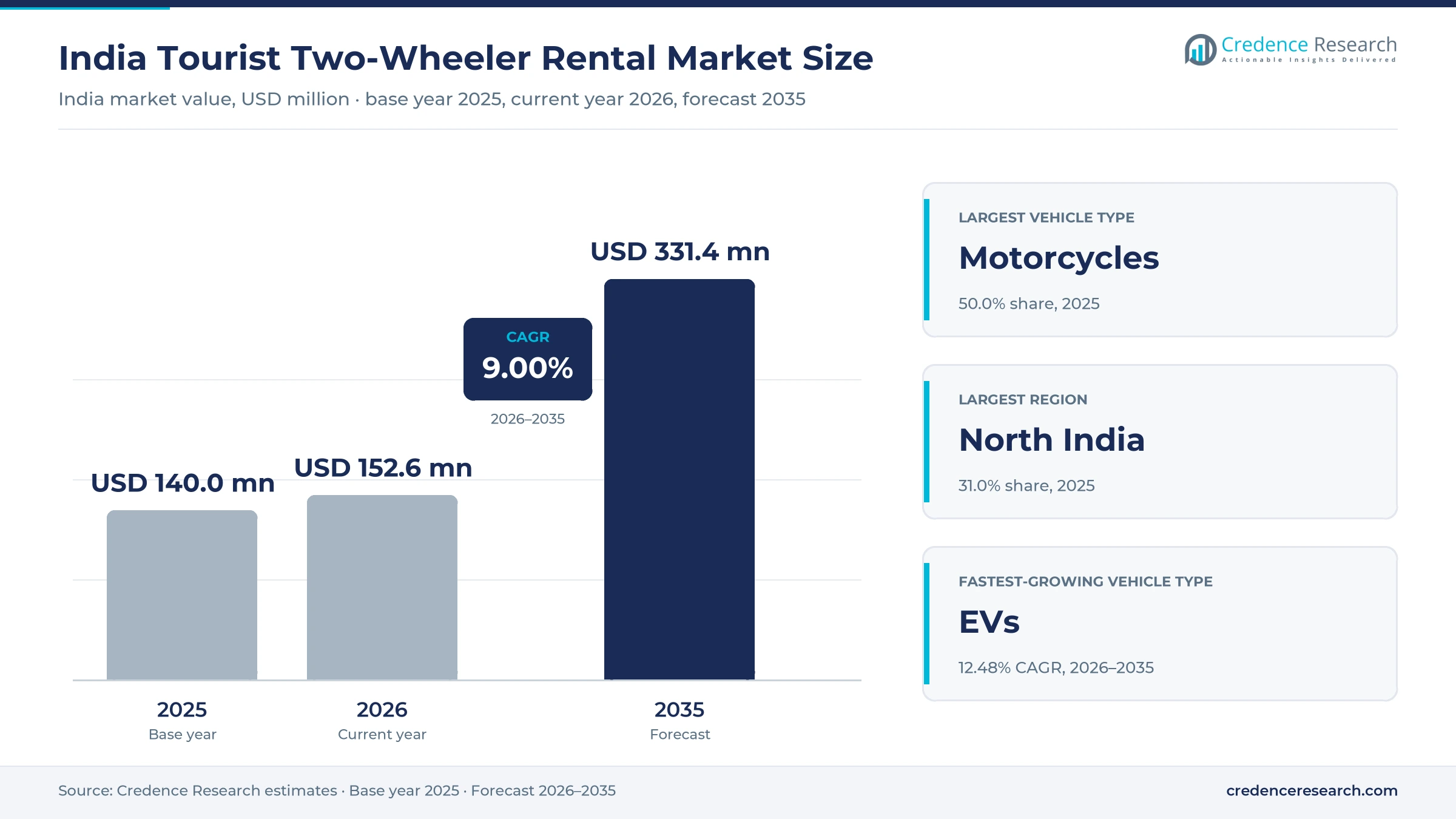
India Tourist Two-Wheeler Rental Market Insights
- The market grows from USD 140.0 million in 2025 to USD 331.4 million by 2035 at a 9.00% CAGR as domestic leisure trips and app bookings widen the rider base.
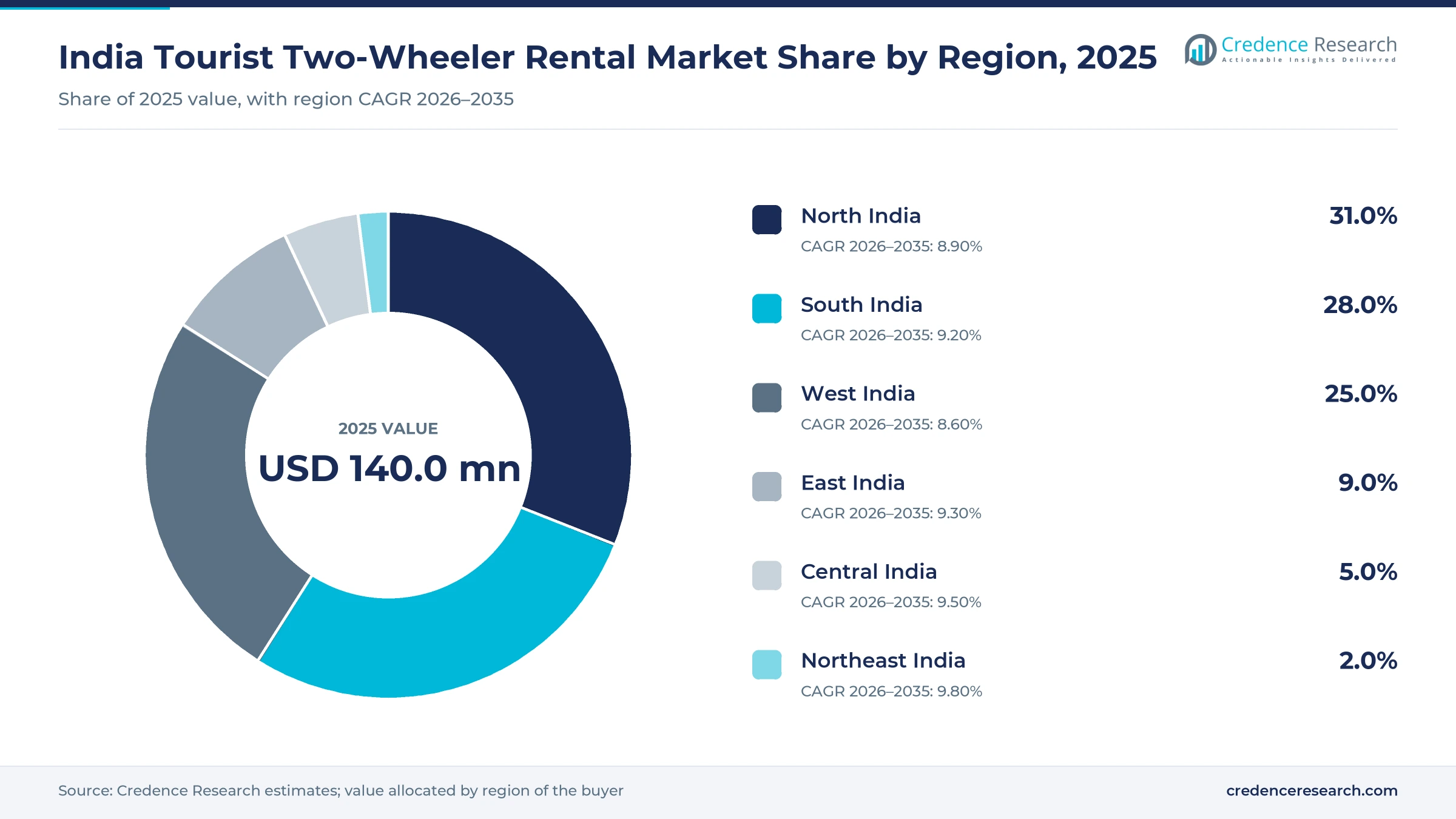
- North India held 31.0% of 2025 value because Himalayan circuits such as Leh and Manali command the longest rides and the highest daily tariffs.
- Motorcycles led the vehicle split with 50.0% in 2025, as touring riders on Ladakh and Himachal routes pay several times scooter rates per day.
- Royal Enfield launched a rental program with more than 40 operators in 25 cities on Sept. 20, 2023, bringing an OEM brand into destination rentals.
- Suzuki Motorcycle India and Royal Brothers began renting the e-Access electric scooter for 24 hours to 12 months in seven cities from March 2026.
Motorcycles and walk-in shops hold the largest shares
Why do motorcycles earn the largest share of rental value?
Based on vehicle, the market is categorized into scooters, motorcycles and EVs. Motorcycles led with 50.0% of 2025 value because touring riders pay far more per day, and a 2026 Leh rate card lists about Rs 1,800 for a Classic 350 against Rs 800 to Rs 1,200 for a scooter. Scooters still serve the cheaper short trips in beach towns such as Goa. EVs grow fastest at 12.48% a year as Suzuki Motorcycle India and Royal Brothers began renting the e-Access electric scooter in seven cities in March 2026, for tenures from 24 hours to 12 months.
Which destinations generate the most rental revenue?
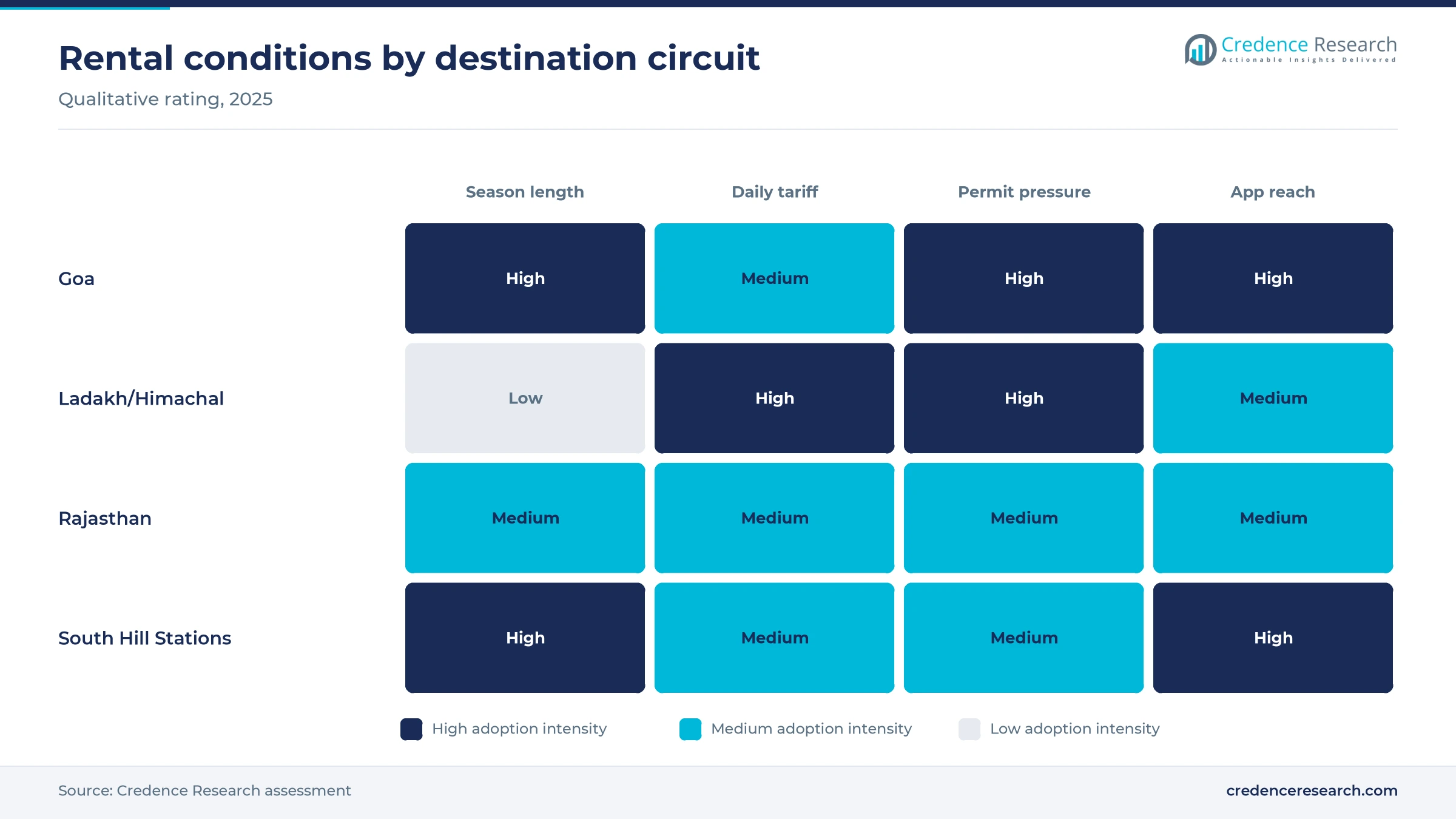
Based on destination, the market is categorized into Goa, Ladakh/Himachal, Rajasthan, South Hill Stations and Other Destinations. Other Destinations held 42.0% of 2025 value because rentals are spread across Rishikesh, Pondicherry, Gokarna, Hampi and many smaller towns. Goa is the largest single circuit, and The Goan reported 29,681 motorcycles for hire registered there by December 2023. Rajasthan grows fastest at 10.18% a year as Royal Enfield named Jaipur, Udaipur and Jaisalmer among its 25 rental destinations in September 2023, and ONN Bikes lists Jaisalmer and Pushkar pages.
How do walk-in shops and apps split the booking market?
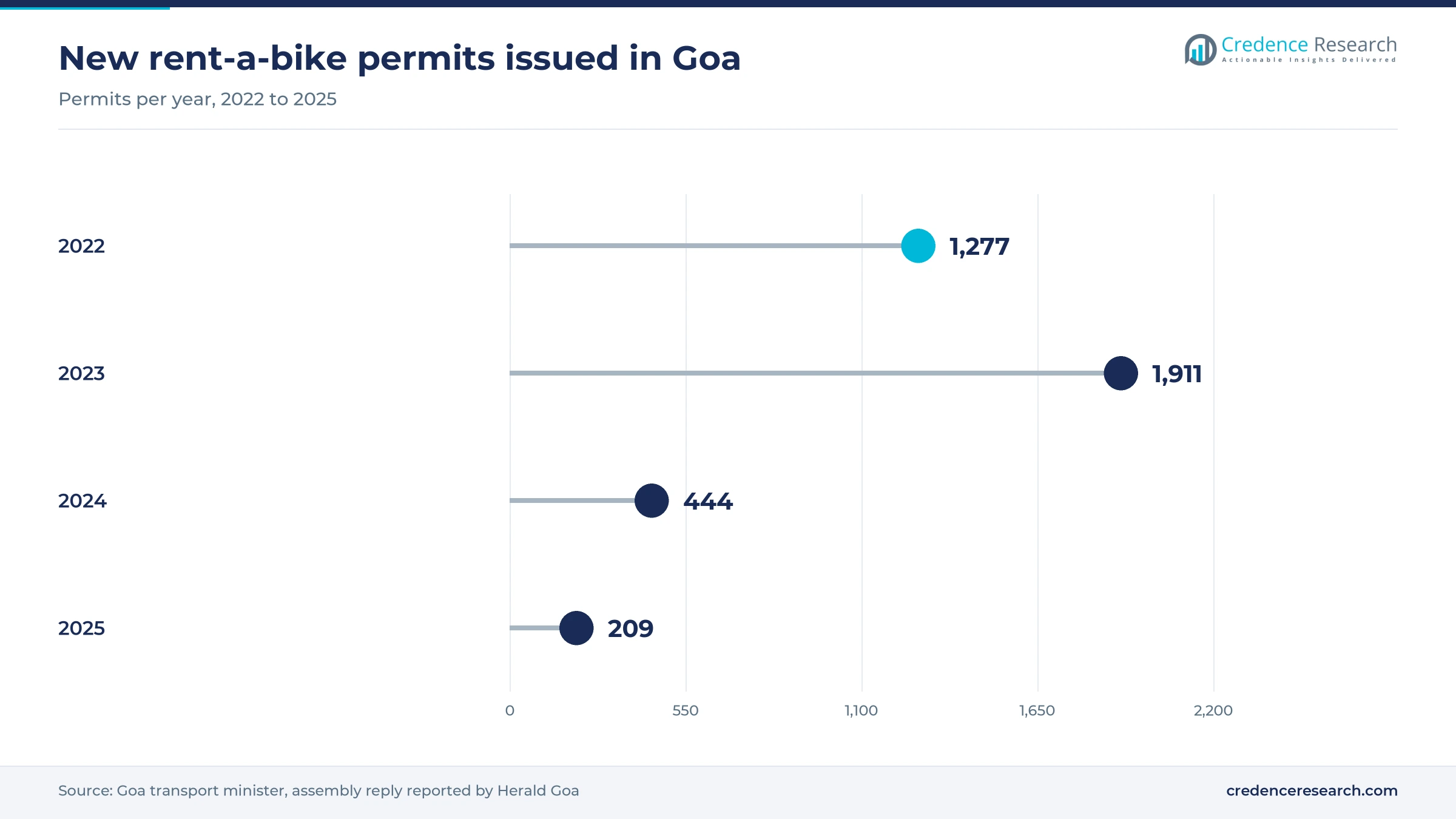
Based on booking, the market is categorized into walk-in and app channels. Walk-In bookings led with 54.0% of 2025 value because most destination fleets belong to small licensed owners, and Goa issued 3,841 rent-a-bike permits from 2022 to 2025 according to the transport minister's reply in the state assembly reported by Herald Goa. App bookings grow fastest at 10.39% a year as ONN Bikes reports more than one million app downloads, and Zoomcar added motorcycles and scooters to its app in Bengaluru on June 30, 2026.
| Segment Group | Leading Sub-segment | Share, 2025 | Fastest-growing Sub-segment | CAGR, 2026–2035 |
|---|---|---|---|---|
| By Vehicle | Motorcycles | 50.0% | EVs | 12.48% |
| By Destination | Other Destinations | 42.0% | Rajasthan | 10.18% |
| By Booking | Walk-In | 54.0% | App | 10.39% |
Request a Free Sample
Fill in your details and we'll send you a free sample report.
- Sample data tables & charts
- Research methodology
Leisure trips and app checks lift bookings at destinations
Tourist mobility needs support rental bookings
Tourist mobility needs form the base of the market because visitors at beaches, passes and hill towns need flexible transport that buses rarely match. The Ministry of Tourism counted 2,948.19 million domestic tourist visits in 2024, and The Policy Edge reported in September 2026 that the 2025 count reached 428.55 crore visits, up 45.5% on the year. Leisure is a large part of this travel, since the MoSPI domestic tourism expenditure survey released on Sept. 23, 2026 found that holidaying made up 36.4% of urban overnight trips. That pool of holiday trips feeds the licensed fleets at Goa, Manali and Leh every season. In the Credence Research model this driver adds about 3.3 percentage points to annual growth to 2035.
App pickup and digital checks simplify rentals
App-based pickup and digital verification simplify rentals because riders can upload a licence, pay and collect a vehicle without queuing at a shop. Royal Brothers, founded in Bengaluru in July 2015, runs a self-ride app with licence upload and document checks in more than 40 cities, according to Indian Startup Times. ONN Bikes lists more than 3,200 active vehicles and over one million app downloads on its franchise page, with hourly, daily and monthly plans. Zoomcar added motorcycle and scooter rentals to its existing app in Bengaluru on June 30, 2026, reusing the verification and payment systems of its car business. As a result, App bookings grow at 10.39% a year, and the Credence Research model credits this driver with about 2.4 percentage points of annual growth.
Leisure destination expansion lifts fleet use
Expansion into leisure destinations lifts fleet utilization because operators can move vehicles toward towns where the season is busiest. ONN Bikes runs rental pages for Coorg, Hampi, Manali, Nainital, Rishikesh, Jaisalmer, Pushkar, Wayanad and Dandeli, and names hotel corridors and hostel clusters as its strongest station formats. Royal Enfield's rental network covers Leh, Manali, Bir Billing, Goa and Kochi among 25 destinations. Demand at these points can recover fast, and Telangana Today reported that Ladakh logged more than 3.3 lakh tourist arrivals from January to July 2026, nearly 98% of its full 2025 tally. In the Credence Research model this adds about 1.8 percentage points to annual growth to 2035.
Motorcycle makers back branded rental networks
Motorcycle makers now back rental networks because a rented ride works as a long test ride for a future buyer. Royal Enfield launched its rental program on Sept. 20, 2023 with more than 300 motorcycles from over 40 operators, according to the Eicher Motors press release. Suzuki Motorcycle India then partnered Royal Brothers Rentals in March 2026 to offer the e-Access in Bengaluru, Hyderabad, Ahmedabad, Visakhapatnam, Bhubaneswar, Jaipur and Gurugram. Royal Brothers had earlier taken a Yamaha-linked minority investment in February 2022, Indian Startup Times reported. This OEM support keeps premium bikes in fleets, which helps Motorcycles hold 50.0% of value.
Electric fleets and stricter local rules reshape the trade
Electric scooters shift into rental fleets
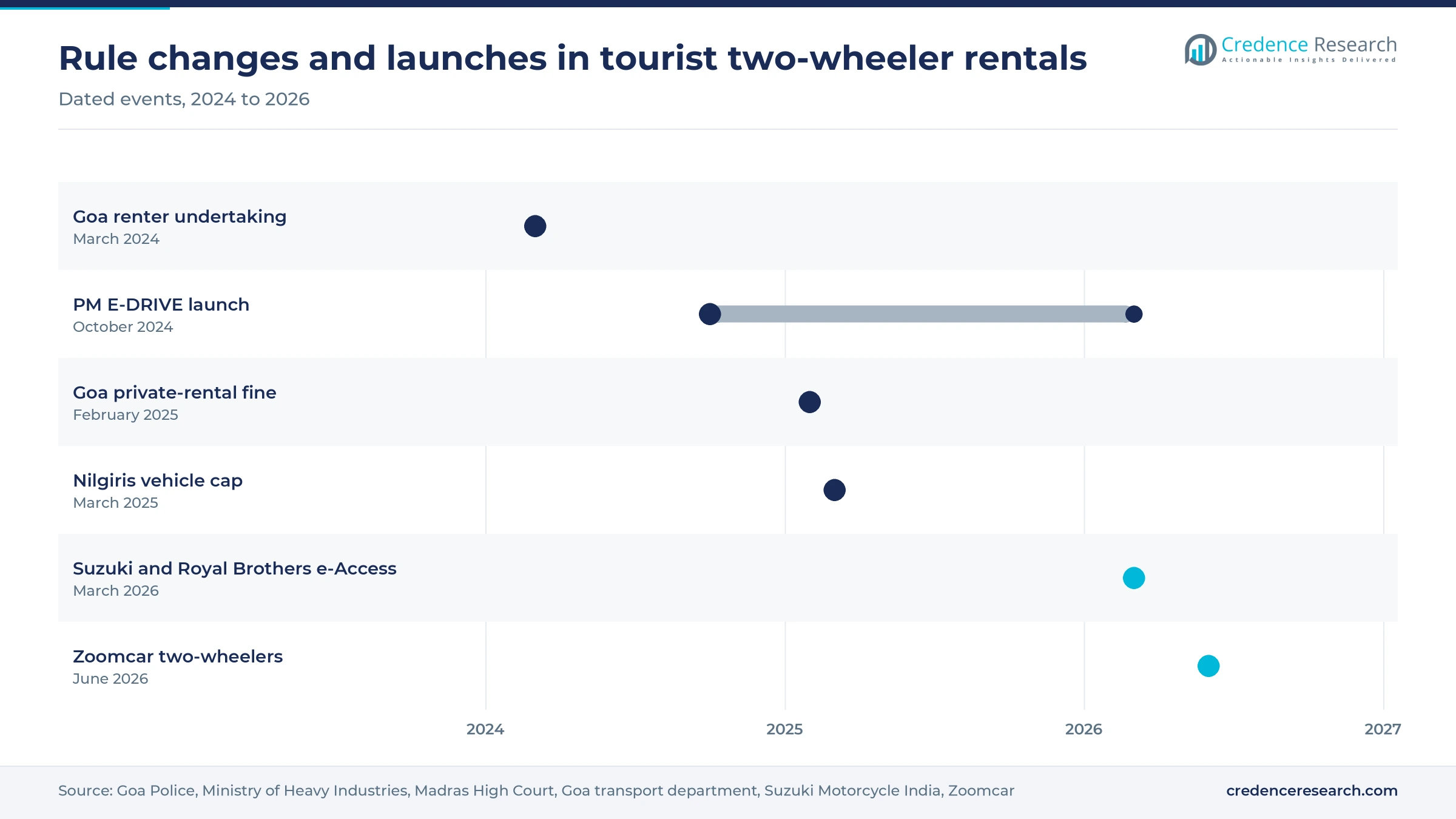
A shift toward electric scooters is under way in rental fleets because low running costs suit short tourist trips in towns. The PM E-DRIVE scheme, launched on Oct. 1, 2024 with an outlay of Rs 10,900 crore, targeted 24.79 lakh electric two-wheelers and funded 48,400 chargers for two- and three-wheelers, Autocar Professional reported. Its purchase subsidy fell from Rs 5,000 to Rs 2,500 per kWh in April 2025 and ended for two-wheelers on March 31, 2026, which raised fleet prices. Even so, the Royal Brothers website now lists try-before-you-buy electric models, including the e-Access, in several cities and electric scooter sales give fleets a wider choice of models. As a result, EVs grow at 12.48% a year, the fastest rate in the vehicle split.
Stricter local rules shift rental operations
Destination authorities are shifting rental operations toward stricter compliance, because accidents and disputes involving tourists draw public pressure. A Himachal Pradesh transport notification of Aug. 25, 2017 requires GPS and a fare meter on every rented motorcycle and limits licences to bona fide Himachalis, while private bikes may join only within four years of registration. Goa told operators in October 2022 to issue only ISI-marked helmets, and on March 13, 2024 Goa police required tourists to sign a safe-driving undertaking, ThePrint reported. In Ladakh, a 2026 Leh rate guide notes that bikes rented outside Leh cannot be used for Nubra or Pangong sightseeing. These rules favor licensed, well-documented fleets over informal lenders that rent private bikes.
Premium adventure rentals open higher yields
Premium adventure rentals are an opportunity because mountain riders pay the highest tariffs and stay on a bike for many days. A 2026 Leh rate card lists Rs 3,000 to Rs 3,500 a day for a Himalayan 450 and Rs 3,500 for an Interceptor 650, against Rs 800 to Rs 1,200 for a scooter. Ladakh arrivals are recovering, since Telangana Today reported 3.3 lakh visitors from January to July 2026. Riders who outgrow a rented bike often move to buying one, which links this niche with the wider motorcycle industry. Operators that add adventure models, luggage and support vehicles can lift revenue per rental day.
Franchise fleets can reach pilgrimage towns
Franchise fleets can reach pilgrimage towns, which is an opportunity because temple circuits draw huge visitor counts but have few licensed rental counters. The Policy Edge reported that Uttar Pradesh recorded 155.74 crore domestic visits in 2025, including the Kumbh Mela. Pilgrimage was the leading purpose of overnight trips in the MoSPI survey, at about 48%. ONN Bikes sells franchise packages from Rs 14.2 lakh for 15 vehicles and already runs rental pages for Ayodhya and Rishikesh, a base for Char Dham pilgrimage travel. Partners near hotels and bus stands can fill vehicles across festival seasons.
Permit freezes and enforcement slow fleet growth
Traffic violations draw enforcement on Goa rentals
Traffic violations by renters draw heavy enforcement in Goa, the largest single circuit. Navhind Times reported 14,718 cases against rented bikes in 2024 and 3,629 more in January and February 2025, with tourists making up most violators. Police say accidents involving rental vehicles are twice those of other vehicles. As a result, operators face seizures, suspended registrations and higher insurance costs. Mitigation depends on helmet checks, briefings and digital records of each renter's licence.
Permit freezes cap fleet growth in Goa
Permit limits cap fleet growth in Goa, which slows supply at the peak of the season. Herald Goa reported that new rent-a-bike permits fell from 1,911 in 2023 to 444 in 2024 and 209 in 2025, according to the transport minister. In addition, an order of Feb. 28, 2025 set a Rs 10,000 fine and registration suspension for renting private vehicles, The Goan reported. Operators therefore expand by raising utilization of existing yellow-plate vehicles rather than adding new ones.
Interstate rental disputes limit Himalayan routes
Disputes between rental associations limit Himalayan routes, because Leh and Manali operators each protect their local trade. The Tribune reported that Leh residents vandalized 15 bikes rented from Manali in May 2023, and leaders asked the Ladakh lieutenant governor to restrict Himachal rental bikes. The lieutenant governor then referred the matter to the Union road transport ministry. Riders who start in Manali must therefore switch bikes in Leh for Nubra or Pangong, which raises trip costs and splits bookings between operators.
Volatile footfall and vehicle caps hit hill towns
Volatile footfall and vehicle caps cut rental days in hill towns. Outlook Traveller reported in March 2026 that domestic arrivals in Leh fell from 292,836 in 2024 to 212,799 in 2025, while Kargil dropped from 320,432 to 93,389. In Tamil Nadu, a Madras High Court order of March 13, 2025 capped Nilgiris entries at 6,000 vehicles a day on weekdays, LiveLaw reported. Operators with fleets in one town absorb these swings, so many now shift bikes between circuits.
North India leads on Himalayan routes as South India gains
| Region | Value, 2025 (USD million) | Share, 2025 | CAGR, 2026–2035 |
|---|---|---|---|
| North India | 43.4 | 31.0% | 8.90% |
| South India | 39.2 | 28.0% | 9.20% |
| West India | 35.0 | 25.0% | 8.60% |
| East India | 12.6 | 9.0% | 9.30% |
| Central India | 7.0 | 5.0% | 9.50% |
| Northeast India | 2.8 | 2.0% | 9.80% |
North India leads on Himalayan motorcycle circuits
North India held 31.0% of 2025 tourist two-wheeler rental demand by value and grows at 8.90% a year, because Leh, Manali, Rishikesh and Dharamshala draw multi-day motorcycle trips. Rates in Leh run about Rs 1,800 a day for a Classic 350, according to a 2026 rate guide. The zone is volatile, since Leh domestic arrivals fell to 212,799 in 2025 before Ladakh passed 3.3 lakh visitors by July 2026. Rajasthan adds desert circuits in Jaipur, Udaipur and Jaisalmer, where Royal Enfield lists rental partners.
South India gains on hill towns and heritage circuits
South India held 28.0% of 2025 tourist two-wheeler rental value and grows at 9.20% a year, helped by Coorg, Wayanad, Hampi, Munnar and Pondicherry. Tamil Nadu alone recorded 306.84 million domestic tourist visits in 2024, according to the Ministry of Tourism compendium. App platforms are strongest here, since Royal Brothers is based in Bengaluru and Zoomcar began two-wheeler rentals in the same city in June 2026. Vehicle caps in the Nilgiris and Kodaikanal shape weekend demand in Tamil Nadu.
West India centers on Goa beach rentals
West India held 25.0% of 2025 tourist two-wheeler rental value and grows at 8.60% a year, slower than the national rate because Goa controls new permits. Goa had 29,681 motorcycles for hire registered by December 2023, after the category grew 99.33% between 2019-20 and 2022-23, and these yellow-plate vehicles serve beach travel across the state. Lonavala, Mahabaleshwar, Kutch and Diu add smaller weekend circuits for riders from Mumbai and Pune. Enforcement weighs on growth, as Goa recorded 14,718 cases against rented bikes in 2024.
East India grows from coastal and gateway towns
East India held 9.0% of 2025 value and grows at 9.30% a year, from Puri, Bhubaneswar and Darjeeling hill routes. Royal Enfield included Bhubaneswar and Siliguri in its 25 rental destinations in September 2023, and Bhubaneswar was one of seven launch cities for the Suzuki and Royal Brothers electric scooter rentals in March 2026. Fleets here are smaller and more seasonal, so app listings help operators fill vehicles in quieter months.
Central India builds on heritage and wildlife trips
Central India held 5.0% of 2025 value and grows at 9.50% a year, as riders explore heritage towns and national parks in Madhya Pradesh. Deccan Herald ranked Madhya Pradesh ninth for domestic visits in 2024, with 133 million visits. Rental fleets there remain small, and most riders in heritage towns rent from walk-in shops near hotels. Franchise models offer a low-cost way to add counters in these towns.
Northeast India is the fastest-growing zone from a low base
Northeast India held 2.0% of 2025 value and grows fastest at 9.80% a year, as riders plan Sikkim, Meghalaya and Arunachal routes. Most rides into Sikkim, Meghalaya and Arunachal start from Guwahati or from Siliguri just outside the zone, where Royal Enfield named a rental destination in September 2023. In turn, operators that hold local licences and offer support vehicles capture most of the zone's small value.
OEM programs, app launches and rule changes, 2023 to 2026
| Development | Status and market relevance |
|---|---|
| In September 2023, Royal Enfield launched Royal Enfield Rentals with more than 300 motorcycles from over 40 operators across 25 cities and destinations. | Active; brings an OEM brand to Leh, Manali, Goa and Jaisalmer rentals |
| In October 2024, the PM E-DRIVE scheme began with a Rs 10,900 crore outlay and a target of 24.79 lakh electric two-wheelers. | Two-wheeler subsidy ended March 31, 2026; chargers support electric fleets |
| In February 2025, the Goa transport department set a Rs 10,000 fine and registration suspension for renting out private vehicles. | In force; pushes renters toward licensed yellow-plate fleets |
| In March 2026, Suzuki Motorcycle India and Royal Brothers Rentals began renting the e-Access electric scooter for 24 hours to 12 months in seven cities. | Active; OEM electric scooter offered on a multi-city rental app |
| In June 2026, Zoomcar added motorcycle and scooter rentals to its app in Bengaluru, using its existing verification and payment systems. | Pilot city; wider rollout through local partners under review |
Digital checks, GPS and electric scooters change operations
- Digital licence checks let platforms such as Royal Brothers verify a rider before pickup, which cuts counter time at busy stations.
- GPS tracking is mandatory on rented motorcycles in Himachal Pradesh under the 2017 guidelines, and it helps operators recover vehicles and bill distance.
- Electric scooters such as the Suzuki e-Access suit short town trips, while the PM E-DRIVE charger program extends where they can be used.
- Hourly pricing engines let ONN Bikes advertise rentals from Rs 8 an hour, which brings short sightseeing trips into the market.
Need a Custom Version of This Report?
Tailor the scope, geography, or segments to your exact requirements.
- Custom geography or segment scope
- Direct access to our analyst team
Local shops compete with app platforms and OEM networks
Competition in tourist two-wheeler rental is fragmented across thousands of small fleets. In beach and hill towns, licensed local shops hold most fleets and win walk-in renters through location near hotels, bus stands and ferry points, while associations in Leh and Manali defend local routes. App platforms compete on reach, verified documents and advance payment. Royal Brothers runs a self-ride app across more than 40 cities, partly through franchises and ONN Bikes reports more than 3,200 active vehicles across about 20 cities through franchise partners. Motorcycle makers support the trade in a different way, as Royal Enfield lists approved rental operators and Suzuki supplies electric scooters through Royal Brothers. Zoomcar's June 2026 entry shows that car hire apps also see two-wheelers as a way to add trips. Price competition is sharpest for scooters, while premium motorcycles, support vehicles and multi-day tour packages earn higher margins.
Companies profiled and their roles in this market
| Company | Type | Role in the market |
|---|---|---|
| Royal Brothers | App-based rental platform | Self-ride rentals in 40+ cities; e-Access partner with Suzuki since March 2026 |
| ONN Bikes | Franchise rental network | 3,200+ active vehicles; pages for Manali, Hampi, Coorg, Jaisalmer and Pushkar |
| Royal Enfield | OEM rental program | Royal Enfield Rentals launched Sept. 20, 2023 with 40+ operators in 25 cities |
| Suzuki Motorcycle India | OEM partner | Supplies the e-Access electric scooter for rental and subscription |
| Zoomcar | App-based rental platform | Added motorcycles and scooters in Bengaluru on June 30, 2026 |
| Local rental shops | Licensed destination operators | Yellow-plate fleets in Goa, Leh, Manali and hill towns |
Permits and app reach will decide which fleets scale
Credence Research's view is that permits and app reach will decide which tourist two-wheeler rental fleets scale through 2035, as the market more than doubles from USD 140.0 million. Tourist demand is broad, with domestic visits rising sharply in 2025, but the best destinations restrict new vehicles, as Goa's falling permit counts show. Growth will therefore come from higher utilization of licensed fleets, app bookings that fill vehicles before travelers arrive and electric scooters on short tenures. Operators that hold local licences in several circuits can shift bikes between seasons, which protects them from swings such as Ladakh's 2025 dip. Premium motorcycles will keep the highest yields, so brand partnerships with motorcycle makers remain valuable.
How the tourist rental revenue model was built
The report uses 2025 as the base year and forecasts to 2035. Market values come from the Credence Research model, built bottom-up from destination fleets, typical daily tariffs and rental days, and checked against visitor statistics. Regional, destination, vehicle and booking splits are Credence Research estimates. Inputs include Ministry of Tourism and MoSPI statistics, state transport notifications and assembly replies, court orders reported in the press, company releases and platform websites. The report did not conduct interviews or surveys, and it relies only on the published sources listed above.
Leisure travel and electric fleets set growth to 2035
Through 2035 the tourist two-wheeler rental market grows at a 9.00% CAGR, reaching USD 331.4 million, as leisure travel widens and app booking becomes standard at major destinations. North India will keep the lead on Himalayan circuits, while South India and the Northeast add counters in hill towns and gateway cities. Demand for EVs will rise in town rentals as the 48,400 two- and three-wheeler chargers funded under PM E-DRIVE come into use. In turn, motorcycles will hold value on mountain routes where daily tariffs are highest. Permit policy in Goa and route rules in Ladakh remain the main swing factors, so operators that diversify across circuits and keep strong safety records should gain share.
Frequently Asked Questions
How big is the India tourist two-wheeler rental market?
Which region leads the market?
Which vehicle type holds the largest share?
Which vehicle type grows fastest?
How do tourists book rentals?
What limits growth in Goa?
Who are the key companies in the market?
Which region grows fastest?
Table of Content
Chapter 1 Market Segmentation
- 1.1 Segmentation Framework
- 1.1.1 Product and Service Classification
- 1.1.2 Application and End-Use Classification
- 1.1.3 Technology and Solution Classification
- 1.1.4 Customer and Distribution Channel Classification
- 1.1.5 Geographic Segmentation
- 1.1.6 Market Segment Definitions and Boundaries
- 1.2 By Vehicle
- 1.2.1 Motorcycles
- 1.2.2 Scooters
- 1.2.3 EVs
- 1.3 By Destination
- 1.3.1 Goa
- 1.3.2 Ladakh/Himachal
- 1.3.3 Rajasthan
- 1.3.4 South Hill Stations
- 1.3.5 Other Destinations
- 1.4 By Booking
- 1.4.1 Walk-In
- 1.4.2 App
Chapter 2 Introduction
- 2.1 Report Objectives and Scope
- 2.2 Product Definition and Industry Terminology
- 2.3 Market Inclusions and Exclusions
- 2.4 Research Process
- 2.4.1 Primary Research and Expert Interviews
- 2.4.2 Secondary Research and Source Review
- 2.4.3 Top-Down and Bottom-Up Estimation
- 2.4.4 Data Triangulation and Verification
- 2.5 Market Size Measurement Basis
- 2.5.1 2025: USD 140.0 million → 2035: USD 331.4 million
- 2.6 Historical and Forecast Reference Periods
- 2.6.1 Historical Period: 2018-2025
- 2.6.2 Base Year: 2025
- 2.6.3 Forecast Period: 2025-2035
- 2.7 Research Assumptions and Limitations
Chapter 3 Executive Summary
- 3.1 Market Snapshot and Key Findings
- 3.2 Base-Year Market Size, 2025
- 3.3 Forecast Market Size, 2035
- 3.4 Revenue and Volume Growth Outlook
- 3.5 Key Demand and Supply Indicators
- 3.6 Leading Market Segments
- 3.7 Fastest-Growing Market Opportunities
- 3.8 Regional Performance Highlights
- 3.9 Technology and Industry Transformation
- 3.10 Competitive Landscape Summary
- 3.11 Analyst View and Strategic Implications
Chapter 4 India Tourist Two-Wheeler Rental Market Trends and Developments
- 4.1 Historical Industry Development, 2018-2025
- 4.2 Recent Market Trends and Developments
- 4.3 Demand and Customer Behavior Trends
- 4.4 Technology and Product Innovation
- 4.5 Artificial Intelligence, Automation and Digitalization
- 4.6 Local Manufacturing and Supply Chain Realignment
- 4.7 Industry Partnerships, Mergers and Acquisitions
- 4.8 Sustainability and Circular Economy Developments
- 4.9 Government and Private Sector Investment Trends
- 4.10 Emerging Business Models and Commercialization
- 4.11 Industry Developments and Announcements
Chapter 5 India Tourist Two-Wheeler Rental Market Supply and Demand Analysis
- 5.1 Demand Trend and Consumption Analysis, 2018-2025
- 5.2 Demand Forecast, 2025-2035
- 5.3 Supply Chain Structure and Procurement Trends
- 5.4 Supply-Demand Gap and Bottlenecks
- 5.5 Import Dependence and Sourcing Structure
- 5.6 Regional Supply and Demand Concentration
Chapter 6 India Tourist Two-Wheeler Rental Market Pricing Analysis
- 6.1 Pricing Structure and Measurement
- 6.2 Historical Pricing Trends, 2018-2025
- 6.3 Pricing Outlook, 2025-2035
- 6.4 Pricing by Product and Market Segment
- 6.5 Geographic Pricing Differences
- 6.6 Key Input, Energy, Labor and Logistics Costs
- 6.7 Contract Pricing and Purchasing Models
- 6.8 Pricing Sensitivity and Competitive Positioning
- 6.9 Price, Margin and Profitability Implications
Chapter 7 India Tourist Two-Wheeler Rental Market Dynamics
- 7.1 Market Growth Drivers
- 7.1.1 Demand-Side Drivers
- 7.1.2 Technology and Innovation Drivers
- 7.1.3 Infrastructure and Investment Drivers
- 7.1.4 Regulatory and Policy Drivers
- 7.2 Market Restraints
- 7.2.1 Cost and Affordability Constraints
- 7.2.2 Technology and Adoption Barriers
- 7.2.3 Supply Chain and Operational Constraints
- 7.3 Market Challenges
- 7.3.1 Competitive Pressure and Margin Erosion
- 7.3.2 Skills, Infrastructure and Implementation Gaps
- 7.4 Emerging Market Opportunities
- 7.5 Market Dynamics Impact and Time-Horizon Assessment
Chapter 8 India Tourist Two-Wheeler Rental Value Chain Analysis
- 8.1 Industry Value Chain Overview
- 8.2 Upstream Suppliers and Critical Inputs
- 8.3 Technology and Component Providers
- 8.4 Manufacturing or Service Delivery
- 8.5 Distribution, Channel Partners and Integrators
- 8.6 Downstream Applications and End Users
- 8.7 Value Addition and Profit Pools
- 8.8 Vertical Integration and Outsourcing
- 8.9 Supplier Concentration and Risk
- 8.10 Supply Chain Localization and Resilience
Chapter 9 India Tourist Two-Wheeler Rental Market Regulations and Policies
- 9.1 Relevant Laws, Standards and Compliance Frameworks
- 9.2 Product, Service, Safety and Quality Requirements
- 9.3 Government Policies, Incentives and Subsidies
- 9.4 Imports, Exports and Trade Barriers
- 9.5 Public Procurement and Local Content Requirements
- 9.6 Data Protection, AI and Cybersecurity Compliance
- 9.7 Upcoming Policy Changes and Market Implications
Chapter 10 India Tourist Two-Wheeler Rental Market Hotspots and Opportunities
- 10.1 Market Opportunity Mapping and Growth Hotspots
- 10.2 High-Growth Applications and Customer Groups
- 10.3 Underserved Markets and White-Space Opportunities
- 10.4 Emerging Technology and Product Opportunities
- 10.5 New Capacity and Investment Hotspots
- 10.6 Market Entry and Expansion Opportunities
- 10.7 Distribution and Partnership Opportunities
- 10.8 Near-Term and Long-Term Commercial Potential
- 10.9 Opportunity Attractiveness and Execution Risks
Chapter 11 India Tourist Two-Wheeler Rental Market Outlook, 2025-2035
- 11.1 Market Size and Analysis
- 11.1.1 Revenue (Market Measurement: 2025: USD 140.0 million → 2035: USD 331.4 million)
- 11.1.2 Historical Market Size, 2018-2025
- 11.1.3 Base-Year Market Size, 2025
- 11.2 Market Forecast, 2025-2035
- 11.2.1 Revenue Forecast to 2035
- 11.2.2 CAGR and Year-on-Year Growth
- 11.2.3 Incremental Revenue Opportunity
- 11.3 Forecast Assumptions and Scenario Analysis
- 11.3.1 Base-Case Forecast
- 11.3.2 Optimistic and Conservative Scenarios
- 11.3.3 Technology, Pricing and Policy Sensitivities
- 11.4 Market Attractiveness and Growth Outlook
Chapter 12 India Tourist Two-Wheeler Rental Market Segmentation and Outlook
- 12.1 Segmentation Summary and Market Shares, 2025
- 12.2 Largest and Fastest-Growing Segments
- 12.3 By Vehicle - Market Size and Forecast, 2025-2035
- 12.3.1 Segment Definition and Scope
- 12.3.2 Historical Market Size, 2018-2025
- 12.3.3 Revenue Forecast, 2025-2035
- 12.3.4 Base-Year Market Share, 2025
- 12.3.5 Segment CAGR and Growth Drivers
- 12.3.6 Subsegment Market Size and Forecast
- 12.3.6.1 Motorcycles
- 12.3.6.2 Scooters
- 12.3.6.3 EVs
- 12.3.7 Subsegment Pricing and Adoption Trends
- 12.3.8 Leading Suppliers and Competition
- 12.3.9 Regional Demand and Opportunities
- 12.4 By Destination - Market Size and Forecast, 2025-2035
- 12.4.1 Segment Definition and Scope
- 12.4.2 Historical Market Size, 2018-2025
- 12.4.3 Revenue Forecast, 2025-2035
- 12.4.4 Base-Year Market Share, 2025
- 12.4.5 Segment CAGR and Growth Drivers
- 12.4.6 Subsegment Market Size and Forecast
- 12.4.6.1 Goa
- 12.4.6.2 Ladakh/Himachal
- 12.4.6.3 Rajasthan
- 12.4.6.4 South Hill Stations
- 12.4.6.5 Other Destinations
- 12.4.7 Subsegment Pricing and Adoption Trends
- 12.4.8 Leading Suppliers and Competition
- 12.4.9 Regional Demand and Opportunities
- 12.5 By Booking - Market Size and Forecast, 2025-2035
- 12.5.1 Segment Definition and Scope
- 12.5.2 Historical Market Size, 2018-2025
- 12.5.3 Revenue Forecast, 2025-2035
- 12.5.4 Base-Year Market Share, 2025
- 12.5.5 Segment CAGR and Growth Drivers
- 12.5.6 Subsegment Market Size and Forecast
- 12.5.6.1 Walk-In
- 12.5.6.2 App
- 12.5.7 Subsegment Pricing and Adoption Trends
- 12.5.8 Leading Suppliers and Competition
- 12.5.9 Regional Demand and Opportunities
- 12.6 Segment Growth Comparison
- 12.7 Segment Attractiveness and Priority Matrix
Chapter 13 India Tourist Two-Wheeler Rental Geographic Market Outlook, 2025-2035
- 13.1 Domestic Market Distribution and Demand Clusters
- 13.2 State- or Province-Wise Market Size and Forecast, 2025-2035
- 13.3 City and Metropolitan Market Outlook
- 13.4 Industrial, Manufacturing and Commercial Clusters
- 13.5 Geographic Concentration of Key End Users
- 13.6 Local Pricing and Purchasing Differences
- 13.7 Domestic Production Facilities and Capacity Map
- 13.8 Local Infrastructure and Project Pipeline
- 13.9 State-Level Policy and Incentive Differences
- 13.10 Subnational Investment Hotspots and Opportunities
- 13.11 Distribution and Logistics Networks
- 13.12 Domestic Competitive Footprint
Chapter 14 India Tourist Two-Wheeler Rental Technology, Innovation and Sustainability Outlook
- 14.1 Technology Landscape and Maturity
- 14.2 Product, Process and Service Innovation
- 14.3 AI, Automation and Digital Tools in the Industry
- 14.4 Technology Adoption and Performance Benchmarking
- 14.5 Innovation Pipeline and R&D Investment
- 14.6 Energy Efficiency and Resource Management
- 14.7 Sustainability, Recycling and Circularity
- 14.8 Technology Roadmap, 2025-2035
- 14.9 Risks of Obsolescence and Technology Substitution
Chapter 15 India Tourist Two-Wheeler Rental Market Key Strategic Imperatives
- 15.1 Growth and Market Entry Priorities
- 15.2 High-Return Products and Segments
- 15.3 Pricing, Profitability and Cost Optimization
- 15.4 Technology Investment and Product Differentiation
- 15.5 Supply Chain Localization and Resilience
- 15.6 Distribution and Customer Acquisition
- 15.7 Partnership, Acquisition and Capacity Strategy
- 15.8 Regional Expansion Priorities
- 15.9 Short-, Medium- and Long-Term Actions
Chapter 16 Competition Outlook
- 16.1 Industry Competition Characteristics
- 16.2 Market Structure and Concentration
- 16.3 Market Share and Competitive Positioning, 2025
- 16.4 Company-Wise Revenue and Product Benchmarking
- 16.5 Production and Service Capacity Benchmarking
- 16.6 Technology, Pricing and Differentiation
- 16.7 Regional Footprint and Distribution Strength
- 16.8 Mergers, Acquisitions and Strategic Alliances
- 16.9 New Entrants and Competitive Threats
- 16.10 Porter's Five Forces and Industry Attractiveness
- 16.11 Competitive Outlook, 2025-2035
Chapter 17 Company Profiles
- 17.1 Company Coverage and Selection Criteria
- 17.2 Royal Brothers
- 17.2.1 Business Description
- 17.2.2 Company Ownership and Geographic Presence
- 17.2.3 Product and Service Portfolio
- 17.2.4 Manufacturing and Operating Footprint
- 17.2.5 Financial Performance and Investment
- 17.2.6 Market Share and Competitive Position
- 17.2.7 Technology and Innovation Capabilities
- 17.2.8 Strategic Alliances or Partnerships
- 17.2.9 Recent Developments
- 17.2.10 Growth Strategy and Outlook
- 17.3 ONN Bikes
- 17.4 Royal Enfield
- 17.5 Suzuki Motorcycle India
- 17.6 Zoomcar
- 17.7 Local rental shops
- 17.8 Other Relevant Market Participants
Note: Every listed company is profiled on the structure shown under the first company. The company list is preliminary and may change based on research findings, market developments, data availability and client requirements.
Chapter 18 Disclaimer
- 18.1 Research and Forecast Disclaimer
- 18.2 Data Source and Estimation Limitations
Note: The depth of individual sections depends on data availability for this market. Volume, capacity, trade and other unit-based metrics are included where applicable.

