
Grounded fleets and new hangars keep repair work busy
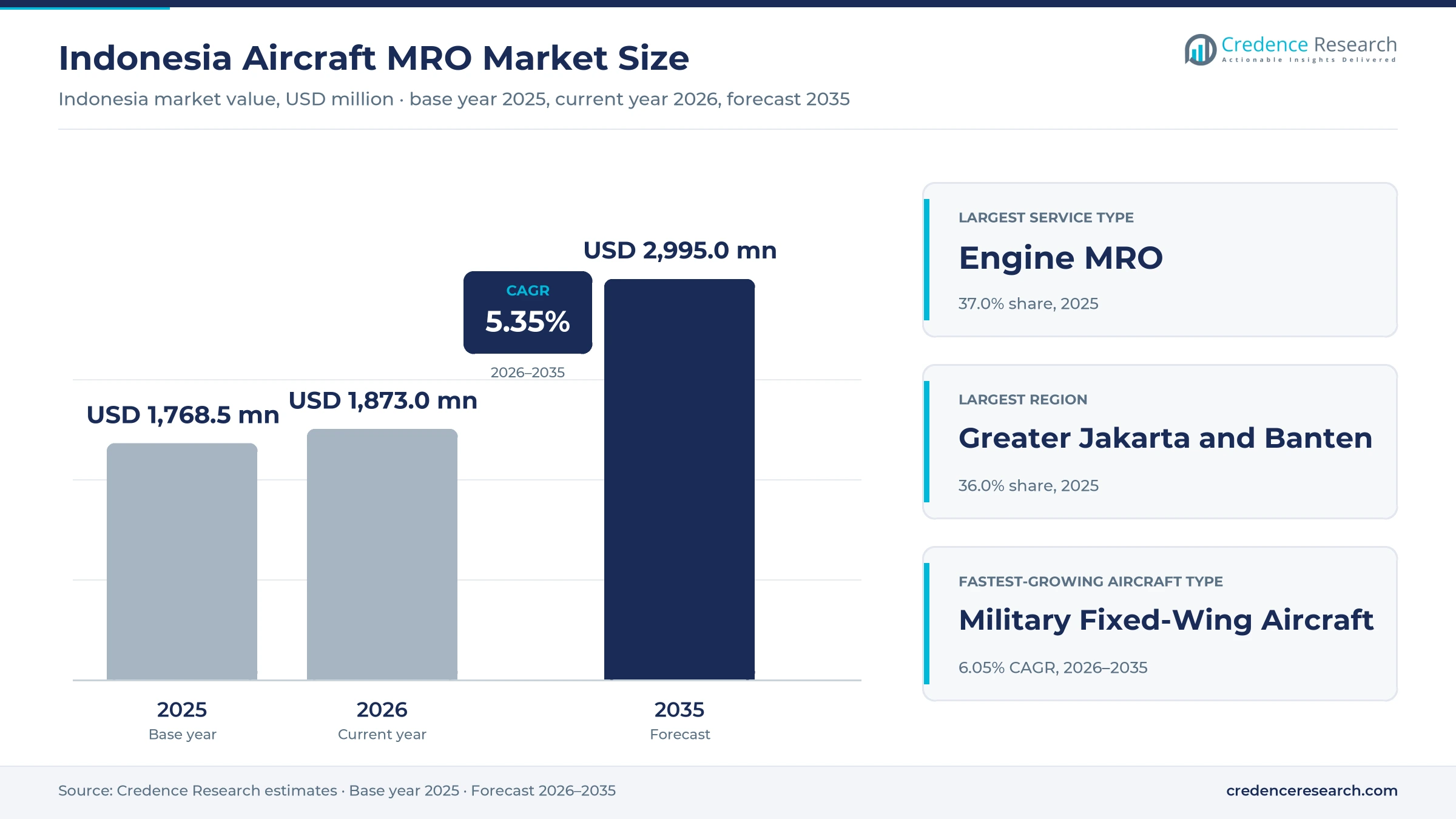
The Indonesia aircraft MRO market was valued at USD 1.77 billion in 2025 and is projected to increase from USD 1.87 billion in 2026 to USD 2.99 billion by 2035, registering a CAGR of 5.35% during 2026–2035. Demand comes from airlines that fly a large narrow-body fleet across thousands of islands, from grounded aircraft returning to service and from defense operators that want local support. Greater Jakarta and Banten held the largest regional share, 36.0% in 2025, because the main airline bases and the largest hangars sit around Soekarno-Hatta. Batam and the Riau Islands grow fastest at 5.95% a year, as new hangars open at Hang Nadim Airport. The most important policy change is a cut in import duties on maintenance supplies to zero, which lowers the cost of parts that local shops still buy from abroad and helps them win work that left the country.
Which maintenance services does the estimate count?
The estimate measures spending on maintenance, repair and overhaul of fixed-wing aircraft operated in Indonesia. It covers engine shop visits, airframe heavy checks, component repair, line maintenance, modifications and cabin work, whether done by airline-owned shops, independent hangars, manufacturer-authorized centers or state-owned providers. Values are stated in USD million at current prices, converted from rupiah at average annual exchange rates.
The estimate excludes the purchase of new aircraft, spare engines bought as assets, fuel, crew training and airport ground handling. It counts work done for Indonesian operators by shops in the country, as well as the value of work they send abroad. The value chain runs from parts makers and lessors through maintenance providers to airlines, the air force and private operators.
Indonesia Aircraft MRO Market Insights
- The Indonesia aircraft MRO market was valued at USD 1.77 billion in 2025 and is projected to reach USD 2.99 billion by 2035, registering a CAGR of 5.35% during 2026–2035.
- Greater Jakarta and Banten held 36.0% of 2025 maintenance value, because the main airline bases and largest hangars sit near Soekarno-Hatta.
- Engine MRO led with 37.0% of 2025 value, as about 270 CFM56-7B engines in Indonesia need regular shop visits and on-wing support.
- Batam Aero Technic opened its seventh hangar at Hang Nadim Airport on Nov. 19, 2025, adding more than 10,000 square meters of floor space.
- Independent providers grow fastest at 6.08% a year during 2026–2035, as new hangars in Bali and Jakarta take base and heavy checks.
Engine work and narrow-body fleets carry the most value
Why does engine work carry the most value?
Based on service type, the market is categorized into engine MRO, airframe heavy maintenance, component repair and overhaul, line maintenance and modifications and cabin services. Engine MRO led with 37.0% of 2025 value, because shop visits need costly parts and long labor hours. Engine MRO also grows fastest at 5.81% a year, as local shops add engine support that airlines once bought abroad.
How do narrow-body fleets shape repair demand?
Based on aircraft type, the market is categorized into narrow-body, wide-body, regional turboprop, business and general aviation, and military fixed-wing aircraft. Narrow-Body Aircraft led with 61.0% of 2025 value, because domestic airlines fly mostly single-aisle jets on short, busy routes. Military Fixed-Wing Aircraft grows fastest at 6.05% a year, as the government asks local firms to service air force transports.
Who performs most of the maintenance work?
Based on MRO provider, the market is categorized into airline-affiliated, independent, OEM-authorized and defense and state-owned providers. Airline-Affiliated MRO Providers led with 50.0% of 2025 value, because the Garuda and Lion groups run their own large hangars. Independent MRO Providers grow fastest at 6.08% a year, as new hangars in Bali and Jakarta take base and heavy checks from many carriers.
Which operators spend the most on maintenance?
Based on end user, the market is categorized into scheduled passenger airlines, low-cost carriers, cargo airlines, government and defense operators, and general aviation operators. Scheduled Passenger Airlines led with 43.0% of 2025 value, because full-service fleets fly longer routes and use more wide-body jets. Cargo Airlines grow fastest at 5.99% a year, as online shopping lifts freight flights between the islands.
| Segment Group | Leading Sub-segment | Share, 2025 | Fastest-growing Sub-segment | CAGR, 2026–2035 |
|---|---|---|---|---|
| By Service Type | Engine MRO | 37.0% | Engine MRO | 5.81% |
| By Aircraft Type | Narrow-Body Aircraft | 61.0% | Military Fixed-Wing Aircraft | 6.05% |
| By MRO Provider | Airline-Affiliated MRO Providers | 50.0% | Independent MRO Providers | 6.08% |
| By End User | Scheduled Passenger Airlines | 43.0% | Cargo Airlines | 5.99% |
Request a Free Sample
Fill in your details and we'll send you a free sample report.
- Sample data tables & charts
- Research methodology
Traffic, fleet repairs, hangars and duty cuts lift demand
How does air traffic across the archipelago lift demand?
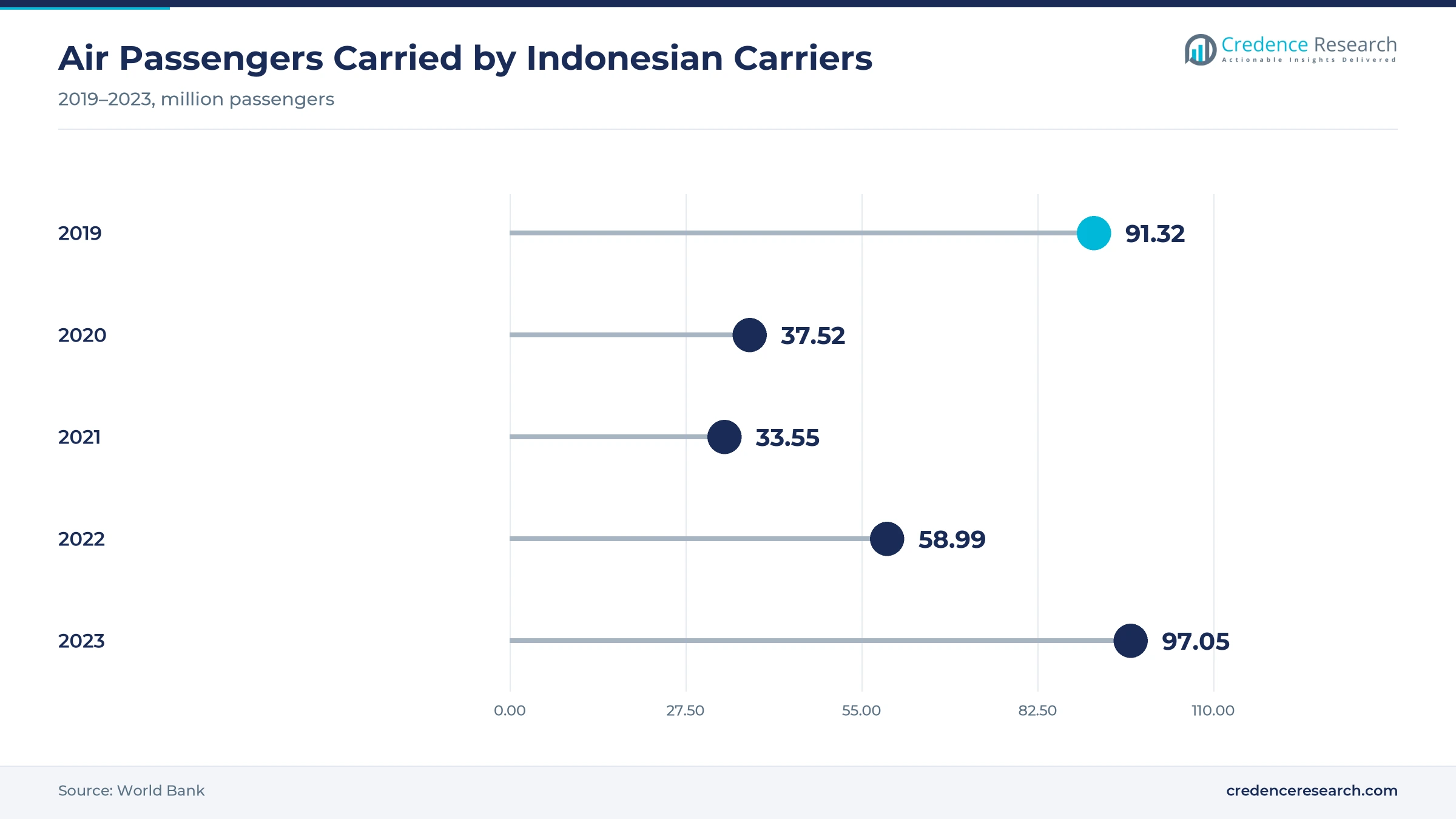
Air traffic recovery lifts maintenance demand, because every extra flight adds cycles that trigger checks, part changes and engine shop visits. Indonesian carriers flew 97.05 million passengers in 2023, above the 91.32 million carried in 2019, according to World Bank data. Domestic flights carried 5.27 million passengers in October 2025, up 8.80% from the month before, while international flights carried 1.79 million, according to Statistics Indonesia. Because the country spans more than 17,000 islands, many towns can be reached quickly only by air, so airlines keep single-aisle and turboprop fleets flying hard. As a result, narrow-body aircraft held 61.0% of 2025 value, and line work stays busy at the main hub airports.
Why do grounded fleets and parts shortages raise spending?
Fleet life extension and global supply constraints raise maintenance spending, because airlines must repair older aircraft rather than replace them quickly. Of 570 aircraft owned by Indonesian airlines in November 2025, only about 360 were airworthy, according to Bisnis.com. Lion Air Group had 182 of its 297 aircraft flying at the same time. Danantara set aside Rp23.67 trillion for Garuda Indonesia in November 2025, and its managers said most of the money would go to maintenance so grounded jets can return in 2026. Worldwide, IATA counted more than 17,000 aircraft on order, nearly 12 years of production, which keeps older jets flying longer. Consequently, heavy checks and engine shop visits take a larger part of airline budgets through 2035.
How is new domestic hangar capacity bringing work home?
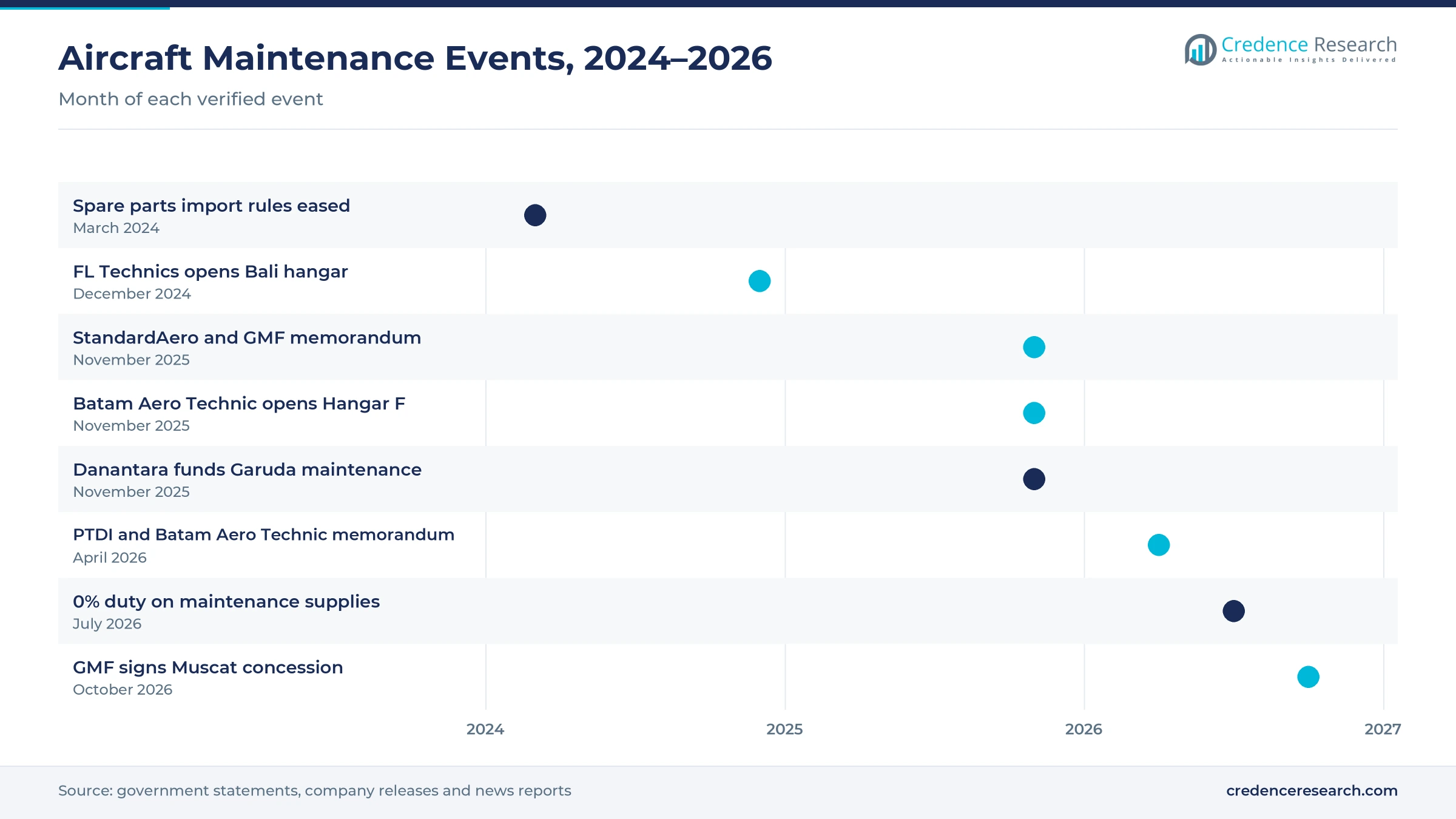
Domestic capability expansion brings work back from overseas shops, because new hangars and approvals let local providers take larger checks. Batam Aero Technic opened its seventh hangar at Hang Nadim Airport on Nov. 19, 2025, with more than 10,000 square meters of floor space and 27 maintenance lines across its site. FL Technics Indonesia opened a facility on 17,000 square meters of land at Bali's Ngurah Rai airport on Dec. 2, 2024, offering line, base and heavy maintenance. PT Dirgantara Indonesia and Batam Aero Technic then signed a memorandum on April 10, 2026, to share resources and train technicians. Even so, about 70% of engine and component work in the Indonesia aircraft MRO market still went overseas in late 2025. Therefore, Batam and the Riau Islands become the fastest-growing zone for maintenance spending.
Why do lower import barriers on parts cut repair costs?
Lower import barriers on parts cut repair costs, because most spare parts used in Indonesian hangars still come from abroad. Imports supplied 93% of maintenance spare parts, and about 200 of 557 civil aircraft needed repairs, when the trade ministry eased import restrictions in a regulation effective March 10, 2024, according to Kontan. The government then cut import duties on maintenance supplies to 0% under Finance Minister Regulation 50 of 2026, announced on July 25, 2026, according to Investortrust. Industry Minister Regulation 16 of 2026 sets operating guidelines for maintenance providers in the same package. As a result, local shops can offer shorter turnaround times and compete for engine and component jobs that went to overseas shops.
Engine partnerships and hub plans reshape repair work
How is the rise of on-wing engine support changing service?
On-wing engine support is rising, because airlines want to keep engines flying longer between costly shop visits. StandardAero signed a memorandum with GMF AeroAsia on Nov. 4, 2025, to offer joint on-wing support, starting with the CFM56-7B that powers the Boeing 737NG family, according to AviTrader. About 270 CFM56-7B engines operate in Indonesia, and more than 4,200 operate across the wider region. About 46% of national fleet maintenance was still done overseas in June 2026, mainly high-value components and engines, according to speakers at the Indonesia MRO Summit. Consequently, engine MRO keeps the largest service share and grows fastest at 5.81% a year as more work stays in the country.
Why are integrated repair hubs and overseas sites emerging?
Integrated repair hubs are emerging, because parts move slowly across a country of more than 17,000 islands. Officials at the Indonesia MRO Summit in Batam on June 9, 2026, named Batam, Jakarta, Surabaya and Makassar as priority hub locations to cut parts turnaround time. BP Batam, the island's development authority, plans about 100 hectares of extra land near Hang Nadim Airport, and industry leaders said about 90% of airframe and hangar work can already be done in the country. GMF AeroAsia also signed a 20-year concession on Oct. 5, 2026, to run a maintenance facility at Muscat International Airport in Oman. As a result, local providers gain scale at home and new customers abroad.
Is there an opening in military and state fleet support?
Military and state fleet support offers a clear opening, because the government wants local firms to service air force aircraft that were once maintained abroad. In August 2026, Defense Minister Sjafrie Sjamsoeddin asked PT Dirgantara Indonesia and GMF AeroAsia to use a maintenance facility under construction at Kertajati Airport in West Java. He cited GMF's heavy maintenance of the C-130 Hercules, work that Lockheed Martin had handled earlier. Plans for military fleet modernization add newer transports that will need long-term support. PT Dirgantara Indonesia already runs a certified maintenance training center in Bandung. Consequently, military fixed-wing aircraft become the fastest-growing aircraft type for maintenance through 2035.
Can data-driven planning cut costs for aging fleets?
Data-driven planning offers a second opening, because older aircraft need more checks and suffer longer waits for parts. IATA reported that the global fleet's average age rose to 15.1 years from 13.4 years before the pandemic. The same IATA study put extra maintenance costs from supply chain problems at $3.1 billion in 2025, with more than 5,000 aircraft in storage worldwide. Tools for predictive maintenance use engine and system data to plan part changes before failures ground an aircraft. Indonesian carriers with many idle jets can use these tools to choose which aircraft to repair first. In turn, providers that sell planning and health monitoring with hangar work can win longer contracts.
Imported parts, scarce technicians and airline debt weigh
How do imported parts and layered taxes raise costs?
Imported parts and layered taxes raise costs, because about 93% of aircraft components still come from abroad. Industry leaders said in June 2026 that customs codes do not fully fit aviation, so some parts are taxed as general industrial goods. As a result, local shops pay more and wait longer for parts than foreign rivals do. The 0% duty on maintenance supplies and a planned special import scheme should ease part of this burden.
Why do scarce certified technicians limit growth?
Scarce certified technicians limit growth, because each new hangar line needs licensed engineers and inspectors. The civil aviation directorate said in June 2026 that the number of internationally certified technicians produced each year is limited. Consequently, providers compete for the same staff, and hiring becomes a limit on new hangar lines. Training partnerships, such as the plan for Batam Aero Technic to hire graduates of PT Dirgantara Indonesia's training center, can widen supply.
How does airline financial stress delay maintenance?
Airline financial stress delays maintenance, because carriers short of cash postpone checks and leave aircraft parked. Grounded aircraft still carry lease and fixed costs, so each day of delayed repair deepens losses for the operator. As a result, providers face uneven order books and less predictable hangar loading. Some airlines turn to ACMI leasing to cover routes, while state funding for Garuda Indonesia should restore steadier repair volumes in 2026.
Why do foreign approvals slow the capture of export work?
Foreign approvals slow the capture of export work, because airlines from other countries usually require shops approved by their own regulators. Batam Aero Technic was still in the final stage of European certification in November 2025, although it already held approvals from Malaysia, Thailand, the Philippines and India. Consequently, some foreign customers wait before moving work to Indonesia. Earlier approvals and joint ventures with engine makers can shorten this delay.
Greater Jakarta leads while Batam grows fastest
| Region | Value, 2025 (USD billion) | Share, 2025 | CAGR, 2026–2035 |
|---|---|---|---|
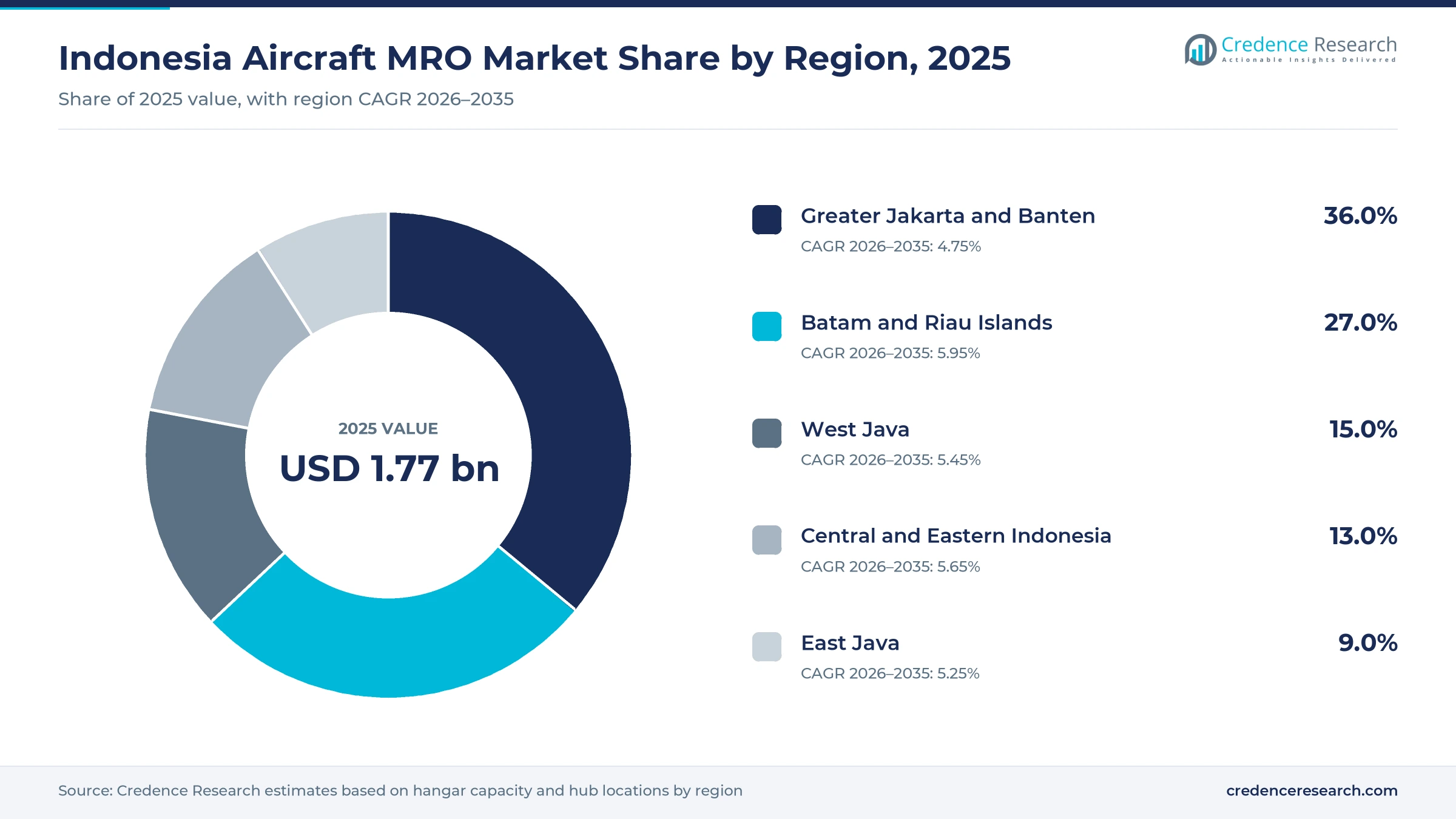
| Greater Jakarta and Banten | 0.64 | 36.0% | 4.75% |
| Batam and Riau Islands | 0.48 | 27.0% | 5.95% |
| West Java | 0.27 | 15.0% | 5.45% |
| Central and Eastern Indonesia | 0.23 | 13.0% | 5.65% |
| East Java | 0.16 | 9.0% | 5.25% |
Why do Greater Jakarta and Banten lead repair spending?
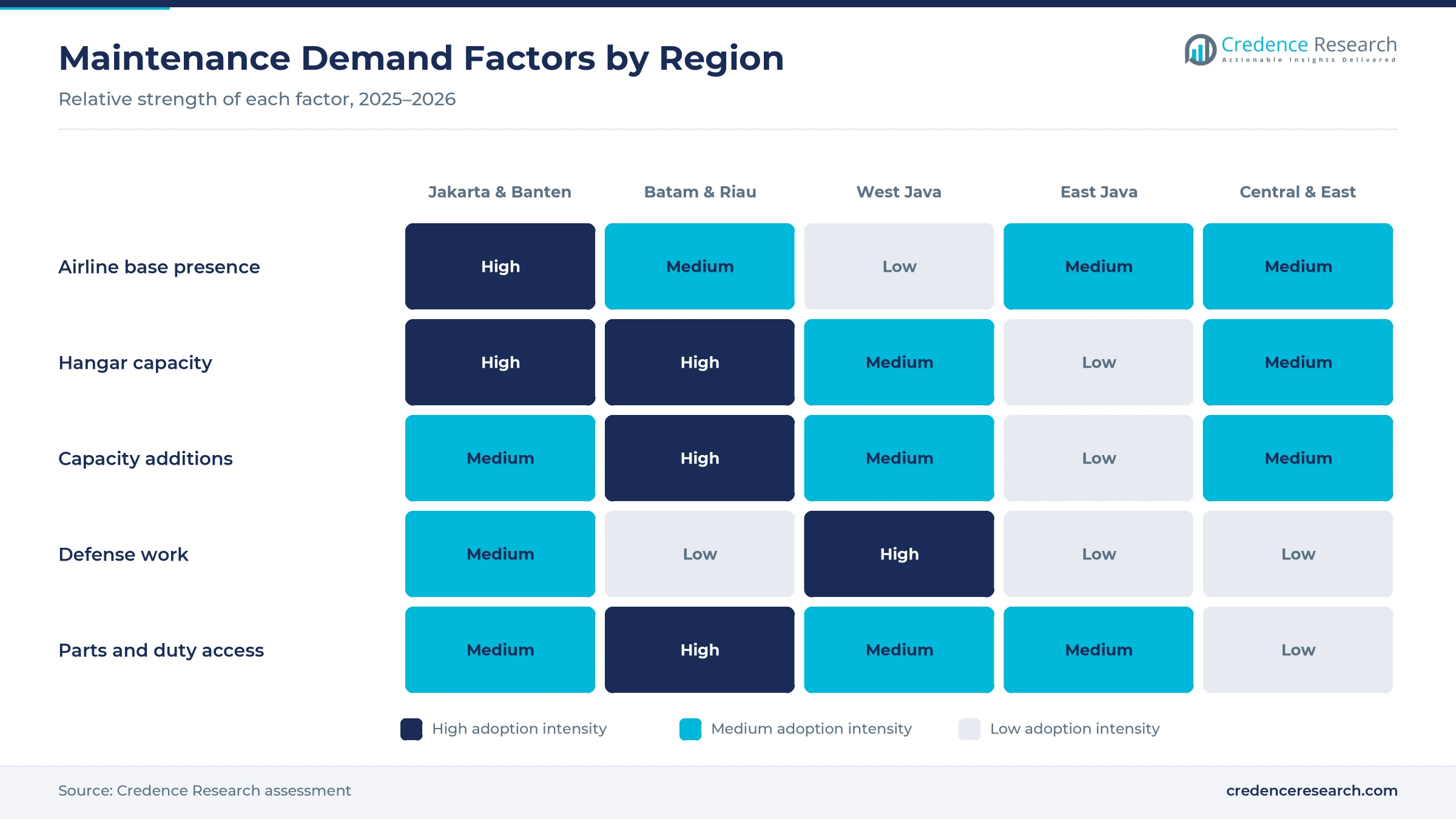
Greater Jakarta and Banten held 36.0% of 2025 value and grow at 4.75% a year, because the main bases of the largest airlines sit around Soekarno-Hatta International Airport. GMF AeroAsia runs four hangars at the airport, and its Hangar 4 can handle up to 16 narrow-body aircraft at once. FL Technics Indonesia also runs a hangar of about 15,000 square meters at Soekarno-Hatta that can hold three narrow-body aircraft at once.
How do Batam and the Riau Islands grow fastest?
Batam and the Riau Islands held 27.0% of 2025 value and grow fastest at 5.95% a year, because Batam Aero Technic keeps adding hangars at Hang Nadim Airport. Its site has seven hangars on a 21-hectare technopark, and Philippine Airlines and Cebu Pacific have sent aircraft there. The local free trade authority plans about 100 more hectares near the airport. Licensing for new projects in the zone is also being simplified.
What shapes maintenance demand in West Java?
West Java held 15.0% of 2025 value and grows at 5.45% a year, because PT Dirgantara Indonesia builds and supports aircraft in Bandung. The company runs a certified maintenance training center there, which supplies technicians to other providers. A maintenance facility under construction at Kertajati Airport is meant to support air force aircraft, and the defense minister asked local firms to use it in August 2026.
How does East Java add regional demand?
East Java held 9.0% of 2025 value and grows at 5.25% a year, because Surabaya is a busy hub for flights to eastern Indonesia. Officials named Surabaya as a priority location for an integrated maintenance and parts hub in June 2026. Line work at the city's airport supports domestic and regional airlines.
Why do Bali and eastern Indonesia gain hangar work?
Central and Eastern Indonesia held 13.0% of 2025 value and grows at 5.65% a year, because Bali and Makassar host growing hangar and line work. FL Technics Indonesia opened a base and heavy maintenance facility at Ngurah Rai airport in December 2024. Officials also named Makassar as a priority hub to serve the eastern islands.
Hangar openings, engine deals and duty relief
| Development | Status and market relevance |
|---|---|
| In March 2024, the trade ministry eased import restrictions on aircraft spare parts for maintenance providers and airlines. | Speeds up parts supply for local shops |
| In November 2025, StandardAero and GMF AeroAsia signed a memorandum on on-wing support for CFM56-7B engines. | Adds engine support for Boeing 737NG fleets |
| In November 2025, Batam Aero Technic opened Hangar F, its seventh hangar, at Hang Nadim Airport. | Adds base maintenance capacity in Batam |
| In April 2026, PT Dirgantara Indonesia and Batam Aero Technic signed a memorandum on maintenance and training. | Links state and private capacity |
| In October 2026, GMF AeroAsia signed a 20-year concession to run a maintenance facility at Muscat International Airport. | Opens Middle East, African and European customers |
Digital records, health monitoring and inspection tools
- Digital maintenance planning links check schedules, parts stock and hangar slots, which helps airlines bring grounded aircraft back in a planned order.
- Engine health monitoring reads flight data to spot wear early, which supports on-wing repairs and fewer unplanned shop visits.
- Automated inspection with non-destructive testing tools finds cracks and corrosion faster during heavy checks on older airframes.
- Electronic technical records replace paper logbooks, which speeds audits by regulators and eases the transfer of leased aircraft between operators.
Need a Custom Version of This Report?
Tailor the scope, geography, or segments to your exact requirements.
- Custom geography or segment scope
- Direct access to our analyst team
Airline-owned shops and independent hangars compete
Competition is led by airline-owned shops, with independent hangars and state-owned firms gaining ground. GMF AeroAsia, part of the Garuda Indonesia Group, offers airframe, engine and component work and added on-wing engine support with StandardAero in November 2025. Batam Aero Technic, which serves the Lion Air Group, runs seven hangars and 27 maintenance lines in Batam and also takes work from foreign airlines. FL Technics Indonesia competes for base and heavy checks from hangars in Jakarta and Bali. PT Dirgantara Indonesia supports military and state aircraft from Bandung and trains technicians for other providers. Providers compete on turnaround time, approvals from foreign regulators, parts access, engine capability and labor cost. Partnerships with engine makers and service firms help local shops add capability without building every skill alone.
Companies profiled and their roles in this market
| Company | Type | Role in the market |
|---|---|---|
| GMF AeroAsia | Airline-affiliated MRO provider | Signed an on-wing engine support memorandum with StandardAero in November 2025 |
| Batam Aero Technic | Airline-affiliated MRO provider | Opened Hangar F at Hang Nadim Airport in November 2025 |
| FL Technics Indonesia | Independent MRO provider | Opened a base and heavy maintenance facility in Bali in December 2024 |
| PT Dirgantara Indonesia | State-owned aerospace firm | Signed a maintenance and training memorandum with Batam Aero Technic in April 2026 |
Credence Research view on bringing repair work home
Credence Research's view is that Indonesian aircraft MRO spending will grow steadily through 2035, because a large grounded fleet must return to service and new hangars let more work stay in the country. Engine work already holds 37.0% of 2025 value and grows fastest, while military aircraft demand rises at 6.05% a year. Duty cuts on maintenance supplies and planned hubs should lower costs. However, scarce technicians, imported parts and weak airline finances could slow some programs. Greater Jakarta and Banten keep the largest share, while Batam and the Riau Islands grow faster as hangars open.
How the maintenance spending estimate was built
The report uses 2025 as the base year, with values in USD million at current prices. Market values come from the Credence Research model, which combines fleet size, flight activity and maintenance cost per aircraft. Regional shares are Credence Research estimates based on hangar capacity and hub locations by region, and segment splits by service, aircraft, provider and end user are also Credence Research estimates. Sources used are government statements, regulations, World Bank data, industry association statements, company announcements and news reports, and no interviews or surveys were used.
Domestic engine capacity and hub plans set the path to 2035
The market is expected to reach USD 2.99 billion by 2035, a 5.35% CAGR during 2026–2035, as traffic growth, fleet repairs and new hangars lift maintenance spending. Growth should be strongest in engine work, military aircraft support and in Batam and the Riau Islands, while Greater Jakarta and Banten keep the largest share. Providers that add engine capability and foreign approvals should win work that now leaves the country. In contrast, a long shortage of parts or new airline cash problems would slow the return of grounded aircraft.
Frequently Asked Questions
How big is the Indonesia aircraft MRO market?
Which region leads aircraft maintenance spending in Indonesia?
Which region grows fastest?
Which service type holds the largest share?
How many Indonesian airline aircraft were grounded?
What policy changes support local maintenance providers?
Who are the leading aircraft maintenance companies in Indonesia?
What are the main risks to growth?
Table of Content
Chapter 1 Market Segmentation
- 1.1 Segmentation Framework
- 1.1.1 Product and Service Classification
- 1.1.2 Application and End-Use Classification
- 1.1.3 Technology and Solution Classification
- 1.1.4 Customer and Distribution Channel Classification
- 1.1.5 Geographic Segmentation
- 1.1.6 Market Segment Definitions and Boundaries
- 1.2 By Service Type
- 1.2.1 Engine MRO
- 1.2.2 Airframe Heavy Maintenance
- 1.2.3 Component Repair and Overhaul
- 1.2.4 Line Maintenance
- 1.2.5 Modifications and Cabin Services
- 1.3 By Aircraft Type
- 1.3.1 Narrow-Body Aircraft
- 1.3.2 Wide-Body Aircraft
- 1.3.3 Regional Turboprop Aircraft
- 1.3.4 Military Fixed-Wing Aircraft
- 1.3.5 Business and General Aviation Aircraft
- 1.4 By MRO Provider
- 1.4.1 Airline-Affiliated MRO Providers
- 1.4.2 OEM-Authorized Service Centers
- 1.4.3 Independent MRO Providers
- 1.4.4 Defense and State-Owned MRO Providers
- 1.5 By End User
- 1.5.1 Scheduled Passenger Airlines
- 1.5.2 Low-Cost Carriers
- 1.5.3 Government and Defense Operators
- 1.5.4 Cargo Airlines
- 1.5.5 General Aviation Operators
Chapter 2 Introduction
- 2.1 Report Objectives and Scope
- 2.2 Product Definition and Industry Terminology
- 2.3 Market Inclusions and Exclusions
- 2.4 Research Process
- 2.4.1 Primary Research and Expert Interviews
- 2.4.2 Secondary Research and Source Review
- 2.4.3 Top-Down and Bottom-Up Estimation
- 2.4.4 Data Triangulation and Verification
- 2.5 Market Size Measurement Basis
- 2.5.1 2025: USD 1.77 billion → 2035: USD 2.99 billion
- 2.6 Historical and Forecast Reference Periods
- 2.6.1 Historical Period: 2018-2025
- 2.6.2 Base Year: 2025
- 2.6.3 Forecast Period: 2025-2035
- 2.7 Research Assumptions and Limitations
Chapter 3 Executive Summary
- 3.1 Market Snapshot and Key Findings
- 3.2 Base-Year Market Size, 2025
- 3.3 Forecast Market Size, 2035
- 3.4 Revenue and Volume Growth Outlook
- 3.5 Key Demand and Supply Indicators
- 3.6 Leading Market Segments
- 3.7 Fastest-Growing Market Opportunities
- 3.8 Regional Performance Highlights
- 3.9 Technology and Industry Transformation
- 3.10 Competitive Landscape Summary
- 3.11 Analyst View and Strategic Implications
Chapter 4 Indonesia Aircraft MRO Market Trends and Developments
- 4.1 Historical Industry Development, 2018-2025
- 4.2 Recent Market Trends and Developments
- 4.3 Demand and Customer Behavior Trends
- 4.4 Technology and Product Innovation
- 4.5 Artificial Intelligence, Automation and Digitalization
- 4.6 Local Manufacturing and Supply Chain Realignment
- 4.7 Industry Partnerships, Mergers and Acquisitions
- 4.8 Sustainability and Circular Economy Developments
- 4.9 Government and Private Sector Investment Trends
- 4.10 Emerging Business Models and Commercialization
- 4.11 Industry Developments and Announcements
Chapter 5 Indonesia Aircraft MRO Market Production, Supply and Demand Analysis
- 5.1 Demand Trend and Consumption Analysis, 2018-2025
- 5.2 Demand Forecast, 2025-2035
- 5.3 Production and Output Trend, 2018-2025
- 5.4 Production and Output Forecast, 2025-2035
- 5.5 Installed Capacity and Capacity Utilization
- 5.6 Company-Wise Production Plants and Statistics
- 5.6.1 Installed Production Capacity
- 5.6.2 Actual Production
- 5.6.3 Planned Capacity and Expansion Targets
- 5.7 Supply Chain Structure and Procurement Trends
- 5.8 Supply-Demand Gap and Bottlenecks
- 5.9 Import Dependence and Sourcing Structure
- 5.10 Contract Manufacturing and Outsourcing
- 5.11 Regional Supply and Demand Concentration
Chapter 6 Indonesia Aircraft MRO Market Pricing Analysis
- 6.1 Pricing Structure and Measurement
- 6.2 Historical Pricing Trends, 2018-2025
- 6.3 Pricing Outlook, 2025-2035
- 6.4 Average Selling Price and Unit Economics
- 6.5 Pricing by Product and Market Segment
- 6.6 Geographic Pricing Differences
- 6.7 Key Input, Energy, Labor and Logistics Costs
- 6.8 Contract Pricing and Purchasing Models
- 6.9 Pricing Sensitivity and Competitive Positioning
- 6.10 Price, Margin and Profitability Implications
Chapter 7 Indonesia Aircraft MRO Market Dynamics
- 7.1 Market Growth Drivers
- 7.1.1 Demand-Side Drivers
- 7.1.2 Technology and Innovation Drivers
- 7.1.3 Infrastructure and Investment Drivers
- 7.1.4 Regulatory and Policy Drivers
- 7.2 Market Restraints
- 7.2.1 Cost and Affordability Constraints
- 7.2.2 Technology and Adoption Barriers
- 7.2.3 Supply Chain and Operational Constraints
- 7.3 Market Challenges
- 7.3.1 Competitive Pressure and Margin Erosion
- 7.3.2 Skills, Infrastructure and Implementation Gaps
- 7.4 Emerging Market Opportunities
- 7.5 Market Dynamics Impact and Time-Horizon Assessment
Chapter 8 Indonesia Aircraft MRO Value Chain Analysis
- 8.1 Industry Value Chain Overview
- 8.2 Upstream Suppliers and Critical Inputs
- 8.3 Technology and Component Providers
- 8.4 Manufacturing or Service Delivery
- 8.5 Distribution, Channel Partners and Integrators
- 8.6 Downstream Applications and End Users
- 8.7 Value Addition and Profit Pools
- 8.8 Vertical Integration and Outsourcing
- 8.9 Supplier Concentration and Risk
- 8.10 Supply Chain Localization and Resilience
Chapter 9 Indonesia Aircraft MRO Market Regulations and Policies
- 9.1 Relevant Laws, Standards and Compliance Frameworks
- 9.2 Product, Service, Safety and Quality Requirements
- 9.3 Government Policies, Incentives and Subsidies
- 9.4 Imports, Exports and Trade Barriers
- 9.5 Public Procurement and Local Content Requirements
- 9.6 Environmental and Sustainability Compliance
- 9.7 Upcoming Policy Changes and Market Implications
Chapter 10 Indonesia Aircraft MRO Market Hotspots and Opportunities
- 10.1 Market Opportunity Mapping and Growth Hotspots
- 10.2 High-Growth Applications and Customer Groups
- 10.3 Underserved Markets and White-Space Opportunities
- 10.4 Emerging Technology and Product Opportunities
- 10.5 New Capacity and Investment Hotspots
- 10.6 Market Entry and Expansion Opportunities
- 10.7 Distribution and Partnership Opportunities
- 10.8 Near-Term and Long-Term Commercial Potential
- 10.9 Opportunity Attractiveness and Execution Risks
Chapter 11 Indonesia Aircraft MRO Market Outlook, 2025-2035
- 11.1 Market Size and Analysis
- 11.1.1 Revenue (Market Measurement: 2025: USD 1.77 billion → 2035: USD 2.99 billion)
- 11.1.2 Market Volume and Quantity Sold
- 11.1.3 Historical Market Size, 2018-2025
- 11.1.4 Base-Year Market Size, 2025
- 11.2 Market Forecast, 2025-2035
- 11.2.1 Revenue Forecast to 2035
- 11.2.2 Volume Forecast to 2035
- 11.2.3 CAGR and Year-on-Year Growth
- 11.2.4 Incremental Revenue Opportunity
- 11.3 Forecast Assumptions and Scenario Analysis
- 11.3.1 Base-Case Forecast
- 11.3.2 Optimistic and Conservative Scenarios
- 11.3.3 Technology, Pricing and Policy Sensitivities
- 11.4 Market Attractiveness and Growth Outlook
Chapter 12 Indonesia Aircraft MRO Market Segmentation and Outlook
- 12.1 Segmentation Summary and Market Shares, 2025
- 12.2 Largest and Fastest-Growing Segments
- 12.3 By Service Type - Market Size and Forecast, 2025-2035
- 12.3.1 Segment Definition and Scope
- 12.3.2 Historical Market Size, 2018-2025
- 12.3.3 Revenue Forecast, 2025-2035
- 12.3.4 Volume Forecast, 2025-2035
- 12.3.5 Base-Year Market Share, 2025
- 12.3.6 Segment CAGR and Growth Drivers
- 12.3.7 Subsegment Market Size and Forecast
- 12.3.7.1 Engine MRO
- 12.3.7.2 Airframe Heavy Maintenance
- 12.3.7.3 Component Repair and Overhaul
- 12.3.7.4 Line Maintenance
- 12.3.7.5 Modifications and Cabin Services
- 12.3.8 Subsegment Pricing and Adoption Trends
- 12.3.9 Leading Suppliers and Competition
- 12.3.10 Regional Demand and Opportunities
- 12.4 By Aircraft Type - Market Size and Forecast, 2025-2035
- 12.4.1 Segment Definition and Scope
- 12.4.2 Historical Market Size, 2018-2025
- 12.4.3 Revenue Forecast, 2025-2035
- 12.4.4 Volume Forecast, 2025-2035
- 12.4.5 Base-Year Market Share, 2025
- 12.4.6 Segment CAGR and Growth Drivers
- 12.4.7 Subsegment Market Size and Forecast
- 12.4.7.1 Narrow-Body Aircraft
- 12.4.7.2 Wide-Body Aircraft
- 12.4.7.3 Regional Turboprop Aircraft
- 12.4.7.4 Military Fixed-Wing Aircraft
- 12.4.7.5 Business and General Aviation Aircraft
- 12.4.8 Subsegment Pricing and Adoption Trends
- 12.4.9 Leading Suppliers and Competition
- 12.4.10 Regional Demand and Opportunities
- 12.5 By MRO Provider - Market Size and Forecast, 2025-2035
- 12.5.1 Segment Definition and Scope
- 12.5.2 Historical Market Size, 2018-2025
- 12.5.3 Revenue Forecast, 2025-2035
- 12.5.4 Volume Forecast, 2025-2035
- 12.5.5 Base-Year Market Share, 2025
- 12.5.6 Segment CAGR and Growth Drivers
- 12.5.7 Subsegment Market Size and Forecast
- 12.5.7.1 Airline-Affiliated MRO Providers
- 12.5.7.2 OEM-Authorized Service Centers
- 12.5.7.3 Independent MRO Providers
- 12.5.7.4 Defense and State-Owned MRO Providers
- 12.5.8 Subsegment Pricing and Adoption Trends
- 12.5.9 Leading Suppliers and Competition
- 12.5.10 Regional Demand and Opportunities
- 12.6 By End User - Market Size and Forecast, 2025-2035
- 12.6.1 Segment Definition and Scope
- 12.6.2 Historical Market Size, 2018-2025
- 12.6.3 Revenue Forecast, 2025-2035
- 12.6.4 Volume Forecast, 2025-2035
- 12.6.5 Base-Year Market Share, 2025
- 12.6.6 Segment CAGR and Growth Drivers
- 12.6.7 Subsegment Market Size and Forecast
- 12.6.7.1 Scheduled Passenger Airlines
- 12.6.7.2 Low-Cost Carriers
- 12.6.7.3 Government and Defense Operators
- 12.6.7.4 Cargo Airlines
- 12.6.7.5 General Aviation Operators
- 12.6.8 Subsegment Pricing and Adoption Trends
- 12.6.9 Leading Suppliers and Competition
- 12.6.10 Regional Demand and Opportunities
- 12.7 Segment Growth Comparison
- 12.8 Segment Attractiveness and Priority Matrix
Chapter 13 Indonesia Aircraft MRO End-Use and Application Market Outlook
- 13.1 End-Use Industry and Customer Demand Structure
- 13.2 Leading Applications and Customer Groups
- 13.3 End-Use Market Size, Share and Forecast
- 13.4 Major End-Use Industry Deep Dives
- 13.4.1 Customer Requirements and Use Cases
- 13.4.2 Demand and Replacement Cycles
- 13.4.3 Technical and Regulatory Considerations
- 13.4.4 Purchasing and Procurement Models
- 13.4.5 Leading Vendors and Distribution Channels
- 13.4.6 Forecast and Commercial Opportunities
- 13.5 Emerging Applications and Cross-Segment Demand
- 13.6 End-Use Industry Investment Priorities
Chapter 14 Indonesia Aircraft MRO Geographic Market Outlook, 2025-2035
- 14.1 Domestic Market Distribution and Demand Clusters
- 14.2 State- or Province-Wise Market Size and Forecast, 2025-2035
- 14.3 City and Metropolitan Market Outlook
- 14.4 Industrial, Manufacturing and Commercial Clusters
- 14.5 Geographic Concentration of Key End Users
- 14.6 Local Pricing and Purchasing Differences
- 14.7 Domestic Production Facilities and Capacity Map
- 14.8 Local Infrastructure and Project Pipeline
- 14.9 State-Level Policy and Incentive Differences
- 14.10 Subnational Investment Hotspots and Opportunities
- 14.11 Distribution and Logistics Networks
- 14.12 Domestic Competitive Footprint
Chapter 15 Indonesia Aircraft MRO Technology, Innovation and Sustainability Outlook
- 15.1 Technology Landscape and Maturity
- 15.2 Product, Process and Service Innovation
- 15.3 AI, Automation and Digital Tools in the Industry
- 15.4 Technology Adoption and Performance Benchmarking
- 15.5 Innovation Pipeline and R&D Investment
- 15.6 Patent and Intellectual Property Trends
- 15.7 Energy Efficiency and Resource Management
- 15.8 Sustainability, Recycling and Circularity
- 15.9 Technology Roadmap, 2025-2035
- 15.10 Risks of Obsolescence and Technology Substitution
Chapter 16 Indonesia Aircraft MRO Market Key Strategic Imperatives
- 16.1 Growth and Market Entry Priorities
- 16.2 High-Return Products and Segments
- 16.3 Pricing, Profitability and Cost Optimization
- 16.4 Technology Investment and Product Differentiation
- 16.5 Supply Chain Localization and Resilience
- 16.6 Distribution and Customer Acquisition
- 16.7 Partnership, Acquisition and Capacity Strategy
- 16.8 Regional Expansion Priorities
- 16.9 Short-, Medium- and Long-Term Actions
Chapter 17 Competition Outlook
- 17.1 Industry Competition Characteristics
- 17.2 Market Structure and Concentration
- 17.3 Market Share and Competitive Positioning, 2025
- 17.4 Company-Wise Revenue and Product Benchmarking
- 17.5 Production and Service Capacity Benchmarking
- 17.6 Technology, Pricing and Differentiation
- 17.7 Regional Footprint and Distribution Strength
- 17.8 Mergers, Acquisitions and Strategic Alliances
- 17.9 New Entrants and Competitive Threats
- 17.10 Porter's Five Forces and Industry Attractiveness
- 17.11 Competitive Outlook, 2025-2035
Chapter 18 Company Profiles
- 18.1 Company Coverage and Selection Criteria
- 18.2 GMF AeroAsia (PT Garuda Maintenance Facility Aero Asia Tbk)
- 18.2.1 Business Description
- 18.2.2 Company Ownership and Geographic Presence
- 18.2.3 Product and Service Portfolio
- 18.2.4 Manufacturing and Operating Footprint
- 18.2.5 Production Capacity and Expansion Plans
- 18.2.6 Financial Performance and Investment
- 18.2.7 Market Share and Competitive Position
- 18.2.8 Technology and Innovation Capabilities
- 18.2.9 Strategic Alliances or Partnerships
- 18.2.10 Recent Developments
- 18.2.11 Growth Strategy and Outlook
- 18.3 Batam Aero Technic (PT Batam Aero Technic)
- 18.4 PT Dirgantara Indonesia
- 18.5 PT JAS Aero-Engineering Services
- 18.6 FL Technics Indonesia (PT Avia Technics Dirgantara)
- 18.7 PT Indopelita Aircraft Services
- 18.8 PT Nusantara Turbin dan Propulsi
- 18.9 PT Merpati Maintenance Facility
- 18.10 PT Aero Nusantara Indonesia
- 18.11 PT Global Maintenance Facility
- 18.12 Other Relevant Market Participants
Note: Every listed company is profiled on the structure shown under the first company. The company list is preliminary and may change based on research findings, market developments, data availability and client requirements.
Chapter 19 Disclaimer
- 19.1 Research and Forecast Disclaimer
- 19.2 Data Source and Estimation Limitations
Note: The depth of individual sections depends on data availability for this market. Volume, capacity, trade and other unit-based metrics are included where applicable.

