
155mm Ammunition Market: USD 3.46 billion in 2025 as Governments Rebuild Artillery Stocks
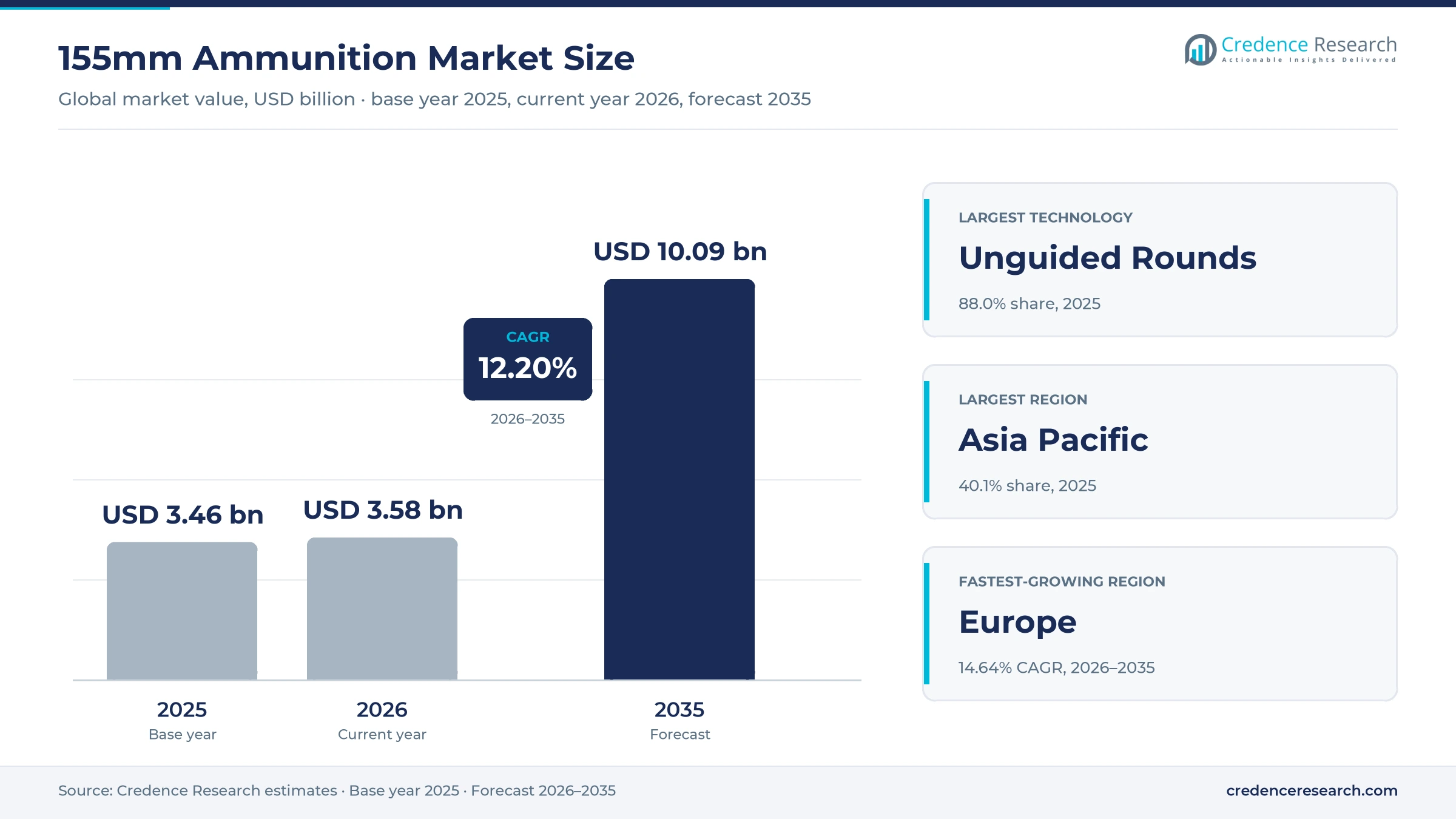
Government spending on 155mm ammunition reached USD 3.46 billion in 2025, and Credence Research forecasts USD 10.09 billion by 2035, a 12.20% CAGR over 2026–2035. Factory capacity, not budgets, now sets the pace: orders placed since 2023 still exceed what plants can deliver, and 2026 spending is estimated at USD 3.58 billion.
Several years of high consumption emptied many national stockpiles. Buyers now sign multi-year framework contracts so that suppliers can invest in new production lines.
What does the market include?
The market covers complete 155 mm artillery rounds and their main components. The scope includes:
- Projectile bodies, fuzes, primers and propellant charges sold to defense ministries, armed forces and procurement agencies.
- Guided and unguided rounds, including extended-range and practice rounds.
- Load, assemble and pack (LAP) work when it is bought as part of a round.
The scope excludes other artillery calibers, rockets and missiles, the howitzers themselves, and bulk explosives sold outside a 155 mm program. Values are contract values in USD billion at current prices, allocated to the country of the end user. The segment sits within the wider ammunition market.
How was the estimate built?
All figures are Credence Research estimates, built from public budget lines, announced contracts, production capacity statements and typical round prices. This overview reports business and procurement trends only.
What do public indicators show?
US output reached 36,000 complete rounds a month in March 2026, up from 14,000 before 2022, against a goal of 100,000 a month, according to a July 2026 report by the Department of Defense Inspector General. The same report counts USD 4.5 billion of US investment in 155 mm production between February 2022 and September 2025. In Europe, the EU has set a goal of 2 million shells a year of production capacity.
Report Attributes
| Attribute | Details |
|---|---|
| Historical Period | 2018–2024 |
| Base Year | 2025 |
| Forecast Period | 2026–2035 |
| Market Size 2025 | USD 3.46 billion |
| Market Size 2026 (estimate) | USD 3.58 billion |
| Market Size 2035 (forecast) | USD 10.09 billion |
| CAGR (2026–2035) | 12.20% |
| Segments Covered | By Technology, By Component, By Projectile Type, By Range, By Platform, By End User |
| Regions Covered | North America, Europe, Asia Pacific, Latin America, Middle East & Africa |
| Companies Covered | BAE Systems plc, Rheinmetall AG, General Dynamics Ordnance and Tactical Systems, Northrop Grumman Corporation, Nammo AS, KNDS, Elbit Systems Ltd., MSM Group s.r.o., Hanwha Aerospace, Munitions India Limited |
155mm Ammunition Market Insights
- The 155mm ammunition market was worth USD 3.46 billion in 2025 and is forecast to reach USD 10.09 billion by 2035, a 12.20% CAGR over 2026–2035.
- Credence Research estimates the market at USD 3.58 billion in 2026, the current year.
- Stockpile replenishment is the strongest driver, adding about 3.8 percentage points to the forecast CAGR.
- Unguided rounds hold 88.0% of 2025 value; guided rounds grow fastest at 16.91% a year.
- Asia Pacific is the largest region at 40.1%; Europe grows fastest at 14.64%.
- US output reached 36,000 rounds a month in March 2026, against a goal of 100,000.
Conventional High-Explosive Rounds for Self-Propelled Guns Dominate Value
Which technology leads?
Unguided, conventional rounds lead with a 88.0% share in 2025, because stock targets are counted in volume. Guided rounds grow fastest at 16.91% a year as buyers add precision for high-value targets.
Which component leads?
Projectiles lead with a 55.0% share of value. Fuzes and primers make up the rest of the round's hardware. Propellant grows fastest at 13.55% a year, because energetics capacity is being expanded from a low base.
Which projectile type leads?
High-explosive rounds lead with a 70.0% share and are also the fastest-growing type, at 13.21% a year. Practice, smoke, illumination, cargo and armor-piercing rounds serve training and specialized missions.
Which range band leads?
Rounds for ranges up to 30 km lead with a 62.0% share. Extended-range rounds above 50 km grow fastest at 18.71% a year, as longer 52-caliber barrels enter service.
Which platform and end user lead?
Self-propelled howitzers lead platforms with a 52.0% share, while towed guns remain common in many armies. Army and land forces lead end users with a 82.0% share; marine corps buy smaller volumes.
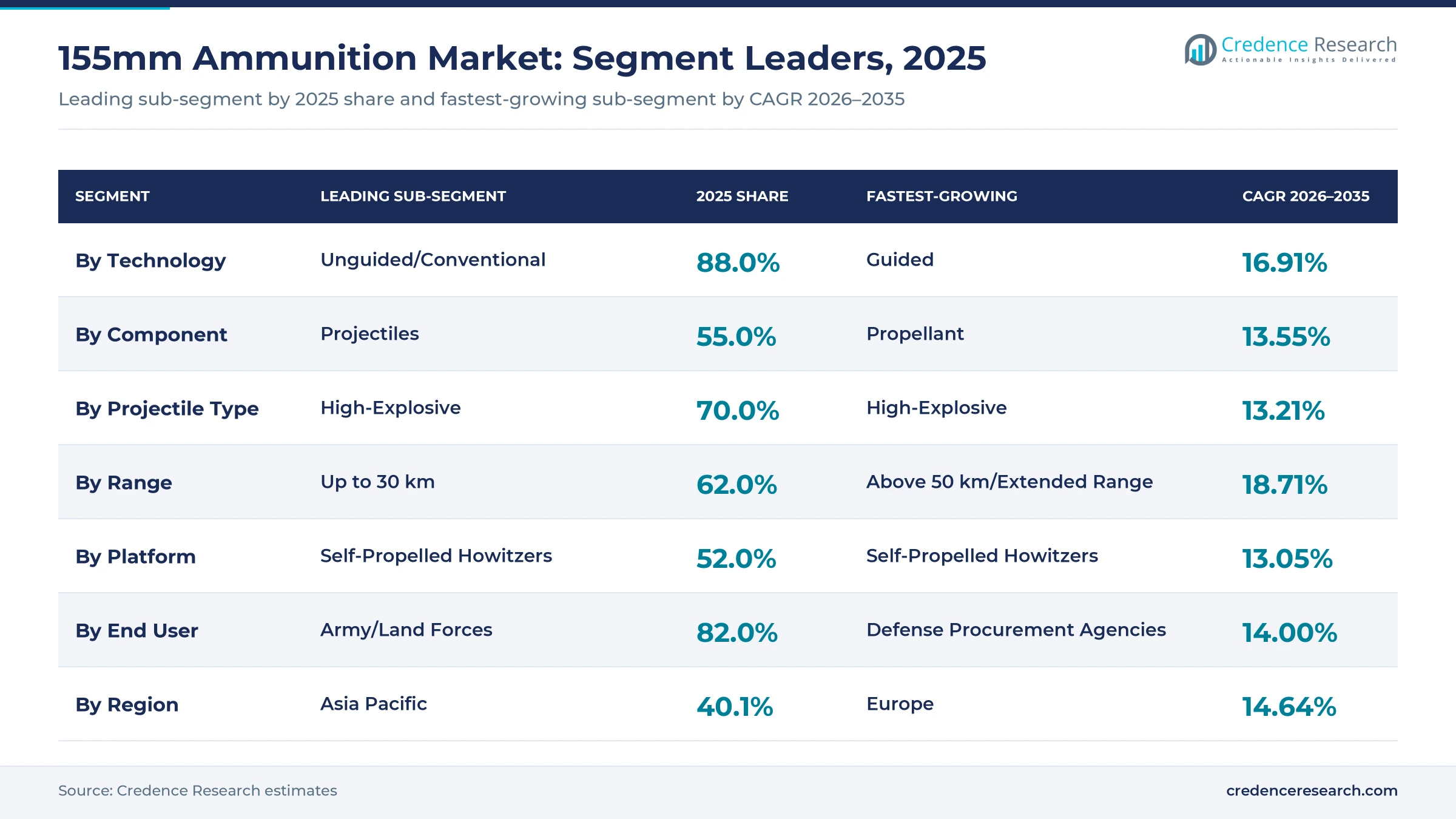
| Segment Group | Leading Sub-segment | 2025 Share | Fastest-growing Sub-segment | CAGR 2026–2035 |
|---|---|---|---|---|
| By Technology | Unguided/Conventional | 88.0% | Guided | 16.91% |
| By Component | Projectiles | 55.0% | Propellant | 13.55% |
| By Projectile Type | High-Explosive | 70.0% | High-Explosive | 13.21% |
| By Range | Up to 30 km | 62.0% | Above 50 km/Extended Range | 18.71% |
| By Platform | Self-Propelled Howitzers | 52.0% | Self-Propelled Howitzers | 13.05% |
| By End User | Army/Land Forces | 82.0% | Defense Procurement Agencies | 14.00% |
Request a Free Sample
Fill in your details and we'll send you a free sample report.
- Sample data tables & charts
- Research methodology
Stockpile Rebuilding, New Howitzer Fleets and Longer-Range Rounds Lift Orders
Why does stockpile replenishment lead growth? (~+3.8% impact on forecast CAGR)
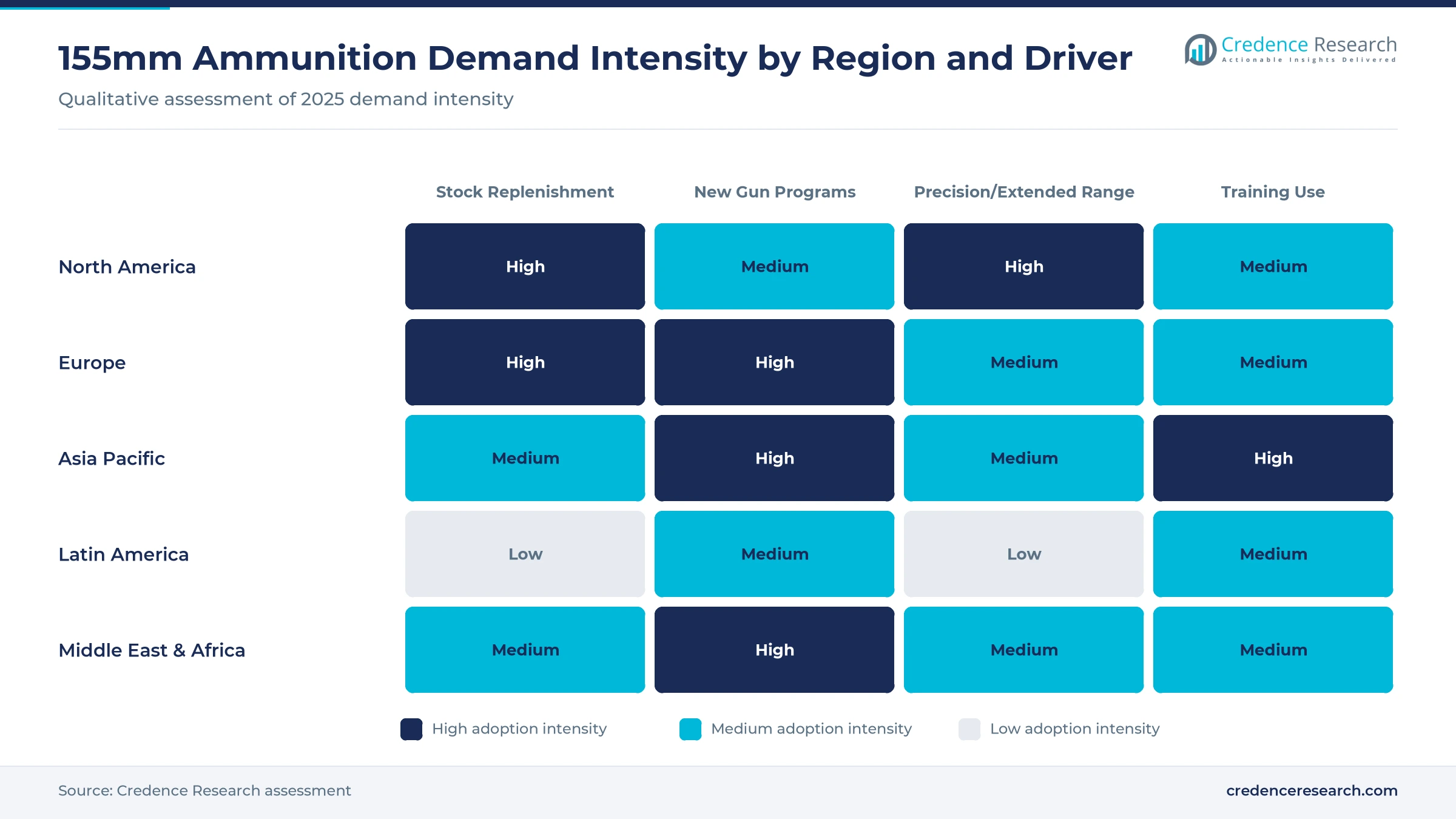
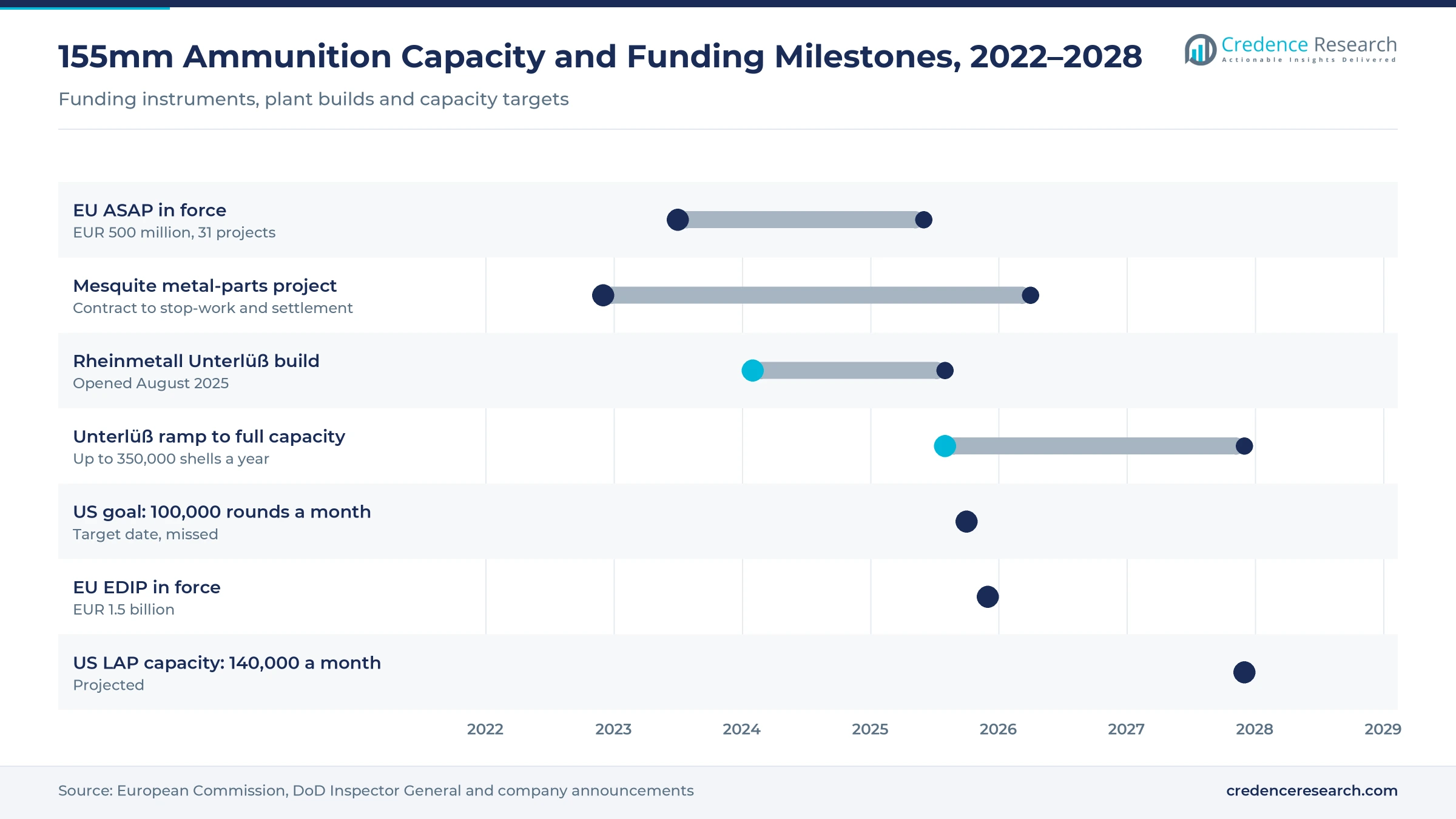
National stockpile replenishment and the replacement of wartime consumption are the strongest driver, adding an estimated 3.8 percentage points to the forecast CAGR. Governments that supplied rounds to Ukraine or drew down reserves must rebuild them to meet NATO and national stock targets. The US Army plans load, assemble and pack capacity of 140,000 rounds a month by December 2027, across its plants in Iowa, Arkansas and Kansas, according to the DoD Inspector General report. Orders are large and multi-year, which gives suppliers the confidence to build plants. The limit is industrial: metal parts, energetics and skilled labor take years to scale, so deliveries lag orders.
How do new artillery programs add demand? (~+2.6% impact on forecast CAGR)
New artillery procurement and modernization programs add about 2.6 percentage points to the forecast CAGR. Each new self-propelled or towed howitzer brings a stock of rounds for training and war reserves, and many armies are buying new 52-caliber systems. Self-propelled howitzers lead platforms with a 52.0% share of 2025 value. Program timing depends on budgets and on deliveries of the guns themselves, which are covered in the artillery systems market.
Why are precision and range rising in importance? (~+1.8% impact on forecast CAGR)
The shift toward precision-guided and extended-range 155 mm rounds adds about 1.8 percentage points to the forecast CAGR. Guided rounds cost many times more than conventional ones, so even a small volume share raises value. Guided rounds grow fastest by technology at 16.91% a year, and rounds for ranges above 50 km grow fastest by range at 18.71%. Their adoption depends on unit cost and on qualification for each gun and fuze combination.
What role does joint procurement play?
Joint buying through agencies such as the NATO Support and Procurement Agency and EU instruments lets smaller states pool orders. Defense procurement agencies are the fastest-growing end user at 14.00% a year.
New Plants, Pooled Funding and Energetics Investment Reshape Supply
Trend 1: Are new plants coming online?
Yes. Rheinmetall opened its plant at Unterlüß, Germany, in August 2025, with capacity planned to reach up to 350,000 shells a year by 2027, as reported by Janes. Nammo broke ground in November 2025 to restart ammunition production at Elling, Denmark.
Trend 2: Is public funding shifting to energetics?
Yes. Propellant and explosives are the tightest bottleneck, and propellant is the fastest-growing component at 13.55% a year. The EU's Act in Support of Ammunition Production (ASAP) committed EUR 500 million to 31 projects, as described on the European Commission ASAP page. A large part went to powder and explosives. Chemring Nobel in Norway received EUR 66.7 million in 2025 to more than double its explosives capacity.
Trend 3: Are suppliers partnering across the Atlantic?
KNDS and General Dynamics Ordnance and Tactical Systems announced stronger ammunition cooperation in June 2026, aimed mainly at North American capacity for 52-caliber artillery ammunition. Such partnerships spread qualification costs and bring European designs closer to US buyers.
Metal Parts, Energetics and Qualification Hold Back Output
Why are production goals being missed?
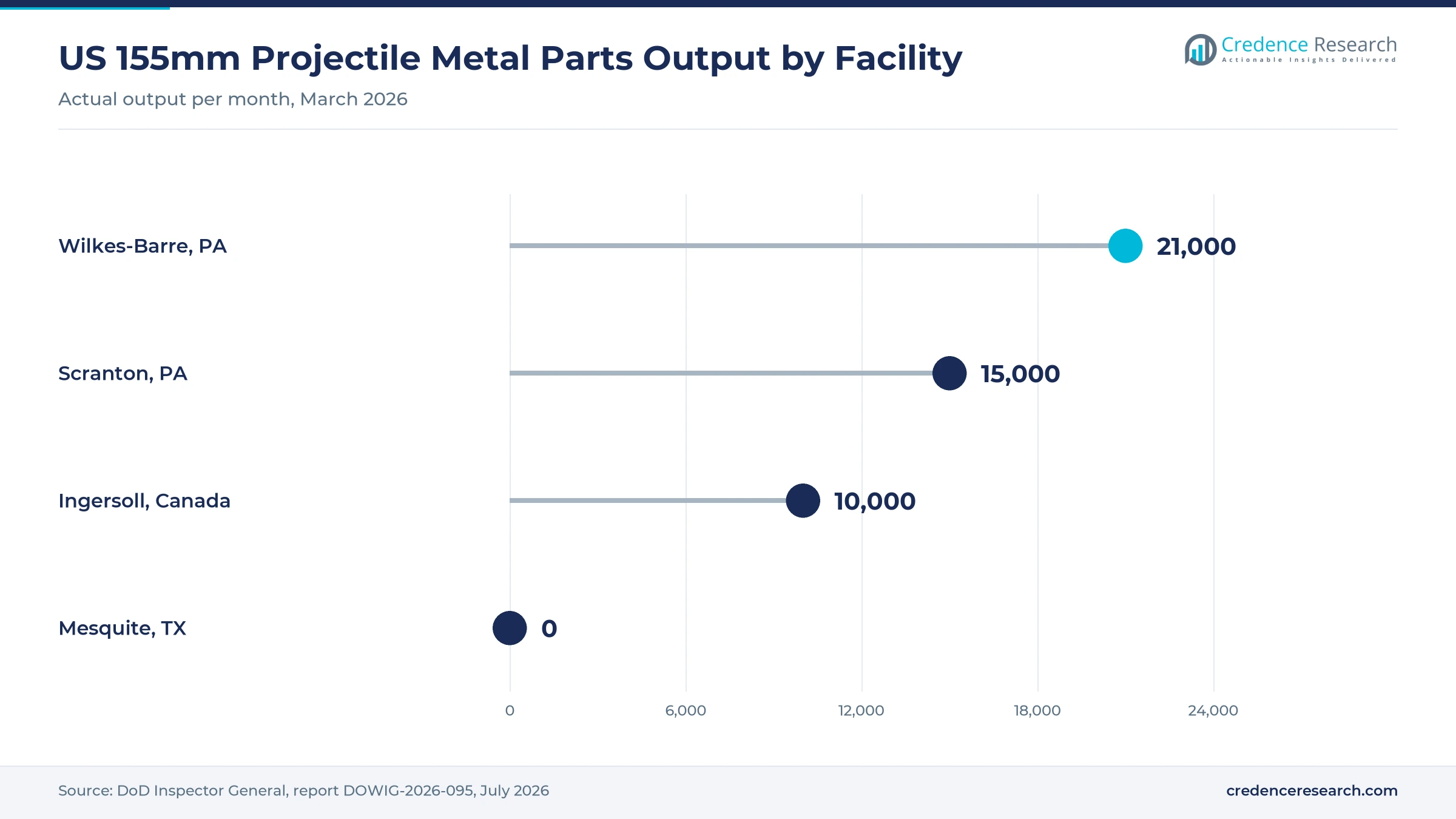
New plants take longer than planned. The US goal of 100,000 rounds a month by October 2025 was missed, and a new metal-parts plant in Mesquite, Texas, produced no usable parts against a 30,000-a-month requirement as of March 2026. The Army issued a stop-work order in August 2025 and executed a settlement in April 2026 to move orders to Pennsylvania sites. Delays push deliveries to the right and raise unit costs for buyers.
How tight are energetics supplies?
A small number of plants make nitrocellulose propellant and high explosives in Europe and North America. Expanding them requires permits, safety zones and long equipment lead times, so propellant availability caps the number of rounds that can be completed, whatever the shell capacity.
Why does qualification slow adoption?
Each round must be qualified for each howitzer, charge and fuze. Differences between national standards limit how freely rounds can move between allies. The EU's European Defence Industry Programme sets aside EUR 50 million to harmonize 155 mm qualification.
What happens when the urgency fades?
Suppliers fear a demand cliff once stocks are rebuilt. Without long-term contracts, they hesitate to build capacity that could sit idle after 2030.
Where are the opportunities?
Mid-sized armies in Europe, Asia and the Middle East lack domestic energetics and LAP capacity. Suppliers that offer licensed local assembly with assured propellant supply can win these customers. The execution risk is export licensing, which can delay or block transfers.
Asia Pacific Leads by Value, While Europe Grows Fastest
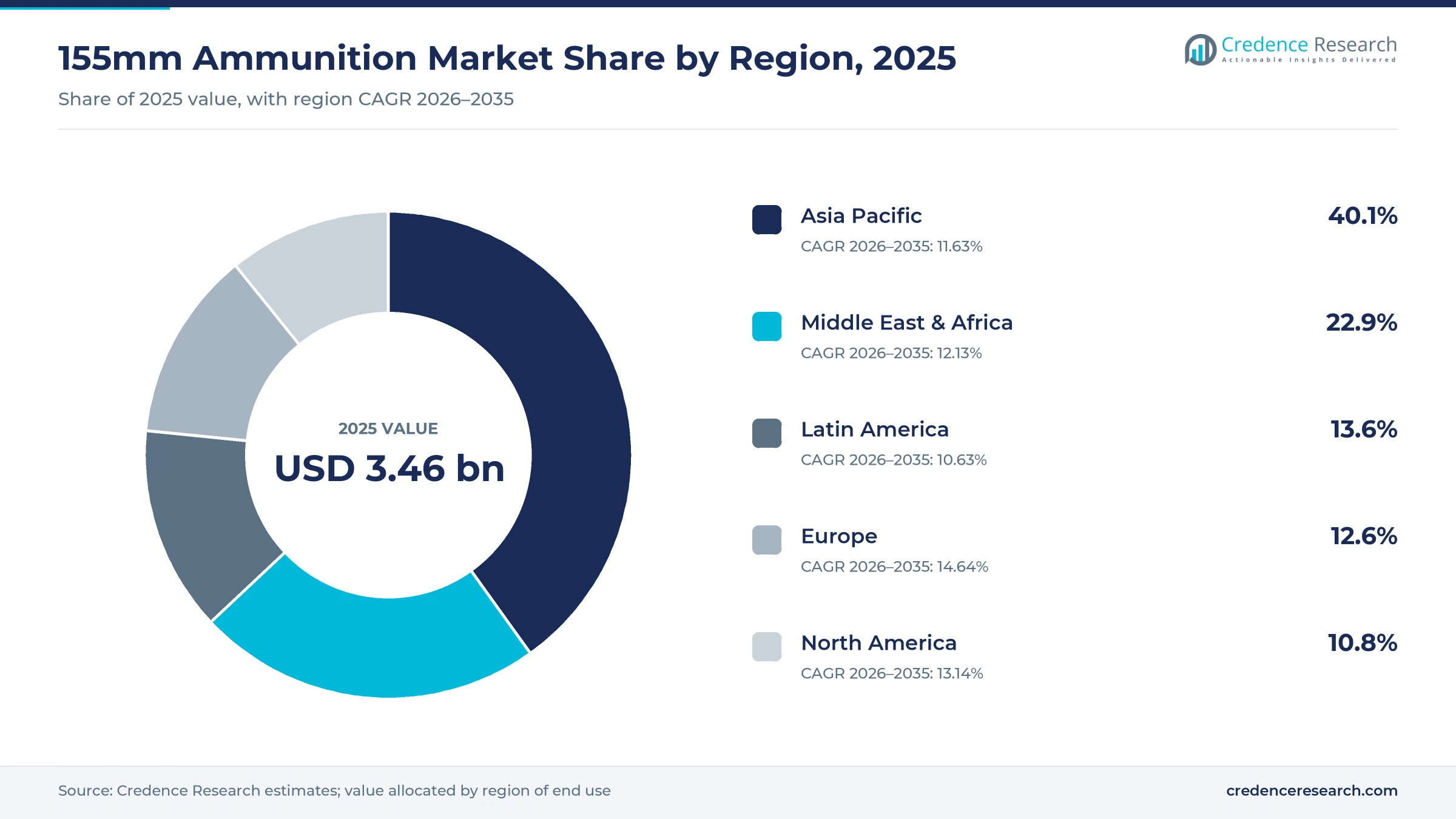
Value is allocated to the country of the end user, not the producer.
| Region | Share 2025 | CAGR 2026–2035 |
|---|---|---|
| Asia Pacific | 40.1% | 11.63% |
| Middle East & Africa | 22.9% | 12.13% |
| Latin America | 13.6% | 10.63% |
| Europe | 12.6% | 14.64% |
| North America | 10.8% | 13.14% |
Why does Asia Pacific lead?
Asia Pacific holds a 40.1% share in 2025 and grows at 11.63% a year. Large standing armies and active artillery programs in South Korea, India, China and Australia generate steady training and reserve demand. Domestic producers, such as Hanwha Aerospace in South Korea and Munitions India, supply much of this demand.
What shapes Europe?
Europe holds 12.6% and is the fastest-growing region at 14.64% a year. The EU's Regulation (EU) 2025/2643 establishing the European Defence Industry Programme, published in EUR-Lex, follows ASAP with EUR 1.5 billion for defense industrial projects.
What drives North America?
North America holds 10.8% and grows at 13.14% a year. US demand is concentrated in Army production programs, with metal parts made in Pennsylvania and Canada and loading in Iowa, Arkansas and Kansas.
What about Latin America and the Middle East & Africa?
Latin America holds 13.6% and grows at 10.63% a year, driven by armies that field 155 mm howitzers and are refreshing aging stocks. The Middle East & Africa region holds 22.9% and grows at 12.13%, led by Gulf states that buy artillery and ammunition through government-to-government deals and local industrial programs.
Plant Openings, Funding Decisions and Contract Changes, 2025–2026
| Development | Status and why it matters |
|---|---|
| In July 2026, the US Department of Defense Inspector General published a report showing 36,000 rounds a month in March 2026 against a 100,000 goal, with metal parts as the limiting factor. | Published. Confirms the gap between targets and output. |
| In June 2026, KNDS and General Dynamics Ordnance and Tactical Systems announced stronger cooperation to expand North American capacity for 52-caliber artillery ammunition. | Announced. Links European designs with US production. |
| In April 2026, the US Army signed a settlement with General Dynamics to move Mesquite orders to Pennsylvania sites at a reduced price. | Completed. Resets one of the main US expansion projects. |
| In January 2026, General Dynamics said in its annual report that its ordnance unit is expanding production capacity across multiple locations to meet growing demand. | Disclosed. Signals continued US investment. |
| In December 2025, the EU adopted Regulation (EU) 2025/2643 on the European Defence Industry Programme, with EUR 50 million to harmonize 155 mm qualification. | Adopted. Succeeds ASAP as the main EU funding tool. |
| In November 2025, Nammo broke ground at Elling, Denmark, to reopen ammunition production. | Under construction. Adds Nordic capacity. |
| In November 2025, the European Commission announced EUR 66.7 million in ASAP funding for Chemring Nobel to more than double its explosives capacity in Norway. | Funded. Eases the energetics bottleneck. |
| In August 2025, Rheinmetall opened its Unterlüß plant in Germany, planned to reach up to 350,000 shells a year by 2027. | Opened. The largest new plant in Europe. |
Need a Custom Version of This Report?
Tailor the scope, geography, or segments to your exact requirements.
- Custom geography or segment scope
- Direct access to our analyst team
National Champions and Transatlantic Primes Compete for Long-Term Contracts
Most 155 mm supply is tied to national programs, and much of it is not disclosed. No share ranking is given, because contract values and volumes are rarely published in a comparable form.
Who leads in Europe?
Rheinmetall AG is the largest European producer, with plants in Germany and partners across the region, including the Unterlüß plant. Nammo AS, owned by the Norwegian state and Finland's Patria, supplies rounds and propellants to Nordic and NATO customers. KNDS, the Franco-German land systems group, makes ammunition through its national units. MSM Group s.r.o. in Slovakia and BAE Systems plc in the United Kingdom add capacity for European buyers.
Who supplies the United States?
General Dynamics Ordnance and Tactical Systems, part of General Dynamics, makes projectile metal parts in Pennsylvania and is expanding capacity across several sites, as its fiscal 2025 Form 10-K states. Government-owned, contractor-operated plants handle loading. Northrop Grumman Corporation supplies precision guidance kits that turn standard rounds into guided ones.
Who leads in Asia and the Middle East?
Hanwha Aerospace supplies South Korea and export customers. Munitions India Limited, a state-owned company formed from the former Ordnance Factory Board, supplies the Indian Army. Elbit Systems Ltd. supplies Israel and export markets.
How do suppliers compete?
Suppliers compete on delivery speed, qualified designs and assured energetics. Those that control propellant and explosives supply, or win long framework contracts, hold the stronger position. Related small-arms demand is covered in the small caliber ammunition market.
Frequently Asked Questions
How big is the 155mm ammunition market?
What is driving demand for 155mm ammunition?
Which region buys the most 155mm ammunition?
Which component is growing fastest?
How much 155mm ammunition does the United States produce?
Who are the main suppliers?
Table of Content
Chapter 1 Market Segmentation
- 1.1 Segmentation Framework
- 1.1.1 Product and Service Classification
- 1.1.2 Application and End-Use Classification
- 1.1.3 Technology and Solution Classification
- 1.1.4 Customer and Distribution Channel Classification
- 1.1.5 Geographic Segmentation
- 1.1.6 Market Segment Definitions and Boundaries
- 1.2 By Technology
- 1.2.1 Unguided/Conventional
- 1.2.2 Guided
- 1.3 By Component
- 1.3.1 Projectiles
- 1.3.2 Propellant
- 1.3.3 Fuze
- 1.3.4 Primer
- 1.4 By Projectile Type
- 1.4.1 High-Explosive
- 1.4.2 Practice
- 1.4.3 Smoke
- 1.4.4 Illumination
- 1.4.5 Cargo/DPICM
- 1.4.6 Armor-Piercing
- 1.5 By Range
- 1.5.1 Up to 30 km
- 1.5.2 31–50 km
- 1.5.3 Above 50 km/Extended Range
- 1.6 By Platform
- 1.6.1 Self-Propelled Howitzers
- 1.6.2 Towed Howitzers
- 1.6.3 Other Artillery Platforms
- 1.7 By End User
- 1.7.1 Army/Land Forces
- 1.7.2 Marine Corps
- 1.7.3 Defense Procurement Agencies
Chapter 2 Introduction
- 2.1 Report Objectives and Scope
- 2.2 Product Definition and Industry Terminology
- 2.3 Market Inclusions and Exclusions
- 2.4 Research Process
- 2.4.1 Primary Research and Expert Interviews
- 2.4.2 Secondary Research and Source Review
- 2.4.3 Top-Down and Bottom-Up Estimation
- 2.4.4 Data Triangulation and Verification
- 2.5 Market Size Measurement Basis
- 2.5.1 2025: USD 3.46 billion → 2035: USD 10.09 billion
- 2.6 Historical and Forecast Reference Periods
- 2.6.1 Historical Period: 2018-2025
- 2.6.2 Base Year: 2025
- 2.6.3 Forecast Period: 2025-2035
- 2.7 Research Assumptions and Limitations
Chapter 3 Executive Summary
- 3.1 Market Snapshot and Key Findings
- 3.2 Base-Year Market Size, 2025
- 3.3 Forecast Market Size, 2035
- 3.4 Revenue and Volume Growth Outlook
- 3.5 Key Demand and Supply Indicators
- 3.6 Leading Market Segments
- 3.7 Fastest-Growing Market Opportunities
- 3.8 Regional Performance Highlights
- 3.9 Technology and Industry Transformation
- 3.10 Competitive Landscape Summary
- 3.11 Analyst View and Strategic Implications
Chapter 4 Global 155mm Ammunition Market Trends and Developments
- 4.1 Historical Industry Development, 2018-2025
- 4.2 Recent Market Trends and Developments
- 4.3 Demand and Customer Behavior Trends
- 4.4 Technology and Product Innovation
- 4.5 Artificial Intelligence, Automation and Digitalization
- 4.6 Local Manufacturing and Supply Chain Realignment
- 4.7 Industry Partnerships, Mergers and Acquisitions
- 4.8 Sustainability and Circular Economy Developments
- 4.9 Government and Private Sector Investment Trends
- 4.10 Emerging Business Models and Commercialization
- 4.11 Industry Developments and Announcements
Chapter 5 Global 155mm Ammunition Market Production, Supply and Demand Analysis
- 5.1 Demand Trend and Consumption Analysis, 2018-2025
- 5.2 Demand Forecast, 2025-2035
- 5.3 Production and Output Trend, 2018-2025
- 5.4 Production and Output Forecast, 2025-2035
- 5.5 Installed Capacity and Capacity Utilization
- 5.6 Company-Wise Production Plants and Statistics
- 5.6.1 Installed Production Capacity
- 5.6.2 Actual Production
- 5.6.3 Planned Capacity and Expansion Targets
- 5.7 Supply Chain Structure and Procurement Trends
- 5.8 Supply-Demand Gap and Bottlenecks
- 5.9 Import Dependence and Sourcing Structure
- 5.10 Contract Manufacturing and Outsourcing
- 5.11 Regional Supply and Demand Concentration
Chapter 6 Global 155mm Ammunition Market Pricing Analysis
- 6.1 Pricing Structure and Measurement
- 6.2 Historical Pricing Trends, 2018-2025
- 6.3 Pricing Outlook, 2025-2035
- 6.4 Average Selling Price and Unit Economics
- 6.5 Pricing by Product and Market Segment
- 6.6 Geographic Pricing Differences
- 6.7 Key Input, Energy, Labor and Logistics Costs
- 6.8 Contract Pricing and Purchasing Models
- 6.9 Pricing Sensitivity and Competitive Positioning
- 6.10 Price, Margin and Profitability Implications
Chapter 7 Global 155mm Ammunition Market Dynamics
- 7.1 Market Growth Drivers
- 7.1.1 Demand-Side Drivers
- 7.1.2 Technology and Innovation Drivers
- 7.1.3 Infrastructure and Investment Drivers
- 7.1.4 Regulatory and Policy Drivers
- 7.2 Market Restraints
- 7.2.1 Cost and Affordability Constraints
- 7.2.2 Technology and Adoption Barriers
- 7.2.3 Supply Chain and Operational Constraints
- 7.3 Market Challenges
- 7.3.1 Competitive Pressure and Margin Erosion
- 7.3.2 Skills, Infrastructure and Implementation Gaps
- 7.4 Emerging Market Opportunities
- 7.5 Market Dynamics Impact and Time-Horizon Assessment
Chapter 8 Global 155mm Ammunition Value Chain Analysis
- 8.1 Industry Value Chain Overview
- 8.2 Upstream Suppliers and Critical Inputs
- 8.3 Technology and Component Providers
- 8.4 Manufacturing or Service Delivery
- 8.5 Distribution, Channel Partners and Integrators
- 8.6 Downstream Applications and End Users
- 8.7 Value Addition and Profit Pools
- 8.8 Vertical Integration and Outsourcing
- 8.9 Supplier Concentration and Risk
- 8.10 Supply Chain Localization and Resilience
Chapter 9 Global 155mm Ammunition Market Regulations and Policies
- 9.1 Relevant Laws, Standards and Compliance Frameworks
- 9.2 Product, Service, Safety and Quality Requirements
- 9.3 Government Policies, Incentives and Subsidies
- 9.4 Imports, Exports and Trade Barriers
- 9.5 Public Procurement and Local Content Requirements
- 9.6 Environmental and Sustainability Compliance
- 9.7 Upcoming Policy Changes and Market Implications
Chapter 10 Global 155mm Ammunition Market Hotspots and Opportunities
- 10.1 Market Opportunity Mapping and Growth Hotspots
- 10.2 High-Growth Applications and Customer Groups
- 10.3 Underserved Markets and White-Space Opportunities
- 10.4 Emerging Technology and Product Opportunities
- 10.5 New Capacity and Investment Hotspots
- 10.6 Market Entry and Expansion Opportunities
- 10.7 Distribution and Partnership Opportunities
- 10.8 Near-Term and Long-Term Commercial Potential
- 10.9 Opportunity Attractiveness and Execution Risks
Chapter 11 Global 155mm Ammunition Market Outlook, 2025-2035
- 11.1 Market Size and Analysis
- 11.1.1 Revenue (Market Measurement: 2025: USD 3.46 billion → 2035: USD 10.09 billion)
- 11.1.2 Market Volume and Quantity Sold
- 11.1.3 Historical Market Size, 2018-2025
- 11.1.4 Base-Year Market Size, 2025
- 11.2 Market Forecast, 2025-2035
- 11.2.1 Revenue Forecast to 2035
- 11.2.2 Volume Forecast to 2035
- 11.2.3 CAGR and Year-on-Year Growth
- 11.2.4 Incremental Revenue Opportunity
- 11.3 Forecast Assumptions and Scenario Analysis
- 11.3.1 Base-Case Forecast
- 11.3.2 Optimistic and Conservative Scenarios
- 11.3.3 Technology, Pricing and Policy Sensitivities
- 11.4 Market Attractiveness and Growth Outlook
Chapter 12 Global 155mm Ammunition Market Segmentation and Outlook
- 12.1 Segmentation Summary and Market Shares, 2025
- 12.2 Largest and Fastest-Growing Segments
- 12.3 By Technology - Market Size and Forecast, 2025-2035
- 12.3.1 Segment Definition and Scope
- 12.3.2 Historical Market Size, 2018-2025
- 12.3.3 Revenue Forecast, 2025-2035
- 12.3.4 Volume Forecast, 2025-2035
- 12.3.5 Base-Year Market Share, 2025
- 12.3.6 Segment CAGR and Growth Drivers
- 12.3.7 Subsegment Market Size and Forecast
- 12.3.7.1 Unguided/Conventional
- 12.3.7.2 Guided
- 12.3.8 Subsegment Pricing and Adoption Trends
- 12.3.9 Leading Suppliers and Competition
- 12.3.10 Regional Demand and Opportunities
- 12.4 By Component - Market Size and Forecast, 2025-2035
- 12.4.1 Segment Definition and Scope
- 12.4.2 Historical Market Size, 2018-2025
- 12.4.3 Revenue Forecast, 2025-2035
- 12.4.4 Volume Forecast, 2025-2035
- 12.4.5 Base-Year Market Share, 2025
- 12.4.6 Segment CAGR and Growth Drivers
- 12.4.7 Subsegment Market Size and Forecast
- 12.4.7.1 Projectiles
- 12.4.7.2 Propellant
- 12.4.7.3 Fuze
- 12.4.7.4 Primer
- 12.4.8 Subsegment Pricing and Adoption Trends
- 12.4.9 Leading Suppliers and Competition
- 12.4.10 Regional Demand and Opportunities
- 12.5 By Projectile Type - Market Size and Forecast, 2025-2035
- 12.5.1 Segment Definition and Scope
- 12.5.2 Historical Market Size, 2018-2025
- 12.5.3 Revenue Forecast, 2025-2035
- 12.5.4 Volume Forecast, 2025-2035
- 12.5.5 Base-Year Market Share, 2025
- 12.5.6 Segment CAGR and Growth Drivers
- 12.5.7 Subsegment Market Size and Forecast
- 12.5.7.1 High-Explosive
- 12.5.7.2 Practice
- 12.5.7.3 Smoke
- 12.5.7.4 Illumination
- 12.5.7.5 Cargo/DPICM
- 12.5.7.6 Armor-Piercing
- 12.5.8 Subsegment Pricing and Adoption Trends
- 12.5.9 Leading Suppliers and Competition
- 12.5.10 Regional Demand and Opportunities
- 12.6 By Range - Market Size and Forecast, 2025-2035
- 12.6.1 Segment Definition and Scope
- 12.6.2 Historical Market Size, 2018-2025
- 12.6.3 Revenue Forecast, 2025-2035
- 12.6.4 Volume Forecast, 2025-2035
- 12.6.5 Base-Year Market Share, 2025
- 12.6.6 Segment CAGR and Growth Drivers
- 12.6.7 Subsegment Market Size and Forecast
- 12.6.7.1 Up to 30 km
- 12.6.7.2 31–50 km
- 12.6.7.3 Above 50 km/Extended Range
- 12.6.8 Subsegment Pricing and Adoption Trends
- 12.6.9 Leading Suppliers and Competition
- 12.6.10 Regional Demand and Opportunities
- 12.7 By Platform - Market Size and Forecast, 2025-2035
- 12.7.1 Segment Definition and Scope
- 12.7.2 Historical Market Size, 2018-2025
- 12.7.3 Revenue Forecast, 2025-2035
- 12.7.4 Volume Forecast, 2025-2035
- 12.7.5 Base-Year Market Share, 2025
- 12.7.6 Segment CAGR and Growth Drivers
- 12.7.7 Subsegment Market Size and Forecast
- 12.7.7.1 Self-Propelled Howitzers
- 12.7.7.2 Towed Howitzers
- 12.7.7.3 Other Artillery Platforms
- 12.7.8 Subsegment Pricing and Adoption Trends
- 12.7.9 Leading Suppliers and Competition
- 12.7.10 Regional Demand and Opportunities
- 12.8 By End User - Market Size and Forecast, 2025-2035
- 12.8.1 Segment Definition and Scope
- 12.8.2 Historical Market Size, 2018-2025
- 12.8.3 Revenue Forecast, 2025-2035
- 12.8.4 Volume Forecast, 2025-2035
- 12.8.5 Base-Year Market Share, 2025
- 12.8.6 Segment CAGR and Growth Drivers
- 12.8.7 Subsegment Market Size and Forecast
- 12.8.7.1 Army/Land Forces
- 12.8.7.2 Marine Corps
- 12.8.7.3 Defense Procurement Agencies
- 12.8.8 Subsegment Pricing and Adoption Trends
- 12.8.9 Leading Suppliers and Competition
- 12.8.10 Regional Demand and Opportunities
- 12.9 Segment Growth Comparison
- 12.10 Segment Attractiveness and Priority Matrix
Chapter 13 Global 155mm Ammunition End-Use and Application Market Outlook
- 13.1 End-Use Industry and Customer Demand Structure
- 13.2 Leading Applications and Customer Groups
- 13.3 End-Use Market Size, Share and Forecast
- 13.4 Major End-Use Industry Deep Dives
- 13.4.1 Customer Requirements and Use Cases
- 13.4.2 Demand and Replacement Cycles
- 13.4.3 Technical and Regulatory Considerations
- 13.4.4 Purchasing and Procurement Models
- 13.4.5 Leading Vendors and Distribution Channels
- 13.4.6 Forecast and Commercial Opportunities
- 13.5 Emerging Applications and Cross-Segment Demand
- 13.6 End-Use Industry Investment Priorities
Chapter 14 Global 155mm Ammunition Geographic Market Outlook, 2025-2035
- 14.1 Regional Market Size and Share, 2025
- 14.2 Regional Market Forecast, 2025-2035
- 14.3 Regional Pricing, Production and Demand Differences
- 14.4 North America
- 14.4.1 United States
- 14.4.2 Canada
- 14.4.3 Mexico
- 14.5 Europe
- 14.5.1 Germany
- 14.5.2 France
- 14.5.3 Italy
- 14.5.4 United Kingdom
- 14.5.5 Spain
- 14.5.6 Poland
- 14.5.7 Russia
- 14.5.8 Netherlands
- 14.5.9 Belgium
- 14.5.10 Sweden
- 14.5.11 Denmark
- 14.5.12 Norway
- 14.5.13 Rest of Europe
- 14.6 Asia Pacific
- 14.6.1 China
- 14.6.2 India
- 14.6.3 Japan
- 14.6.4 South Korea
- 14.6.5 Thailand
- 14.6.6 Indonesia
- 14.6.7 Vietnam
- 14.6.8 Malaysia
- 14.6.9 Australia
- 14.6.10 Rest of Asia Pacific
- 14.7 Latin America
- 14.7.1 Brazil
- 14.7.2 Argentina
- 14.7.3 Colombia
- 14.7.4 Chile
- 14.7.5 Rest of Latin America
- 14.8 Middle East
- 14.8.1 Saudi Arabia
- 14.8.2 United Arab Emirates
- 14.8.3 Turkey
- 14.8.4 Israel
- 14.8.5 Iran
- 14.8.6 Rest of the Middle East
- 14.9 Africa
- 14.9.1 South Africa
- 14.9.2 Egypt
- 14.9.3 Nigeria
- 14.9.4 Morocco
- 14.9.5 Rest of Africa
- 14.10 Regional Investment, Policy and Supply Chain Differences
- 14.11 Regional Competitive Landscape
- 14.12 Geographic Growth Hotspots
Chapter 15 Global 155mm Ammunition Technology, Innovation and Sustainability Outlook
- 15.1 Technology Landscape and Maturity
- 15.2 Product, Process and Service Innovation
- 15.3 AI, Automation and Digital Tools in the Industry
- 15.4 Technology Adoption and Performance Benchmarking
- 15.5 Innovation Pipeline and R&D Investment
- 15.6 Patent and Intellectual Property Trends
- 15.7 Energy Efficiency and Resource Management
- 15.8 Sustainability, Recycling and Circularity
- 15.9 Technology Roadmap, 2025-2035
- 15.10 Risks of Obsolescence and Technology Substitution
Chapter 16 Global 155mm Ammunition Market Key Strategic Imperatives
- 16.1 Growth and Market Entry Priorities
- 16.2 High-Return Products and Segments
- 16.3 Pricing, Profitability and Cost Optimization
- 16.4 Technology Investment and Product Differentiation
- 16.5 Supply Chain Localization and Resilience
- 16.6 Distribution and Customer Acquisition
- 16.7 Partnership, Acquisition and Capacity Strategy
- 16.8 Regional Expansion Priorities
- 16.9 Short-, Medium- and Long-Term Actions
Chapter 17 Competition Outlook
- 17.1 Industry Competition Characteristics
- 17.2 Market Structure and Concentration
- 17.3 Market Share and Competitive Positioning, 2025
- 17.4 Company-Wise Revenue and Product Benchmarking
- 17.5 Production and Service Capacity Benchmarking
- 17.6 Technology, Pricing and Differentiation
- 17.7 Regional Footprint and Distribution Strength
- 17.8 Mergers, Acquisitions and Strategic Alliances
- 17.9 New Entrants and Competitive Threats
- 17.10 Porter's Five Forces and Industry Attractiveness
- 17.11 Competitive Outlook, 2025-2035
Chapter 18 Company Profiles
- 18.1 Company Coverage and Selection Criteria
- 18.2 BAE Systems plc
- 18.2.1 Business Description
- 18.2.2 Company Ownership and Geographic Presence
- 18.2.3 Product and Service Portfolio
- 18.2.4 Manufacturing and Operating Footprint
- 18.2.5 Production Capacity and Expansion Plans
- 18.2.6 Financial Performance and Investment
- 18.2.7 Market Share and Competitive Position
- 18.2.8 Technology and Innovation Capabilities
- 18.2.9 Strategic Alliances or Partnerships
- 18.2.10 Recent Developments
- 18.2.11 Growth Strategy and Outlook
- 18.3 Rheinmetall AG
- 18.4 General Dynamics Ordnance and Tactical Systems
- 18.5 Northrop Grumman Corporation
- 18.6 Nammo AS
- 18.7 KNDS
- 18.8 Elbit Systems Ltd.
- 18.9 MSM Group s.r.o.
- 18.10 Hanwha Aerospace
- 18.11 Munitions India Limited
- 18.12 Other Relevant Market Participants
Note: Every listed company is profiled on the structure shown under the first company. The company list is preliminary and may change based on research findings, market developments, data availability and client requirements.
Chapter 19 Disclaimer
- 19.1 Research and Forecast Disclaimer
- 19.2 Data Source and Estimation Limitations
Note: The depth of individual sections depends on data availability for this market. Volume, capacity, trade and other unit-based metrics are included where applicable.

