
Indonesia health insurance grows as top-up cover over JKN
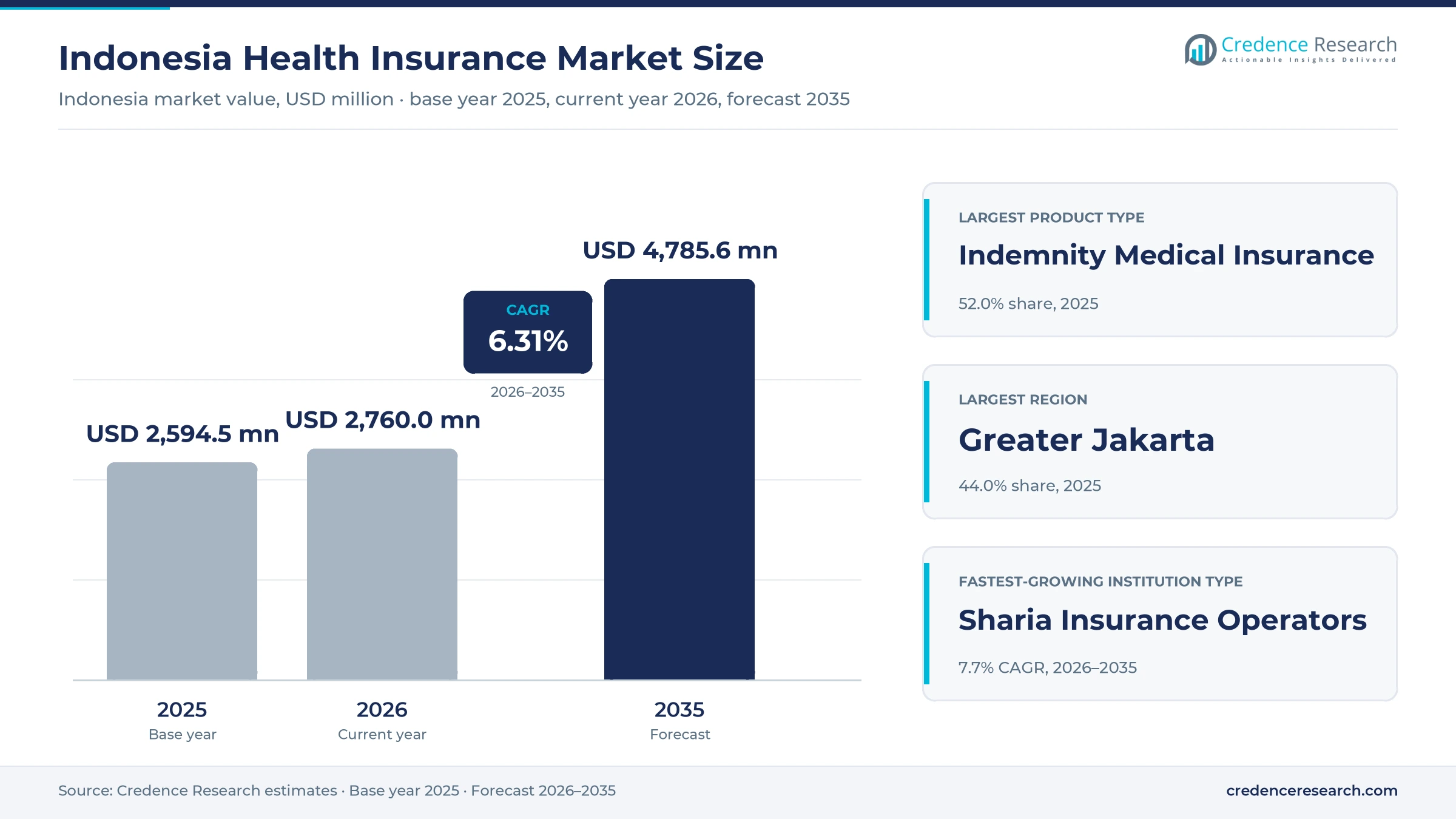
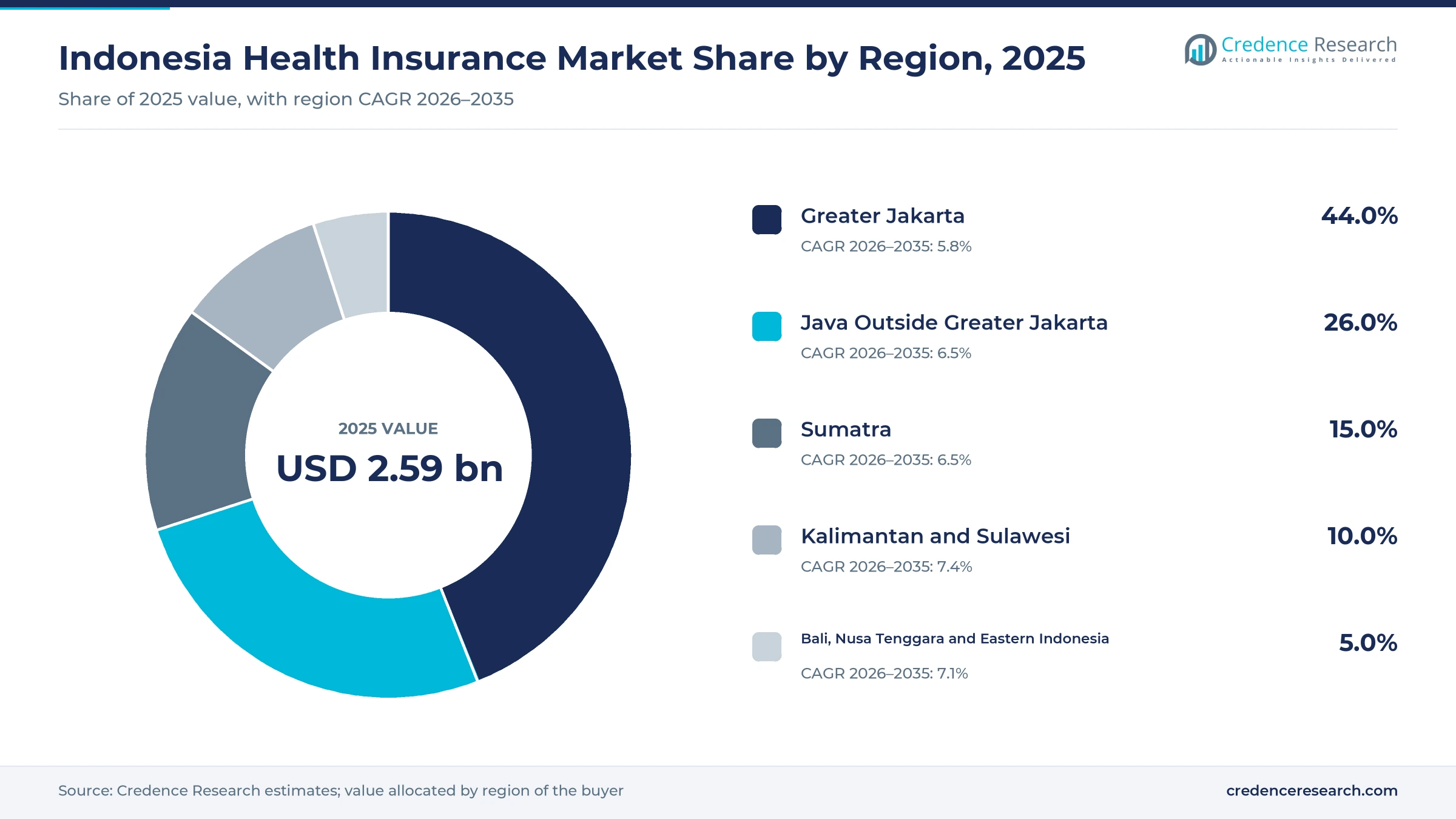
The Indonesia health insurance market was valued at USD 2.59 billion in 2025 and is projected to increase from USD 2.76 billion in 2026 to USD 4.79 billion by 2035, registering a CAGR of 6.31% during 2026–2035. Demand comes from employers that buy group inpatient and outpatient cover, from affluent families that top up the national JKN scheme, and from bank customers who add health riders to savings and life policies. Greater Jakarta held the largest regional share, 44.0% in 2025, because corporate head offices, private hospital groups and high-income households cluster there. Kalimantan and Sulawesi is the fastest-growing region at 7.4% a year, as resource employers in both islands formalize benefits for large workforces. Pricing is the central commercial issue, because claims have outrun premiums for several years and insurers have repriced portfolios hard. The Financial Services Authority (OJK) responded with a health insurance regulation that took effect in March 2026 and lets insurers sell co-payment plans beside full-cover products.
Why does private cover sit on top of JKN rather than replace it?
The estimate counts gross written premiums and sharia contributions for private medical cover sold in Indonesia by life insurers, general insurers, sharia operators and managed care insurers. It includes indemnity plans, hospital cash and fixed-benefit plans, international private medical insurance, health riders attached to life and unit-linked policies, and group plans bought by employers. Members usually keep their JKN membership and use private cover for higher room classes, private hospitals, faster access and treatment abroad.
Contributions to BPJS Kesehatan, government-paid premiums for poor households, personal accident cover and travel insurance are excluded, as are fees earned by third-party administrators. The value chain runs from insurers through bank, agency, broker and digital channels to hospital networks, where cashless agreements and package rates decide much of the claims cost.
Indonesia Health Insurance Market Insights
- The market grows from USD 2.59 billion in 2025 to USD 4.79 billion by 2035 at 6.31%, as private plans fund the care that the national JKN scheme leaves to higher-income members and employers.
- Greater Jakarta accounted for 44.0% of 2025 value, reflecting the concentration of corporate head offices, private hospital groups and affluent households in the capital region.
- Indemnity medical insurance led with 52.0% in 2025 because employers and affluent families still prefer reimbursement of actual hospital bills over fixed daily cash benefits.
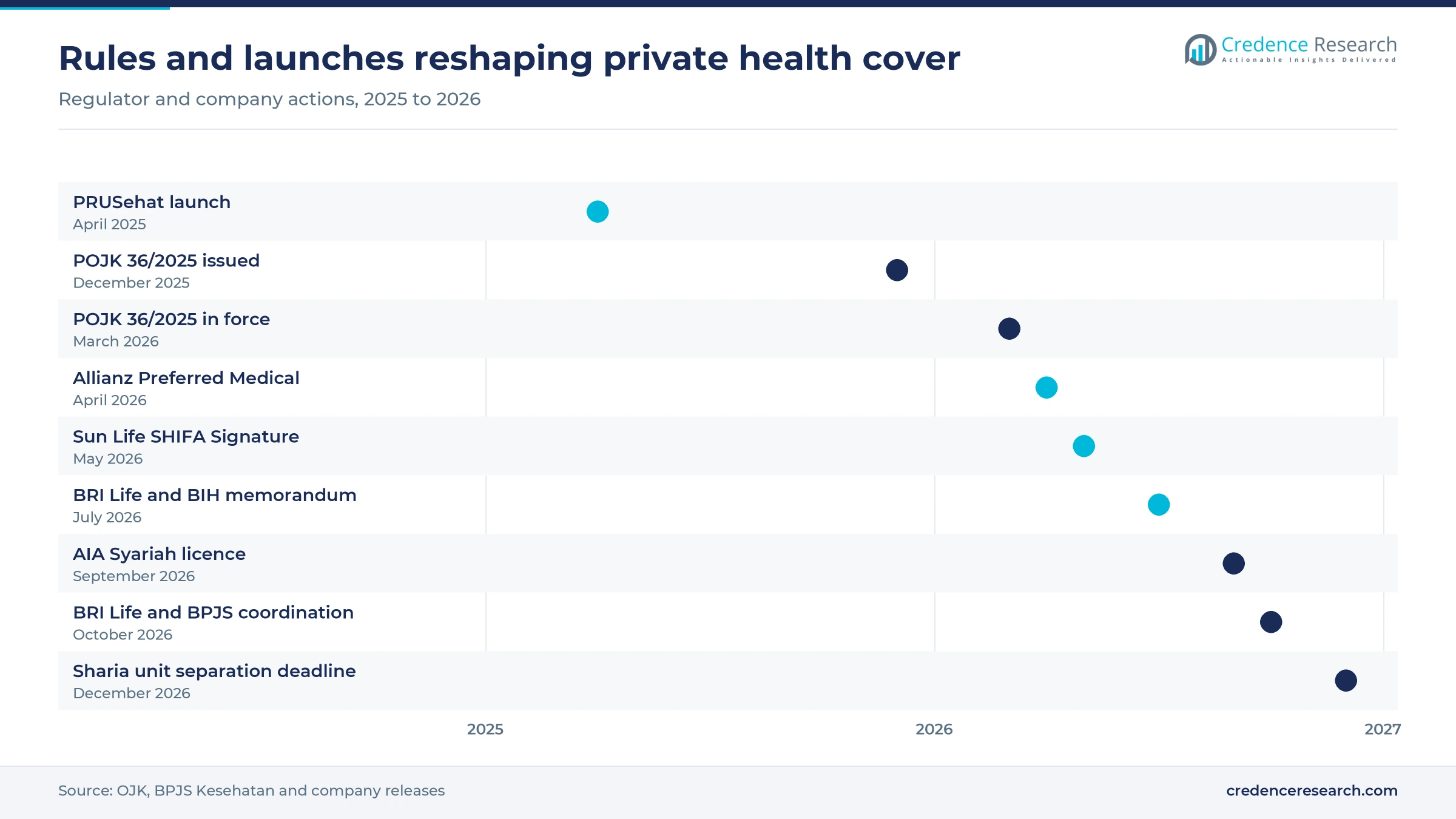
- POJK 36/2025, in force since March 2026, lets insurers sell co-payment plans beside full-cover products and makes utilization reviews and medical advisory boards mandatory for every health insurer.
- Life insurers and bank-affiliated groups dominate supply, and the end-2026 deadline for separating sharia units is adding new stand-alone sharia operators to the competitive field.
Indemnity plans lead while managed care gains fastest
Segment shares and growth rates are Credence Research estimates built from insurer disclosures, association channel data and product filings, and each group sums to the market total. Sharia Insurance Operators post the fastest segment growth by institution type in the market, at 7.7% a year, as sharia units become stand-alone insurers.
Why do indemnity plans still carry most of the premium?
Based on product type, the market is categorized into indemnity medical insurance, managed care and provider-network plans, hospital cash and fixed-benefit health plans, and international private medical insurance. Indemnity Medical Insurance led with 52.0% of 2025 value because most riders and group plans reimburse actual hospital bills, which matters when room and procedure prices rise every year. OJK data show health products made up 19.23% of life insurers' premium income through October 2025, a book built largely on reimbursement riders sold with life policies. Managed Care and Provider-Network Plans grow fastest at 7.3% a year, as Inhealth serves more than 1.7 million participants through more than 8,000 partner providers.
How much of the market do employers fund?
Based on customer segment, the market is categorized into corporate employees, SMEs and professional groups, affluent individuals and families, and mass-affluent retail consumers. Corporate Employees led with 46.0% in 2025 because employers fund cover for staff and dependants, and OJK estimates that companies pay Rp43.7 trillion of national health costs a year. That employer budget sits above JKN and is renewed annually through brokers and bank relationships. Mass-Affluent Retail Consumers grow fastest at 7.3% a year, as the number of people insured by life companies rose 8.6% to 168.03 million in 2025, according to the Indonesian Life Insurance Association (AAJI).
Which channel reaches the most policyholders?
Based on distribution channel, the market is categorized into bancassurance, agency force, brokers and corporate benefits consultants, and direct and digital platforms. Bancassurance led with 38.0% in 2025 because bank-led distribution lets partners sell health riders to account holders when they save or borrow. AAJI data show that bank channels collected 41.5% of life premiums in the first nine months of 2025, ahead of agents at 31.7%. Direct and Digital Platforms grow fastest at 7.9% a year, as alternative distribution was the only life channel to grow in that period, led by direct marketing, employee benefits and brokers.
Why do life insurers write most health premiums?
Based on institution type, the market is categorized into life insurance companies, general insurance companies, sharia insurance operators and health-focused managed care insurers. Life Insurance Companies led with 64.0% in 2025 because health riders attach to life and unit-linked policies sold through banks and agents. According to OJK data for October 2025, life insurers wrote Rp28.63 trillion of health premiums year to date, against Rp9.10 trillion for general insurers and reinsurers. Sharia Insurance Operators grow fastest at 7.7% a year, as the end-2026 spin-off deadline described in the trends section moves sharia portfolios of large life insurers into stand-alone operators.
| Segment Group | Leading Sub-segment | Share, 2025 | Fastest-growing Sub-segment | CAGR, 2026–2035 |
|---|---|---|---|---|
| By Product Type | Indemnity Medical Insurance | 52.0% | Managed Care and Provider-Network Plans | 7.3% |
| By Customer Segment | Corporate Employees | 46.0% | Mass-Affluent Retail Consumers | 7.3% |
| By Distribution Channel | Bancassurance | 38.0% | Direct and Digital Platforms | 7.9% |
| By Institution Type | Life Insurance Companies | 64.0% | Sharia Insurance Operators | 7.7% |
How co-payment caps and annual repricing set premiums
Private health premiums in Indonesia are set per insured life, banded by age and plan limit, and repriced at renewal against the claims experience of the pool or the employer group. Group plans are experience-rated, so a company with heavy hospital use pays more next year, while retail plans move by age band and rider. POJK 36/2025 now limits premium resets to once a year and allows a 5% co-payment option, which lowers the premium for buyers willing to share costs. The JKN contribution works as a reference price, because members compare a private plan with the Rp150,000 monthly class I contribution they already pay. Insurers with cashless hospital deals hold margins best, because package rates cap claims costs.
| Offer or charge | Typical price or fee | Basis |
|---|---|---|
| JKN class I contribution, independent member | Rp150,000 per person per month | CNBC Indonesia, March 2026 |
| Entry individual inpatient plan (PRUSehat) | From Rp230,000 per month | Prudential Indonesia via Kontan, April 2025 |
| Co-payment option under POJK 36/2025 | 5% of claim, capped at Rp300,000 outpatient and Rp3 million inpatient | OJK, December 2025 |
| Outpatient cost difference billed to a supplementary insurer | Up to Rp400,000 per visit | BPJS Kesehatan via Kontan, July 2025 |
| Premium review frequency | 1 reset per 12 months at most | OJK, December 2025 |
Request a Free Sample
Fill in your details and we'll send you a free sample report.
- Sample data tables & charts
- Research methodology
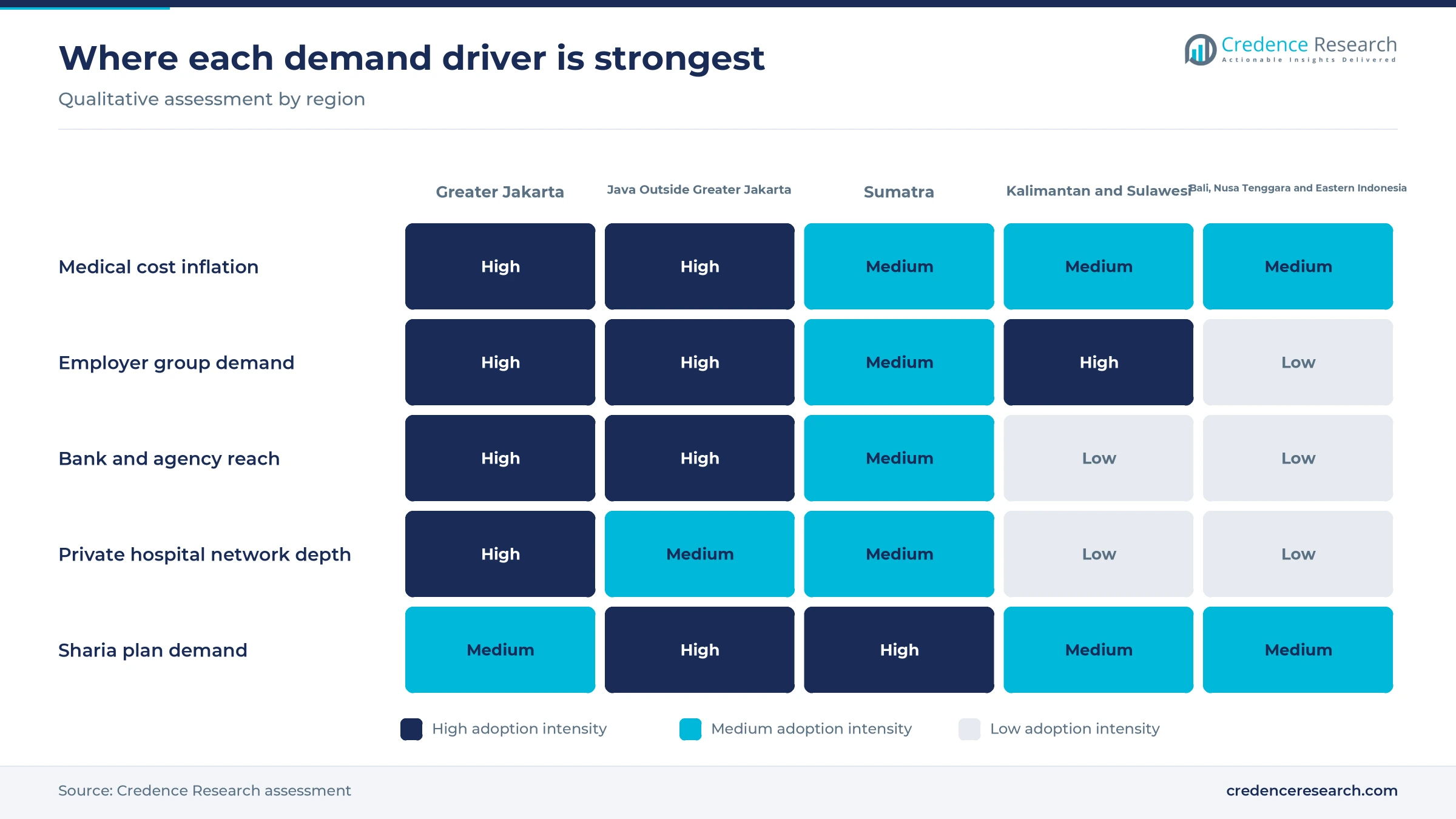
Medical costs and coverage gaps push private cover demand
Medical cost inflation raises the value of private cover
Hospital prices in Indonesia are rising several times faster than consumer prices, which raises the cost of an uninsured admission and the value of a private policy. OJK put medical inflation at 16.9% in 2025 and projects 14.4% for 2026, against general inflation of about 2%, according to remarks by its insurance supervision chief in July 2026. Claims show the same pressure, as life insurers paid Rp26.74 trillion in health claims in 2025, 9.1% more than a year earlier, according to AAJI. The result is a market that grows in value even when policy counts move slowly, and indemnity plans capture most of that gain.
A wide protection gap leaves room for supplementary cover
Universal JKN membership has not closed the financing gap at the top of the market, because many households still pay privately for private hospitals, higher room classes and drugs outside the JKN formulary. The World Health Organization reports that out-of-pocket spending fell from 45% of current health expenditure in 2014 to 27.5% after JKN expanded, which still leaves more than a quarter of costs on households. OJK estimates that private health insurance pays only Rp32.5 trillion of Rp639 trillion in national health costs, while households pay Rp181 trillion directly. Overall insurance penetration stood at 2.72% in February 2025, according to OJK. Each share of that out-of-pocket pool converted into premiums lifts supplementary cover.
Employer benefits and multi-channel selling widen reach
Employers remain the cheapest route to large insured pools, because one group contract covers hundreds of employees and dependants without individual underwriting. Inhealth, the managed care insurer inside the state-owned Indonesia Financial Group, paid about Rp4.4 trillion in claims in 2025 and held the largest share of group health business in the first quarter of 2026, according to AAJI data cited by Republika. Insurers are also stacking channels, as Sun Life Indonesia sells its SHIFA Signature sharia health plan through its agents and through CIMB Niaga, CIMB Niaga Syariah and Bank Muamalat. Brokers and employee benefits consultants sit inside the alternative channel, which collected Rp35.69 trillion, or 26.8% of life premiums, in the first nine months of 2025. Insurers that combine group contracts with retail top-ups gain the widest reach.
Coordination with BPJS Kesehatan lowers the cost of top-ups
Coordination of benefits with the national scheme lets a private plan pay only the difference above JKN, which cuts the premium needed for upgraded hospital care. JKN covered 282.7 million people, or 98.62% of the population, at the end of 2025, according to BPJS Kesehatan, so almost every private policyholder is also a JKN member. Under the coordination rules, a supplementary insurer pays the gap between a member's JKN class and a higher class at a partner hospital. BRI Life signed an inter-payer coordination agreement with BPJS Kesehatan on Oct. 6, 2026, covering membership checks, single-door billing and cost guarantees. Wider use of this mechanism favors insurers with hospital contracts inside JKN networks and supports cheaper top-up plans for mid-income buyers.
Managed care and risk-sharing reshape product design
Insurers shift toward managed care and hospital price deals
Insurers are shifting from paying hospital bills as presented toward managed care contracts that fix treatment costs in advance. AXA Mandiri expanded its cost-certainty partnership with the Hermina hospital group in July 2026, after similar deals with Mitra Keluarga and EMC Healthcare in 2025, according to Infobank. POJK 36/2025, in force since March 22, 2026, requires every health insurer to run utilization reviews by doctors. BRI Life describes its hospital partnerships as part of a managed care strategy focused on efficiency. Prudential Indonesia reported a health claim ratio of 86.54% in the first nine months of 2025, according to Kontan, which shows the margin pressure these contracts aim to relieve. This shift creates openings for managed care and provider-network plans across group and retail lines.
Risk-sharing plans emerge as insurers redesign products
A shift toward risk-sharing designs is emerging as insurers look for ways to hold premiums down without cutting benefit limits. The POJK 36/2025 regulation sets the co-payment caps shown in the pricing table while still obliging insurers to sell full-cover plans beside them. Allianz Life Indonesia and Allianz Syariah launched Allianz Preferred Medical on April 16, 2026, with a self-risk option on its higher plans that the company says curbs over-treatment. Sun Life Indonesia expects health claim ratios to improve over 12 to 24 months through product redesign, citing an industry health claim ratio of 76.72% in October 2025. Price-sensitive retail buyers and small employers gain the most from these cheaper plans.
Sharia spin-offs open room for new health plans
The separation of sharia units creates an opening for stand-alone sharia operators to build health portfolios for Muslim households and for employers that require sharia-compliant benefits. OJK granted AIA Syariah Insurance its business licence on Sept. 25, 2026, so AIA Financial can move its sharia portfolio, assets and policyholders into the new company. OJK said on Nov. 5, 2026, that 11 sharia units still had to form new companies before the end-2026 deadline, while 10 insurers had chosen portfolio transfers instead. Manulife Syariah, already operating as a separate company, sells MiUltimate HealthCare Syariah plans. New sharia operators that pair bank partners with cashless hospital networks can win group contracts from sharia banks, Islamic schools and their employees.
Affordable entry plans can reach younger urban buyers
Low-premium inpatient plans are an opening for insurers to reach young workers and families who rely on JKN but want private hospital access for common illnesses. Prudential Indonesia and Prudential Syariah launched PRUSehat on April 24, 2025, aiming at younger buyers in the retail segment. Premiums start from Rp230,000 a month for certain conditions, with limits of up to Rp900 million. The plan covers inpatient care and outpatient treatment for typhoid, dengue, cancer and dialysis at more than 1,700 partner hospitals, 359 of them cashless. Digital servicing of the kind built by insurtech platforms lowers the cost of small policies, and Inhealth launched the One by IFG app in 2025. Insurers that hold claims costs down through networks can make these plans profitable for mass-affluent retail consumers.
Claims inflation and new rules squeeze smaller carriers
Claims pressure pushes smaller general insurers out of health
General insurers are the most exposed to claims inflation because their health books are mostly short-term group contracts repriced in a competitive broker market. Their health premiums fell 20.9% to Rp9.35 trillion in 2025 while the claim ratio rose to 67.3%, according to the general insurers association (AAUI). Employers that buy group cover from general insurers now face re-tendering and higher renewal quotes, and smaller carriers with thin claims data are the most likely to withdraw from the line.
Repricing fatigue threatens renewals among retail buyers
Repeated premium increases risk lapses among retail policyholders, especially older buyers whose age-banded premiums rise fastest. OJK said the industry health claim ratio peaked at 97.5% in 2023, and insurers responded with portfolio-wide increases that also hit policyholders who had made no claims, prompting public complaints. The new rule that limits premium resets to once a year constrains how quickly insurers can recover losses. Insurers with weak claims control are the most exposed, because they must absorb cost spikes between annual reviews.
Governance rules raise fixed costs for small carriers
The new governance rules raise the fixed cost of staying in health insurance, and that cost falls hardest on small carriers. POJK 36/2025 requires a medical advisory board, doctor-led utilization reviews and adequate information systems, and existing products must be adjusted within one year of the December 2025 promulgation. Insurers without these capabilities must buy them from third parties or exit the line. OJK counted 77 of 144 insurers marketing health products in October 2025, down from 81 of 146 in 2023, which suggests consolidation is already under way.
JKN funding strain adds policy uncertainty for private cover
The financial strain on JKN creates policy uncertainty for private insurers whose products are designed around it. BPJS Kesehatan recorded a claim ratio of 108.27% and a deficit of Rp14.61 trillion in 2025, according to its director general in July 2026. A contribution increase was under discussion in March 2026, according to CNBC Indonesia. Changes to JKN benefits, contribution levels or room classes would move the boundary of supplementary cover, so insurers face product redesign risk and repricing at short notice.
Greater Jakarta leads as Sulawesi and Kalimantan gain
| Region | Value, 2025 (USD billion) | Share, 2025 | CAGR, 2026–2035 |
|---|---|---|---|
| Greater Jakarta | 1.14 | 44.0% | 5.8% |
| Java Outside Greater Jakarta | 0.67 | 26.0% | 6.5% |
| Sumatra | 0.39 | 15.0% | 6.5% |
| Kalimantan and Sulawesi | 0.26 | 10.0% | 7.4% |
| Bali, Nusa Tenggara and Eastern Indonesia | 0.13 | 5.0% | 7.1% |
Greater Jakarta books the largest employer and affluent premium pool
Greater Jakarta held 44.0% of 2025 value and grows at 5.8% a year, the slowest pace of the five regions because its corporate and affluent buyers are already the most insured. Jakarta alone generated 16.67% of national GDP in the first quarter of 2026 and grew 5.59%, according to the provincial government as reported by iNews. No regulator publishes premiums by province, so the share is a Credence Research estimate that assumes head offices in the capital book group plans for staff across the archipelago. International private medical plans also sell mostly to executives and expatriates in this region.
Java outside the capital adds salaried households and factory payrolls
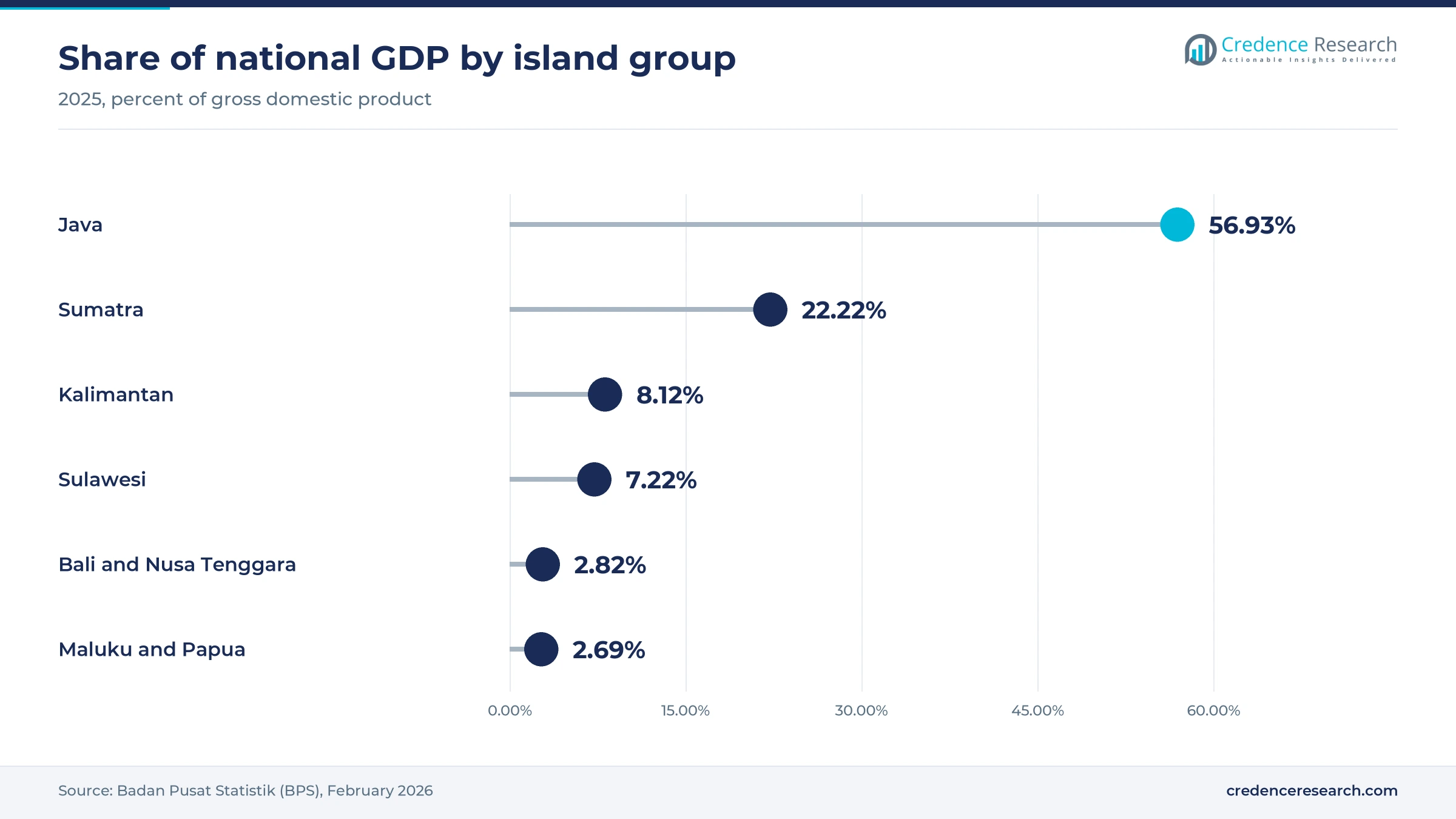
Java Outside Greater Jakarta held 26.0% in 2025 and grows at 6.5% a year, supported by manufacturing payrolls in West, Central and East Java and by large cities such as Surabaya, Bandung and Semarang. Java as a whole produced 56.93% of Indonesia's GDP in 2025 and grew 5.30%, according to Badan Pusat Statistik. Bank branches and agency offices in these cities sell riders to salaried households who want private rooms above their JKN class, which keeps indemnity riders the core product here.
Sumatra relies on plantation, energy and trading employers
Sumatra held 15.0% of 2025 value and grows at 6.5% a year. The island produced 22.22% of national GDP in 2025 and grew 4.81%, according to Badan Pusat Statistik, and plantation, energy and trading companies in Medan, Pekanbaru, Palembang and Batam buy group cover for their staff. International plans with Asia coverage areas let Sumatran buyers use hospitals across the Strait of Malacca, which links part of local demand to medical travel to Malaysia and favors insurers with regional networks.
Kalimantan and Sulawesi grow fastest on resource-sector benefits
Kalimantan and Sulawesi held 10.0% in 2025 and is the fastest-growing region at 7.4% a year. Sulawesi recorded the fastest GDP growth of any island group in 2025, at 6.23%, while Kalimantan grew 4.79%, according to Badan Pusat Statistik. No regulator publishes premiums by island, so the rate is a Credence Research estimate that assumes nickel smelting and plantation employers in Sulawesi and Kalimantan extend group cover as their workforces grow far from private hospitals, which favors plans with evacuation and referral benefits. The region starts from a thin base of private providers, so cashless network depth remains the main constraint.
Bali and the eastern provinces depend on referral hubs
Bali, Nusa Tenggara and Eastern Indonesia held 5.0% of 2025 value and grows at 7.1% a year. Bali and Nusa Tenggara produced 2.82% of GDP in 2025 and Maluku and Papua 2.69%, according to Badan Pusat Statistik. BRI Life signed a memorandum with Bali International Hospital in July 2026, making the 255-bed hospital in the Sanur health special economic zone a referral center for its members in eastern Indonesia, after the value of their claims there rose about 344%, with no base period given, BRI Life told Metro TV.
Regulation and sharia spin-offs drive recent moves
| Development | Status and market relevance |
|---|---|
| In December 2025, OJK issued POJK 36/2025 on strengthening the health insurance ecosystem, enacted Dec. 17 and promulgated Dec. 22, with effect from March 22, 2026. | Completed regulation, now in force; existing health products must be adjusted within one year. |
| In April 2026, Allianz Life Indonesia and Allianz Syariah launched Allianz Preferred Medical and AlliSya Preferred Medical, with Standard, Extra and Premier plans covering Asia and Australia. | Commercial launch; the higher plans include an optional self-risk feature aimed at over-treatment. |
| In May 2026, Sun Life Indonesia launched SHIFA Signature, a sharia health plan with an annual limit of up to Rp15 billion and seven coverage areas from Indonesia to worldwide. | Commercial launch through agents and three bank partners, widening sharia retail supply. |
| In July 2026, BRI Life and Bali International Hospital signed a memorandum of understanding on referral pathways, cashless care and utilization management. | Signed memorandum; no effective date announced, targets eastern Indonesia members. |
| In September 2026, OJK granted AIA Syariah Insurance a business licence for sharia life insurance and employee benefits. | Regulatory approval; the transfer of the AIA Financial sharia portfolio follows. |
Claims controls now decide product economics
- Coordination of benefits splits a claim between JKN and the private plan, so the insurer pays only the cost above the member's JKN class entitlement.
- Utilization review checks whether admissions, tests and length of stay match clinical need, and POJK 36/2025 now makes it mandatory for every health insurer.
- Cashless provider networks let members receive treatment without paying upfront, while insurers negotiate package rates with hospital groups in return for patient volume.
- Telehealth benefits extend outpatient cover to telemedicine consultations, which Sun Life Indonesia includes in SHIFA Signature and which cost less than clinic visits.
Need a Custom Version of This Report?
Tailor the scope, geography, or segments to your exact requirements.
- Custom geography or segment scope
- Direct access to our analyst team
Bank alliances and hospital networks shape competition
Competition turns on three assets, which are bank or agency reach, hospital networks and the ability to price claims accurately. Prudential Indonesia competes in retail health through its agency force, where thin underwriting margins make claims control decisive for renewals and new sales. Allianz Life Indonesia, AIA Financial, Manulife Indonesia and Sun Life Indonesia pair agency forces with exclusive bank partners. AXA Mandiri Financial Services and BRI Life sell through the branch networks of their state-owned bank shareholders. Inhealth competes on managed care for employers, while Generali Indonesia relies heavily on health, which made up 83% of its 2025 claim payments, according to Fortune Indonesia. MSIG Life Insurance Indonesia Tbk competes with health and critical illness cover sold through agents and bank partners.
How concentrated is supply, and where do margins sit?
Supply is concentrated among foreign-owned life insurers and bank-affiliated groups, which control the two channels that sell most health cover. Joint ventures with banks or exclusive bank alliances give AXA Mandiri, BRI Life, AIA Financial, Allianz Life Indonesia and Sun Life Indonesia access to account holders at low acquisition cost. Entry barriers are rising, since a health line now needs a medical advisory board, utilization review staff, hospital contracts and OJK approval. General insurers compete mostly for group contracts through brokers, where pricing is tight and margins thin. Margins sit with insurers that own claims data and cashless networks, while administrators and hospitals capture fees around them.
Companies profiled and their roles in this market
| Company | Type | Role in the market |
|---|---|---|
| Prudential Indonesia | Life insurer, agency-led | Individual medical plans and riders, including PRUSehat and PRUWell Medical |
| Allianz Life Indonesia | Life insurer, multi-channel | Individual and group medical plans, including Allianz Preferred Medical |
| AIA Financial | Life insurer, bancassurance-led | Health and critical illness plans sold mainly through Bank Central Asia |
| AXA Mandiri Financial Services | Bank joint venture | Health protection through Bank Mandiri branches, with hospital cost agreements |
| Manulife Indonesia | Life insurer, multi-channel | MiSmart Health Care riders and medical plans through agents and banks |
| Inhealth (Indonesia Financial Group) | Managed care insurer | Managed care group health plans with more than 8,000 partner providers |
| MSIG Life Insurance Indonesia Tbk | Listed life insurer | Health and critical illness protection through agents and bank partners |
| Generali Indonesia | Life insurer | Individual and group medical plans, with health dominating claim payments |
| BRI Life | Bank-affiliated life insurer | Group and retail health plans through BRI branches and hospital partnerships |
| Sun Life Indonesia | Life insurer, multi-channel | Conventional and sharia health plans, including SHIFA Signature |
Claims control will separate winners from exits
Credence Research's view is that growth now depends less on selling more policies and more on controlling what each policy pays out. The next stage rewards insurers that negotiate hospital rates, run utilization reviews and use coordination with JKN to sell cheaper top-up plans. The most attractive buyers for new entrants are mid-size employers and mass-affluent families outside Greater Jakarta, who are underinsured but price-sensitive. Kalimantan and Sulawesi offers the strongest regional demand growth for group plans, where resource employers add staff far from private hospitals. Carriers that cannot meet the new governance requirements within the adjustment period are likely to sell or transfer portfolios, which would concentrate the market further.
Premium data from OJK and AAJI anchor the estimate
The report uses 2025 as the base year and forecasts to 2035. Market values come from the Credence Research model, which starts from health premiums and sharia contributions reported by OJK, AAJI and AAUI and converts them to U.S. dollars at average annual exchange rates. Segment, channel and regional splits are Credence Research estimates informed by insurer disclosures, association channel data, regional GDP from Badan Pusat Statistik and BPJS Kesehatan membership statistics. Company actions and regulations were checked against regulator releases, company statements and national business press. No interviews or surveys were conducted for this edition of the report.
Private cover expands as a top-up to JKN through 2035
Through 2035, the path of the market depends on whether claims inflation settles toward single digits as managed care, utilization review and co-payment plans take hold. The base case assumes medical inflation eases gradually, JKN remains the first payer for most members and private plans grow as top-ups priced against it. Managed care plans, sharia operators and digital channels gain share, while indemnity plans remain the core of the market. The base case puts the market at USD 4.79 billion by 2035. Regional growth shifts gradually toward Kalimantan, Sulawesi and the eastern provinces as employers there formalize benefits and referral networks expand.
Claims control decides where the 2035 value lands
The range of outcomes turns mainly on claims inflation and on how quickly coordination with JKN becomes routine. In the downside case, medical inflation stays near recent levels, insurers keep repricing and retail lapses rise. In the base case, utilization reviews and co-payment plans slow claims growth enough for steady renewals. In the upside case, inter-payer coordination spreads across hospital networks and cheaper top-up plans pull mass-affluent buyers into private cover.
| Scenario | CAGR, 2026–2035 | Value, 2035 | What has to hold |
|---|---|---|---|
| Downside | 4.8% | USD 4.21 billion | Medical inflation stays near recent double-digit levels and repricing drives retail lapses |
| Base | 6.31% | USD 4.79 billion | Claims growth slows as utilization reviews and co-payment plans take hold across insurers |
| Upside | 7.6% | USD 5.34 billion | Coordination with JKN becomes routine and low-cost top-up plans expand retail uptake |
Frequently Asked Questions
How big is the Indonesia health insurance market?
Which product type leads the market?
Which region holds the largest share?
What does POJK 36/2025 change for buyers?
How does private cover work with BPJS Kesehatan?
Which channels sell the most health cover?
Who are the leading companies in the market?
What is the main risk for health insurers?
Table of Content
Chapter 1 Market Segmentation
- 1.1 Segmentation Framework
- 1.1.1 Product and Service Classification
- 1.1.2 Application and End-Use Classification
- 1.1.3 Technology and Solution Classification
- 1.1.4 Customer and Distribution Channel Classification
- 1.1.5 Geographic Segmentation
- 1.1.6 Market Segment Definitions and Boundaries
- 1.2 By Product Type
- 1.2.1 Indemnity Medical Insurance
- 1.2.2 Managed Care and Provider-Network Plans
- 1.2.3 Hospital Cash and Fixed-Benefit Health Plans
- 1.2.4 International Private Medical Insurance
- 1.3 By Customer Segment
- 1.3.1 Corporate Employees
- 1.3.2 SMEs and Professional Groups
- 1.3.3 Affluent Individuals and Families
- 1.3.4 Mass-Affluent Retail Consumers
- 1.4 By Institution Type
- 1.4.1 Life Insurance Companies
- 1.4.2 General Insurance Companies
- 1.4.3 Sharia Insurance Operators
- 1.4.4 Health-Focused Managed Care Insurers
Chapter 2 Introduction
- 2.1 Report Objectives and Scope
- 2.2 Product Definition and Industry Terminology
- 2.3 Market Inclusions and Exclusions
- 2.4 Research Process
- 2.4.1 Primary Research and Expert Interviews
- 2.4.2 Secondary Research and Source Review
- 2.4.3 Top-Down and Bottom-Up Estimation
- 2.4.4 Data Triangulation and Verification
- 2.5 Market Size Measurement Basis
- 2.5.1 2025: USD 2.59 billion → 2035: USD 4.79 billion
- 2.6 Historical and Forecast Reference Periods
- 2.6.1 Historical Period: 2018-2025
- 2.6.2 Base Year: 2025
- 2.6.3 Forecast Period: 2025-2035
- 2.7 Research Assumptions and Limitations
Chapter 3 Executive Summary
- 3.1 Market Snapshot and Key Findings
- 3.2 Base-Year Market Size, 2025
- 3.3 Forecast Market Size, 2035
- 3.4 Revenue and Volume Growth Outlook
- 3.5 Key Demand and Supply Indicators
- 3.6 Leading Market Segments
- 3.7 Fastest-Growing Market Opportunities
- 3.8 Regional Performance Highlights
- 3.9 Technology and Industry Transformation
- 3.10 Competitive Landscape Summary
- 3.11 Analyst View and Strategic Implications
Chapter 4 Indonesia Health Insurance Market Trends and Developments
- 4.1 Historical Industry Development, 2018-2025
- 4.2 Recent Market Trends and Developments
- 4.3 Demand and Customer Behavior Trends
- 4.4 Technology and Product Innovation
- 4.5 Artificial Intelligence, Automation and Digitalization
- 4.6 Local Manufacturing and Supply Chain Realignment
- 4.7 Industry Partnerships, Mergers and Acquisitions
- 4.8 Sustainability and Circular Economy Developments
- 4.9 Government and Private Sector Investment Trends
- 4.10 Emerging Business Models and Commercialization
- 4.11 Industry Developments and Announcements
Chapter 5 Indonesia Health Insurance Market Supply and Demand Analysis
- 5.1 Demand Trend and Consumption Analysis, 2018-2025
- 5.2 Demand Forecast, 2025-2035
- 5.3 Supply Chain Structure and Procurement Trends
- 5.4 Supply-Demand Gap and Bottlenecks
- 5.5 Import Dependence and Sourcing Structure
- 5.6 Regional Supply and Demand Concentration
Chapter 6 Indonesia Health Insurance Market Pricing Analysis
- 6.1 Pricing Structure and Measurement
- 6.2 Historical Pricing Trends, 2018-2025
- 6.3 Pricing Outlook, 2025-2035
- 6.4 Pricing by Product and Market Segment
- 6.5 Geographic Pricing Differences
- 6.6 Key Input, Energy, Labor and Logistics Costs
- 6.7 Contract Pricing and Purchasing Models
- 6.8 Pricing Sensitivity and Competitive Positioning
- 6.9 Price, Margin and Profitability Implications
Chapter 7 Indonesia Health Insurance Market Dynamics
- 7.1 Market Growth Drivers
- 7.1.1 Demand-Side Drivers
- 7.1.2 Technology and Innovation Drivers
- 7.1.3 Infrastructure and Investment Drivers
- 7.1.4 Regulatory and Policy Drivers
- 7.2 Market Restraints
- 7.2.1 Cost and Affordability Constraints
- 7.2.2 Technology and Adoption Barriers
- 7.2.3 Supply Chain and Operational Constraints
- 7.3 Market Challenges
- 7.3.1 Competitive Pressure and Margin Erosion
- 7.3.2 Skills, Infrastructure and Implementation Gaps
- 7.4 Emerging Market Opportunities
- 7.5 Market Dynamics Impact and Time-Horizon Assessment
Chapter 8 Indonesia Health Insurance Value Chain Analysis
- 8.1 Industry Value Chain Overview
- 8.2 Upstream Suppliers and Critical Inputs
- 8.3 Technology and Component Providers
- 8.4 Manufacturing or Service Delivery
- 8.5 Distribution, Channel Partners and Integrators
- 8.6 Downstream Applications and End Users
- 8.7 Value Addition and Profit Pools
- 8.8 Vertical Integration and Outsourcing
- 8.9 Supplier Concentration and Risk
- 8.10 Supply Chain Localization and Resilience
Chapter 9 Indonesia Health Insurance Market Regulations and Policies
- 9.1 Relevant Laws, Standards and Compliance Frameworks
- 9.2 Product, Service, Safety and Quality Requirements
- 9.3 Government Policies, Incentives and Subsidies
- 9.4 Imports, Exports and Trade Barriers
- 9.5 Public Procurement and Local Content Requirements
- 9.6 Data Protection, AI and Cybersecurity Compliance
- 9.7 Upcoming Policy Changes and Market Implications
Chapter 10 Indonesia Health Insurance Market Hotspots and Opportunities
- 10.1 Market Opportunity Mapping and Growth Hotspots
- 10.2 High-Growth Applications and Customer Groups
- 10.3 Underserved Markets and White-Space Opportunities
- 10.4 Emerging Technology and Product Opportunities
- 10.5 New Capacity and Investment Hotspots
- 10.6 Market Entry and Expansion Opportunities
- 10.7 Distribution and Partnership Opportunities
- 10.8 Near-Term and Long-Term Commercial Potential
- 10.9 Opportunity Attractiveness and Execution Risks
Chapter 11 Indonesia Health Insurance Market Outlook, 2025-2035
- 11.1 Market Size and Analysis
- 11.1.1 Revenue (Market Measurement: 2025: USD 2.59 billion → 2035: USD 4.79 billion)
- 11.1.2 Historical Market Size, 2018-2025
- 11.1.3 Base-Year Market Size, 2025
- 11.2 Market Forecast, 2025-2035
- 11.2.1 Revenue Forecast to 2035
- 11.2.2 CAGR and Year-on-Year Growth
- 11.2.3 Incremental Revenue Opportunity
- 11.3 Forecast Assumptions and Scenario Analysis
- 11.3.1 Base-Case Forecast
- 11.3.2 Optimistic and Conservative Scenarios
- 11.3.3 Technology, Pricing and Policy Sensitivities
- 11.4 Market Attractiveness and Growth Outlook
Chapter 12 Indonesia Health Insurance Market Segmentation and Outlook
- 12.1 Segmentation Summary and Market Shares, 2025
- 12.2 Largest and Fastest-Growing Segments
- 12.3 By Product Type - Market Size and Forecast, 2025-2035
- 12.3.1 Segment Definition and Scope
- 12.3.2 Historical Market Size, 2018-2025
- 12.3.3 Revenue Forecast, 2025-2035
- 12.3.4 Base-Year Market Share, 2025
- 12.3.5 Segment CAGR and Growth Drivers
- 12.3.6 Subsegment Market Size and Forecast
- 12.3.6.1 Indemnity Medical Insurance
- 12.3.6.2 Managed Care and Provider-Network Plans
- 12.3.6.3 Hospital Cash and Fixed-Benefit Health Plans
- 12.3.6.4 International Private Medical Insurance
- 12.3.7 Subsegment Pricing and Adoption Trends
- 12.3.8 Leading Suppliers and Competition
- 12.3.9 Regional Demand and Opportunities
- 12.4 By Customer Segment - Market Size and Forecast, 2025-2035
- 12.4.1 Segment Definition and Scope
- 12.4.2 Historical Market Size, 2018-2025
- 12.4.3 Revenue Forecast, 2025-2035
- 12.4.4 Base-Year Market Share, 2025
- 12.4.5 Segment CAGR and Growth Drivers
- 12.4.6 Subsegment Market Size and Forecast
- 12.4.6.1 Corporate Employees
- 12.4.6.2 SMEs and Professional Groups
- 12.4.6.3 Affluent Individuals and Families
- 12.4.6.4 Mass-Affluent Retail Consumers
- 12.4.7 Subsegment Pricing and Adoption Trends
- 12.4.8 Leading Suppliers and Competition
- 12.4.9 Regional Demand and Opportunities
- 12.5 By Institution Type - Market Size and Forecast, 2025-2035
- 12.5.1 Segment Definition and Scope
- 12.5.2 Historical Market Size, 2018-2025
- 12.5.3 Revenue Forecast, 2025-2035
- 12.5.4 Base-Year Market Share, 2025
- 12.5.5 Segment CAGR and Growth Drivers
- 12.5.6 Subsegment Market Size and Forecast
- 12.5.6.1 Life Insurance Companies
- 12.5.6.2 General Insurance Companies
- 12.5.6.3 Sharia Insurance Operators
- 12.5.6.4 Health-Focused Managed Care Insurers
- 12.5.7 Subsegment Pricing and Adoption Trends
- 12.5.8 Leading Suppliers and Competition
- 12.5.9 Regional Demand and Opportunities
- 12.6 Segment Growth Comparison
- 12.7 Segment Attractiveness and Priority Matrix
Chapter 13 Indonesia Health Insurance End-Use and Application Market Outlook
- 13.1 End-Use Industry and Customer Demand Structure
- 13.2 Leading Applications and Customer Groups
- 13.3 End-Use Market Size, Share and Forecast
- 13.4 Major End-Use Industry Deep Dives
- 13.4.1 Customer Requirements and Use Cases
- 13.4.2 Demand and Replacement Cycles
- 13.4.3 Technical and Regulatory Considerations
- 13.4.4 Purchasing and Procurement Models
- 13.4.5 Leading Vendors and Distribution Channels
- 13.4.6 Forecast and Commercial Opportunities
- 13.5 Emerging Applications and Cross-Segment Demand
- 13.6 End-Use Industry Investment Priorities
Chapter 14 Indonesia Health Insurance Geographic Market Outlook, 2025-2035
- 14.1 Domestic Market Distribution and Demand Clusters
- 14.2 State- or Province-Wise Market Size and Forecast, 2025-2035
- 14.3 City and Metropolitan Market Outlook
- 14.4 Industrial, Manufacturing and Commercial Clusters
- 14.5 Geographic Concentration of Key End Users
- 14.6 Local Pricing and Purchasing Differences
- 14.7 Domestic Production Facilities and Capacity Map
- 14.8 Local Infrastructure and Project Pipeline
- 14.9 State-Level Policy and Incentive Differences
- 14.10 Subnational Investment Hotspots and Opportunities
- 14.11 Distribution and Logistics Networks
- 14.12 Domestic Competitive Footprint
Chapter 15 Indonesia Health Insurance Technology, Innovation and Sustainability Outlook
- 15.1 Technology Landscape and Maturity
- 15.2 Product, Process and Service Innovation
- 15.3 AI, Automation and Digital Tools in the Industry
- 15.4 Technology Adoption and Performance Benchmarking
- 15.5 Innovation Pipeline and R&D Investment
- 15.6 Energy Efficiency and Resource Management
- 15.7 Sustainability, Recycling and Circularity
- 15.8 Technology Roadmap, 2025-2035
- 15.9 Risks of Obsolescence and Technology Substitution
Chapter 16 Indonesia Health Insurance Market Key Strategic Imperatives
- 16.1 Growth and Market Entry Priorities
- 16.2 High-Return Products and Segments
- 16.3 Pricing, Profitability and Cost Optimization
- 16.4 Technology Investment and Product Differentiation
- 16.5 Supply Chain Localization and Resilience
- 16.6 Distribution and Customer Acquisition
- 16.7 Partnership, Acquisition and Capacity Strategy
- 16.8 Regional Expansion Priorities
- 16.9 Short-, Medium- and Long-Term Actions
Chapter 17 Competition Outlook
- 17.1 Industry Competition Characteristics
- 17.2 Market Structure and Concentration
- 17.3 Market Share and Competitive Positioning, 2025
- 17.4 Company-Wise Revenue and Product Benchmarking
- 17.5 Production and Service Capacity Benchmarking
- 17.6 Technology, Pricing and Differentiation
- 17.7 Regional Footprint and Distribution Strength
- 17.8 Mergers, Acquisitions and Strategic Alliances
- 17.9 New Entrants and Competitive Threats
- 17.10 Porter's Five Forces and Industry Attractiveness
- 17.11 Competitive Outlook, 2025-2035
Chapter 18 Company Profiles
- 18.1 Company Coverage and Selection Criteria
- 18.2 Prudential Indonesia
- 18.2.1 Business Description
- 18.2.2 Company Ownership and Geographic Presence
- 18.2.3 Product and Service Portfolio
- 18.2.4 Manufacturing and Operating Footprint
- 18.2.5 Financial Performance and Investment
- 18.2.6 Market Share and Competitive Position
- 18.2.7 Technology and Innovation Capabilities
- 18.2.8 Strategic Alliances or Partnerships
- 18.2.9 Recent Developments
- 18.2.10 Growth Strategy and Outlook
- 18.3 Allianz Life Indonesia
- 18.4 AIA Financial
- 18.5 AXA Mandiri Financial Services
- 18.6 Manulife Indonesia
- 18.7 Inhealth (Indonesia Financial Group)
- 18.8 MSIG Life Insurance Indonesia Tbk
- 18.9 Generali Indonesia
- 18.10 BRI Life
- 18.11 Sun Life Indonesia
- 18.12 Other Relevant Market Participants
Note: Every listed company is profiled on the structure shown under the first company. The company list is preliminary and may change based on research findings, market developments, data availability and client requirements.
Chapter 19 Disclaimer
- 19.1 Research and Forecast Disclaimer
- 19.2 Data Source and Estimation Limitations
Note: The depth of individual sections depends on data availability for this market. Volume, capacity, trade and other unit-based metrics are included where applicable.

