
Federal rules turned crypto into a regulated U.S. service
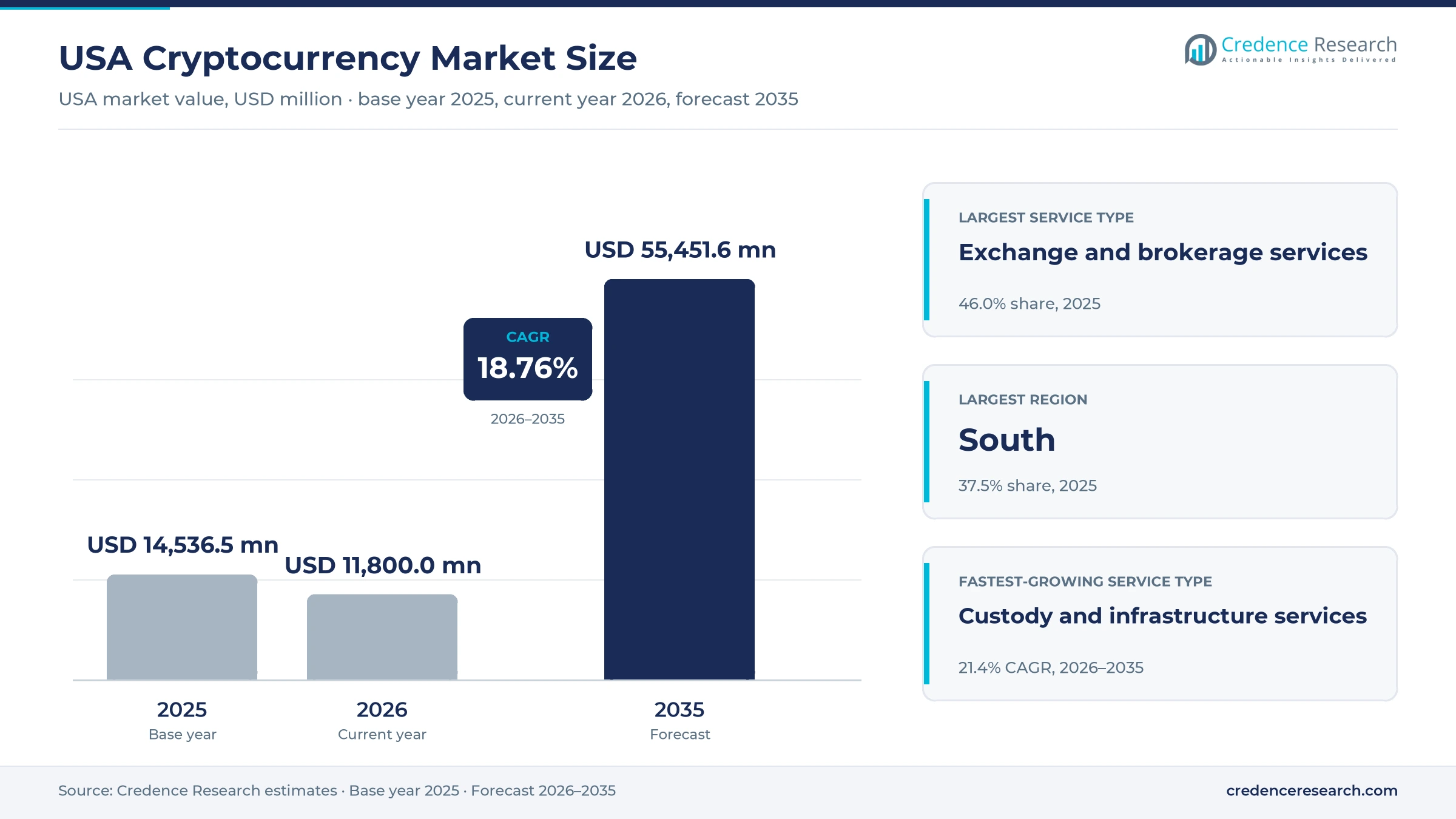
The USA cryptocurrency market was valued at USD 14.54 billion in 2025 and is projected to increase from USD 11.80 billion in 2026 to USD 55.45 billion by 2035, registering a CAGR of 18.76% during 2026–2035. Revenue comes from trading fees, interest on stablecoin reserves, mining rewards and contract fees for custody and blockchain infrastructure. Federal policy turned in 2025, when a stablecoin law, new bank guidance and the rescission of SEC custody accounting rules let banks, brokers and asset managers work openly with crypto providers. The South held 37.5% of 2025 value, the largest share of any region, because it hosts large mining sites on the Texas grid and has the largest and fastest-growing adult population. The same region is also the fastest-growing at 19.0% a year. Revenue dips in 2026 as weaker coin prices cut retail trading and mining rewards, before bank channels and stablecoins carry the recovery. On the commercial side, the largest exchanges spent 2025 buying derivatives venues and brokerages, which is turning crypto apps into multi-asset trading accounts.
Trading fees, reserve income and block rewards form one estimate
The estimate measures what U.S. providers earn from crypto services, meaning trading and brokerage fees, spreads and subscriptions, interest income on stablecoin reserves, block rewards and transaction fees earned by miners and validators, and contract fees for custody, prime brokerage, staking and blockchain infrastructure. Buyers reach these services directly through apps and exchanges, through banks, brokers and funds, or through enterprise software integrations.
The estimate excludes the market value of the coins themselves, gains or losses on crypto held as treasury assets, the fees charged by funds that only hold crypto, mining hardware sales and general software not tied to digital assets. The value chain runs from miners and stablecoin issuers through exchanges, custodians and brokers to banks, wealth platforms and individual holders.
USA Cryptocurrency Market Insights
- The USA cryptocurrency market was valued at USD 14.54 billion in 2025 and is projected to reach USD 55.45 billion by 2035, registering a CAGR of 18.76% during 2026–2035.
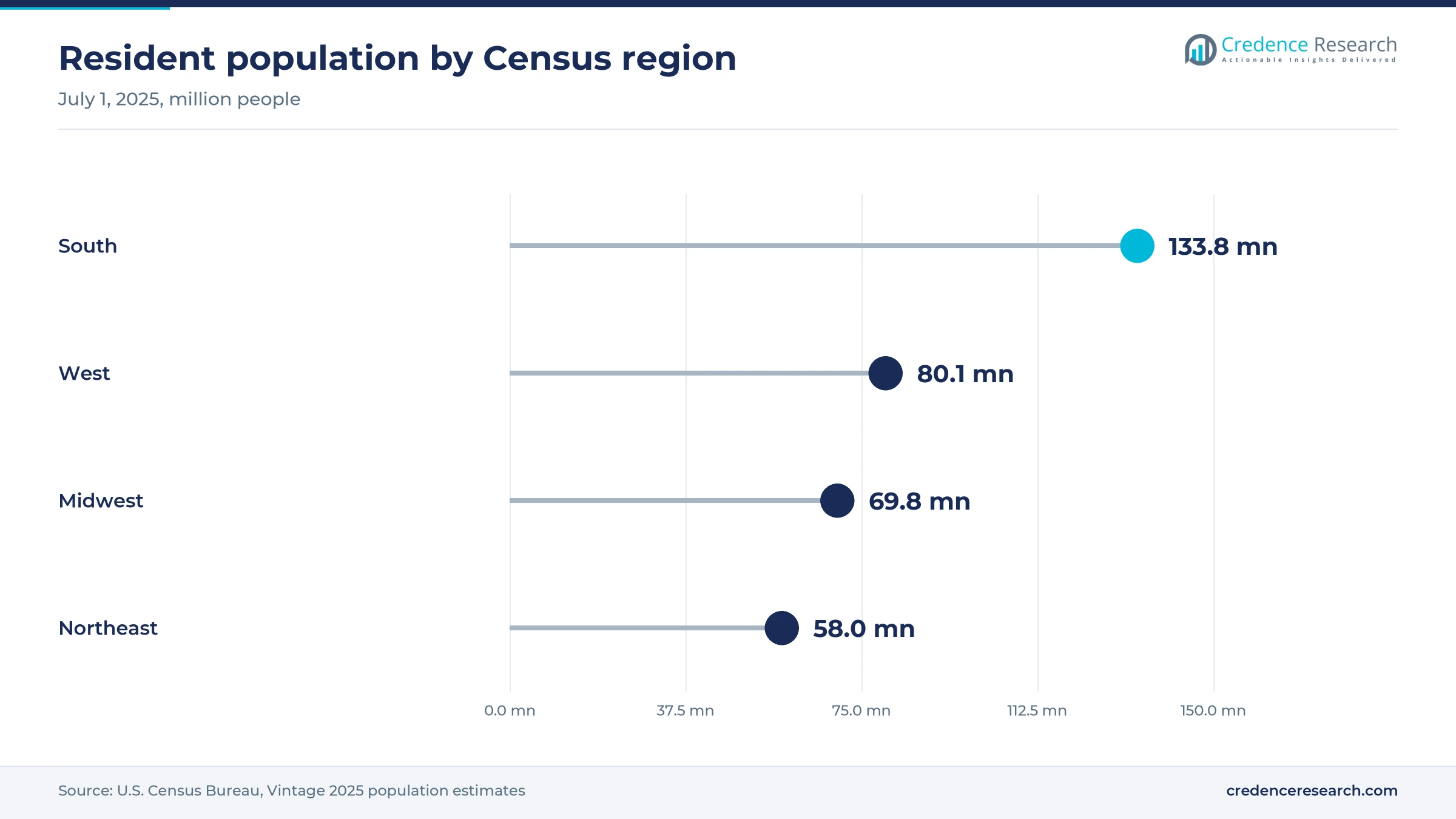
- The South held 37.5% of 2025 value, because Texas grid capacity draws large mining sites and the region had 133.8 million residents in July 2025.
- Exchange and brokerage services led with 46.0% of 2025 value, as Coinbase trading volume rose 156% to $5.2 trillion in 2025.
- The GENIUS Act, signed on July 18, 2025, created the first federal framework for payment stablecoins and barred issuers from paying holders interest.
- In December 2025, the OCC conditionally approved national trust bank charters for Circle, Ripple, BitGo, Fidelity Digital Assets and Paxos.
Exchanges lead while custody and infrastructure grow fastest
Why do exchanges earn the most while custody grows fastest?
Based on service type, the market is categorized into exchange and brokerage services, stablecoin issuance services, mining and validation services, and custody and infrastructure services. Exchange and brokerage services led with 46.0% of 2025 value, because every buy, sell and conversion pays a fee or spread, and Coinbase said its total trading volume grew 156% to $5.2 trillion in 2025. Custody and infrastructure services grow fastest at 21.4% a year, as the OCC conditionally approved national trust bank charters for Circle, Ripple, BitGo, Fidelity Digital Assets and Paxos on Dec. 12, 2025, according to Axios. Bank-grade custody is becoming the entry ticket for pension funds, advisers and fund sponsors.
How do households and institutions split the revenue?
Based on customer segment, the market is categorized into individual customers, financial institutions and business and public-sector customers. Individual customers led with 58.0% of 2025 value, because app users pay the highest fee rates, and the Federal Reserve found that 10% of adults used crypto in 2025, with 9% buying or holding it as an investment. Financial institutions grow fastest at 20.1% a year, as PNC launched direct bitcoin trading for eligible PNC Private Bank clients on Dec. 9, 2025, using Coinbase's Crypto-as-a-Service infrastructure. Banks that rent this plumbing pay contract fees on top of client trading fees.
Why do apps still carry most of the business?
Based on distribution channel, the market is categorized into direct digital access, intermediated financial access and enterprise integration. Direct digital access led with 64.0% of 2025 value, because exchanges own the customer relationship, and Coinbase ended 2025 with nearly 1 million paid Coinbase One subscribers, up from 733,000 a year earlier. Intermediated financial access grows fastest at 20.4% a year, as Vanguard opened its brokerage to crypto exchange-traded funds on Dec. 2, 2025, reaching more than 50 million customers with over $11 trillion in assets, according to InvestmentNews. Each fund pays custody and execution fees to crypto providers.
| Segment Group | Leading Sub-segment | Share, 2025 | Fastest-growing Sub-segment | CAGR, 2026–2035 |
|---|---|---|---|---|
| By Service Type | Exchange and brokerage services | 46.0% | Custody and infrastructure services | 21.4% |
| By Customer Segment | Individual customers | 58.0% | Financial institutions | 20.1% |
| By Distribution Channel | Direct digital access | 64.0% | Intermediated financial access | 20.4% |
Fees fall from 1.2% to near zero as volume rises
Pricing in the USA cryptocurrency market depends on who trades and how much. Retail buyers pay a spread on simple trades or tiered maker and taker fees on advanced screens, while subscriptions remove fees for frequent users. Fees drop steeply with monthly volume, so institutions and funds pay a small fraction of retail rates and buy custody under contract. Exchange-traded funds compress the price of exposure further, which pushes exchanges to earn more from subscriptions, stablecoin balances, derivatives and custody than from spot spreads alone.
| Offer or fee | Typical price or fee | Basis |
|---|---|---|
| Coinbase simple trade spread | About 0.5% per trade | NerdWallet, December 2025 |
| Coinbase Advanced, lowest tier | 0.60% maker, 1.20% taker | NerdWallet, December 2025 |
| Coinbase One subscriptions | $4.99, $29.99 or $299.99 a month | NerdWallet, December 2025 |
| Kraken Pro, lowest tier | 0.40% maker, 0.80% taker | Kraken fee schedule, November 2026 |
| Kraken Pro, top tier above $500 million | 0.00% maker, 0.05% taker | Kraken fee schedule, November 2026 |
| iShares Bitcoin Trust ETF | 0.25% sponsor fee a year | BlackRock fund page, November 2026 |
Request a Free Sample
Fill in your details and we'll send you a free sample report.
- Sample data tables & charts
- Research methodology
Banks, stablecoin law and deals pull crypto into finance
How does bank integration widen institutional distribution?
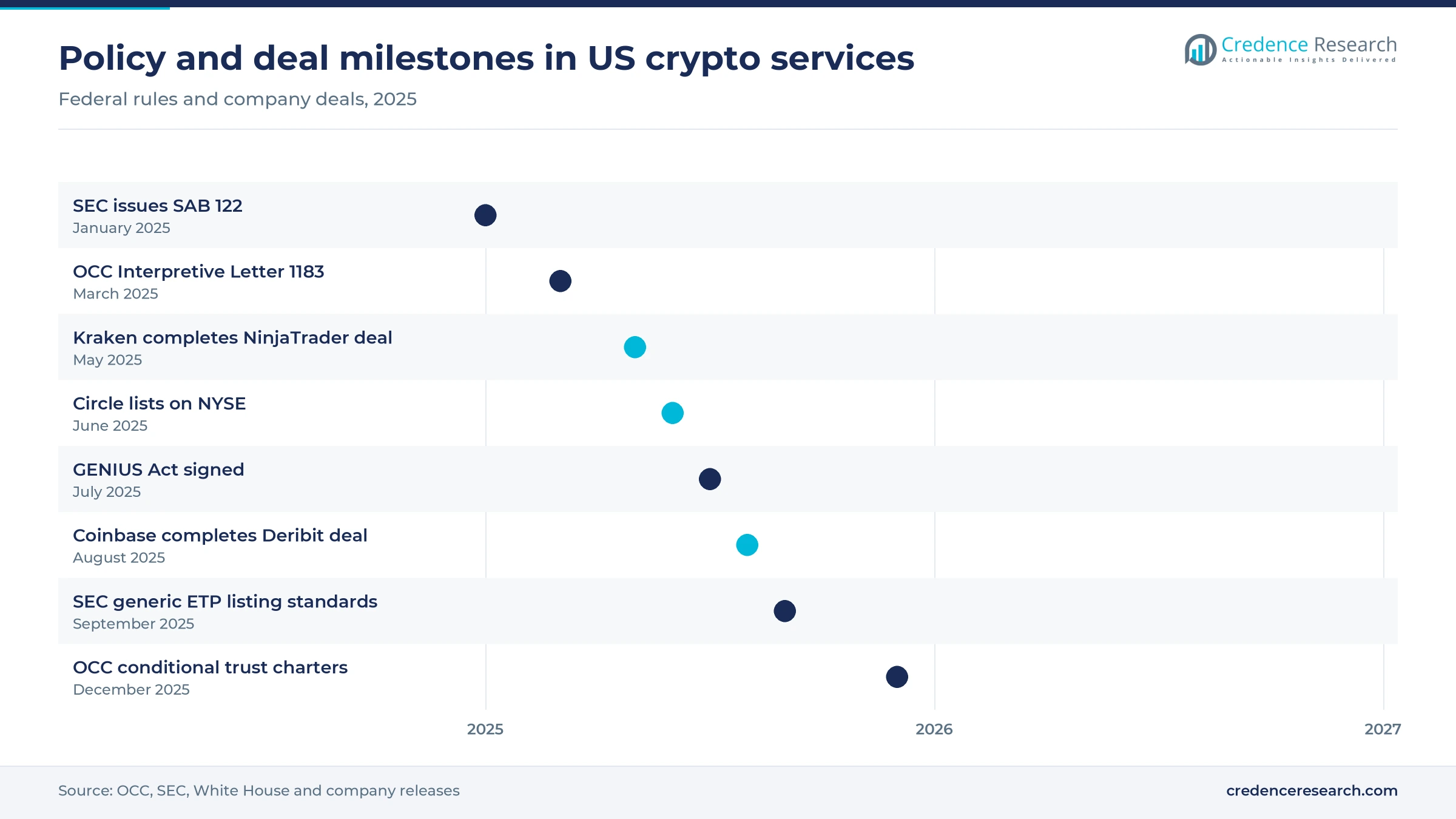
Banks can now distribute crypto services without the capital and approval hurdles that kept them out before 2025, which moves crypto revenue onto bank channels with large customer bases. The Office of the Comptroller of the Currency confirmed on March 7, 2025, that national banks may offer crypto custody, certain stablecoin activities and node participation without prior supervisory nonobjection. The SEC issued SAB 122 on Jan. 23, 2025, rescinding SAB 121 and its safeguarding liability treatment, according to KPMG. JPMorganChase agreed with Coinbase on July 30, 2025, to let customers fund Coinbase accounts with Chase credit cards from fall 2025 and to link bank accounts and transfer rewards points in 2026. Bank channels lower the cost of acquiring each new account.
Why do stablecoin rules support commercial planning?
A federal statute for payment stablecoins gives issuers, banks and merchants a fixed rulebook, which lets them commit capital to dollar tokens for payments and settlement. The GENIUS Act, signed on July 18, 2025, makes the OCC the default federal regulator for large issuers above a $10 billion threshold and bars issuers from paying holders interest solely for holding a token, according to Mayer Brown. USDC circulation reached $73.7 billion at the end of September 2025, up 108% from a year earlier, according to The Block. Circle priced its upsized initial public offering at $31 a share on June 4, 2025, in a $1.05 billion offering ahead of its NYSE debut. Stablecoin issuance services grow faster than the market as reserves scale.
How do acquisitions extend execution capabilities?
The largest U.S. platforms are buying the venues and licenses they lack, which lets them sell derivatives, institutional services and token sales from one account. Coinbase completed its roughly $2.9 billion purchase of Deribit on Aug. 14, 2025, adding an options venue with about $59 billion in open interest, according to The Block. Robinhood closed its purchase of Bitstamp on June 2, 2025, gaining over 50 active licenses and registrations and its first institutional crypto business. Coinbase then agreed on Oct. 21, 2025, to buy onchain fundraising platform Echo for about $375 million, according to Decrypt. Scale in derivatives and listings lets these platforms earn more from each active trader.
Why does federal and state policy legitimize holdings?
Federal and state governments now hold or approve crypto exposure in regulated forms, which lowers the reputational risk for pensions, advisers and corporate treasurers, and that lifts demand for regulated custody. The White House established a Strategic Bitcoin Reserve on March 6, 2025, funded with forfeited bitcoin that may not be sold. Greg Abbott, the governor of Texas, signed SB 21 on June 20, 2025, creating a state reserve limited to assets with an average market value of at least $500 billion over 24 months, according to Hunton. The SEC approved generic listing standards for crypto exchange-traded products on Sept. 17, 2025, cutting review time from up to 240 days to as little as 75 days. Each additional listed fund brings new custody and execution mandates to U.S. providers.
Miners pivot to AI as exchanges become multi-asset brokers
Shift of bitcoin miners toward AI and high-performance computing
Large miners are converting part of their power and sites to AI and high-performance computing, because contracted hosting income is steadier than block rewards. MARA reported a fourth-quarter 2025 cost of $30.5 per petahash per day and formed a joint venture with Starwood Digital Ventures whose first phase is expected to support more than 1 gigawatt of IT capacity. The U.S. Energy Information Administration expected large flexible loads such as crypto mining and data centers to use 54 billion kWh on the Texas grid in 2025, about 10% of forecast consumption. Miners that keep fleets of ASIC mining rigs running will compete with AI tenants for the same megawatts.
Rise of multi-asset accounts that bundle crypto with futures
Crypto platforms are adding futures, equities and prediction markets, which keeps customers trading when coin prices stall. Kraken completed its purchase of NinjaTrader, a U.S. retail futures platform, in May 2025, and bought CFTC-licensed Small Exchange for $100 million on Oct. 16, 2025, to build U.S.-native derivatives, according to Kraken. Robinhood reported $82 billion in fourth-quarter 2025 crypto notional volume, of which $48 billion ran through Bitstamp, while app volume fell 52% from a year earlier to $34 billion. Institutional venues and futures cushion the swings in retail spot trading, which makes the multi-asset account the main competitive unit.
Can stablecoin payments serve unbanked households?
Payments remain a small use case, which leaves room for providers that make dollar tokens cheap and safe to send. According to the Federal Reserve, only 2% of adults used crypto to buy something or make a payment in 2025, and 1% used it to send money to friends or family. Transactional use reached 6% among unbanked adults against 2% among banked adults, and one-third of those sending money to family made at least one international transfer. With the GENIUS framework noted above in place, issuers and remittance firms can build compliant wallets for households that banks serve poorly, earning reserve income on every balance held.
Is federally chartered custody an underserved opening?
National trust charters let crypto firms serve funds and advisers under one federal supervisor, which opens custody and settlement work that state licenses could not reach. Beyond the five approvals noted above, Comptroller Jonathan Gould said 14 de novo charter applications were filed in 2025, nearly as many as in the previous four years combined, according to Axios. The charters carry no deposits or FDIC insurance, but they cover custody, settlement and payments. New York already supervises 22 virtual currency licensees holding more than $404 billion in assets, which shows the size of the custody pool at stake. Custodians that link to blockchain in banking projects can sell tokenized settlement to the same clients.
Fraud, state kiosk curbs and rates pressure revenue
How does fraud weigh on trust and compliance costs?
Fraud remains the largest reputational drag on the market and raises compliance spending at every platform. The FBI's Internet Crime Complaint Center counted 181,565 crypto-related complaints and $11.366 billion in losses in 2025, a record, according to The Block, with older adults bearing a large share of the damage. Exchanges respond with withdrawal holds, scam warnings and blockchain analytics, which slow onboarding and add cost per account. Platforms that cut fraud losses visibly win the trust of banks and regulators.
Why do state kiosk curbs and licensing raise operating costs?
States are tightening rules where scams reach consumers, which raises costs and removes some retail channels. Americans reported $389 million in losses through bitcoin kiosks across 13,460 complaints in 2025, according to the FBI. Tennessee banned crypto ATMs in April 2026 and Indiana outlawed them in March 2026, according to The Record. California requires a license, a pending application or an exemption for covered activity from July 1, 2026. Kiosk and exchange operators must now fund licensing and compliance teams state by state.
How do lower rates squeeze stablecoin reserve income?
Stablecoin issuers earn most of their income from Treasury bills and repo, so each rate cut lowers income per dollar in circulation. The Federal Open Market Committee held the federal funds target range at 3.50% to 3.75% on April 29, 2026, leaving reserve yields exposed to any further cut. Circle said in November 2025 that higher reserve income was partly offset by a lower reserve return rate. Because the GENIUS Act bars interest to holders, issuers must grow circulation and share less with distributors to protect margins.
Why does network difficulty erode mining returns?
Mining revenue depends on network share, so a miner can add machines and still earn fewer coins. MARA raised its energized hashrate 25% to 66.4 EH/s in 2025, but it produced 8,799 bitcoin, 7% fewer than in 2024, according to its fourth-quarter shareholder letter. Rising network hashrate diluted every operator's share of a fixed block reward, and fleet growth alone no longer lifts output. Miners respond by cutting power costs, selling hosting capacity and moving sites into AI workloads.
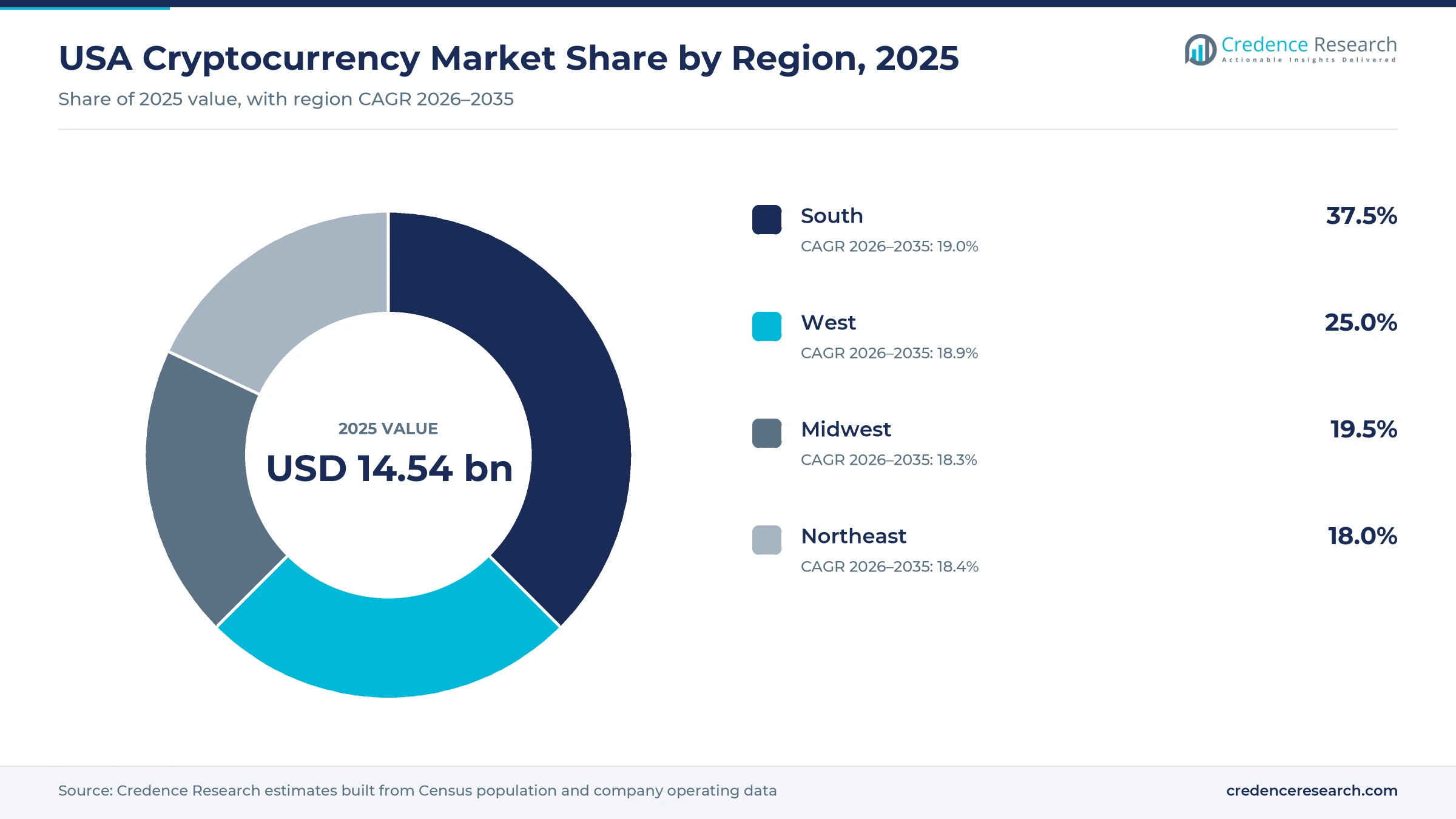
The South leads on population, mining power and policy
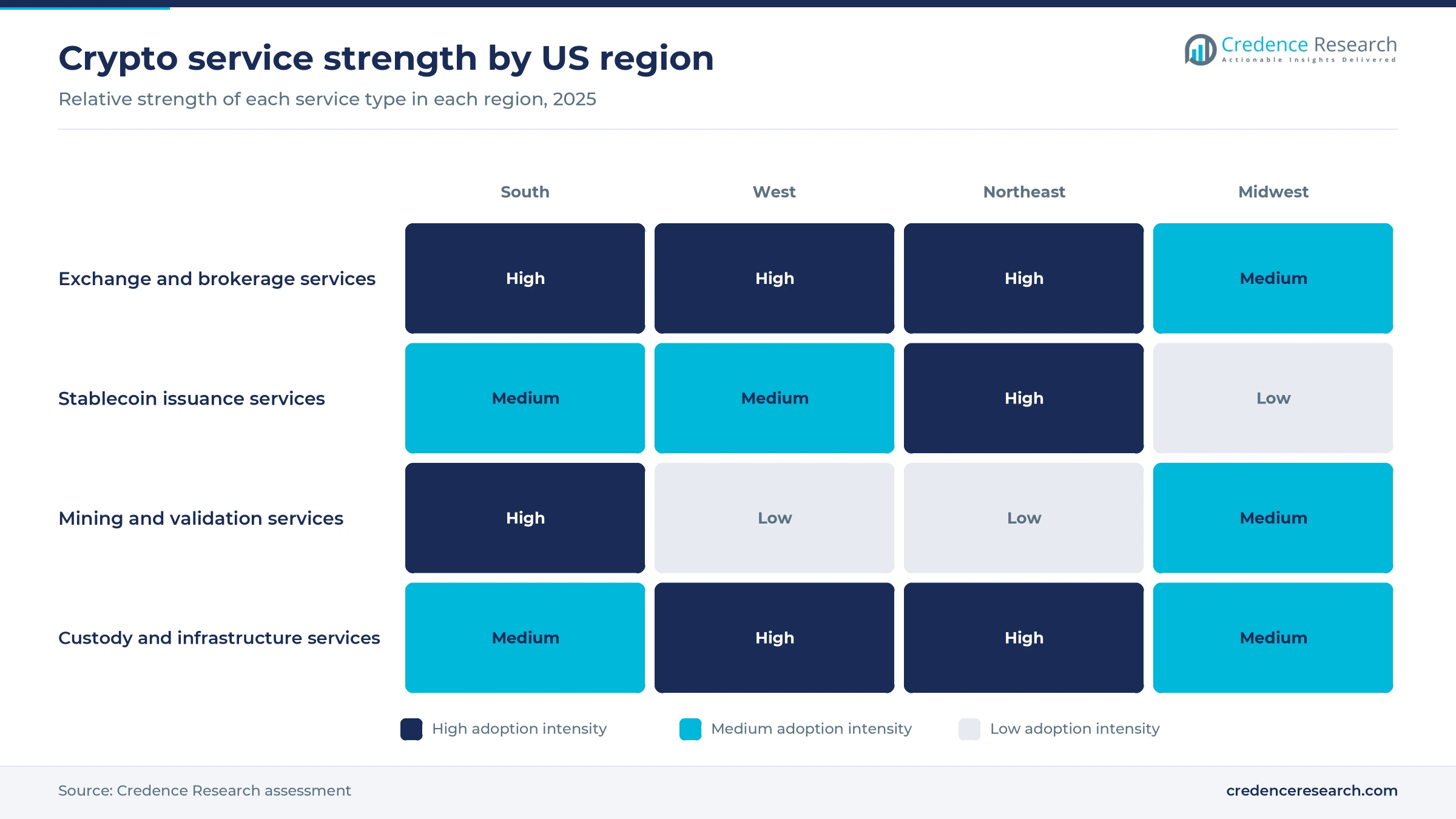
The USA cryptocurrency market is split into the four Census regions, which follow population, mining power capacity and the location of exchange, custody and banking operations. Regional shares and growth rates are Credence Research estimates built from Census population counts, grid and mining data, state licensing rules and company operating disclosures. The South and West together held more than three-fifths of 2025 value.
| Region | Value, 2025 (USD billion) | Share, 2025 | CAGR, 2026–2035 |
|---|---|---|---|
| South | 5.45 | 37.5% | 19.0% |
| West | 3.63 | 25.0% | 18.9% |
| Midwest | 2.83 | 19.5% | 18.3% |
| Northeast | 2.62 | 18.0% | 18.4% |
Why does the South lead on mining and retail demand?
The South held 37.5% of 2025 value and grows fastest at 19.0% a year, because it pairs the largest adult population with Texas grid capacity for large mining sites. According to the U.S. Census Bureau, the South reached 133.8 million residents on July 1, 2025, up 6.0% since 2020. The Texas reserve law noted above also adds a public buyer of bitcoin custody services. Kiosk scam losses also concentrate here, with nearly $57 million reported in Texas and $32.7 million in Florida in 2025, according to The Record.
How do California rules shape the West?
The West held 25.0% of 2025 value and grows at 18.9% a year, as its technology hubs host many exchange, wallet and infrastructure firms that sell nationwide. The region had 80.1 million residents in July 2025, according to the Census Bureau. Roughly a quarter of U.S. blockchain firms are based in California, according to Decrypt, so the state's Digital Financial Assets Law sets the compliance bar for a large part of the supply base. Firms that licensed early can serve California users without interruption.
Why does the Midwest gain from data-center campuses?
The Midwest held 19.5% of 2025 value and grows at 18.3% a year, the slowest pace, because its retail base grows slowly and its mining sites are smaller than those in Texas. The region had 69.8 million residents in July 2025, up 1.1% since 2020, according to the Census Bureau. MARA acquired a 42 MW data center in Nebraska, according to its fourth-quarter 2025 letter. Illinois reported more than $20 million in kiosk scam losses in 2025, which drives tighter state oversight.
How does New York licensing shape the Northeast?
The Northeast held 18.0% of 2025 value and grows at 18.4% a year, as New York anchors institutional trading, custody and stablecoin issuance under state supervision. New York's comptroller reported on Dec. 4, 2025, that the Department of Financial Services oversaw 22 virtual currency licensees with more than $404 billion in assets at the end of 2024. The region had 58.0 million residents in July 2025, up only 0.7% since 2020, which limits retail growth.
Exchange deals, an IPO and trust charters, 2025
| Development | Status and market relevance |
|---|---|
| In May 2025, Kraken completed its acquisition of NinjaTrader, a U.S. retail futures trading platform. | Adds futures to a crypto exchange |
| In June 2025, Robinhood completed its acquisition of Bitstamp, its first institutional crypto business. | Adds licenses and institutional clients |
| In August 2025, Coinbase completed its acquisition of Deribit for about $2.9 billion. | Leads crypto options by open interest |
| In October 2025, Coinbase agreed to acquire onchain fundraising platform Echo for about $375 million. | Moves into token capital raising |
| In December 2025, the OCC conditionally approved national trust bank charters for five crypto firms. | Federal custody and settlement charters |
Custody, stablecoin rails and derivatives engines matter
- Qualified custody with multi-party computation splits private keys across parties, which lets banks and funds hold assets under federal rules.
- Crypto-as-a-Service APIs let banks such as PNC offer trading and custody inside their own apps without building an exchange.
- Stablecoin minting and redemption rails convert dollars to tokens and back around the clock for exchanges, payment firms and treasurers.
- Options and futures matching engines run derivatives books with margin and clearing, which keeps traders active in flat markets.
- Layer-2 networks and smart contract wallets cut onchain transaction costs, which makes small payments and token sales practical.
Need a Custom Version of This Report?
Tailor the scope, geography, or segments to your exact requirements.
- Custom geography or segment scope
- Direct access to our analyst team
Coinbase scale meets bank-chartered custodians and brokers
Competition in the USA cryptocurrency market turns on licenses, liquidity, custody credentials and the breadth of products in one account. Coinbase leads exchange, custody and stablecoin distribution and now runs the Deribit options venue. Robinhood bundles crypto with stocks for app users and serves institutions through Bitstamp. Kraken pairs its exchange with NinjaTrader futures and a CFTC-licensed contract market. Circle issues USDC, while Paxos and Ripple issue their own dollar tokens and hold conditional national trust charters with Circle. BitGo and Fidelity Digital Assets compete for fund and bank custody, and MARA leads public bitcoin mining while moving sites toward AI computing. Banks now enter mostly as distributors, which favors suppliers with bank-grade controls.
A few scaled platforms sit above chartered specialists
Supply in the USA cryptocurrency market is organized in four layers. Coinbase, Robinhood and Kraken run the largest retail and institutional digital asset exchanges, each now adding derivatives through acquired venues. Circle, Paxos and Ripple issue dollar stablecoins, while BitGo, Fidelity Digital Assets and Coinbase Custody hold assets for funds and banks. Public miners such as MARA operate large mining fleets that compete for cheap grid power. Licenses, charters and liquidity are costly to build, so margins sit with platforms that combine trading, custody and stablecoin balances.
Companies profiled and their roles in this market
| Company | Type | Role in the market |
|---|---|---|
| Coinbase Global, Inc. | Exchange and custodian | Retail and institutional trading, custody, Deribit options and USDC distribution |
| Robinhood Markets, Inc. | Multi-asset broker | Crypto trading in its app and institutional services through Bitstamp |
| Payward, Inc. (Kraken) | Exchange and futures broker | Spot crypto exchange with NinjaTrader futures and a CFTC contract market |
| Circle Internet Group, Inc. | Stablecoin issuer | Issues USDC and earns income on its dollar reserves |
| Paxos Trust Company | Stablecoin issuer and custodian | Issues dollar stablecoins and provides custody, converting to a national trust bank |
| Ripple Labs Inc. | Stablecoin issuer and payments firm | Issues the RLUSD stablecoin and runs cross-border payment services |
| MARA Holdings, Inc. | Bitcoin miner | Large-scale bitcoin mining with sites moving toward AI and HPC hosting |
| BitGo | Qualified custodian | Institutional custody, wallets and settlement, converting to a national trust bank |
| Fidelity Investments (Fidelity Digital Assets) | Institutional custodian | Custody and trade execution for institutions, converting to a national trust bank |
Custody and stablecoin rails will carry the next leg
Credence Research's view is that the USA cryptocurrency market will keep outgrowing traditional brokerage, because banks, wealth platforms and fund sponsors now buy crypto services instead of avoiding them. Exchange and brokerage services keep the largest share, while custody and infrastructure grow at 21.4% a year from a small base. Stablecoin issuers gain scale from the federal framework but face lower reserve yields as rates ease. The South stays the largest and fastest-growing region on population and mining capacity. Winners will hold bank-grade licenses, cut fraud losses visibly and earn from balances and contracts rather than only from spot trading spreads.
Fed, Census and company filings anchor the model
The report uses 2025 as the base year on a calendar basis, and market values come from the Credence Research model. That model combines Federal Reserve household survey data, U.S. Census Bureau population estimates, Energy Information Administration grid data, OCC and SEC releases, FBI complaint statistics, state laws, company filings, shareholder letters and published fee schedules, and trade press. Segment splits, regional shares and regional growth rates are Credence Research estimates built from population, grid, licensing and company operating data, and no interviews or surveys were used for this report.
Bank channels and stablecoins carry growth to 2035
Crypto service revenue in the United States is expected to reach USD 55.45 billion by 2035, an 18.76% CAGR during 2026–2035, as banks, brokers and fund platforms distribute crypto and stablecoins become part of payments and settlement. Intermediated financial access grows at 20.4% a year, the fastest channel, while direct apps stay the largest. Financial institutions grow at 20.1% a year, faster than households. Mining and validation loses share as large operators move power capacity to AI hosting. Growth would slow if prices slumped for long and rates fell sharply, while final passage of market structure rules would lift results toward the upside case.
Prices, rates and bank uptake set the range of outcomes
In the base case, revenue recovers from a weaker 2026 along the central forecast as bank channels, stablecoin circulation and custody mandates keep their recent pace. Total crypto spot trading volume fell 25% quarter over quarter in the second quarter of 2026, and total crypto market capitalization fell 11%, according to SiliconANGLE, so the 2026 dip comes from retail spot spreads and mining rewards rather than from custody or stablecoin balances. The downside case assumes a long price slump, lower reserve yields and a stalled market structure bill. The upside case adds broad bank distribution, final passage of market structure legislation and fast stablecoin payments growth.
| Scenario | CAGR, 2026–2035 | Value, 2035 | What has to hold |
|---|---|---|---|
| Downside | 15.8% | USD 44.05 billion | Long price slump, lower reserve yields and stalled market structure legislation |
| Base | 18.76% | USD 55.45 billion | Bank channels, stablecoin circulation and custody mandates keep their recent pace |
| Upside | 21.3% | USD 66.89 billion | Broad bank distribution, final passage of market structure rules and fast stablecoin payments growth |
Frequently Asked Questions
How big is the USA cryptocurrency market?
Which service type leads U.S. crypto revenue?
Which region holds the largest share?
How many Americans use crypto?
What does the GENIUS Act change for stablecoins?
How much does it cost to trade crypto in the United States?
Who are the main companies in this market?
What are the main risks for crypto providers?
Table of Content
Chapter 1 Market Segmentation
- 1.1 Segmentation Framework
- 1.1.1 Product and Service Classification
- 1.1.2 Application and End-Use Classification
- 1.1.3 Technology and Solution Classification
- 1.1.4 Customer and Distribution Channel Classification
- 1.1.5 Geographic Segmentation
- 1.1.6 Market Segment Definitions and Boundaries
- 1.2 By Service Type
- 1.2.1 Exchange and brokerage services
- 1.2.2 Stablecoin issuance services
- 1.2.3 Mining and validation services
- 1.2.4 Custody and infrastructure services
- 1.3 By Customer Segment
- 1.3.1 Individual customers
- 1.3.2 Financial institutions
- 1.3.3 Business and public-sector customers
Chapter 2 Introduction
- 2.1 Report Objectives and Scope
- 2.2 Product Definition and Industry Terminology
- 2.3 Market Inclusions and Exclusions
- 2.4 Research Process
- 2.4.1 Primary Research and Expert Interviews
- 2.4.2 Secondary Research and Source Review
- 2.4.3 Top-Down and Bottom-Up Estimation
- 2.4.4 Data Triangulation and Verification
- 2.5 Market Size Measurement Basis
- 2.5.1 2025: USD 14.54 billion → 2035: USD 55.45 billion
- 2.6 Historical and Forecast Reference Periods
- 2.6.1 Historical Period: 2018-2025
- 2.6.2 Base Year: 2025
- 2.6.3 Forecast Period: 2025-2035
- 2.7 Research Assumptions and Limitations
Chapter 3 Executive Summary
- 3.1 Market Snapshot and Key Findings
- 3.2 Base-Year Market Size, 2025
- 3.3 Forecast Market Size, 2035
- 3.4 Revenue and Volume Growth Outlook
- 3.5 Key Demand and Supply Indicators
- 3.6 Leading Market Segments
- 3.7 Fastest-Growing Market Opportunities
- 3.8 Regional Performance Highlights
- 3.9 Technology and Industry Transformation
- 3.10 Competitive Landscape Summary
- 3.11 Analyst View and Strategic Implications
Chapter 4 USA Cryptocurrency Market Trends and Developments
- 4.1 Historical Industry Development, 2018-2025
- 4.2 Recent Market Trends and Developments
- 4.3 Demand and Customer Behavior Trends
- 4.4 Technology and Product Innovation
- 4.5 Artificial Intelligence, Automation and Digitalization
- 4.6 Local Manufacturing and Supply Chain Realignment
- 4.7 Industry Partnerships, Mergers and Acquisitions
- 4.8 Sustainability and Circular Economy Developments
- 4.9 Government and Private Sector Investment Trends
- 4.10 Emerging Business Models and Commercialization
- 4.11 Industry Developments and Announcements
Chapter 5 USA Cryptocurrency Market Supply and Demand Analysis
- 5.1 Demand Trend and Consumption Analysis, 2018-2025
- 5.2 Demand Forecast, 2025-2035
- 5.3 Supply Chain Structure and Procurement Trends
- 5.4 Supply-Demand Gap and Bottlenecks
- 5.5 Import Dependence and Sourcing Structure
- 5.6 Regional Supply and Demand Concentration
Chapter 6 USA Cryptocurrency Market Pricing Analysis
- 6.1 Pricing Structure and Measurement
- 6.2 Historical Pricing Trends, 2018-2025
- 6.3 Pricing Outlook, 2025-2035
- 6.4 Pricing by Product and Market Segment
- 6.5 Geographic Pricing Differences
- 6.6 Key Input, Energy, Labor and Logistics Costs
- 6.7 Contract Pricing and Purchasing Models
- 6.8 Pricing Sensitivity and Competitive Positioning
- 6.9 Price, Margin and Profitability Implications
Chapter 7 USA Cryptocurrency Market Dynamics
- 7.1 Market Growth Drivers
- 7.1.1 Demand-Side Drivers
- 7.1.2 Technology and Innovation Drivers
- 7.1.3 Infrastructure and Investment Drivers
- 7.1.4 Regulatory and Policy Drivers
- 7.2 Market Restraints
- 7.2.1 Cost and Affordability Constraints
- 7.2.2 Technology and Adoption Barriers
- 7.2.3 Supply Chain and Operational Constraints
- 7.3 Market Challenges
- 7.3.1 Competitive Pressure and Margin Erosion
- 7.3.2 Skills, Infrastructure and Implementation Gaps
- 7.4 Emerging Market Opportunities
- 7.5 Market Dynamics Impact and Time-Horizon Assessment
Chapter 8 USA Cryptocurrency Value Chain Analysis
- 8.1 Industry Value Chain Overview
- 8.2 Upstream Suppliers and Critical Inputs
- 8.3 Technology and Component Providers
- 8.4 Manufacturing or Service Delivery
- 8.5 Distribution, Channel Partners and Integrators
- 8.6 Downstream Applications and End Users
- 8.7 Value Addition and Profit Pools
- 8.8 Vertical Integration and Outsourcing
- 8.9 Supplier Concentration and Risk
- 8.10 Supply Chain Localization and Resilience
Chapter 9 USA Cryptocurrency Market Regulations and Policies
- 9.1 Relevant Laws, Standards and Compliance Frameworks
- 9.2 Product, Service, Safety and Quality Requirements
- 9.3 Government Policies, Incentives and Subsidies
- 9.4 Imports, Exports and Trade Barriers
- 9.5 Public Procurement and Local Content Requirements
- 9.6 Data Protection, AI and Cybersecurity Compliance
- 9.7 Upcoming Policy Changes and Market Implications
Chapter 10 USA Cryptocurrency Market Hotspots and Opportunities
- 10.1 Market Opportunity Mapping and Growth Hotspots
- 10.2 High-Growth Applications and Customer Groups
- 10.3 Underserved Markets and White-Space Opportunities
- 10.4 Emerging Technology and Product Opportunities
- 10.5 New Capacity and Investment Hotspots
- 10.6 Market Entry and Expansion Opportunities
- 10.7 Distribution and Partnership Opportunities
- 10.8 Near-Term and Long-Term Commercial Potential
- 10.9 Opportunity Attractiveness and Execution Risks
Chapter 11 USA Cryptocurrency Market Outlook, 2025-2035
- 11.1 Market Size and Analysis
- 11.1.1 Revenue (Market Measurement: 2025: USD 14.54 billion → 2035: USD 55.45 billion)
- 11.1.2 Historical Market Size, 2018-2025
- 11.1.3 Base-Year Market Size, 2025
- 11.2 Market Forecast, 2025-2035
- 11.2.1 Revenue Forecast to 2035
- 11.2.2 CAGR and Year-on-Year Growth
- 11.2.3 Incremental Revenue Opportunity
- 11.3 Forecast Assumptions and Scenario Analysis
- 11.3.1 Base-Case Forecast
- 11.3.2 Optimistic and Conservative Scenarios
- 11.3.3 Technology, Pricing and Policy Sensitivities
- 11.4 Market Attractiveness and Growth Outlook
Chapter 12 USA Cryptocurrency Market Segmentation and Outlook
- 12.1 Segmentation Summary and Market Shares, 2025
- 12.2 Largest and Fastest-Growing Segments
- 12.3 By Service Type - Market Size and Forecast, 2025-2035
- 12.3.1 Segment Definition and Scope
- 12.3.2 Historical Market Size, 2018-2025
- 12.3.3 Revenue Forecast, 2025-2035
- 12.3.4 Base-Year Market Share, 2025
- 12.3.5 Segment CAGR and Growth Drivers
- 12.3.6 Subsegment Market Size and Forecast
- 12.3.6.1 Exchange and brokerage services
- 12.3.6.2 Stablecoin issuance services
- 12.3.6.3 Mining and validation services
- 12.3.6.4 Custody and infrastructure services
- 12.3.7 Subsegment Pricing and Adoption Trends
- 12.3.8 Leading Suppliers and Competition
- 12.3.9 Regional Demand and Opportunities
- 12.4 By Customer Segment - Market Size and Forecast, 2025-2035
- 12.4.1 Segment Definition and Scope
- 12.4.2 Historical Market Size, 2018-2025
- 12.4.3 Revenue Forecast, 2025-2035
- 12.4.4 Base-Year Market Share, 2025
- 12.4.5 Segment CAGR and Growth Drivers
- 12.4.6 Subsegment Market Size and Forecast
- 12.4.6.1 Individual customers
- 12.4.6.2 Financial institutions
- 12.4.6.3 Business and public-sector customers
- 12.4.7 Subsegment Pricing and Adoption Trends
- 12.4.8 Leading Suppliers and Competition
- 12.4.9 Regional Demand and Opportunities
- 12.5 Segment Growth Comparison
- 12.6 Segment Attractiveness and Priority Matrix
Chapter 13 USA Cryptocurrency End-Use and Application Market Outlook
- 13.1 End-Use Industry and Customer Demand Structure
- 13.2 Leading Applications and Customer Groups
- 13.3 End-Use Market Size, Share and Forecast
- 13.4 Major End-Use Industry Deep Dives
- 13.4.1 Customer Requirements and Use Cases
- 13.4.2 Demand and Replacement Cycles
- 13.4.3 Technical and Regulatory Considerations
- 13.4.4 Purchasing and Procurement Models
- 13.4.5 Leading Vendors and Distribution Channels
- 13.4.6 Forecast and Commercial Opportunities
- 13.5 Emerging Applications and Cross-Segment Demand
- 13.6 End-Use Industry Investment Priorities
Chapter 14 USA Cryptocurrency Geographic Market Outlook, 2025-2035
- 14.1 Domestic Market Distribution and Demand Clusters
- 14.2 State- or Province-Wise Market Size and Forecast, 2025-2035
- 14.3 City and Metropolitan Market Outlook
- 14.4 Industrial, Manufacturing and Commercial Clusters
- 14.5 Geographic Concentration of Key End Users
- 14.6 Local Pricing and Purchasing Differences
- 14.7 Domestic Production Facilities and Capacity Map
- 14.8 Local Infrastructure and Project Pipeline
- 14.9 State-Level Policy and Incentive Differences
- 14.10 Subnational Investment Hotspots and Opportunities
- 14.11 Distribution and Logistics Networks
- 14.12 Domestic Competitive Footprint
Chapter 15 USA Cryptocurrency Technology, Innovation and Sustainability Outlook
- 15.1 Technology Landscape and Maturity
- 15.2 Product, Process and Service Innovation
- 15.3 AI, Automation and Digital Tools in the Industry
- 15.4 Technology Adoption and Performance Benchmarking
- 15.5 Innovation Pipeline and R&D Investment
- 15.6 Energy Efficiency and Resource Management
- 15.7 Sustainability, Recycling and Circularity
- 15.8 Technology Roadmap, 2025-2035
- 15.9 Risks of Obsolescence and Technology Substitution
Chapter 16 USA Cryptocurrency Market Key Strategic Imperatives
- 16.1 Growth and Market Entry Priorities
- 16.2 High-Return Products and Segments
- 16.3 Pricing, Profitability and Cost Optimization
- 16.4 Technology Investment and Product Differentiation
- 16.5 Supply Chain Localization and Resilience
- 16.6 Distribution and Customer Acquisition
- 16.7 Partnership, Acquisition and Capacity Strategy
- 16.8 Regional Expansion Priorities
- 16.9 Short-, Medium- and Long-Term Actions
Chapter 17 Competition Outlook
- 17.1 Industry Competition Characteristics
- 17.2 Market Structure and Concentration
- 17.3 Market Share and Competitive Positioning, 2025
- 17.4 Company-Wise Revenue and Product Benchmarking
- 17.5 Production and Service Capacity Benchmarking
- 17.6 Technology, Pricing and Differentiation
- 17.7 Regional Footprint and Distribution Strength
- 17.8 Mergers, Acquisitions and Strategic Alliances
- 17.9 New Entrants and Competitive Threats
- 17.10 Porter's Five Forces and Industry Attractiveness
- 17.11 Competitive Outlook, 2025-2035
Chapter 18 Company Profiles
- 18.1 Company Coverage and Selection Criteria
- 18.2 Coinbase Global, Inc.
- 18.2.1 Business Description
- 18.2.2 Company Ownership and Geographic Presence
- 18.2.3 Product and Service Portfolio
- 18.2.4 Manufacturing and Operating Footprint
- 18.2.5 Financial Performance and Investment
- 18.2.6 Market Share and Competitive Position
- 18.2.7 Technology and Innovation Capabilities
- 18.2.8 Strategic Alliances or Partnerships
- 18.2.9 Recent Developments
- 18.2.10 Growth Strategy and Outlook
- 18.3 Robinhood Markets, Inc.
- 18.4 Payward, Inc. (Kraken)
- 18.5 Circle Internet Group, Inc.
- 18.6 Paxos Trust Company
- 18.7 Ripple Labs Inc.
- 18.8 MARA Holdings, Inc.
- 18.9 BitGo
- 18.10 Fidelity Investments (Fidelity Digital Assets)
- 18.11 Other Relevant Market Participants
Note: Every listed company is profiled on the structure shown under the first company. The company list is preliminary and may change based on research findings, market developments, data availability and client requirements.
Chapter 19 Disclaimer
- 19.1 Research and Forecast Disclaimer
- 19.2 Data Source and Estimation Limitations
Note: The depth of individual sections depends on data availability for this market. Volume, capacity, trade and other unit-based metrics are included where applicable.

