
| REPORT ATTRIBUTE | DETAILS |
|---|---|
| Historical Period | 2020-2023 |
| Base Year | 2024 |
| Forecast Period | 2025-2032 |
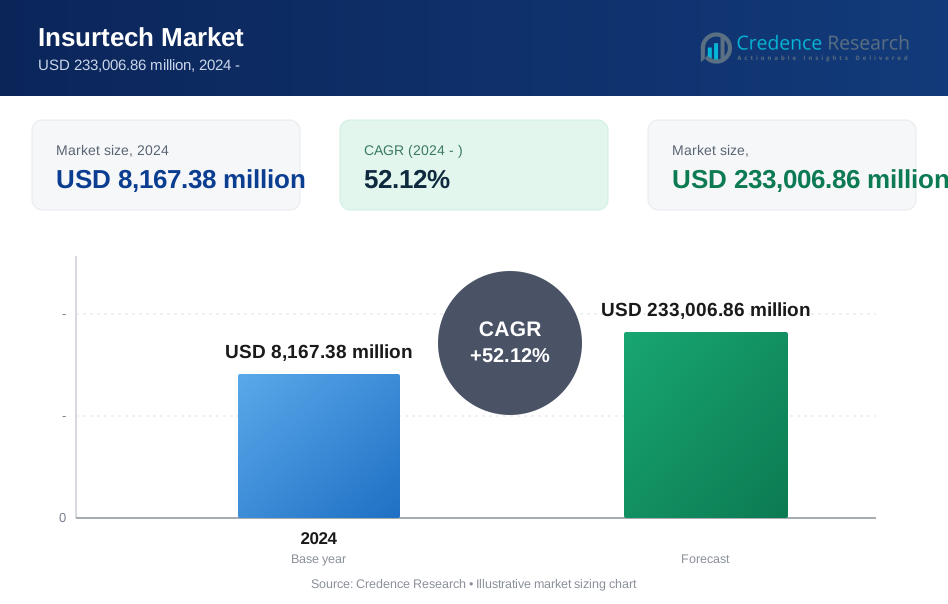
| Insurtech Market Size 2024 | USD 8,167.38 million |
| Insurtech Market, CAGR | 52.12% |
| Insurtech Market Size 2032 | USD 233,006.86 million |
Market Overview
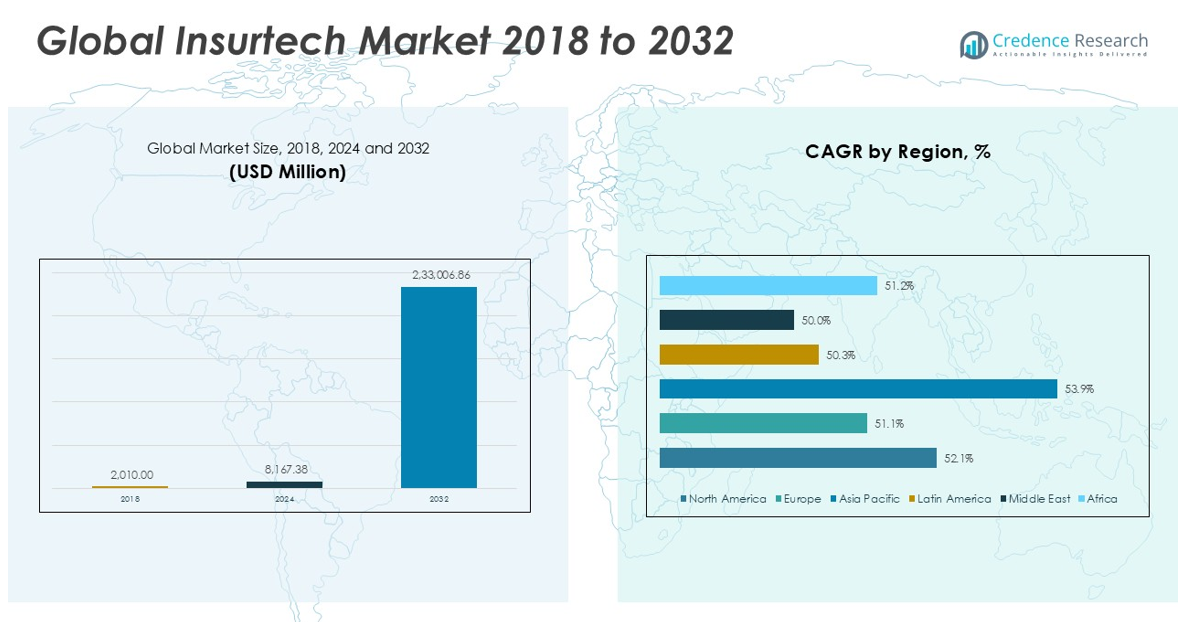
The Insurtech Market size was valued at USD 2,010.00 million in 2018, reached USD 8,167.38 million in 2024, and is anticipated to reach USD 233,006.86 million by 2032, growing at a CAGR of 52.12% during the forecast period.
The Insurtech market is highly dynamic, with key players such as Damco Group, Insurance Technology Services, DXC Technology Company, Majesco, Oscar Insurance, Quantemplate, Shift Technology, Wipro Limited, and ZhongAn Insurance driving innovation through advanced digital solutions. These companies focus on enhancing customer engagement, streamlining claims processing, and offering tailored insurance products by leveraging technologies like AI, cloud computing, and data analytics. North America leads the global Insurtech market, commanding a significant market share of 39.1% in 2024, supported by robust digital infrastructure and early adoption of emerging technologies. The region’s dominance is further reinforced by the strong presence of leading Insurtech firms and favorable regulatory frameworks that encourage technological advancement in the insurance sector.
Market Insights
- The Insurtech market was valued at USD 2,010.00 million in 2018, reached USD 8,167.38 million in 2024, and is projected to reach USD 233,006.86 million by 2032, growing at a CAGR of 52.12% during the forecast period.
- The market is driven by the increasing demand for digital transformation, growing smartphone penetration, and rising consumer preference for seamless, technology-driven insurance solutions.
- Key trends include the rising adoption of cloud computing, artificial intelligence, and usage-based insurance models that offer more personalized, flexible, and real-time insurance services.
- The competitive landscape features key players like Damco Group, DXC Technology, Majesco, Oscar Insurance, and ZhongAn Insurance, focusing on partnerships, digital platforms, and AI-driven claims processing to strengthen their market positions.
- North America leads the market with a 39.1% share in 2024, followed by Europe (25.5%) and Asia Pacific (24.6%), while the health insurance segment holds the largest share across all types.
Market Segmentation Analysis:
By Services:
In the Insurtech market, the managed services segment dominates, accounting for the largest market share due to the increasing demand for outsourced technology management and the growing need for continuous support in complex insurance operations. Managed services enable insurers to enhance operational efficiency, reduce costs, and ensure system reliability, which significantly drives their adoption. Additionally, the rising preference for scalable solutions and the need to focus on core business functions further accelerate the growth of managed services within the Insurtech landscape, surpassing consulting and support & maintenance services.
- For instance, DXC Technology supports over 700 insurance clients globally through its managed services, operating more than 30 insurance-specific delivery centers to handle policy administration and claims processing.
By Type:
Among the insurance types, the health insurance sub-segment holds the dominant market share in the Insurtech market, driven by rising healthcare awareness, increasing digital health adoption, and the growing demand for personalized insurance solutions. The shift towards digital claim processing and real-time policy management has significantly boosted the adoption of Insurtech solutions in the health segment. Furthermore, the rising emphasis on affordable health coverage, combined with regulatory support for digital transformation in the insurance sector, continues to position health insurance as the fastest-growing and most impactful type within the Insurtech ecosystem.
- For instance, Oscar Health has built a fully digital platform that manages over 1 million health insurance members, with more than 90% of interactions completed through their app or website.
By Technology:
Cloud computing emerges as the dominant technology in the Insurtech market, capturing the largest share due to its scalability, cost efficiency, and ability to facilitate seamless data integration. Cloud-based solutions empower insurers to rapidly deploy applications, enhance customer engagement, and manage large volumes of real-time data effectively. The increasing adoption of cloud computing is further driven by the growing need for disaster recovery, cybersecurity, and flexible infrastructure. While technologies like blockchain, IoT, and machine learning are gaining traction, cloud computing remains the most widely adopted and critical technology supporting the digital transformation of the insurance industry.
Market Overview
Rising Demand for Digital Transformation in Insurance
The growing demand for digital transformation within the insurance industry significantly drives the Insurtech market. Insurers are increasingly adopting digital platforms to streamline processes, enhance customer experiences, and reduce operational costs. The integration of technologies such as AI, IoT, and big data analytics enables real-time policy management, faster claims processing, and personalized customer solutions. This shift towards digital-first strategies is not only improving efficiency but also meeting the expectations of tech-savvy consumers, positioning Insurtech as a vital enabler of future-ready insurance services.
- For instance, ZhongAn Insurance processed over 9.4 billion insurance policies online in a single year across its digital platform, serving more than 600 million users without any physical branch offices.
Increasing Penetration of Smartphones and Internet Connectivity
The expanding use of smartphones and improved internet infrastructure worldwide are propelling the growth of the Insurtech market. Mobile accessibility allows customers to easily compare, purchase, and manage insurance policies in real-time, enhancing customer engagement and satisfaction. This digital accessibility also supports insurers in reaching underserved populations and new markets. The rapid rise of mobile-based Insurtech applications and platforms is transforming insurance delivery models, making the purchase and management of insurance products faster, more transparent, and highly customer-centric.
- For instance, BIMA, a mobile micro-insurance provider, has reached over 35 million subscribers through smartphone-based insurance services in emerging markets such as Ghana, Bangladesh, and Indonesia.
Growing Investment in Insurtech Startups
Substantial investment inflows from venture capitalists and major financial institutions are significantly boosting the Insurtech market. Investors are attracted to innovative Insurtech solutions that promise to disrupt traditional insurance models and offer high growth potential. This influx of funding supports the development of advanced technologies such as blockchain, machine learning, and robo-advisory services. The continuous financial backing enables startups to scale rapidly, expand their service offerings, and foster competition, driving technological advancements and accelerating the overall growth of the global Insurtech sector.
Key Trends & Opportunities
Emergence of Usage-Based and On-Demand Insurance
Usage-based and on-demand insurance products are becoming prominent trends in the Insurtech market. These flexible, customer-centric models allow policyholders to pay premiums based on actual usage or specific events, particularly in auto and travel insurance segments. This approach aligns with the modern consumer's preference for personalized and cost-efficient solutions. Insurtech platforms leveraging telematics and real-time data analytics are enabling this shift, creating significant opportunities for insurers to offer tailored products that appeal to digitally engaged customers and niche market segments.
- For instance, Metromile has deployed over 300,000 telematics devices to support its pay-per-mile auto insurance model, collecting more than 500 million miles of driving data to personalize premiums.
Integration of Artificial Intelligence and Predictive Analytics
The adoption of artificial intelligence (AI) and predictive analytics presents a critical growth opportunity in the Insurtech landscape. These technologies enhance risk assessment, enable proactive fraud detection, and improve customer service through intelligent chatbots and automated claim processing. Predictive analytics allows insurers to better forecast customer behavior and market trends, optimizing pricing models and underwriting processes. As the industry moves toward data-driven decision-making, the integration of AI-driven tools will continue to unlock new efficiencies and competitive advantages for Insurtech providers.
- For instance, Shift Technology’s AI-based fraud detection platform has analyzed more than 350 million claims globally, helping insurers to detect fraudulent activities with high accuracy across their portfolios.
Key Challenges
Regulatory and Compliance Complexities
The Insurtech market faces considerable challenges related to regulatory frameworks and compliance requirements that vary across regions. Navigating complex insurance regulations, data protection laws, and cybersecurity standards can slow down the adoption of innovative solutions. Insurtech companies must constantly adapt to evolving legal landscapes, ensuring their technologies comply with local and international guidelines. Failure to meet these stringent requirements can lead to legal penalties, reputational damage, and hindered market entry, making regulatory adherence a persistent operational challenge.
Data Privacy and Cybersecurity Risks
The increasing reliance on digital platforms and extensive use of customer data heightens the risk of data breaches and cybersecurity threats in the Insurtech sector. Protecting sensitive customer information against cyberattacks is critical, as any security lapse can severely undermine consumer trust and regulatory standing. Insurtech companies must invest in robust cybersecurity infrastructure and ensure stringent data privacy protocols. Addressing these security concerns is essential to maintain customer confidence and sustain long-term growth in an increasingly interconnected digital environment.
Resistance from Traditional Insurance Providers
Despite the growing traction of Insurtech, resistance from established insurance providers remains a challenge. Many traditional insurers are hesitant to fully embrace digital transformation due to concerns about technology risks, high initial investment costs, and potential disruption of existing processes. This resistance slows collaborative opportunities and delays the widespread adoption of advanced Insurtech solutions. Bridging the gap between traditional insurers and technology-driven entrants will require strategic partnerships and a cultural shift towards innovation within legacy organizations.
Regional Analysis
North America
North America dominates the global Insurtech market, accounting for the largest market share of approximately 39.1% in 2024. The market was valued at USD 793.95 million in 2018 and reached USD 3,190.13 million in 2024, with projections to grow significantly to USD 90,730.54 million by 2032 at a robust CAGR of 52.1%. The region’s strong digital infrastructure, high insurance penetration, and early adoption of advanced technologies like AI and blockchain are key growth drivers. The presence of leading Insurtech startups and supportive regulatory frameworks further solidify North America’s leadership position in the global market.
Europe
Europe holds a substantial position in the Insurtech market, contributing around 25.5% market share in 2024. The market was valued at USD 532.65 million in 2018, expanded to USD 2,080.83 million in 2024, and is expected to reach USD 56,097.02 million by 2032, growing at a CAGR of 51.1%. The region’s growth is fueled by the increasing demand for digital insurance solutions, rising investment in Insurtech startups, and stringent regulatory reforms promoting innovation and consumer protection. Europe’s mature insurance market, coupled with growing consumer preference for digital platforms, is accelerating the adoption of Insurtech solutions across the region.
Asia Pacific
Asia Pacific is emerging as the fastest-growing region in the Insurtech market, with a CAGR of 53.9% and capturing approximately 24.6% market share in 2024. The market size increased from USD 472.35 million in 2018 to USD 2,007.92 million in 2024 and is projected to reach USD 62,892.93 million by 2032. The rapid digitalization, growing middle-class population, and increasing smartphone penetration are key drivers in the region. Additionally, strong government support for financial inclusion and the rise of local Insurtech startups are fueling market expansion. Countries like China, India, and Japan are leading this significant growth trajectory.
Latin America
Latin America represents a growing Insurtech market, with a market share of approximately 5.0% in 2024. The market was valued at USD 100.90 million in 2018 and reached USD 405.02 million in 2024, expected to grow to USD 10,501.62 million by 2032 at a CAGR of 50.3%. The region is witnessing increased adoption of digital insurance platforms, driven by the rising need for affordable insurance products and mobile-based solutions. Investment in Insurtech is steadily rising as insurers target underserved populations. Brazil and Mexico, in particular, are emerging as key markets contributing to Latin America’s overall growth.
Middle East
The Middle East Insurtech market is growing at a CAGR of 50.0%, holding approximately 3.2% market share in 2024. Valued at USD 69.35 million in 2018, the market expanded to USD 262.12 million in 2024 and is forecast to reach USD 6,665.28 million by 2032. The region’s growth is supported by increasing digital adoption, government-led digital transformation initiatives, and the rising demand for Sharia-compliant insurance solutions. The shift towards customer-centric, tech-enabled insurance services is encouraging traditional insurers to adopt Insurtech solutions, with countries like the UAE and Saudi Arabia driving significant market activity.
Africa
Africa’s Insurtech market is rapidly developing, with a CAGR of 51.2% and a 2024 market share of approximately 2.7%. The market grew from USD 40.80 million in 2018 to USD 221.37 million in 2024, and it is projected to reach USD 6,119.47 million by 2032. The growth is largely driven by the increasing use of mobile technology, which provides opportunities for insurers to reach remote and underserved populations. The expansion of mobile payment platforms and digital financial services across the continent is a key enabler. Countries like South Africa, Nigeria, and Kenya are leading Insurtech adoption in the region.
Market Segmentations:
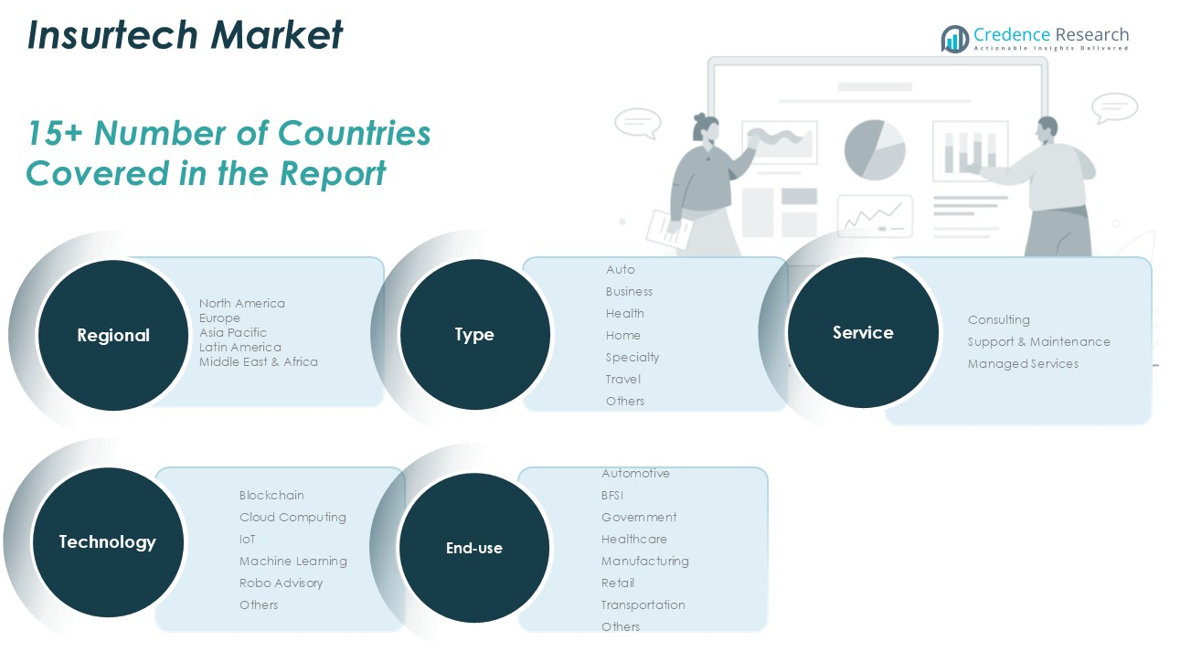
By Services
- Consulting
- Support & Maintenance
- Managed Services
By Type
- Auto
- Business
- Health
- Home
- Specialty
- Travel
- Others
By Technology
- Blockchain
- Cloud Computing
- IoT
- Machine Learning
- Robo Advisory
- Others
By End-Use
- Automotive
- BFSI
- Government
- Healthcare
- Manufacturing
- Retail
- Transportation
- Others
By Geography
- North America
- U.S.
- Canada
- Mexico
- Europe
- Germany
- France
- U.K.
- Italy
- Spain
- Rest of Europe
- Asia Pacific
- China
- Japan
- India
- South Korea
- South-east Asia
- Rest of Asia Pacific
- Latin America
- Brazil
- Argentina
- Rest of Latin America
- Middle East & Africa
- GCC Countries
- South Africa
- Rest of the Middle East and Africa
Competitive Landscape
The Insurtech market is highly competitive and rapidly evolving, characterized by the presence of both established technology providers and innovative startups. Key players such as Damco Group, Insurance Technology Services, DXC Technology Company, Majesco, Oscar Insurance, Quantemplate, Shift Technology, Wipro Limited, and ZhongAn Insurance are actively shaping the market through strategic initiatives including partnerships, product innovations, and mergers. These companies focus on leveraging advanced technologies like artificial intelligence, machine learning, blockchain, and cloud computing to develop customer-centric solutions that enhance policy management, risk assessment, and claims processing. Continuous investment in research and development and a growing emphasis on expanding digital capabilities are pivotal strategies to maintain market leadership. Additionally, the competitive landscape is influenced by increasing collaborations between traditional insurers and Insurtech firms, as established players seek to accelerate their digital transformation efforts. As competition intensifies, companies are prioritizing agility, customer experience, and technological advancements to gain a sustainable competitive edge.
Key Player Analysis
- Damco Group
- Insurance Technology Services
- DXC Technology Company
- Majesco
- Oscar Insurance
- Quantemplate
- Shift Technology
- Wipro Limited
- ZhongAn Insurance
Recent Developments
- In December 2024, Sure partnered with CU Financial Group, LLC to unveil SimpleQuote, the latest digital insurance solution that will help credit unions provide their members seamless access to insurance.
- In November 2024, Fedo.ai partnered with Canara HSBC Life Insurance to launch non-invasive health assessments using AI. This strategic partnership is aimed at enhancing the customer experience in health assessments.
- In March 2024, Zego, a U.K.-based insurtech company, expanded its fleet insurance offering to Southeast Asia, highlighting the growing globalization of insurtech companies.
- In January 2024, Lemonade acquired an AI-powered claims automation startup to improve its claims processing efficiency. The company aims to use this technology to speed up its claims review process and reduce operational costs.
- In March 2022, Nividous partnered with Damco Solutions to deliver optimal business value through industries by restructuring core and non-core processes with intelligent automation technology.
Market Concentration & Characteristics
The Insurtech market demonstrates moderate to high market concentration, with a few dominant players holding substantial influence due to their technological capabilities and established customer bases. It is characterized by rapid technological adoption, strong demand for digital insurance solutions, and increasing preference for customer-centric models. The market focuses on automation, real-time policy management, and data-driven underwriting to enhance operational efficiency and improve customer experience. Major companies actively pursue partnerships, product development, and geographic expansion to strengthen their competitive position. The market shows a high level of innovation, driven by evolving consumer expectations and the need for cost-effective insurance services. Cloud computing, artificial intelligence, and machine learning play pivotal roles in shaping new insurance products and streamlining claims processes. Strong regulatory oversight ensures consumer protection while encouraging digital transformation within the industry. The Insurtech market remains highly responsive to technological advancements, with insurers integrating smart technologies to optimize risk assessment and deliver faster, more transparent services. Growth opportunities continue to emerge in underpenetrated regions where mobile accessibility and digital infrastructure improve. Competitive dynamics push companies to prioritize agile operations and customer engagement while managing cybersecurity and regulatory compliance challenges.
Report Coverage
The research report offers an in-depth analysis based on Services, Type, Technology, End-Use and Geography. It details leading market players, providing an overview of their business, product offerings, investments, revenue streams, and key applications. Additionally, the report includes insights into the competitive environment, SWOT analysis, current market trends, as well as the primary drivers and constraints. Furthermore, it discusses various factors that have driven market expansion in recent years. The report also explores market dynamics, regulatory scenarios, and technological advancements that are shaping the industry. It assesses the impact of external factors and global economic changes on market growth. Lastly, it provides strategic recommendations for new entrants and established companies to navigate the complexities of the market.
Future Outlook
- The Insurtech market will continue to grow rapidly, driven by increasing digitalization across the insurance sector.
- Demand for personalized and usage-based insurance products will rise, reshaping traditional insurance models.
- Cloud computing and artificial intelligence will remain central to future Insurtech solutions and innovations.
- Real-time data processing and predictive analytics will significantly improve risk assessment and claims management.
- Mobile-based insurance platforms will expand, offering greater accessibility and convenience for consumers.
- Regulatory bodies are expected to introduce more supportive frameworks to encourage digital insurance adoption.
- Strategic partnerships between traditional insurers and Insurtech startups will accelerate technology integration.
- Investment in cybersecurity will become a top priority to protect customer data and ensure regulatory compliance.
- The market will witness continued expansion into underserved regions, improving insurance penetration globally.
- Customer experience and digital engagement will remain key competitive differentiators for Insurtech providers.
Request a Free Sample
Fill in your details and we'll send you a free sample report.
- Sample data tables & charts
- Research methodology
Need a Custom Version of This Report?
Tailor the scope, geography, or segments to your exact requirements.
- Custom geography or segment scope
- Direct access to our analyst team
Frequently Asked Questions
What is the current size of the Insurtech Market?
What are the key segments within the Insurtech Market?
What are some challenges faced by the Insurtech Market?
Who are the major players in the Insurtech Market?
Table of Content
Chapter 1. Report Introduction
- 1.1 Report Description & Purpose
- 1.1.1 Report Title & Market Definition
- 1.1.2 Unique Selling Propositions (USP) & Key Differentiators
- 1.1.3 Value Proposition for Stakeholders
- 1.2 Research Objectives
- 1.2.1 Market Sizing Objectives (Volume & Revenue)
- 1.2.2 Segmentation Objectives
- 1.2.3 Competitive Intelligence Objectives
- 1.2.4 Forecast & Scenario Objectives
- 1.3 Report Scope
- 1.3.1 Insurtech Scope – Types & Subtypes Covered
- 1.3.2 Geographic Scope – Regions & Countries Covered
- 1.3.3 Historical Period, Base Year & Forecast Period (2024; forecast to the forecast period)
- 1.3.4 Inclusions & Exclusions
- 1.4 HS Code & Classification Framework
- 1.5 Currency, Units & Pricing Basis
- 1.6 Target Stakeholders
- 1.7 Limitations & Assumptions
Chapter 2. Executive Summary
- 2.1 Global Insurtech Market Snapshot
- 2.1.1 Market Size – Historical (2024) & Forecast (the forecast period) (2024: USD 8,167.38 million → forecast year: USD 233,006.86 million)
- 2.1.2 Volume & Revenue – Global Totals
- 2.1.3 Key Market Highlights – Top Five Facts
- 2.2 Insurtech Market Segmentation Snapshot
- 2.2.1 Market Split by Region – 2024 vs.
- 2.3 Competitive Snapshot
- 2.3.1 Top 10 Players by Revenue Share – 2024
- 2.3.2 Top 10 Players by Volume Share – 2024
- 2.3.3 Recent Strategic Developments (18-Month Summary)
- 2.4 Key Investment Highlights & Strategic Conclusions
Chapter 3. Insurtech Market Dynamics & Industry Analysis
- 3.1 Market Overview & Context
- 3.1.1 Insurtech Market Position in the Broader Automotive Value Chain
- 3.1.2 OEM vs. Replacement Market Dynamics
- 3.1.3 Market Maturity & Development Stage by Region
- 3.2 Insurtech Market Drivers
- 3.3 Insurtech Market Restraints & Challenges
- 3.4 Insurtech Market Opportunities
- 3.5 Porter's Five Forces Analysis
- 3.5.1 Threat of New Entrants
- 3.5.2 Bargaining Power of Suppliers
- 3.5.3 Bargaining Power of Buyers
- 3.5.4 Threat of Substitutes
- 3.5.5 Competitive Rivalry – Intensity Assessment
- 3.6 Insurtech Value Chain Analysis
- 3.6.1 Upstream – Raw Material/Input Suppliers
- 3.6.1.1 Raw Material/Input 1
- 3.6.1.2 Raw Material/Input 2
- 3.6.1.3 Raw Material/Input 3
- 3.6.2 Midstream – Production/Manufacturing/Service Delivery
- 3.6.2.1 Production/Process Overview
- 3.6.2.2 Key Facility Locations & Capacity by Manufacturer
- 3.6.3 Downstream – Distribution & End Consumer
- 3.6.3.1 Primary Channel – B2B/OEM
- 3.6.3.2 Secondary Channels – Dealer, Retail, Online, Direct
- 3.6.4 Value Chain Profitability Analysis
- 3.6.1 Upstream – Raw Material/Input Suppliers
- 3.7 PESTEL Analysis
- 3.7.1 Political Factors
- 3.7.2 Economic Factors
- 3.7.3 Social Factors
- 3.7.4 Technological Factors
- 3.7.5 Environmental Factors
- 3.7.6 Legal Factors
- 3.8 Insurtech Supply Chain Analysis
- 3.8.1 Raw Material/Input Supply Risk Assessment
- 3.8.2 Manufacturing Concentration Risk (Geographic Exposure)
- 3.8.3 Trade Disruption Impact Analysis
- 3.9 Regulatory & Policy Landscape
Note: The regulatory and policy landscape section covers regulations based on their applicability to the market, Insurtech category, geography, and scope of the study. Only regulatory frameworks with a material impact on operations, compliance, trade, sustainability, or market access are analyzed in detail.
Chapter 4. Key Investment Pockets & Opportunity Analysis
- 4.1 Insurtech Market Attractiveness Analysis
- 4.1.1 By Region – Investment Attractiveness Matrix (Volume × CAGR)
- 4.2 Absolute Revenue Growth Opportunity
- 4.2.1 By Region – Absolute USD Growth Through the forecast period
- 4.3 Incremental Volume Opportunity
- 4.3.1 By Region – Incremental Volume Through the forecast period
- 4.3.2 Segment – Incremental Volume
- 4.4 Emerging Submarket Opportunity Deep Dive (Subject to Applicability)
- 4.5 Emerging Market Opportunity Scorecards
- 4.5.1 United States
- 4.5.2 Europe
- 4.5.3 Asia
- 4.5.4 Middle East & Africa
Note: Emerging Market Opportunity Scorecards will be included based on relevance and strategic importance. Regions listed are indicative and may vary depending on data availability and market dynamics.
Chapter 5. Insurtech Import-Export Analysis & Trade Flows
- 5.1 Global Trade Overview
- 5.1.1 Global Export Value by Country (2024)
- 5.1.2 Global Export Volume by Country (2024)
- 5.1.3 Global Import Value by Country (2024)
- 5.1.4 Global Import Volume by Country (2024)
- 5.1.5 Net Trade Balance by Country (2024)
- 5.2 Export Analysis – Segment
- 5.2.1 Type 1 (HS Code)
- 5.2.2 Type 2 (HS Code)
- 5.2.3 Type 3 (HS Code)
- 5.2.4 Type 4 (HS Code)
- 5.2.5 Type 5 (HS Code)
- 5.3 Import Analysis – Segment
- 5.3.1 Type 1 (HS Code)
- 5.3.2 Type 2 (HS Code)
- 5.3.3 Type 3 (HS Code)
- 5.3.4 Type 4 (HS Code)
- 5.3.5 Type 5 (HS Code)
- 5.4 Average Unit Trade Prices
- 5.4.1 Average Export Price – Segment & Country
- 5.4.2 Average Import Price – Segment & Source Country
- 5.4.3 Price Trends (2024)
- 5.5 Key Trade Route Analysis
- 5.5.1 Trade Route 1
- 5.5.2 Trade Route 2
- 5.5.3 Trade Route 3
- 5.5.4 Trade Route 4
- 5.5.5 Trade Route 5
- 5.6 Trade Policy Impact Assessment
- 5.6.1 US Anti-Dumping & Section 301 Tariffs
- 5.6.2 EU Customs Union Impact
- 5.6.3 Major Free Trade Agreements
- 5.6.4 USMCA Rules of Origin
Note: Trade policy analysis will be included only where relevant to the Insurtech market.
Chapter 6. Competitive Landscape & Company Benchmarking
- 6.1 Insurtech Market Concentration & Structure
- 6.1.1 Herfindahl-Hirschman Index (HHI) – vs. 2024
- 6.1.2 Tier 1, Tier 2 & Tier 3 Market Structure
- 6.1.3 Global, Regional & Local Player Dynamics
- 6.2 Insurtech Market Share Analysis – 2024
- 6.2.1 Global Revenue Share by Company
- 6.2.2 Global Volume Share by Company
- 6.2.3 Regional Revenue Share
- 6.2.4 Market Share Evolution ( vs. 2024)
- 6.2.5 OEM Segment Share by Company
- 6.2.6 Replacement Segment Share by Company
- 6.3 Production/Delivery Capacity & Facility Analysis
- 6.3.1 Global Installed Capacity
- 6.3.2 Capacity Utilization Rates
- 6.3.3 Production/Output Volume
- 6.3.4 Facility Locations & Capacity Map
- 6.3.5 Planned Capacity Additions
- 6.4 Insurtech Competitive Benchmarking Matrix
- 6.4.1 Revenue, Volume, CAGR & Profitability Comparison
- 6.4.2 Channel Revenue Mix
- 6.4.3 Geographic Revenue Exposure
- 6.4.4 R&D Intensity
- 6.4.5 Sustainability Maturity
- 6.5 Strategic Developments in Insurtech (Last 24 Months)
- 6.5.1 Mergers, Acquisitions & Divestments
- 6.5.2 New Insurtech Launches
- 6.5.3 Facility Expansions
- 6.5.4 Strategic Alliances, Joint Ventures & Partnerships
- 6.5.5 Distribution Expansion & Market Entry
- 6.5.6 Sustainability & ESG Initiatives
- 6.6 Competitive Strategy Mapping
- 6.6.1 Leader, Challenger, Follower & Niche Classification
- 6.6.2 Pricing Strategy Comparison
- 6.6.3 Channel Strategy Matrix
Note: Strategic developments are included based on their materiality and the availability of reliable information.
Chapter 7. Global Insurtech Market – By Distribution Channel
- 7.1 Segment Overview
- 7.1.1 Volume & Revenue Split by Channel (2024 & )
- 7.1.2 Channel Mix Evolution (the forecast period)
Chapter 8. Regional Market Analysis – Global Overview
- 8.1 Global Regional Overview
- 8.1.1 Regional Volume Share
- 8.1.2 Regional Revenue Share
- 8.1.3 Regional Volume by Region
- 8.1.4 Regional Revenue by Region
- 8.1.5 Regional Forecast Through the forecast period
- 8.2 Cross-Regional Segment Analysis
- 8.2.1 By Distribution Channel
- 8.2.2 By Brand/Price Tier
Chapter 9. North America Insurtech Market
- 9.1 United States
- 9.2 Canada
- 9.3 Mexico
Chapter 10. Europe Insurtech Market
- 10.1 Germany
- 10.2 France
- 10.3 Italy
- 10.4 United Kingdom
- 10.5 Spain
- 10.6 Poland
- 10.7 Russia
- 10.8 Netherlands
- 10.9 Belgium
- 10.10 Sweden
- 10.11 Denmark
- 10.12 Norway
- 10.13 Rest of Europe
Chapter 11. Asia Pacific Insurtech Market
- 11.1 China
- 11.2 India
- 11.3 Japan
- 11.4 South Korea
- 11.5 Thailand
- 11.6 Indonesia
- 11.7 Vietnam
- 11.8 Malaysia
- 11.9 Australia
- 11.10 Rest of Asia Pacific
Chapter 12. Latin America Insurtech Market
- 12.1 Brazil
- 12.2 Argentina
- 12.3 Colombia
- 12.4 Chile
- 12.5 Rest of Latin America
Chapter 13. Middle East Insurtech Market
- 13.1 Saudi Arabia
- 13.2 United Arab Emirates
- 13.3 Turkey
- 13.4 Israel
- 13.5 Iran
- 13.6 Rest of the Middle East
Chapter 14. Africa Insurtech Market
- 14.1 South Africa
- 14.2 Egypt
- 14.3 Nigeria
- 14.4 Morocco
- 14.5 Rest of Africa
Chapter 15. Insurtech Company Profiles
- 15.1 [Company 01]
- 15.1.1 Company Overview
- 15.1.2 Key Management Personnel
- 15.1.3 Products & Services Portfolio
- 15.1.4 Financial Performance
- 15.1.5 Key Market Focus & Geographic Presence
- 15.1.6 Recent Developments & Strategic Initiatives
Note: The company profile list is preliminary and may change based on research findings, market developments, data availability, and client requirements.
Chapter 16. Appendices
- Appendix A – List of Abbreviations & Acronyms
- Appendix B – Industry Classification Code Reference – Full Series
- Appendix C – Production & Capacity Data Tables
- Appendix D – End-Use & Demand Base Tables
- Appendix E – Consumption & Replacement Rate Assumptions
- Appendix F – ASP Reference Tables
- Appendix G – Manufacturing & Facility Database
- Appendix H – Import-Export Data Tables
- Appendix I – Regulatory Summary Tables
- Appendix J – Primary Research Participant List (Anonymized)
- Appendix K – Primary Research Questionnaire Framework
- Appendix L – Data Sources & Bibliography
- Appendix M – Market Size Divergence & Source Comparison
Chapter 17. Research Methodology
- 17.1 Research Framework & Philosophy
- 17.2 Secondary Research – Sources, Hierarchy & Data Extraction
- 17.3 Data Modeling – Bottom-Up & Top-Down Market Sizing
- 17.4 Primary Research – Stakeholder Framework, LOI & Sample Sizes
- 17.5 Forecast Methodology – Regression, Scenario & Sensitivity Analysis
- 17.6 Quality Control – Four-Layer Validation Framework
- 17.7 Limitations & Standard Assumptions
- 17.8 Disclaimer
