
Commission platforms still earn most digital revenue
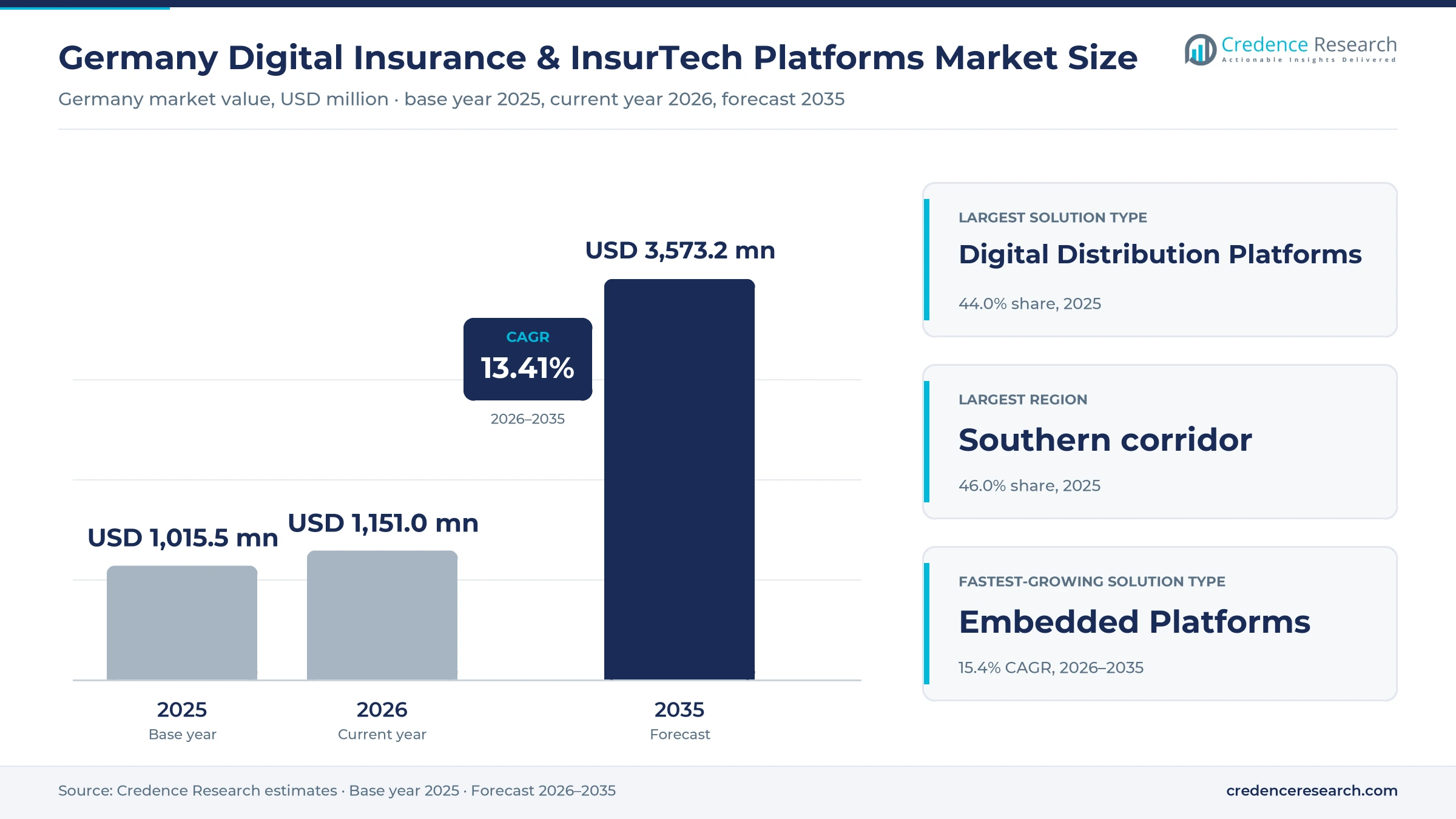
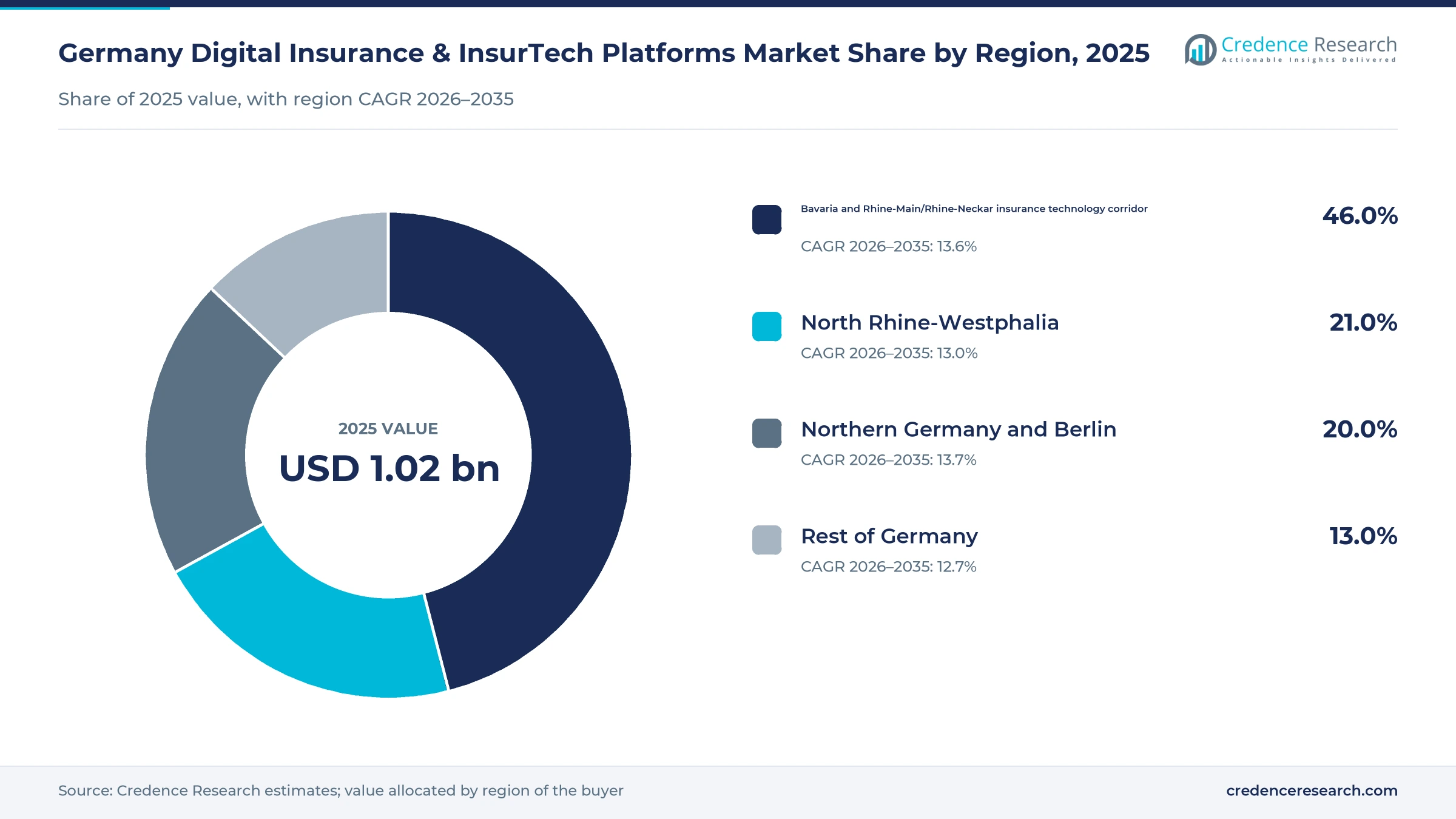
The Germany digital insurance and insurtech platforms market was valued at USD 1.02 billion in 2025 and is projected to increase from USD 1.15 billion in 2026 to USD 3.57 billion by 2035, registering a CAGR of 13.41% during 2026–2035. Demand comes from households that now compare and buy motor, liability, pet and supplementary health cover online, and from carriers that buy pricing, policy and claims software instead of building it. The Bavaria and Rhine-Main/Rhine-Neckar insurance technology corridor held 46.0% of 2025 revenue, because the largest comparison portals, digital brokers and neo-insurers are based in Munich, Frankfurt and Heidelberg. Northern Germany and Berlin is the fastest-growing region at 13.7% a year. The most important commercial change is that two of the best-known digital insurers, Getsafe in 2025 and Neodigital in 2026, decided to hand their risk to established carriers and keep the customer and technology platform.
Which revenues make up German digital insurance platforms?
This report sizes the revenue that German digital insurance and insurtech platforms earn each year, not the premiums that pass through them. It counts commissions earned by comparison portals and digital brokers, net insurance revenue retained by digital-native carriers and managing general agents, subscription and license fees for insurance software, and transaction fees charged by embedded insurance orchestrators.
Premiums written by traditional insurers through their own agents are excluded, as are general IT services that are not specific to insurance. Revenue is allocated to the region where the customer relationship or the software contract is managed, which concentrates value in the southern hubs where most platforms operate.
Germany Digital Insurance & Insurtech Platforms Market Insights
- German digital insurance and insurtech platform revenue was USD 1.02 billion in 2025 and is forecast to reach USD 3.57 billion by 2035, growing at 13.41% a year during 2026–2035.
- The Bavaria and Rhine-Main/Rhine-Neckar insurance technology corridor held 46.0% of 2025 revenue, while Northern Germany and Berlin grows fastest at 13.7% a year.
- Digital Distribution Platforms made up 44.0% of 2025 revenue, because comparison portals and broker apps still earn the largest commission pool.
- Neodigital said in July 2026 that it will give up its risk-carrier role and run its more than 400,000 customers on its platform for Württembergische.
- ProSiebenSat.1 sold the Heidelberg comparison portal Verivox to Italy-based Moltiply Group in March 2025, adding a foreign owner to the comparison tier.
Distribution platforms lead and embedded models grow fastest
Why do distribution platforms earn the most revenue?
Based on solution type, the market is categorized into digital distribution platforms, full-stack digital insurers, insurance software platforms and embedded insurance platforms. Digital Distribution Platforms led with 44.0% of 2025 revenue, because comparison portals and broker apps collect commissions on every policy they place, and CLARK says its app now serves more than 700,000 customers in Germany. Embedded Insurance Platforms grow fastest at 15.4% a year as specialist carriers build products for partners, and hepster announced a partnership with HDI Embedded on March 24, 2025, to widen its pet cover range in Germany and Austria.
Which tasks carry the most platform revenue?
Based on application, the market is categorized into policy comparison and acquisition, underwriting and pricing, policy administration and servicing, and claims automation. Policy Comparison and Acquisition led with 45.0% of 2025 revenue because the comparison tier remains the main paid gateway to customers, and ProSiebenSat.1 announced on March 21, 2025, that it had sold Verivox to Moltiply Group, which runs comparison sites in several European countries. Claims Automation grows fastest at 14.8% a year as Getsafe said in June 2025 that its AI agents already handle much of its claims settlement, advice and contract conclusion.
Which customers generate the most platform revenue?
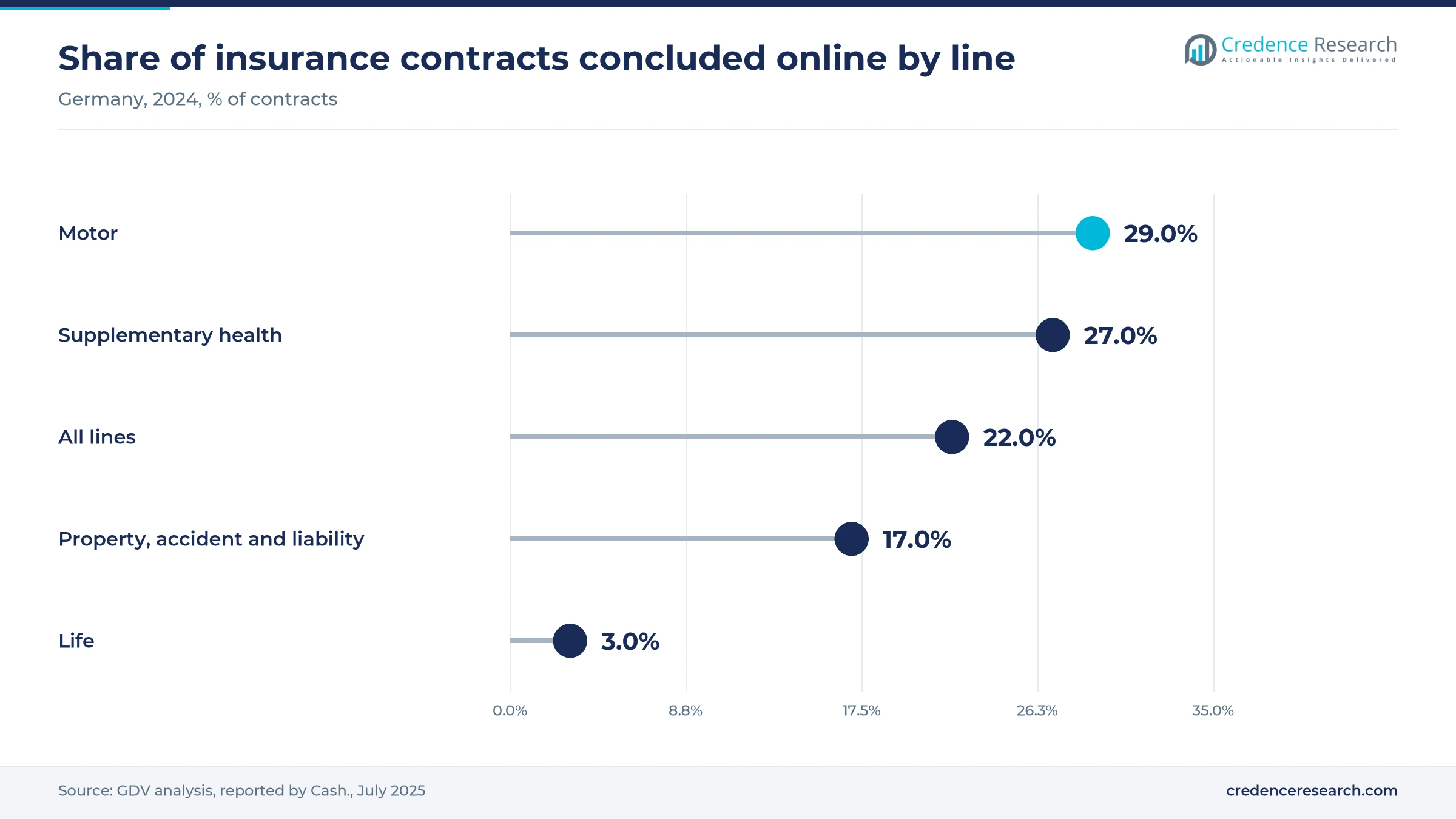
Based on customer type, the market is categorized into retail policyholders, self-employed professionals, SMEs and large enterprises. Retail Policyholders led with 63.0% of 2025 revenue because personal lines move online first, and GDV data reported by Cash. showed that more than 27% of supplementary health contracts and more than 17% of property, accident and liability contracts were concluded online in 2024. SMEs grow fastest at 14.5% a year as carriers digitize workplace benefits, and Neodigital began supplying the platform for the first VGH company health product in January 2026.
| Segment Group | Leading Sub-segment | Share, 2025 | Fastest-growing Sub-segment | CAGR, 2026–2035 |
|---|---|---|---|---|
| By Solution Type | Digital Distribution Platforms | 44.0% | Embedded Insurance Platforms | 15.4% |
| By Application | Policy Comparison and Acquisition | 45.0% | Claims Automation | 14.8% |
| By Customer Type | Retail Policyholders | 63.0% | SMEs | 14.5% |
Commission funding keeps most consumer tools free to use
Pricing in this market is mostly hidden from the policyholder, because comparison portals and broker apps are paid by the carrier rather than the customer. That makes platform revenue a direct function of premium levels and switching volumes. Motor premiums rose 13.4% to EUR 38.6 billion in 2025, according to the GDV, which lifted the commission pool on the most heavily compared line. Embedded and SaaS providers price differently, through small monthly premiums shared with partners or annual license fees per line. Suppliers with recurring license or servicing income are less exposed when premium inflation fades and switching slows.
| Offer or segment | Typical price or fee | Basis |
|---|---|---|
| Consumer broker app with free advice (CLARK) | EUR 0 to the customer, funded by carrier commission | CLARK, accessed November 2026 |
| Embedded bicycle cover (hepster) | From EUR 2.42 a month | hepster, accessed November 2026 |
| Full private health tariff for a sample employee (Verivox comparison) | From EUR 142.03 a month, employee share | Verivox, accessed November 2026 |
| Portal or broker commission on a new motor policy | About 8% to 15% of first-year premium | Credence Research estimate from broker commission practice |
| B2B policy, pricing or claims platform license | About USD 0.2 million to 1.5 million a year per insurer line | Credence Research estimate from vendor deal scope |
Request a Free Sample
Fill in your details and we'll send you a free sample report.
- Sample data tables & charts
- Research methodology
Online buying and a larger premium pool lift revenue
Mainstream digital insurance purchasing
Buying insurance online has become normal for most German adults, which widens the base that portals, digital brokers and neo-insurers can serve. A GDV analysis reported by Cash. in July 2025 found that 22% of all insurance contracts were concluded digitally in 2024, up from 18% in 2022. Motor insurance led all lines, with 29% of its contracts closed online. Bitkom's 2026 survey found that 89% of people aged 16 and over had taken out a policy online, up from 83% a year earlier. This shift moves acquisition spending away from agents and toward platforms, and Policy Comparison and Acquisition already took 45.0% of 2025 revenue.
Expanding insurance revenue pool
A larger premium pool raises the commissions and retained premiums that digital platforms earn without any change in their market share. German insurers collected EUR 253.6 billion in premiums in 2025, 6.6% more than a year earlier, according to GDV figures reported in February 2026. The private health insurance association PKV counted 31.98 million supplementary health policies in 2025, up 2.2%, and supplementary health is one of the lines most often sold online. Part of the premium growth reflects inflation in repair and medical costs. Platforms paid as a share of premium therefore gain revenue even when policy counts are flat, and this effect underpins the 13.41% growth rate of German insurtech platforms.
Scaling platform and embedded-insurance economics
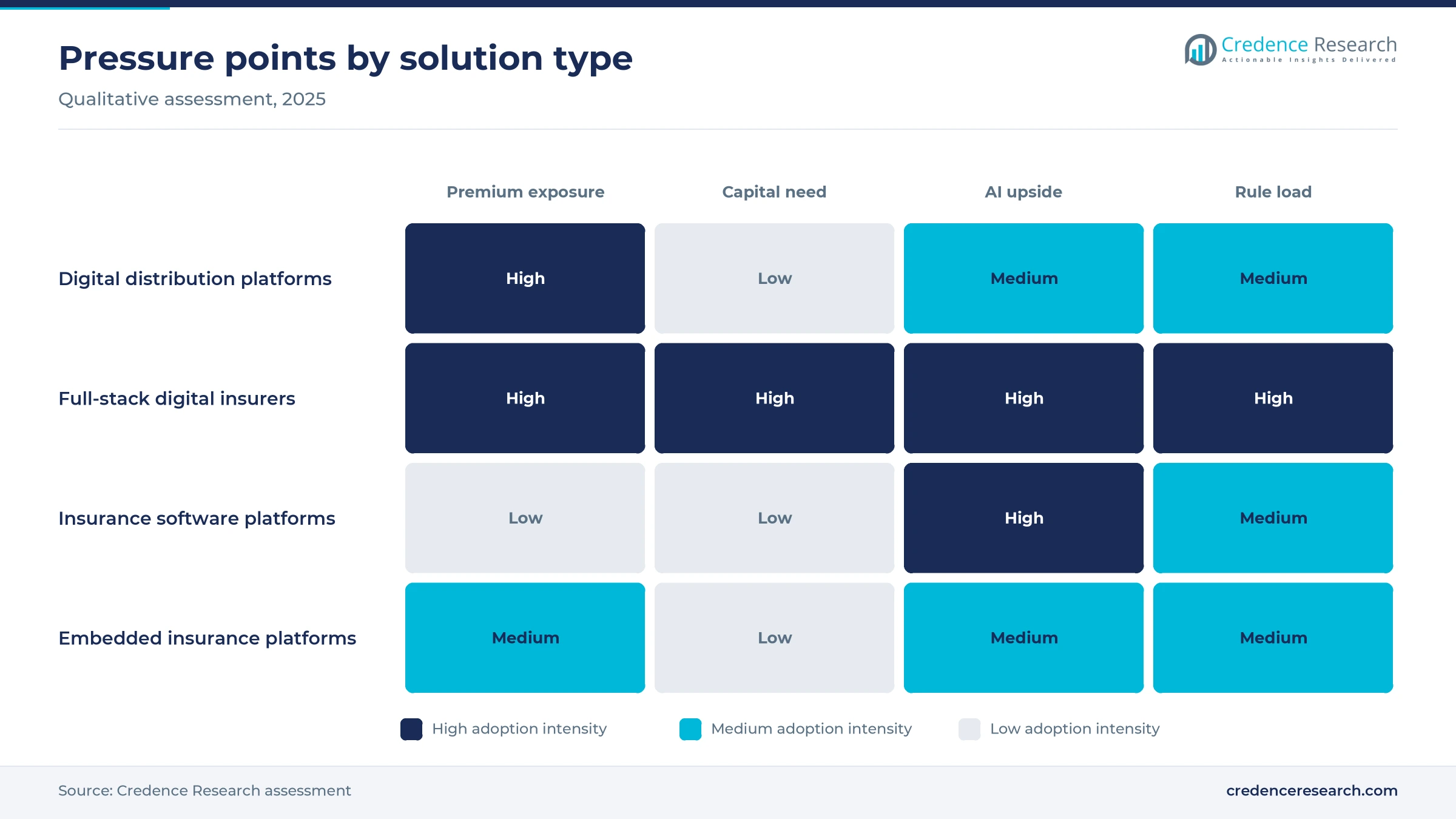
Cover sold at the point of purchase is becoming a large and cheap acquisition channel for specialist carriers. GDV data reported by Cash. showed that embedded products accounted for about 40% of the private property, accident and liability contracts concluded digitally in 2024. hepster says a retailer can connect its API in about one day and go live within two weeks, so partner onboarding costs stay low. Bitkom's 2025 survey found that 52% of people whose latest policy was pet cover bought it online, as did 48% for device cover. These economics resemble those of embedded finance, and Embedded Insurance Platforms grow fastest at 15.4% a year.
Pension and benefit reforms favor workplace platforms
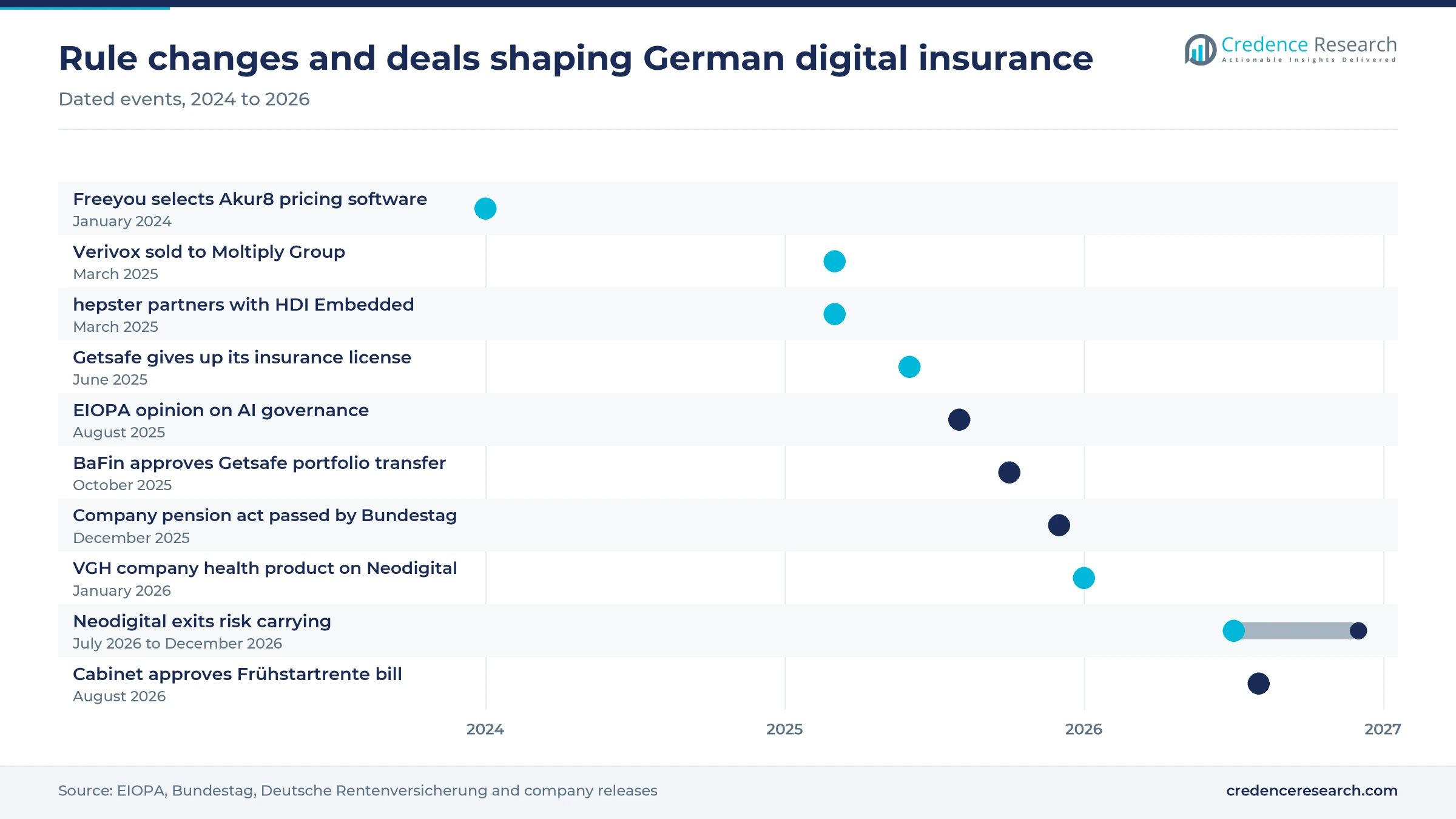
New pension rules give employers and savers more reasons to use digital advice and administration platforms. The Bundestag passed the Second Act Strengthening Company Pensions on Dec. 5, 2025, with measures taking effect in stages from Jan. 1, 2026, including employer opt-out schemes through works agreements. On Aug. 12, 2026, the federal cabinet approved the Frühstartrente bill, under which the state would pay EUR 10 a month into a pension depot for each child from age six, starting Jan. 1, 2027, according to Deutsche Rentenversicherung. Both measures add many small contracts that are only profitable to serve digitally. For that reason SMEs grow at 14.5% a year, the fastest customer type.
Neo-insurers hand risk to carriers and keep the platform
Neo-insurers shift from carrying risk to running platforms
The most visible digital insurers are moving away from holding their own risk and toward managing general agent or platform models. On June 5, 2025, Getsafe said it would give up its own insurance license and operate as a technology-driven agent for more than 500,000 customers. BaFin approved the transfer of its insurance portfolio to a new risk carrier on Oct. 27, 2025, according to law firm Clyde & Co. Neodigital followed in July 2026, when it said it would give up its risk-carrier role and move its property, liability and accident business to Württembergische. This shift moves revenue away from full-stack digital insurers and toward software fees and commission income, while established carriers keep the balance-sheet risk.
AI moves into advice, pricing and claims handling
Artificial intelligence is moving from pilots into customer-facing insurance work, under closer supervisory attention. Bitkom found in 2026 that 52% of people would like AI to help fill in an insurance application and 38% would use AI to assess photos of accident damage, although only 9% had already consulted an AI before buying. EIOPA issued an opinion on AI governance and risk management on Aug. 6, 2025, and Annex III of the EU AI Act lists risk assessment and pricing in life and health insurance as high-risk. Remote onboarding of new policyholders also depends on reliable identity verification tools. Vendors that document their models well should win more carrier contracts as these rules bite.
Health switching opens a new advice opportunity
Rising statutory health contributions give digital brokers a new reason to contact customers who rarely review their cover. Getsafe entered health insurance advice on Dec. 1, 2025, citing an average additional contribution that rose from 1.7% in 2024 to 2.5% in 2025 and is expected to reach 2.9% in 2026. The company estimates that about one-third of the 74 million people with statutory cover are with funds that do not suit them. Switching advice is cheap to deliver in an app and opens cross-selling of supplementary health and dental cover. Brokers that turn this advice into recurring commission on private add-ons stand to gain most, and retail policyholders remain the core audience for this advice.
Workplace benefit platforms offer a route to SMEs
Workplace pensions and company health plans are an opening for platforms that can serve many small employers at low cost. Xempus reported about 60,000 connected employers and 18,000 insurance intermediaries on its platform in 2022, according to Munich Startup. Swiss Life told Cash. in October 2026 that it has placed the Xempus platform at the center of its company benefits strategy and expects participation of 80% to 90% under employer opt-out schemes. Coverage is strong at larger firms but much weaker at very small companies, where paper processes are too costly. Platforms that bundle pensions, health benefits and payroll links should win this segment as the reforms take effect.
Advice-heavy lines and slower premium growth cap the upside
Life and pension products remain advice-led
The largest insurance line is still sold almost entirely through people, which limits the revenue platforms can capture. GDV data reported by Cash. showed that just over 3% of life insurance contracts were concluded online in 2024, against 29% in motor. Life insurers booked EUR 99.4 billion in premiums in 2025, so most of that pool stays with agents and banks. Platforms can respond with hybrid models that combine digital comparison with telephone advice, as CLARK and Xempus already do.
Comparison portals face a slightly smaller audience
The share of online buyers who use comparison portals has started to slip, which matters because portals earn the largest single revenue pool. Bitkom found that 57% of online insurance buyers used a portal such as Check24 or Verivox in 2026, down from 62% in 2025, while 49% bought directly from an insurer. A drop of 5 points in portal use within one year shows how quickly demand can shift toward direct channels. Carriers that win direct traffic save commission, so portals must spend more to defend volume and margins.
Slower premium growth reduces commission momentum
Platform revenue tied to premiums will grow more slowly once price increases fade. The GDV expects nominal industry growth of 4.7% in 2026, below the 6.6% recorded in 2025, and forecasts recurring-premium life business to fall about 0.8%. Lower premium inflation also reduces the incentive to switch motor cover, which drives much portal traffic. Suppliers dependent on first-year commission are most exposed, while SaaS vendors with fixed license fees are better protected.
Older customers still prefer personal contact
A large group of older policyholders has not moved online, which slows digital penetration in household and health lines. Bitkom's 2025 survey of 1,003 people found that 55% of those aged 65 and over had ever taken out a policy online, compared with 97% of those aged 30 to 49. This group holds many long-standing contracts and high-value health cover. Platforms that add telephone advice and simple claims reporting can reach part of it, but progress will be gradual.
Southern hubs lead while the north and Berlin grow fastest
| Region | Value, 2025 (USD million) | Share, 2025 | CAGR, 2026–2035 |
|---|---|---|---|
| Bavaria and Rhine-Main/Rhine-Neckar insurance technology corridor | 467.1 | 46.0% | 13.6% |
| North Rhine-Westphalia | 213.3 | 21.0% | 13.0% |
| Northern Germany and Berlin | 203.1 | 20.0% | 13.7% |
| Rest of Germany | 132.0 | 13.0% | 12.7% |
The southern corridor hosts most leading platforms
The Bavaria and Rhine-Main/Rhine-Neckar insurance technology corridor held 46.0% of 2025 revenue and grows at 13.6% a year. CHECK24 runs its insurance comparison through a registered broker entity in Munich, Verivox and Getsafe are based in Heidelberg, and CLARK operates from Frankfurt. Munich is also home to Xempus, whose workplace pension platform adds benefit revenue to the corridor's portal and broker base. The concentration of portals, neo-insurers and pension platforms means this corridor will keep the largest share, although growth is close to the national rate.
North Rhine-Westphalia carriers back platforms rather than run them
North Rhine-Westphalia held 21.0% of 2025 revenue and grows at 13.0% a year. Andsafe, the Münster-based digital insurer of the Provinzial group, agreed in July 2025 to become risk carrier for the Getsafe contracts, according to Cash., which shows North Rhine-Westphalia carriers backing platforms rather than running consumer portals themselves. The state's revenue share is below its population weight because few comparison portals or digital brokers are based there. Demand comes mainly from carriers buying software, so the state's regional share should stay near 21% through 2035 as growth runs slightly below the national rate.
Northern Germany and Berlin grow fastest
Northern Germany and Berlin held 20.0% of 2025 revenue and form the fastest-growing region at 13.7% a year. Hanover-based VGH, whose company health launch on the Neodigital platform is described above, shows how northern carriers now buy platforms rather than build them. Young urban customers in Berlin and Hamburg add retail demand for app-based cover. Northern Germany and Berlin should lift its regional share of national platform revenue above 20% by 2035.
The rest of Germany relies on national platforms
The rest of Germany held 13.0% of 2025 revenue and grows at 12.7% a year. This region covers most of Baden-Württemberg outside the Rhine-Neckar area, Saxony, Thuringia and other eastern and central states. Few platform operators are based there, so most revenue comes from residents who use national portals and apps. Growth is the slowest of the four regions because demand here depends on national platforms rather than on locally based operators.
License exits, sales and platform deals from 2024 to 2026
| Development | Status and market relevance |
|---|---|
| In January 2024, Akur8 said the German digital insurer Freeyou Insurance AG had selected its pricing software for motor and personal possessions cover. | Live; shows specialist pricing tools entering German carriers. |
| In March 2025, ProSiebenSat.1 sold the comparison portal Verivox to a subsidiary of Moltiply Group. | Signed with closing expected the same day; Verivox joins a European comparison group. |
| In June 2025, Getsafe said it would give up its own insurance license and run as a managing general agent. | Portfolio transfer to a new risk carrier approved by BaFin in October 2025. |
| In January 2026, VGH entered company health insurance with a budget tariff run on the Neodigital platform. | Live; Provinzial Krankenversicherung Hannover carries the risk. |
| In July 2026, Neodigital agreed to hand its property, liability and accident business to Württembergische and become a platform provider. | Expected to close by the end of 2026, subject to approvals. |
Rating engines, APIs and AI agents reshape the value chain
- Machine-learning rating engines let carriers rebuild motor and property tariffs faster than manual modeling allows, which is why Freeyou chose Akur8 software.
- Partner APIs allow retailers and apps to add cover at checkout, so embedded orchestrators can sign many small partners quickly.
- AI service agents answer customer questions, check claims and issue contracts, reducing the staff cost per policy for neo-insurers and brokers.
- Cloud policy platforms run on cloud services and let carriers launch new products without changing their legacy core systems.
Need a Custom Version of This Report?
Tailor the scope, geography, or segments to your exact requirements.
- Custom geography or segment scope
- Direct access to our analyst team
Portals, neo-insurers and B2B vendors compete for policies
Competition among German digital insurance and insurtech platforms depends on who owns the customer contact and who supplies the technology behind it. CHECK24 and Verivox control the largest comparison audiences, and Verivox now belongs to the Italian Moltiply Group. CLARK competes as a digital broker with free advice funded by carrier commission. DFV Deutsche Familienversicherung AG and ottonova remain digital-native carriers in health and property lines, while Getsafe and Neodigital have moved to agent and platform roles. Xempus supplies a workplace pension platform used by several life insurers, hepster runs embedded cover for retailers and mobility partners, and Akur8 sells pricing software to German carriers. Advantage increasingly depends on traffic, low acquisition cost and the ability to run products for established carriers.
How is the supply side organized and where do margins sit?
Supply is split between a few large comparison portals and digital brokers, a small group of digital-native carriers and agents, and B2B vendors that sell pricing, policy and pension software to established insurers. The comparison tier is concentrated, while the software tier is fragmented. Distribution still depends heavily on people, since the DIHK register listed 179,923 insurance intermediaries on July 1, 2025, including 46,771 brokers and 99,797 tied agents. Broker numbers rose while tied agents fell 3.3%, which favors the independent distribution that portals and digital brokers depend on. A carrier needs a BaFin license and capital, so newer firms prefer agent models. Margins sit mainly with portals that own traffic and with vendors of recurring software.
Companies profiled and their roles in this market
| Company | Type | Role in the market |
|---|---|---|
| CHECK24 | Comparison portal and broker | Insurance comparison and broking through a registered broker entity in Munich |
| Verivox (Moltiply Group) | Comparison portal | Motor, health, liability and household insurance comparison from Heidelberg |
| CLARK | Digital broker | App with free advice, funded by carrier commission |
| Getsafe | Managing general agent | App-based liability, contents, pet and legal cover with AI-led service |
| DFV Deutsche Familienversicherung AG | Digital-native insurer | Supplementary health, care and property insurance sold mainly online |
| Neodigital Versicherung AG | Insurance software platform | Insurance-as-a-service platform for carriers, motor business for Neodigital Autoversicherung |
| ottonova | Digital private health insurer | Full and supplementary private health insurance with app-based service |
| Xempus | B2B pension platform | Workplace pension advice and administration platform for employers, brokers and insurers |
| hepster | Embedded insurance orchestrator | API-based mobility, electronics and pet cover for retail partners |
| Akur8 | Pricing software vendor | Machine-learning pricing and rating software used by German carriers |
Platform ownership matters more than carrying the risk
Credence Research's view is that owning the customer platform will matter more than carrying the risk for German insurtech platforms over the next decade. The license exits at Getsafe and Neodigital show that capital-light models are more attractive to investors than small balance sheets. Retail policyholders still generated 63.0% of 2025 revenue, so consumer demand will decide most of the growth. Portals remain the largest revenue pool, but slowing premium growth and more direct buying will push them toward advice and cross-selling. The fastest gains should come from embedded orchestration, workplace platforms and software that carriers license instead of build.
Platform revenue built from commissions, fees and premiums
The report uses 2025 as the base year and forecasts German digital insurance and insurtech platform revenue for 2026 to 2035. Market values come from the Credence Research model, which estimates commission revenue from premium volumes and online sales shares, retained premium from digital-native carriers and agents, and fee income from software and embedded platforms. Segment and regional splits are Credence Research estimates built from these inputs. Sources include GDV and PKV association data reported in the press, Bitkom surveys, EIOPA, Deutsche Rentenversicherung, the DIHK register and company releases, and no interviews or surveys were conducted for this edition.
Revenue roughly triples as embedded and SaaS models scale
Revenue of German digital insurance and insurtech platforms should rise from USD 1.15 billion in 2026 to USD 3.57 billion by 2035, because online buying, embedded sales and outsourced platform work keep gaining share of a growing premium pool. Comparison and broker platforms will remain the largest solution type, but embedded orchestrators and software vendors should grow faster as carriers buy rather than build. SMEs and workplace benefits should gain share as pension reforms take effect. The main risks are slower premium growth, a further drop in portal use and stricter supervision of AI in pricing, which would keep growth near the downside case.
How wide is the range of outcomes to 2035?
The outcome depends mainly on how fast embedded and workplace channels scale and on whether premium growth stays above inflation. Strong uptake of pension reforms and carrier outsourcing of policy and claims systems would push growth toward the upside. A sharp slowdown in premium growth, falling portal use and strict AI rules for pricing would hold it near the downside, because commission revenue reacts quickly to premium trends.
| Scenario | CAGR, 2026–2035 | Value, 2035 | What has to hold |
|---|---|---|---|
| Downside | 11.4% | USD 3.04 billion | Premium growth slows sharply, portal use keeps falling and AI rules delay automation |
| Base | 13.41% | USD 3.57 billion | Online buying keeps rising gradually and carriers keep outsourcing platform work |
| Upside | 15.2% | USD 4.12 billion | Embedded and workplace channels scale fast and carriers move core systems to SaaS |
Frequently Asked Questions
How big is the Germany digital insurance and insurtech platforms market?
Which solution type leads the market?
Which solution type grows fastest?
Which region leads the market?
How many insurance contracts are concluded online in Germany?
Why did Getsafe and Neodigital give up carrying risk?
How do pension reforms affect the market?
Who are the key players in the market?
Table of Content
Chapter 1 Market Segmentation
- 1.1 Segmentation Framework
- 1.1.1 Product and Service Classification
- 1.1.2 Application and End-Use Classification
- 1.1.3 Technology and Solution Classification
- 1.1.4 Customer and Distribution Channel Classification
- 1.1.5 Geographic Segmentation
- 1.1.6 Market Segment Definitions and Boundaries
- 1.2 By Solution Type
- 1.2.1 Digital Distribution Platforms
- 1.2.2 Full-Stack Digital Insurers
- 1.2.3 Insurance Software Platforms
- 1.2.4 Embedded Insurance Platforms
- 1.3 By Application
- 1.3.1 Policy Comparison and Acquisition
- 1.3.2 Underwriting and Pricing
- 1.3.3 Policy Administration and Servicing
- 1.3.4 Claims Automation
- 1.4 By Customer Type
- 1.4.1 Retail Policyholders
- 1.4.2 Self-Employed Professionals
- 1.4.3 SMEs
- 1.4.4 Large Enterprises
Chapter 2 Introduction
- 2.1 Report Objectives and Scope
- 2.2 Product Definition and Industry Terminology
- 2.3 Market Inclusions and Exclusions
- 2.4 Research Process
- 2.4.1 Primary Research and Expert Interviews
- 2.4.2 Secondary Research and Source Review
- 2.4.3 Top-Down and Bottom-Up Estimation
- 2.4.4 Data Triangulation and Verification
- 2.5 Market Size Measurement Basis
- 2.5.1 2025: USD 1.02 billion → 2035: USD 3.57 billion
- 2.6 Historical and Forecast Reference Periods
- 2.6.1 Historical Period: 2018-2025
- 2.6.2 Base Year: 2025
- 2.6.3 Forecast Period: 2025-2035
- 2.7 Research Assumptions and Limitations
Chapter 3 Executive Summary
- 3.1 Market Snapshot and Key Findings
- 3.2 Base-Year Market Size, 2025
- 3.3 Forecast Market Size, 2035
- 3.4 Revenue and Volume Growth Outlook
- 3.5 Key Demand and Supply Indicators
- 3.6 Leading Market Segments
- 3.7 Fastest-Growing Market Opportunities
- 3.8 Regional Performance Highlights
- 3.9 Technology and Industry Transformation
- 3.10 Competitive Landscape Summary
- 3.11 Analyst View and Strategic Implications
Chapter 4 Germany Digital Insurance & Insurtech Platforms Market Trends and Developments
- 4.1 Historical Industry Development, 2018-2025
- 4.2 Recent Market Trends and Developments
- 4.3 Demand and Customer Behavior Trends
- 4.4 Technology and Product Innovation
- 4.5 Artificial Intelligence, Automation and Digitalization
- 4.6 Local Manufacturing and Supply Chain Realignment
- 4.7 Industry Partnerships, Mergers and Acquisitions
- 4.8 Sustainability and Circular Economy Developments
- 4.9 Government and Private Sector Investment Trends
- 4.10 Emerging Business Models and Commercialization
- 4.11 Industry Developments and Announcements
Chapter 5 Germany Digital Insurance & Insurtech Platforms Market Supply and Demand Analysis
- 5.1 Demand Trend and Consumption Analysis, 2018-2025
- 5.2 Demand Forecast, 2025-2035
- 5.3 Supply Chain Structure and Procurement Trends
- 5.4 Supply-Demand Gap and Bottlenecks
- 5.5 Import Dependence and Sourcing Structure
- 5.6 Regional Supply and Demand Concentration
Chapter 6 Germany Digital Insurance & Insurtech Platforms Market Pricing Analysis
- 6.1 Pricing Structure and Measurement
- 6.2 Historical Pricing Trends, 2018-2025
- 6.3 Pricing Outlook, 2025-2035
- 6.4 Pricing by Product and Market Segment
- 6.5 Geographic Pricing Differences
- 6.6 Key Input, Energy, Labor and Logistics Costs
- 6.7 Contract Pricing and Purchasing Models
- 6.8 Pricing Sensitivity and Competitive Positioning
- 6.9 Price, Margin and Profitability Implications
Chapter 7 Germany Digital Insurance & Insurtech Platforms Market Dynamics
- 7.1 Market Growth Drivers
- 7.1.1 Demand-Side Drivers
- 7.1.2 Technology and Innovation Drivers
- 7.1.3 Infrastructure and Investment Drivers
- 7.1.4 Regulatory and Policy Drivers
- 7.2 Market Restraints
- 7.2.1 Cost and Affordability Constraints
- 7.2.2 Technology and Adoption Barriers
- 7.2.3 Supply Chain and Operational Constraints
- 7.3 Market Challenges
- 7.3.1 Competitive Pressure and Margin Erosion
- 7.3.2 Skills, Infrastructure and Implementation Gaps
- 7.4 Emerging Market Opportunities
- 7.5 Market Dynamics Impact and Time-Horizon Assessment
Chapter 8 Germany Digital Insurance & Insurtech Platforms Value Chain Analysis
- 8.1 Industry Value Chain Overview
- 8.2 Upstream Suppliers and Critical Inputs
- 8.3 Technology and Component Providers
- 8.4 Manufacturing or Service Delivery
- 8.5 Distribution, Channel Partners and Integrators
- 8.6 Downstream Applications and End Users
- 8.7 Value Addition and Profit Pools
- 8.8 Vertical Integration and Outsourcing
- 8.9 Supplier Concentration and Risk
- 8.10 Supply Chain Localization and Resilience
Chapter 9 Germany Digital Insurance & Insurtech Platforms Market Regulations and Policies
- 9.1 Relevant Laws, Standards and Compliance Frameworks
- 9.2 Product, Service, Safety and Quality Requirements
- 9.3 Government Policies, Incentives and Subsidies
- 9.4 Imports, Exports and Trade Barriers
- 9.5 Public Procurement and Local Content Requirements
- 9.6 Data Protection, AI and Cybersecurity Compliance
- 9.7 Upcoming Policy Changes and Market Implications
Chapter 10 Germany Digital Insurance & Insurtech Platforms Market Hotspots and Opportunities
- 10.1 Market Opportunity Mapping and Growth Hotspots
- 10.2 High-Growth Applications and Customer Groups
- 10.3 Underserved Markets and White-Space Opportunities
- 10.4 Emerging Technology and Product Opportunities
- 10.5 New Capacity and Investment Hotspots
- 10.6 Market Entry and Expansion Opportunities
- 10.7 Distribution and Partnership Opportunities
- 10.8 Near-Term and Long-Term Commercial Potential
- 10.9 Opportunity Attractiveness and Execution Risks
Chapter 11 Germany Digital Insurance & Insurtech Platforms Market Outlook, 2025-2035
- 11.1 Market Size and Analysis
- 11.1.1 Revenue (Market Measurement: 2025: USD 1.02 billion → 2035: USD 3.57 billion)
- 11.1.2 Historical Market Size, 2018-2025
- 11.1.3 Base-Year Market Size, 2025
- 11.2 Market Forecast, 2025-2035
- 11.2.1 Revenue Forecast to 2035
- 11.2.2 CAGR and Year-on-Year Growth
- 11.2.3 Incremental Revenue Opportunity
- 11.3 Forecast Assumptions and Scenario Analysis
- 11.3.1 Base-Case Forecast
- 11.3.2 Optimistic and Conservative Scenarios
- 11.3.3 Technology, Pricing and Policy Sensitivities
- 11.4 Market Attractiveness and Growth Outlook
Chapter 12 Germany Digital Insurance & Insurtech Platforms Market Segmentation and Outlook
- 12.1 Segmentation Summary and Market Shares, 2025
- 12.2 Largest and Fastest-Growing Segments
- 12.3 By Solution Type - Market Size and Forecast, 2025-2035
- 12.3.1 Segment Definition and Scope
- 12.3.2 Historical Market Size, 2018-2025
- 12.3.3 Revenue Forecast, 2025-2035
- 12.3.4 Base-Year Market Share, 2025
- 12.3.5 Segment CAGR and Growth Drivers
- 12.3.6 Subsegment Market Size and Forecast
- 12.3.6.1 Digital Distribution Platforms
- 12.3.6.2 Full-Stack Digital Insurers
- 12.3.6.3 Insurance Software Platforms
- 12.3.6.4 Embedded Insurance Platforms
- 12.3.7 Subsegment Pricing and Adoption Trends
- 12.3.8 Leading Suppliers and Competition
- 12.3.9 Regional Demand and Opportunities
- 12.4 By Application - Market Size and Forecast, 2025-2035
- 12.4.1 Segment Definition and Scope
- 12.4.2 Historical Market Size, 2018-2025
- 12.4.3 Revenue Forecast, 2025-2035
- 12.4.4 Base-Year Market Share, 2025
- 12.4.5 Segment CAGR and Growth Drivers
- 12.4.6 Subsegment Market Size and Forecast
- 12.4.6.1 Policy Comparison and Acquisition
- 12.4.6.2 Underwriting and Pricing
- 12.4.6.3 Policy Administration and Servicing
- 12.4.6.4 Claims Automation
- 12.4.7 Subsegment Pricing and Adoption Trends
- 12.4.8 Leading Suppliers and Competition
- 12.4.9 Regional Demand and Opportunities
- 12.5 By Customer Type - Market Size and Forecast, 2025-2035
- 12.5.1 Segment Definition and Scope
- 12.5.2 Historical Market Size, 2018-2025
- 12.5.3 Revenue Forecast, 2025-2035
- 12.5.4 Base-Year Market Share, 2025
- 12.5.5 Segment CAGR and Growth Drivers
- 12.5.6 Subsegment Market Size and Forecast
- 12.5.6.1 Retail Policyholders
- 12.5.6.2 Self-Employed Professionals
- 12.5.6.3 SMEs
- 12.5.6.4 Large Enterprises
- 12.5.7 Subsegment Pricing and Adoption Trends
- 12.5.8 Leading Suppliers and Competition
- 12.5.9 Regional Demand and Opportunities
- 12.6 Segment Growth Comparison
- 12.7 Segment Attractiveness and Priority Matrix
Chapter 13 Germany Digital Insurance & Insurtech Platforms End-Use and Application Market Outlook
- 13.1 End-Use Industry and Customer Demand Structure
- 13.2 Leading Applications and Customer Groups
- 13.3 End-Use Market Size, Share and Forecast
- 13.4 Major End-Use Industry Deep Dives
- 13.4.1 Customer Requirements and Use Cases
- 13.4.2 Demand and Replacement Cycles
- 13.4.3 Technical and Regulatory Considerations
- 13.4.4 Purchasing and Procurement Models
- 13.4.5 Leading Vendors and Distribution Channels
- 13.4.6 Forecast and Commercial Opportunities
- 13.5 Emerging Applications and Cross-Segment Demand
- 13.6 End-Use Industry Investment Priorities
Chapter 14 Germany Digital Insurance & Insurtech Platforms Geographic Market Outlook, 2025-2035
- 14.1 Domestic Market Distribution and Demand Clusters
- 14.2 State- or Province-Wise Market Size and Forecast, 2025-2035
- 14.3 City and Metropolitan Market Outlook
- 14.4 Industrial, Manufacturing and Commercial Clusters
- 14.5 Geographic Concentration of Key End Users
- 14.6 Local Pricing and Purchasing Differences
- 14.7 Domestic Production Facilities and Capacity Map
- 14.8 Local Infrastructure and Project Pipeline
- 14.9 State-Level Policy and Incentive Differences
- 14.10 Subnational Investment Hotspots and Opportunities
- 14.11 Distribution and Logistics Networks
- 14.12 Domestic Competitive Footprint
Chapter 15 Germany Digital Insurance & Insurtech Platforms Technology, Innovation and Sustainability Outlook
- 15.1 Technology Landscape and Maturity
- 15.2 Product, Process and Service Innovation
- 15.3 AI, Automation and Digital Tools in the Industry
- 15.4 Technology Adoption and Performance Benchmarking
- 15.5 Innovation Pipeline and R&D Investment
- 15.6 Energy Efficiency and Resource Management
- 15.7 Sustainability, Recycling and Circularity
- 15.8 Technology Roadmap, 2025-2035
- 15.9 Risks of Obsolescence and Technology Substitution
Chapter 16 Germany Digital Insurance & Insurtech Platforms Market Key Strategic Imperatives
- 16.1 Growth and Market Entry Priorities
- 16.2 High-Return Products and Segments
- 16.3 Pricing, Profitability and Cost Optimization
- 16.4 Technology Investment and Product Differentiation
- 16.5 Supply Chain Localization and Resilience
- 16.6 Distribution and Customer Acquisition
- 16.7 Partnership, Acquisition and Capacity Strategy
- 16.8 Regional Expansion Priorities
- 16.9 Short-, Medium- and Long-Term Actions
Chapter 17 Competition Outlook
- 17.1 Industry Competition Characteristics
- 17.2 Market Structure and Concentration
- 17.3 Market Share and Competitive Positioning, 2025
- 17.4 Company-Wise Revenue and Product Benchmarking
- 17.5 Production and Service Capacity Benchmarking
- 17.6 Technology, Pricing and Differentiation
- 17.7 Regional Footprint and Distribution Strength
- 17.8 Mergers, Acquisitions and Strategic Alliances
- 17.9 New Entrants and Competitive Threats
- 17.10 Porter's Five Forces and Industry Attractiveness
- 17.11 Competitive Outlook, 2025-2035
Chapter 18 Company Profiles
- 18.1 Company Coverage and Selection Criteria
- 18.2 CHECK24
- 18.2.1 Business Description
- 18.2.2 Company Ownership and Geographic Presence
- 18.2.3 Product and Service Portfolio
- 18.2.4 Manufacturing and Operating Footprint
- 18.2.5 Financial Performance and Investment
- 18.2.6 Market Share and Competitive Position
- 18.2.7 Technology and Innovation Capabilities
- 18.2.8 Strategic Alliances or Partnerships
- 18.2.9 Recent Developments
- 18.2.10 Growth Strategy and Outlook
- 18.3 Verivox (Moltiply Group)
- 18.4 CLARK
- 18.5 Getsafe
- 18.6 DFV Deutsche Familienversicherung AG
- 18.7 Neodigital Versicherung AG
- 18.8 ottonova
- 18.9 Xempus
- 18.10 hepster
- 18.11 Akur8
- 18.12 Other Relevant Market Participants
Note: Every listed company is profiled on the structure shown under the first company. The company list is preliminary and may change based on research findings, market developments, data availability and client requirements.
Chapter 19 Disclaimer
- 19.1 Research and Forecast Disclaimer
- 19.2 Data Source and Estimation Limitations
Note: The depth of individual sections depends on data availability for this market. Volume, capacity, trade and other unit-based metrics are included where applicable.

