
Market Overview
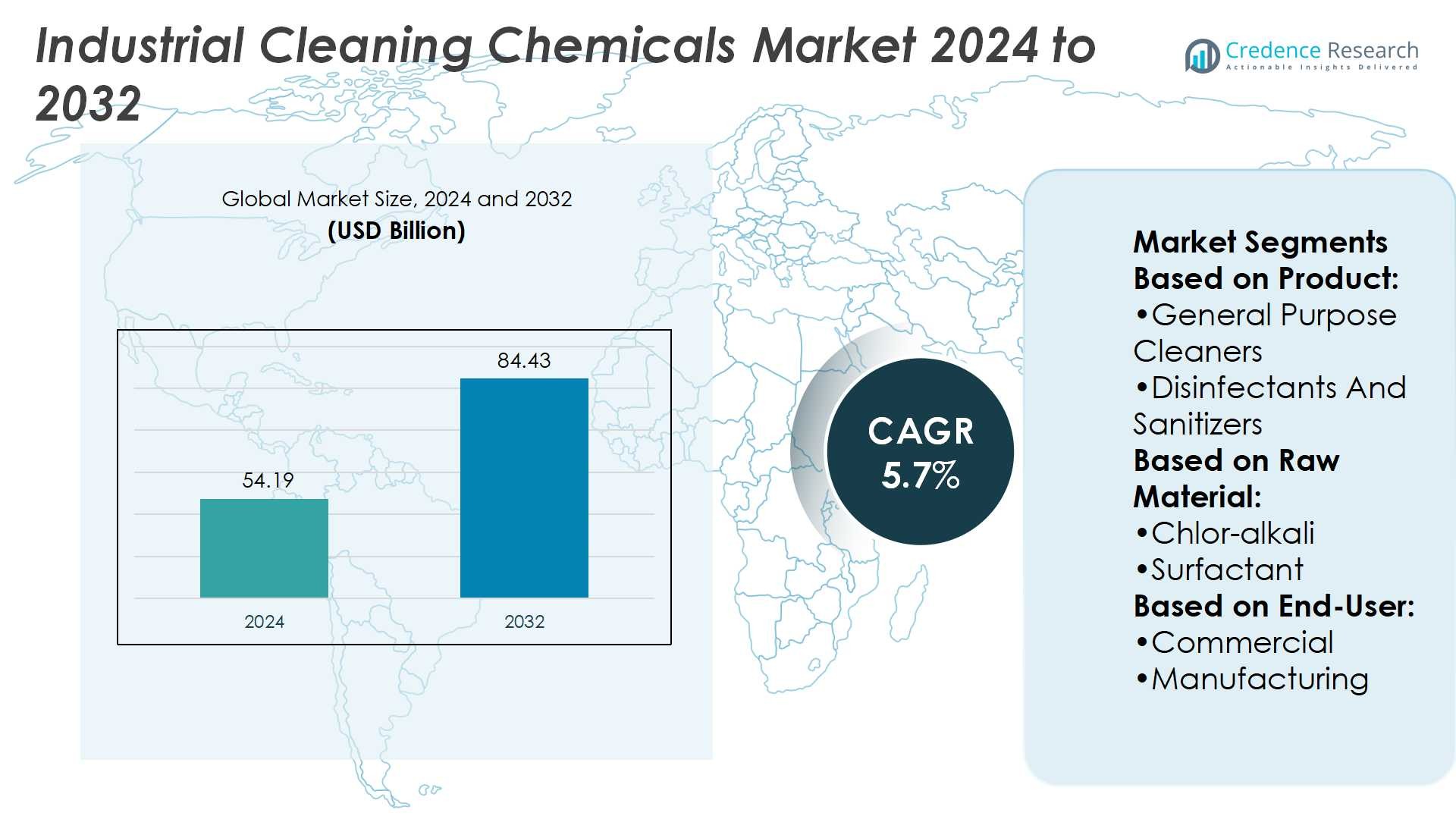
Industrial Cleaning Products Market size was valued at USD 58.49 billion in 2024 and is anticipated to reach USD 85.11 billion by 2032, at a CAGR of 4.8% during the forecast period.
| REPORT ATTRIBUTE | DETAILS |
|---|---|
| Historical Period | 2020-2023 |
| Base Year | 2024 |
| Forecast Period | 2025-2032 |
| Industrial Cleaning Products Market Size 2024 | USD 58.49 Billion |
| Industrial Cleaning Products Market, CAGR | 4.8% |
| Industrial Cleaning Products Market Size 2032 | USD 85.11 Billion |
The Industrial Cleaning Products Market grows through strong drivers such as rising hygiene standards across healthcare, foodservice, and manufacturing, along with stricter regulatory frameworks that enforce quality and safety compliance. Demand for eco-friendly and biodegradable products continues to shape innovation, while automation-compatible solutions reduce operational costs and improve efficiency. Key trends highlight growing adoption of multi-purpose and concentrated cleaning agents, which support flexibility and cost savings for end users. The market also benefits from digital monitoring systems and smart dispensing technologies, aligning industrial cleaning with sustainability goals and creating long-term opportunities for global and regional suppliers.
The Industrial Cleaning Products Market shows strong geographical presence, with North America and Europe leading due to strict hygiene regulations and advanced infrastructure, while Asia Pacific records the fastest growth driven by rapid industrialization and rising healthcare demand. Latin America and the Middle East & Africa present steady opportunities through expanding foodservice and hospitality sectors. Key players driving competition and innovation include BASF SE, Ecolab Inc., Dow Inc., DuPont de Nemours, Inc., Evonik Industries AG, Clariant AG, and Solvay SA.
Market Insights
- The Industrial Cleaning Products Market was valued at USD 58.49 billion in 2024 and is expected to reach USD 85.11 billion by 2032, growing at a CAGR of 4.8%.
- Rising hygiene standards in healthcare, foodservice, and manufacturing drive consistent demand for advanced cleaning solutions.
- Eco-friendly and biodegradable formulations shape product innovation, supported by stricter global regulatory compliance.
- Growing adoption of multi-purpose and concentrated agents reduces costs and improves efficiency across industries.
- Competition remains intense, with global leaders and regional players focusing on sustainable and automation-compatible solutions.
- Volatile raw material costs and regulatory complexity act as restraints, challenging pricing stability and product flexibility.
- North America and Europe lead in share due to advanced infrastructure, while Asia Pacific records the fastest growth, and Latin America and Middle East & Africa expand steadily with rising foodservice and hospitality demand.
Market Drivers
Rising Demand for Hygiene Standards Across Industries
The Industrial Cleaning Products Market is driven by strict hygiene protocols across food processing, healthcare, and manufacturing sectors. Companies adopt advanced cleaning solutions to maintain compliance with safety and quality standards. It supports prevention of contamination risks, ensuring consistent operational reliability. Growing health awareness among consumers further pressures industries to strengthen hygiene practices. Stringent inspections by regulatory agencies encourage businesses to prioritize certified cleaning formulations. This demand sustains product development tailored to critical environments where cleanliness defines performance.
- For instance, Pro Chem Inc. offers a portfolio of more than 500 cleaning and maintenance products, covering disinfectants, degreasers, and sanitizers designed for regulated industries.
Technological Innovations Enhancing Product Performance
Continuous innovation fuels adoption of sustainable and effective industrial cleaning products. The market benefits from eco-friendly chemicals, biodegradable formulations, and concentrated solutions that reduce resource use. It helps organizations balance cleaning effectiveness with environmental responsibility. Automated cleaning systems integrated with advanced products boost efficiency and cut labor costs. Development of multi-purpose solutions enables flexibility across various industrial applications. These advances reinforce adoption by aligning with modern sustainability goals and operational needs.
- For instance, Clariant GlucoPure™ sugar surfactants, Several Clariant press releases, including those from state that the TexCare™ Terra range has an RCI of 80%. The Terra designation specifically indicates that the product contains at least 50% renewable carbon content.
Growing Focus on Worker Safety and Productivity
Worker safety remains a key driver shaping the Industrial Cleaning Products Market. Industrial operations increasingly require solutions that minimize exposure to harsh chemicals. It ensures compliance with occupational safety regulations and reduces risks of health hazards. Products designed for safer handling improve employee confidence and workplace productivity. Ergonomic packaging and reduced toxic emissions further strengthen adoption. This focus on safety drives manufacturers to innovate user-friendly and protective formulations.
Expansion of Manufacturing and Industrial Infrastructure
Rapid industrial growth in emerging economies accelerates demand for cleaning solutions. The Industrial Cleaning Products Market gains momentum from expanding sectors like automotive, chemicals, and energy. It helps industries maintain operational efficiency and asset longevity under strict maintenance cycles. Urbanization and infrastructure projects increase usage across heavy-duty cleaning applications. Rising investments in modern facilities create consistent demand for industrial-grade solutions. This expansion cements the role of cleaning products in sustaining efficiency and regulatory compliance.
Market Trends
Increasing Shift Toward Eco-Friendly and Sustainable Formulations
The Industrial Cleaning Products Market is witnessing a strong move toward sustainable solutions. Companies are introducing biodegradable, non-toxic, and water-efficient cleaning agents. It aligns with global environmental regulations and corporate sustainability goals. Demand grows for products that reduce chemical discharge without compromising cleaning effectiveness. Green certifications strengthen buyer confidence and support corporate social responsibility initiatives. This trend continues to reshape product portfolios across global suppliers.
- For instance, BASF launched BVERDE GP 790 L, an anti-redeposition polymer containing 79 % biobased content, designed to match acrylic polymer performance in detergents and readily biodegrade-meeting the OECD 301F standard of at least 60 % degradation within 28 days.
Rising Adoption of Automation and Smart Cleaning Solutions
Automation significantly influences product use across industrial facilities. The Industrial Cleaning Products Market benefits from integration with robotics, dispensing systems, and automated floor cleaners. It improves efficiency, reduces manual labor, and ensures consistent results. Companies value solutions that lower operational costs while maintaining high standards. Smart technologies also enable monitoring of product usage and waste reduction. Growing interest in digital-enabled cleaning processes expands opportunities for innovation.
- For instance, Ecolab’s Precision Dispensing System for Membranes delivers chemical dosing accuracy within ±20 ml. It handles cleaning for up to five membrane systems per plant using separate modules for acid and alkaline chemistries.
Growing Preference for Multi-Purpose and Concentrated Products
Versatility remains a leading trend across industrial cleaning applications. The Industrial Cleaning Products Market is seeing higher adoption of concentrated solutions that save storage space and reduce transport costs. It enables industries to streamline procurement by using one product for multiple surfaces. Multi-purpose formulations provide flexibility in handling varied industrial needs. Businesses prioritize efficiency by reducing product inventories. This trend drives manufacturers to design solutions offering cost savings and performance balance.
Expansion of Customized Solutions for Industry-Specific Applications
Tailored cleaning products gain importance in specialized sectors. The Industrial Cleaning Products Market reflects growing demand for formulations meeting unique needs in healthcare, food, and heavy manufacturing. It ensures strict compliance with hygiene and safety standards in critical environments. Customized solutions also address challenges such as high-residue removal and corrosion prevention. Industry-specific packaging and delivery methods enhance usability and adoption. This trend highlights the rising value of customization in competitive markets.
Market Challenges Analysis
Regulatory Pressures and Environmental Compliance Constraints
The Industrial Cleaning Products Market faces persistent challenges from evolving regulatory frameworks. Authorities impose strict rules on chemical formulations, packaging, and waste disposal. It forces manufacturers to invest heavily in research to develop compliant yet effective solutions. Regulatory delays often slow product launches and raise operational costs. Companies must balance performance with environmental safety, which limits flexibility in product design. Frequent changes in regional laws add further complexity for global suppliers managing diverse markets.
Rising Raw Material Costs and Market Competition
Volatile raw material prices create uncertainty for manufacturers across industrial cleaning segments. The Industrial Cleaning Products Market struggles with fluctuations in chemical feedstocks and transportation costs. It affects profit margins and limits pricing stability in competitive environments. Intense competition from low-cost alternatives pressures established players to cut costs or differentiate through innovation. Counterfeit or substandard products also disrupt brand credibility and end-user trust. High competition and cost instability make long-term strategic planning difficult for industry leaders.
Market Opportunities
Expanding Demand in Emerging Economies and Infrastructure Growth
The Industrial Cleaning Products Market holds strong opportunities in rapidly industrializing regions. Expanding sectors such as automotive, food processing, and energy increase reliance on high-performance cleaning solutions. It benefits from rising investments in modern infrastructure and large-scale manufacturing facilities. Governments in emerging economies promote stricter hygiene and safety standards, driving consistent adoption. Growing urbanization further supports demand across heavy-duty and specialized cleaning needs. This creates long-term opportunities for suppliers to strengthen regional presence and scale production.
Innovation in Sustainable and Technology-Driven Solutions
Advances in product design create new growth avenues for manufacturers. The Industrial Cleaning Products Market increasingly favors eco-friendly formulations, smart dispensing systems, and automated cleaning technologies. It enables companies to meet sustainability goals while improving operational efficiency. Demand for multi-purpose products also supports innovation that reduces costs for end users. Integration with digital monitoring tools provides data-driven insights into product usage and resource optimization. These opportunities position forward-looking companies to capture market share through differentiation and innovation.
Market Segmentation Analysis:
By Product Type
The Industrial Cleaning Products Market demonstrates significant diversity across product categories. General-purpose cleaners dominate demand due to their wide usage across commercial and industrial environments. It provides flexibility for businesses aiming to reduce procurement complexity. Disinfectants and sanitizers maintain strong growth driven by heightened focus on hygiene standards in healthcare, foodservice, and hospitality sectors. Laundry care products hold importance in healthcare and hospitality facilities where fabric hygiene is critical. Metal cleaners cater to specialized needs in automotive, manufacturing, and heavy industries, supporting equipment maintenance and performance reliability. Each category plays a vital role in addressing sector-specific cleaning requirements.
- For instance, DuPont’s B-Free™ pretreatment technology reduces required downtime by up to 50%, lowers clean-in-place frequency by up to 75%, and doubles the lifetime of reverse osmosis (RO) membranes (200%), while saving up to 25,000 kg of CO₂, 10,000 kg of chemicals, and 4,000 m³ of wastewater for every 10,000 m³/day of water treatment capacity.
By Ingredient Type
Ingredient choices shape product performance and compliance with safety standards. The Industrial Cleaning Products Market relies heavily on surfactants for effective dirt and grease removal. It also uses solvents to ensure deep cleaning in industrial-grade applications, especially where oil or chemical residues are common. Chelating agents find demand in sectors requiring scale removal and water softening, enhancing product effectiveness. PH regulators ensure stability and safety of formulations across varied applications. The balance of these ingredients determines cleaning strength, environmental impact, and overall product adoption. This segmentation highlights the role of chemistry in driving innovation and differentiation.
- For instance, the Sharonville Technology Center added a 750-square-foot microbiology lab, backed by more than 4 million in R&D investments, increasing team capacity by 30%. These enhancements support the development of biocidal and ingredient technologies.
By Application
Applications define adoption patterns across industries. The Industrial Cleaning Products Market sees strong demand from manufacturing and commercial offices where consistent hygiene supports productivity and compliance. Healthcare facilities require advanced disinfectants and sanitizers to meet strict infection control standards. It positions cleaning products as essential tools for maintaining patient safety and regulatory adherence. Retail and foodservice environments depend on reliable solutions to prevent contamination and ensure consumer safety. The hospitality sector values multi-purpose and fabric-friendly solutions that support guest satisfaction and operational efficiency. Together, these applications represent a wide spectrum of growth opportunities across end-use sectors.
Segments:
Based on Product Type:
- General-purpose cleaners
- Disinfectants and sanitizers
Based on Ingredient Type:
- Surfactants
- Solvents
Based on Application:
- Manufacturing & Commercial Offices
- Health Care
Based on the Geography:
- North America
- U.S.
- Canada
- Mexico
- Europe
- Germany
- France
- U.K.
- Italy
- Spain
- Rest of Europe
- Asia Pacific
- China
- Japan
- India
- South Korea
- South-east Asia
- Rest of Asia Pacific
- Latin America
- Brazil
- Argentina
- Rest of Latin America
- Middle East & Africa
- GCC Countries
- South Africa
- Rest of the Middle East and Africa
Regional Analysis
North America
North America accounts for 33% of the Industrial Cleaning Products Market, making it one of the largest regions globally. Strong regulatory frameworks in the United States and Canada drive adoption of high-quality cleaning formulations. It benefits from consistent demand across healthcare, foodservice, and manufacturing industries, where hygiene compliance is strictly monitored. The U.S. dominates regional demand, supported by its advanced infrastructure and innovation in sustainable products. Canada shows strong growth in hospitality and healthcare, while Mexico records steady expansion in food processing and commercial offices. Companies continue to focus on eco-friendly and automation-compatible cleaning solutions, reinforcing North America’s leadership position in the market.
Europe
Europe holds 30% of the Industrial Cleaning Products Market, supported by stringent environmental and workplace safety regulations. The European Union enforces strict standards for biodegradability, emissions, and worker protection, encouraging the development of sustainable cleaning products. Germany, France, and the UK remain the primary contributors, driven by industrial activity and healthcare demand. It also benefits from high adoption of disinfectants and sanitizers across public institutions and hospitals. Growth is steady as suppliers innovate with enzyme-based and low-impact chemistry to align with EU directives. Europe’s commitment to green solutions ensures long-term demand for eco-certified industrial cleaning agents.
Asia Pacific
Asia Pacific leads with 35% of the global Industrial Cleaning Products Market, supported by rapid industrialization and urbanization. China dominates demand through its extensive manufacturing sector, while India and Southeast Asia contribute strong growth in healthcare, foodservice, and retail applications. It benefits from rising investment in modern infrastructure and expanding hygiene awareness among industries and consumers. Asia Pacific is also the fastest-growing region, with governments enforcing stricter hygiene and safety standards across industrial and institutional facilities. Regional suppliers focus on cost-effective and sustainable formulations to capture growing demand. Increasing adoption of concentrated and multi-purpose products reflects the need for affordability and operational efficiency across emerging economies.
Latin America
Latin America holds 5% of the Industrial Cleaning Products Market, with Brazil serving as the largest contributor. Rising industrial activity in Brazil and Mexico supports demand for heavy-duty cleaning solutions. Healthcare modernization across Argentina and Chile also drives the adoption of disinfectants and sanitizers. It benefits from growing awareness of workplace hygiene, particularly in foodservice and hospitality sectors. However, economic fluctuations limit rapid growth, making expansion moderate but steady. Local manufacturers focus on delivering affordable cleaning solutions tailored to regional requirements, ensuring stable progress in the coming years.
Middle East & Africa
The Middle East & Africa account for 2% of the Industrial Cleaning Products Market, making it the smallest regional contributor. GCC nations, particularly Saudi Arabia and the UAE, lead demand due to large-scale infrastructure projects and a booming hospitality industry. It also benefits from increasing healthcare investments, which require strict adherence to hygiene standards. Africa shows potential through growing industrialization and urban expansion in markets such as South Africa and Nigeria. Suppliers adapt strategies by offering localized products and distribution networks to capture emerging opportunities. Though market share remains limited, the region shows strong long-term prospects fueled by diversification and rising hygiene awareness.
Key Player Analysis
- Pro Chem Inc
- Clariant AG
- BASF SE
- Solvay SA
- Ecolab Inc.
- DuPont de Nemours, Inc.
- Pilot Chemical Corp.
- Diversey Holdings Ltd.
- Dow Inc.
- Evonik Industries AG
Competitive Analysis
The Industrial Cleaning Products Market players include BASF SE, Clariant AG, Diversey Holdings Ltd., Dow Inc., DuPont de Nemours, Inc., Ecolab Inc., Evonik Industries AG, Pilot Chemical Corp., Pro Chem Inc., and Solvay SA. The Industrial Cleaning Products Market shows intense competition, shaped by continuous innovation and strict regulatory requirements. Companies focus on developing eco-friendly, biodegradable, and high-performance cleaning solutions to address global sustainability goals. It also emphasizes automation-ready and multi-purpose products that reduce operational costs for end users. Competitive strategies include investment in research, expansion into emerging markets, and partnerships that strengthen distribution networks. Rising demand in healthcare, foodservice, and manufacturing drives firms to adapt quickly to evolving hygiene standards. The market’s competitive dynamics highlight the importance of product differentiation, regulatory compliance, and customer-focused solutions for long-term growth.
Recent Developments
- In August 2024, Ecolab Inc. advanced its product sustainability mission by installing its Ultrasil membrane technology at customer facilities. The aim is to help food and beverage clients maintain hygiene standards while lowering environmental impact.
- In June 2024, Solenis announced the acquisition of Aqua ChemPacs LLC to expand its specialty chemical portfolio for institutional cleaning and disinfection. The aim is to integrate pre-portioned, dissolvable cleaning pods that allow customers to produce cleaners and disinfectants on-site.
- In September 2023, At Climate Week NYC, the University of Oxford, in collaboration with Unilever, published a new report outlining the policy measures that need to be taken to tackle the carbon footprint of day-to-day cleaning, laundry and home care products.
- In February 2023, Ecolab introduced a new consumer retail line, Ecolab Scientific Clean, which provides cleaning products for commercial, industrial, and household use, exclusively available online and in stores at The Home Depot. The new Ecolab Scientific Clean product line in four categories – degreasers, pressure washer concentrates, floor care, and bathroom cleaners – is now available at The Home Depot.
Report Coverage
The research report offers an in-depth analysis based on Product Type, Ingredient Type, Application and Geography. It details leading market players, providing an overview of their business,product offerings, investments, revenue streams, and key applications. Additionally, the reportincludes insights into the competitive environment, SWOT analysis, current market trends, as well as the primary drivers and constraints. Furthermore, it discusses various factors that have driven market expansion in recent years. The report also explores market dynamics, regulatory scenarios, and technological advancements that are shaping the industry. It assesses the impact of external factors and global economic changes on market growth. Lastly, it provides strategic recommendations for new entrants and established companies to navigate the complexities of the market.
Future Outlook
- The Industrial Cleaning Products Market will expand with growing demand for hygiene across industries.
- Sustainable and biodegradable cleaning solutions will gain stronger adoption worldwide.
- Automation-compatible products will see higher usage in industrial and commercial facilities.
- Multi-purpose and concentrated cleaning agents will reduce costs and drive efficiency.
- Healthcare and foodservice sectors will remain primary demand drivers for advanced formulations.
- Digital monitoring and smart dispensing systems will enhance product utilization.
- Emerging economies will provide growth opportunities through industrialization and urban expansion.
- Regulatory pressure will continue to shape product innovation and compliance strategies.
- Customized solutions for sector-specific needs will strengthen market competitiveness.
- Strategic collaborations and R&D investments will define future leadership in the market.

Request a Free Sample
Fill in your details and we'll send you a free sample report.
- Sample data tables & charts
- Research methodology
Market Dynamics
Rising Demand for Hygiene Standards Across Industries
Strict hygiene protocols in sectors like healthcare, food processing, and manufacturing are driving the adoption of advanced cleaning solutions to ensure compliance with safety and quality standards, prevent contamination, and maintain operational reliability.
Technological Innovations Enhancing Product Performance
Continuous innovation in eco-friendly chemicals, biodegradable formulations, and automation-compatible solutions is enabling organizations to balance cleaning effectiveness with environmental responsibility and operational efficiency.
Growing Focus on Worker Safety and Productivity
Industrial operations are increasingly prioritizing cleaning products that minimize exposure to harsh chemicals, ensuring compliance with occupational safety regulations and improving workplace productivity through safer handling and ergonomic packaging.
Expansion of Manufacturing and Industrial Infrastructure
Rapid industrial growth and urbanization, especially in emerging economies, are increasing the need for industrial cleaning products to maintain equipment, support operational efficiency, and comply with stricter maintenance and hygiene standards.
Increasing Shift Toward Eco-Friendly and Sustainable Formulations
Global environmental regulations and corporate sustainability goals are accelerating the demand for biodegradable, non-toxic, and water-efficient cleaning agents, prompting suppliers to innovate and expand their green product portfolios.
Need a Custom Version of This Report?
Tailor the scope, geography, or segments to your exact requirements.
- Custom geography or segment scope
- Direct access to our analyst team
Frequently Asked Questions
What is the current market size for Industrial Cleaning Products Market, and what is its projected size in 2032?
At what Compound Annual Growth Rate is the Industrial Cleaning Products Market projected to grow between 2025 and 2032?
Which Industrial Cleaning Products Market segment held the largest share in 2024?
What are the primary factors fueling the growth of the Industrial Cleaning Products Market?
Who are the leading companies in the Industrial Cleaning Products Market?
Which region commanded the largest share of the Industrial Cleaning Products Market in 2024?
Table of Content
Chapter 1 Market Segmentation
- 1.1 Segmentation Framework
- 1.1.1 Product and Service Classification
- 1.1.2 Application and End-Use Classification
- 1.1.3 Technology and Solution Classification
- 1.1.4 Customer and Distribution Channel Classification
- 1.1.5 Geographic Segmentation
- 1.1.6 Market Segment Definitions and Boundaries
- 1.2 By Application
- 1.2.1 Manufacturing & Commercial Offices
- 1.2.2 Healthcare Facilities
- 1.2.3 Retail & Foodservice
- 1.2.4 Hospitality
- 1.2.5 Industrial Processing
- 1.3 By Product Type
- 1.3.1 General-purpose cleaners
- 1.3.2 Disinfectants and sanitizers
- 1.3.3 Laundry care products
- 1.3.4 Metal cleaners
- 1.3.5 Specialty cleaning agents
- 1.4 By Ingredient Type
- 1.4.1 Surfactants
- 1.4.2 Solvents
- 1.4.3 Chelating agents
- 1.4.4 pH regulators
- 1.4.5 Enzymes
Chapter 2 Introduction
- 2.1 Report Objectives and Scope
- 2.2 Product Definition and Industry Terminology
- 2.3 Market Inclusions and Exclusions
- 2.4 Research Process
- 2.4.1 Primary Research and Expert Interviews
- 2.4.2 Secondary Research and Source Review
- 2.4.3 Top-Down and Bottom-Up Estimation
- 2.4.4 Data Triangulation and Verification
- 2.5 Market Size Measurement Basis
- 2.5.1 2024: USD 58.49 billion → 2032: USD 85.11 billion
- 2.6 Historical and Forecast Reference Periods
- 2.6.1 Base Year: 2024
- 2.6.2 Forecast Period: 2024-2032
- 2.7 Research Assumptions and Limitations
Chapter 3 Executive Summary
- 3.1 Market Snapshot and Key Findings
- 3.2 Base-Year Market Size, 2024
- 3.3 Forecast Market Size, 2032
- 3.4 Revenue and Volume Growth Outlook
- 3.5 Key Demand and Supply Indicators
- 3.6 Leading Market Segments
- 3.7 Fastest-Growing Market Opportunities
- 3.8 Regional Performance Highlights
- 3.9 Technology and Industry Transformation
- 3.10 Competitive Landscape Summary
- 3.11 Analyst View and Strategic Implications
Chapter 4 Global Industrial Cleaning Chemicals Market Trends and Developments
- 4.1 Historical Industry Development
- 4.2 Recent Market Trends and Developments
- 4.3 Demand and Customer Behavior Trends
- 4.4 Technology and Product Innovation
- 4.5 Artificial Intelligence, Automation and Digitalization
- 4.6 Local Manufacturing and Supply Chain Realignment
- 4.7 Industry Partnerships, Mergers and Acquisitions
- 4.8 Sustainability and Circular Economy Developments
- 4.9 Government and Private Sector Investment Trends
- 4.10 Emerging Business Models and Commercialization
- 4.11 Industry Developments and Announcements
Chapter 5 Global Industrial Cleaning Chemicals Market Production, Supply and Demand Analysis
- 5.1 Demand Trend and Consumption Analysis
- 5.2 Demand Forecast, 2024-2032
- 5.3 Production and Output Trend
- 5.4 Production and Output Forecast, 2024-2032
- 5.5 Installed Capacity and Capacity Utilization
- 5.6 Company-Wise Production Plants and Statistics
- 5.6.1 Installed Production Capacity
- 5.6.2 Actual Production
- 5.6.3 Planned Capacity and Expansion Targets
- 5.7 Supply Chain Structure and Procurement Trends
- 5.8 Supply-Demand Gap and Bottlenecks
- 5.9 Import Dependence and Sourcing Structure
- 5.10 Contract Manufacturing and Outsourcing
- 5.11 Regional Supply and Demand Concentration
Chapter 6 Global Industrial Cleaning Chemicals Market Pricing Analysis
- 6.1 Pricing Structure and Measurement
- 6.2 Historical Pricing Trends
- 6.3 Pricing Outlook, 2024-2032
- 6.4 Average Selling Price and Unit Economics
- 6.5 Pricing by Product and Market Segment
- 6.6 Geographic Pricing Differences
- 6.7 Key Input, Energy, Labor and Logistics Costs
- 6.8 Contract Pricing and Purchasing Models
- 6.9 Pricing Sensitivity and Competitive Positioning
- 6.10 Price, Margin and Profitability Implications
Chapter 7 Global Industrial Cleaning Chemicals Market Dynamics
- 7.1 Market Growth Drivers
- 7.1.1 Demand-Side Drivers
- 7.1.2 Technology and Innovation Drivers
- 7.1.3 Infrastructure and Investment Drivers
- 7.1.4 Regulatory and Policy Drivers
- 7.2 Market Restraints
- 7.2.1 Cost and Affordability Constraints
- 7.2.2 Technology and Adoption Barriers
- 7.2.3 Supply Chain and Operational Constraints
- 7.3 Market Challenges
- 7.3.1 Competitive Pressure and Margin Erosion
- 7.3.2 Skills, Infrastructure and Implementation Gaps
- 7.4 Emerging Market Opportunities
- 7.5 Market Dynamics Impact and Time-Horizon Assessment
Chapter 8 Global Industrial Cleaning Chemicals Value Chain Analysis
- 8.1 Industry Value Chain Overview
- 8.2 Upstream Suppliers and Critical Inputs
- 8.3 Technology and Component Providers
- 8.4 Manufacturing or Service Delivery
- 8.5 Distribution, Channel Partners and Integrators
- 8.6 Downstream Applications and End Users
- 8.7 Value Addition and Profit Pools
- 8.8 Vertical Integration and Outsourcing
- 8.9 Supplier Concentration and Risk
- 8.10 Supply Chain Localization and Resilience
Chapter 9 Global Industrial Cleaning Chemicals Market Regulations and Policies
- 9.1 Relevant Laws, Standards and Compliance Frameworks
- 9.2 Product, Service, Safety and Quality Requirements
- 9.3 Government Policies, Incentives and Subsidies
- 9.4 Imports, Exports and Trade Barriers
- 9.5 Public Procurement and Local Content Requirements
- 9.6 Environmental and Sustainability Compliance
- 9.7 Upcoming Policy Changes and Market Implications
Chapter 10 Global Industrial Cleaning Chemicals Market Hotspots and Opportunities
- 10.1 Market Opportunity Mapping and Growth Hotspots
- 10.2 High-Growth Applications and Customer Groups
- 10.3 Underserved Markets and White-Space Opportunities
- 10.4 Emerging Technology and Product Opportunities
- 10.5 New Capacity and Investment Hotspots
- 10.6 Market Entry and Expansion Opportunities
- 10.7 Distribution and Partnership Opportunities
- 10.8 Near-Term and Long-Term Commercial Potential
- 10.9 Opportunity Attractiveness and Execution Risks
Chapter 11 Global Industrial Cleaning Chemicals Market Outlook, 2024-2032
- 11.1 Market Size and Analysis
- 11.1.1 Revenue (Market Measurement: 2024: USD 58.49 billion → 2032: USD 85.11 billion)
- 11.1.2 Market Volume and Quantity Sold
- 11.1.3 Historical Market Size
- 11.1.4 Base-Year Market Size, 2024
- 11.2 Market Forecast, 2024-2032
- 11.2.1 Revenue Forecast to 2032
- 11.2.2 Volume Forecast to 2032
- 11.2.3 CAGR and Year-on-Year Growth
- 11.2.4 Incremental Revenue Opportunity
- 11.3 Forecast Assumptions and Scenario Analysis
- 11.3.1 Base-Case Forecast
- 11.3.2 Optimistic and Conservative Scenarios
- 11.3.3 Technology, Pricing and Policy Sensitivities
- 11.4 Market Attractiveness and Growth Outlook
Chapter 12 Global Industrial Cleaning Chemicals Market Segmentation and Outlook
- 12.1 Segmentation Summary and Market Shares, 2024
- 12.2 Largest and Fastest-Growing Segments
- 12.3 By Application - Market Size and Forecast, 2024-2032
- 12.3.1 Segment Definition and Scope
- 12.3.2 Historical Market Size
- 12.3.3 Revenue Forecast, 2024-2032
- 12.3.4 Volume Forecast, 2024-2032
- 12.3.5 Base-Year Market Share, 2024
- 12.3.6 Segment CAGR and Growth Drivers
- 12.3.7 Subsegment Market Size and Forecast
- 12.3.7.1 Manufacturing & Commercial Offices
- 12.3.7.2 Healthcare Facilities
- 12.3.7.3 Retail & Foodservice
- 12.3.7.4 Hospitality
- 12.3.7.5 Industrial Processing
- 12.3.8 Subsegment Pricing and Adoption Trends
- 12.3.9 Leading Suppliers and Competition
- 12.3.10 Regional Demand and Opportunities
- 12.4 By Product Type - Market Size and Forecast, 2024-2032
- 12.4.1 Segment Definition and Scope
- 12.4.2 Historical Market Size
- 12.4.3 Revenue Forecast, 2024-2032
- 12.4.4 Volume Forecast, 2024-2032
- 12.4.5 Base-Year Market Share, 2024
- 12.4.6 Segment CAGR and Growth Drivers
- 12.4.7 Subsegment Market Size and Forecast
- 12.4.7.1 General-purpose cleaners
- 12.4.7.2 Disinfectants and sanitizers
- 12.4.7.3 Laundry care products
- 12.4.7.4 Metal cleaners
- 12.4.7.5 Specialty cleaning agents
- 12.4.8 Subsegment Pricing and Adoption Trends
- 12.4.9 Leading Suppliers and Competition
- 12.4.10 Regional Demand and Opportunities
- 12.5 By Ingredient Type - Market Size and Forecast, 2024-2032
- 12.5.1 Segment Definition and Scope
- 12.5.2 Historical Market Size
- 12.5.3 Revenue Forecast, 2024-2032
- 12.5.4 Volume Forecast, 2024-2032
- 12.5.5 Base-Year Market Share, 2024
- 12.5.6 Segment CAGR and Growth Drivers
- 12.5.7 Subsegment Market Size and Forecast
- 12.5.7.1 Surfactants
- 12.5.7.2 Solvents
- 12.5.7.3 Chelating agents
- 12.5.7.4 pH regulators
- 12.5.7.5 Enzymes
- 12.5.8 Subsegment Pricing and Adoption Trends
- 12.5.9 Leading Suppliers and Competition
- 12.5.10 Regional Demand and Opportunities
- 12.6 Segment Growth Comparison
- 12.7 Segment Attractiveness and Priority Matrix
Chapter 13 Global Industrial Cleaning Chemicals End-Use and Application Market Outlook
- 13.1 End-Use Industry and Customer Demand Structure
- 13.2 Leading Applications and Customer Groups
- 13.3 End-Use Market Size, Share and Forecast
- 13.4 Major End-Use Industry Deep Dives
- 13.4.1 Customer Requirements and Use Cases
- 13.4.2 Demand and Replacement Cycles
- 13.4.3 Technical and Regulatory Considerations
- 13.4.4 Purchasing and Procurement Models
- 13.4.5 Leading Vendors and Distribution Channels
- 13.4.6 Forecast and Commercial Opportunities
- 13.5 Emerging Applications and Cross-Segment Demand
- 13.6 End-Use Industry Investment Priorities
Chapter 14 Global Industrial Cleaning Chemicals Geographic Market Outlook, 2024-2032
- 14.1 Regional Market Size and Share, 2024
- 14.2 Regional Market Forecast, 2024-2032
- 14.3 Regional Pricing, Production and Demand Differences
- 14.4 North America
- 14.4.1 United States
- 14.4.2 Canada
- 14.4.3 Mexico
- 14.5 Europe
- 14.5.1 Germany
- 14.5.2 France
- 14.5.3 Italy
- 14.5.4 United Kingdom
- 14.5.5 Spain
- 14.5.6 Poland
- 14.5.7 Russia
- 14.5.8 Netherlands
- 14.5.9 Belgium
- 14.5.10 Sweden
- 14.5.11 Denmark
- 14.5.12 Norway
- 14.5.13 Rest of Europe
- 14.6 Asia Pacific
- 14.6.1 China
- 14.6.2 India
- 14.6.3 Japan
- 14.6.4 South Korea
- 14.6.5 Thailand
- 14.6.6 Indonesia
- 14.6.7 Vietnam
- 14.6.8 Malaysia
- 14.6.9 Australia
- 14.6.10 Rest of Asia Pacific
- 14.7 Latin America
- 14.7.1 Brazil
- 14.7.2 Argentina
- 14.7.3 Colombia
- 14.7.4 Chile
- 14.7.5 Rest of Latin America
- 14.8 Middle East
- 14.8.1 Saudi Arabia
- 14.8.2 United Arab Emirates
- 14.8.3 Turkey
- 14.8.4 Israel
- 14.8.5 Iran
- 14.8.6 Rest of the Middle East
- 14.9 Africa
- 14.9.1 South Africa
- 14.9.2 Egypt
- 14.9.3 Nigeria
- 14.9.4 Morocco
- 14.9.5 Rest of Africa
- 14.10 Regional Investment, Policy and Supply Chain Differences
- 14.11 Regional Competitive Landscape
- 14.12 Geographic Growth Hotspots
Chapter 15 Global Industrial Cleaning Chemicals Technology, Innovation and Sustainability Outlook
- 15.1 Technology Landscape and Maturity
- 15.2 Product, Process and Service Innovation
- 15.3 AI, Automation and Digital Tools in the Industry
- 15.4 Technology Adoption and Performance Benchmarking
- 15.5 Innovation Pipeline and R&D Investment
- 15.6 Patent and Intellectual Property Trends
- 15.7 Energy Efficiency and Resource Management
- 15.8 Sustainability, Recycling and Circularity
- 15.9 Technology Roadmap, 2024-2032
- 15.10 Risks of Obsolescence and Technology Substitution
Chapter 16 Global Industrial Cleaning Chemicals Market Key Strategic Imperatives
- 16.1 Growth and Market Entry Priorities
- 16.2 High-Return Products and Segments
- 16.3 Pricing, Profitability and Cost Optimization
- 16.4 Technology Investment and Product Differentiation
- 16.5 Supply Chain Localization and Resilience
- 16.6 Distribution and Customer Acquisition
- 16.7 Partnership, Acquisition and Capacity Strategy
- 16.8 Regional Expansion Priorities
- 16.9 Short-, Medium- and Long-Term Actions
Chapter 17 Competition Outlook
- 17.1 Industry Competition Characteristics
- 17.2 Market Structure and Concentration
- 17.3 Market Share and Competitive Positioning, 2024
- 17.4 Company-Wise Revenue and Product Benchmarking
- 17.5 Production and Service Capacity Benchmarking
- 17.6 Technology, Pricing and Differentiation
- 17.7 Regional Footprint and Distribution Strength
- 17.8 Mergers, Acquisitions and Strategic Alliances
- 17.9 New Entrants and Competitive Threats
- 17.10 Porter's Five Forces and Industry Attractiveness
- 17.11 Competitive Outlook, 2024-2032
Chapter 18 Company Profiles
- 18.1 Company Coverage and Selection Criteria
- 18.2 BASF SE
- 18.2.1 Business Description
- 18.2.2 Company Ownership and Geographic Presence
- 18.2.3 Product and Service Portfolio
- 18.2.4 Manufacturing and Operating Footprint
- 18.2.5 Production Capacity and Expansion Plans
- 18.2.6 Financial Performance and Investment
- 18.2.7 Market Share and Competitive Position
- 18.2.8 Technology and Innovation Capabilities
- 18.2.9 Strategic Alliances or Partnerships
- 18.2.10 Recent Developments
- 18.2.11 Growth Strategy and Outlook
- 18.3 Ecolab Inc.
- 18.4 Dow Inc.
- 18.5 DuPont de Nemours, Inc.
- 18.6 Evonik Industries AG
- 18.7 Clariant AG
- 18.8 Solvay SA
- 18.9 Pro Chem Inc.
- 18.10 Diversey Holdings Ltd.
- 18.11 Pilot Chemical Corp.
- 18.12 Other Relevant Market Participants
Note: Every listed company is profiled on the structure shown under the first company. The company list is preliminary and may change based on research findings, market developments, data availability and client requirements.
Chapter 19 Disclaimer
- 19.1 Research and Forecast Disclaimer
- 19.2 Data Source and Estimation Limitations
Note: The depth of individual sections depends on data availability for this market. Volume, capacity, trade and other unit-based metrics are included where applicable.

