
Market Overview:
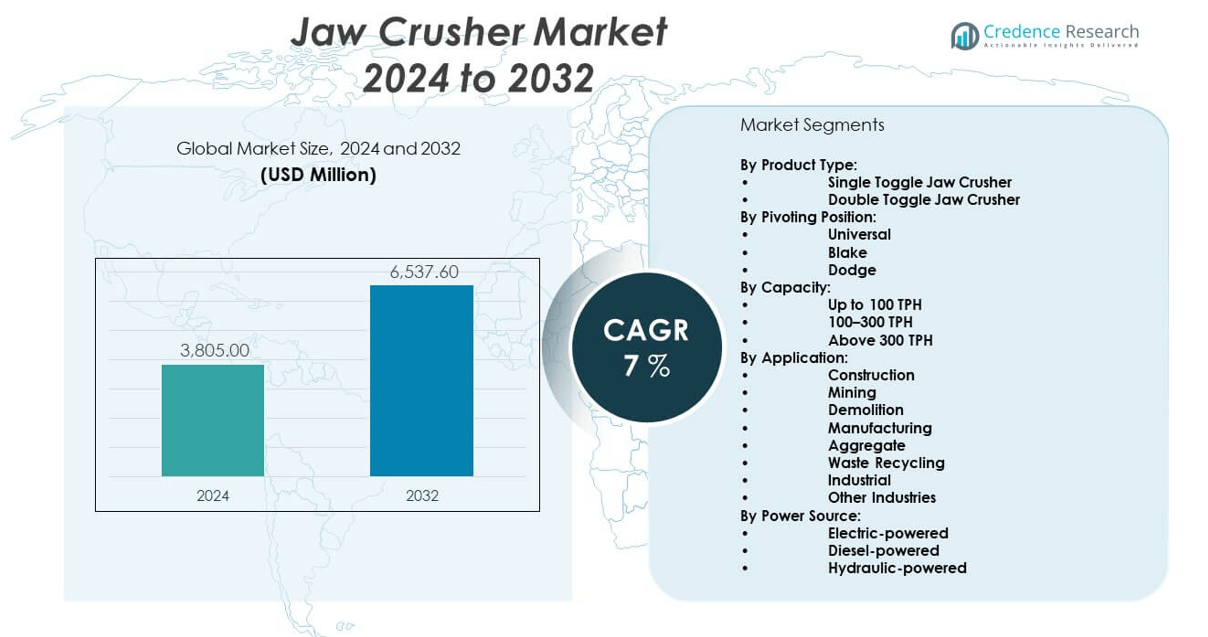
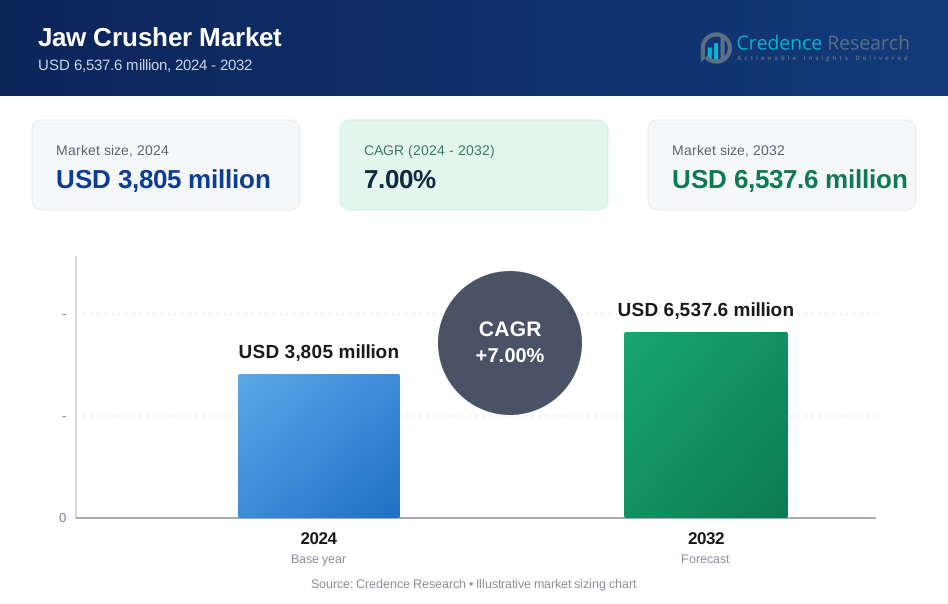
The Jaw crusher market is projected to grow from USD 3,805 million in 2024 to an estimated USD 6,537.6 million by 2032, with a compound annual growth rate (CAGR) of 7% from 2024 to 2032.
| REPORT ATTRIBUTE | DETAILS |
|---|---|
| Historical Period | 2020-2023 |
| Base Year | 2024 |
| Forecast Period | 2025-2032 |
| Jaw Crusher Market Size 2024 | USD 3,805 million |
| Jaw Crusher Market, CAGR | 7% |
| Jaw Crusher Market Size 2032 | USD 6,537.6 million |
The jaw crusher market is expanding due to the rising demand for efficient and durable crushing equipment across mining, construction, and demolition industries. Increasing infrastructure development projects, particularly in emerging economies, drive the need for raw material processing. Manufacturers are innovating to offer high-capacity, energy-efficient, and low-maintenance crushers that meet stringent environmental regulations. Urbanization, industrialization, and the need for cost-effective aggregate production continue to propel market adoption globally.
Asia-Pacific dominates the jaw crusher market, led by countries like China and India, where rapid urban expansion and infrastructure investments create high demand. North America and Europe follow with consistent growth, backed by modernization of construction practices and steady mining operations. Latin America and Africa are emerging regions, driven by mining exploration, economic development, and government-supported infrastructure projects. These geographies benefit from abundant mineral reserves and increasing construction activities, positioning them as key growth areas for jaw crusher adoption.
Market Insights:
- The Jaw crusher market was valued at USD 3,805 million in 2024 and is projected to reach USD 6,537.6 million by 2032, growing at a CAGR of 7% during the forecast period.
- Rising infrastructure development, mining expansion, and demolition activities are major drivers boosting demand for jaw crushers globally.
- Growing preference for mobile and energy-efficient crushers supports product innovation and wider adoption across construction and quarrying sectors.
- High capital investment and maintenance costs remain key restraints, especially for small and medium-sized enterprises.
- Supply chain disruptions and a shortage of skilled labor affect timely equipment availability and servicing in several regions.
- Asia-Pacific dominates the market with a 3% share, led by China, India, and Southeast Asia due to strong infrastructure and mining growth.
- North America and Europe follow, driven by modernization of industrial equipment and rising emphasis on environmentally compliant crushing systems.
Market Drivers:
Infrastructure Growth and Industrial Expansion Amplify Equipment Demand:
The Jaw crusher market benefits from rising global investments in large-scale infrastructure and industrial development. Governments prioritize construction of highways, railways, and airports, which accelerates demand for aggregates. Mining and quarrying sectors require robust crushing equipment to process materials for cement and concrete. The increase in urban population leads to more construction activity, further driving equipment needs. Manufacturers respond with durable and high-output jaw crushers to meet industrial performance standards. It supports efficient material handling across construction and mining applications. Energy efficiency and automation in machines enhance their appeal in cost-sensitive sectors. The Jaw crusher market gains momentum as project volumes continue to grow.
- For instance, Metso Corporation’s Nordberg® C Series jaw crushers, widely used in the construction and mining sectors, offer feed openings up to 1200 mm and throughput capacities of up to 7,500 metric tons per hour (MTPH) in their MKIII 54-75 models, powered by an 800-hp motor. These crushers incorporate automation systems like VisioRock® for real-time feed-size monitoring, achieving up to 30% more capacity with significantly lower energy consumption while maintaining robustness for industrial demands
Growing Mineral Exploration and Mining Activities Drive Equipment Adoption:
The rise in global mineral exploration projects fuels demand for reliable rock-crushing systems. The Jaw crusher market leverages this growth by providing machinery suited for hard rock and ore crushing. Governments in developing regions grant more licenses to tap into untapped mineral reserves. Mining companies prefer jaw crushers for primary crushing due to their high crushing ratios and low operational costs. It ensures consistency in output, which is vital for downstream processing. The shift to deeper and more complex mining sites intensifies the need for advanced crushing solutions. Safety requirements and operational efficiency further increase equipment specifications. This environment sustains long-term demand for heavy-duty jaw crushers.
- For instance, Sandvik AB's acquisition of the Schenck Process Group mining segment supports the integration of enhanced crushing solutions with engineered components that improve throughput and wear resistance essential for mineral processing, though specific numerical metrics for crushers were not disclosed recently, the firm is known for delivering crushers with capacities surpassing 1000 tons per hour aimed at complex ore bodies.
Rapid Urbanization and Commercial Construction Drive Product Utilization:
Urban development projects contribute significantly to the expansion of the Jaw crusher market. Cities continue to expand outward and upward, requiring demolition and reconstruction of aging infrastructure. This creates steady demand for equipment that supports efficient material recycling. Jaw crushers enable onsite crushing of concrete and stone debris, reducing transportation and disposal costs. It promotes sustainability and helps meet modern construction norms. Real estate and commercial sectors invest in high-rise buildings and shopping complexes, which increases aggregate requirements. Contractors prioritize portable and mobile jaw crushers for flexible deployment. The growing construction volume worldwide keeps jaw crushers relevant in project planning.
Regulatory Compliance and Environmental Considerations Influence Market Expansion:
The Jaw crusher market aligns with evolving regulatory frameworks targeting environmental protection. Governments impose strict emissions and noise control regulations on construction equipment. Manufacturers develop crushers that operate within permissible noise and dust levels. It integrates advanced filtration systems and energy-efficient motors to meet environmental standards. The shift toward sustainable development encourages adoption of low-emission and recyclable equipment. Construction firms seek compliance-ready machinery to avoid legal penalties and improve public image. The push for greener operations creates demand for smart, low-impact crushing systems. These regulatory forces shape product innovation and market penetration strategies across regions.
Market Trends:
Adoption of Mobile and Portable Jaw Crushers for Onsite Efficiency:
A notable trend in the Jaw crusher market is the shift toward mobile and portable crushing units. Contractors and construction firms prioritize mobility to reduce setup times and minimize transport costs. Compact jaw crushers offer ease of movement between job sites without sacrificing crushing power. It enhances productivity by allowing onsite processing of demolition waste and raw aggregates. The rising use of mobile crushers in remote and rugged terrains highlights their operational flexibility. Rental models for portable crushers are also gaining traction among SMEs. Manufacturers expand their product lines with trailer-mounted and skid-mounted variants. The mobility trend caters to dynamic project needs in evolving construction environments.
- For instance, Metso’s Lokotrack® LT120™ mobile jaw crusher offers a flexible solution designed for primary crushing with feed openings optimized for aggregate production, capable of handling large feed sizes and integrating easily into multi-stage processes, designed for quick setup and breakdown enabling two working days assembly on average, thus enhancing onsite operational efficiency
Integration of Automation and Digital Monitoring for Operational Control:
Automation plays a growing role in the evolution of the Jaw crusher market. Smart systems now enable remote monitoring of machine health, performance metrics, and maintenance schedules. It reduces downtime and improves safety by alerting operators to faults in real-time. Integration of digital control panels, IoT sensors, and AI-based diagnostics improves equipment efficiency. Data-driven decision-making helps operators optimize throughput and reduce wear and tear. Manufacturers invest in R&D to offer crushers with intelligent feedback systems. These solutions are especially valuable in large-scale mining and industrial operations. The push for automation strengthens as industries modernize their equipment ecosystems.
- For instance, Metso’s Remote IC app, launched in 2024, offers connected remote monitoring and control of Lokotrack crushers and screens, providing operators with real-time data on machine status, predictive maintenance alerts, and performance optimization tools from mobile devices, reducing unplanned downtime and optimizing operational continuity.
Use of Wear-Resistant Materials and Component Enhancements:
Another trend influencing the Jaw crusher market is the incorporation of advanced materials in component design. High manganese steel, abrasion-resistant alloys, and composite materials extend machine life. It reduces the frequency of replacements, lowering operational costs for end users. The focus is on longer-lasting jaw plates, side liners, and bearings to improve crushing durability. Enhancements in hydraulic systems and lubrication also contribute to performance. OEMs differentiate their offerings with material-grade customization based on application needs. These innovations improve reliability in harsh environments, including mining and demolition. Wear-resistant materials support the demand for rugged, low-maintenance crushing systems.
Strategic Collaborations and Aftermarket Service Expansion:
Strategic partnerships and extended service networks are shaping the Jaw crusher market landscape. Manufacturers collaborate with distributors to expand reach and enhance support capabilities. It improves customer satisfaction through localized service, parts availability, and training programs. Aftermarket services, including equipment refurbishment and predictive maintenance, generate recurring revenue. Global brands enter joint ventures to co-develop region-specific solutions and improve brand presence. Companies invest in digital platforms to streamline support, diagnostics, and spare part ordering. These strategies build long-term relationships and increase machine lifecycle value. The trend strengthens as customers demand not just equipment, but full-service reliability.
Market Challenges Analysis:
High Capital Investment and Maintenance Costs Limit Market Penetration:
The Jaw crusher market faces challenges related to the high initial cost of equipment and ongoing maintenance expenses. Small and medium-sized enterprises often lack the financial flexibility to invest in high-performance machines. It becomes harder to justify capital outlays in cost-sensitive or short-duration projects. Operational costs, including wear part replacement, energy consumption, and service downtime, impact profitability. Equipment failure due to improper use or lack of skilled labor further increases expenses. Financing options and leasing models are limited in some regions, restricting access to advanced crushers. Buyers may settle for less efficient alternatives due to budget constraints. This cost barrier hinders rapid market penetration among smaller players and new entrants.
Supply Chain Disruptions and Skilled Labor Shortages Hinder Operations:
Global supply chain disruptions present another challenge for the Jaw crusher market. Component shortages, transportation delays, and raw material price volatility affect production timelines. It results in extended lead times and cost overruns, impacting both manufacturers and end users. In parallel, the industry experiences a shortage of skilled technicians and operators. Training requirements for new, digitally enabled crushers are higher than traditional models. The lack of qualified service personnel delays maintenance and reduces equipment uptime. Regional disparities in workforce development and logistics infrastructure compound the issue. These factors introduce uncertainty in delivery, deployment, and support of jaw crushers in growing markets.
Market Opportunities:
Expansion in Emerging Economies and Infrastructure Development Initiatives:
The Jaw crusher market finds strong growth potential in emerging economies where urbanization and infrastructure spending remain high. Governments launch large-scale transportation and housing projects that require extensive aggregate production. It creates opportunities for localized manufacturing, rental fleets, and customized product lines. Strategic expansion into countries with rich mineral reserves also unlocks mining sector demand. Regional players can capitalize by offering cost-effective and energy-efficient equipment tailored to local needs. These markets present untapped potential for manufacturers seeking growth beyond saturated regions.
Recycling and Sustainable Construction Practices Create New Use Cases:
Recycling in construction and demolition generates fresh demand in the Jaw crusher market. Onsite crushing of old concrete and building materials reduces landfill use and transportation emissions. It supports sustainability goals and aligns with green building standards. Municipalities and contractors increasingly adopt jaw crushers to process recyclable debris. Product designs that emphasize noise reduction, dust suppression, and fuel efficiency appeal to eco-conscious buyers. This segment creates long-term opportunity for crushers that deliver both performance and environmental compliance.
Market Segmentation Analysis:
By Product Type
The Jaw crusher market is segmented into single toggle and double toggle crushers. Single toggle crushers dominate due to their simple design, lower maintenance, and widespread use in primary crushing operations. Double toggle crushers offer enhanced force and durability, making them suitable for heavy-duty applications in mining and quarrying.
- For example, single toggle models like Metso’s C Series crushers emphasize ease of maintenance with features such as hydraulic shell separation and top-size-in designs allowing feed sizes up to 41 inches, optimized for energy efficiency and throughput, while double toggle designs typically handle tougher crushing conditions requiring more robust components.
By Pivoting Position
This segment includes Blake, Dodge, and Universal types. Blake crushers lead the segment, favored for their high capacity and consistent output in large-scale operations. Universal crushers offer versatility in feed and discharge, while Dodge crushers, though less common, are used in specific controlled-size output applications.
By Capacity
Crushers with 100–300 TPH capacity hold the largest market share, meeting the requirements of mid-sized infrastructure and mining projects. Above 300 TPH units are used in high-volume aggregate and mineral processing. Equipment under 100 TPH is primarily used in small-scale operations and laboratory settings.
By Application/End-User Industry
The Jaw crusher market sees highest demand from mining and construction sectors due to ongoing infrastructure and extraction activities. Aggregate, demolition, and waste recycling industries follow closely. Emerging applications include manufacturing and processing industries such as chemicals, food, and pharmaceuticals.
By Power Source
Electric-powered crushers dominate, driven by operational efficiency and reduced emissions in fixed installations. Diesel-powered crushers are preferred for field mobility and off-grid use. Hydraulic-powered variants serve high-precision or high-pressure crushing needs in specific industrial environments.
Segmentation:
By Product Type:
- Single Toggle Jaw Crusher
- Double Toggle Jaw Crusher
By Pivoting Position:
- Universal
- Blake
- Dodge
By Capacity:
- Up to 100 TPH
- 100–300 TPH
- Above 300 TPH
By Application:
- Construction
- Mining
- Demolition
- Manufacturing
- Aggregate
- Waste Recycling
- Industrial
- Other Industries
By Power Source:
- Electric-powered
- Diesel-powered
- Hydraulic-powered
By Region:
- North America
- U.S.
- Canada
- Mexico
- Europe
- Germany
- France
- U.K.
- Italy
- Spain
- Rest of Europe
- Asia Pacific
- China
- Japan
- India
- South Korea
- South-east Asia
- Rest of Asia Pacific
- Latin America
- Brazil
- Argentina
- Rest of Latin America
- Middle East & Africa
- GCC Countries
- South Africa
- Rest of the Middle East and Africa
Regional Analysis:
Asia-Pacific: Leading with Infrastructure and Mining Demand (42.3%)
Asia-Pacific holds the largest share in the jaw crusher market, accounting for approximately 42.3% of global revenue. The region's dominance is driven by rapid urbanization, extensive infrastructure projects, and the presence of major mining operations in China, India, and Australia. Government investments in roads, railways, housing, and energy sectors fuel consistent demand for crushing equipment. China leads in both production and consumption, supported by its large-scale construction and mineral processing activities. India follows with growing quarrying and cement industries, while Southeast Asian countries expand their construction and mining footprints. It benefits from cost-effective manufacturing and a strong distribution base across key countries.
North America: Mature Market with Steady Industrial Demand (24.7%)
North America contributes around 24.7% to the global jaw crusher market, driven by robust construction, aggregate production, and industrial recycling sectors. The United States dominates the regional market with stable demand from road construction, commercial infrastructure, and mining. Equipment replacement cycles and technological upgrades support continued investment in advanced, energy-efficient crushers. Canada contributes through mineral exploration and infrastructure development in remote regions. The presence of established manufacturers and rental equipment providers strengthens market penetration. It reflects a mature but active market, focused on high-capacity, compliant, and automated crushing systems.
Europe and LAMEA: Diversified Growth with Industrial and Mining Expansion (Europe: 18.5%, LAMEA: 14.5%)
Europe holds a 18.5% share of the jaw crusher market, supported by ongoing renovation projects, waste recycling regulations, and investments in sustainable construction. Germany, the UK, and France lead demand through advanced infrastructure and manufacturing sectors. LAMEA (Latin America, Middle East, and Africa) accounts for 14.5%, driven by expanding mining exploration, especially in Brazil, Chile, South Africa, and parts of the Middle East. Increasing urbanization and infrastructure development in these regions create favorable conditions for crusher deployment. It benefits from rising foreign direct investments, raw material demand, and untapped resource potential, although supply chain limitations and political risk remain challenges.
Key Player Analysis:
- Metso Corporation
- Sandvik AB
- Thyssenkrupp AG
- Komatsu Ltd.
- Astec Industries, Inc.
- Terex Corporation
- Weir Group
- Wirtgen Group
- FLSmidth A/S
- McLanahan Corporation
Competitive Analysis:
The Jaw crusher market is highly competitive, with key players focusing on product innovation, global expansion, and strategic collaborations. Major companies such as Metso Corporation, Sandvik AB, Thyssenkrupp AG, and Komatsu Ltd. dominate due to their strong technical expertise and extensive distribution networks. These firms emphasize advanced automation, fuel efficiency, and modular designs to meet industry-specific demands. Mid-sized players target niche applications and regional markets with cost-effective solutions. The market sees a blend of established global manufacturers and emerging local players, creating pricing pressure and constant innovation. It drives competition through continuous R&D and aftersales service differentiation.
Recent Developments:
- In July 2025, Metso Corporation reinforced its position in the jaw crusher market by continuing to offer its flagship Nordberg® C Series primary jaw crushers, including the C106, C117, and C120 models. These crushers are designed with core principles of sustainability and environmental compliance, catering to the strong demand in construction, infrastructure, and mining sectors, particularly in India. Metso's facility in Alwar, Rajasthan, manufactures these models to ensure local support and faster deliveries, meeting diverse operational needs with energy-efficient, dust and noise reduction technologies integrated into the equipment.
Market Concentration & Characteristics:
The Jaw crusher market is moderately concentrated, with a few global manufacturers holding significant share due to brand recognition, product range, and distribution scale. It features both capital-intensive multinational companies and agile regional players. High entry barriers exist due to technological complexity, regulatory compliance, and investment in production facilities. The market prioritizes durability, energy efficiency, and customization. Product differentiation often centers around automation, mobility, and environmental performance. It remains driven by project-based procurement, long product lifecycles, and strong aftermarket service requirements.
Report Coverage:
The research report offers an in-depth analysis based on Product Type, Pivoting Position, Capacity, Application/End-User Industry, Power Source, and Region. It details leading market players, providing an overview of their business, product offerings, investments, revenue streams, and key applications. Additionally, the report includes insights into the competitive environment, SWOT analysis, current market trends, as well as the primary drivers and constraints. Furthermore, it discusses various factors that have driven market expansion in recent years. The report also explores market dynamics, regulatory scenarios, and technological advancements that are shaping the industry. It assesses the impact of external factors and global economic changes on market growth. Lastly, it provides strategic recommendations for new entrants and established companies to navigate the complexities of the market.
Future Outlook:
- Growth will be driven by infrastructure development in emerging markets.
- Mining expansion will sustain long-term demand for heavy-duty jaw crushers.
- Mobile and portable variants will gain popularity in field-based applications.
- Automation and remote monitoring will become standard features in new models.
- Product innovations will focus on energy efficiency and environmental compliance.
- Asia-Pacific will continue to dominate global demand due to construction activity.
- Waste recycling and demolition sectors will generate new market opportunities.
- Equipment leasing and rental will rise among small and mid-sized contractors.
- Digital aftermarket services will differentiate key players and boost revenue.
- Regulatory frameworks will shape product design and localization strategies.
Request a Free Sample
Fill in your details and we'll send you a free sample report.
- Sample data tables & charts
- Research methodology
Market Dynamics
Infrastructure Growth and Industrial Expansion
Large-scale investments in highways, railways, airports, and urban development projects are increasing the demand for aggregates and raw materials, directly boosting the need for jaw crushers in construction and mining sectors.
Rising Mineral Exploration and Mining Activities
The expansion of mining operations, especially in emerging economies, is driving the adoption of jaw crushers for primary crushing of ores and minerals, as these machines offer high throughput and operational efficiency.
Urbanization and Commercial Construction
Rapid urbanization and the construction of commercial buildings and infrastructure require efficient onsite material processing, making mobile and portable jaw crushers increasingly popular for demolition and recycling applications.
Regulatory Compliance and Environmental Considerations
Stricter environmental regulations regarding emissions, noise, and dust are pushing manufacturers to innovate with energy-efficient, low-emission jaw crushers, which in turn drives market growth as customers seek compliant equipment.
Adoption of Automation and Digital Monitoring
The integration of automation, IoT, and remote monitoring technologies in jaw crushers enhances operational control, reduces downtime, and improves safety, making advanced crushers more attractive to large-scale industrial and mining operators.
Need a Custom Version of This Report?
Tailor the scope, geography, or segments to your exact requirements.
- Custom geography or segment scope
- Direct access to our analyst team
Frequently Asked Questions
What is the current market size for Jaw crusher market, and what is its projected size in 2032?
Which Jaw crusher market segment held the largest share in 2024?
Who are the leading companies in the Jaw crusher market?
Which region commanded the largest share of the Jaw crusher market in 2024?
Table of Content
Chapter 1 Market Segmentation
- 1.1 Segmentation Framework
- 1.1.1 Product and Service Classification
- 1.1.2 Application and End-Use Classification
- 1.1.3 Technology and Solution Classification
- 1.1.4 Customer and Distribution Channel Classification
- 1.1.5 Geographic Segmentation
- 1.1.6 Market Segment Definitions and Boundaries
- 1.2 By Capacity
- 1.2.1 Up to 100 TPH
- 1.2.2 100–300 TPH
- 1.2.3 Above 300 TPH
- 1.3 By Application
- 1.3.1 Construction
- 1.3.2 Mining
- 1.3.3 Demolition
- 1.3.4 Aggregate
- 1.3.5 Waste Recycling
- 1.3.6 Industrial
- 1.4 By Power Source
- 1.4.1 Electric-powered
- 1.4.2 Diesel-powered
- 1.4.3 Hydraulic-powered
- 1.5 By Product Type
- 1.5.1 Single Toggle Jaw Crusher
- 1.5.2 Double Toggle Jaw Crusher
Chapter 2 Introduction
- 2.1 Report Objectives and Scope
- 2.2 Product Definition and Industry Terminology
- 2.3 Market Inclusions and Exclusions
- 2.4 Research Process
- 2.4.1 Primary Research and Expert Interviews
- 2.4.2 Secondary Research and Source Review
- 2.4.3 Top-Down and Bottom-Up Estimation
- 2.4.4 Data Triangulation and Verification
- 2.5 Market Size Measurement Basis
- 2.5.1 2024: USD 3,805 million → 2032: USD 6,537.6 million
- 2.6 Historical and Forecast Reference Periods
- 2.6.1 Base Year: 2024
- 2.6.2 Forecast Period: 2024-2032
- 2.7 Research Assumptions and Limitations
Chapter 3 Executive Summary
- 3.1 Market Snapshot and Key Findings
- 3.2 Base-Year Market Size, 2024
- 3.3 Forecast Market Size, 2032
- 3.4 Revenue and Volume Growth Outlook
- 3.5 Key Demand and Supply Indicators
- 3.6 Leading Market Segments
- 3.7 Fastest-Growing Market Opportunities
- 3.8 Regional Performance Highlights
- 3.9 Technology and Industry Transformation
- 3.10 Competitive Landscape Summary
- 3.11 Analyst View and Strategic Implications
Chapter 4 Global Jaw Crusher Market Trends and Developments
- 4.1 Historical Industry Development
- 4.2 Recent Market Trends and Developments
- 4.3 Demand and Customer Behavior Trends
- 4.4 Technology and Product Innovation
- 4.5 Artificial Intelligence, Automation and Digitalization
- 4.6 Local Manufacturing and Supply Chain Realignment
- 4.7 Industry Partnerships, Mergers and Acquisitions
- 4.8 Sustainability and Circular Economy Developments
- 4.9 Government and Private Sector Investment Trends
- 4.10 Emerging Business Models and Commercialization
- 4.11 Industry Developments and Announcements
Chapter 5 Global Jaw Crusher Market Production, Supply and Demand Analysis
- 5.1 Demand Trend and Consumption Analysis
- 5.2 Demand Forecast, 2024-2032
- 5.3 Production and Output Trend
- 5.4 Production and Output Forecast, 2024-2032
- 5.5 Installed Capacity and Capacity Utilization
- 5.6 Company-Wise Production Plants and Statistics
- 5.6.1 Installed Production Capacity
- 5.6.2 Actual Production
- 5.6.3 Planned Capacity and Expansion Targets
- 5.7 Supply Chain Structure and Procurement Trends
- 5.8 Supply-Demand Gap and Bottlenecks
- 5.9 Import Dependence and Sourcing Structure
- 5.10 Contract Manufacturing and Outsourcing
- 5.11 Regional Supply and Demand Concentration
Chapter 6 Global Jaw Crusher Market Pricing Analysis
- 6.1 Pricing Structure and Measurement
- 6.2 Historical Pricing Trends
- 6.3 Pricing Outlook, 2024-2032
- 6.4 Average Selling Price and Unit Economics
- 6.5 Pricing by Product and Market Segment
- 6.6 Geographic Pricing Differences
- 6.7 Key Input, Energy, Labor and Logistics Costs
- 6.8 Contract Pricing and Purchasing Models
- 6.9 Pricing Sensitivity and Competitive Positioning
- 6.10 Price, Margin and Profitability Implications
Chapter 7 Global Jaw Crusher Market Dynamics
- 7.1 Market Growth Drivers
- 7.1.1 Demand-Side Drivers
- 7.1.2 Technology and Innovation Drivers
- 7.1.3 Infrastructure and Investment Drivers
- 7.1.4 Regulatory and Policy Drivers
- 7.2 Market Restraints
- 7.2.1 Cost and Affordability Constraints
- 7.2.2 Technology and Adoption Barriers
- 7.2.3 Supply Chain and Operational Constraints
- 7.3 Market Challenges
- 7.3.1 Competitive Pressure and Margin Erosion
- 7.3.2 Skills, Infrastructure and Implementation Gaps
- 7.4 Emerging Market Opportunities
- 7.5 Market Dynamics Impact and Time-Horizon Assessment
Chapter 8 Global Jaw Crusher Value Chain Analysis
- 8.1 Industry Value Chain Overview
- 8.2 Upstream Suppliers and Critical Inputs
- 8.3 Technology and Component Providers
- 8.4 Manufacturing or Service Delivery
- 8.5 Distribution, Channel Partners and Integrators
- 8.6 Downstream Applications and End Users
- 8.7 Value Addition and Profit Pools
- 8.8 Vertical Integration and Outsourcing
- 8.9 Supplier Concentration and Risk
- 8.10 Supply Chain Localization and Resilience
Chapter 9 Global Jaw Crusher Market Regulations and Policies
- 9.1 Relevant Laws, Standards and Compliance Frameworks
- 9.2 Product, Service, Safety and Quality Requirements
- 9.3 Government Policies, Incentives and Subsidies
- 9.4 Imports, Exports and Trade Barriers
- 9.5 Public Procurement and Local Content Requirements
- 9.6 Environmental and Sustainability Compliance
- 9.7 Upcoming Policy Changes and Market Implications
Chapter 10 Global Jaw Crusher Market Hotspots and Opportunities
- 10.1 Market Opportunity Mapping and Growth Hotspots
- 10.2 High-Growth Applications and Customer Groups
- 10.3 Underserved Markets and White-Space Opportunities
- 10.4 Emerging Technology and Product Opportunities
- 10.5 New Capacity and Investment Hotspots
- 10.6 Market Entry and Expansion Opportunities
- 10.7 Distribution and Partnership Opportunities
- 10.8 Near-Term and Long-Term Commercial Potential
- 10.9 Opportunity Attractiveness and Execution Risks
Chapter 11 Global Jaw Crusher Market Outlook, 2024-2032
- 11.1 Market Size and Analysis
- 11.1.1 Revenue (Market Measurement: 2024: USD 3,805 million → 2032: USD 6,537.6 million)
- 11.1.2 Market Volume and Quantity Sold
- 11.1.3 Historical Market Size
- 11.1.4 Base-Year Market Size, 2024
- 11.2 Market Forecast, 2024-2032
- 11.2.1 Revenue Forecast to 2032
- 11.2.2 Volume Forecast to 2032
- 11.2.3 CAGR and Year-on-Year Growth
- 11.2.4 Incremental Revenue Opportunity
- 11.3 Forecast Assumptions and Scenario Analysis
- 11.3.1 Base-Case Forecast
- 11.3.2 Optimistic and Conservative Scenarios
- 11.3.3 Technology, Pricing and Policy Sensitivities
- 11.4 Market Attractiveness and Growth Outlook
Chapter 12 Global Jaw Crusher Market Segmentation and Outlook
- 12.1 Segmentation Summary and Market Shares, 2024
- 12.2 Largest and Fastest-Growing Segments
- 12.3 By Capacity - Market Size and Forecast, 2024-2032
- 12.3.1 Segment Definition and Scope
- 12.3.2 Historical Market Size
- 12.3.3 Revenue Forecast, 2024-2032
- 12.3.4 Volume Forecast, 2024-2032
- 12.3.5 Base-Year Market Share, 2024
- 12.3.6 Segment CAGR and Growth Drivers
- 12.3.7 Subsegment Market Size and Forecast
- 12.3.7.1 Up to 100 TPH
- 12.3.7.2 100–300 TPH
- 12.3.7.3 Above 300 TPH
- 12.3.8 Subsegment Pricing and Adoption Trends
- 12.3.9 Leading Suppliers and Competition
- 12.3.10 Regional Demand and Opportunities
- 12.4 By Application - Market Size and Forecast, 2024-2032
- 12.4.1 Segment Definition and Scope
- 12.4.2 Historical Market Size
- 12.4.3 Revenue Forecast, 2024-2032
- 12.4.4 Volume Forecast, 2024-2032
- 12.4.5 Base-Year Market Share, 2024
- 12.4.6 Segment CAGR and Growth Drivers
- 12.4.7 Subsegment Market Size and Forecast
- 12.4.7.1 Construction
- 12.4.7.2 Mining
- 12.4.7.3 Demolition
- 12.4.7.4 Aggregate
- 12.4.7.5 Waste Recycling
- 12.4.7.6 Industrial
- 12.4.8 Subsegment Pricing and Adoption Trends
- 12.4.9 Leading Suppliers and Competition
- 12.4.10 Regional Demand and Opportunities
- 12.5 By Power Source - Market Size and Forecast, 2024-2032
- 12.5.1 Segment Definition and Scope
- 12.5.2 Historical Market Size
- 12.5.3 Revenue Forecast, 2024-2032
- 12.5.4 Volume Forecast, 2024-2032
- 12.5.5 Base-Year Market Share, 2024
- 12.5.6 Segment CAGR and Growth Drivers
- 12.5.7 Subsegment Market Size and Forecast
- 12.5.7.1 Electric-powered
- 12.5.7.2 Diesel-powered
- 12.5.7.3 Hydraulic-powered
- 12.5.8 Subsegment Pricing and Adoption Trends
- 12.5.9 Leading Suppliers and Competition
- 12.5.10 Regional Demand and Opportunities
- 12.6 By Product Type - Market Size and Forecast, 2024-2032
- 12.6.1 Segment Definition and Scope
- 12.6.2 Historical Market Size
- 12.6.3 Revenue Forecast, 2024-2032
- 12.6.4 Volume Forecast, 2024-2032
- 12.6.5 Base-Year Market Share, 2024
- 12.6.6 Segment CAGR and Growth Drivers
- 12.6.7 Subsegment Market Size and Forecast
- 12.6.7.1 Single Toggle Jaw Crusher
- 12.6.7.2 Double Toggle Jaw Crusher
- 12.6.8 Subsegment Pricing and Adoption Trends
- 12.6.9 Leading Suppliers and Competition
- 12.6.10 Regional Demand and Opportunities
- 12.7 Segment Growth Comparison
- 12.8 Segment Attractiveness and Priority Matrix
Chapter 13 Global Jaw Crusher End-Use and Application Market Outlook
- 13.1 End-Use Industry and Customer Demand Structure
- 13.2 Leading Applications and Customer Groups
- 13.3 End-Use Market Size, Share and Forecast
- 13.4 Major End-Use Industry Deep Dives
- 13.4.1 Customer Requirements and Use Cases
- 13.4.2 Demand and Replacement Cycles
- 13.4.3 Technical and Regulatory Considerations
- 13.4.4 Purchasing and Procurement Models
- 13.4.5 Leading Vendors and Distribution Channels
- 13.4.6 Forecast and Commercial Opportunities
- 13.5 Emerging Applications and Cross-Segment Demand
- 13.6 End-Use Industry Investment Priorities
Chapter 14 Global Jaw Crusher Geographic Market Outlook, 2024-2032
- 14.1 Regional Market Size and Share, 2024
- 14.2 Regional Market Forecast, 2024-2032
- 14.3 Regional Pricing, Production and Demand Differences
- 14.4 North America
- 14.4.1 United States
- 14.4.2 Canada
- 14.4.3 Mexico
- 14.5 Europe
- 14.5.1 Germany
- 14.5.2 France
- 14.5.3 Italy
- 14.5.4 United Kingdom
- 14.5.5 Spain
- 14.5.6 Poland
- 14.5.7 Russia
- 14.5.8 Netherlands
- 14.5.9 Belgium
- 14.5.10 Sweden
- 14.5.11 Denmark
- 14.5.12 Norway
- 14.5.13 Rest of Europe
- 14.6 Asia Pacific
- 14.6.1 China
- 14.6.2 India
- 14.6.3 Japan
- 14.6.4 South Korea
- 14.6.5 Thailand
- 14.6.6 Indonesia
- 14.6.7 Vietnam
- 14.6.8 Malaysia
- 14.6.9 Australia
- 14.6.10 Rest of Asia Pacific
- 14.7 Latin America
- 14.7.1 Brazil
- 14.7.2 Argentina
- 14.7.3 Colombia
- 14.7.4 Chile
- 14.7.5 Rest of Latin America
- 14.8 Middle East
- 14.8.1 Saudi Arabia
- 14.8.2 United Arab Emirates
- 14.8.3 Turkey
- 14.8.4 Israel
- 14.8.5 Iran
- 14.8.6 Rest of the Middle East
- 14.9 Africa
- 14.9.1 South Africa
- 14.9.2 Egypt
- 14.9.3 Nigeria
- 14.9.4 Morocco
- 14.9.5 Rest of Africa
- 14.10 Regional Investment, Policy and Supply Chain Differences
- 14.11 Regional Competitive Landscape
- 14.12 Geographic Growth Hotspots
Chapter 15 Global Jaw Crusher Technology, Innovation and Sustainability Outlook
- 15.1 Technology Landscape and Maturity
- 15.2 Product, Process and Service Innovation
- 15.3 AI, Automation and Digital Tools in the Industry
- 15.4 Technology Adoption and Performance Benchmarking
- 15.5 Innovation Pipeline and R&D Investment
- 15.6 Patent and Intellectual Property Trends
- 15.7 Energy Efficiency and Resource Management
- 15.8 Sustainability, Recycling and Circularity
- 15.9 Technology Roadmap, 2024-2032
- 15.10 Risks of Obsolescence and Technology Substitution
Chapter 16 Global Jaw Crusher Market Key Strategic Imperatives
- 16.1 Growth and Market Entry Priorities
- 16.2 High-Return Products and Segments
- 16.3 Pricing, Profitability and Cost Optimization
- 16.4 Technology Investment and Product Differentiation
- 16.5 Supply Chain Localization and Resilience
- 16.6 Distribution and Customer Acquisition
- 16.7 Partnership, Acquisition and Capacity Strategy
- 16.8 Regional Expansion Priorities
- 16.9 Short-, Medium- and Long-Term Actions
Chapter 17 Competition Outlook
- 17.1 Industry Competition Characteristics
- 17.2 Market Structure and Concentration
- 17.3 Market Share and Competitive Positioning, 2024
- 17.4 Company-Wise Revenue and Product Benchmarking
- 17.5 Production and Service Capacity Benchmarking
- 17.6 Technology, Pricing and Differentiation
- 17.7 Regional Footprint and Distribution Strength
- 17.8 Mergers, Acquisitions and Strategic Alliances
- 17.9 New Entrants and Competitive Threats
- 17.10 Porter's Five Forces and Industry Attractiveness
- 17.11 Competitive Outlook, 2024-2032
Chapter 18 Company Profiles
- 18.1 Company Coverage and Selection Criteria
- 18.2 Metso Corporation
- 18.2.1 Business Description
- 18.2.2 Company Ownership and Geographic Presence
- 18.2.3 Product and Service Portfolio
- 18.2.4 Manufacturing and Operating Footprint
- 18.2.5 Production Capacity and Expansion Plans
- 18.2.6 Financial Performance and Investment
- 18.2.7 Market Share and Competitive Position
- 18.2.8 Technology and Innovation Capabilities
- 18.2.9 Strategic Alliances or Partnerships
- 18.2.10 Recent Developments
- 18.2.11 Growth Strategy and Outlook
- 18.3 Sandvik AB
- 18.4 Thyssenkrupp AG
- 18.5 Komatsu Ltd.
- 18.6 Astec Industries, Inc.
- 18.7 Terex Corporation
- 18.8 Weir Group
- 18.9 Wirtgen Group
- 18.10 FLSmidth A/S
- 18.11 McLanahan Corporation
- 18.12 Other Relevant Market Participants
Note: Every listed company is profiled on the structure shown under the first company. The company list is preliminary and may change based on research findings, market developments, data availability and client requirements.
Chapter 19 Disclaimer
- 19.1 Research and Forecast Disclaimer
- 19.2 Data Source and Estimation Limitations
Note: The depth of individual sections depends on data availability for this market. Volume, capacity, trade and other unit-based metrics are included where applicable.

