
| REPORT ATTRIBUTE | DETAILS |
|---|---|
| Historical Period | 2019-2022 |
| Base Year | 2023 |
| Forecast Period | 2024-2032 |
| Mobile Crushers Market Size 2023 | USD 2,789.41 Million |
| Mobile Crushers Market, CAGR | 4.85%. |
| Mobile Crushers Market Size 2032 | USD 4,271.97 Million |
Market Overview
The Global Mobile Crushers Market is projected to witness significant growth, with its value expected to surge from USD 2,789.41 million in 2023 to USD 4,271.97 million by 2032, reflecting a compound annual growth rate of 4.85%.
The Global Mobile Crushers Market is being propelled by several market drivers and trends. Rapid urbanization and industrialization are fostering the demand for construction materials, driving the need for mobile crushers in various construction projects worldwide. Additionally, technological advancements, such as the integration of IoT and AI, are enhancing the efficiency and productivity of mobile crushers, further fueling market growth. Moreover, the increasing focus on environmental sustainability is prompting manufacturers to develop eco-friendly mobile crushers, aligning with stringent regulations and preferences for sustainable practices among consumers. These factors collectively contribute to the dynamic expansion of the Global Mobile Crushers Market.
Geographical analysis reveals a robust presence of the Global Mobile Crushers Market across key regions such as North America, Europe, Asia Pacific, Latin America, and the Middle East and Africa. North America leads the market owing to extensive infrastructure development projects and technological advancements in the region. Europe follows closely with significant investments in construction activities and the adoption of mobile crushers for efficient material processing. In Asia Pacific, rapid urbanization and industrialization are driving market growth. Key players dominating the Global Mobile Crushers Market include Terex Corporation, Sandvik AB, Metso Corporation, Kleemann GmbH, and Komatsu Ltd., among others, leveraging innovation and strategic partnerships to maintain their competitive edge.
Market Drivers
Driving Growth in Construction Industry
The construction industry serves as a pivotal driver for the mobile crushers market, especially in burgeoning economies such as China and India. With a surge in construction activities, the demand for construction aggregates like crushed stone, gravel, and sand escalates. Mobile crushers play a crucial role in meeting this demand. They offer a 20-30% reduction in transportation costs and can increase the efficiency of construction projects by up to 25%. With their ability to move to the construction site and crush materials on the spot, they eliminate the need for material transport, thus reducing both costs and carbon emissions. This makes them an increasingly popular choice in the construction industry, particularly in fast-developing regions.
Facilitating Rising Urbanization
Global urbanization trends fuel the necessity for crushed aggregates in various urban infrastructure projects like roads, bridges, and buildings. In urban infrastructure projects, mobile crushers are particularly valuable due to their adaptability to confined spaces and their role in recycling construction and demolition waste. For example, advanced mobile crushers can achieve production outputs of 150-350t/h, and their capability to efficiently control particle size and shape ensures superior-quality particles. This efficiency is crucial in urban settings where space is limited and the need for sustainable development practices is high. Moreover, the adoption of green building standards like LEED and BREEAM supports the use of sustainable and locally sourced construction materials, further propelling the construction aggregates market growth. Mobile crushers facilitate this by allowing on-site processing of materials, which not only reduces transportation costs but also minimizes the environmental impact of construction projects.
Compliance with Environmental Regulations and Recycling Imperatives
Stringent environmental regulations advocate for the utilization of recycled construction and demolition waste in new projects. For instance, stringent environmental regulations, such as those implemented by the UAE Ministry of Climate Change and Environment, allow contractors to meet up to 40% of their material requirements from recycled aggregates. This policy supports a smooth transition to a circular economy and enhances waste management efficiency while reducing landfill pressure. Mobile crushers significantly contribute to this initiative by processing recycled materials into usable aggregates. They are known for their efficiency in recycling construction waste, with some models boasting production outputs of 150-350t/h. Moreover, the use of recycled aggregates can lead to a reduction in carbon emissions by 27-37% when compared to using virgin materials. These crushers align perfectly with sustainable construction practices, meeting regulatory requirements for environmental conservation while also providing a cost-effective solution for the construction industry. By turning construction and demolition waste into valuable resources, mobile crushers play a pivotal role in promoting environmental sustainability in construction projects.
Versatile Applications and Technological Advancements
Beyond construction, mobile crushers find utility in diverse sectors including mining operations, quarrying, road maintenance projects, and disaster relief efforts. Additionally, the advent of technological innovations such as electric and hybrid-powered mobile crushers addresses environmental concerns regarding emissions, meeting the burgeoning demand for sustainable solutions in the construction industry.
Market Trends
Integration of Advanced Technologies
The mobile crushers market is experiencing a significant transformation with the integration of advanced technologies. Automation and digitalization are revolutionizing operations, with features like remote monitoring, which is now used by over 60% of businesses, real-time performance data analysis, and predictive maintenance, which can reduce downtime by up to 20%, becoming increasingly prevalent. These technological advancements significantly enhance operational efficiency, with some companies reporting a 30% increase in productivity. They also minimize downtime, which can cost companies an average of $260,000 per hour, and improve overall productivity in crushing operations, with a potential 10% reduction in costs. The adoption of these smart technologies is not just a trend but a competitive necessity in today’s fast-paced construction and mining industries.
Rise of Telematics and Machine-to-Machine (M2M) Communication
Mobile crushers are becoming increasingly connected through telematics systems, enabling a suite of advanced functionalities. For instance, the integration of telematics systems can lead to a 10% reduction in fuel consumption, while real-time tracking and fuel usage monitoring are now standard features in many models. Remote diagnostics, facilitated by these systems, can reduce equipment downtime by 25%, ensuring continuous operation and productivity.
Machine-to-Machine (M2M) communication further enhances this connectivity. For example, M2M communication can improve operational efficiency by 15% through seamless coordination between machines. This allows crushers to communicate with other equipment on-site, potentially optimizing project logistics and material handling. The impact of M2M communication on construction equipment efficiency is significant, with some reports indicating a 20% increase in overall project efficiency and a 30% reduction in associated labor costs. These advancements not only improve efficiency but also contribute to cost-effectiveness in the long run.
Market Challenges Analysis
Navigating High Initial Investment
The acquisition of mobile crushers, particularly high-capacity models equipped with advanced features, entails substantial upfront costs. This poses a significant challenge for small and medium-sized construction companies, which may find the initial investment prohibitive. The financial burden associated with purchasing mobile crushers can potentially limit their adoption rate, hindering smaller players from benefiting from the efficiency and productivity gains offered by this equipment.
Addressing Stringent Regulations and Permitting Challenges
Navigating the regulatory landscape and obtaining permits for operating mobile crushers present considerable challenges for construction companies. The complexity of the permitting process varies depending on factors such as location and environmental regulations. Compliance with these regulations requires meticulous attention to detail and often involves engaging with multiple stakeholders, which can be time-consuming and add administrative burdens to project timelines. Overcoming these regulatory hurdles is essential for ensuring legal compliance and avoiding delays in project execution.
Market Segmentation Analysis:
By Type:
The Global Mobile Crushers Market is segmented by type into jaw crushers, impact crushers, and others. Jaw crushers hold a prominent share owing to their widespread use in various industries such as mining, construction, and recycling. These crushers are preferred for their ability to crush hard and abrasive materials efficiently. Impact crushers, on the other hand, are gaining traction due to their versatility in crushing softer materials and their ability to produce uniform cubical-shaped aggregates. The "others" category includes specialized crushers designed for specific applications or featuring unique crushing mechanisms, catering to niche market segments and specialized requirements.
By Application:
Global Mobile Crushers Market is segmented into mining & quarry, construction aggregates, material recycling, and others. The mining & quarry segment dominates the market, driven by the extensive use of mobile crushers for extracting and processing various minerals and aggregates. Construction aggregates also constitute a significant market segment, fueled by the demand for crushed stone, gravel, and sand in construction projects worldwide. Material recycling is emerging as a key application area, with mobile crushers playing a crucial role in processing construction and demolition waste into reusable aggregates, aligning with sustainability objectives. The "others" category encompasses diverse applications beyond the primary segments, reflecting the versatility of mobile crushers across various industries and specialized requirements.
Segments:
Based on Type
- Jaw crushers
- Impact Crushers
- Others
Based on Application
- Mining & Quarry
- Construction Aggregates
- Material Recycling
- Others
Based on the Geography:
- North America
- The U.S.
- Canada
- Mexico
- Europe
- Germany
- France
- The U.K.
- Italy
- Spain
- Rest of Europe
- Asia Pacific
- China
- Japan
- India
- South Korea
- South-east Asia
- Rest of Asia Pacific
- Latin America
- Brazil
- Argentina
- Rest of Latin America
- Middle East & Africa
- GCC Countries
- South Africa
- Rest of the Middle East and Africa
Regional Analysis
Asia-Pacific
Asia-Pacific commands the largest market share, accounting for approximately 40% of the global revenue. This region's dominance stems from the rapid urbanization and infrastructure expansion witnessed in countries like China, India, and Southeast Asian nations. The surging demand for construction materials, coupled with the abundance of mineral resources, propels the adoption of mobile crushers in this region.
Europe
Europe follows closely, holding a market share of around 30%. The region's emphasis on sustainable practices and environmental regulations has encouraged the use of mobile crushers, which offer reduced emissions and efficient material processing. Major economies such as Germany, France, and the United Kingdom significantly contribute to the market's growth through their robust construction and mining sectors.
Key Player Analysis
- Astec Industries
- Thyssenkrupp AG
- Terex Corporation
- Metso Corporation
- Sandvik AB
- McCloskey International
- Kleemann GmbH
- SBM Mineral Processing GmbH
- Striker Australia Pty Ltd
- Shanghai Sanme Mining Machinery Corp., Ltd.
- China Zme Machinery Co., Ltd
- Tesab Engineering Ltd etc.
- Rubble Master Hmh Gmbh
- Keestrack NV
Competitive Analysis
The leading players in the Global Mobile Crushers Market are characterized by their diverse product portfolios, extensive geographic presence, and strategic initiatives to maintain competitiveness. Astec Industries, Thyssenkrupp AG, Terex Corporation, Metso Corporation, and Sandvik AB are among the key players dominating the market, leveraging their technological expertise and brand recognition to capture significant market share. Companies like McCloskey International, Kleemann GmbH, and SBM Mineral Processing GmbH are renowned for their innovative product offerings and commitment to customer satisfaction. Striker Australia Pty Ltd, Shanghai Sanme Mining Machinery Corp., Ltd., and China Zme Machinery Co., Ltd are prominent players in the Asia Pacific region, capitalizing on the region's growing construction and mining activities. Additionally, Tesab Engineering Ltd, Rubble Master Hmh Gmbh, and Keestrack NV are recognized for their specialization in specific crusher types or niche markets, contributing to the competitive landscape of the industry. These leading players continuously invest in research and development, strategic partnerships, and mergers and acquisitions to strengthen their market position and meet evolving customer demands in the Global Mobile Crushers Market.
Recent Developments
In June 2023, Rubble Master Group (RM Group) expanded its presence in the Southeast Asian market by opening a new subsidiary in Singapore. This will further strengthen the network of companies in Southeast Asia and across Asia to build closer relations with their dealers and customers.
In June 2023, Tesab announced that Maverick Environmental Equipment joined the global network of dealers as an exclusive partner in the states of Michigan and Ohio. In support of Tesab's ongoing commitment to the American market, Maverick will offer a full range of products from Tesab and be an ideal partner.
In July 15, 2022, Terex Corporation rolled out the new Finlay J-1280 hybrid jaw crusher, which offers flexibility to power the plant either by the on-board genset powerpack configuration or be connected to an external power source. The machine is also fitted with a high-powered alternator that generates sufficient energy that can be used to power downstream screening plants or stockpile conveyors, further improving overall fuel consumption and efficiencies of production trains.
In July 14, 2022 Metso Corporation signed an agreement with Larsen & Toubro Limited to supply four Symons cone crushers for an iron ore crushing and screening plant of National Mineral Development Corporation at Kirandul complex in Chhattisgarh, in Central India. Compared to prior models and other similar crushers in the market, the new Symons cone crushers include updated features that would improve client operations and lower maintenance requirements.
Market Concentration & Characteristics
The Global Mobile Crushers Market exhibits a notable degree of market concentration, with several key players holding significant market share. This concentration is primarily driven by the dominance of established manufacturers such as Astec Industries, Thyssenkrupp AG, Terex Corporation, Metso Corporation, and Sandvik AB, among others. These leading players possess robust technological capabilities, extensive distribution networks, and strong brand recognition, enabling them to maintain their competitive edge in the market. Additionally, the market is characterized by continuous technological advancements and product innovations aimed at enhancing performance, efficiency, and sustainability. Strategic collaborations, mergers, and acquisitions are common strategies employed by companies to expand their product portfolios and geographic presence, further contributing to market consolidation. Despite the concentrated nature of the market, opportunities exist for smaller players to carve out niches by specializing in specific crusher types or catering to niche markets. Overall, the Global Mobile Crushers Market demonstrates a dynamic landscape shaped by a combination of market concentration, technological advancements, and strategic initiatives by key players.
Report Coverage
The research report offers an in-depth analysis based on Type, Application and Geography. It details leading market players, providing an overview of their business, product offerings, investments, revenue streams, and key applications. Additionally, the report includes insights into the competitive environment, SWOT analysis, current market trends, as well as the primary drivers and constraints. Furthermore, it discusses various factors that have driven market expansion in recent years. The report also explores market dynamics, regulatory scenarios, and technological advancements that are shaping the industry. It assesses the impact of external factors and global economic changes on market growth. Lastly, it provides strategic recommendations for new entrants and established companies to navigate the complexities of the market.
Future Outlook
- Continued Growth: The Global Mobile Crushers Market is expected to witness sustained growth driven by ongoing urbanization and infrastructure development projects worldwide.
- Technological Advancements: Future developments in mobile crushers are likely to focus on enhancing automation, efficiency, and environmental sustainability.
- Expansion in Emerging Markets: Market expansion efforts will likely target emerging economies, where rapid urbanization and industrialization create demand for construction materials.
- Increasing Environmental Concerns: Environmental regulations will drive the adoption of eco-friendly mobile crushers, encouraging manufacturers to invest in cleaner technologies.
- Shift Towards Electric and Hybrid Models: The market is anticipated to witness a shift towards electric and hybrid-powered mobile crushers to reduce emissions and comply with stricter environmental standards.
- Focus on Recycling: Recycling initiatives will drive demand for mobile crushers capable of processing construction and demolition waste into reusable aggregates, promoting a circular economy.
- Growing Demand for Compact Crushers: Demand for compact and portable mobile crushers is expected to rise due to space constraints in urban areas and the need for easy deployment in remote locations.
- Emphasis on Customer Service: Leading manufacturers will continue to prioritize customer service, offering comprehensive support packages and training programs to maximize equipment uptime and performance.
- Strategic Partnerships and Acquisitions: Market consolidation efforts will persist, with established players forming strategic partnerships or acquiring smaller companies to expand their product portfolios and geographic reach.
- Adoption of Digital Solutions: Integration of digital solutions such as telematics and IoT will enhance the connectivity and operational efficiency of mobile crushers, facilitating remote monitoring and predictive maintenance capabilities.
Request a Free Sample
Fill in your details and we'll send you a free sample report.
- Sample data tables & charts
- Research methodology
Need a Custom Version of This Report?
Tailor the scope, geography, or segments to your exact requirements.
- Custom geography or segment scope
- Direct access to our analyst team
Frequently Asked Questions
What is the current size of the Global Mobile Crushers Market?
What factors are driving the growth of the Global Mobile Crushers Market?
What are the key segments within the Global Mobile Crushers Market?
What are some challenges faced by the Global Mobile Crushers Market?
Who are the major players in the Global Mobile Crushers Market?
Table of Content
Chapter 1. Report Introduction
- 1.1 Report Description & Purpose
- 1.1.1 Report Title & Market Definition
- 1.1.2 Unique Selling Propositions (USP) & Key Differentiators
- 1.1.3 Value Proposition for Stakeholders
- 1.2 Research Objectives
- 1.2.1 Market Sizing Objectives (Volume & Revenue)
- 1.2.2 Segmentation Objectives
- 1.2.3 Competitive Intelligence Objectives
- 1.2.4 Forecast & Scenario Objectives
- 1.3 Report Scope
- 1.3.1 Mobile Crushers Scope – Types & Subtypes Covered
- 1.3.2 Geographic Scope – Regions & Countries Covered
- 1.3.3 Historical Period, Base Year & Forecast Period (the historical period; forecast to the forecast period)
- 1.3.4 Inclusions & Exclusions
- 1.4 HS Code & Classification Framework
- 1.5 Currency, Units & Pricing Basis
- 1.6 Target Stakeholders
- 1.7 Limitations & Assumptions
Chapter 2. Executive Summary
- 2.1 Global Mobile Crushers Market Snapshot
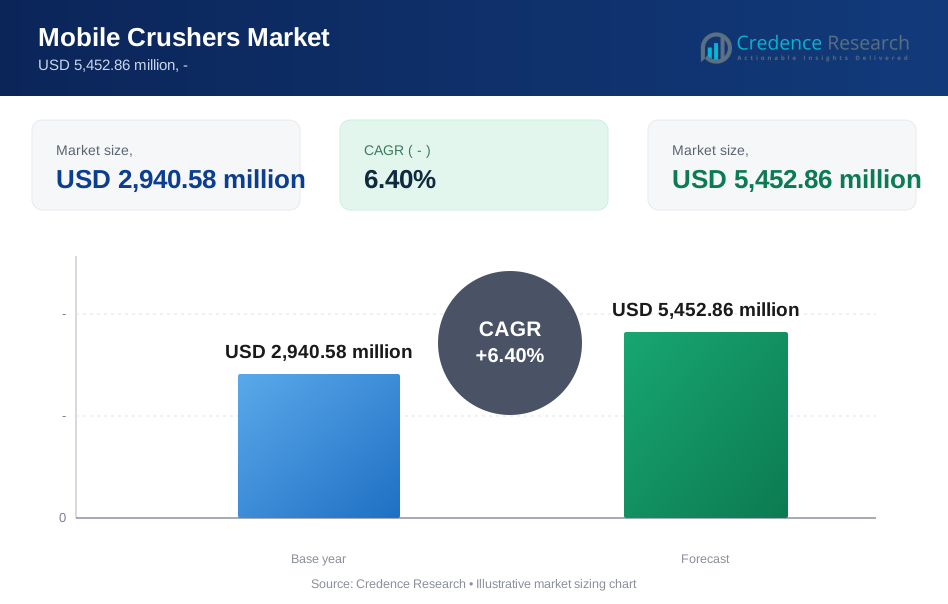
- 2.1.1 Market Size – Historical (the historical period) & Forecast (the forecast period) (base year: USD 2,940.58 million → forecast year: USD 5,452.86 million)
- 2.1.2 Volume & Revenue – Global Totals
- 2.1.3 Key Market Highlights – Top Five Facts
- 2.2 Mobile Crushers Market Segmentation Snapshot
- 2.2.1 Market Split by Region – vs.
- 2.3 Competitive Snapshot
- 2.3.1 Top 10 Players by Revenue Share –
- 2.3.2 Top 10 Players by Volume Share –
- 2.3.3 Recent Strategic Developments (18-Month Summary)
- 2.4 Key Investment Highlights & Strategic Conclusions
Chapter 3. Mobile Crushers Market Dynamics & Industry Analysis
- 3.1 Market Overview & Context
- 3.1.1 Mobile Crushers Market Position in the Broader Automotive Value Chain
- 3.1.2 OEM vs. Replacement Market Dynamics
- 3.1.3 Market Maturity & Development Stage by Region
- 3.2 Mobile Crushers Market Drivers
- 3.3 Mobile Crushers Market Restraints & Challenges
- 3.4 Mobile Crushers Market Opportunities
- 3.5 Porter's Five Forces Analysis
- 3.5.1 Threat of New Entrants
- 3.5.2 Bargaining Power of Suppliers
- 3.5.3 Bargaining Power of Buyers
- 3.5.4 Threat of Substitutes
- 3.5.5 Competitive Rivalry – Intensity Assessment
- 3.6 Mobile Crushers Value Chain Analysis
- 3.6.1 Upstream – Raw Material/Input Suppliers
- 3.6.1.1 Raw Material/Input 1
- 3.6.1.2 Raw Material/Input 2
- 3.6.1.3 Raw Material/Input 3
- 3.6.2 Midstream – Production/Manufacturing/Service Delivery
- 3.6.2.1 Production/Process Overview
- 3.6.2.2 Key Facility Locations & Capacity by Manufacturer
- 3.6.3 Downstream – Distribution & End Consumer
- 3.6.3.1 Primary Channel – B2B/OEM
- 3.6.3.2 Secondary Channels – Dealer, Retail, Online, Direct
- 3.6.4 Value Chain Profitability Analysis
- 3.6.1 Upstream – Raw Material/Input Suppliers
- 3.7 PESTEL Analysis
- 3.7.1 Political Factors
- 3.7.2 Economic Factors
- 3.7.3 Social Factors
- 3.7.4 Technological Factors
- 3.7.5 Environmental Factors
- 3.7.6 Legal Factors
- 3.8 Mobile Crushers Supply Chain Analysis
- 3.8.1 Raw Material/Input Supply Risk Assessment
- 3.8.2 Manufacturing Concentration Risk (Geographic Exposure)
- 3.8.3 Trade Disruption Impact Analysis
- 3.9 Regulatory & Policy Landscape
Note: The regulatory and policy landscape section covers regulations based on their applicability to the market, Mobile Crushers category, geography, and scope of the study. Only regulatory frameworks with a material impact on operations, compliance, trade, sustainability, or market access are analyzed in detail.
Chapter 4. Key Investment Pockets & Opportunity Analysis
- 4.1 Mobile Crushers Market Attractiveness Analysis
- 4.1.1 By Region – Investment Attractiveness Matrix (Volume × CAGR)
- 4.2 Absolute Revenue Growth Opportunity
- 4.2.1 By Region – Absolute USD Growth Through the forecast period
- 4.3 Incremental Volume Opportunity
- 4.3.1 By Region – Incremental Volume Through the forecast period
- 4.3.2 Segment – Incremental Volume
- 4.4 Emerging Submarket Opportunity Deep Dive (Subject to Applicability)
- 4.5 Emerging Market Opportunity Scorecards
- 4.5.1 United States
- 4.5.2 Europe
- 4.5.3 Asia
- 4.5.4 Middle East & Africa
Note: Emerging Market Opportunity Scorecards will be included based on relevance and strategic importance. Regions listed are indicative and may vary depending on data availability and market dynamics.
Chapter 5. Mobile Crushers Import-Export Analysis & Trade Flows
- 5.1 Global Trade Overview
- 5.1.1 Global Export Value by Country (the historical period)
- 5.1.2 Global Export Volume by Country (the historical period)
- 5.1.3 Global Import Value by Country (the historical period)
- 5.1.4 Global Import Volume by Country (the historical period)
- 5.1.5 Net Trade Balance by Country (the historical period)
- 5.2 Export Analysis – Segment
- 5.2.1 Type 1 (HS Code)
- 5.2.2 Type 2 (HS Code)
- 5.2.3 Type 3 (HS Code)
- 5.2.4 Type 4 (HS Code)
- 5.2.5 Type 5 (HS Code)
- 5.3 Import Analysis – Segment
- 5.3.1 Type 1 (HS Code)
- 5.3.2 Type 2 (HS Code)
- 5.3.3 Type 3 (HS Code)
- 5.3.4 Type 4 (HS Code)
- 5.3.5 Type 5 (HS Code)
- 5.4 Average Unit Trade Prices
- 5.4.1 Average Export Price – Segment & Country
- 5.4.2 Average Import Price – Segment & Source Country
- 5.4.3 Price Trends (the historical period)
- 5.5 Key Trade Route Analysis
- 5.5.1 Trade Route 1
- 5.5.2 Trade Route 2
- 5.5.3 Trade Route 3
- 5.5.4 Trade Route 4
- 5.5.5 Trade Route 5
- 5.6 Trade Policy Impact Assessment
- 5.6.1 US Anti-Dumping & Section 301 Tariffs
- 5.6.2 EU Customs Union Impact
- 5.6.3 Major Free Trade Agreements
- 5.6.4 USMCA Rules of Origin
Note: Trade policy analysis will be included only where relevant to the Mobile Crushers market.
Chapter 6. Competitive Landscape & Company Benchmarking
- 6.1 Mobile Crushers Market Concentration & Structure
- 6.1.1 Herfindahl-Hirschman Index (HHI) – vs.
- 6.1.2 Tier 1, Tier 2 & Tier 3 Market Structure
- 6.1.3 Global, Regional & Local Player Dynamics
- 6.2 Mobile Crushers Market Share Analysis –
- 6.2.1 Global Revenue Share by Company
- 6.2.2 Global Volume Share by Company
- 6.2.3 Regional Revenue Share
- 6.2.4 Market Share Evolution ( vs. )
- 6.2.5 OEM Segment Share by Company
- 6.2.6 Replacement Segment Share by Company
- 6.3 Production/Delivery Capacity & Facility Analysis
- 6.3.1 Global Installed Capacity
- 6.3.2 Capacity Utilization Rates
- 6.3.3 Production/Output Volume
- 6.3.4 Facility Locations & Capacity Map
- 6.3.5 Planned Capacity Additions
- 6.4 Mobile Crushers Competitive Benchmarking Matrix
- 6.4.1 Revenue, Volume, CAGR & Profitability Comparison
- 6.4.2 Channel Revenue Mix
- 6.4.3 Geographic Revenue Exposure
- 6.4.4 R&D Intensity
- 6.4.5 Sustainability Maturity
- 6.5 Strategic Developments in Mobile Crushers (Last 24 Months)
- 6.5.1 Mergers, Acquisitions & Divestments
- 6.5.2 New Mobile Crushers Launches
- 6.5.3 Facility Expansions
- 6.5.4 Strategic Alliances, Joint Ventures & Partnerships
- 6.5.5 Distribution Expansion & Market Entry
- 6.5.6 Sustainability & ESG Initiatives
- 6.6 Competitive Strategy Mapping
- 6.6.1 Leader, Challenger, Follower & Niche Classification
- 6.6.2 Pricing Strategy Comparison
- 6.6.3 Channel Strategy Matrix
Note: Strategic developments are included based on their materiality and the availability of reliable information.
Chapter 7. Global Mobile Crushers Market – By Distribution Channel
- 7.1 Segment Overview
- 7.1.1 Volume & Revenue Split by Channel ( & )
- 7.1.2 Channel Mix Evolution (the forecast period)
Chapter 8. Regional Market Analysis – Global Overview
- 8.1 Global Regional Overview
- 8.1.1 Regional Volume Share
- 8.1.2 Regional Revenue Share
- 8.1.3 Regional Volume by Region
- 8.1.4 Regional Revenue by Region
- 8.1.5 Regional Forecast Through the forecast period
- 8.2 Cross-Regional Segment Analysis
- 8.2.1 By Distribution Channel
- 8.2.2 By Brand/Price Tier
Chapter 9. North America Mobile Crushers Market
- 9.1 United States
- 9.2 Canada
- 9.3 Mexico
Chapter 10. Europe Mobile Crushers Market
- 10.1 Germany
- 10.2 France
- 10.3 Italy
- 10.4 United Kingdom
- 10.5 Spain
- 10.6 Poland
- 10.7 Russia
- 10.8 Netherlands
- 10.9 Belgium
- 10.10 Sweden
- 10.11 Denmark
- 10.12 Norway
- 10.13 Rest of Europe
Chapter 11. Asia Pacific Mobile Crushers Market
- 11.1 China
- 11.2 India
- 11.3 Japan
- 11.4 South Korea
- 11.5 Thailand
- 11.6 Indonesia
- 11.7 Vietnam
- 11.8 Malaysia
- 11.9 Australia
- 11.10 Rest of Asia Pacific
Chapter 12. Latin America Mobile Crushers Market
- 12.1 Brazil
- 12.2 Argentina
- 12.3 Colombia
- 12.4 Chile
- 12.5 Rest of Latin America
Chapter 13. Middle East Mobile Crushers Market
- 13.1 Saudi Arabia
- 13.2 United Arab Emirates
- 13.3 Turkey
- 13.4 Israel
- 13.5 Iran
- 13.6 Rest of the Middle East
Chapter 14. Africa Mobile Crushers Market
- 14.1 South Africa
- 14.2 Egypt
- 14.3 Nigeria
- 14.4 Morocco
- 14.5 Rest of Africa
Chapter 15. Mobile Crushers Company Profiles
- 15.1 [Company 01]
- 15.1.1 Company Overview
- 15.1.2 Key Management Personnel
- 15.1.3 Products & Services Portfolio
- 15.1.4 Financial Performance
- 15.1.5 Key Market Focus & Geographic Presence
- 15.1.6 Recent Developments & Strategic Initiatives
Note: The company profile list is preliminary and may change based on research findings, market developments, data availability, and client requirements.
Chapter 16. Appendices
- Appendix A – List of Abbreviations & Acronyms
- Appendix B – Industry Classification Code Reference – Full Series
- Appendix C – Production & Capacity Data Tables
- Appendix D – End-Use & Demand Base Tables
- Appendix E – Consumption & Replacement Rate Assumptions
- Appendix F – ASP Reference Tables
- Appendix G – Manufacturing & Facility Database
- Appendix H – Import-Export Data Tables
- Appendix I – Regulatory Summary Tables
- Appendix J – Primary Research Participant List (Anonymized)
- Appendix K – Primary Research Questionnaire Framework
- Appendix L – Data Sources & Bibliography
- Appendix M – Market Size Divergence & Source Comparison
Chapter 17. Research Methodology
- 17.1 Research Framework & Philosophy
- 17.2 Secondary Research – Sources, Hierarchy & Data Extraction
- 17.3 Data Modeling – Bottom-Up & Top-Down Market Sizing
- 17.4 Primary Research – Stakeholder Framework, LOI & Sample Sizes
- 17.5 Forecast Methodology – Regression, Scenario & Sensitivity Analysis
- 17.6 Quality Control – Four-Layer Validation Framework
- 17.7 Limitations & Standard Assumptions
- 17.8 Disclaimer
