
Market Overview
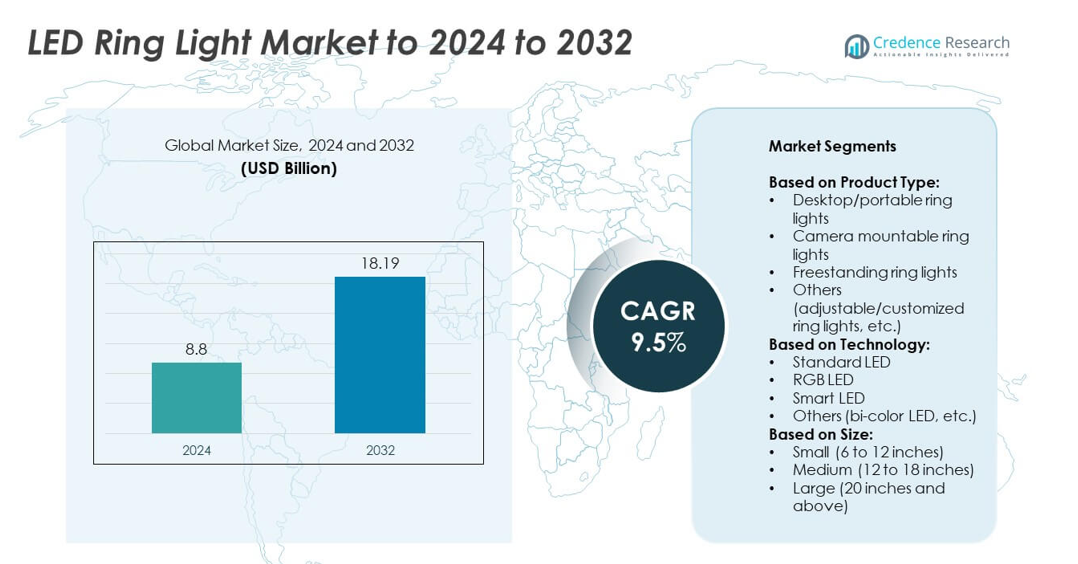
The LED Ring Light market was valued at USD 8.8 billion in 2024 and is anticipated to reach USD 18.19 billion by 2032, expanding at a CAGR of 9.5% during the forecast period.
| REPORT ATTRIBUTE | DETAILS |
|---|---|
| Historical Period | 2020-2023 |
| Base Year | 2024 |
| Forecast Period | 2025-2032 |
| LED Ring Light market Size 2024 | USD 8.8 billion |
| LED Ring Light market, CAGR | 9.5% |
| LED Ring Light market Size 2032 | USD 18.19 billion |
The LED ring light market is shaped by prominent players such as Opto Plus, Neewer, Lume Cube, Godox, UBeesize, Ring Light, Yongnuo, Inkeltech, FalconEyes, Pony, Mactrem, Signify, Elgato, K&F Concept, Innens, Impact, and Viltrox. These companies focus on enhancing product quality, integrating smart features, and expanding distribution through e-commerce platforms to capture diverse consumer groups ranging from professionals to hobbyists. Regionally, North America led the market in 2024 with nearly 35% share, driven by strong adoption among content creators, remote professionals, and established digital platforms, positioning it as the dominant hub for market growth.
Market Insights
- The LED ring light market was valued at USD 8.8 billion in 2024 and is projected to reach USD 18.19 billion by 2032, growing at a CAGR of 9.5% during the forecast period.
- Rising demand from content creators, influencers, and remote professionals is fueling strong product adoption, supported by affordability and ease of use across personal and professional applications.
- Key trends include the growing integration of smart features, app-based controls, and RGB customization, making ring lights more appealing for live streaming, gaming, and social media-driven content creation.
- The market is competitive with global and regional players focusing on innovation, product differentiation, and online retail expansion, while facing challenges from intense price competition in emerging markets.
- North America led the market in 2024 with nearly 35% share, followed by Europe at 25% and Asia Pacific at 30%, while freestanding ring lights held the largest segment share at over 40%.
Market Segmentation Analysis:
By Product Type
The freestanding ring lights segment held the dominant share of the LED ring light market in 2024, accounting for over 40% of total sales. Their leadership stems from strong demand among professional photographers, videographers, and content creators who require stable lighting solutions for studios and live streaming. The adjustable height, wider illumination coverage, and compatibility with professional cameras drive adoption. Desktop or portable ring lights follow closely, boosted by remote work, online learning, and influencer-led demand. Increasing usage of camera mountable ring lights in on-the-go shooting adds to segment diversity.
- For instance, Neewer’s RL-18 freestanding kit uses a 61-inch stand and 240 SMD LEDs.
By Technology
Standard LED ring lights dominated the market in 2024, capturing nearly 45% of the share. Their affordability, high energy efficiency, and wide availability make them the preferred choice for both personal and commercial users. However, RGB LED and smart LED segments are gaining momentum, fueled by the growing popularity of dynamic lighting effects in live streaming, gaming, and social media content creation. Bi-color LED models also appeal to professionals requiring adjustable color temperatures. Still, standard LED remains the leader due to cost-effectiveness and strong penetration across consumer categories.
- For instance, Rotolight’s NEO 3 uses RGBWW chips and supports 16.7 million colour modes.
By Size
Medium-sized ring lights (12 to 18 inches) led the market in 2024, holding more than 50% share. Their dominance is linked to the balance they offer between portability and powerful illumination, making them ideal for influencers, vloggers, and small studios. These lights deliver sufficient brightness for close-up shots while remaining compact for easy handling. Small-sized ring lights are popular among hobbyists and casual users, while large models above 20 inches cater to professional studios. The medium segment continues to grow, supported by rising demand from e-commerce sellers and content creators seeking flexible setups.
Key Growth Drivers
Rising Demand from Content Creators
The rapid growth of digital platforms such as YouTube, Instagram, and TikTok has fueled strong demand for LED ring lights. Content creators, influencers, and streamers rely on these lights for enhanced video quality and professional-grade illumination. The segment’s expansion is further supported by affordable product availability, making professional lighting accessible to a wider consumer base. With millions of new creators entering the digital economy each year, this demand continues to serve as a major growth driver for the global LED ring light market.
- For instance, Elgato's Ring Light delivers up to 2,500 lumens and supports app-based control for brightness and color temperature (from 2900 to 7000 K).
Expansion of Remote Work and Online Education
The rise of hybrid work models and online education has significantly boosted the use of LED ring lights. Professionals and students increasingly invest in these devices to improve visibility during video calls, webinars, and presentations. Clear and consistent lighting enhances communication and professional appearance, strengthening adoption across households and institutions. This widespread shift to digital platforms has made LED ring lights an essential accessory, ensuring stable growth momentum. The long-term adoption of remote communication practices continues to support this as a key growth driver.
- For instance, Logitech’s Litra Glow produces 250 lumens of edge-lit LED light for video calls.
Technological Advancements in LED Lighting
Ongoing innovations in LED technology have played a vital role in expanding market potential. Features such as adjustable color temperatures, RGB customization, wireless connectivity, and smart integration with mobile apps enhance user experience. Manufacturers are launching models tailored for both casual and professional use, increasing versatility across applications. Improved energy efficiency and durability also strengthen adoption, reducing replacement costs for users. These advancements create strong differentiation among brands and foster sustained growth, making technological innovation one of the most critical growth drivers for the LED ring light market.
Key Trends & Opportunities
Integration of Smart Features
The adoption of smart LED ring lights integrated with Bluetooth, Wi-Fi, and app-based controls represents a growing trend. Users can remotely adjust brightness, color temperature, and effects, making them highly appealing for both professionals and casual users. Integration with smart home ecosystems provides new opportunities for manufacturers to expand product functionality. This innovation aligns with the rising consumer preference for convenience and automation, positioning smart-enabled ring lights as a major opportunity in the evolving LED ring light market.
- For instance, the Godox LR150 is an 18-inch bi-color LED ring light designed for vlogging, photography, and makeup application. It features built-in LEDs that provide a variable color temperature from 3000K to 6000K.
Rising Popularity of RGB and Customized Lighting
The growing demand for RGB LED ring lights among gamers, streamers, and content creators highlights a key trend in the market. Vibrant lighting effects enhance aesthetics and allow personalized user experiences, making these products highly attractive in the entertainment and social media sectors. Customization options, such as bi-color LEDs and adjustable hues, expand creative possibilities for professionals. This trend presents opportunities for companies to introduce innovative lighting models that cater to specialized needs, boosting competitiveness in the global market.
- For instance, Yongnuo markets its YN608 ring light, featuring 304 LEDs, as a budget-friendly and high-performance option for photographers and videographers globally. The brand's use of an aggressive, competitive pricing strategy is a key part of its business model, allowing it to gain a strong market position and appeal to a wider range of customers in Asia and beyond.
Key Challenges
Price Sensitivity and Market Competition
The LED ring light market faces intense competition from low-cost manufacturers, particularly in Asia-Pacific. Price-sensitive consumers often opt for inexpensive alternatives, leading to margin pressures for established brands. While premium products offer advanced features, affordability remains a decisive factor for mass adoption. Companies must strike a balance between pricing and innovation to remain competitive. This challenge continues to affect profitability, forcing players to focus on cost optimization and differentiation through product design, quality, and brand positioning.
Saturation in Mature Markets
Market saturation in developed economies poses another significant challenge for the LED ring light industry. Regions like North America and Europe already exhibit high adoption levels among creators, professionals, and hobbyists. Growth opportunities in these markets are becoming limited, pushing companies to shift focus toward emerging economies with rising digital penetration. However, building brand presence in new regions requires additional investments in marketing, distribution, and consumer education. This saturation effect makes it harder for established companies to achieve rapid growth in mature markets.
Regional Analysis
North America
North America accounted for the largest share of the LED ring light market in 2024, holding nearly 35%. The region benefits from the strong presence of content creators, vloggers, and professional photographers who drive high product adoption. The widespread use of LED ring lights in remote work setups, online education, and live streaming has further strengthened regional demand. The United States dominates North America due to the influence of digital platforms and advanced retail channels. Continuous innovations by manufacturers and growing consumer spending on high-quality lighting products continue to reinforce North America’s leadership in the global market.
Europe
Europe captured around 25% share of the global LED ring light market in 2024. The region is driven by a strong base of fashion, photography, and e-commerce industries, where ring lights are essential for product shoots and professional content. Countries such as Germany, the United Kingdom, and France contribute significantly due to their advanced digital economies and rising popularity of influencer marketing. Government initiatives supporting creative industries further aid adoption. However, the market faces high competition from low-cost imports. Demand for smart-enabled and eco-friendly lighting solutions continues to support growth in the European LED ring light sector.
Asia Pacific
Asia Pacific held a market share of nearly 30% in 2024, making it one of the fastest-growing regions. The rapid expansion of social media, short-video platforms, and online retail in countries like China, India, and Japan has fueled strong adoption. Affordable product availability and rising smartphone penetration encourage consumers to invest in LED ring lights for content creation and e-learning. Local manufacturers dominate the low-cost segment, while global brands focus on premium offerings. The region’s dynamic youth population and increasing number of online influencers are major drivers, ensuring Asia Pacific remains a key growth engine for the industry.
Latin America
Latin America represented about 6% of the LED ring light market share in 2024. The region is experiencing steady growth, supported by rising social media engagement and growing adoption of influencer-driven marketing. Countries such as Brazil and Mexico lead the regional demand, with younger populations increasingly investing in affordable lighting products for online content. Economic fluctuations and limited purchasing power in some markets restrain rapid expansion. However, the popularity of low-cost ring lights and increasing smartphone-based content creation create strong opportunities. Local e-commerce platforms are also expanding distribution, strengthening market presence across the region.
Middle East and Africa
The Middle East and Africa accounted for nearly 4% of the global LED ring light market in 2024. Growth in the region is supported by increasing digital penetration, expanding e-commerce platforms, and rising interest in online content creation. Countries such as the United Arab Emirates and South Africa are emerging as key adopters due to higher disposable incomes and tech-savvy consumers. However, market expansion is limited by lower awareness in rural areas and dependence on imported products. Still, the increasing adoption of LED ring lights in professional studios and online education highlights promising growth potential across the region.
Market Segmentations:
By Product Type:
- Desktop/portable ring lights
- Camera mountable ring lights
- Freestanding ring lights
- Others (adjustable/customized ring lights, etc.)
By Technology:
- Standard LED
- RGB LED
- Smart LED
- Others (bi-color LED, etc.)
By Size:
- Small (6 to 12 inches)
- Medium (12 to 18 inches)
- Large (20 inches and above)
By Geography:
- North America
- U.S.
- Canada
- Mexico
- Europe
- Germany
- France
- U.K.
- Italy
- Spain
- Rest of Europe
- Asia Pacific
- China
- Japan
- India
- South Korea
- South-east Asia
- Rest of Asia Pacific
- Latin America
- Brazil
- Argentina
- Rest of Latin America
- Middle East & Africa
- GCC Countries
- South Africa
- Rest of the Middle East and Africa
Competitive Landscape
The LED ring light market is characterized by the presence of notable players including Opto Plus, Neewer, Lume Cube, Godox, UBeesize, Ring Light, Yongnuo, Inkeltech, FalconEyes, Pony, Mactrem, Signify, Elgato, K&F Concept, Innens, Impact, and Viltrox. The competitive landscape reflects strong rivalry, with companies focusing on product innovation, advanced lighting technologies, and affordability to expand their customer base. Manufacturers are investing in smart features, energy-efficient designs, and customizable options to meet the growing demand from content creators, professionals, and hobbyists. Strategic partnerships, online retail expansion, and brand collaborations with influencers are common approaches to enhance market presence. Intense price competition, particularly from low-cost regional producers, continues to influence strategies, while premium brands differentiate through quality and advanced features. The market shows a blend of established global brands and emerging regional companies, creating a dynamic competitive environment driven by constant innovation and evolving consumer needs.
Key Player Analysis
- Opto Plus
- Neewer
- Godox
- UBeesize
- Ring Light
- Yongnuo
- Inkeltech
- FalconEyes
- Pony
- Mactrem
- Signify
- Elgato
- K&F Concept
- Innens
- Impact
- Viltrox
Recent Developments
- In 2025, Godox Introduced a professional studio-grade ring light designed specifically for niche applications like beauty clinics and dermatology/medical photography, expanding its high-margin medical portfolio.
- In 2025, Signify Continued to push Smart Home lighting integration through its Philips Hue line, with general LED advancements focusing on seamless connectivity and ecosystem control that influences future ring light smart features.
- In 2023, Opto Plus launched a new round LED display with a hollow center that can be used to create a ring-shaped ambient light.
Report Coverage
The research report offers an in-depth analysis based on Product Type, Technology, Size and Geography. It details leading market players, providing an overview of their business, product offerings, investments, revenue streams, and key applications. Additionally, the report includes insights into the competitive environment, SWOT analysis, current market trends, as well as the primary drivers and constraints. Furthermore, it discusses various factors that have driven market expansion in recent years. The report also explores market dynamics, regulatory scenarios, and technological advancements that are shaping the industry. It assesses the impact of external factors and global economic changes on market growth. Lastly, it provides strategic recommendations for new entrants and established companies to navigate the complexities of the market.
Future Outlook
- The LED ring light market will continue growing with rising demand from digital creators.
- Remote work and online education will sustain long-term adoption of ring lights.
- Technological upgrades such as smart and app-controlled features will drive product innovation.
- Medium-sized ring lights will remain the most preferred choice among users.
- Asia Pacific will emerge as the fastest-growing regional market with strong influencer culture.
- North America will maintain dominance due to established creator ecosystems and premium demand.
- Price competition from low-cost manufacturers will intensify across global markets.
- RGB and customizable lighting will gain more popularity among gaming and streaming communities.
- E-commerce platforms will play a central role in product distribution and brand visibility.
- Growing adoption in professional industries such as fashion and photography will strengthen market prospects.

Request a Free Sample
Fill in your details and we'll send you a free sample report.
- Sample data tables & charts
- Research methodology
Market Dynamics
Content Creator and Influencer Boom
The proliferation of digital platforms like YouTube, Instagram, and TikTok has led to a surge in demand for LED ring lights, as creators and influencers seek professional-grade lighting to enhance video and photo quality.
Expansion of Remote Work and Online Education
The widespread adoption of hybrid work models and virtual learning has made LED ring lights essential for improving visibility and professionalism during video calls, webinars, and online classes.
Technological Advancements and Smart Features
Continuous innovation in LED technology, including app-based controls, RGB customization, and wireless connectivity, is making ring lights more versatile and appealing for both casual and professional users.
Affordability and Accessibility
The availability of cost-effective LED ring lights has democratized access to professional lighting, enabling a broader range of consumers, from hobbyists to small businesses, to adopt these products.
Growth of E-commerce and Online Retail Channels
The expansion of e-commerce platforms has facilitated easy access to a wide variety of LED ring lights, allowing manufacturers to reach global audiences and consumers to compare and purchase products conveniently.
Need a Custom Version of This Report?
Tailor the scope, geography, or segments to your exact requirements.
- Custom geography or segment scope
- Direct access to our analyst team
Frequently Asked Questions
What is the current market size for LED Ring Light Market, and what is its projected size in 2032?
At what Compound Annual Growth Rate is the LED Ring Light Market projected to grow between 2025 and 2032?
Which LED Ring Light Market segment held the largest share in 2024?
What are the primary factors fueling the growth of the LED Ring Light Market?
Who are the leading companies in the LED Ring Light Market?
Table of Content
Chapter 1 Market Segmentation
- 1.1 Segmentation Framework
- 1.1.1 Product and Service Classification
- 1.1.2 Application and End-Use Classification
- 1.1.3 Technology and Solution Classification
- 1.1.4 Customer and Distribution Channel Classification
- 1.1.5 Geographic Segmentation
- 1.1.6 Market Segment Definitions and Boundaries
- 1.2 By Size
- 1.2.1 Small (6 to 12 inches)
- 1.2.2 Medium (12 to 18 inches)
- 1.2.3 Large (20 inches and above)
- 1.3 By Technology
- 1.3.1 Standard LED
- 1.3.2 RGB LED
- 1.3.3 Smart LED
- 1.3.4 Others (bi-color LED, etc.)
- 1.4 By Product Type
- 1.4.1 Desktop/portable ring lights
- 1.4.2 Camera mountable ring lights
- 1.4.3 Freestanding ring lights
- 1.4.4 Others (adjustable/customized ring lights, etc.)
Chapter 2 Introduction
- 2.1 Report Objectives and Scope
- 2.2 Product Definition and Industry Terminology
- 2.3 Market Inclusions and Exclusions
- 2.4 Research Process
- 2.4.1 Primary Research and Expert Interviews
- 2.4.2 Secondary Research and Source Review
- 2.4.3 Top-Down and Bottom-Up Estimation
- 2.4.4 Data Triangulation and Verification
- 2.5 Market Size Measurement Basis
- 2.5.1 2024: USD 8.8 billion → 2032: USD 18.19 billion
- 2.6 Historical and Forecast Reference Periods
- 2.6.1 Base Year: 2024
- 2.6.2 Forecast Period: 2024-2032
- 2.7 Research Assumptions and Limitations
Chapter 3 Executive Summary
- 3.1 Market Snapshot and Key Findings
- 3.2 Base-Year Market Size, 2024
- 3.3 Forecast Market Size, 2032
- 3.4 Revenue and Volume Growth Outlook
- 3.5 Key Demand and Supply Indicators
- 3.6 Leading Market Segments
- 3.7 Fastest-Growing Market Opportunities
- 3.8 Regional Performance Highlights
- 3.9 Technology and Industry Transformation
- 3.10 Competitive Landscape Summary
- 3.11 Analyst View and Strategic Implications
Chapter 4 Global LED Ring Light Market Trends and Developments
- 4.1 Historical Industry Development
- 4.2 Recent Market Trends and Developments
- 4.3 Demand and Customer Behavior Trends
- 4.4 Technology and Product Innovation
- 4.5 Artificial Intelligence, Automation and Digitalization
- 4.6 Local Manufacturing and Supply Chain Realignment
- 4.7 Industry Partnerships, Mergers and Acquisitions
- 4.8 Sustainability and Circular Economy Developments
- 4.9 Government and Private Sector Investment Trends
- 4.10 Emerging Business Models and Commercialization
- 4.11 Industry Developments and Announcements
Chapter 5 Global LED Ring Light Market Production, Supply and Demand Analysis
- 5.1 Demand Trend and Consumption Analysis
- 5.2 Demand Forecast, 2024-2032
- 5.3 Production and Output Trend
- 5.4 Production and Output Forecast, 2024-2032
- 5.5 Installed Capacity and Capacity Utilization
- 5.6 Company-Wise Production Plants and Statistics
- 5.6.1 Installed Production Capacity
- 5.6.2 Actual Production
- 5.6.3 Planned Capacity and Expansion Targets
- 5.7 Supply Chain Structure and Procurement Trends
- 5.8 Supply-Demand Gap and Bottlenecks
- 5.9 Import Dependence and Sourcing Structure
- 5.10 Contract Manufacturing and Outsourcing
- 5.11 Regional Supply and Demand Concentration
Chapter 6 Global LED Ring Light Market Pricing Analysis
- 6.1 Pricing Structure and Measurement
- 6.2 Historical Pricing Trends
- 6.3 Pricing Outlook, 2024-2032
- 6.4 Average Selling Price and Unit Economics
- 6.5 Pricing by Product and Market Segment
- 6.6 Geographic Pricing Differences
- 6.7 Key Input, Energy, Labor and Logistics Costs
- 6.8 Contract Pricing and Purchasing Models
- 6.9 Pricing Sensitivity and Competitive Positioning
- 6.10 Price, Margin and Profitability Implications
Chapter 7 Global LED Ring Light Market Dynamics
- 7.1 Market Growth Drivers
- 7.1.1 Demand-Side Drivers
- 7.1.2 Technology and Innovation Drivers
- 7.1.3 Infrastructure and Investment Drivers
- 7.1.4 Regulatory and Policy Drivers
- 7.2 Market Restraints
- 7.2.1 Cost and Affordability Constraints
- 7.2.2 Technology and Adoption Barriers
- 7.2.3 Supply Chain and Operational Constraints
- 7.3 Market Challenges
- 7.3.1 Competitive Pressure and Margin Erosion
- 7.3.2 Skills, Infrastructure and Implementation Gaps
- 7.4 Emerging Market Opportunities
- 7.5 Market Dynamics Impact and Time-Horizon Assessment
Chapter 8 Global LED Ring Light Value Chain Analysis
- 8.1 Industry Value Chain Overview
- 8.2 Upstream Suppliers and Critical Inputs
- 8.3 Technology and Component Providers
- 8.4 Manufacturing or Service Delivery
- 8.5 Distribution, Channel Partners and Integrators
- 8.6 Downstream Applications and End Users
- 8.7 Value Addition and Profit Pools
- 8.8 Vertical Integration and Outsourcing
- 8.9 Supplier Concentration and Risk
- 8.10 Supply Chain Localization and Resilience
Chapter 9 Global LED Ring Light Market Regulations and Policies
- 9.1 Relevant Laws, Standards and Compliance Frameworks
- 9.2 Product, Service, Safety and Quality Requirements
- 9.3 Government Policies, Incentives and Subsidies
- 9.4 Imports, Exports and Trade Barriers
- 9.5 Public Procurement and Local Content Requirements
- 9.6 Environmental and Sustainability Compliance
- 9.7 Upcoming Policy Changes and Market Implications
Chapter 10 Global LED Ring Light Market Hotspots and Opportunities
- 10.1 Market Opportunity Mapping and Growth Hotspots
- 10.2 High-Growth Applications and Customer Groups
- 10.3 Underserved Markets and White-Space Opportunities
- 10.4 Emerging Technology and Product Opportunities
- 10.5 New Capacity and Investment Hotspots
- 10.6 Market Entry and Expansion Opportunities
- 10.7 Distribution and Partnership Opportunities
- 10.8 Near-Term and Long-Term Commercial Potential
- 10.9 Opportunity Attractiveness and Execution Risks
Chapter 11 Global LED Ring Light Market Outlook, 2024-2032
- 11.1 Market Size and Analysis
- 11.1.1 Revenue (Market Measurement: 2024: USD 8.8 billion → 2032: USD 18.19 billion)
- 11.1.2 Market Volume and Quantity Sold
- 11.1.3 Historical Market Size
- 11.1.4 Base-Year Market Size, 2024
- 11.2 Market Forecast, 2024-2032
- 11.2.1 Revenue Forecast to 2032
- 11.2.2 Volume Forecast to 2032
- 11.2.3 CAGR and Year-on-Year Growth
- 11.2.4 Incremental Revenue Opportunity
- 11.3 Forecast Assumptions and Scenario Analysis
- 11.3.1 Base-Case Forecast
- 11.3.2 Optimistic and Conservative Scenarios
- 11.3.3 Technology, Pricing and Policy Sensitivities
- 11.4 Market Attractiveness and Growth Outlook
Chapter 12 Global LED Ring Light Market Segmentation and Outlook
- 12.1 Segmentation Summary and Market Shares, 2024
- 12.2 Largest and Fastest-Growing Segments
- 12.3 By Size - Market Size and Forecast, 2024-2032
- 12.3.1 Segment Definition and Scope
- 12.3.2 Historical Market Size
- 12.3.3 Revenue Forecast, 2024-2032
- 12.3.4 Volume Forecast, 2024-2032
- 12.3.5 Base-Year Market Share, 2024
- 12.3.6 Segment CAGR and Growth Drivers
- 12.3.7 Subsegment Market Size and Forecast
- 12.3.7.1 Small (6 to 12 inches)
- 12.3.7.2 Medium (12 to 18 inches)
- 12.3.7.3 Large (20 inches and above)
- 12.3.8 Subsegment Pricing and Adoption Trends
- 12.3.9 Leading Suppliers and Competition
- 12.3.10 Regional Demand and Opportunities
- 12.4 By Technology - Market Size and Forecast, 2024-2032
- 12.4.1 Segment Definition and Scope
- 12.4.2 Historical Market Size
- 12.4.3 Revenue Forecast, 2024-2032
- 12.4.4 Volume Forecast, 2024-2032
- 12.4.5 Base-Year Market Share, 2024
- 12.4.6 Segment CAGR and Growth Drivers
- 12.4.7 Subsegment Market Size and Forecast
- 12.4.7.1 Standard LED
- 12.4.7.2 RGB LED
- 12.4.7.3 Smart LED
- 12.4.7.4 Others (bi-color LED, etc.)
- 12.4.8 Subsegment Pricing and Adoption Trends
- 12.4.9 Leading Suppliers and Competition
- 12.4.10 Regional Demand and Opportunities
- 12.5 By Product Type - Market Size and Forecast, 2024-2032
- 12.5.1 Segment Definition and Scope
- 12.5.2 Historical Market Size
- 12.5.3 Revenue Forecast, 2024-2032
- 12.5.4 Volume Forecast, 2024-2032
- 12.5.5 Base-Year Market Share, 2024
- 12.5.6 Segment CAGR and Growth Drivers
- 12.5.7 Subsegment Market Size and Forecast
- 12.5.7.1 Desktop/portable ring lights
- 12.5.7.2 Camera mountable ring lights
- 12.5.7.3 Freestanding ring lights
- 12.5.7.4 Others (adjustable/customized ring lights, etc.)
- 12.5.8 Subsegment Pricing and Adoption Trends
- 12.5.9 Leading Suppliers and Competition
- 12.5.10 Regional Demand and Opportunities
- 12.6 Segment Growth Comparison
- 12.7 Segment Attractiveness and Priority Matrix
Chapter 13 Global LED Ring Light Geographic Market Outlook, 2024-2032
- 13.1 Regional Market Size and Share, 2024
- 13.2 Regional Market Forecast, 2024-2032
- 13.3 Regional Pricing, Production and Demand Differences
- 13.4 North America
- 13.4.1 United States
- 13.4.2 Canada
- 13.4.3 Mexico
- 13.5 Europe
- 13.5.1 Germany
- 13.5.2 France
- 13.5.3 Italy
- 13.5.4 United Kingdom
- 13.5.5 Spain
- 13.5.6 Poland
- 13.5.7 Russia
- 13.5.8 Netherlands
- 13.5.9 Belgium
- 13.5.10 Sweden
- 13.5.11 Denmark
- 13.5.12 Norway
- 13.5.13 Rest of Europe
- 13.6 Asia Pacific
- 13.6.1 China
- 13.6.2 India
- 13.6.3 Japan
- 13.6.4 South Korea
- 13.6.5 Thailand
- 13.6.6 Indonesia
- 13.6.7 Vietnam
- 13.6.8 Malaysia
- 13.6.9 Australia
- 13.6.10 Rest of Asia Pacific
- 13.7 Latin America
- 13.7.1 Brazil
- 13.7.2 Argentina
- 13.7.3 Colombia
- 13.7.4 Chile
- 13.7.5 Rest of Latin America
- 13.8 Middle East
- 13.8.1 Saudi Arabia
- 13.8.2 United Arab Emirates
- 13.8.3 Turkey
- 13.8.4 Israel
- 13.8.5 Iran
- 13.8.6 Rest of the Middle East
- 13.9 Africa
- 13.9.1 South Africa
- 13.9.2 Egypt
- 13.9.3 Nigeria
- 13.9.4 Morocco
- 13.9.5 Rest of Africa
- 13.10 Regional Investment, Policy and Supply Chain Differences
- 13.11 Regional Competitive Landscape
- 13.12 Geographic Growth Hotspots
Chapter 14 Global LED Ring Light Technology, Innovation and Sustainability Outlook
- 14.1 Technology Landscape and Maturity
- 14.2 Product, Process and Service Innovation
- 14.3 AI, Automation and Digital Tools in the Industry
- 14.4 Technology Adoption and Performance Benchmarking
- 14.5 Innovation Pipeline and R&D Investment
- 14.6 Patent and Intellectual Property Trends
- 14.7 Energy Efficiency and Resource Management
- 14.8 Sustainability, Recycling and Circularity
- 14.9 Technology Roadmap, 2024-2032
- 14.10 Risks of Obsolescence and Technology Substitution
Chapter 15 Global LED Ring Light Market Key Strategic Imperatives
- 15.1 Growth and Market Entry Priorities
- 15.2 High-Return Products and Segments
- 15.3 Pricing, Profitability and Cost Optimization
- 15.4 Technology Investment and Product Differentiation
- 15.5 Supply Chain Localization and Resilience
- 15.6 Distribution and Customer Acquisition
- 15.7 Partnership, Acquisition and Capacity Strategy
- 15.8 Regional Expansion Priorities
- 15.9 Short-, Medium- and Long-Term Actions
Chapter 16 Competition Outlook
- 16.1 Industry Competition Characteristics
- 16.2 Market Structure and Concentration
- 16.3 Market Share and Competitive Positioning, 2024
- 16.4 Company-Wise Revenue and Product Benchmarking
- 16.5 Production and Service Capacity Benchmarking
- 16.6 Technology, Pricing and Differentiation
- 16.7 Regional Footprint and Distribution Strength
- 16.8 Mergers, Acquisitions and Strategic Alliances
- 16.9 New Entrants and Competitive Threats
- 16.10 Porter's Five Forces and Industry Attractiveness
- 16.11 Competitive Outlook, 2024-2032
Chapter 17 Company Profiles
- 17.1 Company Coverage and Selection Criteria
- 17.2 Neewer
- 17.2.1 Business Description
- 17.2.2 Company Ownership and Geographic Presence
- 17.2.3 Product and Service Portfolio
- 17.2.4 Manufacturing and Operating Footprint
- 17.2.5 Production Capacity and Expansion Plans
- 17.2.6 Financial Performance and Investment
- 17.2.7 Market Share and Competitive Position
- 17.2.8 Technology and Innovation Capabilities
- 17.2.9 Strategic Alliances or Partnerships
- 17.2.10 Recent Developments
- 17.2.11 Growth Strategy and Outlook
- 17.3 Godox
- 17.4 Lume Cube
- 17.5 Elgato
- 17.6 Signify
- 17.7 Yongnuo
- 17.8 UBeesize
- 17.9 Opto Plus
- 17.10 Viltrox
- 17.11 FalconEyes
- 17.12 Other Relevant Market Participants
Note: Every listed company is profiled on the structure shown under the first company. The company list is preliminary and may change based on research findings, market developments, data availability and client requirements.
Chapter 18 Disclaimer
- 18.1 Research and Forecast Disclaimer
- 18.2 Data Source and Estimation Limitations
Note: The depth of individual sections depends on data availability for this market. Volume, capacity, trade and other unit-based metrics are included where applicable.

