
Market Overview
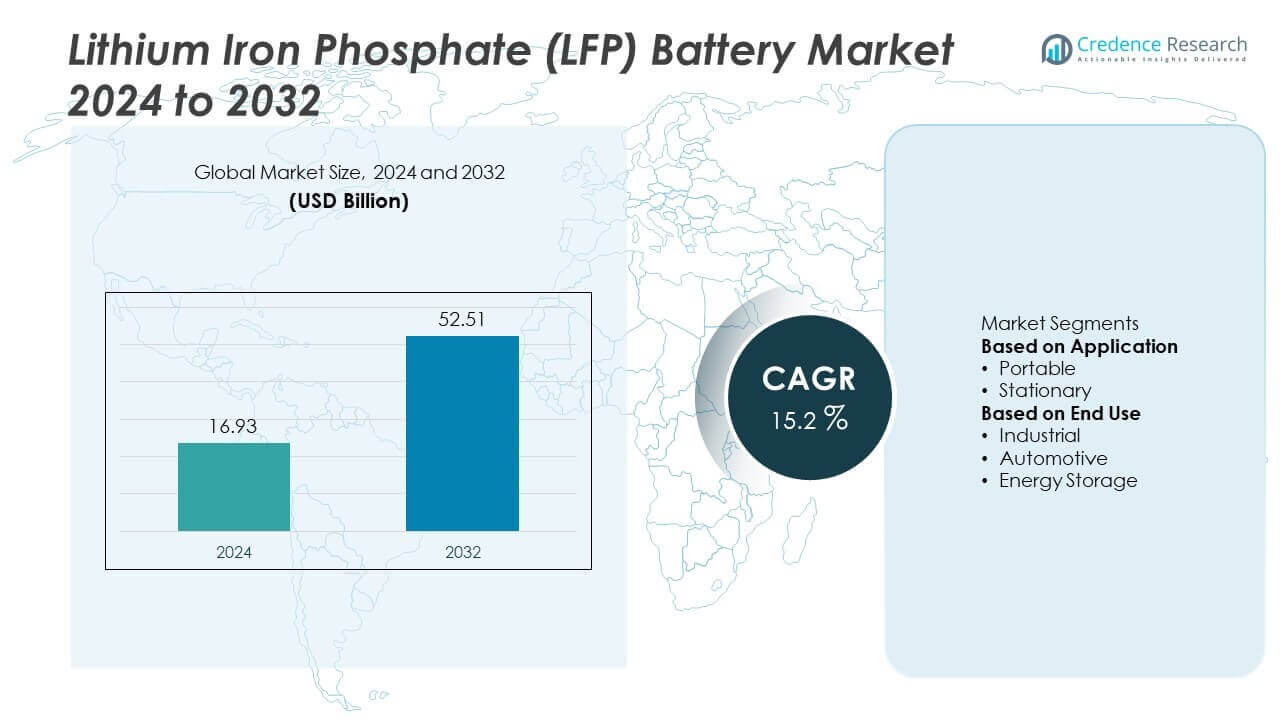
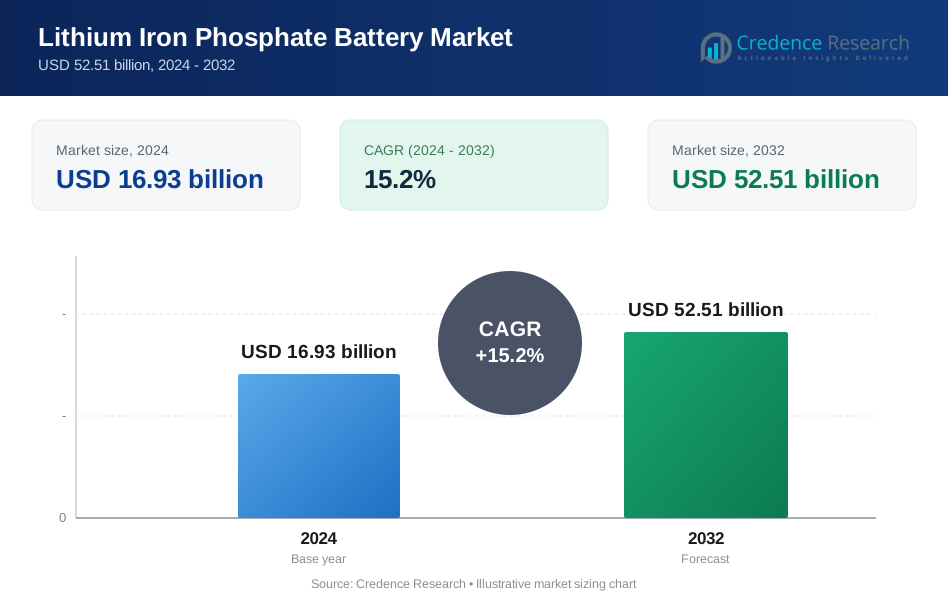
The Lithium Iron Phosphate (LFP) Battery Market was valued at USD 16.93 billion in 2024 and is projected to reach USD 52.51 billion by 2032, expanding at a CAGR of 15.2% during the forecast period.
| REPORT ATTRIBUTE | DETAILS |
|---|---|
| Historical Period | 2020-2023 |
| Base Year | 2024 |
| Forecast Period | 2025-2032 |
| Lithium Iron Phosphate (LFP) Battery Market Size 2024 | USD 16.93 Billion |
| Lithium Iron Phosphate (LFP) Battery Market, CAGR | 15.2% |
| Lithium Iron Phosphate (LFP) Battery Market Size 2032 | USD 52.51 Billion |
The lithium iron phosphate (LFP) battery market is led by key players including Energon, Exide Technologies, Contemporary Amperex Technology, Lithiumwerks, A123 Systems, Clarios, Prologium Technology, Ding Tai Battery Company, Duracell, and Koninklijke Philips. These companies focus on expanding production capacity, advancing cycle life, and forming partnerships with automakers and renewable energy developers to strengthen market presence. Asia-Pacific dominated with 47% share in 2024, driven by large-scale EV adoption and renewable integration in China and India. North America accounted for 21%, supported by strong EV policies and storage demand, while Europe held 18%, fueled by emission reduction goals and localized gigafactory investments.
 Market Insights
- The lithium iron phosphate (LFP) battery market was valued at USD 16.93 billion in 2024 and is projected to reach USD 52.51 billion by 2032, growing at a CAGR of 15.2%.
- Rising adoption of electric vehicles and renewable energy storage systems is driving strong demand for LFP batteries due to their safety, long cycle life, and cost efficiency.
- Key trends include rapid expansion of grid-scale energy storage projects, localization of supply chains in North America and Europe, and growing use in consumer electronics and industrial applications.
- The market is highly competitive with leading players such as Energon, Exide Technologies, Contemporary Amperex Technology, Lithiumwerks, A123 Systems, Clarios, Prologium Technology, Ding Tai Battery Company, Duracell, and Koninklijke Philips focusing on capacity expansion and innovation.
- Asia-Pacific dominated with 47% share in 2024, followed by North America at 21% and Europe at 18%, while automotive applications held 54% share, leading among end-use segments.
Market Segmentation Analysis:
By Application
The application segment of the lithium iron phosphate (LFP) battery market is divided into portable and stationary uses. Stationary applications dominated in 2024, holding over 62% share, driven by rising demand for grid stabilization, backup power, and renewable energy integration. Stationary systems are favored for their long cycle life, thermal stability, and safety, making them suitable for large-scale energy storage projects. The growing installation of renewable power plants and emphasis on reliable grid infrastructure are key factors boosting the stationary segment’s lead in the global market.
- For instance, CATL supplied batteries to integrator FlexGen for a 220 MWh LFP storage project in Texas, which demonstrates the utility-scale deployment of LFP technology.
By End Use
Within end-use categories, the automotive sector held the largest share at 54% in 2024, owing to rapid adoption of electric vehicles. Automakers favor LFP batteries for their cost-effectiveness, long lifespan, and resistance to thermal runaway compared to other chemistries. Leading EV manufacturers increasingly deploy LFP in entry and mid-range models, fueling its dominance. Supportive government incentives, expanding charging infrastructure, and consumer preference for affordable EVs are further strengthening the automotive segment’s position in the market.
- For instance, Gotion High-Tech launched its “Astroinno” LFP battery, which achieved a pack energy density of 190 Wh/kg and a cycle life of 4,000 cycles at room temperature, and is now supplied for several electric vehicle platforms requiring fast charging capability.
Key Growth Drivers
Rising Electric Vehicle Adoption
The rapid adoption of electric vehicles is a primary growth driver for the lithium iron phosphate (LFP) battery market. Automakers are increasingly integrating LFP batteries in mid-range and entry-level EVs due to their safety, durability, and cost advantages over nickel-based chemistries. Strong government incentives and emission reduction policies are accelerating EV demand globally. As consumer preference shifts toward affordable EVs with reliable performance, the automotive sector continues to push large-scale adoption of LFP technology, reinforcing its leading role in the market’s expansion.
- For instance, Tesla equips its standard range models with LFP battery packs that offer a long cycle life of over 2,500 cycles and significantly greater thermal stability than nickel-based chemistries, enabling owners to regularly charge to 100% with a low risk of thermal runaway.
Growing Renewable Energy Integration
The increasing integration of renewable energy into global power grids is boosting demand for energy storage systems. LFP batteries dominate stationary storage due to their long cycle life, safety, and ability to withstand deep discharges. Rising solar and wind installations create a pressing need for efficient storage solutions to address intermittency challenges. Governments and utilities are investing heavily in grid-scale projects and microgrids, where LFP offers cost-effective reliability. This trend ensures consistent demand for LFP batteries in the renewable energy ecosystem.
- For instance, CATL provides LFP-based stationary storage modules engineered for over 6000 charging cycles and continuous operation at up to 55°C, supporting resilient grid performance in large-scale solar farms.
Enhanced Safety and Longer Lifespan
Safety and longevity remain crucial factors driving LFP battery adoption. Compared to other lithium-ion chemistries, LFP provides superior thermal stability, reducing risks of fire or explosion. Its extended lifespan, often exceeding 3,000–5,000 cycles, makes it highly suitable for EVs, residential storage, and industrial backup. Businesses and consumers prioritize low-maintenance solutions with long service life, supporting LFP’s market expansion. The combination of safety and performance ensures continued preference across automotive, energy, and industrial applications, cementing LFP’s competitive advantage in the global battery landscape.
Key Trends & Opportunities
Expansion in Grid-Scale Storage Projects
The deployment of grid-scale energy storage projects is a strong trend shaping the LFP market. Utilities and governments favor LFP batteries for stabilizing renewable energy supply and enhancing grid resilience. Large-scale projects, including solar-plus-storage systems and wind farm storage, are increasing worldwide. This trend creates opportunities for manufacturers to scale production and enhance performance features, such as higher energy density. The growing focus on decarbonization and electrification presents a long-term opportunity for LFP batteries in supporting energy transitions globally.
- For instance, CATL recently introduced a high-capacity LFP energy storage battery with a 587 Ah cell and an energy density of 434 Wh/L, enabling grid-scale systems to achieve over 9 MWh single-unit capacity and maintain zero degradation over five years of continuous use.
Rising Penetration in Consumer Electronics
The market is witnessing increasing use of LFP batteries in portable devices, such as power tools, medical devices, and backup systems. Their safety, affordability, and long cycle life make them ideal for applications demanding reliability. Growing demand for portable electronics in developing regions opens new revenue streams for LFP manufacturers. Opportunities also lie in improving compact designs and boosting energy density for wider consumer adoption. As technology advances, LFP is expected to capture a stronger foothold in the consumer electronics ecosystem.
- For instance, Highstar Battery Technology supplies LFP battery cells for portable backup power, with a typical 100 Ah, 3.2V cell rated for over 3,500 charge-discharge cycles. Multiple cells are assembled into a module to support power outputs up to 3 kW for use in medical and UPS devices.
Global Supply Chain Localization
An emerging trend involves the localization of LFP battery supply chains, particularly in North America and Europe. Governments aim to reduce reliance on Asian imports by supporting local battery manufacturing through subsidies and investments. This shift offers opportunities for regional producers to establish strong market positions. It also drives collaboration between automakers, energy firms, and battery manufacturers to ensure stable supply. Localization enhances competitiveness while aligning with national energy security and sustainability goals, accelerating LFP market penetration worldwide.
Key Challenges
Lower Energy Density Compared to Alternatives
Despite its benefits, LFP batteries face a challenge due to their lower energy density compared to nickel-cobalt chemistries. This limitation affects their adoption in premium EVs, where longer driving range is a priority. While automakers adopt LFP for cost-sensitive models, competition from high-energy alternatives continues. Research and development efforts aim to enhance density while maintaining safety. Until then, the limited energy density of LFP restricts its use in applications demanding compact, high-capacity solutions, creating a significant restraint for broader market penetration.
Raw Material Supply and Cost Volatility
The supply and pricing of raw materials, particularly lithium, pose a challenge to LFP battery producers. Fluctuating costs and regional supply constraints directly impact manufacturing expenses and pricing strategies. The heavy reliance on mining and refining industries adds uncertainty to the value chain. Geopolitical tensions and rising demand across multiple industries further intensify risks. These supply-related challenges may affect profitability for manufacturers and slow adoption in cost-sensitive markets unless mitigated through recycling initiatives and diversified sourcing strategies.
Regional Analysis
North America
North America accounted for 21% share of the lithium iron phosphate (LFP) battery market in 2024. The region’s growth is driven by strong electric vehicle adoption supported by tax credits, emissions regulations, and expansion of charging infrastructure. Energy storage deployment is also accelerating, particularly in the United States, where LFP batteries are favored for grid reliability and renewable integration. Collaborations between automakers and battery manufacturers, alongside rising investments in domestic production facilities, further strengthen the market. The combination of clean energy policies and increasing EV penetration continues to expand LFP adoption across the region.
Europe
Europe held 18% share of the LFP battery market in 2024, supported by stringent environmental regulations and rising EV adoption. Countries such as Germany, France, and the Netherlands lead in vehicle electrification, while regional battery alliances promote domestic production capacity. The European Union’s Green Deal and energy transition goals drive substantial demand for stationary energy storage solutions. Automotive manufacturers are increasingly deploying LFP batteries in mid-range EVs, prioritizing safety and cost benefits. With ongoing investments in local gigafactories, Europe is positioned to reduce reliance on imports and accelerate LFP technology deployment in both automotive and energy storage applications.
Asia-Pacific
Asia-Pacific dominated the global LFP battery market with 47% share in 2024. China remains the largest producer and consumer, fueled by government subsidies, widespread EV adoption, and strong renewable energy integration. Leading battery manufacturers, including CATL and BYD, have expanded production capacity to meet both domestic and international demand. India and Japan are also increasing investments in EV manufacturing and energy storage infrastructure. The region’s established supply chain, cost advantages, and large-scale manufacturing base reinforce its leadership. Continuous government support and expanding export markets ensure Asia-Pacific remains the central hub of LFP battery development and deployment worldwide.
Latin America
Latin America captured 7% share of the LFP battery market in 2024, driven by the growing need for energy storage and electric mobility. Brazil and Mexico lead the regional adoption, supported by renewable energy expansion and pilot EV programs. Governments are promoting investments in solar-plus-storage systems to address grid stability challenges. Industrial applications such as telecom towers and backup power systems further contribute to LFP demand. However, limited manufacturing infrastructure and reliance on imports constrain rapid growth. Rising renewable capacity and gradual EV adoption are expected to create opportunities for LFP battery deployment across the region.
Middle East & Africa
The Middle East & Africa region accounted for 7% share of the LFP battery market in 2024. Market growth is influenced by increasing solar power projects in Gulf countries and off-grid energy storage solutions in Africa. Governments are investing heavily in renewable integration to diversify energy sources, creating opportunities for stationary LFP storage systems. Adoption in electric buses and industrial applications is also expanding, particularly in urban centers. However, high dependency on imports and limited local manufacturing capacity restrict large-scale deployment. Ongoing renewable energy investments are expected to drive consistent demand for LFP batteries in the region.
Market Segmentations:
By Application
- Portable
- Stationary
By End Use
- Industrial
- Automotive
- Energy Storage
By Geography
- North America
- U.S.
- Canada
- Mexico
- Europe
- Germany
- France
- U.K.
- Italy
- Spain
- Rest of Europe
- Asia Pacific
- China
- Japan
- India
- South Korea
- South-east Asia
- Rest of Asia Pacific
- Latin America
- Brazil
- Argentina
- Rest of Latin America
- Middle East & Africa
- GCC Countries
- South Africa
- Rest of the Middle East and Africa
Competitive Landscape
The competitive landscape of the lithium iron phosphate (LFP) battery market features key players such as Energon, Exide Technologies, Contemporary Amperex Technology, Lithiumwerks, A123 Systems, Clarios, Prologium Technology, Ding Tai Battery Company, Duracell, and Koninklijke Philips. These companies are actively engaged in expanding production capacities, advancing battery technologies, and strengthening supply chains to meet rising global demand. Leading firms like CATL and BYD emphasize large-scale manufacturing and global partnerships, while others focus on specialized applications such as stationary storage or consumer electronics. Strategic alliances with automakers and renewable energy developers play a crucial role in enhancing market presence. Continuous investment in safety, cost optimization, and sustainability initiatives remains central to competitive positioning. Regional players are also emerging, supported by government incentives and local manufacturing projects. The market remains dynamic, with innovation in energy density, cycle life, and eco-friendly solutions driving intense competition among established and emerging manufacturers.
Key Player Analysis
- Energon
- Exide Technologies
- Contemporary Amperex Technology
- Lithiumwerks
- A123 Systems
- Clarios
- Prologium Technology
- Ding Tai Battery Company
- Duracell
- Koninklijke Philips
Recent Developments
- In April 2025, CATL has announced the successful launch of its new generation of sodium-ion batteries, designed to offer a high-energy density and cost-effective solution for electric vehicles (EVs) and energy storage systems.
- In December 2024, Stellantis and CATL’s joint venture effort to build a LFP battery plant in Zaragoza, Spain. The plant is carbon neutral and worth up to USD 4.28 billion. Production is set to begin from the last quarter of 2026 with an overarching aim of supporting the Spanish and EU authorities and attaining a capacity of 50 GWh.
- In September 2024, Hyundai and Kia have announced a collaboration to develop new Lithium Iron Phosphate (LFP) cathode technology aimed at improving the performance and efficiency of their electric vehicle (EV) batteries.
- In March 2024, Nissan has announced the launch of its next-generation battery technology aimed at significantly improving the performance, efficiency, and sustainability of electric vehicles (EVs).
Report Coverage
The research report offers an in-depth analysis based on Application, End Use and Geography. It details leading market players, providing an overview of their business, product offerings, investments, revenue streams, and key applications. Additionally, the report includes insights into the competitive environment, SWOT analysis, current market trends, as well as the primary drivers and constraints. Furthermore, it discusses various factors that have driven market expansion in recent years. The report also explores market dynamics, regulatory scenarios, and technological advancements that are shaping the industry. It assesses the impact of external factors and global economic changes on market growth. Lastly, it provides strategic recommendations for new entrants and established companies to navigate the complexities of the market.
Future Outlook
- The market will see strong growth driven by rising electric vehicle adoption worldwide.
- Demand for stationary energy storage systems will increase with renewable integration projects.
- Automakers will expand use of LFP batteries in mid-range and entry-level EVs.
- Technological advancements will improve energy density and charging efficiency of LFP batteries.
- Governments will support local manufacturing to reduce dependence on Asian imports.
- Safety and long cycle life will remain key advantages over other battery chemistries.
- Industrial applications such as telecom, forklifts, and backup systems will witness steady growth.
- Competition among global and regional players will intensify with new capacity expansions.
- Recycling and circular economy initiatives will shape raw material sourcing strategies.
- Asia-Pacific will maintain leadership, while North America and Europe will expand rapidly with policy support.
Request a Free Sample
Fill in your details and we'll send you a free sample report.
- Sample data tables & charts
- Research methodology
Market Dynamics
Rising Electric Vehicle Adoption
Automakers are increasingly integrating LFP batteries in mid-range and entry-level EVs due to their safety, durability, and cost advantages over nickel-based chemistries. Strong government incentives and emission reduction policies are accelerating EV demand globally, reinforcing LFP's leading role in the market’s expansion.
Growing Renewable Energy Integration
The increasing integration of renewable energy into global power grids is boosting demand for energy storage systems. LFP batteries dominate stationary storage due to their long cycle life, safety, and ability to withstand deep discharges, making them ideal for solar and wind energy storage projects.
Enhanced Safety and Longer Lifespan
LFP batteries offer superior thermal stability and extended lifespan compared to other lithium-ion chemistries, reducing risks of fire or explosion and providing thousands of charge cycles. This makes them highly attractive for both automotive and stationary applications where reliability and low maintenance are critical.
Expansion in Grid-Scale Storage Projects
Utilities and governments are deploying large-scale LFP battery systems to stabilize renewable energy supply and enhance grid resilience. The trend toward decarbonization and electrification is creating significant opportunities for LFP batteries in supporting energy transitions worldwide.
Global Supply Chain Localization
Efforts to localize LFP battery manufacturing in North America and Europe, supported by government incentives and investments, are reducing reliance on Asian imports. This enhances supply chain security and supports regional market growth, especially as demand for EVs and energy storage rises.
Need a Custom Version of This Report?
Tailor the scope, geography, or segments to your exact requirements.
- Custom geography or segment scope
- Direct access to our analyst team
Frequently Asked Questions
What is the current market size for Lithium Iron Phosphate Battery market, and what is its projected size in 2032?
At what Compound Annual Growth Rate is the Lithium Iron Phosphate Battery market projected to grow between 2025 and 2032?
Which Lithium Iron Phosphate Battery market segment held the largest share in 2024?
What are the primary factors fueling the growth of the Lithium Iron Phosphate Battery market?
Who are the leading companies in the Lithium Iron Phosphate Battery market?
Which region commanded the largest share of the Lithium Iron Phosphate Battery market in 2024?
Table of Content
Chapter 1 Market Segmentation
- 1.1 Segmentation Framework
- 1.1.1 Product and Service Classification
- 1.1.2 Application and End-Use Classification
- 1.1.3 Technology and Solution Classification
- 1.1.4 Customer and Distribution Channel Classification
- 1.1.5 Geographic Segmentation
- 1.1.6 Market Segment Definitions and Boundaries
- 1.2 By End Use
- 1.2.1 Industrial
- 1.2.2 Automotive
- 1.2.3 Energy Storage
- 1.3 By Application
- 1.3.1 Portable
- 1.3.2 Stationary
Chapter 2 Introduction
- 2.1 Report Objectives and Scope
- 2.2 Product Definition and Industry Terminology
- 2.3 Market Inclusions and Exclusions
- 2.4 Research Process
- 2.4.1 Primary Research and Expert Interviews
- 2.4.2 Secondary Research and Source Review
- 2.4.3 Top-Down and Bottom-Up Estimation
- 2.4.4 Data Triangulation and Verification
- 2.5 Market Size Measurement Basis
- 2.5.1 2024: USD 16.93 billion → 2032: USD 52.51 billion
- 2.6 Historical and Forecast Reference Periods
- 2.6.1 Base Year: 2024
- 2.6.2 Forecast Period: 2024-2032
- 2.7 Research Assumptions and Limitations
Chapter 3 Executive Summary
- 3.1 Market Snapshot and Key Findings
- 3.2 Base-Year Market Size, 2024
- 3.3 Forecast Market Size, 2032
- 3.4 Revenue and Volume Growth Outlook
- 3.5 Key Demand and Supply Indicators
- 3.6 Leading Market Segments
- 3.7 Fastest-Growing Market Opportunities
- 3.8 Regional Performance Highlights
- 3.9 Technology and Industry Transformation
- 3.10 Competitive Landscape Summary
- 3.11 Analyst View and Strategic Implications
Chapter 4 Global Lithium Iron Phosphate Battery Market Trends and Developments
- 4.1 Historical Industry Development
- 4.2 Recent Market Trends and Developments
- 4.3 Demand and Customer Behavior Trends
- 4.4 Technology and Product Innovation
- 4.5 Artificial Intelligence, Automation and Digitalization
- 4.6 Local Manufacturing and Supply Chain Realignment
- 4.7 Industry Partnerships, Mergers and Acquisitions
- 4.8 Sustainability and Circular Economy Developments
- 4.9 Government and Private Sector Investment Trends
- 4.10 Emerging Business Models and Commercialization
- 4.11 Industry Developments and Announcements
Chapter 5 Global Lithium Iron Phosphate Battery Market Production, Supply and Demand Analysis
- 5.1 Demand Trend and Consumption Analysis
- 5.2 Demand Forecast, 2024-2032
- 5.3 Production and Output Trend
- 5.4 Production and Output Forecast, 2024-2032
- 5.5 Installed Capacity and Capacity Utilization
- 5.6 Company-Wise Production Plants and Statistics
- 5.6.1 Installed Production Capacity
- 5.6.2 Actual Production
- 5.6.3 Planned Capacity and Expansion Targets
- 5.7 Supply Chain Structure and Procurement Trends
- 5.8 Supply-Demand Gap and Bottlenecks
- 5.9 Import Dependence and Sourcing Structure
- 5.10 Contract Manufacturing and Outsourcing
- 5.11 Regional Supply and Demand Concentration
Chapter 6 Global Lithium Iron Phosphate Battery Market Pricing Analysis
- 6.1 Pricing Structure and Measurement
- 6.2 Historical Pricing Trends
- 6.3 Pricing Outlook, 2024-2032
- 6.4 Average Selling Price and Unit Economics
- 6.5 Pricing by Product and Market Segment
- 6.6 Geographic Pricing Differences
- 6.7 Key Input, Energy, Labor and Logistics Costs
- 6.8 Contract Pricing and Purchasing Models
- 6.9 Pricing Sensitivity and Competitive Positioning
- 6.10 Price, Margin and Profitability Implications
Chapter 7 Global Lithium Iron Phosphate Battery Market Dynamics
- 7.1 Market Growth Drivers
- 7.1.1 Demand-Side Drivers
- 7.1.2 Technology and Innovation Drivers
- 7.1.3 Infrastructure and Investment Drivers
- 7.1.4 Regulatory and Policy Drivers
- 7.2 Market Restraints
- 7.2.1 Cost and Affordability Constraints
- 7.2.2 Technology and Adoption Barriers
- 7.2.3 Supply Chain and Operational Constraints
- 7.3 Market Challenges
- 7.3.1 Competitive Pressure and Margin Erosion
- 7.3.2 Skills, Infrastructure and Implementation Gaps
- 7.4 Emerging Market Opportunities
- 7.5 Market Dynamics Impact and Time-Horizon Assessment
Chapter 8 Global Lithium Iron Phosphate Battery Value Chain Analysis
- 8.1 Industry Value Chain Overview
- 8.2 Upstream Suppliers and Critical Inputs
- 8.3 Technology and Component Providers
- 8.4 Manufacturing or Service Delivery
- 8.5 Distribution, Channel Partners and Integrators
- 8.6 Downstream Applications and End Users
- 8.7 Value Addition and Profit Pools
- 8.8 Vertical Integration and Outsourcing
- 8.9 Supplier Concentration and Risk
- 8.10 Supply Chain Localization and Resilience
Chapter 9 Global Lithium Iron Phosphate Battery Market Regulations and Policies
- 9.1 Relevant Laws, Standards and Compliance Frameworks
- 9.2 Product, Service, Safety and Quality Requirements
- 9.3 Government Policies, Incentives and Subsidies
- 9.4 Imports, Exports and Trade Barriers
- 9.5 Public Procurement and Local Content Requirements
- 9.6 Environmental and Sustainability Compliance
- 9.7 Upcoming Policy Changes and Market Implications
Chapter 10 Global Lithium Iron Phosphate Battery Market Hotspots and Opportunities
- 10.1 Market Opportunity Mapping and Growth Hotspots
- 10.2 High-Growth Applications and Customer Groups
- 10.3 Underserved Markets and White-Space Opportunities
- 10.4 Emerging Technology and Product Opportunities
- 10.5 New Capacity and Investment Hotspots
- 10.6 Market Entry and Expansion Opportunities
- 10.7 Distribution and Partnership Opportunities
- 10.8 Near-Term and Long-Term Commercial Potential
- 10.9 Opportunity Attractiveness and Execution Risks
Chapter 11 Global Lithium Iron Phosphate Battery Market Outlook, 2024-2032
- 11.1 Market Size and Analysis
- 11.1.1 Revenue (Market Measurement: 2024: USD 16.93 billion → 2032: USD 52.51 billion)
- 11.1.2 Market Volume and Quantity Sold
- 11.1.3 Historical Market Size
- 11.1.4 Base-Year Market Size, 2024
- 11.2 Market Forecast, 2024-2032
- 11.2.1 Revenue Forecast to 2032
- 11.2.2 Volume Forecast to 2032
- 11.2.3 CAGR and Year-on-Year Growth
- 11.2.4 Incremental Revenue Opportunity
- 11.3 Forecast Assumptions and Scenario Analysis
- 11.3.1 Base-Case Forecast
- 11.3.2 Optimistic and Conservative Scenarios
- 11.3.3 Technology, Pricing and Policy Sensitivities
- 11.4 Market Attractiveness and Growth Outlook
Chapter 12 Global Lithium Iron Phosphate Battery Market Segmentation and Outlook
- 12.1 Segmentation Summary and Market Shares, 2024
- 12.2 Largest and Fastest-Growing Segments
- 12.3 By End Use - Market Size and Forecast, 2024-2032
- 12.3.1 Segment Definition and Scope
- 12.3.2 Historical Market Size
- 12.3.3 Revenue Forecast, 2024-2032
- 12.3.4 Volume Forecast, 2024-2032
- 12.3.5 Base-Year Market Share, 2024
- 12.3.6 Segment CAGR and Growth Drivers
- 12.3.7 Subsegment Market Size and Forecast
- 12.3.7.1 Industrial
- 12.3.7.2 Automotive
- 12.3.7.3 Energy Storage
- 12.3.8 Subsegment Pricing and Adoption Trends
- 12.3.9 Leading Suppliers and Competition
- 12.3.10 Regional Demand and Opportunities
- 12.4 By Application - Market Size and Forecast, 2024-2032
- 12.4.1 Segment Definition and Scope
- 12.4.2 Historical Market Size
- 12.4.3 Revenue Forecast, 2024-2032
- 12.4.4 Volume Forecast, 2024-2032
- 12.4.5 Base-Year Market Share, 2024
- 12.4.6 Segment CAGR and Growth Drivers
- 12.4.7 Subsegment Market Size and Forecast
- 12.4.7.1 Portable
- 12.4.7.2 Stationary
- 12.4.8 Subsegment Pricing and Adoption Trends
- 12.4.9 Leading Suppliers and Competition
- 12.4.10 Regional Demand and Opportunities
- 12.5 Segment Growth Comparison
- 12.6 Segment Attractiveness and Priority Matrix
Chapter 13 Global Lithium Iron Phosphate Battery End-Use and Application Market Outlook
- 13.1 End-Use Industry and Customer Demand Structure
- 13.2 Leading Applications and Customer Groups
- 13.3 End-Use Market Size, Share and Forecast
- 13.4 Major End-Use Industry Deep Dives
- 13.4.1 Customer Requirements and Use Cases
- 13.4.2 Demand and Replacement Cycles
- 13.4.3 Technical and Regulatory Considerations
- 13.4.4 Purchasing and Procurement Models
- 13.4.5 Leading Vendors and Distribution Channels
- 13.4.6 Forecast and Commercial Opportunities
- 13.5 Emerging Applications and Cross-Segment Demand
- 13.6 End-Use Industry Investment Priorities
Chapter 14 Global Lithium Iron Phosphate Battery Geographic Market Outlook, 2024-2032
- 14.1 Regional Market Size and Share, 2024
- 14.2 Regional Market Forecast, 2024-2032
- 14.3 Regional Pricing, Production and Demand Differences
- 14.4 North America
- 14.4.1 United States
- 14.4.2 Canada
- 14.4.3 Mexico
- 14.5 Europe
- 14.5.1 Germany
- 14.5.2 France
- 14.5.3 Italy
- 14.5.4 United Kingdom
- 14.5.5 Spain
- 14.5.6 Poland
- 14.5.7 Russia
- 14.5.8 Netherlands
- 14.5.9 Belgium
- 14.5.10 Sweden
- 14.5.11 Denmark
- 14.5.12 Norway
- 14.5.13 Rest of Europe
- 14.6 Asia Pacific
- 14.6.1 China
- 14.6.2 India
- 14.6.3 Japan
- 14.6.4 South Korea
- 14.6.5 Thailand
- 14.6.6 Indonesia
- 14.6.7 Vietnam
- 14.6.8 Malaysia
- 14.6.9 Australia
- 14.6.10 Rest of Asia Pacific
- 14.7 Latin America
- 14.7.1 Brazil
- 14.7.2 Argentina
- 14.7.3 Colombia
- 14.7.4 Chile
- 14.7.5 Rest of Latin America
- 14.8 Middle East
- 14.8.1 Saudi Arabia
- 14.8.2 United Arab Emirates
- 14.8.3 Turkey
- 14.8.4 Israel
- 14.8.5 Iran
- 14.8.6 Rest of the Middle East
- 14.9 Africa
- 14.9.1 South Africa
- 14.9.2 Egypt
- 14.9.3 Nigeria
- 14.9.4 Morocco
- 14.9.5 Rest of Africa
- 14.10 Regional Investment, Policy and Supply Chain Differences
- 14.11 Regional Competitive Landscape
- 14.12 Geographic Growth Hotspots
Chapter 15 Global Lithium Iron Phosphate Battery Technology, Innovation and Sustainability Outlook
- 15.1 Technology Landscape and Maturity
- 15.2 Product, Process and Service Innovation
- 15.3 AI, Automation and Digital Tools in the Industry
- 15.4 Technology Adoption and Performance Benchmarking
- 15.5 Innovation Pipeline and R&D Investment
- 15.6 Patent and Intellectual Property Trends
- 15.7 Energy Efficiency and Resource Management
- 15.8 Sustainability, Recycling and Circularity
- 15.9 Technology Roadmap, 2024-2032
- 15.10 Risks of Obsolescence and Technology Substitution
Chapter 16 Global Lithium Iron Phosphate Battery Market Key Strategic Imperatives
- 16.1 Growth and Market Entry Priorities
- 16.2 High-Return Products and Segments
- 16.3 Pricing, Profitability and Cost Optimization
- 16.4 Technology Investment and Product Differentiation
- 16.5 Supply Chain Localization and Resilience
- 16.6 Distribution and Customer Acquisition
- 16.7 Partnership, Acquisition and Capacity Strategy
- 16.8 Regional Expansion Priorities
- 16.9 Short-, Medium- and Long-Term Actions
Chapter 17 Competition Outlook
- 17.1 Industry Competition Characteristics
- 17.2 Market Structure and Concentration
- 17.3 Market Share and Competitive Positioning, 2024
- 17.4 Company-Wise Revenue and Product Benchmarking
- 17.5 Production and Service Capacity Benchmarking
- 17.6 Technology, Pricing and Differentiation
- 17.7 Regional Footprint and Distribution Strength
- 17.8 Mergers, Acquisitions and Strategic Alliances
- 17.9 New Entrants and Competitive Threats
- 17.10 Porter's Five Forces and Industry Attractiveness
- 17.11 Competitive Outlook, 2024-2032
Chapter 18 Company Profiles
- 18.1 Company Coverage and Selection Criteria
- 18.2 Energon
- 18.2.1 Business Description
- 18.2.2 Company Ownership and Geographic Presence
- 18.2.3 Product and Service Portfolio
- 18.2.4 Manufacturing and Operating Footprint
- 18.2.5 Production Capacity and Expansion Plans
- 18.2.6 Financial Performance and Investment
- 18.2.7 Market Share and Competitive Position
- 18.2.8 Technology and Innovation Capabilities
- 18.2.9 Strategic Alliances or Partnerships
- 18.2.10 Recent Developments
- 18.2.11 Growth Strategy and Outlook
- 18.3 Exide Technologies
- 18.4 Contemporary Amperex Technology (CATL)
- 18.5 Lithiumwerks
- 18.6 A123 Systems
- 18.7 Clarios
- 18.8 Prologium Technology
- 18.9 Ding Tai Battery Company
- 18.10 Duracell
- 18.11 Koninklijke Philips
- 18.12 Other Relevant Market Participants
Note: Every listed company is profiled on the structure shown under the first company. The company list is preliminary and may change based on research findings, market developments, data availability and client requirements.
Chapter 19 Disclaimer
- 19.1 Research and Forecast Disclaimer
- 19.2 Data Source and Estimation Limitations
Note: The depth of individual sections depends on data availability for this market. Volume, capacity, trade and other unit-based metrics are included where applicable.

