| REPORT ATTRIBUTE | DETAILS |
|---|---|
| Historical Period | 2020-2023 |
| Base Year | 2024 |
| Forecast Period | 2025-2032 |
| Loitering Munition Market Size 2023 | USD 1,967.89 Million |
| Loitering Munition Market, CAGR | 10.8% |
| Loitering Munition Market Size 2032 | USD 4,952.89 Million |
Market Overview:
Global Loitering Munition Market size was valued at USD 1,967.89 million in 2023 and is anticipated to reach USD 4,952.89 million by 2032, at a CAGR of 10.8% during the forecast period (2023-2032).
Several key factors are propelling the expansion of the loitering munition market. The primary driver is the escalating demand for precision strike capabilities, as armed forces seek to minimize collateral damage and improve targeting accuracy. Loitering munitions, capable of real-time surveillance and autonomous engagement, address these needs effectively. Additionally, advancements in artificial intelligence (AI) and machine learning are enhancing the autonomy and decision-making processes of these systems, further boosting their appeal. The growing emphasis on military modernization and increased defense budgets worldwide are also contributing to the market's growth, as nations invest in advanced technologies to maintain strategic advantages.
Regionally, North America holds a significant share of the loitering munition market, driven by substantial defense budgets and a strong focus on technological innovation. The United States, in particular, has been at the forefront, with companies like AeroVironment and Elbit Systems leading in the development and deployment of loitering munition systems. Europe follows closely, with countries such as the United Kingdom, France, and Germany investing in advanced unmanned systems to enhance their military capabilities. The Asia-Pacific region is witnessing rapid growth, fueled by increasing military expenditures in nations like China and India, who are modernizing their armed forces to address regional security challenges. Collectively, these regions are shaping the global landscape of the loitering munition market, each contributing to its expansion through strategic investments and technological advancements.
Market Insights:
- The global loitering munition market is valued at USD 1,967.89 million in 2023 and is expected to grow significantly, reaching USD 4,952.89 million at a CAGR of 10.8% by 2032, driven by increasing demand for precision strike systems.
- The rising demand for precision strikes in modern warfare is one of the primary factors propelling the market, as loitering munitions offer enhanced targeting accuracy and reduced collateral damage.
- Advancements in artificial intelligence (AI) and machine learning are enhancing the autonomy and decision-making capabilities of loitering munitions, boosting their appeal for military forces seeking smart, efficient systems.
- Cost-effectiveness compared to traditional missile systems allows loitering munitions to be deployed in larger quantities, providing a flexible and efficient solution for military forces with constrained budgets.
- Geopolitical tensions and security concerns are driving nations to invest in advanced defense technologies, including loitering munitions, for enhanced strike capabilities in asymmetric warfare and counter-terrorism operations.
- Despite their benefits, loitering munitions face challenges such as high development and maintenance costs, which may hinder their widespread adoption, especially in countries with smaller defense budgets.
- Ethical and legal concerns regarding the use of autonomous systems in warfare, along with potential regulatory restrictions, are significant challenges that could impact the deployment and growth of loitering munition technology.
 Market Drivers:
Rising Demand for Precision Strikes
One of the primary drivers of the global loitering munition market is the increasing demand for precision strike capabilities in modern warfare. Military forces worldwide are seeking advanced solutions to minimize collateral damage while maintaining high levels of operational effectiveness. Loitering munitions, with their ability to loiter over a target area for extended periods and strike with pinpoint accuracy, meet these demands. They can autonomously identify and engage targets, making them ideal for situations where traditional missile systems may be too costly or inefficient. As military operations move toward precision-based strikes, the role of loitering munitions continues to grow, ensuring that these systems are increasingly integrated into the arsenals of modern defense forces.
Technological Advancements in Autonomous Systems
Advancements in artificial intelligence (AI) and machine learning have significantly enhanced the capabilities of loitering munitions, making them more autonomous and reliable. For instance, the Kargu-2 quadcopter, deployed in counter-insurgency missions, leverages AI-powered target recognition and EO/IR sensors to autonomously detect, track, and eliminate threats without direct human input. These technologies enable loitering munitions to make real-time decisions, identify targets with greater accuracy, and engage them effectively with minimal human intervention. Furthermore, innovations in sensor technologies such as electro-optical/infrared (EO/IR) and radar systems allow loitering munitions to operate effectively in complex environments, including low-light and cluttered battlefield scenarios. As these technological improvements continue to evolve, loitering munitions become increasingly attractive to defense forces looking for autonomous, smart weapons that can operate with high levels of efficiency in dynamic, unpredictable combat situations.
Cost-Effectiveness and Operational Efficiency
Another key driver of the loitering munition market is their cost-effectiveness compared to traditional high-cost missile systems. Loitering munitions are generally more affordable, enabling military forces to deploy them in larger quantities without compromising the quality of the strike capability. The ability of these munitions to be launched from various platforms, including ground vehicles, aircraft, or naval vessels, further enhances their operational flexibility and reduces the overall cost of operations. Additionally, as loitering munitions are expendable and do not require recovery after a mission, they eliminate the need for expensive, complex maintenance protocols associated with reusable systems. These factors make loitering munitions an attractive solution for countries with constrained defense budgets, as they provide an efficient and cost-effective way to enhance combat capabilities.
Increasing Geopolitical Tensions and Security Concerns
Geopolitical tensions and regional security challenges have been driving increased military spending globally, which in turn supports the adoption of advanced defense technologies like loitering munitions. For instance, the U.S. Navy’s recent acquisition of XQ-58A Valkyrie drones equipped with loitering munition payloads exemplifies the strategic emphasis on rapid, autonomous strike capabilities in response to evolving threats. As global security dynamics evolve, nations are focusing on modernizing their defense capabilities to address growing threats. Countries facing security challenges from near-peer adversaries or non-state actors are increasingly looking toward loitering munitions as part of their defense strategies. These munitions offer a highly versatile, long-range strike capability that can be employed in asymmetric warfare scenarios, such as counter-terrorism or counter-insurgency operations. With the growing need to enhance defense strategies in response to unpredictable security situations, loitering munitions are becoming a crucial component of military arsenals worldwide.
Market Trends:
Increasing Adoption of Hybrid Loitering Munitions
A key trend in the global loitering munition market is the growing adoption of hybrid systems, which combine the capabilities of both loitering munitions and traditional missile systems. For instance, Israel Aerospace Industries (IAI) has developed the Harpy and Harop systems, which integrate automatic reconnaissance and strike missions, allowing these hybrid munitions to loiter for extended periods and autonomously engage targets such as enemy radar installations. These hybrid loitering munitions provide enhanced flexibility, allowing military forces to execute a wider range of missions, from precision strikes to surveillance and reconnaissance. By combining different operational features, such as loitering for real-time target identification and missile-like strike capabilities, these hybrid systems offer a versatile solution that can be deployed across various military operations. The shift towards hybrid loitering munitions reflects a broader trend of merging advanced technologies to provide multifunctional platforms that meet the dynamic demands of modern warfare.
Integration of Advanced Communication Systems
Another significant trend in the loitering munition market is the integration of advanced communication and data-sharing systems. For instance, Creomagic Ltd., a communications technology provider, has partnered with leading loitering munition manufacturers to equip platforms with its advanced Software-Defined Radio (SDR) technology, delivering ultra-secure and reliable connectivity for mission-critical airborne applications. Modern loitering munitions are increasingly being equipped with secure, high-bandwidth communication channels that enable real-time data transmission between the munition, the launch platform, and command centers. This integration facilitates seamless coordination in complex operational environments, allowing for greater control over the munitions and the ability to change mission parameters on the fly. The enhancement of communication systems in loitering munitions is transforming their role from being autonomous strike systems to collaborative tools within a broader network of assets, improving the overall effectiveness and adaptability of military operations.
Miniaturization and Improved Endurance
A notable trend in loitering munition development is the focus on miniaturization and improved endurance. Manufacturers are designing smaller, more compact loitering munitions that can be deployed from a wider range of platforms, including handheld systems and smaller unmanned ground vehicles. These smaller systems maintain the operational effectiveness of their larger counterparts but offer significant advantages in terms of portability, flexibility, and cost. Additionally, improvements in battery technology and fuel efficiency are extending the endurance of loitering munitions, allowing them to stay in the air for longer periods and cover greater distances. These developments make loitering munitions more versatile, enabling their use in diverse combat situations and expanding their application to a broader range of defense scenarios.
Growth in Commercial and Non-Military Applications
While loitering munitions have traditionally been associated with military applications, there is a growing trend of exploring their use in commercial and non-military sectors. For instance, loitering munitions are being tested for use in search and rescue missions, disaster response, and critical infrastructure monitoring. These systems can cover large areas autonomously and provide real-time imagery, making them valuable tools for non-military operations that require rapid, on-site data collection and decision-making. The transition of loitering munition technology into these commercial domains is opening up new revenue streams and broadening the scope of their market applications beyond traditional defense use.
Market Challenges Analysis:
High Development and Maintenance Costs
One of the key restraints in the global loitering munition market is the high development and maintenance costs associated with these systems. For instance, the U.S. Marine Corps is currently running an eight-year, $249 million contract competition for new loitering munition systems, illustrating the significant financial investment required to develop, test, and deploy these technologies. While loitering munitions offer significant advantages in terms of precision and operational flexibility, their advanced technology, including AI, sensors, and guidance systems, can make them expensive to design and manufacture. Additionally, the maintenance and operational costs of these systems can be substantial, especially in military forces with limited budgets. The cost challenges limit the widespread adoption of loitering munitions, particularly among smaller or less-resourced nations and defense organizations, potentially hindering market growth.
Technological and Operational Limitations
Despite advancements, loitering munitions still face certain technological and operational limitations that may impact their effectiveness. These include issues related to payload capacity, range, and the ability to operate in highly contested environments with electronic warfare countermeasures. While loitering munitions can be highly effective in ideal conditions, their performance may degrade in areas with high levels of interference, such as jamming or signal disruption. This reliance on advanced communication and targeting systems makes them vulnerable to countermeasures, limiting their reliability in certain tactical scenarios.
Ethical and Legal Concerns
Another significant challenge is the growing concern surrounding the ethical and legal implications of deploying loitering munitions in military conflicts. As autonomous systems capable of making real-time decisions about targeting and engagement, loitering munitions raise questions about accountability and compliance with international humanitarian law. The risk of accidental strikes or collateral damage, especially in populated areas, has sparked debate regarding the use of such technology in warfare. Governments and defense organizations must address these concerns to ensure the responsible use of loitering munitions, which could lead to regulatory restrictions on their deployment.
Dependence on Global Political Stability
The adoption of loitering munitions is also influenced by global political stability. In regions experiencing geopolitical tensions or instability, the market for these munitions may be subject to disruptions, especially if trade policies or defense agreements are impacted. Fluctuations in international relations, trade barriers, and arms control treaties could hinder the development and export of loitering munitions, posing a challenge to global market growth.
Market Opportunities:
Expansion in Emerging Markets
One significant market opportunity for the global loitering munition market lies in the expansion of defense technologies in emerging markets. As countries in Asia-Pacific, Latin America, and the Middle East continue to modernize their military forces, there is a growing demand for cost-effective and precise strike capabilities. Loitering munitions, with their relatively lower cost compared to traditional missile systems, present an attractive option for these nations looking to enhance their defense capabilities without straining their budgets. The increasing focus on strengthening national security, coupled with growing defense expenditures in these regions, presents a prime opportunity for manufacturers to cater to these markets. The ability to provide advanced, autonomous weaponry to these regions will likely drive the adoption of loitering munitions in the coming years.
Commercial Applications and Diversification
Another promising opportunity lies in the diversification of loitering munition technology for commercial and non-military applications. With advances in autonomous systems, loitering munitions are being explored for use in disaster management, search-and-rescue operations, and environmental monitoring. Their ability to cover vast areas and provide real-time data makes them valuable tools for a range of civil applications. As governments and private companies seek innovative solutions for monitoring critical infrastructure or conducting environmental assessments, the adaptability of loitering munitions could open up new revenue streams outside of traditional defense sectors. This expansion into commercial markets is expected to drive innovation and growth within the industry, offering significant opportunities for manufacturers to capitalize on emerging markets.
Market Segmentation Analysis:
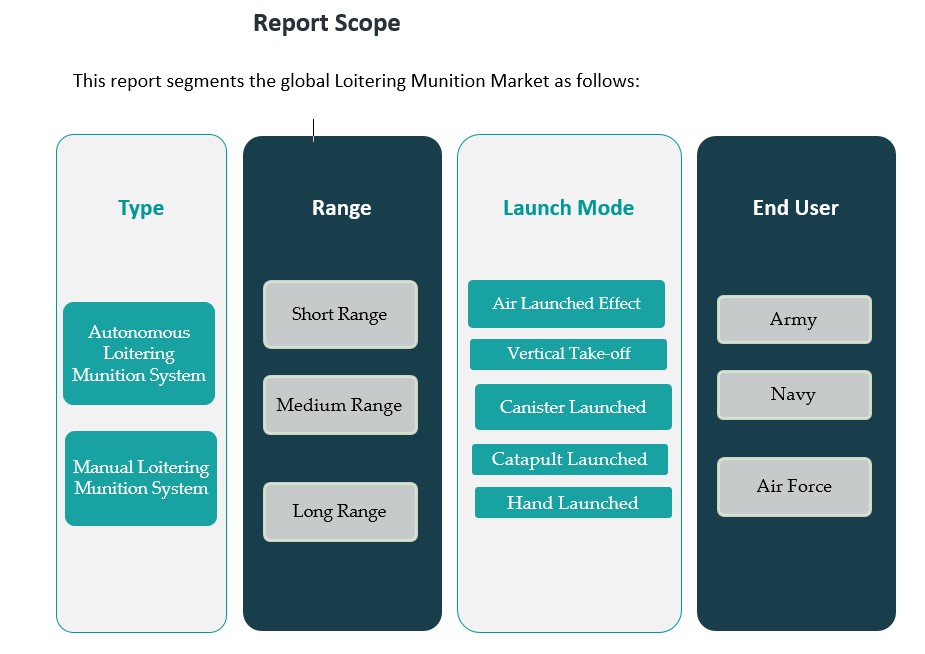
The global loitering munition market is segmented across several dimensions, including type, range, launch mode, and end user, each contributing to its diverse applications in modern warfare.
By Type:
The market is primarily divided into Autonomous Loitering Munition Systems and Manual Loitering Munition Systems. Autonomous systems, leveraging advanced AI and machine learning, allow for real-time targeting and decision-making with minimal human intervention, driving their adoption in complex, dynamic environments. Manual systems, on the other hand, offer greater control for operators, particularly in more precise or targeted missions where human input is crucial.
By Range:
The Short Range segment is primarily used for localized strikes and surveillance, offering quick deployment. Medium Range loitering munitions are suitable for tactical operations in more expansive areas. Long Range systems, typically used for strategic missions, offer extended endurance and reach, allowing for precision strikes over large distances.
By Launch Mode:
The launch modes include Air Launched Effect, Vertical Take-off, Canister Launched, Catapult Launched, and Hand Launched systems. Each launch mode offers different deployment advantages based on mission requirements and operational environments. Air-launched and vertical take-off systems are particularly useful for versatile, rapid deployment from various platforms, while hand-launched systems are more portable and adaptable in tactical ground operations.
By End User:
The market serves three primary end users: Land, Air, and Navy. Land forces use loitering munitions for precision strikes and surveillance in ground combat. Air forces leverage them for strategic and tactical air-to-ground operations, while navies deploy these systems to enhance maritime security and precision targeting in naval operations.
Segmentation:
By Type:
- Autonomous Loitering Munition System
- Manual Loitering Munition System
By Range:
- Short Range
- Medium Range
- Long Range
By Launch Mode:
- Air Launched Effect
- Vertical Take-off
- Canister Launched
- Catapult Launched
- Hand Launched
By End User:
- Land
- Air
- Navy
Regional Analysis:
The global loitering munition market is experiencing significant growth across various regions, each contributing to the overall market development in distinct ways. North America, particularly the United States, holds the largest share of the market, accounting for approximately 40% of the global market share. The region's dominance is primarily driven by the advanced defense infrastructure, substantial military budgets, and the presence of key manufacturers such as AeroVironment and Raytheon Technologies. The U.S. military's increasing reliance on loitering munitions for precision strikes in both conventional and asymmetric warfare further solidifies its position. Furthermore, North America continues to lead in technological innovation, pushing the market forward with advancements in autonomous systems, AI, and sensor technologies.
Europe ranks as the second-largest region, representing about 25% of the market share. Key countries such as the United Kingdom, France, and Germany are focusing heavily on defense modernization, which includes integrating loitering munitions into their arsenals. European defense forces are particularly interested in the versatility and cost-effectiveness of loitering munitions, which offer operational flexibility in counter-terrorism and peacekeeping missions. The growing collaboration between European nations on defense projects also fosters market growth, with governments seeking innovative solutions to strengthen their military capabilities. Additionally, the region’s involvement in NATO operations enhances the demand for advanced strike technologies like loitering munitions.
The Asia-Pacific region is poised for rapid growth, contributing to approximately 20% of the global loitering munition market share. Countries such as China, India, and Japan are investing heavily in modernizing their defense technologies. The growing geopolitical tensions in the region, particularly in the South China Sea and the Indian subcontinent, are driving the demand for more precise and flexible strike capabilities. The expansion of the Asia-Pacific market is further fueled by the rising defense budgets of key nations, as well as the increasing integration of advanced unmanned systems in military operations. Moreover, the adoption of loitering munitions in counter-insurgency and border control operations presents additional growth opportunities in the region.
The Middle East and Africa (MEA) region, accounting for around 10% of the market, has witnessed an uptick in the adoption of loitering munitions, primarily driven by the ongoing conflicts and security concerns in countries like Israel, Saudi Arabia, and the UAE. Loitering munitions have become a critical asset for nations in the region that face asymmetric threats from non-state actors and insurgent groups. Their ability to provide low-cost, precision strikes in complex, congested environments has made them an essential part of the region's military arsenals.
Latin America, while holding the smallest market share at approximately 5%, is gradually embracing loitering munitions as part of defense modernization efforts. Countries like Brazil and Argentina are exploring the potential of these systems to enhance their defense capabilities, particularly in border control and counter-terrorism operations. While the market in this region remains in its nascent stages, there is a growing interest in cost-effective, autonomous systems to address security challenges.
Key Player Analysis:
- AeroVironment, Inc.
- UVision Air Ltd.
- Embenation
- Paramount Group
- Elbit Systems Ltd
- ZALA Aero group
- Israel Aerospace Industries Ltd.
- WB Group
- Rheinmetall AG
- WB Group
- Thales
- Uvision
- KNDS
- Paramount Group
- RTX
- Others
Competitive Analysis:
The global loitering munition market is highly competitive, with several key players dominating the landscape. Major companies such as AeroVironment, Elbit Systems, and Israel Aerospace Industries (IAI) are at the forefront, leveraging their expertise in unmanned aerial systems (UAS) and advanced defense technologies. AeroVironment, with its Switchblade series, has established itself as a leader in the market, offering cost-effective, rapidly deployable loitering munitions. Elbit Systems, with its Harop and Spice systems, continues to innovate with long-range, autonomous munitions for precision strikes in complex environments. Additionally, smaller and emerging players, including Raytheon Technologies and Rheinmetall, are making significant strides in loitering munition development, focusing on enhancing system autonomy, payload capacity, and communication capabilities. Competition in this market is intensifying as countries seek to modernize their defense arsenals with precision strike capabilities. Strategic partnerships, technological advancements, and cost-effective solutions remain key competitive factors driving the growth of loitering munition manufacturers.
Recent Developments:
- In October 2024, AeroVironment, a leading US defense technology company, received a $54.9 million delivery order from the US Army for the production of Switchblade loitering munition systems. This order is part of a larger indefinite-delivery/indefinite-quantity (IDIQ) contract with a potential additional contract ceiling of $743 million, reinforcing AeroVironment’s position as a key supplier of advanced loitering munitions to the US military.
- In October 2024, Anduril Industries, in collaboration with AeroVironment and Teledyne FLIR, secured contracts from the US Marine Corps to develop loitering munitions for the Organic Precision Fires-Light (OPF-L) Program. The initial contracts total $27.5 million, with the potential to reach a combined value of up to $249 million by April 2026. This initiative aims to modernize strike capabilities for dismounted troops under the Force Design Initiative, marking a significant step in the evolution of US Marine Corps’ precision strike capabilities.
- In April 2024, UVision, an Israeli defense technology company, partnered with Science Applications International Corporation (SAIC) in the United States to double the domestic production of its HERO 120 loitering munitions. This partnership establishes a robust US-based supply chain for the HERO 120, HERO 30, and HERO 400 models, which are already in use by US Special Operations Command and are being considered for broader Army adoption.
Market Concentration & Characteristics:
The global loitering munition market is characterized by a moderate concentration, with a few dominant players holding significant market share. Companies such as AeroVironment, Elbit Systems, and Israel Aerospace Industries (IAI) lead the market, leveraging their established reputations and technological expertise in unmanned systems. These players have substantial resources for research and development, enabling them to innovate and offer advanced, high-performance loitering munitions. However, the market also features a growing number of smaller, emerging companies that are focusing on cost-effective solutions, autonomous capabilities, and specialized systems tailored to regional defense needs. The market exhibits a high degree of technological advancement, with increasing demand for autonomous, precision-guided systems. Manufacturers are continually investing in improving system reliability, payload capacity, and endurance. The market is also influenced by the increasing adoption of hybrid loitering munition models and expanding commercial applications, contributing to both defense and non-defense sector growth.
Report Coverage:
The research report offers an in-depth analysis based on Type. Range, Launch Mode and End User. It details leading market players, providing an overview of their business, product offerings, investments, revenue streams, and key applications. Additionally, the report includes insights into the competitive environment, SWOT analysis, current market trends, as well as the primary drivers and constraints. Furthermore, it discusses various factors that have driven market expansion in recent years. The report also explores market dynamics, regulatory scenarios, and technological advancements that are shaping the industry. It assesses the impact of external factors and global economic changes on market growth. Lastly, it provides strategic recommendations for new entrants and established companies to navigate the complexities of the market.
Future Outlook:
- The global loitering munition market is anticipated to experience substantial growth in the coming years.
- Continued advancements in AI and autonomous systems will further improve the precision and operational efficiency of loitering munitions.
- Rising defense budgets, particularly in emerging markets, will drive demand for cost-effective, precise strike solutions.
- The integration of loitering munitions into hybrid systems will offer greater operational flexibility for military forces.
- Technological innovations in miniaturization and endurance will enable loitering munitions to cover more extensive areas and operate longer.
- The growing use of loitering munitions in counter-terrorism and asymmetric warfare will accelerate their adoption across various defense sectors.
- Loitering munition technology is expected to expand into commercial applications such as search and rescue and critical infrastructure monitoring.
- Improved communication systems will enhance the connectivity, control, and adaptability of loitering munitions during operations.
- Increased geopolitical tensions, particularly in Asia-Pacific and the Middle East, will lead to greater demand for advanced loitering munitions.
- Ethical and regulatory challenges surrounding their use in warfare may shape market dynamics, resulting in the implementation of more stringent guidelines.

Request a Free Sample
Fill in your details and we'll send you a free sample report.
- Sample data tables & charts
- Research methodology
Market Dynamics
Demand for Precision Strike Capabilities
Modern armed forces are prioritizing precision strike systems to minimize collateral damage and maximize targeting accuracy, making loitering munitions attractive due to their ability to loiter, surveil, and autonomously engage targets.
Advancements in AI and Autonomous Systems
Rapid progress in artificial intelligence and machine learning is enhancing the autonomy, target recognition, and decision-making of loitering munitions, increasing their operational effectiveness and appeal to militaries seeking smart weaponry.
Cost-Effectiveness Compared to Traditional Missiles
Loitering munitions are generally less expensive than conventional missile systems, allowing for larger-scale deployment and providing a flexible, efficient solution for militaries with constrained budgets.
Rising Geopolitical Tensions and Security Concerns
Increasing regional conflicts and asymmetric warfare threats are prompting nations to invest in advanced strike technologies like loitering munitions, which offer rapid, precise, and versatile response options.
Military Modernization and Increased Defense Budgets
Global trends toward military modernization and higher defense spending, especially in emerging markets, are driving the adoption of advanced loitering munitions as part of broader efforts to maintain strategic and technological superiority.
Need a Custom Version of This Report?
Tailor the scope, geography, or segments to your exact requirements.
- Custom geography or segment scope
- Direct access to our analyst team
Frequently Asked Questions
What is the current size of the Global Loitering Munition Market?
What factors are driving the growth of the Global Loitering Munition Market?
What are the key segments within the Global Loitering Munition Market?
What are some challenges faced by the Global Loitering Munition Market?
Who are the major players in the Global Loitering Munition Market?
Table of Content
Chapter 1 Market Segmentation
- 1.1 Segmentation Framework
- 1.1.1 Product and Service Classification
- 1.1.2 Application and End-Use Classification
- 1.1.3 Technology and Solution Classification
- 1.1.4 Customer and Distribution Channel Classification
- 1.1.5 Geographic Segmentation
- 1.1.6 Market Segment Definitions and Boundaries
- 1.2 By Type
- 1.2.1 Autonomous Loitering Munition System
- 1.2.2 Manual Loitering Munition System
- 1.3 By Range
- 1.3.1 Short Range
- 1.3.2 Medium Range
- 1.3.3 Long Range
- 1.4 By End User
- 1.4.1 Land
- 1.4.2 Air
- 1.4.3 Navy
- 1.5 By Launch Mode
- 1.5.1 Air Launched Effect
- 1.5.2 Vertical Take-off
- 1.5.3 Canister Launched
- 1.5.4 Catapult Launched
- 1.5.5 Hand Launched
Chapter 2 Introduction
- 2.1 Report Objectives and Scope
- 2.2 Product Definition and Industry Terminology
- 2.3 Market Inclusions and Exclusions
- 2.4 Research Process
- 2.4.1 Primary Research and Expert Interviews
- 2.4.2 Secondary Research and Source Review
- 2.4.3 Top-Down and Bottom-Up Estimation
- 2.4.4 Data Triangulation and Verification
- 2.5 Market Size Measurement Basis
- 2.5.1 2023: USD 1,967.89 million → 2032: USD 4,952.89 million
- 2.6 Historical and Forecast Reference Periods
- 2.6.1 Base Year: 2023
- 2.6.2 Forecast Period: 2023-2032
- 2.7 Research Assumptions and Limitations
Chapter 3 Executive Summary
- 3.1 Market Snapshot and Key Findings
- 3.2 Base-Year Market Size, 2023
- 3.3 Forecast Market Size, 2032
- 3.4 Revenue and Volume Growth Outlook
- 3.5 Key Demand and Supply Indicators
- 3.6 Leading Market Segments
- 3.7 Fastest-Growing Market Opportunities
- 3.8 Regional Performance Highlights
- 3.9 Technology and Industry Transformation
- 3.10 Competitive Landscape Summary
- 3.11 Analyst View and Strategic Implications
Chapter 4 Global Loitering Munition Market Trends and Developments
- 4.1 Historical Industry Development
- 4.2 Recent Market Trends and Developments
- 4.3 Demand and Customer Behavior Trends
- 4.4 Technology and Product Innovation
- 4.5 Artificial Intelligence, Automation and Digitalization
- 4.6 Local Manufacturing and Supply Chain Realignment
- 4.7 Industry Partnerships, Mergers and Acquisitions
- 4.8 Sustainability and Circular Economy Developments
- 4.9 Government and Private Sector Investment Trends
- 4.10 Emerging Business Models and Commercialization
- 4.11 Industry Developments and Announcements
Chapter 5 Global Loitering Munition Market Production, Supply and Demand Analysis
- 5.1 Demand Trend and Consumption Analysis
- 5.2 Demand Forecast, 2023-2032
- 5.3 Production and Output Trend
- 5.4 Production and Output Forecast, 2023-2032
- 5.5 Installed Capacity and Capacity Utilization
- 5.6 Company-Wise Production Plants and Statistics
- 5.6.1 Installed Production Capacity
- 5.6.2 Actual Production
- 5.6.3 Planned Capacity and Expansion Targets
- 5.7 Supply Chain Structure and Procurement Trends
- 5.8 Supply-Demand Gap and Bottlenecks
- 5.9 Import Dependence and Sourcing Structure
- 5.10 Contract Manufacturing and Outsourcing
- 5.11 Regional Supply and Demand Concentration
Chapter 6 Global Loitering Munition Market Pricing Analysis
- 6.1 Pricing Structure and Measurement
- 6.2 Historical Pricing Trends
- 6.3 Pricing Outlook, 2023-2032
- 6.4 Average Selling Price and Unit Economics
- 6.5 Pricing by Product and Market Segment
- 6.6 Geographic Pricing Differences
- 6.7 Key Input, Energy, Labor and Logistics Costs
- 6.8 Contract Pricing and Purchasing Models
- 6.9 Pricing Sensitivity and Competitive Positioning
- 6.10 Price, Margin and Profitability Implications
Chapter 7 Global Loitering Munition Market Dynamics
- 7.1 Market Growth Drivers
- 7.1.1 Demand-Side Drivers
- 7.1.2 Technology and Innovation Drivers
- 7.1.3 Infrastructure and Investment Drivers
- 7.1.4 Regulatory and Policy Drivers
- 7.2 Market Restraints
- 7.2.1 Cost and Affordability Constraints
- 7.2.2 Technology and Adoption Barriers
- 7.2.3 Supply Chain and Operational Constraints
- 7.3 Market Challenges
- 7.3.1 Competitive Pressure and Margin Erosion
- 7.3.2 Skills, Infrastructure and Implementation Gaps
- 7.4 Emerging Market Opportunities
- 7.5 Market Dynamics Impact and Time-Horizon Assessment
Chapter 8 Global Loitering Munition Value Chain Analysis
- 8.1 Industry Value Chain Overview
- 8.2 Upstream Suppliers and Critical Inputs
- 8.3 Technology and Component Providers
- 8.4 Manufacturing or Service Delivery
- 8.5 Distribution, Channel Partners and Integrators
- 8.6 Downstream Applications and End Users
- 8.7 Value Addition and Profit Pools
- 8.8 Vertical Integration and Outsourcing
- 8.9 Supplier Concentration and Risk
- 8.10 Supply Chain Localization and Resilience
Chapter 9 Global Loitering Munition Market Regulations and Policies
- 9.1 Relevant Laws, Standards and Compliance Frameworks
- 9.2 Product, Service, Safety and Quality Requirements
- 9.3 Government Policies, Incentives and Subsidies
- 9.4 Imports, Exports and Trade Barriers
- 9.5 Public Procurement and Local Content Requirements
- 9.6 Environmental and Sustainability Compliance
- 9.7 Upcoming Policy Changes and Market Implications
Chapter 10 Global Loitering Munition Market Hotspots and Opportunities
- 10.1 Market Opportunity Mapping and Growth Hotspots
- 10.2 High-Growth Applications and Customer Groups
- 10.3 Underserved Markets and White-Space Opportunities
- 10.4 Emerging Technology and Product Opportunities
- 10.5 New Capacity and Investment Hotspots
- 10.6 Market Entry and Expansion Opportunities
- 10.7 Distribution and Partnership Opportunities
- 10.8 Near-Term and Long-Term Commercial Potential
- 10.9 Opportunity Attractiveness and Execution Risks
Chapter 11 Global Loitering Munition Market Outlook, 2023-2032
- 11.1 Market Size and Analysis
- 11.1.1 Revenue (Market Measurement: 2023: USD 1,967.89 million → 2032: USD 4,952.89 million)
- 11.1.2 Market Volume and Quantity Sold
- 11.1.3 Historical Market Size
- 11.1.4 Base-Year Market Size, 2023
- 11.2 Market Forecast, 2023-2032
- 11.2.1 Revenue Forecast to 2032
- 11.2.2 Volume Forecast to 2032
- 11.2.3 CAGR and Year-on-Year Growth
- 11.2.4 Incremental Revenue Opportunity
- 11.3 Forecast Assumptions and Scenario Analysis
- 11.3.1 Base-Case Forecast
- 11.3.2 Optimistic and Conservative Scenarios
- 11.3.3 Technology, Pricing and Policy Sensitivities
- 11.4 Market Attractiveness and Growth Outlook
Chapter 12 Global Loitering Munition Market Segmentation and Outlook
- 12.1 Segmentation Summary and Market Shares, 2023
- 12.2 Largest and Fastest-Growing Segments
- 12.3 By Type - Market Size and Forecast, 2023-2032
- 12.3.1 Segment Definition and Scope
- 12.3.2 Historical Market Size
- 12.3.3 Revenue Forecast, 2023-2032
- 12.3.4 Volume Forecast, 2023-2032
- 12.3.5 Base-Year Market Share, 2023
- 12.3.6 Segment CAGR and Growth Drivers
- 12.3.7 Subsegment Market Size and Forecast
- 12.3.7.1 Autonomous Loitering Munition System
- 12.3.7.2 Manual Loitering Munition System
- 12.3.8 Subsegment Pricing and Adoption Trends
- 12.3.9 Leading Suppliers and Competition
- 12.3.10 Regional Demand and Opportunities
- 12.4 By Range - Market Size and Forecast, 2023-2032
- 12.4.1 Segment Definition and Scope
- 12.4.2 Historical Market Size
- 12.4.3 Revenue Forecast, 2023-2032
- 12.4.4 Volume Forecast, 2023-2032
- 12.4.5 Base-Year Market Share, 2023
- 12.4.6 Segment CAGR and Growth Drivers
- 12.4.7 Subsegment Market Size and Forecast
- 12.4.7.1 Short Range
- 12.4.7.2 Medium Range
- 12.4.7.3 Long Range
- 12.4.8 Subsegment Pricing and Adoption Trends
- 12.4.9 Leading Suppliers and Competition
- 12.4.10 Regional Demand and Opportunities
- 12.5 By End User - Market Size and Forecast, 2023-2032
- 12.5.1 Segment Definition and Scope
- 12.5.2 Historical Market Size
- 12.5.3 Revenue Forecast, 2023-2032
- 12.5.4 Volume Forecast, 2023-2032
- 12.5.5 Base-Year Market Share, 2023
- 12.5.6 Segment CAGR and Growth Drivers
- 12.5.7 Subsegment Market Size and Forecast
- 12.5.7.1 Land
- 12.5.7.2 Air
- 12.5.7.3 Navy
- 12.5.8 Subsegment Pricing and Adoption Trends
- 12.5.9 Leading Suppliers and Competition
- 12.5.10 Regional Demand and Opportunities
- 12.6 By Launch Mode - Market Size and Forecast, 2023-2032
- 12.6.1 Segment Definition and Scope
- 12.6.2 Historical Market Size
- 12.6.3 Revenue Forecast, 2023-2032
- 12.6.4 Volume Forecast, 2023-2032
- 12.6.5 Base-Year Market Share, 2023
- 12.6.6 Segment CAGR and Growth Drivers
- 12.6.7 Subsegment Market Size and Forecast
- 12.6.7.1 Air Launched Effect
- 12.6.7.2 Vertical Take-off
- 12.6.7.3 Canister Launched
- 12.6.7.4 Catapult Launched
- 12.6.7.5 Hand Launched
- 12.6.8 Subsegment Pricing and Adoption Trends
- 12.6.9 Leading Suppliers and Competition
- 12.6.10 Regional Demand and Opportunities
- 12.7 Segment Growth Comparison
- 12.8 Segment Attractiveness and Priority Matrix
Chapter 13 Global Loitering Munition End-Use and Application Market Outlook
- 13.1 End-Use Industry and Customer Demand Structure
- 13.2 Leading Applications and Customer Groups
- 13.3 End-Use Market Size, Share and Forecast
- 13.4 Major End-Use Industry Deep Dives
- 13.4.1 Customer Requirements and Use Cases
- 13.4.2 Demand and Replacement Cycles
- 13.4.3 Technical and Regulatory Considerations
- 13.4.4 Purchasing and Procurement Models
- 13.4.5 Leading Vendors and Distribution Channels
- 13.4.6 Forecast and Commercial Opportunities
- 13.5 Emerging Applications and Cross-Segment Demand
- 13.6 End-Use Industry Investment Priorities
Chapter 14 Global Loitering Munition Geographic Market Outlook, 2023-2032
- 14.1 Regional Market Size and Share, 2023
- 14.2 Regional Market Forecast, 2023-2032
- 14.3 Regional Pricing, Production and Demand Differences
- 14.4 North America
- 14.4.1 United States
- 14.4.2 Canada
- 14.4.3 Mexico
- 14.5 Europe
- 14.5.1 Germany
- 14.5.2 France
- 14.5.3 Italy
- 14.5.4 United Kingdom
- 14.5.5 Spain
- 14.5.6 Poland
- 14.5.7 Russia
- 14.5.8 Netherlands
- 14.5.9 Belgium
- 14.5.10 Sweden
- 14.5.11 Denmark
- 14.5.12 Norway
- 14.5.13 Rest of Europe
- 14.6 Asia Pacific
- 14.6.1 China
- 14.6.2 India
- 14.6.3 Japan
- 14.6.4 South Korea
- 14.6.5 Thailand
- 14.6.6 Indonesia
- 14.6.7 Vietnam
- 14.6.8 Malaysia
- 14.6.9 Australia
- 14.6.10 Rest of Asia Pacific
- 14.7 Latin America
- 14.7.1 Brazil
- 14.7.2 Argentina
- 14.7.3 Colombia
- 14.7.4 Chile
- 14.7.5 Rest of Latin America
- 14.8 Middle East
- 14.8.1 Saudi Arabia
- 14.8.2 United Arab Emirates
- 14.8.3 Turkey
- 14.8.4 Israel
- 14.8.5 Iran
- 14.8.6 Rest of the Middle East
- 14.9 Africa
- 14.9.1 South Africa
- 14.9.2 Egypt
- 14.9.3 Nigeria
- 14.9.4 Morocco
- 14.9.5 Rest of Africa
- 14.10 Regional Investment, Policy and Supply Chain Differences
- 14.11 Regional Competitive Landscape
- 14.12 Geographic Growth Hotspots
Chapter 15 Global Loitering Munition Technology, Innovation and Sustainability Outlook
- 15.1 Technology Landscape and Maturity
- 15.2 Product, Process and Service Innovation
- 15.3 AI, Automation and Digital Tools in the Industry
- 15.4 Technology Adoption and Performance Benchmarking
- 15.5 Innovation Pipeline and R&D Investment
- 15.6 Patent and Intellectual Property Trends
- 15.7 Energy Efficiency and Resource Management
- 15.8 Sustainability, Recycling and Circularity
- 15.9 Technology Roadmap, 2023-2032
- 15.10 Risks of Obsolescence and Technology Substitution
Chapter 16 Global Loitering Munition Market Key Strategic Imperatives
- 16.1 Growth and Market Entry Priorities
- 16.2 High-Return Products and Segments
- 16.3 Pricing, Profitability and Cost Optimization
- 16.4 Technology Investment and Product Differentiation
- 16.5 Supply Chain Localization and Resilience
- 16.6 Distribution and Customer Acquisition
- 16.7 Partnership, Acquisition and Capacity Strategy
- 16.8 Regional Expansion Priorities
- 16.9 Short-, Medium- and Long-Term Actions
Chapter 17 Competition Outlook
- 17.1 Industry Competition Characteristics
- 17.2 Market Structure and Concentration
- 17.3 Market Share and Competitive Positioning, 2023
- 17.4 Company-Wise Revenue and Product Benchmarking
- 17.5 Production and Service Capacity Benchmarking
- 17.6 Technology, Pricing and Differentiation
- 17.7 Regional Footprint and Distribution Strength
- 17.8 Mergers, Acquisitions and Strategic Alliances
- 17.9 New Entrants and Competitive Threats
- 17.10 Porter's Five Forces and Industry Attractiveness
- 17.11 Competitive Outlook, 2023-2032
Chapter 18 Company Profiles
- 18.1 Company Coverage and Selection Criteria
- 18.2 AeroVironment, Inc.
- 18.2.1 Business Description
- 18.2.2 Company Ownership and Geographic Presence
- 18.2.3 Product and Service Portfolio
- 18.2.4 Manufacturing and Operating Footprint
- 18.2.5 Production Capacity and Expansion Plans
- 18.2.6 Financial Performance and Investment
- 18.2.7 Market Share and Competitive Position
- 18.2.8 Technology and Innovation Capabilities
- 18.2.9 Strategic Alliances or Partnerships
- 18.2.10 Recent Developments
- 18.2.11 Growth Strategy and Outlook
- 18.3 Elbit Systems Ltd.
- 18.4 Israel Aerospace Industries Ltd.
- 18.5 UVision Air Ltd.
- 18.6 Raytheon Technologies (RTX)
- 18.7 Rheinmetall AG
- 18.8 WB Group
- 18.9 Thales Group
- 18.10 Paramount Group
- 18.11 ZALA Aero Group
- 18.12 Other Relevant Market Participants
Note: Every listed company is profiled on the structure shown under the first company. The company list is preliminary and may change based on research findings, market developments, data availability and client requirements.
Chapter 19 Disclaimer
- 19.1 Research and Forecast Disclaimer
- 19.2 Data Source and Estimation Limitations
Note: The depth of individual sections depends on data availability for this market. Volume, capacity, trade and other unit-based metrics are included where applicable.