
Repeat injectables anchor clinic spending across the region
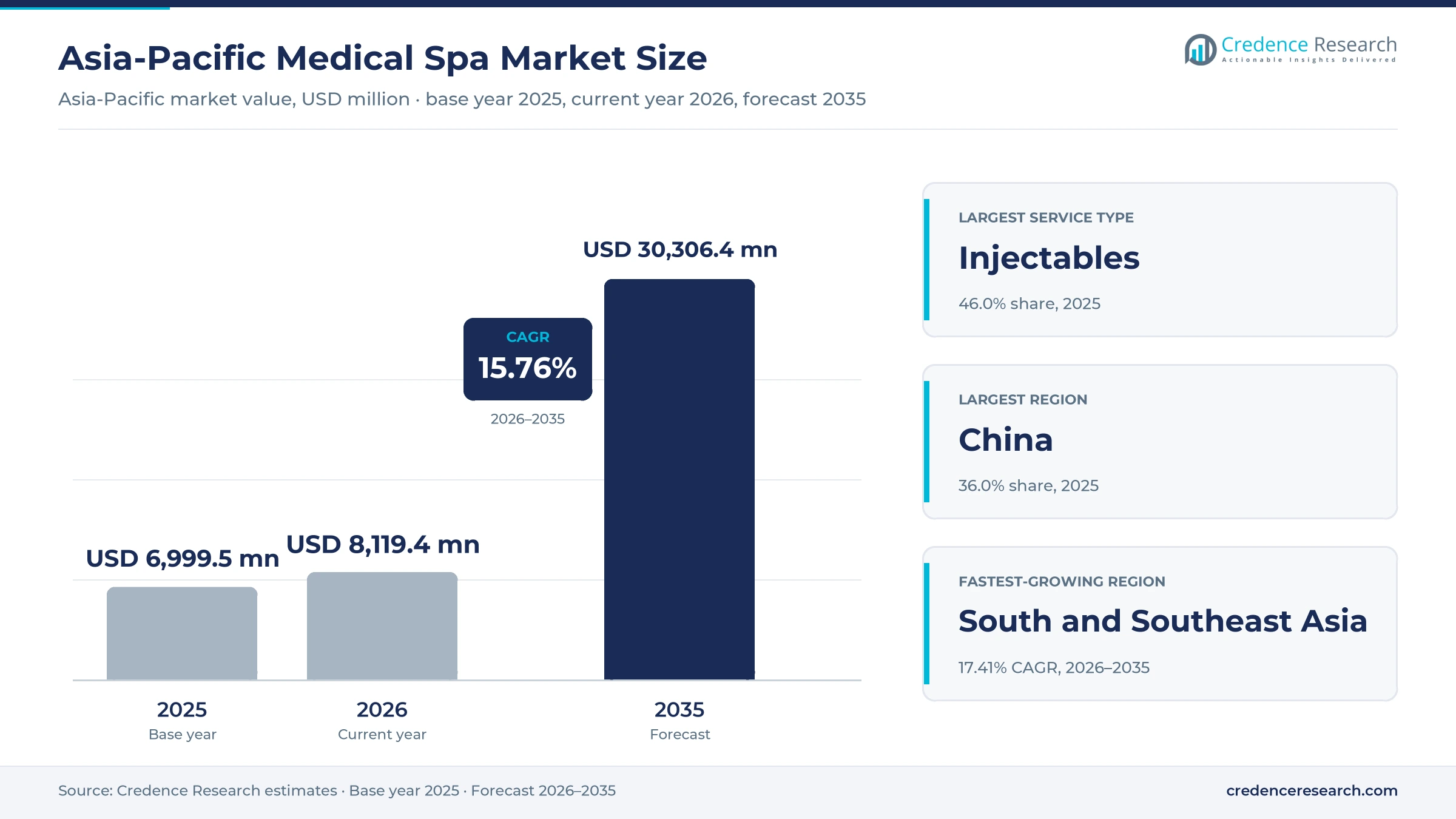
The Asia-Pacific medical spa market was valued at USD 7.00 billion in 2025 and is projected to increase from USD 8.12 billion in 2026 to USD 30.31 billion by 2035, registering a CAGR of 15.76% during 2026–2035. Demand comes from repeat injectable and energy-based sessions sold by physician-led clinics in dense metropolitan catchments. China held the largest share, 36.0% in 2025, and So-Young International alone operated 65 youth clinics in 18 Chinese cities by June 30, 2026. South and Southeast Asia is the fastest-growing zone at 17.41% a year because partner-led chains such as V6 Clinics are moving into Tier 2 Indian cities. International demand adds a distinct layer, with South Korea's Ministry of Health and Welfare counting 2.01 million foreign patients in 2025, most of them in dermatology. Regulation is tightening at the same time, because China's National Health Commission, Japan's health ministry and Australia's Ahpra each moved against unsafe practice or promotion during 2024 and 2025.
What does a medical spa sell in Asia-Pacific clinics?
The Asia-Pacific medical spa market counts physician-supervised, non-surgical aesthetic and medical wellness services delivered in clinics, including injectables, energy-based treatments, medical skin care and related in-clinic retail. Patients usually pay out of pocket per session, through prepaid courses or through loyalty and membership schemes, and they book directly, through specialist apps or through referrals.
Surgical cosmetic procedures, hospital inpatient care, home-use devices and day spas without medical supervision are excluded from the estimate. The value chain runs from toxin, filler and device makers through distributors to clinics, while platforms and travel referrers influence where patients book. Values reflect clinic-level spending rather than manufacturer sales of toxins, fillers or devices.
Asia-Pacific Medical Spa Market Insights
- Clinic spending grows from USD 7.00 billion in 2025 to USD 30.31 billion by 2035, a compound rate of 15.76%, as repeat non-surgical treatment widens across the region.
- China held 36.0% of 2025 value, supported by clinic groups such as So-Young, which reached 65 youth clinics in 18 cities by June 2026.
- Injectables held 46.0% of 2025 value, as toxin and filler rank first and second among non-surgical procedures in the 2025 ISAPS survey.
- South Korea counted 2.01 million foreign patients in 2025, nearly double the 2024 total, and dermatology took 62.9% of those patients, according to its health ministry.
- SBC Medical Group listed 237 franchisee treatment centers in Japan at Dec. 31, 2025, and it reported that 72% of customers returned to clinics at least twice.
Injectables and independent clinics hold the largest shares
Why do injectables lead clinic treatment menus?
Based on service type, the market is categorized into injectables, energy-based treatments and medical skin and wellness services. Injectables led with 46.0% of 2025 value because botulinum toxin and hyaluronic acid accounted for 12.0 million of the 17.3 million non-surgical procedures in the 2025 survey by the International Society of Aesthetic Plastic Surgery. Energy-based treatments grow fastest at 16.51% a year as Kaya began a national rollout of the Aerolase Neo Elite laser across its Indian clinics in July 2025, while the same survey ranks non-surgical skin tightening third worldwide.
How much do foreign visitors add to resident demand?
Based on customer type, the market is categorized into domestic resident patients, expatriate resident patients and international visiting patients. Domestic resident patients led with 78.0% of 2025 value because resident clients supply the repeat base, and SBC Medical Group alone served about 6.76 million customers in the 12 months to March 31, 2026, mostly through its clinics in Japan. International visiting patients grow fastest at 18.20% a year as South Korea's Ministry of Health and Welfare recorded 2.01 million foreign patients in 2025 against 1.17 million in 2024, with dermatology taking 62.9% of them.
Why do physician-owned clinics still hold most value?
Based on operating model, the market is categorized into independent physician-owned clinics, corporate-owned clinic chains and franchise and partnership networks. Independent physician-owned clinics led with 52.0% of 2025 value because even large networks remain small against national demand, as Kaya counted 82 Indian clinics in January 2026 and So-Young counted 65 clinics in 18 Chinese cities in June 2026. Franchise and partnership networks grow fastest at 17.32% a year as SBC Medical Group reached 284 franchise locations by March 31, 2026, up 33 in a year, and V6 Clinics targets 100 partner-led Indian clinics by March 2029.
Which payment structures keep clients returning?
Based on revenue model, the market is categorized into pay-per-procedure, prepaid treatment packages, recurring memberships and in-clinic retail. Pay-per-procedure led with 50.0% of 2025 value because visitors and first-time clients tend to buy single sessions, and the Korea Institute for Industrial Economics & Trade put foreign patient treatment spending at 3.3 trillion won in 2025. Recurring memberships grow fastest at 17.59% a year as So-Young counted more than 78,000 core members at level three or above in June 2026, while SBC Medical Group runs silver, gold and diamond customer tiers.
| Segment Group | Leading Sub-segment | Share, 2025 | Fastest-growing Sub-segment | CAGR, 2026–2035 |
|---|---|---|---|---|
| By Service Type | Injectables | 46.0% | Energy-based treatments | 16.51% |
| By Customer Type | Domestic resident patients | 78.0% | International visiting patients | 18.20% |
| By Operating Model | Independent physician-owned clinics | 52.0% | Franchise and partnership networks | 17.32% |
| By Revenue Model | Pay-per-procedure | 50.0% | Recurring memberships | 17.59% |
Request a Free Sample
Fill in your details and we'll send you a free sample report.
- Sample data tables & charts
- Research methodology
Repeat visits, inbound patients and chains lift demand
Repeatable non-surgical treatment demand
Clients return to non-surgical treatment on a maintenance cycle, and that repeat behavior gives clinics a more predictable patient base than one-off surgery. SBC Medical Group reported in its first-quarter 2026 release that 72% of customers visited franchisee clinics two or more times, within a base of about 6.76 million customers over 12 months. So-Young International recorded more than 362,000 verified aesthetic treatments in the second quarter of 2026, up 134% from a year earlier, while same-store sales at its clinics rose 52%. According to the International Society of Aesthetic Plastic Surgery survey released Sept. 29, 2026, toxin and hyaluronic acid made up 12.0 million of 17.3 million non-surgical procedures worldwide in 2025. As a result, injectables hold 46.0% of regional 2025 value.
Medical tourism and metropolitan demand
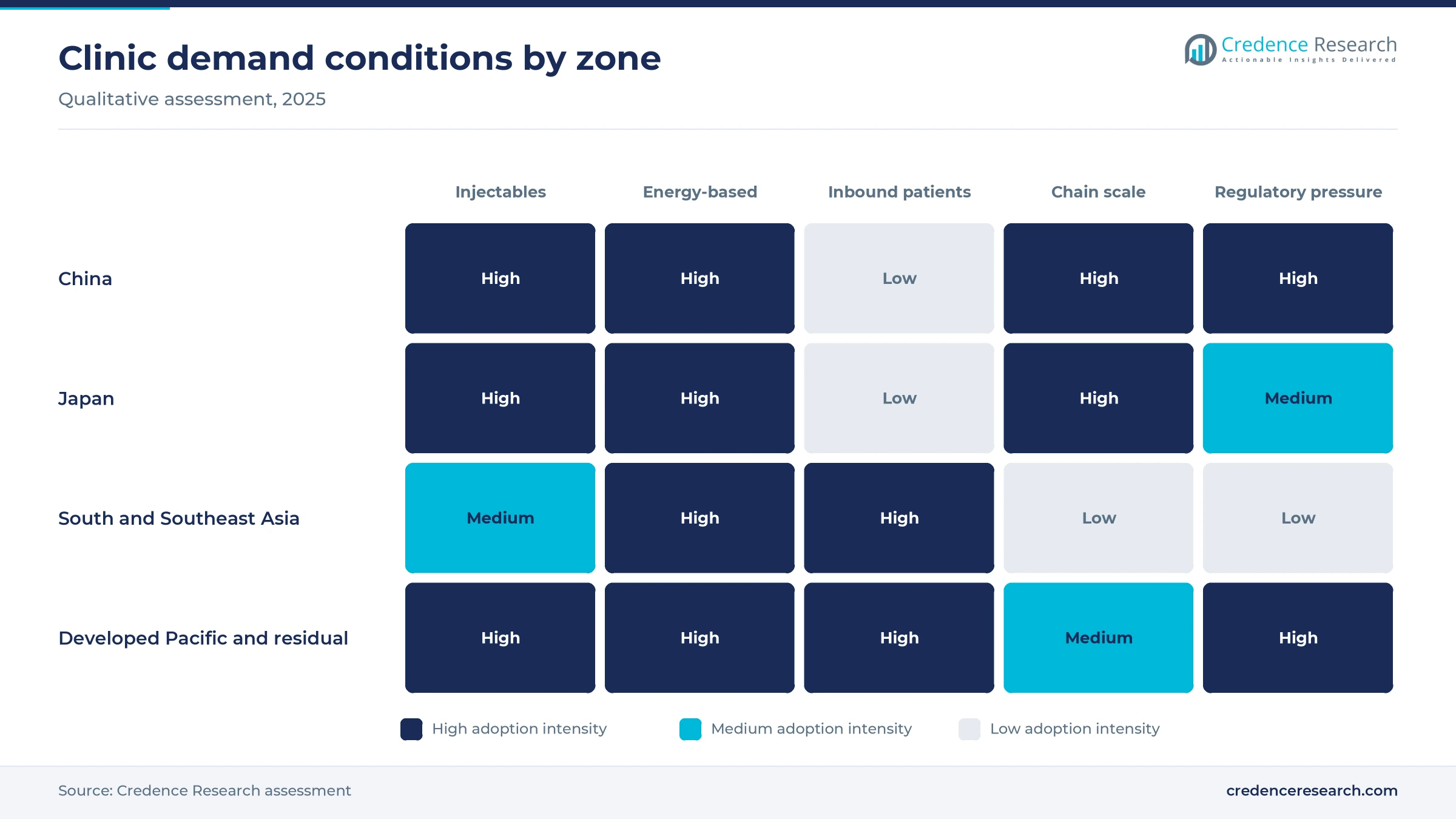
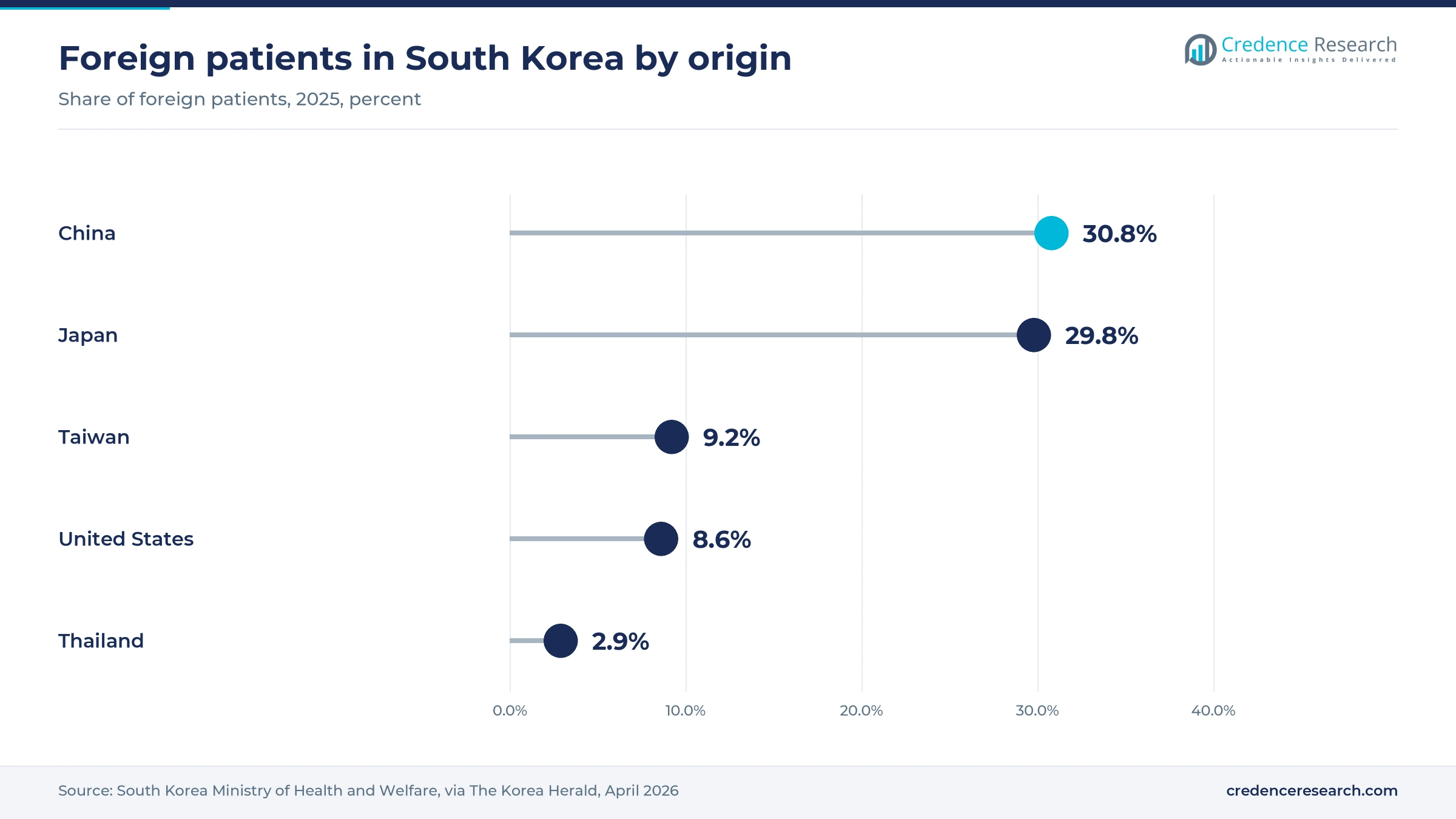
Inbound patients concentrate spending in a few metropolitan clinic districts, which lifts utilization in those cities well above national averages. South Korea's Ministry of Health and Welfare counted 2.01 million foreign patients in 2025, and 62.9% of them used dermatology services, according to The Korea Herald. Seoul treated 87.2% of those patients although it holds 62.5% of registered establishments, which shows how tightly demand clusters. The Korea Institute for Industrial Economics & Trade estimated total visitor spending at 12.5 trillion won, including 3.3 trillion won for treatment. China supplied 30.8% of those patients and Japan 29.8%, while clinic-level institutions handled 87.7% of visits, according to the same Korea Herald report. International visiting patients therefore grow fastest at 18.20% a year.
Chain expansion and standardized delivery
Clinic groups are adding sites through repeatable formats, which spreads training, procurement and marketing across more locations. SBC Medical Group's annual report lists 237 franchisee treatment centers in Japan, plus 21 company-operated centers in Singapore and one in Vietnam, at Dec. 31, 2025. Its corporate presentation dated March 27, 2026, said SBC-branded clinics opened in 2025 reached profitability in an average of five months. So-Young added 11 clinics net in the second quarter of 2026 to reach 65 in 18 cities, supported by about 280 full-time physicians and regular training workshops. Wesfarmers completed its purchase of SILK Laser Australia on Nov. 29, 2023, pairing it with Clear Skincare, which operates more than 90 clinics, to build scale in Australia and New Zealand.
New toxin approvals widen clinic product choice in China
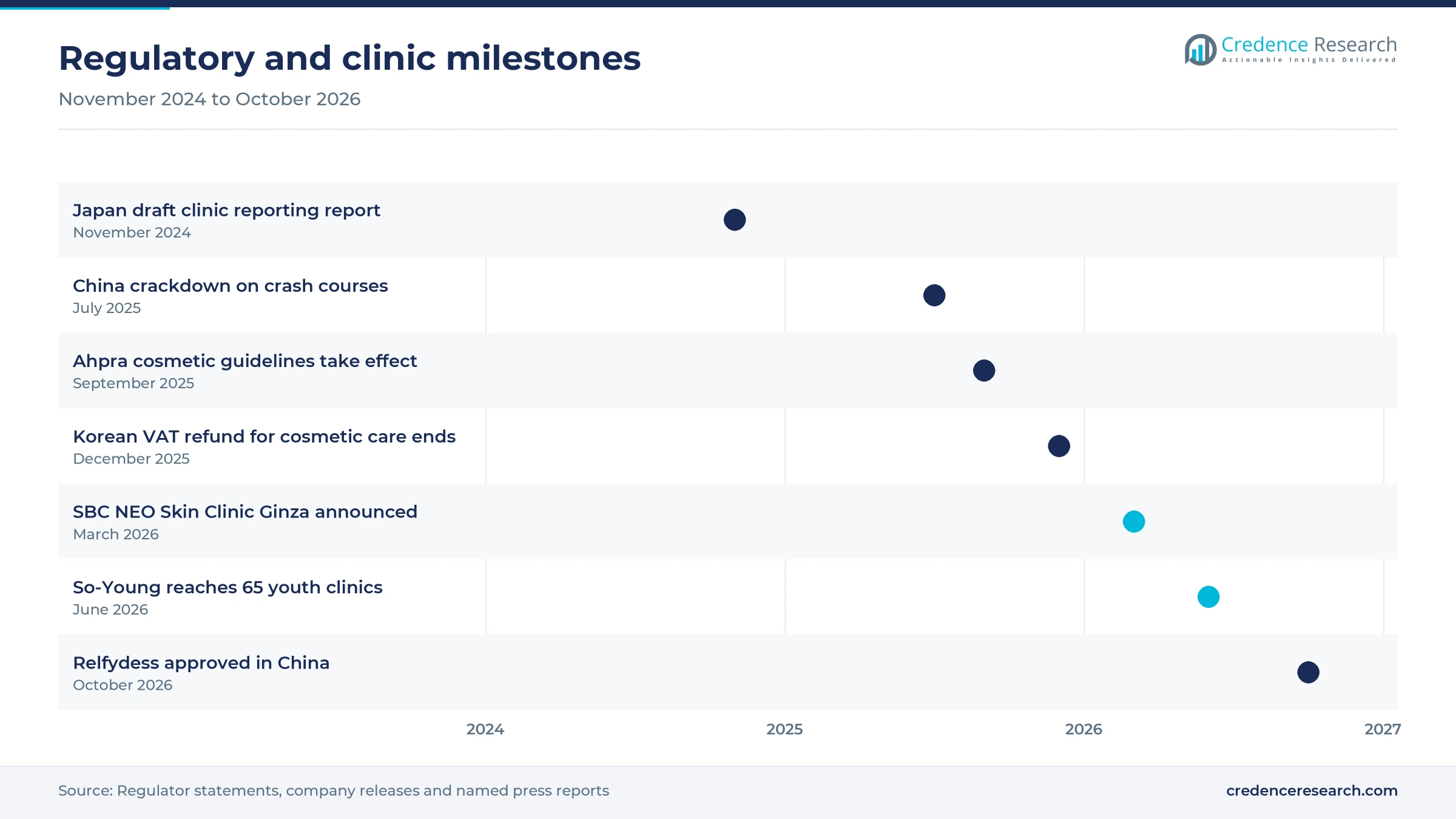
New toxin approvals in China are widening clinic choice and sharpening product-level competition, which supports broader injectable menus over the forecast period. In October 2026, China's National Medical Products Administration approved Galderma's Relfydess for moderate-to-severe frown lines, and Galderma expects a commercial launch in the second half of 2027. Herald Business reported the same month that Inibio's Inibo became the ninth botulinum toxin approved in China and the third from South Korea, after Hugel's Letybo and Huons BioPharma's Hutox. Inibio targets commercialization in the first quarter of 2027, so clinics should see more brands within 18 months. Suppliers of dermal fillers and botulinum toxin therefore compete harder for clinic accounts in China, the largest zone in the region.
Male clients, longevity menus and apps reshape demand
Rise of male clients in clinic customer bases
Men are becoming a commercial target rather than a niche, particularly in Japan and clinics are adjusting menus around that shift. SBC Medical Group's corporate presentation dated March 27, 2026, said male customers made up 44% of more than 6.5 million customers. By comparison, the International Society of Aesthetic Plastic Surgery found that women accounted for 84.8% of non-surgical procedures worldwide in 2025, which leaves men near 15% in that sample. SBC also lists alopecia treatment among its service areas in its first-quarter 2026 release, and Kaya named hair care among its growth categories in January 2026. Interest in hair restoration gives clinics a reason to recruit men who might never request facial injectables.
Shift from aesthetics toward longevity and wellness menus
Operators are extending aesthetic relationships into preventive and longevity services, which raises the number of reasons a client has to return. SBC Medical Group announced its SBC Wellness 2.0 strategy on March 24, 2026, describing a performance medicine category for entry into longevity. Its first-quarter 2026 release also lists fertility treatment, orthopedics and ophthalmology among its service areas. In India, V6 Clinics said on Jan. 29, 2026, that its centers combine dermatology and aesthetics with nutrition, metabolic health and preventive care. Thailand's Ministry of Tourism and Sports counted 92,813 health tourism operators in 2025, according to the U.S.-ASEAN Business Council. Together, these moves support medical skin and wellness services, which already form a distinct part of clinic menus.
Opportunity in multilingual booking platforms for visitors
Multilingual platforms offer clinics a low-cost opening to reach foreign clients who cannot easily compare providers across borders. Healing Paper, operator of Gangnam Unni, announced on April 27, 2026, that its Unni app had passed 700,000 cumulative foreign users by March 2026, across six languages. Japan was its largest source market with about 200,000 new users in the past year, while Thai users rose roughly 20-fold and Taiwanese users about 25-fold. So-Young said more than half of new customers came through referrals in the second quarter of 2026, with acquisition costs below a tenth of aesthetic revenue. Clinics that publish verified prices and physician profiles on such platforms can therefore win visitors with far less spending on advertising.
Opportunity in Tier 2 India and Southeast Asian cities
Secondary cities in India and Southeast Asia offer an opening for standardized formats because organized clinic supply there remains thin. V6 Clinics plans 12 to 15 clinics in its first phase from early 2026, covering major cities and selected Tier 2 markets, on the way to 100 clinics by March 2029. Kaya counted 82 clinics across India in January 2026, with more than 600 service lines. SBC Medical Group reported 21 treatment centers in Singapore and one in Vietnam at the end of 2025, which leaves considerable room elsewhere in Southeast Asia. Laser Clinics Group also announced its first Asian clinic in 2021 through a Singapore partnership with Privé Clinic. South and Southeast Asia is also the fastest-growing zone in Credence Research estimates, which supports that case.
Tighter safety rules and tax changes raise clinic pressure
Unqualified injectors keep China enforcement active
Unqualified practice remains the main safety risk in China, and it exposes compliant clinics to reputational damage. On July 3, 2025, the National Health Commission vowed to crack down on malpractice after crash courses lasting three to four days ran in at least 20 cities, teaching injectables and thread lifts. Independent operators face more inspections and tighter staffing checks as a result. Clinics can respond by documenting physician qualifications and using the national drug traceability system for toxin purchases.
Rising complaints invite tighter oversight in Japan
Consumer complaints are pushing Japan toward stricter clinic oversight, which adds reporting work for operators of every size. The National Consumer Affairs Center and related bodies received more than 5,000 aesthetic medicine consultations in fiscal 2023, according to Sakigake. A health ministry study group draft of Nov. 13, 2024, proposed annual clinic reporting on safety management and complication contacts, and a later notice in 2025 clarified inspection grounds. Chains with central compliance teams can absorb this more easily than single clinics.
Australian advertising limits restrict social promotion
Advertising limits reduce the social promotion that many Australian clinics relied on to win new clients. Ahpra guidelines effective Sept. 2, 2025, strengthened the ban on influencer testimonials, banned practitioner advertising aimed at people under 18 and set a seven-day cooling-off period for those clients. Clinics such as SILK and Laser Clinics must therefore review images, captions and referral content across every location. Operators can offset some of the lost reach through member communications and existing client referrals.
End of the Korean VAT refund tests visitor pricing
The loss of a tax refund raises effective prices for visitors to South Korea, the region's most visible dermatology destination. The 10% value-added tax refund on cosmetic and dermatological procedures expired at the end of 2025, according to Korea JoongAng Daily. Clinics serving price-sensitive visitors from China and Japan, which supplied 30.8% and 29.8% of 2025 foreign patients, now absorb or pass on that cost. Operators may respond with bundled packages, while destinations in Thailand gain a sharper price argument.
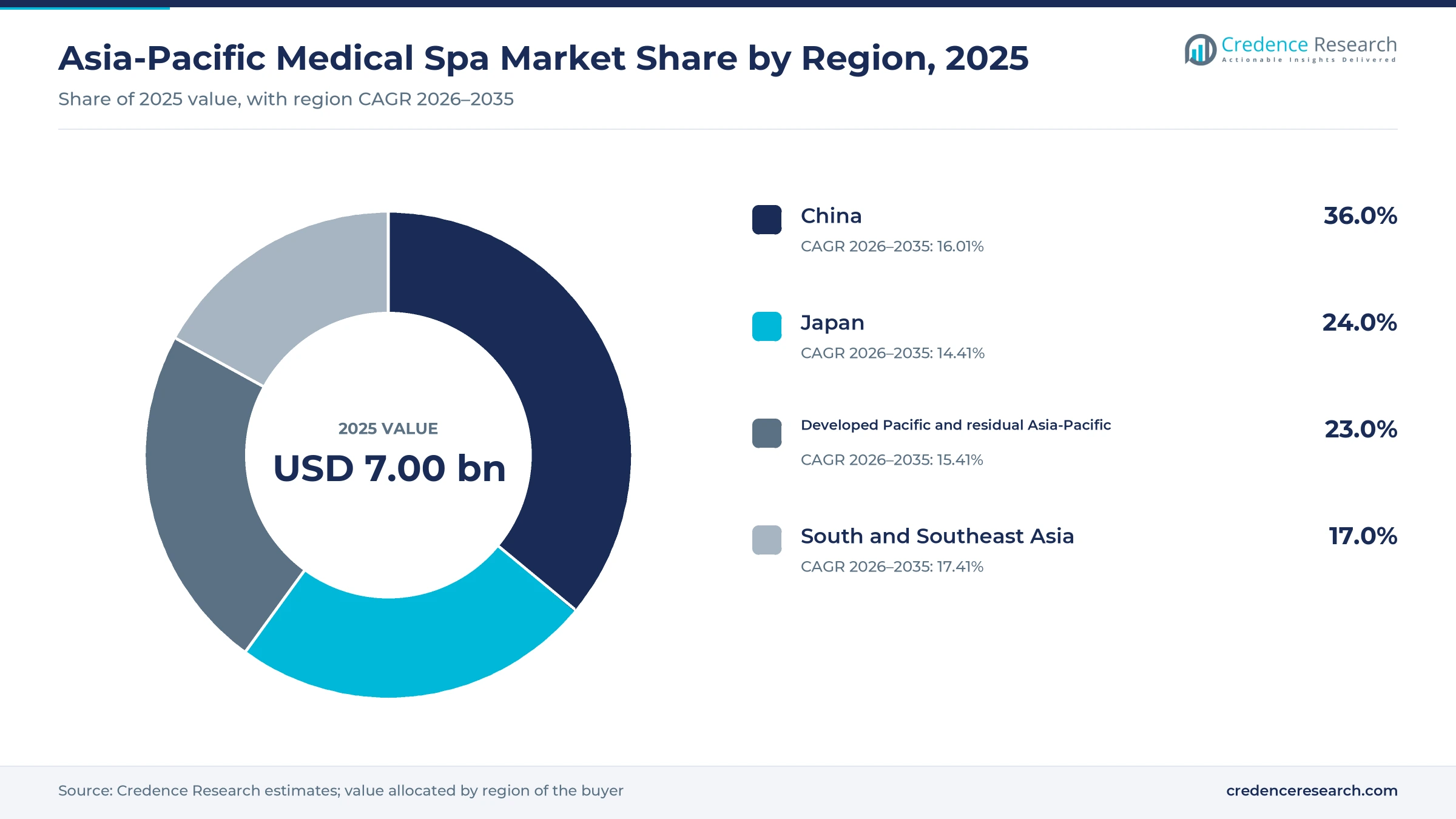
China leads while South and Southeast Asia grows fastest
| Region | Value, 2025 (USD billion) | Share, 2025 | CAGR, 2026–2035 |
|---|---|---|---|
| China | 2.52 | 36.0% | 16.01% |
| Japan | 1.68 | 24.0% | 14.41% |
| Developed Pacific and residual Asia-Pacific | 1.61 | 23.0% | 15.41% |
| South and Southeast Asia | 1.19 | 17.0% | 17.41% |
China leads on clinic scale and toxin supply
China held 36.0% of 2025 value and grows at 16.01% a year as branded chains and new products reach more cities. So-Young operated 65 youth clinics in 18 cities on June 30, 2026, and it recorded more than 165,000 verified visits in that quarter. The 2025 ISAPS survey placed China third worldwide with 2.8 million procedures, behind the United States and Brazil. Enforcement by the National Health Commission since July 2025 favors licensed operators over informal providers.
Japan combines mature demand with franchise scale
Japan held 24.0% of 2025 value and grows at 14.41% a year, the slowest pace among the zones because its client base is already mature. SBC Medical Group alone supports 237 franchisee treatment centers there, and it announced the NEO Skin Clinic Ginza flagship on March 16, 2026. Demand for beauty and aesthetics services also faces closer review, because the health ministry proposed annual clinic reporting in November 2024.
Developed Pacific and residual Asia-Pacific blends inbound and chain demand
Developed Pacific and residual Asia-Pacific held 23.0% of 2025 value and grows at 15.41% a year. South Korea anchors inbound demand with 2.01 million foreign patients in 2025, while Australia and New Zealand rely on chains. Clear Skincare operates more than 90 clinics, and Wesfarmers also owns the SILK Group brands, which offer cosmetic injecting and laser hair removal across both countries. Ahpra rules since September 2025 limit how these groups can promote treatments.
South and Southeast Asia grows fastest on partner-led clinic rollouts
South and Southeast Asia held 17.0% of 2025 value and grows at 17.41% a year, the fastest pace in the region. Kaya counted 82 clinics across India in January 2026, while V6 Clinics plans 100 partner-led centers by March 2029. Thailand's Ministry of Tourism and Sports counted 92,813 health tourism operators in 2025, according to the U.S.-ASEAN Business Council, which shows the supply serving inbound patients in Thailand.
Toxin approvals and clinic openings mark 2026 activity
| Development | Status and market relevance |
|---|---|
| In October 2026, China's National Medical Products Administration approved Galderma's Relfydess for moderate-to-severe frown lines in adults | Commercial launch expected in the second half of 2027, adding another toxin option for clinics |
| In October 2026, Inibio received Chinese approval for Inibo, the ninth botulinum toxin approved in China according to Herald Business | Commercialization targeted for the first quarter of 2027 |
| In June 2026, So-Young International reached 65 youth clinics in 18 cities after adding 11 net during the quarter | Operating, with intelligent centers planned for the fourth quarter of 2026 |
| In March 2026, SBC Medical Group announced the NEO Skin Clinic Ginza brand flagship in Tokyo | Open, extending its multi-brand aesthetic dermatology strategy |
| In January 2026, V6 Clinics announced a partner-led plan for 100 Indian clinics by March 2029 | First phase of 12 to 15 clinics planned from early 2026 |
Lasers, traceability and AI tools change clinic workflow
- Microsecond lasers such as the Aerolase Neo Elite, which Kaya began rolling out in July 2025, treat acne and pigmentation in sessions of about 20 to 30 minutes.
- Drug traceability gives Chinese regulators a national system for monitoring toxin distribution, according to the National Medical Products Administration comments reported in July 2025.
- Clinic AI platforms support partner networks such as V6 Clinics, which supplies partner dermatologists with its AI platform along with training and clinical frameworks.
- Intelligent centers are planned by So-Young for the fourth quarter of 2026, and the company has already raised its capacity-utilization benchmark for aesthetic centers by 50%.
Need a Custom Version of This Report?
Tailor the scope, geography, or segments to your exact requirements.
- Custom geography or segment scope
- Direct access to our analyst team
Clinic groups compete on reach and physician supply
Competition among medical spa operators runs on network reach, physician supply and client retention, and no operator holds a dominant position across all four zones. SBC Medical Group supports franchisee clinics in Japan through contracts covering procurement, management services and brand licensing, and it holds no voting control over those medical corporations. So-Young International runs its own branded youth clinics, and about 280 full-time physicians now staff its Chinese network. Wesfarmers Health combines SILK Group brands with Clear Skincare in Australia and New Zealand, which gives it wholly owned, joint venture and franchised formats. Laser Clinics Group built its network through franchising across Australia, New Zealand, the United Kingdom and Canada, and it announced a Singapore entry through a local partner in 2021. Kaya competes in India on skin and hair care, with more than 600 service lines and more than 75 products.
Key clinic operators and their regional roles
| Company | Type | Role in the market |
|---|---|---|
| SBC Medical Group Holdings | Franchise and management services group | Supports 237 franchisee treatment centers in Japan and operates 21 centers in Singapore and one in Vietnam at Dec. 31, 2025 |
| So-Young International | Branded clinic chain | Operated 65 youth clinics in 18 Chinese cities on June 30, 2026 |
| SILK Laser Australia | Multi-format clinic group | Part of Wesfarmers Health since Nov. 29, 2023, with wholly owned, joint venture and franchised clinics |
| Laser Clinics Group | Franchise clinic chain | Reported more than 180 clinics globally in October 2021, with Australia and New Zealand among its markets |
| Kaya | Dermatology clinic chain | Counted 82 clinics across India in January 2026, offering more than 600 service lines |
Chains gain, but clinical governance keeps clients
Credence Research's view is that network scale alone will not decide the medical spa market, because regulators in China, Japan and Australia have all raised the cost of weak clinical governance since 2024. Chains that can document physician training, product provenance and complication handling should take share from informal operators. Inbound demand also deserves caution, since Korea's visitor surge came with a tax refund that expired at the end of 2025. Operators that rely on repeat resident clients carry less exposure to that risk. The most useful indicator to monitor is therefore repeat rate rather than the number of clinic openings.
How the regional clinic spending estimates were built
The report uses 2025 as the base year and projects medical spa values from 2026 through 2035 using the Credence Research market model. Regional and segment shares and growth rates are Credence Research estimates, informed by clinic network counts, patient statistics and regulatory actions in each zone. Sources include company filings and results releases, regulator statements, national health ministry statistics, a professional society survey and named press reports opened during preparation. No primary interviews or surveys were conducted for this edition, and qualitative heat map ratings reflect analyst judgment.
Regional clinic spending keeps compounding through 2035
Regional medical spa spending is projected to rise from USD 8.12 billion in 2026 to USD 30.31 billion by 2035, a compound rate of 15.76% over 2026–2035. South and Southeast Asia should gain share as partner-led chains enter secondary Indian cities, while Japan remains large but slower. New toxin launches due in China during 2027 should widen product choice, and they should intensify price competition among clinics. Enforcement will likely continue to move treatment volume toward licensed operators with documented physician oversight. Visitor flows remain the main swing factor, since South Korea's tax change only took effect at the start of 2026.
Frequently Asked Questions
How big is the Asia-Pacific medical spa market?
Which zone holds the largest share?
Which zone grows fastest through 2035?
Which service type leads clinic spending?
How important are foreign patients to clinic demand?
Which operating model is expanding fastest?
What regulatory changes affect clinics most?
Which companies are active in this market?
Table of Content
Chapter 1 Market Segmentation
- 1.1 Segmentation Framework
- 1.1.1 Product and Service Classification
- 1.1.2 Application and End-Use Classification
- 1.1.3 Technology and Solution Classification
- 1.1.4 Customer and Distribution Channel Classification
- 1.1.5 Geographic Segmentation
- 1.1.6 Market Segment Definitions and Boundaries
- 1.2 By Service Type
- 1.2.1 Injectables
- 1.2.2 Energy-based treatments
- 1.2.3 Medical skin and wellness services
- 1.3 By Customer Type
- 1.3.1 Domestic resident patients
- 1.3.2 International visiting patients
- 1.3.3 Expatriate resident patients
- 1.4 By Operating Model
- 1.4.1 Independent physician-owned clinics
- 1.4.2 Corporate-owned clinic chains
- 1.4.3 Franchise and partnership networks
- 1.5 By Revenue Model
- 1.5.1 Pay-per-procedure
- 1.5.2 Prepaid treatment packages
- 1.5.3 Recurring memberships
- 1.5.4 In-clinic retail
Chapter 2 Introduction
- 2.1 Report Objectives and Scope
- 2.2 Product Definition and Industry Terminology
- 2.3 Market Inclusions and Exclusions
- 2.4 Research Process
- 2.4.1 Primary Research and Expert Interviews
- 2.4.2 Secondary Research and Source Review
- 2.4.3 Top-Down and Bottom-Up Estimation
- 2.4.4 Data Triangulation and Verification
- 2.5 Market Size Measurement Basis
- 2.5.1 2025: USD 7.00 billion → 2035: USD 30.31 billion
- 2.6 Historical and Forecast Reference Periods
- 2.6.1 Historical Period: 2018-2025
- 2.6.2 Base Year: 2025
- 2.6.3 Forecast Period: 2025-2035
- 2.7 Research Assumptions and Limitations
Chapter 3 Executive Summary
- 3.1 Market Snapshot and Key Findings
- 3.2 Base-Year Market Size, 2025
- 3.3 Forecast Market Size, 2035
- 3.4 Revenue and Volume Growth Outlook
- 3.5 Key Demand and Supply Indicators
- 3.6 Leading Market Segments
- 3.7 Fastest-Growing Market Opportunities
- 3.8 Regional Performance Highlights
- 3.9 Technology and Industry Transformation
- 3.10 Competitive Landscape Summary
- 3.11 Analyst View and Strategic Implications
Chapter 4 Asia-Pacific Medical Spa Market Trends and Developments
- 4.1 Historical Industry Development, 2018-2025
- 4.2 Recent Market Trends and Developments
- 4.3 Demand and Customer Behavior Trends
- 4.4 Technology and Product Innovation
- 4.5 Artificial Intelligence, Automation and Digitalization
- 4.6 Local Manufacturing and Supply Chain Realignment
- 4.7 Industry Partnerships, Mergers and Acquisitions
- 4.8 Sustainability and Circular Economy Developments
- 4.9 Government and Private Sector Investment Trends
- 4.10 Emerging Business Models and Commercialization
- 4.11 Industry Developments and Announcements
Chapter 5 Asia-Pacific Medical Spa Market Production, Supply and Demand Analysis
- 5.1 Demand Trend and Consumption Analysis, 2018-2025
- 5.2 Demand Forecast, 2025-2035
- 5.3 Production and Output Trend, 2018-2025
- 5.4 Production and Output Forecast, 2025-2035
- 5.5 Installed Capacity and Capacity Utilization
- 5.6 Company-Wise Production Plants and Statistics
- 5.6.1 Installed Production Capacity
- 5.6.2 Actual Production
- 5.6.3 Planned Capacity and Expansion Targets
- 5.7 Supply Chain Structure and Procurement Trends
- 5.8 Supply-Demand Gap and Bottlenecks
- 5.9 Import Dependence and Sourcing Structure
- 5.10 Contract Manufacturing and Outsourcing
- 5.11 Regional Supply and Demand Concentration
Chapter 6 Asia-Pacific Medical Spa Market Pricing Analysis
- 6.1 Pricing Structure and Measurement
- 6.2 Historical Pricing Trends, 2018-2025
- 6.3 Pricing Outlook, 2025-2035
- 6.4 Average Selling Price and Unit Economics
- 6.5 Pricing by Product and Market Segment
- 6.6 Geographic Pricing Differences
- 6.7 Key Input, Energy, Labor and Logistics Costs
- 6.8 Contract Pricing and Purchasing Models
- 6.9 Pricing Sensitivity and Competitive Positioning
- 6.10 Price, Margin and Profitability Implications
Chapter 7 Asia-Pacific Medical Spa Market Dynamics
- 7.1 Market Growth Drivers
- 7.1.1 Demand-Side Drivers
- 7.1.2 Technology and Innovation Drivers
- 7.1.3 Infrastructure and Investment Drivers
- 7.1.4 Regulatory and Policy Drivers
- 7.2 Market Restraints
- 7.2.1 Cost and Affordability Constraints
- 7.2.2 Technology and Adoption Barriers
- 7.2.3 Supply Chain and Operational Constraints
- 7.3 Market Challenges
- 7.3.1 Competitive Pressure and Margin Erosion
- 7.3.2 Skills, Infrastructure and Implementation Gaps
- 7.4 Emerging Market Opportunities
- 7.5 Market Dynamics Impact and Time-Horizon Assessment
Chapter 8 Asia-Pacific Medical Spa Value Chain Analysis
- 8.1 Industry Value Chain Overview
- 8.2 Upstream Suppliers and Critical Inputs
- 8.3 Technology and Component Providers
- 8.4 Manufacturing or Service Delivery
- 8.5 Distribution, Channel Partners and Integrators
- 8.6 Downstream Applications and End Users
- 8.7 Value Addition and Profit Pools
- 8.8 Vertical Integration and Outsourcing
- 8.9 Supplier Concentration and Risk
- 8.10 Supply Chain Localization and Resilience
Chapter 9 Asia-Pacific Medical Spa Market Regulations and Policies
- 9.1 Relevant Laws, Standards and Compliance Frameworks
- 9.2 Product, Service, Safety and Quality Requirements
- 9.3 Government Policies, Incentives and Subsidies
- 9.4 Imports, Exports and Trade Barriers
- 9.5 Public Procurement and Local Content Requirements
- 9.6 Environmental and Sustainability Compliance
- 9.7 Upcoming Policy Changes and Market Implications
Chapter 10 Asia-Pacific Medical Spa Market Hotspots and Opportunities
- 10.1 Market Opportunity Mapping and Growth Hotspots
- 10.2 High-Growth Applications and Customer Groups
- 10.3 Underserved Markets and White-Space Opportunities
- 10.4 Emerging Technology and Product Opportunities
- 10.5 New Capacity and Investment Hotspots
- 10.6 Market Entry and Expansion Opportunities
- 10.7 Distribution and Partnership Opportunities
- 10.8 Near-Term and Long-Term Commercial Potential
- 10.9 Opportunity Attractiveness and Execution Risks
Chapter 11 Asia-Pacific Medical Spa Market Outlook, 2025-2035
- 11.1 Market Size and Analysis
- 11.1.1 Revenue (Market Measurement: 2025: USD 7.00 billion → 2035: USD 30.31 billion)
- 11.1.2 Market Volume and Quantity Sold
- 11.1.3 Historical Market Size, 2018-2025
- 11.1.4 Base-Year Market Size, 2025
- 11.2 Market Forecast, 2025-2035
- 11.2.1 Revenue Forecast to 2035
- 11.2.2 Volume Forecast to 2035
- 11.2.3 CAGR and Year-on-Year Growth
- 11.2.4 Incremental Revenue Opportunity
- 11.3 Forecast Assumptions and Scenario Analysis
- 11.3.1 Base-Case Forecast
- 11.3.2 Optimistic and Conservative Scenarios
- 11.3.3 Technology, Pricing and Policy Sensitivities
- 11.4 Market Attractiveness and Growth Outlook
Chapter 12 Asia-Pacific Medical Spa Market Segmentation and Outlook
- 12.1 Segmentation Summary and Market Shares, 2025
- 12.2 Largest and Fastest-Growing Segments
- 12.3 By Service Type - Market Size and Forecast, 2025-2035
- 12.3.1 Segment Definition and Scope
- 12.3.2 Historical Market Size, 2018-2025
- 12.3.3 Revenue Forecast, 2025-2035
- 12.3.4 Volume Forecast, 2025-2035
- 12.3.5 Base-Year Market Share, 2025
- 12.3.6 Segment CAGR and Growth Drivers
- 12.3.7 Subsegment Market Size and Forecast
- 12.3.7.1 Injectables
- 12.3.7.2 Energy-based treatments
- 12.3.7.3 Medical skin and wellness services
- 12.3.8 Subsegment Pricing and Adoption Trends
- 12.3.9 Leading Suppliers and Competition
- 12.3.10 Regional Demand and Opportunities
- 12.4 By Customer Type - Market Size and Forecast, 2025-2035
- 12.4.1 Segment Definition and Scope
- 12.4.2 Historical Market Size, 2018-2025
- 12.4.3 Revenue Forecast, 2025-2035
- 12.4.4 Volume Forecast, 2025-2035
- 12.4.5 Base-Year Market Share, 2025
- 12.4.6 Segment CAGR and Growth Drivers
- 12.4.7 Subsegment Market Size and Forecast
- 12.4.7.1 Domestic resident patients
- 12.4.7.2 International visiting patients
- 12.4.7.3 Expatriate resident patients
- 12.4.8 Subsegment Pricing and Adoption Trends
- 12.4.9 Leading Suppliers and Competition
- 12.4.10 Regional Demand and Opportunities
- 12.5 By Operating Model - Market Size and Forecast, 2025-2035
- 12.5.1 Segment Definition and Scope
- 12.5.2 Historical Market Size, 2018-2025
- 12.5.3 Revenue Forecast, 2025-2035
- 12.5.4 Volume Forecast, 2025-2035
- 12.5.5 Base-Year Market Share, 2025
- 12.5.6 Segment CAGR and Growth Drivers
- 12.5.7 Subsegment Market Size and Forecast
- 12.5.7.1 Independent physician-owned clinics
- 12.5.7.2 Corporate-owned clinic chains
- 12.5.7.3 Franchise and partnership networks
- 12.5.8 Subsegment Pricing and Adoption Trends
- 12.5.9 Leading Suppliers and Competition
- 12.5.10 Regional Demand and Opportunities
- 12.6 By Revenue Model - Market Size and Forecast, 2025-2035
- 12.6.1 Segment Definition and Scope
- 12.6.2 Historical Market Size, 2018-2025
- 12.6.3 Revenue Forecast, 2025-2035
- 12.6.4 Volume Forecast, 2025-2035
- 12.6.5 Base-Year Market Share, 2025
- 12.6.6 Segment CAGR and Growth Drivers
- 12.6.7 Subsegment Market Size and Forecast
- 12.6.7.1 Pay-per-procedure
- 12.6.7.2 Prepaid treatment packages
- 12.6.7.3 Recurring memberships
- 12.6.7.4 In-clinic retail
- 12.6.8 Subsegment Pricing and Adoption Trends
- 12.6.9 Leading Suppliers and Competition
- 12.6.10 Regional Demand and Opportunities
- 12.7 Segment Growth Comparison
- 12.8 Segment Attractiveness and Priority Matrix
Chapter 13 Asia-Pacific Medical Spa End-Use and Application Market Outlook
- 13.1 End-Use Industry and Customer Demand Structure
- 13.2 Leading Applications and Customer Groups
- 13.3 End-Use Market Size, Share and Forecast
- 13.4 Major End-Use Industry Deep Dives
- 13.4.1 Customer Requirements and Use Cases
- 13.4.2 Demand and Replacement Cycles
- 13.4.3 Technical and Regulatory Considerations
- 13.4.4 Purchasing and Procurement Models
- 13.4.5 Leading Vendors and Distribution Channels
- 13.4.6 Forecast and Commercial Opportunities
- 13.5 Emerging Applications and Cross-Segment Demand
- 13.6 End-Use Industry Investment Priorities
Chapter 14 Asia-Pacific Medical Spa Geographic Market Outlook, 2025-2035
- 14.1 Regional Market Size and Country-Level Shares, 2025
- 14.2 Country Market Size Comparison, 2025
- 14.3 Country Market Forecasts, 2025-2035
- 14.4 Subregional Industrial and Demand Clusters
- 14.5 Intra-Regional Pricing and Cost Differences
- 14.6 Cross-Border Trade and Supply Networks
- 14.7 Regional Supply and Demand Balances
- 14.8 Country Opportunity Comparison and Prioritization
Note: Every listed country is covered on the structure shown under the first country.
Chapter 15 Asia-Pacific Medical Spa Technology, Innovation and Sustainability Outlook
- 15.1 Technology Landscape and Maturity
- 15.2 Product, Process and Service Innovation
- 15.3 AI, Automation and Digital Tools in the Industry
- 15.4 Technology Adoption and Performance Benchmarking
- 15.5 Innovation Pipeline and R&D Investment
- 15.6 Patent and Intellectual Property Trends
- 15.7 Energy Efficiency and Resource Management
- 15.8 Sustainability, Recycling and Circularity
- 15.9 Technology Roadmap, 2025-2035
- 15.10 Risks of Obsolescence and Technology Substitution
Chapter 16 Asia-Pacific Medical Spa Market Key Strategic Imperatives
- 16.1 Growth and Market Entry Priorities
- 16.2 High-Return Products and Segments
- 16.3 Pricing, Profitability and Cost Optimization
- 16.4 Technology Investment and Product Differentiation
- 16.5 Supply Chain Localization and Resilience
- 16.6 Distribution and Customer Acquisition
- 16.7 Partnership, Acquisition and Capacity Strategy
- 16.8 Regional Expansion Priorities
- 16.9 Short-, Medium- and Long-Term Actions
Chapter 17 Competition Outlook
- 17.1 Industry Competition Characteristics
- 17.2 Market Structure and Concentration
- 17.3 Market Share and Competitive Positioning, 2025
- 17.4 Company-Wise Revenue and Product Benchmarking
- 17.5 Production and Service Capacity Benchmarking
- 17.6 Technology, Pricing and Differentiation
- 17.7 Regional Footprint and Distribution Strength
- 17.8 Mergers, Acquisitions and Strategic Alliances
- 17.9 New Entrants and Competitive Threats
- 17.10 Porter's Five Forces and Industry Attractiveness
- 17.11 Competitive Outlook, 2025-2035
Chapter 18 Company Profiles
- 18.1 Company Coverage and Selection Criteria
- 18.2 SBC Medical Group Holdings
- 18.2.1 Business Description
- 18.2.2 Company Ownership and Geographic Presence
- 18.2.3 Product and Service Portfolio
- 18.2.4 Manufacturing and Operating Footprint
- 18.2.5 Production Capacity and Expansion Plans
- 18.2.6 Financial Performance and Investment
- 18.2.7 Market Share and Competitive Position
- 18.2.8 Technology and Innovation Capabilities
- 18.2.9 Strategic Alliances or Partnerships
- 18.2.10 Recent Developments
- 18.2.11 Growth Strategy and Outlook
- 18.3 Laser Clinics Group
- 18.4 SILK Laser Australia
- 18.5 So-Young International
- 18.6 Kaya
- 18.7 Other Relevant Market Participants
Note: Every listed company is profiled on the structure shown under the first company. The company list is preliminary and may change based on research findings, market developments, data availability and client requirements.
Chapter 19 Disclaimer
- 19.1 Research and Forecast Disclaimer
- 19.2 Data Source and Estimation Limitations
Note: The depth of individual sections depends on data availability for this market. Volume, capacity, trade and other unit-based metrics are included where applicable.

