
| REPORT ATTRIBUTE | DETAILS |
|---|---|
| Historical Period | 2020-2023 |
| Base Year | 2024 |
| Forecast Period | 2025-2032 |
| Megapixel Fixed Focal Lens Market Size 2024 | USD 1,150 million |
| Megapixel Fixed Focal Lens Market, CAGR | 7.25% |
| Megapixel Fixed Focal Lens Market Size 2032 | USD 2,013 million |
Market Overview
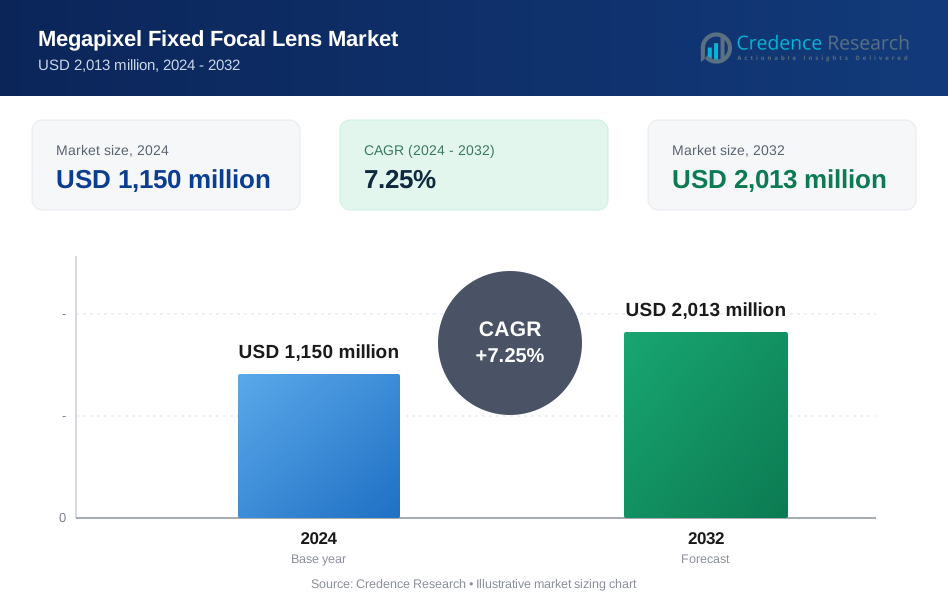
The Megapixel Fixed Focal Lens Market is projected to grow from USD 1,150 million in 2024 to USD 2,013 million by 2032, expanding at a CAGR of 7.25%.
The Megapixel Fixed Focal Lens Market experiences strong growth driven by increasing demand for high-resolution imaging in security, surveillance, and industrial applications. Rising adoption of smart city initiatives and advanced video analytics fuels the need for precise, reliable lenses that deliver clear image quality. The growing deployment of IP cameras across residential, commercial, and public sectors supports market expansion. Technological advancements, including enhanced optical performance and miniaturization, improve lens efficiency and integration with various imaging devices. Market trends highlight the shift toward lenses optimized for artificial intelligence and machine learning-enabled cameras, enabling real-time data processing and improved object detection. Additionally, rising investments in infrastructure development and increasing awareness of public safety boost market adoption. The market also observes growing use of fixed focal lenses in automotive and healthcare sectors, expanding application horizons. These factors collectively propel the Megapixel Fixed Focal Lens Market toward sustained growth through 2032.
The Megapixel Fixed Focal Lens Market spans key regions including North America, Asia Pacific, and Europe, each contributing significantly to global growth. North America holds a 35% market share, driven by advanced surveillance adoption and strong automotive and healthcare sectors. Asia Pacific leads with 40% market share, fueled by rapid urbanization and expanding smart city initiatives in countries like China and India. Europe accounts for 20%, supported by stringent security regulations and automotive innovations. Major key players operating across these regions include Canon Inc., Nikon Corporation, Sony Corporation, Zeiss Group, Panasonic Corporation, Leica Camera AG, and Sigma Corporation. These companies focus on technological innovation, product quality, and strategic partnerships to maintain market leadership and cater to diverse regional demands, ensuring continuous expansion of the Megapixel Fixed Focal Lens Market worldwide.
Market Insights
- The Megapixel Fixed Focal Lens Market is projected to grow from USD 1,150 million in 2024 to USD 2,013 million by 2032, expanding at a CAGR of 7.25%.
- Increasing demand for high-resolution imaging in security, surveillance, and industrial applications drives market growth, supported by smart city initiatives and advanced video analytics.
- Growing deployment of IP cameras in residential, commercial, and public sectors expands market adoption globally.
- Technological advancements improve optical performance and enable miniaturization, enhancing lens efficiency and integration with diverse imaging devices.
- Market trends show a shift toward lenses optimized for AI and machine learning-enabled cameras, supporting real-time data processing and improved object detection.
- Key regions include Asia Pacific with 40% market share fueled by rapid urbanization, North America holding 35% driven by advanced surveillance adoption, and Europe at 20% supported by strict security regulations and automotive innovations.
- Leading players such as Canon, Nikon, Sony, and Zeiss focus on continuous innovation and strategic partnerships to maintain leadership amid intense competition and rapid technological changes.
Market Drivers
Rising Demand for High-Resolution Imaging in Surveillance and Security
The Megapixel Fixed Focal Lens Market benefits from the increasing need for high-resolution imaging in surveillance and security systems. Growing urbanization and the expansion of smart city projects drive demand for reliable cameras that capture detailed images. It supports law enforcement and public safety by enhancing monitoring capabilities. Enhanced image clarity and accuracy in fixed focal lenses improve threat detection and crime prevention effectiveness. This demand strongly propels market growth globally.
For instance, Theia Technologies supplies multi-megapixel industrial lenses that are integrated into CCTV and traffic surveillance systems, providing detailed imaging for critical infrastructure monitoring.
Advancements in Optical Technology Enhancing Lens Performance
Technological improvements in optical design and manufacturing significantly influence the Megapixel Fixed Focal Lens Market. Innovations focus on improving lens sharpness, reducing distortion, and optimizing light transmission. These enhancements ensure better image quality and compatibility with diverse camera systems. It enables the production of compact, efficient lenses suitable for various applications, including automotive and industrial inspection. Continuous optical innovation strengthens the market by meeting evolving customer requirements.
- For instance, Tamron has developed ultra-high-resolution fixed focal lenses supporting up to 50 megapixels, which are widely used in advanced surveillance applications to deliver exceptional image detail and clarity.
Integration with Artificial Intelligence and Machine Learning Systems
The integration of fixed focal lenses with AI and machine learning technologies fuels growth in the Megapixel Fixed Focal Lens Market. These lenses enable cameras to deliver precise images necessary for real-time data analysis and object recognition. It enhances the performance of intelligent video surveillance systems by supporting automated monitoring and threat detection. This synergy between hardware and software increases adoption across commercial, industrial, and government sectors, driving market expansion.
Expanding Applications in Healthcare and Automotive Industries
The Megapixel Fixed Focal Lens Market experiences growth due to expanding applications in healthcare imaging and automotive safety systems. It supports medical devices requiring detailed visual data for diagnostics and surgery. In the automotive sector, these lenses enhance driver assistance and autonomous driving technologies by providing clear, accurate images. The widening application base diversifies market demand, offering new growth opportunities and reinforcing the importance of fixed focal lens technology in various industries.
Market Trends
Growing Adoption of Smart Surveillance Systems in Urban Infrastructure
The Megapixel Fixed Focal Lens Market sees a significant trend toward the adoption of smart surveillance systems within urban infrastructure. It supports smart city initiatives that require high-precision imaging for traffic management, public safety, and infrastructure monitoring. Governments and private organizations invest heavily in upgrading existing surveillance networks to integrate advanced fixed focal lenses. This adoption improves real-time monitoring and decision-making, driving demand for reliable, high-quality imaging solutions in urban environments.
- For instance, London’s “Ring of Steel” comprises thousands of surveillance cameras distributed throughout the city, transmitting video to control centers for real-time monitoring. This network, regularly upgraded with advanced imaging technology, plays a critical role in crime prevention and rapid response to public safety incidents.
Shift Toward Compact and Energy-Efficient Lens Designs
The market trends highlight a growing preference for compact, lightweight, and energy-efficient fixed focal lenses. It caters to the increasing need for cameras in space-constrained applications such as drones, body-worn cameras, and mobile devices. Manufacturers focus on reducing lens size without compromising optical performance. Energy efficiency aligns with global sustainability goals and extends device battery life, enhancing product appeal. This trend propels innovation and adoption across multiple sectors.
- For instance, Tamron’s 20-40mm F/2.8 Di III VXD (Model A062) is recognized as the smallest and lightest lens in its class, offering high image quality and portability for everyday photography and vlogging, which addresses the need for lightweight solutions in mobile and handheld devices.
Rising Demand for Fixed Focal Lenses in AI-Enabled Cameras
Integration of AI-enabled cameras drives the Megapixel Fixed Focal Lens Market’s growth trajectory. These cameras require lenses that provide sharp, distortion-free images to support machine learning algorithms for object detection and facial recognition. It enhances automation in sectors like retail, transportation, and security. The demand for lenses tailored to AI applications increases, pushing manufacturers to develop specialized optical components that optimize camera intelligence and accuracy.
Expansion of Fixed Focal Lens Applications Across Diverse Industries
The Megapixel Fixed Focal Lens Market benefits from expanding applications beyond traditional surveillance. It finds increasing use in healthcare imaging, automotive safety systems, and industrial quality control. Each sector demands specific optical capabilities, encouraging customized lens solutions. This diversification reduces market dependency on any single industry and fuels continuous innovation. Expanding applications create steady demand and support sustained market growth.
Market Challenges Analysis
High Manufacturing Costs and Technical Complexity Limiting Market Expansion
The Megapixel Fixed Focal Lens Market faces challenges due to the high manufacturing costs and technical complexity involved in producing advanced optical components. It requires precision engineering and quality materials to achieve superior image clarity and performance. These factors increase production expenses, limiting affordability for some end-users and restraining market penetration in cost-sensitive regions. The complexity also demands skilled labor and sophisticated manufacturing facilities, which pose barriers to entry for new players.
Intense Competition and Rapid Technological Changes Impacting Market Stability
The Megapixel Fixed Focal Lens Market experiences pressure from intense competition among established and emerging manufacturers. Rapid technological advancements force companies to continually innovate, increasing research and development costs. It complicates maintaining product differentiation and can lead to shorter product life cycles. This dynamic environment challenges companies to balance investment in innovation with profitability, creating uncertainty in long-term market stability and growth prospects.
- For instance, Edmund Optics offers megapixel fixed focal length lenses with low distortion and high resolution for machine vision, but notes that the need for locking screws and robust construction to withstand high-vibration environments adds to the complexity and expense of manufacturing these components.
Market Opportunities
Expansion in Emerging Markets Driven by Infrastructure Development and Urbanization
The Megapixel Fixed Focal Lens Market holds significant opportunities in emerging regions where rapid urbanization and infrastructure development increase demand for advanced surveillance and monitoring solutions. It can capitalize on government initiatives aimed at enhancing public safety, transportation, and smart city projects. Rising investments in residential and commercial construction create further demand for high-quality imaging systems. Expanding market presence in these regions offers growth potential through tailored products and localized strategies.
Integration with Advanced Technologies Creating New Application Areas
The Megapixel Fixed Focal Lens Market benefits from opportunities arising from integration with emerging technologies such as artificial intelligence, IoT, and autonomous systems. It supports next-generation cameras that require precise optics to enhance analytics, automation, and real-time decision-making. Expanding use in automotive safety, healthcare diagnostics, and industrial automation opens new revenue streams. Developing lenses that align with these technological advancements allows companies to diversify offerings and capture evolving market segments.
Market Segmentation Analysis:
By Product Type
The Megapixel Fixed Focal Lens Market segments by product type into wide-angle, standard, and telephoto lenses. Wide-angle lenses attract demand for applications requiring broader field of view, such as urban surveillance and traffic monitoring. Standard lenses offer balanced focal lengths suitable for general-purpose imaging, making them versatile across multiple sectors. Telephoto lenses support long-distance capturing with high precision, favored in specialized surveillance and industrial inspection. Each product type addresses distinct imaging needs, driving diverse market growth.
By Application
The Megapixel Fixed Focal Lens Market categorizes applications into surveillance, industrial, medical, automotive, and others. Surveillance dominates due to rising security concerns and smart city projects demanding high-resolution imaging. Industrial applications leverage fixed focal lenses for quality control and process monitoring, requiring accuracy and durability. Medical uses focus on diagnostic imaging and surgical tools that demand precise optics. Automotive adoption grows with driver assistance and autonomous systems. Expanding applications broaden market reach and encourage technological advancements.
By End-User
The Megapixel Fixed Focal Lens Market divides end-users into commercial, residential, industrial, and others. Commercial sectors lead demand through deployment in retail, offices, and public facilities requiring advanced surveillance. Residential adoption increases due to rising home security awareness. Industrial end-users depend on these lenses for manufacturing and infrastructure monitoring. Other sectors include government and transportation, further supporting market expansion. Diverse end-user segments promote steady market growth and innovation.
Segments:
Based on Product Type
- Wide-Angle
- Standard
- Telephoto
Based on Application
- Surveillance
- Industrial
- Medical
- Automotive
- Others
Based on End-User
- Commercial
- Residential
- Industrial
- Others
Based on Distribution Channel
- Online Stores
- Specialty Stores
- Others
Based on the Geography:
- North America
- U.S.
- Canada
- Mexico
- Europe
- Germany
- France
- U.K.
- Italy
- Spain
- Rest of Europe
- Asia Pacific
- China
- Japan
- India
- South Korea
- South-east Asia
- Rest of Asia Pacific
- Latin America
- Brazil
- Argentina
- Rest of Latin America
- Middle East & Africa
- GCC Countries
- South Africa
- Rest of the Middle East and Africa
Regional Analysis
North America
North America holds a significant share of 35% in the Megapixel Fixed Focal Lens Market due to strong adoption of advanced surveillance technologies and smart city initiatives. It benefits from high investments in public safety infrastructure and technological innovation. Leading manufacturers and early adoption of AI-enabled imaging systems drive demand. The region’s robust automotive and healthcare sectors further boost market growth. Regulatory support and consumer awareness contribute to widespread use of fixed focal lenses. These factors collectively position North America as a dominant market for high-resolution imaging solutions.
Asia Pacific
The Asia Pacific region commands a 40% market share in the Megapixel Fixed Focal Lens Market, fueled by rapid urbanization and infrastructure development across countries like China, India, and Japan. It experiences growing demand in surveillance, industrial automation, and automotive applications. Increasing government initiatives for smart cities and rising disposable incomes accelerate adoption. The presence of major manufacturing hubs supports cost-effective production and innovation. Expansion in emerging markets within this region creates substantial opportunities for market players to capture new customers.
Europe
Europe accounts for 20% of the Megapixel Fixed Focal Lens Market, driven by strict security regulations and increasing investments in intelligent surveillance systems. It focuses on integrating fixed focal lenses with AI and IoT technologies for enhanced monitoring. The automotive industry’s shift toward autonomous vehicles creates additional demand. Strong emphasis on research and development fosters innovation in optical technologies. Government policies promoting safety and sustainability encourage widespread implementation. This region maintains steady growth with balanced demand across sectors.\
Key Player Analysis
- Panasonic Corporation
- Leica Camera AG
- Ricoh Imaging Company, Ltd.
- Sony Corporation
- Zeiss Group
- Canon Inc.
- Olympus Corporation
- Tamron Co., Ltd.
- Fujifilm Holdings Corporation
- Samsung Electronics Co., Ltd.
- Sigma Corporation
- Nikon Corporation
Competitive Analysis
The Megapixel Fixed Focal Lens Market features intense competition among leading optical and imaging companies focused on innovation and quality. Key players such as Canon Inc., Nikon Corporation, Sony Corporation, and Zeiss Group maintain strong market positions through continuous product development and technological advancements. It faces challenges from emerging companies offering cost-effective alternatives and specialized lens solutions. Market leaders invest heavily in research to enhance optical performance, miniaturization, and integration with AI-enabled cameras. Strategic collaborations and acquisitions further strengthen their competitive edge. The market’s dynamic environment encourages differentiation based on lens precision, durability, and compatibility with diverse applications. Companies also focus on expanding their global distribution networks and improving after-sales services to increase customer loyalty. This competitive landscape drives ongoing improvements and expansion within the Megapixel Fixed Focal Lens Market, fostering innovation and broader adoption across various industries.
Recent Developments
- In October 2024, BRICKCOM Communication Co., Ltd. announced its innovative WiFi HaLow outdoor network camera solution designed to address the increasing demand for reliable and efficient long-range wireless monitoring in smart cities, smart agriculture, and various outdoor settings.
- On May 13, 2025, Panasonic announced the launch of two new full-frame mirrorless cameras, the LUMIX S1II and S1IIE, along with the new LUMIX S 24-60mm F2.8 lens.
- On April 8, 2025, Zeiss expanded its premium lens portfolio in India with the launch of the DuraVision Gold UV, a new standard in lens coatings, enhancing durability and optical clarity for professional use.
- On March 20, 2025, Fujifilm launched the “FUJIFILM GFX100RF,” the first fixed-lens digital camera in the GFX Series. The camera features a newly developed FUJINON 35mm F4 fixed focal length lens and a 102-megapixel high-speed sensor.
Market Concentration & Characteristics
The Megapixel Fixed Focal Lens Market exhibits a moderately concentrated competitive landscape dominated by a few key players such as Canon Inc., Nikon Corporation, Sony Corporation, and Zeiss Group. It features a blend of established companies with strong technological capabilities and emerging firms offering specialized and cost-effective solutions. The market emphasizes continuous innovation in optical performance, miniaturization, and integration with AI-enabled imaging systems. It demands precision engineering and advanced manufacturing processes to meet high-quality standards. Customer preferences focus on lens durability, image clarity, and compatibility with diverse applications including surveillance, automotive, and healthcare. The market’s dynamic nature encourages strategic collaborations, mergers, and acquisitions to strengthen product portfolios and expand geographic reach. These characteristics define the Megapixel Fixed Focal Lens Market’s competitive environment and shape its growth trajectory toward advanced, reliable imaging solutions.
Report Coverage
The research report offers an in-depth analysis based on Product Type, Application, End-User, Distribution Channel and Geography. It details leading market players, providing an overview of their business, product offerings, investments, revenue streams, and key applications. Additionally, the report includes insights into the competitive environment, SWOT analysis, current market trends, as well as the primary drivers and constraints. Furthermore, it discusses various factors that have driven market expansion in recent years. The report also explores market dynamics, regulatory scenarios, and technological advancements that are shaping the industry. It assesses the impact of external factors and global economic changes on market growth. Lastly, it provides strategic recommendations for new entrants and established companies to navigate the complexities of the market.
Future Outlook
- The Megapixel Fixed Focal Lens Market will grow with increasing demand for high-resolution imaging across sectors.
- Integration with AI and machine learning technologies will improve lens precision and expand its applications.
- Continuous optical innovations will enhance lens sharpness while minimizing distortion and improving overall performance.
- Smart city initiatives globally will boost demand for reliable surveillance systems using fixed focal lenses.
- Healthcare and automotive sectors will increasingly adopt fixed focal lenses for diagnostics and safety applications.
- Miniaturized lenses will support compact devices like drones and wearables, expanding market reach significantly.
- Emerging economies will drive growth due to urbanization and investments in infrastructure development projects.
- Partnerships between lens makers and camera manufacturers will accelerate new product development and adoption.
- Demand for energy-efficient, durable lenses will rise across industrial, commercial, and residential applications.
- Mergers and acquisitions will shape market dynamics by strengthening portfolios and increasing geographic presence.
Request a Free Sample
Fill in your details and we'll send you a free sample report.
- Sample data tables & charts
- Research methodology
Need a Custom Version of This Report?
Tailor the scope, geography, or segments to your exact requirements.
- Custom geography or segment scope
- Direct access to our analyst team
Frequently Asked Questions
What is the current size of the Megapixel Fixed Focal Lens Market?
What factors are driving the growth of the Megapixel Fixed Focal Lens Market?
What are some challenges faced by the Megapixel Fixed Focal Lens Market?
Who are the major players in the Megapixel Fixed Focal Lens Market?
Table of Content
Chapter 1 Market Segmentation
- 1.1 Segmentation Framework
- 1.1.1 Product and Service Classification
- 1.1.2 Application and End-Use Classification
- 1.1.3 Technology and Solution Classification
- 1.1.4 Customer and Distribution Channel Classification
- 1.1.5 Geographic Segmentation
- 1.1.6 Market Segment Definitions and Boundaries
Chapter 2 Introduction
- 2.1 Report Objectives and Scope
- 2.2 Product Definition and Industry Terminology
- 2.3 Market Inclusions and Exclusions
- 2.4 Research Process
- 2.4.1 Primary Research and Expert Interviews
- 2.4.2 Secondary Research and Source Review
- 2.4.3 Top-Down and Bottom-Up Estimation
- 2.4.4 Data Triangulation and Verification
- 2.5 Market Size Measurement Basis
- 2.5.1 2024: USD 1,150 million → 2032: USD 2,013 million
- 2.6 Historical and Forecast Reference Periods
- 2.6.1 Base Year: 2024
- 2.6.2 Forecast Period: 2024-2032
- 2.7 Research Assumptions and Limitations
Chapter 3 Executive Summary
- 3.1 Market Snapshot and Key Findings
- 3.2 Base-Year Market Size, 2024
- 3.3 Forecast Market Size, 2032
- 3.4 Revenue and Volume Growth Outlook
- 3.5 Key Demand and Supply Indicators
- 3.6 Leading Market Segments
- 3.7 Fastest-Growing Market Opportunities
- 3.8 Regional Performance Highlights
- 3.9 Technology and Industry Transformation
- 3.10 Competitive Landscape Summary
- 3.11 Analyst View and Strategic Implications
Chapter 4 Global Megapixel Fixed Focal Lens Market Trends and Developments
- 4.1 Historical Industry Development
- 4.2 Recent Market Trends and Developments
- 4.3 Demand and Customer Behavior Trends
- 4.4 Technology and Product Innovation
- 4.5 Artificial Intelligence, Automation and Digitalization
- 4.6 Local Manufacturing and Supply Chain Realignment
- 4.7 Industry Partnerships, Mergers and Acquisitions
- 4.8 Sustainability and Circular Economy Developments
- 4.9 Government and Private Sector Investment Trends
- 4.10 Emerging Business Models and Commercialization
- 4.11 Industry Developments and Announcements
Chapter 5 Global Megapixel Fixed Focal Lens Market Production, Supply and Demand Analysis
- 5.1 Demand Trend and Consumption Analysis
- 5.2 Demand Forecast, 2024-2032
- 5.3 Production and Output Trend
- 5.4 Production and Output Forecast, 2024-2032
- 5.5 Installed Capacity and Capacity Utilization
- 5.6 Company-Wise Production Plants and Statistics
- 5.6.1 Installed Production Capacity
- 5.6.2 Actual Production
- 5.6.3 Planned Capacity and Expansion Targets
- 5.7 Supply Chain Structure and Procurement Trends
- 5.8 Supply-Demand Gap and Bottlenecks
- 5.9 Import Dependence and Sourcing Structure
- 5.10 Contract Manufacturing and Outsourcing
- 5.11 Regional Supply and Demand Concentration
Chapter 6 Global Megapixel Fixed Focal Lens Market Pricing Analysis
- 6.1 Pricing Structure and Measurement
- 6.2 Historical Pricing Trends
- 6.3 Pricing Outlook, 2024-2032
- 6.4 Average Selling Price and Unit Economics
- 6.5 Pricing by Product and Market Segment
- 6.6 Geographic Pricing Differences
- 6.7 Key Input, Energy, Labor and Logistics Costs
- 6.8 Contract Pricing and Purchasing Models
- 6.9 Pricing Sensitivity and Competitive Positioning
- 6.10 Price, Margin and Profitability Implications
Chapter 7 Global Megapixel Fixed Focal Lens Market Dynamics
- 7.1 Market Growth Drivers
- 7.1.1 Demand-Side Drivers
- 7.1.2 Technology and Innovation Drivers
- 7.1.3 Infrastructure and Investment Drivers
- 7.1.4 Regulatory and Policy Drivers
- 7.2 Market Restraints
- 7.2.1 Cost and Affordability Constraints
- 7.2.2 Technology and Adoption Barriers
- 7.2.3 Supply Chain and Operational Constraints
- 7.3 Market Challenges
- 7.3.1 Competitive Pressure and Margin Erosion
- 7.3.2 Skills, Infrastructure and Implementation Gaps
- 7.4 Emerging Market Opportunities
- 7.5 Market Dynamics Impact and Time-Horizon Assessment
Chapter 8 Global Megapixel Fixed Focal Lens Value Chain Analysis
- 8.1 Industry Value Chain Overview
- 8.2 Upstream Suppliers and Critical Inputs
- 8.3 Technology and Component Providers
- 8.4 Manufacturing or Service Delivery
- 8.5 Distribution, Channel Partners and Integrators
- 8.6 Downstream Applications and End Users
- 8.7 Value Addition and Profit Pools
- 8.8 Vertical Integration and Outsourcing
- 8.9 Supplier Concentration and Risk
- 8.10 Supply Chain Localization and Resilience
Chapter 9 Global Megapixel Fixed Focal Lens Market Regulations and Policies
- 9.1 Relevant Laws, Standards and Compliance Frameworks
- 9.2 Product, Service, Safety and Quality Requirements
- 9.3 Government Policies, Incentives and Subsidies
- 9.4 Imports, Exports and Trade Barriers
- 9.5 Public Procurement and Local Content Requirements
- 9.6 Environmental and Sustainability Compliance
- 9.7 Data Protection, AI and Cybersecurity Compliance
- 9.8 Upcoming Policy Changes and Market Implications
Chapter 10 Global Megapixel Fixed Focal Lens Market Hotspots and Opportunities
- 10.1 Market Opportunity Mapping and Growth Hotspots
- 10.2 High-Growth Applications and Customer Groups
- 10.3 Underserved Markets and White-Space Opportunities
- 10.4 Emerging Technology and Product Opportunities
- 10.5 New Capacity and Investment Hotspots
- 10.6 Market Entry and Expansion Opportunities
- 10.7 Distribution and Partnership Opportunities
- 10.8 Near-Term and Long-Term Commercial Potential
- 10.9 Opportunity Attractiveness and Execution Risks
Chapter 11 Global Megapixel Fixed Focal Lens Market Outlook, 2024-2032
- 11.1 Market Size and Analysis
- 11.1.1 Revenue (Market Measurement: 2024: USD 1,150 million → 2032: USD 2,013 million)
- 11.1.2 Market Volume and Quantity Sold
- 11.1.3 Historical Market Size
- 11.1.4 Base-Year Market Size, 2024
- 11.2 Market Forecast, 2024-2032
- 11.2.1 Revenue Forecast to 2032
- 11.2.2 Volume Forecast to 2032
- 11.2.3 CAGR and Year-on-Year Growth
- 11.2.4 Incremental Revenue Opportunity
- 11.3 Forecast Assumptions and Scenario Analysis
- 11.3.1 Base-Case Forecast
- 11.3.2 Optimistic and Conservative Scenarios
- 11.3.3 Technology, Pricing and Policy Sensitivities
- 11.4 Market Attractiveness and Growth Outlook
Chapter 12 Global Megapixel Fixed Focal Lens Market Segmentation and Outlook
- 12.1 Segmentation Summary and Market Shares, 2024
- 12.2 Largest and Fastest-Growing Segments
- 12.3 Segment Growth Comparison
- 12.4 Segment Attractiveness and Priority Matrix
Chapter 13 Global Megapixel Fixed Focal Lens Geographic Market Outlook, 2024-2032
- 13.1 Regional Market Size and Share, 2024
- 13.2 Regional Market Forecast, 2024-2032
- 13.3 Regional Pricing, Production and Demand Differences
- 13.4 North America
- 13.4.1 United States
- 13.4.2 Canada
- 13.4.3 Mexico
- 13.5 Europe
- 13.5.1 Germany
- 13.5.2 France
- 13.5.3 Italy
- 13.5.4 United Kingdom
- 13.5.5 Spain
- 13.5.6 Poland
- 13.5.7 Russia
- 13.5.8 Netherlands
- 13.5.9 Belgium
- 13.5.10 Sweden
- 13.5.11 Denmark
- 13.5.12 Norway
- 13.5.13 Rest of Europe
- 13.6 Asia Pacific
- 13.6.1 China
- 13.6.2 India
- 13.6.3 Japan
- 13.6.4 South Korea
- 13.6.5 Thailand
- 13.6.6 Indonesia
- 13.6.7 Vietnam
- 13.6.8 Malaysia
- 13.6.9 Australia
- 13.6.10 Rest of Asia Pacific
- 13.7 Latin America
- 13.7.1 Brazil
- 13.7.2 Argentina
- 13.7.3 Colombia
- 13.7.4 Chile
- 13.7.5 Rest of Latin America
- 13.8 Middle East
- 13.8.1 Saudi Arabia
- 13.8.2 United Arab Emirates
- 13.8.3 Turkey
- 13.8.4 Israel
- 13.8.5 Iran
- 13.8.6 Rest of the Middle East
- 13.9 Africa
- 13.9.1 South Africa
- 13.9.2 Egypt
- 13.9.3 Nigeria
- 13.9.4 Morocco
- 13.9.5 Rest of Africa
- 13.10 Regional Investment, Policy and Supply Chain Differences
- 13.11 Regional Competitive Landscape
- 13.12 Geographic Growth Hotspots
Chapter 14 Global Megapixel Fixed Focal Lens Technology, Innovation and Sustainability Outlook
- 14.1 Technology Landscape and Maturity
- 14.2 Product, Process and Service Innovation
- 14.3 AI, Automation and Digital Tools in the Industry
- 14.4 Technology Adoption and Performance Benchmarking
- 14.5 Innovation Pipeline and R&D Investment
- 14.6 Patent and Intellectual Property Trends
- 14.7 Energy Efficiency and Resource Management
- 14.8 Sustainability, Recycling and Circularity
- 14.9 Technology Roadmap, 2024-2032
- 14.10 Risks of Obsolescence and Technology Substitution
Chapter 15 Global Megapixel Fixed Focal Lens Market Key Strategic Imperatives
- 15.1 Growth and Market Entry Priorities
- 15.2 High-Return Products and Segments
- 15.3 Pricing, Profitability and Cost Optimization
- 15.4 Technology Investment and Product Differentiation
- 15.5 Supply Chain Localization and Resilience
- 15.6 Distribution and Customer Acquisition
- 15.7 Partnership, Acquisition and Capacity Strategy
- 15.8 Regional Expansion Priorities
- 15.9 Short-, Medium- and Long-Term Actions
Chapter 16 Competition Outlook
- 16.1 Industry Competition Characteristics
- 16.2 Market Structure and Concentration
- 16.3 Market Share and Competitive Positioning, 2024
- 16.4 Company-Wise Revenue and Product Benchmarking
- 16.5 Production and Service Capacity Benchmarking
- 16.6 Technology, Pricing and Differentiation
- 16.7 Regional Footprint and Distribution Strength
- 16.8 Mergers, Acquisitions and Strategic Alliances
- 16.9 New Entrants and Competitive Threats
- 16.10 Porter's Five Forces and Industry Attractiveness
- 16.11 Competitive Outlook, 2024-2032
Chapter 17 Company Profiles
- 17.1 Company Coverage and Selection Criteria
- 17.2 Leading Market Participants – Standard Profile Structure
- 17.2.1 Business Description
- 17.2.2 Company Ownership and Geographic Presence
- 17.2.3 Product and Service Portfolio
- 17.2.4 Manufacturing and Operating Footprint
- 17.2.5 Production Capacity and Expansion Plans
- 17.2.6 Financial Performance and Investment
- 17.2.7 Market Share and Competitive Position
- 17.2.8 Technology and Innovation Capabilities
- 17.2.9 Strategic Alliances or Partnerships
- 17.2.10 Recent Developments
- 17.2.11 Growth Strategy and Outlook
- 17.3 Other Relevant Market Participants
Note: Every listed company is profiled on the structure shown under the first company. The company list is preliminary and may change based on research findings, market developments, data availability and client requirements.
Chapter 18 Disclaimer
- 18.1 Research and Forecast Disclaimer
- 18.2 Data Source and Estimation Limitations
Note: The depth of individual sections depends on data availability for this market. Volume, capacity, trade and other unit-based metrics are included where applicable.
