Digestive care, pharmacies and direct sellers shape demand
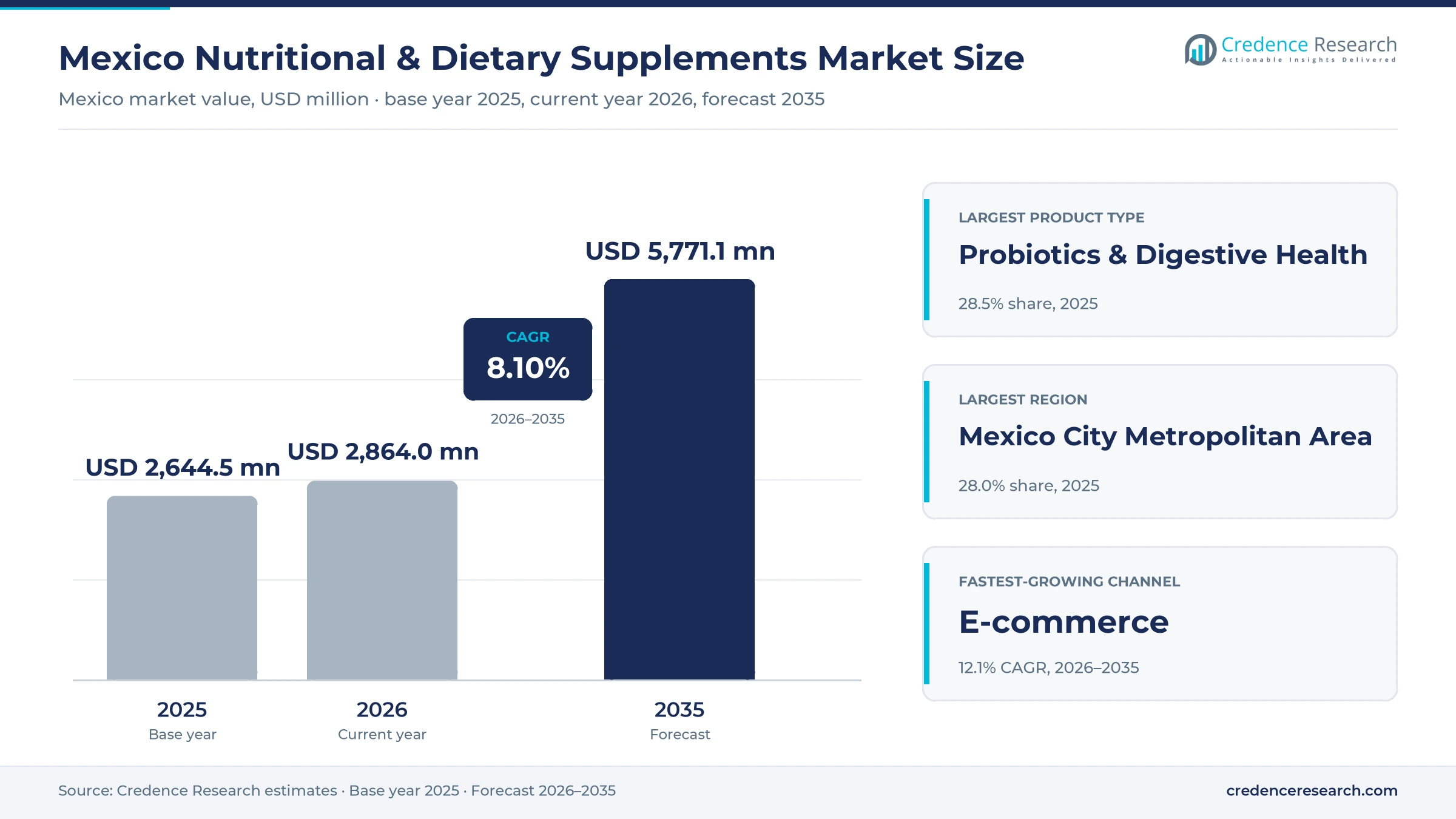
The Mexico nutritional and dietary supplements market was valued at USD 2.64 billion in 2025 and is projected to increase from USD 2.86 billion in 2026 to USD 5.77 billion by 2035, registering a CAGR of 8.10% during 2026–2035. Demand comes from adults who buy probiotics, multivitamins, protein powders and herbal formulas through pharmacies, direct-selling distributors and online stores. The Mexico City Metropolitan Area held the largest regional share, 28.0% in 2025, because the capital combines the highest incomes with the densest pharmacy and gym networks. South-Southeast is the fastest-growing region at 8.8% a year, since pharmacy chains and falling poverty are widening the buyer base from a small start. Regulation is also changing the product mix, after COFEPRIS issued guidance in June 2026 on which products qualify as food supplements. Products made only of vitamins or minerals and products sold as meal replacements fall outside that category, so brands are reviewing labels, registrations and claims before the next launch cycle.
Which products and sales channels does this estimate count?
The estimate measures sales in Mexico, valued at the prices brand owners and direct-selling companies receive before pharmacy and distributor retail margins, of vitamins and minerals, proteins and amino acids, botanicals and herbals, probiotics and digestive health products, and omega and specialty lipids. It counts tablets, capsules, powders, gummies, liquids and ready-to-drink formats sold through pharmacies, direct-selling networks, specialty nutrition stores, supermarkets and online stores.
The estimate excludes prescription medicines, infant formula, enteral feeding supplied to hospitals and fortified everyday foods such as dairy drinks and cereals. The value chain runs from ingredient importers, organic farms and contract manufacturers through brand owners and distributors to pharmacy chains, independent distributors and online marketplaces.
Mexico Nutritional & Dietary Supplements Market Insights
- The market was valued at USD 2.64 billion in 2025 and is projected to reach USD 5.77 billion by 2035, registering a CAGR of 8.10% during 2026–2035.
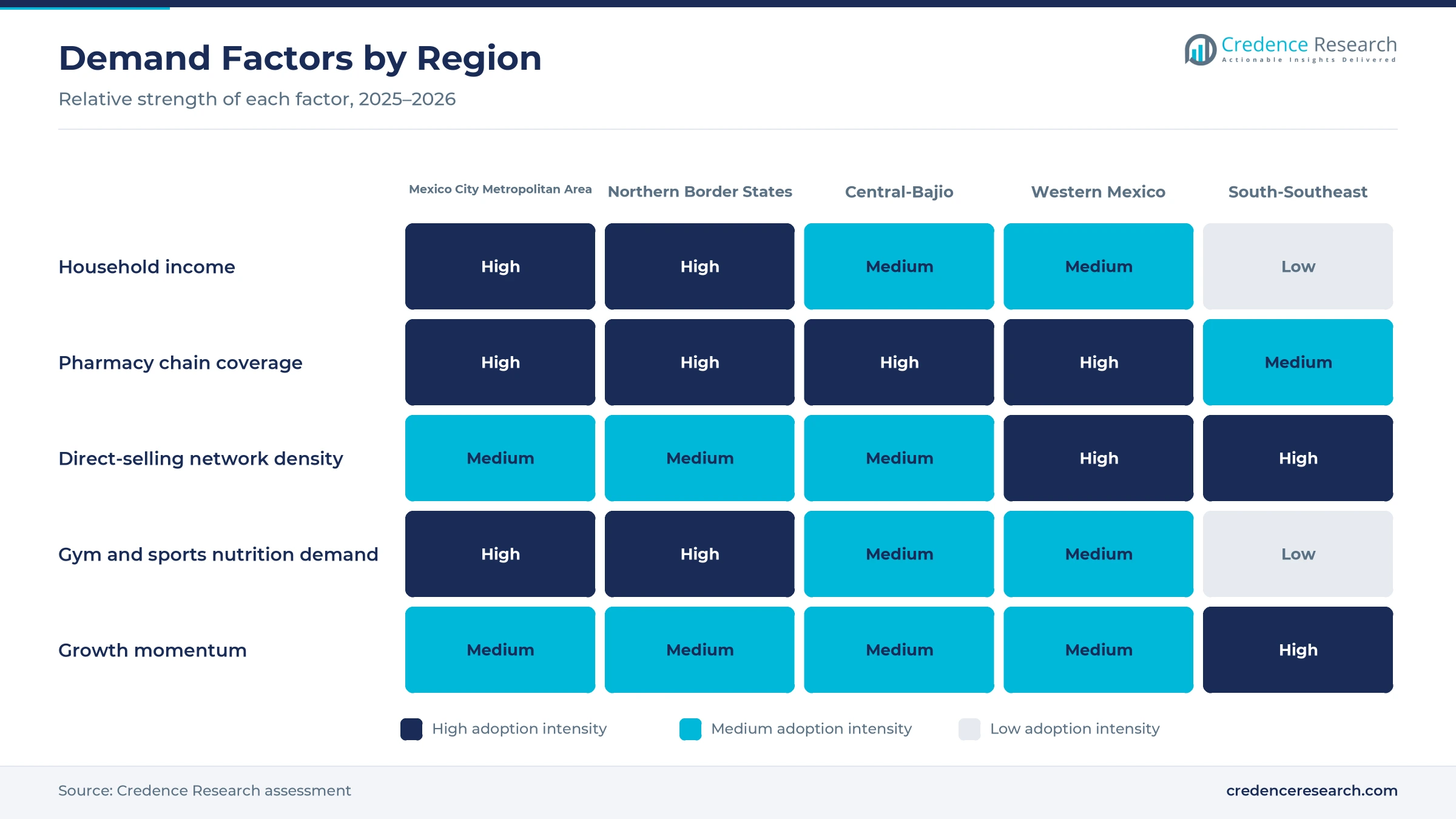
- The Mexico City Metropolitan Area held 28.0% of national value in 2025, supported by the highest incomes and densest store networks.
- Probiotics and digestive health products led with 28.5% of 2025 value, the largest category in industry sales data.
- COFEPRIS issued guidance in June 2026 that excludes vitamin-only products and meal replacements from the food supplement category.
- Herbalife reported 9% local-currency net sales growth in Mexico in the fourth quarter of 2025, showing that direct selling still adds volume.
Digestive products, wellness adults and pharmacies lead
Why do digestive health products lead supplement sales?
Based on product type, the market is categorized into vitamins and minerals, proteins and amino acids, botanicals and herbals, probiotics and digestive health, and omega and specialty lipids. Probiotics & Digestive Health led with 28.5% of 2025 value, because ANAISA data reported by Mexico Business News in August 2025 put digestive health at 26% of 2023 sales, the largest category, ahead of immune health at 12%. Fiber blends and probiotic strains sell through both pharmacies and distributors. Proteins & Amino Acids grow fastest at 9.3% a year, as Birdman creatine alone has sold more than 750,000 units on Mercado Libre, according to El Imparcial in October 2026.
How much do older adults add to supplement demand?
Based on customer type, the market is categorized into general wellness adults, sports and fitness consumers, women's health consumers, older adults and children and adolescents. General Wellness Adults led with 37.5% of 2025 value, because ANAISA estimated in June 2024 that about 15 million Mexicans take supplements, a base far wider than any single condition group. Older Adults grow fastest at 8.9% a year, as INEGI's 2024 aging survey counted about 17.7 million people aged 60 and older, and 42.1% of those reporting an illness had diabetes. Women's health buyers favor collagen peptides, iron blends and prenatal formulas sold in pharmacies.
Where do Mexican buyers purchase supplements?
Based on distribution channel, the market is categorized into pharmacies and drugstores, direct selling networks, specialty nutrition retail, supermarkets and hypermarkets, and e-commerce. Pharmacies & Drugstores led with 42.5% of 2025 value, because ANAISA data put pharmacies at 45% of 2023 sales and direct sales at 41%, leaving every other channel small. Pharmacists also steer first-time buyers toward known brands at the counter. E-commerce grows fastest at 12.1% a year, as ANAISA expects online sales to rise from 5.7% of the market in 2023 to more than 15% by 2028.
| Segment Group | Leading Sub-segment | Share, 2025 | Fastest-growing Sub-segment | CAGR, 2026–2035 |
|---|---|---|---|---|
| By Product Type | Probiotics & Digestive Health | 28.5% | Proteins & Amino Acids | 9.3% |
| By Customer Type | General Wellness Adults | 37.5% | Older Adults | 8.9% |
| By Distribution Channel | Pharmacies & Drugstores | 42.5% | E-commerce | 12.1% |
Pack prices, VAT and promotions set what buyers pay
Supplements in Mexico are priced by the pack, and the shelf price includes 16% VAT. Mass pharmacy brands such as Centrum sit near MXN 465 for 60 tablets, while adult nutrition powders cost about MXN 426 to MXN 474 a can. Marketplaces push prices down through heavy promotions, and the Birdman creatine tub sold at 35% below list in October 2026. Direct sellers set suggested retail prices that include distributor margins, so their shakes carry higher prices but come with coaching. Duty on non-agreement imports, noted in the challenges, keeps Asian products from undercutting these price points.
| Product or charge | Typical price or fee | Basis |
|---|---|---|
| Creatine monohydrate, 450 g tub (Birdman) | MXN 363–559 (sale and list) | Mercado Libre listing reported by El Imparcial, October 2026 |
| Multivitamin for women over 50, 60 tablets (Centrum) | MXN 465 | Farmacias Benavides online listing, November 2026 |
| Adult nutrition powder, 400 g (Ensure) | MXN 426–474 (sale and list) | WeCarePharma online listing, November 2026 |
| Import duty and VAT, tariff line 2106.90.99 | 20% duty for non-agreement origins plus 16% VAT | Camtom tariff database, November 2026 |
Request a Free Sample
Fill in your details and we'll send you a free sample report.
- Sample data tables & charts
- Research methodology
Chronic disease, online buying and gyms lift demand
Chronic disease and excess weight push preventive buying
Chronic disease gives Mexican buyers a concrete reason to spend on prevention, which keeps demand steady even when budgets tighten. According to the ENSANUT 2022 chronic disease analysis, 10.9% of adults aged 20 and older had a previous diabetes diagnosis and 15.9% had diagnosed hypertension. ANAISA cites a figure of 75% of the population as overweight, a base for fiber, digestive and weight-management products. The same association reported that its wellness segment grew 32% to about MXN 19 billion in 2023. In turn, suppliers that can show clinical backing for glucose, heart and digestive claims within COFEPRIS limits gain pharmacy shelf space, while unsupported weight-loss products face enforcement.
Online retail widens access to brands and formats
Online retail lets small brands reach buyers without pharmacy listings, which widens the range of formats and prices. The AMVO 2026 online sales study put Mexican online retail at MXN 941 billion in 2025, up 19.2%, with 77.2 million people buying online and e-commerce at 17.7% of total retail. Expansión reported in June 2024 that Mercado Libre's supplement category drew more than 41 million visits in the first half of that year, with omega 3, creatine, magnesium and protein the top sellers. Direct sellers are adding physical showrooms as well, as Immunotec opened an experience center in Polanco in July 2026. Buyers now compare labels and prices across marketplaces, and that comparison puts pressure on pharmacy pricing.
Gym growth expands sports nutrition demand
Gym expansion turns protein and creatine into regular purchases for a younger, urban customer base. Smart Fit passed 500 gyms in Mexico in the first half of 2026 and counted more than 1.3 million active users, up 18% to 20% from a year earlier, according to Emprendedor. The chain also planned more than MXN 1,500 million of investment and about 70 new gyms in 2026. ANAISA valued sports nutrition at MXN 4.5 billion in 2023, a small base that leaves room for creatine and whey powders to gain share. Sports nutrition demand rises with each of the roughly 70 gyms the chain plans to open in 2026, and brands that sell through gyms capture members before they settle on a product.
Direct-selling networks reach buyers beyond the cities
Direct-selling networks reach households that pharmacies and online stores serve poorly, which keeps them central to supplement demand. Food supplements were the largest category in Mexican direct selling in 2025, at about 39% of sales valued at distributor retail prices, according to AMVD figures reported by El Imparcial in July 2026. Expansión reported in February 2026 that more than 4 million people take part in multilevel selling in the country. Herbalife said Mexico posted 9% local-currency net sales growth in the fourth quarter of 2025, with about 3% volume growth. Distributor networks therefore remain the main route for shakes and nutrition programs outside large cities.
Stricter COFEPRIS rules and local plants reshape supply
COFEPRIS tightens product classification and claims
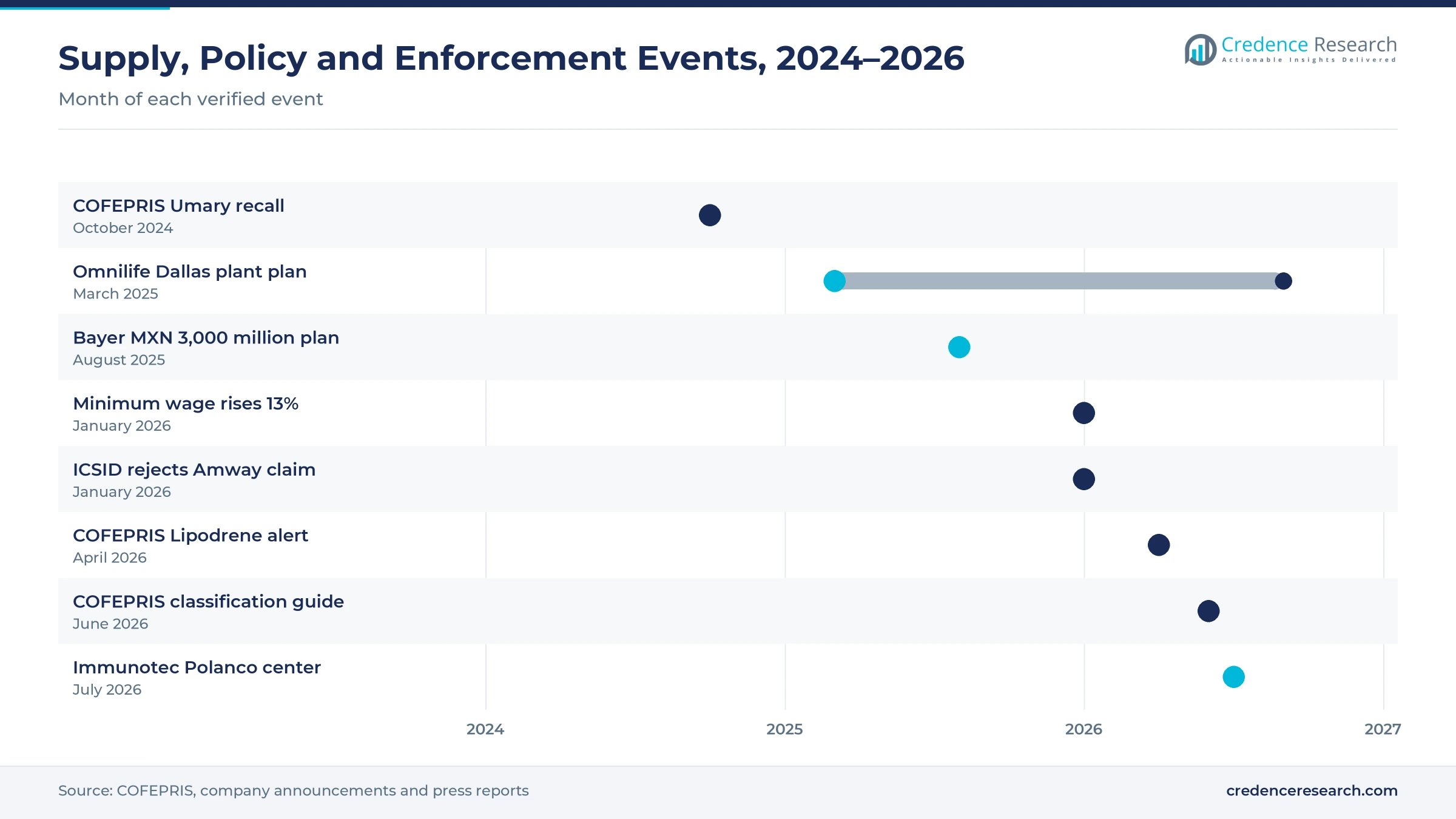
A shift toward stricter classification is changing which products can be sold as food supplements in Mexico. COFEPRIS released a non-binding classification guide on June 12, 2026 with three exclusion rules, LexLatin reported, covering vitamin-only products, meal replacements and ingredients with a recognized pharmacological action. El Universal reported in August 2026 that COFEPRIS had removed 31,155 online ads so far that year, and that 7,090 of the violations involved supplements. The agency also warned in April 2026 against Lipodrene weight-loss products sold online. Brands with pharmaceutical-grade dossiers benefit, while marketplace sellers with unsupported claims lose listings and face seizure risk.
Local and North American plants rise to meet demand
Supplement makers are adding production capacity in and near Mexico, which shortens lead times and lowers exposure to Asian imports. Omnilife told Revista E&N in March 2025 that its Guadalajara plant runs at 95% of capacity and that a new Dallas plant, with more than $35 million invested in technology and automation, should start in the second half of 2026. Bayer announced about MXN 3,000 million over five years for its Mexican sites in August 2025, including about MXN 1,100 million for a new plant in Lerma, with the consumer health division included. Local capacity running at 95% shows how close supplement demand in Mexico already runs to plant limits, and local supply helps brands hold prices when the peso weakens.
Pharmacy chain expansion opens room for wellness ranges
Expanding pharmacy chains create an opportunity for supplement brands that can supply private-label and mid-priced ranges. Farmacias Guadalajara ran 2,867 stores in 485 cities across all 32 states at the end of 2024, Expansión reported in December 2025. The same report counted more than 1,800 Farmacias del Ahorro stores, and Farmacias Similares runs a large network of small outlets near clinics. These chains want wellness aisles that lift basket size beyond medicines, and they prefer suppliers that train pharmacy staff and keep registrations current. With pharmacies holding the largest share of supplement demand, a listing across one national chain can reach buyers in every state at once.
Wage gains open an economy tier in lower-income states
Rising wages create an opportunity for economy-priced vitamins and probiotics among households that rarely bought supplements. The general minimum wage rose 13% to MXN 315.04 a day on Jan. 1, 2026, El Imparcial reported, citing Conasami. INEGI data also show poverty falling since 2022, which widens the pool of first-time buyers. Small packs, sachets and generic pharmacy brands suit these buyers, who buy by the week rather than by the month. Economy packs could lift supplement demand among the 38.5 million people INEGI still counted in poverty in 2024, many of them in the south-southeast. Suppliers that price below about MXN 150 a pack can reach them first.
Adulterated products, duties and soft networks weigh
Adulterated products undermine buyer trust
Adulterated and unregistered products undermine trust and pull sales away from compliant brands. COFEPRIS recalled all lots of one Umary hyaluronic acid product in October 2024 after it was found to contain diclofenac and omeprazole. One Lipodrene lot flagged in April 2026 carried DMAA, which the FDA says is illegal in products sold as supplements because it can raise blood pressure. Online buyers face the most risk, so brands invest in seals, authorized sellers and batch testing.
Import duties raise costs for Asian-sourced products
Import costs weigh on brands that source finished supplements from Asia. Products under tariff line 2106.90.99 pay a 20% duty from origins without a trade agreement, such as China, South Korea and India, and 16% VAT on top, according to the Camtom tariff database. Goods from the United States and Canada enter duty free. Marketplace sellers of Asian gummies and capsules feel this most, so many shift sourcing to North American contract makers.
Distributor networks lose momentum in parts of the region
Slower recruitment in some direct-selling networks limits volume growth for companies that rely on distributors. Mexican direct sales rose only 1.2% in 2024 to MXN 88,574 million, Emprendedor reported, citing AMVD. Nature's Sunshine said in March 2026 that its Latin America and Other segment fell 4.2% in 2025 excluding currency effects. Smaller networks lose distributors to online sellers, so companies add retail showrooms, apps and subscription programs to hold their customers.
Land and sourcing disputes add supply risk
The 2022 return of Amway's El Petacal farm in Jalisco, more than 643 hectares that grew broccoli, alfalfa, spinach and citrus for Nutrilite, shows that land claims can cut a supplier off from its own organic raw materials. Because an ICSID panel rejected Amway's claim on jurisdiction grounds in January 2026, brands planning farm-based sourcing for 2026 to 2035 now treat ejido land titles as a supply risk and spread crops across contract growers in several states.
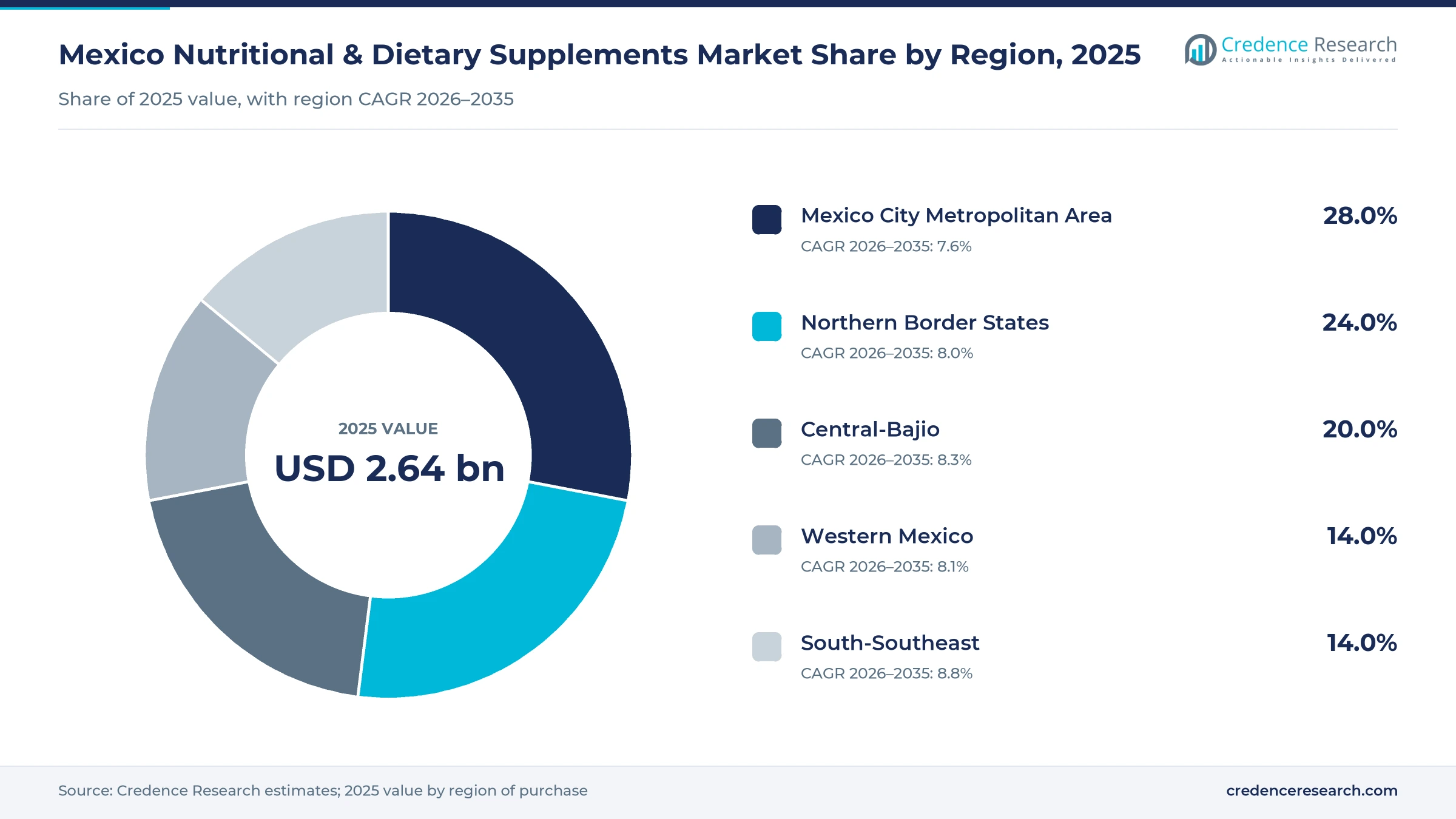
The capital leads while the south-southeast grows fastest
| Region | Value, 2025 (USD billion) | Share, 2025 | CAGR, 2026–2035 |
|---|---|---|---|
| Mexico City Metropolitan Area | 0.74 | 28.0% | 7.6% |
| Northern Border States | 0.63 | 24.0% | 8.0% |
| Central-Bajio | 0.53 | 20.0% | 8.3% |
| Western Mexico | 0.37 | 14.0% | 8.1% |
| South-Southeast | 0.37 | 14.0% | 8.8% |
The capital region leads on income and store density
The Mexico City Metropolitan Area held 28.0% of 2025 value and grows at 7.6% a year. Mexico City produced 15.0% of national GDP in 2024 and the State of Mexico 9.1%, according to INEGI. Direct sellers such as Immunotec also choose the capital for consultant showrooms, as noted above. Dense pharmacy coverage and the highest incomes make it the first market for new formats and premium brands.
Northern border states pair high wages with low poverty
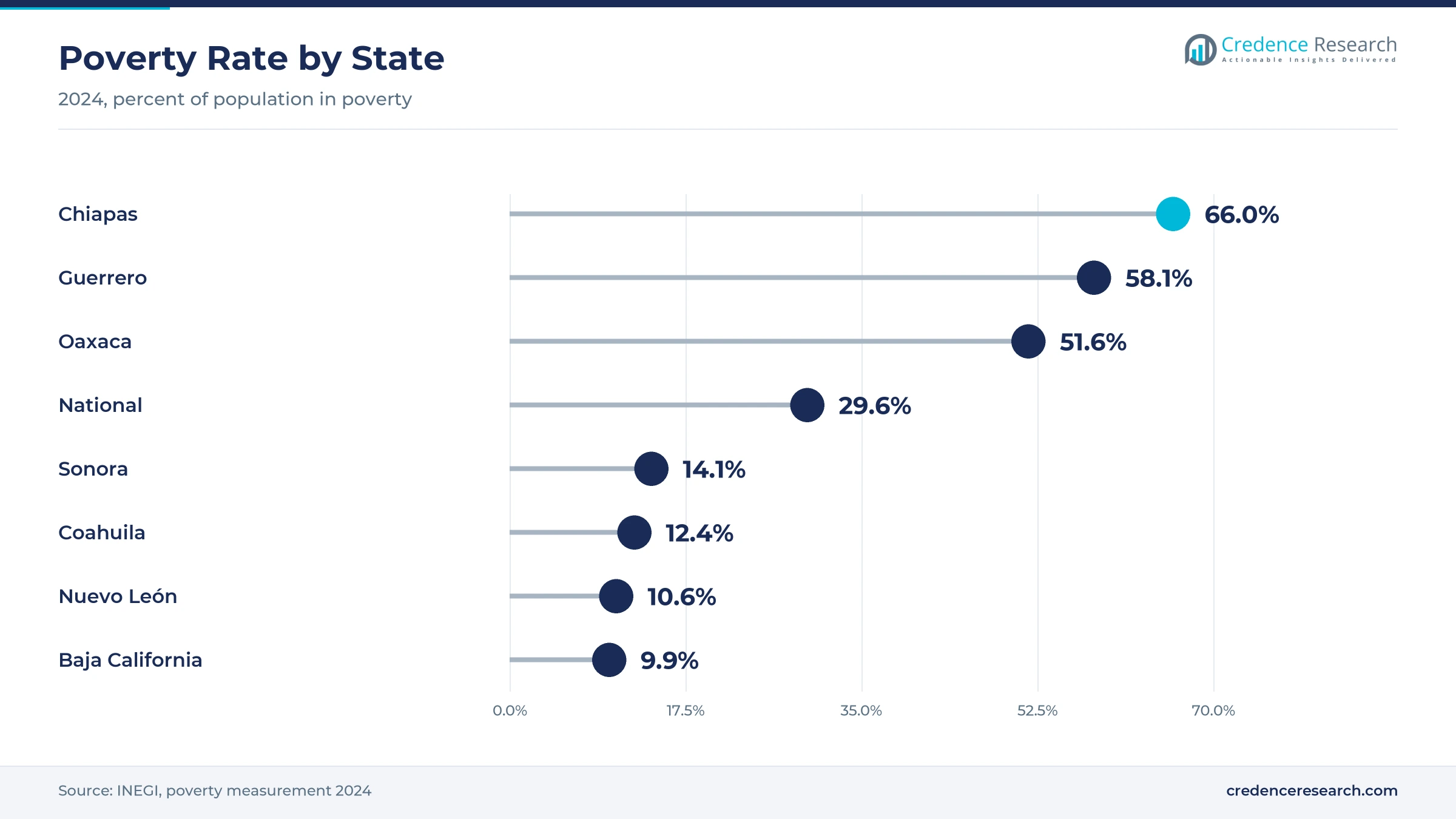
Northern Border States held 24.0% of 2025 value and grow at 8.0% a year. Nuevo León produced 8.1% of national GDP in 2024, while Baja California, Chihuahua, Coahuila and Sonora each added between 3.3% and 3.9%, according to INEGI. Poverty in Baja California and Nuevo León stood near 10% in 2024. Proximity to U.S. suppliers also makes imported sports and premium brands easier to stock in the zone.
Central-Bajio grows with manufacturing jobs
Central-Bajio held 20.0% of 2025 value and grows at 8.3% a year. Guanajuato produced 4.5% of national GDP in 2024 and Puebla 3.5%, according to INEGI. Pharmacy chains and supermarkets carry most supplement sales in the zone's mid-size industrial cities, where formal factory jobs support steady monthly purchases. These cities are the natural next step for gym and specialty store openings after the capital.
Western Mexico is home to direct-selling supply
Western Mexico held 14.0% of 2025 value and grows at 8.1% a year. Jalisco produced 7.5% of national GDP in 2024, according to INEGI, and Guadalajara hosts Omnilife's main plant. Jalisco also has the organic farm land that Nutrilite used before the 2022 return of El Petacal. Distributor networks are dense in the zone, so shakes and herbal products sell well beyond the main city.
South-southeast grows fastest from a low base
South-Southeast held 14.0% of 2025 value and grows fastest at 8.8% a year. Poverty reached 66% in Chiapas, 58.1% in Guerrero and 51.6% in Oaxaca in 2024, according to INEGI, far above the national average. Veracruz, the largest economy in the zone, produced 4.3% of national GDP. Growth comes from pharmacy chain openings and economy packs, while distributors remain the main supply route in smaller towns.
Plants, rulings and COFEPRIS guidance in 2025 and 2026
| Development | Status and market relevance |
|---|---|
| In March 2025, Omnilife said its Dallas plant would open in the second half of 2026 because its Guadalajara plant runs at 95% capacity. | Construction under way; adds North American supply |
| In August 2025, Bayer announced about MXN 3,000 million over five years for its Mexican sites, including a new Lerma plant. | Investment planned through 2030; covers consumer health |
| In January 2026, an ICSID panel rejected Amway's claim over the El Petacal farm in Jalisco. | Final for the claim; Nutrilite sourcing relies on other sites |
| In June 2026, COFEPRIS released a non-binding guide for classifying products as food supplements. | In use; brands review labels and registrations |
| In July 2026, Immunotec opened an experience center in Polanco, Mexico City, for its consultant network. | Open; supports direct-selling recruitment |
Formats and compliance tools change how products sell
- Gummy and chewable formats widen the buyer base to children and adults who dislike tablets, though sugar content limits claims.
- Strain-specific probiotic blends let brands make narrower digestive claims that fit within COFEPRIS rules on therapeutic language.
- Classification self-assessment follows the COFEPRIS decision diagram, letting makers check composition, use and labels before filing.
- Batch testing for hidden drugs helps compliant brands prove purity after recalls of products containing undeclared medicines.
- Marketplace storefronts give brands official stores on Mercado Libre and Amazon, which separate authentic stock from resellers.
Need a Custom Version of This Report?
Tailor the scope, geography, or segments to your exact requirements.
- Custom geography or segment scope
- Direct access to our analyst team
Distributor networks and pharmacy brands compete
Competition in the Mexico nutritional and dietary supplements market runs along two lines, distributor networks and pharmacy brands. Herbalife, Amway with its Nutrilite range, Grupo Omnilife, USANA and Nature's Sunshine compete for distributors and for buyers who want shakes, herbal blends and coaching. Herbalife's recent local growth shows that this model still adds volume, while Omnilife is adding capacity beyond its Guadalajara plant. Haleon, Bayer, Abbott and Nestlé Health Science compete for pharmacy shelf space with multivitamins, immune products and adult nutrition drinks. GNC, owned by Harbin Pharmaceutical Group since 2020, runs specialty stores and online sales for sports and wellness ranges, while local brands such as Birdman win on marketplace price. Pharmacy chains also push their own lower-priced brands beside these names. Registration quality, pharmacist recommendation and distributor incentives decide most wins, with price mattering most online.
How is the supply side organized?
The supply side splits into three groups with different economics. Direct-selling companies such as Herbalife, Amway, Omnilife, USANA and Nature's Sunshine own their formulas and often their plants, and they share margin with millions of distributors. Consumer health groups such as Haleon, Bayer, Abbott and Nestlé sell through pharmacy chains, where a few large chains control shelf access. Local brands such as Birdman sell mainly online and rely on contract makers. COFEPRIS registration and pharmacy listings are the main entry barriers, and margins are highest for brand owners with proven claims.
Key suppliers in Mexican supplements
| Company | Type | Role in the market |
|---|---|---|
| Herbalife | Direct seller | Sells shakes and supplements through distributors; Mexico grew 9% locally in late 2025 |
| Grupo Omnilife | Direct seller and manufacturer | Makes supplements in Guadalajara and is adding a Dallas plant |
| Amway (Nutrilite) | Direct seller | Sells Nutrilite vitamins and botanicals through independent business owners |
| Haleon | Consumer health company | Sells Centrum multivitamins through Mexican pharmacy chains |
| Bayer | Consumer health company | Consumer health division covered by its MXN 3,000 million Mexican investment |
| Abbott | Nutrition company | Sells Ensure adult nutrition powders and drinks through pharmacies |
| Nestlé Health Science (Nestlé) | Nutrition company | Vitamin, supplement and adult medical nutrition brand owner |
| GNC (Harbin Pharmaceutical Group) | Specialty retailer | Runs supplement stores and delivery storefronts for sports and wellness ranges |
| Nature's Sunshine Products | Direct seller | Herbal and nutritional supplement direct seller with Latin American operations |
| USANA Health Sciences | Direct seller | Lists Mexico among markets served through brand partners |
Credence Research view on channel and rule changes
Credence Research's view is that Mexican supplement value will grow through online sales, older adults and pharmacy wellness ranges, while direct selling keeps a large but slowly falling share. Chronic disease gives buyers a lasting reason to spend, and the gym base adds a younger customer group. COFEPRIS classification is the main source of uncertainty, because vitamin-only and meal-replacement products may need new registrations. Brands with clean dossiers, batch testing and official online stores are best placed, while unregistered sellers will lose ground as enforcement continues.
National estimate built from channel and survey data
The report uses 2025 as the base year and 2026 to 2035 as the forecast period. Market values come from the Credence Research model, and regional, product type, customer type and channel splits are Credence Research estimates. Inputs include INEGI and ENSANUT health and income data, industry association figures reported by the press, COFEPRIS notices, company releases and filings, retailer listings and store counts. Regional shares were built from state output, poverty rates and store density. No interviews or surveys were used in preparing these estimates.
E-commerce and older adults lead growth to 2035
The Mexico nutritional and dietary supplements market is expected to reach USD 5.77 billion by 2035, an 8.10% CAGR during 2026–2035, as online buying, older adults and pharmacy wellness aisles add value. E-commerce should gain share faster than any other channel, while pharmacies stay the largest. South-Southeast should add the most new buyers as poverty falls and chains open stores. A strict COFEPRIS reading or a sharper fall in distributor numbers would lower this path, while faster wage gains and clinical claims backed by evidence would raise it.
What separates the low and high cases to 2035?
The range of outcomes depends mainly on how COFEPRIS applies its classification rules and how fast online sales grow. A strict reading would move vitamin-only and meal-replacement products out of the category or into costlier registrations, lowering growth. Faster wage gains and online buying in the south would lift it. Direct selling is the swing factor, because it holds a large share and recent results have been mixed.
| Scenario | CAGR, 2026–2035 | Value, 2035 | What has to hold |
|---|---|---|---|
| Downside | 6.5% | USD 5.05 billion | Strict classification removes products and distributor networks keep shrinking |
| Base | 8.10% | USD 5.77 billion | Rules settle through registration updates and online sales keep gaining share |
| Upside | 9.4% | USD 6.43 billion | Online sales pass 15% of the market and older-adult nutrition grows faster |
Frequently Asked Questions
How big is the Mexico nutritional and dietary supplements market?
Which product type leads supplement sales in Mexico?
Where do Mexicans buy most supplements?
Which region leads supplement spending in Mexico?
Are vitamins classified as food supplements in Mexico?
How important is direct selling for supplements in Mexico?
Why are older adults important for supplement demand?
Who are the main companies in the market?
Table of Content
Chapter 1 Market Segmentation
- 1.1 Segmentation Framework
- 1.1.1 Product and Service Classification
- 1.1.2 Application and End-Use Classification
- 1.1.3 Technology and Solution Classification
- 1.1.4 Customer and Distribution Channel Classification
- 1.1.5 Geographic Segmentation
- 1.1.6 Market Segment Definitions and Boundaries
- 1.2 By Product Type
- 1.2.1 Probiotics & Digestive Health
- 1.2.2 Vitamins & Minerals
- 1.2.3 Proteins & Amino Acids
- 1.2.4 Botanicals & Herbals
- 1.2.5 Omega & Specialty Lipids
- 1.3 By Customer Type
- 1.3.1 General Wellness Adults
- 1.3.2 Older Adults
- 1.3.3 Women's Health Consumers
- 1.3.4 Sports & Fitness Consumers
- 1.3.5 Children & Adolescents
Chapter 2 Introduction
- 2.1 Report Objectives and Scope
- 2.2 Product Definition and Industry Terminology
- 2.3 Market Inclusions and Exclusions
- 2.4 Research Process
- 2.4.1 Primary Research and Expert Interviews
- 2.4.2 Secondary Research and Source Review
- 2.4.3 Top-Down and Bottom-Up Estimation
- 2.4.4 Data Triangulation and Verification
- 2.5 Market Size Measurement Basis
- 2.5.1 2025: USD 2.64 billion → 2035: USD 5.77 billion
- 2.6 Historical and Forecast Reference Periods
- 2.6.1 Historical Period: 2018-2025
- 2.6.2 Base Year: 2025
- 2.6.3 Forecast Period: 2025-2035
- 2.7 Research Assumptions and Limitations
Chapter 3 Executive Summary
- 3.1 Market Snapshot and Key Findings
- 3.2 Base-Year Market Size, 2025
- 3.3 Forecast Market Size, 2035
- 3.4 Revenue and Volume Growth Outlook
- 3.5 Key Demand and Supply Indicators
- 3.6 Leading Market Segments
- 3.7 Fastest-Growing Market Opportunities
- 3.8 Regional Performance Highlights
- 3.9 Technology and Industry Transformation
- 3.10 Competitive Landscape Summary
- 3.11 Analyst View and Strategic Implications
Chapter 4 Mexico Nutritional & Dietary Supplements Market Trends and Developments
- 4.1 Historical Industry Development, 2018-2025
- 4.2 Recent Market Trends and Developments
- 4.3 Demand and Customer Behavior Trends
- 4.4 Technology and Product Innovation
- 4.5 Artificial Intelligence, Automation and Digitalization
- 4.6 Local Manufacturing and Supply Chain Realignment
- 4.7 Industry Partnerships, Mergers and Acquisitions
- 4.8 Sustainability and Circular Economy Developments
- 4.9 Government and Private Sector Investment Trends
- 4.10 Emerging Business Models and Commercialization
- 4.11 Industry Developments and Announcements
Chapter 5 Mexico Nutritional & Dietary Supplements Market Production, Supply and Demand Analysis
- 5.1 Demand Trend and Consumption Analysis, 2018-2025
- 5.2 Demand Forecast, 2025-2035
- 5.3 Production and Output Trend, 2018-2025
- 5.4 Production and Output Forecast, 2025-2035
- 5.5 Installed Capacity and Capacity Utilization
- 5.6 Company-Wise Production Plants and Statistics
- 5.6.1 Installed Production Capacity
- 5.6.2 Actual Production
- 5.6.3 Planned Capacity and Expansion Targets
- 5.7 Supply Chain Structure and Procurement Trends
- 5.8 Supply-Demand Gap and Bottlenecks
- 5.9 Import Dependence and Sourcing Structure
- 5.10 Contract Manufacturing and Outsourcing
- 5.11 Regional Supply and Demand Concentration
Chapter 6 Mexico Nutritional & Dietary Supplements Market Pricing Analysis
- 6.1 Pricing Structure and Measurement
- 6.2 Historical Pricing Trends, 2018-2025
- 6.3 Pricing Outlook, 2025-2035
- 6.4 Average Selling Price and Unit Economics
- 6.5 Pricing by Product and Market Segment
- 6.6 Geographic Pricing Differences
- 6.7 Key Input, Energy, Labor and Logistics Costs
- 6.8 Contract Pricing and Purchasing Models
- 6.9 Pricing Sensitivity and Competitive Positioning
- 6.10 Price, Margin and Profitability Implications
Chapter 7 Mexico Nutritional & Dietary Supplements Market Dynamics
- 7.1 Market Growth Drivers
- 7.1.1 Demand-Side Drivers
- 7.1.2 Technology and Innovation Drivers
- 7.1.3 Infrastructure and Investment Drivers
- 7.1.4 Regulatory and Policy Drivers
- 7.2 Market Restraints
- 7.2.1 Cost and Affordability Constraints
- 7.2.2 Technology and Adoption Barriers
- 7.2.3 Supply Chain and Operational Constraints
- 7.3 Market Challenges
- 7.3.1 Competitive Pressure and Margin Erosion
- 7.3.2 Skills, Infrastructure and Implementation Gaps
- 7.4 Emerging Market Opportunities
- 7.5 Market Dynamics Impact and Time-Horizon Assessment
Chapter 8 Mexico Nutritional & Dietary Supplements Value Chain Analysis
- 8.1 Industry Value Chain Overview
- 8.2 Upstream Suppliers and Critical Inputs
- 8.3 Technology and Component Providers
- 8.4 Manufacturing or Service Delivery
- 8.5 Distribution, Channel Partners and Integrators
- 8.6 Downstream Applications and End Users
- 8.7 Value Addition and Profit Pools
- 8.8 Vertical Integration and Outsourcing
- 8.9 Supplier Concentration and Risk
- 8.10 Supply Chain Localization and Resilience
Chapter 9 Mexico Nutritional & Dietary Supplements Market Regulations and Policies
- 9.1 Relevant Laws, Standards and Compliance Frameworks
- 9.2 Product, Service, Safety and Quality Requirements
- 9.3 Government Policies, Incentives and Subsidies
- 9.4 Imports, Exports and Trade Barriers
- 9.5 Public Procurement and Local Content Requirements
- 9.6 Environmental and Sustainability Compliance
- 9.7 Upcoming Policy Changes and Market Implications
Chapter 10 Mexico Nutritional & Dietary Supplements Market Hotspots and Opportunities
- 10.1 Market Opportunity Mapping and Growth Hotspots
- 10.2 High-Growth Applications and Customer Groups
- 10.3 Underserved Markets and White-Space Opportunities
- 10.4 Emerging Technology and Product Opportunities
- 10.5 New Capacity and Investment Hotspots
- 10.6 Market Entry and Expansion Opportunities
- 10.7 Distribution and Partnership Opportunities
- 10.8 Near-Term and Long-Term Commercial Potential
- 10.9 Opportunity Attractiveness and Execution Risks
Chapter 11 Mexico Nutritional & Dietary Supplements Market Outlook, 2025-2035
- 11.1 Market Size and Analysis
- 11.1.1 Revenue (Market Measurement: 2025: USD 2.64 billion → 2035: USD 5.77 billion)
- 11.1.2 Market Volume and Quantity Sold
- 11.1.3 Historical Market Size, 2018-2025
- 11.1.4 Base-Year Market Size, 2025
- 11.2 Market Forecast, 2025-2035
- 11.2.1 Revenue Forecast to 2035
- 11.2.2 Volume Forecast to 2035
- 11.2.3 CAGR and Year-on-Year Growth
- 11.2.4 Incremental Revenue Opportunity
- 11.3 Forecast Assumptions and Scenario Analysis
- 11.3.1 Base-Case Forecast
- 11.3.2 Optimistic and Conservative Scenarios
- 11.3.3 Technology, Pricing and Policy Sensitivities
- 11.4 Market Attractiveness and Growth Outlook
Chapter 12 Mexico Nutritional & Dietary Supplements Market Segmentation and Outlook
- 12.1 Segmentation Summary and Market Shares, 2025
- 12.2 Largest and Fastest-Growing Segments
- 12.3 By Product Type - Market Size and Forecast, 2025-2035
- 12.3.1 Segment Definition and Scope
- 12.3.2 Historical Market Size, 2018-2025
- 12.3.3 Revenue Forecast, 2025-2035
- 12.3.4 Volume Forecast, 2025-2035
- 12.3.5 Base-Year Market Share, 2025
- 12.3.6 Segment CAGR and Growth Drivers
- 12.3.7 Subsegment Market Size and Forecast
- 12.3.7.1 Probiotics & Digestive Health
- 12.3.7.2 Vitamins & Minerals
- 12.3.7.3 Proteins & Amino Acids
- 12.3.7.4 Botanicals & Herbals
- 12.3.7.5 Omega & Specialty Lipids
- 12.3.8 Subsegment Pricing and Adoption Trends
- 12.3.9 Leading Suppliers and Competition
- 12.3.10 Regional Demand and Opportunities
- 12.4 By Customer Type - Market Size and Forecast, 2025-2035
- 12.4.1 Segment Definition and Scope
- 12.4.2 Historical Market Size, 2018-2025
- 12.4.3 Revenue Forecast, 2025-2035
- 12.4.4 Volume Forecast, 2025-2035
- 12.4.5 Base-Year Market Share, 2025
- 12.4.6 Segment CAGR and Growth Drivers
- 12.4.7 Subsegment Market Size and Forecast
- 12.4.7.1 General Wellness Adults
- 12.4.7.2 Older Adults
- 12.4.7.3 Women's Health Consumers
- 12.4.7.4 Sports & Fitness Consumers
- 12.4.7.5 Children & Adolescents
- 12.4.8 Subsegment Pricing and Adoption Trends
- 12.4.9 Leading Suppliers and Competition
- 12.4.10 Regional Demand and Opportunities
- 12.5 Segment Growth Comparison
- 12.6 Segment Attractiveness and Priority Matrix
Chapter 13 Mexico Nutritional & Dietary Supplements End-Use and Application Market Outlook
- 13.1 End-Use Industry and Customer Demand Structure
- 13.2 Leading Applications and Customer Groups
- 13.3 End-Use Market Size, Share and Forecast
- 13.4 Major End-Use Industry Deep Dives
- 13.4.1 Customer Requirements and Use Cases
- 13.4.2 Demand and Replacement Cycles
- 13.4.3 Technical and Regulatory Considerations
- 13.4.4 Purchasing and Procurement Models
- 13.4.5 Leading Vendors and Distribution Channels
- 13.4.6 Forecast and Commercial Opportunities
- 13.5 Emerging Applications and Cross-Segment Demand
- 13.6 End-Use Industry Investment Priorities
Chapter 14 Mexico Nutritional & Dietary Supplements Geographic Market Outlook, 2025-2035
- 14.1 Domestic Market Distribution and Demand Clusters
- 14.2 State- or Province-Wise Market Size and Forecast, 2025-2035
- 14.3 City and Metropolitan Market Outlook
- 14.4 Industrial, Manufacturing and Commercial Clusters
- 14.5 Geographic Concentration of Key End Users
- 14.6 Local Pricing and Purchasing Differences
- 14.7 Domestic Production Facilities and Capacity Map
- 14.8 Local Infrastructure and Project Pipeline
- 14.9 State-Level Policy and Incentive Differences
- 14.10 Subnational Investment Hotspots and Opportunities
- 14.11 Distribution and Logistics Networks
- 14.12 Domestic Competitive Footprint
Chapter 15 Mexico Nutritional & Dietary Supplements Technology, Innovation and Sustainability Outlook
- 15.1 Technology Landscape and Maturity
- 15.2 Product, Process and Service Innovation
- 15.3 AI, Automation and Digital Tools in the Industry
- 15.4 Technology Adoption and Performance Benchmarking
- 15.5 Innovation Pipeline and R&D Investment
- 15.6 Patent and Intellectual Property Trends
- 15.7 Energy Efficiency and Resource Management
- 15.8 Sustainability, Recycling and Circularity
- 15.9 Technology Roadmap, 2025-2035
- 15.10 Risks of Obsolescence and Technology Substitution
Chapter 16 Mexico Nutritional & Dietary Supplements Market Key Strategic Imperatives
- 16.1 Growth and Market Entry Priorities
- 16.2 High-Return Products and Segments
- 16.3 Pricing, Profitability and Cost Optimization
- 16.4 Technology Investment and Product Differentiation
- 16.5 Supply Chain Localization and Resilience
- 16.6 Distribution and Customer Acquisition
- 16.7 Partnership, Acquisition and Capacity Strategy
- 16.8 Regional Expansion Priorities
- 16.9 Short-, Medium- and Long-Term Actions
Chapter 17 Competition Outlook
- 17.1 Industry Competition Characteristics
- 17.2 Market Structure and Concentration
- 17.3 Market Share and Competitive Positioning, 2025
- 17.4 Company-Wise Revenue and Product Benchmarking
- 17.5 Production and Service Capacity Benchmarking
- 17.6 Technology, Pricing and Differentiation
- 17.7 Regional Footprint and Distribution Strength
- 17.8 Mergers, Acquisitions and Strategic Alliances
- 17.9 New Entrants and Competitive Threats
- 17.10 Porter's Five Forces and Industry Attractiveness
- 17.11 Competitive Outlook, 2025-2035
Chapter 18 Company Profiles
- 18.1 Company Coverage and Selection Criteria
- 18.2 Herbalife
- 18.2.1 Business Description
- 18.2.2 Company Ownership and Geographic Presence
- 18.2.3 Product and Service Portfolio
- 18.2.4 Manufacturing and Operating Footprint
- 18.2.5 Production Capacity and Expansion Plans
- 18.2.6 Financial Performance and Investment
- 18.2.7 Market Share and Competitive Position
- 18.2.8 Technology and Innovation Capabilities
- 18.2.9 Strategic Alliances or Partnerships
- 18.2.10 Recent Developments
- 18.2.11 Growth Strategy and Outlook
- 18.3 Grupo Omnilife
- 18.4 Amway (Nutrilite)
- 18.5 Haleon
- 18.6 Bayer
- 18.7 Abbott
- 18.8 Nestlé Health Science (Nestlé)
- 18.9 GNC (Harbin Pharmaceutical Group)
- 18.10 Nature's Sunshine Products
- 18.11 USANA Health Sciences
- 18.12 Other Relevant Market Participants
Note: Every listed company is profiled on the structure shown under the first company. The company list is preliminary and may change based on research findings, market developments, data availability and client requirements.
Chapter 19 Disclaimer
- 19.1 Research and Forecast Disclaimer
- 19.2 Data Source and Estimation Limitations
Note: The depth of individual sections depends on data availability for this market. Volume, capacity, trade and other unit-based metrics are included where applicable.