Sports Nutrition Supplements Market Overview:
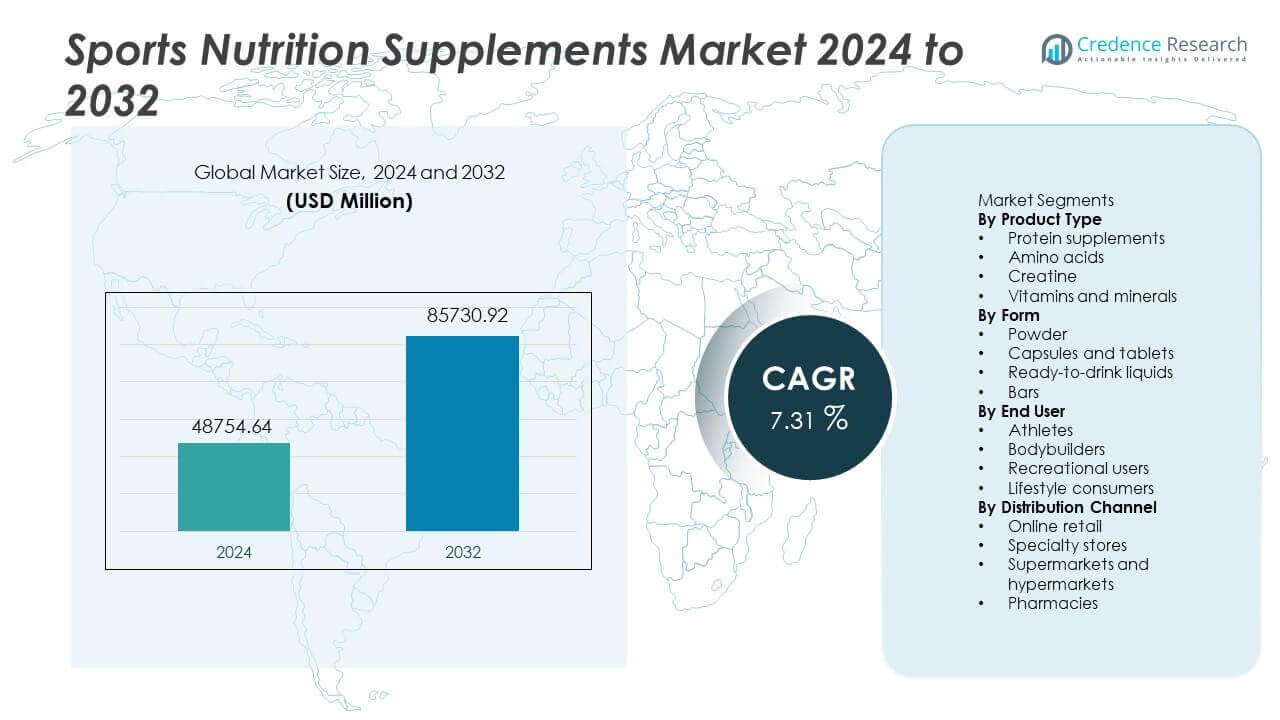
The Sports Nutrition Supplements market size was valued at USD 48,754.64 million in 2024 and is projected to reach USD 85,730.92 million by 2032, growing at a CAGR of 7.31% during the forecast period.
| REPORT ATTRIBUTE | DETAILS |
|---|---|
| Historical Period | 2020-2023 |
| Base Year | 2024 |
| Forecast Period | 2025-2032 |
| Sports Nutrition Supplements Market Size 2024 | USD 48,754.64 million |
| Sports Nutrition Supplements Market, CAGR | 7.31% |
| Sports Nutrition Supplements Market Size 2032 | USD 85,730.92 million |
Sports Nutrition Supplements Market Insights
- Growing focus on muscle recovery, endurance, and performance drives demand, with protein supplements leading the product segment with a share of 42.6% due to daily usage and workout recovery needs.
- Clean label formulations, plant-based proteins, and convenient ready-to-drink formats shape market trends, while powders dominate the form segment with a 48.3% share due to cost efficiency and flexible dosing.
- Intense competition and price sensitivity act as key restraints, as global brands and private labels compete on pricing, promotions, and online visibility, limiting margin expansion.
- North America leads regional demand with a 36.8% share, followed by Europe at 24.5% and Asia Pacific at 22.7%, supported by gym culture, lifestyle nutrition adoption, and rapid urban fitness growth.
Sports Nutrition Supplements Market Segmentation Analysis:
By Product Type
By product type, protein supplements dominate the Sports Nutrition Supplements market with a market share of 42.6%. Strong demand comes from muscle building, recovery support, and daily protein intake needs. Whey protein leads due to fast absorption and high amino acid content. Plant-based proteins gain steady traction among vegan and lactose-intolerant consumers. Rising gym memberships and fitness awareness support consistent protein demand. Amino acids and creatine follow, driven by performance and strength goals. Vitamins and minerals support general wellness use. Product innovation and flavor variety further strengthen protein supplement leadership across global markets.
- For instance, Glanbia plc formulated whey isolates delivering 25 grams protein and 5.5 grams BCAAs per serving, validated through batch-level amino acid testing.
By Form
By form, powder products hold the leading market share of 48.3%. Powders offer cost efficiency, flexible dosing, and easy blending with food or beverages. Fitness enthusiasts prefer powders for protein shakes and pre-workout mixes. Long shelf life and wide flavor options support higher adoption. Ready-to-drink liquids gain traction due to convenience, especially among urban consumers. Capsules, tablets, and bars address portability needs. However, higher pricing limits volume growth. Strong retail presence and online sales further reinforce powder dominance in both developed and emerging fitness markets.
- For instance, Abbott Laboratories developed powdered sports nutrition formulas offering 30 grams protein, under 2 grams sugar, and stability across 24 months shelf life.
By End User
By end user, athletes represent the dominant sub-segment with a market share of 39.1%. Professional and semi-professional athletes drive consistent consumption for performance, endurance, and recovery. Structured training programs increase supplement dependency. Bodybuilders follow closely, supported by muscle gain and physique goals. Recreational users show steady growth due to fitness lifestyle adoption. Lifestyle consumers expand demand through weight management and wellness trends. Rising sports participation, fitness events, and coaching programs strengthen athlete-focused sales. Brand endorsements and sports nutrition education further sustain dominance of this end-user segment.
Key Growth Drivers
Rising Fitness and Active Lifestyle Adoption
Growing fitness awareness drives strong demand for sports nutrition supplements. Urban consumers adopt regular workout routines. Gym memberships increase across age groups. Home fitness programs expand due to lifestyle shifts. Consumers seek products that support muscle strength and endurance. Sports participation rises in schools and colleges. Recreational sports gain popularity in cities. Fitness influencers shape purchase behavior. Social media boosts visibility of protein products. This driver supports sustained consumption across developed and emerging markets.
- For instance, Nestlé S.A. utilizes its ISO 17025 accredited quality assurance centers to verify protein formulations that provide a complete profile of all essential amino acids.
Increasing Focus on Muscle Recovery and Performance
Athletes prioritize faster recovery and better performance outcomes. Training intensity continues to rise across sports levels. Muscle fatigue management becomes essential. Protein and amino acid supplements support post-workout recovery. Creatine addresses strength and power goals. Endurance athletes demand energy and hydration solutions. Scientific validation improves consumer confidence. Coaches recommend structured supplement intake. Performance-focused formulations gain acceptance. This driver strengthens demand among professional and amateur athletes.
- For instance, MusclePharm Corporation developed recovery formulations delivering protein, BCAAs, and creatine per serving, designed for digestion and absorption during the post-workout window.
Expansion of Online Retail and Direct-to-Consumer Channels
Digital platforms expand product accessibility across regions. Online retail offers wide product choice and convenience. Consumers compare formulations and pricing easily. Subscription models drive repeat purchases. Influencer marketing boosts digital sales volumes. Brands access consumer insights directly. Personalized nutrition recommendations gain traction. Cross-border e-commerce improves market reach. Discount-led campaigns attract first-time users. This driver accelerates market penetration globally.
Key Trends and Opportunities
Growth of Plant-Based and Clean Label Products
Plant-based supplements gain strong traction among health-conscious consumers. Vegan and flexitarian diets support adoption. Clean label claims influence purchase decisions. Consumers prefer products without artificial additives. Plant proteins attract lactose-intolerant users. Sustainability concerns increase ingredient transparency. Brands invest in natural sourcing. Clean formulations enhance brand trust. Premium positioning improves margins. This trend creates clear product differentiation opportunities.
- For instance, PepsiCo Inc. developed plant-based protein powders delivering 20 grams pea and rice protein, containing fewer than 6 ingredients, and verified for heavy metal compliance below FDA action limits.
Rising Demand from Lifestyle and Wellness Consumers
Sports nutrition expands beyond professional athletes. Lifestyle consumers adopt supplements for daily wellness. Weight management remains a key use case. Busy schedules increase demand for convenient nutrition. Ready-to-use formats appeal to working professionals. Preventive health awareness supports routine intake. Female fitness participation rises steadily. Ageing populations seek muscle support. This trend broadens the overall consumer base.
- For instance, Amway Corporation formulated plant-based lifestyle nutrition products that provide high-quality protein, include added calcium, and achieve the highest possible clinical digestibility scores.
Key Challenges
Regulatory Compliance and Product Standardization Issues
Regulatory standards vary significantly across regions. Ingredient approvals differ by country. Labeling rules increase compliance complexity. Quality testing raises operational costs. Smaller brands face higher entry barriers. Misleading claims attract strict scrutiny. Product recalls damage brand credibility. Cross-border sales encounter approval delays. Compliance demands slow innovation cycles. This challenge limits faster market expansion.
High Competition and Price Sensitivity
Competition remains intense among global and local brands. Product differentiation becomes difficult. Price sensitivity affects buying decisions. Online platforms increase price comparison. Private labels add competitive pressure. Promotional spending reduces margins. Brand loyalty remains limited. New entrants face high marketing costs. Cost efficiency becomes critical. This challenge impacts long-term profitability.
Regional Analysis
North America
North America leads the Sports Nutrition Supplements market with a market share of 36.8%. High fitness awareness drives consistent supplement consumption. Strong gym culture supports protein and performance products. Professional sports participation increases demand for recovery solutions. E-commerce penetration improves product access across urban and suburban areas. Brand loyalty remains strong due to established players. Clean label and plant-based products gain traction. The United States dominates regional demand, supported by high disposable income. Sports endorsements influence purchasing decisions. Continuous product innovation sustains regional leadership.
Europe
Europe accounts for a market share of 24.5% in the Sports Nutrition Supplements market. Rising health consciousness supports steady growth. Functional nutrition gains popularity among lifestyle consumers. Sports participation increases across amateur and professional levels. Regulatory oversight improves product quality standards. Plant-based and organic supplements record strong demand. Germany, the United Kingdom, and France drive regional sales. Aging populations seek muscle maintenance products. Online and specialty retail channels expand steadily. Premium formulations support value growth across the region.
Asia Pacific
Asia Pacific holds a market share of 22.7%, supported by rapid urbanization and rising fitness adoption. Young populations show strong interest in gym culture. Disposable income growth boosts supplement affordability. Sports academies and fitness centers expand across major cities. Protein powders gain strong traction among first-time users. China, India, and Japan remain key contributors. E-commerce platforms accelerate market penetration. Influencer-driven marketing shapes consumer awareness. Expanding middle-class populations support long-term regional growth.
Latin America
Latin America represents a market share of 9.1% in the Sports Nutrition Supplements market. Fitness awareness rises steadily across urban centers. Gym memberships increase among young consumers. Protein supplements dominate due to muscle-building focus. Brazil and Mexico lead regional demand. Affordable product offerings improve accessibility. Sports culture supports supplement adoption among athletes. Retail expansion improves product availability. Online sales gain momentum in metropolitan areas. Economic recovery supports gradual consumption growth across the region.
Middle East and Africa
The Middle East and Africa account for a market share of 6.9%. Growing health awareness supports supplement adoption. Fitness clubs expand across urban areas. Protein and hydration products see rising demand. Gulf countries lead due to higher disposable income. Sports events and wellness initiatives drive interest. Retail infrastructure improves product access. E-commerce adoption grows steadily. Africa shows emerging demand among young consumers. Long-term growth remains supported by lifestyle changes.
Sports Nutrition Supplements Market Segmentations:
By Product Type
- Protein supplements
- Amino acids
- Creatine
- Vitamins and minerals
By Form
- Powder
- Capsules and tablets
- Ready-to-drink liquids
- Bars
By End User
- Athletes
- Bodybuilders
- Recreational users
- Lifestyle consumers
By Distribution Channel
- Online retail
- Specialty stores
- Supermarkets and hypermarkets
- Pharmacies
By Geography
- North America
- U.S.
- Canada
- Mexico
- Europe
- Germany
- France
- U.K.
- Italy
- Spain
- Rest of Europe
- Asia Pacific
- China
- Japan
- India
- South Korea
- South-east Asia
- Rest of Asia Pacific
- Latin America
- Brazil
- Argentina
- Rest of Latin America
- Middle East & Africa
- GCC Countries
- South Africa
- Rest of the Middle East and Africa
Competitive Landscape
Competitive landscape analysis highlights strong competition among Glanbia plc, Abbott Laboratories, Nestlé S.A., Herbalife Ltd., and PepsiCo Inc.. These players focus on product innovation, brand strength, and wide distribution networks. Companies invest in protein blends, clean label formulations, and plant-based offerings. Strategic acquisitions help expand portfolios and geographic reach. Strong marketing through athletes and influencers improves brand visibility. Online and direct-to-consumer channels gain priority for customer engagement. Pricing strategies balance premium positioning with mass-market access. Regional players compete through localized flavors and cost advantages. Regulatory compliance and quality assurance remain critical competitive factors. Continuous research investment supports performance-focused and recovery-oriented products. This competitive environment drives rapid product launches and intensifies brand differentiation efforts.
Key Player Analysis
- Glanbia plc
- Abbott Laboratories
- PepsiCo Inc.
- The Coca-Cola Company
- GNC Holdings LLC
- Herbalife Ltd.
- Nestlé S.A.
- MusclePharm Corporation
- Iovate Health Sciences International Inc.
- Amway Corporation
Recent Developments
- In October 2025, Abbott Laboratories reported that its adult nutrition products, including Ensure shakes and drinks, drove steady sales growth.
- In July 2025, Herbalife Ltd. introduced MultiBurn, a next-generation multi-action dietary supplement with botanicals targeting metabolic health.
- In February 2025, The Coca-Cola Company officially announced the expansion of its Indian beverage portfolio by introducing the premium sports drink BodyArmor Lyte alongside other brands such as Honest Tea and Vitaminwater.
Report Coverage
The research report offers an in-depth analysis based on Product Type, Form, End User, Distribution Channel and Geography. It details leading market players, providing an overview of their business, product offerings, investments, revenue streams, and key applications. Additionally, the report includes insights into the competitive environment, SWOT analysis, current market trends, as well as the primary drivers and constraints. Furthermore, it discusses various factors that have driven market expansion in recent years. The report also explores market dynamics, regulatory scenarios, and technological advancements that are shaping the industry. It assesses the impact of external factors and global economic changes on market growth. Lastly, it provides strategic recommendations for new entrants and established companies to navigate the complexities of the market.

Request a Free Sample
Fill in your details and we'll send you a free sample report.
- Sample data tables & charts
- Research methodology
Market Dynamics
Rising Fitness and Active Lifestyle Adoption
Increasing fitness awareness and the adoption of active lifestyles are driving demand for sports nutrition supplements, as more consumers join gyms, participate in recreational sports, and seek products to support muscle strength and endurance.
Increasing Focus on Muscle Recovery and Performance
Athletes and fitness enthusiasts are prioritizing faster recovery and improved performance, fueling demand for protein, amino acids, and creatine supplements that aid in muscle repair and post-workout recovery.
Expansion of Online Retail and Direct-to-Consumer Channels
The growth of digital platforms and e-commerce has made sports nutrition supplements more accessible, allowing consumers to easily compare products, access a wider variety, and benefit from subscription models and influencer-driven marketing.
Growth of Plant-Based and Clean Label Products
Health-conscious consumers are increasingly seeking plant-based and clean label sports nutrition supplements, driving innovation in formulations that cater to vegan, flexitarian, and ingredient-conscious buyers.
Rising Demand from Lifestyle and Wellness Consumers
The market is expanding beyond professional athletes to include lifestyle and wellness consumers who use supplements for daily nutrition, weight management, and preventive health, broadening the overall consumer base.
Need a Custom Version of This Report?
Tailor the scope, geography, or segments to your exact requirements.
- Custom geography or segment scope
- Direct access to our analyst team
Frequently Asked Questions
What is the current market size for Sports Nutrition Supplements market, and what is its projected size in 2032?
At what Compound Annual Growth Rate is the Sports Nutrition Supplements market projected to grow between 2024 and 2032?
Which Sports Nutrition Supplements market segment held the largest share in 2024?
What are the primary factors fueling the growth of the Sports Nutrition Supplements market?
Who are the leading companies in the Sports Nutrition Supplements market?
Which region commanded the largest share of the Sports Nutrition Supplements market in 2024?
Table of Content
Chapter 1 Market Segmentation
- 1.1 Segmentation Framework
- 1.1.1 Product and Service Classification
- 1.1.2 Application and End-Use Classification
- 1.1.3 Technology and Solution Classification
- 1.1.4 Customer and Distribution Channel Classification
- 1.1.5 Geographic Segmentation
- 1.1.6 Market Segment Definitions and Boundaries
- 1.2 By Form
- 1.2.1 Powder
- 1.2.2 Capsules and tablets
- 1.2.3 Ready-to-drink liquids
- 1.2.4 Bars
- 1.3 By End User
- 1.3.1 Athletes
- 1.3.2 Bodybuilders
- 1.3.3 Recreational users
- 1.3.4 Lifestyle consumers
- 1.4 By Product Type
- 1.4.1 Protein supplements
- 1.4.2 Amino acids
- 1.4.3 Creatine
- 1.4.4 Vitamins and minerals
Chapter 2 Introduction
- 2.1 Report Objectives and Scope
- 2.2 Product Definition and Industry Terminology
- 2.3 Market Inclusions and Exclusions
- 2.4 Research Process
- 2.4.1 Primary Research and Expert Interviews
- 2.4.2 Secondary Research and Source Review
- 2.4.3 Top-Down and Bottom-Up Estimation
- 2.4.4 Data Triangulation and Verification
- 2.5 Market Size Measurement Basis
- 2.5.1 2024: USD 48,754.64 million → 2032: USD 85,730.92 million
- 2.6 Historical and Forecast Reference Periods
- 2.6.1 Base Year: 2024
- 2.6.2 Forecast Period: 2024-2032
- 2.7 Research Assumptions and Limitations
Chapter 3 Executive Summary
- 3.1 Market Snapshot and Key Findings
- 3.2 Base-Year Market Size, 2024
- 3.3 Forecast Market Size, 2032
- 3.4 Revenue and Volume Growth Outlook
- 3.5 Key Demand and Supply Indicators
- 3.6 Leading Market Segments
- 3.7 Fastest-Growing Market Opportunities
- 3.8 Regional Performance Highlights
- 3.9 Technology and Industry Transformation
- 3.10 Competitive Landscape Summary
- 3.11 Analyst View and Strategic Implications
Chapter 4 Global Sports Nutrition Supplements Market Trends and Developments
- 4.1 Historical Industry Development
- 4.2 Recent Market Trends and Developments
- 4.3 Demand and Customer Behavior Trends
- 4.4 Technology and Product Innovation
- 4.5 Artificial Intelligence, Automation and Digitalization
- 4.6 Local Manufacturing and Supply Chain Realignment
- 4.7 Industry Partnerships, Mergers and Acquisitions
- 4.8 Sustainability and Circular Economy Developments
- 4.9 Government and Private Sector Investment Trends
- 4.10 Emerging Business Models and Commercialization
- 4.11 Industry Developments and Announcements
Chapter 5 Global Sports Nutrition Supplements Market Production, Supply and Demand Analysis
- 5.1 Demand Trend and Consumption Analysis
- 5.2 Demand Forecast, 2024-2032
- 5.3 Production and Output Trend
- 5.4 Production and Output Forecast, 2024-2032
- 5.5 Installed Capacity and Capacity Utilization
- 5.6 Company-Wise Production Plants and Statistics
- 5.6.1 Installed Production Capacity
- 5.6.2 Actual Production
- 5.6.3 Planned Capacity and Expansion Targets
- 5.7 Supply Chain Structure and Procurement Trends
- 5.8 Supply-Demand Gap and Bottlenecks
- 5.9 Import Dependence and Sourcing Structure
- 5.10 Contract Manufacturing and Outsourcing
- 5.11 Regional Supply and Demand Concentration
Chapter 6 Global Sports Nutrition Supplements Market Pricing Analysis
- 6.1 Pricing Structure and Measurement
- 6.2 Historical Pricing Trends
- 6.3 Pricing Outlook, 2024-2032
- 6.4 Average Selling Price and Unit Economics
- 6.5 Pricing by Product and Market Segment
- 6.6 Geographic Pricing Differences
- 6.7 Key Input, Energy, Labor and Logistics Costs
- 6.8 Contract Pricing and Purchasing Models
- 6.9 Pricing Sensitivity and Competitive Positioning
- 6.10 Price, Margin and Profitability Implications
Chapter 7 Global Sports Nutrition Supplements Market Dynamics
- 7.1 Market Growth Drivers
- 7.1.1 Demand-Side Drivers
- 7.1.2 Technology and Innovation Drivers
- 7.1.3 Infrastructure and Investment Drivers
- 7.1.4 Regulatory and Policy Drivers
- 7.2 Market Restraints
- 7.2.1 Cost and Affordability Constraints
- 7.2.2 Technology and Adoption Barriers
- 7.2.3 Supply Chain and Operational Constraints
- 7.3 Market Challenges
- 7.3.1 Competitive Pressure and Margin Erosion
- 7.3.2 Skills, Infrastructure and Implementation Gaps
- 7.4 Emerging Market Opportunities
- 7.5 Market Dynamics Impact and Time-Horizon Assessment
Chapter 8 Global Sports Nutrition Supplements Value Chain Analysis
- 8.1 Industry Value Chain Overview
- 8.2 Upstream Suppliers and Critical Inputs
- 8.3 Technology and Component Providers
- 8.4 Manufacturing or Service Delivery
- 8.5 Distribution, Channel Partners and Integrators
- 8.6 Downstream Applications and End Users
- 8.7 Value Addition and Profit Pools
- 8.8 Vertical Integration and Outsourcing
- 8.9 Supplier Concentration and Risk
- 8.10 Supply Chain Localization and Resilience
Chapter 9 Global Sports Nutrition Supplements Market Regulations and Policies
- 9.1 Relevant Laws, Standards and Compliance Frameworks
- 9.2 Product, Service, Safety and Quality Requirements
- 9.3 Government Policies, Incentives and Subsidies
- 9.4 Imports, Exports and Trade Barriers
- 9.5 Public Procurement and Local Content Requirements
- 9.6 Environmental and Sustainability Compliance
- 9.7 Upcoming Policy Changes and Market Implications
Chapter 10 Global Sports Nutrition Supplements Market Hotspots and Opportunities
- 10.1 Market Opportunity Mapping and Growth Hotspots
- 10.2 High-Growth Applications and Customer Groups
- 10.3 Underserved Markets and White-Space Opportunities
- 10.4 Emerging Technology and Product Opportunities
- 10.5 New Capacity and Investment Hotspots
- 10.6 Market Entry and Expansion Opportunities
- 10.7 Distribution and Partnership Opportunities
- 10.8 Near-Term and Long-Term Commercial Potential
- 10.9 Opportunity Attractiveness and Execution Risks
Chapter 11 Global Sports Nutrition Supplements Market Outlook, 2024-2032
- 11.1 Market Size and Analysis
- 11.1.1 Revenue (Market Measurement: 2024: USD 48,754.64 million → 2032: USD 85,730.92 million)
- 11.1.2 Market Volume and Quantity Sold
- 11.1.3 Historical Market Size
- 11.1.4 Base-Year Market Size, 2024
- 11.2 Market Forecast, 2024-2032
- 11.2.1 Revenue Forecast to 2032
- 11.2.2 Volume Forecast to 2032
- 11.2.3 CAGR and Year-on-Year Growth
- 11.2.4 Incremental Revenue Opportunity
- 11.3 Forecast Assumptions and Scenario Analysis
- 11.3.1 Base-Case Forecast
- 11.3.2 Optimistic and Conservative Scenarios
- 11.3.3 Technology, Pricing and Policy Sensitivities
- 11.4 Market Attractiveness and Growth Outlook
Chapter 12 Global Sports Nutrition Supplements Market Segmentation and Outlook
- 12.1 Segmentation Summary and Market Shares, 2024
- 12.2 Largest and Fastest-Growing Segments
- 12.3 By Form - Market Size and Forecast, 2024-2032
- 12.3.1 Segment Definition and Scope
- 12.3.2 Historical Market Size
- 12.3.3 Revenue Forecast, 2024-2032
- 12.3.4 Volume Forecast, 2024-2032
- 12.3.5 Base-Year Market Share, 2024
- 12.3.6 Segment CAGR and Growth Drivers
- 12.3.7 Subsegment Market Size and Forecast
- 12.3.7.1 Powder
- 12.3.7.2 Capsules and tablets
- 12.3.7.3 Ready-to-drink liquids
- 12.3.7.4 Bars
- 12.3.8 Subsegment Pricing and Adoption Trends
- 12.3.9 Leading Suppliers and Competition
- 12.3.10 Regional Demand and Opportunities
- 12.4 By End User - Market Size and Forecast, 2024-2032
- 12.4.1 Segment Definition and Scope
- 12.4.2 Historical Market Size
- 12.4.3 Revenue Forecast, 2024-2032
- 12.4.4 Volume Forecast, 2024-2032
- 12.4.5 Base-Year Market Share, 2024
- 12.4.6 Segment CAGR and Growth Drivers
- 12.4.7 Subsegment Market Size and Forecast
- 12.4.7.1 Athletes
- 12.4.7.2 Bodybuilders
- 12.4.7.3 Recreational users
- 12.4.7.4 Lifestyle consumers
- 12.4.8 Subsegment Pricing and Adoption Trends
- 12.4.9 Leading Suppliers and Competition
- 12.4.10 Regional Demand and Opportunities
- 12.5 By Product Type - Market Size and Forecast, 2024-2032
- 12.5.1 Segment Definition and Scope
- 12.5.2 Historical Market Size
- 12.5.3 Revenue Forecast, 2024-2032
- 12.5.4 Volume Forecast, 2024-2032
- 12.5.5 Base-Year Market Share, 2024
- 12.5.6 Segment CAGR and Growth Drivers
- 12.5.7 Subsegment Market Size and Forecast
- 12.5.7.1 Protein supplements
- 12.5.7.2 Amino acids
- 12.5.7.3 Creatine
- 12.5.7.4 Vitamins and minerals
- 12.5.8 Subsegment Pricing and Adoption Trends
- 12.5.9 Leading Suppliers and Competition
- 12.5.10 Regional Demand and Opportunities
- 12.6 Segment Growth Comparison
- 12.7 Segment Attractiveness and Priority Matrix
Chapter 13 Global Sports Nutrition Supplements End-Use and Application Market Outlook
- 13.1 End-Use Industry and Customer Demand Structure
- 13.2 Leading Applications and Customer Groups
- 13.3 End-Use Market Size, Share and Forecast
- 13.4 Major End-Use Industry Deep Dives
- 13.4.1 Customer Requirements and Use Cases
- 13.4.2 Demand and Replacement Cycles
- 13.4.3 Technical and Regulatory Considerations
- 13.4.4 Purchasing and Procurement Models
- 13.4.5 Leading Vendors and Distribution Channels
- 13.4.6 Forecast and Commercial Opportunities
- 13.5 Emerging Applications and Cross-Segment Demand
- 13.6 End-Use Industry Investment Priorities
Chapter 14 Global Sports Nutrition Supplements Geographic Market Outlook, 2024-2032
- 14.1 Regional Market Size and Share, 2024
- 14.2 Regional Market Forecast, 2024-2032
- 14.3 Regional Pricing, Production and Demand Differences
- 14.4 North America
- 14.4.1 United States
- 14.4.2 Canada
- 14.4.3 Mexico
- 14.5 Europe
- 14.5.1 Germany
- 14.5.2 France
- 14.5.3 Italy
- 14.5.4 United Kingdom
- 14.5.5 Spain
- 14.5.6 Poland
- 14.5.7 Russia
- 14.5.8 Netherlands
- 14.5.9 Belgium
- 14.5.10 Sweden
- 14.5.11 Denmark
- 14.5.12 Norway
- 14.5.13 Rest of Europe
- 14.6 Asia Pacific
- 14.6.1 China
- 14.6.2 India
- 14.6.3 Japan
- 14.6.4 South Korea
- 14.6.5 Thailand
- 14.6.6 Indonesia
- 14.6.7 Vietnam
- 14.6.8 Malaysia
- 14.6.9 Australia
- 14.6.10 Rest of Asia Pacific
- 14.7 Latin America
- 14.7.1 Brazil
- 14.7.2 Argentina
- 14.7.3 Colombia
- 14.7.4 Chile
- 14.7.5 Rest of Latin America
- 14.8 Middle East
- 14.8.1 Saudi Arabia
- 14.8.2 United Arab Emirates
- 14.8.3 Turkey
- 14.8.4 Israel
- 14.8.5 Iran
- 14.8.6 Rest of the Middle East
- 14.9 Africa
- 14.9.1 South Africa
- 14.9.2 Egypt
- 14.9.3 Nigeria
- 14.9.4 Morocco
- 14.9.5 Rest of Africa
- 14.10 Regional Investment, Policy and Supply Chain Differences
- 14.11 Regional Competitive Landscape
- 14.12 Geographic Growth Hotspots
Chapter 15 Global Sports Nutrition Supplements Technology, Innovation and Sustainability Outlook
- 15.1 Technology Landscape and Maturity
- 15.2 Product, Process and Service Innovation
- 15.3 AI, Automation and Digital Tools in the Industry
- 15.4 Technology Adoption and Performance Benchmarking
- 15.5 Innovation Pipeline and R&D Investment
- 15.6 Patent and Intellectual Property Trends
- 15.7 Energy Efficiency and Resource Management
- 15.8 Sustainability, Recycling and Circularity
- 15.9 Technology Roadmap, 2024-2032
- 15.10 Risks of Obsolescence and Technology Substitution
Chapter 16 Global Sports Nutrition Supplements Market Key Strategic Imperatives
- 16.1 Growth and Market Entry Priorities
- 16.2 High-Return Products and Segments
- 16.3 Pricing, Profitability and Cost Optimization
- 16.4 Technology Investment and Product Differentiation
- 16.5 Supply Chain Localization and Resilience
- 16.6 Distribution and Customer Acquisition
- 16.7 Partnership, Acquisition and Capacity Strategy
- 16.8 Regional Expansion Priorities
- 16.9 Short-, Medium- and Long-Term Actions
Chapter 17 Competition Outlook
- 17.1 Industry Competition Characteristics
- 17.2 Market Structure and Concentration
- 17.3 Market Share and Competitive Positioning, 2024
- 17.4 Company-Wise Revenue and Product Benchmarking
- 17.5 Production and Service Capacity Benchmarking
- 17.6 Technology, Pricing and Differentiation
- 17.7 Regional Footprint and Distribution Strength
- 17.8 Mergers, Acquisitions and Strategic Alliances
- 17.9 New Entrants and Competitive Threats
- 17.10 Porter's Five Forces and Industry Attractiveness
- 17.11 Competitive Outlook, 2024-2032
Chapter 18 Company Profiles
- 18.1 Company Coverage and Selection Criteria
- 18.2 Glanbia plc
- 18.2.1 Business Description
- 18.2.2 Company Ownership and Geographic Presence
- 18.2.3 Product and Service Portfolio
- 18.2.4 Manufacturing and Operating Footprint
- 18.2.5 Production Capacity and Expansion Plans
- 18.2.6 Financial Performance and Investment
- 18.2.7 Market Share and Competitive Position
- 18.2.8 Technology and Innovation Capabilities
- 18.2.9 Strategic Alliances or Partnerships
- 18.2.10 Recent Developments
- 18.2.11 Growth Strategy and Outlook
- 18.3 Abbott Laboratories
- 18.4 PepsiCo Inc.
- 18.5 The Coca-Cola Company
- 18.6 GNC Holdings LLC
- 18.7 Herbalife Ltd.
- 18.8 Nestlé S.A.
- 18.9 MusclePharm Corporation
- 18.10 Iovate Health Sciences International Inc.
- 18.11 Amway Corporation
- 18.12 Other Relevant Market Participants
Note: Every listed company is profiled on the structure shown under the first company. The company list is preliminary and may change based on research findings, market developments, data availability and client requirements.
Chapter 19 Disclaimer
- 19.1 Research and Forecast Disclaimer
- 19.2 Data Source and Estimation Limitations
Note: The depth of individual sections depends on data availability for this market. Volume, capacity, trade and other unit-based metrics are included where applicable.