Protein and hydration move into everyday training
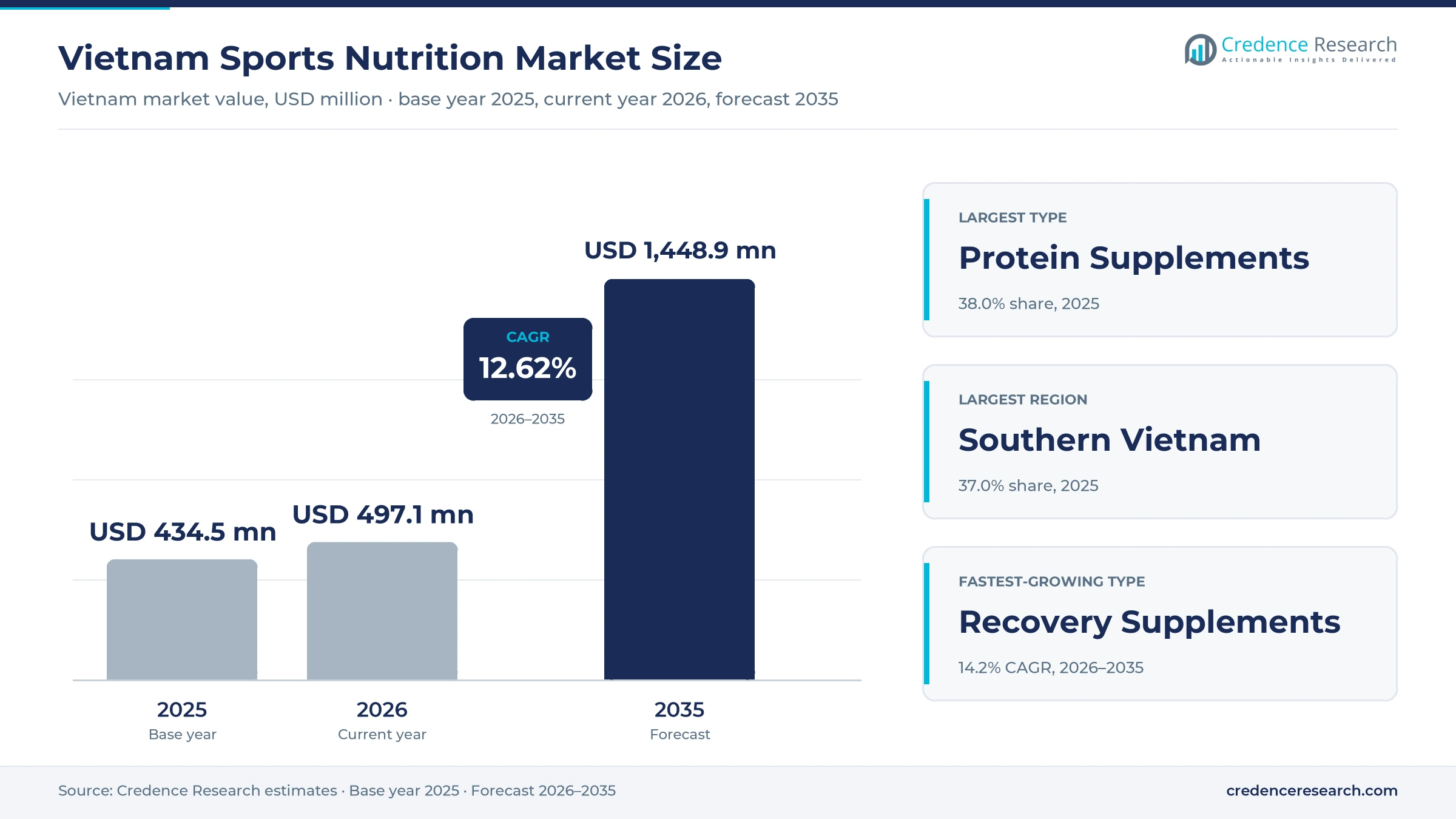
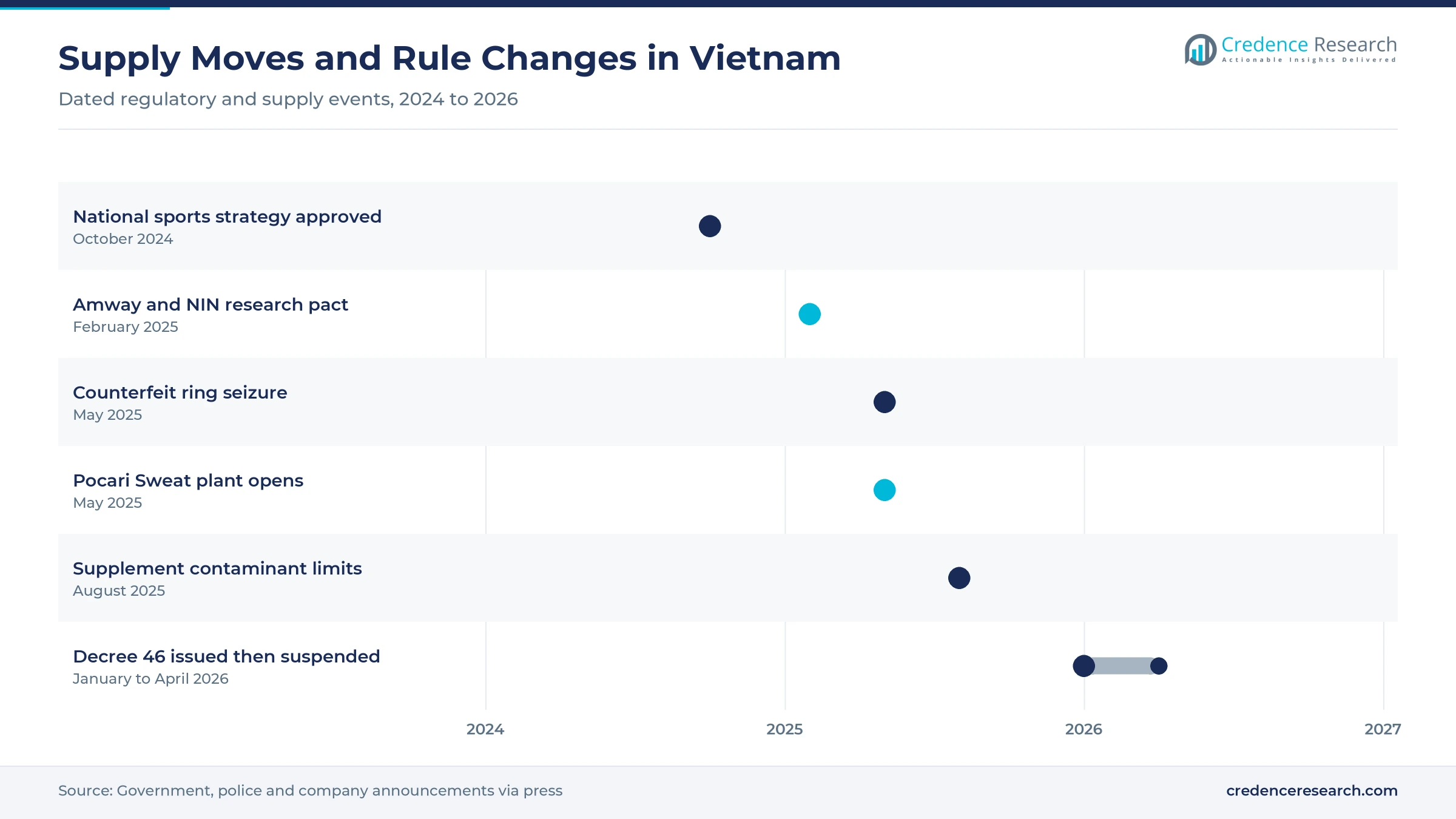
The Vietnam sports nutrition market was valued at USD 434.5 million in 2025 and is projected to increase from USD 497.1 million in 2026 to USD 1.45 billion by 2035, registering a CAGR of 12.62% during 2026–2035. Spending comes from a broad base of casual exercisers, a fast-growing community of road runners and a large group of adults trying to manage weight, with most purchases made online or through direct sellers. Southern Vietnam held the largest regional share, 37.0% in 2025, because Ho Chi Minh City concentrates specialist stores, gyms and the country’s largest marathons. Secondary Provincial Cities is the fastest-growing region at 13.6% a year as marketplace delivery and new race venues reach buyers beyond the two main metros. Regulation is also shifting, since the government issued a new food safety decree in January 2026 and then suspended it in April, leaving importers to plan around two sets of rules.
Which products and buyers make up sports nutrition spending in Vietnam?
The market counts retail sales of protein powders and ready-to-drink shakes, isotonic sports drinks, pre-workout formulas, recovery products such as amino acids and electrolytes, and sports foods such as bars and gels. Buyers range from national team athletes and marathon runners to gym members and office workers who use protein as a meal substitute. Purchases happen mainly on e-commerce marketplaces, through direct-selling networks, at pharmacies and in specialist supplement stores.
The estimate excludes caffeinated energy drinks sold mainly as refreshment, general multivitamins without a sports positioning, infant and pediatric formula, and medical nutrition dispensed in hospitals. Counterfeit goods are also excluded because their volume cannot be measured. Value is counted at retail prices, so importers, local bottlers, distributors, platforms and retailers all sit inside the chain that the final sale pays for.
Vietnam Sports Nutrition Market Insights
- The market grows from USD 434.5 million in 2025 to USD 1.45 billion by 2035, a 12.62% pace that nearly triples its 2026 base of USD 497.1 million.
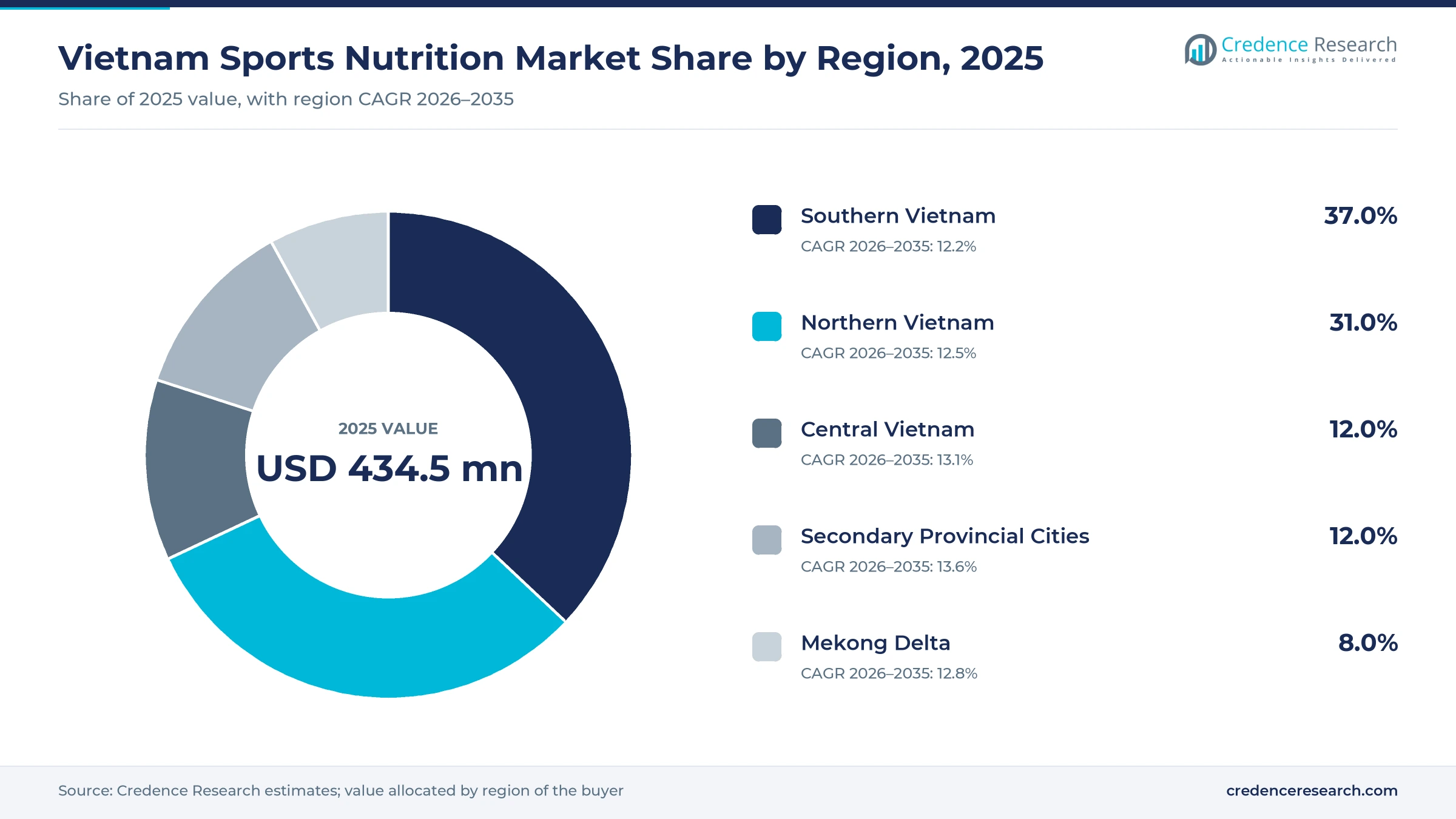
- Southern Vietnam led with 37.0% of 2025 value, while Secondary Provincial Cities expands fastest at 13.6% a year as delivery and races spread.
- Protein Supplements held 38.0% of 2025 sports nutrition value, because high-ticket whey tubs anchor spending for gym and lifestyle buyers alike.
- Hanoi police seized more than 100 tons of counterfeit health products in May 2025, which has made verified sourcing a central purchase criterion.
- Otsuka opened its first Pocari Sweat factory in Phu My in 2025, 13 years after entering Vietnam with drinks imported from Indonesia.
Protein tubs, casual users and online carts hold value
Why do protein supplements carry the largest share?
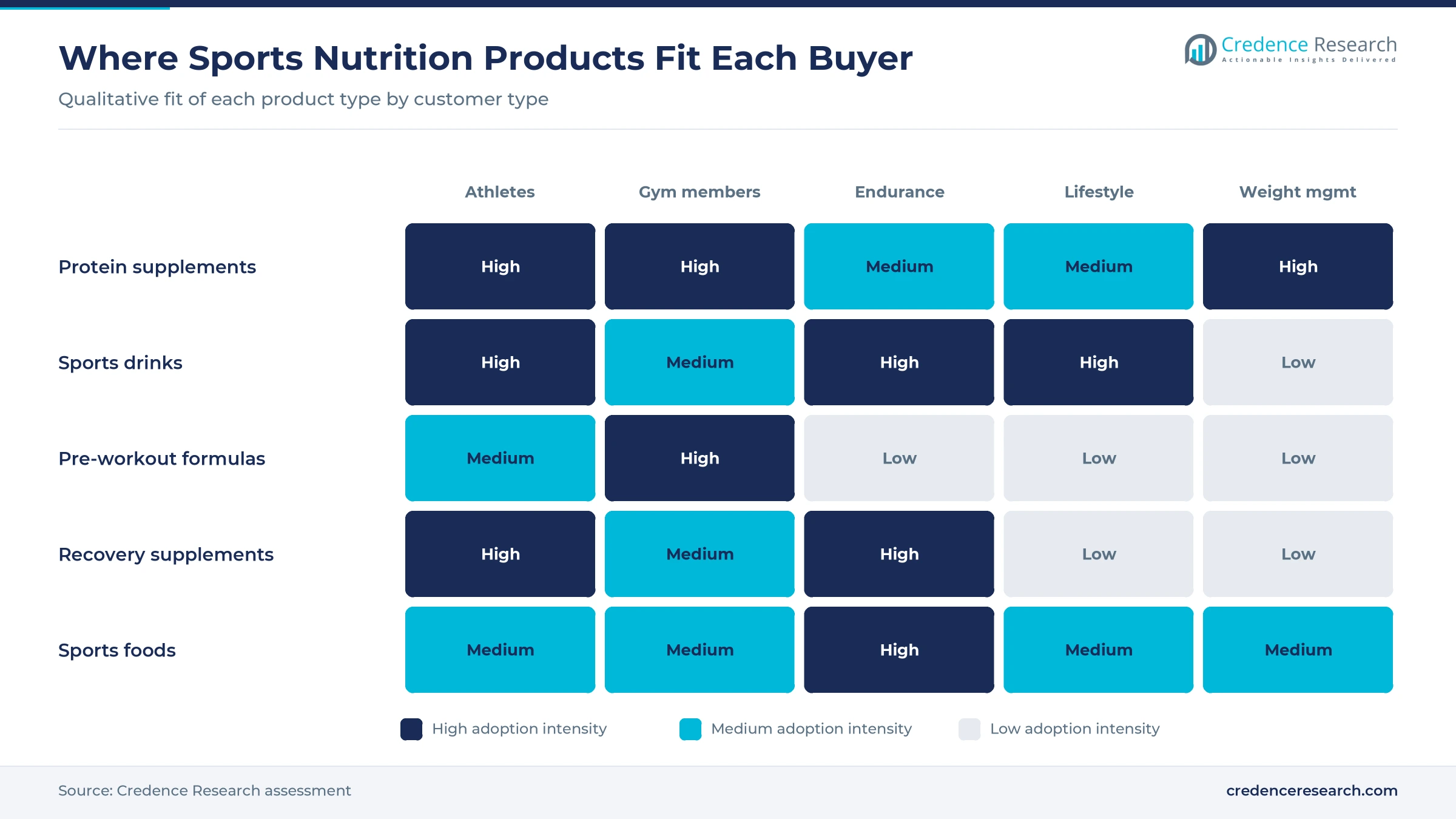
Based on product type, the market is categorized into protein supplements, sports drinks, pre-workout formulas, recovery supplements and sports foods. Protein Supplements led with 38.0% of 2025 value because each purchase carries a high ticket, and Wheystore.vn lists a 5-pound Optimum Nutrition Gold Standard tub at VND2.28 million. Recovery Supplements grow fastest at 14.2% a year as recovery enters mainstream coaching, with Vietnam Investment Review reporting that a Nov. 17, 2025, Herbalife workshop for the Vietnam Olympic Committee covered recovery, injury prevention and safe supplement use. Suppliers of recovery products will compete on evidence and testing rather than on discounts.
Which buyers spend the most, and which are growing fastest?
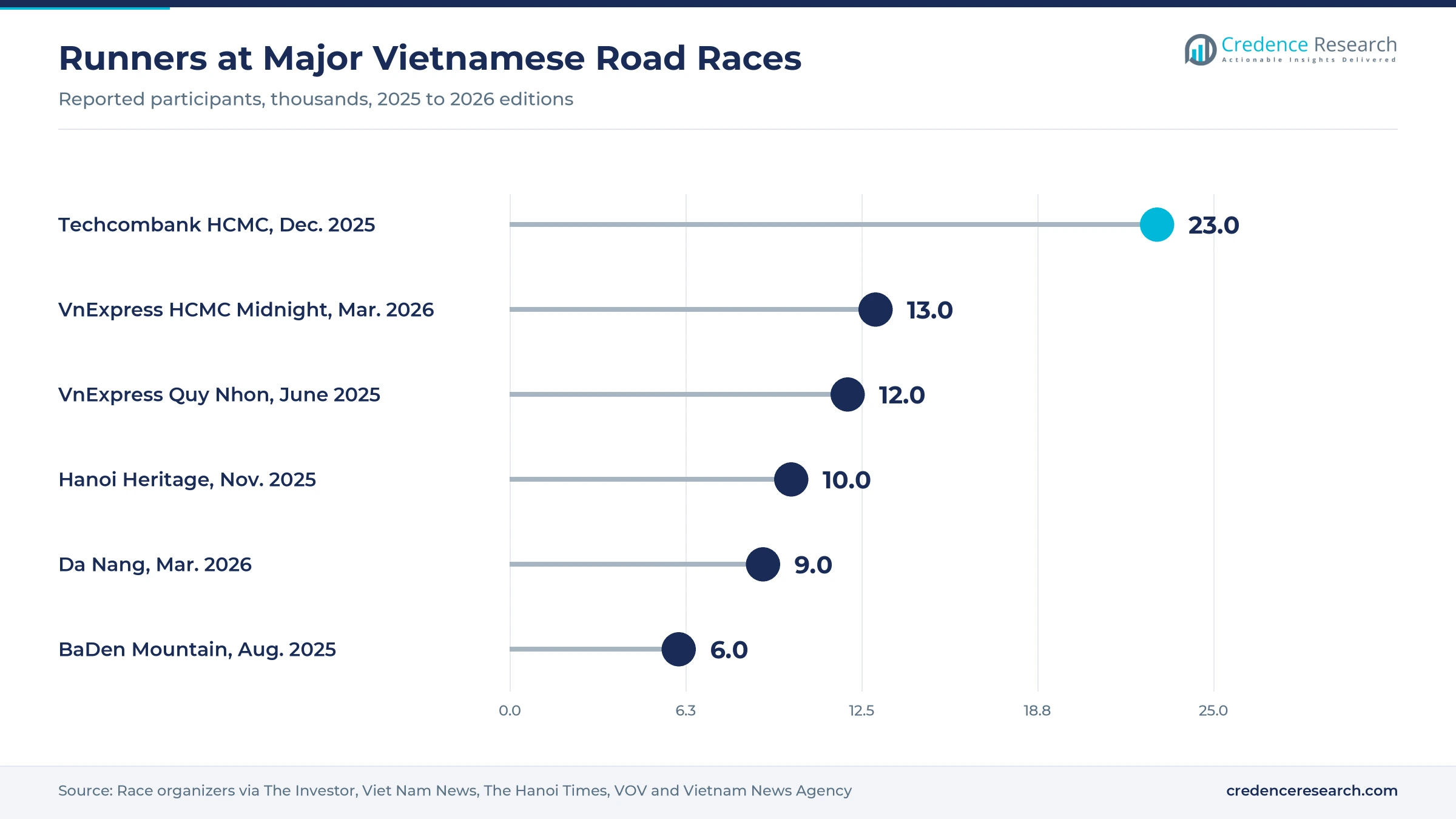
Based on customer type, the market is categorized into competitive athletes, gym members, endurance participants, lifestyle fitness consumers and weight management users. Lifestyle Fitness Consumers led with 35.0% of 2025 value because casual exercisers far outnumber club members and competitors, a base that widens as gyms shift to the monthly and pay-per-visit formats described below. Endurance Participants grow fastest at 14.0% a year as road races scale, with Viet Nam News reporting more than 13,000 expected runners at the March 2026 VnExpress Marathon HCM City Midnight, up from about 12,000 a year earlier. Each new runner adds hydration and recovery purchases around training blocks, lifting sports nutrition demand.
Why do online marketplaces lead and grow fastest?
Based on distribution channel, the market is categorized into e-commerce marketplaces, brand direct-to-consumer, sports nutrition specialists, pharmacies and gyms and fitness clubs. E-Commerce Marketplaces led with 34.0% of 2025 value because tubs and powders ship easily, and platform data cited by The Investor show TikTok Shop taking 41.31% of four-platform sales in 2025, up from 29% a year earlier. E-Commerce Marketplaces also grow fastest at 13.7% a year as livestream selling reaches buyers without a nearby specialist. Marketplaces therefore set the reference price that physical stores must match.
How far does the mid-market tier set the price anchor?
Based on price tier, the market is categorized into economy, mid-market, premium and clinical performance. Mid-Market led with 41.0% of 2025 value because most buyers combine a mid-priced protein with low-cost hydration, and Pharmacity sells a 500 ml Pocari Sweat bottle at VND16,000. Premium grows fastest at 13.5% a year as authenticity becomes a purchase filter, since VietNamNet reported that the May 2025 counterfeit network involved 17 companies, six of them holding import licenses. Buyers who once chased the cheapest listing now pay more for authorized stores and brands with traceable batches, which widens the gap between tiers.
| Segment Group | Leading Sub-segment | Share, 2025 | Fastest-growing Sub-segment | CAGR, 2026–2035 |
|---|---|---|---|---|
| By Product Type | Protein Supplements | 38.0% | Recovery Supplements | 14.2% |
| By Customer Type | Lifestyle Fitness Consumers | 35.0% | Endurance Participants | 14.0% |
| By Distribution Channel | E-Commerce Marketplaces | 34.0% | E-Commerce Marketplaces | 13.7% |
| By Price Tier | Mid-Market | 41.0% | Premium | 13.5% |
Imported tubs set premiums while drinks stay cheap
Sports nutrition pricing splits into two worlds, imported tubs and locally bottled drinks. Protein and isolate tubs are imported finished goods priced at roughly VND2.2 million to VND2.3 million for 5 pounds, which works out to about VND30,000 per serving, while a bottled sports drink costs about half that. Tub prices move with the dong-dollar rate, because almost every performance tub arrives as a finished import. Since whey protein ingredients are bought in dollars on world markets, importers carry the currency risk, and specialists protect margins through bundles rather than deep discounts.
| Product or format | Typical price or fee | Basis |
|---|---|---|
| Whey concentrate blend, 5 lb tub (Optimum Nutrition Gold Standard) | VND2.28 million (list VND2.48 million) | Wheystore.vn listing, viewed November 2026 |
| Hydrolyzed whey isolate, 5 lb tub (Dymatize ISO 100) | VND2.25 million (list VND2.30 million) | Wheystore.vn listing, viewed November 2026 |
| Whey blend, 5 lb tub (Rule 1 Protein) | VND2.19 million (list VND2.40 million) | Wheystore.vn listing, viewed November 2026 |
| Isotonic sports drink, 500 ml bottle (Pocari Sweat) | VND16,000 per bottle | Pharmacity listing, viewed November 2026 |
| Sport multivitamin, 120 tablets (GNC Mega Men Sport) | VND1.22 million, cross-border | Desertcart Vietnam listing, viewed November 2026 |
Request a Free Sample
Fill in your details and we'll send you a free sample report.
- Sample data tables & charts
- Research methodology
Online reach, race calendars and weight concerns lift spend
Online marketplaces put imported brands within reach
E-commerce has become the main route to market because it lets imported brands reach buyers without building a store network. Platform data reported by The Investor put four-platform sales at VND429.7 trillion ($16.35 billion) in 2025, up 34.75% from a year earlier, with 3.94 billion products sold. The number of active sellers also fell 7.43% to about 601,800, which concentrates traffic on larger official stores that can carry full brand ranges. As a result, E-Commerce Marketplaces already hold 34.0% of sports nutrition value, and a new protein or electrolyte brand can now test demand nationwide in months. Platform reach also lowers the cost of serving provincial buyers, which is why delivery-led regions gain share through 2035.
Federation sponsorship and mass races normalize supplements
Sports nutrition gains credibility when national teams and race organizers use it in public, and Vietnam now has both on a regular calendar. Herbalife Vietnam has partnered with the Vietnam Olympic Committee since 2012 and the Vietnam Football Federation since 2021, and it has been the official nutrition sponsor of the VnExpress Marathon, Tien Phong Marathon and Vietnam International Half Marathon since 2021. Elite results reinforce that exposure, since Vietnam won 87 gold medals and finished third at the 33rd SEA Games in December 2025, according to VOV. The October 2024 sports strategy also targets a regular top-two SEA Games finish. Together these programs move protein and hydration from niche gym products to accepted training tools.
Rising overweight rates widen the protein buyer base
Weight management is a large and growing reason to buy protein, because many adults now use shakes to control calories rather than to build muscle. A National Institute of Nutrition study released in June 2026 found that 43.6% of respondents were overweight or obese under the Asian BMI classification, with higher rates among men. The institute also reported that overweight among school-aged children rose from 8.5% in 2010 to 19% in 2020, which points to a larger adult problem ahead. Amway, the institute and the Nutrilite Health Institute signed a research agreement in February 2025 covering supplement use for specific groups. This evidence supports steady demand for meal replacement and high-protein formats beyond the athlete base.
Income growth makes premium training spend affordable
Higher incomes turn sports nutrition from an occasional treat into a monthly budget line for urban workers. The economy grew 8.02% in 2025, the General Statistics Office reported, according to Viet Nam News, which keeps household spending power rising faster than in most of the region. The General Statistics Office reported average monthly income of VND8.3 million in the first quarter of 2025, up 9.5% from a year earlier, and urban workers averaged VND10.1 million. A premium whey tub still costs more than a quarter of the national monthly average, so each income gain widens the pool of regular buyers. This is why Premium products grow at 13.5% a year, ahead of every other price tier.
Flexible training and local hydration plants reset supply
Shift from long gym contracts to flexible training
Training is moving away from year-long premium gym memberships toward flexible formats, outdoor sport and home routines. VietNamNet reported in August 2026 that California Fitness & Yoga, which once ran nearly 50 clubs, closed two locations in Ho Chi Minh City and two in Hanoi, while Elite Fitness closed its Thao Dien club on May 1, 2026, and now operates only in Hanoi. Fit House also announced in March 2026 that it would close after 10 years. Dan Tri reported that younger customers increasingly prefer monthly or pay-per-visit options, and Citigym’s chief executive described the contraction as a return to a more sustainable playing field. As a result, gym counters lose share to online and specialist channels, and brands must reach users who train without a club.
Rise of locally produced hydration lowers drink costs
Hydration brands are moving production into Vietnam, which cuts landed costs and supports wider distribution of sports drinks. NutraIngredients reported that Otsuka opened its first Pocari Sweat factory in Vietnam in Phu My on a 50,000 square meter site, 13 years after entering the country with drinks imported from Indonesia. The plant bottles two PET bottle sizes for supermarkets, convenience stores and general trade, according to the same May 2025 report. Otsuka said it built the factory because the brand had grown steadily and needed stable local supply. Local bottling also sharpens competition with energy drinks for convenience store shelves, which keeps sports drinks price-led even as volumes grow.
Opening for authorized specialists outside the two metros
Authorized specialist retail outside Hanoi and Ho Chi Minh City is an opening because counterfeit fears have raised the value of a trusted counter. Gymstore distributes more than 50 international brands but operates only six branches, all in the two largest cities, and it has named central provinces as an expansion target because few supplement retailers operate there, Znews reported. Online specialist Wheystore.vn already lists Optimum Nutrition, Dymatize and Rule 1 tubs with discounts of 2% to 9%. A chain that pairs verified stock with local pickup could capture buyers in Secondary Provincial Cities, the fastest-growing zone in the Credence Research estimate.
Opening for pharmacy chains in clinical performance products
Pharmacy chains offer an opening for clinically positioned protein and hydration because shoppers already consult pharmacists on health purchases. Abbott and FPT Long Chau signed a strategic partnership on Oct. 30, 2025, covering pharmacist training and public health awareness, and Vietnam Investment Review describes Long Chau as operating more than 2,400 locations plus 200 vaccination centers. The same report notes that more than 24 million people in Vietnam live with non-communicable diseases, a group for whom medically framed protein products are relevant. Pharmacity already stocks Pocari Sweat on its shelves, which shows that sports formats can sit in a pharmacy range. The clinical performance tier gains a credible channel that marketplaces cannot easily copy.
Counterfeits and rule changes test buyer trust
How much do counterfeit supplements damage buyer trust?
Counterfeits are the largest threat because a buyer cannot test protein content or purity at home. Hanoi police seized more than 100 tons of counterfeit health products in May 2025, including 28,531 boxes and 34,822 bottles, from a network that allegedly supplied pharmacies and hospitals since 2020. Genuine brands bear the cost through weaker confidence and higher authentication spending. Batch codes, official storefronts and published third-party test results are the most practical defenses for importers and retailers.
Will unsettled food safety rules delay new launches?
Regulatory uncertainty is raising the cost of planning new sports nutrition launches. The government issued Decree 46/2026 on Jan. 26, 2026, to replace Decree 15/2018, then suspended it on April 6, 2026, under Resolution 15/2026 until an amended Food Safety Law takes effect, VnEconomy reported. Importers of health supplement and sports products must keep dossiers ready for both regimes. Smaller distributors face the most exposure, so early legal review and complete product files are essential.
Do banned substances threaten weight management products?
Adulterated slimming products put the weight management segment at risk because one scandal can taint legitimate protein shakes. The Food Safety Department warned in May 2025 about two products found to contain sibutramine, a weight-loss drug banned in Vietnam since 2010, Viet Nam News reported. Competitive athletes face a parallel doping risk from contaminated supplements as well. Brands can respond with certified testing and clear labels, although these steps add cost for smaller importers.
Is affordability still a ceiling for regular use?
Affordability limits regular use because premium formats remain expensive relative to local wages. As the income comparison above shows, a full imported tub still takes about 27% of an average month’s pay. Many buyers instead purchase smaller pouches or sachets and use protein only during training peaks. Smaller packs, local blending and subscription discounts offer the most practical routes to steadier consumption.
The south leads while provincial cities grow fastest
| Region | Value, 2025 (USD million) | Share, 2025 | CAGR, 2026–2035 |
|---|---|---|---|
| Southern Vietnam | 160.8 | 37.0% | 12.2% |
| Northern Vietnam | 134.7 | 31.0% | 12.5% |
| Central Vietnam | 52.1 | 12.0% | 13.1% |
| Secondary Provincial Cities | 52.1 | 12.0% | 13.6% |
| Mekong Delta | 34.8 | 8.0% | 12.8% |
Southern Vietnam leads on races, retail and local bottling
Southern Vietnam held 37.0% of 2025 value and grows at 12.2% a year. Ho Chi Minh City hosts the country’s largest road race, and The Investor reported more than 23,000 runners from 81 countries and territories at the Techcombank Ho Chi Minh City International Marathon in December 2025. Tay Ninh’s BaDen Mountain race drew more than 6,000 runners in August 2025, according to the Vietnam News Agency. Otsuka’s Phu My plant also gives the south a local hydration supply base. For importers, the south is where new formats should launch first, because race expos and specialist stores give immediate trial.
Northern Vietnam combines higher incomes with heritage races
Northern Vietnam held 31.0% of 2025 value and grows at 12.5% a year. Incomes support premium spending, since the Red River Delta averaged VND9.8 million a month in the first quarter of 2025, up 9.5%, according to the General Statistics Office. The Hanoi Heritage Marathon drew more than 10,000 runners, including over 2,500 from abroad, in November 2025, The Hanoi Times reported. Hanoi also keeps premium gym capacity, as Elite Fitness now operates only in the capital. Premium isolates can hold full price in Hanoi, where incomes and club capacity still support them.
Central Vietnam gains from coastal races and income catch-up
Central Vietnam held 12.0% of 2025 value and grows at 13.1% a year. The Da Nang International Marathon drew nearly 9,000 runners, about 3,200 of them international, in March 2026, according to VOV. Incomes are catching up, since the North Central and Central Coast region averaged VND7.3 million a month in early 2025, up 11.7%. Race weekends make Da Nang the natural hub for distributors serving the central coast.
Mekong Delta depends on affordable formats and delivery
Mekong Delta held 8.0% of 2025 value and grows at 12.8% a year. The Mekong Delta is mainly rural, and Viet Nam News reported that overweight rates were 18.3% in rural areas against 26.8% in urban areas, which narrows the weight management base. Specialist chains have not reached the Mekong Delta, as the opening for authorized specialists noted above shows, so most protein arrives through marketplaces and pharmacies. Low-cost hydration and single-serve sachets make up a larger share of baskets here than in the main cities.
Secondary Provincial Cities grow fastest on new race venues
Secondary Provincial Cities held 12.0% of 2025 value and grow fastest at 13.6% a year. Race tourism is spreading to these cities, and the VnExpress Marathon Quy Nhon drew more than 12,000 runners in June 2025, a record in its six-year history, according to The World and Vietnam Report. Herbalife Vietnam served as the official nutrition sponsor of that race. Marketplace delivery lets runners in such cities buy the same imported brands that metro specialists stock, so sports nutrition demand there tracks the race calendar closely.
Plants, partnerships and enforcement mark 2025 and 2026
| Development | Status and market relevance |
|---|---|
| In May 2025, Otsuka opened its first Pocari Sweat factory in Vietnam at Phu My, producing 350 ml and 500 ml bottles. | Operating; localizes sports drink supply |
| In August 2025, Nutifood raised investment in its Gia Lai dairy and nutrition plant to VND1.05 trillion. | Approved expansion; adds liquid milk capacity beside supplement lines |
| In October 2025, Abbott and FPT Long Chau signed a strategic partnership on Oct. 30 covering pharmacist training and health awareness. | Signed; strengthens the pharmacy route for nutrition products |
| In November 2025, Herbalife Vietnam held a Nov. 17 nutrition workshop for the Vietnam Olympic Committee on recovery and safe supplement use. | Completed; supports evidence-based athlete nutrition |
| In April 2026, the government suspended Decree 46/2026 on food safety under Resolution 15/2026, keeping Decree 15/2018 in force. | In force; extends the existing registration regime |
Isolates, electrolytes and clean testing shape choice
- Hydrolyzed whey isolates target buyers who want faster digestion and lower lactose, and Wheystore.vn prices Dymatize’s hydrolyzed isolate close to standard whey blends.
- Electrolyte formulas replace salts lost in heat and long races, which is why Pocari Sweat is now bottled locally in 350 ml and 500 ml formats.
- Contaminant testing gained regulatory weight when national limits for lead, mercury and microbes in health supplements took effect on Aug. 1, 2025.
- Portable formats such as sachets, stick packs and protein bars suit buyers who train outdoors or cannot afford a full tub.
Need a Custom Version of This Report?
Tailor the scope, geography, or segments to your exact requirements.
- Custom geography or segment scope
- Direct access to our analyst team
Direct sellers and imported brands split the shelf
Competition divides between direct-selling groups, imported performance brands and local food and drink makers. Herbalife Vietnam has the most visible sports profile through its federation and marathon sponsorships, while Amway Vietnam ties its Nutrilite range to research with the National Institute of Nutrition. Optimum Nutrition and Dymatize are prominent on the imported whey shelf at online specialists, where 5-pound tubs sell at similar prices. GNC and Myprotein products also reach buyers through cross-border services such as Desertcart Vietnam, which handles purchase and customs on the buyer’s behalf. Nutifood brings domestic manufacturing scale, and Abbott competes in adult protein through Ensure and its pharmacy partnership with FPT Long Chau. Otsuka anchors the sports drink shelf with its locally bottled Pocari Sweat. Suppliers compete less on headline price than on proof of authenticity, sponsorship visibility and access to the channels that buyers trust.
How is the supply side organized, and where do margins sit?
Supply is split between three business models with very different economics. Direct sellers such as Herbalife and Amway control their own formulas and distributor networks, so they keep the widest margins and invest heavily in sponsorship. Imported performance brands such as Optimum Nutrition and Dymatize rely on importers, specialists and marketplace stores, where retailers compete on authenticity and bundles. Drink makers such as Otsuka and dairy groups such as Nutifood compete on local production scale. Entry barriers are low online but high for proving authenticity, which favors established importers.
Herbalife, Amway and imported whey brands lead the shelf
| Company | Type | Role in the market |
|---|---|---|
| Herbalife Vietnam | Direct seller | Nutrition partner of the Vietnam Olympic Committee since 2012 and the Vietnam Football Federation since 2021 |
| Amway Vietnam | Direct seller | Nutrilite range; research agreement with the National Institute of Nutrition signed February 2025 |
| Optimum Nutrition | Imported brand | Gold Standard whey sold through online specialists such as Wheystore.vn |
| Dymatize | Imported brand | Hydrolyzed whey isolate sold through online specialists |
| Nutifood | Domestic manufacturer | Gia Lai plant with 1,500 tons a year of nutritional product capacity |
| Abbott Laboratories | Global nutrition group | Ensure adult nutrition; strategic partnership with FPT Long Chau since October 2025 |
| GNC | Imported brand | Sport multivitamins available through cross-border sellers such as Desertcart Vietnam |
| Myprotein | Imported brand | Impact Whey available through cross-border purchase services |
| Otsuka Nutraceutical Vietnam | Local drink producer | Pocari Sweat bottled at Phu My since 2025 |
Authenticity will decide who captures premium spend
Credence Research’s view is that verified supply, not product novelty, will decide which suppliers capture premium spending through 2030. The 2025 counterfeit seizures showed buyers how easily fake products enter pharmacies and online stores, and the suspended 2026 decree leaves rules unsettled. Brands that publish batch tests and sell through official stores can therefore hold prices while unverified sellers lose traffic. Endurance participants, growing at 14.0% a year, are the most reliable demand signal, since each new race brings training, hydration and recovery purchases. The most useful investments are authorized distribution outside the two metros and pharmacist education, not deeper livestream discounts.
Consumption and price checks support the estimate
The report uses 2025 as the base year and forecasts values to 2035. Market values come from the Credence Research model, and segment and regional splits are Credence Research estimates. The size was cross-checked against sports drink retail prices and population, imported protein tub prices and an estimate of regular users, and against published platform sales data. Evidence comes from World Bank and General Statistics Office data, police and regulator announcements, company releases, retailer listings and national press. No interviews or surveys were conducted for this report, and counterfeit sales are excluded from the value estimate.
Endurance and online buying carry growth to 2035
Sports nutrition value should reach USD 1.45 billion by 2035 because regular use is still concentrated among urban gym-goers and runners, leaving a large base to convert. The forecast assumes the number of regular buyers roughly doubles over the decade, which is why it runs well ahead of income growth. Recovery supplements should expand at 14.2% a year, while sports drinks keep the category accessible. Provincial cities should gain share as race calendars and delivery spread. The main risk is another counterfeit wave or a prolonged gap in food safety rules, although stricter testing and authorized retail could turn that risk into an advantage for verified brands.
What separates the downside, base and upside paths to 2035?
The range of outcomes depends mainly on trust and regulation rather than on underlying interest in exercise. A downside path follows if another counterfeit scandal or a slow rewrite of the food safety framework delays imports and pushes buyers back toward cheap, unverified listings. The base case assumes steady online growth and stable rules, in line with a March 2025 World Bank forecast of growth of 6.5% in 2026. An upside path needs faster pharmacy and specialist expansion into provincial cities, together with continued growth in race participation.
| Scenario | CAGR, 2026–2035 | Value, 2035 | What has to hold |
|---|---|---|---|
| Downside | 10.1% | USD 1.18 billion | New counterfeit scandals and delayed food safety rules slow imports and erode trust |
| Base | 12.62% | USD 1.45 billion | Online sales keep growing and current registration rules stay in place |
| Upside | 14.1% | USD 1.63 billion | Authorized specialists and pharmacies expand into provincial cities as race fields keep growing |
Frequently Asked Questions
How big is the Vietnam sports nutrition market?
Which region leads sports nutrition sales in Vietnam?
Which region grows fastest?
Which product type holds the largest share?
Why are online marketplaces so important?
How is Vietnam regulating supplements and sports products?
What is the biggest risk for brands in this market?
Which companies are active in the market?
Table of Content
Chapter 1 Market Segmentation
- 1.1 Segmentation Framework
- 1.1.1 Product and Service Classification
- 1.1.2 Application and End-Use Classification
- 1.1.3 Technology and Solution Classification
- 1.1.4 Customer and Distribution Channel Classification
- 1.1.5 Geographic Segmentation
- 1.1.6 Market Segment Definitions and Boundaries
- 1.2 By Product Type
- 1.2.1 Protein Supplements
- 1.2.2 Sports Drinks
- 1.2.3 Sports Foods
- 1.2.4 Pre-Workout Formulas
- 1.2.5 Recovery Supplements
- 1.3 By Customer Type
- 1.3.1 Lifestyle Fitness Consumers
- 1.3.2 Gym Members
- 1.3.3 Endurance Participants
- 1.3.4 Weight Management Users
- 1.3.5 Competitive Athletes
- 1.4 By Price Tier
- 1.4.1 Mid-Market
- 1.4.2 Premium
- 1.4.3 Economy
- 1.4.4 Clinical Performance
Chapter 2 Introduction
- 2.1 Report Objectives and Scope
- 2.2 Product Definition and Industry Terminology
- 2.3 Market Inclusions and Exclusions
- 2.4 Research Process
- 2.4.1 Primary Research and Expert Interviews
- 2.4.2 Secondary Research and Source Review
- 2.4.3 Top-Down and Bottom-Up Estimation
- 2.4.4 Data Triangulation and Verification
- 2.5 Market Size Measurement Basis
- 2.5.1 2025: USD 434.5 million → 2035: USD 1.45 billion
- 2.6 Historical and Forecast Reference Periods
- 2.6.1 Historical Period: 2018-2025
- 2.6.2 Base Year: 2025
- 2.6.3 Forecast Period: 2025-2035
- 2.7 Research Assumptions and Limitations
Chapter 3 Executive Summary
- 3.1 Market Snapshot and Key Findings
- 3.2 Base-Year Market Size, 2025
- 3.3 Forecast Market Size, 2035
- 3.4 Revenue and Volume Growth Outlook
- 3.5 Key Demand and Supply Indicators
- 3.6 Leading Market Segments
- 3.7 Fastest-Growing Market Opportunities
- 3.8 Regional Performance Highlights
- 3.9 Technology and Industry Transformation
- 3.10 Competitive Landscape Summary
- 3.11 Analyst View and Strategic Implications
Chapter 4 Vietnam Sports Nutrition Market Trends and Developments
- 4.1 Historical Industry Development, 2018-2025
- 4.2 Recent Market Trends and Developments
- 4.3 Demand and Customer Behavior Trends
- 4.4 Technology and Product Innovation
- 4.5 Artificial Intelligence, Automation and Digitalization
- 4.6 Local Manufacturing and Supply Chain Realignment
- 4.7 Industry Partnerships, Mergers and Acquisitions
- 4.8 Sustainability and Circular Economy Developments
- 4.9 Government and Private Sector Investment Trends
- 4.10 Emerging Business Models and Commercialization
- 4.11 Industry Developments and Announcements
Chapter 5 Vietnam Sports Nutrition Market Production, Supply and Demand Analysis
- 5.1 Demand Trend and Consumption Analysis, 2018-2025
- 5.2 Demand Forecast, 2025-2035
- 5.3 Production and Output Trend, 2018-2025
- 5.4 Production and Output Forecast, 2025-2035
- 5.5 Installed Capacity and Capacity Utilization
- 5.6 Company-Wise Production Plants and Statistics
- 5.6.1 Installed Production Capacity
- 5.6.2 Actual Production
- 5.6.3 Planned Capacity and Expansion Targets
- 5.7 Supply Chain Structure and Procurement Trends
- 5.8 Supply-Demand Gap and Bottlenecks
- 5.9 Import Dependence and Sourcing Structure
- 5.10 Contract Manufacturing and Outsourcing
- 5.11 Regional Supply and Demand Concentration
Chapter 6 Vietnam Sports Nutrition Market Pricing Analysis
- 6.1 Pricing Structure and Measurement
- 6.2 Historical Pricing Trends, 2018-2025
- 6.3 Pricing Outlook, 2025-2035
- 6.4 Average Selling Price and Unit Economics
- 6.5 Pricing by Product and Market Segment
- 6.6 Geographic Pricing Differences
- 6.7 Key Input, Energy, Labor and Logistics Costs
- 6.8 Contract Pricing and Purchasing Models
- 6.9 Pricing Sensitivity and Competitive Positioning
- 6.10 Price, Margin and Profitability Implications
Chapter 7 Vietnam Sports Nutrition Market Dynamics
- 7.1 Market Growth Drivers
- 7.1.1 Demand-Side Drivers
- 7.1.2 Technology and Innovation Drivers
- 7.1.3 Infrastructure and Investment Drivers
- 7.1.4 Regulatory and Policy Drivers
- 7.2 Market Restraints
- 7.2.1 Cost and Affordability Constraints
- 7.2.2 Technology and Adoption Barriers
- 7.2.3 Supply Chain and Operational Constraints
- 7.3 Market Challenges
- 7.3.1 Competitive Pressure and Margin Erosion
- 7.3.2 Skills, Infrastructure and Implementation Gaps
- 7.4 Emerging Market Opportunities
- 7.5 Market Dynamics Impact and Time-Horizon Assessment
Chapter 8 Vietnam Sports Nutrition Value Chain Analysis
- 8.1 Industry Value Chain Overview
- 8.2 Upstream Suppliers and Critical Inputs
- 8.3 Technology and Component Providers
- 8.4 Manufacturing or Service Delivery
- 8.5 Distribution, Channel Partners and Integrators
- 8.6 Downstream Applications and End Users
- 8.7 Value Addition and Profit Pools
- 8.8 Vertical Integration and Outsourcing
- 8.9 Supplier Concentration and Risk
- 8.10 Supply Chain Localization and Resilience
Chapter 9 Vietnam Sports Nutrition Market Regulations and Policies
- 9.1 Relevant Laws, Standards and Compliance Frameworks
- 9.2 Product, Service, Safety and Quality Requirements
- 9.3 Government Policies, Incentives and Subsidies
- 9.4 Imports, Exports and Trade Barriers
- 9.5 Public Procurement and Local Content Requirements
- 9.6 Environmental and Sustainability Compliance
- 9.7 Upcoming Policy Changes and Market Implications
Chapter 10 Vietnam Sports Nutrition Market Hotspots and Opportunities
- 10.1 Market Opportunity Mapping and Growth Hotspots
- 10.2 High-Growth Applications and Customer Groups
- 10.3 Underserved Markets and White-Space Opportunities
- 10.4 Emerging Technology and Product Opportunities
- 10.5 New Capacity and Investment Hotspots
- 10.6 Market Entry and Expansion Opportunities
- 10.7 Distribution and Partnership Opportunities
- 10.8 Near-Term and Long-Term Commercial Potential
- 10.9 Opportunity Attractiveness and Execution Risks
Chapter 11 Vietnam Sports Nutrition Market Outlook, 2025-2035
- 11.1 Market Size and Analysis
- 11.1.1 Revenue (Market Measurement: 2025: USD 434.5 million → 2035: USD 1.45 billion)
- 11.1.2 Market Volume and Quantity Sold
- 11.1.3 Historical Market Size, 2018-2025
- 11.1.4 Base-Year Market Size, 2025
- 11.2 Market Forecast, 2025-2035
- 11.2.1 Revenue Forecast to 2035
- 11.2.2 Volume Forecast to 2035
- 11.2.3 CAGR and Year-on-Year Growth
- 11.2.4 Incremental Revenue Opportunity
- 11.3 Forecast Assumptions and Scenario Analysis
- 11.3.1 Base-Case Forecast
- 11.3.2 Optimistic and Conservative Scenarios
- 11.3.3 Technology, Pricing and Policy Sensitivities
- 11.4 Market Attractiveness and Growth Outlook
Chapter 12 Vietnam Sports Nutrition Market Segmentation and Outlook
- 12.1 Segmentation Summary and Market Shares, 2025
- 12.2 Largest and Fastest-Growing Segments
- 12.3 By Product Type - Market Size and Forecast, 2025-2035
- 12.3.1 Segment Definition and Scope
- 12.3.2 Historical Market Size, 2018-2025
- 12.3.3 Revenue Forecast, 2025-2035
- 12.3.4 Volume Forecast, 2025-2035
- 12.3.5 Base-Year Market Share, 2025
- 12.3.6 Segment CAGR and Growth Drivers
- 12.3.7 Subsegment Market Size and Forecast
- 12.3.7.1 Protein Supplements
- 12.3.7.2 Sports Drinks
- 12.3.7.3 Sports Foods
- 12.3.7.4 Pre-Workout Formulas
- 12.3.7.5 Recovery Supplements
- 12.3.8 Subsegment Pricing and Adoption Trends
- 12.3.9 Leading Suppliers and Competition
- 12.3.10 Regional Demand and Opportunities
- 12.4 By Customer Type - Market Size and Forecast, 2025-2035
- 12.4.1 Segment Definition and Scope
- 12.4.2 Historical Market Size, 2018-2025
- 12.4.3 Revenue Forecast, 2025-2035
- 12.4.4 Volume Forecast, 2025-2035
- 12.4.5 Base-Year Market Share, 2025
- 12.4.6 Segment CAGR and Growth Drivers
- 12.4.7 Subsegment Market Size and Forecast
- 12.4.7.1 Lifestyle Fitness Consumers
- 12.4.7.2 Gym Members
- 12.4.7.3 Endurance Participants
- 12.4.7.4 Weight Management Users
- 12.4.7.5 Competitive Athletes
- 12.4.8 Subsegment Pricing and Adoption Trends
- 12.4.9 Leading Suppliers and Competition
- 12.4.10 Regional Demand and Opportunities
- 12.5 By Price Tier - Market Size and Forecast, 2025-2035
- 12.5.1 Segment Definition and Scope
- 12.5.2 Historical Market Size, 2018-2025
- 12.5.3 Revenue Forecast, 2025-2035
- 12.5.4 Volume Forecast, 2025-2035
- 12.5.5 Base-Year Market Share, 2025
- 12.5.6 Segment CAGR and Growth Drivers
- 12.5.7 Subsegment Market Size and Forecast
- 12.5.7.1 Mid-Market
- 12.5.7.2 Premium
- 12.5.7.3 Economy
- 12.5.7.4 Clinical Performance
- 12.5.8 Subsegment Pricing and Adoption Trends
- 12.5.9 Leading Suppliers and Competition
- 12.5.10 Regional Demand and Opportunities
- 12.6 Segment Growth Comparison
- 12.7 Segment Attractiveness and Priority Matrix
Chapter 13 Vietnam Sports Nutrition End-Use and Application Market Outlook
- 13.1 End-Use Industry and Customer Demand Structure
- 13.2 Leading Applications and Customer Groups
- 13.3 End-Use Market Size, Share and Forecast
- 13.4 Major End-Use Industry Deep Dives
- 13.4.1 Customer Requirements and Use Cases
- 13.4.2 Demand and Replacement Cycles
- 13.4.3 Technical and Regulatory Considerations
- 13.4.4 Purchasing and Procurement Models
- 13.4.5 Leading Vendors and Distribution Channels
- 13.4.6 Forecast and Commercial Opportunities
- 13.5 Emerging Applications and Cross-Segment Demand
- 13.6 End-Use Industry Investment Priorities
Chapter 14 Vietnam Sports Nutrition Geographic Market Outlook, 2025-2035
- 14.1 Domestic Market Distribution and Demand Clusters
- 14.2 State- or Province-Wise Market Size and Forecast, 2025-2035
- 14.3 City and Metropolitan Market Outlook
- 14.4 Industrial, Manufacturing and Commercial Clusters
- 14.5 Geographic Concentration of Key End Users
- 14.6 Local Pricing and Purchasing Differences
- 14.7 Domestic Production Facilities and Capacity Map
- 14.8 Local Infrastructure and Project Pipeline
- 14.9 State-Level Policy and Incentive Differences
- 14.10 Subnational Investment Hotspots and Opportunities
- 14.11 Distribution and Logistics Networks
- 14.12 Domestic Competitive Footprint
Chapter 15 Vietnam Sports Nutrition Technology, Innovation and Sustainability Outlook
- 15.1 Technology Landscape and Maturity
- 15.2 Product, Process and Service Innovation
- 15.3 AI, Automation and Digital Tools in the Industry
- 15.4 Technology Adoption and Performance Benchmarking
- 15.5 Innovation Pipeline and R&D Investment
- 15.6 Patent and Intellectual Property Trends
- 15.7 Energy Efficiency and Resource Management
- 15.8 Sustainability, Recycling and Circularity
- 15.9 Technology Roadmap, 2025-2035
- 15.10 Risks of Obsolescence and Technology Substitution
Chapter 16 Vietnam Sports Nutrition Market Key Strategic Imperatives
- 16.1 Growth and Market Entry Priorities
- 16.2 High-Return Products and Segments
- 16.3 Pricing, Profitability and Cost Optimization
- 16.4 Technology Investment and Product Differentiation
- 16.5 Supply Chain Localization and Resilience
- 16.6 Distribution and Customer Acquisition
- 16.7 Partnership, Acquisition and Capacity Strategy
- 16.8 Regional Expansion Priorities
- 16.9 Short-, Medium- and Long-Term Actions
Chapter 17 Competition Outlook
- 17.1 Industry Competition Characteristics
- 17.2 Market Structure and Concentration
- 17.3 Market Share and Competitive Positioning, 2025
- 17.4 Company-Wise Revenue and Product Benchmarking
- 17.5 Production and Service Capacity Benchmarking
- 17.6 Technology, Pricing and Differentiation
- 17.7 Regional Footprint and Distribution Strength
- 17.8 Mergers, Acquisitions and Strategic Alliances
- 17.9 New Entrants and Competitive Threats
- 17.10 Porter's Five Forces and Industry Attractiveness
- 17.11 Competitive Outlook, 2025-2035
Chapter 18 Company Profiles
- 18.1 Company Coverage and Selection Criteria
- 18.2 Herbalife
- 18.2.1 Business Description
- 18.2.2 Company Ownership and Geographic Presence
- 18.2.3 Product and Service Portfolio
- 18.2.4 Manufacturing and Operating Footprint
- 18.2.5 Production Capacity and Expansion Plans
- 18.2.6 Financial Performance and Investment
- 18.2.7 Market Share and Competitive Position
- 18.2.8 Technology and Innovation Capabilities
- 18.2.9 Strategic Alliances or Partnerships
- 18.2.10 Recent Developments
- 18.2.11 Growth Strategy and Outlook
- 18.3 Optimum Nutrition
- 18.4 Myprotein
- 18.5 MuscleTech
- 18.6 Dymatize
- 18.7 GNC
- 18.8 Nutifood
- 18.9 Amway Vietnam
- 18.10 Abbott Laboratories
- 18.11 Applied Nutrition
- 18.12 Other Relevant Market Participants
Note: Every listed company is profiled on the structure shown under the first company. The company list is preliminary and may change based on research findings, market developments, data availability and client requirements.
Chapter 19 Disclaimer
- 19.1 Research and Forecast Disclaimer
- 19.2 Data Source and Estimation Limitations
Note: The depth of individual sections depends on data availability for this market. Volume, capacity, trade and other unit-based metrics are included where applicable.