Cassava flour turns a medical niche into a shelf category
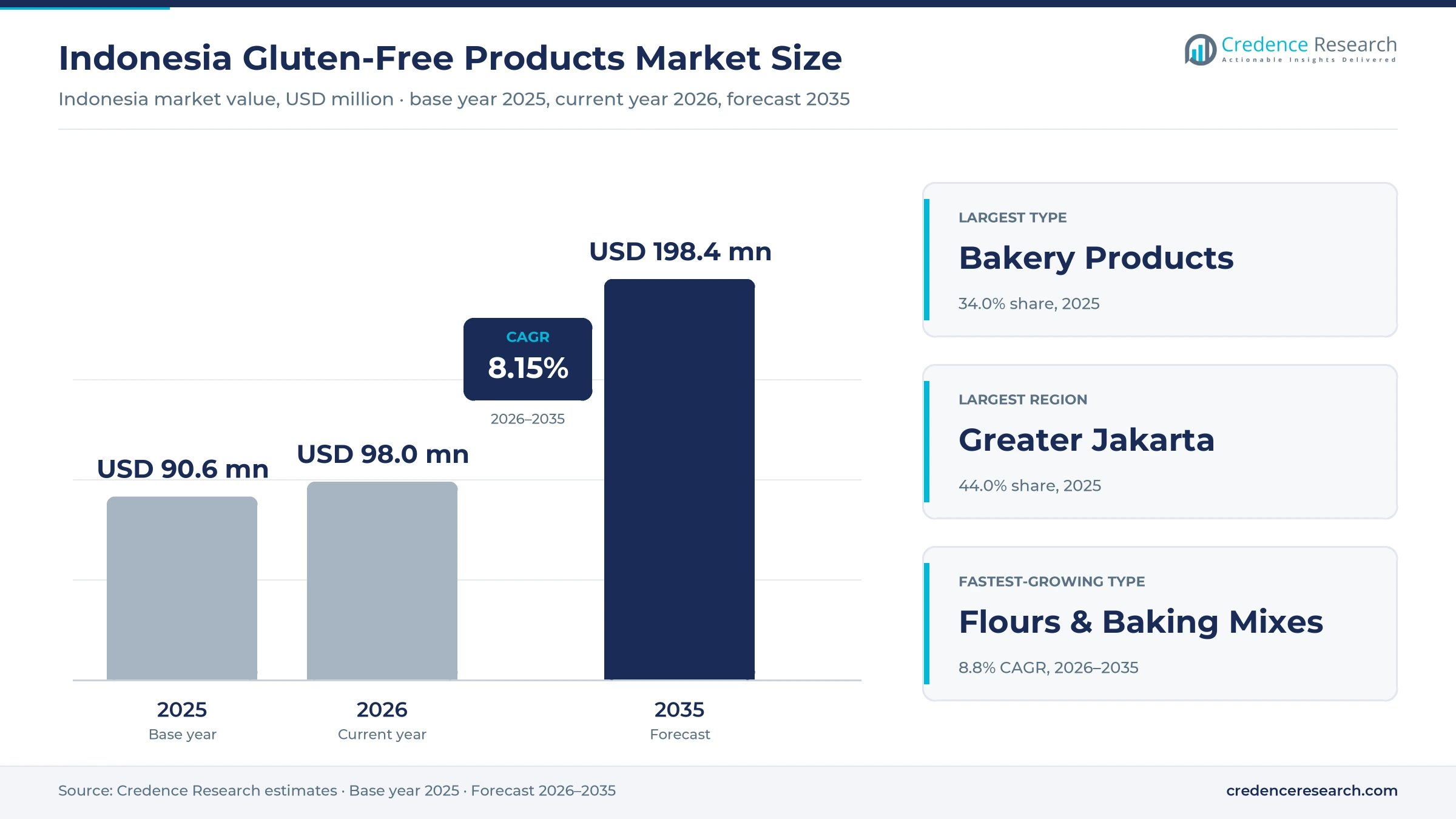
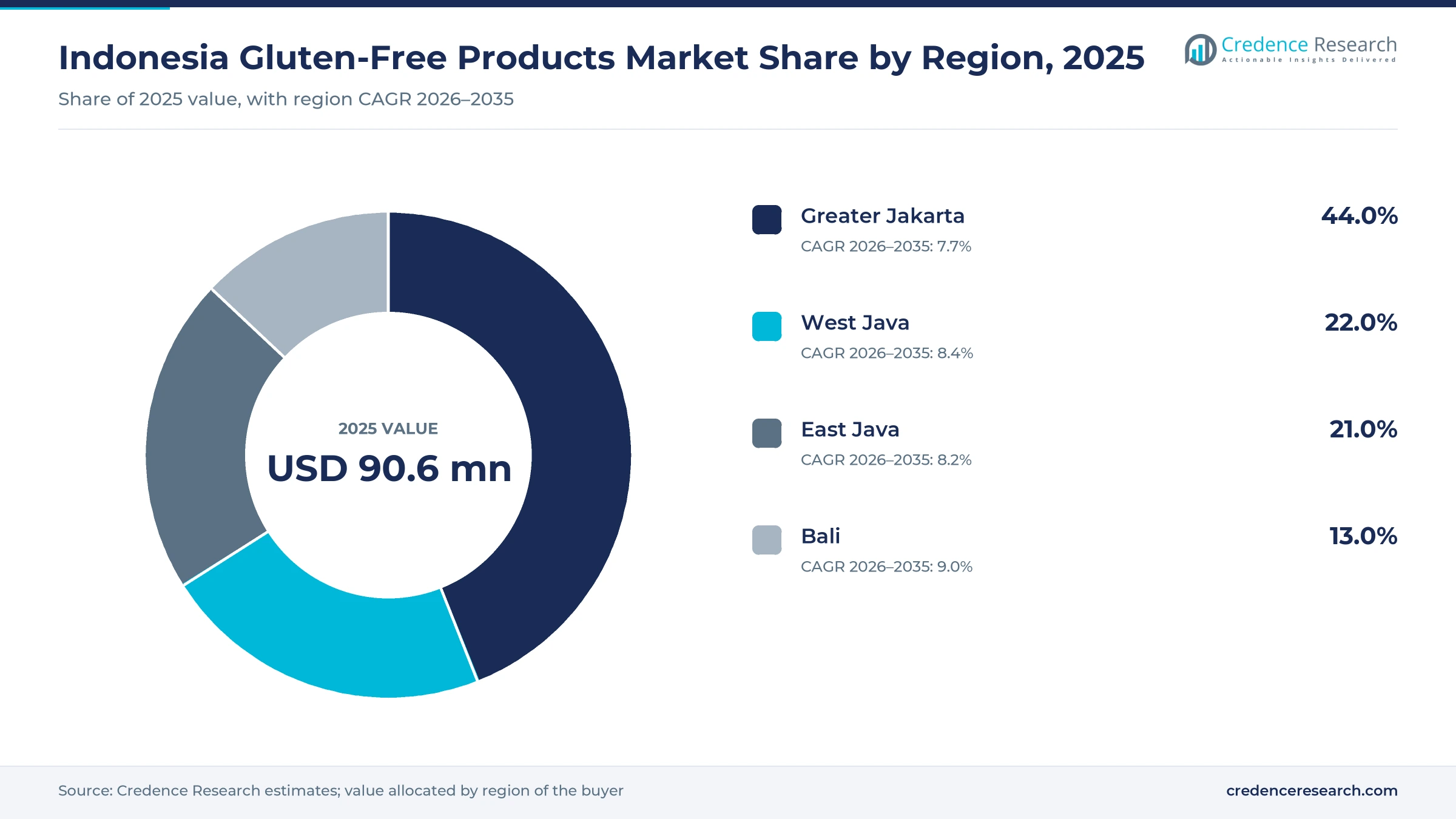
The Indonesia gluten-free products market was valued at USD 90.6 million in 2025 and is projected to increase from USD 98.0 million in 2026 to USD 198.4 million by 2035, registering a CAGR of 8.15% during 2026–2035. Spending comes from a small group of diagnosed celiac and gluten-sensitive patients, families following restricted diets for children, and a much larger group of urban buyers who choose cassava or rice products for health reasons. Greater Jakarta held the largest regional share, 44.0% in 2025, because specialist grocers, hospitals and dedicated bakeries cluster in the capital. Bali is the fastest-growing region at 9.0% a year, since resorts, cafes and international visitors expect gluten-free menus. Supply is shifting toward domestic ingredients, as modified cassava flour, known as mocaf, now competes with imported blends at a fraction of their shelf price, and national food diversification policy favors local starches over imported wheat.
Which products and buyers make up gluten-free spending in Indonesia?
The market counts retail and foodservice sales of products marketed as gluten-free, including breads, cakes and cookies, snacks and ready-to-eat items, pasta and noodles, and flours and baking mixes. Buyers include people with celiac disease or wheat allergy, parents who keep children on gluten-free diets, wellness-minded adults and cafes, hotels and bakeries that serve them. Purchases happen through marketplaces, modern grocery chains, health stores and direct orders from bakeries.
The estimate excludes staples that are naturally free of gluten but sold without that positioning, such as plain rice, ordinary rice vermicelli and bulk tapioca for industrial use. Value is counted at retail and menu prices, so cassava growers, flour processors, brand owners, importers, platforms and retailers all sit inside the chain that the final sale pays for.
Indonesia Gluten-Free Products Market Insights
- The market grows from USD 90.6 million in 2025 to USD 198.4 million by 2035, an 8.15% pace that roughly doubles its 2026 base of USD 98.0 million.
- Greater Jakarta led with 44.0% of 2025 value, while Bali expands fastest at 9.0% a year on resort and cafe demand.
- Cassava-Based products held 41.0% of 2025 value, because mocaf and cassava flour give local brands a cheap, abundant base.
- Researchers at FKUI-RSCM found celiac disease in 2.83% of high-risk patients in a study published in June 2024, against 0.61% in an earlier study.
- A false gluten-free claim by a Jakarta online bakery in October 2025 made lab-verified labels a key purchase criterion for medically required buyers.
Bakery, cassava and online carts hold the largest shares
Why do bakery products carry the largest share?
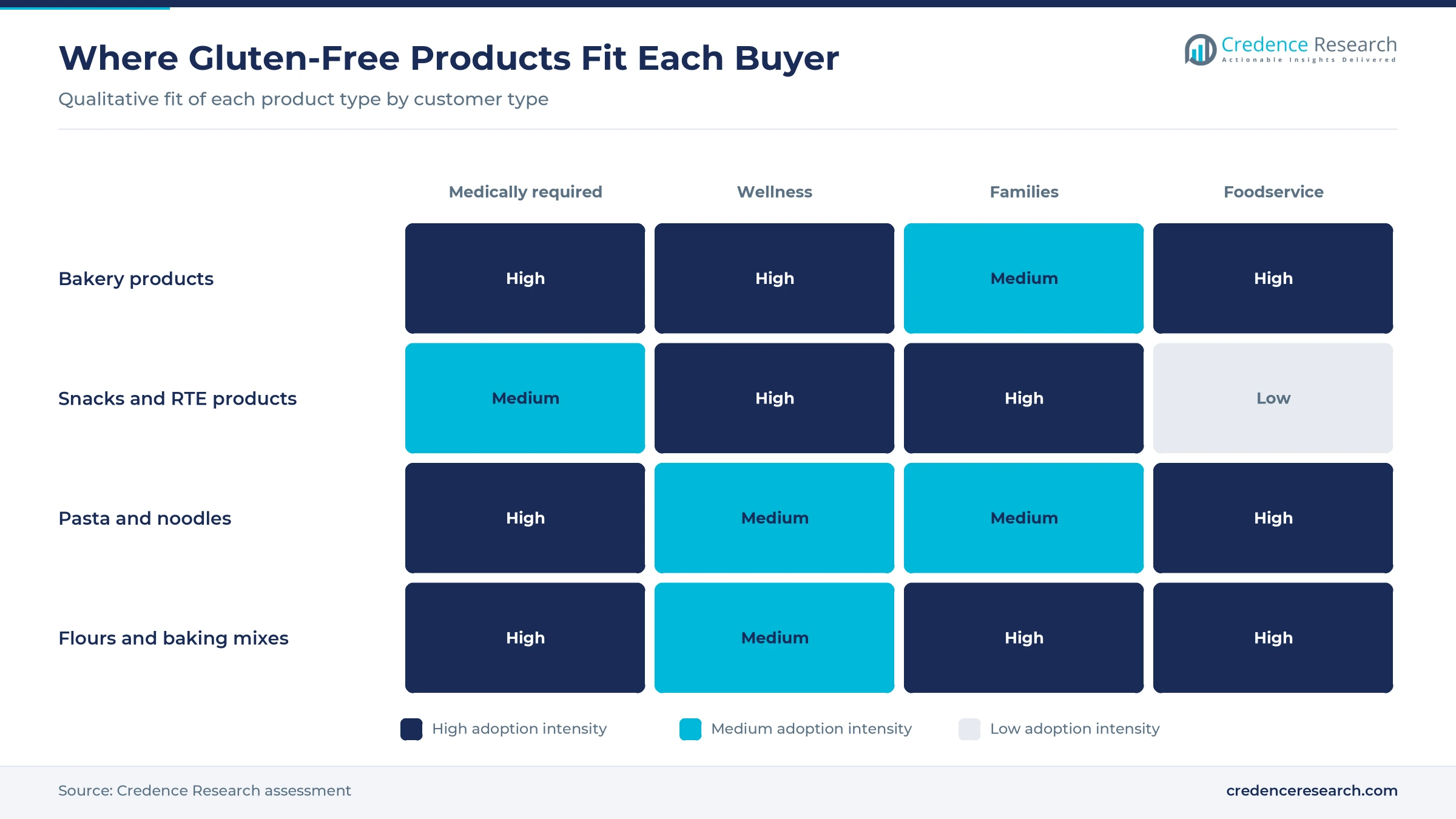
Based on product type, the market is categorized into bakery products, snacks and RTE products, pasta and noodles, and flours and baking mixes. Bakery Products led with 34.0% of 2025 value because cakes, cookies and bread carry the highest ticket per purchase, and What’s New Indonesia counted six dedicated gluten-free cake and bake shops in Jakarta in August 2023, including Goodiebake, which has run as a gluten-free cake shop since 2014. Flours & Baking Mixes grow fastest at 8.8% a year as home baking spreads, with a Popmama buyer guide in November 2025 listing eight gluten-free flour brands, four of them Indonesian. Flour brands win when they teach buyers to bake at home.
How far does cassava set the ingredient base?
Based on ingredient base, the market is categorized into cassava-based, rice-based, corn-based and sorghum and multi-grain-based products. Cassava-Based products led with 41.0% of 2025 value because mocaf supply is organized at village level, and PT Rumah Mocaf Indonesia in Banjarnegara works with more than 452 farmers in 11 cassava farmer groups, according to its Karya Kreatif Indonesia profile. Sorghum & Multi-Grain-Based products grow fastest at 9.5% a year as the Ministry of Agriculture prepares a 5,000-hectare state-funded sorghum trial from 2026, announced Nov. 24, 2025, in Java and East Nusa Tenggara. Brands that blend sorghum with cassava gain protein and texture without imports.
Which buyers spend the most, and which are growing fastest?
Based on customer type, the market is categorized into medically required consumers, wellness-oriented consumers, families with children and foodservice buyers. Wellness-Oriented Consumers led with 43.0% of 2025 value because gluten-free now sits inside mainstream health ranges, and PT Nutrifood Indonesia sells stevia-sweetened Tropicana Slim Alergon gluten-free cookies, a line it launched in 2014. Medically Required Consumers grow fastest at 8.9% a year as diagnosis improves, because the FKUI-RSCM study cited below found celiac disease in 2.83% of high-risk patients, against 0.61% in an earlier study. This group pays for certified products and returns to brands that pass testing.
Why do online marketplaces lead and grow fastest?
Based on distribution channel, the market is categorized into supermarkets and hypermarkets, specialty health stores, e-commerce marketplaces and foodservice and direct-to-consumer. E-Commerce Marketplaces led with 34.0% of 2025 value because buyers outside a few Jakarta grocers can only find imported brands through marketplace sellers, such as the Tokopedia store that lists a 623-gram pack of Bob’s Red Mill gluten-free flour. E-Commerce Marketplaces also grow fastest at 9.1% a year as video commerce scales, with Google reporting 2.6 billion video commerce transactions in Indonesia in 2025, up 90%. Small mocaf brands can therefore reach national buyers without a distributor.
| Segment Group | Leading Sub-segment | Share, 2025 | Fastest-growing Sub-segment | CAGR, 2026–2035 |
|---|---|---|---|---|
| By Product Type | Bakery Products | 34.0% | Flours & Baking Mixes | 8.8% |
| By Ingredient Base | Cassava-Based | 41.0% | Sorghum & Multi-Grain-Based | 9.5% |
| By Customer Type | Wellness-Oriented Consumers | 43.0% | Medically Required Consumers | 8.9% |
| By Distribution Channel | E-Commerce Marketplaces | 34.0% | E-Commerce Marketplaces | 9.1% |
Local cassava flour sells at a fraction of imported blends
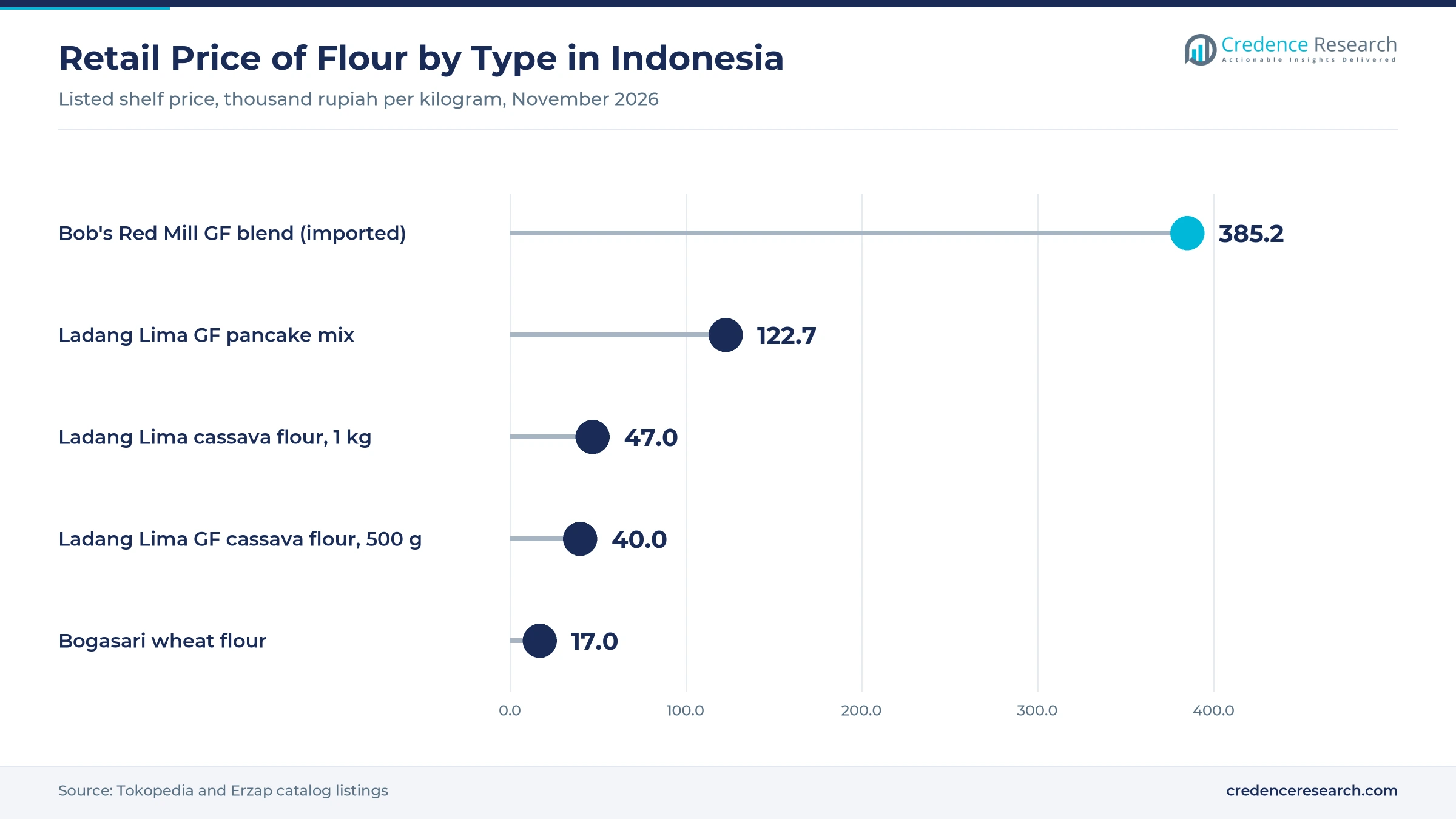
Gluten-free pricing splits into two tiers, imported blends and local cassava products. An imported Bob’s Red Mill all-purpose blend costs about Rp385,000 per kilogram on Tokopedia, while Ladang Lima cassava flour sells for roughly a tenth of that price. Both local and imported flours still cost more than wheat flour, which caps everyday use. Imported prices move with the rupiah and freight, while local prices follow cassava farm-gate rates and packaging scale. Local brands can therefore hold margin on baking mixes and cookies, where packaging and branding set more of the price than flour does.
| Product and pack | Typical price or fee | Basis |
|---|---|---|
| Ladang Lima gluten-free all-purpose cassava flour, 500 g | Rp20,000 | Erzap online grocery catalog listing, viewed November 2026 |
| Ladang Lima all-purpose cassava flour, 1 kg | Rp30,273 to Rp47,000 | Tokopedia (A to Z Family Store) and Erzap catalog listings, viewed November 2026 |
| Ladang Lima gluten-free pancake mix with cranberry, 220 g | Rp27,000 | Erzap catalog listing, viewed November 2026 |
| Ladang Lima Pumpberry gluten-free cookies, 180 g | Rp41,000 | Erzap catalog listing, viewed November 2026 |
| Bob’s Red Mill gluten-free all-purpose baking flour, 623 g (imported) | Rp240,000 | Tokopedia (Stevania Online) listing, viewed November 2026 |
| Bogasari Segitiga Biru wheat flour, 1 kg (reference) | Rp17,000 | Erzap catalog listing, viewed November 2026 |
Request a Free Sample
Fill in your details and we'll send you a free sample report.
- Sample data tables & charts
- Research methodology
Urban buyers, marketplaces and local cassava lift sales
A large urban consumer base widens the buyer pool
Indonesia’s scale turns a small medical niche into a commercially relevant market, because even a low share of buyers yields millions of shoppers. World Bank data show that 59.4% of Indonesia’s 285.7 million people lived in urban areas in 2025, which concentrates buyers near modern retail and private hospitals. Diagnosis is also improving, since researchers at FKUI-RSCM in Jakarta found celiac disease in 8 of 283 high-risk patients, or 2.83% with functional gastrointestinal disorders, in a study published in PLoS ONE in June 2024. Income supports trial purchases, as World Bank data put gross domestic product per person at about USD 5,060 in 2025. This urban base explains why Wellness-Oriented Consumers already hold 43.0% of value, while each confirmed diagnosis adds a household that must buy gluten-free products regularly.
Digital retail and marketplace expansion reach buyers
Marketplaces are the main route to market because gluten-free products are too niche for most physical shelves outside central Jakarta. Google reported that Indonesia’s e-commerce gross merchandise value would rise more than 14% to USD 71 billion in 2025, the largest contributor to the country’s digital economy. The same report counted 800,000 sellers and online stores in video commerce, up 75%, which gives small brands a low-cost storefront. Surabaya-based Ladang Lima, founded in 2014 by Annisa Pratiwi and Raka Bagus Vinaya, sells about 1 million products a year, The Jakarta Post reported, and its cassava flour and mixes appear in marketplace stores such as Tokopedia. Marketplace reach lets a single mocaf producer in East Java serve buyers in Sumatra or Sulawesi, which is why E-Commerce Marketplaces lead the channel mix.
Domestic cassava and rice give local brands a cost edge
Indonesia grows its own gluten-free starches, which lets local brands undercut imported blends without depending on wheat. Presidential Regulation No. 81 of 2024, promulgated Aug. 15, 2024, orders faster food diversification based on local resources. On July 17, 2026, the Ministry of Industry said it was working with Bappenas, the bread, biscuit and instant noodle association AROBIM and PT Thai Wah Indonesia to develop cassava downstream industries, naming Lampung as the source of about 51% of national output. Village processors add value, since PT Rumah Mocaf Indonesia buys from more than 450 farmers. This policy support keeps Cassava-Based products at 41.0% of value and lowers costs for buyers of cassava flour.
Tourism and cafes bring gluten-free menus into foodservice
International visitors and cafe culture push gluten-free options onto menus, which creates steady bulk demand for flours and baked goods. Bali received 6,948,754 direct foreign arrivals in 2025, up 9.72% from 2024, according to the BPS Bali office as reported by Antara in February 2026. Many of these visitors come from markets where gluten-free menus are standard, so resorts and cafes keep cassava and rice bakery items in stock. Hotel kitchens buy in bulk rather than in retail packs, which favors suppliers that offer foodservice formats and steady island delivery. This foodservice demand helps Bali hold a 13.0% share of national value in 2025 despite a resident population far smaller than Java’s.
Sorghum and local brands reshape the ingredient base
Rise of sorghum as a second local gluten-free base
Sorghum is emerging as a second domestic base after cassava, because it adds protein and fiber that cassava flour lacks. The National Food Agency said on Jan. 3, 2026, that it was supplying threshers, hullers, milling machines and dryers to sorghum processors in Karawang, West Java, whose products include flour and cookies, Antara reported. Popmama’s November 2025 guide listed Unis gluten-free all-purpose flour made from Indonesian sorghum and a JAVARA premix that blends cassava and sorghum. The state sorghum trial noted above adds raw material from 2026. Brand owners that secure sorghum supply early will be able to sell multi-grain breads and mixes that compete with imported blends on texture.
Shift from imported blends to local brand shelves
Gluten-free shelves are shifting from imported blends toward Indonesian brands, because local mocaf and cassava products now match imported quality at much lower prices. Ladang Lima sells cassava flour at roughly a tenth of the imported price per kilogram, as the pricing table shows. PT Rumah Mocaf Indonesia has widened its range to Mocafine bread flour, Miecassa low-gluten noodles and vegan cookies, and Kontan reported in April 2025 that a 45-ton mocaf shipment from the company went to Turkey. JAVARA, legally PT Kampung Kearifan Indonesia, works with more than 50,000 small farmers and exports to over 22 countries. Export volumes give these brands the scale to cut domestic prices further.
Opening for gluten-free noodles and pasta made from mocaf
Gluten-free noodles are an opening because noodles are a daily staple, yet almost all are made from imported wheat. Miller Magazine reported in December 2024 that Indonesia used 9.6 million tons of wheat for food in 2023/24, much of it for instant noodles and bread. Only a few domestic lines exist, such as Miecassa, which Rumah Mocaf positions as a low-gluten cassava noodle. Blends of rice flour, tapioca and mocaf can replicate the chew of wheat noodles, and the Ministry of Industry’s July 2026 cassava program already includes the noodle association. A producer that reaches certified gluten-free status at instant noodle prices could take share in Flours & Baking Mixes and in pasta and noodles together.
Opening for pediatric and clinical gluten-free nutrition
Pediatric and clinical channels offer an opening because medically required buyers trust doctors and pharmacists more than marketplace listings. Nutrifood formulated its Tropicana Slim Alergon cookies, launched in 2014, for consumers including autistic children who cannot consume gluten, which shows that a mainstream brand can serve restricted diets. Ladang Lima’s founders began the business because they wanted safe food for their own child, The Jakarta Post reported in November 2023. The FKUI-RSCM study screened only 283 high-risk patients at one hospital, so most of the 285.7 million population has never been tested, and wider celiac disease testing would convert them into regular buyers. Brands that place certified products in hospital and pharmacy channels will capture this demand early.
Cheap wheat and false claims hold back wider use
How far does cheap wheat flour cap everyday use?
Wheat flour remains much cheaper, which limits gluten-free products to buyers who need or strongly prefer them. USDA Foreign Agricultural Service estimates reported in April 2026 put Indonesia’s 2025/26 wheat imports at 12.3 million tons, milled by 31 plants with 14.8 million tons of capacity. This milling scale keeps wheat flour near Rp17,000 per kilogram on grocery shelves. Gluten-free brands can narrow the gap through larger mocaf runs and blends, not by matching wheat on price.
Do false gluten-free claims damage buyer trust?
False claims are a serious risk because one incident can make medically required buyers distrust a whole category. In October 2025, a product sold as gluten-free by Jakarta online bakery Bake n Grind triggered a severe reaction in a toddler, and a sample that an influencer had tested at PT Saraswanti Indo Genetech was positive for gluten, detikHealth reported. BPOM defines gluten-free food as containing less than 20 ppm of gluten. Bakeries that repackage goods from other suppliers carry the most exposure, so batch testing and supplier audits are the most practical defenses.
Can cassava supply stay stable enough for brands?
Cassava supply is volatile, which makes raw material costs hard to plan for mocaf producers. The Indonesian Cassava Society says national output fell from 9 million tons in 2010 to below 5 million tons in 2019, The Jakarta Post reported in January 2025. Farmers rallied in Lampung on Jan. 13, 2025, demanding an agreed price of Rp1,400 per kilogram. Brands can reduce exposure through farmer contracts and sourcing from several provinces.
Will small producers manage to scale up?
Most local producers are small, which limits shelf presence in national grocery chains and raises unit testing costs. AgNavigator reported in July 2026 that Telarasa, a mocaf processor working with growers in Siak, Riau, was still seeking distribution and manufacturing partners and aimed for several tons of cassava products a month. Modern grocery chains need steady volumes, compliant labeling and consistent quality. Contract manufacturing and shared testing labs offer the most practical routes to scale.
Greater Jakarta leads while Bali grows fastest
| Region | Value, 2025 (USD million) | Share, 2025 | CAGR, 2026–2035 |
|---|---|---|---|
| Greater Jakarta | 39.9 | 44.0% | 7.7% |
| West Java | 19.9 | 22.0% | 8.4% |
| East Java | 19.0 | 21.0% | 8.2% |
| Bali | 11.8 | 13.0% | 9.0% |
Greater Jakarta leads on hospitals, grocers and bakeries
Greater Jakarta held a 44.0% share of 2025 value and grows at 7.7% a year. Statistics Indonesia counts 10.67 million residents in DKI Jakarta and 12.64 million in neighboring Banten, according to its Statistik Indonesia 2026 data as compiled by GoodStats. The capital also hosts the national referral hospital behind the celiac study and most of the dedicated gluten-free bakeries described above. Importers and local brands should launch new products here first, because specialist grocers and clinics give the fastest trial among buyers who will pay certified prices.
West Java combines a huge population with sorghum processing
West Java held a 22.0% share of 2025 value and grows at 8.4% a year. The province is the most populous in the country, with 51.16 million residents in BPS data, and its towns bordering the capital buy through the same grocery chains and delivery networks. Karawang’s sorghum processors give the province a second ingredient base. Snack brands can use the region as a mass channel test before national rollout.
East Java anchors cassava processing and online brands
East Java held a 21.0% share of 2025 value and grows at 8.2% a year. The province has 42.35 million residents in BPS data and is home to Ladang Lima in Surabaya, one of the most widely listed domestic gluten-free brands. A brand based in Surabaya can source mocaf from Java and still reach national buyers through marketplaces, which keeps its costs below those of Jakarta repackers that buy finished goods. East Java is therefore the natural base for producers that want scale without Jakarta rents.
Bali grows fastest on resorts, cafes and visitors
Bali held a 13.0% share of 2025 value and grows fastest at 9.0% a year. The visitor record noted above, close to 7 million foreign arrivals in 2025, makes Bali the market where foodservice buyers matter most. Resorts, wellness retreats and cafes in Canggu, Ubud and Seminyak buy flours, breads and pasta in bulk and expect clear allergen labeling. Suppliers that offer foodservice packs and reliable island delivery can win long contracts here, which is why foodservice buyers carry more weight in Bali than elsewhere.
Policy moves, sorghum trials and a labeling scare
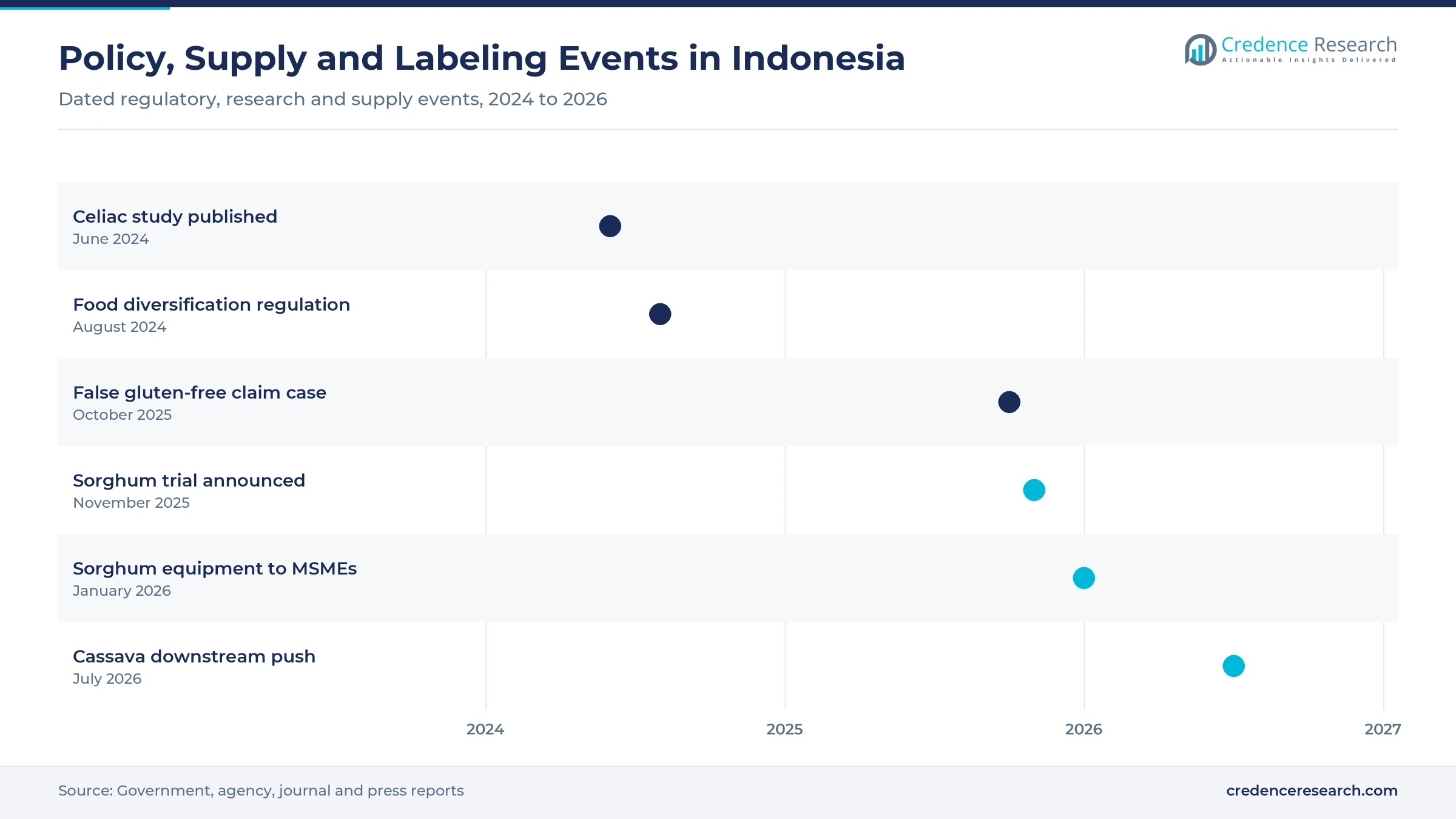
| Development | Status and market relevance |
|---|---|
| In June 2024, FKUI-RSCM researchers published a PLoS ONE study on celiac disease among high-risk patients in Jakarta. | Published; points to underdiagnosis among high-risk patients |
| In August 2024, Presidential Regulation No. 81 of 2024 on local-resource food diversification was promulgated on Aug. 15. | In force; supports cassava, sago and sorghum foods |
| In October 2025, a false gluten-free claim by Jakarta online bakery Bake n Grind was confirmed by a laboratory test. | Reported; raised demand for verified labels |
| In November 2025, the Ministry of Agriculture announced a 5,000-hectare sorghum trial to start in 2026. | Planned; expands domestic sorghum supply |
| In July 2026, the Ministry of Industry launched a cassava downstream push with Bappenas, AROBIM and PT Thai Wah Indonesia. | Under way; deepens cassava processing |
Fermented cassava and testing decide product quality
- Mocaf fermentation modifies cassava starch so that the flour bakes and handles more like wheat, which is why Rumah Mocaf can market bread and all-purpose grades.
- Rice and tapioca blending gives noodles and pasta their chew and lets producers mix domestic starches instead of importing ready blends.
- Gluten testing below 20 ppm gives brands proof for the BPOM definition, and private labs such as PT Saraswanti Indo Genetech already run these tests.
- Sorghum milling and dehulling turns a drought-tolerant grain into flour, and the National Food Agency’s 2026 equipment program targets this step.
Need a Custom Version of This Report?
Tailor the scope, geography, or segments to your exact requirements.
- Custom geography or segment scope
- Direct access to our analyst team
Mocaf pioneers and imported flour brands split demand
Competition divides between domestic cassava brands, imported flour labels and specialist bakeries. Ladang Lima is among the most widely listed local brands, selling cassava flour, mixes, cookies and pasta from Surabaya at the volumes noted above. PT Rumah Mocaf Indonesia supplies Mocafine flours and Miecassa noodles from Banjarnegara and also exports. JAVARA brings an organic premium and a premix that blends cassava and sorghum. PT Nutrifood Indonesia places gluten-free cookies inside its Tropicana Slim range, which gives the category supermarket reach. Bob’s Red Mill leads the imported flour shelf at much higher prices, through Jakarta importer PT Indospirit Natura. Dedicated bakeries such as Goodiebake serve buyers who want fresh cakes and bread. Suppliers compete less on headline price than on verified labeling, taste and availability in the channels buyers trust.
How is the supply side organized, and where do margins sit?
Gluten-free supply in Indonesia is split between three distinct business models. Local mocaf and cassava brands such as Ladang Lima, Rumah Mocaf and JAVARA source from farmer groups and keep the widest margins on mixes and cookies, where packaging rather than raw material sets cost. Imported flour brands such as Bob’s Red Mill sell through importers and marketplace resellers, so freight and currency absorb much of their margin. Dedicated bakeries and cafes form the third layer and earn on freshness. Entry barriers are low online but high for credible testing, which favors established brands.
Cassava flour brands compete with imported labels
| Company | Type | Role in the market |
|---|---|---|
| PT Ladang Sehat Indonesia (Ladang Lima) | Local brand | Cassava flours, baking mixes, cookies and pasta from Surabaya, sold online and in stores |
| PT Kampung Kearifan Indonesia (JAVARA) | Local brand | Organic local foods including a cassava and sorghum gluten-free premix |
| PT Rumah Mocaf Indonesia (Mocafine) | Local manufacturer | Mocafine gluten-free mocaf flours and Miecassa low-gluten noodles from Banjarnegara |
| PT Nutrifood Indonesia (Tropicana Slim) | Local food group | Tropicana Slim Alergon gluten-free cookies sweetened with stevia |
| Bob's Red Mill Natural Foods | Imported brand | Gluten-free flours and granola imported by PT Indospirit Natura under BPOM ML registration |
| Goodiebake | Specialist bakery | Gluten-free cakes and bakes in Jakarta since 2014 |
Verified labels will decide who wins repeat buyers
Credence Research’s view is that verified labeling, not product novelty, will decide which suppliers capture repeat spending through 2030. The October 2025 false-claim case showed medically required buyers how easily an unverified product reaches them, and these buyers grow at 8.9% a year. Local cassava brands already hold a large price advantage over imports, so their task is proving purity rather than cutting prices. The most useful investments are batch testing, foodservice packs for Bali and Jakarta, and noodle lines that bring gluten-free into daily meals.
Consumer base and shelf prices support the estimate
The report uses 2025 as the base year and forecasts values to 2035. Market values come from the Credence Research model, and segment and regional splits are Credence Research estimates. The size was cross-checked against the urban population, an estimate of regular buyers and their annual spending, and shelf prices from marketplace and grocery listings. Evidence comes from World Bank and Statistics Indonesia data, ministry and agency statements, a peer-reviewed clinical study, company profiles and national press. No interviews or surveys were conducted, and naturally gluten-free staples sold without that positioning are excluded.
Local flours and online reach carry growth to 2035
Gluten-free value should reach USD 198.4 million by 2035 because regular buying is still concentrated in Jakarta and Bali, leaving a large urban base in Java to convert. Sorghum & Multi-Grain-Based products should expand at 9.5% a year as state trials and processing equipment add supply, while cassava keeps the category affordable. Marketplaces will remain the main growth channel for small brands. The main risks are further labeling incidents and cassava price swings, although stricter testing and farmer contracts could turn both into advantages for established local brands.
What separates the downside, base and upside paths to 2035?
The range of outcomes depends mainly on trust and raw material costs rather than on interest in healthier food. A downside path follows if further false claims undermine confidence and cassava prices swing, which would push buyers back to wheat. The base case assumes steady marketplace growth and stable cassava supply. An upside path needs certified gluten-free noodles at mass prices and wider celiac testing in hospitals, which together would widen the buyer base well beyond Jakarta.
| Scenario | CAGR, 2026–2035 | Value, 2035 | What has to hold |
|---|---|---|---|
| Downside | 6.2% | USD 167.7 million | New false-claim incidents and volatile cassava prices push buyers back to wheat products |
| Base | 8.15% | USD 198.4 million | Marketplace sales keep growing and cassava supply stays steady under current policy |
| Upside | 9.7% | USD 224.5 million | Certified mocaf noodles reach mass prices and celiac testing spreads beyond Jakarta hospitals |
Frequently Asked Questions
How big is the Indonesia gluten-free products market?
Which region leads gluten-free sales in Indonesia?
Which region grows fastest?
Which ingredient base holds the largest share?
How do gluten-free flour prices compare with wheat?
How does Indonesia regulate gluten-free claims?
What is the biggest risk for brands in this market?
Which companies are active in the market?
Table of Content
Chapter 1 Market Segmentation
- 1.1 Segmentation Framework
- 1.1.1 Product and Service Classification
- 1.1.2 Application and End-Use Classification
- 1.1.3 Technology and Solution Classification
- 1.1.4 Customer and Distribution Channel Classification
- 1.1.5 Geographic Segmentation
- 1.1.6 Market Segment Definitions and Boundaries
- 1.2 By Product Type
- 1.2.1 Bakery Products
- 1.2.2 Snacks & RTE Products
- 1.2.3 Flours & Baking Mixes
- 1.2.4 Pasta & Noodles
- 1.3 By Ingredient Base
- 1.3.1 Cassava-Based
- 1.3.2 Rice-Based
- 1.3.3 Corn-Based
- 1.3.4 Sorghum & Multi-Grain-Based
- 1.4 By Customer Type
- 1.4.1 Wellness-Oriented Consumers
- 1.4.2 Medically Required Consumers
- 1.4.3 Families with Children
- 1.4.4 Foodservice Buyers
Chapter 2 Introduction
- 2.1 Report Objectives and Scope
- 2.2 Product Definition and Industry Terminology
- 2.3 Market Inclusions and Exclusions
- 2.4 Research Process
- 2.4.1 Primary Research and Expert Interviews
- 2.4.2 Secondary Research and Source Review
- 2.4.3 Top-Down and Bottom-Up Estimation
- 2.4.4 Data Triangulation and Verification
- 2.5 Market Size Measurement Basis
- 2.5.1 2025: USD 90.6 million → 2035: USD 198.4 million
- 2.6 Historical and Forecast Reference Periods
- 2.6.1 Historical Period: 2018-2025
- 2.6.2 Base Year: 2025
- 2.6.3 Forecast Period: 2025-2035
- 2.7 Research Assumptions and Limitations
Chapter 3 Executive Summary
- 3.1 Market Snapshot and Key Findings
- 3.2 Base-Year Market Size, 2025
- 3.3 Forecast Market Size, 2035
- 3.4 Revenue and Volume Growth Outlook
- 3.5 Key Demand and Supply Indicators
- 3.6 Leading Market Segments
- 3.7 Fastest-Growing Market Opportunities
- 3.8 Regional Performance Highlights
- 3.9 Technology and Industry Transformation
- 3.10 Competitive Landscape Summary
- 3.11 Analyst View and Strategic Implications
Chapter 4 Indonesia Gluten-Free Products Market Trends and Developments
- 4.1 Historical Industry Development, 2018-2025
- 4.2 Recent Market Trends and Developments
- 4.3 Demand and Customer Behavior Trends
- 4.4 Technology and Product Innovation
- 4.5 Artificial Intelligence, Automation and Digitalization
- 4.6 Local Manufacturing and Supply Chain Realignment
- 4.7 Industry Partnerships, Mergers and Acquisitions
- 4.8 Sustainability and Circular Economy Developments
- 4.9 Government and Private Sector Investment Trends
- 4.10 Emerging Business Models and Commercialization
- 4.11 Industry Developments and Announcements
Chapter 5 Indonesia Gluten-Free Products Market Production, Supply and Demand Analysis
- 5.1 Demand Trend and Consumption Analysis, 2018-2025
- 5.2 Demand Forecast, 2025-2035
- 5.3 Production and Output Trend, 2018-2025
- 5.4 Production and Output Forecast, 2025-2035
- 5.5 Installed Capacity and Capacity Utilization
- 5.6 Company-Wise Production Plants and Statistics
- 5.6.1 Installed Production Capacity
- 5.6.2 Actual Production
- 5.6.3 Planned Capacity and Expansion Targets
- 5.7 Supply Chain Structure and Procurement Trends
- 5.8 Supply-Demand Gap and Bottlenecks
- 5.9 Import Dependence and Sourcing Structure
- 5.10 Contract Manufacturing and Outsourcing
- 5.11 Regional Supply and Demand Concentration
Chapter 6 Indonesia Gluten-Free Products Market Pricing Analysis
- 6.1 Pricing Structure and Measurement
- 6.2 Historical Pricing Trends, 2018-2025
- 6.3 Pricing Outlook, 2025-2035
- 6.4 Average Selling Price and Unit Economics
- 6.5 Pricing by Product and Market Segment
- 6.6 Geographic Pricing Differences
- 6.7 Key Input, Energy, Labor and Logistics Costs
- 6.8 Contract Pricing and Purchasing Models
- 6.9 Pricing Sensitivity and Competitive Positioning
- 6.10 Price, Margin and Profitability Implications
Chapter 7 Indonesia Gluten-Free Products Market Dynamics
- 7.1 Market Growth Drivers
- 7.1.1 Demand-Side Drivers
- 7.1.2 Technology and Innovation Drivers
- 7.1.3 Infrastructure and Investment Drivers
- 7.1.4 Regulatory and Policy Drivers
- 7.2 Market Restraints
- 7.2.1 Cost and Affordability Constraints
- 7.2.2 Technology and Adoption Barriers
- 7.2.3 Supply Chain and Operational Constraints
- 7.3 Market Challenges
- 7.3.1 Competitive Pressure and Margin Erosion
- 7.3.2 Skills, Infrastructure and Implementation Gaps
- 7.4 Emerging Market Opportunities
- 7.5 Market Dynamics Impact and Time-Horizon Assessment
Chapter 8 Indonesia Gluten-Free Products Value Chain Analysis
- 8.1 Industry Value Chain Overview
- 8.2 Upstream Suppliers and Critical Inputs
- 8.3 Technology and Component Providers
- 8.4 Manufacturing or Service Delivery
- 8.5 Distribution, Channel Partners and Integrators
- 8.6 Downstream Applications and End Users
- 8.7 Value Addition and Profit Pools
- 8.8 Vertical Integration and Outsourcing
- 8.9 Supplier Concentration and Risk
- 8.10 Supply Chain Localization and Resilience
Chapter 9 Indonesia Gluten-Free Products Market Regulations and Policies
- 9.1 Relevant Laws, Standards and Compliance Frameworks
- 9.2 Product, Service, Safety and Quality Requirements
- 9.3 Government Policies, Incentives and Subsidies
- 9.4 Imports, Exports and Trade Barriers
- 9.5 Public Procurement and Local Content Requirements
- 9.6 Environmental and Sustainability Compliance
- 9.7 Upcoming Policy Changes and Market Implications
Chapter 10 Indonesia Gluten-Free Products Market Hotspots and Opportunities
- 10.1 Market Opportunity Mapping and Growth Hotspots
- 10.2 High-Growth Applications and Customer Groups
- 10.3 Underserved Markets and White-Space Opportunities
- 10.4 Emerging Technology and Product Opportunities
- 10.5 New Capacity and Investment Hotspots
- 10.6 Market Entry and Expansion Opportunities
- 10.7 Distribution and Partnership Opportunities
- 10.8 Near-Term and Long-Term Commercial Potential
- 10.9 Opportunity Attractiveness and Execution Risks
Chapter 11 Indonesia Gluten-Free Products Market Outlook, 2025-2035
- 11.1 Market Size and Analysis
- 11.1.1 Revenue (Market Measurement: 2025: USD 90.6 million → 2035: USD 198.4 million)
- 11.1.2 Market Volume and Quantity Sold
- 11.1.3 Historical Market Size, 2018-2025
- 11.1.4 Base-Year Market Size, 2025
- 11.2 Market Forecast, 2025-2035
- 11.2.1 Revenue Forecast to 2035
- 11.2.2 Volume Forecast to 2035
- 11.2.3 CAGR and Year-on-Year Growth
- 11.2.4 Incremental Revenue Opportunity
- 11.3 Forecast Assumptions and Scenario Analysis
- 11.3.1 Base-Case Forecast
- 11.3.2 Optimistic and Conservative Scenarios
- 11.3.3 Technology, Pricing and Policy Sensitivities
- 11.4 Market Attractiveness and Growth Outlook
Chapter 12 Indonesia Gluten-Free Products Market Segmentation and Outlook
- 12.1 Segmentation Summary and Market Shares, 2025
- 12.2 Largest and Fastest-Growing Segments
- 12.3 By Product Type - Market Size and Forecast, 2025-2035
- 12.3.1 Segment Definition and Scope
- 12.3.2 Historical Market Size, 2018-2025
- 12.3.3 Revenue Forecast, 2025-2035
- 12.3.4 Volume Forecast, 2025-2035
- 12.3.5 Base-Year Market Share, 2025
- 12.3.6 Segment CAGR and Growth Drivers
- 12.3.7 Subsegment Market Size and Forecast
- 12.3.7.1 Bakery Products
- 12.3.7.2 Snacks & RTE Products
- 12.3.7.3 Flours & Baking Mixes
- 12.3.7.4 Pasta & Noodles
- 12.3.8 Subsegment Pricing and Adoption Trends
- 12.3.9 Leading Suppliers and Competition
- 12.3.10 Regional Demand and Opportunities
- 12.4 By Ingredient Base - Market Size and Forecast, 2025-2035
- 12.4.1 Segment Definition and Scope
- 12.4.2 Historical Market Size, 2018-2025
- 12.4.3 Revenue Forecast, 2025-2035
- 12.4.4 Volume Forecast, 2025-2035
- 12.4.5 Base-Year Market Share, 2025
- 12.4.6 Segment CAGR and Growth Drivers
- 12.4.7 Subsegment Market Size and Forecast
- 12.4.7.1 Cassava-Based
- 12.4.7.2 Rice-Based
- 12.4.7.3 Corn-Based
- 12.4.7.4 Sorghum & Multi-Grain-Based
- 12.4.8 Subsegment Pricing and Adoption Trends
- 12.4.9 Leading Suppliers and Competition
- 12.4.10 Regional Demand and Opportunities
- 12.5 By Customer Type - Market Size and Forecast, 2025-2035
- 12.5.1 Segment Definition and Scope
- 12.5.2 Historical Market Size, 2018-2025
- 12.5.3 Revenue Forecast, 2025-2035
- 12.5.4 Volume Forecast, 2025-2035
- 12.5.5 Base-Year Market Share, 2025
- 12.5.6 Segment CAGR and Growth Drivers
- 12.5.7 Subsegment Market Size and Forecast
- 12.5.7.1 Wellness-Oriented Consumers
- 12.5.7.2 Medically Required Consumers
- 12.5.7.3 Families with Children
- 12.5.7.4 Foodservice Buyers
- 12.5.8 Subsegment Pricing and Adoption Trends
- 12.5.9 Leading Suppliers and Competition
- 12.5.10 Regional Demand and Opportunities
- 12.6 Segment Growth Comparison
- 12.7 Segment Attractiveness and Priority Matrix
Chapter 13 Indonesia Gluten-Free Products End-Use and Application Market Outlook
- 13.1 End-Use Industry and Customer Demand Structure
- 13.2 Leading Applications and Customer Groups
- 13.3 End-Use Market Size, Share and Forecast
- 13.4 Major End-Use Industry Deep Dives
- 13.4.1 Customer Requirements and Use Cases
- 13.4.2 Demand and Replacement Cycles
- 13.4.3 Technical and Regulatory Considerations
- 13.4.4 Purchasing and Procurement Models
- 13.4.5 Leading Vendors and Distribution Channels
- 13.4.6 Forecast and Commercial Opportunities
- 13.5 Emerging Applications and Cross-Segment Demand
- 13.6 End-Use Industry Investment Priorities
Chapter 14 Indonesia Gluten-Free Products Geographic Market Outlook, 2025-2035
- 14.1 Domestic Market Distribution and Demand Clusters
- 14.2 State- or Province-Wise Market Size and Forecast, 2025-2035
- 14.3 City and Metropolitan Market Outlook
- 14.4 Industrial, Manufacturing and Commercial Clusters
- 14.5 Geographic Concentration of Key End Users
- 14.6 Local Pricing and Purchasing Differences
- 14.7 Domestic Production Facilities and Capacity Map
- 14.8 Local Infrastructure and Project Pipeline
- 14.9 State-Level Policy and Incentive Differences
- 14.10 Subnational Investment Hotspots and Opportunities
- 14.11 Distribution and Logistics Networks
- 14.12 Domestic Competitive Footprint
Chapter 15 Indonesia Gluten-Free Products Technology, Innovation and Sustainability Outlook
- 15.1 Technology Landscape and Maturity
- 15.2 Product, Process and Service Innovation
- 15.3 AI, Automation and Digital Tools in the Industry
- 15.4 Technology Adoption and Performance Benchmarking
- 15.5 Innovation Pipeline and R&D Investment
- 15.6 Patent and Intellectual Property Trends
- 15.7 Energy Efficiency and Resource Management
- 15.8 Sustainability, Recycling and Circularity
- 15.9 Technology Roadmap, 2025-2035
- 15.10 Risks of Obsolescence and Technology Substitution
Chapter 16 Indonesia Gluten-Free Products Market Key Strategic Imperatives
- 16.1 Growth and Market Entry Priorities
- 16.2 High-Return Products and Segments
- 16.3 Pricing, Profitability and Cost Optimization
- 16.4 Technology Investment and Product Differentiation
- 16.5 Supply Chain Localization and Resilience
- 16.6 Distribution and Customer Acquisition
- 16.7 Partnership, Acquisition and Capacity Strategy
- 16.8 Regional Expansion Priorities
- 16.9 Short-, Medium- and Long-Term Actions
Chapter 17 Competition Outlook
- 17.1 Industry Competition Characteristics
- 17.2 Market Structure and Concentration
- 17.3 Market Share and Competitive Positioning, 2025
- 17.4 Company-Wise Revenue and Product Benchmarking
- 17.5 Production and Service Capacity Benchmarking
- 17.6 Technology, Pricing and Differentiation
- 17.7 Regional Footprint and Distribution Strength
- 17.8 Mergers, Acquisitions and Strategic Alliances
- 17.9 New Entrants and Competitive Threats
- 17.10 Porter's Five Forces and Industry Attractiveness
- 17.11 Competitive Outlook, 2025-2035
Chapter 18 Company Profiles
- 18.1 Company Coverage and Selection Criteria
- 18.2 PT Ladang Sehat Indonesia (Ladang Lima)
- 18.2.1 Business Description
- 18.2.2 Company Ownership and Geographic Presence
- 18.2.3 Product and Service Portfolio
- 18.2.4 Manufacturing and Operating Footprint
- 18.2.5 Production Capacity and Expansion Plans
- 18.2.6 Financial Performance and Investment
- 18.2.7 Market Share and Competitive Position
- 18.2.8 Technology and Innovation Capabilities
- 18.2.9 Strategic Alliances or Partnerships
- 18.2.10 Recent Developments
- 18.2.11 Growth Strategy and Outlook
- 18.3 PT Kampung Kearifan Indonesia (JAVARA)
- 18.4 PT Rumah Mocaf Indonesia (Mocafine)
- 18.5 PT Nutrifood Indonesia (Tropicana Slim)
- 18.6 Bob's Red Mill Natural Foods
- 18.7 Goodiebake
- 18.8 Other Relevant Market Participants
Note: Every listed company is profiled on the structure shown under the first company. The company list is preliminary and may change based on research findings, market developments, data availability and client requirements.
Chapter 19 Disclaimer
- 19.1 Research and Forecast Disclaimer
- 19.2 Data Source and Estimation Limitations
Note: The depth of individual sections depends on data availability for this market. Volume, capacity, trade and other unit-based metrics are included where applicable.