Working households and new plants reshape Saudi meal demand
The Saudi Arabia ready meals market was valued at USD 2.06 billion in 2025 and is projected to increase from USD 2.19 billion in 2026 to USD 3.70 billion by 2035, registering a CAGR of 5.98% during 2026–2035. Demand comes from working women and dual-income couples who have less time to cook, from a large expatriate workforce that often lives alone, and from pilgrims and tourists who need quick halal food. Riyadh Region held 26.3% of 2025 value, the largest share of any single region, while the ten smaller regions grouped as Other Saudi Regions held 32.5% together. The capital combines the most households with the densest network of supermarkets and delivery services. Riyadh Region is also the fastest-growing zone at 6.4% a year, as new office and residential districts add buyers. On the commercial side, multinational and Gulf food groups are building Saudi plants for frozen and processed foods, which shortens supply chains and lets brands adapt recipes to local tastes faster than importers can.
Frozen, chilled, canned and instant meals form one estimate
The estimate measures retail sales of prepared meals that need only heating or adding water, sold to households in Saudi Arabia. It covers frozen ready meals and appetizers, chilled meals and meal-plan boxes, ambient canned and retort meals such as foul medames and beans, and dried and instant meals such as packet and cup noodles.
The estimate excludes restaurant meals, meal kits that need cooking, frozen raw meat and vegetables, plain dough and pastry sheets, and sales to airlines and hotels. The value chain runs from local plants and importers through distributors and retail chains to delivery apps and the households that buy the meals.
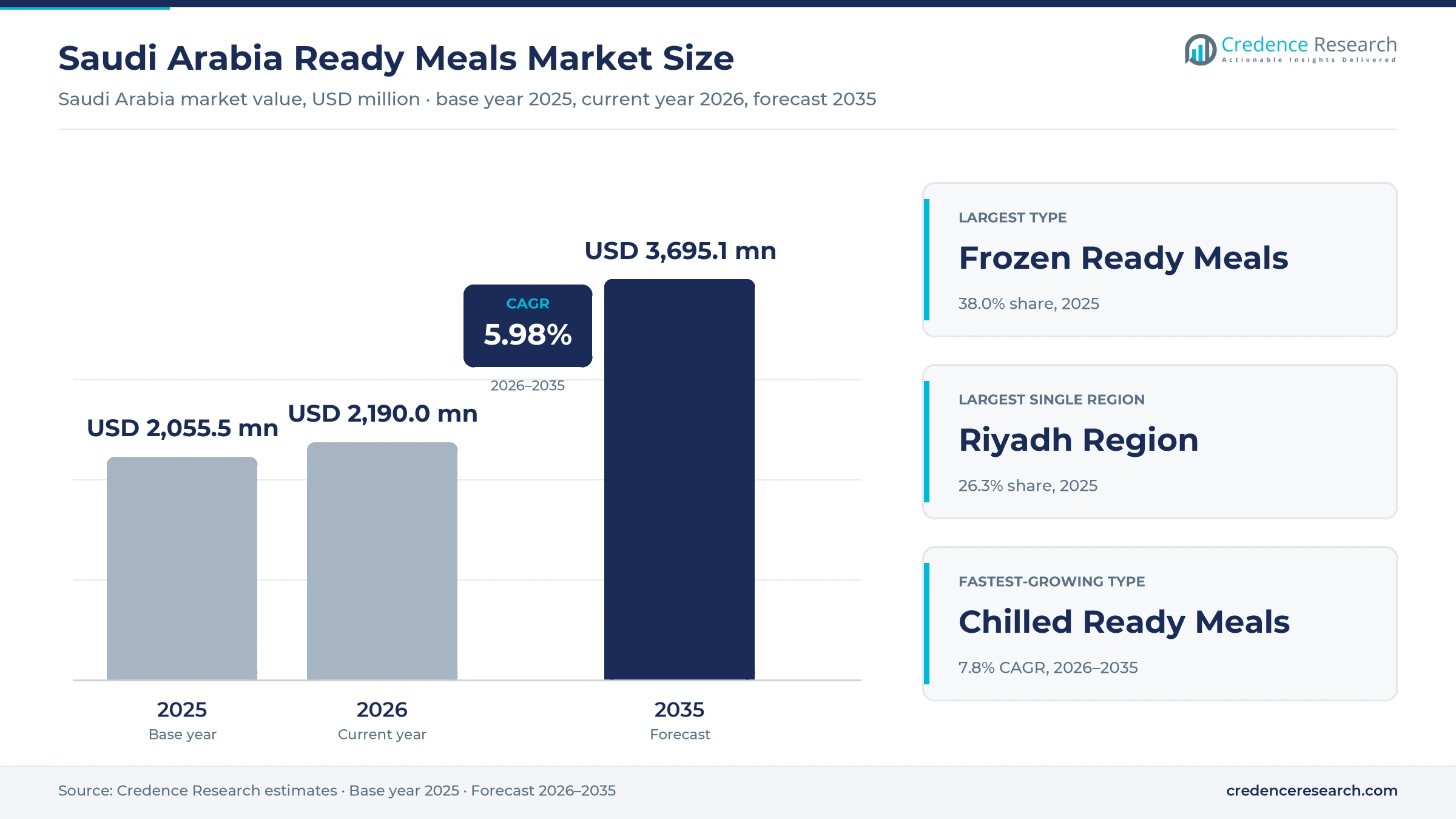
Saudi Arabia Ready Meals Market Insights
- The Saudi Arabia ready meals market was valued at USD 2.06 billion in 2025 and is projected to reach USD 3.70 billion by 2035, registering a CAGR of 5.98% during 2026–2035.
- Riyadh Region held 26.3% of 2025 value, because the capital has the most households and the largest number of online stores registered with the Ministry of Commerce.
- Frozen ready meals led with 38.0% of 2025 value, because hypermarket freezers carry wide ranges from Al Kabeer, Americana, Sadia and other brands.
- Saudi women's labor force participation reached 34.5% in the fourth quarter of 2025, up 0.8 points in one quarter, <a href="https://english.aawsat.com/business/5257548-saudi-women-help-steady-unemployment-end-2025" target="_blank" rel="nofollow noopener" data-bl="e">GASTAT data show</a>.
- In April 2025, BRF and the Halal Products Development Company began building a USD 160 million processed food plant in Jeddah with 40,000 tons of yearly capacity.
Frozen trays lead as chilled meal plans grow fastest
Why do frozen trays and appetizers hold the most value?
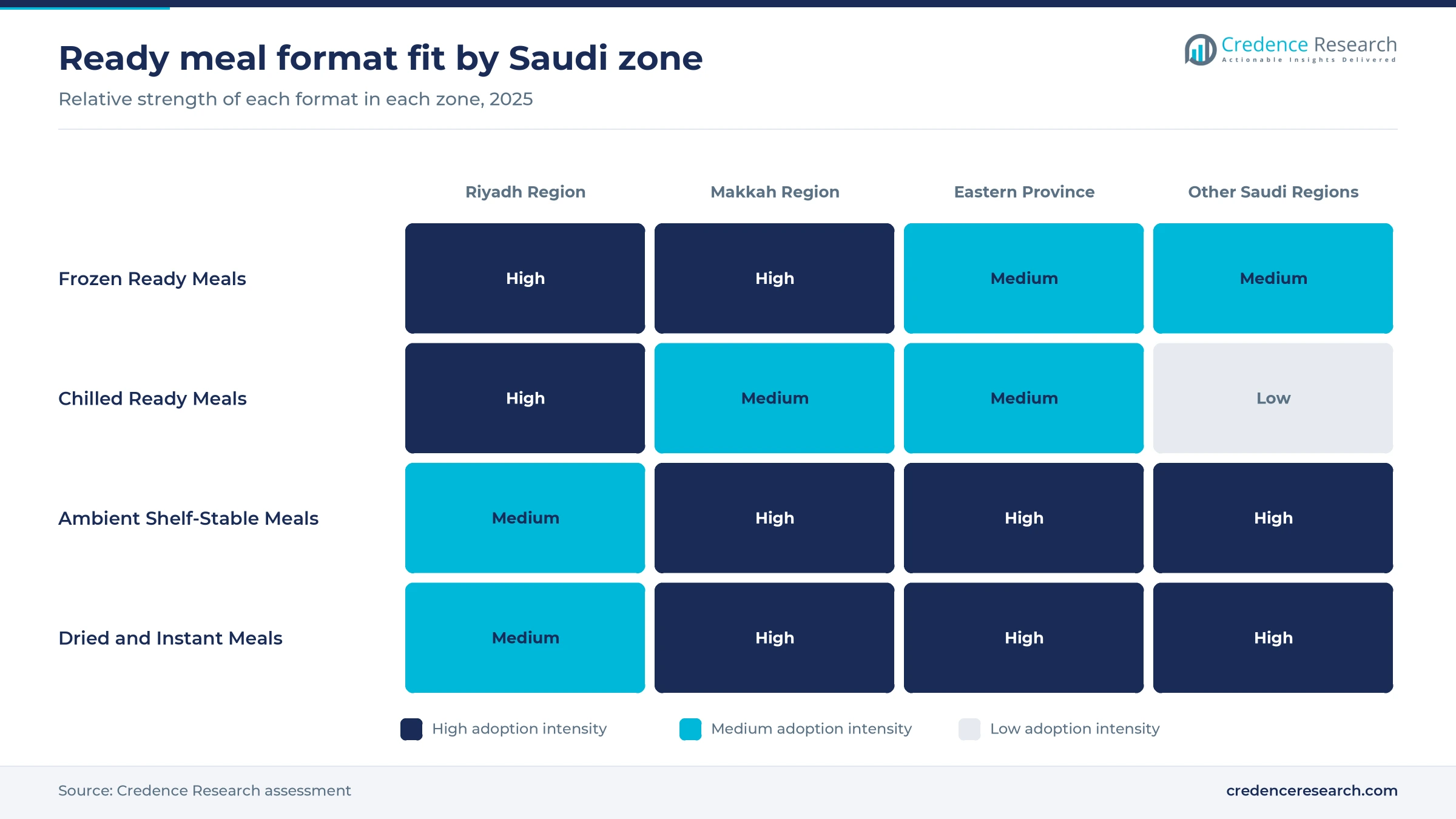
Based on product type, the market is categorized into frozen ready meals, chilled ready meals, ambient shelf-stable meals and dried and instant meals. Frozen Ready Meals led with 38.0% of 2025 value, because hypermarket freezers carry broad ranges, and the Carrefour Saudi Arabia frozen ready meals aisle lists Al Kabeer, Sadia, Americana, Dari and Seara among its brands. Chilled Ready Meals grow fastest at 7.8% a year, as Riyadh-based Calo delivered more than 10 million fresh meals across the Gulf in 2024, according to Enterprise. Chilled meals still carry the highest price per portion, so they remain mainly a purchase of higher-income buyers for now.
How do chain stores and apps split ready meal sales?
Based on distribution channel, the market is categorized into supermarkets and hypermarkets, convenience stores, online grocery platforms and specialty food stores. Supermarkets and Hypermarkets led with 58.0% of 2025 value, because large chains control freezer space, and USDA FAS reports that five chains, led by Panda and Othaim, hold more than 80 percent of retail revenue. Online Grocery Platforms grow fastest at 8.5% a year, as Ministry of Commerce data show delivery service registrations rose 13% to 953 by the third quarter of 2025, while traditional grocery registrations fell 4%. Brands now need app listings as well as shelf space to stay visible.
Which households buy the most ready meals in Saudi Arabia?
Based on customer type, the market is categorized into single professionals, dual-income households, families with children and students and young adults. Dual-Income Households led with 31.0% of 2025 value, because two salaries leave less time for cooking, and USDA FAS links rising demand for convenient foods to increased workforce participation among women, which GASTAT put at 34.5% for Saudi women in late 2025. Single Professionals grow fastest at 6.8% a year, as Siwar Foods sells single portions through its app and Chef in a Box vending machines placed in offices. Office workers buy one portion at a time, so single-portion packs suit them best.
When do Saudi shoppers reach for a ready meal?
Based on purchase occasion, the market is categorized into weekday lunch and dinner, on-the-go consumption, Ramadan and Eid convenience, and social and family gatherings. Weekday Lunch and Dinner led with 46.0% of 2025 value, because working households use them mainly for routine meals, and Siwar Foods says pizza, biryani and mandi are its best-selling meals. On-the-Go Consumption grows fastest at 6.9% a year, as the Kingdom received about 29.7 million inbound tourists in 2024, according to the Ministry of Tourism. Travelers and pilgrims buy single heat-and-eat portions near hotels, offices and transport hubs.
| Segment Group | Leading Sub-segment | Share, 2025 | Fastest-growing Sub-segment | CAGR, 2026–2035 |
|---|---|---|---|---|
| By Product Type | Frozen Ready Meals | 38.0% | Chilled Ready Meals | 7.8% |
| By Distribution Channel | Supermarkets and Hypermarkets | 58.0% | Online Grocery Platforms | 8.5% |
| By Customer Type | Dual-Income Households | 31.0% | Single Professionals | 6.8% |
| By Purchase Occasion | Weekday Lunch and Dinner | 46.0% | On-the-Go Consumption | 6.9% |
Shelf prices run from SAR 1.55 noodles to SAR 24 trays
Pricing in the Saudi ready meals market follows format more than brand. Instant noodles and canned beans sell for a few riyals a portion and compete on promotion depth, while frozen appetizers and pasta trays sell at SAR 16 to SAR 24 and compete on recipe and portion size. Chains add listing fees and markups, and an Argaam basket survey found a 20% gap between the cheapest and the most expensive hypermarket basket in early 2026. Brands therefore set prices by channel and rely on promotions to win share in the cheaper chains.
| Product or format | Typical price or fee | Basis |
|---|---|---|
| Indomie fried noodles, five 80 g packs | SAR 7.75, about SAR 1.55 a pack | Carrefour Saudi Arabia listing, November 2026 |
| Baidar foul medames, 397 g can | SAR 3.50 a can | Carrefour Saudi Arabia listing, November 2026 |
| Al Kabeer chicken spring rolls, 240 g frozen | SAR 16.00 a pack | Carrefour Saudi Arabia listing, November 2026 |
| Dari beef lasagne, 425 g frozen tray | SAR 18.99 on promotion, SAR 20.95 list | Carrefour Saudi Arabia listing, November 2026 |
| Aljawad chicken fettuccine Alfredo, 400 g frozen | SAR 23.95 a tray | Carrefour Saudi Arabia listing, November 2026 |
Request a Free Sample
Fill in your details and we'll send you a free sample report.
- Sample data tables & charts
- Research methodology
Working women, chain retail and tourists lift demand
How are working women changing weekday meal routines?
More Saudi women in paid work means fewer hours for home cooking, which moves weekday dinners toward frozen and chilled meals that heat in minutes. GASTAT data reported by Asharq Al-Awsat put the labor force participation rate of Saudi women at 34.5% in the fourth quarter of 2025, up 0.8 points in a single quarter. Their unemployment rate fell 1.8 points to 10.3% in the same period, so more of those women now earn a salary. The USDA Foreign Agricultural Service lists ready meals among its top ten growth products in Saudi retail. Dual-income households already hold 31.0% of 2025 value, and that share should rise as female employment keeps climbing.
Why do chain stores and delivery apps widen meal ranges?
Modern grocery formats carry the freezer and chiller space that ready meals need, and delivery apps now bring that range to homes across the main cities. USDA FAS estimates Saudi retail food sales at about USD 57 billion in 2025 and expects online sales to pass 10% of grocery sales within a few years, led by Ninja and NANA. The Ministry of Commerce counted 43,854 e-commerce registrations at the end of 2025, up 9% from a year earlier, as reported by Sharikat Mubasher. Brands that secure app listings alongside freezer space can reach households the chains do not.
How do new plants and tourist flows add meal demand?
Local production and a fast-growing visitor base support each other, because new plants cut lead times while tourists and pilgrims add demand for quick halal meals. Food makers operate about 1,300 factories in the industrial cities run by MODON, according to AGBI. Americana and Farm Frites committed USD 100 million to a frozen potato plant in Sudair Industrial City with 70,000 tons of first-phase capacity, as reported by Food Business Middle East. The Ministry of Tourism counted about 115.9 million domestic and inbound tourists in 2024, who spent about SAR 284 billion, according to Argaam. Hotels, transport hubs and pilgrim routes need single heat-and-eat portions.
Why does a young, expatriate-heavy population buy instant meals?
The population structure favors quick meals, because many residents are young or live in shared housing with small kitchens. The 2022 census counted about 32.2 million people, of whom 13.4 million, or 41.6%, were not Saudi nationals, and the average age was 29 years, according to GASTAT figures reported by Argaam. USDA FAS puts the 2025 population at about 35.2 million, so the buyer base is still growing. Pinehill Arabia Food makes Indomie noodles inside the Kingdom, according to The Jakarta Post, which keeps instant noodles cheap and widely stocked. Dried and instant meals hold a large share of volume, even though their value per portion is low.
Local plants, labeling and subscriptions set the pace
Shift of prepared-food production into Saudi plants
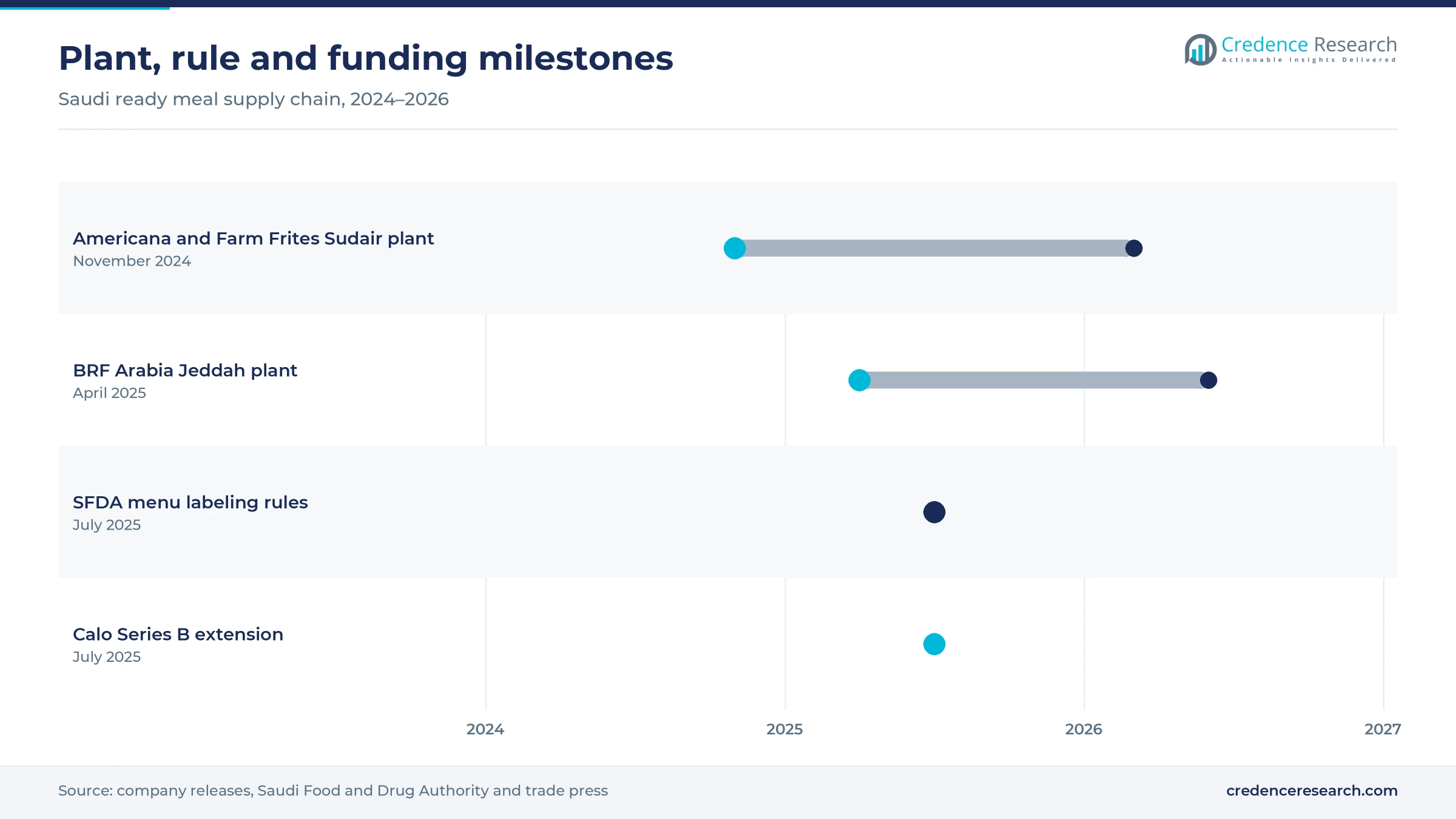
Global food groups are moving prepared-food production into the Kingdom, which brings frozen ranges closer to Saudi shoppers and cuts import lead times. BRF and HPDC, a Public Investment Fund company, began building a USD 160 million processed food plant in Jeddah in April 2025, with 40,000 tons of yearly capacity due by mid-2026, according to Mubasher. Nestlé signed for its first Saudi plant on Sept. 15, 2024, a SAR 270 million site in Jeddah Third Industrial City, as reported by Arab News. Local plants also let processors tailor halal frozen ranges to Saudi tastes, which gives red meat and poultry suppliers new industrial buyers.
Rise of nutrition labeling on menus and delivery apps
Health rules are pushing prepared-food sellers to show what is in each meal, which favors brands that can reformulate for lower salt. The Saudi Food and Drug Authority required food establishments and online ordering platforms to show a saltshaker icon beside high-sodium meals from July 1, 2025. The same rules require the time needed to burn off each meal's calories on printed and digital menus. Kraft Heinz launched Heinz products with 50% less sugar and salt for the region at Gulfood in January 2026, according to Food Business Middle East. Chilled meal makers that list full ingredients fit these rules best, which favors chilled brands that already publish nutrition data.
Can Ramadan and Eid packs become a high-value opening?
Ramadan concentrates grocery spending into a few weeks, which opens room for family-size frozen trays, iftar sides and ready sahoor meals. Point-of-sale food and beverage sales reached SAR 9.2 billion in Ramadan 2025, up 19.5% from the previous Ramadan, while restaurant and cafe sales fell 3.1%, according to Argaam. In the week before Ramadan 2025, food and beverage spending jumped 74.9% to SAR 3.3 billion, based on Saudi Central Bank data reported by Arab News. Al Kabeer and Americana already sell samosas, spring rolls and kebabs that families stock for iftar. Brands that book hypermarket promotion slots well before Ramadan can lift annual volume with a single season.
Is subscription meal delivery an opening for chilled brands?
Meal-plan subscriptions turn ready meals into a recurring purchase, which gives chilled brands predictable volume and higher prices per portion. Calo raised a USD 39 million Series B extension in July 2025, bringing the round to USD 64 million, and plans a Saudi listing by 2027, according to Enterprise. Siwar Foods already sells single portions through Chef in a Box vending machines in offices. Calo delivered more than 10 million meals across the region in 2024, and single office workers already order much of their lunch through apps. Brands that pair central kitchens with corporate contracts and app subscriptions can build demand outside the supermarket shelf.
Safety checks, import costs and listing fees test brands
Why do food safety inspections weigh on frozen meal plants?
Food safety enforcement has tightened, so frozen meal plants face higher compliance costs and the risk of sudden stoppages. In July 2025, the Saudi Food and Drug Authority closed a factory making ready-to-serve frozen foods and seized its products, and it stopped 11 production lines at dairy and frozen pastry plants, according to Khaleej Times. Smaller producers feel this most, because one closure can remove a brand from shelves for weeks. Investment in cold-chain monitoring and hazard controls is the main mitigation.
How do import and freight costs squeeze ready meal margins?
Many ingredients and finished meals still arrive by sea, so freight and supplier price moves feed directly into shelf prices. USDA FAS puts imports of consumer-oriented food products at USD 17.4 billion in 2025, up 6% from 2024, and reports rising freight and insurance costs. Brands that import finished lasagnas, pizzas and pasta meals pay these costs twice, on raw materials and on frozen shipping space. Local co-packing and regional sourcing of meat and vegetables reduce this exposure for larger players.
Why do listing fees and chain concentration limit new brands?
A handful of chains decide which ready meals reach most shoppers, which raises the cost of entry for new brands. USDA FAS notes that markups and listing fees significantly raise the cost of launching new products, while Al Othaim alone runs 412 branches and Panda 213, according to an Argaam survey from early 2026. Small Saudi brands therefore start online or in specialty stores before they can afford hypermarket freezer space. Direct-to-consumer apps and vending formats offer a cheaper route, although they reach fewer households at first.
How does restaurant delivery compete with packaged meals?
Restaurant delivery competes directly with packaged ready meals for the same weekday dinner, and Saudi households still spend heavily on eating out. In the week ending Sept. 6, 2025, point-of-sale spending at restaurants and cafes reached SAR 1.67 billion, against SAR 2.26 billion for food and beverages, based on Saudi Central Bank data reported by Arab News. Aggregators also run frequent discounts, which narrows the price gap with frozen meals. Packaged brands respond with larger portions, local recipes and lower prices per serving.
Riyadh is the largest single region and grows fastest
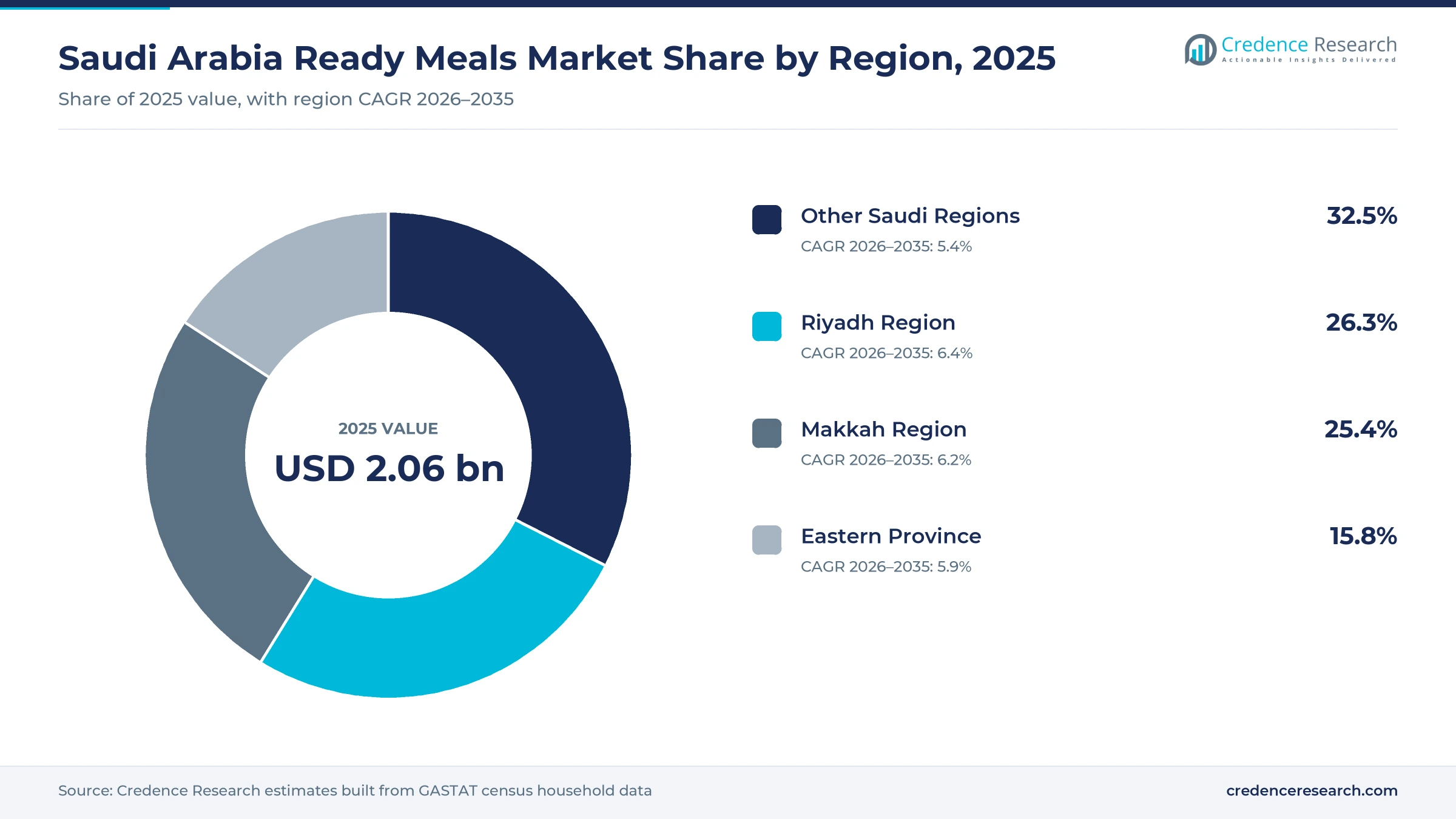
The Saudi Arabia ready meals market is split into four zones that follow household counts, retail coverage and pilgrim and tourist flows. Zone shares and growth rates are Credence Research estimates built from census household data and Ministry of Commerce e-commerce registrations.
| Region | Value, 2025 (USD billion) | Share, 2025 | CAGR, 2026–2035 |
|---|---|---|---|
| Other Saudi Regions | 0.67 | 32.5% | 5.4% |
| Riyadh Region | 0.54 | 26.3% | 6.4% |
| Makkah Region | 0.52 | 25.4% | 6.2% |
| Eastern Province | 0.32 | 15.8% | 5.9% |
Why does Riyadh region lead on households and online stores?
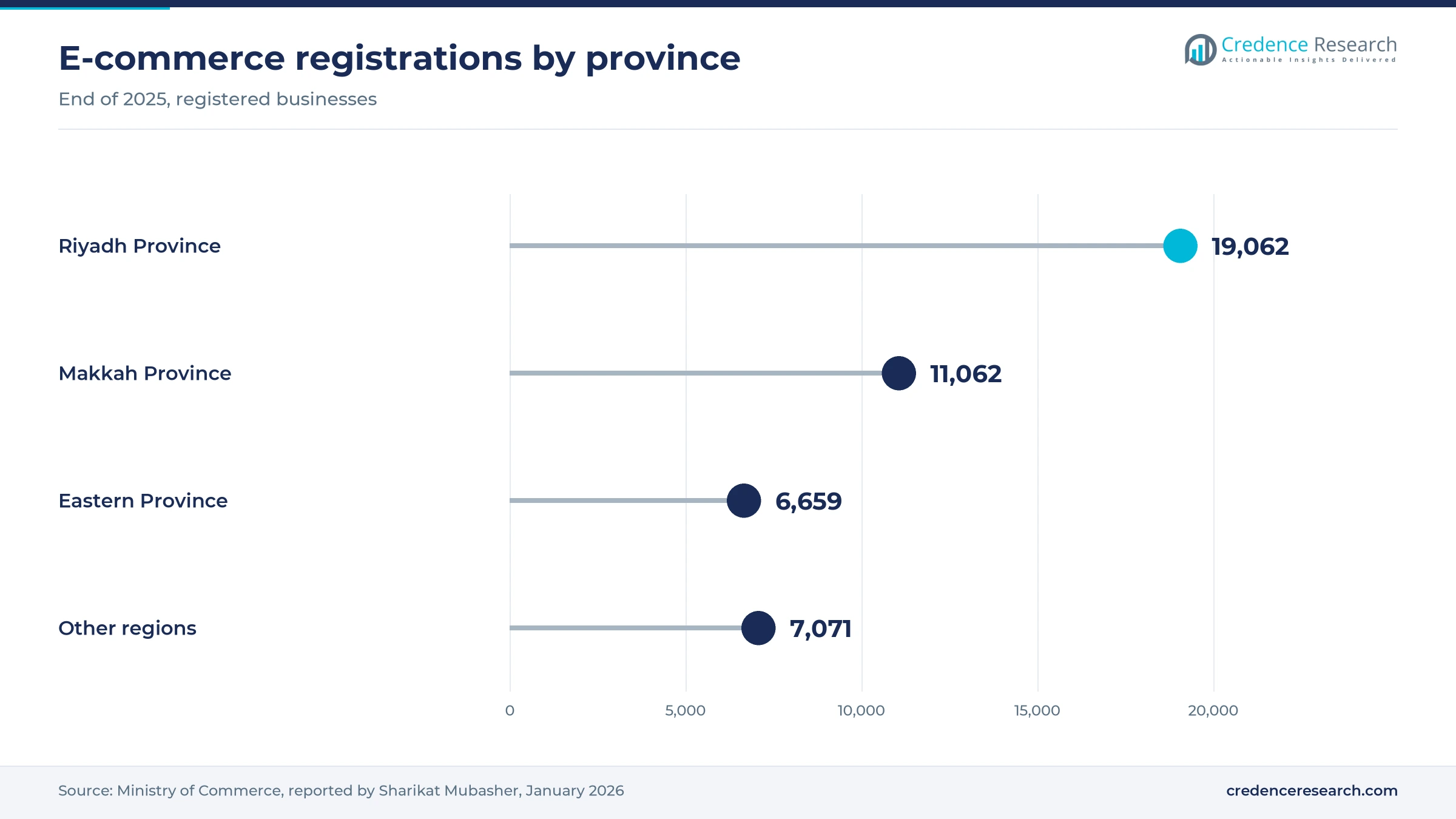
Riyadh Region held 26.3% of 2025 value and grows fastest at 6.4% a year, because the capital has the most households and the densest online retail base. The 2022 census counted about 2.27 million households in Riyadh, the highest of any region, according to GASTAT figures reported by Argaam. Riyadh also had 19,062 registered e-commerce businesses at the end of 2025, more than any other province. Calo is headquartered in the capital, which places subscription meal capacity close to the largest base of office workers.
How do pilgrims and Jeddah plants shape Makkah region?
Makkah Region held 25.4% of 2025 value and grows at 6.2% a year, as Jeddah hosts many food plants and pilgrims add seasonal demand. Hajj drew 1.67 million pilgrims in 2025, of whom 1.51 million came from abroad, according to GASTAT figures reported by Argaam. The region had about 2.13 million households in the 2022 census and 11,062 registered e-commerce businesses at the end of 2025. BRF is building its new processed food plant in Jeddah, and Halwani Brothers makes frozen and ready-made foods in the city.
Why does Eastern Province favor frozen and canned meals?
Eastern Province held 15.8% of 2025 value and grows at 5.9% a year, close to the national pace. The 2022 census counted about 1.35 million households in the province, and it had 6,659 registered e-commerce businesses at the end of 2025, the third-highest total. Non-Saudi residents made up about half of those households, according to the same census tables. Workers in shared housing often rely on canned beans, instant noodles and frozen meals that need only a microwave, and this favors ambient and dried formats in the province.
How do smaller regions add volume from a lower base?
The ten smaller regions, grouped as Other Saudi Regions, held 32.5% of 2025 value and grow at 5.4% a year, the slowest pace, because modern retail and delivery coverage is thinner outside the three main regions. Riyadh, Makkah and the Eastern Province together held 68% of the population in the 2022 census, so the remaining regions hold about one-third of residents. These regions had about 7,070 registered e-commerce businesses at the end of 2025, fewer than Makkah alone. National chains such as Othaim and Panda carry most ready meals into these markets.
Plant investments, labeling rules and funding, 2024–2026
| Development | Status and market relevance |
|---|---|
| In November 2024, Americana and Farm Frites announced a USD 100 million frozen potato plant in Sudair Industrial City near Riyadh. | Initial capacity of 70,000 tons a year |
| In April 2025, BRF and HPDC began building a USD 160 million processed food plant in Jeddah. | Operations planned for mid-2026 |
| In June 2025, the Saudi Food and Drug Authority issued menu labeling rules for food outlets and delivery platforms. | Rules in force from July 1, 2025 |
| In July 2025, Calo closed a USD 39 million Series B extension led by Aljazira Capital. | Funds expansion, with a Saudi listing planned by 2027 |
Freezing, retort and cold-chain delivery shape supply
- Individual quick freezing locks in texture for samosas, kebabs and pasta trays, which lets plants build stock ahead of Ramadan peaks.
- Retort processing sterilizes beans, foul medames and curries in cans or retort pouches, which keeps them safe without refrigeration.
- Modified atmosphere packaging extends the shelf life of chilled meals, which lets subscription kitchens deliver several days of food at once.
- Microwaveable tray design lets frozen and chilled meals heat evenly in a few minutes, which suits office and dormitory kitchens.
- App-based cold-chain delivery keeps frozen and chilled orders at safe temperatures from dark stores to homes, so online grocery orders arrive in good condition.
Need a Custom Version of This Report?
Tailor the scope, geography, or segments to your exact requirements.
- Custom geography or segment scope
- Direct access to our analyst team
Freezer space and halal recipes decide the ranking
Competition in the Saudi ready meals market turns on freezer space, halal sourcing, recipe fit and price per portion. Al Kabeer Group, majority-owned by Savola since the fourth quarter of 2018, offers more than 200 frozen products, including ready-to-eat meals, according to Savola. Americana Foods and BRF, part of MBRF Global Foods Company since its September 2025 merger with Marfrig, compete through brands such as Sadia in breaded chicken, kebabs and other frozen food lines, and both are adding Saudi capacity. Halwani Brothers, a listed Jeddah producer, and GoodyCo compete with local recipes, frozen dishes and canned beans. Pinehill Arabia Food makes Indomie noodles in the Kingdom, and Nestlé sells Maggi instant products. Siwar Foods and Calo lead the newer frozen and chilled meal brands that sell through apps, offices and subscriptions. Kraft Heinz brings Heinz canned beans and sauces to the ambient aisle of the large chains.
Multinationals, Gulf frozen groups and startups split supply
Supply in the Saudi ready meals market is organized in three layers. Multinationals such as Nestlé, Kraft Heinz and BRF supply instant, canned and frozen processed lines from global brands, increasingly from Saudi plants. Gulf frozen-food groups such as Al Kabeer and Americana Foods hold wide freezer ranges in hypermarkets. Local brands such as Halwani Brothers, GoodyCo and Siwar Foods compete on Saudi recipes, while Calo leads chilled meal subscriptions. Entry is easiest online, but cold-chain logistics, halal certification and listing fees protect incumbents, so margins sit with the brands that own freezer space and trusted recipes.
Companies profiled and their roles in this market
| Company | Type | Role in the market |
|---|---|---|
| Americana Foods | Gulf frozen food group | Frozen chicken, kebabs and appetizers, plus a Sudair potato plant with Farm Frites |
| Al Kabeer Group (Savola) | Frozen food specialist | More than 200 frozen products, including ready-to-eat meals and samosas |
| BRF (MBRF Global Foods Company) | Multinational processor | Sadia frozen lines and a Jeddah processed food plant with HPDC |
| Nestlé Saudi Arabia LLC | Multinational | Maggi instant noodles and soups, plus a first Saudi plant in Jeddah |
| Pinehill Arabia Food Limited | Local manufacturer | Makes Indomie instant noodles in Saudi Arabia |
| Halwani Brothers | Listed local manufacturer | Jeddah producer of frozen and ready-made foods and meat products |
| GoodyCo | Local brand owner | Goody canned beans, fava beans and other ambient foods |
| Siwar Foods | Local ready meal brand | Frozen meals sold in retail, through its app and office vending machines |
| Calo | Meal subscription provider | Riyadh-based chilled meal plans delivered across Gulf markets |
| The Kraft Heinz Company | Multinational | Heinz canned beans and sauces for the ambient aisle |
Chilled and online formats will gain share fastest
Credence Research's view is that the Saudi Arabia ready meals market will grow faster than total food retail, because female employment, a young expatriate workforce and tourism all raise the number of meals eaten without home cooking. Frozen meals keep the largest share, while chilled subscriptions and online grocery orders gain from small bases. Riyadh Region should stay both the largest single region and the fastest-growing zone. The brands that win will combine Saudi-made halal recipes, freezer space in the large chains and app listings, while keeping import costs and food safety risk under control.
Census, retail and payment data anchor the model
The report uses 2025 as the base year on a calendar basis, and market values come from the Credence Research model. That model combines GASTAT census and labor statistics, USDA Foreign Agricultural Service retail reports, Saudi Central Bank point-of-sale data, Ministry of Commerce registration data, retailer shelf prices and company announcements. Segment splits, zone shares and zone growth rates are Credence Research estimates built from household counts and retail coverage. Sources used are government statistics, international agencies, trade press, retailer listings and company releases, and no interviews or surveys were used.
Working households and tourism carry growth to 2035
Ready meal sales in Saudi Arabia are expected to reach USD 3.70 billion by 2035, a 5.98% CAGR during 2026–2035, as more women join the workforce, chain stores and delivery apps widen freezer ranges, and tourists and pilgrims add demand for quick halal food. Chilled meals and online grocery orders should gain share fastest, while frozen meals remain the largest format. Riyadh Region keeps its lead among single regions as office and residential districts expand. Growth would slow if restaurant delivery became much cheaper or freight costs rose sharply, while faster local production would lift the forecast toward the upside case.
Female employment and app adoption set the range of outcomes
In the base case, sales grow from the 2026 value along the central forecast as female employment, tourism and online grocery keep their recent pace. The downside case assumes weaker hiring of women, cheaper restaurant delivery and higher freight costs that lift shelf prices. The upside case adds faster local production, wider app coverage outside the three main regions and strong growth in chilled meal subscriptions.
| Scenario | CAGR, 2026–2035 | Value, 2035 | What has to hold |
|---|---|---|---|
| Downside | 4.5% | USD 3.25 billion | Female hiring slows, restaurant delivery gets cheaper and freight costs push shelf prices up |
| Base | 5.98% | USD 3.70 billion | Female employment, tourism and online grocery keep their recent pace |
| Upside | 7.4% | USD 4.16 billion | Local plants scale up and apps and meal plans spread beyond the three main regions |
Frequently Asked Questions
How big is the Saudi Arabia ready meals market?
Which product type leads Saudi ready meal sales?
Which single region holds the largest share?
What drives demand for ready meals in the Kingdom?
How fast are online grocery platforms growing?
How does Ramadan affect ready meal sales?
Who are the main companies in this market?
What are the main challenges for ready meal brands?
Table of Content
Chapter 1 Market Segmentation
- 1.1 Segmentation Framework
- 1.1.1 Product and Service Classification
- 1.1.2 Application and End-Use Classification
- 1.1.3 Technology and Solution Classification
- 1.1.4 Customer and Distribution Channel Classification
- 1.1.5 Geographic Segmentation
- 1.1.6 Market Segment Definitions and Boundaries
- 1.2 By Product Type
- 1.2.1 Frozen Ready Meals
- 1.2.2 Chilled Ready Meals
- 1.2.3 Ambient Shelf-Stable Meals
- 1.2.4 Dried and Instant Meals
- 1.3 By Customer Type
- 1.3.1 Single Professionals
- 1.3.2 Dual-Income Households
- 1.3.3 Families with Children
- 1.3.4 Students and Young Adults
- 1.4 By Purchase Occasion
- 1.4.1 Weekday Lunch and Dinner
- 1.4.2 On-the-Go Consumption
- 1.4.3 Ramadan and Eid Convenience
- 1.4.4 Social and Family Gatherings
Chapter 2 Introduction
- 2.1 Report Objectives and Scope
- 2.2 Product Definition and Industry Terminology
- 2.3 Market Inclusions and Exclusions
- 2.4 Research Process
- 2.4.1 Primary Research and Expert Interviews
- 2.4.2 Secondary Research and Source Review
- 2.4.3 Top-Down and Bottom-Up Estimation
- 2.4.4 Data Triangulation and Verification
- 2.5 Market Size Measurement Basis
- 2.5.1 2025: USD 2.06 billion → 2035: USD 3.70 billion
- 2.6 Historical and Forecast Reference Periods
- 2.6.1 Historical Period: 2018-2025
- 2.6.2 Base Year: 2025
- 2.6.3 Forecast Period: 2025-2035
- 2.7 Research Assumptions and Limitations
Chapter 3 Executive Summary
- 3.1 Market Snapshot and Key Findings
- 3.2 Base-Year Market Size, 2025
- 3.3 Forecast Market Size, 2035
- 3.4 Revenue and Volume Growth Outlook
- 3.5 Key Demand and Supply Indicators
- 3.6 Leading Market Segments
- 3.7 Fastest-Growing Market Opportunities
- 3.8 Regional Performance Highlights
- 3.9 Technology and Industry Transformation
- 3.10 Competitive Landscape Summary
- 3.11 Analyst View and Strategic Implications
Chapter 4 Saudi Arabia Ready Meals Market Trends and Developments
- 4.1 Historical Industry Development, 2018-2025
- 4.2 Recent Market Trends and Developments
- 4.3 Demand and Customer Behavior Trends
- 4.4 Technology and Product Innovation
- 4.5 Artificial Intelligence, Automation and Digitalization
- 4.6 Local Manufacturing and Supply Chain Realignment
- 4.7 Industry Partnerships, Mergers and Acquisitions
- 4.8 Sustainability and Circular Economy Developments
- 4.9 Government and Private Sector Investment Trends
- 4.10 Emerging Business Models and Commercialization
- 4.11 Industry Developments and Announcements
Chapter 5 Saudi Arabia Ready Meals Market Production, Supply and Demand Analysis
- 5.1 Demand Trend and Consumption Analysis, 2018-2025
- 5.2 Demand Forecast, 2025-2035
- 5.3 Production and Output Trend, 2018-2025
- 5.4 Production and Output Forecast, 2025-2035
- 5.5 Installed Capacity and Capacity Utilization
- 5.6 Company-Wise Production Plants and Statistics
- 5.6.1 Installed Production Capacity
- 5.6.2 Actual Production
- 5.6.3 Planned Capacity and Expansion Targets
- 5.7 Supply Chain Structure and Procurement Trends
- 5.8 Supply-Demand Gap and Bottlenecks
- 5.9 Import Dependence and Sourcing Structure
- 5.10 Contract Manufacturing and Outsourcing
- 5.11 Regional Supply and Demand Concentration
Chapter 6 Saudi Arabia Ready Meals Market Pricing Analysis
- 6.1 Pricing Structure and Measurement
- 6.2 Historical Pricing Trends, 2018-2025
- 6.3 Pricing Outlook, 2025-2035
- 6.4 Average Selling Price and Unit Economics
- 6.5 Pricing by Product and Market Segment
- 6.6 Geographic Pricing Differences
- 6.7 Key Input, Energy, Labor and Logistics Costs
- 6.8 Contract Pricing and Purchasing Models
- 6.9 Pricing Sensitivity and Competitive Positioning
- 6.10 Price, Margin and Profitability Implications
Chapter 7 Saudi Arabia Ready Meals Market Dynamics
- 7.1 Market Growth Drivers
- 7.1.1 Demand-Side Drivers
- 7.1.2 Technology and Innovation Drivers
- 7.1.3 Infrastructure and Investment Drivers
- 7.1.4 Regulatory and Policy Drivers
- 7.2 Market Restraints
- 7.2.1 Cost and Affordability Constraints
- 7.2.2 Technology and Adoption Barriers
- 7.2.3 Supply Chain and Operational Constraints
- 7.3 Market Challenges
- 7.3.1 Competitive Pressure and Margin Erosion
- 7.3.2 Skills, Infrastructure and Implementation Gaps
- 7.4 Emerging Market Opportunities
- 7.5 Market Dynamics Impact and Time-Horizon Assessment
Chapter 8 Saudi Arabia Ready Meals Value Chain Analysis
- 8.1 Industry Value Chain Overview
- 8.2 Upstream Suppliers and Critical Inputs
- 8.3 Technology and Component Providers
- 8.4 Manufacturing or Service Delivery
- 8.5 Distribution, Channel Partners and Integrators
- 8.6 Downstream Applications and End Users
- 8.7 Value Addition and Profit Pools
- 8.8 Vertical Integration and Outsourcing
- 8.9 Supplier Concentration and Risk
- 8.10 Supply Chain Localization and Resilience
Chapter 9 Saudi Arabia Ready Meals Market Regulations and Policies
- 9.1 Relevant Laws, Standards and Compliance Frameworks
- 9.2 Product, Service, Safety and Quality Requirements
- 9.3 Government Policies, Incentives and Subsidies
- 9.4 Imports, Exports and Trade Barriers
- 9.5 Public Procurement and Local Content Requirements
- 9.6 Environmental and Sustainability Compliance
- 9.7 Upcoming Policy Changes and Market Implications
Chapter 10 Saudi Arabia Ready Meals Market Hotspots and Opportunities
- 10.1 Market Opportunity Mapping and Growth Hotspots
- 10.2 High-Growth Applications and Customer Groups
- 10.3 Underserved Markets and White-Space Opportunities
- 10.4 Emerging Technology and Product Opportunities
- 10.5 New Capacity and Investment Hotspots
- 10.6 Market Entry and Expansion Opportunities
- 10.7 Distribution and Partnership Opportunities
- 10.8 Near-Term and Long-Term Commercial Potential
- 10.9 Opportunity Attractiveness and Execution Risks
Chapter 11 Saudi Arabia Ready Meals Market Outlook, 2025-2035
- 11.1 Market Size and Analysis
- 11.1.1 Revenue (Market Measurement: 2025: USD 2.06 billion → 2035: USD 3.70 billion)
- 11.1.2 Market Volume and Quantity Sold
- 11.1.3 Historical Market Size, 2018-2025
- 11.1.4 Base-Year Market Size, 2025
- 11.2 Market Forecast, 2025-2035
- 11.2.1 Revenue Forecast to 2035
- 11.2.2 Volume Forecast to 2035
- 11.2.3 CAGR and Year-on-Year Growth
- 11.2.4 Incremental Revenue Opportunity
- 11.3 Forecast Assumptions and Scenario Analysis
- 11.3.1 Base-Case Forecast
- 11.3.2 Optimistic and Conservative Scenarios
- 11.3.3 Technology, Pricing and Policy Sensitivities
- 11.4 Market Attractiveness and Growth Outlook
Chapter 12 Saudi Arabia Ready Meals Market Segmentation and Outlook
- 12.1 Segmentation Summary and Market Shares, 2025
- 12.2 Largest and Fastest-Growing Segments
- 12.3 By Product Type - Market Size and Forecast, 2025-2035
- 12.3.1 Segment Definition and Scope
- 12.3.2 Historical Market Size, 2018-2025
- 12.3.3 Revenue Forecast, 2025-2035
- 12.3.4 Volume Forecast, 2025-2035
- 12.3.5 Base-Year Market Share, 2025
- 12.3.6 Segment CAGR and Growth Drivers
- 12.3.7 Subsegment Market Size and Forecast
- 12.3.7.1 Frozen Ready Meals
- 12.3.7.2 Chilled Ready Meals
- 12.3.7.3 Ambient Shelf-Stable Meals
- 12.3.7.4 Dried and Instant Meals
- 12.3.8 Subsegment Pricing and Adoption Trends
- 12.3.9 Leading Suppliers and Competition
- 12.3.10 Regional Demand and Opportunities
- 12.4 By Customer Type - Market Size and Forecast, 2025-2035
- 12.4.1 Segment Definition and Scope
- 12.4.2 Historical Market Size, 2018-2025
- 12.4.3 Revenue Forecast, 2025-2035
- 12.4.4 Volume Forecast, 2025-2035
- 12.4.5 Base-Year Market Share, 2025
- 12.4.6 Segment CAGR and Growth Drivers
- 12.4.7 Subsegment Market Size and Forecast
- 12.4.7.1 Single Professionals
- 12.4.7.2 Dual-Income Households
- 12.4.7.3 Families with Children
- 12.4.7.4 Students and Young Adults
- 12.4.8 Subsegment Pricing and Adoption Trends
- 12.4.9 Leading Suppliers and Competition
- 12.4.10 Regional Demand and Opportunities
- 12.5 By Purchase Occasion - Market Size and Forecast, 2025-2035
- 12.5.1 Segment Definition and Scope
- 12.5.2 Historical Market Size, 2018-2025
- 12.5.3 Revenue Forecast, 2025-2035
- 12.5.4 Volume Forecast, 2025-2035
- 12.5.5 Base-Year Market Share, 2025
- 12.5.6 Segment CAGR and Growth Drivers
- 12.5.7 Subsegment Market Size and Forecast
- 12.5.7.1 Weekday Lunch and Dinner
- 12.5.7.2 On-the-Go Consumption
- 12.5.7.3 Ramadan and Eid Convenience
- 12.5.7.4 Social and Family Gatherings
- 12.5.8 Subsegment Pricing and Adoption Trends
- 12.5.9 Leading Suppliers and Competition
- 12.5.10 Regional Demand and Opportunities
- 12.6 Segment Growth Comparison
- 12.7 Segment Attractiveness and Priority Matrix
Chapter 13 Saudi Arabia Ready Meals End-Use and Application Market Outlook
- 13.1 End-Use Industry and Customer Demand Structure
- 13.2 Leading Applications and Customer Groups
- 13.3 End-Use Market Size, Share and Forecast
- 13.4 Major End-Use Industry Deep Dives
- 13.4.1 Customer Requirements and Use Cases
- 13.4.2 Demand and Replacement Cycles
- 13.4.3 Technical and Regulatory Considerations
- 13.4.4 Purchasing and Procurement Models
- 13.4.5 Leading Vendors and Distribution Channels
- 13.4.6 Forecast and Commercial Opportunities
- 13.5 Emerging Applications and Cross-Segment Demand
- 13.6 End-Use Industry Investment Priorities
Chapter 14 Saudi Arabia Ready Meals Geographic Market Outlook, 2025-2035
- 14.1 Domestic Market Distribution and Demand Clusters
- 14.2 State- or Province-Wise Market Size and Forecast, 2025-2035
- 14.3 City and Metropolitan Market Outlook
- 14.4 Industrial, Manufacturing and Commercial Clusters
- 14.5 Geographic Concentration of Key End Users
- 14.6 Local Pricing and Purchasing Differences
- 14.7 Domestic Production Facilities and Capacity Map
- 14.8 Local Infrastructure and Project Pipeline
- 14.9 State-Level Policy and Incentive Differences
- 14.10 Subnational Investment Hotspots and Opportunities
- 14.11 Distribution and Logistics Networks
- 14.12 Domestic Competitive Footprint
Chapter 15 Saudi Arabia Ready Meals Technology, Innovation and Sustainability Outlook
- 15.1 Technology Landscape and Maturity
- 15.2 Product, Process and Service Innovation
- 15.3 AI, Automation and Digital Tools in the Industry
- 15.4 Technology Adoption and Performance Benchmarking
- 15.5 Innovation Pipeline and R&D Investment
- 15.6 Patent and Intellectual Property Trends
- 15.7 Energy Efficiency and Resource Management
- 15.8 Sustainability, Recycling and Circularity
- 15.9 Technology Roadmap, 2025-2035
- 15.10 Risks of Obsolescence and Technology Substitution
Chapter 16 Saudi Arabia Ready Meals Market Key Strategic Imperatives
- 16.1 Growth and Market Entry Priorities
- 16.2 High-Return Products and Segments
- 16.3 Pricing, Profitability and Cost Optimization
- 16.4 Technology Investment and Product Differentiation
- 16.5 Supply Chain Localization and Resilience
- 16.6 Distribution and Customer Acquisition
- 16.7 Partnership, Acquisition and Capacity Strategy
- 16.8 Regional Expansion Priorities
- 16.9 Short-, Medium- and Long-Term Actions
Chapter 17 Competition Outlook
- 17.1 Industry Competition Characteristics
- 17.2 Market Structure and Concentration
- 17.3 Market Share and Competitive Positioning, 2025
- 17.4 Company-Wise Revenue and Product Benchmarking
- 17.5 Production and Service Capacity Benchmarking
- 17.6 Technology, Pricing and Differentiation
- 17.7 Regional Footprint and Distribution Strength
- 17.8 Mergers, Acquisitions and Strategic Alliances
- 17.9 New Entrants and Competitive Threats
- 17.10 Porter's Five Forces and Industry Attractiveness
- 17.11 Competitive Outlook, 2025-2035
Chapter 18 Company Profiles
- 18.1 Company Coverage and Selection Criteria
- 18.2 Americana Foods
- 18.2.1 Business Description
- 18.2.2 Company Ownership and Geographic Presence
- 18.2.3 Product and Service Portfolio
- 18.2.4 Manufacturing and Operating Footprint
- 18.2.5 Production Capacity and Expansion Plans
- 18.2.6 Financial Performance and Investment
- 18.2.7 Market Share and Competitive Position
- 18.2.8 Technology and Innovation Capabilities
- 18.2.9 Strategic Alliances or Partnerships
- 18.2.10 Recent Developments
- 18.2.11 Growth Strategy and Outlook
- 18.3 Al Kabeer Group (Savola)
- 18.4 BRF (MBRF Global Foods Company)
- 18.5 Nestlé Saudi Arabia LLC
- 18.6 Pinehill Arabia Food Limited
- 18.7 Halwani Brothers
- 18.8 GoodyCo
- 18.9 Siwar Foods
- 18.10 Calo
- 18.11 The Kraft Heinz Company
- 18.12 Other Relevant Market Participants
Note: Every listed company is profiled on the structure shown under the first company. The company list is preliminary and may change based on research findings, market developments, data availability and client requirements.
Chapter 19 Disclaimer
- 19.1 Research and Forecast Disclaimer
- 19.2 Data Source and Estimation Limitations
Note: The depth of individual sections depends on data availability for this market. Volume, capacity, trade and other unit-based metrics are included where applicable.