
Market Overview:
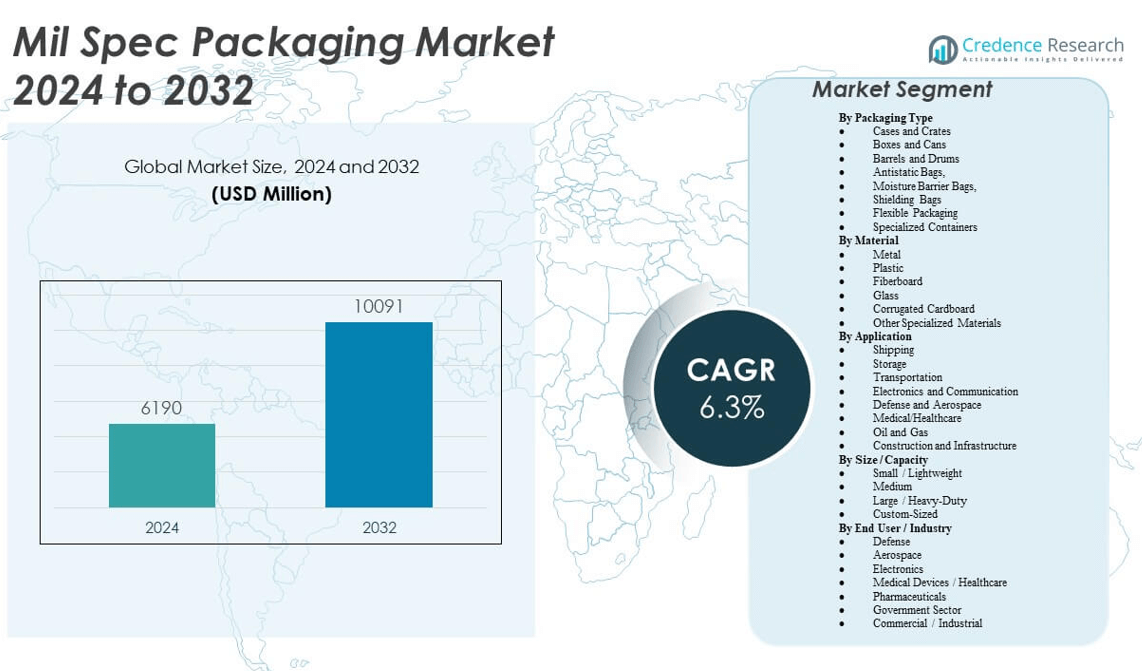
The Mil Spec Packaging Market is projected to grow from USD 6,190 million in 2024 to an estimated USD 10,091 million by 2032, with a compound annual growth rate (CAGR) of 6.3% from 2024 to 2032.
| REPORT ATTRIBUTE | DETAILS |
|---|---|
| Historical Period | 2020-2023 |
| Base Year | 2024 |
| Forecast Period | 2025-2032 |
| Mil Spec Packaging Market Size 2024 | USD 6,190 million |
| Mil Spec Packaging Market CAGR | 6.3% |
| Mil Spec Packaging Market Size 2032 | USD 10,091 million |
This market is driven by increasing global defense spending, heightened focus on safeguarding sensitive military equipment, and stringent regulatory standards for packaging durability and compliance. Military forces worldwide demand robust, moisture-resistant, and anti-corrosive packaging materials to ensure the safe transport and storage of mission-critical assets. The rising need for long-term storage solutions and secure logistics for defense electronics, ammunition, and medical supplies continues to elevate the adoption of Mil Spec packaging across land, air, and naval operations.
North America leads the Mil Spec Packaging Market, supported by strong defense investments in the United States and the presence of established military packaging manufacturers. Europe follows, with countries like Germany and the UK modernizing their defense logistics infrastructure. Meanwhile, Asia-Pacific is emerging as a fast-growing region due to increased defense procurement in China, India, and South Korea, driven by geopolitical tensions and efforts to enhance military readiness. The Middle East also shows steady growth, fueled by rising defense budgets in countries like Saudi Arabia and the UAE.
Market Insights:
- The Mil Spec Packaging Market is projected to grow from USD 6,190 million in 2024 to USD 10,091 million by 2032, at a CAGR of 6.3% during the forecast period.
- Rising global defense spending and increasing demand for durable, compliant packaging solutions continue to drive market growth.
- Growing complexity in military electronics and communication systems fuels the need for advanced antistatic and shielding packaging.
- High cost of specialized materials and compliance with stringent military packaging standards restrain adoption, especially among smaller vendors.
- North America leads the market due to strong defense logistics infrastructure and consistent military procurement in the United States.
- Asia-Pacific is the fastest-growing region, driven by expanding defense capabilities in China, India, and South Korea.
- Increasing use of RFID-enabled smart packaging and modular, reusable formats highlights the market’s shift toward digitized, efficient logistics.
Market Drivers:
Rising Global Defense Expenditure Drives Demand for Military-Grade Packaging
Countries across the globe continue to increase defense budgets, prioritizing modernization and equipment readiness. This shift directly supports the growth of the Mil Spec Packaging Market, where durable packaging ensures safe handling of sensitive military assets. Governments are procuring advanced weapons, surveillance systems, and electronics that require compliant packaging for transport and storage. Military-grade packaging solutions must meet stringent specifications such as moisture resistance, pressure resistance, and thermal insulation. It enables extended shelf life of critical components even in harsh environments. The market benefits from high military logistics activity in the U.S., NATO, and Asia-Pacific defense corridors. Frequent deployment of troops and equipment accelerates packaging demand across sea, land, and air channels. It reflects the vital role of packaging in operational efficiency and asset preservation.
Increased Focus on Lifecycle Management of Military Assets
Military logistics now prioritize asset sustainability and service lifecycle management. The Mil Spec Packaging Market supports this strategy by providing packaging solutions that enable equipment reuse and prevent degradation. Forces worldwide are implementing systems for repair, return, and refurbish models where packaging must ensure damage-free transit. It allows storage of critical spare parts for extended periods without performance loss. This trend aligns with the shift toward resource efficiency and cost control in defense logistics. Packaging acts as a protective interface that shields high-value gear from humidity, corrosion, and UV exposure. Standardized containers and reusable packaging formats gain popularity for logistics optimization. It helps align packaging processes with modern defense supply chain automation.
- For instance, Nefab Group supplies reusable ExPak and ShockWatch packaging solutions to global defense manufacturers, including support for long-term storage of avionics and control systems. Their wood-free collapsible packaging formats integrate humidity and tilt indicators, enabling extended lifecycle tracking and damage prevention during returns, maintenance, and multi-year warehousing in accordance with NATO codification practices.
Growing Complexity in Military Equipment and Electronics
Modern military operations deploy advanced electronics, sensors, and communication systems, demanding specialized packaging. The Mil Spec Packaging Market addresses the need for static-safe, shock-absorbing, and temperature-controlled packaging formats. Sensitive instruments like satellite components, radars, and night vision devices require high-grade packaging to prevent malfunctions. It supports customized foam inserts, tamper-proof seals, and vacuum-sealed pouches that preserve product integrity. Defense organizations mandate detailed documentation, traceability, and labeling protocols for each packaged unit. Packaging suppliers must innovate to meet changing specifications for electronics protection. It fosters development of hybrid material solutions like polymer-metal blends. The growing need to shield systems from electromagnetic interference (EMI) reinforces market demand.
Rising Deployment in Unpredictable Environments
Military operations in extreme and unpredictable terrains continue to grow, from deserts to the Arctic. The Mil Spec Packaging Market supports such deployments by offering robust solutions resistant to environmental stress. It includes water-proof, pressure-proof, and sand-resistant packaging formats critical to preserving operational equipment. Defense teams require reliable packaging that performs without failure during long-haul airlifts or naval missions. It contributes to mission success by eliminating equipment damage risks during transit. Suppliers are aligning product innovations with battlefield deployment protocols. The push for lightweight yet durable materials is intensifying due to mobility concerns. This dynamic field environment drives packaging specifications for enhanced ruggedness and adaptability.
- For instance, Pelican‑Hardigg manufactures robust roto-molded cases used extensively by military and government clients. These cases are engineered to meet MIL‑STD‑810 (including G-level protocols)-covering environmental stress tests such as sand and dust, water immersion, altitude, and impact resistance. They are made from polyethylene resins and temperature-tested in Pelican’s chambers over ranges from at least –55 °C to +70 °C, as published in their certifications documentation, ensuring protective performance in extreme climates.
Market Trends
Shift Toward Sustainable and Reusable Military Packaging Solutions
Defense organizations are emphasizing sustainable packaging practices without compromising performance. The Mil Spec Packaging Market reflects this trend through increased demand for recyclable and reusable materials. Manufacturers are developing ruggedized containers that support multiple deployment cycles. It helps reduce procurement costs and environmental impact. Biodegradable materials and recyclable polymers are gaining traction in non-combat supply chains. Governments are incorporating sustainability KPIs into military procurement frameworks. Packaging vendors must align with these green mandates while meeting durability standards. It enhances the market's alignment with broader ESG goals within the defense sector.
- For instance, TriEnda manufactures reusable pallets and bulk containers from thermoformed high-density polyethylene (HDPE), designed for long-term use in rugged supply chain environments. Their Tough Pallet series and BigPak® sleeve packs are engineered for durability and sustainability, offering collapsible designs that reduce return shipping volume and support circular logistics models across industrial and government sectors.
Integration of Smart Labels and RFID for Real-Time Asset Tracking
Digital transformation in defense logistics is boosting demand for smart packaging solutions. The Mil Spec Packaging Market is adopting technologies like RFID tagging, QR coding, and NFC sensors. It enables real-time tracking of high-value assets across global supply chains. Armed forces leverage these tools to monitor condition, tampering, and transit status of critical gear. Smart packaging enhances traceability, accountability, and operational coordination. Vendors are embedding data chips within containers to automate inventory updates. This integration supports mission-critical logistics and improves warehouse-to-battlefield transparency. The market benefits from government investment in smart supply chain technologies.
- For instance, Avery Dennison Smartrac’s UHF RFID inlays such as the AD‑232 series have been used extensively for item-level tracking in industries like retail, healthcare, and logistics. Their labels have demonstrated better than 99.5% read accuracy in high-volume distribution environments, such as warehouses handling mixed substrates including plastic and metal, enhancing traceability and inventory management.
Customization of Packaging for Mission-Specific Requirements
The need for tailored packaging solutions based on mission profiles is growing rapidly. The Mil Spec Packaging Market sees increased demand for modular designs that can adapt to specific cargo types. Packaging must meet payload size, deployment time, and handling protocol variations across missions. It supports custom foam inserts, variable wall thicknesses, and detachable compartments. Vendors are working closely with defense contractors to design packaging that integrates with larger logistics systems. This trend reduces packaging waste and enhances load optimization. The modular packaging approach aligns with rapid deployment logistics and evolving battlefield needs.
Adoption of Lightweight Composite Materials in Packaging Design
The push for operational agility is encouraging the use of lightweight packaging materials. The Mil Spec Packaging Market is shifting toward composites like carbon fiber blends, aluminum alloys, and advanced plastics. It helps reduce the overall logistical burden on transport fleets. Lightweight materials also contribute to fuel efficiency and improved soldier mobility during manual handling. Defense units prefer packaging that meets strength-to-weight benchmarks without sacrificing protection. This trend supports rapid air mobility operations where load weight is tightly regulated. The rise in drone-based supply delivery further accelerates the demand for ultra-light packaging formats.
Market Challenges Analysis
Compliance with Evolving Military Standards and Contract Protocols
The Mil Spec Packaging Market faces regulatory complexity due to varying standards across different defense organizations. Each country or agency mandates unique packaging formats, test procedures, and documentation norms. Vendors must align with MIL-STD protocols while adapting to NATO, DoD, and other regional military codes. It increases R&D and administrative overhead. Failing to meet audit-ready documentation or test certifications often disqualifies vendors from procurement programs. Rapidly evolving military technologies introduce new packaging compatibility challenges. It limits scalability and increases custom engineering costs. Smaller manufacturers struggle to meet evolving compliance requirements under tight defense timelines.
High Cost of Advanced Packaging Materials and Manufacturing Processes
Cost barriers continue to challenge the adoption of high-performance packaging materials. The Mil Spec Packaging Market requires corrosion-proof metals, anti-static polymers, and multi-layer insulation foils that raise unit costs. Complex fabrication processes such as thermoforming, injection molding, and vacuum sealing increase operational expenses. It limits cost-effectiveness for small-scale or short-term missions. Budget constraints in certain defense programs discourage adoption of premium packaging solutions. Achieving the balance between performance, durability, and affordability remains difficult. Vendors must navigate trade-offs between ruggedness and cost, particularly during competitive bidding for government tenders.
Market Opportunities
Rising Defense Modernization Programs in Emerging Economies
Emerging countries are expanding military infrastructure and procurement budgets. The Mil Spec Packaging Market is well-positioned to support this transition by offering compliant packaging for new defense assets. Countries like India, Brazil, and Indonesia are acquiring advanced surveillance systems, missile platforms, and protective gear. These products require specialized packaging for secure delivery and storage. Vendors can tap into partnerships with local defense OEMs and logistics firms. It offers opportunities for product localization and technology transfers. The growing geopolitical tensions and cross-border skirmishes in Asia-Pacific and Latin America further drive demand for mission-ready packaging formats.
Growth in Military Medical and Humanitarian Missions
Defense forces are increasingly involved in medical relief, disaster response, and peacekeeping missions. The Mil Spec Packaging Market can serve these operations by supplying sterile, temperature-controlled, and crush-resistant packaging. Medical devices, vaccines, and surgical kits require protection during airlifts or conflict-area deployment. The packaging must support sterile integrity and easy access in emergencies. It creates a demand for single-use, modular, and color-coded packaging systems. Humanitarian missions often involve multi-agency coordination, which increases the need for standardized and scalable packaging formats. Vendors that develop solutions for both combat and civil missions gain strategic growth potential.
Market Segmentation Analysis:
By Packaging Type
The Mil Spec Packaging Market features a diverse range of packaging types tailored to military and industrial requirements. Cases and crates dominate due to their high strength and ability to secure heavy or delicate equipment during transit. Boxes and cans are widely used for standard issue items and small components. Barrels and drums are preferred for bulk liquids and chemical storage. Flexible packaging, including pouches and liners, offers space efficiency and lightweight handling benefits. Specialized formats such as antistatic bags, moisture barrier bags, shielding bags, and custom containers serve critical roles in protecting sensitive electronics and mission-critical assets from environmental hazards.
By Material
Material selection in the Mil Spec Packaging Market plays a vital role in meeting performance and compliance standards. Metal and plastic packaging remain dominant for their ruggedness, impact resistance, and moisture control capabilities. Fiberboard and corrugated cardboard are commonly used in secondary and short-term applications. Glass is applied sparingly, primarily for secure chemical containment. Other specialized materials, including advanced barrier films and composite laminates, are gaining traction for their lightweight structure and enhanced protection against corrosion, static, and temperature fluctuations.
- For instance, several suppliers including MAC Packaging, Correct Products, and API Storage Bags manufacture heat-sealable MIL‑DTL‑117H Type I, Class E, Style I barrier bags, using MIL‑PRF‑131K multi‑layer laminates (film/foil/poly) that deliver moisture‑proof and grease‑proof protection. Some variants, like Class F Style I, are engineered with MIL‑PRF‑81705 Type I static/EMI shielding materials, providing both moisture vapor barrier and electrostatic shielding for storing electronics and precision devices in corrosive or humid conditions
By Application
Applications within the Mil Spec Packaging Market span several critical use cases, with defense and aerospace leading overall demand. Packaging designed for electronics and communication ensures protection from electromagnetic interference and mechanical shocks. Shipping, storage, and transportation remain essential applications, supporting operational readiness and efficient distribution. Medical and healthcare packaging ensures the sterility and integrity of sensitive supplies during field deployments. The market also supports oil and gas, construction, and infrastructure sectors, where rugged and certified packaging is required to meet harsh environmental conditions.
- For instance, ECS Composites provides Loadmaster® rackmount and transit cases used across military and aerospace sectors (including for communications infrastructure, servers, and tactical gear). Their products are constructed with composite materials and meet MIL‑STD‑810H environmental testing (covering shock, vibration, temperature extremes from –65 °F to +185 °F), and are designed to resist fuels, oils, and chemical decontamination offering rugged protection for critical electronics in deployment and storage environments.
By Size / Capacity
Packaging size and capacity segmentation is central to addressing a wide range of equipment dimensions and handling requirements. Small and lightweight packaging serves components and field kits where portability is essential. Medium-sized formats support modular systems and standard equipment. Large and heavy-duty packaging accommodates oversized machinery, weaponry, and sensitive electronics. Custom-sized packaging offers tailored solutions for irregular or uniquely dimensioned assets, supporting secure and compliant transportation under mission-specific conditions.
By End User / Industry
The defense sector is the largest end user of the Mil Spec Packaging Market, driven by global procurement, long-term storage needs, and active deployments. Aerospace follows closely, requiring high-precision packaging for avionics and mechanical systems. The electronics industry demands packaging that ensures safety against static and vibration. Medical devices and pharmaceuticals rely on sterile and protective packaging for field use. Government agencies and industrial sectors use military-grade packaging for infrastructure, public safety, and high-value asset management. It underlines the market’s role across both military and civilian operations.
Segmentation:
By Packaging Type
- Cases and Crates
- Boxes and Cans
- Barrels and Drums
- Antistatic Bags,
- Moisture Barrier Bags,
- Shielding Bags
- Flexible Packaging
- Specialized Containers
By Material
- Metal
- Plastic
- Fiberboard
- Glass
- Corrugated Cardboard
- Other Specialized Materials
By Application
- Shipping
- Storage
- Transportation
- Electronics and Communication
- Defense and Aerospace
- Medical/Healthcare
- Oil and Gas
- Construction and Infrastructure
By Size / Capacity
- Small / Lightweight
- Medium
- Large / Heavy-Duty
- Custom-Sized
By End User / Industry
- Defense
- Aerospace
- Electronics
- Medical Devices / Healthcare
- Pharmaceuticals
- Government Sector
- Commercial / Industrial
By Region
- North America
- U.S.
- Canada
- Mexico
- Europe
- Germany
- France
- U.K.
- Italy
- Spain
- Rest of Europe
- Asia Pacific
- China
- Japan
- India
- South Korea
- South-east Asia
- Rest of Asia Pacific
- Latin America
- Brazil
- Argentina
- Rest of Latin America
- Middle East & Africa
- GCC Countries
- South Africa
- Rest of the Middle East and Africa
Regional Analysis:
North America dominates the Mil Spec Packaging Market with a market share of 41%. The region benefits from extensive military spending, strong defense infrastructure, and a well-established network of packaging suppliers. The United States leads global defense procurement, which drives demand for advanced packaging solutions to support air, land, and naval operations. It consistently invests in modernizing logistics and maintaining long-term equipment readiness. Canada also contributes through defense support contracts and compliance with NATO packaging requirements. The presence of leading companies and high product standardization further strengthens regional leadership.
Europe holds the second-largest share in the Mil Spec Packaging Market, accounting for 28% of the global revenue. Countries such as Germany, the United Kingdom, and France are enhancing their defense logistics capabilities through increased procurement and modernization programs. It supports regional demand for compliant packaging to protect high-value systems such as drones, communication equipment, and ammunition. NATO’s standardization mandates and joint missions have increased packaging complexity, prompting suppliers to deliver solutions compatible across member states. The growth in Eastern Europe, particularly in Poland and the Baltics, is linked to heightened defense alertness and collaborative procurement.
The Asia-Pacific region captures 21% of the Mil Spec Packaging Market and is the fastest-growing segment. China, India, Japan, and South Korea are driving regional growth by expanding military operations and investing in modern equipment. It fuels demand for specialized packaging to support electronics, munitions, and sensitive instruments. Increased cross-border tensions and modernization of logistics in maritime and aerospace sectors push packaging innovations. Local manufacturers are aligning with global military standards to meet export requirements and defense procurement protocols. Southeast Asia is emerging as a new market due to rising defense partnerships and regional security strategies.
Key Player Analysis:
- Edco Supply Corporation
- Royco Packaging, Inc.
- Mil-Spec Packaging of Georgia
- Adsorbents & Desiccants Corporation of America
- Protective Packaging Corporation
- Accuspec Packaging Corporation
- Reid Packaging
- IMPAK Corporation
- MAC Packaging
- ProtoPak Engineering Corporation
Competitive Analysis:
The Mil Spec Packaging Market features a competitive landscape marked by specialized players focused on defense-grade packaging solutions. Key companies such as Edco Supply Corporation, Mil-Spec Packaging of Georgia, and Royco Packaging, Inc. hold significant positions due to their long-standing experience and adherence to military specifications. It is driven by innovation in moisture-barrier materials, corrosion protection, and smart tracking technologies. Companies compete by offering customized solutions aligned with MIL-STD protocols, rapid delivery schedules, and contract compliance. Strategic partnerships with defense agencies and OEMs help maintain competitive positioning. Smaller firms are entering the market by focusing on niche services like desiccant integration and RFID labeling. Continuous investment in manufacturing automation and compliance testing further intensifies competition across all tiers.
Market Concentration & Characteristics
The Mil Spec Packaging Market demonstrates moderate to high market concentration, with several established companies supplying to both domestic and international defense sectors. It is characterized by stringent regulatory compliance, long product validation cycles, and technical documentation requirements. Entry barriers remain high due to defense certification needs and contract-based procurement. The market favors suppliers with vertically integrated capabilities, in-house testing, and consistent quality assurance systems. Demand is primarily driven by long-term military contracts and government tenders. It supports innovation in packaging technologies tailored for shock resistance, moisture control, and EMI shielding. The market also exhibits a strong preference for suppliers offering rapid prototyping and mission-specific packaging formats.
Report Coverage:
The research report offers an in-depth analysis based on Packaging Type, Material, Application, Size, and End User Industry, It details leading market players, providing an overview of their business, product offerings, investments, revenue streams, and key applications. Additionally, the report includes insights into the competitive environment, SWOT analysis, current market trends, as well as the primary drivers and constraints. Furthermore, it discusses various factors that have driven market expansion in recent years. The report also explores market dynamics, regulatory scenarios, and technological advancements that are shaping the industry. It assesses the impact of external factors and global economic changes on market growth. Lastly, it provides strategic recommendations for new entrants and established companies to navigate the complexities of the market.
Future Outlook:
- Defense modernization efforts will continue to drive demand for advanced and compliant military packaging solutions across global procurement programs.
- Lifecycle asset management strategies will boost the need for long-term storage and reusable packaging systems to reduce operational costs.
- Integration of RFID tags, NFC chips, and smart sensors will improve asset traceability and condition monitoring throughout defense logistics chains.
- Lightweight, durable composite materials will gain traction to support increased mobility in land, air, and maritime operations.
- Expanding defense budgets in Asia-Pacific and the Middle East will open new opportunities for both regional and international packaging suppliers.
- Automation and precision manufacturing will become central to meeting military compliance, documentation, and volume requirements.
- Customized packaging for specialized systems like UAVs, military electronics, and field medical supplies will see significant growth.
- Sustainability goals and regulatory pressures will lead to innovation in recyclable, reusable, and low-impact military packaging formats.
- Long-term supplier partnerships with defense contractors will become essential for securing repeat contracts and driving product development.
- Rising geopolitical tensions and rapid deployments will increase demand for tamper-evident, impact-resistant, and weather-proof packaging systems.

Request a Free Sample
Fill in your details and we'll send you a free sample report.
- Sample data tables & charts
- Research methodology
Market Dynamics
Rising Global Defense Expenditure
Increasing defense budgets worldwide are fueling demand for military-grade packaging that ensures the safe transport and storage of sensitive equipment, weapons, and electronics. This trend is especially pronounced in the U.S., NATO countries, and Asia-Pacific, where modernization and readiness are top priorities.
Lifecycle Management and Asset Sustainability
Military logistics are increasingly focused on extending the service life of assets, requiring packaging that supports long-term storage, reuse, and protection from environmental degradation. This drives demand for durable, reusable, and standardized packaging solutions that align with modern defense supply chain strategies.
Complexity in Military Electronics and Equipment
The proliferation of advanced electronics, sensors, and communication systems in defense operations necessitates specialized packaging with antistatic, shock-absorbing, and EMI-shielding properties. This complexity drives innovation in packaging materials and formats to ensure mission-critical equipment remains operational.
Deployment in Extreme and Unpredictable Environments
Military operations often occur in harsh climates and terrains, increasing the need for packaging that is moisture-resistant, pressure-proof, and capable of withstanding temperature extremes. This requirement accelerates the adoption of robust, high-performance packaging solutions.
Shift Toward Smart and Sustainable Packaging
Defense agencies are integrating RFID, smart labels, and modular, reusable packaging to enhance asset tracking, logistics efficiency, and sustainability. These innovations are becoming essential as military supply chains digitize and environmental mandates become more stringent.
Need a Custom Version of This Report?
Tailor the scope, geography, or segments to your exact requirements.
- Custom geography or segment scope
- Direct access to our analyst team
Frequently Asked Questions
What is the current size of the Mil Spec Packaging Market?
What are the key segments within the Mil Spec Packaging Market?
What are some challenges faced by the Mil Spec Packaging Market?
Who are the major players in the Mil Spec Packaging Market?
Table of Content
Chapter 1 Market Segmentation
- 1.1 Segmentation Framework
- 1.1.1 Product and Service Classification
- 1.1.2 Application and End-Use Classification
- 1.1.3 Technology and Solution Classification
- 1.1.4 Customer and Distribution Channel Classification
- 1.1.5 Geographic Segmentation
- 1.1.6 Market Segment Definitions and Boundaries
- 1.2 By Material
- 1.2.1 Metal
- 1.2.2 Plastic
- 1.2.3 Fiberboard
- 1.2.4 Glass
- 1.2.5 Corrugated Cardboard
- 1.2.6 Other Specialized Materials
- 1.3 By Application
- 1.3.1 Shipping
- 1.3.2 Storage
- 1.3.3 Transportation
- 1.3.4 Electronics and Communication
- 1.3.5 Defense and Aerospace
- 1.3.6 Medical/Healthcare
- 1.4 By Packaging Type
- 1.4.1 Cases and Crates
- 1.4.2 Boxes and Cans
- 1.4.3 Barrels and Drums
- 1.4.4 Antistatic Bags
- 1.4.5 Moisture Barrier Bags
- 1.4.6 Shielding Bags
- 1.4.7 Flexible Packaging
- 1.4.8 Specialized Containers
- 1.5 By End User / Industry
- 1.5.1 Defense
- 1.5.2 Aerospace
- 1.5.3 Electronics
- 1.5.4 Medical Devices / Healthcare
- 1.5.5 Pharmaceuticals
- 1.5.6 Government Sector
- 1.5.7 Commercial / Industrial
Chapter 2 Introduction
- 2.1 Report Objectives and Scope
- 2.2 Product Definition and Industry Terminology
- 2.3 Market Inclusions and Exclusions
- 2.4 Research Process
- 2.4.1 Primary Research and Expert Interviews
- 2.4.2 Secondary Research and Source Review
- 2.4.3 Top-Down and Bottom-Up Estimation
- 2.4.4 Data Triangulation and Verification
- 2.5 Market Size Measurement Basis
- 2.5.1 2024: USD 6,190 million → 2032: USD 10,091 million
- 2.6 Historical and Forecast Reference Periods
- 2.6.1 Base Year: 2024
- 2.6.2 Forecast Period: 2024-2032
- 2.7 Research Assumptions and Limitations
Chapter 3 Executive Summary
- 3.1 Market Snapshot and Key Findings
- 3.2 Base-Year Market Size, 2024
- 3.3 Forecast Market Size, 2032
- 3.4 Revenue and Volume Growth Outlook
- 3.5 Key Demand and Supply Indicators
- 3.6 Leading Market Segments
- 3.7 Fastest-Growing Market Opportunities
- 3.8 Regional Performance Highlights
- 3.9 Technology and Industry Transformation
- 3.10 Competitive Landscape Summary
- 3.11 Analyst View and Strategic Implications
Chapter 4 Global Mil Spec Packaging Market Trends and Developments
- 4.1 Historical Industry Development
- 4.2 Recent Market Trends and Developments
- 4.3 Demand and Customer Behavior Trends
- 4.4 Technology and Product Innovation
- 4.5 Artificial Intelligence, Automation and Digitalization
- 4.6 Local Manufacturing and Supply Chain Realignment
- 4.7 Industry Partnerships, Mergers and Acquisitions
- 4.8 Sustainability and Circular Economy Developments
- 4.9 Government and Private Sector Investment Trends
- 4.10 Emerging Business Models and Commercialization
- 4.11 Industry Developments and Announcements
Chapter 5 Global Mil Spec Packaging Market Production, Supply and Demand Analysis
- 5.1 Demand Trend and Consumption Analysis
- 5.2 Demand Forecast, 2024-2032
- 5.3 Production and Output Trend
- 5.4 Production and Output Forecast, 2024-2032
- 5.5 Installed Capacity and Capacity Utilization
- 5.6 Company-Wise Production Plants and Statistics
- 5.6.1 Installed Production Capacity
- 5.6.2 Actual Production
- 5.6.3 Planned Capacity and Expansion Targets
- 5.7 Supply Chain Structure and Procurement Trends
- 5.8 Supply-Demand Gap and Bottlenecks
- 5.9 Import Dependence and Sourcing Structure
- 5.10 Contract Manufacturing and Outsourcing
- 5.11 Regional Supply and Demand Concentration
Chapter 6 Global Mil Spec Packaging Market Pricing Analysis
- 6.1 Pricing Structure and Measurement
- 6.2 Historical Pricing Trends
- 6.3 Pricing Outlook, 2024-2032
- 6.4 Average Selling Price and Unit Economics
- 6.5 Pricing by Product and Market Segment
- 6.6 Geographic Pricing Differences
- 6.7 Key Input, Energy, Labor and Logistics Costs
- 6.8 Contract Pricing and Purchasing Models
- 6.9 Pricing Sensitivity and Competitive Positioning
- 6.10 Price, Margin and Profitability Implications
Chapter 7 Global Mil Spec Packaging Market Dynamics
- 7.1 Market Growth Drivers
- 7.1.1 Demand-Side Drivers
- 7.1.2 Technology and Innovation Drivers
- 7.1.3 Infrastructure and Investment Drivers
- 7.1.4 Regulatory and Policy Drivers
- 7.2 Market Restraints
- 7.2.1 Cost and Affordability Constraints
- 7.2.2 Technology and Adoption Barriers
- 7.2.3 Supply Chain and Operational Constraints
- 7.3 Market Challenges
- 7.3.1 Competitive Pressure and Margin Erosion
- 7.3.2 Skills, Infrastructure and Implementation Gaps
- 7.4 Emerging Market Opportunities
- 7.5 Market Dynamics Impact and Time-Horizon Assessment
Chapter 8 Global Mil Spec Packaging Value Chain Analysis
- 8.1 Industry Value Chain Overview
- 8.2 Upstream Suppliers and Critical Inputs
- 8.3 Technology and Component Providers
- 8.4 Manufacturing or Service Delivery
- 8.5 Distribution, Channel Partners and Integrators
- 8.6 Downstream Applications and End Users
- 8.7 Value Addition and Profit Pools
- 8.8 Vertical Integration and Outsourcing
- 8.9 Supplier Concentration and Risk
- 8.10 Supply Chain Localization and Resilience
Chapter 9 Global Mil Spec Packaging Market Regulations and Policies
- 9.1 Relevant Laws, Standards and Compliance Frameworks
- 9.2 Product, Service, Safety and Quality Requirements
- 9.3 Government Policies, Incentives and Subsidies
- 9.4 Imports, Exports and Trade Barriers
- 9.5 Public Procurement and Local Content Requirements
- 9.6 Environmental and Sustainability Compliance
- 9.7 Upcoming Policy Changes and Market Implications
Chapter 10 Global Mil Spec Packaging Market Hotspots and Opportunities
- 10.1 Market Opportunity Mapping and Growth Hotspots
- 10.2 High-Growth Applications and Customer Groups
- 10.3 Underserved Markets and White-Space Opportunities
- 10.4 Emerging Technology and Product Opportunities
- 10.5 New Capacity and Investment Hotspots
- 10.6 Market Entry and Expansion Opportunities
- 10.7 Distribution and Partnership Opportunities
- 10.8 Near-Term and Long-Term Commercial Potential
- 10.9 Opportunity Attractiveness and Execution Risks
Chapter 11 Global Mil Spec Packaging Market Outlook, 2024-2032
- 11.1 Market Size and Analysis
- 11.1.1 Revenue (Market Measurement: 2024: USD 6,190 million → 2032: USD 10,091 million)
- 11.1.2 Market Volume and Quantity Sold
- 11.1.3 Historical Market Size
- 11.1.4 Base-Year Market Size, 2024
- 11.2 Market Forecast, 2024-2032
- 11.2.1 Revenue Forecast to 2032
- 11.2.2 Volume Forecast to 2032
- 11.2.3 CAGR and Year-on-Year Growth
- 11.2.4 Incremental Revenue Opportunity
- 11.3 Forecast Assumptions and Scenario Analysis
- 11.3.1 Base-Case Forecast
- 11.3.2 Optimistic and Conservative Scenarios
- 11.3.3 Technology, Pricing and Policy Sensitivities
- 11.4 Market Attractiveness and Growth Outlook
Chapter 12 Global Mil Spec Packaging Market Segmentation and Outlook
- 12.1 Segmentation Summary and Market Shares, 2024
- 12.2 Largest and Fastest-Growing Segments
- 12.3 By Material - Market Size and Forecast, 2024-2032
- 12.3.1 Segment Definition and Scope
- 12.3.2 Historical Market Size
- 12.3.3 Revenue Forecast, 2024-2032
- 12.3.4 Volume Forecast, 2024-2032
- 12.3.5 Base-Year Market Share, 2024
- 12.3.6 Segment CAGR and Growth Drivers
- 12.3.7 Subsegment Market Size and Forecast
- 12.3.7.1 Metal
- 12.3.7.2 Plastic
- 12.3.7.3 Fiberboard
- 12.3.7.4 Glass
- 12.3.7.5 Corrugated Cardboard
- 12.3.7.6 Other Specialized Materials
- 12.3.8 Subsegment Pricing and Adoption Trends
- 12.3.9 Leading Suppliers and Competition
- 12.3.10 Regional Demand and Opportunities
- 12.4 By Application - Market Size and Forecast, 2024-2032
- 12.4.1 Segment Definition and Scope
- 12.4.2 Historical Market Size
- 12.4.3 Revenue Forecast, 2024-2032
- 12.4.4 Volume Forecast, 2024-2032
- 12.4.5 Base-Year Market Share, 2024
- 12.4.6 Segment CAGR and Growth Drivers
- 12.4.7 Subsegment Market Size and Forecast
- 12.4.7.1 Shipping
- 12.4.7.2 Storage
- 12.4.7.3 Transportation
- 12.4.7.4 Electronics and Communication
- 12.4.7.5 Defense and Aerospace
- 12.4.7.6 Medical/Healthcare
- 12.4.8 Subsegment Pricing and Adoption Trends
- 12.4.9 Leading Suppliers and Competition
- 12.4.10 Regional Demand and Opportunities
- 12.5 By Packaging Type - Market Size and Forecast, 2024-2032
- 12.5.1 Segment Definition and Scope
- 12.5.2 Historical Market Size
- 12.5.3 Revenue Forecast, 2024-2032
- 12.5.4 Volume Forecast, 2024-2032
- 12.5.5 Base-Year Market Share, 2024
- 12.5.6 Segment CAGR and Growth Drivers
- 12.5.7 Subsegment Market Size and Forecast
- 12.5.7.1 Cases and Crates
- 12.5.7.2 Boxes and Cans
- 12.5.7.3 Barrels and Drums
- 12.5.7.4 Antistatic Bags
- 12.5.7.5 Moisture Barrier Bags
- 12.5.7.6 Shielding Bags
- 12.5.7.7 Flexible Packaging
- 12.5.7.8 Specialized Containers
- 12.5.8 Subsegment Pricing and Adoption Trends
- 12.5.9 Leading Suppliers and Competition
- 12.5.10 Regional Demand and Opportunities
- 12.6 By End User / Industry - Market Size and Forecast, 2024-2032
- 12.6.1 Segment Definition and Scope
- 12.6.2 Historical Market Size
- 12.6.3 Revenue Forecast, 2024-2032
- 12.6.4 Volume Forecast, 2024-2032
- 12.6.5 Base-Year Market Share, 2024
- 12.6.6 Segment CAGR and Growth Drivers
- 12.6.7 Subsegment Market Size and Forecast
- 12.6.7.1 Defense
- 12.6.7.2 Aerospace
- 12.6.7.3 Electronics
- 12.6.7.4 Medical Devices / Healthcare
- 12.6.7.5 Pharmaceuticals
- 12.6.7.6 Government Sector
- 12.6.7.7 Commercial / Industrial
- 12.6.8 Subsegment Pricing and Adoption Trends
- 12.6.9 Leading Suppliers and Competition
- 12.6.10 Regional Demand and Opportunities
- 12.7 Segment Growth Comparison
- 12.8 Segment Attractiveness and Priority Matrix
Chapter 13 Global Mil Spec Packaging End-Use and Application Market Outlook
- 13.1 End-Use Industry and Customer Demand Structure
- 13.2 Leading Applications and Customer Groups
- 13.3 End-Use Market Size, Share and Forecast
- 13.4 Major End-Use Industry Deep Dives
- 13.4.1 Customer Requirements and Use Cases
- 13.4.2 Demand and Replacement Cycles
- 13.4.3 Technical and Regulatory Considerations
- 13.4.4 Purchasing and Procurement Models
- 13.4.5 Leading Vendors and Distribution Channels
- 13.4.6 Forecast and Commercial Opportunities
- 13.5 Emerging Applications and Cross-Segment Demand
- 13.6 End-Use Industry Investment Priorities
Chapter 14 Global Mil Spec Packaging Geographic Market Outlook, 2024-2032
- 14.1 Regional Market Size and Share, 2024
- 14.2 Regional Market Forecast, 2024-2032
- 14.3 Regional Pricing, Production and Demand Differences
- 14.4 North America
- 14.4.1 United States
- 14.4.2 Canada
- 14.4.3 Mexico
- 14.5 Europe
- 14.5.1 Germany
- 14.5.2 France
- 14.5.3 Italy
- 14.5.4 United Kingdom
- 14.5.5 Spain
- 14.5.6 Poland
- 14.5.7 Russia
- 14.5.8 Netherlands
- 14.5.9 Belgium
- 14.5.10 Sweden
- 14.5.11 Denmark
- 14.5.12 Norway
- 14.5.13 Rest of Europe
- 14.6 Asia Pacific
- 14.6.1 China
- 14.6.2 India
- 14.6.3 Japan
- 14.6.4 South Korea
- 14.6.5 Thailand
- 14.6.6 Indonesia
- 14.6.7 Vietnam
- 14.6.8 Malaysia
- 14.6.9 Australia
- 14.6.10 Rest of Asia Pacific
- 14.7 Latin America
- 14.7.1 Brazil
- 14.7.2 Argentina
- 14.7.3 Colombia
- 14.7.4 Chile
- 14.7.5 Rest of Latin America
- 14.8 Middle East
- 14.8.1 Saudi Arabia
- 14.8.2 United Arab Emirates
- 14.8.3 Turkey
- 14.8.4 Israel
- 14.8.5 Iran
- 14.8.6 Rest of the Middle East
- 14.9 Africa
- 14.9.1 South Africa
- 14.9.2 Egypt
- 14.9.3 Nigeria
- 14.9.4 Morocco
- 14.9.5 Rest of Africa
- 14.10 Regional Investment, Policy and Supply Chain Differences
- 14.11 Regional Competitive Landscape
- 14.12 Geographic Growth Hotspots
Chapter 15 Global Mil Spec Packaging Technology, Innovation and Sustainability Outlook
- 15.1 Technology Landscape and Maturity
- 15.2 Product, Process and Service Innovation
- 15.3 AI, Automation and Digital Tools in the Industry
- 15.4 Technology Adoption and Performance Benchmarking
- 15.5 Innovation Pipeline and R&D Investment
- 15.6 Patent and Intellectual Property Trends
- 15.7 Energy Efficiency and Resource Management
- 15.8 Sustainability, Recycling and Circularity
- 15.9 Technology Roadmap, 2024-2032
- 15.10 Risks of Obsolescence and Technology Substitution
Chapter 16 Global Mil Spec Packaging Market Key Strategic Imperatives
- 16.1 Growth and Market Entry Priorities
- 16.2 High-Return Products and Segments
- 16.3 Pricing, Profitability and Cost Optimization
- 16.4 Technology Investment and Product Differentiation
- 16.5 Supply Chain Localization and Resilience
- 16.6 Distribution and Customer Acquisition
- 16.7 Partnership, Acquisition and Capacity Strategy
- 16.8 Regional Expansion Priorities
- 16.9 Short-, Medium- and Long-Term Actions
Chapter 17 Competition Outlook
- 17.1 Industry Competition Characteristics
- 17.2 Market Structure and Concentration
- 17.3 Market Share and Competitive Positioning, 2024
- 17.4 Company-Wise Revenue and Product Benchmarking
- 17.5 Production and Service Capacity Benchmarking
- 17.6 Technology, Pricing and Differentiation
- 17.7 Regional Footprint and Distribution Strength
- 17.8 Mergers, Acquisitions and Strategic Alliances
- 17.9 New Entrants and Competitive Threats
- 17.10 Porter's Five Forces and Industry Attractiveness
- 17.11 Competitive Outlook, 2024-2032
Chapter 18 Company Profiles
- 18.1 Company Coverage and Selection Criteria
- 18.2 Edco Supply Corporation
- 18.2.1 Business Description
- 18.2.2 Company Ownership and Geographic Presence
- 18.2.3 Product and Service Portfolio
- 18.2.4 Manufacturing and Operating Footprint
- 18.2.5 Production Capacity and Expansion Plans
- 18.2.6 Financial Performance and Investment
- 18.2.7 Market Share and Competitive Position
- 18.2.8 Technology and Innovation Capabilities
- 18.2.9 Strategic Alliances or Partnerships
- 18.2.10 Recent Developments
- 18.2.11 Growth Strategy and Outlook
- 18.3 Royco Packaging, Inc.
- 18.4 Mil-Spec Packaging of Georgia
- 18.5 Adsorbents & Desiccants Corporation of America
- 18.6 Protective Packaging Corporation
- 18.7 Accuspec Packaging Corporation
- 18.8 Reid Packaging
- 18.9 IMPAK Corporation
- 18.10 MAC Packaging
- 18.11 ProtoPak Engineering Corporation
- 18.12 Other Relevant Market Participants
Note: Every listed company is profiled on the structure shown under the first company. The company list is preliminary and may change based on research findings, market developments, data availability and client requirements.
Chapter 19 Disclaimer
- 19.1 Research and Forecast Disclaimer
- 19.2 Data Source and Estimation Limitations
Note: The depth of individual sections depends on data availability for this market. Volume, capacity, trade and other unit-based metrics are included where applicable.

