
Market Definition
The Mobile Threat Defence Market refers to the industry that provides solutions and technology to defend mobile devices from various security risks, such as smartphones and tablets. Malware, phishing attacks, data breaches, and other types of cyber threats are examples of such threats. To safeguard the security and privacy of mobile devices and the data they contain, Mobile Threat Defence systems often incorporate capabilities such as real-time threat detection, secure surfing, app scanning, and device management.
Market Overview
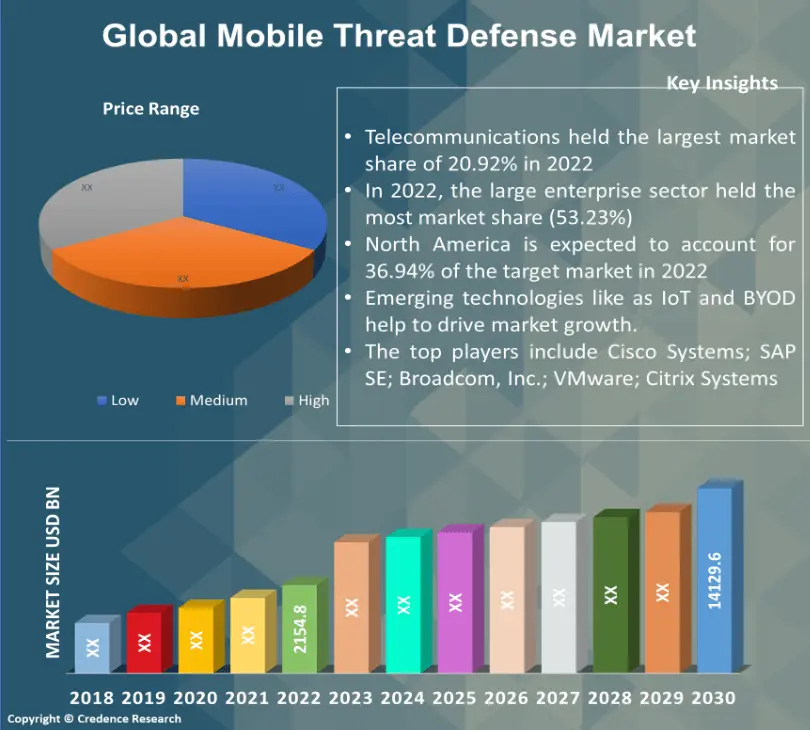
It is anticipated that between 2023 and 2030, the worldwide Mobile Threat Defense Marketwill expand at a compound annual growth rate (CAGR) of 26.50%. From USD 2154.8 million in 2022, the market is projected to be worth USD 14129.6 million by 2030.
The Mobile Threat Defence Market is expanding rapidly as a result of increased reliance on mobile devices and an increase in the amount of cyber attacks targeting these devices. Businesses and consumers are recognizing the need for enhanced security measures to secure sensitive data and prevent unwanted access as smartphones and tablets become more widely used.
Factors driving the market include an increase in mobile malware assaults, an increase in mobile workforce, and an increase in the usage of mobile devices for financial transactions and accessing key company information. As a result, businesses are putting money into Mobile Threat Defence solutions to protect their mobile devices and networks.
Real-time threat detection, mobile app security, safe surfing, data encryption, and device management are common aspects of Mobile Threat Defence solutions. These solutions are designed to detect and prevent a wide range of threats, such as malware, phishing attacks, network vulnerabilities, and data leaks.
The market is extremely competitive, with numerous vendors offering Mobile Threat Defence solutions targeted to various industrial sectors and device kinds. The market is likely to expand further as mobile threats evolve and enterprises consider mobile security as an important component of their entire cybersecurity strategy.
Market Insights
- The global demand for Mobile Threat Defense was valued at USD 2154.8 million in 2022 and is expected to reach USD 14129.6 Million in 2030, growing at a CAGR of 26.50% between 2023 and 2030.
- App security is the fastest growing market sector, while malware protection is another important business sector.
- The cloud-based category held a 56.16% market share in 2022, and the on-premise category is estimated to grow at a CAGR of 22.6% during the forecast period.
- In 2022, the large enterprise sector held the most market share (53.23%), while the SMEs category is predicted to grow at the quickest CAGR of 25.9% over the forecast period.
- Enterprises make up a large percentage, while the government and public sector are also important.
- In 2022, the Android sector held a 58.24% market share, and the iOS sector is forecasted to expand at the fastest CAGR of 27.2% during the projected period.
- Telecommunications held the largest market share of 20.92% in 2022, and the retail segment is predicted to increase at a CAGR of 29.4%.
- GDPR compliance is the most important category in the Mobile Threat Defence Market, while HIPAA compliance is another crucial area.
- North America is expected to account for 36.94% of the target market in 2022, with the Asia Pacific region growing at the highest rate.
Segmentation By Security Threat Type
- App Security is the fastest expanding segment. This is because the number of mobile applications being developed and used is expanding, raising the danger of app-related hazards. App Security solutions are primarily concerned with safeguarding mobile applications by identifying and preventing vulnerabilities, illegal access, and malicious activity within the apps.
- Malware protection is another significant market sector. With the increasing incidence of malware attacks on mobile devices, Malware Protection solutions are critical in protecting against harmful software.
Segmentation By Deployment Model
- In 2022, the cloud-based category held a 56.16% market share. The cloud servers manage cloud-based mobile threat defence technology. It does not need to be installed on users' devices; instead, it may be accessed using special user login credentials.
- During the projected period, the on-premise category is expected to increase at a CAGR of 22.6%. On-premise solutions give users entire control over advanced mobile threat defence, and they offer a bespoke solution to users and organizational personnel depending on their individual needs.
Segmentation by Organization Size
- In 2022, the large enterprise sector held the highest market share (53.23%). With the rise of cyber threats, malware attacks, and data theft, the demand for mobile threat defence is increasing significantly in large enterprises to secure employees' mobile devices, which may contain important documents, data, passwords, and other sensitive information that can harm the organization and their interests.
- During the forecast period, the SMEs category is expected to develop at the fastest CAGR of 25.9%.
Segmentation by End Users
- Enterprises account for a sizable portion. Because of the increased number of mobile devices used by employees and the sensitive data they handle, enterprises confront complex security concerns. Mobile Threat Defence solutions are tailored to the needs of businesses, delivering powerful threat detection and mitigation capabilities to protect critical data.
- Another significant sector is government and public sector. Government agencies and public sector enterprises deal with sensitive information and are frequently targeted by sophisticated cyber threats.
Segmentation by Operating System
- In 2022, the Android sector held a 58.24% market share. According to IBM Corporation, there are more than 3.3 billion Android phone users worldwide, and demand is increasing significantly due to user-friendly and cost-effective features, as well as increased availability of Android mobile devices in the market.
- During the projected period, the iOS sector is expected to grow at the fastest CAGR of 27.2%.
Segmentation by Industry Verticals
- In 2022, telecommunication category held the greatest market share of 20.92%. Because most of their operations need the usage of mobile devices, desktops, and laptops storing vital information, documents, passwords, and other information, telecommunication have a substantial share of mobile threat defence.
- During the projection period, the retail segment is expected to grow at a CAGR of 29.4%. The retail industry's rising consumer base necessitates frequent connections with consumers, clients, and manufacturers via mobile phones.
Segmentation by Regulatory Compliance and Standards
- GDPR Compliance is the largest category in the Mobile Threat Defence Market. Organizations must ensure the protection of personal data, including data on mobile devices, with the adoption of the General Data Protection Regulation (GDPR). GDPR Compliance solutions assist businesses in meeting regulatory obligations and protecting sensitive information, thereby improving data privacy and security.
- Another critical area is HIPAA compliance. The Health Insurance Portability and Accountability Act (HIPAA) establishes guidelines for safeguarding sensitive patient health data.
Segmentation by Region
- In 2022, North America accounted for 36.94% of the target market.
- The Asia Pacific region is predicted to grow at the fastest rate.
- The rest of the world, including Latin America, the Middle East, and Africa, supplies the remaining demand for Mobile Threat Defense.
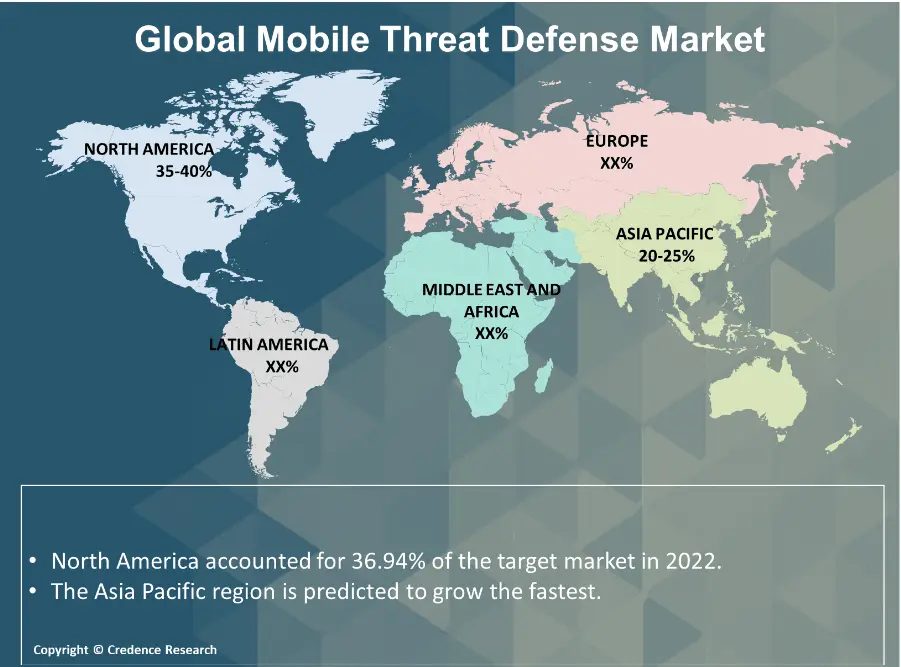
With a sizable market share, North America led the global market. With a huge percentage of the population relying on mobile devices for various personal and professional activities, the region has seen a considerable increase in smartphone use. The increased use of smartphones expands the potential danger landscape, driving up need for MTD solutions that protect these devices from security risks. Organizations in North America understand the need of safeguarding sensitive data against unauthorized access, data breaches, and other security threats. MTD solutions are essential for guaranteeing data security on mobile devices.
However, The Asia Pacific area is expected to develop at the quickest rate, with a solid CAGR during the forecast period. The Asia Pacific region's fast mobile device usage, 5G technology, government efforts, and attractiveness of digital platforms offer a fertile environment for MTD solutions. Organizations and individuals are increasingly aware of the importance of mobile security and are looking for comprehensive MTD solutions to protect their devices and data.
Key Highlights of the Report
The global Mobile Threat Defense Marketis segmented By Security Threat Type, Deployment Model, End-User, Access Method, Industry Verticals, Regulatory Compliance and Standards and region. The large enterprise sector and cloud-based category had the most market share in 2022. App Security is also the fastest growing segment, and the SMEs category is predicted to grow at the fastest CAGR. Also, Enterprises make up a large portion, with North America leading the market growth.
The primary drivers of the market include the increasing frequency and sophistication of mobile threats, the growing adoption of mobile devices and the mobile workforce, and stringent data protection legislation and compliance requirements. Furthermore, the primary market limitations are a lack of awareness and knowledge of mobile security concerns, the fragmented structure of the mobile device ecosystem, and challenges in balancing security with user experience and device performance.
Nonetheless, North America lead the global market with a substantial market share. The region has seen a significant increase in smartphone use, with a large percentage of the population relying on mobile devices for various personal and professional tasks. However, the Asia Pacific region is predicted to grow the fastest, with a strong CAGR during the forecast period.
What Elements Are Driving the Global Market for Mobile Threat Defense ?
Several variables influence the Mobile Threat Defence Market. A important driver is the growing popularity of mobile devices such as smartphones and tablets. As more people and businesses rely on mobile devices for communication and productivity, the requirement for robust mobile threat defence solutions to protect against developing cyber threats becomes critical. Furthermore, as mobile threats become more sophisticated, there is a greater need for robust defence methods. Cybercriminals are continually devising new ways to attack vulnerabilities in mobile devices, necessitating investments in advanced mobile threat defence solutions by enterprises..
What Are The Main Obstacles That The Global Mobile Threat Defense MarketFaces?
While there are some drivers, the Mobile Threat Defence Market also has some limitations. One of the major impediments is a lack of knowledge and understanding of mobile hazards among organizations. Some firms may be unaware of the threats connected with mobile devices, resulting in a lower rate of adoption of mobile threat defence solutions. Furthermore, budget limits can be a problem for enterprises, particularly small and medium-sized businesses, because complete mobile threat defence systems can be expensive to adopt.
What Market Development Prospects Are There For Mobile Threat Defense Globally?
The Mobile Threat Defence Market has numerous chances for expansion and innovation. The growing need for cloud-based solutions provides an opportunity for scalability, flexibility, and centralized security administration. Cloud-based mobile threat defence solutions enable businesses to adapt and extend their security architecture as needed. In addition, combining mobile threat defence solutions with existing security infrastructure, such as endpoint protection and network security, can provide a unified and comprehensive cyber defence. This integration enables enterprises to leverage their existing security efforts while improving mobile security.
Market Drivers
The global Mobile Threat Defense Marketis driven by several factors. The following are the key drivers of the global Mobile Threat Defense Market:
Rising need for security solutions that provide protection against web-based malware
Mobile devices in business applications serve as a bridge between app distribution platforms and data transmission channels, through which data is routed to the server. The growing demand for security solutions that offer protection against web-based malwares for mobile application security has fueled market expansion. Many end users are developing apps to protect against malware that runs on Android and iOS-based mobile devices. These programs generally provide threat protection and data protection for mobile security applications. Mobile application security is a critical necessity for practically all enterprises in order to protect their consumer, corporate, and intellectual property data.
Furthermore, consumer app development and IT acquisition strategies need the usage of a secure mobile application by business users. These factors are propelling the industry forward.
Increased use of cloud computing, mobile devices and software, and vulnerability assessment
The expansion of the IT and telecommunications industries has resulted in the expansion of cloud computing, mobile device vulnerability assessment, and software vulnerability assessment. According to the International Trade Administration, in 2018, 50% of organizations with more than 1000 users in the United States used Cloud Access Security Broker (CASB) technologies to monitor and control their use of software as a service and other kinds of public cloud. Cloud computing has increased the possibility of malware attacks on cloud networks. The public cloud, private cloud, and hybrid cloud technologies are accessed through the organizations' servers since they are best suited for use in various IT enterprises due to their high speed internet and cost effectiveness. Because of these advantages, there is a boom in cloud computing use, which is driving market expansion. These factors are propelling the industry forward.
Market Restraints
The global Mobile Threat Defense Marketfaces some challenges that may hinder its growth. These include the following:
Inadequate resources and capital investment
Despite the numerous benefits of mobile application security solutions, small and medium-sized businesses frequently encounter resource constraints that prevent them from implementing security and vulnerability monitoring tools in mobile devices. Furthermore, many businesses have capital constraints. These reasons are impeding market expansion.
Opportunities
The global Mobile Threat Defense Marketoffers significant growth opportunities. These include the following:
Advancements in technologies like artificial intelligence and machine learning for threat detection
Artificial intelligence (AI) and machine learning (ML) advancements have created new opportunities in the Mobile Threat Defence Market. AI and machine learning algorithms can evaluate massive volumes of data from mobile devices in real time to discover and mitigate potential dangers. These systems can detect trends and anomalies that may suggest malicious activity, allowing proactive defence measures to be implemented. AI and ML-based solutions can improve the effectiveness of mobile threat detection and response by continuously learning from new threats and evolving attack strategies. This not only enhances an organization's overall security posture, but it also decreases the burden on security professionals by automating threat detection operations. As mobile threats get more sophisticated, leveraging AI and ML technologies becomes critical for staying ahead of hackers in the ever-changing world of mobile security.
Competitive Landscape
Key Players
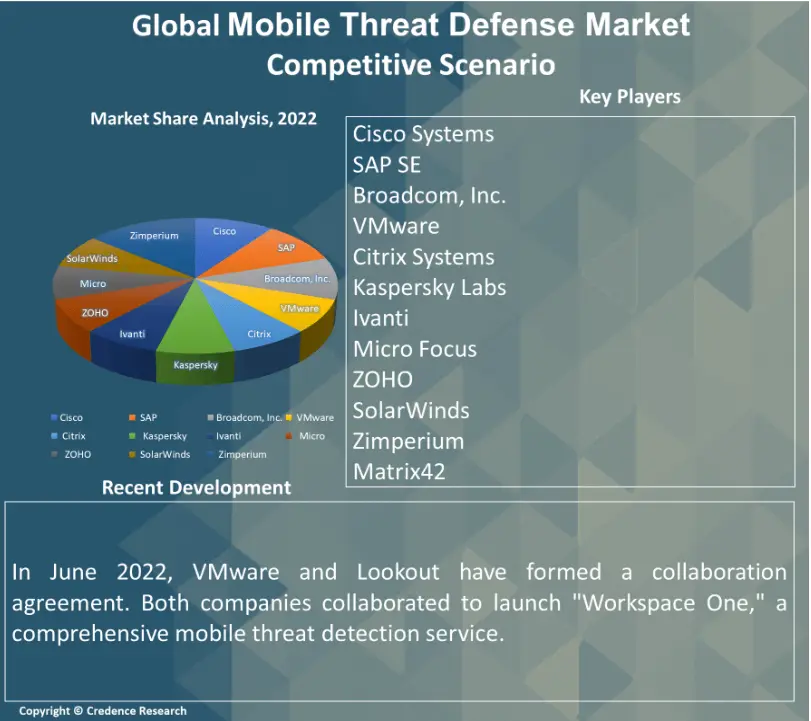
The global Mobile Threat Defense Marketis highly competitive, with several key players. Some of the major players in the market and their market share are as follows:
- Cisco Systems
- SAP SE
- Broadcom, Inc.
- VMware
- Citrix Systems
- Kaspersky Labs
- Ivanti
- Micro Focus
- ZOHO
- SolarWinds
- Zimperium
- Matrix42
- Sophos
- BlackberryEsper
These organizations prioritize product innovation, Disease Area expansion, and mergers and acquisitions to stay competitive.
The global Mobile Threat Defense Market's key players continually seek to stay ahead by offering new Speciess and developments.
In November 2018, Appthority was purchased by Symantec Corporation. The acquisition provided Symantec customers with cutting-edge mobile application security that protects against malware and other threats.
In June 2018, Mi3 Security, Inc. was purchased by Zimperium. Customers of Zimperium were given with cyber threat detection and security for cellphones as a result of the acquisition.
In January 2023, Ivanti, a cyber-security services provider, collaborated with Lookout to create customized cloud security solutions.
Summary of Key Findings
- The market opportunity is advancements in technology such as artificial intelligence and machine learning for threat detection.
- Market segmented By Type of Mobile Threat Defense, Deployment Model, Organization Size, End Users, Operating System, Regulatory Compliance and Standards and region
- Telecommunications held the largest market share of 20.92% in 2022
- In 2022, the large enterprise sector held the most market share (53.23%)
- North America with key players including Cisco Systems; SAP SE; Broadcom, Inc.; VMware; Citrix Systems; Kaspersky Labs; Ivanti; Micro Focus; ZOHO; SolarWinds; Zimperium; Matrix42; Sophos; Blackberry; Esper
Future Outlook
- The growing popularity of mobile devices fuels the demand for Mobile Threat Defence solutions.
- As mobile threats become more sophisticated, advanced security measures are required.
- The growing mobile workforce need improved mobile security.
- Artificial intelligence and machine learning integration in Mobile Threat Defence systems.
- The demand for Mobile Threat Defence is driven by an emphasis on data privacy and compliance.
- Emerging technologies like as IoT and BYOD help to drive market growth.
Segmentation
By Security Threat Type:
- Malware Protection
- Phishing Protection
- Data Loss Prevention (DLP)
- Network Security
- App Security
- Device Security
By Deployment Model:
- Cloud-based
- On-Premises
- Hybrid
By Organization Size:
- Small and Medium-sized Enterprises (SMEs)
- Large Enterprises
By End Users:
- Enterprises
- Government and Public Sector
- Individuals and Consumers
BY Operating System:
- Android
- iOS
- Multi-OS Compatibility
By Industry Verticals:
- Financial Services
- Healthcare
- Retail
- Telecommunications
- Government and Defense
- Energy and Utilities
- Other Verticals
By Regulatory Compliance and Standards:
- GDPR Compliance
- HIPAA Compliance
- Industry-specific Compliance
By Region
- North America
- US
- Canada
- Mexico
- Europe
- Germany
- France
- UK
- Italy
- Spain
- Rest of Europe
- Asia Pacific
- China
- Japan
- India
- South Korea
- South-east Asia
- Rest of Asia Pacific
- Latin America
- Brazil
- Argentina
- Rest of Latin America
- Middle East & Africa
- GCC Countries
- South Africa
- Rest of Middle East and Africa
Request a Free Sample
Fill in your details and we'll send you a free sample report.
- Sample data tables & charts
- Research methodology
Need a Custom Version of This Report?
Tailor the scope, geography, or segments to your exact requirements.
- Custom geography or segment scope
- Direct access to our analyst team
Frequently Asked Questions
What is the current Species of the worldwide Mobile Threat Defense Market?
What is the predicted growth rate of the Mobile Threat Defense Marketbetween 2023 and 2030?
Which segment has the most market share Operating System?
Which Operating System segment is predicted to grow at the Highest CAGR segment over the forecast period?
Who are the major players in the global Mobile Threat Defense Market?
Table of Content
Chapter 1. Report Introduction
- 1.1 Report Description & Purpose
- 1.1.1 Report Title & Market Definition
- 1.1.2 Unique Selling Propositions (USP) & Key Differentiators
- 1.1.3 Value Proposition for Stakeholders
- 1.2 Research Objectives
- 1.2.1 Market Sizing Objectives (Volume & Revenue)
- 1.2.2 Segmentation Objectives
- 1.2.3 Competitive Intelligence Objectives
- 1.2.4 Forecast & Scenario Objectives
- 1.3 Report Scope
- 1.3.1 Mobile Threat Defence Scope – Types & Subtypes Covered
- 1.3.2 Geographic Scope – Regions & Countries Covered
- 1.3.3 Historical Period, Base Year & Forecast Period (the historical period; forecast to the forecast period)
- 1.3.4 Inclusions & Exclusions
- 1.4 HS Code & Classification Framework
- 1.5 Currency, Units & Pricing Basis
- 1.6 Target Stakeholders
- 1.7 Limitations & Assumptions
Chapter 2. Executive Summary
- 2.1 Global Mobile Threat Defence Market Snapshot
- 2.1.1 Market Size – Historical (the historical period) & Forecast (the forecast period) (base year: NULL → forecast year: NULL)
- 2.1.2 Volume & Revenue – Global Totals
- 2.1.3 Key Market Highlights – Top Five Facts
- 2.2 Mobile Threat Defence Market Segmentation Snapshot
- 2.2.1 Market Split by Region – vs.
- 2.3 Competitive Snapshot
- 2.3.1 Top 10 Players by Revenue Share –
- 2.3.2 Top 10 Players by Volume Share –
- 2.3.3 Recent Strategic Developments (18-Month Summary)
- 2.4 Key Investment Highlights & Strategic Conclusions
Chapter 3. Mobile Threat Defence Market Dynamics & Industry Analysis
- 3.1 Market Overview & Context
- 3.1.1 Mobile Threat Defence Market Position in the Broader Automotive Value Chain
- 3.1.2 OEM vs. Replacement Market Dynamics
- 3.1.3 Market Maturity & Development Stage by Region
- 3.2 Mobile Threat Defence Market Drivers
- 3.3 Mobile Threat Defence Market Restraints & Challenges
- 3.4 Mobile Threat Defence Market Opportunities
- 3.5 Porter's Five Forces Analysis
- 3.5.1 Threat of New Entrants
- 3.5.2 Bargaining Power of Suppliers
- 3.5.3 Bargaining Power of Buyers
- 3.5.4 Threat of Substitutes
- 3.5.5 Competitive Rivalry – Intensity Assessment
- 3.6 Mobile Threat Defence Value Chain Analysis
- 3.6.1 Upstream – Raw Material/Input Suppliers
- 3.6.1.1 Raw Material/Input 1
- 3.6.1.2 Raw Material/Input 2
- 3.6.1.3 Raw Material/Input 3
- 3.6.2 Midstream – Production/Manufacturing/Service Delivery
- 3.6.2.1 Production/Process Overview
- 3.6.2.2 Key Facility Locations & Capacity by Manufacturer
- 3.6.3 Downstream – Distribution & End Consumer
- 3.6.3.1 Primary Channel – B2B/OEM
- 3.6.3.2 Secondary Channels – Dealer, Retail, Online, Direct
- 3.6.4 Value Chain Profitability Analysis
- 3.6.1 Upstream – Raw Material/Input Suppliers
- 3.7 PESTEL Analysis
- 3.7.1 Political Factors
- 3.7.2 Economic Factors
- 3.7.3 Social Factors
- 3.7.4 Technological Factors
- 3.7.5 Environmental Factors
- 3.7.6 Legal Factors
- 3.8 Mobile Threat Defence Supply Chain Analysis
- 3.8.1 Raw Material/Input Supply Risk Assessment
- 3.8.2 Manufacturing Concentration Risk (Geographic Exposure)
- 3.8.3 Trade Disruption Impact Analysis
- 3.9 Regulatory & Policy Landscape
Note: The regulatory and policy landscape section covers regulations based on their applicability to the market, Mobile Threat Defence category, geography, and scope of the study. Only regulatory frameworks with a material impact on operations, compliance, trade, sustainability, or market access are analyzed in detail.
Chapter 4. Key Investment Pockets & Opportunity Analysis
- 4.1 Mobile Threat Defence Market Attractiveness Analysis
- 4.1.1 By Region – Investment Attractiveness Matrix (Volume × CAGR)
- 4.2 Absolute Revenue Growth Opportunity
- 4.2.1 By Region – Absolute USD Growth Through the forecast period
- 4.3 Incremental Volume Opportunity
- 4.3.1 By Region – Incremental Volume Through the forecast period
- 4.3.2 Segment – Incremental Volume
- 4.4 Emerging Submarket Opportunity Deep Dive (Subject to Applicability)
- 4.5 Emerging Market Opportunity Scorecards
- 4.5.1 United States
- 4.5.2 Europe
- 4.5.3 Asia
- 4.5.4 Middle East & Africa
Note: Emerging Market Opportunity Scorecards will be included based on relevance and strategic importance. Regions listed are indicative and may vary depending on data availability and market dynamics.
Chapter 5. Mobile Threat Defence Import-Export Analysis & Trade Flows
- 5.1 Global Trade Overview
- 5.1.1 Global Export Value by Country (the historical period)
- 5.1.2 Global Export Volume by Country (the historical period)
- 5.1.3 Global Import Value by Country (the historical period)
- 5.1.4 Global Import Volume by Country (the historical period)
- 5.1.5 Net Trade Balance by Country (the historical period)
- 5.2 Export Analysis – Segment
- 5.2.1 Type 1 (HS Code)
- 5.2.2 Type 2 (HS Code)
- 5.2.3 Type 3 (HS Code)
- 5.2.4 Type 4 (HS Code)
- 5.2.5 Type 5 (HS Code)
- 5.3 Import Analysis – Segment
- 5.3.1 Type 1 (HS Code)
- 5.3.2 Type 2 (HS Code)
- 5.3.3 Type 3 (HS Code)
- 5.3.4 Type 4 (HS Code)
- 5.3.5 Type 5 (HS Code)
- 5.4 Average Unit Trade Prices
- 5.4.1 Average Export Price – Segment & Country
- 5.4.2 Average Import Price – Segment & Source Country
- 5.4.3 Price Trends (the historical period)
- 5.5 Key Trade Route Analysis
- 5.5.1 Trade Route 1
- 5.5.2 Trade Route 2
- 5.5.3 Trade Route 3
- 5.5.4 Trade Route 4
- 5.5.5 Trade Route 5
- 5.6 Trade Policy Impact Assessment
- 5.6.1 US Anti-Dumping & Section 301 Tariffs
- 5.6.2 EU Customs Union Impact
- 5.6.3 Major Free Trade Agreements
- 5.6.4 USMCA Rules of Origin
Note: Trade policy analysis will be included only where relevant to the Mobile Threat Defence market.
Chapter 6. Competitive Landscape & Company Benchmarking
- 6.1 Mobile Threat Defence Market Concentration & Structure
- 6.1.1 Herfindahl-Hirschman Index (HHI) – vs.
- 6.1.2 Tier 1, Tier 2 & Tier 3 Market Structure
- 6.1.3 Global, Regional & Local Player Dynamics
- 6.2 Mobile Threat Defence Market Share Analysis –
- 6.2.1 Global Revenue Share by Company
- 6.2.2 Global Volume Share by Company
- 6.2.3 Regional Revenue Share
- 6.2.4 Market Share Evolution ( vs. )
- 6.2.5 OEM Segment Share by Company
- 6.2.6 Replacement Segment Share by Company
- 6.3 Production/Delivery Capacity & Facility Analysis
- 6.3.1 Global Installed Capacity
- 6.3.2 Capacity Utilization Rates
- 6.3.3 Production/Output Volume
- 6.3.4 Facility Locations & Capacity Map
- 6.3.5 Planned Capacity Additions
- 6.4 Mobile Threat Defence Competitive Benchmarking Matrix
- 6.4.1 Revenue, Volume, CAGR & Profitability Comparison
- 6.4.2 Channel Revenue Mix
- 6.4.3 Geographic Revenue Exposure
- 6.4.4 R&D Intensity
- 6.4.5 Sustainability Maturity
- 6.5 Strategic Developments in Mobile Threat Defence (Last 24 Months)
- 6.5.1 Mergers, Acquisitions & Divestments
- 6.5.2 New Mobile Threat Defence Launches
- 6.5.3 Facility Expansions
- 6.5.4 Strategic Alliances, Joint Ventures & Partnerships
- 6.5.5 Distribution Expansion & Market Entry
- 6.5.6 Sustainability & ESG Initiatives
- 6.6 Competitive Strategy Mapping
- 6.6.1 Leader, Challenger, Follower & Niche Classification
- 6.6.2 Pricing Strategy Comparison
- 6.6.3 Channel Strategy Matrix
Note: Strategic developments are included based on their materiality and the availability of reliable information.
Chapter 7. Global Mobile Threat Defence Market – By Distribution Channel
- 7.1 Segment Overview
- 7.1.1 Volume & Revenue Split by Channel ( & )
- 7.1.2 Channel Mix Evolution (the forecast period)
Chapter 8. Regional Market Analysis – Global Overview
- 8.1 Global Regional Overview
- 8.1.1 Regional Volume Share
- 8.1.2 Regional Revenue Share
- 8.1.3 Regional Volume by Region
- 8.1.4 Regional Revenue by Region
- 8.1.5 Regional Forecast Through the forecast period
- 8.2 Cross-Regional Segment Analysis
- 8.2.1 By Distribution Channel
- 8.2.2 By Brand/Price Tier
Chapter 9. North America Mobile Threat Defence Market
- 9.1 United States
- 9.2 Canada
- 9.3 Mexico
Chapter 10. Europe Mobile Threat Defence Market
- 10.1 Germany
- 10.2 France
- 10.3 Italy
- 10.4 United Kingdom
- 10.5 Spain
- 10.6 Poland
- 10.7 Russia
- 10.8 Netherlands
- 10.9 Belgium
- 10.10 Sweden
- 10.11 Denmark
- 10.12 Norway
- 10.13 Rest of Europe
Chapter 11. Asia Pacific Mobile Threat Defence Market
- 11.1 China
- 11.2 India
- 11.3 Japan
- 11.4 South Korea
- 11.5 Thailand
- 11.6 Indonesia
- 11.7 Vietnam
- 11.8 Malaysia
- 11.9 Australia
- 11.10 Rest of Asia Pacific
Chapter 12. Latin America Mobile Threat Defence Market
- 12.1 Brazil
- 12.2 Argentina
- 12.3 Colombia
- 12.4 Chile
- 12.5 Rest of Latin America
Chapter 13. Middle East Mobile Threat Defence Market
- 13.1 Saudi Arabia
- 13.2 United Arab Emirates
- 13.3 Turkey
- 13.4 Israel
- 13.5 Iran
- 13.6 Rest of the Middle East
Chapter 14. Africa Mobile Threat Defence Market
- 14.1 South Africa
- 14.2 Egypt
- 14.3 Nigeria
- 14.4 Morocco
- 14.5 Rest of Africa
Chapter 15. Mobile Threat Defence Company Profiles
- 15.1 [Company 01]
- 15.1.1 Company Overview
- 15.1.2 Key Management Personnel
- 15.1.3 Products & Services Portfolio
- 15.1.4 Financial Performance
- 15.1.5 Key Market Focus & Geographic Presence
- 15.1.6 Recent Developments & Strategic Initiatives
Note: The company profile list is preliminary and may change based on research findings, market developments, data availability, and client requirements.
Chapter 16. Appendices
- Appendix A – List of Abbreviations & Acronyms
- Appendix B – Industry Classification Code Reference – Full Series
- Appendix C – Production & Capacity Data Tables
- Appendix D – End-Use & Demand Base Tables
- Appendix E – Consumption & Replacement Rate Assumptions
- Appendix F – ASP Reference Tables
- Appendix G – Manufacturing & Facility Database
- Appendix H – Import-Export Data Tables
- Appendix I – Regulatory Summary Tables
- Appendix J – Primary Research Participant List (Anonymized)
- Appendix K – Primary Research Questionnaire Framework
- Appendix L – Data Sources & Bibliography
- Appendix M – Market Size Divergence & Source Comparison
Chapter 17. Research Methodology
- 17.1 Research Framework & Philosophy
- 17.2 Secondary Research – Sources, Hierarchy & Data Extraction
- 17.3 Data Modeling – Bottom-Up & Top-Down Market Sizing
- 17.4 Primary Research – Stakeholder Framework, LOI & Sample Sizes
- 17.5 Forecast Methodology – Regression, Scenario & Sensitivity Analysis
- 17.6 Quality Control – Four-Layer Validation Framework
- 17.7 Limitations & Standard Assumptions
- 17.8 Disclaimer
